

Analysis of the poetic texts usually constitutes an integral part of the analysis of Trecento musical compositions since they are considered a reliable source of background information, which is generally lacking for this repertory. The spectrum of topics encountered in the Trecento musical poetry is truly multifarious. Agostino Ziino observes that the madrigals and ballatas are of courtly, lyric, amorous, narrative, pastoral, realistic, satiric, moralising, philosophic and other content. He also distinguishes a group of so-called celebratory compositions (‘di tipo celebrativo’), which could have the same function as the political motets in Latin.Footnote 1 Two madrigals written by Jacopo da Bologna, Lo lume vostro and O, in Italia, incontestably related to the Milanese ruler Luchino Visconti, belong to this category. In this essay, I shall focus attention on another composition by Jacopo da Bologna, the three-voice polytextual madrigal Aquil'altera,Footnote 2 considered by modern scholars as a celebratory composition, and on two madrigals by Francesco Landini and Bartolino da Padova, which show intertextual relations between them. The aim is to examine the three pieces in the context of cultural phenomena in Italy of this period, particularly in literary practice.
AQUIL'ALTERA IN MODERN INTERPRETATIONS
Poetic texts, such as that of the madrigal Aquil'altera, are difficult to interpret: the language they use is often that of allegories and symbols. In the madrigal Aquil'altera, the image of the eagle clearly has symbolic meaning. According to a widely accepted opinion, this madrigal was written either for a wedding or for a coronation ceremony.
Giosuè Carducci was the first to assume that Aquil'altera was composed for the visit of Charles IV of Bohemia to Italy in 1354–5, when he was crowned in Milan.Footnote 3 This interpretation was later supported by Kurt von Fischer, Nino Pirrotta and many other musicologists. Pirrotta, for example, states that Jacopo's ‘three-voice madrigal Aquil'altera – Ucel di Dio – Creatura gentil speaks of the eagle as a symbol of imperial dignity; with its highly independent and well-articulated contrapuntal lines, and with a different text, motet-fashion, for each voice, it is so ambitious a work as to suggest a connection with the coronation of Charles IV in Milan on 6 January 1355’.Footnote 4
Another interpretation of the text of Aquil'altera, prompted by Geneviève ThibaultFootnote 5 and afterwards supported and developed by other musicologists, among them Pedro Memelsdorff Footnote 6 and Oliver Huck,Footnote 7 links this composition to the marriage of Gian Galeazzo Visconti with Isabella of Valois in 1360. Thibault put forward the idea that there might be a second bird in this madrigal, namely the dove, because of the expression ‘uccel di Dio’ (the bird of God).Footnote 8 The eagle and the dove have been interpreted as heraldic devices of the Visconti and Valois families, and on this basis a matrimonial content has been suggested.Footnote 9
These interpretations, however, provoke further questions. Generally speaking, we are dealing with a special trend in medieval and Renaissance poetry that could be defined as ‘heraldic poetry’. This poetry played on the images depicted on the blazons and banners of noble families, which were, as a rule, those of animals and birds, and on devices and mottos as well.Footnote 10 It might have been an element of the courtly ritual, and, as such, could have been bound by certain norms and rules (particularly regarding the use of symbols), the disclosure of which would allow more exact and appropriate interpretation of the symbols. At present, musicologists are apparently the only group of scholars to support the idea of ‘heraldic poetry’, and to accept it as obvious,Footnote 11 without seeking more subtle definitions and characterisations of its symbolism.Footnote 12 Would the animal images necessarily have been understood as heraldic symbols? And if so, what would their meaning have been within the composition? Significantly, the fact that Aquil'altera is seen as a reference to either of two such different events as a wedding or a coronation ceremony indicates a very broad interpretation of symbols in modern research.Footnote 13 These questions therefore call for a more profound exploration by other means.
One of the accepted approaches in the modern study of medieval literature and music is the search for so-called intertextuality, namely allusions and quotations which may link one work to one or more other works, thus shedding more light on their content, circumstances of composing, and other relevant data. Among the studies on intertextual relationships in poetry and musicFootnote 14 are Yolanda Plumley's works dedicated to the ars subtilior and French music on the seam of the fourteenth and fifteenth centuries.Footnote 15 She states that in many cases a text ‘is a member of a larger network of texts and depends on knowledge of them for its sense to be fully apprehended’.Footnote 16 In his research on Italian poetry of the thirteenth and fourteenth centuries, the philologist Claudio Giunta also presents intertextuality as a deliberate relationship between texts, an allusive art, and a conscious reproduction of words and images from a pre-existing text well known to the readers.Footnote 17 With regard to the content of the poetry, he claims that the texts are never what they seem; thus, a key is required to decipher their true meaning. What is necessary for a complete and authentic understanding of the work is a knowledge of its connection with other texts and other literature.Footnote 18
Returning to the madrigal Aquil'altera, the interpretations above ignore one very important source of metaphoric poetic inspiration, well known to any educated person of that time. The source in question is the bestiaries – medieval encyclopedias of animals and birds. They were not scientific books in the proper sense, even though they do contain naturalistic observations on animals. The main objective of these bestiaries was the ‘moralising’ application of the qualities of the beasts to human characters, virtues and vices.Footnote 19
THE EAGLE IN BESTIARIES AND JACOPO'S AQUILA
The source of all known European medieval bestiaries was the early Christian Greek treatise Physiologus, written in the second century, probably in Alexandria in Egypt. During the first millennium, many insertions from other writings were incorporated in it, for instance, from the Etymologies by Isidore of Seville. In modern research, all the Latin medieval bestiaries have been divided into four main groups, or families, which include some transitional variants as well. The largest and more important families are the first two, which are represented by the greatest number of manuscripts.Footnote 20 The bestiaries were designated for didactic and diversional reading, and also served as textbooks for primary school studies.Footnote 21
In Italy, the tradition of Latin bestiaries seems to have flourished less than it did north of the Alps, as we may judge from the distribution and editorial qualities of surviving manuscripts. But certainly in Italy too they were very popular books for reading and teaching.Footnote 22 Luigina Morini, in her edition of several medieval bestiaries, observes that in Italy this genre survived first and foremost because of its evolution into an ‘educational form’, that is to say, it was suited to the requirements of a new class that was less interested in theology and more in practical morals and norms of behaviour.Footnote 23
The vernacular poetic tradition of bestiaries was also widespread in Italy. The French rhymed Bestiaire d'amour by Richard de Fournival apparently served as a font of inspiration for much thirteenth-century Italian poetry, such as the bestiary-like descriptions in the poetry of the Florentine poet Chiaro Davanzati (d. 1303),Footnote 24 or in the Bestiario moralizzato, presumably written at the very beginning of the fourteenth century.Footnote 25
The bestiary section of the long poem Acerba, or Acerba etas, by the Florentine poet Cecco d'Ascoli (or Francesco Stabili, 1269–1327) is another important example. The Acerba was actually an encyclopedia covering a very large spectrum of disciplines. In it Cecco, one of the erudite persons of the period, discussed the most controversial questions of the time, such as the movement of the planets, the phenomena of nature, human psychology and many other topics. In fact, his knowledge and his provocative style of thinking turned many of his contemporaries against him. He was burnt alive on the stake together with his books. However, his poem Acerba remained very popular in Italy for a long time, partly due to its author's fate. As Marco Albertazzi, the modern editor of the poem, observes, this shocking event so deeply affected Cecco's contemporaries that he soon came to be regarded as one of the most prestigious sorcerers of the time, as evidenced by the huge number of surviving manuscripts of the Acerba.Footnote 26
In general, Italian literature, and poetry in particular, was strongly influenced by the bestiaries, which provided a broad field for associations, comparisons, etc. And it seems only natural that the poetic texts of the musical repertory, and especially those containing images of animals, would not have remained separate from this important literary stream.
However, before we begin the analysis of Jacopo's Aquila, we have to take into consideration one more bestiary, evidently the most essential one in the Italian milieu: Li Livres dou Tresor by Brunetto Latini (c. 1220–94). Brunetto Latini, a Florentine statesman and scholar, wrote most of his works during his exile in France between 1260 and 1266.Footnote 27 His main opus is the three-part encyclopedia Tresor, written in French, which attempted to cover the broadest range of knowledge of his time. One of its sections is a bestiary that constitutes the seventy chapters of the first book, where all known kinds of animals, birds and fishes, including fantastic ones, are described.
In the 1280s the Tresor was translated into Italian as Il Tesoro. Earlier the translation was ascribed to Bono Giamboni, but today this opinion is rejected by scholars.Footnote 28 Now it is accepted that Brunetto himself translated his work, possibly for his pupils, among them Dante. Brunetto's Italian Tesoro became a very popular book, as one can understand from the large number (forty-four) and excellent quality of extant manuscripts in which it was transmitted.Footnote 29
Is it possible that for his description of the eagle in the madrigal Aquil'altera Jacopo used characteristics, devices and symbolic meanings derived from bestiaries? Let us look at the first three paragraphs of the chapter ‘Della natura dell'aquila’ (On the nature of the eagle) in Brunetto's book:
[1.] L'aquila è con la migliore veduta che nessuno altro uccello del mondo. E vola sì in alto, che l'uomo perde la sua veduta, e vede sì chiaramente che conosce in terra ogni piccola bestia che vola, e li pesci nell'acqua, e quando vi si abbatte sì li piglia.
[2.] E dura di guardare verso il sole sì fissamente, chè suoi occhi non muove niente. E però piglia li suoi figliuoli, e volgeli verso li raggi del sole, e quello che vi guarda dirittamente senza mutare suoi occhi, si è ritenuto e notricato, sì come degno, e quello che muta li suoi occhi, si è rifiutato e cacciato del nido, sì come bastardo.
[3.] E ciò non addiviene per crudeltà di natura, ma per giudicamento di dirittura, che non lo ha per suo figliuolo, anzi come uno strano.Footnote 30
1. The eagle sees better than any bird in the world, and it flies so high that it is lost to the sight of men, but it sees so clearly that it distinguishes even the smallest creatures on earth and the fish in the water, and it takes them as it swoops down.
2. Its nature is such that it looks at the rays of the sun, and its eyes do not flinch, and for this reason the eagle takes its offspring and holds them in its talons against the rays of the sun, and the one which looks straight at it without turning away is kept and nurtured as a worthy child, and the one whose gaze turns away is rejected and thrown from the nest like the illegitimate child.
3. This comes about not because of cruelty of nature, but through a just judgment, because it does not refer to it as to its own offspring, but on the contrary, as to an alien bird.Footnote 31
We can distinguish here three important things about the eagle: (1) its excellent sight, better than that of any other bird, which enables it to see even small things from great altitudes; (2) the ability to look directly at the sun without averting its eyes; (3) the testing of its offspring for their ability to look at the sun.
Now we come to the poetic text of Jacopo's Aquila. The tercets plus ritornello are given here in an order that differs from the one found in musical editions and musicological research, that is, Aquila altera – Creatura gentil – Uccel di Di o, instead of Aquila altera – Uccel di Dio – Creatura gentil, where the tenor and the contratenor have changed places. We shall soon see the reason for that:
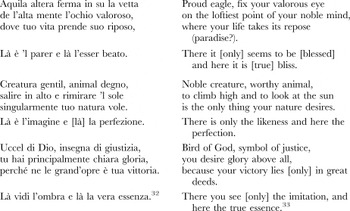
Jacopo's poem, although obscure in some points, is an incontestable expression of admiration for the eagle's qualities. We can distinguish the following features of the eagle in the two first tercets: (1) outstanding ability to see (‘occhio valoroso’), (2) high flight (‘salire in alto’), (3) ability to look at the sun (‘rimirare il sole’).
Pedro Memelsdorff claims that the topos of ‘rimirare il sole’ was established by Dante in his Paradiso: ‘vidi rivolta e riguardar nel sole’ (i. 46–8) and ‘e pate il sole nell'aguglie [aquile] mortali … or fissamente riguardar si vole’ (xx. 31–3).Footnote 34 It is obvious, however, that Dante also took this detail from the bestiaries, most likely from his teacher Brunetto Latini's Italian version of the Tresor – Il Tesoro.Footnote 35
It is the third tercet, ‘Uccel di Dio, insegna di giustizia’, however, which seems the most challenging and intriguing. As mentioned above, the ‘bird of God’ has been interpreted as a dove, giving rise to the idea of a wedding as a joining of the eagle and the dove (the Visconti and Valois families). Memelsdorff suggested that the expression ‘creatura gentil’, in the second tercet of Aquil'altera, might also refer to a dove, which is supposed to be the bride, Isabella of Valois, who admires the sun, namely her fiancé, and could symbolise the merging of their families.Footnote 36 Yet in the text of Jacopo's madrigal the word dove, ‘colomba’ or ‘tortora’, does not appear; therefore, each contemporary listener or reader of the poem would connect the noble bird able to gaze at the sun specifically with the eagle. Furthermore, Memelsdorff himself notes that the label ‘Uccel di Dio’ appears as an attribute of the eagle in Dante's Paradiso (vi. 1–4).
The expression ‘insegna di giustizia’ (symbol of justice) remains obscure and unyielding to interpretation, if in fact marriage was the topic of the poem.Footnote 37 But it becomes clear and unequivocal as a description of the eagle's merits. In Brunetto's description of the eagle's nature, the section about the testing of his chicks for their ability to look at the sun states that the eagle keeps and nurtures those chicks which do not turn their eyes away from the sun's rays, but rejects those who cannot look at the sun, considering them unworthy. And the explanation follows: ‘This comes about not because of cruelty of nature, but through a just judgement [giudicamento di dirittura]’.
Willene Clark claims that no one main source can be established for Brunetto's section on animals, since he used many different encyclopedias and animal books, from which he ‘usually took only selected passages, sometimes translating directly, sometimes paraphrasing’.Footnote 38 In connection with our subject we may add that the passage on the eagle's just judgement evidently was taken from the bestiaries of the second family, most of which were of English or northern French production.Footnote 39 The mention of justice in the description of the eagle is not found in the other bestiaries.
Due to this specific detail, the episode of testing the chicks gains a somewhat different meaning in the bestiaries of the second family. In the first family of bestiaries, in the works by Hugh of Fouilloy, Guillaume le Clerc, in the Bestiario toscano and others it describes a test of the legitimacy of the chicks. In the bestiaries of the second family and in Brunetto's book, the eagle is described as condemning even its own children to be thrown out of the nest, if they are not worthy and do not have the eagle's true nature. That is evidently the ‘giustizia’ intended in the third tercet of Jacopo's madrigal: the eagle's trait of loyalty to just judgement.
Therefore, we can conclude that the poetic text of Jacopo's madrigal Aquil'altera follows the first three paragraphs of the chapter of the section on eagles in Brunetto's Il Tesoro, in the order proposed in this essay. If the tercet ‘Uccel di Dio’, with the expression ‘insegna di giustizia’, is not placed after the tercet ‘Creatura gentil’, which relates the ability to look at the sun, the poem loses its sense.
Jacopo evidently was also familiar with other texts concerning eagles. One of them might have been the above-mentioned anonymous Bestiario toscano, or Libro della natura degli animali, which could have provided him with another attribute of the eagle, ‘gentile’, or noble: ‘L'aquila si è uno gentile ucello’ (‘the eagle is a noble bird’).Footnote 40 This quality as applied to the eagle appears in the poem De l'aquila in another anonymous Italian poetic bestiary, Bestiario moralizzato, dated at the end of the thirteenth century or the beginning of the fourteenth: ‘L'aquila lo gentile modo tene’ (‘the eagle acts in a noble way’).Footnote 41 This attribute of the eagle is found in the second tercet, in the contratenor: ‘Creatura gentil, animal degno’. Once again, as Brunetto's description reads, the worthy (‘degno’) eagle is the one that can gaze directly at the sun (‘rimirare il sole’), as stated in the second tercet.
Another work that might have inspired Jacopo's imagination is Cecco d'Ascoli's poem Acerba, the third book of which contains a moralising bestiary.Footnote 42 As Morini observes, this bestiary starts with thoughts on the nature of love and continues with the praises of a heavenly woman who symbolises, in fact, Divine Intelligence and Knowledge. Her outstanding qualities are expressed through ornithological symbols, one of them being the eagle.Footnote 43 In chapter 3 of Cecco's bestiary, the image of the eagle symbolises an active intellect, without which one cannot reach this Lady Divine Sapience. After describing the traditional qualities of the eagle (high flight, renewing its feathers, testing chicks for the ability to look at the sun), Cecco continues:
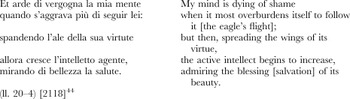
An appropriate decoding of this allegory tells us that the very moment when the eagle in flight is no longer visible to the human eye is the moment in which the activity of man's intellect expands to enable him nonetheless to follow its journey, which represents a mental image of the heavenly Lady Sapience.
It is quite probable that Jacopo knew this poem, very popular in his time, and the idea of the active intellect and the eagle as its symbol could have entered his mind when planning his own composition about the eagle. He even indicated it at the beginning of the poem through the expression ‘in su la vetta dell'alta mente’.Footnote 45 To understand this issue better, let us look at the three lines of the ritornello in the order proposed in this essay:
In the translation by Giovanni Carsaniga we read as follows:
And yet, Jacopo clearly presents here a contraposition of two instances, namely, the fictive and false against the factual and true. The eagle, with its sharp eyes and active intellect, is able to distinguish between them. The eagle's custom of testing the true nature of its offspring is actually a symbolic description of the ability to distinguish between what only seems to be genuine and what is genuine in fact: even though the young birds look like the eagle, if they cannot fix their gaze on the sun they do not have the true essence, vera essenza, of the eagle's nature. That is why I propose the following translation, which holds the original contraposition:
A look at some of Jacopo's works might elucidate another obscure point in the Aquila, namely the meaning of the word ‘vittoria’, on which the linking of this madrigal to noble military persons is based. We find it once again in the madrigal Vestise la cornacchia, in a very specific context.
The motif of the crow that dresses itself in the feathers of another bird (‘altrui penne’), only to end up shamefully plucked in the company of parrots, appears in some Trecento madrigals: Fra mille corvi by Giovanni da Firenze, Jacopo's Vestise la Cornacchia and Io me son un (‘Corvo che de paon veste la penna, fra’ papagal con vergogna si spenna’). Agostino Ziino and Marco Gozzi, in their analysis of newly discovered Trecento pieces in a fragment of Reggio Emilia, observe that this ‘bird metaphor [crow and parrot] probably refers to singers active at the northern Italian courts (Scaligeri and Visconti): all the madrigals mentioned refer to attempts to take the lead in courtly “tenzoni”.’Footnote 47
It is correctly thought that bird metaphors refer first and foremost to singers.Footnote 48 However, in our case, there is one more topic in this group of madrigals, namely that of imitation and plagiarism, as it appears in a sonnet ascribed, although with no certainty, to the already mentioned Florentine poet of the Duecento, Chiaro Davanzati: ‘Di penne di paone e d'altre assai / vistita, la corniglia a corte andau’.Footnote 49 The last six lines of the sonnet are addressed to a poet (‘novo canzonero’) who tried to imitate the most famous poet of the Duecento, Jacopo da Lentini, or Jacopo il Notaro. Evidently, this allegory of a crow in peacock's feathers, taken from Aesop's fable,Footnote 50 had a specific connection with the issue of plagiarism and imitation of another's style, which was viewed unfavourably already in the Duecento.Footnote 51 As Jacopo asserts in his madrigal Vestise la cornacchia, the crow in someone else's feathers was not victorious: ‘ma con quelle mai non ebbe vittoria’. However, the victory that the dressed-up crow failed to achieve was won by the eagle in its high flight: ‘nelle grand'opre tu hai vittoria’. Therefore, we can assume that in this particular context the victory apparently had nothing to do with military supremacy, but everything to do with outstanding products (‘grand'opre’) of intellectual activity and artistic authenticity.Footnote 52
The above provides quite a solid background for further conclusions regarding Jacopo's intentions as expressed in the madrigal Aquil'altera, even if some points still remain obscure. This text is evidently in praise of specific human mental and spiritual traits, such as a clear mind, a sharp intellect, and a refined understanding of the res naturae. Still, it would be very difficult, if not impossible, for us to link this composition to a concrete person, an event or a date. Jacopo probably intended it for someone for whom he felt a very deep respect and whose intellectual capacity he admired. Certainly it might have been a member of some noble family, but it is more likely that Jacopo intended someone from his own circle, perhaps a colleague. It is also possible that this madrigal did not have an addressee and thereby belongs to the long tradition of the bestiary-inspired poetry in its rich variety of forms and styles – what might be termed ‘a musical bestiary’. If so, it was an audacious, daring musical experiment, which reflected the author's thoughts about intellect and art, revealing a particular characteristic of Jacopo da Bologna's personality.
A SOPHISTICATED MUSIC FOR A SOPHISTICATED POETRY
The revealing of the ‘true nature’ of the Aquil'altera may also be helpful for a better understanding of its musical setting.Footnote 53 The question about the sources of Jacopo's inspiration for the musical form of the Aquila seems, however, to be much more difficult to resolve than that regarding the poetic text. Here we may only hypothesise, yet some possible answers exist.
The influence of the French motet has been mentioned several times by scholars with regard to the polytextuality of the Aquila, as for example in Pirrotta's above-quoted opinion about ‘a different text, motet-fashion, for each voice’.Footnote 54 Von Fischer and D'Agostino remark as well that the madrigal Aquil'altera has been ‘composed to three separate texts under the influence of the French motet’.Footnote 55 Oliver Huck observes that ‘in Aquila altera the form of the text of each voice corresponds to a madrigal with one stanza, the polytextuality however to the motet’.Footnote 56
Memelsdorff and Huck, in their analyses of Aquila, emphasise other elements of French music which, being combined with purely Italian elements (‘the madrigal is a decidedly Italian genre, whereas the verto/chiuso ending is a French element’Footnote 57), are meant to symbolise the idea of the French-Italian wedding: ‘The emblematic union of Isabelle de Valois’ (pigeon) and Gian Galeazzo Visconti's (eagle) coats of arms expressed in the text is set to music in the ritornello of the madrigal by connecting two different mensurations, the modus gallicus and the modus italicus.’Footnote 58
Yet, according to the interpretation of Aquila's poetic text proposed in this essay, which is not based on the prevalent reading as either a French–Italian nuptial alliance or the coronation of a transalpine king, the ‘Gallicisms’ by themselves seem to be much less relevant for the ideology of its musical setting. From this new viewpoint, it would be more logical to suppose that Jacopo intended to introduce the elements of learned music, no matter what their origin, in order to express the concept of the active intellect. In other terms, Jacopo's apparent intention was to match the sophistication of the music to that of the poetic text.
It is true that the learned elements were mostly French, but it is also worth noting that in Jacopo's time many French elements were already being absorbed into Italian music and musical theory, beginning with Marchetto's theoretical treatise Pomerium musicae (c. 1320) and the anonymous treatise Capitulum de vocibus applicatis verbis (after 1332).Footnote 59 For example, Marchetto's ‘modus cantandi de tempore inperfecto inter Gallicos’ and the so-called ‘aer gallicus’, mentioned in the Capitulum and often found in musical sources, were adopted in full by such purely Italian genres as the ballata and the madrigal.
Of course, the very idea of the simultaneous musical setting of different texts has its roots in the genre of motet.Footnote 60 French motets evidently were known in Italy, but we do not have sufficient information for more definitive conclusions about French genres as a direct source of Jacopo's inspiration; we do not know which compositions written in French musical forms may have been available to him. At the same time, we have to bear in mind that the motet was also adopted by the Italian musical practice of the fourteenth century, and that it became a part of a local musical experience, even if not many compositions have been preserved in musical sources. Margaret Bent has shown that the Italian motet had its own characteristics and that ‘to consider it an offshoot of the French tradition is more valid for its origins than for its continuing story’.Footnote 61
Significantly, Jacopo is definitely the author of the three-voice motet Lux purpurata/Diligite iustitiam, and possibly the author of another surviving motet, Laudibus dignis, of which only one voice is known. The text of his Oseletto selvaggio, known in two variants, as a two-voice madrigal and as a three-voice caccia-madrigal, contains an indication that the composition of motets was quite popular among professional musicians: ‘Fa(n) ballate, matrical e muteti, / tut’èn Fioran, Filipoti e Marcheti’ (‘Everybody makes ballatas, madrigals and motets, supposing themselves to be Florans, Philipottos and Marchettos’).Footnote 62
Even more significant is the insertion of the motet within the above-mentioned Capitulum, which was in fact a didactic treatise designed for students of music and written in the Veneto ambience.Footnote 63 The section discussing the motet is the largest in this treatise,Footnote 64 and from this we can infer that the motet was well accepted in pedagogic practice. Another important detail is that Capitulum's anonymous author treats the caccias that follow immediately after as a close, if not germane, genre to the motet: ‘Cacie sive incalci, a simili per omnia formantur ut motteti’ (‘Cacce, or incalci are in all respects composed similarly to motets’).Footnote 65
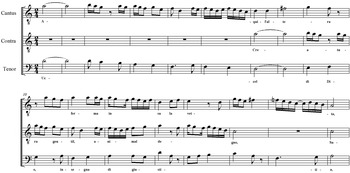
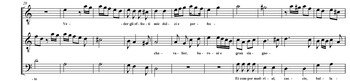
Analysing this affinity, Bent observes that there are some features which the Italian motet shares with the caccia, among them the use of canonic technique and imitations.Footnote 66 It is quite plausible that this peculiarly Italian concept of the motet, quite different from that of the contemporary French motet,Footnote 67 was known to Jacopo, who was active and possibly also educated in northern Italy. In any case, it cannot be coincidental that the beginning of Aquila, up to bar 12, is, in almost all its characteristics except for the different texts and the texted tenor, a typical Italian caccia; see Example 1. The same is true for the beginning of the third line (bars 29–36); see Example 2. Thus, it would be reasonable to assume that Jacopo intended to create such an unusual and, in fact, hybrid form for a poem dealing with the topic of ‘an active intellect’.
That this polytextual form was chosen deliberately is also confirmed by the inconsistency of the verse structure, namely the number of syllables in the line. The first and second tercets, ‘Aquil'altera’ and ‘Creatura gentil’, are normal, plain, hendecasyllables, while the third, ‘Uccel di Dio’, placed in the tenor, consists of sdruccioli lines (twelve-syllable lines) only, in which the final word of the line is trisyllabic of accent structure + – – : giusti-zia, glo-ria, vitto-ria.Footnote 68
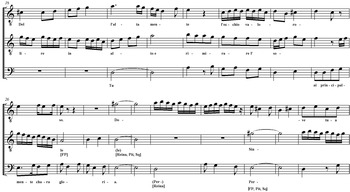
In discussing the musical structure of the Trecento madrigal, we refer to the most salient characteristics of the genre – first and foremost among them the melismas on the first and penultimate syllables of the line. However, in musical compositions containing versi sdruccioli, the melisma is placed on the antepenultimate syllable – a strictly respected rule, because the final melisma must fall on the tenth and only accented syllable of the hendecasyllable.Footnote 69 In the musical setting, the accented syllable is always elongated and here it is the antepenultimate syllable, while the penultimate in this situation is the shortest of the three, as demonstrated in Example 2, which presents the musical setting of the third line of each of Aquila's tercets.Footnote 70
Generally, a combination of the plain, truncated (ten-syllabic) and/or sdruccioli hendecasyllables may occur in a poem, but in such instances, the corresponding lines of the different tercets have to retain the same structure. This phenomenon is called isosyllabism, that is, an equal number of syllables in corresponding lines of different strophes. In Italian poetry, cases of flawed isosyllabism, as in the madrigal Aquil'altera, are rare. The isosyllabism is intended also to guarantee the best possible adaptation of residua, namely all the remaining strophes, usually written separately, to the music. This becomes less important, however, when each strophe is set to its own music.

Jacopo da Bologna, Aquil'altera, bb. 1–35

Jacopo da Bologna, Aquil'altera, bb. 36–50

JACOPO'S AQUIL'ALTERA AND LANDINI'S MUSICA SON: TWO RELATED PIECES
The Italian fourteenth-century musical repertory includes a well-known three-voice madrigal in which each strophe of the poem is adapted to one voice: Musica son by Francesco Landini.Footnote 71 Evidently Jacopo, with his triple-texted madrigal Aquil'altera, inspired his younger colleague Francesco Landini. The influence was expressed first and foremost in the very idea of the polytextual musical madrigal.Footnote 72 Although there is no melodic identity between these madrigals, we still can speak about a special affinity between them. Dorothea Baumann, having studied the compositional technique of three-voice pieces in the Trecento, attributes both madrigals to the same type of ‘Satztechnik’, with a contratenorFootnote 73 in the role of a second superius, moving in the same ambitus and never crossing with the tenor.Footnote 74 Significantly, this type was common for early three-voice compositions up to about 1375. Moreover, both madrigals share the same type of final cadence with the fifth and the octave, which is generally rare in the madrigals of type 1.Footnote 75
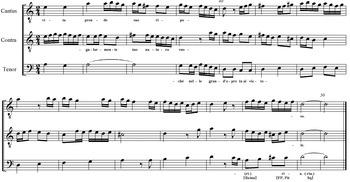
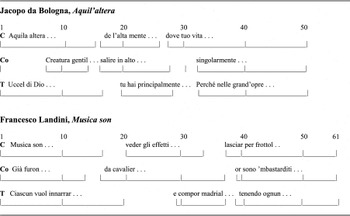
Although Landini, unlike Jacopo in Aquila, did not use canonic technique in his Musica son, thus, perhaps, bring his composition closer to the contemporary French motet,Footnote 76 we can identify a certain structural similarity between both madrigals. See Example 3.Footnote 77 Table 1 presents a graphic depiction of the deployment of voices in the main part of the two madrigals.Footnote 78 It shows that with the exception of the two main cadences at the end of the third line and the ritornello there are no simultaneous cadences at the end of the respective verse-lines in all three voices. This is one of the most salient characteristics of the French motet, but not at all typical of the Italian Trecento musical style.

Francesco Landini, Musica son, bb. 1–30

Comparison of the structure of Jacopo da Bologna, Aquil'altera, and Francesco Landini, Musica son, up to the ritornello

A comparison of the two compositions shows a quite clear similarity between the entrances and endings of the voices in the section from the end of the first poetic line up to the beginning of the third one in both compositions. In both pieces the second line of the contratenor (Aquila: ‘salire in alto’ – Musica son: ‘da chavalier’) enters at the moment when the superius proffers the last syllable of the first line. The second line of the superius enters immediately after this in Aquila (‘de l'alta mente’) and after two brevis pauses in Musica son (‘veder gli effetti’). In both pieces the tenor enters last, after two brevis pauses both in Aquila (‘tu hai principalmente’) and in Musica son (‘et compor madrigal’). In both compositions the superius is first to finish the second line of the text, and then the contratenor and tenor finish their lines simultaneously, while at the same moment the superius starts its third line (Aquila: ‘dove tua vita’ – Musica son: ‘lasciar per frottole’). Of course, this similarity might be a coincidence, yet the probability remains that Landini used it to show a special relation between the two madrigals.
Landini's use of this sophisticated motet-like form, evidently created by the fervid artistic imagination of Jacopo, for the musical setting of a poem which speaks about refined (although abandoned) musical means, was understandable to modern researchers. With the new interpretation of Jacopo's Aquila, the purpose of this very special formal concept becomes obvious as well. Landini, having been educated in the same Trecento atmosphere, clearly understood the meaning of Jacopo's Aquila. That is why it is no surprise that the two madrigals, Aquil'altera and Musica son, have more in common also in terms of textual content.
Landini's Musica son expresses his frustration at the decline of the level of musical art.Footnote 79 At the same time, this madrigal also talks about the importance of the intellect, which was, sadly, in decline during Landini's time, not only among musicians, but also in other fields of creative and intellectual endeavour:

Kurt von Fischer's comment is very appropriate in this respect: ‘The text of the upper voice of the same piece contains a complaint about the decline of artistic and intellectual standards…. These observations provide some idea of the apparently considerable importance of musical personality and individual creative activity during the Trecento.’Footnote 82
When put together, both compositions form a corresponding pair, comprising a dialogue between an optimist and a pessimist: the former, Jacopo, through his Aquil'altera, sings a definitely optimistic laud to human intellectual ability, while the latter, Landini, with his Musica son, responds in the pessimistic tone of a person who sees around him more and more ‘vagh'intelletti’. These men, lacking intellectual abilities, have no interest in true and good things (‘il bon’); instead they prefer to ‘catch the foam’ (‘la schiuma’). In this respect, this pair of madrigals conformed to contemporary Italian poetic practice, in which dialogism played an important role, being not far from a tenzone: a kind of poetic communication that was very popular in Italy. Bearing in mind that this fascinating phenomenon may not be completely familiar to music scholars, a short survey of this practice follows.
Excursus on tenzone
In Italy, beginning in the Duecento, there flourished a tradition of communication or correspondence in poetic forms, mostly in sonnets. Thanks to two recent studies by Claudio Giunta on correspondence in rhymes, or tenzone, in thirteenth- and fourteenth-century ItalyFootnote 83 we understand that the poetry of correspondence, which constitutes a large part of the Italian poetic repertory, had a social rather than lyric function.Footnote 84 One well-known example has survived in Libro delle rime, a book of poems by the fourteenth-century Florentine poet Franco Sacchetti, namely Landini's poetic sonnet-letter from the end of the 1380s: ‘Se per segno mirar che dal ciel vegni’ (CCXLII b), a reply to Franco's sonnet ‘Veggendo tante piaghe e tanti segni’ (CCXLII a). Franco had requested that one of his canzoni be set to music, and Landini responded that he had fulfilled the request with great pleasure.Footnote 85
The topics of these poetic correspondences were limited only by the imagination of the writers, and covered subjects ranging from the mundane to the sublime. Among those who communicated in poetic forms were not only true poets, but also people who would never have been called poets in the proper sense.Footnote 86 The tenzoni were actually macro-texts, composed of at least two or more poems by two or more persons. The most salient trait of this form was that it was intended as a discussion, and, therefore, many texts are often of a provocative, even offensive and insulting character, thus evoking reaction.Footnote 87 That led to the appearance of coupled texts and even chains of poems linked to each other by their meaning and associations. Such a macro-composition was not a synchronic collaboration of a number of poets, but something which developed over the course of time.Footnote 88
Before being collected in codices, the tenzoni had been circulated within a restricted circle of friends and colleagues. Rarely were they transmitted in their entirety, with all their components included. For whatever reason, it often happened that they were fragmented in transmission and their parts dispersed in various codices.Footnote 89 Therefore, one of the objectives of the explorer of the practice of poetic correspondence is to trace a specific tenzone within a larger poetic repertory.
There were some specific rules for corresponding in rhymes, as presented by Antonio da Tempo and Gidino da Sommacampagna in their treatises on the poetic art, respectively Summa artis rithimici vulgaris dictaminis (1332) and De li rhitimi volgari (c. 1384).Footnote 90 Both authors describe the practice of sending ‘a sonnet or any other rhyme to some companion’ and receiving a response in the same form. The response had to retain the same rhyming pattern as the verse that occasioned it. However, this rule was not always maintained in the tenzone. As Giunta observes, not only rhymes, but contents and ideas too are to be examined when tracing a tenzone.Footnote 91 In fact, the practice of tenzone was the natural domain of the phenomenon which we know as intertextuality.
Another important characteristic of the poetry of tenzone was the adoption, from the very beginning of this practice in the Duecento and for a long time afterwards, of a very obscure style of language, which is compared by Giunta to trobar clus.Footnote 92 It continued to be the particular feature of the poetry of tenzoni even when, in the non-correspondence poetry, the tendency towards clarity and comprehensibility of style, prompted by Petrarch, predominated. Giunta supposes that the rationale behind this was that the tenzoni contained within them a strong element of play, lusus, so that the challenging task of decoding the meaning of poems was a necessary component of this game, a special pleasure of its participants.Footnote 93
Here, it is important to note that the idea of the presence of tenzoni within the Trecento musical repertory has not hitherto been raised by researchers, apparently because the poetic texts of the musical compositions rarely have common rhyming patterns. Moreover, in this music the practice of musical quotations is completely absent. However, since the Italian vocal music of the Trecento is not only a musical art but a poetic one as well, when dealing with it we cannot disregard the forms and functions of poetry as they were practised and as they existed in that time. It is true that the commonly accepted expression poesia per musica defined this repertory as a separate phenomenon, which seemingly remained outside the processes that occurred within the pure poetic art. Yet, if we look at the list of topics encountered in Trecento musical compositions, cited at the beginning of this essay, we see a spectrum of issues going far beyond the ‘diverting and pleasing’ musical function alone.
The examination of another Trecento musical madrigal, Se premio di virtù by Bartolino da Padova, will clarify the question of intertextual relationships even more.Footnote 94
BARTOLINO DA PADOVA'S SE PREMIO DI VIRTÙ – ANOTHER RELATED TRECENTO MADRIGAL
Bartolino's madrigal Se premio di virtù is clearly of a moralising character. It claims that when the intellect or mind is not supported by virtues, it will lead man, in his quest for glory, to vanities and to mere illusions of truth, and will distract him from the true essence and true being. If he nonetheless wishes to achieve glory, he first has to acquire virtues, and only after that will his glory have a desirable effect.

This sounds familiar: the likeness (il parer attende, l'ombra, la vista) against the true essence and true being (la vera essenza, l'esser proprio). The final line of the ritornello, ‘seguendo l'ombra e non la vera essenzia’,Footnote 96 is a quite literal quotation from the final ritornello of Jacopo's Aquila, ‘là vidi l'ombra e là la vera essenza’. Landini's expression ‘vagh'intelletti’ appears in Bartolino's madrigal as ‘vano intelletto’, which bears the same meaning. The impression of similarity is reinforced by the use of the rhyme ‘intelletto – effetto’, the internal rhyme in the first tercet of the Musica son: ‘effetti – perfetti – intelletti’. The issue of virtue that is worthy of praise and honour is also present in Musica son: ‘chi vuol d'una virtù venire in loda’ (he who strives through some virtue to achieve honour). And finally, the remark about glory as desired by an unstable, vain intellect recalls the passage in the Aquila, which tells that the eagle desires glory above all.
Had we not known this meaning of Jacopo's Aquila, the quotations above could have been considered a coincidence. But in the light of a new understanding of Aquila's content, a clear and unequivocal connection between all three madrigals, a well-meditated intertextual play becomes evident. In referring directly to the intellect, Bartolino shows that he has decoded the meaning of Aquila. However, Bartolino enters, as an opponent in a tenzone, into polemics and, in fact, criticises the main idea of Jacopo's Aquila about the power of the human mind by warning that the ‘vano intelletto’ may be dangerous for anyone who seeks fame when he is lacking the necessary virtues.
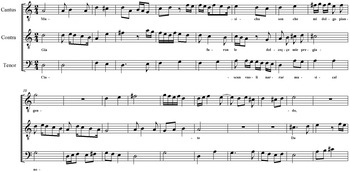
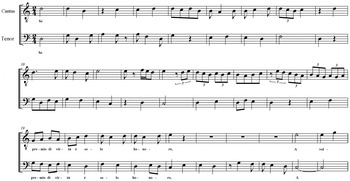
Musically, Bartolino's madrigal presents a complete contrast to both Aquila and Musica son, being a simple two-voice composition of the traditional Italian madrigal format with the traditional deployment of syllabic and melismatic sections within a phrase. See Example 4 .
Bartolino da Padova, Se premio di virtù, bb. 1–28

The general stylistic affinity between these three composers has already been pointed out by musicologists.Footnote 97 It might, therefore, seem strange that Bartolino did not try to imitate the polytextual three-voice madrigal form of Aquila and Musica son, which, in fact, neither he nor any other composer, except for Jacopo and Landini, ever used; nor did he attempt to develop a special new form of his own.
In looking for reasons why he did not do so, we have to bear in mind that, as von Fischer notes, Bartolino's musical style was always strictly Italian. Indeed, he preferred to use Italian notation, the ‘normative’ metric organisation within the madrigal form (where the measure was changed only in the ritornello if at all), text in all the voices, even in the three-voice ballatas, and a ‘Satztechnik’ characteristic of earlier Trecento style.Footnote 98 This remained his personal style even when French influences became more noticeable in the works of his contemporaries.Footnote 99 We may suppose, therefore, that the hints on vain intellect seeking for fame, in his Se premio di virtù, refer also to the extravagant musical style of Aquila and Musica son.Footnote 100 Therefore, the simplicity and modesty of the madrigal Se premio di virtù could have been planned by Bartolino as an intentional demonstration of the true virtue, which in regard to the music would have meant adherence to the authentic Italian musical style.
Nonetheless, these three madrigals form a group of compositions related by the topics of intellect, virtue and honour. Whereas the madrigal Se premio di virtù by Bartolino has a clear textual connection to either of the two other madrigals, the poetic texts of Aquila and Musica son lack certain textual characteristics necessary to form a true poetic tenzone. However, the similar deployment of voices in both madrigals that we have examined above, together with their polytextuality, seem to be a peculiar musical variant of those syntactic tools which link the parts of a tenzone together. In fact, the entrance or ending of a voice is a feature that the ear can easily distinguish. Thus, in this particular instance we can suppose that it is the music itself, with its ‘effetti dolci e perfetti’, that is, with its sweet and perfect musical means, that plays the necessary role of the subject matter that connects the two madrigals, Jacopo's Aquil'altera and Landini's Musica son, both composed in the same unusual and unique musical form of a polytextual madrigal. In other terms, they can be considered as a kind of tenzone realised by musical means.
CONCLUSIONS
Based on the new understanding of its symbolic meaning, my conclusion is that those interpretations of Aquila which treat it as a composition written for either a coronation or a wedding ceremony seem to be somewhat arbitrary and contrived. This is, first and foremost, because of the confusion, strongly rooted in Trecento studies, between the author's intention when planning his composition and that composition's possible use afterwards. Even if a custom of public performance of written polyphonic music did exist in the Trecento, the question whether the madrigal Aquil'altera was consciously designed by the composer for a ceremony still remains open.Footnote 101
Indeed, the only incontestable conclusion regarding the content of the poem is that it presents an allegory of the eagle's image based on a number of descriptions found in bestiaries. An additional conclusion is that the poetic text is a song of praise to the human intellect in general. As shown above, this issue of the intellect was plainly understood by Jacopo's younger contemporaries, Landini and Bartolino, as far as we can judge from the content of their madrigals and the way they reply to Aquila's ideas.
Much less certain, however, are the assumptions regarding the addressee of this madrigal: was it designed for some specific person or event? On this the poem, unfortunately, contains no clear indication or hint. Surely, this madrigal might have been sung before a public for any celebration. However, the wedding context apparently has to be discarded because the poem unequivocally has only one protagonist, the eagle, whereas it would be logical for a nuptial song to introduce two equal protagonists, persons, symbols, or units.Footnote 102 But for more persuasive conclusions in this regard, more profound research of courtly rituals and customs of that time, and of allegories and symbols within the so-called ‘heraldic’ poetry in general has to be carried out. If, nevertheless, we still want to classify it within the spectrum of common poetic topics, we would prefer to ascribe it to a category of allegorical-philosophical texts which incorporate a polemic inviting a response.
However, the most important outcome of the present research seems to be the disclosure of the rich and profound cultural background of the madrigal Aquil'altera. Aquila's content and literary style echoed the ideas and images that were circulating in the literature of its time, and especially in the bestiaries and bestiary-inspired poetry. In turn, this madrigal provided the stimulus for a further discussion of its ideas in related musical compositions. I do not intend to assert that the entire Trecento musical repertory was created within the tenzone-like practice, but some part of it certainly could have been. Undoubtedly, further investigation will expand the quantity of relevant compositions. However, we already have enough information to allow for some conclusions.
What we see in the madrigals above can be defined as a discussion of questions regarding the function of art (music in particular), the position of the artist, and the authenticity of creativity. All these topics were to become almost commonplace within the similar debates in the Renaissance. But whereas in the Renaissance these ideas were published and discussed openly, in the Trecento they were transmitted and discussed in coded communications within a very select circle of colleagues, a practice that enabled them to express their audacious avant-garde thoughts. The conclusion is that the Trecento musicians adopted the practice of tenzone for their needs, adding the musical element and making the intellectual game even more sophisticated. Jacopo da Bologna, with his ideas of authenticity and originality, seems to be the most daring, Landini insists on a high level of professionalism, whereas Bartolino appears to be a prudent and cautious defender of tradition.
One more conclusion can be made with regard to the authorship of the poetic texts of such musical compositions as could have been written within a tenzone-like practice. It would be more logical to suppose that the poems in question, transmitted anonymously, were written by the composers themselves as an integral part of the entire musical-poetic opus.Footnote 103
This specific trio of madrigals, Aquila, Musica son and Se premio di virtù, connects three generations of Trecento composers. But it is not impossible that all three compositions were composed around 1360–5, which is just the time between the presumed end of Jacopo's activity and the beginning of that of Bartolino. However, these chronological arguments do not exclude that this chain might have been created over a longer time-span, perhaps even when one of the ‘respondents’ was no longer alive.
In any case, the discussion within the Trecento musical repertory which is illuminated in this study may be considered a harbinger of Renaissance discussions of these issues. The deciphering of the symbols in Aquila and this madrigal's relation to Musica and Se premio enables a closer acquaintance with the personalities of these Trecento composers, their education, preferences, thoughts, intentions and tastes. Moreover, it enables a refining of our understanding of the Trecento musical repertory, which was, at least in part, more private and personal than had been thought previously.