Introduction
Insects are estimated to one of the largest reservoirs of endosymbionts, comprising protozoa, nematodes, viruses, fungi, bacteria, and multicellular parasites (Douglas, Reference Douglas1998; Moran et al., Reference Moran, Degnan, Santos, Dunbar and Ochman2005; Naaz et al., Reference Naaz, Choudhary, Prabhakar, Moanaro and Maurya2016) on earth, and approximately 15% of all insects harbor diverse communities of bacteria (Stouthamer et al., Reference Stouthamer, Breeuwer and Hurst1999; Wernegreen, Reference Wernegreen2002; Moran et al., Reference Moran, McCutcheon and Nakabachi2008; Prabhakar et al., Reference Prabhakar, Sood, Kapoor, Kanwar, Mehta and Sharma2009a). It has been known for the last century that associations between insects and bacteria are very common in nature, and these organisms have co-evolved for more than 250 million years (Petri, Reference Petri1909). Insect-bacterial interactions between range from pathogenicity to highly sophisticated symbiotic relationships (Wernegreen, Reference Wernegreen2002; Oliver et al., Reference Oliver, Russell, Moran and Hunter2003, Reference Oliver, Moran and Hunter2005). Bacteria can be extracellular or intracellular which have significant roles in host insect physiology, the nutrition, as well as reproduction (Dale & Moran, Reference Dale and Moran2006). A notable example is an interaction between insects and gut bacteria, which extend insects by providing nutrients as endosymbiotic bacteria (Douglas et al., Reference Douglas, Minto and Wilkinson2001) and by entering other indigestible substrates, including as lignocellulose-derived organic substances from the soil (Brune, Reference Brune1998). Symbionts can be classified into two groups: the obligate or primary (P) symbionts and facultative or secondary (S) symbionts. Obligate symbionts have a long evolutionary history with their hosts and are required for host survival and fertility, especially in nutritional function (Baumann, Reference Baumann2005), while facultative symbionts have a much broader array of effects, ranging from mutualism to manipulation of reproduction (Moran et al., Reference Moran, McCutcheon and Nakabachi2008).
Fruit flies (Diptera: Tephritidae) constitute a large and diverse group of phytophagous species, most of which are frugivores and have an adverse effect on fruit and vegetable crops worldwide (Ben-Yosef, Reference Ben-Yosef, Pasternak, Jurkevitch and Yuval2015). There are nearly 4000 described species from 500 genera of tephritid fruit flies (Qin et al., Reference Qin, Paini, Wang, Fang and Li2015), of which approximately 1500 are associated with fruit, and more than 250 are considered as economically important (Li et al., Reference Li, Jiang, Ma, Fang, Sun, Qin and Wang2013) that belongs to five genera: Anastrepha Schiner, Bactrocera Macquart, Ceratitis MacLeay, Dacus Fabricius, and Rhagoletis Loew (Van Houdt et al., Reference Van Houdt, Breman, Virgilio and Meyer2010).
Associations between fruit flies and their gut bacterial communities have been well-studied, usually in Rhagoletis, Ceratitis, Bactrocera, and Anastrepha and (Raghu et al., Reference Raghu, Clarke and Bradley2002; Capuzzo et al., Reference Capuzzo, Firrao, Mazzon, Squartini and Girolami2005; Kounatidis et al., Reference Kounatidis, Crotti, Sapountzis, Sacchi, Rizzi and Chouaia2009; Prabhakar et al., Reference Prabhakar, Sood, Mehta and Choudhary2009b, Reference Prabhakar, Sood, Kanwar, Sharma, Kumar and Mehta2013; Naaz et al., Reference Naaz, Choudhary, Prabhakar, Moanaro and Maurya2016). Despite the wide occurrence and economic importance of these organisms as fruit pests, unfortunately a little information is available about the functions of gut symbionts of the fruit fly. But the hypothesis of many researchers is that bacteria not only play an important role of fruit fly survivability but also in attracting different fruit flies towards the infected host fruits (MacCollom et al., Reference MacCollom, Lauzon, Sjogren, Meyer and Olday2009; Narit & Anuchit, Reference Narit and Anuchit2011; Reddy et al., Reference Reddy, Sharma and Singh2014).
It is very uncommon that the fruit fly acts as a vector of human or plant diseases. But there are some researches, as for example, the Mediterranean fruit fly (Ceratitis capitata) has the potential capacity to transmit plant disease (Cayol et al., Reference Cayol, Causse, Louis and Barthes1994) as well as human pathogens (bacterial) to fruits (Sela et al., Reference Sela, Nestel, Pinto, Lavy and Joseph2005). There is another fruit fly, Drosophila melanogaster also has the involvement to transmit pathogenic bacteria to postharvest wounded apples (Janisiewicz et al., Reference Janisiewicz, Conway, Brown, Sapers, Fratamico and Buchanan1999).
Chemical pesticides (Perry et al., Reference Perry, Yamamoto, Ishaaya. and Perry1998), mass trapping and bait spray (Ras et al., Reference Ras, Leo, Beukeboom, Caceres and Bourtzis2017) are commonly used to manage the most invasive fruit fly species, though many pesticides have developed resistance to insect, killing non targeted insects as well as create environmental hazard and mass trapping has lower field performance (Haniotakis, Reference Haniotakis2005; Kakani et al., Reference Kakani, Zygouridis, Tsoumani, Seraphides, Zalom and Mathiopoulos2010; Ras et al., Reference Ras, Leo, Beukeboom, Caceres and Bourtzis2017). Therefore, alternative management strategies are now time demanding. In this review, we will provide an overview of the diversity of bacterial communities in economically important fruit flies including their function and the use of bacteria in eco-friendly control strategies for fruit flies.
Development of research on symbiotic bacteria in the fruit fly
The research on symbiotic bacteria and fruit flies began in 1909, after which research progress was slow (fig. 1a) until 2000. Studies performed during that period first focused on bacteria diversity and then on diversity with pest control strategies. However, after 2000, there was a dynamic shift, and from 2000 to 2010, the research focus was on diversity with pest control strategies by using molecular techniques (fig. 1b). After 2010, the research focus has been the function of symbiotic bacteria.
Development of research on symbiotic bacteria. (a) Based on different research directions and (b) based on different methods.

Diversity of bacteria in tephritids
Several studies on tephritids have provided important data on the role of microorganisms in relationships with host plants and in fruit fly biology (Drew, Reference Drew1987; Drew & Lloyd, Reference Drew and Lloyd1987; Jang & Nishijima, Reference Jang and Nishijima1990). The role of extracellular bacteria associated with the digestive tracts of dipteran larvae, pupae, exuviae and/or adults are now understood (Yong et al., Reference Yong, Song, Chua and Lim2017b). In this review, we discuss the bacterial diversity identified by culture-dependent and molecular methods (table 1). Before 2002, all researchers identified bacteria in fruit flies by using culture-dependent methods because at that time these were the only methods available for bacterial identification (fig. 1b). Recently, molecular biological techniques have made it possible to study the diversity and taxonomy of native microbial communities. Studies on the bacteria in insects by using molecular techniques have revealed more taxa and larger microbial community structures; including both rare species and unculturable microorganisms (Haynes et al., Reference Haynes, Darby, Daniell, Webster, van Veen, Godfray, Prosser and Douglas2003; Broderick et al., Reference Broderick, Raffa, Goodman and Handelsman2004; Egert et al., Reference Egert, Stingl, Bruun, Pommerenke, Brune and Friedrich2005; Nakajima et al., Reference Nakajima, Hongoh, Usami, Kudo and Ohkuma2005; Cox & Gilmore, Reference Cox and Gilmore2007; Miyata et al., Reference Miyata, Noda, Tamaki, Kinjyo, Aoyagi, Uchiyama and Tanaka2007). Culture-dependent and molecular method has provided a more holistic of the bacterial community structures in insects (Amann et al., Reference Amann, Ludwig and Schleifer1995).
Diversity of bacteria in different organ of fruit fly by using molecular and culture depended methods.

Culture-dependent method
Bacterial symbionts were firstly mentioned by Petri in 1909 from the olive fly Bactrocera oleae (Dacinae) (Kounatidis et al., Reference Kounatidis, Crotti, Sapountzis, Sacchi, Rizzi and Chouaia2009; Prabhakar et al., Reference Prabhakar, Sood, Mehta and Choudhary2009b; Naaz et al., Reference Naaz, Choudhary, Prabhakar, Moanaro and Maurya2016). Petri (Reference Petri1910), found the association of organism Bacillus (Pseudomonas) savastanoi Smith (the known cause of olive knot disease) with B. oleae and another bacterium Ascobacterium luteum in association with B. oleae. Thirty-seven species of bacteria were isolated from Tephritidae, and bacterial transport through each stage of the life cycle of B. oleae was described; however, the associated bacteria were not identified (Stammer, Reference Stammer1929). In contrast to the earlier report, neither P. savastanoi nor A. luteum was able to be isolated from eggs or esophageal bulbs of field-collected B. oleae adults in the following research (Yamvris et al., Reference Yamvris, Panagopoulos and Psallidas1970). Two different types of symbiosis were defined in fruit fly: in the first type, bacteria associated with the esophageal bulb (a foregut diverticulum) of the adult fly, and in the second type, the bacteria associated with the blind sacs at the anterior end of the larval midgut (Girolami, Reference Girolami1973). The release of compact masses of bacteria from the esophageal bulb into the midgut was described; however, the identity of the microorganisms was not reported (Girolami, Reference Girolami1983). Nine species of bacteria were isolated from the esophageal bulb of B. oleae and eight species from the phylloplane of the host plant (Belcari et al., Reference Belcari, Sacchetti, Marchi and Surico2003). Only three species, namely, Agrobacterium radiobacter, Pseudomonas putida, and Serratia marcescens, were isolated from both fruit fly and host plant. It was speculated that Acetobacter tropicalis can influence host nutrition and physiology by participating in the glycometabolism of the olive fruit fly (Kounatidis et al., Reference Kounatidis, Crotti, Sapountzis, Sacchi, Rizzi and Chouaia2009). When it comes to the other Bactrocera species, twenty-three strains, characterized as members of the Enterobacteriaceae family were reported from wild adults of B. dorsalis; Pseudomonas pseudomallei was identified from the adult and larval stages of B. cucurbitae, and eight genera named Proteus, Klebsiella, Streptobacillus, Alcaligenes, Haemophilus, Erwinia, Chromobacterium, and Flavobacterium were identified in B. tau (Gupta et al., Reference Gupta, Pant and Lal1982a, Reference Gupta, Pant and Lalb; Jang & Nishijima, Reference Jang and Nishijima1990; Khan et al., Reference Khan, Mahin, Pramanik and Akter2014). Eleven types of bacteria were also isolated when comparing bacterial associated with B. tau and B. cucurbitae, and, five of these bacteria, namely, P. putida, Erwinia herbicola, Cedecea davisae, Arthrobacter spp., and Xanthomonas maltophilia (Stenotrophomonas maltophilia), were found in both species of fruit fly (Sood & Nath, Reference Sood and Nath2002). All the bacterial isolated belonging to the family Enterobacteriaceae, and the most common species of Bactrocera flies were Citrobacter freundii, E. agglomerans, E. cloacae, K. oxytoca, and Kluyvera spp., and these bacteria were collectively referred to as ‘fruit fly type’ bacteria (Lloyd et al., Reference Lloyd, Drew, Teakle and Hayward1986; Jang & Nishijima, Reference Jang and Nishijima1990).
As a very important quarantine pest, the Mediterranean fruit fly C. capitata, also harbor bacteria in its esophageal bulb and the bacteria K. oxytoca and E. agglomerans were identified as the predominant species in wild and laboratory medfly populations, respectively (Marchini et al., Reference Marchini, Rosetto, Dallai and Marri2002). Besides Pseudomonas (Phytomonas) melophthora was found to be associated with all stages of R. pomonella (Walsh) (Allen & Riker, Reference Allen and Riker1932; Allen et al., Reference Allen, Pinckard and Riker1934; Baerwald & Boush, Reference Baerwald and Boush1968) another two R. pomonella associated bacteria species, K. oxytoca and E. cloacae were reported to be necessary for normal development in most tephritid species (Rossiter et al., Reference Rossiter, Howard and Bush1983). Fifteen morphologically different bacteria associated with the walnut husk fly R. completa (Cresson) were identified (Tsiropoulos, Reference Tsiropoulos1976), but only Pseudomonas spp. and Xanthomonas spp. were present in all stages of the life cycle of the fly. A diverse microbial flora was discovered in the esophageal-bulb of six Rhagoletis spp., and K. oxytoca was predominant in every species of fly (Howard et al., Reference Howard, Bush and Breznak1985). Not only bacteria diversity varied in different fruit fly species, but also it is different in new and old colonies of the fruit fly. Out of eighteen identified different gut bacterial species of Mexican fruit flies, A. ludens, bacterial species Aeromonas hydrophila and K. pneumoniae ssp. pneumoniae were found only in the old colony whereas, Providencia stuartii, Bacillus cereus, P. aeruginosa, and Enterobacter sakazakii from a new colony only (Kuzina et al., Reference Kuzina, Peloquin, Vacek and Miller2001).
Bacteria from fruit flies are not simply envisaged as environmental microorganisms but are in fact symbionts of the host body, where it occupies a specific favorable niche (Dale & Moran, Reference Dale and Moran2006). However, there remains a paucity of information on this subject. Research with modern molecular tools in this particular area is essential for improving our knowledge of fruit fly ecology and for clarification of the functions of these bacteria. Such studies will also be a major step toward understanding bacterium-fruit-fly association.
Molecular characterization
Molecular approaches for microbial detection have led to dramatic changes in the identification of microbial diversity. It is recognized that about 99 percent microbes in the environment cannot be cultured (Amann et al., Reference Amann, Ludwig and Schleifer1995). However, nucleic-acid-based approaches for the characterization of microbes have provided new information in spite of the limitations of these techniques (Head et al., Reference Head, Saunders and Piclup1998). Nucleic acid sequencing, particularly those 16S rRNA gene sequencing, has enabled the identification of the microbiota associated with insects (Brauman et al., Reference Brauman, Dore, Eggleton, Bignell, Breznak and Kane2001; Toth et al., Reference Toth, Kovacs, Schumann, Kovacs and Steiner2001). Random amplification polymorphic DNA-polymerase chain reaction (RAPD-PCR) analysis has been used to compare strains of bacteria between insects and within generations. Profiling of the insect gut microbiota is now feasible using methods based on the 16S rRNA gene (de Vries et al., Reference de Vries, Jacobs and Breeuwer2001).
For the first time, five distinct strains of Wolbachia were identified (Jamnongluk et al., Reference Jamnongluk, Kittayapong, Baimai and O'Neill2002) in B. ascita based on the wsp (Wolbachia surface protein gene sequence). This report also stated that four of the five Wolbachia strains were in the same group as those identified in other tephritid fruit flies, suggesting possible horizontal transfer of Wolbachia from other fruit flies into B. ascita (Waleron et al., Reference Waleron, Waleron, Podhajska and Lojkowska2002) studied the genotypic characteristics of Erwinia was studied by PCR-RFLP analysis (polymerase chain reaction-restriction fragment length polymorphism) of the recA gene fragment. The results indicated that PCR-RFLP analysis of the recA gene fragment is a useful tool for the identification of species and subspecies of Erwinia (Sood & Prabhakar, Reference Sood and Prabhakar2009). RAPD and PCR-RFLP using the recA gene and the rrs gene were also be used to study the genotypic characteristics of gut bacteria of B. tau, and it reported that the PCR-RFLP profiles of three symbionts were more accurate than the RAPD-REP-PCR (Sood & Prabhakar, Reference Sood and Prabhakar2009).
Bacteria from several fruit fly species such as B. zonata, B. tau, B. cucurbitae, B. oleae, B. dorsalis, B. tryoni, B. cacuminata, B. carambolae, and B. minax was identified by targeted 16S rRNA gene sequencing (Illumina MiSeq platform). Bacillus, Enterobacter, Klebsiella, and Stenotrophomonas were the dominating bacterial genera, identified from field and laboratory-collected B. zonata (Reddy et al., Reference Reddy, Sharma and Singh2014). Two most abundant species, i.e. K. oxytoca and Pantoea agglomerans, belonged to the bacterial family Enterobacteriaceae, and one species, namely, Staphylococcus sp., belonged to the family Staphylococcaceae were characterized from B. tau (Prabhakar et al., Reference Prabhakar, Sood, Mehta and Choudhary2009b, Reference Prabhakar, Sood, Kanwar, Sharma, Kumar and Mehta2013). But in recently, Luo et al. (Reference Luo, Zhang, Du, Idrees, He, Chena and Jia2018) mentioned three bacteria, namely – Enterobacter, Providencia, and Serratia were the dominant bacteria of both male and female B. tau. Twenty-six bacteria belonging to the families Enterobacteriaceae, Micrococcaceae, Bacillaceae, and Staphylococcaceae were isolated and identified from the midgut of the melon fly B. cucurbitae whereas, Enterobacter, Bacillus, Klebsiella, Citrobacter, and Providencia as the dominating genera (Hadapad et al., Reference Hadapad, Prabhakar, Chandekar, Tripathi and Hire2016). Symbiotic bacteria of the olive fruit fly (B. oleae) consistently yielded a single sequence that exhibited marked similarity with enterobacterial lineages, with closest matches (97%) to Erwinia persicina and E. rhapontici. The identity of the symbiont was also distinct from Pseudomonas savastanoi. A novel species was proposed, by virtue of its unique properties, under the designation ‘Candidatus Erwinia dacicola’ (Capuzzo et al., Reference Capuzzo, Firrao, Mazzon, Squartini and Girolami2005; Kounatidis et al., Reference Kounatidis, Crotti, Sapountzis, Sacchi, Rizzi and Chouaia2009).
Till now many researchers worked on oriental fruit fly, B. dorsalis. From the gut (Wang et al., Reference Wang, Jin, Peng, Zhang, Chen and Hua2013, Reference Wang, Yao, Zheng and Zhang2014), five species from three genera namely, Raoultella terrigena, E. sakazakii, Enterobacter amnigenus, Klebsiella pneumonia, and Klebsiella oxytoca (Shi et al., Reference Shi, Wang and Zhang2012), were identified. As compared to laboratory-reared population, bacterial diversity was found to higher in the wild populations, and the same result was observed between the samples from late-term invasion regions to early-term invasion regions in China (Liu et al., Reference Liu, Martinez-Sañudo, Mazzon, Prabhakar, Girolami, Deng, Dail and Li2016).
Bacterial community varied between crop and midgut and as well as male and female sex of two fruit fly species – B. tryoni and B. cacuminata (Thaochan et al., Reference Thaochan, Drew, Hughes, Vijaysegaran and Chinajariyawong2010, Reference Thaochan, Drew, Chinajariyawong, Sunpapao and Pornsuriya2015). Seventeen bacterial phyla with four major genera, namely, Enterobacter Klebsiella, Serratia, and Citrobacter, were identified from B. minax (Wang et al., Reference Wang, Jin, Peng, Zhang, Chen and Hua2013, Reference Wang, Yao, Zheng and Zhang2014).
Most of the researchers only used adult fruit flies, but recently some reports (C. capitata, B. dorsalis, and B. carambola) found the bacterial diversity in different developmental stages like egg, larvae, pupae, adult male and female. In B. dorsalis, the phylum Proteobacteria was dominant in the immature stages, but Firmicutes dominated in adult stages. In the pupal stage, the genus Comamonas was most abundant but completely absent in adults (Andongma et al., Reference Andongma, Wan, Dong, Li and Desneux2015). Acetobacter sp. from Acetobacteraceae was the most abundant in larvae, mainly Brachybacterium from Dermabacteraceae, and mainly Brevibacterium from Brevibacteriaceae were the most abundant in pupa and bacteria from Enterobacteriaceae were the most abundant in adult B. dorsalis (Zhao et al., Reference Zhao, Zhang, Chen, Wang, Lu and Cheng2018). Erwinia was the dominant genus in the larval stage; Halomonas was most abundant in adult females; Stenotrophomonas was most abundant in adult males; and Chryseobacterium was most abundant in the larval and pupal stages of B. carambola (Yong et al., Reference Yong, Song, Chua and Lim2017b). Though the bacterial hosted within the Mediterranean fruit fly differs among instars, life stages (Aharon et al., Reference Aharon, Pasternak, Yosef, Behar, Lauzon, Yuval and Jurkevitcha2013) and host-plant species, most of them belong to the phylum Proteobacteria, including Alphaproteobacteria, Betaproteobacteria and Gammaproteobacteria (Malacrinò et al., Reference Malacrinò, Campolo, Medina and Palmeri2018). The most abundant species are Providencia stuartii, Klebsiella spp., Pectobacterium spp. C. freundii, Enterobacter spp. and Pantoea spp. (Behar et al., Reference Behar, Yuval and Jurkevitch2005, Reference Behar, Jurkevitch and Yuval2008). The gut of larvae and adults from four species of Anastrepha genus, including A. serpentine, Anastrepha ludens, A. striata, and A. obliqua, and among which Klebsiella, Enterobacter, Raoultella, Escherichia and Citrobacter and were confirmed to be the dominant bacteria. Adults had a higher bacterial diversity than larvae, and the adult flies with a broader diet breadth possess a higher bacterial diversity than species with a limited number of hosts (Ventura et al., Reference Ventura, Briones-Roblero, Briones-Roblero, Rivera-Orduña and Zúñiga2018).
Till now different bacterial genera, namely – Pantoea, Micrococcus, Agrobacterium, Xanthomonas, Acetobacter, Lactobacillus, Escherichia, Kluyvera, Arthrobacter, Proteus, Bacillus, Hafnia, Pseudomonas, Chryseobacterium, Defluvibacter, Enterobacter, Providencia,, Flavobacterium, Halomonas, Streptococcus, Klebsiella, Listeria, Staphylococcus, Ochrobactrum, Pectobacterium, Serratia, Stenotrophomonas, Delftia, Raoultella, Serratia, Erwinia and Citrobacter have been isolated, identified and characterized from esophageal bulb, the gut and reproductive organs of laboratory-reared and field-collected tephritid flies, both male and female (Lloyd et al., Reference Lloyd, Drew, Teakle and Hayward1986; Drew & Lloyd, Reference Drew and Lloyd1987; Jang & Nishijima, Reference Jang and Nishijima1990; Lauzon et al., Reference Lauzon, Sjogren and Prokopy2000; Zinder & Dworkin, Reference Zinder, Dworkin and Dworkin2000; Bergey et al., Reference Bergey, Holt and Krieg2001; Kuzina et al., Reference Kuzina, Peloquin, Vacek and Miller2001; Marchini et al., Reference Marchini, Rosetto, Dallai and Marri2002; Belcari et al., Reference Belcari, Sacchetti, Marchi and Surico2003; Behar et al., Reference Behar, Yuval and Jurkevitch2005, Reference Behar, Ben-Yosef, Lauzon, Yuval, Jurkevich, Bourtzis and Miller2009; Capuzzo et al., Reference Capuzzo, Firrao, Mazzon, Squartini and Girolami2005; Sacchetti et al., Reference Sacchetti, Granchietti, Landini, Viti, Giovannetti and Belcari2008; Kounatidis et al., Reference Kounatidis, Crotti, Sapountzis, Sacchi, Rizzi and Chouaia2009; Prabhakar et al., Reference Prabhakar, Sood, Mehta and Choudhary2009b, Reference Prabhakar, Sood, Kanwar, Sharma, Kumar and Mehta2013; Thaochan et al., Reference Thaochan, Drew, Hughes, Vijaysegaran and Chinajariyawong2010; Wang et al., Reference Wang, Jin and Zhang2011, Reference Wang, Jin, Peng, Zhang, Chen and Hua2013, Reference Wang, Yao, Zheng and Zhang2014; Reddy et al., Reference Reddy, Sharma and Singh2014; Naaz et al., Reference Naaz, Choudhary, Prabhakar, Moanaro and Maurya2016; Yong et al., Reference Yong, Song, Chua and Lim2017b). In general, from many studies, tephritid bacteria mostly belong to the gram-negative type except Micrococcus, Lactobacillus, Arthrobacter, Bacillus, Streptococcus, Listeria, and Staphylococcus. Members of the Enterobacteriaceae family and mainly Klebsiella and Enterobacter are the predominant bacterial species in most of the adults. The bacteria were present mainly in the midgut and to a lesser extent in the salivary glands and reproductive organs (Rani et al., Reference Rani, Sharm, Rajagopal, Adak and Bhatnagar2009; Crotti et al., Reference Crotti, Rizzi, Chouaia, Ricci, Favia, Alma, Sacchi, Bourtzis, Mandrioli, Cherif, Bandi and Daffonchio2010); however, one study explained that the female ovary had the highest bacterial diversity followed by the male testis, and reproductive organs were rich in bacterial community than that of the gut (Wang et al., Reference Wang, Jin, Peng, Zhang, Chen and Hua2013, Reference Wang, Yao, Zheng and Zhang2014). Most of the findings supported the intestinal tract from where the highest bacterial diversity was found. This change may be due to the host preference of different tephritids species and also little contribution to the surrounding environment (Michael et al., Reference Michael, Jurkevitch and Yuval2008; Colman et al., Reference Colman, Toolson and Takacs2012). Bacterial diversity in fruit fly also may varied in different geographic locations (Liu et al., Reference Liu, Chen, Li, Tang, Yang, Jiang, Dou and Wang2018).
Wolbachia strains were found from most Anastrepha species (Prezotto et al., Reference Prezotto, Perondini, Hernandez-Ortiz, Marino and Selivon2017) but in Bactrocera genus, polyphagous species are more likely to harbor compared to stenophagous or monophagous ones (Jamnongluk et al., Reference Jamnongluk, Kittayapong, Baimai and O'Neill2002). The genus Ceratitis, only two species were reported in Wolbachia (Bourtzis et al., Reference Bourtzis, Nirgianaki, Onyango and Savakis1994). However, four species of Rhagoletis (Rhagoletis cerasi, Rhagoletis pomonella, Rhagoletis cingulata, and Rhagoletis completa) are the harbour of Wolbachia (Schuler et al., Reference Schuler, Bertheau, Egan, Feder, Riegler, Schlick-Steiner, Steiner, Johannesen, Kern and Tuba2013). Low infection rates of Wolbachia, another bacterium with potential for pest management, was detected in four of five Chinese populations of B. dorsalis (0.7–3%) (Sun et al., Reference Sun, Cui and Li2007). However, no bacteria belonging to the genus Wolbachia were detected in one of the Chinese populations, which may be attributed to the transient infections that result from spillover events from a yet unknown source, questioning the vertical inheritance of this species (Augustinos et al., Reference Augustinos, Drosopoulou, Gariou-Papalexiou, Asimakis, Cáceres, Tsiamis, Bourtzis, Mavragani-Tsipidou and Zacharopoulou2015; Morrow et al., Reference Morrow, Frommer, Royer, Shearman and Riegler2015; Liu et al., Reference Liu, Martinez-Sañudo, Mazzon, Prabhakar, Girolami, Deng, Dail and Li2016)
Regarding the symbiotic bacteria diversity, there was no regularity among different tephritidae species and different development stages. The bacterial diversity is proved to be associated with environment and host plants. Through the molecular method, especially the Pyrosequencing method can reveal more symbiotic bacteria from fruit flies, it also has its disadvantages. The acquisition of pure culture strain using culture-dependent method can lay a solid foundation for studying the function of bacteria.
Function of symbionts in fruit flies
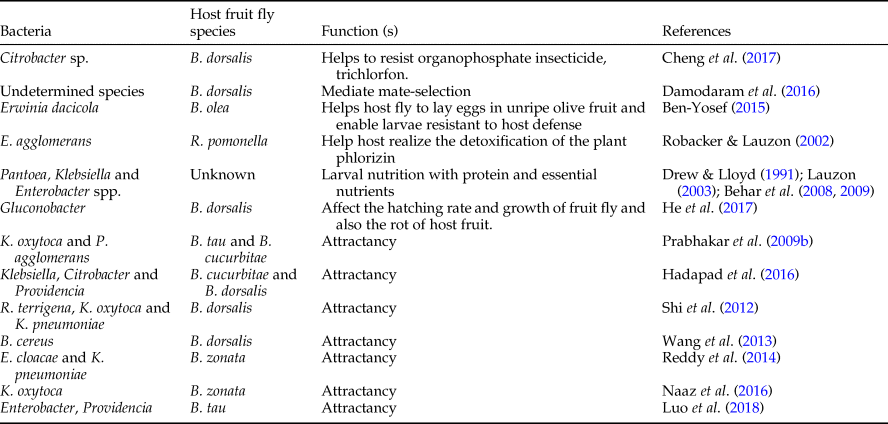
Commonly, fruit flies are associated with rot-inducing, free-living bacteria (mainly those of the Enterobacteriaceae family such as Enterobacter spp., Pantoea and Klebsiella), which might be enter into the fruit by ovipositor during female oviposition and enhance larval development by providing protein and necessary nutrients (table 2) (Drew & Lloyd, Reference Drew, Lloyd, Barbosa, Krischik and Jones1991; Lauzon, Reference Lauzon, Bourtzis and Miller2003; Behar et al., Reference Behar, Jurkevitch and Yuval2008, Reference Behar, Ben-Yosef, Lauzon, Yuval, Jurkevich, Bourtzis and Miller2009). Regardless of the affinity of fruit flies for the Enterobacteriaceae family, most fruit flies have only a weak alignment with somewhat specific species of bacteria but they can increase their population independently in fruit tissues; outside the insect gut (Girolami, Reference Girolami1973; Behar et al., Reference Behar, Ben-Yosef, Lauzon, Yuval, Jurkevich, Bourtzis and Miller2009; Martinez-Sañudo, Reference Martinez-Sañudo2009). Bacteria isolated from adult fruit flies and different tissues of fruit flies can attract egg-laying flies (Wang et al., Reference Wang, Yao, Zheng and Zhang2014). Additionally, maximum flies generally tend to keep away from the restrictive situation in green fruit and preferentially lay eggs in ripe fruit (Fletcher, Reference Fletcher1987), that offer higher guide for larval development (Greany, Reference Greany, Robinson and Hooper1989; Messina & Jones, Reference Messina and Jones1990; Joachim-Bravo et al., Reference Joachim-Bravo, Fernandes, Bortoli and Zucoloto2001; Rattanapun et al., Reference Rattanapun, Amornsak and Clarke2009) and for bacterial proliferation (Behar et al., Reference Behar, Jurkevitch and Yuval2008). There is, however, an exception: the bacteria Erwinia dacicola (table 2) in B. oleae helps the host fly lay eggs in unripe olive fruit and enables larval resistance to host plant defenses (Ben-Yosef, Reference Ben-Yosef, Pasternak, Jurkevitch and Yuval2015). The symbionts provide digestive enzymes or vitamins that are absent from the fruit tissues of the host plant and improve digestion efficiency; consummately affects the survival capacity, fecundity with growth and development of host flies (Robacker & Lauzon, Reference Robacker and Lauzon2002). Bacteria isolated from R. pomonella can help the host in detoxification of phlorizin from the plant. Genes encoding detoxifying and digestive enzymes were identified in the bacteria associated with B. oleae, indicating the potential ability of associated bacteria to help the host fly survive in green olives (Pavlidi et al., Reference Pavlidi, Giotil, Wybouw, Dermauw, Ben-Yosef, Yuval, Jurkevich, Kampouraki, Leeuwen and Vontas2017). The bacteria can mediate mate selection in B. dorsalis by attracting male flies to females harboring the microbiota and by causing the male flies to ejaculate more sperm into the females (Damodaram et al., Reference Damodaram, Ayyasamy and Kempraj2016). Certain bacteria also possess the ability to degrade pesticides (Robertson & Alexander, Reference Robertson and Alexander1994; Sonia Rodríguez-Cruz, Reference Sonia Rodríguez-Cruz, Jones and Bending2006), suggesting that symbiotic bacteria of insects may also contribute to insecticide resistance. The ability of the gut symbiont Citrobacter sp. to resist the organophosphate insecticide trichlorfon (table 2) has been confirmed in B. dorsalis (Cheng et al., Reference Cheng, Guo, Riegler, Xi, Liang and Xu2017)
Function of the symbiotic bacteria in related to economic fruit fly.

Research shows that bacteria are scattered into the alimentary tract of female flies, which are then shifted to eggs and then to the fruit by ovipositor; the bacteria are ultimately inherited by the fly's offspring (Shi et al., Reference Shi, Wang and Zhang2012). Symbiotic bacteria has a great contribution on adult survival (Capuzzo et al., Reference Capuzzo, Firrao, Mazzon, Squartini and Girolami2005) by providing some essential compound, if, which are rare in host fruit, pectin degradation and nitrogen fixation (Behar et al., Reference Behar, Yuval and Jurkevitch2005). Gluconobacter, one of plant pathogenic bacteria was confirmed to affect the hatching rate and growth of B. dorsalis and the rot rate of host fruit (He et al., Reference He, Jiang and Cheng2017). The precise function of bacterial association of different species of the fruit fly isn't properly understood, and an additional look at is required. With the development of next-generation sequencing method and current biological techniques, more and more attention has been paid to the function of symbiotic bacteria. Genes encoding detoxifying and digestive enzymes have been verified to help host olive fruit fly endure the green olive (Pavlidi et al., Reference Pavlidi, Giotil, Wybouw, Dermauw, Ben-Yosef, Yuval, Jurkevich, Kampouraki, Leeuwen and Vontas2017)). The function of one single symbiotic bacteria and its transmission in the host fly is still the focus of attention. The function of the key genes from symbiotic bacteria further rises to the hot research topic.
Bacterial symbionts in pest management techniques of tephritids
Recently, symbionts have been used for developing control strategies against pest insect populations because chemical pesticides lead to environmental pollution, risks to human health hazard and chemical resistance and to the death of beneficial insects as well as rapid loss of biodiversity. Bacteria have been seen to be environed in toxic compounds degradation which ingested by host insects, propulsion to insecticide resistance (Eutick et al., Reference Eutick, O'Brien and Slaytor1978; Fukatsu & Hosokawa, Reference Fukatsu and Hosokawa2002). Bacterial odors have been used in pest management strategies as attractants (pheromone traps), bait sprays (Robacker, Reference Robacker2007; Sood et al., Reference Sood, Prabhakar and Mehta2010; Naaz et al., Reference Naaz, Choudhary, Prabhakar, Moanaro and Maurya2016) and stimulation of insect feeding or oviposition (Drew & Lloyd, Reference Drew and Lloyd1987; Jang & Nishijima, Reference Jang and Nishijima1990; Lauzon et al., Reference Lauzon, Sjogren and Prokopy2000). Symbiont biology has received increasing attention because insect symbionts can potentially be used to control vector-borne diseases or to suppress insect pests (Crotti et al., Reference Crotti, Rizzi, Chouaia, Ricci, Favia, Alma, Sacchi, Bourtzis, Mandrioli, Cherif, Bandi and Daffonchio2010).
Bacterial odors as attractants
Various protein bait formulations have been used as attractants for many years in tephritid control programs. The attractancy of protein solutions containing bacteria to tephritids was first reported in 1954, when B. dorsalis in Hawaii strongly responded to solutions containing Proteus species (Gow, Reference Gow1954). Fruit-fly-type bacteria were grown on peptone-yeast-extract agar (Drew et al., Reference Drew, Courtice and Teakle1983), and hydrolyzed protein solutions inoculated with these bacteria were seen to strongly attract wild Bactrocera species (Drew & Fay, Reference Drew and Fay1988). Furthermore, in the absence of PIB-7 (protein hydrolysate), the response of flies (B. tryoni) to the bacteria was significantly high, but relatively lower than the response of flies to bacteria exposed to PIB-7 (Jang & Nishijima, Reference Jang and Nishijima1990). Volatile compounds, such as 2-butanone, from bacteria were important attractants of dacinae and served as both feeding attractants for females and sex attractants for mature males (Drew, Reference Drew1987). But, 3-methyl-1-butanol and ammonia released from Enterobacter agglomerans attracted only female sex of the Caribbean fruit fly, Anastrepha suspense (Epsky et al., Reference Epsky, Heath, Dueben, Lauzon, Proveaux and Maccollom1998). Several volatile compounds, such as ammonia, isoamylamine, trimethylamine, 2,5-dimethylpyrazine, 2-methyl-butylamine, and acetic acid, were presented in cultures of Staphylococcus aureus (Robacker & Flath, Reference Robacker and Flath1995); 3-methyl-1-butanol, 2,5-dimethylpyrazine, phenethyl alcohol, 3-(methylthio)-1-propanol and 2-methyl-1-propanol were identified from the bacteria K. pneumonia (Lee et al., Reference Lee, Demilo, Moreno and Martinez1995); butyl isocyanatoacetate, 3-methyl-1-butanol, 2-methyl-1-propanol and 2-phenylethanol, and were found from bacteria, C. freundii and K. oxytoca (Hadapad et al., Reference Hadapad, Prabhakar, Chandekar, Tripathi and Hire2016).
Two predominant symbionts, K. oxytoca and P. agglomerans (reported by Prabhakar et al., Reference Prabhakar, Sood, Mehta and Choudhary2009b), of B. tau exhibit attractancy toward two species of fruit fly, namely, B. cucurbitae, and B. tau (Sood et al., Reference Sood, Prabhakar and Mehta2010). But, in recent research, Enterobacter cloacae Enterobacter sp., and Providencia alcalifaciens attract more adult both male and female of B. tau (Luo et al., Reference Luo, Zhang, Du, Idrees, He, Chena and Jia2018).
Metabolites from K. oxytoca attracted more adult of B. dorsalis in field condition whereas other two bacteria R. terrigena and K. pneumoniae had the capacity to attract (Shi et al., Reference Shi, Wang and Zhang2012). However, it is showed that metabolites from B. cereus allured the highest number of B. dorsalis adults in the laboratory and in the field (Wang et al., Reference Wang, Jin, Peng, Zhang, Chen and Hua2013). On the other hand, bacterial suspension from Citrobacter, Klebsiella, and Providencia attracted a significantly higher number of females compared to males of B. cucurbitae and B. dorsalis (Hadapad et al., Reference Hadapad, Prabhakar, Chandekar, Tripathi and Hire2016).
The bacteria E. cloacae and K. pneumoniae exhibited the highest attractancy toward all age groups of B. zonata (Reddy et al., Reference Reddy, Sharma and Singh2014). However, K. oxytoca showed the highest attractancy toward adult female B. zonata compared to the metabolites produced by other bacteria, and compared to the combinations of these metabolites used in the field bioassay (Naaz et al., Reference Naaz, Choudhary, Prabhakar, Moanaro and Maurya2016). An interesting finding from Naaz et al. (Reference Naaz, Choudhary, Prabhakar, Moanaro and Maurya2016) was that the individual bacterial metabolites attracted more male adult flies of B. zonata compare to metabolites from a combination of different bacteria. Female flies harboring bacteria showed a higher ability to attract males than the female flies whose microbiota had been abolished by antibiotic treatment (Damodaram et al., Reference Damodaram, Ayyasamy and Kempraj2016).
The enchantment of fruit fly adults to intestine bacteria is especially because of the presence of chemical compounds along with ammonia, alcohols, ketones, sulfur-containing compounds, several amines, pyrazines, phenols and acetic acid (DeMilo et al., Reference DeMilo, Lee, Moreno and Martinez1996; Robacker et al., Reference Robacker, Martinez, Garcia and Bartelt1998; Liscia et al., Reference Liscia, Angioni, Sacchetti, Poddighe, Granchietti and Setzu2013; Hadapad et al., Reference Hadapad, Prabhakar, Chandekar, Tripathi and Hire2016). But sometimes, combinations of attractive chemicals are not attractive (Robacker et al., Reference Robacker, Lauzon and HE2004). The response of fruit flies to specific bacteria pointed out that, a system of bacterial attraction for fruit flies possibly exists in nature and also may contribute the fruit fly behaviour.
Potential application of symbionts in fruit fly control
Manipulation of symbionts for the control of tephritids was first proposed in 1929–30. For killing of symbiotic bacteria, foliar application of copper carbonate was suggested firstly and at a later stage, this preparation was improved by adding sugar (Baker et al., Reference Baker, Stone, Plummer and McPhail1944; Fytizas & Tzanakakis, Reference Fytizas and Tzanakakis1966a, Reference Fytizas and Tzanakakisb). Treatment of the larvae of the melon fruit fly B. cucurbitae with the antibiotics oxytetracycline and sulfanilamide destroyed the symbiotic microorganisms in the mycetocytes of the midgut region and eventually led to reduced larval survival rates (Chinnarajan et al., Reference Chinnarajan, Jayaraj and Narayanan1972). These two approaches (copper and antibiotics) were the first steps toward this application; however, these approaches failed to be commercialized because of the low efficacy of copper carbonate and the residual hazards of streptomycin and other antibiotic treatments. Then, copper was reported to play an important role as symbioticide in the elimination of fruit-fly-associated bacteria and was thus helpful in managing the first- and second-instar larvae of olive fruit flies (Belcari & Bobbio, Reference Belcari and Bobbio1999).
Endosymbiotic bacteria of the genus Wolbachia induce cytoplasmic incompatibility, thelytokous parthenogenesis, male-killing or feminization in their hosts, and thus, these bacteria may be useful in IPM (Jamnongluk et al., Reference Jamnongluk, Kittayapong, Baimai and O'Neill2002). As a primary symbiont, Wolbachia has been used to control an important malaria vector, Anopheles stephensi (Bian et al., Reference Bian, Joshi, Dong, Lu, Zhou, Pan, Xu, Dimopoulos and Xi2013). However, Wolbachia has not been applied in tephritid fruit flies by now. The most important obstacle is the low infection of Wolbachia. How to resolve this problem determines whether we can use Wolbachia for tephritid fruit fly management. Finding effective Wolbachia strains with a high infection rate from genetically close species, and introducing it into the target tephritidae fruit fly through genetic modification can be an effective solution (Bian et al., Reference Bian, Joshi, Dong, Lu, Zhou, Pan, Xu, Dimopoulos and Xi2013). Foliar application of the fruit fly symbiont K. oxytoca as bait in combination with insecticides under field conditions resulted in a significant reduction in fruit fly infestation (65.46%) relative to the untreated control (79.56%) (Sood et al., Reference Sood, Prabhakar and Mehta2010). Gut bacteria of Mediterranean fruit fly are related to the management of this fruit fly (Ben Ami et al., Reference Ben Ami, Yuval and Jurkevitch2010; Gavriel et al., Reference Gavriel, Gazit, Jurkevitch and Yuval2011).
Recently one of the strategies for controlling these invasive pest species is sterile insect technique (SIT). Gut symbiotic bacteria, E. agglomerans and K. pneumoniae increase mating performance, calling activity, or life expectancy of mass-reared male of C. capitata (Niyazi et al., Reference Niyazi, Lauzon and Shelly2004). But gamma irradiation influences the gut microbial community by reduction of Klebsiella sp. and increase the Pseudomonas sp. abundance that phenotypically affects the performance of the sterile male (Ben Ami et al., Reference Ben Ami, Yuval and Jurkevitch2010). However, increasing of K. oxytoca led to stable colonization and decreasing the abundance of Pseudomonas spp., accelerate mating competitiveness compared with wild males. Furthermore, bacteria belonging to the family Enterobacteriaceae, in which one of the members is K. oxytoca, extended the longevity of the fly (Behar et al., Reference Behar, Jurkevitch and Yuval2008). Enterococcus phoeniculicola, another isolated gut bacteria, can promote the larval and pupae developmental, while Lactobacillus lactis showed negative effects on B. dorsalis development (Khaeso et al., Reference Khaeso, Andongma, Akami, Souliyanonh, Zhu, Krutmuang and Niu2018). This approach can be used proudly to prolong the survival capacity of the sterile male insect, that can be improved the success rate of SIT programs. On the other hand, commensal bacteria influence many aspects of an organism's behavior. In B. dorsalis, the fly microbiota can mediate mate selection. Compared to female flies whose bacteria had been abolished by antibiotic treatment, male flies were attracted to and ejaculated more sperm into females harboring the microbiota (Damodaram et al., Reference Damodaram, Ayyasamy and Kempraj2016). The effect of commensal bacteria on the mate-selection behavior of B. dorsalis could be useful for devising control operations against this devastating pest (Yuval et al., Reference Yuval, Ben-Ami, Behar, Ben-Yosef and Jurkevitch2013).
The identification of the symbiont Citrobacter sp., which plays a key role in the degradation of trichlorfon, leading to insecticide resistance opened new avenues of research for the control of the most economically important fruit fly Bactrocera dorsalis (Cheng et al., Reference Cheng, Guo, Riegler, Xi, Liang and Xu2017). On the other hand, the symbiotic bacteria modified with toxin genes can be used in the management of fruit flies (Sood & Nath, Reference Sood and Nath2005). Fluorescence in situ hybridization showed that the bacteria was aggregated in rectal pads, and can be vertically transmitted via egg surface contamination. The important biological role of these bacteria in the fitness of host insects provide us broader application prospects of this pesticide – resisting bacteria for pest management (Guo et al., Reference Guo, Lu, Yang, Zeng, Liang and Xu2017).
Symbiotic bacteria play a potential role in the rearing of parasitoids as host detection (Leroy et al., Reference Leroy, Sabri, Heuskin, Thonart and Lognay2011), breakdown host defense mechanism as well as quality improvement. This area is not well studied in tephritids, but the findings from other host-parasitoid systems (Thibout et al., Reference Thibout, Guillot and Auger1993; Hoffmeister & Gienapp, Reference Hoffmeister and Gienapp1999; Paredes et al., Reference Paredes, Herren, Schupfer and Lemaitre2016) may be pertinent for the mass-rearing and applications of parasitoids on tephritids. For instance, chemicals from the host feces often influence host detection. As for example, parasitoid was Halticoptera laevigata and its host Myoleja lucida (Hoffmeister & Gienapp, Reference Hoffmeister and Gienapp1999). This interaction was shown to be mediated by microbes in moth parasitoid Diadromus pulchellus (Wesmael) (Thibout et al., Reference Thibout, Guillot and Auger1993). Symbiotic bacteria possess a direct or indirect effect on defensive mechanism against parasites and pathogens (Oliver et al., Reference Oliver, Smith and Russell2014). As for example, bacterial species, Serratia symbiotica (Oliver et al., Reference Oliver, Russell, Moran and Hunter2003), Candidatus Hamiltonella defensa (Schmid et al., Reference Schmid, Sieber, Zimmermann and Vorburger2012) and Regiella insecticola (Vorburger et al., Reference Vorburger, Gehrer and Rodriguez2010), found from the aphids have great contribution as a protective symbiont. However, several studies suggest that Spiroplasma is a defensive symbiotic bacterium of Drosophila (Xie et al., Reference Xie, Winter, Winter and Mateos2015; Paredes et al., Reference Paredes, Herren, Schupfer and Lemaitre2016). These types of protective bacteria may exist in tephritids, used for the rearing of parasitoids but several studies are required. On the other hand, host bacteria not only involve in host immunity but also create a suitable environment of parasitoids rearing as well as improve the quality such as size, fecundity and longevity of parasitoids. An elegant example of parasitoid, D. longicaudata with host, Anastrepha ludens (Eben et al., Reference Eben, Benrey, Sivinski and Aluja2000; Cicero et al., Reference Cicero, Sivinski and Aluja2012).
The attractancy of gut bacterial symbionts to fruit fly species has low-field efficacy (Sood et al., Reference Sood, Prabhakar and Mehta2010). Therefore, bacterial attractancy alone is not an effective control measure. Maybe extracellular extracts can be used as odors instead of bacteria itself in the future. Bacterial attractancy can be used only for pest monitoring and surveillance. Attractancy, SIT and parasitoids application can be complementary approaches; the use of natural predators (parasitoids) is generally more efficient in case of is higher host intensity, whereas in low host densities, SIT is generally more efficient based on theoretical models as well as field studies (Barclay, Reference Barclay1987; Bloem et al., Reference Bloem, Bloem and Knight1998). These three methods can be integrated as components of Integrated Pest Management (IPM) strategies.
Conclusions and research gap
Bacterial endosymbionts are reported to be common in insects, especially in fruit flies. Molecular tools are essential to improve our knowledge of fruit fly ecology. Recently, next-generation sequencing of PCR-generated amplicons (16S rRNA gene) has been successfully employed (Lemos et al., Reference Lemos, Adaime, De Jesus-Barros and De Deus2014; Wang et al., Reference Wang, Yao, Zheng and Zhang2014; Cheng et al., Reference Cheng, Guo, Riegler, Xi, Liang and Xu2017; Yong et al., Reference Yong, Song, Chua and Lim2017a, Reference Yong, Song, Chua and Limb), and compare to traditional method of microbiota identification, these high-throughput technologies have shown a higher diversity of microbiota. However, the short sequences used for high-throughput sequencing only identify bacteria at the genus level, which restricts access to detailed molecular information. Elucidation of the functions of the bacteria in and for the hosts will be a major step toward understanding bacterium-fruit-fly associations. The in vivo and in vitro experiments on cultivable bacteria make it easier to determine the functions of symbiotic bacteria (Cheng et al., Reference Cheng, Guo, Riegler, Xi, Liang and Xu2017). However, the uncultivable nature of many symbionts makes the identification of bacterial function more challenging. In recent years, antibiotics have been very useful to abolish or modulate the targeted gut bacteria, which makes up for the limitations of non-cultivability (Damodaram et al., Reference Damodaram, Ayyasamy and Kempraj2016). However, this method also has disadvantages; non-lethal and toxic concentrations of antibiotics can influence the results of the experiment. It is important to focus on the selection of correct negative controls in order to eliminate the influence of the antibiotic on the experimental results. Perhaps in the future bacteriophages can be used instead of antibiotics to eliminate bacteria (Louradour et al., Reference Louradour, Monteiro and Inbar2017). While for the cultivable gut bacteria, identification of their clear localization and transmission pathway between intra- and inter-species will also be useful for the function study and for the future pest management technologies (Guo et al., Reference Guo, Lu, Yang, Zeng, Liang and Xu2017).
In this review, we described several families and genera of bacteria that are associated with 17 economically important species of the fruit fly; however, there are more than 250 species that are economically significance (Li et al., Reference Li, Jiang, Ma, Fang, Sun, Qin and Wang2013). To date, the diversity of bacteria in many economically important species of fruit fly is unknown. The members from Enterobacteriaceae are often considered to be the dominant bacteria of several tephritids, such as Anastrepha, Dacus, Bactrocera and Ceratitis. Bacteria of this family (E. herbicola, E. cloacae and K. oxytoca) are believed to mediate interactions between adult fruit flies and the larval host plant. To date, few specific functions of symbiotic bacteria have been identified, but most of the functions remain unknown.
Symbiotic bacteria have great attraction potential. This property is useful for fruit fly monitoring and surveillance, but for fruit fly control, bacterial attractancy should be combined with SIT and the use of parasitoids. However, there is little known about the mass rearing of parasitoids of fruit flies and about the associated microbiota. In addition, an in-depth study on the functions of the symbiotic bacteria of fruit flies can provide a new target for novel control techniques based on sterilization. Many interesting and meaningful scientific questions deserve our further study. How to get the extraction with high attracting ability from symbionts? How to find suitable Wolbachia strains and use them for fruit fly management after genetic modification? What is the function of some single strains and the mix function of several strains? What is the molecular mechanism of the function of symbiotic bacteria? Which genes control those functions? What we can get from the genome and transcriptome of symbiotic bacteria? All these further studies on the bacteria of fruit flies will also help develop the use of bacteria as an environmentally friendly method to control infestations of fruit and vegetable pests.
Acknowledgements
We thank all other members of the Plant Quarantine and Invasion Biology Laboratory of China Agricultural University (CAUPQL) for their valuable suggestions to improve this manuscript. The National Key Research and Development Project of China (No. 2016YFC1200605) and the Natural Science Foundation of Beijing (No. 6174043) provided the financial support for this study.
Disclosure
The authors declare that there is no conflict of interest among them.