INTRODUCTION
Immigration touches virtually every dimension of social, political, and economic life, and now most reaches of the U.S. map. But for some segments of the U.S. population, the changes immigration brings may be especially significant. Notably, African Americans, who are the most segregated and over-represented in the bottom portion of the socioeconomic distribution (Rugh and Massey, Reference Rugh and Massey2013), increasingly find themselves living side-by-side with newcomers from Latin America, the largest source of today’s immigrant population (Camarillo Reference Camarillo2007; Logan and Zhang, Reference Logan and Zhang2011; Rodríguez Reference Rodríguez2012). Black contact with Latinos has increased dramatically nationwide, partly the result of the influx of Latino immigrants in the Midwest and South, but also as a result of their settlement in metro areas of historically high Black concentration within traditional immigrant-settlement regions (Telles et al., Reference Telles, Sawyer and Rivera-Salgado2011). Using surveys, social-science research necessarily relies on a priori definitions of groups, assessing the economic implications of this trend on African Americans (Borjas Reference Borjas1999; Card Reference Card2005), or on the attitudinal and even violent reactions by African Americans (Bergesen and Herman, Reference Bergesen and Herman1998; Bobo and Johnson, Reference Bobo, Johnson, Bobo, Oliver, Johnson and Valenzuela2000; Gay Reference Gay2006; Hutchins and Wong, Reference Hutchings and Wong2014) and Latinos (McClain et al., Reference McClain, Carter, DeFrancesco Soto, Lyle, Grynaviski, Nunnally, Scotto, Kendrick, Lackey and Cotton2006). By defining groupness a priori in broad ethnoracial terms (i.e., “Black” and “Latino”), survey research is generally unable to capture potentially important nuances in how Blacks and Latinos construct social groupings—whether ethnoracial or not—in everyday life (Fox and Jones, Reference Fox and Jones2013). Given the growing body of research showing myriad kinds of groupings in ethnoracially mixed settings (Hannah Reference Hannah, Good, Willen, Hannah, Vickery and Park2011; Horton Reference Horton1995; Vertovec Reference Vertovec2007; Watson and Saha, Reference Watson and Saha2013; Wimmer Reference Wimmer2004; Woldoff Reference Woldoff2011), the study of Black/Brown relations advances by answering the question: How do African Americans construct groups in settings defined by large numbers of African Americans and Latinos? I take up this question by employing an inductive approach, drawing on fieldwork among African Americans in East Palo Alto, California, a Black-majority-turned-Latino-majority city in Silicon Valley, to offer an “on-the-ground” view of the way African Americans experience and make sense of “symbolic boundaries” – “conceptual distinctions made by social actors to categorize objects, people, practices, and even time and space” (Lamont and Molnár, Reference Lamont and Molnár2002, p. 168). The interviews show that ethnoracial symbolic boundaries are relevant to Blacks in the way that group position theories would predict (Blumer Reference Blumer1958; Bobo and Tuan, Reference Bobo and Tuan2007). Respondents’ reading of the context they navigate in the broadest terms invokes ethnoracial boundaries as a source of significant division. African Americans see Latinos as having overwhelmed Black material prowess in the job market and local commerce, as well as Black access to services for the indigent. Similarly, respondents see Latino immigrant settlement as contributing to the decline of Black collective identity in a city that has historically been known as the Black community in Silicon Valley. But respondents’ interpretation of the context they navigate also points to interpersonal cooperation similar to what the contact hypothesis would predict (Allport Reference Allport1954; Pettigrew Reference Pettigrew1998). Indeed, ethnoracial origin is not an exclusive frame through which African Americans understand boundaries in East Palo Alto. Their accounts of inter-personal interactions highlight intra-ethnoracial-group distinctions defined by language and neighborhood tenure that interact with ethnoracial group boundaries in structuring respondents’ rendering of symbolic boundaries. Respondents point out how the ability to speak English and long-time residence in the neighborhood are important factors facilitating ties and cooperation across ethnoracial lines.
The findings point to the importance of intra-ethnoracial group differences – marked by language, legal status, generation-since-immigration, socioeconomic status, etc. – for inter-ethnoracial-group attitudes and relations. Growing variation within ethnoracial groups does not eliminate ethnoracial boundaries, but interacts with perceptions of ethnoracial boundaries, making them porous to other kinds of distinctions that mark divisions within ethnoracial groups. These non-ethnoracially based boundaries encompass individuals across ethnoracial lines based on other relevant shared characteristics, like language and neighborhood tenure. Moreover, these findings suggest that the competition and contact perspectives may operate simultaneously. As I point out in the conclusion, adopting ethnographic and survey research practices that treat boundaries as multiplex will better capture how growing intra-ethnoracial-group diversity shapes inter-ethnoracial-group relations.
“Black/Brown” Relations in an Era of Mass Migration
There is a long history of scholarship showing the neighborhood dynamics that unfold when minorities move into formerly White dominated context (Rieder Reference Rieder1987; Sugrue Reference Sugrue1996; Taub and Wilson, Reference Taub and Wilson2007; Woldoff Reference Woldoff2011). But, in view of changing immigration-driven demographics that find native- and foreign-born minorities living and working in close proximity, scholarship on intergroup relations has increasingly turned its attention toward inter-minority relations. Early observations produce a picture of hostility between minority groups in general, and Blacks and Latinos in particular, showing that distrust (Putnam Reference Putnam2007), conflict (Hutchinson Reference Hutchinson2007; Vaca Reference Vaca2004), and even violence emerge (Bergesen and Herman, Reference Bergesen and Herman1998; Olzak Reference Olzak1992). Others focus on attitudinal dimensions of relations, showing that Blacks and Latinos carry strong stereotypes about one another as part of often negative inter-group attitudes (Bobo et al., Reference Bobo, Oliver, Johnson and Valenzuela2000; McClain et al., Reference McClain, Carter, DeFrancesco Soto, Lyle, Grynaviski, Nunnally, Scotto, Kendrick, Lackey and Cotton2006). Attempts to introduce nuance into the understanding of Black/Brown relations have shown a mixed picture of both attitudes and everyday interactions (McDermott Reference McDermott, Telles, Sawyer and Rivera-Salgado2011). Drawing on studies in multiple contexts that employ a range of methods, Telles et al. (Reference Telles, Sawyer and Rivera-Salgado2011) conclude that a spectrum of conflict and cooperation exists across and even within contexts (also see Foner Reference Foner, Rosenblum and Tichenor2012). Research on racial attitudes, a core component of inter-group relations, supports this conclusion. Gay (Reference Gay2006) shows that the less well-off Blacks are relative to Latinos, the more negative their attitudes toward Latinos. Mindiola et al. (Reference Mindiola, Niemann and Rodriguez2002) find that attitudes among Blacks in Houston cannot be easily situated in a negative/positive dichotomy. These studies add important correctives to early conceptions of Black/Latino relations as conflict-ridden, but they nonetheless treat ethnoracial symbolic boundaries as more or less impermeable.
The assimilation tradition likewise depends upon an a priori definition of groups to guide investigations of how immigrant groups become more similar to a host population and its ethnoracial and class segments. In the segmented assimilation account, poor urban areas previously defined by African Americans produce a downward assimilation trajectory for the second-generation children of immigrants who grow up there (Portes and Rumbaut, Reference Portes and Rumbaut2001; Waters Reference Waters1999). Footnote 1 Even newer versions of assimilation, which remedy the shortcomings of previous assimilation theories by offering an account of change among non-immigrant, native-born populations, largely rely on ethnoracial groups as the central delineator between insiders and outsiders. In their “new assimilation” theory, Alba and Nee (Reference Alba and Nee2003) define assimilation as the decline of an ethnoracial boundary.
Examinations of immigration settlement and adaptation that follow Barth (Reference Barth1969) in taking ethnoracial social boundaries as given may miss how other kinds of symbolic boundaries operate in everyday life, and their bearing on inter-group relations. Such a consideration is particularly important in a time when growing socioeconomic inequality, intermarriage (Vasquez Reference Vasquez2014; Wang Reference Wang2012), ethnoracial hybridity (Lee and Bean, Reference Lee and Bean2010), language (Rumbaut et al., Reference Rumbaut, Massey and Bean2006), legal status (Gonzales Reference Gonzales2011; Menjívar and Abrego, Reference Menjívar and Abrego2012), and residential mobility (Logan and Zhang, Reference Logan and Zhang2011; Sharkey Reference Sharkey2014) characterize both between and within ethnoracial-group difference (Alba et al., Reference Alba, Jiménez and Marrow2014; also see Jiménez et al., Reference Jiménez, Fields and Schachter2015). As Wimmer (Reference Wimmer2013, Reference Wimmer2008) points out, endogenous compositional changes to a group through assimilation and exogenous changes via immigration can make boundaries blurrier by introducing intra-group differences that make ethnoracial group boundaries more porous (also see Lamont and Molnár, Reference Lamont and Molnár2002). This effect is apparent in studies of how different kinds of boundaries operate in everyday life (Brubaker et al., Reference Brubaker, Feinschmidt, Fox and Grancea2007; Fox and Jones, Reference Fox and Jones2013; Wimmer Reference Wimmer2004, Reference Wimmer2013; Wise and Velayutham, Reference Wise and Velayutham2009). In a broad theoretical statement, Vertovec (Reference Vertovec2007) contends that ethnoracial diversity is just one dimension of immigration-driven diversity, which also includes, among other dimensions, immigration status; labor market experiences; gender and age profiles; and patterns of spatial distribution. Studies of neighborhoods in various European cities lend credence to Vertovec’s claims, showing that the distinction between established and non-established residents is more salient than the difference between ethnoracial insiders and outsiders (Watson and Saha, Reference Watson and Saha2013; Wimmer Reference Wimmer2004; Wise and Velayutham, Reference Wise and Velayutham2009). More recently, scholars of U.S. diversity have dissected the way in which intragroup differences shape inter-ethnoracial group boundaries. Notably, Hannah’s (Reference Hannah, Good, Willen, Hannah, Vickery and Park2011) ethnographic research in health clinics shows that, in spite of healthcare models that encourage health practitioners to emphasize “cultural” (i.e., ethnoracial) competency, practitioners look beyond ethnoracial background in assessing the needs of patients precisely because they recognize multiple and cross-cutting kinds of diversity among the people they serve. Similarly, neighborhood studies show the most salient dividing line between individuals is that between long-time residents and newcomers, regardless of ethnoracial origin (Horton Reference Horton1995; Woldoff Reference Woldoff2011).
This body of work shows the salience of ethnoracial boundaries remains high, but that the way individuals make sense of these boundaries is multifaceted due to growing intra-group variation. Advancing the understanding of Black/Brown relations requires placing a similar lens on contexts defined by Blacks and Latinos, allowing individuals who navigate these contexts to articulate how they experience and make sense of the kinds of symbolic boundaries they encounter in all their potential complexity and variation. Such an approach reveals not only whether there is conflict, cooperation, mutual ignorance, or a combination of these outcomes. It also reveals the bases for these outcomes.
SETTING
The analysis draws on field research in East Palo Alto, California. The city has been, historically, the Black community in Silicon Valley, a region defined mostly by its wealth-generating high-tech industry, its large and diverse immigrant population, and its small overall Black population (Saxenian Reference Saxenian1999; Singer et al., Reference Singer, Hardwick and Brettell2008). African Americans began coming to East Palo Alto in large numbers in the late 1950s and early 1960s, when the city was overwhelmingly White. As they moved in, the processes that produced segregation in large urban areas—redlining, blockbusting, White flight—unfolded (Massey and Denton, Reference Massey and Denton1993). By 1970, the majority (61%) of individuals in East Palo Alto were Black. Residents embraced the city’s distinctly Black identity. For instance, a group of education activists helped established a school with an Afro-centric curriculum in the mid-1960s, and in 1968, residents nearly voted to rename East Palo Alto “Little Nairobi,” a name that they ultimately attached to the main shopping center (Berman Reference Berman2002; Hoover Reference Hoover1992). This pride existed alongside other, troubling circumstances. Beginning in the 1980s and lasting through the early 1990s, a crack-cocaine epidemic and drug-related violence swept through East Palo Alto, reaching a boiling point in 1992, when the city was the U.S. per-capita murder capital (with a murder rate of 173 per 100,000 people). African-Americans’ demographic dominance remained until the early 1990s, when large numbers of Latino as well as Pacific Islander immigrants began moving into the city, one of few pockets of relatively affordable housing in the region. Long-time Black residents began moving out, mostly to cash in on large home equity gains. By the early part of the new millennium, the city had transformed into a Latino-majority locale.
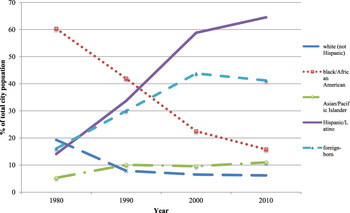
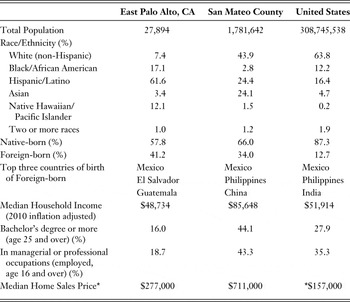
As Figure 1 shows, East Palo Alto experienced a dramatic change in its population during the last few decades. As recently as 1990, 30% of residents were foreign-born; 42% were Black, 36% were Hispanic, 9% were Asian or Pacific Islander, and 12% were non-Hispanic White. As Table 1 shows, by 2010, 41% were foreign-born; 16% were Black, 65% were Hispanic, 11% were Asian/Pacific Islander, and 6% were non-Hispanic White. Footnote 2 Immigrants in East Palo Alto overwhelmingly come from Latin America, particularly Mexico. Footnote 3 Though the city’s crime rate has declined considerably since its peak in the early 1990s, it is still more than double the California average (Lawrence and Shapiro, Reference Lawrence and Shapiro2010). East Palo Alto remains a poor community in a region known for its wealth. The median household income is $48,734 (slightly less than $30,000 per year when adjusting for the cost of living) Footnote 4 compared to a county median of $85,648. Just 16% of the city’s population holds a bachelor’s degree or higher; and less than a fifth of its residents work in managerial or professional occupations.
Demographic Change in East Palo Alto, 1980–2010.
Source: United States Decenial Census.

Selected Characteristics of East Palo Alto, San Mateo County, and the United States, 2006–2010

Sources: American Community Survey, 2006–2010.
* Zillow.com home value index, August 1, 2010.
In spite of East Palo Alto’s high crime rate and low socioeconomic profile, there are seldom instances of overt ethnoracial hostility. Even though gang and drug-related violence are all too common, violent confrontations are generally between members of the same ethnoracial group. As with other locales that have large Black and Latino populations, members of the two groups generally coexist without incident (Martinez and Rios, Reference Martinez, Rios, Telles, Sawyer and Rivera-Salgado2011). Moreover, Blacks and Latinos have extensive contact in multiple rounds of life: at work, in schools, in the neighborhood, during recreation, and even in romantic pairings. As the paper makes clear later, contact between second-generation Latinos and Blacks tends to be more common than between Blacks and immigrant Latinos.
I chose East Palo Alto for theoretical reasons. I gathered the data this article presents as part of a larger project examining how established populations adjust to immigration-driven change. East Palo Alto represents the poor, minority segment of a host population for a larger study that also includes cities with different ethnoracial and class compositions (Jiménez and Horowitz, Reference Jiménez and Horowitz2013). The study, and thus the findings presented in this paper, focus on established populations, and not on immigrants and their children, as has been customary in immigration-related research.
METHODS & DATA
I gathered sixty in-depth interviews with “third-plus generation” (U.S.-born of U.S.-born parents) residents of East Palo Alto and another fifteen interviews with key informants, including community organizers, clergy, city officials, teachers, and small business owners. I did not choose respondents because of their ethnoracial background. Instead, respondents who are U.S.-born of U.S.-born parents qualified to be in the study. Almost by definition, these “third-plus-generation” established residents of East Palo Alto are Black. I also wanted respondents who have a substantial amount of experience living in the city, and so I only chose respondents who have lived in the city for roughly a decade or more. Very few, if any, African-Americans have moved into the city in the last decade, and so most African-Americans in the city have lived there for an extended amount of time. I relied on my own networks and on community leaders to put me in touch with potential respondents whom I asked to participate in an interview. Footnote 5 I offered each respondent a cash incentive of $45. The interviews lasted between 45 minutes and three hours. Respondents ranged from fifteen to eighty years of age because I was interested in capturing the experiences of individuals who adjust to immigration-driven changes at different points in the life course. All but one of the respondents are Black; thirty-three of the sixty respondents are women. Footnote 6 Most of the interviews were conducted in respondents’ homes, a public park, or the city’s public library study room, which is out of earshot of the library’s patrons. Pilot interviews led me to believe that respondents might censor their comments given that my name is revealing of my Mexican ancestry. Respondents thus knew me as “TJ,” a name that downplays my ethnic origins. My appearance would likely lead respondents to assume that I am (non-Hispanic) White. Downplaying my Mexican ancestry surely did not make me an ethnoracial insider to the African Americans I interviewed. But the salience of Latinoness in this context would have likely made this feature of my identity an impediment to respondents being entirely forthcoming of their views. Footnote 7 I thus downplayed my Mexican ancestry as a precautionary measure. I hired an African-American research assistant who conducted roughly half of the interviews; I conducted the other half. My analysis suggests that the ethnoracial background of the interviewer did not yield differences in what respondents reported, though respondents sometimes implicitly assumed the Black research assistant had knowledge of their circumstances, while not assuming the same knowledge on my part. In such cases, the interviewer probed further, asking respondents to explain or elaborate.
The findings emerge from an interview protocol designed to collect interview data inductively. The interviews did not begin by inviting respondents to discuss their sense of symbolic boundaries as defined by the interviewer (i.e., ethnoracial origin, non-English speakers, etc.). Instead, each interview opened by asking respondents how they would describe East Palo Alto to someone who had never visited the city. The interviewer then posed follow up questions based on the salient features of the city, as defined by the respondent. Respondents’ comments reflecting their view of symbolic boundaries thus emerged from answers to questions that invited them to describe, in broad terms, their daily life and the context in relation to work, family, neighborhood, and social dimensions of life, as well as their sense of the bounds of national identity, and not from questions that steered them to discuss this paper’s topic specifically. Footnote 8
All of the interviews were audio recorded and transcribed verbatim by a professional transcriber. I used Dedoose, a web-based qualitative analysis software to attach coding categories to blocks of related text. I developed an initial set of codes related to inter-group relations. I then developed more specific codes related to the different kinds of groupings, including those based on language and neighborhood tenure, that emerged in interview transcripts. Alongside this coding, I developed my analysis by creating detailed memos that put these data in conversation with the existing literature. The quotes that I present exemplify the themes that emerge prominently from across the interview sample.
FINDINGS
The symbolic boundaries that emerged as salient seemingly confirm the prominent place of ethnoracial boundaries in Black/Brown relations, and the potential conflict that ensues. When assessing intergroup relations, respondents privileged ethnoracial boundaries that got in the way of communal cohesion and that drown out the material and symbolic relevance of African Americans. But in respondents’ interpretations of interpersonal experiences, ethnoracial boundaries are porous to boundaries defined by language use and neighborhood tenure, showing that recognition of intra-ethnoracial-group differences among Latinos structure inter-ethnoracial-group relations.
Ethnoracial Boundaries and Community Relations
Each interview began by asking respondents how they would describe East Palo Alto to someone who had never visited the city. Their answers almost invariably included crime and poverty, but immigration-driven change was also a defining characteristic. Respondents offered causal accounts that link immigration-driven change to the emergence of significant, ethnoracially based symbolic boundaries. Their comments highlight the special significance of this change because of the city’s history of being, self-consciously, the region’s primary Black community. Interviewees were glad to see the crack epidemic and the accompanying violence that engulfed the city during the 1980s and 1990s disappear. But they also longed for a connectedness among Black residents that they saw as more prevalent in the past. Primary drivers of this feeling of fragmentation were the exit of the Black population and its replacement by a large settlement of Latino and, to a lesser extent, Pacific Islander immigrants. Arnold McFadden, Footnote 9 a 39-year-old mechanic, summarized the assessment that others offered when he articulated ethnoracial boundaries as the source of diminished community solidarity:
The neighbors back then seemed to interact a lot more. I think that’s primarily because we were of the same race. Now with the change, with the shift and the Latinos being the greater percentage, there’s not as much interaction between the neighbors.
Q: Why do you think that is?
A: Just different ethnic backgrounds. If you’re of the same ethnicity I think you have more to share, more of a chance to interact when you have the same nationality.
Interviewees’ views of the effect of mass immigrant settlement on solidarity echoes research showing diversity is associated with lower “social capital” (Alesina and La Ferrara, Reference Alesina and La Ferrara2002; Putnam Reference Putnam2007). Footnote 10 To be sure, respondents also blamed economic development that has pushed out small businesses and replaced them with large retail stores. Further, violence and crime, although diminished, remain impediments to community cohesion, as respondents saw it. But immigrant settlement loomed large in their accounts of growing disconnectedness in the city.
Respondents wrapped their construction of ethnoracial group boundaries in concrete, lived experiences. They thus saw ethnoracial symbolic boundaries as social boundaries—“objectified forms of social differences manifested in unequal access to and unequal distribution of resources (material and nonmaterial) and social opportunities” (Lamont and Molnár, Reference Lamont and Molnár2002, p. 168)—apparent in the material and symbolic prowess of Blacks relative to Latinos. Much as in other settings where Blacks perceive economic competition with Latinos (McDermott Reference McDermott, Telles, Sawyer and Rivera-Salgado2011; Mindiola et al., Reference Mindiola, Niemann and Rodriguez2002), a salient instantiation of these boundaries was their view that material resources are reserved for Latinos at the expense of Blacks. East Palo Alto’s former identity as a poor and Black city meant that the institutional focus of service agencies, both public and private, was African Americans. Latinos and the complications associated with immigration – legal status, language, etc. – now dominate the agenda of service agencies at the expense of Blacks. This perceived skewing of resources is particularly apparent to older respondents, who have resided in the city before, during, and after the major immigration-driven shift of the last two decades. Respondents further said this shift in service resources was a function of not just the changing population, but also of Latino group solidarity and resulting competition for resources (McClain et al., Reference McClain, Carter, DeFrancesco Soto, Lyle, Grynaviski, Nunnally, Scotto, Kendrick, Lackey and Cotton2006; McDermott Reference McDermott, Telles, Sawyer and Rivera-Salgado2011). For example, Elaine Middlefield, a sixty-year-old freight service warehouse worker, reflected on harder times when she felt that her ethnoracial background excluded her from accessing resources for which she qualified, while Latinos not only took advantage of the system but also showed group favoritism in various agencies:
I find that being an African American sometimes it’s hard to go to the community and get, like if you need financial help or Medi-Cal or AFDC or food stamps. I just find that [Hispanics] are more ready to help their friend’s race than they are to help African American race…. we were having difficulties trying to keep the family fed with just one paycheck. So I had gone up to the community center on Bay Road…. They didn’t approve it. But yet, and still, the Hispanic immigrants come in and they get pregnant, they have babies born here, but they know how to work the system where everything they need they get. They get WIC, they get Medi-Cal, they get food stamps, they get cash aid. But yet, and still, I go to work every day, pay into these programs, and when I need the help, I don’t even qualify for it. That pisses me off. And when you put Hispanics in the upper positions to help other people, they make sure their race gets every little thing that they qualify for and they’ll tell you, “Oh no, you don’t qualify.”
Respondents said the fact that services focused on Latinos was not surprising, given the large proportion of the city’s residents who are Latino. However, this recognition did not take the edge off of their view that Blacks seem to be invisible to service agencies. Footnote 11 As Elaine’s comments suggest, also factoring into their accounts was a perception that Latino solidarity is a penalty to African Americans who are not privy to the benefits flowing through Latino co-ethnoracial community (Portes and Rumbaut, Reference Portes and Rumbaut2006). The ethnoracial social boundaries extend to the labor market, where some Blacks saw their ethnoracial origin as a basis for exclusion in successful searching for a job. Jaime Jefferson, a forty-three-year-old Black chef from East Palo Alto, had extensive contact with immigrant and second-generation Latinos in multiple realms of life, and even expressed empathy with the plight of unauthorized immigrants to the point of tears. But he nonetheless articulated the sting of exclusion when he applied for a job at a newly opened restaurant:
I do culinary skills, so I knew I was overqualified but I knew I was good for the job, too…. So then [the manager] goes, “Oh yeah. I’ve got everybody I need already. I have my staff. I’m already…” And I’m like, “This is an open interview. How do you have the people already?” So I was like, “I put an application in awhile back and I’m just curious. I never got a call. Was there a reason? Or what was the …” And he goes, “Like I just told you, I pretty much got everybody I need….” He was Mexican…. Every single person in there was Mexican that he was interviewing…. And that made me so angry because I knew for a fact that this guy had called ‘cause Mexicans, Latins…. they really look out for each other. They do. But sometimes they do it to the point to where it’s almost like they’re creating their own little clique or their own .… And I was like, “Wow. He didn’t even consider the application, just by my name alone, I’m sure.”
The ethnoracial networks that serve to integrate immigrants appears as social closure to African Americans who are not included in these networks. Such exclusionary practices instantiate ethnoracial social boundaries as “Black/Latino,” with the former sitting on the bottom of an economic hierarchy that the latter seeks to protect (Wimmer Reference Wimmer2013). Footnote 12 The sense of Black disappearance from policy that respondents articulated has historical parallels. Social policies that ostensibly applied to all, like veterans’ benefits (Katznelson Reference Katznelson2005) and the New Deal, were far less available to Blacks than Whites, and even Latinos (Fox Reference Fox2012). While the interviews do not offer a clear view of whether respondents’ experiences represent a modern incarnation of the ethnoracial favoritism that characterized the past, what is clear is that African Americans perceived ethnoracial symbolic and social boundaries that manifest in the provision of institutional resources that go toward the community’s new needy—Latinos—at the expense of African Americans.
For Blacks in East Palo Alto, their symbolic prowess relative to Latinos was an imprint of the ethnoracial social boundaries they perceive. They saw the waning of symbolic elements of Black identity from the local civic scene as a result of Latino demographic dominance. This fading was especially apparent to the older respondents, who carry the history of a time when city residents, and even the small Black population of Silicon Valley residing outside the city, converged to celebrate a collective pride. For example, at a meeting of Black civic and business leaders I attended, one of the attendees offered an observation that summarizes the general sense of interviewees:
We don’t feel we fit. We definitely are the minority. Definitely what [another member of the groups] saying, where people don’t respect you because they don’t see a presence of your culture. And so not that it needs to be negative but just that we say, “We belong too.” And I don’t sense that any more.
The dynamic this respondent depicts inverts the stereotypical immigrant/native dynamic in which the foreign-born are strangers in a land where the native-born define norms and culture (Gordon Reference Gordon1964). In a separate interview, another community leader lamented that shared knowledge of the city’s rich history of activism was slipping away as the Black population fades:
And we see a lot of that where people come back into the community and say, “Hey, the Walkers used to live there.” Well, the Walkers don’t live there any more. There’s the Martinez family. And what’s really interesting is that the Martinez family can’t tell you a thing about the Walkers; can’t tell you a thing…. Our storytellers are gone…. So what does that mean when you talk about EPA that says Mrs. Gertrude Wilks or a Barbara Mouton (early leaders in the city); when you say that to a Latino family today the majority of them don’t know who they are.
Older Black residents viewed changes through a historical frame of reference that highlights the importance of the early struggles of the city’s African Americans, and thus a respect owed to those struggles by today’s residents. The emphasis by civic leaders on the symbolic threat of Latino immigrants echoes findings in other settings, where Black middle-class individuals emphasize cultural over economic issues (Gay Reference Gay2006; McDermott Reference McDermott, Telles, Sawyer and Rivera-Salgado2011). Small (Reference Small2004) similarly notes how a historical frame of reference accounts for the level of investment made by older residents in a Puerto Rican housing project in Boston. Residents from younger cohorts, Small shows, lacked knowledge of past struggles to improve the neighborhood and are thus less engaged in the community. East Palo Alto residents identify a similar dynamic, except that the cohort change is also an ethnoracial one. The city’s (mostly Latino) young people not only lack the same historical frame of reference, their more recent history of struggle is linked to challenges related to immigration and assimilation, rather than an African American Civil Rights Movement. It is important to note that the city’s institutions and leaders have made efforts to integrate Latinoness into the local civic identity, including observance of César Chávez Day. Yet some older African Americans are concerned that what might have started as incorporation has turned into the symbolic overshadowing of Black identity.
For rank-and-file East Palo Alto residents, the invisibility of Black identity is also apparent. Several respondents noted that the renaming of one of the city’s largest grammar schools to César Chávez Academy marked a visible and significant shift in the identity of a city that once had a thriving Afrocentric school. Others cited the diminished state of once-vibrant public celebrations. East Palo Alto has a Collard Green Festival and a Juneteenth Celebration; the latter commemorates the emancipation of the United States’ last remaining slaves. According to respondents, these events have seen a precipitous decline in prominence. To emphasize the point, some compared these Black celebrations to flourishing Latino-oriented ones, like Cinco de Mayo. Aaron Mullin, a twenty-three-year-old delivery truck driver, whose girlfriend is the daughter of Mexican immigrants, described this dynamic:
The last one we had, I don’t know how they can call that a festival! It wasn’t even a festival. It seemed like it was last minute. They had it on the school grounds. The sprinklers came on while the vendors were out there. They had one performer. It was like somebody just threw that at the last minute. Man this is what it’s come to?! It seems like EPA itself, the castle, it wasn’t like they put too much focus on activities for the African American community. Seems like they’re more leaning towards the Latino community because that’s the bigger population and that’s probably where they’re getting the most income, from that population. So I guess it all comes down to politics and business. It’s just sad that some of the activities that the city used to pride itself on, they really let them go. And it’s sad because sometimes that makes people feel foreign too, knowing that you can’t even stay within your own city and have some type of festival.
As Aaron’s comments illustrate, respondents saw the shifting symbolic representation of Latinos as a logical outcome of the city’s changing demographics. Still, their comments were tinged with what they saw as the irony of finding it more challenging to experience a collective sense of Blackness in a city that has for so long stood as the Black cultural hub of the region.
If the decline of annual festivals is a prominent, but infrequent, reminder of the invisibility of Black identity, the city’s retail landscape is an everyday prompt. Black barbershops and soul food restaurants, important institutions that are difficult to find in Silicon Valley, now number few in East Palo Alto. Respondents explained that the Latino retail scene has become much more prominent. The city’s only major grocery store is Mi Pueblo, a Bay Area-based, Latino-themed store that opened in 2008. In the lead-up to its opening, Black residents of the city as well as some in the city leadership expressed opposition to its establishment for fear that it would not benefit the city’s Black residents. The individuals I interviewed have come around to some degree, frequenting the store to purchase small items, like milk and produce, but still lament having to travel outside of the city to find “mainstream” stores. The decline of existing Black retail institutions is due in part to the razing of “Whiskey Gulch,” the city’s former downtown, and its replacement by a Four Seasons hotel and a large office complex that houses, among other businesses, a major accounting firm. Whiskey Gulch used to be home to several liquor stores and bars, but also to music stores, a wig shop, and soul food restaurants that served as Black cultural anchors. Respondents pointed to the demise of these Black institutions and the rise of Latino establishments as evidence of the city’s changed character, but also as part of what makes it difficult to experience a deep sense of Blackness locally. Rachel Abernathy, who was raised in East Palo Alto and still lives in the city, is a thirty-seven-year-old executive assistant who mourns the disappearance of Black institutions. She put it like this:
Well, they had special, at least in my world of EPA, they had schools in particular that was geared for African American teachings. Like they had [an Afrocentric school], which I went to but I was real young. I went there when I was like fourth grade. And then my son went there when he was in the 8th grade…. So they just had more things available or resources of teaching more of the foundation of being an African American…. Soul food for the most part. A lot of barbecue places. Like here on this main street here…. mostly now you see most of the markets are Hispanic or just some of the restaurants are mostly to me Mexican restaurants. But where before it was a little nightclub and they had more barbecue restaurants and just more Black owned businesses.
The prevalence of Latino institutions and the declining number of Black ones presented a challenge to expressions of Black pride, one posed not by a putative White mainstream but rather by a Latino population whose symbols and practices have grown visible in inverse proportion to Black culture.
There is, to be sure, a nostalgic undercurrent in respondents’ reflections on the past, underplaying the city’s history of violent crime. But even poor areas with high crime rates are not entirely disorganized and disconnected (Small Reference Small2004), and so respondents’ rendering of the past, while selective, may nonetheless reflect actual community connectedness. The accuracy of their memory is not what is central to boundary construction. The key point is that ethnoracial change, and the resulting ethnoracial symbolic and social boundaries, were salient in respondents’ assessment of communal dynamics.
Language and Neighborhood Tenure as Salient Boundaries in Interpersonal Interactions
Respondents’ accounts of communal relations would thus seem to affirm assertions that Latino immigrants’ settlement of a formerly Black-majority community produces ethnoracial boundaries that are a basis for negative inter-group attitudes and even conflict (Blumer Reference Blumer1958; Hutchinson Reference Hutchinson2007; Vaca Reference Vaca2004). But ethnoracial origin was not an all-encompassing lens through which Black respondents viewed their context. Though theories of inter-group relations and assimilation point to ethnoracial boundaries as the delineator of groups, respondents’ accounts of their personal experiences prioritized behavioral characteristics that overlap significantly with ethnoracial origin, but nonetheless played an independent role in their views of the kinds of boundaries that matter most in everyday life. When describing their interpersonal contact with Latinos, respondents recognized intra-ethnoracial group differences among Latinos based on language and neighborhood tenure, and these characteristics can be a basis for interpersonal cooperation (Allport Reference Allport1954; Pettigrew Reference Pettigrew1998). These characteristics defined a set of symbolic boundaries cut through what are ultimately porous ethnoracial boundaries.
Shared language is a primary mechanism of inclusion for both immigrant-origin individuals and the native-born. Immigrants often flock to neighborhoods and jobs where there is a co-ethnic population that provides access to valuable resources and a cultural home (Portes and Bach, Reference Portes and Bach1985). Likewise, the native-born attach significance to language, particularly as it relates to American national identity (Schildkraut Reference Schildkraut2005). The role that language played in defining symbolic boundaries was tacit but clear in respondents’ descriptions of their interactions with Latinos. They reported having close ties with immigrants and second-generation Latinos who speak fluent English. In fact, it is a virtual given that the Latinos in their network are fluent English speakers. Their emphasis on linguistic difference as an impediment to interpersonal interactions speaks to the importance of language as a symbolic boundary that does not map neatly onto ethnoracial boundaries. Respondents were especially likely to cite the role of language in harming the quantity and quality of interpersonal interactions. Some said that they are more likely to hear Spanish than English in their neighborhood. As a result, they reported feeling less attached to their neighbors because they simply could not communicate with many of them. Their articulation of this detachment was often overlaid with the ambivalence that comes from seeing the language barrier as an impediment to interpersonal interaction while also seeing the benefits of bilingualism. Aaron Mullin, for example, articulated a desire to speak Spanish in order to break down the linguistic boundaries that he sees as prevalent:
I took Spanish in school for like four or five years. Wish I’d have kept up with it but it’s the only one I really wanted to learn was Spanish….I guess it would make it easier right now due to the community that’s around us, which is predominantly Hispanic. It would make it easier to communicate – so kind of bring down that wall between both worlds because we have people who don’t speak English and it’s kind of difficult to communicate with them because they don’t know what you’re saying and you don’t know what they’re saying. And sometimes you come in with different role models, especially trying to get something handled that’s important.
Even if respondents feel distant from some neighbors, they see few boundaries getting in the way of interactions with those who do speak English fluently and who have lived in the neighborhood for a period of time (I discuss the latter later). Interviewees reported regularly attending family parties, such as quinceañeras, Footnote 13 celebrated by Latino friends and neighbors to whom they are close. Still, linguistic differences can get in the way of realizing the potential benefits of events like these, which some scholars regard as exercises in building social capital (Putnam Reference Putnam2000). Consider the experience of Derek Jackson, a fifty-six-year-old factory worker. His sons are close friends with several second-generation Mexican Americans. Indeed, Derek’s living room was lined with photos from school dances that featured his sons with these very friends, and often with Mexican-American dates. A friend of one of his sons invited Derek to a barbeque, upon which he reflected like this:
OK, like the Blacks, you go over and barbecue, where everybody like to barbecue and sit around and talk mess, in a fun way. Now, I went to a Latino barbecue, and everybody was talking their language, so I felt very uncomfortable, even though I was invited. It was fun, because I was there and I learned something. They want to have fun just as well as I do. I might not have understood what everybody was saying, but the person who invited me, we talked. But I wanted to get to know everybody else. This person introduced me to his family: “This is my family. This is this person.” And they’re, “How you doing? How you doing? “But as far as the language barrier, that was the only thing that kind of got me down, ‘cause I didn’t know what they were saying, most of them.
The fact that Derek was invited, in combination with his experience at the event speak to how linguistic and ethnoracial boundaries intersect in everyday life. While ethnoracial origin and language use are correlated, respondents nonetheless teased the two apart when describing the boundaries most salient in interpersonal interactions. As Derek explained, he freely conversed with the English-speaking Latinos who invited him, but had a more difficult time with the monolingual Spanish attendees.
The degree to which respondents see language as an important boundary is especially clear when they described differences among Latinos to whom they are close. Their sense of this diversity and the linguistic boundaries that define it comes from their network ties to second-generation Latinos whose parents are Spanish monolinguals. Take, for example, the observations offered by Regine Cooper, a forty-two-year-old cosmetologist:
And not learning how to speak the language – I have friends whose parents still don’t know how to speak English. They’ve been here 10, 15, 20 years. I’ve got a neighbor across the street from me. She’s been here since I was at least nine. And she doesn’t know how to speak English. I think it cuts people off from a lot of the opportunities they could have here for being stubborn or not.
While it is certainly true that non-English speakers are virtually all Latino, respondents were well aware that many Latinos are fluent in English, a fact apparent to them because of their close ties to established Latino immigrants and their second-generation children. This recognition of linguistic variation among Latinos significantly shapes how African-American respondents drew boundaries not only between ethnoracial groups, but also within them.
Linguistic difference can be an elusive, situational marker of inter-group boundaries, especially for the youngest respondents. Having grown up in a Latino-majority environment, they do not have the experience of living in a Black-majority context as a frame of reference for making sense of the boundaries that operate now, and so linguistic differences are especially important to them. They have also grown up alongside 1.5- and second-generation Latinos, and thus easily recognize significant internal differences among Latinos that inform their understanding of symbolic boundaries. Chanita Jones, a seventeen-year-old high school student, is active in her school’s cheerleading squad, through which she grew close to her two best friends: a 1.5-generation Mexican American and a Mexican/Black biracial. When her friends use Spanish, linguistic boundaries become a defining obstacle to inter-group interaction:
Because most people [at school] seem to be closer to their own race, especially not trying to be racist, but Mexicans. Because you know they like to talk their native language and they like to talk Spanish and for you to not be in that loop, it would be like… Especially when you’re with her or him and then they’re with their own friends of their racial background, it’s kind of like weird. You feel like the odd ball out because they’re up there talking Spanish and you’re like, “Ummmm, yeah…” (confused tone) And I just feels weird. So I think most people I’m closest probably are going to be the same racial background…. I would just be talking to my Mexican friend and just out of nowhere a friend would come by and say something in Spanish and I’d just be like, “Uhhh what?” I don’t know what they’re talking about.
Ethnoracial boundaries are clearly relevant, and ethnoracial categories can be defined, in part, by linguistic difference (Jiménez Reference Jiménez2010). But in a context of heavy Latino-immigrant settlement that includes more than just Spanish monolinguals, linguistic boundaries bisect ethnoracial boundaries in how respondents interpret their interpersonal interactions.
Residential tenure defines a second important symbolic boundary knifing through ethnoracial boundaries that East Palo Alto interviewees highlighted. Respondents reported that any sense of a tight-knit neighborhood that once existed has been diminished by residential turnover. By most accounts, the turnover results from an aging, native-born Black population moving out to cash in on large equity gains built up during a massive run-up in housing prices, and their replacement by immigrant renters who were looking for relatively inexpensive housing. Current East Palo Alto residents are mostly renters. Footnote 14 Latino immigrants, according to respondents, often crowd multiple people into a single dwelling to afford the rent, and such a population is seldom in the neighborhood for long. Thus immigrant newcomers and longtime East Palo Alto residents alike have little time or desire to invest in what are likely to be fleeting relationships.
But these relationships are hardly defined by the inter-group strife that some observers have portrayed (Hutchinson Reference Hutchinson2007; Vaca Reference Vaca2004). Interviewees often attributed the lack of connectedness in their neighborhoods to ethnoracial diversity, but it was clear that tenure in the neighborhood mattered, adding a layer of differences on top of the ethnoracial boundaries they perceive. While Latino neighbors may not have been in the city all their lives, Black and Latino residents form close bonds as a result of living side-by-side for a long time. Take, for example, Molly Taylor, a fifty-four-year-old warehouse worker, who is particularly close to her Mexican-origin neighbors. Her next-door neighbor, a second-generation Mexican-American woman, stopped by to bring Molly peaches from her tree during the interview. The visit prompted me to ask Molly about her relationship with her neighbors. She focused on the changed demographics of her neighborhood, but also on her closeness to her Mexican-American neighbor:
We’ve been here 13 years. Oh, I’ve seen, since we’ve been here, the majority of Mexicans have moved in here…. Well, right in this little block, about six Black families. The rest are Mexicans. Yeah. They’re the ones coming over here buying all these houses.... [My Mexican neighbors] were there when we moved here. So they’ve been there awhile, probably over 20 [years]…. But we get along good with my neighbors. We do. You should look out for your neighbors, each other, you really should. That’s a good thing. When they’re going on vacation they ask us to watch their house. And we do the same thing. Which is good. And every time they go… Christmas time, they always give you a Christmas gift. And we do the same. My mom, they do the [same gift exchange with another family] and us. And we always give them a present, too, which is nice. They started doing this, so we… And they’re nice people. They really are. We look out for each other.
Interviewees reported ties with long-time neighbors through which trust and material support flowed easily. Ethnoracial background and neighborhood tenure as bases for multifaceted symbolic boundaries can coexist side-by-side for individual respondents. Recall how Jaime Jefferson felt like his outsider status to Latino networks hurt his job search. Jamie struck a different tone when describing his relationship with his long-time Latino neighbors, noting that the closeness he feels to his neighbors is dictated significantly by how established they are:
I went to [my neighbor’s] quinceañera.... We went over there and ate with the rest of them in their back yard. That’s pretty much it. Well, there’s a girl that stays – but I been knowing her all my life so wouldn’t call her neighbor. She’s more like family....I have my Latin neighbors across street, they always come and bring me Latin dishes and stuff like that. And I can go swimming at their house anytime I want without asking. I pretty much know most of my neighbors and I have a general basic relationship with them, some of them a little closer than more [people] that been on the street just as long as I have. Last week [my Latin neighbors cooked]… some kind of salsa made with shrimp and it was delicious. It had cucumbers and everything in it…. Their dad marinates chicken and he grills it. It’s really good. Just the typical Latin dishes, though, the traditional ones that they bring me. I’m a cook, too. I barbecue. If I made baby-back ribs - their mom loves baby-back ribs. I make barbecue sauce. She’s always like, “Did you make any barbecue sauce?”
While Jaime reported Latino social closure kept him out of restaurant jobs, ethnoracial origin was not a source of closure in neighborhood networks. Instead, symbolic boundaries between newcomers and long-time residents were more salient (Watson and Saha, Reference Watson and Saha2013; Wimmer Reference Wimmer2004; Woldoff Reference Woldoff2011). Neighborhood tenure is relative. While older respondents recall a time when the neighborhood was Blacker in character, younger respondents make no such temporal comparison. For as long as they have been in East Palo Alto, young respondents have known a majority-Latino city and neighborhood. Thus, neighborhood tenure mattered for them less than linguistic ability in demarcating symbolic boundaries. Young people themselves offered accounts of close ties with second-generation Latinos, and parents often marveled at the ease with which their children cross ethnoracial lines in both friendship and romantic partnering.
Respondents did not, then, consider ethnoracial boundaries an exclusive distinction in their interactions with the people who live around them. The distinctions between English and non-English speakers and between longtime residents and newcomers inform how they view symbolic boundaries around them. Ethnographic research in other settings uncovers similar dynamics. Horton’s (Reference Horton1995) study of a Los Angeles suburb shows that the native/foreigner divide was the most salient among residents who were a mix of native-born Whites, Asians, and Latinos, and foreign-born Latinos and Asians. In a similar vein, Woldoff’s (Reference Woldoff2011) ethnography of a working class neighborhood shows that “White stayers,” who remained after a period of White flight, and Black longtime residents, or “Black pioneers,” had more in common with each other than did Black pioneers and Black newcomers – “second-wave Blacks.” Woldoff demonstrates significant divisions among Blacks defined by the duration of their residence in the neighborhood, and its correlation to a commitment to the neighborhood’s wellbeing. Likewise, Watson and Saha (Reference Watson and Saha2013), and Wimmer (Reference Wimmer2004, Reference Wimmer2013) report that residents in ethnoracially mixed neighborhoods feel attached to one another not because of a shared ethnoracial origin, but because of having lived side-by-side for a long period of time. Outsiders are new residents and insiders are established residents, regardless of ethnoracial origin. Though the newcomers tend to be Latino immigrants in East Palo Alto, respondents recognize that “newcomer” and “Latino” are not perfectly overlapping boundaries, and their recognition of differences among Latinos is central to their rendering of symbolic boundaries, some of which cut through ethnoracial boundaries.
DISCUSSION AND CONCLUSION
By defining groupness a priori in broad ethnoracial terms (i.e., “Black” and “Latino”), survey research can miss crucial nuances in how Blacks and Latinos construct symbolic boundaries in everyday life. The findings show that such boundaries are important to how they experience and make sense of immigration-driven change. But their accounts also demonstrate how respondents recognized intra-group differences among Latinos such that ethnoracial boundaries interact with symbolic boundaries marked by English-language use and neighborhood tenure.
The findings from East Palo Alto add to a chorus of mostly ethnographic research showing that intra-ethnoracial group variation has significant implication for inter-group relations. As in East Palo Alto, research in other settings shows not only that ethnoracial boundaries are one of many kinds of symbolic boundaries defining groups and thus inter-group relations (Horton Reference Horton1995; Vertovec Reference Vertovec2007; Watson and Saha, Reference Watson and Saha2013; Wimmer Reference Wimmer2013, Reference Wimmer2004; Wise and Velayutham, Reference Wise and Velayutham2009; Woldoff Reference Woldoff2011). Together, these studies point to the importance of intra-ethnoracial-group diversity for inter-ethnoracial group relations. Numerous studies document how intra-ethnoracial group diversity based on language use, socioeconomic mobility, intermarriage, ethnoracial hybridity, and neighborhood residence contributes to contested meaning and expressions of group membership among individuals who are group insiders (Erdmans Reference Erdmans1998; Jackson Reference Jackson2005; Jiménez Reference Jiménez2010; Pattillo Reference Pattillo2008). This diversity also has implications for how groups view and treat each other. As ethnoracial groups become more internally diverse, the “web of group affiliations” (Simmel Reference Simmel1922 [1955]) of group members expands, connecting them to other individuals on the basis of shared characteristics other than ethnoracial origin. Ethnoracial boundaries remain—as they do in East Palo Alto—but the diversity of characteristics within groups chips away at essentialized notions that individuals hold of ethnoracial group members, lending to inter-ethnoracial-group attitudes and relations that are patterned less exclusively by ethnoracial origins (Verkuyten Reference Verkuyten2003). Instead, cross-cutting social groupings form based on ethnoracial origin in combination with a growing range of characteristics shared among individuals across ethnoracial groups, like language and neighborhood tenure in East Palo Alto (Blau and Schwartz, Reference Blau and Schwartz1984).
The intersecting nature of multiple symbolic boundaries also helps explain coexistence of perceptions of competition (Blumer Reference Blumer1958) and cooperation (Allport Reference Allport1954) in East Palo Alto. While scholars often treat the competition and contact theories as competing, and empirical research has marshaled evidence in support of each, competition and cooperation may simultaneously characterize inter-group relations. In East Palo Alto, views of group competition that animate ethnoracial boundaries emerge prominently from interviews. Yet so do accounts of interpersonal cooperation. In the aggregate, respondents prominently cited ethnoracial boundaries because those boundaries, more than any other, defined the setting. But accounts of interpersonal contact, especially when the contact is frequent and sustained, can break down that basis for competition. The result is not the elimination of perceptions of ethnoracial group boundaries and competition. Instead, sustained interpersonal interaction with out-group members reveals intra-group variation marked by, for example, language and neighborhood tenure, that can form the basis for inter-personal, cross-group cooperation.
In view of these patterns, social science research must adopt new research practices, answering Lamont and Molnár’s (Reference Lamont and Molnár2002) call to examine the conditions under which boundaries are porous. Ethnographic research aimed at understanding inter-group relations should heed Brubaker’s call to study “ethnicity without groups” (Brubaker Reference Brubaker2004; also see Wimmer Reference Wimmer2013): to make the conceptions of group boundaries held by group outsiders and insiders the basis of the study of identity, rather than assume the boundaries a priori. The inductive strategy used in the ethnographic studies highlighted above, as well as the findings presented in this paper, offer an example of how such an approach uncovers variation in social boundaries that a less inductive approach might miss. My study offers a portrait of African Americans’ accounting of group boundaries in a particular place, but uncovering the fuller picture of the potential variation of that accounting could entail sampling across a broader range of potential groupings in a setting, including those defined by ethnoracial origin, but also those defined by nativity and class. Survey research approaches can also adapt. In contrast to surveys examining inter-group attitudes between members of different ethnoracial groups, Schachter (Reference Schachter2014) offers a promising approach in a set of survey experiments tapping into how White opinions of groups vary by the target group’s nativity status (i.e., immigrant, U.S.-born, unspecified). Schachter shows that attitudes about Latinos, Blacks, and Asians differ depending on the nativity of the individuals they are asked to rate. Extending this research to examine other sources of intra-group variation (linguistic ability, citizenship status, socioeconomic status, legal status, etc.) and their effects on inter-group attitudes will enable survey research to better capture important nuance in inter-group relations that has bearing on everyday life.