Introduction
The migratory locust Locusta migratoria (L.) (Orthoptera: Acrididae) sometimes undergoes outbreaks and causes serious damage to agricultural crops in the world (Uvarov, Reference Uvarov1966, Reference Uvarov1977). This locust species occurs throughout the Japanese archipelago ranging from 24°N to 45°N, and its outbreaks have been recorded in all districts of Japan (Azuma, Reference Azuma1974; Tanaka, Reference Tanaka1980; Tanaka et al., Reference Tanaka, Hara, Nagashima, Ikeda and Ikeura1987; Kiritani and Tanaka, Reference Kiritani and Tanaka1987; Yamagishi and Tanaka, Reference Yamagishi and Tanaka2009). However, outbreaks during the last 50 years have been limited mainly to small areas such as airports and pasture in northern districts (Takahashi, Reference Takahashi1986; Yamagishi and Tanaka, Reference Yamagishi and Tanaka2009). Relatively frequent upsurges of locust populations mainly occur in the southern part of Japan.
In Okinawa prefecture located in the southern part of Japan, sugarcane fields and pasture land are common and swarming of locusts and grasshoppers, including Nomadacris succincta, Hieroglyphus annulicornis (both Orthoptera: Acrididae) and L. migratoria is often announced by the Plant Protection Center of Okinawa Prefecture. Except for several studies that have documented the outbreaks of L. migratoria on Kita- and Minami-Daito Islands from 1971 to 1974 (Azuma, Reference Azuma1974; Nakamori and Ito, Reference Nakamori and Ito1974; Ito and Yamagishi, Reference Ito and Yamagishi1976) and on Iheya Island from 2005 to 2006 (Yamagishi and Tanaka, Reference Yamagishi and Tanaka2009), little information is available about the details of outbreaks and upsurges of locust populations, particularly the population dynamics before and after the control. This information would not only be important as a record of the occurrence of such phenomena but would also be helpful in deciding how increased populations should be controlled to prevent an outbreak.
In July 2011, a large number of nymphs and adults of L. migratoria appeared at the Shimojishima Airport and in its adjacent sugarcane fields and pathways on Shimoji Island, Okinawa, Japan. A prompt locust control action was launched during the summer and early autumn. In this paper, we describe the occurrence of locusts, their population dynamics, seasonal life cycle and successful control on this island, and discuss the possible causes for the upsurges of locust populations on Shimoji Island.
Materials and methods
Location of Shimoji Island and locust populations
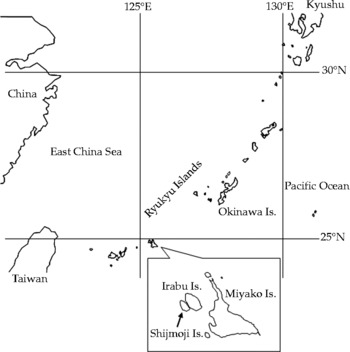
Shimoji Island is a subtropical island located at 24.1°N and 125.1°E. The average daily temperature is 23.8°C (range 18.0–29.1°C) and the average cumulative annual rainfall is 1867.3 mm. This island is separated by a narrow strait from Irabu Island and about 9 km away from Miyako Island, part of the Ryukyu Islands, Japan (Fig. 1). The island is 954 ha in area and has approximately 50 inhabitants. The island has an airport with 365 ha and sugarcane fields with a total area of 110 ha.
Map of Shimoji Island. Arrow indicates Shimoji Island located to the west of Miyako Island in the Ryukyu Islands.

Recent molecular studies by Tokuda et al. (Reference Tokuda, Tanaka and Zhu2010) suggested that L. migratoria populations in the world might consist of two major clades, north and south. The north clade includes populations in northern Asia and the south clade includes African, European, Southeast Asia and Australian populations. The Japanese populations consist of the two clades separated by the Tokara strait, which is located north of Okinawa prefecture. The populations in the Ryukyu and Ogasawara Islands belong to the south clade. The Shimoji Island populations thus belong to the south clade.
Field survey at the Shimojishima Airport
At Shimojishima Airport, the number of adults was roughly estimated on 20 July 2011 by counting adults flying away from an area of 60 m2 (2 m × 30 m) at each of the seven sites as an investigator walked from one end to the other. Between 25 July and 18 October 2011, we estimated the abundance of adults and nymphs at 29 grassland sites at the airport. We counted the number of adults and nymphs in an area of 100 m2 (length 50 m; width 2 m) by walking each site and the procedure was replicated twice for each section. We ignored small nymphs such as the first and second instars because of difficulty in counting them accurately. In a separate survey, nymphs were collected by placing an insect net (diameter 42 cm) on the ground randomly in the grassland of the airport. We repeated this procedure seven times per site, and brought the samples to the laboratory of the Miyako Branch of Okinawa Prefectural Plant Protection Center where their developmental stages were determined.
Survey in sugarcane fields
Sugarcane fields located in the southeastern part of the island were surveyed from 20 July to 18 October 2011. The height of sugarcane plants in those fields was approximately 1–2.5 m and sugarcane furrows were 1.2 m apart. The abundance of locusts was recorded at 7 to 11 sites of sugarcane fields in July and August 2011, and four sites of sugarcane fields after August. The size of these fields varied from 0.3 to 1.6 ha. One observer walked between the furrows over 30 m and recorded the number of locusts flying from the area between the furrow area (width 2.4 m) and nymphs found on the ground between the two furrows (width, 1.2 m). This procedure was replicated twice for each site. The locust density (number of individuals/m2) was calculated by dividing the number of individuals observed by 72 m2 (length 30 m; width 2.4 m) for adults and by 36 m2 (length 30 m; width 1.2 m) for nymphs.
On 2 August, numerous dark-coloured locust nymphs were observed in a sugarcane field (1.6 ha; designated as sugarcane-field A) and its pathways between this field and the southeastern fence of the airport. Locust abundance was then surveyed intensively during August. In sugarcane-field A, we counted the number of locusts on three to four sugarcane plants. The density of locusts (per m2) was then calculated by multiplying the number of individuals found per plant by 2, because two plants were grown per m2 on average in the field. Locusts on the ground between the furrows were sampled by placing an insect net on the ground (diameter 42 cm) and collecting all locusts under the net. The collected locusts were brought to the laboratory where their number and developmental stages were determined. The density of locusts on the ground was estimated by dividing the number of individuals sampled with the insect net by the net area (0.14 m2). The total number of locusts in sugarcane-field A was calculated by combining the numbers of adults and nymphs determined as described above. We also estimated the number of nymphs occurring along the pathway (approximately 7 m × 695 m) between sugarcane-field A and the airport fence by counting the number of nymphs found in an area of approximately 10 m2 (1 m × 10 m) at 11 or 17 sites. The locust density in the pathway was calculated by dividing the number of individuals observed by 10 m2. The total number of locusts in the pathway was estimated by multiplying the locust density by the total area (516 m2).
Survey for overwintering locusts
Overwintering populations at the airport and in sugarcane fields were surveyed monthly from November of 2011 to June of 2012 at four sites in each place. One investigator walked over 50 m at each site in the grassland of the airport and 30 m in sugarcane fields to count the adults and nymphs observed over an area of 100 m2 (50 m × 2 m) at the airport and 72 m2 (30 m × 2.4 m) in sugarcane fields. This procedure was replicated twice for each site. Small nymphs such as the first and second instars were ignored. After the survey, locusts were also caught with an insect net or by hand for approximately 1 h and transported to the National Institute of Agrobiological Sciences at Ohwashi, Tsukuba (NIASO) where the morphometric characteristics of adults and developmental stages were examined.
Locust control
Ninety tonnes of an insecticide mixture of 20% fenobucarb and 50% fenitrothion (Sumitomo Chemical Co. Ltd, Tokyo, Japan) were sprayed between 21 July and 3 August 2011 intermittently with spraying machines (Power sprayer; Maruyama Mfg Co., Inc., Tokyo, Japan) by a total of 55 personnel over an area of 50 ha of sugarcane fields.
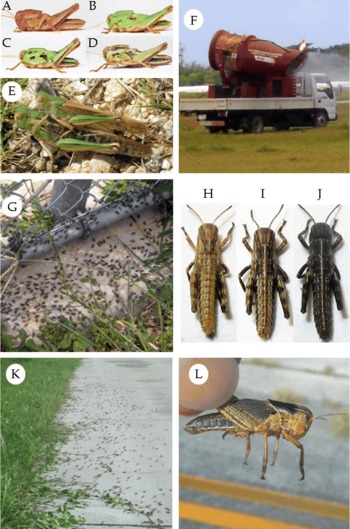
At the airport, 67 tonnes of 50% fenitrothion (Sumitomo Chemical Co. Ltd) were sprayed on 30 and 31 July by a total of 40 personnel over the entire grassland area (120 ha). Spraying was also made during an 8-day period between 1 and 9 September 2011. In this case, a total of 24.5 tonnes of fenitrothion were sprayed using spraying machines in those areas where the locust density was relatively high (approximately >0.3 individuals/m2). One type of spraying vehicle (Super spouter; Maruyama Mfg Co., Inc.) is shown in Fig. 2F.
Adults and nymphs of Locusta migratoria on Shimoji Island and their control. A-D, body colouration of nymphs. E, pair of adults on 20 July 2011 at Shimojishima Airport. F, spraying vehicle used at the airport. G, pale and dark-coloured nymphs at early instars. H-J, pale medium and dark-coloured first-instar nymphs collected in the pathway between the airport fence and sugarcane fields on 2 August 2011. K and L, last-instar nymphs with gregarious body colouration observed at the airport on 31 August 2011. (A colour version of this figure can be found online at: journals.cambridge.org/jti).

Determination of developmental stages
Nymphs collected in the pathways around sugarcane fields on 2 August 2011 were sent to the NIASO where the head width, including the two compound eyes, was measured for each individual using a micrometer installed in a binocular microscope. Some of those nymphs were reared at 31°C and a 12 h light–12 h dark photoperiod (Tanaka, Reference Tanaka1992) and their head widths were recorded after each ecdysis during the nymphal stage. These data were used to identify the instars of the nymphs that were collected in sugarcane fields and at the airport. The developmental stages of late-instar nymphs were determined by head widths and the position of wing pads (Uvarov, Reference Uvarov1966).
Measurements of body dimensions
Various body dimensions including maximum head width (C), hind femur length (F) and forewing length (E) were measured for field-collected and laboratory-reared adult locusts with a digital caliper, and classical morphometric ratios (F:C and E:F ratios) were calculated (Stower et al., Reference Stower, Davies and Jones1960).
Statistical analyses
Body dimensions were analysed with ANOVA and morphometric ratios were compared with the Dwass–Steel multiple comparison test.
Results
Airport populations
Numerous adults (Fig. 2E) and nymphs were observed in the airport grassland on 20 July 2011. Adults were green or brown in colour and similar in appearance to typical solitarious forms. On the other hand, nymphs showed different types of body colouration from dark brown to green (Fig. 2A–D) and some apparently assumed solitarious body colouration (cf. Tanaka, Reference Tanaka2000). The density of adults was estimated to be 1.67 individuals per m2 by counting their number at 11 grassy sites around the runways.
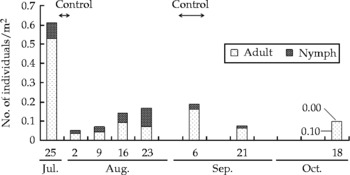
Another survey was performed on 25 July 2011 to determine the abundance of locusts and their developmental stages in the airport grassland by collecting all nymphs covered with an insect net at 29 sites. The mean density of locusts at the 29 sites was 0.61 per m2 (Fig. 3) and the total number of locusts including nymphs and adults in the airport grassland was estimated to be 634,974 individuals. Insecticides were spayed over the entire area of the airport grassland (approximately 120 ha) on 30 and 31 July 2011 with spraying vehicles (Fig. 2F) and the locust density decreased to 0.05 per m2 when surveyed on 2 August. However, the density gradually increased again during the second half of August 2011 (Fig. 3).
Changes in the density of Locusta migratoria populations at the Shimojishima Airport from 25 July to 18 October 2011. The locust density was estimated by counting adults and nymphs per 100 m2 at 29 sites. Arrows indicate the periods of spraying.

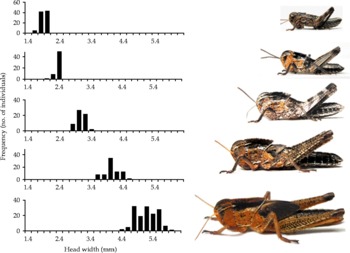
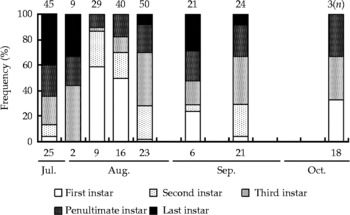
Figure 4 illustrates changes in head widths in nymphs reared in a group of approximately 100 in the laboratory. Based on these measurements, the developmental stages of nymphs sampled at the airport were determined. As shown in Fig. 5, most individuals were nymphs during the second half of August 2011 and they were rapidly growing, which, together with the increasing locust density, made us decide to spray again at the end of that month.
Frequency distribution of head widths from the first to last (fifth or sixth) nymphal instar of Locusta migratoria populations with their photographs. Nymphs were collected as first-instar nymphs on 2 August 2011, and then reared in a group at 31°C and a 12 h light–12 h dark photoperiod. Nymphs developed black patterns. (A colour version of this figure can be found online at: journals.cambridge.org/jti).

Frequencies of developmental stages of Locusta migratoria collected at the Shimojishima Airport from 25 July to 18 October 2011. Specimens were brought to the laboratory and their instars were determined based on head widths and wing pad morphology shown in Fig. 4.

Dark-coloured nymphs were abundant on and around the apron at the airport on 31 August (Fig. 2K and L), although no effort was made to count them. They had black patterns with a dirty orange background colour and were similar in appearance to nymphs reared in a group in the laboratory (cf. Fig. 4). They were mostly at the penultimate or last instar, judging from the position of their wing pads. During a period from 1 to 9 September 2011, spraying was carried out at several sites where nymphs were relatively abundant (approximately >0.3 individuals/m2). After spraying, the locust density decreased markedly (Fig. 3). In late September and October 2011, nymphs became scarce and the populations consisted of mostly adults (Fig. 5).
Sugarcane field populations
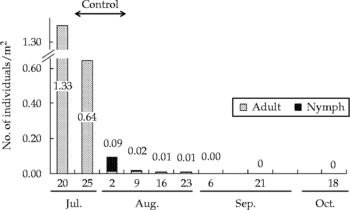
On 20 July 2011, a large number of locust adults were found feeding on sugarcane leaves voraciously in the south-eastern part of Shimoji Island. The adult density was estimated to be an average of 1.33 per m2 in seven sugarcane fields (Fig. 6). No nymph was found in those fields. On 21 July 2011, spraying was started in those sugarcane fields (a total area of approximately 50 ha) with severe feeding damage by locusts. The number of locusts decreased to 0.64 per m2 on 25 July and to 0.09 per m2 on 2 August.
Changes in the density of Locusta migratoria populations in sugarcane fields on Shimoji Island from 25 July to 18 October 2011. The density was estimated by counting adults and nymphs per 72 m2 at 7–11 sites. Arrows indicate spraying periods.

However, numerous early-instar nymphs were observed in sugarcane-field A and its pathways between this field and the airport fence on 2 August 2011 (Fig. 2G). Their body colour ranged from pale to black (Fig. 2H–J). Some of those nymphs were reared in the laboratory to observe their development, as will be described later in this section. On 3 August, the locust density was estimated to be 81.6 nymphs per m2 in sugarcane-field A and 27.8 nymphs per m2 in the pathway. The number of locusts combined for the two sites was estimated to be 1,393,079 individuals (sugarcane-field A: 1,305,469 per 16,000 m2; pathway: 87,610 per 5160 m2). Insecticides were sprayed in both areas on 3 August 2011. As a result, virtually all locusts disappeared from sugarcane-field A by 9 August 2011. The locust density at these sites remained < 0.02 per m2 through October 2011.
Overwintering populations
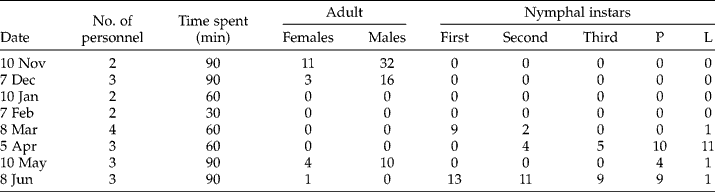
In November and December 2011, only adults were found at the airport and their density was 0.165 and 0.06 per m2, respectively. No locust was seen in January and February 2012. Several nymphs were caught on 8 March 2012. They were all early-instar nymphs except for one last instar nymph (Table 1). Nymphs at the penultimate and last instars were common on 5 April 2012, while no adult was found. These observations indicate that hatching might have started early in March 2012. Adults emerged in May 2012 and early-instar nymphs that were probably of the second generation appeared in June 2012.
Number of Locusta migratoria collected with an insect net and by hand in the Shimojishima Airport grassland from November 2011 to June 2012+
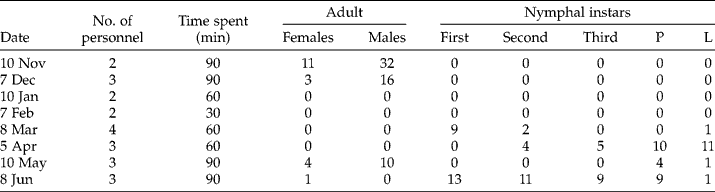
+ Numbers of adults and each nymphal instar were determined in the laboratory and were pooled for four collection sites. Nymphs at the last two instars were categorized into the penultimate (P) or last (L) instar.
In sugarcane fields, adults were scarce in November and December 2011 with their density of 0.002 and 0.003 individuals per m2, respectively. No adult or nymph was found during the period from January to June 2012.
Developmental characteristics
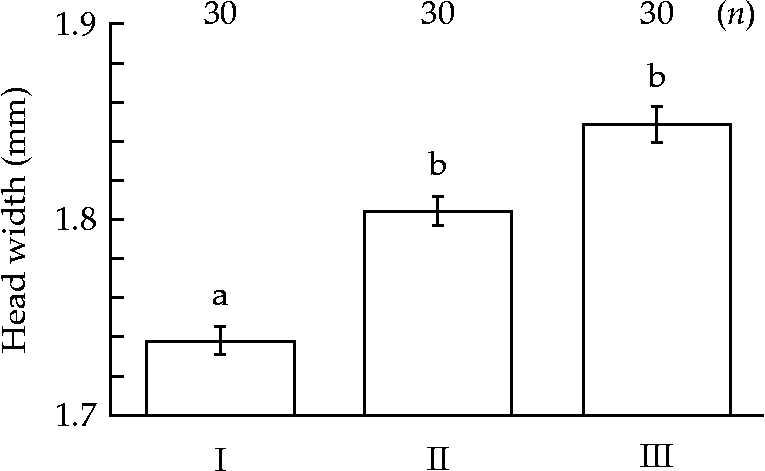
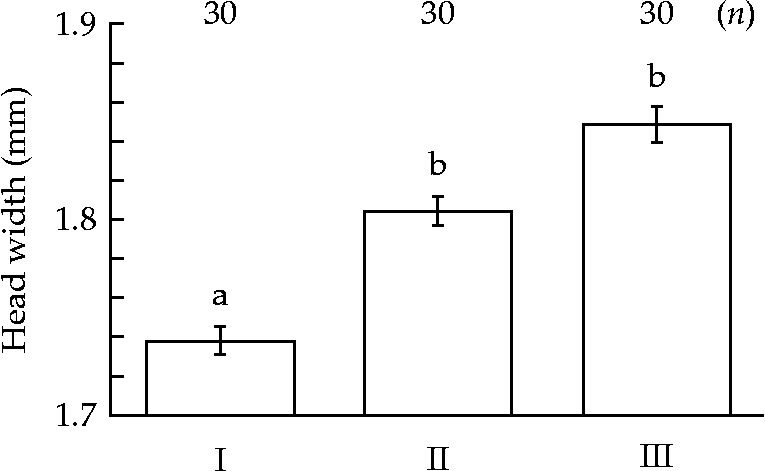
The locust sample collected in sugarcane-field A and its pathways on 2 August 2011 consisted of small nymphs ranging from the first to third instar. As shown in Fig. 2G-J, first-instar nymphs exhibited a wide range of variation in body colour. It was found that this variation was correlated with body weight when the nymphs were divided into three groups based on the darkness of the body and compared: black nymphs were significantly larger than pale nymphs (Fig. 7). These groups were separately reared in groups at 30°C and a 12 h light–12 h dark photoperiod. Nymphs developed black patterns with a dirty orange background colour after ecdysis during the second instar and possessed similar body colouration from this instar onwards. The differences in body size between the smallest group (I) and the other two (II and III) became obscure as they grew (Table 2), partly because some individuals in group I apparently underwent extra moulting.
Mean head width (±SD) of first-instar nymphs divided into three different groups based on the darkness of the body. I, Pale; II, intermediate; III, dark (see Fig. 2H, I and J). Different letters represent significant differences by multiple comparison using Sheffe's test (P < 0.05).
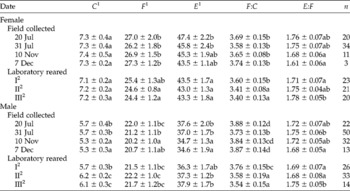
Morphometrics of field-collected and laboratory-reared locusts
Table 2 summarizes various body dimensions and morphometric ratios of adult locusts. Body size was similar over the seasons in females, whereas it was significantly larger in July populations than in November and December populations. Morphometric ratios were also similar over the seasons in both females and males except for the F:C ratio in males collected on 31 July that was significantly smaller than the values in those collected on the other dates. Body size and E:F ratios of locusts collected as first-instar nymphs and reared in groups in the laboratory were similar to those collected in the field, but the F:C ratios, particularly for groups II and III, were significantly smaller than those for field-collected individuals.
Body dimensions (mm) and morphometric ratios of adult specimens collected on Shimoji Island or reared in the laboratory

Within each column, data followed by the same letter indicate no significant difference at P>0.05 (ANOVA with Sheffe's multiple comparison test followed by ANOVA for C, E and F, and with the Dwass–Steel multiple comparison test for F:C and E:F).
1 C, F and E represent maximum head width, hind femur length and forewing length.
2 I, II and III represent three groups of locusts collected at the first instar on 2 August 2011 and classified based on the darkness of the body. I, pale; II, intermediate; III, dark (see Fig. 2H–J).
Discussion
Locust populations and their characteristics on Shimoji Island
The present study documented that upsurges in L. migratoria populations occurred on Shimoji Island, Japan in 2011. Numerous adults and nymphs at late instar were first found in July 2011. However, their body colouration was similar to that typically observed in solitarious forms. The classical morphometric traits such as F:C and E:F ratios for sampled adults were also similar to those in solitarious forms when compared with other populations in different phases (Yamagishi and Tanaka, Reference Yamagishi and Tanaka2009). One week later, however, as many as 1.4 million of dark-coloured nymphs appeared in sugarcane fields and their adjacent pathways. Nymphs at early instar had different types of body colouration from dark to pale colour (Fig. 2H–J). Dark-coloured hatchlings were heavier than pale hatchlings. This variation is probably related to the crowding conditions to which their parents were exposed as adults, as inferred from a study by Hunter-Jones (Reference Hunter-Jones1958). The penultimate and last-instar nymphs observed at the Shimojishima Airport on the island had black patterns and a dirty orange background colour, body colouration typically observed in gregarious forms and displayed marching behaviour at and around the runways.
Monthly surveys of L. migratoria populations were conducted from July 2011 to April 2012 in sugarcane fields and at the airport to monitor the changes in population size and to investigate the seasonal life cycle of this locust species. New adults appeared in July and September. The populations decreased in size during autumn, and consisted exclusively of adults shortly before winter. During winter, no locusts were found probably because they were motionless and hiding somewhere among bushes and forbs. Some nymphs were found again in early March 2012. They were all early-instar nymphs except for one last-instar nymph. It was suggested that locusts in the southern part of Japan would have three or more generations per year and overwinter at different developmental stages (Tanaka, Reference Tanaka1994a, Reference Tanakab). It appears that L. migratoria on Shimoji Island also overwinters at different developmental stages including eggs, nymphs and adults. This inference is based on three reasons: (1) the locust samples collected shortly before winter comprised exclusively of adults, (2) early-instar nymphs and a last-instar nymph were found in March, and (3) adults, which were not found during the winter in the present study, are known to overwinter on Miyako Island (S. Tanaka, unpublished observations) and other islands of the Okinawa prefecture (Azuma, Reference Azuma1974; Yamagishi and Tanaka, Reference Yamagishi and Tanaka2009).
Yamagishi and Tanaka (Reference Yamagishi and Tanaka2009) suggested that L. migratoria on Iheya Island (Okinawa prefecture) mainly overwinter as adults or eggs in such a way that, irrespective of the overwintering stage, egg hatching is prevented from occurring in winter. They proposed a hypothesis that the chance of survival of hatchlings or early-instar nymphs during the winter is low on this island, and that this low rate of survival has served as a driving force to shape the life-history characteristics of this locust on this island. This hypothesis might be applicable to the Shimoji Island populations.
Based on the present observations, it may be suggested that the Shimoji Island L. migratoria populations mainly produce three generations per year. Overwintered eggs and nymphs start their activity and development in March and become adults by May. Nymphs of the second generation emerge in June. The adults found in July and September 2011 (Fig. 3) were probably the second and third generation, respectively.
Gregarization and its possible causes
Various factors, including drought, fire and reduced numbers of natural enemies, are suggested to cause gregarization of locusts in Japan (Azuma, Reference Azuma1974; Takahashi, Reference Takahashi1986; Tanaka and Kiritani, Reference Tanaka and Kiritani1987).
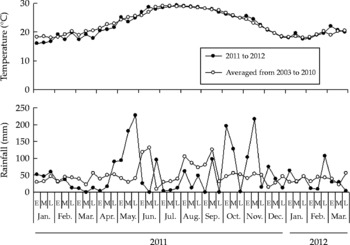
Meteorological data for the year 2011 at the Shimojishima Airport showed unusual patterns in air temperature and rainfall (Fig. 8). Air temperature from January to early April was markedly lower in 2011 than on average. Activity and development of locusts during that period were probably suppressed, which might have brought about somewhat synchronized development thereafter. Rainfall in the spring was very low in 2011, which might have caused natural enemy and pathogen populations to decline. In contrast, rainfall was much higher than average during the following rainy season from mid May to early June in 2011 partly due to unseasonable strong typhoons. Such rainfall, together with high temperatures, is suitable for plant growth. Then, the summer was considerably dry in 2011. Therefore, it is possible that locusts were able to enjoy abundant food under conditions where natural enemies and pathogens were considerably suppressed, which might have been responsible for the upsurges in locust populations on Shimoji Island in 2011.
Air temperature (°C) and rainfall (mm) in 2011–2012 compared with the averages during 2003–2010 at the Shimojishima Airport. E, M and L indicate the first, second and third 10-day periods during a month, respectively. The meteorological data were obtained from a website of Japan Meteorological Agency (http://www.jma.go.jp/jma/indexe.html).

Prompt action and co-operation for locust control
After receiving the first information from a sugarcane farmer about upsurges in locust populations in sugarcane fields and the grassland at Shimojishima Airport on 19 July 2011, we surveyed the locust populations in those areas on the next day. We collaborated with staff from Miyakojima City, the Sugar Manufacturing Company, Agricultural Co-operatives and Shimojishima Airport and started spraying insecticides to control the locusts in sugarcane fields on 21 July, as described above. Spraying was also conducted in the grassland at the airport for 2 days at the end of July 2011, because there was a possibility that locusts of the airport population might have moved to adjacent sugarcane fields. Another reason for spraying at the airport was to avoid aeroplane accidents caused by birds that are attracted to these locusts. It has been reported that locusts sometimes continue to be abundant for an extended period of time in subtropical regions once their outbreak occurs, as reported for L. migratoria on Minami-Daitoh Island from 1971 to 1974 (Azuma, Reference Azuma1974; Nakamori and Ito, Reference Nakamori and Ito1974) and on Iheya Island from 2005 to 2006 (Yamagishi and Tanaka, Reference Yamagishi and Tanaka2009). Therefore, locust populations in sugarcane fields and at the airport were continuously monitored after the first spraying, and they were sprayed again in September when numerous late-instar nymphs appeared. We believe that our prompt action led to a successful locust control with a minimum amount of insecticide used and prevented their outbreaks. For preventive control, regular survey of locust populations as well as co-operation and communication with local government agents and farmers is essential, although this may not be feasible everywhere.
Acknowledgements
Insecticide spraying and associated work was assisted by many people including local farmers, staff of Shimojishima Airport, Miyakojima City, Japan Agricultural Co-operative Okinawa and Miyako Sugar Manufacturing Co. Ltd, to whom we are most grateful. Ms Yukie Sugama helped us with the survey. Ms Noriko Totsuka, Ms Masako Higuchi and Ms Yoko Yokota assisted us with rearing locusts at the NIASO. We also thank Dr Hiroshi Tanaka of the Research Institute of Environment, Agriculture and Fisheries, Osaka Prefectural Government for useful advice on the control. We thank Mr Morikazu Nakasone of Okinawa Prefectural Miyako Agriculture, Forestry and Fisheries Promotion Center and Dr Shinji Kawano and Mr Makoto Nishimura of Okinawa Prefectural Plant Protection Center for encouragement. Dr Norio Arakaki of Miyako Branch, Okinawa Prefectural Agricultural Research Center improved the manuscript. This study was funded in part by a Kakenhi grant of Japan (No. 23380038) to S.T. The Field Management Section of NIASO raised the grass used for this study.