Introduction
The speech signal is variable: speakers pronounce sounds differently depending on, e.g., their gender, dialect, accent, and age. Listeners cope with this variation by quickly tuning into a speaker, even when pronunciations are ambiguous (Norris, McQueen & Cutler, Reference Norris, McQueen and Cutler2003). There is ample evidence that native speakers use lexical and phonotactic knowledge to retune their phonetic categories in response to ambiguous pronunciations of sounds (see Samuel & Kraljic, Reference Samuel and Kraljic2009, for an overview), and apply this learning to novel items (McQueen, Cutler & Norris, Reference McQueen, Cutler and Norris2006). This competence, termed lexically-guided perceptual learning (Norris et al., Reference Norris, McQueen and Cutler2003), leads to temporary adjustments of phonetic category boundaries (Clarke-Davidson, Luce & Sawusch, Reference Clarke-Davidson, Luce and Sawusch2008). We argue here that highly proficient non-native listeners are able to benefit from the same process and, as a result of a brief exposure to an ambiguous sound, can retune their second language (L2) phonetic category boundaries to include this ambiguous sound, and can apply this learning to new, unheard words.
Lexically-guided retuning has been demonstrated for native listeners using an exposure-test paradigm. In the seminal study by Norris et al. (Reference Norris, McQueen and Cutler2003), Dutch listeners were exposed to word items containing an ambiguous sound between /f/ and /s/. The authors demonstrated that listeners exposed to the ambiguous sound in /f/-final words (e.g., gira[f/s], where giraffe is an existing Dutch word and giras is not) learned to interpret the sound as /f/. The group exposed to the ambiguous sound in /s/-final words (e.g., mui[f/s], where muis (mouse) is an existing Dutch word) learned to interpret the same ambiguous sound as /s/. In a subsequent phonetic-categorization task, the listeners exposed to ambiguous /f/-final stimuli characterized stimuli on an [ɛf-ɛs] continuum more often as an [ɛf] than the other group, thus showing a retuning of their /f/ phoneme category.
For lexically-guided retuning to occur, the availability of lexical knowledge is critical. Since non-native listeners typically have an impoverished vocabulary in comparison to native listeners, their lexical-phonological knowledge is arguably less reliable (Lecumberri, Cooke & Cutler, Reference Lecumberri, Cooke and Cutler2010). Secondly, non-native listeners might not have a phonetic category for the non-native sound or it might differ from the one in the native sound system (Flege, Reference Flege and Strange1995). It is therefore questionable whether non-native listeners would be able to retune (non-native) phonetic categories.
Results of a previous study on lexically-guided retuning by non-native listeners were not conclusive. Reinisch, Weber and Mitterer (Reference Reinisch, Weber and Mitterer2013) demonstrated that, on the basis of Dutch L2 input, highly proficient German learners of Dutch showed retuning for ambiguous /f-s/ sounds. These sounds are however highly similar in Dutch and German. As Reinisch et al. (Reference Reinisch, Weber and Mitterer2013) point out, their results could be explained by L2 input guiding L1 retuning rather than retuning L2 phoneme categories since non-native phonemes that are perceived as similar to native phonemes are assimilated to these native phoneme categories (Best & Tyler, Reference Best, Tyler, Bohn and Munro2007; Flege, Reference Flege and Strange1995). In the present study, we investigate the question whether an ambiguous sound in a non-native language can retune L2 phonetic categories, using the British English sound contrast /ɹ/-/l/. The here-presented results extend those reported in Drozdova, van Hout and Scharenborg (Reference Drozdova, van Hout and Scharenborg2014, Reference Drozdova, van Hout and Scharenborg2015).
While articulation of /l/ is fairly similar in Dutch and English (Collins & Mees, Reference Collins and Mees2003), marked phonetic differences exist between British English and Dutch /r/. Realization of /r/ in Dutch depends on its position and on the speaker (e.g., Sebregts, Reference Sebregts2015). In the onset position, uvular /ʀ/ trills or alveolar /r/ taps and trills are used while the variant closest to the British English one, the prevelar bunched approximant /ɹ/, only occurs in coda position (Mitterer, Scharenborg & McQueen, Reference Mitterer, Scharenborg and McQueen2013; Scobbie, Sebregts & Stuart-Smith, Reference Scobbie, Sebregts and Stuart-Smith2009; Van de Velde & van Hout, Reference Van de Velde, van Hout, van Bezooijen and Kager1999). British English, being non-rhotic, does not allow /ɹ/ in post-vocalic position (Collins & Mees, Reference Collins and Mees2003). Dutch listeners thus would have to create a language-specific phonetic category for British English /ɹ/. If lexically-guided retuning is observed for Dutch listeners for the British English /ɹ/-/l/ sound contrast, this would then indicate that L2 phonetic boundaries can be retuned on the basis of ambiguous L2 input.
In the present study, Dutch non-native listeners of English were first exposed to one of two versions of a short story containing ambiguous [l/ɹ] sounds (Eisner & McQueen, Reference Eisner and McQueen2006) and, subsequently, had to perform a phonetic-categorization task. We predict that if non-native listeners retune their L2 phonetic categories, non-native listeners in the /ɹ/-ambiguous group will show a greater proportion of /ɹ/ responses in the categorization task than listeners in the /l/-ambiguous group. To provide a baseline for the learning effect, a separate group of Dutch listeners only performed the categorization task (following, e.g., Zhang & Samuel, Reference Zhang and Samuel2014). Moreover, since retuning has not yet been demonstrated for British English native listeners for the /l/-/ɹ/ contrast, a group of native British English listeners functioned as a control group.
Method
Participants
Eighty-nine native Dutch participants were recruited from the Radboud University Nijmegen subject pool of which 15 (3 males, M age=23.1, SD=4.7) took part in the pretest of the stimuli, and 20 (6 males, M age=21.1, SD=2.3) in the baseline experiment. The remaining 54 participants (11 males, M age =21.6, SD=2.0) participated in the main experiment. All Dutch participants possessed a ‘VWO’ (i.e., pre-university education) diploma, indicating a B2 or higher level of English according to the European Framework of Reference. As a control group, 47 native British English participants (9 males, M age=21.0, SD=2.2) were recruited from the participant pool of the University of York, UK. All participants were paid for their participation and none reported a history of hearing or learning disorders.
Materials
Nineteen English words containing one /ɹ/ sound and no /l/ sounds and 19 words containing one /l/ sound and no /ɹ/ sounds with word frequencies of at least 100 per million were selected from the CELEX database (Baayen, Piepenbrock & Gulikers, Reference Baayen, Piepenbrock and Gulikers1995). Since lexically-guided retuning is allophone-dependent (Mitterer et al., Reference Mitterer, Scharenborg and McQueen2013), the /l/ or /ɹ/ target sound always occurred at the onset of the third or fourth syllable. The target words were embedded in a short story, which importantly, contained no other words with /l/ and /ɹ/. The story was recorded by a male native speaker of British English in three versions (normal; each /ɹ/ pronounced as /l/; each /l/ pronounced as /ɹ/). The target words were excised at the positive-going zero crossings. Two versions of each word (e.g., memory-memoly) were morphed with the STRAIGHT algorithm (Kawahara, Masuda-Katsuse & Cheveigne, Reference Kawahara, Masuda-Katsuse and Cheveigne1999) to create an 11-step ambiguous word continuum where the interpretation of the ambiguous [l/ɹ] sound ranged from /l/ (step 0) to /ɹ/ (step 10). The most ambiguous variant of each individual word was chosen on the basis of a pretest with Dutch listeners. It was the step on the continuum that received approximately 50% /ɹ/ and 50% /l/ responses. This step was spliced back into the story to create two versions. In the /l/-ambiguous version, the /l/ sound in all words was replaced by the ambiguous [l/ɹ] sound while all /ɹ/ sounds were natural. In the /ɹ/-ambiguous version, all /ɹ/ sounds were replaced with the ambiguous [l/ɹ] sound while all /l/ sounds were natural.
In the phonetic-categorization task, two minimal pairs were used: alive-arrive and collect-correct. According to CELEX (Baayen et al., Reference Baayen, Piepenbrock and Gulikers1995), alive is the most frequent word of the alive-arrive pair, while correct is the most frequent of the collect-correct pair, thus reducing bias towards an /l/ or /ɹ/ interpretation in the task. The words were recorded by the same male speaker, and morphed following the procedure described above. The test phase consisted of five steps from each minimal pair: the most ambiguous item chosen on the basis of the pretest, and the two steps directly preceding and following it. For the alive-arrive minimal pair these were steps 3–7, and for collect-correct these were steps 2–6.
Procedure
During the exposure phase, half of the non-native and native control group participants heard the /ɹ/-ambiguous version of the story while the other half listened to the /l/-ambiguous version. In the subsequent phonetic-categorization task, participants heard the 120 test stimuli divided over four blocks. They categorized the stimuli as containing an /l/ (left button on the button box) or /ɹ/ (right button on the button box). The whole procedure took approximately twenty minutes. Participants in the baseline condition only performed the phonetic-categorization task, which lasted approximately ten minutes.
Results
In the non-native condition, 26 Dutch participants listened to the /ɹ/-ambiguous version of the story and 28 to the /l/-ambiguous version. In the native English, control condition, 23 participants listened to the /ɹ/-ambiguous version and 24 to the /l/-ambiguous version. A generalized linear mixed-effect model analysis (Baayen, Davidson & Bates, Reference Baayen, Davidson and Bates2008) was conducted on the responses in the phonetic-categorization task (/l/ coded as 0 or /ɹ/ coded as 1) using the logit link function. The analysis started from the model containing all predictors and all possible interactions between Exposure Condition (the critical variable), Continuum Step (the most /l/-like step was recoded as step 1, and the most /ɹ/-like step was recoded as step 5), and Minimal Pair. Additionally, by-Subject and by-Minimal-Pair random intercepts and slopes were added to the model. Subsequently, interactions and predictors that were not significant were removed one-by-one, and each subsequent model was compared with the previous one using the likelihood ratio test. Final model was selected by comparing AIC values on the basis of likelihood ratio tests and degrees of freedom (the number of factors). Factors and their interactions included in the initial, intermediate and final models and model comparison scores are presented in Supplementary materials A (supplementary materials).
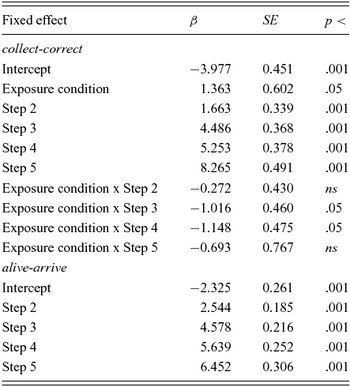
Although, the analysis of the responses of the native listeners in the phonetic-categorization task did not reveal a general effect of Exposure Condition (β=- 0.67, SE=0.437, p=0.125), there was a significant interaction between Exposure Condition and Minimal Pair (β=1.296, SE=0.565, p<.05). Consequently, separate analyses were carried out for each minimal pair. Table 1 displays the estimates of the fixed effects and their interactions in the best-fitting model for the native listeners for the collect-correct (upper part) and the alive-arrive (lower part) minimal pair.
Fixed-effect estimates of performance of native listeners in the phonetic categorization task, for the minimal pairs separately.

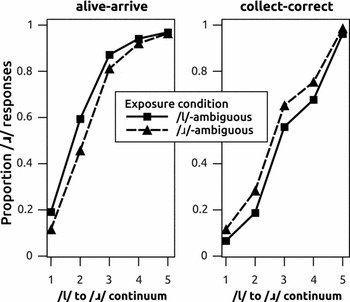
Figure 1 shows the proportion of /ɹ/ responses for the 5 steps of the /l/-/ɹ/ test continuum for the /l/-ambiguous group (solid line with squares) and the /ɹ/-ambiguous group (dashed line with triangles) for the results for alive-arrive (left panel) and collect-correct (right panel). The difference between the curves of the two exposure groups, indicating the lexically-guided retuning effect, was significant only for collect-correct (see Table 1, Exposure Condition; Exposure Condition was not significant for alive-arrive in the final, best-fitting model, Exposure Condition in the penultimate model: β=- 0.668, SE=0.436, p=0.125). Native participants, therefore, demonstrated lexically-guided retuning for the /l/-/ɹ/ continuum, albeit only for the collect-correct pair.
Proportion of /ɹ/ responses for the alive-arrive (left) and collect-correct (right) test continua for the native listeners. Responses of the listeners in the /ɹ/-ambiguous group are plotted with the dashed line with triangles; responses of the listeners in the /l/-ambiguous group are plotted with the solid line with squares.

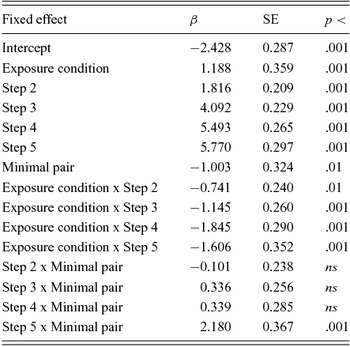
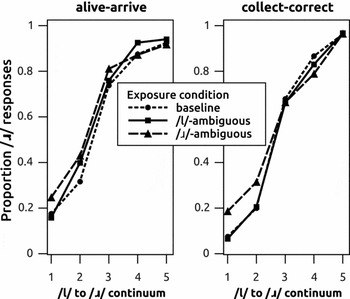
Table 2 displays the estimates of the fixed effects and their interactions in the best-fitting model for the non-native listeners for both minimal pairs together. Similar to Figure 1, Figure 2 shows the proportion of /ɹ/ responses of the non-native listeners for the 5 steps of the /l/-/ɹ/ continuum for the two minimal pairs separately. Crucially, the /ɹ/-ambiguous group gave significantly more /ɹ/ responses than the /l/-ambiguous group (Table 2, Exposure Condition), showing lexically-guided retuning.
Fixed-effect estimates of performance of non-native listeners in the phonetic categorization task.

Proportion of /ɹ/ responses for the alive-arrive (left) and collect-correct (right) test continua for the non-native listeners. Responses of the listeners in the /ɹ/-ambiguous group are plotted with the dashed line with triangles; responses of the listeners in the /l/-ambiguous group are plotted with the solid line with squares, responses of the listeners in the baseline group are plotted with the dotted line with bullets.

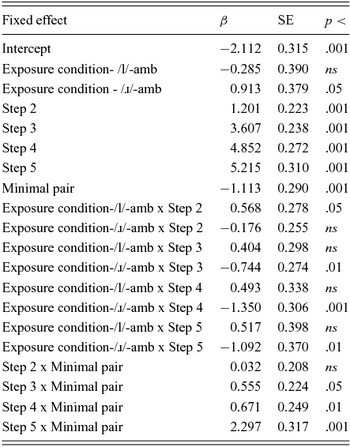
To investigate whether retuning occurred for the non-native listeners for the crucial /ɹ/ category, the responses of both exposure groups were compared to the responses of the 20 non-native participants in the baseline condition (no exposure to the ambiguous sound; see dotted line with bullets in Figure 2). In the statistical analysis, baseline was added as a third level to the factor Exposure Condition as reference category. No significant difference was found between the baseline condition and the /l/-ambiguous group (see Table 3: Exposure Condition-/l/-amb). Crucially, however, the listeners in the /ɹ/-ambiguous group gave significantly more /ɹ/ responses in the phonetic-categorization task than the baseline group (Table 3: Exposure Condition-/ɹ/-amb). Retuning was thus observed for the group exposed to the /ɹ/-ambiguous version but not the /l/-ambiguous version of the storyFootnote 1 .
Fixed-effect estimates of performance of non-native listeners in the phonetic categorization task including the baseline condition.

Discussion and conclusions
According to the PAM-L2 model (Best & Tyler, Reference Best, Tyler, Bohn and Munro2007), L2 phonemes that are perceived as phonologically similar but phonetically deviant from the corresponding L1 phonemes are dissimilated from their L1 equivalent at the phonetic level, and form a separate language-specific phonetic category. This hypothesis is corroborated by the finding that French listeners of English tend to perceive British English /ɹ/ as /w/-like, despite French and English both having a phonological category for /r/ (Halle, Best & Levitt, Reference Halle, Best and Levitt1999). French listeners in that study dissimilated English /ɹ/ from French /r/ at the phonetic level because English and French /r/ differ phonetically. In our experiment, English /l/ is most likely assimilated with Dutch /l/, as the phonetic realization of /l/ in English and Dutch is highly similar. On the other hand, marked differences exist in the phonetic realizations of British English and Dutch /r/, similar to the French case (Halle et al., Reference Halle, Best and Levitt1999). The Dutch /r/ closest to British English /ɹ/ only occurs in coda position, where the British English /ɹ/ does not appear. Following PAM-L2, British English /ɹ/ would require a language-specific phonetic category for the Dutch listeners.
The proportion of /ɹ/ responses of the non-native listeners exposed to the /ɹ/-ambiguous version of the story was significantly larger than that of the non-native listeners in the /l/-ambiguous and the baseline groups, demonstrating retuning in non-native listeners in the /ɹ/-ambiguous condition. Three explanations seem possible for this finding: the size of the native /l/-category shrank to exclude ambiguous pronunciations, the size of the non-native /ɹ/-category widened to include ambiguous pronunciations, or a combination of both happened. Solely a retuning of the /l/-category seems to be the least plausible, as the /ɹ/-ambiguous participants were exposed to natural /l/-tokens, and were unaware that /l/-/ɹ/ was the target contrast in the study. Moreover, if exposure to an ambiguous sound in an /ɹ/-context would lead to shrinking of the /l/-category, one would also expect a reduction in the size of the /ɹ/-category for the listeners in the /l/-ambiguous group. This was not found. So, even if exposure to the ambiguous sound caused a reduction in the size of the /l/-category, the size of the /ɹ/-category needs to increase to account for our data.
In contrast to what is typically found in native listeners (e.g., compare Figures 1 and 2), the non-native retuning seems to be concentrated mostly on the /l/-side of the continuum. Potentially, native listeners have a better developed /ɹ/-category than non-native listeners, helping them to flexibly adjust category boundaries when faced with ambiguous pronunciations. The arguably less well-developed /ɹ/-category of the non-natives might result in a retuning that is more bound to specific rather than a range of ambiguous steps. Taken together, we conclude that the observed retuning effect seems to suggest that L2 listeners can, in addition to their L1, also retune their L2 phonetic categories, albeit perhaps in a ‘narrower’ sense than native listeners.
The responses in the phonetic-categorization task of the non-native /l/-ambiguous group did not differ significantly from those of the non-native baseline group. This asymmetry in lexically-guided retuning has previously been demonstrated for the /s/-/f/ contrast (Eisner & McQueen, Reference Eisner and McQueen2006; Norris et al., Reference Norris, McQueen and Cutler2003; Zhang & Samuel, Reference Zhang and Samuel2014), where the /s/-ambiguous group experienced a stronger retuning than the /f/-ambiguous group. Zhang and Samuel (Reference Zhang and Samuel2014) argued that the frication cue of /f/ is weaker than that of /s/ and therefore more susceptible to variation, which in turn would block retuning. We want to add a complimentary interpretation: the acoustic variation for /ɹ/ both in British English and Dutch is high both in allophonic variation and between speakers, higher than that of /l/. Like /ɹ/, /s/ has large inter-speaker variation (Dart, Reference Dart1991, Reference Dart1998), more so than /f/ (Gordon, Barthmaier & Sands, Reference Gordon, Barthmaier and Sands2002), suggesting that the acoustics of /s/ are inherently more variable than those of /f/. Taken together, potentially, listeners more easily retune phoneme categories of sounds which are acoustically variable, after exposure to artificially-induced variation, as they are used to hearing this variation and adapting these phoneme categories. This explanation is in agreement with studies on talker variability (Bradlow & Bent, Reference Bradlow and Bent2008, Clopper & Pisoni, Reference Clopper and Pisoni2004) which show that highly variable training stimuli (e.g., exposure to different voices) promote perceptual learning. Whether indeed sounds with high(er) inherent acoustic variability are more prone to retuning than more stable sounds is an interesting question for future research.
Surprisingly, lexically-guided retuning for the native listeners only occurred for the collect-correct pair. Potentially, the steps used for the alive-arrive pair were not well positioned for native listeners as the ambiguous steps were chosen on the basis of a pre-test with non-native listeners. Post-hoc acoustic analyses indeed revealed that the first step of the alive-arrive continuum was more /ɹ/-like than the first step of the collect-correct continuum (see Drozdova et al., Reference Drozdova, van Hout and Scharenborg2014, for more discussion). This slight /ɹ/-bias could possibly reduce the perceptual learning effect.
To summarize, our results suggest that non-native listeners are able to retune their non-native phonetic boundaries. This suggests that the mechanisms underlying lexically-guided perceptual learning in non-native listening correspond to those observed in native listening (Norris et al., Reference Norris, McQueen and Cutler2003; Samuel & Kraljic, Reference Samuel and Kraljic2009), although perhaps in a somewhat ‘narrower’ sense, and that non-native listeners enjoy a similar remarkable flexibility at the prelexical/phonetic level which has previously been associated with native listening (Cutler, Reference Cutler2012).
Supplementary material
For supplementary material accompanying this paper, visit http://dx.doi.org/10.1017/S136672891600002X