1. Introduction
The term ‘trip hop’ was first used by Mixmag in June 1994 to describe the track In/Flux by DJ Shadow and other similar artists on the Mo’ Wax record label (Phillips Reference Phillips2009). Subsequently, Bristol-based artists such as Massive Attack, Portishead and Tricky were grouped under the trip hop label, although these artists have consistently and thoroughly rejected the tag. This discursive conflict raises the issue of whether the label itself is meaningful and appropriate.
Authors in the field of popular music studies have implicitly argued that the validity of labels is not necessarily dependent on acceptance from the artists. As Fabbri (Reference Fabbri2007) notes, it is the community that accepts the rules of a genre, and that community is not limited to artists but also includes fans, journalists, record labels and academics. Accordingly, artists do not have carte blanche over how their music is categorised, and yet their opinions cannot be discounted for the same reason: they too are a part of the community. The challenge is then to reconcile the divergent viewpoints. This article seeks to mediate in this discussion by examining the work of artists labelled ‘trip hop’ through the lens of genre and style. This approach allows one to identify points of musical continuity across a range of artists, while also acknowledging the points of musical difference.
This article proceeds as follows. The second section provides further background to this debate by briefly discussing some of the reasons new genre labels are invented, and why the term ‘trip hop’ was so maligned. There are several reasons the trip hop tag was rejected, not least because many artists reject any attempt to classify their music, viewing labels as restrictive stereotypes that suggest formulaic composition (Walser Reference Walser1993). However, I argue the rejection was due to two processes in particular: genre naming as a merchandising strategy, and genre naming as cultural appropriation (McLeod Reference McLeod2001). I conclude the second section by briefly discussing the term ‘Bristol sound’, and note its synonymous use with ‘trip hop’. The third section, following Fabbri (Reference Fabbri2007), provides definitions for the concepts of genre and style. This sets up a framework for the subsequent analysis. The fourth section discusses the work of nine trip hop artists and focuses on three areas that relate to genre: the prevalence of producer-led outfits, opaque mediation (Brøvig-Hanssen Reference Brøvig-Hanssen2013) and intertextuality. This section seeks to specify common areas among the nine trip hop artists, therefore lending some validity to those that use the trip hop label, while also supporting the notion of trip hop as a genre.
The final section analyses trip hop music through the lens of style, and groups the nine trip hop artists into three distinct, yet related styles: the Bristol sound, post-trip hop and instrumental hip hop. Many compositional practices commonly found in electroacoustic music are also relevant to trip hop. Tools from electroacoustic analysis can therefore yield fruitful results. Drawing from Smalley’s (Reference Smalley1997) theory of spectromorphology, I consider trip hop in regard to notions of gestural surrogacy, spectra and spatiomorphology, and relate each concept to a specific example from the genre. This is not to suggest that conclusions have been drawn from a single musical work, rather the ideas put forward are the result of a wide range of analytical listening, with individual works put forward as representative models. This is not to suggest either that each musical work belonging to the Bristol sound style, for example, will adhere to the approaches described; rather, these observations are more likely to relate to works that fall under the Bristol sound umbrella. The main aim of this article is to distinguish the Bristol sound as a style, as these artists are most vocal in their objection to the trip hop label. In order to achieve this aim, however, it is necessary also to discuss the works of other trip hop artists so as to provide a point of reference.
2. Trip Hop and the Bristol Sound
In order to understand why certain artists have rejected the trip hop label, it is necessary to explore some of the motivating factors behind the creation of new genre labels. The process for naming new genres of music is not just a result of the evolving nature of music. Record companies and music magazines create genre labels as a merchandising strategy and also to market music to new audiences. Similarly, subcultures use subgenre labels as a gatekeeping device to bar entry to those lacking the prerequisite knowledge required to become part of a scene or community (McLeod Reference McLeod2001).
McLeod (Reference McLeod2001) describes five motivating factors for the creation of new genre labels within electronic/dance communities. I argue that two of these motivating factors are most directly responsible for the rejection of the trip hop label: subgenre naming as a merchandising strategy, and subgenre naming as cultural appropriation. I discuss these two strategies within the context of trip hop below. I have arrived at this conclusion based on a wide reading of interviews with the artists, in which they express their aversion to the term ‘trip hop’.
2.1. Subgenre naming as merchandising strategy
Record labels face constant uncertainty over the success of their product so use genre labels as a means of linking producers (artists) with the anticipated consumers (market) (Negus Reference Negus1999). Genre labels communicate meaning to the potential consumer about the likely sound of the product, thus increasing the likelihood it will meet the consumer’s expectations. When faced with marketing a new genre to an unfamiliar market, record companies and music media often work together to create and promote new labels and generate buzz around the new genre (McLeod Reference McLeod2001). However, the manufacture of genre names by record labels and music magazines often creates an air of corporate-driven inauthenticity. Accordingly, artists saddled with these labels will react negatively if they perceive it as a contrived term created in a corporate office. In an interview with The Guardian in 2008, Portishead’s Geoff Barrow stated ‘the whole trip hop tag was nonsense. It was developed by people in London, and the people in Bristol just had to put up with it’ (Simpson Reference Simpson2008: 1).
Although trip hop was initially aligned with the Mo’ Wax record label, it was subsequently used to describe the music of Massive Attack, Portishead and Tricky, possibly due to the difficulty journalists had in categorising their music.Footnote 1 The disparity between the song-based music of the Bristol artists and the instrumental music on the Mo’ Wax label led many to denigrate the term ‘trip hop’ as a corporate invention. When discussing trip hop artists, Barrow said ‘all the other stuff was kind of made by record companies that thought Bristol was cool. They were kind of like products of the media’ (Schild Reference Schild2011: 6). Others simply reacted to the differences between trip hop and the Bristol sound, arguing that the term, authentic or not, is simply not an accurate descriptor. Tricky told Ray Gun magazine in 1999 ‘if you listen to trip hop … if you actually listen to what trip hop is, my music doesn’t sound nothing like it’ (Woodlief Reference Woodlief1999: 3).
2.2. Subgenre naming as cultural appropriation
A great deal of electronic music popular amongst white, middle-class audiences is derived from black, urban communities. Creating a new subgenre label can realign the ‘otherness’ of the original name and assign new meanings that have less association with black culture. Trip hop, as a name, implicitly strips the black identity from the music (McLeod Reference McLeod2001) and moves it out of the ghettos and into the predominantly white rave scene. British music media presented trip hop as a safer alternative to hip hop, leading many to criticise the genre as exploitative, a chance for middle-class whites to experience a taste of hip hop while sidestepping difficult issues of race, class and poverty. ‘According to this critique, trip hop is merely a form of gentrification, a case of middle class whites moving in when the underclass blacks have moved on or been moved out’ (Reynolds Reference Reynolds1999: 324).
This critical view of trip hop is shared amongst many people, including some of the artists branded with the label. Wheaton, author of Dummy (Portishead’s debut album) for the 33 1/3 series, states ‘they [Portishead] hated it then and they probably hate it now. Most of the credible musicians (Massive Attack, Tricky) felt the same way because it was sold, in the music press, as a distinctly British “improvement” upon American hip hop’ (Mistry Reference Mistry2011: 1). Given that the music of Massive Attack, Portishead and Tricky is steeped in the hip hop tradition, and given the high esteem in which they hold other hip hop artists, one can understand how they would take offence at the racial subtext of trip hop and seek to distance themselves from the label.
Additionally, many artists will naturally bridle at the suggestion their music is a ‘safer’, white version of hip hop. Speaking with Ray Gun, Tricky states ‘I hate the word trip hop, ’cause it’s just like, it’s a nice way of putting hip hop. It doesn’t scare people. People don’t want hip hop in their eyes. They don’t want their kids to hear hip hop. It’s scary. But trip hop – you give it a nice little name [and] you get loads of students makin’ the music and it becomes nice, friendly, sellable music’ (Woodlief Reference Woodlief1999: 2).
Accordingly, I argue that trip hop as a merchandising strategy and trip hop as a form of cultural (mis)appropriation are the most compelling reasons several artists have rejected the trip hop tag.
2.3. The Bristol sound
Due to the controversy surrounding the term ‘trip hop’, some people prefer the term ‘Bristol sound’ as a stylistic descriptor. The difficulty is that these terms are either used synonymously, or specifics are never given as to what distinguishes them. Within academic literature some authors prefer the term ‘trip hop’, others the ‘Bristol sound’, while others go back and forth, implying they are simply two names to describe the same thing. Webb (Reference Webb2007) prefers the term ‘Bristol sound’, which he calls a genre, but makes occasional use of the term ‘trip hop’. Prendergast (Reference Prendergast2000) uses the term ‘trip hop’, as does Johnson (Reference Johnson1996), though he occasionally uses ‘Bristol sound’ synonymously, while Sullivan (Reference Sullivan2014) consistently uses ‘Bristol sound’. While ‘trip hop’ is the preferred term within music journalism, other instances can be found where the terms are used interchangeably.Footnote 2
In Global Noise, however, the authors begin to draw a possible distinction between two different types of trip hop, though they refrain from using the term ‘Bristol sound’. They describe the first branch of trip hop as instrumental hip hop, associated with the Mo’ Wax label. The second type of trip hop is a synthesis of hip hop sensibilities and the format of conventional rock, citing Portishead’s Dummy as the prime example (Hesmondhalgh and Melville Reference Hesmondhalgh and Melville2001). Here one begins to see a distinction between the abstract, instrumental music of Mo’ Wax artists such as DJ Shadow and the song-based approach of artists such as Portishead, Massive Attack and Tricky. This article furthers this approach by noting explicit differences in the two ‘types’ of trip hop, as well as suggesting a third type, and situates artists such as Portishead, Massive Attack and Tricky not as a ‘type of trip hop’ but as a distinct style that is related to the trip hop genre. Before beginning the analysis, the following section briefly outlines how the terms ‘genre’ and ’style’ are used throughout this article.
3. Genre and Style
Fabbri (Reference Fabbri2007) defines genre as ‘a set of musical events whose course is governed by rules accepted by a community’. The term ‘community’ accounts for the creators of a musical work and also those responsible for its organisation, distribution and reception. By emphasising the notion of community, the musical events he describes refer not only to formal musical events such as tempo, form, or instrumentation, but also extra-musical events such as behaviour, ideology and semiotics. Accordingly, labelling a type of music as a genre describes certain musical details that are expected to exist within a work as well as certain social conditions that are expected to inform the interpretation of that work.
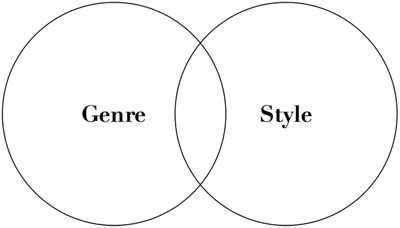
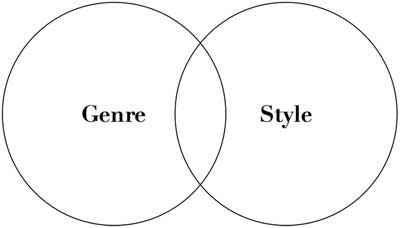
Fabbri (Reference Fabbri2007) defines style as ‘a recurring arrangement of features in musical events which is typical of an individual, a group of musicians, a genre, a place, a period of time’. Here the emphasis is on the (formal) musical code, whereas genre relates to all kinds of codes, therefore the two terms cover different semantic fields. The distinction between genre and style can be understood in terms of scope and level of articulation. Genre has a wider scope of inquiry, accounting for musical and non-musical properties, while style focuses on formal musical properties. While genre accounts for musical properties in terms of a common musical competence, style articulates these musical properties with a higher degree of specificity and an expanded musical competence. Figure 1 provides a visual representation of the way in which genre and style are related.
Relationship between genre and style.
The benefits of defining genre and style in this way are twofold. First, it allows a genre to describe not only musical factors but also social factors. Second, it allows for multiple styles to be brought under the umbrella of a single genre, thus highlighting both the similarities and the differences that may exist between songs by various artists.
4. The Trip Hop Genre
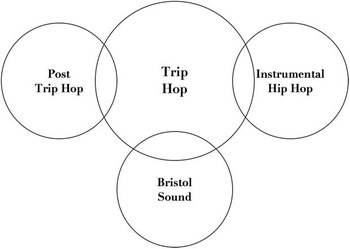
The aim of this section is to apply Fabbri’s rules of genre and identify common traits that exist throughout trip hop. The goal is to lend some validity to those that use the trip hop label, while also supporting the notion that trip hop is best considered as a genre. The analysis focuses on nine artists and situates them within three distinct styles that are related to the trip hop genre (Figure 2). Portishead, Massive Attack and Tricky represent the Bristol sound. Morcheeba, Sneaker Pimps and Lamb represent post-trip hop, a style that followed in the success of the Bristol sound but incorporated elements from rock and pop. DJ Shadow, DJ Krush and U.N.K.L.E represent instrumental hip hop.
How three distinct styles relate to the trip hop genre.

4.1. Producer-led outfit
The division of labour can be classified as a social/ideological rule of a genre (Fabbri Reference Fabbri1981). Within trip hop this can be characterised by the prevalence of producer-led outfits (PLO). A PLO is either an individual or a core group of two to three people that are at the centre of a group’s writing and production activities. Music that emanates from a PLO is the result of the interaction between individuals and technology, rather than the interaction between several individuals: the music is conceived (and realised) in the studio, not in the rehearsal space. Consequently, the studio moves from being an archiving centre and becomes a laboratory for sculpting (Brøvig-Hanssen Reference Brøvig-Hanssen2013). Whereas previously the realisation of music relied on a complex network of composers, arrangers, musicians, engineers and producers, technology has enabled an individual to perform all the roles necessary to make a successful recording (Théberge Reference Théberge1997).
All the artists mentioned above can be characterised as PLOs. DJ Shadow has dispensed with the traditional separation between artist, engineer and producer, making himself the embodiment of all three (Moorefield Reference Moorefield2005). The same could be said for DJ Krush, likewise U.N.K.LE has featured a revolving group of people with James Lavelle the sole consistent member. The core production team in Morcheeba is Paul and Ross Godfrey, who are responsible for writing and production. They feature a cast of guest vocalists across their eight studio albums and recruit additional musicians for live performances. Liam Howe and Chris Corner form the core of Sneaker Pimps, while Lamb consists of Andy Barlow and Lou Rhodes. The founding members of Massive Attack – Robert Del Naja, Grant Marshall and Andrew Vowles – all come from a DJ background, as opposed to being instrumentalists, and all three are credited as writers and producers on their debut album. Tricky is also not an instrumentalist, but is generally credited as a composer and producer. Portishead consists of Barrow (DJ), Adrian Utley (guitar) and Beth Gibbons (vocals), yet a wide variety of instruments can be heard in their music and they did not perform live until after their debut album Dummy was released.
4.2. Opaque mediation
Mediation describes the technological process that occurs during the recording, editing and processing of sound, and while it is always involved in popular music production it is evident to greater and lesser degrees. Transparent mediation describes the attempt to conceal the technological process, whereby music is recorded, edited and processed in a way so as not to draw attention to the intermediary existence of technology. Alternatively, opaque mediation specifically draws attention to the intermediary effect of technology, thus foregrounding the medium rather than attempting to conceal it (Brøvig-Hanssen Reference Brøvig-Hanssen2013). Foregrounding medium can be understood as a type of semiotics, one of Fabbri’s rules of genre, in that the associated sounds of a medium can convey meaning to a listener. Biddinger and Yochim, for instance, write ‘throughout both their history and in the contemporary moment, vinyl records have been articulated with human characteristics, such as fallibility, warmth and mortality, which, for record enthusiasts, imbue vinyl with authenticity’ (Biddinger and Yochim Reference Biddinger and Yochim2008: 183).
While opaque and transparent mediation are useful categorisers to describe the production process, they also represent aesthetic choices made by the producers. Rather than attempt to conceal the technological mediation, trip hop artists explicitly draw attention to it. Reacting against digital technology’s victory over low fidelity, their recordings feature the sound of pre-digital recording and playback media and exaggerate sonic signatures that were once meant to be ignored (Brøvig-Hanssen Reference Brøvig-Hanssen2013). The crackling sound of a vinyl record can be clearly heard in Tricky’s Hell is Around the Corner, Massive Attack’s Teardrop, Morcheeba’s Never an Easy Way, Sneaker Pimps’ Becoming X and U.N.K.L.E’s Lonely Soul. Brøvig-Hanssen (Reference Brøvig-Hanssen2013: 94) describes this as a kind of ‘schizophonic experimentation’, whereby the characteristic signature of earlier media is split from its source and inserted into a new, digital context to produce an aesthetic effect.
Opaque mediation is evident in other ways through these records, such as extreme time stretching, abrupt edits or the creation of surreal spaces through contradictory applications of reverb. Portishead’s Biscuit takes a vocal sample from I’ll Never Fall in Love Again by Jonnie Ray and reduces the original tempo of 102 bpm to a languid 68 bpm; the resulting changes in vocal timbre drawing explicit reference to the artificial manipulation. Abrupt edits in DJ Krush’s What’s Behind Darkness highlight the fact that the recording is not of a continuous, human performance, but rather an assembly of various sound sources, collected and artificially fused together. Additionally, the vocals on Lamb’s Gabriel are seemingly positioned in a consistent environment – medium-sized room with hard, reflective surfaces – yet they are occasionally treated with a contrasting reverb suggesting an open, cavernous space with many reflective surfaces. Opaque mediation is evident in several different ways but is a consistent thread running through trip hop, leading Brøvig-Hanssen (Reference Brøvig-Hanssen2013: 96) to suggest ‘the most characteristic aspect of trip hop may in fact be the particular ways in which the music foregrounds its mediation’.
4.3. Intertextuality
Intertextuality describes the presence of a specific and identifiable work within another work. Frith discusses intertextuality as one of Fabbri’s rules of semiotics, as it refers to ‘how music works as rhetoric … [and] the ways in which “meaning” is conveyed’ (Frith Reference Frith1996: 91).Footnote 3 Intertextuality can exist in a musical work in a number of ways but the most common is quotation.Footnote 4 The significance of quotation is that it not only references musical gestures but also the cultural and historical associations of that gesture, and just as a performer can transform a quoted melody, cultural and historical associations can also be transformed (Metzer Reference Metzer2003). To understand these associations, it is not necessary that the listener identify the intertextual reference. Borrowing often acts on the original source as a stylistic topic (Leydon Reference Leydon2010), and it is the associations implied by a work’s style, performance technique, or timbre that carry cultural resonance. For example, a novice listener is unlikely to listen to Portishead’s Sour Times and identify the sample from the soundtrack of the Mission: Impossible television series. However, they may well suggest ‘it sounds like spy music’.
Intertextual references are common throughout trip hop and not only reference other works but also other styles, periods and cultures. Intertextuality directly informs trip hop’s stylistic multiplicity, as references to hip hop, soul, reggae, jazz and film music intertwine. Additionally, intertextual references occur in a number of different ways, which I shall discuss using Lacasse’s (Reference Lacasse2000) terminology. The most common intertextual reference is autosonic quotation, whereby the recording of a pre-existing work is inserted into a new work; a practice more commonly known as sampling. The Sneaker Pimps’ 6 Underground, Morcheeba’s Trigger Hippie, DJ Krush’s Big City Lover, Lamb’s Górecki and U.N.K.L.E’s Celestial Annihilation are just a few examples. Allosonic quotation describes a work that quotes another work, but not the recording of that work; for example, the way Massive Attack’s Angel references Horace Andy’s You Are My Angel. Allosonic allusion describes a work that references another work without directly quoting from it; for example, the way Portishead’s Half Day Closing references The American Metaphysical Circus by the United States of America. A cover is a work that remakes another work in the style of the covering artist, such as Tricky’s cover of Black Steel in the Hour of Chaos by Public Enemy. Finally, plunderphonics describes a work that is assembled from a large number of pre-existing works, such as DJ Shadow’s In/Flux. Intertextuality is one of the most significant traits of trip hop, evidenced by the sheer number of specific intertextual references that exist, as well as the variety of ways they are implemented.
5. Style Analysis
Having identified three common traits that may help define trip hop as a genre, it is possible to note differences in musical style within this label. The aim of this section is to apply electroacoustic analysis techniques and identify specific musical differences that suggest the existence of three distinct styles related to the trip hop genre. The argument is that, while trip hop may be an appropriate umbrella term, it does not account for the variations that exist between artists.
Analysis of form, rhythm and harmony may assist in drawing distinctions between the various styles, however, a more relevant focus may be the manner in which trip hop artists manipulate the sonic and spectral elements of their work. This is not to diminish the significant musicological differences that exist within trip hop, however, it is the sound that can identify a tune, band, or musician (Brøvig-Hanssen and Danielsen Reference Brøvig-Hanssen and Danielsen2013).
5.1. Gestural surrogacy
The first area of analysis distinguishes the Bristol sound through its deeper engagement in gestural surrogacy. Footnote 5 Gestural surrogacy concerns the ways in which the vocabulary of sound is expanded beyond known sources and known gestures. When we listen to traditional instrumental music, we not only perceive the sound, but also infer the sounding body and physical gesture that produced it; thus, the production of sound and the perception of sound are interconnected. When the relationship between a sound and its source is unclear, it draws the listener’s attention to the distinctive features of the sound, as well as heightens the instability of the listener’s perception (Clarke Reference Clarke2005): they have difficulty identifying the source of the sound or the gesture responsible for the sound’s behaviour.
The relationship between sound, source and gesture can be blurred, stretched, or broken entirely. The various stages of gestural surrogacy describe increasing remoteness of a sound from its source, gesture, or both (Smalley Reference Smalley1997). First order surrogacy refers to sonic objects outside the traditional musical structure: sounds that are not intended for musical use though we can recognise both the source and gesture. Second order surrogacy describes traditional instrumental/vocal activity where an acknowledged performance skill is employed: the source and the gesture can be recognised. Third order surrogacy describes sound whose source and/or gesture is unknown: the relationship between sound, source and gesture is ambiguous. Remote surrogacy refers to the remnants of gesture when human interaction disappears completely: source and gesture are unknown and unknowable. All trip hop artists rely primarily on second order surrogacy: known instruments and gestures. The extent to which first, third and remote orders are explored are good indicators of one particular style over another, as is the manner in which these explorations function within a work.
5.1.1. Instrumental hip hop
Instrumental hip hop primarily relies on first and second order surrogacy. Known instruments provide the bulk of the texture, however, sounds not typically associated with music are also used frequently. References to third order surrogacy can be found, however, they are more decorative than functional in the sense that their presence is not essential in maintaining the work’s structure and they are less indicative of the overall sound, though they may heighten the aesthetic value. For example, DJ Shadow’s What Does Your Soul Look Like (Part 1 – Blue Sky Revisit) opens with the sound of radio chatter over an electronic communications network. After 20 seconds, first order surrogacy gives way to known instruments using known gestures. Second order surrogacy continues until 1:31, when an unknown sound enters the sonic space before disappearing after a few seconds. The track continues in this manner for the next five minutes. Second order surrogacy creates the texture while third order surrogacy decorates it. The final 70 seconds consists of a radio transmission of spoken word, and it is the continual presence of first order references in the opening and closing sections that suggest they are integral elements of the texture.
5.1.2. Post-trip hop
Post-trip hop primarily relies on second and third order surrogacy, and explores the third order to a greater extent than instrumental hip hop. Known instruments comprise the texture of a work while unknown sounds frequently decorate the space to create interest. For example, the Sneaker Pimps song Low Place Like Home opens with several sounds, the source or gesture of which are unknown. The onset of the opening sound is compressed, creating a ‘pushing’ effect, which is then followed by a percussive sound with an extended onset and an immediate termination. Two distinct percussive sounds follow whose gesture can be inferred as a striking motion though the source is unclear. At 0:23 known instruments replace the unknown sounds and continue until 1:20 when the opening unknown sounds return. These sounds continue through the second verse before being replaced by known instruments at the second chorus (2:00). Known instruments continue to create the texture for the remainder of the song while the unknown sounds reappear at strategic points to maintain momentum.
5.1.3. The Bristol sound
The Bristol sound primarily relies on second and third order surrogacy, however, unlike post-trip hop, references to third order surrogacy are functional rather than decorative: their absence would fundamentally change the texture of the work. Unknown sounds often work in concert with known instruments to define the texture, and are therefore more indicative of the overall sound. Massive Attack’s Risingson opens with three distinct sounds whose source and gesture are unknown. The onset of each sound varies, sometimes sudden, sometimes gradual, and the continuation descends in pitch before fading out. At 0:09 an undulating ‘mechanical’ sound moves around the foreground space in centrifugal motion for ten seconds before appearing to morph into an explosive sound emerging from the centre, its spectral energy pulsating before fading out. At 0:30 the verse begins, however, rather than relinquishing space to known instruments, the unknown sounds continue, drawing the listener’s attention as they explore the sonic space, left to right, background to foreground. During the first verse, the only sounds we recognise are vocals, drum set and electric bass, and of the three only the bass provides a pitch reference, with the exception of decorative vocal swells at 0:47 and 1:13. The second verse continues in a similar manner, with second and third order surrogacy equally responsible for defining the texture. At 2:35 a new sound is introduced, its ‘artificial’ source and pulsating gesture are unknown. This sound provides the basis for the next two minutes of the song until the initial unknown sounds return at 4:30 to close the track.
5.2. Spectra
The second area of analysis concerns the artists’ treatment of spectral information and space. A particularly useful tool to distinguish between the styles is the notion of inharmonic saturation – the adding of spectral components to move a harmonic note towards inharmonic noise. A note has an absolute pitch that can be precisely identified, whereas noise does not and must be described spectromorphologically. However, the border between the two extremes is not clear. Spectral components can be added to a note to move it towards noise, just as the colour and resonance of noise can be manipulated to move it towards note. If the composer takes an interventionist approach, the balance between note and noise can be manipulated, and as a note moves towards noise the listener’s attention shifts away from the fundamental pitch and towards the spectral qualities. As a consequence of this approach, the sound that the listener perceives is not dictated by a harmonic instrument’s natural timbre, rather it arises as a result of the composer’s intervention in the mediation process. Alternatively, if the composer takes a naturalist approach, the natural timbre of an instrument is largely responsible for its spectral quality.
The notion of spectral space is also pertinent. Here, spectral space may refer to the distance between the highest (canopy) and lowest (root) audible sounds. Important factors concern the distribution of sound within this spectral space – whether it is densely packed or sparsely filled, and whether the sounds are distributed evenly, concentrated, or separated into streams with intervening spaces. Findings in each area help to shape how the listener perceives the sound.
5.2.1. Instrumental hip hop
Within instrumental hip hop, spectral components are rarely added to a note. Rather, the instruments’ natural timbres are most responsible for their colour and character. This is not to suggest that the note’s timbre is not important, rather that it is perceived as unmediated and ‘pure’, and can be easily reconciled with the original source. The song Unreal from U.N.K.L.E is indicative of this approach. The structural texture of the song is composed of drum set, string bass and organ, and in each of the instruments the spectral quality appears to be unimpeded, as can be heard at 1:08. An acoustic guitar is frequently employed to provide decoration, and its timbre is likewise unmediated. One may suggest that the listener does not focus attention on the particular sound of the guitar, merely identifies it as a guitar. Spectrographic analysis of Unreal demonstrates important details regarding the spectral space commonly found in instrumental hip hop. The spectral space is extensively filled, the density is compressed, and there is little evidence of empty space. The spectral energy becomes slightly more concentrated as we move from the canopy, through the centre, and down to the root, however, it is generally diffused throughout the space. There are traces of horizontal streams of energy, though they do not stand out in stark relief, and there appears to be no intervening spaces separating them.
5.2.2. Post-trip hop
Post-trip hop employs a similar approach with respect to inharmonic saturation. Instrumental timbres are left unmediated, allowing the listener to perceive the natural sound of the instrument. The purity of the instrumental tones is one of the factors that give post-trip hop its ‘polished’ sound, suggesting that great care has been taken to preserve the richness of the original timbre. This approach can be seen in Trigger Hippie by Morcheeba. The structural texture of the song comprises vocals, electric bass, drum set and synthesiser – playing sustained notes with a gentle organ sound. Each instrument projects a pure sound, unaltered by spectral interference. An electric slide guitar plays melodic fills as embellishments and likewise, the timbre is clean and pure, as can be heard at 1:20.
Within the post-trip hop style one begins to find examples of spectral space that, while dense, start to become more opaque than those found in instrumental hip hop.
Trigger Hippie serves as a useful model and spectrographic analysis shows a more diffuse spectral space with less concentration towards the root, and a less compressed density: one can perceive gaps in the texture. Some horizontal streams of spectral energy can be observed, with a small degree of space separating them.
5.2.3. The Bristol sound
Artists working in the Bristol sound style employ a different approach in terms of both inharmonic saturation and spectral space. Spectral components are often added to a given note, thus shifting it towards noise and altering the balance between pitch and timbre as they vie for the listener’s attention. The composer’s hand is evident in the mediation process from source to listener, and the sound that we are finally confronted with differs from the original source. A common approach in the Bristol sound style is to overload a signal pathway in the mediating process, resulting in an overdriven preamp that fuses the note with distorted noise. This has the effect of creating a very ‘dirty’ sound and may encourage the listener to pay greater attention to the spectral quality of a note in addition to the pitch. For example, Portishead’s Wandering Star opens with a bass whose timbre is noticeably distorted, produced from the fusion of note and noise. The bass retains this sonic signature throughout the track, suggesting that this particular spectral quality of the bass functions as an integral element of the texture. This approach can encourage the listener to consider the actual sound of the bass, rather than simply identifying it as a bass.
Noise that moves towards note is also frequently heard, and often functions as part of a track’s texture. For example, on Portishead’s Elysium a continuous noise accompanies the drums, and its resonance gives the suggestion of pitch (0:12). Its continued presence along with the drums significantly alters their tone and draws the listener’s attention towards the kit. Each of these types of sound often appear as integral aspects of a track’s texture, rather than as decorative embellishments.
Turning to the treatment of spectral space, one begins to find a much more transparent density in the Bristol sound. As demonstrated by spectrographic analysis of Wandering Star, spectral energy is often concentrated around the root, opening up significant gaps in the centre and canopy. Horizontal streams are clearly evident, they are compacted and separated by intervening areas of space. These approaches can give an impression of emptiness to a listener, but also allow for a more nuanced perception of micro-level details. If ‘high density is the enemy of low-level detail’ (Smalley Reference Smalley1997: 121), transparent density can be its ally.
5.3. Spatiomorphology
Spatiomorphology is concerned with the exploration of spatial properties and spatial change within a musical work. My focus is on spatial properties as they exist within Moore’s (Reference Moore2012) model of the soundbox, the three dimensional space revealed by the ‘laterality of the stereo image, the perceived proximity of aspects of the image to a listener, and the perceived frequency characteristics of sound-sources’ (Moore Reference Moore2012: 31). Spatial properties can reflect actual physical environments that the listener relates to a previously experienced space, such as a room or concert hall, or they can reflect artificial spaces that do not exist in nature. Artificial spaces can become surreal to the extent that ‘what is heard departs from the convention for normal sound production within a particular context’ (Brøvig-Hanssen and Danielsen Reference Brøvig-Hanssen and Danielsen2013: 75). Smalley develops six categories to discuss the spatial style of a work, two of which are pertinent to this analysis. A single spatial setting relates to music that is situated within a single spatial environment. The environment can be perceived at the outset or it may be revealed over time as the work progresses. ‘Spatial awareness is cumulative, and the listener eventually realises that there is a global spatial topology into which the whole work fits’ (Smalley Reference Smalley1997: 124). Spatial simultaneity relates to music that is situated within different spatial environments simultaneously. For example, a listener may perceive a very direct and intimate sound where low-level detail is evident, suggesting a tightly enclosed space, while simultaneously perceiving a distant sound obfuscated by large reverberation and/or echo.
Smalley also raises the idea of microphone space, which he describes as a ‘compositional tool for creating proximate spaces which beam to us small and microscopic presences and details of spectral space’ (Smalley Reference Smalley2007: 43). Microphone space therefore becomes a means of creating what Moore (Reference Moore2012) calls the intimate zone within his model of proxemics, whereby the vocalist is within touching distance of the listener by virtue of microscopic vocal nuances.Footnote 6 The use of microphone space to create intimacy between singer and listener is a frequent occurrence in the Bristol sound.
5.3.1. Instrumental hip hop
Instrumental hip hop is generally enclosed within a single spatial setting, and the listener is aware of this space within the first few moments of a work. Vocal narratives are not often heard in instrumental hip hop, however, when they are, the vocalist generally inhabits the social zone (medium distance from the listener and situated in the centre of the soundbox). Big City Lover by DJ Krush serves as an example. The track opens with saxophone and vocals and the reverb suggests a large, empty space with numerous hard surfaces. As the drums enter, the long reverb tail of the snare drum is consistent with the elongated space and we perceive the drummer positioned towards the centre of the soundbox. At 0:36 the instruments suddenly stop playing and the reverb decay is clearly heard for two seconds, giving the listener a clear sense of the enclosed space. As the track progresses, the listener perceives each instrument as being placed at a specific location within the soundbox. Certain instruments such as the saxophone are perceived as being at a greater distance from the listener while others, such as the vocals and bass guitar, are perceived as being closer, yet each instrument can be situated within the same environment. The spatial properties are explicitly communicated to the listener within the first 30 seconds of the work and, once stated, do not deviate throughout the remainder of the track. The vocalist is positioned in the social zone, there are no microscopic vocal sounds, and she is integrated within the space rather than being positioned in front of it.
5.3.2. Post-trip hop
Post-trip hop is also generally enclosed within a single spatial setting. At times the spatial properties are revealed to the listener at the onset, however, they can also be revealed over time as the work progresses. Vocalists tend to inhabit either the social or personal zone, whereby the singer is within arms’ length from the listener near the front of the soundbox. In Lamb’s Górecki the opening suggests a large hall with a medium-long decay. At 0:41 hand drums enter and widen the stereo spread and at 1:18 a string bass enters and expands the depth of the space. At 2:00 decorative percussive hits expand the vertical space and the listener perceives the soundbox as expanding gradually as the work progresses. At 2:30 the drum set enters and the full scope of the spectral space is revealed. The vocalist is positioned within the personal zone, slightly back from the front of the soundbox. The vocalist’s projection varies from soft to medium and we can perceive occasional vocal nuances such as a breath intake before singing a phrase. Like instrumental hip hop, different instruments are placed strategically around various points of the soundbox but each instrument can still be reconciled into a singular spatial setting.
5.3.3. The Bristol sound
In the Bristol sound we are more likely to find examples of surreal spaces, as developed by the simultaneous presentation of contradictory acoustic environments.
The contradictory environments do not fit easily into Moore’s model of the soundbox, as a work can often not be resolved into a single spatial setting. Rather, the listener is aware of multiple environments simultaneously. Vocal performances are often based within the intimate zone, the singer is placed at touching distance from the listener and microscopic vocal nuances can be perceived. The immediate opening of Tricky’s Suffocated Love suggests a tight enclosed space with a reasonable amount of absorbent material. The bass guitar and hi-hat are very dry and positioned very close to the listener, suggesting a very small reverb with a fast decay. Three seconds into the track the first snare drum hit carries a noticeably larger reverb and longer decay, and we can clearly perceive the reverb tail as it dissipates. During this time, the listener is aware of two spaces occurring simultaneously: the tightly enclosed space of the bass and hi-hat and the larger open space of the snare drum. When the vocals enter at 0:35, they are positioned extremely close to the listener with only a minimal amount of reverb, suggesting the vocalist is placed within a small room whose surface absorbs most of the reflections. At 1:00 a string section enters and their implied space is very large with multiple hard surfaces spaced some distance apart. This creates a recycling echo effect that obscures the attack of the strings and highlights the vast number of reflections. At 1:24 a female voice enters and the reverb suggests a larger room than her male counterpart, with more reflective surfaces. The listener is now aware of five simultaneous spaces: (from near to far) male voice; bass and hi-hat; female voice; snare drum; string section. The whispering quality of the vocal performance and the audible intakes of breath place the vocalist within the intimate zone. The close placement of the vocalist and minimal reverb allow for a nuanced listening of many low-level details, such as the grainy quality of the voice when he sings the word ‘love’ at 0:42.
The preceding analysis relates to the sound of trip hop, as it is the sound that may lead to identification of an artist or style. The analysis shows there are three distinct areas in which the sound of the Bristol sound differs from other trip hop-related styles. When listening to the Bristol sound, one is more likely to encounter sounds whose source and/or gesture is unknown, creating an ‘otherworldly’ impression. Furthermore, timbres will often be distorted, resulting in a ‘dirty’ and ‘grainy’ sonic quality. Finally, surreal spatial environments contribute to the ‘otherworldly’ quality, while perceptions of space and emptiness allow for greater recognition of low-level details, offering more subtle nuances to the listener.
6. Conclusion
The term ‘trip hop’ has always been problematic, largely due to its continued use by fans, industry and academics, despite the artists’ objections. Rather than promoting one side of the discussion over the other, I argue that the more accurate way to position these artists is within distinct styles related to the trip hop genre, as shown in Figure 2. By approaching the discourse through the lens of genre and style, I have demonstrated three significant areas that unite trip hop artists: prevalence of PLOs, opaque mediation and specific intertextual references. These common areas that exist within trip hop, in addition to the importance of the community’s viewpoint regarding genre labels, may provide support to those who continue to use the term. Conversely, I have demonstrated unique sonic signatures of the Bristol sound regarding gestural surrogacy, inharmonic saturation, spectral space and spatiomorphology. As it is the sound or a recording that may initially engage the listener, these differences cannot be overlooked. In this article I have argued that the opposing viewpoints need not contradict each other, rather they can be reconciled into a holistic model that may ultimately benefit artist and community alike.
Acknowledgement
The author would like to acknowledge the helpful feedback from Ian Whalley and Nick Braae.