Introduction
Hospital-acquired infections (HAIs) are defined as infections that occur after a patient is admitted to a healthcare facility and are not present at the time of admission. HAIs are a patient safety concern with an estimated one in thirty-one patients developing one during their admission. 1 Risk factors associated with HAIs include age; presence of underlying comorbidities; prolonged hospitalization; surgical or invasive procedures; and prior antibiotic use. Reference Monegro, Muppidi and Regunath2 Common types of HAIs include central line-associated bloodstream infections (CLABSI), catheter-associated urinary tract infection (CAUTI), surgical site infections (SSI), ventilator-associated pneumonia, and other infections acquired during hospitalizations. Reference Monegro, Muppidi and Regunath2 National Healthcare Safety Network (NHSN) of the Centers for Disease Control and Prevention (CDC) through its quality metrics has played a role in decreasing HAIs (through improved surveillance, prevention strategies, and reporting requirements). 3 However, they do not capture all clinical infections that may occur during hospitalization. For example, in one study 8% of CAUTIs evolved into a bloodstream infection (BSI), whereas three-fold higher numbers were observed in those with UTI without a urinary catheter. Reference Kelly, Ai, Jung and Yu4 This gap highlights an opportunity for a device-agnostic quality metric that captures infections from diverse sources. Reference Schrank, Snyder and Leekha5
To help address this gap, the CDC and Center of Medicare Services (CMS) proposed a broader quality metric for hospital-onset bacteremia and fungemia (HOB). HOB refers to any bacterial or fungal (i.e., Candida species) BSI detected from a blood culture collected on day four or later of a hospital admission. Reference Schrank, Snyder and Leekha5,6 This proposed metric will supplement current quality metrics by capturing other BSIs, not limited to specific sources. Previous studies have found that in patients with HOB, central venous catheters (CVC) were present in 73% of cases, indwelling urinary catheters in 20%, and invasive mechanical ventilation in 25%. Reference Dantes, Rock and Milstone7 Further, several studies have highlighted the significant clinical and economic burden of HOB, both in the presence of a currently reportable HAI and without a clearly identifiable source. Reference Kelly, Ai, Jung and Yu4,Reference Yu, Jung and Ai8,Reference Ai, Jung, Bastow, Adjaoute, Bostick and Yu9 Expanding the reportable quality metric to include HOB could improve patient safety and care, and may need infection prevention strategies for BSIs not currently reported to the NHSN.
Current literature on HOB has assessed the prevalence, preventability, the association between CLABSI, CAUTI, and SSI with HOB cases, and the overall risk-adjustment feasibility of the quality metric. There is limited research related to HOB in the immunocompromised cancer patients who are at a higher risk for bacteremia, which may lead to spuriously higher rates of HOB in this patient population. One recent study reported a higher incidence of HOB in patients with diagnosis-related groups (DRG) associated with history of myeloproliferative cancer or transplant; however more in-depth guidance for this patient population is needed. Reference Yu, O’Horo, Ai, Jung and Bastow10
City of Hope (COH) is a National Cancer Institute (NCI)-designated comprehensive cancer center in the United States that offers cancer treatment including hematopoietic cell transplant (HCT), cellular therapy, and immunotherapy. Its patient population has a high case mix index suggesting patients with significant comorbidities, population of severely immunocompromised patients due to underlying malignancies, cytotoxic treatments, allogenic stem cell transplantation (e.g., graft versus host disease), and frequent use of central lines and other medical devices. These patients are particularly at high risk for HAIs due to their prolonged hospitalizations and immunosuppression. The COH patient population is well positioned to evaluate the use and relevance of the proposed HOB quality metric.
This study will add to current literature by quantifying HOB in patients with hematologic malignancy (HM) with HCT, HM without HCT, and solid organ malignancy (SOM). Specifically, this study will describe the incidence of HOB in each subgroup, identify clinical risk factors associated with HOB, and delineate the pathogens of HOB in this vulnerable patient demographic.
Methodology
Population
The study included patients aged 18 years old or older who were admitted to COH (Duarte, California) between January 1, 2018, and September 30, 2024, and meet the CDC’s definition of HOB. Patients were excluded if they had positive blood cultures for the same organism within the 4-week period prior to the initial positive culture. These patients were identified by the COH Center for Informatics.
Design
This is a retrospective, single-center, observational analysis utilizing the electronic health record as the data source. The data extraction, methodology, and protocol were reviewed by the COH IRB and approved with a waiver of informed consent.
Outcomes
The primary clinical outcome is incidence of HOB among HM patients with HCT, HM without HCT, and SOM. Patient categorization was performed based on the ICD code for the hospitalization being studied. If patients were diagnosed with both SOM and HM, they were included in the HM category. Secondary outcomes include identifying clinical risk factors associated with HOB events in each subgroup and delineating the pathogens associated with HOB events.
Statistical analysis
Patient, clinical, and hospital characteristics were described using frequencies for categorical variables and medians with interquartile ranges for continuous variables overall. We modeled the association between HOB and various risk factors using logistic regression. HOB was the outcome and the risk factors evaluated were sex, age greater than or equal to 65, body mass index (BMI) greater or equal to 30, admission to the ICU, admitted to COH within the past 90 days, antibiotics administered within the past 90 days, cancer type, use of a central line, use of an indwelling urinary catheter, and documented CAUTI during the hospitalization. All model analyses were conducted using SAS version 9.4 software (SAS Institute, Cary, NC).
Results
Patient demographics and clinical distribution
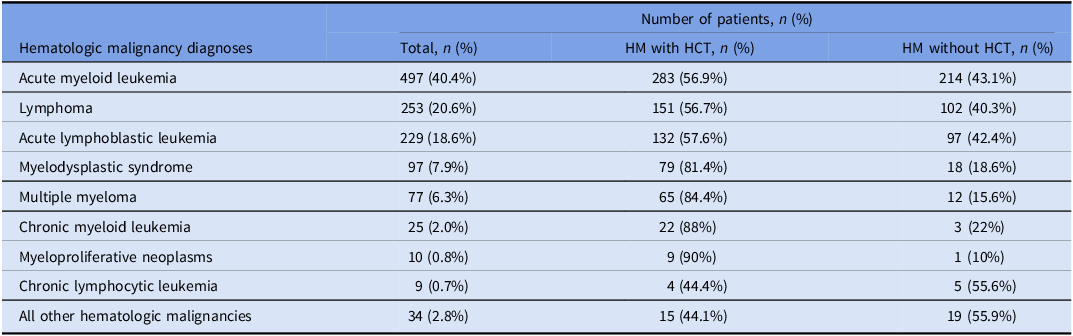
A total of 1,470 admissions met the definition of an HOB event. The study population was predominantly male (59%) with a median age of 59 years [IQR 45–68] (Table 1a). Of all cases 72.5% were White. HM patients with HCT accounted for 51.7% of HOB events. The most common HM types in the HOB population were acute myeloid leukemia (40.4%), lymphoma (20.6%), and acute lymphoblastic leukemia (18.6%) (Table 1b). Most patients had received antibiotics within the prior 90 days and had a CVC at the time of the HOB culture (94.1% and 81.5%, respectively). Only 2.5% of the overall study population had an indwelling urinary catheter. Additionally, severe neutropenia (absolute neutrophil count (ANC) < 0.5 × 10⁹/L) was common in the HM cohorts. A comprehensive list of patient demographics is available in Tables 1a and 1b.
Demographics and clinical distribution of patients with HOB by cancer type

HCT, hematopoietic cell transplant; HM, hematologic malignancy; SOM, solid organ malignancy.
* ANC value for each patient was the first ANC document after time of blood culture collection.
Distribution of hematologic malignancy diagnoses for HOB population

HCT, hematopoietic cell transplant; HM, hematologic malignancy.
Incidence of HOB, infection characteristics and mortality
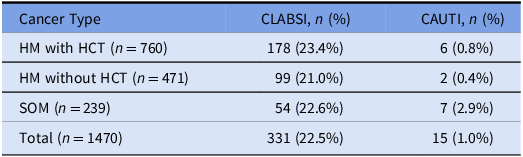
The incidence of HOB was 3.2% (95% CI 2.95%–3.26%) with the highest incidence in HM patients with HCT (3.5%), followed by HM without HCT (2.2%) and SOM (0.9%) (Table 2). Patients with concurrent device related infections were identified to have the following: 22.5% of HOB had a CLABSI and 1.0% had a CAUTI (Table 3). The overall mortality rate in patients with HOB was 22.4%; highest in HM patients without HCT (32%) with no difference in mortality in CLABSI and non-CLABSI HOB cases (Supplemental Table 1).
Incidence of HOB Stratified by Cancer Type

HCT, hematopoietic cell transplant; HM, hematologic malignancy; SOM, solid organ malignancy
Reported CLABSI and CAUTI events in patients with hob stratified by cancer type

HCT, hematopoietic cell transplant; HM, hematologic malignancy; SOM, solid organ malignancy
Clinical risk factors associated with HOB events
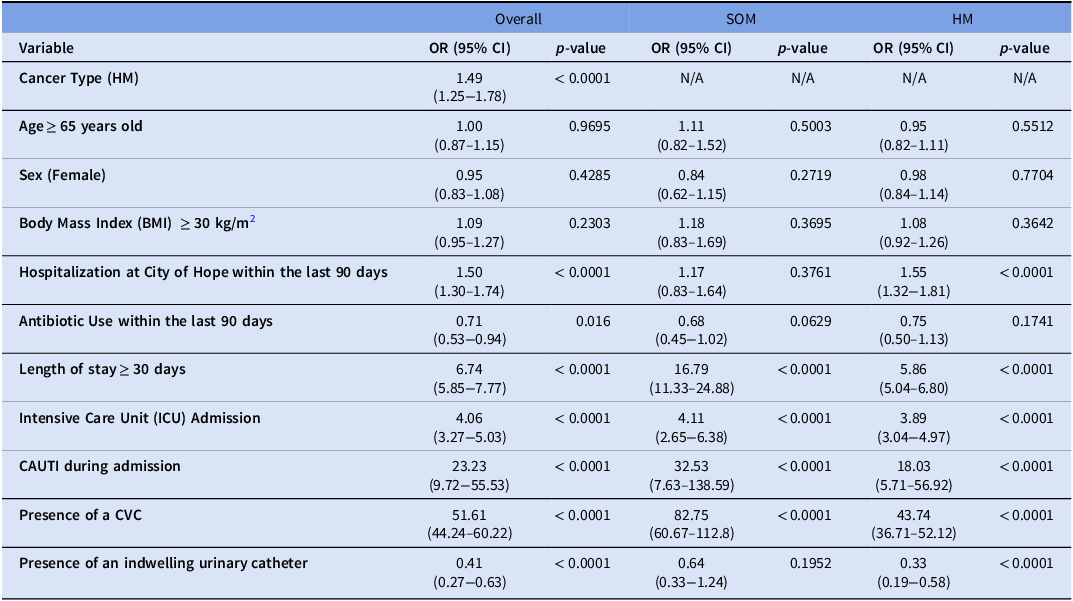
The risk factors and associated Odds Ratios are as follows: patients with HM (OR 1.49, 95% CI 1.25–1.78); hospitalization at COH within the past 90 days (OR 1.50, 95% CI 1.30–1.74); length of stay greater than or equal to 30 days (OR 6.74, 95% CI 5.85–7.77); admission into ICU (OR 4.06, 95% CI 3.27–5.03); development of a CAUTI during admission (OR 23.23, 95% CI 9.72–55.53); and presence of a CVC (OR 51.61, 95% CI 44.24–60.22). Indwelling urinary catheters appeared as protective for development of HOB (OR 0.41, 95% CI 0.27–0.63) (Table 4).
Adjusted odds ratios for risk factors associated with HOB patients stratified by cancer type

HM, hematologic malignancy, SOM, solid organ malignancy
(See Supplemental Table 2 for unadjusted risk analysis)
Risk factors were stratified to evaluate association with SOM and HM (Table 4). In patients with SOM, risk factors included length of stay greater than or equal to 30 days (OR 16.79, 95% CI 11.33–24.88), admission into the ICU (OR 4.11, 95% CI 2.65–6.38), development of a CAUTI during admission (OR 32.53, 95% CI 7.63–138.59), and presence of a CVC (OR 82.75, 95% CI 60.67–112.8); all with a p-value of < 0.0001. For patients with HM, risk factors included prior hospitalization at COH within the past 90 days (OR 1.55, 95% CI 1.32–1.81), length of stay greater than or equal to 30 days (OR 5.86, 95% CI 5.04–6.80), admission into the ICU (OR 3.89, 95% CI 3.04–4.97), development of a CAUTI during admission (OR 18.03, 95% CI 5.71–56.92), and presence of a CVC (OR 43.74, 95% CI 36.71–52.12); all with a p-value of < 0.0001. Notably, the HM patients had lower risk of HOB with the presence of an indwelling urinary catheter (OR 0.33, 95% 0.19–0.58).
Pathogen profile
Pathogen composition by cancer type is presented in Table 5. Among these HOB cases, Escherichia coli (E. coli) was the leading organism (20.1%), followed by Coagulase-Negative Staphylococci (19.0%) and Viridians streptococci (11.3%). The same pathogens were observed among patients with HM, where E. coli, Coagulase-Negative Staphylococci, and Viridians streptococci represented 20.7%, 20.9%, and 11.6% of cases, respectively. The distribution was more diverse in the SOM subgroup: E. coli remained the most common pathogen (16.7%), whereas Viridians streptococci (9.6%), Coagulase-Negative Staphylococci (9.2%), and Klebsiella pneumoniae (9.2%) had similar distributions. Notably, Staphylococcus aureus was present in 7.1% of SOM which was almost twice the distribution in HM patients. Pseudomonas aeruginosa incidence was similar in both types of cancer categories at approximately 4.6%.
Distribution of Pathogens Identified in HOB Events Stratified by Cancer Type

* Most common Candida species included: Candida glabrata, Candida krusei, and Candida albicans (See Supplemental Table 3 for complete list)
**Staphylococcus epidermidis is a subcategory of coagulase-negative Staphylococci
Discussion
The HOB incidence in the cancer patient population studied was 3.2 per 100 admissions. This incidence is higher than previously reported among patients admitted to acute care hospitals that are not “stand-alone cancer centers” (0.124 per 100 admissions). Reference Yu, Jung and Ai8 This finding suggests that cancer patients are more likely to acquire HOB than the general patient population. A recent large multicenter study reported that patients with myeloproliferative malignancies had up to 6-fold higher risk of HOB events than non-cancer patients, further supporting this hypothesis. Reference Yu, O’Horo, Ai, Jung and Bastow10 The incidence of SOM related HOB incidence was lower than other types of malignancies, which may be due to the increasing use of non-myelosuppressive antineoplastic therapy and immunotherapy. HM patients often have immunodeficiency related to neutropenia and lymphopenia from the disease infiltrating the bone marrow, opposed to SOM that may or may not directly invade the bone marrow and/or compromise neutrophil and cellular components crucial in the immunologic response to pathogens. Reference Cibir, Beer and Kraus11
Risk factors associated with HOB events in this study included HM, length of stay greater than or equal to 30 days, prior hospitalization within the past 90 days, antibiotic use within the past 90 days, admission into the ICU, development of a CAUTI during admission, and presence of a CVC. In a large multicenter study myeloproliferative cancers and transplant patients were more likely to develop HOB regardless of length of stay. Reference Yu, O’Horo, Ai, Jung and Bastow10 When analyzing HOB cases regardless of underlying conditions, length of stay greater than 30 days was associated with HOB, which aligns with the findings from our study. Patients who stay longer in acute care tend to have more aggregate invasive devices, and with coagulase negative staphylococci as a top HOB pathogen, it is reasonable to assume that repeated or prolonged skin disruption involved in acute care is a factor in HOB events. However, studies have demonstrated that coagulase negative staphylococci and other pathogens listed as CLABSI organisms are in fact present on mucosal surfaces and are likely to be reflective of mucosal barrier injury (MBI) bacteremia. Reference Tamburini, Andermann, Tkachenko, Senchyna, Banaei and Bhatt12 Best practices in judicious use of invasive devices and blood specimen collections will likely need to be revisited to ensure risk mitigation is optimized without compromising quality of care. In addition, enhanced oral care may reduce risk for coagulase negative staph and other oral pathogens in HCT patients. Reference Suwabe, Fuse and Katsura13
Prior hospitalization at the study center within 90 days was identified as a factor for developing HOB in our population. This association may be due to patients’ recovery from previous hospitalization, ongoing therapy for cancer (particularly HM without HCT or SOM), the development of multi-drug-resistant organisms, or antibiotic exposure which was an additional factor identified to correlate with HOB in this population. Data from CDC’s HAI report identified high-risk antibiotics use as risk for developing sepsis within 90 days of discharge. 14,Reference Baggs, Jernigan, Halpin, Epstein, Hatfield and Donald15 Our data similarly suggests recent hospitalization and antibiotic use were risk factors for HOB.
The study population includes patients receiving cancer treatment and HCT who have a higher baseline acuity due to immunosuppression; this elevated risk is further magnified for those requiring ICU admission. Previous literature has reported that that patients admitted to the ICU are more likely to develop HOB due to their acuity and the use of devices similar to our findings. Reference Yu, Ye and Edwards16 A study reported that 7.8% of CAUTI developed HOB and the rates in our patients were also higher in those with HOB. Additionally, the same study found that 3.7% of HOB cases were secondary to a non-CAUTI hospital-onset urinary tract infection (HOUTI). Reference Kelly, Ai, Jung and Yu4 Presences of CVC were associated with higher incidence of HOB, which is expected given that CLABSI is a subset of HOB. However, like prior study findings, non-CLABSI HOB occurred far more often than CLABSI HOB, emphasizing the sources other than these devices. HM patients with HCT are at risk for HOB based on time post HCT (early vs. late). One study reported 17.8% BSI at 30 days post-HCT (with median time to onset of 9 days post-HCT) and 20.5% at day 100 post-HCT with predominant pathogens being coagulase-negative staphylococci and E. coli. Reference Sava, Bättig and Gerull17 Therefore, it is important to develop device-agnostic quality metric in this special population.
Interestingly indwelling urinary catheters were associated with lower incidence of HOBs in our patients compared to the reported literature. In our institution, indwelling urinary catheter use is limited to patients in the ICU, with suspicion of sepsis or shock, undergoing surgical procedures, or experiencing acute urinary retention - each case requiring daily review of necessity. While the CAUTI decision flow chart (Supplemental Figure 1) reflects institutional processes designed to reduce catheter use, low CAUTI rates are largely attributable to the proactive, day-to-day efforts of the infection prevention team, whose surveillance and intervention strategies are critical to success. The lower incidence of HOBs may reflect both high surveillance and restricted use in a specific population. As such, this outcome should be interpreted with caution given the specific population and smaller sample size. Similarly, literature has shown that non-CAUTI HOUTIs are approximately three times more likely to progress to HOB than CAUTIs. Reference Kelly, Ai, Jung and Yu4 However, when a CAUTI did occur in our study, it was twenty-three times more likely to progress into HOB. This suggests that while CAUTIs may occur less frequently, their occurrence represents a particularly high-risk event for bacteremia.
Common HOB organisms in this study such as E. coli and Klebsiella pneumoniae are often associated with urinary tract infections and coagulase-negative Staphylococcus, including Staphylococcus epidermidis, can be associated with CVCs, although data suggests that mucositis and gut microbiome can also be a risk factor for these pathogens. Regarding the latter, Viridians streptococci (11.3% of cases) is a common oral flora that can evolve into a BSI due to mucositis related to antineoplastic therapy. This has been well documented in patients undergoing active chemotherapy and HCT and similarly in our cohort. Alteration of the oral microbiome and cumulative carbapenem use has been shown to be risk factors for Stenotrophomonas maltophilia infections particularly in those with acute myeloid leukemia. Reference Aitken, Sahasrabhojane and Kontoyiannis18 Main risk factors for the development of Pseudomonas aeruginosa blood stream infections in oncological patients are neutropenia, use of corticosteroids, severity of underlying disease, or prior surgery. Reference Tofas, Samarkos and Piperaki19 GI flora is often implicated in MBI related bacteremia and is an NHSN category. This is observed in the context of cytotoxic chemotherapy, acute GVHD of the gut, and leaky gut as seen with cytokine response syndrome in patients with CART cell therapy or immunotherapy. Reference Berg21 Finally, our study highlights a lower HOB incidence for S. maltophilia and P. aeruginosa compared to published data. Reference Karaba, Goodman, Amoah, Cosgrove and Tamma20 Lower rates reflect aggressive antimicrobial stewardship efforts such as an active prospective review and provider feedback of inpatient carbapenem use.
Analyzing the relevant microbiology can therefore inform targeted HOB prevention and care strategies inclusive of aggressive oral and skin hygiene, proper care and choice of invasive device, antimicrobial stewardship, and continued involvement of environmental services. GI source control such as perineal care, wound care and pressure injury ulcer care and prevention are likely partially modifiable risk factors that may mitigate some of the sources for these pathogens. While this study was not designed to assess the preventability of HOB in these clinical conditions, the question of which preventative measures could mitigate HOB in clinical scenarios described above represent areas of further research.
Limitations
Limitations identified for this project include patients who may have had both SOM and HM at the time of admission. To ensure that the subgroups were mutually exclusive, these patients were categorized under hematologic malignancies. Further, patient categorization was performed based on the ICD coding, which lacks clinical granularity. Additionally, clinical outcomes such as mortality may not be related to the HOB as these patients are complicated by their cancer treatment status.
Conclusion
This study illustrates the burden and risk factors associated with HOB in a high-risk cancer and HCT patient population. These findings underscore the importance of infection prevention strategies that account for patient’s acuity, past medical history, device exposure and determining which of the HOB events are really preventable. Future studies are warranted to further assess the preventability of HOB in this vulnerable patient population.
Supplementary material
The supplementary material for this article can be found at https://doi.org/10.1017/ice.2025.10350
Acknowledgments
The authors would like to acknowledge the City of Hope Center for Informatics and for the utilization of the POSEIDON platforms for data exploration, visualization, analysis, and discovery. We would also like to acknowledge Molly Jung, PhD for providing statistical analysis support.
Financial support
None reported.
Competing interests
SKM, SB, KY are employed by BD. SSD (for last 2 years – although none of these apply to this manuscript/ project): consultant/ advisory board; Merck, Ansun Biopharma, Karius, Aseptiscope, Inc, Basilea, Speakers Bureau; Karius, Stock options; Aseptiscope, Inc, Research funds paid to institution: F2G, Pfizer, Ansun Biopharma, Symbio. SKM, SB, KY are employed by BD.