INTRODUCTION
Research suggests that trauma survivors of color use racial ideologies to organize their accounts of interpersonal violence. In his comparative work on child sexual abuse, for instance, McGuffey (Reference McGuffey2008) utilized a racial appraisal framework to demonstrate how White, Black, and Puerto Rican parents deployed cultural and structural ideologies of gender, sexuality, and race to make sense of their experiences with abuse that justified their behaviors. Whereas Whites did not use race to appraise child sexual abuse, the Black and Puerto Rican participants did. The respondents of color articulated coping processes that they associated with both African American and Puerto Rican cultural traditions and the consequences of living in a racist social structure. By examining Black women's use of racial discourses to appraise same-race sexual assault, this study expands research on the ways in which identity influences responses to interpersonal violence specifically, and the relationship between intersectional and cognitive processes more generally.
Examining Black women's sexual assault is an important social scientific enterprise for at least four reasons. First, analyzing the perceptions of interpersonal violence survivors addresses a central concern of sociologists and social psychologists alike: How are the outlook, attitudes, and behavior of individuals influenced by the actual, imagined, or implied presence of others? Second, sexual victimization often (but certainly not always) involves individuals from differing social positions with varying amounts of social power asserting control over another. As such, this form of sexual terrorism can provide empirical weight to intersectional theory. Intersectional theory posits that race, class, gender, sexuality, and other identity markers mutually reinforce, construct, and, at times, contradict one another (Collins Reference Collins2004, Crenshaw Reference Crenshaw1991). Third, accounts of violence add to theory by emphasizing the importance of language, culture, and cognition in intersectional processes. Fourth, despite the prevalence of rape myths that often characterize Black men as perpetrators of sexual assault on White women, the overwhelming majority of all rapes are committed by someone of the same race as the victim (Bureau of Justice Statistics 2011; Washington Reference Washington2001; Wheeler and George, Reference Wheeler, George, Barrett and George2004). Interracial rape is unusual. Thus same-race sexual assault can provide a window through which to view and analyze intraracial dynamics, an area of investigation that is seriously lacking in race scholarship (Celious and Oyserman, Reference Celious and Oyserman2001; Neighbors and Jackson, Reference Neighbors and Jackson1996).
Interpersonal violence studies suggest that the trauma is not just a physical assault, but also a social and psychological affront that forces the victim to evaluate her or his assumptions about how the world operates (Janoff-Bulman Reference Janoff-Bulman1992). The literature suggests that victims assess their situation based on their interpretation of the event. It is through the appraisal process that survivors determine both the options and actions for managing the trauma (Lazarus Reference Lazarus1966). Inquiries about ethnoracial differences suggest that interpretive variations between racial groups are cultural and are the result of distinctive, internalized cultural expectations (Boss Reference Boss1988; Fisher and Moradi, Reference Fisher, Moradi, Ponterotto, Casas, Suzuki and Alexander2001).
A racial appraisal, however, does not conceptualize race or culture as fixed, tangible variables located within individuals. The racial appraisal perspective asserts that race and culture are outside victims and are used by individuals to construct personal interpretations of a tragic event. In alignment with structural symbolic interactionism (Hollander and Howard, Reference Hollander and Howard2000; Hunt et al., Reference Hunt, Jackson, Powell and Steelman2000), a racial appraisal acknowledges the ways in which race-based structural inequality constrains and mediates the interactions and responses of victims; as well as how race distributes the social, psychological, and culturally symbolic resources from which survivors can draw in cognitive processes. Thus, racial marginalization contours the perceptions of survivors who often view their structurally subordinated racial status as a compounding factor that impedes their ability to act affirmatively (McGuffey Reference McGuffey2005, Reference McGuffey, Battle and Barnes2010).
In other words, perceptions of race provide a “tool kit” of images, representations, and worldviews (Swidler Reference Swidler1986). This racialized tool kit is used in meaning-making processes and suggests specific responses to a tragic event that has been racially encoded. In this sense, interpersonal trauma serves as a situational cue for the deployment of cultural frames (DiMaggio Reference DiMaggio1997). Survivors use these preexisting symbols and worldviews to make sense of their traumatic event and to offer cognitive order to their shattered lives. Cultural symbols, however, are selectively utilized and can be reconfigured in myriad ways for strategic purposes (Bourdieu Reference Bourdieu1990; Sewell Reference Sewell1992; Wedeen Reference Wedeen2002). This aspect of culture highlights how other identity characteristics, such as gender and social class, often delineate which cultural tools are used in a racial appraisal.
Using the accounts of Black women sexual assault survivors, I demonstrate how scholars can use this traumatic event to further extrapolate the mechanics of racial appraisals and how racial appraisals intersect with gender, class, and sexuality. By concentrating on how rape survivors use racial appraisals to organize their accounts, I argue that African Americans in this study use racially inscribed cultural signifiers to root their understandings of rape within a racist social structure—which they also perceive as sexist and, for some, classist—that encourages their silence about same-race sexual assault. African and Caribbean immigrants, however, often avoid the language of social structure in their rape accounts and use cultural references to distance themselves from African Americans.
With its focus on how race intersects with gender, sexuality, and class, the racial appraisal approach clearly draws from intersectionality theory. Racial appraisals differ, however, in one key respect: Whereas intersectionality has typically been grounded in the experience of marginalized individuals, racial appraisals highlight the cognitive frames and meaning-making apparatuses social actors use that are ultimately outside the individual. A racial appraisal, then, is a social cognitive process that illuminates the ways in which social inequalities manifest in the mental schemas of racially marginalized individuals. The racial appraisal approach, though, makes clear that the mental schemas are not merely internalized; rather they are also products of social interaction. The survivors routinely reported that others—their rapists, social service providers, and friends—coached them on how to respond to their assault based on their status as Black women. In fact, many women altered their original strategies once they interacted with peers and professionals. Thus, the respondents reveal the complicated ways in which “controlling images” (Collins Reference Collins2004) are used by themselves and others to control their actions.
RAPE, RACE, AND RECOVERY
Black feminists have been at the forefront when it comes to conceptualizing race, gender, and sexual violence. Utilizing Black feminist theories on the intersection of race, class, gender, and sexuality (i.e., intersectionality), scholars in this tradition explore a multiplicity of identities simultaneously and show how Black women must navigate their lives within multiple forms of oppression. Much of this research suggests that violence, especially sexual violence, is intimately linked to structural inequality and is necessary for the maintenance of both racial and gender hierarchies (Collins Reference Collins1998, Reference Collins2004; White Reference White1999). African American rape victims assess their racial position and social worth within a racialized hierarchy that is also stratified by gender and class (McGuffey Reference McGuffey, Battle and Barnes2010). This, in turn, impacts their responses to the traumatic event. In other words, the more marginalized victims perceive themselves to be in the social order the less likely survivors are to disclose the abuse and the more likely they are to believe that no one cares about their suffering. As Patricia Washington (Reference Washington2001) makes clear, “survivors' awareness of their social location as Black women influences the likelihood of their reporting sexual victimization” (p. 1255). Borrowing from intersectional theories on sexual violence and social stratification, I refer to this cognitive process as a “stratification account.” In summary, a stratification account encapsulates the ways in which individuals use their various social identities (e.g., race, gender, sexuality, class, and so on) to assess how others value them in a hierarchical society.
In addition, most intersectional scholars have identified culturally embedded controlling images that shape the perceptions of African American women survivors. While these controlling images are rooted within a historical legacy of racism, they are continually reproduced and repackaged through the media and other popular culture outlets for contemporary audiences (Collins Reference Collins2004). For heuristic purposes I group women's controlling images into three broad categorical account strategies: Black Promiscuity, the Black Superwoman, and Cultural Protectors. These controlling images provide the cultural material to justify Black women's subordination, oftentimes to themselves as well as to others.
Using the controlling image of Black Promiscuity, social actors justify the systematic targeting of Black women for sexual violence and exploitation by characterizing women of African descent as always sexually willing. This presumed promiscuity is used to solidify Black women's subordinate status in various gender, racial, sexual and class hierarchies. This imagery has been used by perpetrators and social institutions to justify rape within the United States since slavery and continues to provide both a legal and psychological justification for the sexual exploitation of Black women today (Collins Reference Collins2004; Crenshaw Reference Crenshaw1991). Black women are very much aware of this imagery and often use it as a cultural frame to understand their rape (Donovan and Williams, Reference Donovan and Williams2002; Holzman Reference Holzman1996). Helen Neville and her colleagues (Reference Neville, Heppner, Oh, Spanierman and Clark2004), for example, found that African American women reported “cultural attributions as more important in understanding why they were sexually assaulted than their White counterparts” (p. 91). The African American women in their study believed that the cultural imagery of women of African descent as sexually promiscuous led to their assault.
The second category of controlling images is the Black Superwoman. The Black Superwoman is stereotyped as emotionally impervious, independent, and highly resilient to the worst that life has to offer, including sexual assault (McNair and Neville, Reference McNair and Neville1996; Neville and Pugh Reference Neville and Pugh1997; Wyatt Reference Wyatt1992). Researchers often suggest that African American cultural norms put a high value on suffering, especially for African American women, as a way to adjust to ongoing adversity (Ho Reference Ho1992). Mary Wilson (Reference Wilson1994) specifically targets Black women in this nexus of suffering by stating that Black women are expected to be able to “handle anything life throws at them—whether rape … violence against us within our own communities, or sexual abuse” (p. 10). In short, the Superwoman does not need any assistance when confronted with astronomical challenges. As Roxanne Donovan and Michelle Williams (Reference Donovan and Williams2002) argue: “If it is assumed that Black women are inherently strong and resilient, then Black rape survivors may be viewed as less traumatized than other victims of assault” (p. 100). In addition, an African American rape survivor may feel that she is not being a “real” Black woman if she cannot handle the traumatic aftermath on her own.
The third controlling image is the Cultural Protector. Those who use the imagery of the Cultural Protector propose that sexual assault and other forms of sexual misconduct are not a part of “authentic” Black culture. Therefore, if a sexual assault occurs, victims must go out of their way to guard against negative portrayals that may perpetuate pathological stereotypes of African Americans (Pierce-Baker Reference Pierce-Baker1998; White Reference White1999). This “cultural loyalty” (Richie Reference Richie2000), however, is not gender neutral. Since most rapists and their victims are of the same race, this often requires Black women to suffer in silence. To publicly acknowledge the violence perpetrated by a Black man can be perceived as traitorous (Collins Reference Collins1998; Fontes Reference Fontes2005; Walker Reference Walker, Adleman and Enguidanos1995). Further, as Shondrah Nash (Reference Nash2005) explains, many women survivors with male children feel an intense obligation to protect the “social image” of Black men because they fear that adding to the negative stereotypes will negatively affect “the life chances of their Black sons” (p. 1426). Taken together, the stratification account and the controlling images contour the ways in which the survivors appraise how others perceive them in terms of their likelihood to be believed, their own culpability, and how a victim should respond.
Trauma and Ethnic Intraracial Diversity
Within-group ethnic variation is often disregarded in the literature. Shawn Utsey and his colleagues (Reference Utsey, Brown and Bolden2004), however, provide a rare glimpse into ethnic diversity to trauma within Black populations. Utsey and his colleagues discovered that African Americans, Caribbean immigrants, and African immigrants were so divergent in their coping processes that scholars and service providers need to treat them as different populations in regards to theory construction and clinical practice. Cultural competency approaches that are primarily modeled after African Americans are insufficient for understanding the traumatic responses of Caribbean and African immigrants. Nonetheless, the study suggests that cultural norms and negative stereotypes adversely impact trauma responses for intraracial ethnic groups, yet they do so in different ways.
In short, racial inequality and the controlling images described here are detrimental to Black rape survivors. Although not all will uniformly use the cultural apparatus in the same way in their accounts, research consistently demonstrates that these cultural symbols provide a tool kit for Black women to make sense of their rape. Nonetheless, little is actually known about how Black rape survivors cognitively process their assault, and even less about class and ethnic differences within Black populations. Of the studies that examine African-descent rape survivors (both quantitative and qualitative), most rely on sample sizes where the Black participants number fifty or fewer and ignore intraracial diversity (see Donovan and Williams, Reference Donovan and Williams2002; Holzman Reference Holzman1996; McNair and Neville, Reference McNair and Neville1996; Neville et al., Reference Neville, Heppner, Oh, Spanierman and Clark2004; Washington Reference Washington2001; Wyatt Reference Wyatt1992). Further, survivor responses have not been conceptualized as external racial and cultural artifacts. This work attends to these limitations through intensive interviews with a diverse group of over one hundred Black women rape survivors from four U.S. cities, using the data to show how Black survivors interpret their assault, and conceptualizing their accounts as a racial appraisal that takes the intersections of gender, sexuality, and class seriously.
METHODS
Study Participants
This paper is based on interview data from 111 voluntary women participants in four metropolitan areas ranging along the East Coast of the United States from the Northeast through the mid-Atlantic states to the Southeast. All participants self identified as Black and as a rape survivor. This work is drawn from a larger study that included 111 women and 27 men. Participants had to be eighteen years of age or older; and rape was defined as any unwanted, forced, and/or coerced sexual intercourse or attempted sexual intercourse. Sexual intercourse included: vaginal penetration, anal penetration, and/or oral sex. Strangers raped some participants, but someone close to the victim assaulted most—usually friends or dating/intimate partners. All of the participants were raped by at least one Black man, and no women reported being raped by other women. Non-Black men also raped three women in addition to men of African descent. However, this article is focused on these women's experiences with their same-race sexual perpetrator due to the small number of women who were also raped by non-Black men. Participants found out about the study from advertisements on online survivor support sites, rape crisis hotlines and support centers, community board postings, Listserv communications, and announcements at religious organizations and community events geared towards African American, Caribbean immigrant, and African immigrant populations. Although 147 interviews were conducted in the larger study that included both women and men, nine participants were excluded due to: 1) an incomplete interview; 2) too many internal inconsistencies in their interview; and/or 3) the definition of rape was not met as set forth by the project.
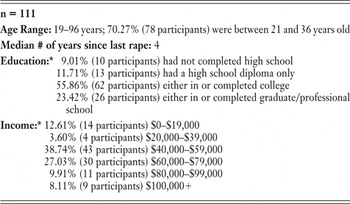
The women's ages were between nineteen and ninety-six, with seventy-eight survivors (70.27%) between twenty-one and thirty-six years of age. Although some victims were raped multiple times over their lifetime, the median number of years since the last rape was four. All women identified as heterosexual. Ten women (9.01%) had not completed high school; thirteen participants (11.71%) had only a high school diploma; sixty-two (55.86%) were either in or had completed a two-year (associate's degree) or four-year (bachelor's) college program; and twenty-six survivors (23.42%) were either in or had completed graduate/professional school (see Table 1). Like their levels of education, the participants' incomes were diverse, ranging from fourteen women (12.61%) who had an annual household income of 0–$19,000 to nine individuals (8.11%) who made $100,000 or more. Ninety-nine women self-identified as African American (89.19%), seven as a Caribbean immigrant (6.31%), and five as an African immigrant (4.50%).
Black Women Participant Characteristics

* For both those in college and those who went straight from college into professional school, household income was determined by the income of their parents/caregivers. For those who took time off between college and graduate/professional school but had not yet finished graduate/professional school, household income was determined by the income bracket they had before they entered their program. Some participants were on public assistance.
Although college-educated and middle-to-upper-middle-class women were over-represented in this study compared to the general population, the results parallel the findings of the scholars presented in the literature review. It is unclear why the study attracted more affluent participants despite active efforts to recruit low-income women. One possibility is that more affluent and more educated women have more flexible schedules; thus making it easier to commit to a time-consuming interview. It is also likely that more economically well-off women have the financial resources to better cope with the abuse—even if they have not disclosed it to others. Consequently, the more affluent respondents may be more willing and better prepared psychologically for a voluntary, emotionally draining interview. What is most striking from an analytic point of view, however, is the remarkable consistency between interview participants across educational and socioeconomic status. While less educated and poorer women utilized a class discourse much more often than their more educated and economically privileged counterparts, all groups still relied on the controlling images in their rape accounts. This, along with the fact that the findings are consistent with those of other scholars, suggests that the economic demographics of the participant pool did not substantially skew the findings.
Data Collection
Phase One
The data was collected in two phases. With the assistance of rape crisis centers and community-based organizations, a research team and I administered interviews with Black sexual assault survivors in the four cities in Phase One. The rape crisis centers and community-based organizations served as the project's “anchors” in the cities. These facilities are where researchers were trained for this project. Participants were given the option to have the interview administered at the place of their choosing; some chose to have their interviews at the crisis centers or community organizations. Although we relied on the rape crisis centers to help spread the word about our recruitment, current clients at the crisis centers in which we were anchored were not allowed to participate in the study. Clients were denied participation in order to: reduce selection bias, to ensure that clients did not feel pressured to participate, and to assure that the crises center contact did not shape their responses. Moreover, while survivors were given resource manuals for dealing with sexual assault and occasionally bus or train fare in order to make it to interview appointments, there was no system of formal compensation.
Phase Two
After the initial data analysis was conducted, patterns emerged among those few respondents who did not use a stratification account. These respondents were interviewed again to check evolving ideas about why this minority of participants used only controlling images in their accounts. Reinterviewing these few respondents who did not articulate a stratification account highlighted ethnic differences among the survivors. Two African American participants, however, declined to be reinterviewed.
Conducting the Interviews
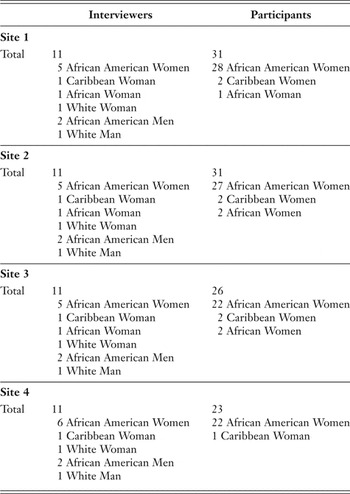
The project included multiple interviewers at each of the four sites and participants could choose which one would conduct their interview (Table 2). Since interview research suggests that race/ethnicity, gender, and socioeconomic status can shape the comfort level of interviewees (Arendell Reference Arendell1997; Best Reference Best2003; DeVault Reference DeVault1995), participants could choose someone of their own race, gender, and class/education category or someone very different. Participants were given a picture and a profile of each potential interviewer that included age, gender, race/ethnicity, and educational level. Participants were also given the option to “screen” interviewers as well. This gave participants more agency and a sense of control over the interview process, an important concern considering the population under investigation.
Interviewer and Participant Demographics by Site

All of the African American women chose other Black Americans to conduct their interviews. Twelve out of 111 African American women (10.81%), however, chose an African American man to conduct their interview. Two of seven Caribbean immigrant women (28.57%) and two of five African immigrant women (40%) chose a White woman to do their interview. All other Caribbean and African immigrant women chose interviewers of their own ethnic background. Educational level/socioeconomic status appeared to be a significant factor only for African American women—all African American women who had a high school diploma or less chose an interviewer who also had a high school diploma or less.
I trained all interviewers in four different training sessions in their respective cities. Training sessions modeled interview techniques such as active listening skills and verbal and nonverbal communication. All training sessions included giving a mock interview. The interviews with survivors were semistructured, included both closed and open-ended questions, and encouraged participants to respond in a conversational manner. Interviewers did not initiate any conversations about controlling images or racism. Interviewers generally asked very broad questions such as: How are you doing today? What do you remember about the sexual assault? How do you understand, or make sense of, the assault? Did you tell others about the assault? Why or why not? If so, how did you explain the assault to others? What did you do after the assault? How did you cope, or handle yourself, after the assault? Why did you handle the situation in this way? What do I need to know that I haven't asked? Most participants offered a narrative about how and why they were assaulted and how they coped afterwards. This allowed me to chart the interpretive mechanisms that survivors used to make sense of their lives. Probing questions were used to get at ethnic and class differences in responses and the rationale for those differences from respondents. Interviews averaged one hour and fifty-three minutes in length. Once transcriptions were complete, participants were contacted and allowed to physically destroy the audiotaped interview. If they chose not to destroy the tape personally, a staff member did so.
Analysis
The interviews were coded, and grouped using NVivo 8 qualitative research software. Nine researchers were involved in the encoding process (two from each site and myself). A constant comparative method (CCM) was employed to analyze the data. CCM requires researchers to continually check, code, and recode the collected data against current conceptual frameworks. If the data merges easily with existing frameworks then the CCM concludes that the findings support conceptual models (Miles and Huberman, Reference Miles and Huberman1984). Divergences from existing models (i.e., negative cases), however, require the researcher to formulate new theories or specify and/or extend previous formulations. When new cases no longer produce new information, the categories are considered “saturated” and it is safe for the researcher to make conclusions (Boeije Reference Boeije2002).
Modifying Hennie Boeije's (Reference Boeije2002) CCM model, a four-step analysis was utilized in this project:
1) Comparison within a single interview: Categories were developed through the process of open coding and a code tree was developed for initial conceptualization.
2) Comparison between interviews within the same group: Participants were compared with other members of the same ethnic group and then, again, with members of the same gender group through axial coding. This stage further refined concepts from step one and helped form typologies in which to organize the data.
3) Comparison of interviews between groups: Participant groups were compared to members of other participant groups to further refine concepts. This process helped verify data sources and concepts from multiple perspectives.
4) Comparison of interviews between sites: Participants were compared with members from each of the four sites to check for regional differences or any idiosyncrasies of any particular research site (Miles Reference Miles1979). No idiosyncrasies emerged between sites.
This sort of defined, rigorous, constant, comparative method is especially important for multisite research, as a large number of codes are condensed into major themes (Miles Reference Miles1979). Further, this aids a researcher's “cognitive complexity” (Boyatzis Reference Boyatzis1998) as she or he “clusters” themes for higher levels of abstraction (Boyatzis Reference Boyatzis1998; Miles and Huberman, Reference Miles and Huberman1984). Consistent with the perspective of qualitative research, the findings are neither objective “facts” nor simply subjective interpretations (Glaser Reference Glaser1992; Glaser and Strauss, Reference Glaser and Strauss1967). Instead, the accounts provide a way of understanding how survivors make sense of their rape experience and the social schemas they used in their meaning-making and coping processes.
FINDINGS
The findings are separated into five sections. The first section takes up the issue of how African Americans used an explicit discourse of racial subordination, gender oppression, and, for some, social class inequality in their stratification accounts of sexual assault. Sections two through four demonstrate the ways in which participants used the controlling cultural images of (2) Black Promiscuity, (3) the Black Superwoman, and (4) Cultural Protectors in their accounts. Regardless of ethnicity or socioeconomic status, all of the survivors used controlling images to inform their interpretation of sexual trauma. In the last section I address the ways in which both Caribbean and African immigrants largely avoided using a stratification account and used negative ethnoracial stereotypes about African Americans to contour their perceptions of rape.
Stratification: “Black women are the feet … of society.”
The African American women uniformly discussed their sexual assault in conjunction with their gender and racially subordinated positions in the social order. For those who were poor, class also intersected with their racial analysis. Most survivors stated that their marginalized positions decreased the likelihood that they would be believed. Even if they were, many feared no one would care. This possibility proved to be too risky for most. Therefore, many decided not to disclose their assault to authorities, family, or friends.
As Melanie, a twenty-eight-year-old middle-class mother of three children, expressed:
I really … just kept it to myself … I feel that as a Black woman I'm not all that likely to be believed. People don't believe those who are at the foot of society. And us Black women are the feet, the feet of society … Meaning that people walk on us all the time and take us for granted … I am Black and I'm a woman so people really don't care about our pain. I mean being Black is bad enough, but being a woman and Black means people really don't care about you being raped … I don't think most people think those of us women who are at the foot can even be raped. So you kind of feel like: Why say anything? No one really cares.
Marcella, a twenty-four-year-old single mother on public assistance, made a similar claim. In addition to acknowledging how gender and race impacted her account, she also discussed the influence of social class. According to Marcella, she initially reported the rape when Marcella's friend found her bruised and crying behind a local bakery during a neighborhood-sponsored block party. Then, however, she decided not to pursue the issue after hospital and social service personnel insinuated that she was not raped. As Marcella explained,
Who in the world is going to accept as true that I was raped? … When [my friend] called for an ambulance and they took me in I told them I was raped and then this White nurse was all patronizing and goes, “Now, Honey, are you sure it was rape? You know these parties can get out of hand and we sometimes do things that we just regret later” … When she said this I was like: “Of course this White lady don't believe me. And even if she did, I'm a Black woman so I'm like the debased of society. So even if she did she wouldn't want to go through all the trouble of dealing with the rape because Black women have no value in this country. We are at the bottom.
A White nurse was not the only negative encounter for Marcella. Marcella stated that the response of a Black social worker was the most devastating:
When I first saw the social worker and that she was [Black] I was so happy … but she was just as cold as the White lady. When she found out I was on welfare she said: “… Are you sure you're not just trying to get pregnant so that you can get a bigger welfare check?” See when you Black, woman, and poor, not even Black women believe you. See I know I'm nothing to most people because I'm a poor, Black woman. But I was hoping to be something to my own kind.
Like Marcella, Tiffany is also on public assistance and discussed how gender and class shaped her racial appraisal. Tiffany stated, “Whenever I walk into a place a person looks at me and sees that I'm a Black woman. That's two strikes there.” This twenty-year-old single mother went on to say: “And when they see that I'm on the government [i.e., public assistance] that's three strikes. They just think I'm ghetto-trash and don't nobody want to help me. And that's just when I'm at [the grocery store]. So why in the hell would I tell the police about something important like this?”
Sandra, a thirty-seven-year-old survivor and partner at a law firm, went further and more clearly articulated how her structural position as a Black woman shaped her perceptions. Sandra's education and law credentials give her subjective appraisal a unique perspective in which to assess the “objective” value of Black women:
When we [Black women] think about disclosing our rape we have to think about how our racial position in a racial hierarchy and our status as female or woman will impact our decision to talk about rape… As a lawyer we are often taught that the legal system is supposed to be blind. But any lawyer worth their salt and who is honest knows this is not the case. Black women are the lowest in order of social prestige. They are the least likely to be believed … they have less power, less social and legal value, and in wrongful death calculations they actually take race and gender into account to measure the economic value of a person's life and Black women are always, consistently calculated as being worth less than any other legal U.S. citizen who has died the same way, under the exact same conditions. So to me that's proof that we [Black women] are truly worth less than any other group in this country. Our rights are not often protected and our bodies are not often respected… That's why we often don't disclose.
The African American women routinely articulated that social structure—and the resultant race, gender, and class hierarchies that are produced—shaped their viewpoints. While race was clearly a central structural identity referent, gender and, for some, social class were vital ingredients in their racial appraisal. From this perspective, the structural position of Black women renders their sexual victimization insignificant to the larger society.
Black Promiscuity: “They think we're sluts. I don't want people to think that about me.”
The women in this study routinely used the controlling cultural image of Black Promiscuity in their accounts. Both historical and contemporary images of women of African descent as being sexually driven tailored the participants' responses and were used to justify why they did not report the abuse to authorities; for many, it was also used as an explanatory tool for understanding why they were raped in the first place.
For instance, as Charlotte, a thirty-five-year-old single mother of one child, described:
People just think we [i.e., Black women] are loose. That's why slave masters thought it was ok to rape us during slavery. And now you see hip-hop music videos bragging about video hoes and everyone just thinks that's how we are. [People] don't think we can be raped or anything like that … If you're raped people just think you really wanted it and now you're just trying to get out of being called a slut. They think we're sluts. I don't want people to think that about me, that I'm a slut, so I haven't told anybody.
Dianna, who was raped five years earlier while a sophomore at a predominately White college, believed that the controlling image of Black Promiscuity encouraged her assailant's attack. She explained:
[My attacker] kept saying, “Stop fighting, bitch, you know you hoes like it rough” … I think he really internalized the idea of Black women just being for his pleasure and that we're always wanting sex …
Dianna also stated that this sexual stereotype hindered her from telling her roommate who saw her shortly after the assault:
When I went back to my dorm my roommate—she's White—could tell something was wrong but I told her I was just stressed from final exams. I may have prejudged her but in that moment I couldn't help but think: “Is she going to think because I'm Black that I actually did want to have sex with him?”
Tina, a twenty-five-year-old small business owner, was also sexually assaulted when she was in college. Like Dianna, she, too, went to a primarily White school and all of her close friends at the college were White. According to Tina, her rapist “dared” her to tell someone since “he knew nobody would believe a Black woman about something like this.” Her assailant went on to say, “‘No one at [your school] is going to believe your black ass turned down some sex.’” Tina feared that he might be right. Tina recalled an earlier conversation she had with a White friend who stated how “lucky” Tina was to be Black since she “could sleep around all she wants” because no one expects “a Black girl to be a good girl.”
As these accounts suggest, images of Black Promiscuity contour the perceptions of survivors. Fearing that they would not be believed since Black women are publicly portrayed as sexually licentious, many survivors used this controlling image to justify why they did not disclose their assault to authorities. Further, many also suggested that this controlling image of Black Promiscuity was a primary reason they were raped in the first place. In fact, several survivors stated that their rapist actually deployed this image during or after the assault to imply that the women wanted to have sex. Whether or not the assailants actually believed their victims desired sexual intercourse is unknown. What is known, however, is that the rapists knew how to deploy this image to silence and delegitimize the reactions of their victims. The image of Black Promiscuity also provided the perpetrators with a justification for their own sexual misconduct.
The Black Superwoman: “It's hard being strong all the time.”
Whereas the controlling image of Black Promiscuity provided a culturally accessible cognitive tool to help make sense of why the rape occurred, the survivors used the controlling image of the Black Superwoman to frame how they should act in the aftermath of rape. Like Black Promiscuity, survivors discussed how the idea of the Black Superwoman contoured their responses to the assault and discouraged their full disclosure.
A single, twenty-nine-year-old professional, Maika affirmed that Black women have been taught that they need to depend on themselves and that they “can handle anything.” According to Maika, this impression has been engrained in the social imagination of all people, regardless of race:
We [Black women] have been taught that we can handle anything … and not just about [sexual assault]. We're supposed to be able to handle anything because we're superwomen. Hell, [singer] Alicia Keys even has a song called “Superwoman” and it's like an anthem for Black women—it's saying sistas [i.e., Black women] can handle it. And everyone knows that song so the idea continues to spread throughout society no matter what race you are.
Later in her interview, Maika went on to explicate how this controlling image constrained her reaction to her rape:
So when I was raped how else was I supposed to act? I was supposed to be strong and get through this on my own because that is what real Black women are supposed to do. We can't fall apart like White women can; even if we really want to. But let me tell you, it's hard being strong all the time.
Carrie, a seventy-one-year-old Black woman who was raped in her late teens, remembers how the cultural mystique of the Black Superwoman kept her silent:
When I was [raped] over fifty years ago I just wanted to fall apart … Then I remember thinking to myself: “Girl, you better get your act together. You are a Black woman and life is going to throw you lots of curve balls your way so beat those hurt feelings down and keep on keeping on.” So that's what I did and I didn't tell anybody then.
Not all women, however, said they were raised to be strong, assertive, or independent. Nonetheless, the Black Superwoman image is so entrenched in U.S. culture that many survivors felt they had to submit to its influence. Thirty six-year-old Kim, for example, said that she was not taught to be “your stereotypical Black girl. I was raised like a princess.” Growing up middle-class in an all-White neighborhood, Kim was “raised to be super feminine like a White girl.” The night Kim was raped in her junior year in college, her roommate convinced her to report the incident to campus police. She did. Before filing an official report, though, the officers on duty told her to go immediately to a hospital for an examination. According to Kim, when she arrived at the hospital a White nurse used the Black Superwoman icon as a way to minimize her assault:
I thought I was going to pass out. Then the nurse said, “Oh Honey, I know it's hard but you will get through this. Your people are strong. I've never met a Black woman who couldn't handle something like this all while raising three or four kids by herself.” After that I just went numb … I guess I just felt like I had to be strong. That's what people expected of me.
Kim did not believe that the nurse had bad intentions. In fact, Kim believed that the nurse was actually trying to promote resiliency in this time of crisis. However, because of the stereotypes she repeated, the nurse's comments caused Kim intense anxiety: Kim did not feel she “was being the right kind of rape victim.” Kim went on to explain how this encounter discouraged her from filing an official report and encouraged her to stop talking about the incident out of fear that she would be perceived as weak. Kim did not seek counseling for an entire decade.
Middle-class Black women were not the only ones who felt as if the Black Superwoman role was thrust upon them by others. Kelisse is a twenty-four-year-old single mother on public assistance. Two days after her assault, Kelisse told her best friend that a neighbor had raped her. Initially her best friend was comforting. This changed two months later when Kelisse called her friend in tears:
I called [my best friend] on the phone and was like, “Hey, I just don't think I can take this anymore. I'm going to have myself a nervous breakdown.” Then [my friend] goes, “Girl, are you still crying about that? You need to get over it. [Your rapist] has raped [two of our other friends] too and you don't see them moping around. This is just the way life is. We've got to be strong.”
Kelisse went on to say that “Black women are supposed to be strong” even when they do not necessarily feel particularly powerful. “I know I'm supposed to be tough,” she said, “but I am not. I'm not tough at all. Sometimes I really wish I could be White so that I could be weak for just one little moment with nobody judging me.”
These survivors' accounts illuminate how the controlling image of the Black Superwoman can be used to steer rape survivors towards silence. As Carrie's account revealed, this is not just a contemporary cultural reference point. Carrie's rape occurred over a half-century ago, yet she makes use of the same imagery as her younger counterparts. And as Maika, Kim, and Kelisse make clear, this is a racially specific cultural trope, as all three women articulate that White women have more “freedom” to show vulnerability in times of crisis. Further, Kim's interaction with the White hospital nurse and Kelisse's conversation with her Black friend illustrates how the controlling image of the Black Superwoman can restrain Black women's disclosure patterns even if the survivor herself has not internalized the image.
The Cultural Protector: “We can't air the dirty laundry.”
The participants often suggested that rape was not a part of African American “culture.” As such, African American culture did not know how to deal with sexual assault. If intraracial rape did occur, the majority of participants suggested that African American culture put a premium on silence in order not to perpetuate negative stereotypes about African Americans. Teresa, a twenty-year-old college sophomore, stated that Black culture deterred women from speaking up:
I think there is something about the way Black people are raised that teaches us we can't talk about rape, that it's not supposed to happen in our community … But everybody knows, or at least every Black woman should know, it can … But Black society teaches us not to air our dirty laundry because White people can use it against us. You know the saying, “Don't deface the race.” So even if other Black people believe you you might be hated or looked down upon by other Black people because you are making the whole race look bad, giving White people another justification for keeping us down. We've got to keep a good public face. We can't air the dirty laundry.
Although numerous participants seemed freely to acquiesce to the controlling image of Cultural Protector, many others felt pressured to succumb to it. As Lauren explained, when she told an African American classmate that a popular Black athlete raped her during her first year in college, her classmate encouraged Lauren not to report the rape out of fear of contributing to deleterious Black stereotypes. According to Lauren her classmate explicated her fears as follows:
[My classmate] said that Blacks on this campus have already got it so hard so why would I want to add fuel to the fire? The racism was already so thick that this would just give them [i.e., Whites] more reasons to say, “See, those people don't belong here.” I tried to explain to her that White girls get raped by White guys just as much as Blacks girls get raped by Black guys. [My friend] said, “Yes that's true. But you know as well as I know that it's not going to be seen the same way. Everything we do is under a microscope and every bad thing that happens is seen as confirmation of a stereotype of Black people.” Although I hated to hear what she was saying, it is true. I didn't want to contribute to that negativity.
Lauren did not report the assault.
The participants, however, did not believe that it is the entire Black community that is being sheltered. Rather, it is primarily Black men who receive the benefits of women's silence. Rosena, a twenty-two-year-old single mother on public assistance, discussed how the Cultural Protector image favors men and organizes group dynamics so that men's status is preserved at all cost:
Black people don't talk about rape and [sexual assault] because we always trying to protect the Black man … Men—Black, White, purple, or green—are the most important people in society, at least in society's eyes. So every group wants they men to be the greatest, and to look good to all the other groups because—for better or for worse, and it's usually worse—men represent that group to the rest of the society. So the higher your men are on the societal ladder, the better your group looks as a whole. So we do our best to protect our men. But it ain't like we the only people who do it. Other cultures do too.
The accounts of these women support the claim that the Cultural Protector image shapes a victim's appraisal process. It is almost as if there is a cultural mandate that they must meet in order to “uplift” the race. This mandate, however, reproduces intraracial inequality and justifies sexism. As Rosena's account illustrates, intraracial sexism is not exclusive to African American communities. Race and racism, nonetheless, can be deployed as a discursive resource to justify sexist practices in the name of “saving” the race from further negative imagery that can add to stereotypes of African American pathology.
Caribbean and African Immigrants: “It's not race like that. It's race as in custom or tradition … It's the way we go about living our lives.”
While the overwhelming majority of African American women (94 out of 99, or 94.95%) used all four of the racial references outlined above, only three out of twelve (25%) of the Caribbean and African immigrant women did so. As previously stated in the methods section, this discrepancy encouraged us to contact these few participants again to further explore their perceptions of sexual assault. All of the immigrant women used the controlling images of Black Promiscuity, the Black Superwoman, and the Cultural Protectors as cultural signifiers, but only three also referenced racial inequality in a way that undergirded the discourse of a stratification account. While it is impossible to know precisely why Caribbean and African immigrants did not express the same kind of racial consciousness as African Americans in their responses, recent scholarship on intraracial differences in general points to a possible answer.
The literature on Black immigrants and African American incorporation processes, for instance, suggests that African Americans tend to think more in terms of a linked fate and group remedies to overcome the structural realities of racial inequality (Allen and Bagozzi, Reference Allen and Bagozzi2001; Early Reference Early1994). According to Reuel Rogers's (Reference Rogers2006) research, however, Black immigrants express racial group identification, but not the same racial group consciousness associated with African Americans. Group identification is a self-awareness of membership in—and a psychological attachment to—a particular group. Group consciousness, on the other hand, is a belief system or ideology about the group's status in society and a plan to improve the structural position of that group (Rogers Reference Rogers2006). As Rogers makes clear, racial group consciousness has acted as a “cognitive devise for diagnosing and responding to racism” (p. 176) for African Americans. The Black immigrants in his study, though, did not utilize an account of antiracism or collectivism typified by a discourse of racial inequality. Rogers suggests this is because Black immigrants have neither a direct claim nor access to a collective memory of racial subordination in the United States. Those Afro Caribbeans in Rogers's study that did express social structural critiques associated with group consciousness were highly immersed in African American networks.
Both the Caribbean and African immigrants show similar patterns in this study—that is, acknowledged membership in a specific group—but they often do not make reference to social structural elements of inequality. Rather, the Caribbean and African immigrants used controlling images of African Americans as a way to distance themselves from African Americans and the negative imagery associated with African Americans. This ethnic distancing strategy deployed by Black immigrants has also been observed in other realms of immigrant social life (Bryce-Laporte Reference Bryce-Laporte1972; Rogers Reference Rogers2004; Waters Reference Waters1999).
For instance, Ruby, a twenty-seven-year-old Haitian domestic, describes how the controlling cultural image of Black Promiscuity, particularly Black American Promiscuity, impacted her disclosure:
Our [Caribbean] culture tells us not to act like Black American girls because they give it away [i.e., have sexual intercourse] to everybody … [Black American] girls are whorish … It's part of their [Black American] culture. So when that man [raped] me I know he thought I was a Black American. Black American girls give us Caribbeans a bad name.
Nomsa, an African immigrant, also deployed controlling images of African American promiscuousness to both distance herself from the perceived sexual immorality of Black Americans and to explain why she was targeted for sexual assault. She stated:
It's important that we [immigrants] not get confused for African Americans. African women are taught to be virtuous when it comes to sex. Black American women are not. They have a bad reputation … They do not respect their bodies like African women … and it's regrettable that Americans confuse Africans and Black Americans in this country because they think [immigrants] are like them … That's why Americans feel like they can rape [immigrants] because they think we are like Black Americans about sex.
Most Caribbean and African immigrants used cultural tools to organize their accounts. A language of intersecting social inequalities, though, was noticeably absent. Stacy, a college student from St. Thomas, made it especially clear that a discourse of race was deployed as a cultural trope only and not as a structural referent to racial inequality. Stacy stated:
I think race had something to do with [my rape]. Not like race as in racism. It's not race as in anti-Black oppression, or race like we are inferior to other races … It's not race like that. It's race as in custom or tradition … It's the way we go about living our lives, or the way people think we live our lives…
Nokhanyo, a current graduate student in literature from Southern Africa, was one of the three immigrant women who used the language of social structure in a stratification account. While this is notable, what is more striking is the way in which she explained how her fellow Black immigrants often perceive of race in the context of sexual assault. She asserted:
We [Black immigrants] often see ourselves as different from African Americans. And many of us even think we're better than African Americans. Now I'm not saying we are the same because we are not. There are truly important cultural differences between us [i.e., Black immigrants] and them [i.e., African Americans]. But what my African, Caribbean, and diasporic sisters fail to see is that our destiny here in the U.S. is in many regards, in fact, determined by the experiences of African Americans … The same sexual stereotypes that afflict African-Americans afflict us as well … those stereotypes are based in a long history of racial inequality and racial oppression. African diasporic peoples will be forever linked to African Americans, whether we like it or not, until the power structure is changed in this country … So even though many of my immigrant sisters will not see how their rape is interwoven into systems of power, their experiences, in fact, are.
The accounts of the Caribbean and African immigrants reveal that race is often deployed differently as compared to their African American counterparts. Whereas the controlling images of the Black Superwoman and the Cultural Protector were used similarly, the Black immigrants utilized the cultural symbol of Black Promiscuity as a way to distance themselves from negative stereotypes of African American sexual immorality. This distancing strategy—or “defensive othering” (Schwalbe et al., Reference Schwalbe, Holden and Schrock2000)—practiced by many immigrants, however, reinforces the power of the controlling images by claiming that they are not like Black Americans. Further, the majority of the African and Caribbean immigrants did not utilize a stratification account. The language of structural inequality was largely absent. The three immigrant women who did express all four of the racial appraisal elements identified had mostly African American friends and were engaged in African American civic and social organizations. This lends support to Rogers's (Reference Rogers2006) claim that Black immigrants who are primarily embedded in African American communities will have attitudes and a racial consciousness more similar to African Americans.
CONCLUSION AND DISCUSSION
Unlike studies of White rape survivors where victims primarily discuss access to resources and feelings of shame and isolation, the Black rape survivors in this study consistently discussed how race shaped their assault in conjunction with these other challenges. For the women of African descent in this study, the culturally approved racialized controlling images clearly patterned their accounts. The overwhelming majority of African Americans also used racial formulations to structure a stratification account to understand their rape within gender and, for some, class hierarchies. The participants felt as if no one cared about their rape or that they were less likely to be believed due to their marginalized status as Black women. Those who were also poor were even more likely to embody this psychological toll. Moreover, the participants' discourses underscore the importance of language, culture, and cognition in intersectional processes as individual accounts are appraised in relation to one's racial status and in conjunction with other identity markers. The cultural languages that encase accounts are constrained by race, gender, and class disparities, which, in turn, narrow the range of possibilities to make meaning of an event and restrict the ways in which people can talk about their lives. Individual accounts, then, often follow a predictable cognitive and social script that legitimates cultural norms and social inequalities. These cultural tropes, however, are not just internalized by the survivors. The participants repeatedly discussed how others used this imagery to constrain them through language. Peers, social service providers, and even the rapists themselves used language to control women's assessment of the assault and their reactions to it. This underscores the power of language in shaping individual cognitions and social behavior. In short, the findings support sociological and social psychological principles that suggest the perceptions and behaviors of individuals are influenced by outside social forces. Others literally told victims how to respond and larger, structural inequalities and cultural ideologies also influenced the coping processes of participants.
Nonetheless, this research suggests that the perceptions of Black immigrants are not adequately reflected in the stratification account. Immigrants' lack of a direct historical legacy and collective memory of U.S. racism, as well as differing levels of racial consciousness, suggest that the concept of a racialized social structure is not a readily available cognitive resource for these survivors. Nonetheless, taken together the survivors' accounts demonstrate that the concept of racial appraisal is an effective heuristic for understanding the ways in which Black participants draw upon larger, macro social forces to understand their micro, interpersonal experiences. The fact that interviewers did not initiate discussions about race lends support to the strength of the racial appraisal concept, as these ideas emerged organically in the interview process.
This article extends the racial appraisal framework from how social actors that are indirectly impacted by trauma (e.g., secondary victims like family and friends) use race in meaning-making processes to how primary social actors use race in their accounts. On a cultural level, the participants were forced to contend with the controlling images of Black Promiscuity, the Black Superwoman, and the Cultural Protector to organize their accounts and to suggest particular ways of action or, in many cases, inaction. On a social structural level, the African American survivors recognized that their subordinate position in racial, gender, and, for some, class hierarchies put them at a particular disadvantage in terms of social worth, the likelihood of being believed, and the possibilities for justice. The oppressive cultural images and the marginalized structural positions of African American women ultimately lie outside the victim and produced the discursive and cognitive resources which the participants used to appraise their situation.
It is not surprising, then, that many women in this study felt as if they had very few options other than silence. However, this should not be interpreted as passive individuals responding to the deterministic influence of culture or the impenetrable power of social structure. Rather, the accounts of these survivors highlighted the perceived available options and the ways in which they navigated their social and psychological terrain. Indeed, as the findings demonstrated, some women did disclose their abuse, even if it wasn't immediate, while others reported their sexual assault and had their rapist convicted. Certainly, the very fact that these survivors agreed to participate in this study is a sign of resistance. As one survivor so aptly put it: “Tell my story so that others know what is going on … Tell my story so others, too, can resist.”
By showing how Black women have a unique cultural framework and a subordinate social location which differentiates their coping processes, the findings of this research lend further support both to those who argue against universal approaches, and those critical of the cultural variation model for not taking structural inequality into full consideration. Future research should apply the racial appraisal concept to other forms of trauma and with other racial, gender, and sexual orientation groups. Only by comparing if and how other groups and critical situations elicit racial appraisals can we deepen our understanding of racial identity and traumatic impact.
Beyond this summary, however, I also want to suggest two larger implications of this study for Black feminist/intersectional theories. First, gender and race scholars have long been interested in conceptual modes that reveal the ways in which identities are not innately tied to bodies but rather produced in interactions, where certain bodies enjoy more privileges due to the higher status of their social position (Fenstermaker and West, Reference Fenstermaker and West2002; Ridgeway Reference Ridgeway and England1993). The appraisal approach adds to these models by underscoring how socially prescribed belief systems imbue structural status characteristics with meaning, which, in turn, shapes perceptions and interactions. Inequality is typically reproduced in this way as individuals often (but certainly not always) enact belief systems that support the status quo. For instance, even the participants in this study who did not personally subscribe to the “controlling images” often succumbed to the cultural mores that dictate social life.
Second, as previously stated, Black feminists have been the theoretical trailblazers for an intersectional approach to sexual assault. Nonetheless, some Black feminists have a seemingly uncomfortable relationship with the confluence of culture and social structure, and have been slow to incorporate a developed understanding of how culture impacts Black intraracial sexual violence. Hawley Fogg-Davis (Reference Fogg-Davis2006) outlines how many progressive, radical, and/or Black feminist thinkers have abandoned the language of “culture.” Fogg-Davis contends that culture has been theoretically and analytically neglected because it is often associated with conservative arguments that pathologize African American behavioral patterns. I, too, share Fogg-Davis's concern that Black feminists scholars need to reformulate our understanding of culture in order to fully comprehend, challenge, and condemn Black-on-Black sexual violence. I also understand why many feminists want to avoid perpetuating negative stereotypes about Black culture. I think the concept of a racial appraisal illuminates how Black feminists can do so without the pathological side effects of conservative prescriptions.
The racial appraisal approach conceptualizes culture as a tool kit (Swidler Reference Swidler1986) of ideas and symbols that are socially constructed and dispersed throughout society. Ideas and symbols, however, do not exist outside of a social structure. In fact, cultural ideas often serve as justification for structural realities (Habermas Reference Habermas1971). It is social structure in interaction with individuals that engenders the meaning of particular ideas and symbols that comprise culture. In this sense, culture is not “in” a person. Instead, culture ultimately lies outside the individual; social institutions provide the cultural apparatus which individuals may utilize. From a Black feminist perspective, this would be a call to action to change the institutions that deploy negative images of and ideas about people of African descent in order to transform the cultural symbols which people can consume. Neglecting culture, as these findings suggest, limits Black feminist theorizing on same-race harassment. Only by looking at how structure and culture work together to shape intraracial sexual assault can theorists and activists truly work towards progressive political action.