Depression is a major public health concern, with an estimated 322 million people around the world currently affected by depression (World Health Organization, 2017). Depression is one of the main causes of years lived with disability (Wittchen et al., Reference Wittchen, Jacobi, Rehm, Gustavsson, Svensson, Jönsson, Olesen, Allgulander, Alonso, Faravelli, Fratiglioni, Jennum, Lieb, Maercker, van Os, Preisig, Salvador-Carulla, Simon and Steinhausen2011) and a risk factor for mortality (Cuijpers and Smit, Reference Cuijpers and Smit2002). In addition, it is related to substantial economic costs. For example, just in Europe alone, the associated direct and indirect costs are estimated at 91 billion euros per year (Olesen et al., Reference Olesen, Gustavsson, Svensson, Wittchen and Jönsson2012). Despite its impact on population health and the amount of personal suffering, only 38.7% of depressed people receive treatment (Wittayanukorn et al., Reference Wittayanukorn, Qian and Hansen2014).
Therefore, prevention has been touted as an additional strategy to further reduce the disease burden of depression. Indeed, a meta-analytic review (van Zoonen et al., Reference Van Zoonen, Buntrock, Ebert, Smit, Reynolds, Beekman and Cuijpers2014) composed of 32 prevention depression studies has shown that preventive psychological interventions reduce the incidence of new cases of depression by approximately 21% (incidence rate ratio = 0.79, 95% CI 0.69–0.91). However, research on prevention of mental disorders is in its early stage (Cuijpers, Reference Cuijpers2011) and much work is still needed to further the field (Botvin, Reference Botvin2004). One of the main research questions regards the enduring effects of preventive programs. The meta-analytic review of preventive depression interventions (Cuijpers et al., Reference Cuijpers, van Straten, Smit, Mihalopoulos and Beekman2008) pointed at a possible decreasing effect over time. But to properly examine whether this is indeed the case, it is necessary to conduct studies with long enough follow-up periods (Muñoz et al., Reference Muñoz, Beardslee and Leykin2012) to verify if they are really preventing the onset of the major depression or only delaying it (Reynolds, Reference Reynolds2009; Muñoz et al., Reference Muñoz, Beardslee and Leykin2012). However, most of the depression prevention studies have not conducted follow-ups to evaluate the long-term impact of the interventions (Bellón et al., Reference Bellón, Moreno-Peral, Motrico, Rodríguez-Morejón, Fernández, Serrano-Blanco, Zabaleta-del-Olmo and Conejo-Cerón2015). More specifically, regarding indicated prevention (i.e. those programs focused on individuals with subclinical depressive symptoms not yet meeting criteria for a diagnosis), there are several studies targeting adolescents (Gillham et al., Reference Gillham, Hamilton, Freres, Patton and Gallop2006; Brent et al., Reference Brent, Brunwasser, Hollon, Weersing, Clarke, Dickerson, Beardslee, Gladstone, Porta, Lynch, Iyengar and Garber2015; Rohde et al., Reference Rohde, Brière and Stice2018). In adult populations, there are only two studies that performed 2-year follow-ups (van't Veer-Tazelaar et al., Reference Van't Veer-Tazelaar, van Marwijk, van Oppen, van der Horst, Smit, Cuijpers and Beekman2011; van Shaik et al., Reference Van Schaik, Dozeman, van Marwijk, Stek, Smit, Beekman and van der Horst2014) and both were aimed at older adults. Although a significant number of indicated prevention programs have been evaluated in a range of populations (e.g. adolescents, university students, adults), there is little research in non-professional caregivers. Non-professional (or informal) care is generally defined as the unpaid assistance provided by persons from the close environment of the dependent person. This person generally performs a wide range of tasks, including providing emotional support and assistance (Triantafillou et al., Reference Triantafillou, Naiditch, Repkova, Stiehr, Carretero, Emilsson, Di Santo, Bednarik, Brichtova, Ceruzzi, Cordero, Mastroyiannakis, Ferrando, Mingot, Ritter and Vlantoni2010). The conditions that can lead a patient to require dependent care are varied. Among these, the main causes of dependence are, first, dementia, followed by other conditions such as cerebrovascular accidents, traumatic brain injury, cancer, amyotrophic lateral sclerosis, vision impairment and blindness, schizophrenia, bipolar disorder, or autism spectrum disorder (Vázquez et al., Reference Vázquez, Otero, Blanco, López, Torres and Mollaoglu2017). Typically, all of these conditions require daily caregiver assistance. It is consistently demonstrated that being a caregiver is a risk factor of depression. Depressive levels are significantly higher in this population than in comparable non-caregiver populations (Pinquart and Sörensen, Reference Pinquart and Sörensen2003; Schulz and Sherwood, Reference Schulz and Sherwood2008; Ma et al., Reference Ma, Dorstyn, Ward and Prentice2018) and it is estimated that between 27.9% to 55.0% of caregivers have clinically significant depressive symptoms (Schulz et al., Reference Schulz, O'Brien, Bookwala and Fleissner1995), and between 9% to 34% suffer from a depressive episode (Sallim et al., Reference Sallim, Sayampanathan, Cuttilan and Ho2015; Torres et al., Reference Torres, Blanco, Vázquez, Díaz, Otero and Hermida2015). In addition, most caregivers are women (Colombo et al., Reference Colombo, Llena-Nozal, Mercier and Tjadens2011), who are twice as likely to develop depression as men (Bromet et al., Reference Bromet, Andrade, Hwang, Sampson, Alonso, de Girolamo, de Graaf, Demyttenaere, Hu, Iwata, Karam, Kaur, Kostyuchenko, Lépine, Levinson, Matschinger, Medina, Browne, Posada-Villa, Viana, Williams and Kessler2011). Previously, we have observed significant effects at 1-year follow-up in two randomized controlled trials of cognitive-behavioral preventive interventions targeting female caregivers who assisted a dependent relative of any kinship (e.g. parents, husband, children) and diagnosis (e.g. dementia, cerebrovascular accidents, traumatic brain injury, cancer) (Otero et al., Reference Otero, Smit, Cuijpers, Torres, Blanco and Vázquez2015; Vázquez et al., Reference Vázquez, Torres, Blanco, Otero, Díaz and Ferraces2016). In one of these studies (Otero et al., Reference Otero, Smit, Cuijpers, Torres, Blanco and Vázquez2015), a total of 173 female caregivers with high levels of depressive symptoms were randomized to either a group receiving a brief (five sessions) group intervention based on problem-solving model (Nezu et al., Reference Nezu, Nezu and Perri1989) (n = 89) or a usual care control group (n = 84). At 1-year follow-up, significantly lower levels of cumulative incidence of depression (10.1% v. 25.0%) and depressive symptomatology (d = 1.14, 95% CI 0.82–1.46) were found in the intervention group compared to the control group. However, the endurance of the effects of this intervention beyond this period remains unknown.
To examine the long-term effects of indicated prevention of depression in general, and more specifically in non-professional female caregivers, the objective of this study was to evaluate the 8-year impact of the problem-solving intervention, which previously demonstrated efficacy at 1-year follow-up (Otero et al., Reference Otero, Smit, Cuijpers, Torres, Blanco and Vázquez2015). Because previous studies on the long-term course of adult depression in primary care have followed a mean of 8 years, in the current study, 8 years was considered an adequate time point to analyze the long-term results of the intervention evaluated in this study (Steinert et al., Reference Steinert, Hofmann, Kruse and Leichsenring2014). As the main hypothesis, we expect that both the incidence of a depressive episode and depressive symptom severity would be significantly lower in the intervention group than in the control group.
Methods
Participants
The methodology of the study has been described in more detail elsewhere (Vázquez et al., Reference Vázquez, Otero, Torres, Hermida, Blanco and Díaz2013; Otero et al., Reference Otero, Smit, Cuijpers, Torres, Blanco and Vázquez2015) though central aspects of the methodology are given here. Participants included in the randomized controlled trial were female caregivers officially recognized by state authorities, who had a score ⩾16 on the Spanish version of the Center of Epidemiological Studies Depression scale (CES-D) (Vázquez et al., Reference Vázquez, Blanco and López2007), not meeting the criteria for a diagnosis of major depression and without prior history of depression according to DSM-IV-TR (American Psychiatric Association, 2000). We excluded caregivers for the following reasons: current or within the past two months psychological or psychopharmacological treatment, presence of other disorders that could act as confounders, presence of medical or psychological conditions that required immediate intervention or that would prevent participation in the study, being part of another study, the family member to whom care was provided was seriously or terminally ill, the caregiver had a change of residence, or the dependent's institutionalization was imminent.
A random sample of 401 candidates was initially assessed. Of these, 176 (43.9%) met the eligibility criteria and were invited to participate in the study. Among them, 173 (98.3%) agreed to participate and were randomized to a problem-solving group (n = 89) or a usual care control group (n = 84) by an independent statistician using a random number table (see Fig. 1). All participants provided written informed consent to participate in the study. The study complied with the ethical standards of the Helsinki Declaration of 1975 (as revised in 2008) and was approved by the Committee for Ethical Research of the University of Santiago de Compostela, Spain. Similar to previous evaluations, caregivers diagnosed with a depression at the 8-year follow-up were referred to the mental health services available in their area to receive appropriate treatment.
CONSORT flow diagram.

Interventions
Problem-solving intervention
Participants of the intervention arm received a brief group program based on the problem-solving model (Nezu et al., Reference Nezu, Nezu and Perri1989). The intervention was offered in centers close to their areas of residence, in five weekly group sessions lasting 90 min each, in 18 groups of four–six participants. A treatment protocol was developed and formalized into a manual and evaluated in a pilot study (Vázquez et al., Reference Vázquez, Otero, López, Blanco and Torres2010). Therapists who delivered the intervention were trained by two experts, each with more than 17 years of clinical experience. The intervention has been described in detail elsewhere (Vázquez et al., Reference Vázquez, Otero, Torres, Hermida, Blanco and Díaz2013; Otero et al., Reference Otero, Smit, Cuijpers, Torres, Blanco and Vázquez2015). In brief, from the first to the third session, the problem-solving skills were trained using a problem that the caregiver was experiencing in her life; the fourth session was dedicated to repeating the learned process with a new problem and the fifth session was focused on relapse prevention. Delivery of treatment was supervised by two expert clinicians with more than 20 years of experience. Sessions were recorded, and adherence to protocol was assessed by one of the expert clinicians by watching the videotaped sessions and registering the topics delivered compared with the total core elements of the treatment manual. In addition, the other expert clinician supervised therapists weekly. Protocol adherence resulted in a mean of 21.1 (s.d. = 1.41) topics delivered out of the 22 (96.0%), indicating that the main elements in the protocol were actually administered. A total of 86.5% of participants attended four or all sessions, with an average attendance of 4.3 (s.d. = 0.8) sessions.
Usual care control group
Participants assigned to the control condition (usual-care control group) were not subject to any intervention and did not receive any educational materials. However, they had unrestricted access to any type of psychological, medical or social services available to them in their communities.
Outcome measures
Participants were previously assessed at pre-treatment, post-treatment (Vázquez et al., Reference Vázquez, Otero, Torres, Hermida, Blanco and Díaz2013) and at 1, 3, 6-month and 1-year follow-ups (Otero et al., Reference Otero, Smit, Cuijpers, Torres, Blanco and Vázquez2015). In the current study, participants were re-assessed at 8-year follow-up. The evaluations were conducted via telephone by trained independent evaluators who were blinded to the experimental conditions to which the participants were assigned. Most of the interviewers had advanced degrees in clinical psychology and several years of clinical experience with diagnostic interviewing. All interviewers were trained in the use of the SCID-CV and CES-D and had completed a minimum of two supervised training interviews, achieving a κ greater than 0.80 for concordance between their symptom ratings and those of the supervisor. When a caregiver did not answer the telephone, a maximum of three contact attempts was made.
The primary outcome was the Depression Status. Diagnoses of major depression were obtained firstly using the corresponding module of the Structured Clinical Interview for the Disorders of the DSM-5, Clinician Version (SCID-5-CV) (First et al., Reference First, Williams, Karg and Spitzer2015), which has inter-observer reliability (κ) ranging from 0.70 to 1.00. We carefully considered that an inherent difficulty in having an 8-year follow-up is that patients could have suffered from a depressive episode in the time period between the 1- and 8-year follow-ups. For this reason, we have constructed the dichotomous primary outcome (Depression Status, 0 = absent, 1 = present) by combining depression diagnoses that have occurred between the 1-year and 8-year follow-ups as well as a current depression diagnosis. Furthermore, DSM-5 recognizes that the loss of a loved one can trigger a mood disorder. Hence, our interviewers asked caregivers whether their relatives had died and carefully considered such an event to correctly diagnose major depression as to differentiate it from normal grief responses.
The secondary outcome was the current Depressive Symptom Severity, which was measured secondly with the Spanish version of the Center for Epidemiologic Studies Depression Scale (Vázquez et al., Reference Vázquez, Blanco and López2007). This instrument is a 20-item scale in which the items are rated on a 4-point Likert scale ranging from 0 (rarely or never) to 3 (most of the time), with the total score ranging from 0 to 60, where higher scores correspond to greater depressive symptomatology. The CES-D has a Cronbach's α of 0.89.
Statistical analysis
The analyses were performed in several steps using Stata Version 14.1 (Stata Corporation, College Station, TX, USA) and Excel 2016 (Microsoft, Redmond, WA, USA). First, descriptive statistics were used to describe the baseline characteristics of all participants and these were reviewed for possible baseline imbalances between both conditions. Second, dropout was evaluated by comparing relevant characteristics of dropouts and completers in the intervention group and the control group. To identify statistically significant predictors of baseline imbalances and selective dropout, backward stepping regression models were used with a purposely-liberal threshold of p < 0.10 (to reduce type-II error) in combination with clinical judgment. Any statistically significant and clinically relevant confounders were incorporated as covariates in the subsequent analysis.
Third, all analyses were conducted in agreement with the intention-to-treat principle as per the Consolidated Standards of Reporting Trials (CONSORT) statement (Schulz et al., Reference Schulz, Altman and Moher2010). This approach implies that all participants were included in the analyses as randomized. Hence, we employed multiple imputation to handle dropout. Multiple imputation was based on predictors of the outcome (SCID depression status at 1-year follow-up plus all predictors of baseline imbalance and dropout) using chained equations and 10-fold imputation. In addition, CES-D Depressive Symptom Severity was also multiply imputed for the intent-to-treat analysis.
Fourth, to test the hypothesis that the intervention is more successful than usual care a logistic regression model was used of Depression Status on the treatment dummy (0 = control group, 1 = problem-solving intervention) to obtain an unadjusted odds ratio (OR). In a prevention trial, an OR lower than 1.00 would represent a risk reduction of becoming depressed.
The effect of the intervention on Depressive Symptom Severity was analyzed with linear regression and the standardized mean difference (Cohen's d) was computed based on the predicted means. Effect sizes of d = 0.20 are interpreted as small, d = 0.50 as medium and d = 0.80 as large (Cohen, Reference Cohen1988).
Finally, descriptive statistics were used to analyze the death of the relatives in completers (n = 151) and the proportion of deaths between both groups was compared using a χ2 test. To analyze the potential effect of the death of the relative in the outcomes, we replicated regression analyses by including death of a dependent relative as a covariate.
Additional analysis
The current study involves a partially nested design because caregivers assigned to the treatment condition were clustered into 18 therapy groups, but participants in the control condition were not clustered. In partially clustered designs, it is often reasonable to assume that observations in the unclustered condition (i.e. control group) are independent. However, in the clustered condition, observations will often be correlated, meaning that individuals within a cluster (i.e. therapeutic group) are more similar to one another than individuals from a different cluster. It is critical to account for lack of independence of observations within a group to protect the nominal Type I error rate. Thus, to accommodate this design, a new variable was created for grouping participants of the experimental arm within their therapeutic groups or clusters (1–18) and caregivers in the control arm as unique members of their own clusters (19–102). Then we conducted a design-based analysis accounting for clustering and potential confounding variables to obtain robust variance estimators based on the first-order Taylor series linearization method.
Results
Baseline characteristics
The sample characteristics at baseline have been previously presented elsewhere (Vázquez et al., Reference Vázquez, Otero, Torres, Hermida, Blanco and Díaz2013; Otero et al., Reference Otero, Smit, Cuijpers, Torres, Blanco and Vázquez2015). Briefly, the mean age of the participants was 53.9 (s.d. = 9.2) years (53.6 and 54.3 years in the problem-solving and control groups, respectively), 58.4% had primary education (51.7% and 65.5% in the problem-solving and control groups, respectively) and domestic work was the main occupation for 73.4% of the caregivers (70.8% and 76.2% in the problem-solving and control groups, respectively). Among the dependent individuals receiving care, 50.9% were a parent of the caregiver (49.5% and 52.4% in the problem-solving and control groups, respectively). The period of care occurred for an average of 9.5 years (8.6 and 10.3 years in the problem-solving and control groups, respectively).
Some minor baseline imbalances were identified using a backward logistic regression model of randomization status (0 = control group, 1 = problem-solving group) on the baseline variables. With a liberal p < 0.10 threshold, three variables were retained as predictors of possible baseline imbalance:
(1) Whether the level of education of the caregiver was at least secondary school or higher (Education, OR 2.16; s.e. = 0.94; z = 1.76; p = 0.078),
(2) Whether the recipient of care was a son or daughter, or another family member (Relative cared for, OR 7.24; s.e. = 5.42; z = 2.64; p = 0.008),
(3) The number of years that care was provided to the family member (Time of care, OR 0.94; s.e. = 0.024; z = −2.28; p = 0.023).
Each of the baseline imbalances could potentially act as a confounder, and the subsequent main analyses were conducted with and without adjustments for these covariates. All other baseline variables were not statistically significant below the 0.10 level and did not appear clinically relevant.
Analysis of dropout
The dropout rate at the 8-year follow-up was 12.7% (22 out of 173), with eight participants in the experimental group and 14 participants in the control group. The dropout rate was not significantly different between the conditions, χ2(1) = 2.30, p = 0.130.
In a backward logistic regression model with a liberal p < 0.10 threshold of dropout at the 8-year follow-up on the baseline variables, one variable was retained as a predictor of dropout: main occupation (OR 4.11, s.e. = 3.14; z = 1.85; p = 0.064). It was therefore decided to include main occupation as a predictor of possible selective dropout in the multiple imputation procedure.
Main outcome: depression status
At the 8-year follow-up, 27 out of the 89 participants (30.3%) in the problem-solving group and 22 out of the 84 (26.2%) in the control group were classified as having depression between the 1- and 8-year follow-ups. This resulted in an unadjusted OR 1.24 (95% CI −0.59 to 2.61), which was not statistically significant (B = 0.22; s.e. = 0.38; t = 0.58, p = 0.563). The covariate adjusted analysis brought the OR to 1.25 (95% CI −0.58 to 2.69), which was not statistically significant (B = 0.22; s.e. = 0.39; t = 0.56, p = 0.574).
Secondary outcome: depressive symptom severity
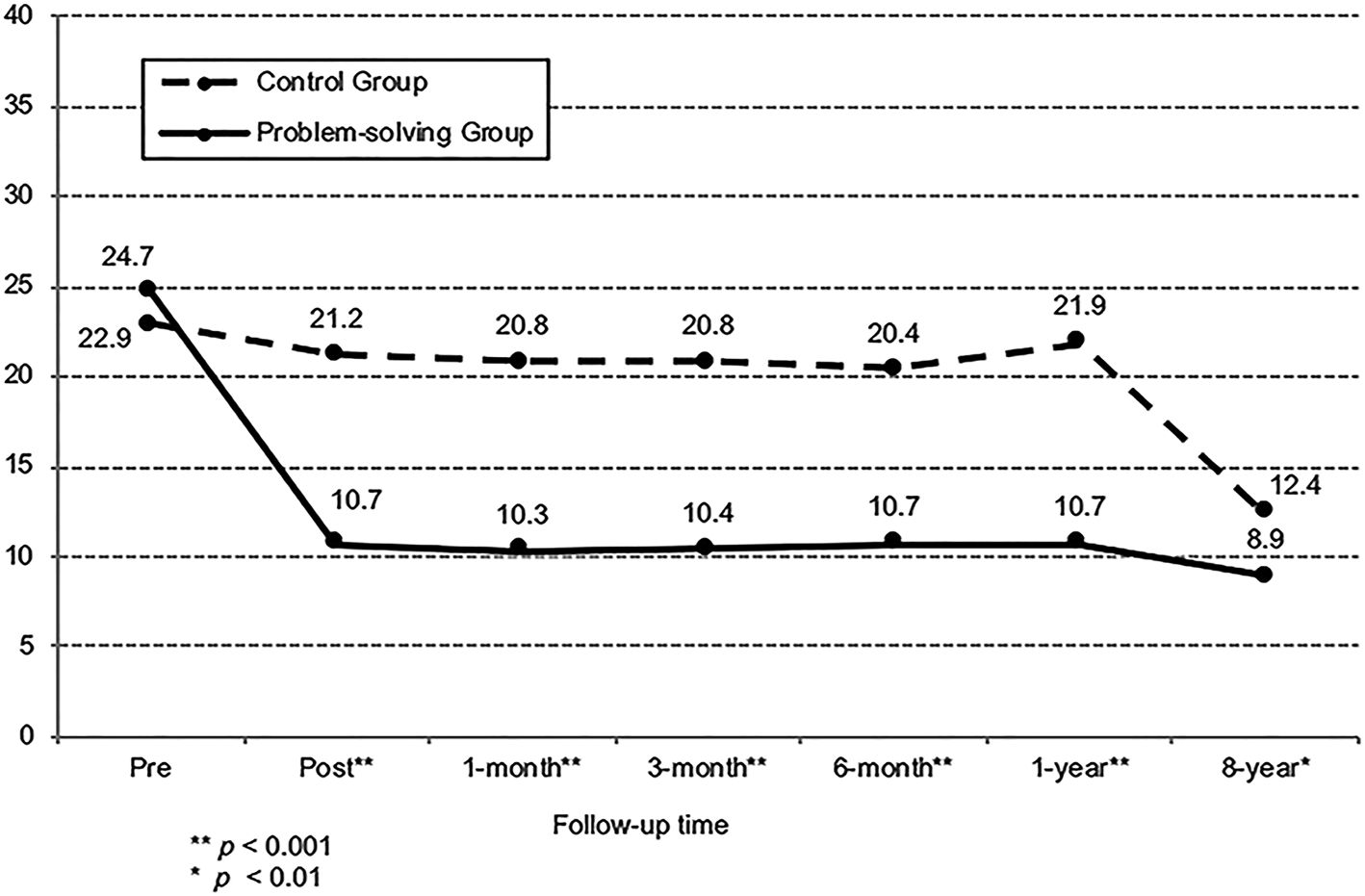
Figure 2 shows the comparison of Depressive Symptom Severity between both groups at every follow-up evaluation. The average depressive symptoms score at the 8-year follow-up was 8.9 (s.d. = 7.7) in the problem-solving group and 12.4 (s.d. = 9.5) in the control group, resulting in a small effect size (d = 0.39; 95% CI 0.10–0.70) in favor of the problem-solving group (Table 1).
Depressive symptom severity during 8-year follow-up.

Punctuations of depressive symptomatology and standardized mean differences between the problem-solving and control group

Participants of the problem-solving group presented with significantly lower depressive symptomatology compared to the control group in the unadjusted (B = −3.43, s.e. = 1.37, t = −2.50, p = 0.014, 95% CI −6.16 to −0.70) and adjusted (B = −3.32, s.e. = 1.39, t = −2.39, p = 0.018, 95% CI −6.08 to −0.57) linear regression analyzes.
Death of the relative
At the 8-year follow-up, 61 out of the 81 participants (75.3%) in the problem-solving group and 48 out of the 70 (68.6%) in the control group informed the interviewer that their dependent relative died. The proportion of deaths was not significantly different between groups, χ2(1) = 0.85, p = 0.357.
Logistic regression analysis of the effect of intervention in Depression Status by including death of the relative as a covariate resulted in an OR of 1.64 (95% CI −0.78 to 3.44), which was not statistically significant (B = 0.49; s.e. = 0.38; t = 1.30, p = 0.192). The effect of the intervention in Depressive Symptom Severity was statistically significant when including this covariate, (B = −3.07, s.e. = 1.32, t = −2.33, p = 0.021, 95% CI −5.67 to −0.47).
Additional analysis
Design-based analysis accounting the partially clustered design showed that robust variance estimators were similar to those of the main regression analysis, supporting that depressive symptomatology at 8-year follow-up was significantly lower in the problem-solving arm compared to the control condition, B = −3.32, s.e. = 1.31, t = −2.53, p = 0.014, 95% CI −5.95 to −0.70.
Discussion
Main findings
The objective of this study was to evaluate the sustainability of the effect at 8-year follow-up of an indicated preventive intervention of depression based on the problem-solving model among female caregivers with subclinical depressive symptoms. Overall, our hypothesis of a prolonged risk reduction by the preventive intervention was not supported by the results. At 8-year follow-up, there were no significant differences in the Depression Status between problem-solving and control group (30.3% v. 26.2%). However, the analysis of depressive symptoms found a significantly lower severity of depressive symptoms in the problem-solving group compared to the control group, amounting to a small effect size (d = 0.39), suggesting that the intervention may have long term benefits. Analysis including death of the relative as a covariate and design-based analysis accounting for the partially-nested structure showed similar results to the unadjusted analyses, indicating that they are consistent when considering death of the relative and partial clustering, respectively.
The wider context
With respect to Depression Status, the current study is consistent with previous ones that did not find significant differences at the 2-year follow-up (Gillham et al., Reference Gillham, Hamilton, Freres, Patton and Gallop2006; van Shaik et al., Reference Van Schaik, Dozeman, van Marwijk, Stek, Smit, Beekman and van der Horst2014; Rohde et al., Reference Rohde, Brière and Stice2018) nor at the 6-year follow-up (Brent et al., Reference Brent, Brunwasser, Hollon, Weersing, Clarke, Dickerson, Beardslee, Gladstone, Porta, Lynch, Iyengar and Garber2015). However, these results are in contrast with another study (van't Veer Tazelaar et al., Reference Van't Veer-Tazelaar, van Marwijk, van Oppen, van der Horst, Smit, Cuijpers and Beekman2011) that did find a significant difference at the 2-year follow-up. However, in this study the follow-up time was considerably shorter than our eight years of follow-up and the outcome consisted of mixed depressive and anxiety disorder (van't Veer Tazelaar et al., Reference Van't Veer-Tazelaar, van Marwijk, van Oppen, van der Horst, Smit, Cuijpers and Beekman2011).
Our results agree with the dominant perception that life-long prevention of depression by a single intervention seems unrealistic with current methods (Muñoz et al., Reference Muñoz, Beardslee and Leykin2012). This means that it is difficult for a single intervention like the one that was evaluated in the present study (of only five sessions) to lead to a life-time lasting prophylactic effect. Depression prevention may have to do less with a one-off (non-recurring) inoculation but is more akin to using safety belts in a car, where the protective effect is solely based on recurrent and consistent application of the preventive measure. Moreover, specifically in this population, a single brief intervention may not be enough to help people to develop preventive strategies to efficiently deal with the stress of the care of family members in addition to the stresses that are bound to occur over longer-terms (Zarit, Reference Zarit2018). It is perhaps by systematic application of periodic booster sessions that the longer-term effects of an initial intervention might be maintained.
Nonetheless, the fact that the intervention effects were preserved until 1-year but not until 8-year follow-up seems to indicate that the protective effect of the intervention became smaller over longer follow-up. This result seems to be consistent with a meta-analysis by van Zoonen et al. (Reference Van Zoonen, Buntrock, Ebert, Smit, Reynolds, Beekman and Cuijpers2014), which suggests that interventions may be delaying the onset of the depressive episodes rather than preventing them indefinitely. Future work should study the time-to-onset (e.g. using a survival analysis) to verify this hypothesis. However, this does not reduce the importance of the strong effects that we find at 1-year of follow-up. From a clinical point of view, preventing new onsets of depression would obviously be preferable. However, delaying the onset is also important. Every year the disorder is delayed results in considerably less suffering by patients and may entail a reduction in economic costs.
There was a reduction in Depressive Symptom Severity observed at the 8-year follow-up, with a small effect size (d = 0.39). These results are consistent with those of a recent meta-analysis (Cuijpers et al., Reference Cuijpers, de Wit, Kleiboer, Karyotaki and Ebert2018) that found an effect size of g = 0.35 (95% CI 0.14–0.56) of problem-solving interventions compared to control conditions at much shorter follow-ups (6-month and 12-month). The mean depressive symptom score of the problem-solving group at the 8-year follow-up (8.9) was close to the average of 8.7 of the general population (Radloff, Reference Radloff1977), suggesting sustained intervention effects until 8 years after the intervention. The preventive problem-solving intervention may have produced this long-term effect by raising awareness of the risk of becoming depressed (which could also increase the percentage of total depressive episodes registered in this group) and probably encouraging active help-seeking behaviors when depressive complaints occurred. On the other hand, depressive symptomatology in the control group has decreased since the 1-year follow-up. This is consistent with a recent study by Jeuring et al. (Reference Jeuring, Huisman, Comijs, Stek and Beekman2016) which found that approximately 45% of people with a subthreshold depression (i.e. CES-D scores ⩾16 and without diagnosis of major depressive disorder) recovered during a natural 6-year follow-up. Therefore, this further strengthens the value of the intervention because the participants of the problem-solving group have reported significantly lower severity at 8-year follow-up, even in comparison with naturally occurring recovery.
The proportion of caregivers who experienced the death of the relative was not significantly different between experimental conditions. The results of the analyses that included death as a covariate were very similar to the unadjusted analyses. Regarding Depression Status, the intervention effect remained not significant after including this covariate, which suggests that the death of the relative did not confound outcomes. These findings are not surprising because caregiver reactions to the death of their relatives are heterogeneous (e.g. ranging from grief to relief), and many individuals demonstrate remarkable resilience in adapting to these events (Schulz et al., Reference Schulz, Mendelsohn, Haley, Mahoney, Allen, Zhang, Thompson and Belle2003).
Strengths and limitations
This study has several important strengths. To our knowledge, this is the first study that conducted an 8-year follow-up of an intervention of indicated prevention of depression. In addition, it provides evidence that there were significant differences in depressive symptom severity at both 1-year and 8-year follow-ups. The dropout rate was 12.7%, which is considerably lower than what is typically seen even in much shorter follow-ups (van't Veer Tazelaar et al., Reference Van't Veer-Tazelaar, van Marwijk, van Oppen, van der Horst, Smit, Cuijpers and Beekman2011; van Shaik et al., Reference Van Schaik, Dozeman, van Marwijk, Stek, Smit, Beekman and van der Horst2014) which could have resulted due to a good rapport between the research team and the participants and the ease of participation (not having to move from their homes to complete the evaluation). Furthermore, the intervention is based on a well-tested theoretical model, reducing the likelihood of chance findings (Holder, Reference Holder2010). In addition, standardized and reliable instruments were used to evaluate the outcomes (Rush et al., Reference Rush, First and Blacker2008).
There are also some limitations that should be considered. It was not possible to analyze the course of the depressive episodes and depressive symptomatology regularly over time. To minimize this lack of information, we retrospectively evaluated diagnoses of depressive episodes that occurred in the last 7 years. This information was combined with the absence or presence of a SCID/DSM-5 depressive episode into the single primary outcome, Depression Status. Future studies should plan more frequent assessments to evaluate the onset and evolution of depression and depressive symptomatology over time. In addition, caution is needed when interpreting the effect of the death of relatives on the outcomes. We could not evaluate how this event may have affected the course of the outcomes. As a result, we do not know if significant fluctuations in the incidence of depressive disorder or depressive symptomatology were present after death. Moreover, the interviews were conducted over the phone although phone interviews generally yield comparable results to face-to-face interviews (Rohde et al., Reference Rohde, Lewinsohn and Seeley1997). It should also be noted that participation in the intervention might also increase social desirability bias when reporting depressive symptoms, which could make group differences larger than they are in reality. Furthermore, generalization of the results may be limited because the sample was composed exclusively of female caregivers, although this limitation is minimal because non-professional care is mostly conducted by women (Colombo et al., Reference Colombo, Llena-Nozal, Mercier and Tjadens2011).
Implications
This study offers several recommendations for clinical practice and future research. The current study addresses an important gap in the literature regarding the longer-term efficacy of preventive interventions for depression. However, more research may be required to arrive at firmer conclusions. Our results suggest that problem-solving interventions delayed depression in non-professional caregivers at least 1 year after the intervention but not up to 8 years. However, the preventive intervention appeared to affect depressive symptoms after 8 years, resulting in lower depressive symptom scores for the problem-solving group than the control group. The results also suggest that periodic booster sessions are needed for sustained preventive effects in this chronically stressed population.
Conclusions
This study provides evidence of the 8-year efficacy of indicated prevention of depression in non-professional caregiver population. The intervention did not reduce the incidence of depression after 8 years, but the depressive symptomatology remained significantly lower in the intervention group compared with the control group. These findings suggest that systematic booster sessions could sustain preventive effects.
Financial support
This work was supported by the Ministry of Labour and Social Affairs of Spain (grant number 2007/PN017) and by the spin-off of the University of Santiago de Compostela ‘Xuntos. Psychological and Psychiatric Care’ (grant number 2013-CE081-4).
Conflict of interest
None.
Ethical standards
The authors assert that all procedures contributing to this work comply with the ethical standards of the relevant national and institutional committees on human experimentation and with the Helsinki Declaration of 1975, as revised in 2008.