Introduction
The general tourmaline formula is XY 3Z 6(BO3)3[T 6O18]V 3W, where the X site in Al-rich and Li-bearing tourmalines is usually occupied by Na, Ca or is vacant (□) (Henry et al., Reference Henry, Novák, Hawthorne, Ertl, Dutrow, Uher and Pezzotta2011). The Y site is in such tourmalines usually occupied by Al and Li, and the Z site is only occupied by Al. The T site can be occupied by Si and by minor amounts of B and Al. The V site is usually occupied by OH, and the W site by OH, O or F. The samples investigated exhibit unit-cell parameters with a = 15.6509–15.9569 Å and c = 7.0406–7.1380 Å (Burns et al., Reference Burns, MacDonald and Hawthorne1994; Bosi et al., Reference Bosi, Skogby, Agrosi and Scandale2005b; Cempírek et al., Reference Cempírek, Jonsson, Skřápková, Škoda, Kolitsch, Čopjaková, Groat, Kampf, Lussier, Hawthorne, Haifler, Holá and Ende2025).
Until now, syntheses have not been successful in producing Li-rich tourmalines with >0.5 atoms per formula unit (apfu) YLi. It is still not clear how Li enters the Y site in tourmalines. It therefore makes sense to take a closer look at which short-range ordering schemes can accommodate Li.
Natural and synthetic samples were used to investigate which Li-containing short-range ordering schemes can occur in Li-bearing Al-rich tourmalines.
Short-range ordering
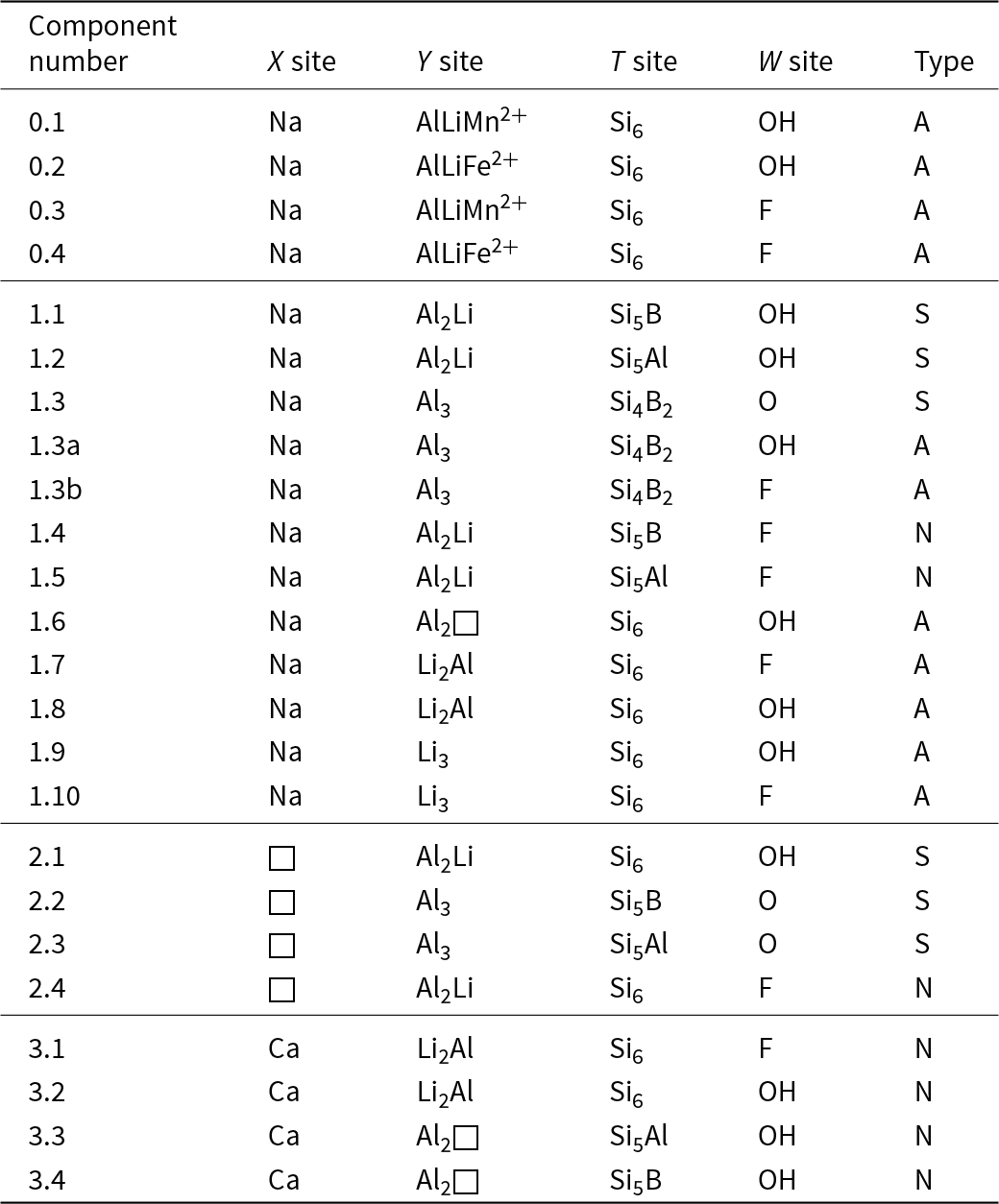
Synthetic Al-rich and Li-bearing tourmalines without F, but with [4]B and [4]Al, are of special interest because they contain no Ca, only Na and vacancies at the X site and mainly Al and Li at the Y site (Ertl et al., Reference Ertl, Hughes, Prowatke, Ludwig, Brandstätter, Körner and Dyar2012a). Because these tourmalines (synthesised by David London) do not have such a complex composition, relationships are easier to recognise. In Table 1, all short-range orders for components that can contribute to these synthetic (denoted as) samples (the Z site is always occupied by Al) are listed.
Natural (N), synthetic (S) and alternative (A) theoretical components with variable short-range ordering schemes.

Component 2.3 is related to the rossmanite end-member. It is also related to the alumino-oxy-rossmanite end-member (Ertl et al., Reference Ertl, Giester, Ludwig, Meyer and Rossman2022), whereas 2.2 is related to the B-analogue of this tourmaline. It seems confirmed that the short-range order 1.3 is an essential component. Without it, it is not possible to explain the crystal-chemical formulae of these synthetic tourmaline samples. The combination of these components with different short-range ordering arrangements makes it clear that the Li content in such a tourmaline containing only Na and vacancies at the X site will be in the range of 0–1 apfu Li. When correlating the components of the different short-range orders in the examined tourmalines, which were synthesised at different temperatures, it can be recognised that, with decreasing temperature, the component 2.1 increases, whereas it decreases with increasing temperature. This explains why the content of the tetrahedrally coordinated B significantly increases towards lower temperatures. There is no evidence that in these synthetic tourmalines, a short-range order occurs, where the X and Y sites are occupied as in 1.1, but Si occupies the T site exclusively, and only O occupies the O1 (W) site. Such a short-range order may not be favourable or even unstable at such pressure/temperature conditions.
A natural Al-rich and Li-bearing tourmaline sample with a vacancy-dominant X site (rossmanite; Selway et al., Reference Selway, Novák, Hawthorne, Černý, Ottolini and Kyser1998) with the updated crystal chemical formula X(□0.6Na0.4)Y(Al2.2Li0.7□0.1)ZAl6(BO3)3 [Si5.6B0.4O18]V(OH)3W[(OH)0.6O0.3 F0.1] (based on data in that publication with added tetrahedral B) seems to consist of the same short-range ordering schemes. A minor component may occur additionally: a short-range order with XNa, Y(Al2□), TSi and W(OH) (see also Ertl, Reference Ertl, Rossman, Hughes, Prowatke and Ludwig2023). However, the dominant component seems to be short-range order 2.1 (Table 1). This component is practically identical to the end-member formula of rossmanite.
However, natural Al- and Li-rich tourmalines with Li >1.0 apfu occur often. Such tourmalines contain additionally some Ca and significant amounts of F (Ertl et al., Reference Ertl, Schuster, Hughes, Ludwig, Meyer, Finger, Dyar, Ruschel, Rossman, Klotzli, Brandstatter, Lengauer and Tillmanns2006, Reference Ertl and Bačík2010). Many short-range ordering schemes occurring in such samples are already listed in Table 1, but additional components might also occur.
Components 3.1 and 3.2 have (Li2Al) at the Y site. The combination of these components, together with short-range orders 1.1, 1.2, 1.4, 1.5, 2.1 and 2.4, produces Li contents in the range 1–2 apfu Li. However, component 2.4 does not appear to occur, as a summary of data from ∼9000 tourmaline analyses from different lithological environments shows that for tourmaline with an average X-site charge of <+0.5, the maximum F amounts are <0.2 apfu (Henry and Dutrow, Reference Henry and Dutrow2011). These chemical data of natural tourmalines indicate crystallographic influences. Natural tourmaline with relatively high Li contents always contains relatively high F contents. It seems that the contents of Li and F are positively correlated (see also Ertl, Reference Ertl, Hughes, Pertlik, Foit, Wright, Brandstätter and Marler2021). In order to find out whether short-range ordering schemes with Li and F (1.4, 1.5, 3.1; Table 1) are more favourable in terms of crystal chemistry than orders with Li and OH (1.1, 1.2, 2.1, 3.2; Table 1), bond valence calculations were carried out.
Bond-valence topological modelling
The stability and structural effects of proposed short-range ordering (or components) can be determined by applying bond-valence topological modelling, which combines Bond Valence Theory and structural topology (Bačík, Reference Bačík2025).
Bond-length calculations, as a part of Bond Valence Theory, are based on the following equation:
 \begin{equation}
d_{\textrm{ij}} = R_0 - \text{b} \ \text{ln} \ \unicode{x03BD}_{\textrm{ij}}\end{equation}
where d ij is the bond length (in Å) between the two given ions, ν ij is the bond valence of the given bond (in vu – valence units), R 0 is the length of a bond for which ν ij = 1 vu, and b is the universal parameter for each bond (Brown, Reference Brown2006).
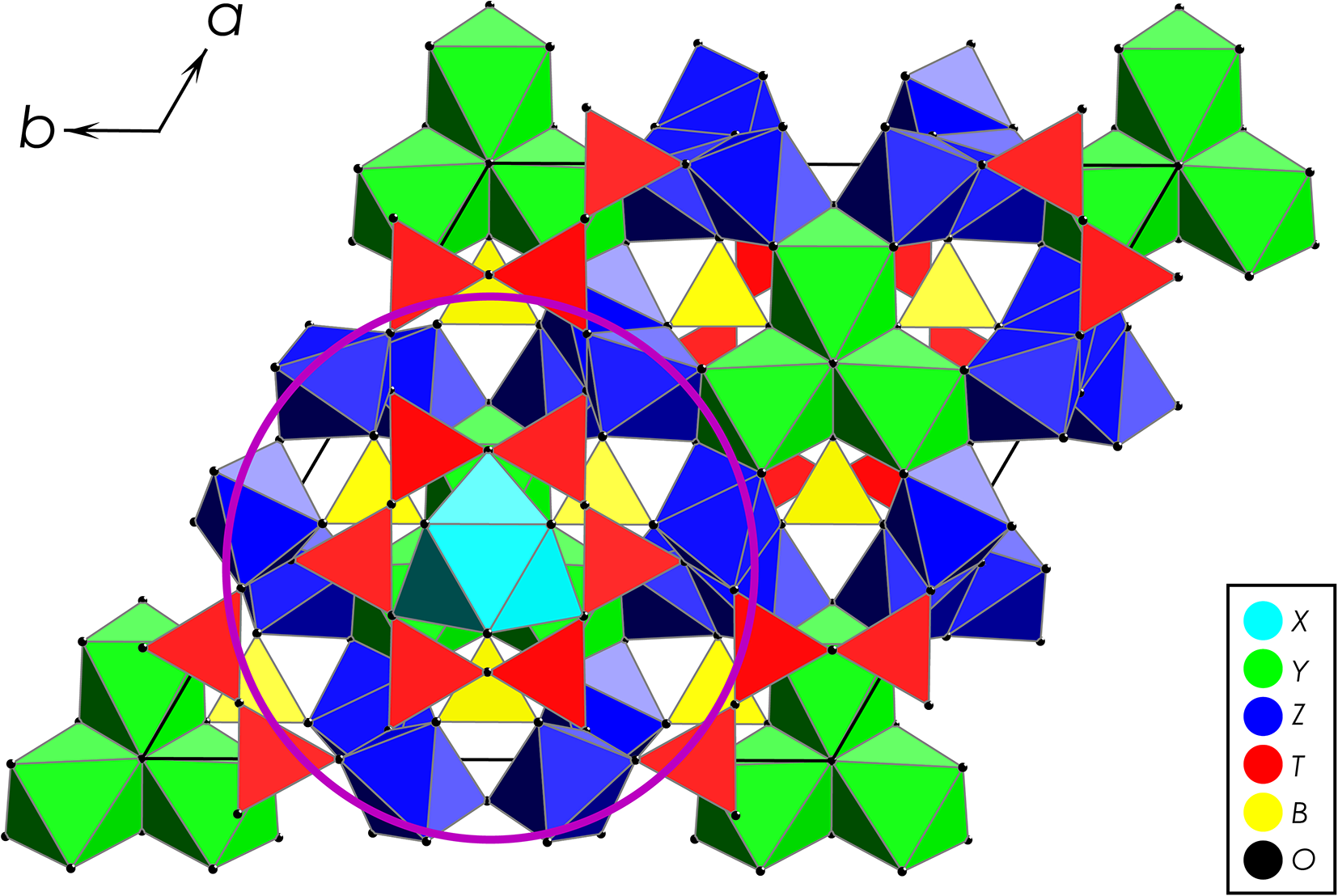
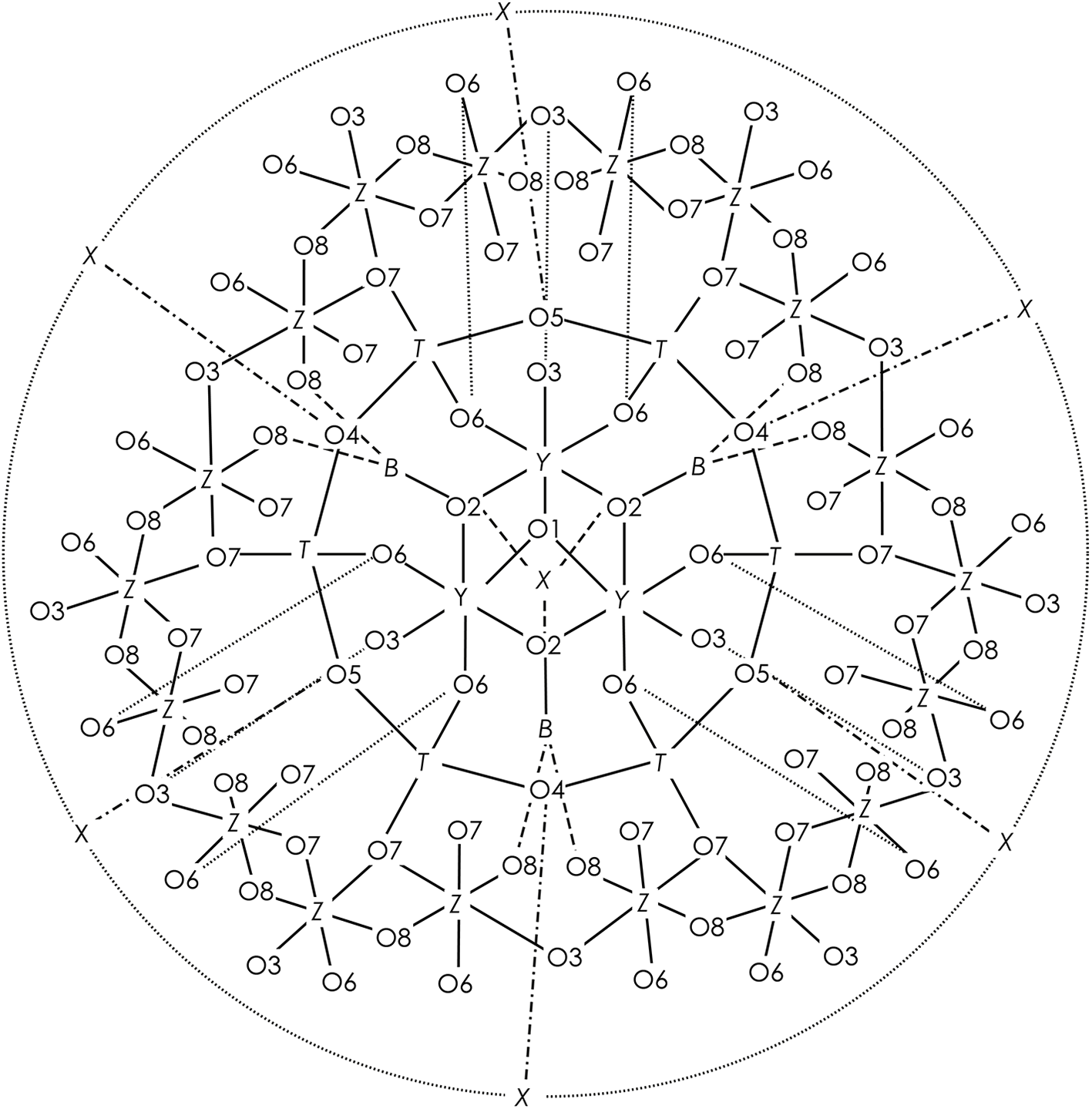
The bond-valence topological modelling is based on bond-valence topological graphs, which represent the specific structural fragment with attached values of bond valences or lengths (Bačík, Reference Bačík2025). Therefore, the first step in bond-valence topological modelling involves defining a structural fragment. Here, the selected fragment is identical to one formula unit extended to include all ZO6 octahedra connected to the TO4 tetrahedra of tourmaline (Fig. 1). The graph is then constructed, with all sites serving as vertices and bonds between them as edges of the graph (Fig. 2). The values are attached to each edge of the graph. These can be derived from the ideal bond valences calculated for each bond at each site (Bačík and Fridrichová, Reference Bačík and Fridrichová2021), however, these almost always differ from empirical values due to polyhedron distortion (Ertl et al., Reference Ertl, Tillmanns, Ntaflos, Francis, Giester, Körner, Hughes, Lengauer and Prem2002). Therefore, the starting model was derived from the structural model of dravite from Forshammar, Sweden, which was based on the empirical data (Bačík, Reference Bačík2025). From this, the bond-valence topological models of all natural and synthetic components specified in Table 1 were calculated. Moreover, Y(Al-Mn-Li) and Y(Al-Fe-Li) components, which are considered stable (Ertl and Bačík, Reference Ertl, Hughes, Prowatke, Ludwig, Prasad, Brandstätter, Körner, Schuster, Pertlik and Marschall2020), were calculated as the reference standard (numbered 0.1 and 0.2). In addition, components that are alternatives to those proposed (1.3a, 1.3b, 1.7, 1.8 – Table 1) and are considered stable (Hawthorne, Reference Hawthorne1996, Reference Hawthorne2002; Bosi, Reference Bosi2010, Reference Bosi2011, Reference Bosi2013, Reference Bosi2018) were also calculated, as well as the YLi3 components (1.9, 1.10 – Table 1) that cannot be assigned to a stable end-member and have never been observed in natural or synthetic tourmalines. These additional components are not charge-balanced at the specified sites because their purpose is simply to test the valence requirements of the local bonds. However, charge balancing can be achieved at other sites not listed in Table 1 (V, Z).
Detail of the crystal structure of tourmaline (drawn in Crystal Impact Diamond 5.1, https://www.crystalimpact.de/diamond) with the purple circle surrounding the part of the structure studied.

Planar bond-topological graph of the tourmaline structure segment encircled in Fig. 1. Transformation of 3D structure to the planar graph was not fully possible, but the spatial relationship is highlighted by the lines used. Full lines are bonds in the plane of the graph, dashed lines are for bonds below, and dash-dotted lines are for bonds above the plane. Dotted lines connect sites, which are identical, but in order to maintain readability of the graph and keep the local environment (i.e. to keep octahedra easily recognisable), were displayed at two or more places. Note that the X site in the middle of the graph is different to one on the surrounding circle.

The process of model calculation is described by Bačík (Reference Bačík2025) and Bačík and Fridrichová (Reference Bačík and Fridrichová2021). The calculations were relatively conservative, with minimal consideration of distortion effects to better compare components and highlight bond-valence requirements. In addition, the calculated values should be treated with caution; the difference between them serves to indicate the structural effects.
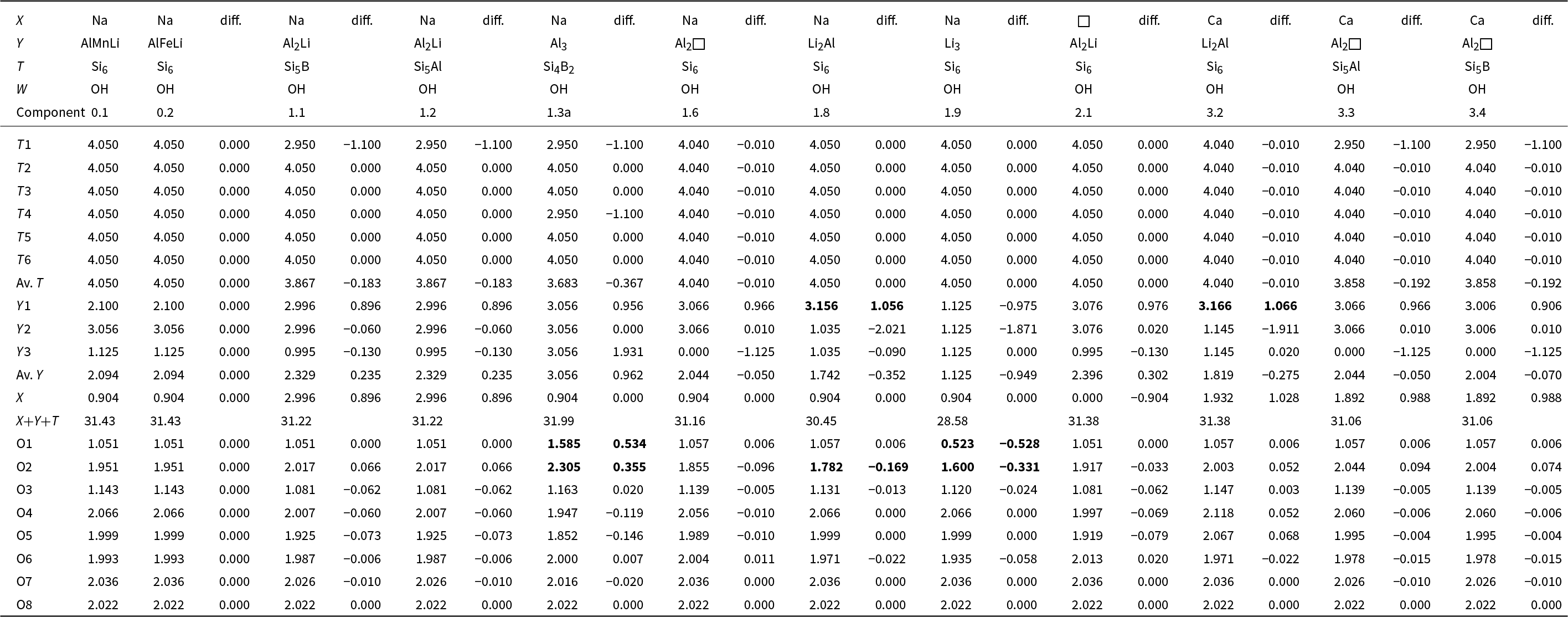
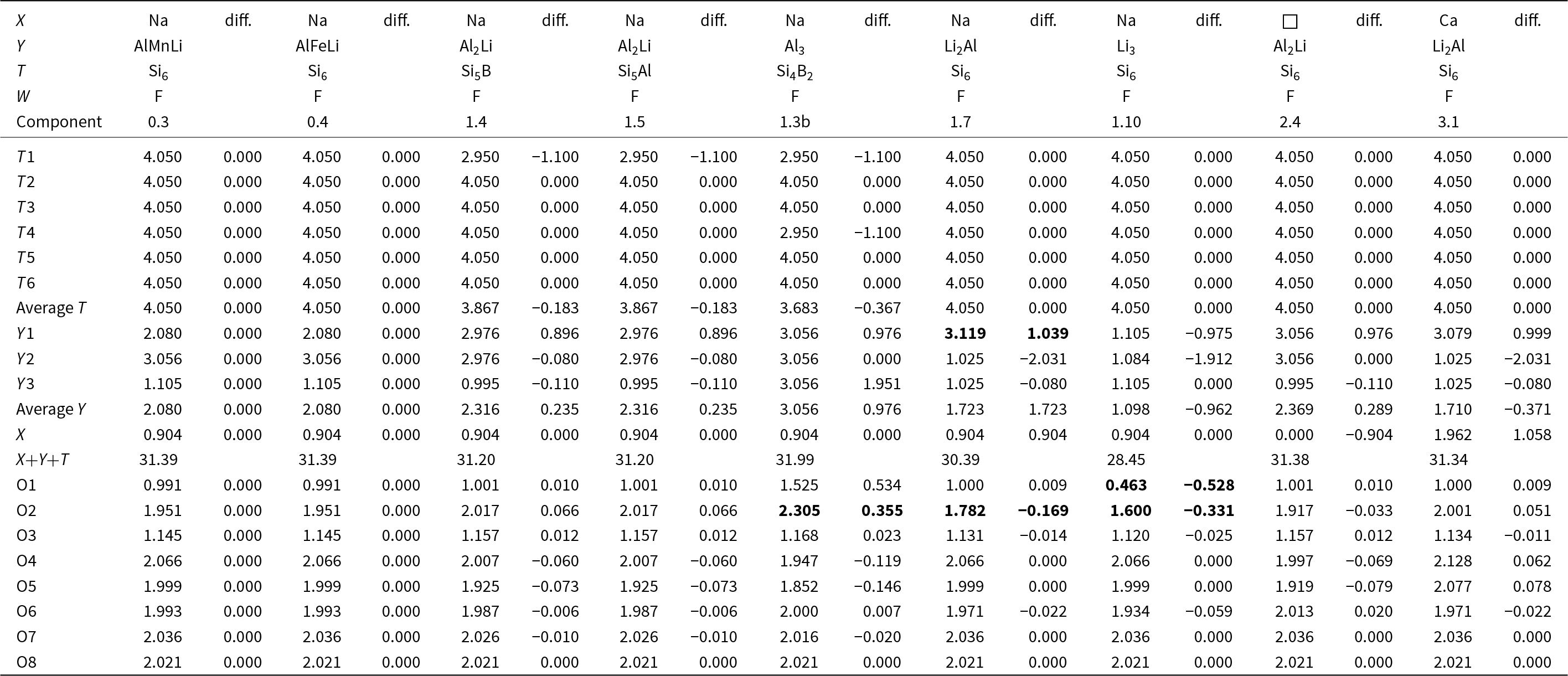
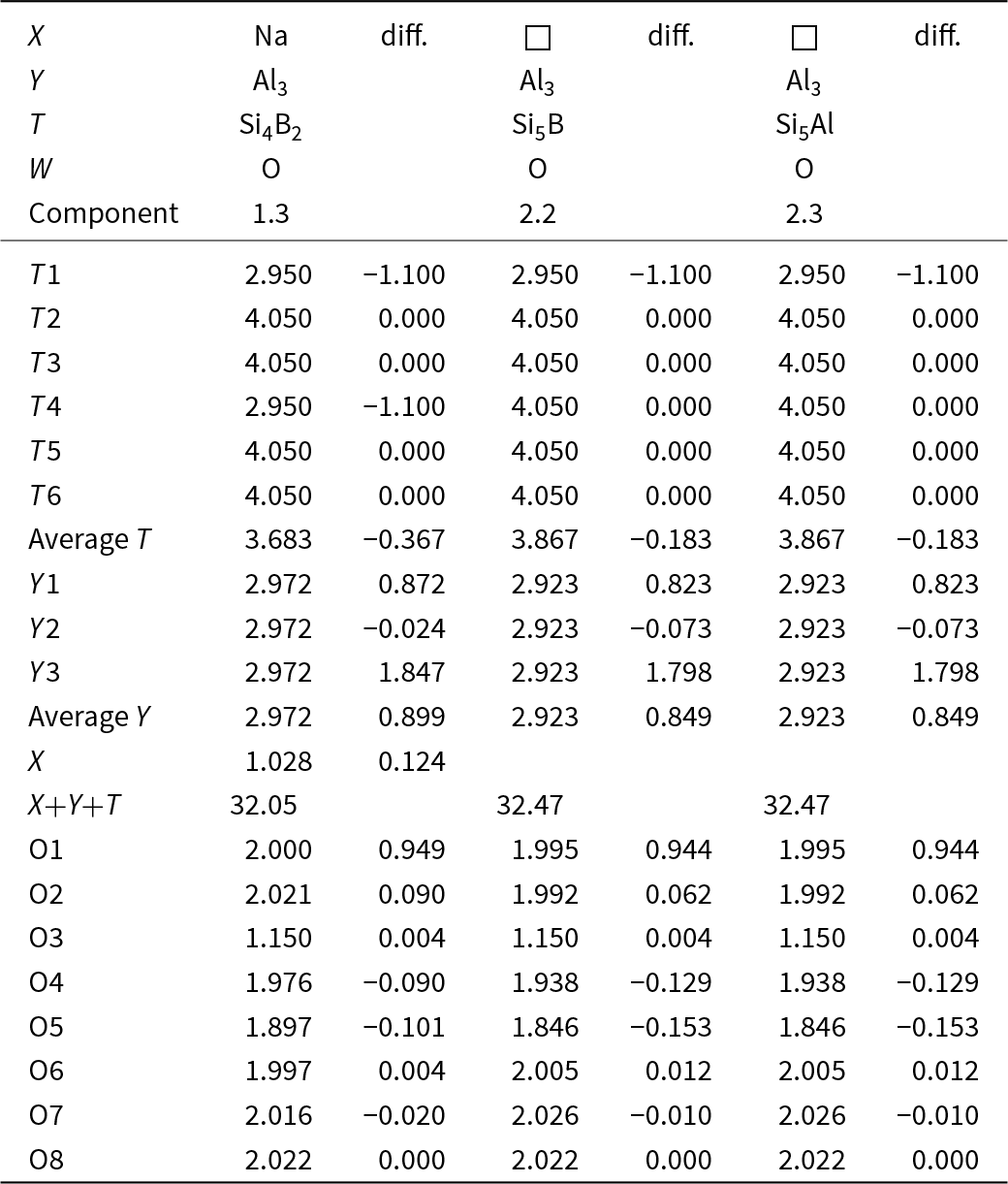
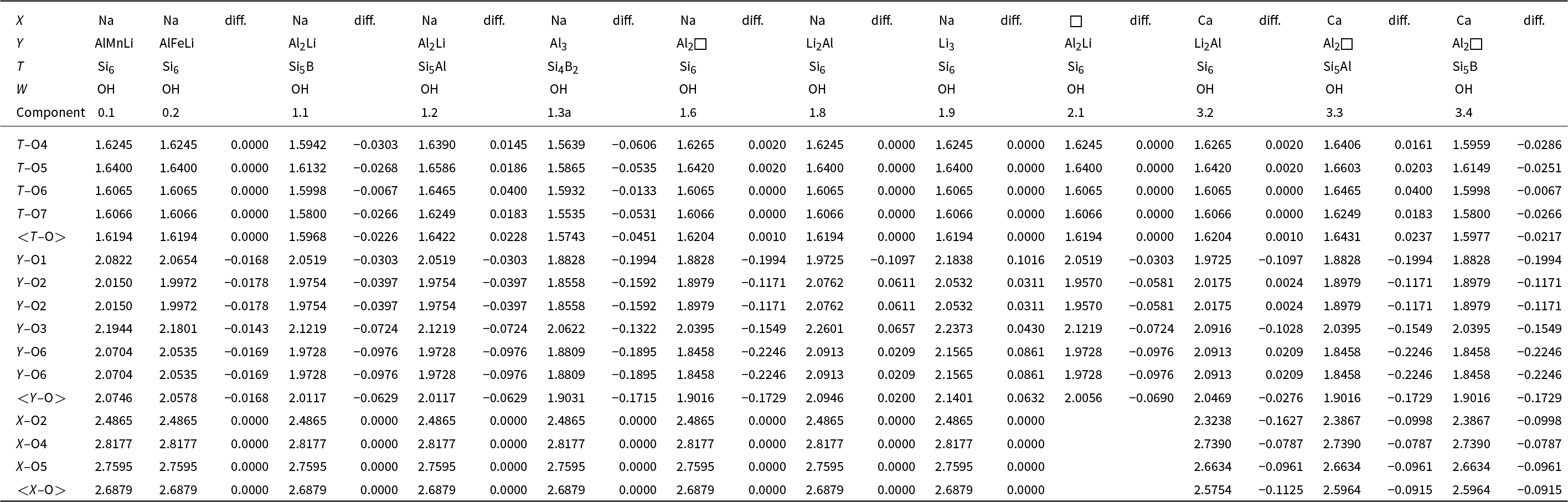
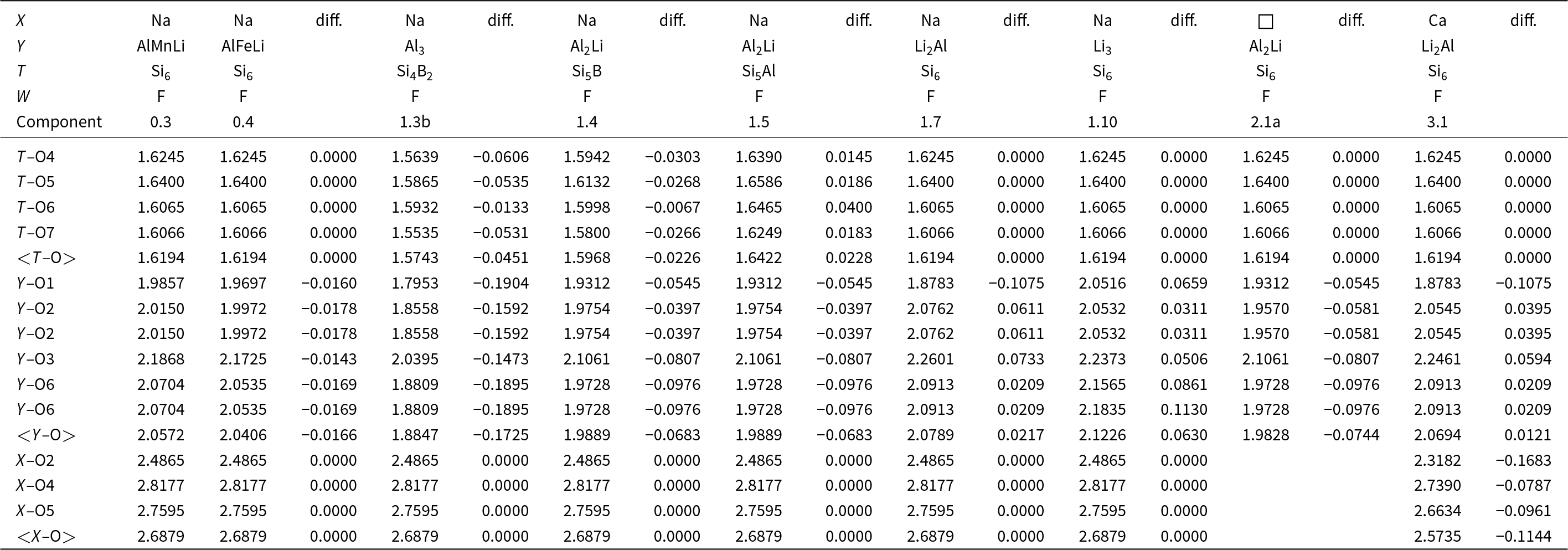
A theoretical bond-topological model for each arrangement was calculated and refined to fit the structural data from natural samples. To calibrate the modelling process, the sets with the compositions of the schorl–elbaite (Burns et al., Reference Burns, MacDonald and Hawthorne1994; Bosi et al., Reference Bosi, Agrosi, Lucchesi, Melchiorre and Scandale2005a, Reference Bosi, Skogby, Agrosi and Scandale2005b, Reference Bosi, Andreozzi, Agrosi and Scandale2012, Reference Bosi, Andreozzi, Skogby, Lussier, Abdu and Hawthorne2013, Reference Bosi, Andreozzi, Federico, Graziani and Lucchesi2015; Ertl et al., Reference Ertl, Schuster, Hughes, Ludwig, Meyer, Finger, Dyar, Ruschel, Rossman, Klotzli, Brandstatter, Lengauer and Tillmanns2006, Reference Ertl2008, Reference Ertl, Hughes, Prowatke, Ludwig, Lengauer, Meyer, Giester, Kolitsch and Prayer2012b, Reference Ertl, Kolitsch, Dyar, Hughes, Rossman, Pieczka, Henry, Pezzotta, Prowatke, Lengauer, Korner, Brandstatter, Francis, Prem and Tillmanns2012c; Vereshchagin et al., Reference Vereshchagin, Rozhdestvenskaya, Frank-Kamenetskaya, Zolotarev and Mashkovtsev2013), elbaite–liddicoatite (Lussier et al., Reference Lussier, Abdu, Hawthorne, Michaelis, Aguiar and Kroeker2011) and rossmanite–ertlite (Selway et al., Reference Selway, Novák, Hawthorne, Černý, Ottolini and Kyser1998; Ertl et al., Reference Ertl2005, Reference Ertl, Giester, Ludwig, Meyer and Rossman2022; Kasatkin et al., Reference Kasatkin, Nestola, Day, Gorelova, Škoda, Vereshchagin, Agakhanov, Belakovskiy, Pamato and Cempírek2024; Cempírek et al., Reference Cempírek, Jonsson, Skřápková, Škoda, Kolitsch, Čopjaková, Groat, Kampf, Lussier, Hawthorne, Haifler, Holá and Ende2025) solid-solution series were used. The modelling results are divided into hydroxyl-, fluor- and oxy-dominant components according to the occupancy of the O1 site. Bond valences (Tables 2, 3 and 4) and bond lengths (Tables 5, 6 and 7), for hydroxyl-, fluor- and oxy-dominant components respectively, of each component are compared with the Y(Al-Mn-Li) component. Differences larger than 0.01 vu and 0.01 Å are highlighted. Since the occupancy of the Z (completely occupied by Al) and B (completely occupied by B) sites has not changed, these are not listed in the bond valence tables for reasons of clarity.
Calculated bond valence sums for T, Y, X and O1–O8 sites in WOH-bearing components and their difference (diff.) to the 0.1 component. Values in bold are significantly different to the ideal formal valence of ion at specific site.

Calculated bond valence sums for T, Y, X and O1–O8 sites in WF-bearing components and their difference (diff.) to the 0.3 component. Values in bold are significantly different to the ideal formal valence of ion at the specific site.

Calculated bond valence sums for T, Y, X and O1–O8 sites in WO-bearing components and their difference (diff.) to the 0.1 component.

Bond lengths (Å) at T, Y, and X sites in WOH-bearing components calculated from BVS in Table 4 and their difference (diff.) to the 0.3 component.

Bond lengths (Å) at T, Y, and X sites in WF-bearing components calculated from BVS in Table 4 and their difference (diff.) to the 0.1 component.

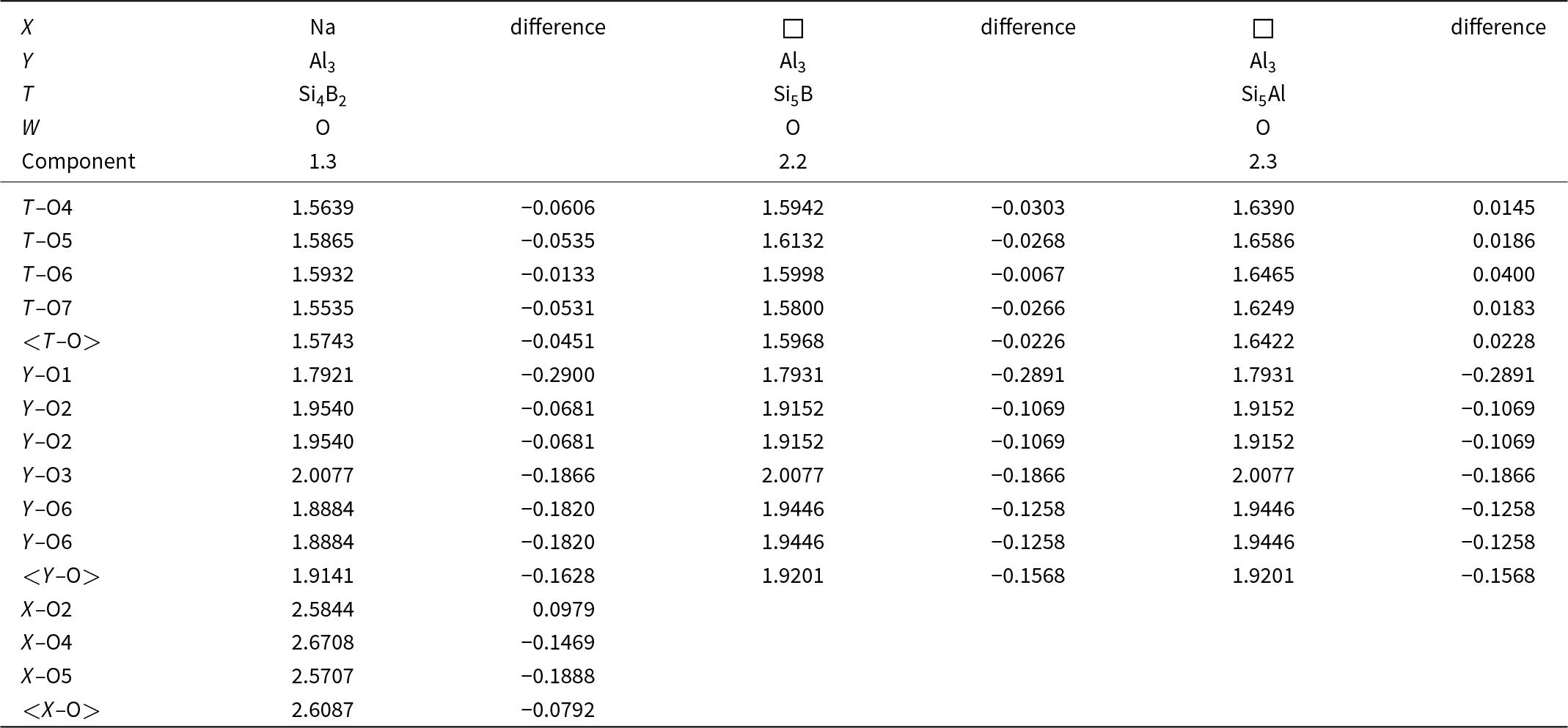
Bond lengths (Å) at T, Y, and X sites in WO-bearing components calculated from BVS in Table 4 and their difference to the 0.1 component.

Bond valence constraints
First, the XNa-bearing components were calculated to identify possible bond-valence requirements for sites adjacent to the Y, i.e. X and O1 (W) sites. From the bond-valence perspective, both AlMn2+Li and AlFe2+Li components are perfectly reasonable and can be stable with XNa and both WF and WOH occupancy. At first glance, Al2Li and Al3 may also be stable, but increased bond-valence sum (BVS) of the O1 and O2 anions should be balanced by WO as in darrellhenryite (or VO as in olenite), by vacancies at the X site, as in rossmanite, or by both, as in alumino-oxy-rossmanite.
The bond-valence effects were studied in more detail, mainly at the O1 and O2 sites. In general, more Al at the Y site leads to overbonding of O1, whereas more Li leads to underbonding of O1. This may influence the preference for O1 occupancy. Underbonding of O1 is preferable for F because OH at the O1 site usually has BVS higher than 1.00 vu (usually around 1.05 vu) due to hydrogen bonding of H to ring oxygen atoms (Hawthorne, Reference Hawthorne1996, Reference Hawthorne2002; Gatta et al., Reference Gatta, Bosi, McIntyre and Skogby2014). Overbonding of O1 leads to a higher BVS of YAl in OH-containing liddicoatitic components (3.2, Table 2) compared to F-containing ones (3.1, Table 3). Consequently, liddicoatitic tourmaline is enriched in F and is usually F-dominant (Ertl et al., Reference Ertl, Schuster, Hughes, Ludwig, Meyer, Finger, Dyar, Ruschel, Rossman, Klotzli, Brandstatter, Lengauer and Tillmanns2006; Lussier et al., Reference Lussier, Abdu, Hawthorne, Michaelis, Aguiar and Kroeker2011). In fact, WOH dominant liddicoatite is a non-approved species, and the originally described liddicoatite has been redefined as fluor-liddicoatite (Henry et al., Reference Henry, Novák, Hawthorne, Ertl, Dutrow, Uher and Pezzotta2011).
In the case of YAl3 components 1.3a and 1.3b, the BVS at O1 increases to 1.59 vu (+0.53 vu compared to 0.1) and 1.53 vu (+0.53 vu compared to 0.3), respectively. This is a clear indication that YAl3 occupancy requires the presence of WO; therefore, the 1.3 component is stable (Table 6).
Similar effects can be observed at the O2 site; it is also strongly influenced by the Al/Li ratio. This in turn sets the bond valence requirements for occupying the X site, which shares O2 with the Y site. The Al-dominant components show an increase in the BVS of O2, 2.02 vu for Y(Al2Li) and even 2.31 vu for YAl3 components. This can be solved in two different ways. In the Y(Al2Li) component, the difference is small and within the value of Na–O2 bond valence. Consequently, the rossmanite substitution with introducing the X-site vacancy is the natural way to reduce the BVS at O2 and relax the possible structural strain. When YAl3 components are considered, the difference is too large, but can be indirectly relaxed by replacing OH with O at O1, which changes the distribution of bond valences in Y–O bonds and reduces the BVS of O2 (Table 6).
In contrast, the Y(Li2Al) components 1.7 and 1.8 exhibit a deficit of –0.12 vu in the BVS of the O2 site (Tables 4 and 5). Consequently, it is necessary to increase the BVS at O2, which can be achieved by replacing Na with Ca at the X site. This results in the stable components 3.1 and 3.2, whereby the F-bearing component 3.1, as discussed above, is significantly more common.
The components with the Y-site vacancy, including 1.6, 3.3 and 3.4 (described by Ertl, Reference Ertl, Rossman, Hughes, Prowatke and Ludwig2023), are very specific because the absence of a Y-site cation limits the possible occupancy of the other two sites in the triplet of linked YO6 octahedra. For components to be as stable as possible, less highly charged cations are required, similar to micas, where micas with three divalent cations at octahedral sites transform into those with two trivalent octahedral cations and a vacancy (Rieder et al., Reference Rieder, Cavazzini, Yakonov, Frank-Kamenetskii, Gottardi, Guggenheim, Koval, Müller, Neiva, Radoslovich, Robert, Sassi, Takeda, Weiss and Wones1999). Similarly, all proposed Y-site vacant components have a Y(Al2□) occupancy. The first component tested, 1.6, shows no significant irregularities that could unambiguously deny its existence. However, the smaller BVS at O2 suggests that the X-site would prefer a cation with a higher charge than Na, which would additionally contribute to the BVS of O2. Apparently, the 3.3 and 3.4 components with XCa show reasonable BVS values for all sites, including O2. Although their values increase slightly compared to 0.1, they correspond almost perfectly to the ideal BVS of 2 vu (Table 4). A good candidate for significant proportions of 3.3 and/or 3.4 is an Al-rich tourmaline from Koralpe, Austria, which has the formula X(Na0.40Ca0.29□0.31)Y(Al2.40Li0.35□0.25)ZAl6(BO3)3T[Si4.89B0.83Al0.27Be0.01]O18V(OH)3W[O0.58(OH)0.36F0.06] (Ertl et al., Reference Ertl, Rossman, Hughes, London, Wang, O’Leary, Darby, Prowatke, Ludwig and Tillmanns2007, and references therein). This tourmaline, originally described as B-rich olenite, is a complex solid solution of various end-members, consisting primarily of ertlite (36 mol.%) and alumino-oxy-rossmanite (16 mol.%), if valid tourmaline end-members and also the V- and W-site occupations are taken into account.
In contrast, the decrease in BVS at O2 in the Li3 components is too large for a divalent substituent at the X-site and would require a trivalent cation at X. However, this is highly unlikely in natural compositions; only trivalent lanthanides from La3+ to Gd3+ with bond lengths similar to Ca2+ could occupy the X site (Bačík and Fridrichová, Reference Bačík and Fridrichová2021), but their content in tourmalines is usually very limited, up to 1200 ppm in natural samples (Hellingwerf et al., Reference Hellingwerf, Gatedal, Gallagher and Baker1994; Ertl et al., Reference Ertl, Schuster, Hughes, Ludwig, Meyer, Finger, Dyar, Ruschel, Rossman, Klotzli, Brandstatter, Lengauer and Tillmanns2006; Novák et al., Reference Novák, Škoda, Filip, Macek and Vaculovič2011; Bačík et al., Reference Bačík, Uher, Ertl, Jonsson, Nysten, Kanický and Vaculovič2012). Furthermore, the BVS at O1 as low as 0.53 vu is obviously unsuitable for any anion at this site and is extremely unlikely to be relaxed by any distortion of the YO6 octahedra. Consequently, it is almost certainly impossible to obtain a stable tourmaline with YLi3.
Bond lengths of theoretical components
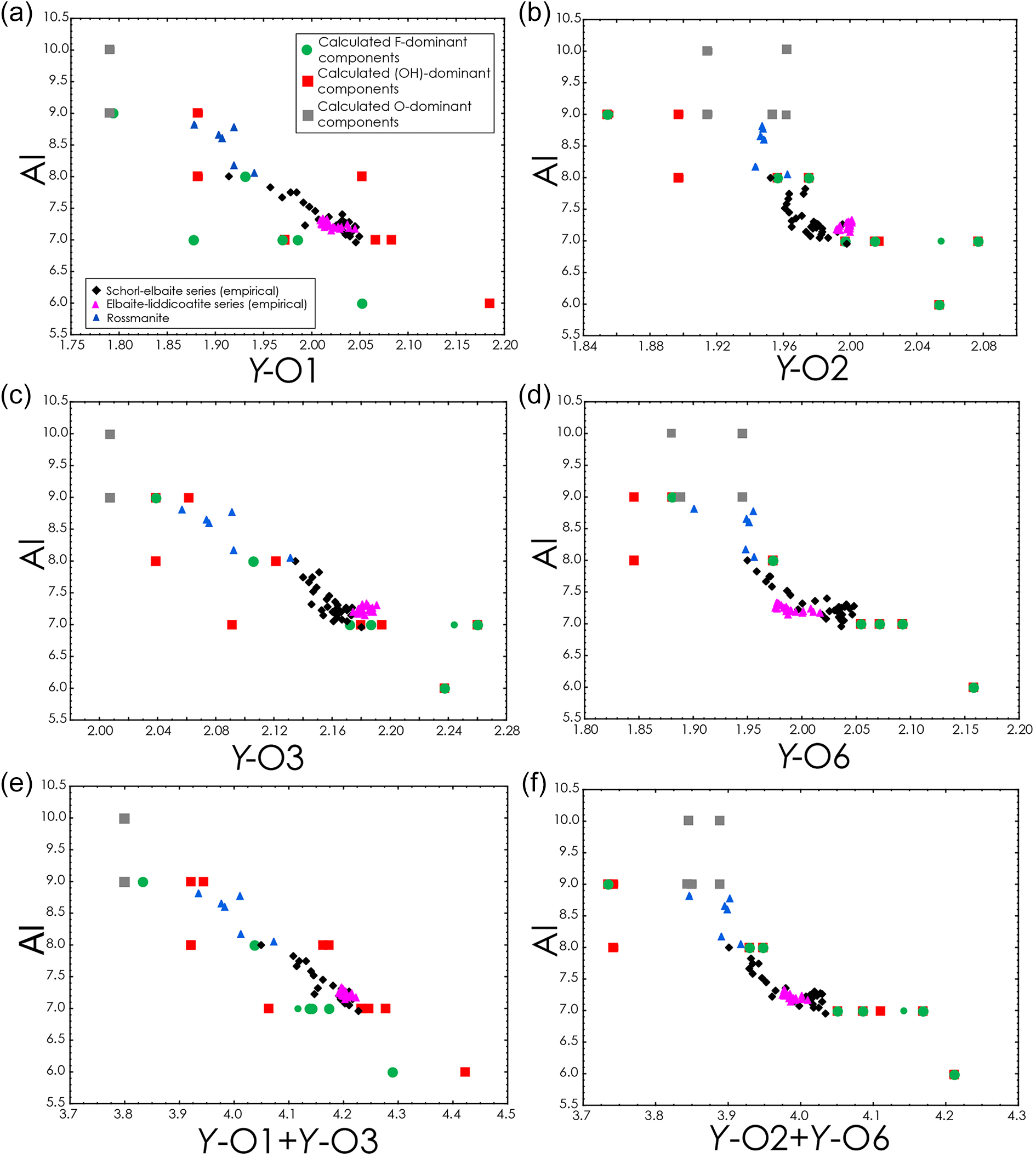
Equation 1 allows calculation of bond lengths from topological bond-valence models of each component using the R 0 and b values for cation–oxygen bonds from the list of Gagné and Hawthorne (Reference Gagné and F.C2015) and for cation–fluorine bonds from Brown (Reference Brown2013). These are listed in Tables 5–7 in comparison to the starting components 0.1 and 0.3. In addition, the calculated bond lengths of each component can be compared with the empirical values of the schorl–elbaite (Burns et al., Reference Burns, MacDonald and Hawthorne1994; Bosi et al., Reference Bosi, Agrosi, Lucchesi, Melchiorre and Scandale2005a, Reference Bosi, Skogby, Agrosi and Scandale2005b, Reference Bosi, Andreozzi, Agrosi and Scandale2012, Reference Bosi, Andreozzi, Skogby, Lussier, Abdu and Hawthorne2013, Reference Bosi, Andreozzi, Federico, Graziani and Lucchesi2015; Ertl et al., Reference Ertl, Schuster, Hughes, Ludwig, Meyer, Finger, Dyar, Ruschel, Rossman, Klotzli, Brandstatter, Lengauer and Tillmanns2006, Reference Ertl2008, Reference Ertl, Hughes, Prowatke, Ludwig, Lengauer, Meyer, Giester, Kolitsch and Prayer2012b, Reference Ertl, Kolitsch, Dyar, Hughes, Rossman, Pieczka, Henry, Pezzotta, Prowatke, Lengauer, Korner, Brandstatter, Francis, Prem and Tillmanns2012c; Vereshchagin et al. Reference Vereshchagin, Rozhdestvenskaya, Frank-Kamenetskaya, Zolotarev and Mashkovtsev2013), the elbaite–liddicoatite (Lussier et al., Reference Lussier, Abdu, Hawthorne, Michaelis, Aguiar and Kroeker2011) and the rossmanite–ertlite (Selway et al., Reference Selway, Novák, Hawthorne, Černý, Ottolini and Kyser1998; Ertl et al., 2005, Reference Ertl, Giester, Ludwig, Meyer and Rossman2022; Kasatkin et al., Reference Kasatkin, Nestola, Day, Gorelova, Škoda, Vereshchagin, Agakhanov, Belakovskiy, Pamato and Cempírek2024; Cempírek et al., Reference Cempírek, Jonsson, Skřápková, Škoda, Kolitsch, Čopjaková, Groat, Kampf, Lussier, Hawthorne, Haifler, Holá and Ende2025) series (Fig. 3). Due to some similarities (i.e. high YAl content and the presence of tetrahedral trivalent cations in samples examined), ertlite was added to rossmanite, even though it is an alkali tourmaline and not a tourmaline with a vacant X site. Comparison with natural samples makes it possible to identify functional models and distinguish them from improbable models.
The comparison of total Al content to each bond length (in Å): (a) Y–O1; (b) Y–O2; (c) Y–O3; (d) Y–O4; and their sums (e) O1–Y–O3; and (f) O2–Y–O6).

All bond lengths in the YO6 octahedron show significant negative correlations with the total Al content (Fig. 3). This is expected because YAl content correlates with total Al and Al produces the shortest bonds among typical octahedral cations (Bačík and Fridrichová, Reference Bačík and Fridrichová2021). The calculated components follow this trend and border the area in which the real samples are located.
The Y–O1 bond lengths clearly separate the WF-containing components with shorter bonds from the WOH-containing tourmalines. Although the Y–O1 bond valence is slightly weaker for O1 occupied by F, because hydrogen bonding increases the BVS of O1 with OH (Hawthorne, Reference Hawthorne1996, Reference Hawthorne2002), F generally forms shorter bonds than O for the same bond valence. The ideal Al–O bond length in the octahedral coordination is 1.904 Å (Bačík and Fridrichová, Reference Bačík and Fridrichová2021; calculated from Gagné and Hawthorne, Reference Gagné and F.C2015), whereas for the Al–O bond it is 1.801 (calculated from Brown, Reference Brown2013). As expected, the natural samples followed the trend between WOH- and WF-containing components (Fig. 3a).
Comparing the total Al bond length with the Y–O2 bond length shows slightly different behaviour (Fig. 3b). There is no clear distinction between WOH- and WF-bearing components; most of them overlap and form a clear negative correlation trend. However, when Al > 8 apfu, the relatively narrow trend breaks with a larger spread between the theoretical components. Components 1.3a and 1.3b have an extremely shortened Y–O2 bond. Decreasing each Y–O2 bond by ca. 0.25 vu would result in strong underbonding of the Y site, making its occurrence unlikely. However, the decrease can be achieved by increasing the valence of other bonds, e.g. Y–O3. Consequently, components with WO, i.e. 1.3, 2.2 and 2.3, have a more reasonable BVS of the Y and O2 sites.
When comparing Y–O3 with total Al, most of the WOH- and WF-containing components overlap as in the previous case (Fig. 3c). However, the components with a vacant Y site (1.6 and 3.4, except 3.3, which is on the main trend line with reasonable Y–O3 bond length) separated from the trend with an extremely shortened Y–O3 bond due to the absence of Li, which increases the average Y–O3 bond length in other components with total Al = 8 apfu. A similar extreme shortening of the average bond length is observed in the components with a vacant Y-site for the Y–O6 bond (Fig. 3d). This is also due to the absence of Li in these components. The oxy-component 2.3 is the extension of the main trend for Y–O3, while the other two oxy-components have shorter Y–O3 distances (Fig. 3c).
The distribution of Y–O6 bond lengths in the components is similar to Y–O2, with a relatively narrow trend at Al < 8 apfu and its scatter at Al > 8 apfu (Fig. 3d). The components with a vacant Y site have an extremely shortened Y–O6 bond due to the absence of Li, similarly to Y–O3. The oxy-components with vacant X sites 2.2 and 2.3 have a similar Y–O6 bond length regardless of the total Al content, while it is shortened in 1.3 (Fig. 3d).
The metrics of the YO6 octahedron can also be described by the sum of opposite bond lengths as O1–Y–O3 and O2–Y–O6 (twice in the octahedron) (Bačík, Reference Bačík2018). The Y–O1 + Y–O3 and Y–O2 + Y–O6 distances, calculated for theoretical components, show a similar negative correlation. The natural samples followed the trend between WOH- and WF-containing components, clearly visible in the comparison Y–O1 + Y–O3 vs. total Al (Fig. 3e); theoretical components form the range in which natural samples occur. In the case of Y–O2 + Y–O6 vs. total Al, WOH- and WF-containing components overlap (Fig. 3f). The natural samples follow the trend in the range limited by theoretical components even better than in the case of individual Y–O2 (Fig. 3b) and Y–O6 (Fig. 3d) bond lengths. This suggests that the valences of these bonds can balance each other and thus influence the overall distortion of the YO6 octahedron.
Bond lengths in natural samples
The plots of bond lengths versus total Al show interesting differences between the series of natural tourmalines studied. Tourmalines of the schorl–elbaite series show a very good correlation for all bond lengths. Consequently, it can be assumed that their behaviour can be well described by the shrinkage of the YO6 octahedra due to the increase in Al content. However, small differences in the two other series indicate the influence of the neighbouring sites.
In tourmalines of the elbaite–liddicoatite series (Lussier et al., Reference Lussier, Abdu, Hawthorne, Michaelis, Aguiar and Kroeker2011), the negative correlation to total Al for Y–O1 is less pronounced (Fig. 3a), and the Y–O1 bond is shorter than in other tourmalines with similar Al content. The much flatter slope of the trend indicates a strong influence of WFW(OH)–1 substitution. Antagonistic behaviour is evident in the Y–O2 and Y–O6 bond lengths; Y–O2 is longer in elbaite–liddicoatite than in schorl–elbaite samples, whereas Y–O6 is shorter. This may be due to the substitution of divalent Ca by monovalent Na at the X site. The stronger Ca–O2 bonds cause a weakening and lengthening of Y–O2 bonds. This is compensated by the shortening of the opposite Y–O6 bonds and is accompanied by a decrease in the bond valence of Z–O6 to maintain the BVS of O6. The Y–O3 bond is longer in elbaite–liddicoatite samples, which probably compensates the increase in Z–O3 bond valence resulting from the bond valence from the above-mentioned decrease in the Z–O6 bond valence. This intricate relationship between O3 and O6 bonds has also been described in the schorl–dravite series (Bačík, Reference Bačík2018).
Rossmanite and ertlite samples have the highest total Al content, which in part also occupies the T site. Consequently, they are expected to extend the schorl–elbaite trend to higher total Al content. This can be observed for Y–O1 and Y–O3 bonds. However, the behaviour of Y–O2 and Y–O6 bonds is more complex. Rossmanite and ertlite have relatively invariant Y–O2 bond lengths of ca. 1.95 Å, apparently independent of total Al content. This suggests an upper limit for the Y–O2 bond valence of ∼0.45 vu. This is close to the value of the Y–O2 bond valence used for the components 1.3 (0.44 vu), 2.2 and 2.3 (both 0.49 vu). This resulted in a slight underbonding of the Y site (2.92–2.97 vu). A similar effect can be observed for the Y–O6 bond, where rossmanite samples follow the vertical trend of the theoretical oxy-components 2.2, 2.3 and 2.4. However, this does not work for ertlite with the extremely shortened Y–O6, which is closer to the oxy-component 1.3. This component also corresponds very well to the chemical composition of natural ertlite. Rossmanite (Selway et al., Reference Selway, Novák, Hawthorne, Černý, Ottolini and Kyser1998; Ertl et al., Reference Ertl2005), fluor-rossmanite (Kasatkin et al., Reference Kasatkin, Nestola, Day, Gorelova, Škoda, Vereshchagin, Agakhanov, Belakovskiy, Pamato and Cempírek2024), and alumino-oxy-rossmanite (Ertl et al., Reference Ertl, Giester, Ludwig, Meyer and Rossman2022) are X-site vacant and Al-rich. However, the total content of trivalent tetrahedral cations is below 1.00 apfu. Therefore, the increase in total Al is crystal-chemically controlled by the components 2.3 and 2.4. The further increase in trivalent tetrahedral cations over 1.00 apfu (up to 2 apfu) in ertlite (Cempírek et al., Reference Cempírek, Jonsson, Skřápková, Škoda, Kolitsch, Čopjaková, Groat, Kampf, Lussier, Hawthorne, Haifler, Holá and Ende2025) is enabled by the XNa-containing oxy-component 1.3.
The last interesting question about X-site vacant tourmalines is whether there is a preference for W-site occupancy, such as in liddicoatite samples. All X-site vacant components (2.1, 2.2, 2.3 and 2.4) seem relatively reasonable from a bond valence perspective, although the first pair has a slightly lower BVS of O2. However, when comparing the natural samples with the theoretical ones, the OH-containing component 2.1 deviates with a significantly longer Y–O1 bond. Natural samples are much closer to F-containing component 2.4. This would suggest that Y(Al2Li) components prefer WF. However, fluor-rossmanite has been described as a valid mineral species but only with 0.44 apfu F (Kasatkin et al., Reference Kasatkin, Nestola, Day, Gorelova, Škoda, Vereshchagin, Agakhanov, Belakovskiy, Pamato and Cempírek2024). Rossmanite from the type locality Rožná, Czech Republic, has an even lower F content of 0.1 apfu (Selway et al., Reference Selway, Novák, Hawthorne, Černý, Ottolini and Kyser1998). A closer look at the composition of all rossmanite samples reveals interesting common features – a relatively significant content of WO2– and trivalent cations at the T site. This suggests that components 2.2 and 2.3 significantly influence natural samples. The resulting bond lengths are the weighted average of various components (the X-site vacant and others), mostly highlighted in the Y–O1 bond length. Although the overall composition of rossmanite from the type locality is OH-dominant, the component 2.1, which corresponds to the end-member composition of rossmanite, may not necessarily be dominant in the crystal structure. This is a similar situation as for tourmaline from Forshammar, Sweden, which is classified as dravite (Bačík et al., Reference Bačík, Uher, Ertl, Jonsson, Nysten, Kanický and Vaculovič2012), though the topological mapping of the bond valence revealed that the component corresponding to the dravite end-member is only 24% present, and the oxy-dravite component is the most abundant (Bačík, Reference Bačík2025). However, for rossmanite, component 2.1 most likely exists (Tables 4, 8). Therefore, rossmanite can still be classified as a common component in Li-containing tourmalines.
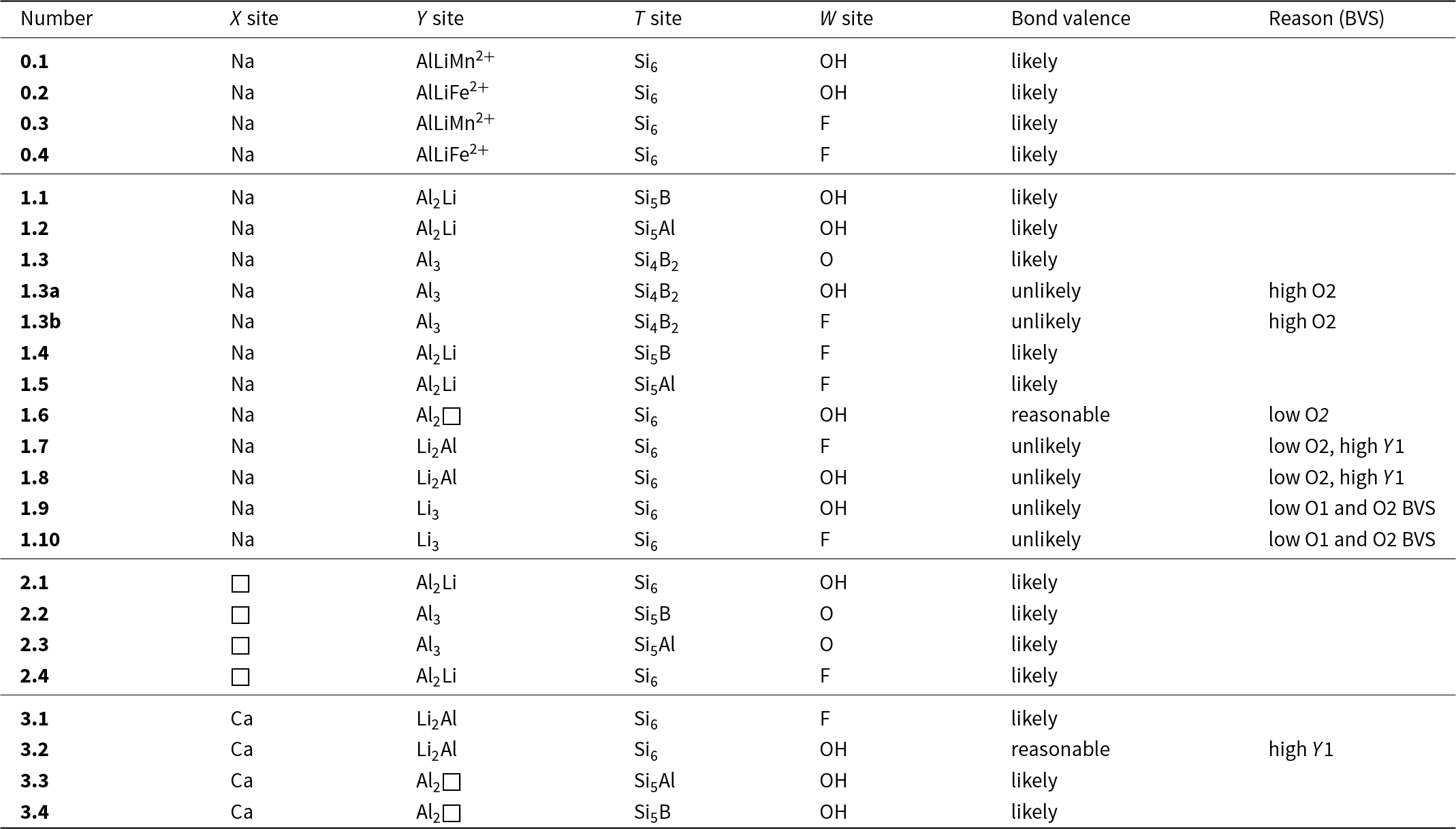
The likelihood of studied theoretical components based on the bond-valence constraints: (1) likely – BVS to IFV has a difference of less than 0.1 vu; (2) reasonable – BVS to IFV with difference of more than 0.1 vu but less than 0.2 vu at one site; (3) unlikely – BVS to IFV more than 0.2 vu at one or more sites.

Conclusions
On the basis of topological modelling of the bond valence of Al- and Li-rich tourmalines, the bond-valence constraints have enabled the assessment of the probability and stability of the components studied. These can be divided into three groups: (1) likely – components with BVS of all sites that are very close to the ideal formal valence (IFV), with a difference of less than 0.1 vu; (2) reasonable – components with BVS with a difference from IFV of less than 0.2 vu at one site; (3) unlikely – components with a BVS difference from IFV greater than 0.2 vu at one or more sites. All components, their probability and their assignment to certain categories are listed in Table 8.
The comparison of bond lengths and total Al revealed interesting differences between the series examined in natural tourmalines: (1) tourmalines of the schorl–elbaite series show a very good correlation for all bond lengths; (2) tourmalines of the elbaite–liddicoatite series have a longer Y–O2 due to XCa, which is compensated by a shorter Y–O6, resulting in a decrease in the Z–O6 bond valence, an increase in the bond valence of Z–O3 and eventually in an elongation of the Y–O3 bond; (3) natural rossmanite samples follow the trend of the theoretical oxy-components 2.2, 2.3 and 2.4, while ertlite with the extremely shortened Y–O6 distance is close to the oxy-component 1.3.
Aluminium-rich tourmaline with varying amounts of Na1+ (different proportions of Na and vacancies at the X site) but without Ca can only contain a limited portion of Li (≤1 apfu YLi) considering the possible short-range orders (Table 8). This is consistent with the different chemical compositions of synthetic, aluminium-rich tourmaline. Tourmaline with higher Li content (Li >1 apfu) can be synthesised if, for example, Ca2+ is present in the starting material. Such tourmaline requires fluorine, because more Li results in O1 underbonding, while more Al at the Y site leads to O1 overbonding, as was demonstrated by bond valence calculations. It was demonstrated that an underbonding of O1 is preferable for F because OH at the O1 site (W site) usually has a bond valence sum (BVS) higher than 1.00 vu due to hydrogen bonding of H to ring oxygen atoms. Therefore, liddicoatitic tourmaline is enriched in F rather than OH and is usually F dominant. If fluorine is not available in the starting material of a tourmaline synthesis, either O or OH will occupy the W site. Most of the likely components with O or OH at the W site also contain B or Al at the T site of Al-rich tourmaline lacking Fe2+ or Mn2+ (Table 8). Therefore, it is likely that significant proportions of B and/or Al are incorporated into the tetrahedral position of such tourmaline samples. Ultimately, however, such samples contain, on average, only a smaller proportion of Li, especially if they do not contain Ca. It is also interesting that tourmaline samples with Ca, [4]B or [4]Al, and OH at the W site would be stable even if one of the three Y sites is vacant (3.3, 3.4, Table 8). Therefore, for the synthesis of Al- and Li-rich tourmaline, we recommend that the starting material also contains (in addition to Na) Ca and F.
Acknowledgements
This contribution is dedicated to celebrating the long and successful career of Edward S. Grew, who is our role model as a scientist, with his outstanding and long career, his attention to detail and perception of the wider picture at the same time. The authors would like to thank the editor and reviewers.
Financial statement
This research was funded by the EU NextGenerationEU through the Recovery and Resilience Plan for Slovakia under the project No. 09I03-03-V04-00060 (PB) and by the Austrian Science Fund (FWF) project P 35585 (AE). For the purpose of open access, the author has applied a CC BY public copyright license to any Author Accepted Manuscript version arising from this submission.
Declaration of Competing Interest
All the authors declare that they are in no current or potential conflict of interest, including any financial, personal or other relationships with other people or organisations that could inappropriately influence, or be perceived to influence their work.
Author contributions
PB: Conceptualisation, Investigation, Data Curation, Formal analysis, Writing – Original Draft, Writing - Review & Editing; AE: Conceptualisation, Investigation, Writing – Original Draft, Writing - Review & Editing