

1. Introduction
Rapid unforeseen changes in the climate are driving us towards a new era of environmental protection. With the consequences of global pollution growing more evident in recent years, the link between trade and environment is drawing greater attention from environmentalists, governments and the private sector alike. More eyes are turning towards the World Trade Organization (WTO) to fulfil a vision of the global enforcement of environmental standards. Indeed, recent rounds have devoted greater attention to the environment. One particular issue under debate has been the potential use of traditional WTO rights to dispute trade obligations set out in multilateral environmental agreements (MEAs).Footnote 1 This has led to suggestions to authorize trade sanctions against non-signatories, thereby granting economic integration only upon the adoption of tougher standards.Footnote 2 Are such tariffs justified and, if so, how do they affect the location of firms and environmental policy?Footnote 3
This paper attempts to answer this question by modelling the above proposal on trade and environment. It endogenizes the decision of firms on location and governments’ respective policies on trade and environment to see whether tariffs are effective in implementing environmental standards. It shows that when required standards lie within a plausible range with respect to the externality caused by pollution, tariffs can work as a successful credible threat to make environmental upgrading and free trade the unique equilibrium outcome.
Environmentalists argue that the absence of trade policy instruments leads governments to ignore environmental policies in order to improve the competitiveness of their firms.Footnote 4 The lack of such policies has also been blamed for the relocation of polluting activities to pollution havens. Theoretical literature on environmental policy and the location of firms goes back to Markusen et al. (Reference Markusen, Morey and Olewiler1993), who look at exogenous trade costs and environmental policies and show that the latter has a very strong impact on a firm's location decision when firms are ‘footloose’. Motta and Thisse (Reference Motta and Thisse1994) consider a different setting where firms are initially established in their country of origin and do not incur a fixed cost when operating at home. They show that a firm is less likely to relocate as a response to environmental policy because fixed costs of establishing a domestic plant are sunk when the game begins. Hoel (Reference Hoel1997) endogenizes environmental policy to demonstrate government motives for choosing weak environmental standards to attract firms as long as the disutility from pollution does not promote a ‘not in my back yard’ policy. Ulph and Valentini (Reference Ulph and Valentini2001) show that environmental dumping is greater when plants are ‘not’ footloose as this creates strategic rent-shifting incentives for governments.Footnote 5
Perhaps the work most closely related to ours is Ludema and Wooton (Reference Ludema and Wooton1994). They find that an exporting country might choose to adopt a pollution tax as a means to capture a larger share of gains from trade. They separately analyse a trade tax to correct an externality when countries are free to impose tariffs, and a pollution tax when a free trade agreement is in place. Their analysis abstracts from capital mobility and the location of firms, which may have noteworthy consequences in the creation of pollution.
The present paper instead integrates environmental standards, trade policy and relocation into a single model to investigate their interaction in shaping the environmental policy. In particular, it builds on Ludema and Wooton (Reference Ludema and Wooton1994) by (i) examining the situation under the simultaneous presence of both trade and pollution taxes, (ii) comparing a non-cooperative tariff regime versus a cooperative free trade regime, (iii) considering the possibility of relocating production. By endogenizing the decision of firms on location and governments’ policies on trade and environment, we study how punishing tariffs can work as an instrument to instigate ‘green’ trade liberalization. If standards are not adopted, optimal tariffs are positive and eliminate firms’ incentives to relocate their polluting activities.
The model can be summarized in the following game: in the first stage, the government of a non-signatory country (South) chooses whether or not to adopt standards taking into consideration that a group of participants in an MEA (North) can impose a tariff against its imports in the second stage upon non-compliance. If the South chooses to harmonize its environmental standards, tariffs are abolished to allow for economic integration as a complement or reward.Footnote 6 Governments also anticipate firms’ decision on output and location. A Northern firm moves next by choosing location in the third stage and competes in production with a Southern firm in the final stage. The timing of the game is illustrated in figure 1.
R&D investment by the Northern firm

The rest of the paper is organized as follows: section 2 describes the model and solves the final two stages of the game when environmental standards are not enforced in the South. Section 3 introduces the other branch of the game where the South adopts the required environmental policy and solves for output and location under harmonized standards. Section 4 finds the optimal tariff set by the North and the decision by the South whether or not to ratify. Section 5 concludes.
2. Asymmetric environmental standards
2.1 The model
There are two regions in the model: the North and the South. They are assumed to be symmetric in all aspects apart from their environmental regulations. The North is assumed to enforce an exogenous level of environmental standards by imposing a pollution tax on emissions released by firms during production. In an environment where production causes transboundary pollution, the South can choose to adopt the pollution tax and enjoy trade liberalization, or to keep its weak environmental regulations.Footnote 7 If the latter option is chosen, local as well as foreign firms operating in the South may produce without an additional charge for causing pollution. There is, however, a punishing tariff in this case set optimally by the North against all dirty imports from the South, including exports by the Northern firm.Footnote 8
There are two firms, one belonging to each region. They produce a homogeneous good and compete in an oligopoly à la Cournot. We assume segmented markets, thus firms choose the optimal output for each market separately. The Northern firm is a multinational and can decide its production location. It can stay at home and serve both markets from its Northern headquarters. Alternatively, it can build a subsidiary in the South to serve the Southern market, but maintain production in the North to serve its home interests. It can also shut down home production altogether and relocate to serve both markets from the South. The Southern firm has no incentives to relocate in this setting due to the fixed costs of moving production location and pollution costs associated with taxes in the North.
We assume a linear demand function with the familiar form

where Qi is the total consumption in region i, and subscripts N and S represent the North and the South. Total consumption in each region is

where qji indicates the quantity of goods produced in region j and consumed in region i. Production costs are divided into non-pollution related costs c and pollution tax τ paid on emissions released from the production of each unit of output.
The rest of this section looks at the case of no standards in the South. The profit function of the Northern firm when all of its production takes place in the North is

where superscript E represents exports. Parameter e 0 represents the unit emission discharged by each firm and can be thought of as the pollution intensity of the industry.Footnote 9 In this location scenario, the Northern firm must pay a pollution tax on its entire production. Alternatively, when it builds a subsidiary in the South to serve each market locally, it must only pay a pollution tax on goods it produces in the North for the domestic market:

Superscript F denotes foreign investment (partial relocation) and Γ is the fixed cost of setting up a plant abroad, which is independent of output. If the Northern firm completely delocates to serve both markets from the South, it avoids paying pollution taxes altogether, but is bound to pay tariffs on its exports back to the North:

where D stands for delocation (full relocation). The profits of the Southern firm are in turn

for each scenario k = E, F, D that prevails subsequent to the Northern firm's decision on production location. Recall that there are no environmental taxes enforced in the South, but a tariff is paid on Southern exports to the North.Footnote 10 Using backward induction, section 2.2 first solves the problem of firms in the final stage where they compete in output.
2.2 Production
In the export case, production by each firm turns out to be

where the asterisk denotes production by the Southern firm. In this case, the direct effect of tariffs is to increase local production in the North and reduce imports from the South. Stricter standards per se have the reverse effect of reducing Northern production and encouraging production by the Southern firm. Inequality t ≥ 2τe 0 − 1 is a constraint for qENN ≥ 0 to hold so that the Northern firm continues to serve its home market through local production.Footnote 11 Also,  is a necessary condition for the Southern firm to maintain its exports to the North, i.e., for q*ESN ≥ 0. This tariff rate denotes a complete ban on imports from the South, making values of t above this level irrelevant for the analysis.
In the case of partial relocation, qFNN = qENN and q*FSN = q*ESN hold as the Northern firm maintains local production for the home market and competes with imports from the South. However, it builds a subsidiary in the South to serve the latter locally, which yields an output of

by each firm aimed at the Southern market. While τ affects the entire production by both firms in the exports case, with partial relocation only goods targeted in the Northern market are influenced.
When the Northern firm fully relocates, production by both firms for the Southern market remains qDSS = qFSS. The Northern firm produces in the South also for its domestic market and re-exports back to the North, making production for the Northern market by each firm

If the Northern firm completely closes down production in the North and establishes a plant in the South to serve both markets, pollution tax becomes irrelevant and tariffs reduce exports of both firms to the North. Market segmentation allows us to drop the superscripts of output by the Northern firm throughout the rest of the paper.
2.3 Location
In the third stage of the game, the Northern multinational chooses its location of production for each market. By substituting the optimal output back into the Northern firm's profit function and comparing profits under each case, we can find the location outcome that yields the highest profits. Northern profits for each scenario are simply



Looking first at profits of keeping all production in the North against establishing an extra plant in the South, we can see that in the absence of a relocation cost Γ, a firm would always prefer to serve each market through a local subsidiary.Footnote 12 The critical level of fixed costs that gives πEN = πFN is
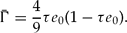
When fixed costs are below this level, costs of relocation are sufficiently low making partial relocation the preferable scenario. Otherwise, relocation is too costly and the Northern firm keeps all production at home, leaving no concerns on how environmental policy may influence firm location. This scenario could reflect a situation where very high plant-specific fixed costs, inflexible foreign investment laws, or political instability in the host country may deter relocation. As we are interested in studying the location of firms, we reduce the analysis to a situation with sufficiently low fixed costs of relocation, where the latter is an option.Footnote 13
Next, we compare profits under partial and full relocation. The threshold tariff rate below which the Northern firm fully relocates all production is the t that makes profits under the two options equal (πFN = πDN):

Figure 2 shows the Northern firm's choice on location in a space of τ and t for an emission level e 0 = 1. It is easy to see that a higher pollution tax in the North makes full relocation more attractive. This implies that tougher standards require a higher tariff on dirty goods from the South to impede complete delocation. As tariffs rise, full relocation becomes less attractive for a larger range of Northern pollution tax. The shaded area shows the region where prohibitive tariffs block trade.
Location of the Northern firm

3. Environmental harmonization and trade liberalization
This section investigates the consequences of a global enforcement of environmental regulations. This can be interpreted as a policy to only grant trade concessions to WTO members that are also parties to a globally recognized MEA. Here, this entails the South upgrading its standards to the level imposed in the North, namely τ, and enjoying free trade as a reward, i.e., tariff t is abolished.
There is only one possible scenario in the case of harmonized standards as liberalized trade and symmetry in environmental policies make firms indifferent about location. There are no incentives to relocate in this situation, as the smallest form of relocation fixed costs induces firms to remain in their home region. Both firms now pay the pollution tax τ on emissions released during production, while trade is liberalized. Profit functions of the two firms become

where superscript H stands for harmonized environmental standards. In this case, the quantity produced by each firm for the domestic and the foreign market is identical:

Profits are equal for both firms under harmonized standards and are

Profits are lower the more stringent are the standards required in an MEA. We now turn to the first two stages of the game where the South decides whether or not to enforce environmental regulations and the North chooses an optimal tariff in the case of non-compliance.
As for location, by choosing to adopt standards the South makes relocation redundant for the Northern firm and forces the latter to keep all production at home. On the other hand, when the South fails to adopt standards, the Northern firm can decide whether to partially or fully relocate production using the approach explained in section 2.3.
4. Optimal policy by governments
4.1 Welfare
This section introduces the components of welfare in the North and the South under each scenario. Economic welfare in this setting is the sum of consumer surplus and producer surplus, minus the disutility caused by pollution, plus the tariff and emission tax revenues.
Consumer surplus is the area under the demand curve and can be written as half of the total output intended for each region squared:

Consumer surplus in the North and the South when the latter does not adopt standards is

for partial and full relocation, respectively. When standards are adopted, consumer surplus turns to

Producer surplus with no standards in the North is profits in (8b) and (8c) for partial and full relocation, respectively. Producer surplus in the South equals Southern profits from (4) using the appropriate output from (5)–(7) for each scenario:

Equation (13) represents producer surplus in both regions with harmonized standards.
The third component of welfare is the disutility caused by pollution in each region. This is parameterized as Δi and contains the sum of emissions in the two regions and a parameter di, which measures the citizens’ concern about pollution:

Another interpretation for parameter di is the relative importance of the disutility caused by emissions against utility gains from other sources of welfare.Footnote 14
Pollution is assumed to be of the transboundary type.Footnote 15 Total world pollution depends on whether the non-signatory joins the MEA, the trade obligations of an MEA and the location of the Northern firm. Looking at the case with no standards, total world emission is
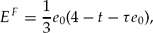
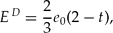
when the multinational has a local subsidiary in each country and when it completely delocates, respectively. Under harmonized standards, total emission becomes
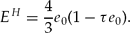
The first-order conditions of emissions released with respect to pollution tax and tariffs show how the environment is affected through government policies. These derivatives are trivially negative with respect to t and τ implying that tariffs and emission taxes per se are beneficial for the environment. When full relocation is binding (t < τe 0), pollution is always lower when global standards are in place. When partial relocation is the outcome on the other hand, pollution is only lower in a sub-region where t < 3τe 0; higher tariffs reduce production by so much that pollution falls below the amount under the harmonization case.
The question that needs to be addressed here is whether environmental policy can be implemented in isolation or only in conjunction with trade sanctions, taking into consideration the consequences of government policy on firm location, output, and hence total welfare. Total welfare for each country can now be summarized to

for k = F, D, H using the corresponding values found above for each component of welfare. Finally, T is the tariff revenue and is equal to the unit tariff rate times the total quantity exported to the North tqSN; Ij is the income from domestic environmental taxation and is equal to τe 0 times output in each region.
4.2 Optimal Northern tariff
We can now use the welfare function derived in the previous section to see if the North finds it optimal to impose a punishing tariff on imports from the South when the latter refuses to adopt the required standards. The Northern government sets an optimal tariff that maximizes its welfare in the second stage for each location scenario. It then compares Northern welfare for partial and full relocation using the respective optimal tariff. Taking the decision of its firm on location into consideration, it chooses the optimal tariff that results in higher Northern welfare.Footnote 16
The optimal tariff for each case can be found by differentiating Northern welfare in (18) with respect to t using the appropriate welfare components from the previous sections to get
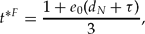

for partial and full relocation, respectively. The optimal tariff is non-negative for all levels of environmental standards and is increasing with higher pollution concern in the North.
Given the optimal tariffs, the Northern government prefers partial to full relocation in terms of welfare as long as

which gives WFN(t*F)>WDN(t*D).Footnote 17 This makes t*F the relevant tariff for  . The Northern optimal tariff is illustrated in figure 3 for dN = 0.1. The thick line illustrates the optimal tariff used, which is t*F for partial and t*D for full relocation. The optimal tariff prevents the complete delocation of production and pollution to the South and results in a partial relocation scenario for .
Optimal government policies

Result 1. A positive optimal Northern tariff deters full relocation for making partial relocation the equilibrium outcome if the South deviates and does not ratify the MEA.
Taking the Northern optimal tariff into account, the Southern government decides whether or not to ratify the MEA in the first stage.
4.3 Southern environmental policy
We turn to the first stage of the game to find the Southern government's optimal choice, namely whether to adopt standards and enjoy trade liberalization or ignore environmental standards and endure punishing tariffs. We do this by looking at Southern welfare in (18) for each case by substituting for its components from the appropriate equations. Comparing (14a) and (14b) with (14c), we can see that Southern consumer surplus is always lower when environmental standards are harmonized. Southern producer surplus also falls with the adoption of standards if full relocation prevails under no standards (t < te 0). If partial relocation is the outcome under no compliance, there is a threshold tax level  under which the Southern firm benefits from the adoption of standards. This is due to tariff savings that arise from a move to free trade. Yet, this advantage only materializes for low values of τ, where switching policy results in higher total production and thus a stronger market position for the Southern firm. Furthermore, πDS > πFS for t > t implies that the interests of the Southern firm are always in conflict with the Northern firm's preferences on location.
Throughout the rest of this section, we focus on the case where only the North suffers from a pollution externality (dS = 0).Footnote 18 In a full relocation scenario, the South never finds it optimal to ratify an MEA as it is strictly better off with no standards. On the other hand, when partial relocation prevails under no standards, there is a critical level of τ below which the South finds it optimal to participate. This level of pollution tax solves WFS = WHS and is

The hyperbola in figure 3 shows the locus where Southern welfare under ratification is equal to that of partial relocation and no standards. The area to the left of the curve is the region where the South prefers to adopt standards. Gains from producer surplus, tax revenues and tariff savings outweigh consumer surplus losses in this region. Anticipating Northern optimal tariffs from the second stage t*F, the South ratifies the international environmental agreement as a tariff makes the Southern policy choice fall in the region where compliance is optimal. This is true as long as

where we have substituted the optimal tariff t*F from (19a) for t in (21). This is the point where t*F meets the hyperbola τ in figure 3. In sum, environmental harmonization is the unique equilibrium outcome if (i) the North prefers partial relocation upon non-compliance by the South, (ii) the South finds it optimal to ratify. Observing (20) and (21′), we can see that inequality  holds for all values of dN and e0. Therefore,
 from (21′) is a sufficient condition for green trade liberalization to go through. Here tariffs work successfully as a credible threat to motivate participation in an MEA without being put into practice in equilibrium. The proposed trade sanctions can hence be deemed effective for , and ratification by the South is the equilibrium outcome. Only in the case of very high τ, would standards not be adopted, tariffs be positive, and the equilibrium outcome be full relocation.
Result 2. Given Result 1 and , a punishing tariff works as a credible threat to persuade the South to adopt environmental standards for . It is hence an effective green instrument when the required standards are not too stringent as environmental harmonization along with free trade is the unique equilibrium outcome.
Finally, in order to see how the critical level of emission tax τ* relates to the marginal externality rate dN, we can obtain from (21′) that as long as per unit negative externality from production dN e 0 does not exceed the value 0.4, all levels of tax equal to or below the marginal damage lead to the ratification of the MEA. On the other hand, when dN e 0 > 0.4 we have τ* < dN, i.e., the tolerable range of pollution tax falls short of the marginal damage caused. This result may suggest that as concern for pollution unilaterally increases in the North, the likelihood of a global MEA being ratified by the South falls.
5. Conclusion
This paper studies the potential role of trade sanctions for the successful implementation of globally recognized environmental standards along with trade liberalization. In particular, it analyses conditional consent for economic integration upon ratification of environmental agreements. This allows for punishing tariffs if a country with weak environmental standards does not cooperate. When environmental obligations are not too stringent, it is optimal for a non-signatory to upgrade its environmental regulations. Punishing tariffs work only as a credible threat to paradoxically motivate green trade liberalization. Even if the Southern government deviates, Northern optimal tariffs are positive and high enough to deter the complete delocation of polluting activities.
It can be deduced from the results that unlike conventional environmental policy recommendations, a successful policy to control pollution could be optimal in combination with other complementary measures. When a pollution tax in isolation may not work as an effective policy tool, trade measures could be considered when reaching out for environmental targets. If trade sanctions can serve as a successful threat against delocation or eco-dumping policies, they may at times be the only means for successful international environmental negotiations. With regard to the detrimental effects of tariffs, the paper shows that a positive tariff does not necessarily arise in equilibrium.
The model in the paper is only a cornerstone to highlight the basic role of tariffs and the potential need for trade sanctions in achieving environmental goals. It can easily be extended to investigate whether an optimal emission tax rate for each region, or a world optimal tariff through an international body, could induce participation in a globally recognized MEA. It is interesting to study the effects of such tariffs and/or emission taxes on the R&D effort by firms to abate pollution. It is also important to look into more direct measures of improving the environment such as abatement R&D subsidies to avoid creating a distortion. It must, however, be taken into account that such subsidies must also be financed from costly taxation. Extending the model to include more countries is a next step to see the impact of the number of signatories on the decision of a non-signatory to join. Another interesting line of research would be to study the issue in a more general multi-firm/multi-sector framework, where firms/sectors have different pollution intensities.
Appendix: The evaluation of welfare
Using (5), (6), (8b), (14b), (16), (17a) and t*F from (19a), Northern welfare in the case of partial relocation can be written in its final form as

Similarly, Northern welfare in the case of full relocation can be rewritten using (6), (7), (8c), (16), (17b) and t*F from (19b):

When instead t from (10) is used as tariffs under full relocation, we have

Note that fixed costs of relocation have been eliminated from profits for the sake of exposition, as they are not involved in welfare comparisons relevant for our analysis. The tax rate that gives WNF (t*F) = W(t) is  . However, the two welfare curves are tangent at this point, with WNF (t*F) > WND (t) for all other values of τ. Also recall from the main text that WFN(t*F)>WDN(t*D) holds for emission tax rates of .
Southern welfare is in turn


using (6), (7), (14b), (15) and t*F from (19a) for partial and t*D from (19b) for full relocation. When the South chooses to adopt standards, welfare of the two regions can be rewritten using (12), (13), (14c) and (17c):


It is easy to see from (A5) and (A7) that WHS < WDS(t*D) is always true, therefore a tariff would only be effective if it moves the equilibrium location from full to partial relocation. Then comparing (A4) and (A5) we find that WHS < WFS(t*F) holds as long as . Since we also have that  , the optimal tariff chosen by the North is credible and leads to ratification by the South for τ ∈ [0, τ*].
Finally, to compare whether world welfare increases upon the global ratification of the MEA, we add (A1) and (A4) for total world welfare under partial relocation and tariffs, and (A6) and (A7) under environmental harmonization. This gives a global welfare for our two cases of interest of


where subscript G stands for global. Setting (A8) equal to (A9) and solving for τ, we find that the tax rate must fall within an intermediate range of

with respect to the negative pollution externality for the global enforcement of standards to increase world welfare.



