Western-centric art period (1970-1973)
I grew up in an artistically-inclined family. My interest in art was sparked by my siblings. It started off from the family, then in school, it was further reinforced. Experiences I have had in school confirmed that for my future profession I wanted to be an artist. Two years after completion of my secondary school I continued with an intense self-directed art practice producing a portfolio of work. In 1962, I was awarded the Johor State scholarship to pursue formal art training at the Hornsey College of Art, London, which in the 1960s, renowned for its pragmatic and analytical training towards the inculcation of a ‘thinking artist.’ I continued a year post-graduate in printmaking at Atelier 17, Paris.
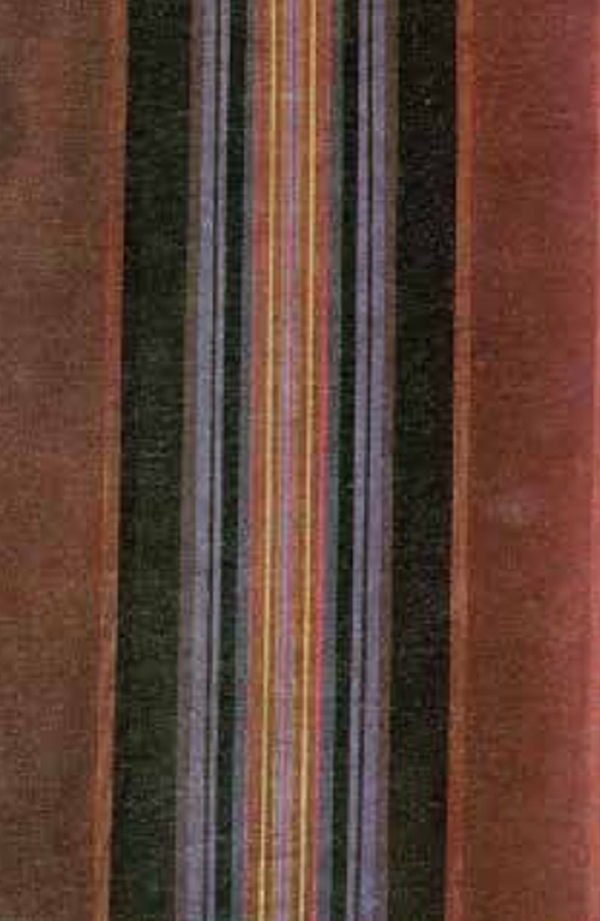
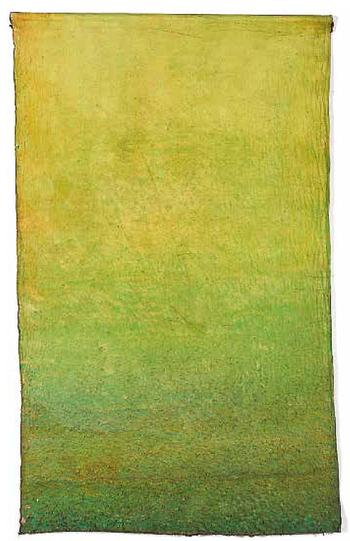
In late 1968, when I returned home to Malaysia, I was intellectually and culturally intoxicated with western art as evident in Scroll No 3, 1970 (Fig. 1), and Compression 3, 1971 (Fig. 2). These paintings demonstrated my interest concerning the physical properties of the art object and, the formal properties of colours reflecting contemporary issues in international modern art. Together with other western-trained artists, I was actively involved in foregrounding modern art exhibitions, in the local art scene. However, the sudden thrust of western art movements by modern artists was not well received by Malaysian scholars. To them, the artists’ involvements were reflections of a ‘captive mentality’ with imitative and carbon copy of Western art hegemony. Ismail Zain, one of our local intellectuals, considered modern art advanced by these Malay artists as spiritually debilitating, sociologically alienating and psychologically corrupting.Footnote 1 A renowned educationist, Salleh lamented the subversive and divisive influence of modern art on traditional art. He posits:
An aspect that is most pronounced concerning the state of the arts in Malaysia today, the existence of two separated and dichotomous worlds- the Traditional and the Modern. The former is slowly dwindling and declining, while latter, ascending but alien. Between them no connection, and no relationship exists.Footnote 2
The decades succeeding independence in 1957 proved to be an intense period of questioning and re-evaluation of the nation's aspirations and idealism. The need for self-definition and self-discovery, addressing questions such as “Who am I?” “What are my roots?” “Where am I going?” assailed the conscience and consciousness of western-trained Malay artists. It was within this intense soul-searching period, among others, that led to the National Cultural Congress (NCC 1971) and later the global Islamic Revivalism in the late 1970s, became most crucial and meaningful to many Malaysian artists. Three resolutions were proposed at the NCC. Islam, once marginalised during British colonisation, became a crucial element in forging Malaysia's cultural identity development.
Sulaiman Esa, Scroll no. 3, acrylic on canvas, 256 cm x 160 cm. 1970. Collection: Artist.

Sulaiman Esa, Compression, acrylic on canvas, 142 cm x 82 cm. 1970. Collection: National Art Gallery, Malaysia

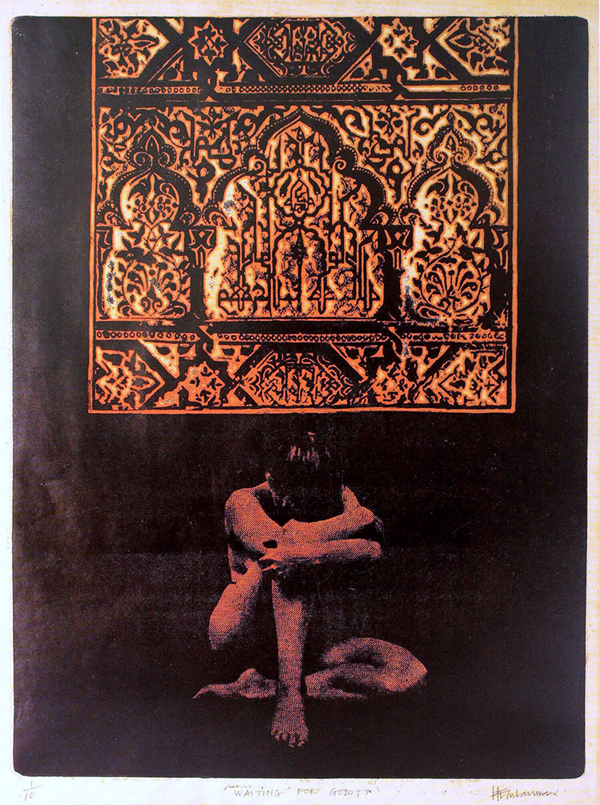
The impact of NCC saw me undergoing a critical soul-searching period in the mid 1970s. The challenge of identity became most urgent as Masahiro has eloquently expressed, ‘the time has come for us to examine ourselves in the light of what we have become as opposed to what we ought to be.’Footnote 3 However, it was during this impasse period, Waiting for Godot 1977 (Fig. 3), a controversial photo-etching of a ‘self-portrait’ of my personal predicament then, was produced. The nude symbolizes western art tradition for the distractions impeding the proper remembrance of God while Islamic calligraphy represents both Islamic art and the state of grace brought by the realisation of God.
Sulaiman Esa, Waiting for Godot, photo-etching, 55 cm x 39 cm. 1977. Collection: National Art Gallery, Malaysia.

Indigenous Malay-Islamic period (1980–1984)
The rise of Malay-Islamic art development in the late 1970s was directly linked to the 1971 NCC. This was epitomised by conscious interest in Malay arts and cultural mores. The emergence of scholarly writings on Islamic art by Muslim scholars such as Ismail Faruqi, S.H. Nasr, M. Abdullah, Muzaffar, to name a few, had bolstered contemporary Muslim artists’ attempts in understanding the philosophical vision of Islamic art tradition.
From the elucidations of these scholarly writings, we can speak of at least three different perspectives on Islamic art from the Qur'anic worldview.
First is the Sufi metaphysical perspective espoused by Nasr, highlighting the spiritual and transcendental dimensions of Islamic art. He argues the underlying rationale of Islamic art is to aesthetically express the Qur'anic concept of divine Unity or Tawhid. Due to its spiritual origin, these arts function as an aid to enable Muslims to get closer to God since the act of artistic creativity is a form remembrance, zikir and the contemplation, fikir, of God's divine Attributes and Beatitude. To Nasr, ‘Islamic art is the manifestation in the world of forms of the spiritual realities, (al-haqa'iq), of the Islamic revelation…it is an art of ennobling matter.’Footnote 4 Hence, an involvement with the sacred and spiritual origin as in Islamic art constitutes a form of good deeds, ibadah, because through the manipulations of religious symbols and archetypes, Muslim artists are actually performing an act of religious cleansing.
Abdullah, a local Sufi scholar, maintains ‘the lack of understanding the Divine Essence which constitutes the foundation of Malay culture, will render one's study about it as superficial.Footnote 5 Accordingly, the Malay notion of Sufi cosmology is embedded in Malay woodcarving and is the key to traditional Malay understanding of Sufi cosmological doctrine as follows:
Translation of the above text:
Such spiritual foundation has penetrated the art and culture of traditional Malay society towards achieving Divine beauty as mentioned in a renowned hadith ‘God is Beautiful and He loves Beauty.’Footnote 8 Braginsky reveals from here that beauty as understood among the Malays, as essentially an ethical-spiritual quality manifested in five principles of the Malay concept of beauty. These include; lembut (gentle, flexible), halus (refined, subtle), seimbang (balance, harmony), teratur (orderliness, decorum), and berguna (beneficial, functional).Footnote 9 It is these ideal value-orientations of Malay society which constitute the concept of adab, decorum, that determines the essence of Malay identity and personality which are mirrored in various forms of creative expressions and behavioural modes.
Second, is Ismail Faruqi's ‘rational’ perspective, chooses to deliberate the formalistic and aesthetic dimensions of arabesque patterns. According to him, the infinite arabesque patterns, is one of the major forms of Islamic art: and exemplifies the genius of Muslim artist in his expression of the inexpressibility of God.Footnote 10 In explaining the principle structure of infinite patterning Lamya al-Faruqi writes:
Infinite patterning involves an intricate combination of abstract and stylized motifs which draws the spectator from shape to shape, from pattern to pattern, from rhythmic moment to rhythmic moment.Footnote 11
The development of infinite patterning was the best way to express tawhidic concept of infinity, in all their ingenious variety, provides: that the positive aesthetic breakthrough of the Muslims in the history of artistic expression.Footnote 12 As stated by the Quran: “No vision can grasp Him, But his grasp is all over vision: He is above comprehension…”Footnote 13
Third, the sociological functions of art espoused by sociologist, Muzaffar, that a Muslim artist ought to be socially just and conscious of the well-being of his society, that is, to enjoin the good and forbid evil. Being not only the servant of God but also His viceregent, thus incumbent upon a Muslim artist to behave like a true khalifah dedicated to the fulfilment of social justice, which is an indispensable aspect of tawhid.Footnote 14
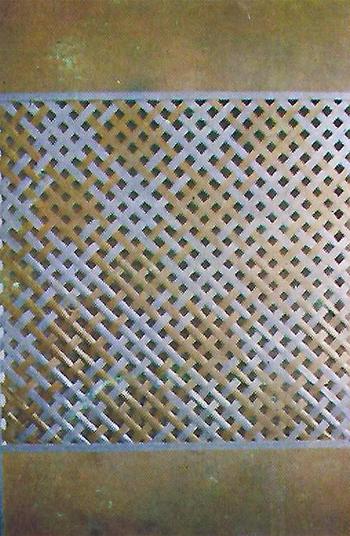
Given the above brief explanations on the different approaches to Islamic art, many were convinced of the vitalities and potentialities of their own traditional heritage as basis for creative expressions that most Malay artists responded positively to the challenges of NCC in the 1980s. Soon after the Godot series, 1977, I denounced western-centric art and instead, embraced my own cultural tradition by producing an experimental woven piece, Meditation 1978 (Fig. 4), inspired by the Malay mat-weaving technique.
Sulaiman Esa, Meditation, enamel on canvas, 183 cm x 122 cm, 1978. Collection: Private

In 1979, I was offered the opportunity to pursue a Masters in Fine Art (MFA) at Maryland Institute College of Art (MICA), Baltimore, USA. Whilst there, I improved my technical skills in craft techniques and handmade paper-making by joining the Fiber Art Department. On the completion of my study, it was quite an accomplishment in being able to shift the Malay traditional ‘craft art into the realm of ‘fine art’, as in Warisan ll, 1981 (Fig. 5), to stress my belief that the two cannot be separated as the Western tradition supposes.Footnote 15
Sulaiman Esa, Warisan II, mixed-media, 240 cm x 210 cm, 1981. Collection: Private

Contemporary Malaysian Islamic art (1991–2018)
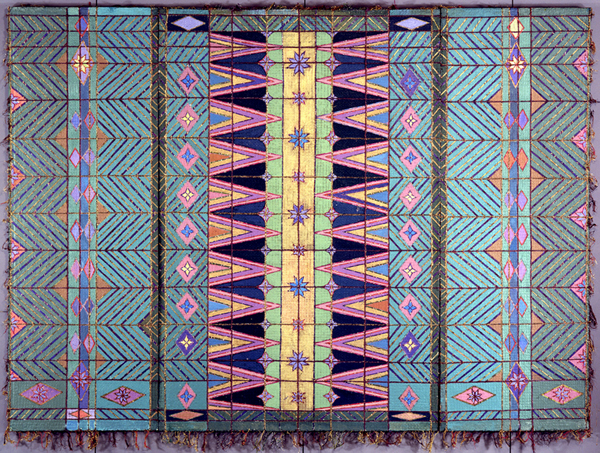
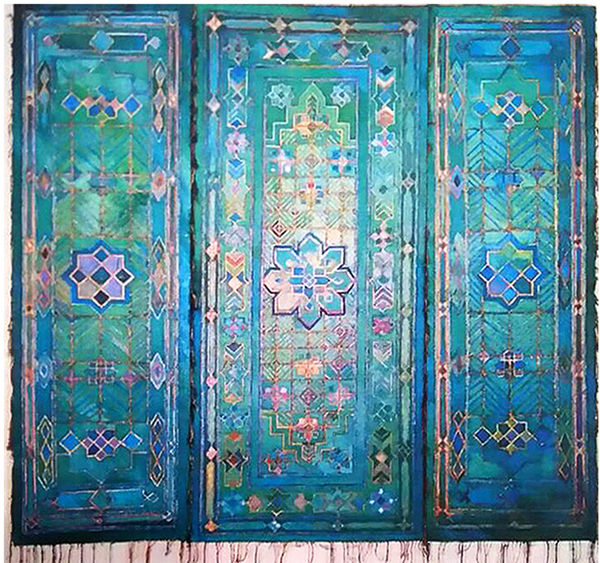
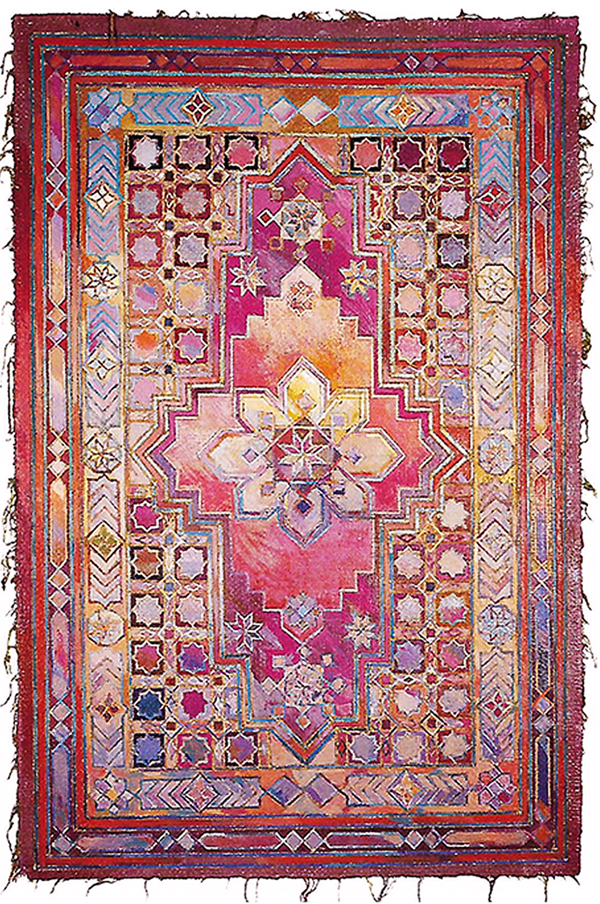
My first solo show on Islamic-oriented art: Ke Arah Tawhid (toward Tawhid 1984), exhibited more refined pieces (than at MICA) in pure geometric patterns woven in metallic yarns expressing the tawhidic concept of unity discerned in Nurani ll 1983 (Fig. 6), Mahsuri ll 1983 (Fig. 7), were in response to Faruqi's vision of art relating to the spiritual dimension of the infinite arabesque patterns. Specifically, Mahsuri is inspired by the batik sarong central design, kepala kain, decorated with flat bamboo strips in striking colourful ornamentations adopting Malay aesthetic principles as explained by Braginsky in the preceding paragraphs. It is the core of spiritual expressions. These attempts are contemporary and a traditional media evoking Islamic presence in synthesis. Nonetheless, Ke Arah Tawhid was my pioneering attempt in showcasing two achievements in one work; personally, it was a transformation from secular to spiritual art, while creatively, shifting the indigenous Malay traditional craft into the realm of ‘fine art.’
Sulaiman Esa, Nurani II, mixed-media, 140 cm x 140 cm, 1983. Collection: Private

Sulaiman Esa, Mahsuri II, mixed-media, 298 cm x 181 cm, 1983. Collection: Fukuoka Museum, Japan.

In 1986, I was offered a scholarship to pursue PhD in Islamic studies under renowned Muslim scholars, Ismail Faruqi and S.H. Nasr at Temple University in the USA. After studying under Faruqi, my understanding of the structural dimensions of arabesque patterns was further enhanced. Faruqi's influence are not only in Ke Arah Tawhid exhibit but further transformed them into contemporary expressions of the present time.
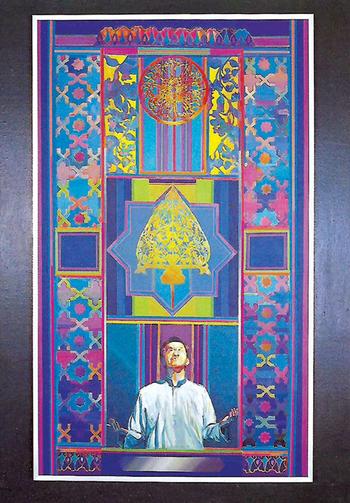
Similarly, studying under Nasr, my understanding of Sufi metaphysical doctrine of Unity became more profound especially when he explained, the two concepts of Unity that is related to us directly: the metaphysical concept of ‘One’ and the ‘many;’ ‘One’- God as the Absolute Creator, and the ‘many’– God's creations - the universe and man. In Sufism, man is seen as a microcosm who is inter-related with the cosmos, macrocosm and God, metacosmos.Footnote 16 The Doa, 2001 (Fig. 8), falls in Nasr's perspectives interpreting the different levels of reality between man, the cosmos and God. It is a self-portrait shaped by the Sufi vision of tawhid in which man is seen as microcosm who is ontologically inter-related with the cosmos and God.
Sulaiman Esa, Doa, mixed media, 114 cm x 68 cm, 2001. Collection: Petronas Gallery

While in Garden Mystery l, 1992 (Fig. 9), and Garden Mystery Vl, 1992 (Fig. 10), as Nasr has pointed out, all the arts of Islam are pervaded by a deep nostalgia for paradise that all aspire to. The medallion designs in this series echo the prayer rug on which a Muslim kneels in prayer. It is within this sacred space that a Muslim ascends by the rhythm of his prayer to that ‘paradisal plane’ where the “Blessed ones, eternally abide.”Footnote 17
Sulaiman Esa, Garden of Mystery I, mixed-media, 185 cm x 180 cm, 1992. Collection: Queensland Art Gallery, Australia

Sulaiman Esa, Garden of Mystery VI, mixed-media, 216 cm x 157 cm, 1992. Collection: National Art Gallery, Malaysia

In summary, these attempts have created a synthesis of contemporary and traditional media evoking Islamic presence in tapestries of geometry, arabesque and medallions in subtle colours.
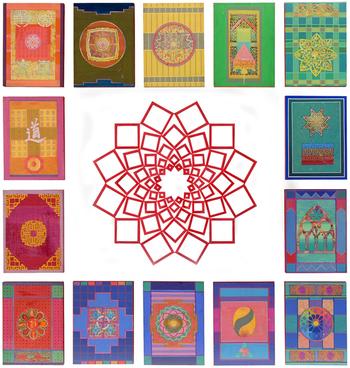
Muzaffar's sociological role of artists as advocats for a just society by ‘enjoining the good and forbid evils’Footnote 18 especially living in harmony in a multicultural society as in Malaysia has inspired my Beauty in Diversity (Figs. 11 and 12) series. They are also a reflection of what Professor Tiew Wee Meng's interview in TV 3,Footnote 19 had emphasized with regards to religious practice in our multicultural society, in that we must show respect when there are ‘differences’ and celebrate when there are ‘similarities.’ While these works take on the theme of unity in religious diversity, I am not in any way advocating syncretism. I hope it is clear my approach to the symbols of other religions in these works, is wholly from within the Qur'anic world view.Footnote 20
Sulaiman Esa, Beauty in Diversity I, mixed-media, 287.5 cm x 273.5 cm, 2011. Collection: Artist

Sulaiman Esa, Beauty in Diversity II, mixed-media, 357 cm x 232 cm, 2011. Collection: Artist

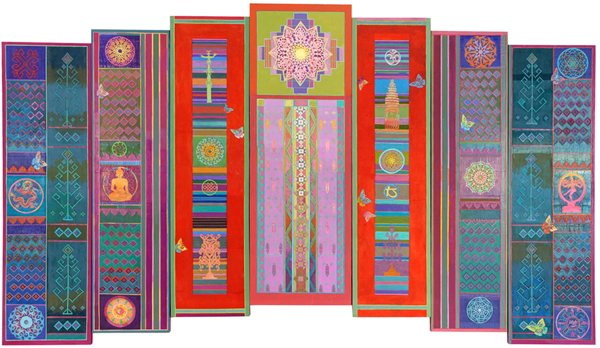
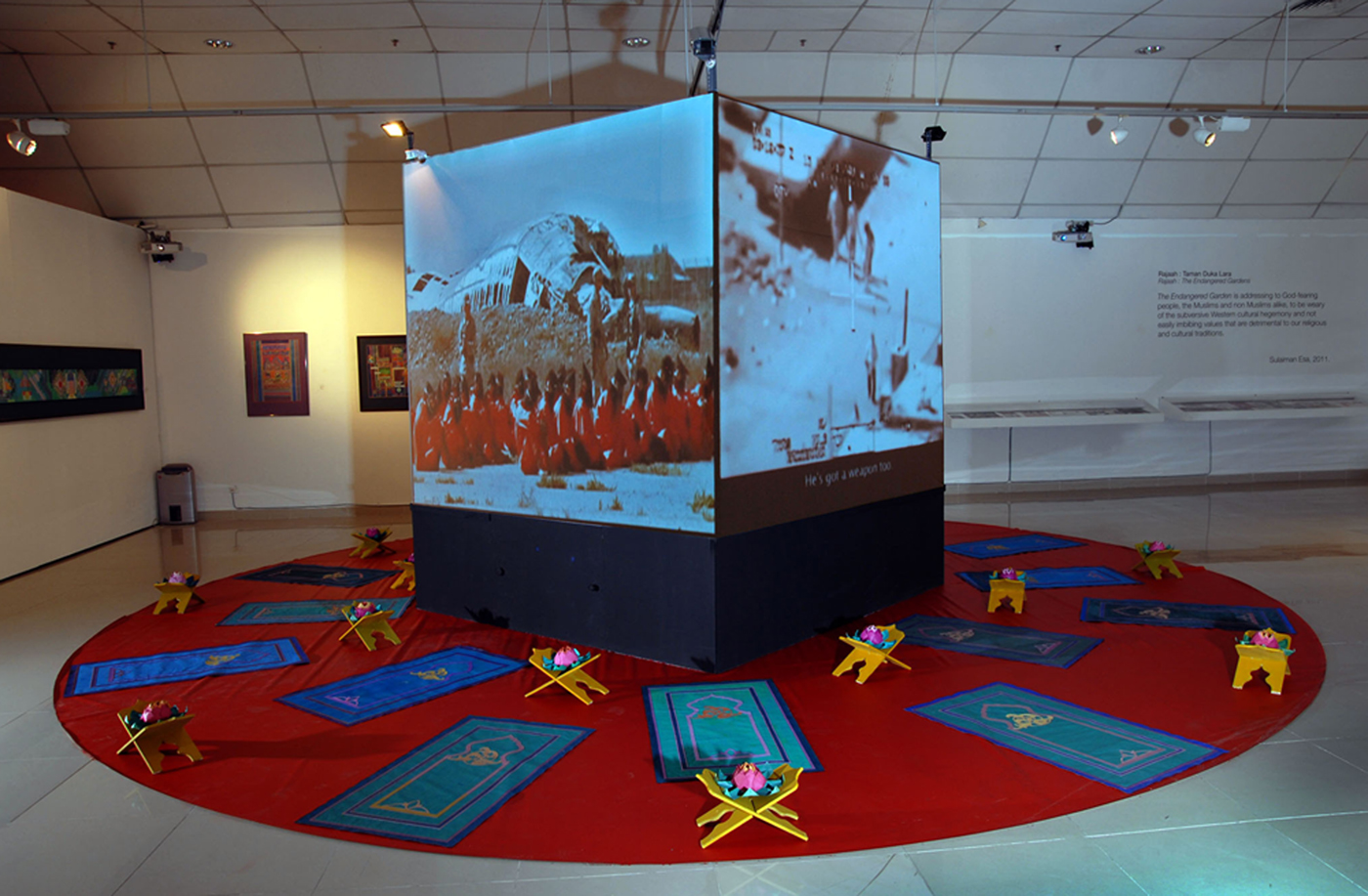
Finally, my installation work Panopticon, 2011 (Fig. 13), with Fairuz Sulaiman, is a model prison inspired by Jeremy Bentham's design of the panopticon institution, in 18th-century, in which cells are arranged in a circle so that prisoners can be seen from a central tower. Video images of Muslim prisoners are shown on the cloth wrapped around the cube representing the Ka'abah, surrounded by prayer mats. Panopticon interprets ‘Western superpowers’ fear of Muslim countries after the Sept 11 tragedy. My intention here is to expose the hypocrisy of western politicians about democracy, justice and human rights but in reality, they themselves, are the main violators.Footnote 21
Sulaiman Esa & Fairuz Sulaiman, Panopticon, mixed-media, 731.5 cm x 731.5 cm, 2011. Collection: Artist.

Significance of my art in Contemporary Malaysian and Asian Art
From the above extrapolations of my art in the last five decades, I regard the significance of my work lies in three aspects.
1. Personally, Islamic perspective has become an absolute determinant and vital frame of reference in my artistic creativity. Islamic-oriented art clearly exposed the inherent fallacy and shortcomings of modern western practice that art despise elements such as tradition, indigenous form, religious and spiritual symbols as being sterile and absolute, either as motifs or content. An Islamic approach to art has positively enriched the diversity of artistic expression and broadened the scope of the philosophical and aesthetic orientations in the evolution of contemporary Malaysian art.Footnote 22
2. Socio-culturally, I have responded to the challenges of the NCC where Islam and Malay elements become dominant components in my work. In so doing I have embarked upon an alternative direction in creating art purely from indigenous materials and local techniques that are liberated from the influence and dominance of Euro-American art.
3. Regionally, by creating these new forms of contemporary Islamic-oriented art, my work actually counters the threat of globalization posed by homogenisation of culture in the context of Southeast Asian art. Kenneth George maintains, that both A.D. Pirous (from Indonesia) and Esa, have continuously spent their creative pursuits in Islamic inspired art for more than five decades, pioneering a new direction in the development of contemporary Islamic art not only in their respective countries but also in the Southeast Asian region.Footnote 23
This is an edited version of a paper delivered at the WLIC Art Libraries Section in Kuala Lumpur, August 2018.