Introduction
Domestic Rabbits (Oryctolagus cuniculus) were among the livestock carried to Australia on the First Fleet in 1788. They were ideal animals to transport halfway around the world to a new penal colony in New South Wales (NSW): edible, useful fur, small, require little food and breed easily. But they all died on the voyage or soon after. Many subsequent early introductions were successful, and if the farmed rabbits escaped, they usually died.Footnote 1 The earliest successes were in Tasmania, where by 1827 they ‘were running about on some large estates in thousands’, but were not considered a problem until the late 1860s.Footnote 2
The earliest imported rabbits were kept in warrens enclosed by paling fences, a direct transfer from England.Footnote 3 A warren at Ryde (near Sydney, NSW, Figure 1) was enclosed ‘partly by a high fence and partly by a high stone wall’.Footnote 4 After failing with several batches of English domestic rabbits, Victorian pastoralist Thomas Austin imported and released two dozen wild-caught rabbits on his Barwon Park estate west of Geelong (Figure 2) in late December 1859. He kept them ‘enclosed in yards made of paling fences … [but] a high flood swept away the paling fences, and the rabbits got a scatter on’.Footnote 5 He organised shooting parties for like-minded sportsmen, and generously gave breeding pairs to his friends. In January 1865, ‘Mr. Austin reckons that, although upwards of five thousand were destroyed last year, there are ten thousand still.’ Ominously, Austin concluded ‘They are a perfect nuisance.’Footnote 6 By mid-1868 he reported that ‘netting has been constantly going on, but it has been found impossible to keep them down’.Footnote 7
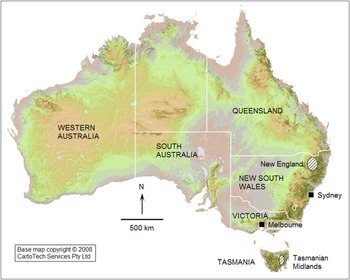
Australia showing colonies and some regions mentioned in the text. See Figure 2 for Victorian locations.

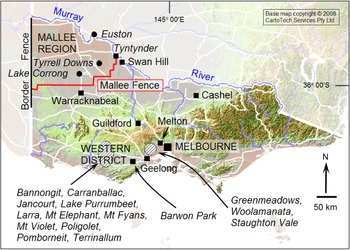
Victorian places mentioned in the text (squares); stations inspected by either Humphry Davy or Thomas H. Myring (round dots and shaded areas) during October to November 1885; and locations of the Victorian Mallee Fence and Victorian Border Fence.

As rabbits spread from escapes and deliberate releases, their status changed from protected private property to a problem that was rapidly escalating. Landholders took unilateral and combined action of poisoning, trapping, hunting with cats and dogs, digging-out, shooting and battues, even if the rabbits legally belonged to their neighbours. Simultaneously, the function of rabbit fences changed, from keeping rabbits in, to keeping them out. Control and eradication were simple but labour-intensive and expensive: burn any brush or log fences and fallen timber, kill all the rabbits inside, dig out all the burrows, and block all holes with stones. But this was to avail without rabbit-proof fences as Edward Harewood Lascelles described: ‘From 1878 to 1883 I poisoned the rabbits, and I found that I got them down to a certain limit; but without fencing they invaded me from all sides, and I was as bad as ever in 1883.’Footnote 8
Despite the essential role of fences, none of the standard histories of rabbits in Australia considers the early efforts. Instead, they start with the long barrier fences erected by colonial governments from the mid-1880s, or with a few passing references to early fences.Footnote 9 Notable exceptions are descriptions of rabbit-proof walls in the Western District of Victoria.Footnote 10
In this article I describe Australian rabbit fences from the 1850s to the mid-1880s, starting with a summary of British antecedents and a review of colonial rabbit and fencing legislation. After describing the types of fences used both before and after the arrival of rabbits, the primary focus is on rabbit fences in two contrasting regions of western Victoria (Figure 2). The rich volcanic Western District was the first region affected by rabbits, providing an ideal place to start. In contrast, the semi-arid Mallee Region in the north-west of the state, is much poorer country, and was devastated by rabbits in the 1870s and 1880s. By 1886 wire netting was standard in Australian rabbit fences and the first rabbit barrier fence was erected, forming a convenient endpoint for this article.
Antecedents in Britain
Rabbits were farmed in Britain in warrens from mediaeval times to the early twentieth century. The area varied from a few acres to over five thousand acres.
In the period immediately following the Black Death they represented one of the ways in which major landowners could diversify their agricultural incomes, and they were a good way of making money from areas of poor-quality land, especially unenclosed wastes and commons, the law holding that a grant of free warren permitted manorial lords to establish colonies of rabbits in such locations regardless of the impact that this might have on the grazing available to the beasts of the commoners.Footnote 11
While many warrens were unenclosed, most were bounded by fences to prevent rabbits escaping to devour adjacent pastures and crops, exclude predators and prevent poaching. The fences were also there to minimise disputes with neighbours. Whether a warren was fenced, and the type of fence, depended on the location, the environment, available materials, the whim of the owner, and agitation from neighbours and commoners affected by a warren. A wide range of fences was used: banks, dry stone walls, paling fences and, from the 1850s, wire netting. Creeks and rivers were also used.
Banks, 1 m to 1.5 m high, were typically made of turf, ‘usually topped with faggots of furze or gorse, or thorn, held in place by a capping of turf, which overhung the inner face of the bank, or more rarely, by live gorse or thorn bushes’.Footnote 12 Stone walls 1.5 m to 2.5 m high were erected where there was plenty of stone. Some walls were modified from the normal structure to prevent rabbits escaping: no through stones, and coping overhanging to the inside.
Colonial legislation to 1886Footnote 13
Rabbit-proof fences were initially erected in a legislative vacuum. As rabbits spread inexorably across Tasmania and mainland Australia, each colonial government passed legislation to combat them. Although there are differences between colonies, all delayed passing legislation dealing with what was recognised as a pest from the mid-1860s.
South Australia was the first to legislate against rabbits. Even before they became a major pest, the Impounding Act 1856 (South Australia [SA]), section 10 allowed a landholder to destroy trespassing rabbits, and it was not necessary to prove that the boundary fence was ‘good and sufficient’ (section 11). The subsequent rabbit acts (1875, 1878 and 1879) after the colony was infested, are all silent on fences, but the Rabbit Destruction Act 1875 (SA), section 4 gave District Rabbit Boards global powers ‘to do all such acts and things as to the said Council may appear proper or necessary to be done to ensure the destruction of rabbits’. The powers were curtailed in the Vermin Destruction Amendment Act 1884 (SA). Dividing fence legislation (1846 and 1865–66) was silent on rabbits.
The Victorian government took over ten years to respond with legislation. Under the Rabbit Suppression Act 1880 (Victoria [Vic]), section 9, inspectors could order the destruction of ‘any brushwood or log fence or stone wall’ believed to be ‘harbor or cover for rabbits’.Footnote 14 The act is silent on hedges that were common and widespread in Victoria, but often spread alarmingly. Dense prickly masses of Gorse (Ulex europaeus), Briar Rose (Rosa rubiginosa) and African Boxthorn (Lycium ferocissimum) form perfect rabbit harbour to the present day. The first mention of netting in fences came in late 1885, with the Mallee Amending Act 1885 (Vic), section 2 recognising both stub (stubb) and netting fences as ‘vermin-proof’Footnote 15 if they met the specifications given (see below). Dividing fence legislation (1865 and 1874) was silent on rabbit fences.
Tasmania was the first colony with rabbit problems, but rabbit-proof fencing is absent from all boundary fencing (1853, 1884) and rabbit acts (1871, 1874, 1875, 1877, 1882) until 1883. Empowered by the Rabbits Destruction Act 1883 (Tasmania), section 7, the Chief Inspector could order destruction of ‘any hedge or any live or dead briars, furze, or gorse on any land’ determined to be ‘a harbour or cover for rabbits’. Section 8 applied to hedges along public roads. Log and brush fences, and walls were not mentioned.
New South Wales took as long as Victoria to act, and the first legislation was similar to Victoria, with Pastures and Stock Act 1880 (New South Wales [NSW]), section 8 empowering Local Stock Boards to burn brush and log fences. Walls were not mentioned. Section 5 of the Pastures and Stock Protection Act Amendment Act 1881 (NSW) was similar, but required notifying neighbours within two miles before burning a fence. The first rabbit act (Rabbit Nuisance Act 1883 (NSW)) did not mention fences, but Regulation I(3)(3) under the Act extended section 8 of the 1880 pastures act to include ‘other fences’ and walls. Dividing fence legislation (1828) was silent on rabbits.
Although seemingly protected by the waterless Nullarbor Plain, the Western Australian government wanted to be forearmed with legislation. The Destruction of Rabbits Act 1883 (Western Australia [WA]), section 7 gave inspectors extensive powers to enforce ‘the duty of every occupier of land upon which there shall be any rabbits to do forthwith all things which may be necessary for the purposes of destroying such rabbits’. The earlier Cattle Trespass, Fencing, and Impounding Act 1882 (WA) did not include rabbits among ‘great and small cattle’ (Schedule 2) to be restrained within a sufficient fence (section 30).
Rabbits were well established on islands off Queensland before 1870, but any mainland colonies appeared to have died out.Footnote 16 However, the Queensland government anxiously watched the inexorable north-easterly spread of rabbits across NSW and South Australia, and the first legislation, the Rabbit Nuisance Act 1880 (Queensland [Qld]) prohibited import of rabbits, but was silent on fences, as was the Rabbit Act 1885 (Qld).
Lands legislation was also important, particularly for Crown purchasers and tenants. Legislation varied over time and from colony to colony, and fencing requirements depended on which section of which Act applied, and the date of any sale or lease. Initially there was no incentive to erect expensive rabbit-proof fences around short-term leases with no pro rata compensation when the lease expired. Eventually all colonial governments recognised the injustice of this, and Crown tenants were granted compensation for fences, including rabbit-proof fences. Some tenures had covenants requiring netting on boundaries.
Victorian landholders also suffered under a punitive 27½ per cent tariff on netting imported into the colony. The sole motive was revenue raising by the government, but with the predictable increased cost of an essential tool in the fight against rabbits. The government was profiting, but the colony as a whole was losing through lost production until the tariff was abolished in July 1886.
Brush and log fences, and hedges
Brush and log fences were a colonial development eminently suited to a rapidly expanding sheep population on land where the squatters lacked secure tenure. Both were common and widespread before the increasing adoption of iron wire from the 1850s.Footnote 17 They were simple lines of branches and logs cleared off the land and piled up to form crude but cost-effective fences. Sand and plant debris accumulated among the tangled branches inside these fences, making perfect rabbit harbour. Consequently brush and log fences fared very badly with the spread of rabbits, and most were burnt in infested districts. ‘Saltbush’ argued for compensation for fences burnt in Victoria, because ‘when these fences were erected they were considered a sufficient legal fence, and now having to be destroyed for the public good, we can justly claim compensation from the Government’.Footnote 18 The government was unmoved. Log fences had been ‘sufficient fences’ since the Fences Statute 1874 (Vic), but as there were ten other structures in Section 4(VI). There was no compulsion to erect log fences.
Hedges were one of the dominant forms of fencing in Britain, and although they were locally common in the cooler colonies of Victoria and Tasmania, they were never particularly popular in Australia. They were expensive to establish, needed a fence to protect them before they were high enough to be an effective barrier, and required constant maintenance. Several plants were used: Gorse (Ulex europea), White Hawthorn (Crataegus monogyna) and Sweet Briar (Rosa rubiginosa) from Britain; African Boxthorn (Lycium ferocissimum) from Africa and Prickly Pear (Opuntia inermis) from Central America via India.Footnote 19 They provided ideal shelter for rabbits, leading to calls for their removal.
Grubbing-out hedges in Tasmania was both supported and opposed. One anonymous landowner described ‘miles upon miles of gorse hedges … above 100 feet in width’, which were ‘natural breeding grounds for rabbits’. Some owners had ‘extirpated several miles of gorse hedges on their properties’, but others wanted government support to pay for grubbing their hedges.Footnote 20 The Rabbit Nuisance Conference in Hobart on 20th May 1886 heard that rampant hedges were no better than brush fences in sheltering rabbits; and conversely, they were beneficial because stock could not eat rabbit poison thrown into them.Footnote 21
Paling and slab fences
A direct technological import from Britain, paling fences are a basic post-and-rail structure with split palings set vertically in a trench and nailed or wired to the rail(s). They were among the first fences used at Sydney to protect gardens and crops.Footnote 22 Replacing thin split palings with more robust split slabs created a slab fence. Similar fences without the supporting rails were generally called ‘stub’ or ‘picket fences’. Thomas Austin used a paling fence on Barwon Park in 1859. Robert Gravenor fenced his commercial warren on Rocky Water Holes (Guildford, Victoria, Figure 2) in 1862 with ‘7-feet paling, sunk two feet in the ground’ to stop domestic dogs killing his rabbits, and his rabbits escaping.Footnote 23
Within eight or nine years of a deliberate release in 1854 in the New England region of northern NSW (Figures 1 and 7), rabbits ‘had increased to such an extent that the best land was being destroyed, and … the inhabitants afterwards enclosed their lands with close-paling fences, but still they could not keep them out’.Footnote 24 Victorian Glen Fyne station was ‘well-fenced with stout palings’ against rabbits.Footnote 25 When rabbits threatened Jancourt, Charles Brown Fisher surrounded his estate with a post-and-rail fence supporting slabs ‘so closely put together that scarcely a lizard can force its way through’.Footnote 26 Tasmanian sheep farmers used palings in the 1870s, with some fencing-off river bends with palings before exterminating the rabbits inside.Footnote 27
Palings and slabs faded from rabbit fences, although they were still used in the early 1900s in some sections of the Darling Downs and Moreton Rabbit-proof Fences on the Queensland-NSW border.Footnote 28
Stub and picket fences in the Western District and Mallee Region, 1870s and 1880s
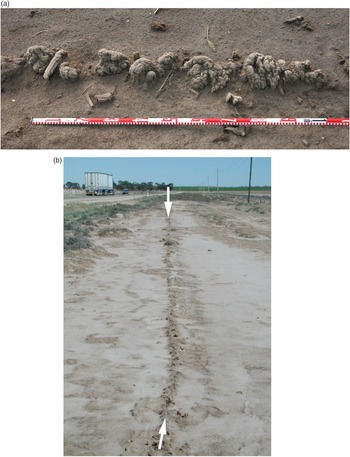
Stub (stubb) fences were another fence structure imported from Britain where they had been used for many years.Footnote 29 Although there were several variations in the colonies, the simplest was used for rabbit-proof fences – a palisade of logs or split slabs of suitable length placed side-by-side vertically or sloping outwards in a trench, and earth back-filled and rammed down hard (Figures 3 and 4). When thin sticks were used, the fence was called a ‘picket fence’. They are essentially self-supporting paling fences. However, contemporary nomenclature is confused, with some stub fences supported by a rail like slab fences.
Salt-encrusted stumps are all that remain of the Tyntynder stub fence, but the structure of closely-set stubs is still apparent. North of Swan Hill, Victoria. Image by John Pickard.

When the Manifold brothers rabbit-proofed walls around most of Lake Purrumbeet, in late May 1878 they used a picket fence across a swampy area because walls would subside and collapse in the soft soil.Footnote 30 The eight-kilometre long stub fence on Tyntynder in the Mallee Region near Swan Hill was built for both horses and rabbits (see Figure 2):
The contractors’ specifications were that the fence should be rabbit proof. 4ft6in high. and that the stubbs (posts) of a minimum diameter of four inches at the small end, and 6ft long. A trench was dug eighteen inches deep and five miles long. Posts were cut along the fence line and placed vertically in the trench, so close together that a rabbit couldn’t get through. It was known as the ‘Stubb Fence’. … Two years after the project was completed, sand storms completely covered the fence with sand, allowing all stock - and rabbits - to walk over it.Footnote 31
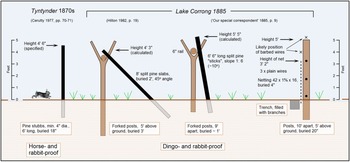
In January 1884, Edward Harewood Lascelles erected rabbit- and dingo-proof stub fences on his adjoining properties, Lake Corrong and Tyrrell Downs, in the Mallee Region.Footnote 32 An anonymous reporter from the Sydney Morning Herald (see below) described the structure in detail (Figures 3 and 4):
There are 27 miles of stick-fencing and five miles of wire netting on the Coorong [sic]. The sticks are of split pine, 6 feet 6 inches high, and sunk in the earth about a foot. They are supported by a 6-inch rail, which in turn is kept in position, at intervals of every nine feet, by stout forks embedded a foot in the ground. The whole fence has a slope of about one foot in six towards the rabbit country. … Though the forks outside offer a good foothold for the foe, he does not seem to successfully avail himself of it; and Mr. Oppy [manager of Lake Corrong] contends that it is much better to have the fence slope outward, even with such props than have it perfectly upright.Footnote 33
Interpretation of Tyntynder and Lake Corrong stub fences, and Lake Corrong netting fence based on published descriptions.Footnote 35

Agnes Hilton’s description from a century later is of a more robust fence, but she cites no contemporaneous sources.Footnote 34 There are significant differences between the two descriptions (Figure 4) that are impossible to reconcile. The 45-degree slope of Hilton’s stubs requires an almost fourfold increase in the volume of the trench, and with posts set considerably deeper, labour costs would increase significantly. Regardless, Lascelles had good reasons for erecting his stub fence, but his experience convinced him that netting was worth the 33 per cent higher cost.
Stub fences were not specified as ‘sufficient fences’ under the Fences Statute 1874 (Vic), section 4, but were included with netting fences as ‘vermin-proof fences’ in the Mallee Region: ‘A substantial slab fence of pieces of timber which pieces shall not be less than four inches by three inches at the small end and shall be at least four feet nine inches in length and shall be placed close together and not less than nine inches in the ground.’Footnote 36 Both the Tyntynder and Lake Corrong stub fences pre-dated the act, and exceeded this specification.
Stub fences used vast numbers of stubs (more than 12,000 per mile at Tyntynder) with a devastating impact on adjacent pine forests and eucalypt woodlands. But these were being cleared for farming anyway. Robert Hastings, a Mallee lessee from Swan Hill, wanted to erect more stub fences, but the impact of his earlier fences forced him to buy netting:
Many of us about here have at great expense erected stub fencing, with very beneficial results; but the scarcity of suitable timber renders much more of this impossible, so we will have fall back on wire-netting.
Now, when stub fencing could be done our own labour went a long way; but for the wire netting we must find the cash.Footnote 37
Thus the choice of fence depended as much on the landholder’s finances as the available technology. Netting was superior, and a better long-term investment, but was out of the reach of many cash-strapped settlers.
Viticulturalists and horticulturalists in the Mallee also had to contend with feral European Hares (Lepus europaeus) eating young plants, and were advised to use either stub fences four feet high or netting.Footnote 38 Stub fences were still used and being praised in the mid-1880s in the Western District.Footnote 39
Modifying walls in the Western District, Victoria
Dry stone walls were one of the common fences enclosing rabbit warrens in Britain, especially in upland areas with abundant nearby raw material.Footnote 40 Many were standard walls 1.5 to 2.5 m high, but others were modified to enhance their efficacy at preventing rabbits escaping: no through stones and coping overhanging to the inside. Some of the first properties affected by rabbits in the Western District were already fenced with extensive dry stone walls, typically 1.5 to 2.0 m high, to restrain sheep and cattle. Rabbits found ideal shelter under walls and in the many gaps between rocks in the walls. Unlike Britain, the Victorian walls proved no barrier to rabbits.Footnote 41 Many were riddled with rabbits, and some shire councils enforced the ‘rabbit harbor’ provisions of the Rabbit Suppression Act 1880 (Vic), section 9, ordering walls to be plugged to block gaps between stones, or demolished. The Messrs Cumming, of Stony Point, had ‘their stonewall fences pulled down, and the estate enclosed with wire fencing, for the purpose of preventing the rabbits from having a harborage in the stone wall’.Footnote 42
Due to the high cost of walls, and the need for them across lava fields of the Stony Rises in the Corangamite area and elsewhere, many modifications were tried.Footnote 43 Most of the historically described and extant examples are in the Corangamite area, but few have been recorded.Footnote 44 None is recorded from the many walls in the Melton area.Footnote 45 It is improbable that Melton pastoralists were unaware of rabbit-proof walls in the Corangamite area, only eighty miles to the south-west, suggesting different attitudes and approaches to rabbits in the different areas, demolition of rabbit-proofed walls, or incomplete records.
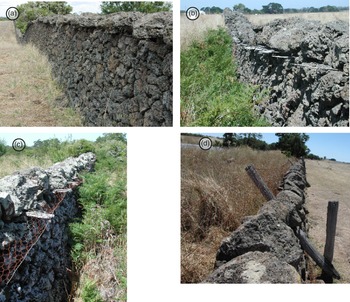
The first alternative was to demolish a wall and disperse or remove the stones. But demolishing walls and replacing them with netting fences was a last resort. Four basic modifications reduced features that would assist rabbits crossing a wall, although not all (except plugging) were used in all modified walls (Figure 5).
-
plugging all gaps in a wall to prevent rabbits sheltering inside walls, and using gaps to get through walls.
-
rebuilding a wall on deeper foundations so that it rests on bedrock, preventing rabbits from burrowing under it;
-
only allowing through stones to project to the inner, rabbit-free side of a wall (a British modification);
-
using flat coping stones overhanging on the outside (a British modification).
Some rabbit-proofing modifications to dry stone walls. (a) Flat overhanging coping. (b) Wooden slats placed under the coping stones. (c) Wire netting under coping stones and supported by widely-spaced slats. (d) Sloping posts on inside of wall supporting netting running down and under coping stones. Images by John Pickard.

More complex modifications involved adding slats and/or wire netting under the coping to form overhangs, or adding netting on posts to form a vertical or sloping barrier above walls (Figure 5). Netting was added to the wire component of composite walls – low walls with an integral post-and-wire fence.
Like so many other aspects of fence building, the modifications demonstrate ingenuity to protect the investment in walls. On lava fields where the ground was too rocky to dig post holes, landholders had little option but to persist with walls which they were still modifying in the late 1880s.
Wire netting
Wire netting is an ideal rabbit barrier: it is light, robust, relatively cheap, and it can be added to existing wire fences, or incorporated in a new rabbit-proof fence. Provided it was high enough, and of small enough mesh, few rabbits could cross. Rabbit-proof netting was advertised in Britain from at least the mid-1840s, but not in Australia until the early 1880s.Footnote 46 Netting was first advertised in Australia in 1853: ‘GALVANIZED Iron Wire and Wire Netting for fencing sheep and cattle runs.’Footnote 47 The following year, Sydney and Melbourne newspapers reprinted an article from the English Journal of the Society of Arts that specifically included rabbit-proof netting in an exhaustive list of the uses of wire: ‘wire-netting fences, for excluding hares and rabbits from gardens, … this wire is galvanised for some purposes to render it durable … There are, too, wire fences, with or without wire-netting attached …’.Footnote 48
Despite this early information, and agents, families and friends ‘back home’ keeping landholders informed of current British agricultural technology, the absence of Australian advertisements suggests that there was little local demand for rabbit netting. The earliest reported use is 1868 when Thomas Austin netted Barwon Park to restrain his out-of-control rabbits. It was used in the Midlands of Tasmania where by 1870
Palings, stone walls, wire netting, according to the character of the ground, or means of the owners are used. Beyond doubt the wire netting is the most certain and (in the long run) economical. It involves however an expenditure of not less than £80 a mile, … This be it remembered in addition to the ordinary cost of fencing. The advantage of wire net is that it can be removed at any time and particular paddocks may be enclosed.Footnote 49
Writing from England in 1877, Lord Elcho advised colonials ‘in danger of being ousted from the Australian world by the fruitful rabbit’, to fill a trench under the netting with rubble, or bend a flange on the soil surface.Footnote 50 South Australian A. F. Lindsay quoted an infomercial from wire importer Walter Carson & Sons recommending netting as the ‘true way to deal with the nuisance’, advising that ‘Although 1⅝-inch and 2-inch netting are sometimes used as a protection against rabbits, it is agreed by all authorities on the subject that the 1½-inch is the only really reliable mesh against small rabbits.’Footnote 52
Despite British use of netting against rabbits since the 1840s, rabbits were not mentioned in advertisements by E. Eastway & Sons for netting during the early years of their spread.Footnote 53 A little over a year later, the company’s advertisements were more specific, offering a range of standard netting as well as making netting to order, but again, no mention of rabbits.Footnote 54
Vegetable gardens may appear trivial compared with the farms and stations being overrun by rabbits. However, home and market gardens were almost universal in regional towns and in the suburbs of cities in the mid- to late nineteenth century, and on farms and stations.Footnote 55 They were an intrinsic and critical part of domestic diet and economy, so any rabbit impact was collectively serious. Victorians were advised to net their gardens against rabbits and hares.Footnote 56 Conversely, rabbit became a primary source of meat protein for many people.
Netting was increasingly discussed in many newspaper articles and letters from the 1870s. Inexplicably, the first advertisements specifically mentioning rabbits were in February 1883, but further research may extend this earlier.Footnote 57 Burgeoning demand and imports by local firms led to English iron-maker John Lysaght & Co. Ltd establishing a wire mill at Chiswick (near Sydney, NSW) in 1884.Footnote 58
Rabbit fences in the Western District and Mallee Region of Victoria in 1885
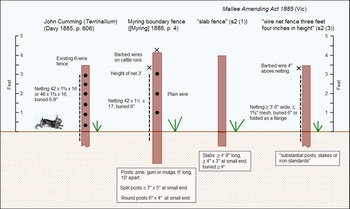
With rabbits well across NSW and approaching Queensland in 1885, both colonial governments sought more information on the most appropriate fences. Queensland sent experienced pastoralist Humphry Davy to the Western District in early October 1885. He visited many stations (Figure 2), and was particularly impressed with John Cumming’s fences on Terrinallum (Figure 6).Footnote 59 Davy subsequently wrote two fence specifications – one to separate infested from clean country; and a second, cheaper fence, for more general use on boundaries in infested areas. He was emphatic that 36 x 1⅝ x 18 ‘wire netting is useless to employ as a barrier thoroughly effectual against rabbits’. Any fence using such netting would be too low, the mesh too large, and the gauge too weak.Footnote 60
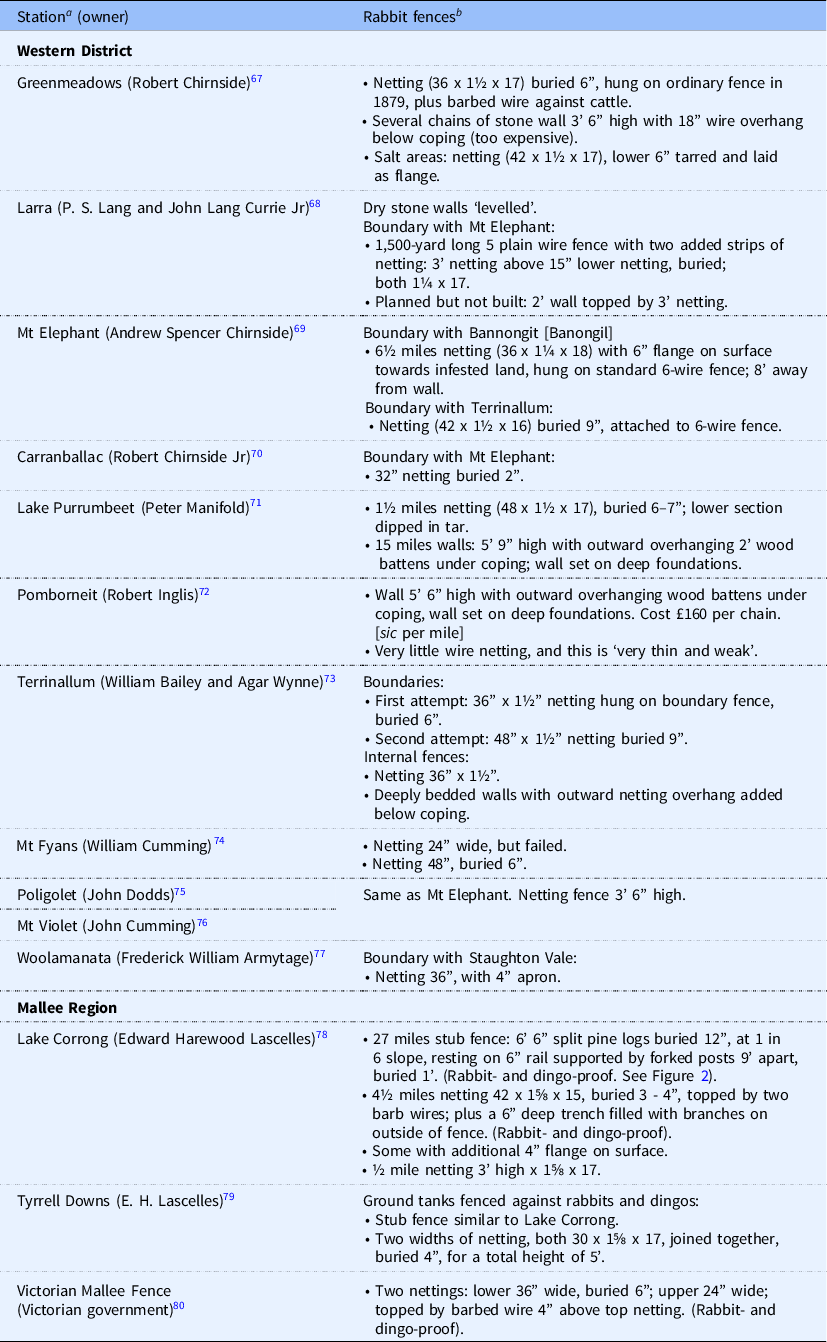
A few weeks later, on 26th October 1885, Thomas Hewitt Myring, the recently appointed Head of the NSW Rabbit Branch, commenced his inspection tour of Victoria to ‘inquire into the merits of the varied character of rabbit-proof fencing, more especially with respect to the efficacy of wire-netting’.Footnote 61 He visited a number of stations in western and northern Victoria, including several also seen by Davy (Figure 2). Both itineraries were organised by the Victorian government and wealthy landholders who had invested heavily in rabbit control and fences. An anonymous reporter from the Sydney Morning Herald accompanied Myring. His first five articles describe many fences in detail, the sixth summarises what they saw (Table 1).
Summary of rabbit fences seen in Victoria during Myring’s inspection, October to November 1885

Notes: a See Figure 2 for locations. The reporter did not accompany Myring on his inspection of Euston Station (NSW). b Details of types of posts and spacings are omitted.
The reporter summarised his observations:Footnote 62
-
Majority of station owners favour ‘a netting at least 3 feet 6 inches above ground’, 48 x 1½ x 17.
-
6” burial most common.
-
Flange works well, but problems on boundaries as neither neighbour wants the flange on their side.
-
Dipping the lower edge of netting in tar to minimise corrosion and rust in salt areas.
-
Netting can be attached to an existing fence, or just to posts.
-
Fences erected against both rabbits and dingoes were either higher, and topped with barbed wire, or used two strips of netting.
Myring concluded unambiguously ‘1st, that rabbit-proof fencing was of incalculable assistance in rabbit extermination; and 2nd, that wire netting was the best material for such fencing.’Footnote 63 Like Davy, he recommended two fence structures: one to ‘divide infested land from non-infested’, and a second, lower fence suitable for boundaries in infested areas (Figure 6). ‘The difference between the two fences is simply that one comprises netting which stands 3 feet 6 inches above ground and is of a stout wire, 16 gauge, while the other stands 3 feet above ground and is of a lighter wire, 17 gauge.’Footnote 64
Comparison of netting fences erected by John Cumming and favoured by Humphry Davy; recommended by Myring for boundaries; and slab and low netting fences specified in the Mallee Amending Act 1885 (Vic), section 2(3).Footnote 51

By this time, netting was increasingly used in rabbit fences across most infested farming and pastoral regions. A series of four articles in the Australasian in early 1886 summarised existing knowledge and experience, concluding that netting was the solution to rabbit fences.Footnote 65 This may be taken as the end of any substantive debate in Australia about netting.
The role of colonial governments
Government delays in legislation to control rabbits and particularly rabbit fencing were described above. What is noteworthy is the absence of any government involvement or initiative in developing rabbit fences. Until 1885 the only government action was to mandate destruction of log and brush fences, walls and hedges that could harbour rabbits. All of the experimentation was by individual landholders trying to develop rabbit-proof fences. Some used almost every conceivable way to save walls. Others tried low netting, which failed, so they increased the height of the fence until they found that 42-inch netting gave an ideal height of 36 inches, with six inches buried. This was legislated in 1885. Landholders also experimented with mesh size and wire gauge, with the efficacy of 1⅝, 1½ or 1¼-inch mesh debated for decades. They read newspaper reports and letters, and keenly watched their neighbours to see what worked, and equally importantly, what did not work.
The Victorian government established an experimental farm at Cashel in December 1876 (subsequently Dookie Agricultural College). The area had been infested with rabbits for several years, there was ample room for some paddock-scale trials of netting fences, but there were none. A few trials in NSW with small pens showed that young rabbits ‘get through “rabbit-proof” wire mesh 1½ measure, with the greatest ease’, but there was nothing at paddock-scale.Footnote 66 Thus there was no rigorous experimental basis for the mesh size in legislation. Instead it relied on countless anecdotal reports, faulty observations, and the personal biases of influential individuals.Footnote 82 The sole exception was the Darling Downs Rabbit Board, which compared 1½-inch and 1¼-inch netting for their barrier, but this was not until 1906, two decades beyond the scope of this article.Footnote 83
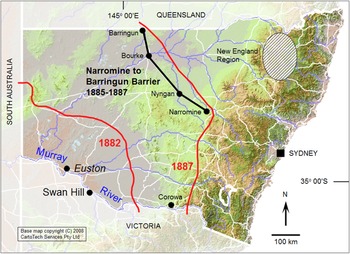
While individual landholders struggled against rabbits, there were also calls for barrier fences. These were not merely rabbit fences writ large, they were a government response to serious problems facing large numbers of settlers over a wide area.Footnote 84 Landholders in both Victoria and South Australia wanted a barrier on the border to stop rabbits and dingoes entering from the neighbouring colony. Lessees in the Victorian mallee wanted a second barrier on latitude 36oS then running north to Tyntynder on the Murray River to stop the rabbits moving south into farmlands, and dingoes moving north to attack sheep in pastoral areas. This barrier – the Victorian Mallee Fence – was erected from 1885 to 1886 and was both rabbit- and dingo-proof (see Figure 2).Footnote 85 The second was the NSW Railway Barrier from Narromine to Barringun (Figure 7), erected from 1885 to 1887 by hanging netting on existing fences along the railway and station boundaries.Footnote 86
New South Wales showing the route of the Narromine to Barringun Barrier Fence (black), the advancing rabbit fronts (red) in 1882 and 1887, and localities mentioned in the text. The general location of the New England Region is shaded.Footnote 81

These and subsequent barrier fences were tacit acknowledgements by colonial governments of the crucial role of netting fences against rabbits (and dingoes), and of the value of barriers in slowing rather than stopping the advance of rabbits. But not everyone believed in barriers. R. J. Murchison was scathing of netting rabbit fences in general, and the NSW Railway Barrier and Victorian Mallee Fence, in particular. He predicted ‘that in a few years to come these fences will be lying rotting on the ground as momentos of the folly of those who erected them’.Footnote 87 Murchison was a lone voice who was spruiking his own scheme for rabbit control using the introduced predators Polecats (Mustela putorius) and Ferrets (Mustela putorius furo). However, he was correct – most rabbit barriers failed either because rabbits were already beyond them before they were erected or through poor maintenance, and most were subsequently abandoned and many were converted to dingo barriers.Footnote 88
Conclusions
From their introduction in 1859, rabbits were probably the largest and longest disruption to Australian agriculture until their control a century later by myxomatosis in 1959. Rabbiters benefited enormously, and hundreds of millions of rabbit carcasses and skins were exported, but all classes of landholders – squatters, pastoralists, farmers, selectors, and tenants – struggled to cope.Footnote 89 Fences were essential to all methods of controlling and eradicating rabbits. Banks and turf walls favoured around warrens in Britain, were never tried, and hedges became infested with rabbits. Paling, slab, picket and stub fences fell by the wayside, but were still cost-effective in some situations until the early 1900s. Walls were demolished and replaced or modified.
By 1886, netting was unanimously accepted as the fencing solution to rabbits. There was no simple sequence of one structure replacing another, leading inevitably to the adoption of netting. Adjoining landholders were trying different approaches and structures to suit the terrain and their finances. Ideally any netting fence would be cheap, 100 per cent rabbit-proof, and require minimal maintenance over a long life. Instead, like all other fences, rabbit-proof fences are always an uneasy compromise, the least suboptimal combination that suits the landholder and, if necessary, satisfies relevant legislation.
By 1885 when the Victorian government specified netting fences in the Mallee Amending Act 1885 (Vic) and erected the first Australian barrier fence (Victorian Mallee Fence), the design of netting fences was (with variations) standardised. More-or-less identical structures were legislated in each colony, and continuing to the present. Given Lascelles’s social standing and experience, it is likely that his netting fence was the model for the Victorian legislative specification.Footnote 90 His netting fences of 1884 would satisfy most current legislation, indicating that there has been essentially no improvement to the structure of rabbit fences, although materials have changed. The fencing solution to rabbits was developed within five years of Austin’s prescient 1865 comment ‘They are a perfect nuisance.’ Available evidence is sketchy, but suggests that in 1868, Thomas Austin was the first to use netting.
The structure of netting fences has been remarkably stable since 1885 with a simple genealogy. Victorian landholders imported British technology and knowledge, and experimented with structures until they developed the optimum combination. These were the basis of Davy’s and Myring’s recommendations. Davy singled out the fences of John Cumming (Terrinalum) as ‘the best and most perfect for the purposes of any I have seen in this Colony’, and these were the basis of his recommended structure. Slightly modified, either Davy’s or Myring’s specifications were used in all Australian rabbit fences and rabbit barriers from 1886 to the early 1900s, and legislation to the present.Footnote 91
Ironically, the first user of netting appears to be Thomas Austin in 1868, but the structure of his fences is unknown. Also unknown is who first buried netting or bent it into a flange. It is likely that this was imported directly from Britain. Thus, the structure of subsequent Australian netting rabbit fences derives from individual Victorian landholders in the mid-1880s, and ultimately from Britain.
Acknowledgements
This article is based on my PhD research, partially supported by the then Department of Physical Geography, Macquarie University, and supervised by Associate Professor Patricia C. Fanning (Graduate School of the Environment), Associate Professor Damian B. Gore and Mrs Carol Jacobson. Associate Professor Fanning assisted with fieldwork, and many landowners generously gave me access and information.
Conflicts of interest
None.