By the time of World War I, the traditional open-air markets had lost their importance throughout Danish towns and cities. In many cases, displaced from the central square or limited to the early hours of the day, the markets were only a pale shadow of what they had been half a century before. The understanding of the traditional central square market's decline in Denmark during the industrial period of c. 1850–1914 has been dominated by two interconnected views. First, being an institution of medieval origin, the markets are often considered to have been in their prime in pre-industrial times when land transport was hampered by poor infrastructure and trade was regulated by privileges and charters. In this view, the market trade became out-dated in the middle of the nineteenth century by liberal trade reforms, industrialization and a revolution in land transport. Secondly, the ailing, outdated markets were soon outmatched by the competition from the emergent fixed shop retailers. In other words, the decline of the central square markets has been seen as the product of changing patterns within the consumer economy.Footnote 1
This article will try to nuance and broaden the understanding of the history of the central square markets. First, it will challenge the teleological view of the market trade as outdated by the middle of the nineteenth century. Rather than sealing the fate of the markets, free trade reforms and industrialization revitalized the age-old institution. On this basis, the article offers an alternative interpretation of the decline of the central square markets looking outside the inner workings of the consumer economy. Instead, new insights can be gained by taking a more detailed look at the physical space of the marketplace itself and the changing notions, visions and interests linked to this central urban space. New ideals of urban space played an important role in the downturn of the urban markets as the modernization benefiting the urban markets in turn also changed the urban economy, the cityscape and the notion of public space. The rapid expansion of the Danish cities placed a new emphasis on the city centre as an area of special economic and metaphorical importance, and the central squares in particular attained a significant symbolic meaning. Consequently, several new economic interests and urban ideals challenged the traditional markets and their use of the central squares, drawing the markets into a complicated struggle over the definition and use of the central urban space. In the urban elite and the municipal councils administrating the street markets conflicting views upon the markets clashed, ranging from efforts to reform and modernize the institution to attempts to relocate the markets away from the central squares.
This article will draw upon a detailed study of the public debate in newspapers and city councils over the regulation of the markets in the largest provincial cities. This is supplemented by a broad survey of markets in Danish market towns, focusing on their changing size, location and public regulation.Footnote 2 In particular, this article will examine the struggle over the construction of a fish market hall in Odense as it serves to reveal the different conceptions of the central urban space that affected the fate of the street markets.
Flourishing central square markets
Central square markets were key points of exchange between the urban and rural economy in the pre-industrial period in Denmark, as in most of Europe. The basic principles were laid down in the Middle Ages and changed little over the centuries. On market days, farmers from the surrounding countryside brought a wide range of agricultural products to the marketplace. The markets provided the urban population with daily necessities like vegetables, meat, fish, fodder and firewood to keep the city fed, moving and warm. In addition to the agricultural products, a broad variety of small household items were also offered for sale. Rural households presented simple handicrafts, and numerous back street artisans as well as petty tradesmen from the city itself set up stalls to display their wares.
The markets took place on one or two weekly market days in the heart of the city. In smaller towns they were held at the central square, often simply named The Market (Torvet), or in the case of larger cities on several, often interconnected squares. Detailed regulations separated different products by specifying where stalls with meat, fish, handicrafts and so on were allowed. Today, place names in Danish cities like Haymarket or Fishmarket still indicate these divisions.
In the middle of the nineteenth century, the industrial revolution came to Denmark and changed the urban economy and demographic fundamentally. Strong population growth, more independent households and a rising number of wage earners increased the markets’ customer base.Footnote 3 At the same time, improved infrastructure in the form of new highways and especially railroads eased the travel for people and goods from the surrounding area. Perishable foodstuff could now be brought to the market in increased quantity and quality, for instance fresh fish transported by rail from the coast to inland cities.
The market trade was further stimulated by the policies of the democratic government established in 1849. The parliament dominated by laissez-faire liberals passed reforms promoting the freedom of trade: all guilds and associated restrictions upon commerce and occupation were banned and market town privileges were revoked to allow trade in rural areas. The liberal government, however, treated the two traditional forms of trading, seasonal fairs and the street markets rather differently. On one hand, the parliament dismissed the seasonal fairs as outdated, morally depraved institutions and consequently abolished them in 1873 – probably under inspiration from the ‘Fairs Act’ passed two years before in Great Britain.Footnote 4 The urban markets, on the other hand, were held in much higher regard. The parliament saw markets as hubs of the urban food provisioning and sought to boost this status further. A farmer-friendly clause in the 1857 free trade law guaranteed anyone the free right to sell domestic, agricultural products at the marketplace in any city or market town. In addition, market stands were exempted from new municipal fees.Footnote 5 According to parliament, the marketplace was a venue for direct trade between rural producer and urban consumer without the unnecessary and costly interference from retailers – a view bearing echoes of much older, moral notions of fair trade and price.
The administration of the central square markets had traditionally resided with the city government. Reforms in the middle of the nineteenth century extended the democratic ideals to the urban scene and established elected city councils in all cities and towns with far-reaching authority over most local matters. The election system, however, guaranteed the social elite the majority, and thus property owners and large retailers often dominated city councils.
The market trade prospered greatly under these favourable economic, technological and political conditions. The increasing number of small food retailers in the cities’ outlying districts that won over more and more private customers did not – at least until the end of the nineteenth century – lessen the trade at the central market as the shopkeepers usually stocked up at market. Consequently, the importance of the wholesale trade rose over the years.
As a measure of the markets’ success some figures can be given for the second-largest Danish city, Odense. In the morning of a Saturday market in October 1880, officials counted 4,500 persons and 700 wagons entering the city – impressive numbers in comparison to the total population of little more than 20,000.Footnote 6 On market days in Odense and other Danish cities, the central squares were crammed with stalls and wagons, and the police struggled to keep order and prevent severe traffic jams (see Figure 1). The entire inner city was bustling with activity.
Market trade at Albani Torv in Odense, c. 1890 (Odense City Museums)

The city councils soon realized the power of the markets to draw trade and people into the city. A large and attractive market was an important asset in the competition over the rural hinterland against neighbouring cities and emergent railroad towns. Beginning in the 1850s, city councils added more market days and, supported by private property owners, began to expand and improve the marketplaces to accommodate growing markets – and promote future growth. Old churchyards around central churches were converted to public squares; inner-city canals were filled and turned into market streets; private buildings next to the central squares were bought by the municipality or private investors and cleared. Even old, prominent, public buildings like bishops’ palaces and gymnasiums were acquired and demolished to enlarge marketplaces.Footnote 7 In Aarhus, a major provincial city, the councillors went as far as to sacrifice the city hall itself and its position on the main square. A new city hall was erected in a side street so the empty plot could be added to the square.Footnote 8 Moreover, city councils improved the paving and drainage of the main squares, established modern street lighting and set up systems of regular sluicing and sweeping of the central streets and squares.
New urban ideals in the city centre
The enlarging of the central squares and the improved paving, lighting and cleaning were not only done for the sake of the markets. Whereas market trade had traditionally been the raison d’être of the urban square, from the middle of the nineteenth century novel ideas about urban space began to emerge.
As opposed to well-known urban planning visions and utopias like, for instance, Ebenezer Howard's garden city, these ideals were rarely explicitly formulated. Instead, they were formed in complex processes taking place in the urban space itself. Here, the analytical approach draws upon French philosopher Henri Lefebvre. In his work on the production of space, Lefebvre stresses the close connection between ideas and the creating of spaces and suggests that space is a social construct. Lefebvre's concept of space encompasses the physical environment, the social space of everyday use as well as the discursive, mental space of perceptions and visions. Space in its abstract and yet concrete form is according to Lefebvre both homogenizing and fractured as it breaks down into different ‘systems’ or space models.Footnote 9 In this sense, several visions of urban space or ‘spatial strategies’ can be said to exist among the urban elite in Danish cities in the second half of the nineteenth century. By looking at urban ideals, economic functions and changes in the built environment several co-existing ‘urban spaces’ can be identified. These ‘urban spaces’ were tied to particular groups of individuals with similar perceptions, behaviour, uses and visions of the city centre. The different ‘urban spaces’ existing at the same time could support each other, co-exist peacefully or be in fierce competition for room, resources and attention. Because of the symbolic meaning attached to the city centre, it was the focal point of a struggle between diverging notions of urban space – all with an increasingly clear idea of what a central square should look like and be used for.
In the following, three new ‘urban spaces’ challenging the traditional street markets use of the central squares will be examined more closely. These are the space of consumption, the space of urban improvement and the space of capital.
The space of consumption
In pre-industrial Denmark, apart from the markets, the urban trade was dominated by large merchants. The merchants carried an incredibly wide variety of wares from bulk goods like grain, timber and livestock to small and trivial household items. Consequently, the forms of trade employed by the same merchant ranged from large-scale wholesale, perhaps even shipping, to local retailing in his booth on the high street. In contrast, dedicated retail shops were few and far between, mostly limited to shops selling books, wine and other luxury items.Footnote 10
In the middle of the nineteenth century, the retail structure began to change as small, specialized retail shops marketing ready-made industrial products emerged. In economic terms, modern, efficient infrastructure allowed the retailers to combine the advantages of a profitable shop location on a busy high street with the factory's economics of scale, outmatching traditional artisans and merchants. Led by drapers’ shops, these new fixed-shop retailers employed novel means of marketing such as advertisements in newspapers and above all luring displays in ever-larger shop windows. In the 1860s, the most successful and exclusive shops introduced polished plate glass spanning the entire frame of the shop window. The plate glass was so expensive that many shopkeepers took out a separate insurance for it. With the intention of turning their shop into a selling machine, shopkeepers gradually made most of the façade transparent.Footnote 11 In addition, by eliminating stairs and lowering the entrance to street level, the physical and mental boundary between the shop and the street was minimized. The shops’ awnings extending over the pavement blurred the distinction between the public street and the shop's private, commercial sphere even further.Footnote 12
As modern retail shops opened in building after building along the busy, central streets, it transformed the nature of the urban space. British urban historian Jon Stobart characterizes the emergent shopping streets in eighteenth-century England as new spaces of consumption referring to Lefebvre's framework of social space.Footnote 13 The shop windows projected the image of enticing wares onto the street, and the semi-public space of the shop functioned as an extension of the public street. Furthermore, as shopkeepers became aware of the importance of the shop's surroundings they increasingly worked together to improve the appearance and status of their street. In this union of individual economic interests, a ‘spatial strategy’ was born. Shopkeepers appealed to the municipality for improved paving, drainage, lighting and cleaning of the shopping streets, while the police were asked to curtail noisy and improper behaviour of young people and the lower classes. Private action was taken to beautify the city centre and create a pleasant environment with no distractions to hinder the pre-eminence of vision, the sense used for shopping.Footnote 14
Soon, the incompatibility between the street markets and the creation of a modern space of consumption became apparent to the retailers. Some shopkeepers complained about the competition from the market stands just outside their windows offering cheaper products. The owners of new specialized retail shops aspiring to sell shopping goods to the well-off consumer felt no direct competition from the market trade, but they were concerned about the general plebeian atmosphere of the market. Groups of shopkeepers petitioned the city councils to reduce the markets’ perceived harmful effects on their business and the perfect shopping environment in general.
In contrast to the specialized retail shops, some businesses benefited from the flow of urban and rural customers of more modest means on market days. Traditional merchants and innkeepers served the market vendors and provided stable room for their horses.Footnote 15 Accordingly, the inner-city businesses did not speak with a unified voice and instead shopkeepers with common interest based upon location or line of business formed groups to put pressure on the city government to follow their agenda.Footnote 16
Since location became ever more important in the expanding city, shop rents rose sharply at the most attractive, central sites. Following the liberal trade laws, setting up a stall in a central square on a market day was free of charge or only subject to a small fee specified in age-old market privileges. The rent-paying shopkeepers, who knew the price and value of a central location, grew increasingly frustrated by this unfair advantage, and petitioned city councils to limit the uneven competition. In most cases, the city government tried to strike a balance between upholding a large, attractive street market and the interests of shopkeepers and their landlords. Back-street artisans who set up a stand at the market and brought their products to the central square were directly short-circuiting the system of location rent. In some cities, this practice was prohibited, in others, the artisans were limited to the stands left unoccupied by the food market.Footnote 17 The competition from rural products was a more complicated matter, as the trade laws guaranteed the right to sell these at any street market. Groups of city centre shopkeepers pushed for a definition as narrow as possible of agricultural products and rural handicrafts. In Odense, a retailer-induced tightening of market regulations in 1880 disallowed among other things bread, flour, shoes and ironwork. This reduced the market goods to fresh produce, animals and crude household items like clogs, rope and simple pottery – products that no respectable high street shop would sell.Footnote 18
From the 1890s, more and more urban meat traders abandoned the street markets in favour of a fixed butcher's shop. Soon, a bitter struggle between the urban, fixed shop butchers and the rural butchers at the central square market ensued. In several cities, the fixed shop butchers campaigned to get rid of the central square meat stalls citing a lack of hygiene. Urban health regulations prohibited the slaughtering of four-legged animals at the marketplace, but as long as the meat had been subject to hygienic control the trade laws prevailed and the open-air meat trade continued well into the twentieth century in Danish cities.Footnote 19
The antagonism between city centre retailers and the traditional market trade was not only a question of economy. It was also a clash of cultures. The shouting salesmen, noises from wagons, the stench of live and dead animals as well as the crowds of rural and urban lower-class people disturbed the space of exclusive middle-class consumption. Accordingly, retailers advocated for the relocation of the markets away from the important shopping streets. In Copenhagen, the main market was moved from the central square of Amagertorv to a square in an outlying district in 1868. The new square offered more space for the expanding market and, equally important, removed it from the upmarket shopping area Østergade to the delight of the retailers.Footnote 20 Such drastic changes were rare, but in many provincial cities incremental adjustments to the market regulations would gradually move the most disagreeable and space-demanding parts of the market away from the central squares and prime shopping streets. This process often began by the relocation of the horse and cattle trade, and, as the city councils tightened health regulations, animals like pigs and sheep followed. In addition, the selling of bulky products like hay, firewood and peat was often moved from the central squares to side or back streets.Footnote 21 Gradually, the high street shopkeepers and their sympathizers in the city councils managed to push the most undesirable and space-demanding part of the markets to side and back streets creating an exclusive space of consumption in the city centre.
Civic improvements and the ideal of the sanitary city
The noise, smell and crowding associated with the open-air markets were not only injurious to the space of consumption, but also to the idea of the efficient, healthy and modern city prevalent in Danish city councils in the middle of the nineteenth century. British social historian Patrick Joyce labels these ideals as the ‘sanitary city’, a notion often expressed at the time in biological terms as unhindered and healthy circulation of people, goods, water and blood. Based on the tenets of liberalism, people and goods should be able to move freely though the city on straight, well-paved, clean and properly lit streets without obstructions by careless people or interference from tolls or fees. The circuit of water was of vital importance to the health of the city, consisting of a pipe network bringing pure drinking water to all houses and sewers taking care of wastewater from households and industries as well as surface water from the streets. The flow of blood was restricted to public slaughterhouses outside the city centre.Footnote 22
With newly won political powers and increased economic resources at their disposal, Danish city councils set out in the 1850s to realize their vision of the modern city. City governments took pride in reforming education, healthcare, poor relief and public administration. New utility networks of water, gas and sewage were held as heralds of progress. Copenhagen appointed the first municipal engineer in 1857 and soon the large provincial cities followed this example. The city councils’ efforts to improve the city were to a large extent directed at the public urban space. The prospect of improved street lightning was the main argument for establishing gas works.Footnote 23 As mentioned earlier, street paving and cleaning were improved, and to further the rational circulation street names and house numbers were standardized. But the city councils tended to more than the physical appearance of the street. To regulate behaviour in the public space, municipal police forces were formed, and strict police regulations issued, cracking down on noisy, soiling and immoral conduct along with obstructions to the free flow of traffic.Footnote 24
Within this context of sanitary civic reforms, attention soon turned to the open-air markets. Rather than banning or relocating the traditional markets, the urban reformers had a different agenda. The markets should be reformed and improved to meet the standards of a healthy, modern city. An efficient, public market in the city centre was a benefit for all citizens and a source of civic pride.
The market reforms were initiated by the state government demanding new market regulations including consideration of the hygienic conditions. The city councils issued regulations that reinforced the spatial division of different types of food within the marketplace and specified some basic product quality standards. Market overseers were appointed to monitor the trading with assistance from the police force. Also, the sweeping of the marketplaces was systemized. Some large cities went a step further by setting up committees to find ways to improve further the hygiene and efficiency of the traditional market trade. The vending of perishable foodstuff like meat, fish and dairy products in the open air was of particular concern to the market improvement committees, and the idea of permanent market halls was raised in several large cities. However, in contrast to most other countries in Europe, only a few halls materialized in Danish cities and they were, as it would turn out, rather unsuccessful.Footnote 25 The liberal trade law's explicit ban of market fees played an important part in this, as it undermined the possibility of financing the construction and maintenance of a market hall. In effect, the law limited the market halls to purely altruistic institutions funded by the municipality. But with eager civic reformers in city halls across the country making vast investments and taking on new expenses for the greater good of the city, it would only seem natural that the reformers and their idea of the market hall prevailed. Nevertheless, other conceptions of the use, definition and appearance of the central urban space clashed with the market halls and the associated permanent presence of the traditional market trade.
The short life of a fish market hall in Odense
Among the few market halls built in Danish cities was a fish market hall in Odense, the country's largest provincial city at the time. It was erected in 1867 on one of the central squares known as Fisketorvet (Fishmarket), only to be torn down seven years later. Although not a particularly remarkable building in itself, the short history of the market hall deserves a closer look, as the struggle over its fate reveals the rivalling interests and spatial ideals vying for control over the central urban space. The analytical focus on the urban space will also emphasize how groups and concerns external to the economy of consumption affected consumer practices and spaces.
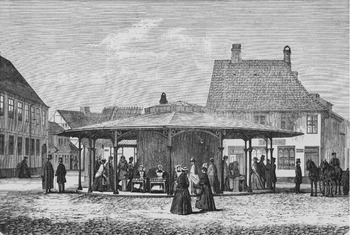
The construction of the market hall was originally proposed by a market reform committee appointed by the city council. In a report on the hygienic conditions of the market trade, the selling of fish was singled out as the most problematic area. The fishwives’ traditional open-air stalls with unrefrigerated, decaying fish provoked ‘revulsion beyond description’ among the committee members.Footnote 26 This explicit reference to the physical feeling of disgust is rather typical of nineteenth-century social reformers – social historian Christopher Hamlin even argues that the feeling of revulsion was a stronger driving force in the urban reform movement than hygienic statistics or advances in medical science.Footnote 27 According to the committee, a permanent market hall would bring order and cleanliness to the fish market. The city council was presented with two options: an inexpensive wooden structure at a peripheral location or a costly cast-iron market hall designed by a well-known architect and erected on a central square. The council was determined to solve the problem in style and opted for a hall of ‘solidity and beauty’ right in the city centre.Footnote 28 The fish market hall was equipped with the latest technological advances to attain the highest possible standards of hygiene: a concrete floor easy to keep clean, gas light to light the 30 stands properly, running water for cleaning fish, a sewer and even a fish tank for live fresh water fish (see Figure 2). To follow up, the conduct of the traditional sellers, the fishwives, were put under strict regulations and in addition an award system put in place for the sellers with the freshest fish and cleanest stalls.Footnote 29 When the fish market hall opened, the city council was lauded in national newspapers and magazines for its progressive municipal reform programme in general and the market hall's sanitary and aesthetic improvement of the traditional market trade in particular.Footnote 30
The fish market hall on Fisketorvet in Odense at the time of the opening in 1867 (Odense City Museums)

Constructing the space of capital
Not all approved of the new fish market, though. Already when the building was proposed to the city council, some of the square's landowners and shopkeepers protested as they considered the fish hall harmful to the real estate values in the surrounding area. Although the complaints were dismissed outright by the council set on sanitary reform, its line of argument signalled a new way of thinking about urban space: as a space of capital.Footnote 31 Of course, urban land and buildings had been bought and sold for centuries and real estate magnates were also known in the early modern period. In the first part of the nineteenth century, however, most buildings in Odense and other Danish cities, including those on the main street, were occupied by the owner, who practised his trade in the building. As economic modernization gradually separated workplace, residence and ownership, the relationship between owner and property became less personal. Accelerating this process, the success of fixed shop retailing, so dependent on the right location, created a lucrative market for letting of shop premises in the city centre. Consequently, urban land was increasingly thought of in abstract terms: as an investment and a source of rent. This change of mindset was furthered by a new municipal property tax system introduced in the 1870s in most Danish cities. Whereas the property tax until then had been based primarily on the buildings’ fire insurance valuation, all properties were now to be appraised with consideration of the location's suitability for profitable business – without regard for the actual use of the lot. The new property tax reflected a distinct group's view of urban houses and land as properties on a real estate market, but the publicized appraisal and individual tax bill bluntly introduced all property owners to the complex concept of optimum use land rent. Furthermore, the tax also affected the policies of the city councils; now the councillors had to pay more attention to landowners and their interests because a good deal of the tax burden and municipal income were linked to location-based land values.Footnote 32
A developing capital market and financial infrastructure facilitated investments in urban land. Financial institutions like banks, savings banks, mortgage credit associations and insurance companies were the backbone of the real estate market. Backed by their substantial economic power, they became the leading advocates for the idea of the city centre as a space of capital. The construction of a new building for the National Bank in Copenhagen in 1870 sparked a wave of purpose-built banks and saving banks across the country. Although the financial institutions did not have to draw customers from the street like retail shops, they were acutely aware of the importance and status connected to the physical appearance and location. The city's leading bank would often seek a building site on the main square next to the principal church and city hall, putting its economic power and prestige on a par with the political and religious. In the jostle for an attractive position, the financial institutions would cynically use their wealth and political connections to acquire the perfect building lot. In Aalborg, the main regional bank bought a venerated medieval building on Gammeltorv (Old Square) and, in spite of public protest, demolished it to make room for a new imposing bank building between the city hall and the cathedral. At the same time, another historical building was torn down by the leading savings bank constructing a new main office dominating the nearby square Nytorv (New Square). In Odense, three banks competed in the early 1870s to erect the most impressive office building. No expense was spared as prominent architects were hired from the capital to design the new bank buildings using the full catalogue of historicist architecture to load it with status and meaning. These imposing financial palaces at prestigious and visible addresses dominated the surrounding urban landscape and became symbolic anchor points for the space of capital.Footnote 33
The fish market hall between rivalling urban spaces
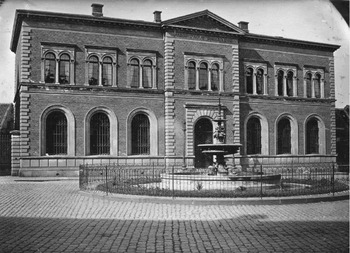
Returning to the fish market hall in Odense, after a few years of successful operation, the hall gained a new but unfriendly neighbour embodying the space of capital. The region's leading savings bank bought a property on Fisketorvet with the intention of building a grand head office. The fish market hall took up most of the square and would partly obscure the saving bank's proposed building. With support from other discontented property owners in the vicinity, the savings bank put the city council under intense pressure to remove the market hall. To further the case, the savings bank offered to fund a pleasant fountain in its place. Soon, the city council reversed its position and the matter was settled before the savings bank's building was completed. A simple back street in a poor neighbourhood was deemed a more suitable spot for the fish market, and the hall was re-erected there.
The prime opponent of the fish market hall, the savings bank, constructing a new head office, was no doubt driven by motives of self-promotion and aspirations for dominance over space (see Figure 3). However, its ability quickly to gather public support and turn the city council around was not solely based on economic power; rather, its opposition resounded well with emergent spatial ideals. Thus, the conflict over the fish market hall can be seen as a conflict between different views upon the use and purpose of the central urban space representing incompatible ‘urban spaces’.
The savings bank building and the water fountain that replaced the fish market hall in Odense, c. 1875 (Odense City Museums)

The open-air market institution was based on the traditional view of the central square as a common ground for everybody that on market days was a place for free and mutually beneficial exchange between the urban and rural worlds. The reformers of the ‘sanitary city’ embraced the idea of unimpeded trade with fresh victuals, and introduced municipal regulation and urban technology to improve hygiene and efficiency. Although not fully realized by the city council at first, the modernizing effort in the form of a permanent market hall changed the fish trade's physical as well as mental footprint fundamentally. As the structure remained in place outside of market hours and days, the otherwise rather inconspicuous fish trade now had an enduring, dominating presence excluding other uses of the square. This led to a more intense conflict with other conceptions of the central urban space than was the case with the temporary street market.
Apart from directly obscuring the façade of one of the city's leading financial institutions, the idea of the fish market hall as such did not comply with the notion of the city centre as a space of capital. Following the trade law and the intention of furthering the public good, no fee was charged for use of the hall. The fee-free stands stood in stark contrast to the high rents paid by the shops in the city centre. Within the logic of the space of the capital, the central square was too attractive and valuable for an undesirable market hall. It was better placed in a low-rent area. Furthermore, nearby landowners were convinced that the fish market had a detrimental effect on land values due to the nuisances of the fish trade. This view was also brought forward by owners in other parts of the city, when the council discussed the relocation of the hall. To strengthen their point, property owners stressed that falling land values and rents would impair their ability to pay the new property tax based on the value of location.Footnote 34 The fish market hall's adverse effect on land values stemmed from its mismatch with the space of consumption and the idea of the city centre as a particularly monumental, aesthetic and moral space.
Despite the reformers’ intention to create a modern place of trade for the benefit of all classes, the fish market hall did not fit into the space of consumption focusing on the refined taste of the middle-class shopper. The daily provisioning of the household with basic foodstuff like fish was hardly a matter for a polite lady, which meant that the fish hall was mainly sought by servant girls and the working class. In addition, high-quality fresh fish were increasingly being brought directly from coastal towns by newly opened railway lines and delivered to the door of well-off customers. This pushed the fish hall's consumer base further down the social scale. Although reformed and regulated, the open market hall was still associated with nuisances of smell and noise in contrast to the space of consumption's fixed shops, where the shop windows stopped all other sensory inputs than vision.Footnote 35 The negative social connotations and the perceived disturbances caused by the fish trade made the otherwise central and prestigious square unattractive to shoppers and shopkeepers, in effect hindering its inclusion in the space of consumption.
The spaces of capital and consumption were rapidly gaining ground in these years, both in the physical urban landscape and as an ideological construct put forward by interest groups. However, a change in the reform agenda of the city council and urban elite was equally important. A shift of focus from hygiene and efficiency to aesthetics and monumentality was evident in the city council's reversal of opinion on the fish market hall. Patrick Joyce argues that the idea of the ‘sanitary city’ transformed into what he terms the ‘moral city’ in the middle of the nineteenth century.Footnote 36 At the heart of the ‘moral city’ was the belief that culture, art and beauty had the power to improve people and society, as well as raise the moral level of the lower classes. In Denmark, these views went hand in hand with the swing among the urban elite from liberalism towards conservatism in the 1860s and put to direct use in the ensuing political struggle against the socialist movement and rural liberal opposition. The ideals of the moral city were unfolded in insistently moral city designs using historicist architecture and monuments to create a symbolic and aesthetically pleasing city centre. Also, since the centre also served as a showcase to out-of-town visitors, an impressive, pleasant and modern city centre would add to prestige of the city as such.Footnote 37
The new emphasis on the moral city was not tantamount to an abandonment of all hygienic concerns; rather, the intention was to remove the workings of the sanitary city from sight and make room for the moral city.Footnote 38 Quite characteristic of the change was the replacement of the main squares’ focal element. In cities across the country, Odense included, water pumps supplying clean water to the public took centre stage in the first half the nineteenth century. Made obsolete by new waterworks, the pumps were superseded in the 1860s and 1870s by patriotic monuments portraying kings and national heroes.Footnote 39 At the same time, a plethora of monumental public buildings – especially new city halls along with cultural institutions like theatres, museums and libraries – were erected as symbols of civic pride. Moreover, an ambitious programme of interpretive and enhancing restorations of medieval church buildings was launched to recast them as historic monuments.Footnote 40
Private owners with wealth and high ambitions – and here the financial institutions were in a league of their own – who wanted to contribute to the remodelling of the central urban landscape with imposing buildings were eagerly welcomed by city councils. When the savings bank on Fisketorvet in Odense offered a beautifying fountain in addition to the monumental, historicist bank building, in essence transforming the square into a prestigious space of moral and beauty following the interest of property owners and retailers, the city council quickly abandoned its earlier vision of market trade for the benefit of all classes.
Dismissed from the central square, the fish hall was re-erected in a poor back street. The new location proved unsuccessful and the hall soon fell out of use. Instead, the fishwives returned with their small, primitive stands to the city centre in spite of regulations. However, the police and council turned a blind eye to the fishwives’ trade due to its inconspicuous and temporary nature.
The central square markets and new urban ideals
The free trade law of 1857 stimulated the markets by granting everyone the right to set up a stand free of charge at any urban marketplace. In the long run, however, the no-fee principle hindered the modernization of the markets since it negated the possibility of getting a return on an investment in a market hall for private investors, associations and municipalities alike. In effect, the markets were cut off from gaining a foothold in the space of consumption and capital, making the market improvement efforts dependent on the altruism of reformist city councils. The fate of the markets was in this way put into the hands of the councillors and their vision for the city centre. The removal of the fish market hall in Odense and similar unsuccessful projects elsewhere signalled the fall of the sanitary agenda of reforming and modernizing the central square markets through aesthetic and hygienic permanent halls. Instead, the urban political elite in Odense and other Danish cities fully embraced the spaces of capital, consumption and moral monumentality and this trio of city centre ideals came to dominate until the advent of automobile traffic in the 1920s.
The abandonment of the market hall idea did not mean the end of central square markets from one day to the next. Yet, the failure to modernize the market trade coupled with the rising pressure from other urban ideals did put the markets at a disadvantage, when the competition from fixed grocers’, butchers’, greengrocers’ and other food shops set in towards the end of the nineteenth century. Whereas the central square markets had been easily accessible to all inhabitants of the small cities of the mid-nineteenth century, the urban growth of the following decades created physical distances that could not be covered by a convenient walk. Both city councils and private property owners laying out the new working-class neighbourhoods and middle-class suburbs neglected to make any provisions for new market places away from the city centre. Towards the end of the century, the city councils had lost interest in open-air market trade, and landowners were naturally more interested in fixed shops that generated rent than fee-free markets. In a few cities, secondary, suburban market places were established, but no Danish city developed a comprehensive decentralized market system to serve new districts. Instead, small corner shops provided for the needs of the local communities.
At this time, in other European cities, notably London, the open-air market trade was continuously invigorated by a steady increase in the number of market places extending the reach of street markets to new districts. It remains to be examined whether this divergence stems from more strict local government control in Denmark, differences in the urban consumer economy or can be attributed to other causes.
Interestingly, the emergence of the small, local food shops did not lead to an imminent demise of the markets because the small shops stocked up at the central square markets. Slowly, wholesale trade came to dominate the markets. Due to hygienic concerns, the wholesale meat trade was moved to public slaughterhouses in Copenhagen and large provincial cities in the 1880s and in the following decades, this concept spread to small towns.Footnote 41 By the turn of the century, specialized fruit and vegetable wholesale markets had developed at central squares in several cities. At a time when no single point could serve all consumers, a wholesale market was more in harmony with the central location. In spite of high number of wholesale buyers and sellers, their presence was hardly felt by most users of the public space as the trade took place in the early hours of the morning. With a regulated closing time of 8 or 9 o'clock, they would hardly interfere with the retail shops. The restricted city centre markets had succumbed to the space of consumption, capital and moral monumentality.