During 2014 Gloucester City Museum hosted a special exhibition of the city’s collection of twelve early seventeenth-century paintings of Gloucester benefactors, approximately 400 years after they were produced.Footnote 2 The exhibition highlighted the importance of the paintings and initiated a fund-raising campaign for urgently needed conservation. This remarkable collection holds enormous value both as a window into the history of Gloucester and into the history of post-Reformation English portraiture. Although images of the twelve paintings have been reproduced online, and some have appeared in scholarly publications, along with brief discussions of some of the sitters,Footnote 3 the only published study of these portraits as a group is a twenty-page pamphlet produced in 1972 by Brian Frith, then City Historian, for Gloucester City Museum and now long out of print.Footnote 4 No doubt this reflects the fact that vital information, which would undoubtedly have been recorded in the chamberlains’ accounts of the city of Gloucester for the period which broad consensus has assigned to their production, cannot be obtained as no such accounts have survived for the years 1597 to 1627 and 1630 to 1635.
Perhaps in partial consequence of this unfortunate gap in the sources, Frith’s brief but scholarly introduction appropriately noted that ‘nothing is known concerning how or when they were acquired, whether by gift or purchase, though the latter is more likely’. He added, citing a chamberlains’ account of that date, that these twelve were almost certainly the surviving remnant of an original eighteen portraits first noted in a civic inventory of 1635–6, and that they had long hung in the Council Chamber of the Old Tolsey until they were removed to the Council Chamber of the current Guildhall in 1892. There they remained until 1959, when they were moved to Gloucester Folk Museum (‘Bishop Hooper’s Lodging’) on Westgate Street, where they have been kept ever since, mostly in storage save for special exhibitions such as that of 2014.Footnote 5
Thus, numerous questions remain unanswered: when and why were they done, and by whom; what precisely is their significance, either to the city itself or to our understanding of English painting of that era? Though the paucity of surviving evidence will preclude giving precise answers to some of these questions, Frith’s valuable initiative can be considerably extended now that we know so much more about Gloucester and comparable cities of this era, and about the civic portraiture produced in such communities.
The Sitters
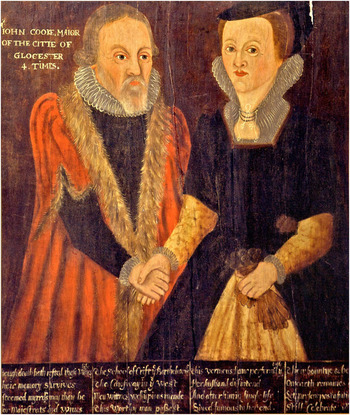
Of the sitters depicted in these twelve paintings, John (d. 1528) and Joan (d. 1545) Cooke, Mayor and Mayoress of Gloucester, are perhaps the best known and most written about. John, a migrant from nearby Minsterworth, was both a mercer and a brewer, and served the city as Alderman, Sheriff (1494 and 1498) and Mayor (1501, 1507, 1512 and 1528). His will of 1528 provided for the upkeep of local roads and bridges, the repair of a local hospital, the relief of the poor and for the founding of a free grammar school adjoining his parish church of St Mary de Crypt. His will required Joan, to whom he also left a substantial legacy, to see to the school’s foundation, a task that she faithfully performed over the course of her remaining years.Footnote 6 The painting (fig 1) has a lengthy poem inscribed along the bottom, describing the benefactions of both:
Though death hath rested these life mates
Their memory survives
Esteemed myrrors may they be
For Majestrats and wives
The School of Crist ye Bartholomews
The Cawseway in ye West
May wittnes wch ye pious minde
This worthy man posest.
This vertuous dame perform’d ye taske
Her husband did intend
And after him in single life
Lived famous to her end
Their bountye & beneficence
On earth remains allways
Let present past a future time
Still Celebrate yr praise.
John and Joan Cooke, oil on panel, 813×755mm. Photograph: © Gloucester City Museum and Art Gallery

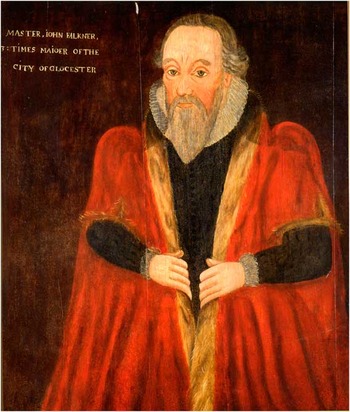
John Falkner (d. 1545) is shown (fig 2) in his fur-trimmed mayoral gown; he was, as the inscription tells us, ‘3: times Maioer of the City of Glocester’ (1525–6, 1534–5 and 1542–3). It was in that capacity that he led a delegation of distinguished townsmen to meet Henry VIII and Anne Boleyn as they approached the city in 1535. Perhaps the wealthiest Gloucesterian of his age, he owned a cap-factory which employed many people. Falkner’s benefactions were widely divided between gifts to the poor, funds for the roads and bridges which were essential to the city’s economy, and money to handicraftsmen in his parish of St Michael’s, though he was still able to leave a considerable sum to his widow.Footnote 7
John Falkner, oil on panel, 822×734mm. Photograph: © Gloucester City Museum and Art Gallery

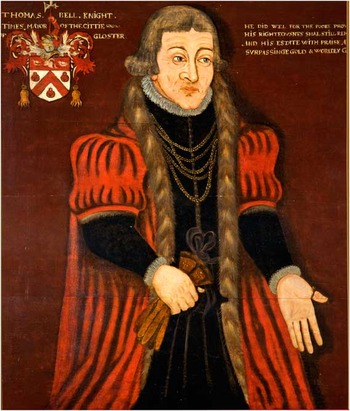
Sir Thomas Bell (1486–1566), the other great Gloucester cap manufacturer of his time (fig 3), also served as mayor three times (1536, 1544 and 1553), but also as Sheriff (1522–3, 1526–7 and 1529–30) and MP for four or five Parliaments: (?)1539, 1545, 1547, 1553 (March) and 1554 (November). He purchased the former Blackfriars in 1539, converting some of the property into a grand home for himself and the rest into a huge workshop for making caps and draperies. He converted a former chapel into an alms house and gave generously to the poor. By 1547 he had gained a knighthood and a coat of arms for his efforts.Footnote 8
Sir Thomas Bell, oil on panel, 797×748mm. Photograph: © Gloucester City Museum and Art Gallery

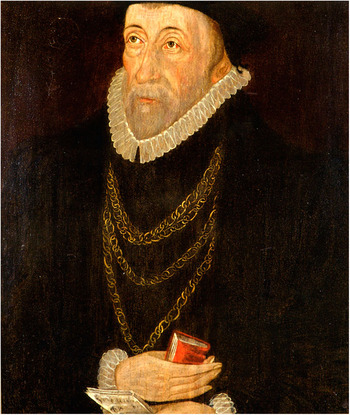
Richard Pate (sometimes rendered as ‘Pates’) (1516–88) never gained a knighthood, but he was the other depicted benefactor (fig 4) who served in Parliament, being elected for Gloucester in 1558, 1559, 1563 and 1586. Born in either Cheltenham or Minsterworth, he rose to fame through the law and national government service rather than business and was as much at home in London and Westminster as in Gloucestershire. His marriage to the widow of a former Gloucester mayor, who was also the daughter of another, gained him a considerable presence in that city. He served Gloucester as its Recorder for thirty-one years (1556–87) until old age and infirmity caught up with him. Though best remembered in the shire for his endowment of the Grammar School in Cheltenham, Pate also made a good many of his benefactions to Gloucester.Footnote 9
Richard Pate, oil on panel, 571×536mm. Photograph: © Gloucester City Museum and Art Gallery

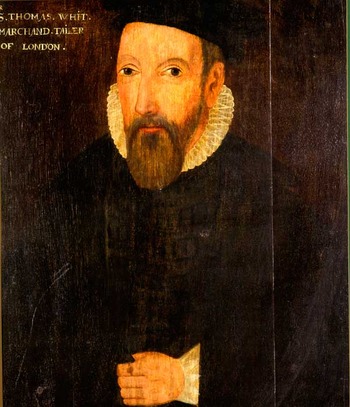
Pate may have lived in Gloucester only part of the time, but Sir Thomas White (?1495–1567) never lived there at all. Born the son of a Reading clothier and apprenticed at a young age to a prominent member of the Merchant Taylors’ Company of London, White became one of the wealthiest non-aristocratic Englishmen of his era, serving as Master of the Company of Merchant Taylors and then as Lord Mayor of London during the first year of Mary Tudor’s reign. His business connections gave him ties to merchant families and cloth-producing towns throughout the realm. In addition to founding St John’s College, Oxford, White’s ingenious charity scheme provided ten-year interest-free loans of £100 each year for the use of four journeymen clothiers in each of twenty-three towns, plus the Company of Merchant Taylors of London, in annual rotation: each town received that sum once every twenty-four years. Gloucester’s turn came first in 1581, and every twenty-four years thereafter well into modern times. Almost all recipient towns commissioned a portrait of White, though those in Gloucester (fig 5) and Chester look nothing like the rest.Footnote 10
Sir Thomas White, oil on panel, 682×524mm. Photograph: © Gloucester City Museum and Art Gallery

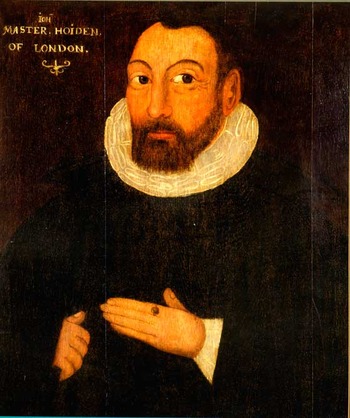
Though never as prominent as White, John Haydon (d. 1582) (fig 6) was another non-resident Gloucester benefactor. Born in Devon, Haydon made his fortune as a London Mercer, becoming Master of that Company and Sheriff of London in the last year of his life. He, too, endowed promising entrepreneurs in several towns, of which Gloucester was one. Like White’s charity, his gift rotated from one recipient town to another and endured at least into the eighteenth century.Footnote 11
John Haydon, oil on panel, 683×515mm. Photograph: © Gloucester City Museum and Art Gallery

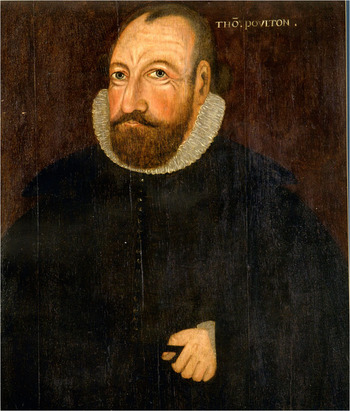
Thomas Poulton (d. 1608) (fig 7), a wealthy yeomen of Tewkesbury, with armigerous relations in Newent, was still another non-resident of Gloucester. Poulton contributed substantially to the construction of a new market hall in Tewkesbury,Footnote 12 but he also left fifty shillings for the repair of Gloucester highways, and £60 to the city government for the relief of its young craftsmen, tradesmen and the poor in general.Footnote 13
Thomas Poulton, oil on panel, 685×528mm. Photograph: © Gloucester City Museum and Art Gallery

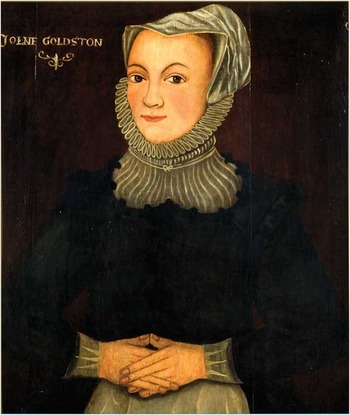
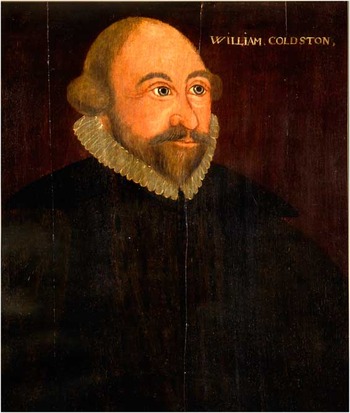
Joan Goldston, née Chambers (d. 1579) (fig 8), and William Goldston (d. 1569) (fig 9) were related through marriage, she being the second wife of William’s brother, Richard Goldston. Both were active parishioners of St Michael’s, one of the wealthiest of Gloucester’s parishes in these years, though in the end Joan asked to be buried in St Owen’s instead. Joan left legacies to both parishes, for the repair of a local bridge and for the support of poor people. William, a shoe manufacturer, acquired considerable property in and around the city and (like Joan) left generous endowments for the upkeep of St Bartholomew’s Hospital.Footnote 14
Joan Goldston, oil on panel, 656×499mm. Photograph: © Gloucester City Museum and Art Gallery

William Goldston, oil on panel, 676×516mm. Photograph: © Gloucester City Museum and Art Gallery

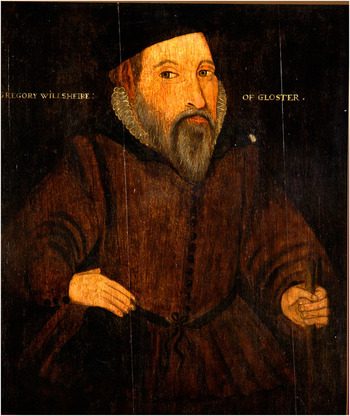
Gregory Willsheire (d. 1585) (fig 10) sprang from a family with branches in several shires, most of them playing a prominent role in the clothing trades wherever they settled. Aside from his bequest of £100 to purchase wine at the election of new mayors each year, he neither served in local office nor left much of a mark on the city itself.Footnote 15
Gregory Willsheire, oil on panel, 683×527mm. Photograph: © Gloucester City Museum and Art Gallery

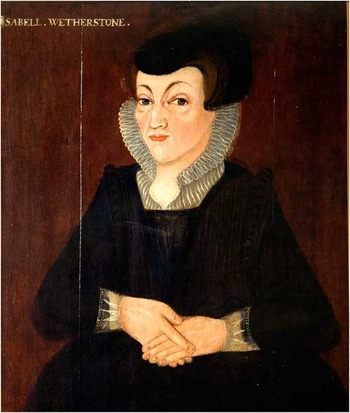
Isabel Wetherstone (b. ?1555) (fig 11) was somehow related to Richard Pate and served as one of his connections to Gloucester. Twice widowed, she commanded considerable wealth at her death and left a modest, if long-remembered, legacy to the Gloucester poor.Footnote 16
Isabel Wetherstone, oil on panel, 674×525mm. Photograph: © Gloucester City Museum and Art Gallery

Finally, John Thorne (d. 1618) may actually have sat for his portrait (fig 12). Though extensive repainting will likely have detracted from whatever verisimilitude it may have displayed, his slightly wandering left eye seems to have been observed from life. Aside from that, he exhibits the same heavy outlining, rubbery fingers and ill-proportioned anatomy as the others. Thorne was a brewer of St Nicholas’s parish, and he rose to civic office as Alderman, Sheriff (1600) and Mayor (1609). The inscription on his portrait tells us that he was seventy-two years old in 1618. This note may have been added after his death, but the fact that he is posed in his mayoral gown suggests that the painting cannot have been done before that mayoral year of 1609.Footnote 17
John Thorne, oil on panel, 773×565mm. Photograph: © Gloucester City Museum and Art Gallery

All the others, save perhaps for Poulton (d. 1608), will have been painted posthumously. In fact, most of them had been deceased for long enough as to raise questions concerning their verisimilitude. Yet since they were most likely to have been commissioned by the city authorities rather than the subjects’ families, and were meant to serve institutional and polemical rather than personal aims, this hardly mattered. The fact that several of the subjects have very similar features is most likely the result of the same pattern books being used for several paintings than the consequence of any particular need for verisimilitude. By the same token, no effort has been made to dress the earlier figures (Joan Cooke, for example) in the clothing styles typical of their time.
Amongst the other shared features of these portraits is their generally crude workmanship and poor physical condition. Centuries of probable display in civic buildings such as the Gloucester Tolsey, and later its city hall, have left them highly vulnerable to poor care and physical disintegration. Close inspection reveals accumulated patinas of dirt, inexpert attempts at restoration or cleaning, faded or oxidised pigments, flaking and/or abrasion of paint and cracking or splitting of the wood panels themselves due to poor climate control and/or excessively constraining supports. Virtually all of the Gloucester Twelve exemplify most of these characteristics; a few exemplify them all. The double portrait of John and Joan Cooke, in which a visible split has developed in the centre panel and considerable abrasion and overpainting appears in several areas, remains in an especially parlous state. Cracks or splits also appear in all the others as well. That of John Thorne in particular shows the clumsiness of extensive overpainting, though others show no overpainting at all.
The goal of restoring these paintings will not have been helped by the ways in which they were produced. Overall it is apparent that most of these paintings have been done on the cheap. Nearly all show evidence of thin and hasty painting; some are painted so thinly as to reveal the ground and even hint at the grain of the wood panel beneath. Abrasion and poor storage conditions have merely heightened this effect. The palette of almost all of them remains dominated by the earth colours – browns, tans, yellows and oranges – of the ochres which were then (and still are) mined in the Forest of Dean nearby, rather than the more expensive and usually more stable pigments that would have to have been acquired from outside the region. As is most evident in the portrait of Haydon, blacks appear granular – evidence perhaps that they were not well ground to begin with – and this has made them all the more vulnerable to abrasion. The workmanship is also crude. On the continuum of early Stuart portraiture, which runs from the more refined, subtle and continentally inspired artistry on one end to the uni-dimensional, rustic and vernacular craftsmanship of most native English work on the other, the Gloucester Twelve must be placed at the very latter end, with only the painting of Richard Pate slightly closer to the centre.Footnote 18
For the most part the figures lack the use of shadow, or chiaroscuro, which might have given them depth. Contours are heavily outlined by the pronounced dark lines that can be clearly seen in every painting; the colour has then been filled in between the lines. The more refined technique of building up subtle nuances of flesh tones or the appearance of flowing drapery by the careful shading and blending of colour is only sparsely apparent. Such work would have required levels of painterly expertise and of funding that were clearly beyond the reach of those who commissioned these works. Equally striking are the oddly foreshortened limbs and other anatomical anomalies that appear in all but the figures of William Goldston and Richard Pate, the rubbery fingers of the Cookes, Falkner, Haydon, Thorne, White and Willsheire, and the very distinctly arched eyebrows and almond-shaped eyes in virtually all thirteen figures.
Though many of these paintings show the same, often idiosyncratic, features, Dr Tarnya Cooper has suggested, in her on-site assessment of 7 May 2007, that as many as five painters were involved in their production.Footnote 19 In the great metropolis of London, and perhaps in a few of the larger provincial cities, such as Bristol or Norwich, that might indicate a single workshop employing numerous artists. In a smaller city such as Gloucester this is less likely. If the comparable example of Chester – a provincial city of comparable size and remoteness from a metropolitan clientele – is any indication, relatively few masters in such venues will have had a sufficiently large clientele to warrant taking on many apprentices or journeymen at all, and even the largest shop will have been limited to two or three working at a time.Footnote 20 The repetition of particular features from one to another of the Gloucester portraits – rubbery hands and fingers, heavily outlined eyes with prominent arching brows, and so on – may have more to do with the circulation of the same few pattern books amongst a small number of workshops.
In his Foreword to Frith’s pamphlet, David Piper referred to the paintings as a set.Footnote 21 Portrait sets were certainly common to this era, and the similarities amongst most of these certainly suggest such a definition. But we need to be very careful how we use the term to describe the Gloucester Twelve. Amongst the defining characteristics of a portrait set are that they were produced by a patron’s conscious decision to commission a series of paintings that demonstrate an affinity with, and make an implicit statement about, a particular group of people, be they monarchs, Reformation theologians or any similar group. They will have been intended to look alike in size, palette and general pose, and to be hung all together in some appropriate space.
Strictly speaking, the Gloucester series fulfils only some of these criteria. Poses differ, but – save for the three figures wearing longer mayoral robes – most show figures from about mid-waist. The colour ranges, as noted above, are similar in all the works, as is the modelling of features, the absence of any but monotone backgrounds and the general lack of sophistication. As for size, the panels fall into two size groups and leave two panels outside such groups. The Cookes, Falkner and Bell form one of those groups and fall within the narrow range of 797–822mm×734–755mm. White, Haydon, the two Goldstons, Willsheire, Wetherstone and Poulton comprise a second size-range grouping, falling with the range 656–685mm×499–528mm. Thorne, at 773×565mm, and Pate, at 571×436mm, stand alone.
Though these differences in panel size may rule out one of the common criteria for the formation of a portrait set, the notion does gain some credence from a consideration of the timing and circumstances behind their production. Let us begin with the recognition that these are virtually certain to be ‘civic’ portraits – commissioned by the civic institution, for civic purposes, and displayed in institutional settings – as opposed to the more familiar portrait type which we may think of as ‘personal’ portraits: those commissioned by the sitter or his/her family, for personal reasons, and meant to be hung in residential spaces. Civic portraiture really only came into its own in England during the latter decades of the sixteenth century, when the leaders of livery companies, grammar schools, university colleges, charitable institutions and, especially, of cities and towns sought images of their leading citizens, living or deceased, to serve, amongst other roles, as models of civic benefaction and/or leadership.Footnote 22
To some extent they may be seen as surrogates for pre-Reformation portraits which, aside from providing images of royalty, largely celebrated saints and other figures who were also seen as protectors and benefactors to particular communities. Banned by post-Reformation legislation as objects of idolatrous worship, such religious portraiture as had long predominated in churches and other such communal spaces largely disappeared from those venues, moving instead to residential and more private spaces.Footnote 23 In the continued need for models of civic benefaction or leadership, civic officials then turned to celebrate the legacies of secular figures instead. Whether living or deceased, real or imagined, native to the community or not, myriad images of such figures were created in these years to serve such purposes.Footnote 24
Taken together, the thirteen figures shown in these twelve paintings perfectly exemplify the sorts of people, and the sorts of benefactions, celebrated in the civic portraiture of the era.Footnote 25 Frith’s surmise, to which there is no contradicting evidence, that they hung together in the Old Tolsey, also conforms to the pattern of display typical of such works.Footnote 26 Most of those portrayed were highly successful entrepreneurs. Four (Pate, White, Haydon and Poulton) were not native to Gloucester or its immediate hinterland; White, Haydon and Poulton seem never to have lived there. Pate and White – and to some extent Bell – were figures of national stature and influence. Bell and the much better connected Pate served as MPs; White became Master of the Merchant Taylors’ Company and Lord Mayor of London. Almost all gave substantial benefactions to the poor. White and Falkner endowed trust funds for local craftsmen. Haydon and Poulton followed suit.Footnote 27 Infrastructure, in the form of roads and bridges, came in for benefactions by Falkner, Pate, Joan Goldston and the Cookes. The Cookes founded a school in Gloucester, as did Pate in Cheltenham, while Bell established an alms house. Pate the lawyer and sometime MP served the city in sundry legal capacities, many of which accrued to his long-time service as the city’s Recorder.
Just as one would want to discover the motivations of an individual patron who commissioned a portrait set of his ancestors, or his heroes, we need to consider the local circumstances surrounding the decision to commission a series of civic portraits like this one. To begin with, it is helpful in this regard to understand that Gloucester was a modest-sized city in this era, with a population of somewhere between 4,500 and 5,000 residents. It was, and would continue to be, a hotbed of religious radicalism, just as it had been – particularly under the episcopal leadership of Bishop John Hooper – since the early days of the Henrician Reformation.Footnote 28 But its earlier prosperity had fallen off in the latter years of the Elizabethan era. The production of cloth and caps in which it excelled – both Falkner and Bell ran large workshops of cappers – had begun to wane as overseas markets were cut off by conflict and fashions changed to favour London-produced headwear of a different sort.Footnote 29
Gloucester also faced political pressure in these years from the shire gentry, which sought to wrest control of the immediate hinterland throughout the era. And its own governing elite were far from united at the same time. Fierce factionalism ensued continually within the ruling elite on the one hand and between them and the swelling ranks of the poor on the other.Footnote 30 Finally, both for Gloucester and for most of the rest of the realm, the decade of the 1590s proved the most economically difficult of the century. Harvest failures in three successive years, widespread poverty and its attendant levels of vagrancy created fears of crime, rootlessness and unrest, prompting Parliament to pass the two climactic poor laws of the entire early modern era in 1598 and 1601.Footnote 31
MPs certainly had towns and cities like Gloucester in mind in considering this legislation, as the city seemed overrun in those years with migrants seeking subsistence and swelling the local population beyond its normal bounds.Footnote 32 As if to compound these dire circumstances, plague struck the city in 1593 and 1594, returning again in 1603 and 1604.Footnote 33 Social tensions throughout these years seemed never far from the surface, erupting into violent protest in 1586 and 1604.Footnote 34 And where in some communities the local ecclesiastical authorities played a leading role in inspiring and directing relief efforts, the clerical establishment of Gloucester found itself unable to do so in these years. The bishopric experienced a period of instability, with four incumbents in the thirteen years (1598–1611), while such parishes as St Aldate’s were too poor to support clergy of their own.Footnote 35
Under these circumstances, Gloucester’s long-term importance as a place of exchange, between the industries of the city and its rich agricultural hinterland on the one hand and both coastal and overseas destinations via the River Severn on the other, perceptibly waned. Its function as a centre of both marketing and legal administration began to be rivalled not only by Bristol but also by other, even smaller regional centres. Those centres had improved their fortunes in part by constructing civic institutions, and the buildings to house them, which were intended to attract trade. Bristol built a covered market hall in 1598,Footnote 36 but even smaller regional towns understood the importance of so doing, and they acted upon that recognition. Tewkesbury built a new tolsey in 1585 and a new town hall in the following year;Footnote 37 Newent built a new market house around the turn of the century;Footnote 38 Stroud constructed a market house with a room for use as an administrative centre in 1590;Footnote 39 even little Painswick had built a three-storeyed, gabled court hall in the late sixteenth century with a proper town hall in 1628.Footnote 40
Yet, local governments like Gloucester’s proved remarkably resilient and imaginative in these years, responding in several ways. Despite its current hardships, and ironic as it may seem, Gloucester’s civic leaders chose to revive the city’s fortunes by a campaign of civic building. The ruling elite will have counted on this to bring employment to the building trades, restore the city’s dignity, allow it to keep up with Bristol and other neighbouring communities and revive the historic functions of marketing and civic administration. Similar building projects in Gloucestershire have been noted above, and they were not uncommon elsewhere even in the worst of times. Even such small communities as Bridport on the south coast, which built a new market hall in 1593, undertook them, as did such larger towns as Shrewsbury, Lincoln, Reading, Boston and Coventry in just these years.Footnote 41 Gloucester must have experienced strong pressure to follow suit, and it rose nobly to the challenge. In 1602 it built a tolsey just south east of the Cross on Southgate Street – that same building in which the portraits of its benefactors would shortly hang – and in 1606 it built both a wheat market just a few yards down the same street and a new Boothall on Westgate Street.Footnote 42
Given the economic tenor of the times, one may well wonder how such projects were financed. Unfortunately, the lack of surviving chamberlains’ accounts for the period 1596–7 to 1634–5 (save for the year 1628–9) leave us no source for a definitive answer to this question as it might apply to Gloucester itself, just as they deprive us of documented payments or other details surrounding the paintings themselves. But sufficient research has now been conducted on similar towns and cities to indicate the ingenuity and resourcefulness applied elsewhere in the same era. For the finance of building projects, Wokingham in Berkshire used fines from those who refused to serve in office;Footnote 43 Penryn sold jewels and plate from its parish church;Footnote 44 Hertford at least tried to sell its old market cross;Footnote 45 Marlborough sold its old town hall and an adjoining house for the grand sum of £140;Footnote 46 Leeds and Deddington appropriated funds earmarked for poor relief;Footnote 47 and Blandford held a series of ‘ales’ as fund-raising events.Footnote 48 Above all, many of the towns that undertook major building projects in these years borrowed heavily and depended heavily on gifts and bequests. Along with John and Joan Cooke and Sir Thomas Bell of Gloucester, as noted above, the prominent London Grocer, Frances Tirrell, gave £200 to his native town of Croydon to build a new town hall in 1566.Footnote 49 The Merchant Adventurer, Henry Hatch, gave a comparable sum to Faversham, his place of birth, towards its new town and market hall of 1574,Footnote 50 while John Lister of Hull gave £100 in 1617 for a meeting place for that town’s merchants and governors.Footnote 51 In fact, almost any town or city of the era had one or more benefactors who helped out in hard times and/or with special needs.
Given the consensus that places the date of the Gloucester paintings between about 1600 and 1620, the financial straits of the city at that time and the impressive benefactions by which these thirteen subjects were remembered, it seems extremely likely that their portraits were commissioned and displayed at just that time precisely to remember and commemorate such philanthropic activity. The series as a whole, its members hung together in one of the very buildings constructed in that era, will have reminded impoverished residents that historically they had not been abandoned by their more affluent neighbours. It will have inspired the wealthier sort to follow the laudable example of their forebears. It will have restored a sense of pride in the Gloucester citizens of the day.
Some further support for this thesis may be found by a consideration of the paintings themselves. Close examination suggests that they were cheaply and perhaps hastily painted by a few local craftsmen, with local materials, and in nearly all cases with a limited vocabulary of visual expression. While it is unlikely that the city’s dire financial position allowed the commissioning of all twelve at the same time – much less the putative eighteen suggested by Frith – there is every reason to accept that its leaders chose to do so over a period of a decade or two towards the same end. A series produced over such a timespan probably would not have been done by the same hand or workshop, as local painters came and went over time. That would account for the impression of several hands at work. It would also account for the range of panel sizes: local craftsmen not much used to painting portraits will not have kept many panels on hand at any one time, and panels will have had to be purchased or (as is less likely) produced over a number of years.
All these factors point to the conclusion that the Gloucester Twelve (perhaps originally eighteen) were produced at a fraught time in the life of the city for the purpose of commemorating past benefactors and in the hope of encouraging others to engage in similar benefactions in times to come. The resulting panels will indeed have been displayed all together in the very public venue of the Tolsey. Given the contemporary constraints on civic finance they will have been commissioned over the course of several years rather than all at once, as a well-heeled individual patron could do with portrait sets for their homes. Even at that, they were produced on the cheap, with local craftsmen rather than experienced portrait painters, and with such local materials as were available. It thus seems fair to say that, though the Gloucester Twelve may not meet all the usual criteria of a portrait set, those city leaders who joined in their commissioning probably thought of them in that guise, and the lack of perfect similarity as we see in other sorts of sets may be explained by the likely circumstances of their production.
The last remaining question to be addressed concerns the identity of those who produced them. Once again, the disappearance of Gloucester’s chamberlains’ accounts for these years, which would probably have recorded payments against a name, puts firm evidence of attribution out of reach. But comparative evidence from elsewhere reveals what sort of painter or painters will have produced these twelve paintings, and some hitherto unexamined archival sources for Gloucester’s hinterland even suggest some possible names.
Just about any city or town, and virtually every parish, employed painters of one sort or another to undertake decorative work or restoration as required from time to time. This will have ranged from whitewashing or painting walls, pews or furnishings to colouring the royal arms and more figurative work on tombs, walls and houses. Some painters were so unskilled as even to lack the traditional training as provided in apprenticeship, but they did take on whatever work they could find. While very few at all of these native English craftsmen may be called ‘artists’ in our sense of the term, in which some understanding of established principles and techniques come into play, the line between decorative and figurative painters was then much more blurred than we may think. In 1620–1 Robert Bradshaw of Leicester was painting the walls of the local parish church of St Martin’s, but in 1647–8 he turned out two fine portraits of the local worthy, William Heyrick, for the Guildhall Parlour, which may still be seen on site.Footnote 52
Recent archival research has turned up at least the names, if not many details, of several local painters who worked in or near Gloucester around this time. None of them is known to have painted portraits or specialised in portrait painting; indeed it is difficult to know from the scant references at hand what sort of painting they did. But an impoverished city, as Gloucester then was, may have turned to almost any painter who answered to that occupational description to produce works like these.
Richard Harrison,Footnote 53 identified on a muster roll as a Gloucester painter in 1581–2, must be considered one of these, but if the paintings were done around the time of the civic buildings of 1602–6, he may have been deceased or too old to have been involved. Richard Kinges is recorded around 1620 as an active and well-employed painter and mason in nearby Tewkesbury,Footnote 54 a town whose residents travelled to Gloucester very frequently. He could well have gone there to paint the Gloucester benefactors, or have painted them in his Tewkesbury workshop. Masons often painted (and were heartily resented for so doing by those in the painters’ trade), especially when engaged in the production of funeral monuments. There were probably enough painters in Gloucester itself to keep the local authorities from hiring a Tewkesbury man for the job, but Kinges cannot be ruled out. The name of John Mady of Tetbury,Footnote 55 also near Gloucester, appears on a muster roll of 1608, which is also within the apparent date range of the paintings. But he may also have encountered resentment as an outsider.
Thomas Pritchard had clearly become the most sought after resident painter in Gloucester by the 1620s,Footnote 56 receiving substantial payments for both painting and writing in the affluent parish of St Michael’s and elsewhere in the city. He seems to be a Bristol man, cited there in 1621, who moved to Gloucester in 1623; perhaps he came to know and like Gloucester because of his familiarity with it gained through commissions to paint its benefactors. Lastly, John Johnson, identified as a Gloucester painter in the year 1608,Footnote 57 seems the likeliest of all by dint of occupational description, residence and dating. He appears likely to have played some part, perhaps a dominant one, in producing at least some of the portraits at hand.
Finally, a word about the importance of this collection, and of the 2014 Gloucester exhibition. We cannot pretend that these works have the same aesthetic quality or monetary value as some of the finer, even canonical, paintings produced in England at this time. Yet, when we compare their level of sophistication and refinement with the work of the more prominent professional portrait painters working elsewhere in England at the time – people then at the very top of their profession and popularity amongst the court circle, such as Daniel Mytens (c 1590–1647/8)Footnote 58 or Cornelius Johnson (1593–1661)Footnote 59 – we can appreciate just how wide a spectrum of expertise pertained in early seventeenth-century England. Their importance as examples both of civic portraiture and of the native English vernacular of their time offers a significant chapter in the story of English painting over the long durée, and that importance deserves to be acknowledged for what it is. Such acknowledgement has been extremely slow to come, especially from our major national museums of art and their ‘blockbuster’ exhibits, the major publishers of art history and the most influential of our curators. That reluctance makes it ever more important that local authorities and museums in provincial centres such as Norwich (Blackfriars’ Hall), York (York Merchant Adventurers’ Hall), Exeter (Royal Albert Memorial Museum and Art Gallery), Chester (Grosvenor Museum) and Gloucester work to preserve and display works like this. Were it not for special exhibitions such as the one held in Gloucester in 2014, such paintings might well lapse from our visual memory altogether and an important part of the national heritage be even more completely overlooked.
This particular series, naturally enough, proves even more important to the city of Gloucester, where it remains both unique and unequalled in its symbolic significance. These twelve paintings serve to remind Gloucester citizens of the role that civic benefaction has played in past years, and of their predecessors’ generosity in sustaining civic and charitable enterprise in their own community. They also attest to the historic importance of Gloucester even to men of national prominence who never lived there. One can only hope that their display as models of civic benefaction will stimulate sufficient civic spirit at the present day at least to raise the funding for their preservation.
ABBREVIATIONS AND BIBLIOGRAPHY
Abbreviations
- DHC
Dorset History Centre, Dorchester
- GRO
Gloucestershire Record Office, Gloucester
- HRO
Hertfordshire Record Office, Hertford
- KHLC
Kent History and Library Centre, Maidstone
- TNA
The National Archives, Kew
- WSA
Wiltshire and Swindon Archives, Chippenham