Introduction
Although most hearing losses arise from factors leading to sensorineural impairment, approximately 20 per cent are attributable to pathologies of the middle ear.Reference Kruyt, Bakkum, Caspers and Hol1–Reference Crowson and Tucci3 Sound waves can reach the cochlea through two distinct pathways. The first is the air-conduction route, in which the auricle, external auditory canal, tympanic membrane and ossicular chain transmit sound via the external and middle ear. The second is the bone-conduction pathway, where vibrations are delivered directly to the cochlea through the skull bones.Reference Doshi and McDermott4, Reference Luque, Liu, Pauwels, Leitmeyer and Chadha5 Conductive hearing loss can result from congenital or acquired lesions of the external ear, middle ear and, less commonly, the inner ear, which impair the effective transmission of sound waves to the cochlea.Reference Doshi and McDermott4, Reference Luque, Liu, Pauwels, Leitmeyer and Chadha5
In patients with hearing loss, the primary goal of hearing aid use is to improve auditory perception and communication abilities, thereby providing auditory function close to that of a normal-hearing ear and enhancing overall quality of life.Reference De Vito, Bruschini, Forli and Berrettini2 While conventional hearing aids are generally sufficient for conductive and sensorineural hearing losses, they may be unsuitable in cases of surgically untreatable middle ear pathologies, recurrent external ear canal infections that interfere with device use, auricular deformities or the presence of a mastoidectomy cavity.Reference Kruyt, Bakkum, Caspers and Hol1, Reference Oberlies, Castaño, Freiser, McCoy, Shaffer and Jabbour6 In these patients, prolonged hearing rehabilitation has posed significant challenges, and the introduction of bone-anchored hearing aids (BAHA) has provided substantial relief in this regard.Reference Kruyt, Bakkum, Caspers and Hol1, Reference De Vito, Bruschini, Forli and Berrettini2 Additionally, the use of BAHA for single-sided deafness was approved by the United States Food and Drug Administration (FDA) in 2002 as an alternative indication.Reference Doshi and McDermott4
The first BAHA implantation was performed by Anders Tjellström in 1977.Reference De Vito, Bruschini, Forli and Berrettini2, Reference Doshi and McDermott4, Reference Iseri, Orhan, Tuncer, Kara, Durgut and Guldiken7 BAHA consists of three components: a titanium implant anchored to the temporal bone, an abutment attached to the implant and a sound processor that collects and processes auditory signals.Reference Kruyt, Bakkum, Caspers and Hol1, Reference Crowson and Tucci3 The Attract system was developed to address issues encountered in abutment-based cases, such as maintenance difficulties, recurrent infections and the need for revision surgery.Reference Oberlies, Castaño, Freiser, McCoy, Shaffer and Jabbour6
The primary aim of this study is to contribute to the literature by sharing our clinical data and experience with both the Attract and Connect systems from a center actively performing these procedures
Materials and methods
This study included 43 individuals who underwent BAHA implantation in our clinic between August 2013 and August 2025. Among these, five patients initially implanted with the Connect system received the Attract system during revision surgery. Therefore, while 43 patients were included as primary cases, data from a total of 48 surgical procedures were evaluated due to the system change in revision cases. The data were retrospectively reviewed for demographic characteristics, aetiology of hearing loss, audiometric results, BAHA indications, personal and family history, presence of congenital anomalies, surgical techniques applied, post-operative complications and reasons for revision surgery. Approval was obtained from the local ethics committee of Selcuk University Faculty of Medicine (2024/415).
Statistical analyses were performed using R version 4.5.1 ([www.r-project.org] [http://www.r-project.org]). Before analysis, data normality was assessed with the Shapiro–Wilk test, and homogeneity of group variances was evaluated using Levene’s test. Differences between the Connect and Attract systems for continuous variables were analyzed using the Mann–Whitney U-test or Student’s t-test, while categorical variables were compared using chi-squared tests.
Results
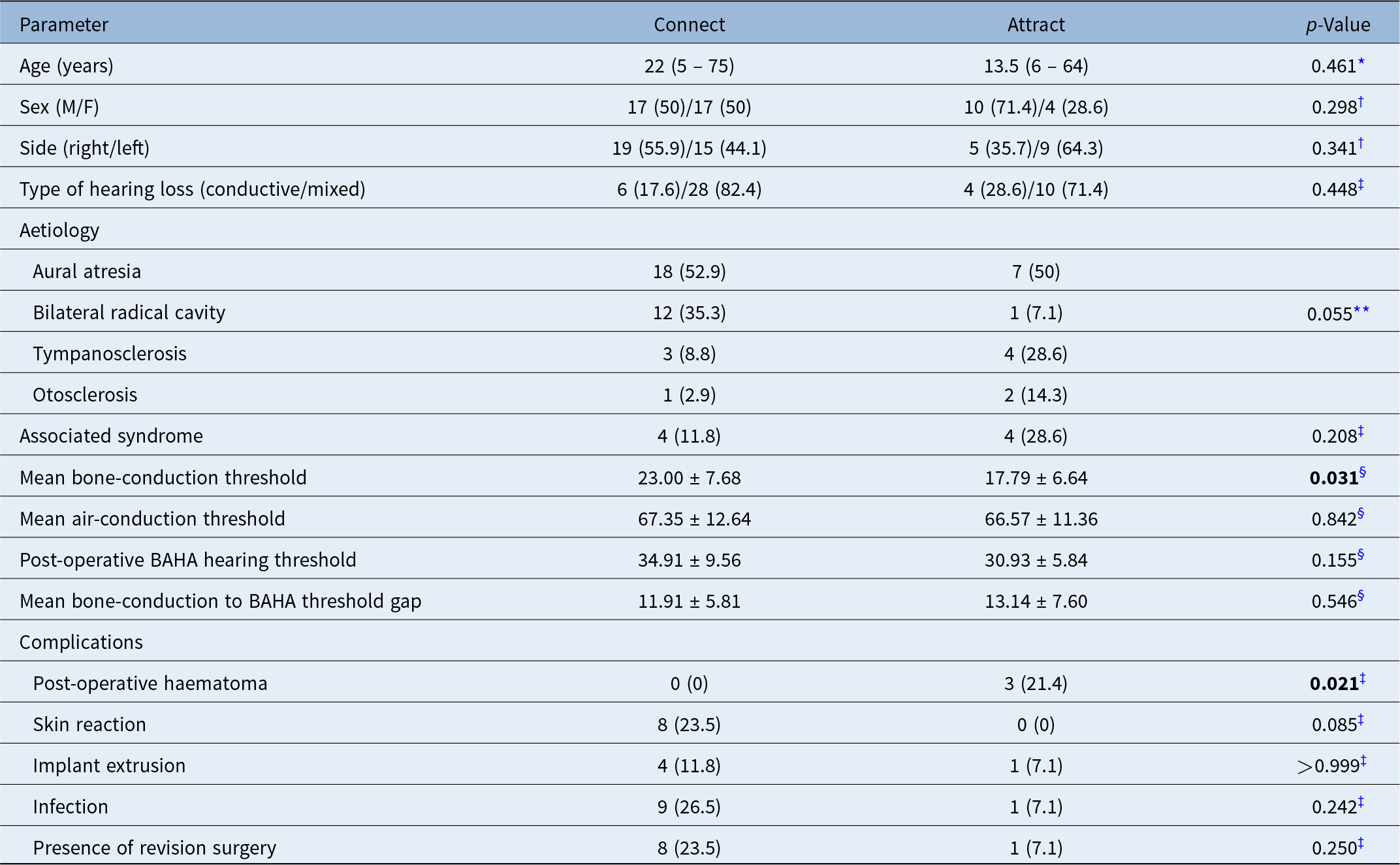
The Connect and Attract patient groups were comparable in terms of age (median 22 years vs. 13.5 years; p = 0.461) and sex distribution (17/17 vs. 10/4; p = 0.298) (p > 0.05) (Table 1). In the Connect group, 19 implants were placed in the right ear and 15 in the left ear, whereas in the Attract group, five were placed in the right ear and nine in the left ear. Two patients had Goldenhar syndrome (Connect system; neither required revision surgery), one patient had Lujan–Fryns syndrome (Attract system), one had Kabuki syndrome (Connect system) and one had Tetralogy of Fallot (Attract system). No significant differences were observed between groups regarding hearing loss type, etiology or associated syndromes (p > 0.05) (Table 1).
Patient demographic and audiological data

Table 1 Long description
Parameters compare Connect and Attract groups with a p Value column for each row. Age in years was 22 with range 5 to 75 for Connect and 13.5 with range 6 to 64 for Attract, p Value 0.461. Sex, M and F, was 17 and 17 for Connect and 10 and 4 for Attract, p Value 0.298. Side, right and left, was 19 and 15 for Connect and 5 and 9 for Attract, p Value 0.341. Type of hearing loss, conductive and mixed, was 6 and 28 for Connect and 4 and 10 for Attract, p Value 0.448. Under Aetiology, Aural atresia was 18 and 7 with p Value 0.055, Bilateral radical cavity was 12 and 1, Tympanosclerosis was 3 and 4, and Otosclerosis was 1 and 2. Associated syndrome was 4 for Connect and 4 for Attract, p Value 0.208. Mean air conduction threshold was 67.35 plus or minus 12.64 for Connect and 66.57 plus or minus 11.36 for Attract, p Value 0.842; post operative BAHA hearing threshold was 34.91 plus or minus 9.56 and 30.93 plus or minus 5.84, p Value 0.155; mean bone conduction to BAHA threshold gap was 11.91 plus or minus 5.81 and 13.14 plus or minus 7.60, p Value 0.546. Under Complications, post operative haematoma was 0 and 3, p Value 0.021; skin reaction was 8 and 0, p Value 0.085; implant extrusion was 4 and 1, p Value greater than 0.999; infection was 9 and 1, p Value 0.242; presence of revision surgery was 8 and 1, p Value 0.250.
* Mann–Whitney U test.
† Chi-squared test with Yates contiunity correction. ‡
** Pearson chi-squared test.
§ Student’s t-test.
Although air-conduction thresholds did not differ significantly between groups, bone-conduction thresholds were significantly poorer in the Connect group compared to the Attract group (p = 0.031) (Table 1; Fig. 1). The mean post-operative BAHA threshold was 34.91 ± 9.56 dB in the Connect group and 30.93 ± 5.84 dB in the Attract group, with no statistically significant difference between groups (p > 0.05) (Table 1; Fig. 1). When evaluating the gain between mean bone-conduction thresholds and mean BAHA thresholds, the Attract system showed slightly lower hearing gain; however, this difference was not statistically significant (p > 0.05) (Fig. 1).
Audiological outcomes of the Connect and Attract systems.

Figure 1 Long description
A bar chart comparing Connect and Attract. The x-axis label is Study Groups. The y-axis label is Air conduction threshold. The y-axis tick labels are 0, 10, 20, 30. Text above the plot reads, T test, t46 equals 2.22, p equals 0.031, n equals 48. The Connect bar is higher than the Attract bar. Each bar includes multiple dot markers and vertical whiskers. The image B showing a bar chart comparing Connect and Attract. The x-axis label is Study Groups. The y-axis label is Bone conduction threshold. The y-axis tick labels are 0, 25, 50, 75. Text above the plot reads, T test, t46 equals 0.2, p equals 0.84, n equals 48. The Connect and Attract bars are at similar heights. Each bar includes multiple dot markers and vertical whiskers. The image C showing a bar chart comparing Connect and Attract. The x-axis label is Study Groups. The y-axis label is Postoperative BAHA threshold. The y-axis tick labels are 0, 20, 40, 60. Text above the plot reads, T test, t46 equals 1.45, p equals 0.15, n equals 48. The Connect bar is slightly higher than the Attract bar. Each bar includes multiple dot markers and vertical whiskers. The image D showing a bar chart comparing Connect and Attract. The x-axis label is Study Groups. The y-axis label is Difference between BAHA threshold and BC. The y-axis tick labels are 0, 10, 20, 30. Text above the plot reads, T test, t46 equals negative 0.61, p equals 0.55, n equals 48. The Connect and Attract bars are at similar heights. Each bar includes multiple dot markers and vertical whiskers.
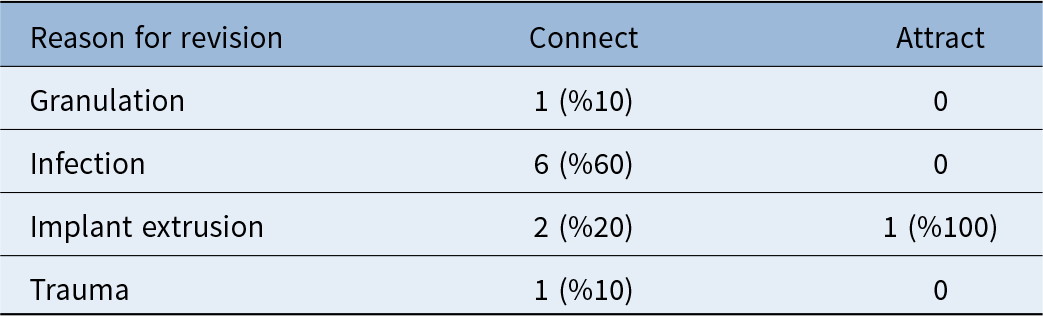
In our study, the follow-up duration ranged from six months to five years in the Connect group, whereas it varied between six months and two years in the Attract group. No intra-operative complications were observed in any case. Early post-operative haematoma occurred more frequently in the Attract group (p = 0.021; Table 1); however, these cases were limited to the first three Attract implantations, and no haematomas were observed in subsequent procedures. Skin reactions occurred in 23.5 per cent of Connect patients, whereas no skin reactions were observed in the Attract group. Implant extrusion rates were 11.8 per cent in the Connect group and 7.1 per cent (one patient) in the Attract group. The single Attract extrusion case involved a patient initially implanted with the Connect system who underwent revision surgery with the Attract system and had Klinefelter syndrome. Infection rates were 26.5 per cent in the Connect group and 7.1 per cent in the Attract group. Revision surgery was required in 23.5 per cent of Connect cases and 7.1 per cent of Attract cases (Table 2). One Connect patient underwent two revision surgeries due to trauma-related implant detachment, and a third revision was performed with the Attract system for another trauma-related case; this patient showed no complications at two years post-operatively.
Reasons for revision surgery

Table 3 Long description
Counts and percentages are listed for reasons for revision across two columns, Connect and Attract. Connect reports granulation 1, 10 percent; infection 6, 60 percent; implant extrusion 2, 20 percent; and trauma 1, 10 percent. Attract reports implant extrusion 1, 100 percent. Attract reports 0 for granulation, infection, and trauma.
Overall, complications were generally lower in the Attract group; however, the differences between the groups were not statistically significant (p > 0.05; Table 1)
Discussion
The most important finding of our study is that the Attract system achieved hearing gains similar to those of the Connect system while demonstrating a substantially lower revision rate. However, the lack of a statistically significant difference in revision rates between the two systems is likely attributable to the limited sample size.
Initially, BAHA was primarily used for auditory rehabilitation in patients with auricular atresia. Over time, its indications have expanded to include individuals with recurrent external auditory canal infections, auricular deformities, tympanosclerosis and mastoidectomy cavities.Reference Kruyt, Bakkum, Caspers and Hol1, Reference De Vito, Bruschini, Forli and Berrettini2, Reference Oberlies, Castaño, Freiser, McCoy, Shaffer and Jabbour6
As a general principle, patients with an average bone-conduction threshold of 45 dB or better have been reported to benefit more significantly from BAHA implantation.Reference Kruyt, Bakkum, Caspers and Hol1, Reference Crowson and Tucci3 BAHA surgery is not recommended for individuals with psychiatric disorders, those with drug or alcohol dependence or children under five years of age whose temporal bone thickness has not yet fully developed.Reference Doshi and McDermott4 In the literature, studies have reported no significant difference in hearing thresholds between patients using the Connect and Attract systems when all frequencies are considered; however, the Connect system has been shown to provide 5–10 dB better thresholds at higher frequencies, particularly around 4000 Hz.Reference Iseri, Orhan, Tuncer, Kara, Durgut and Guldiken7–Reference Mungan Durankaya, Olgun, Kiremitçi, Evin Eskicioğlu, Güneri and Kirazli9 Similarly, Oberlies and colleagues also reported no significant difference in hearing outcomes between the two systems.Reference Oberlies, Castaño, Freiser, McCoy, Shaffer and Jabbour6 There are also studies in the literature reporting that speech recognition threshold (SRT) values are superior in patients using the Connect system.Reference Iseri, Orhan, Tuncer, Kara, Durgut and Guldiken7, Reference Portelli, Ciodaro, Loteta, Alberti and Bruno10 In our study, similar to the existing literature, no significant difference was observed between the hearing thresholds of the two systems. Unlike previous reports, however, we evaluated the effect of each system on hearing gain by calculating the difference between patients’ bone-conduction thresholds and aided thresholds. Although the difference did not reach statistical significance, the Connect system demonstrated a slightly greater hearing gain. We believe that this difference should be re-evaluated in a study with a larger sample size to achieve more robust conclusions.
In BAHA procedures, minor intra-operative complications such as bleeding and subcutaneous haematoma may occur, as well as late complications including soft-tissue necrosis around the implant, keloid formation, hypertrophic scarring and infection.Reference Kruyt, Bakkum, Caspers and Hol1, Reference Oberlies, Castaño, Freiser, McCoy, Shaffer and Jabbour6, Reference Mungan Durankaya, Olgun, Kiremitçi, Evin Eskicioğlu, Güneri and Kirazli9 Due to the challenges associated with abutment care in the Connect system, as well as the complications that may arise from percutaneous abutments, magnet-based models (known as the Attract system) were developed as an alternative approach. In this design, the connection between the sound processor and the implant is achieved through a magnet placed on the implant, thereby eliminating the need for a transcutaneous abutment.Reference Luque, Liu, Pauwels, Leitmeyer and Chadha5 In the Connect system, excessive soft tissue growth can extend over the abutment, potentially interfering with the use of the hearing device.Reference Kruyt, Bakkum, Caspers and Hol1, Reference Oberlies, Castaño, Freiser, McCoy, Shaffer and Jabbour6 This issue is the most common indication for revision surgery.Reference Kruyt, Bakkum, Caspers and Hol1 Abutments of varying lengths have been introduced to prevent and manage these complications.Reference Kruyt, Bakkum, Caspers and Hol1, Reference Oberlies, Castaño, Freiser, McCoy, Shaffer and Jabbour6 In particular, abutment care is especially critical in patients with the Connect system, and careful patient selection is essential to address this requirement.Reference Luque, Liu, Pauwels, Leitmeyer and Chadha5 Due to increased susceptibility to trauma, ongoing temporal bone development and limited ability to maintain implant care, the Attract system has been reported to be a more suitable option for the paediatric population.Reference Oberlies, Castaño, Freiser, McCoy, Shaffer and Jabbour6, Reference Bere, Vass, Perenyi, Tobias and Rovo11 Oberlies and colleagues reported higher rates of skin reactions and infections in Connect system applications compared to the Attract system.Reference Oberlies, Castaño, Freiser, McCoy, Shaffer and Jabbour6 In the same study, one-year post-operative follow-up revealed a complication rate of 41.2 per cent and a revision surgery rate of 29.4 per cent for the Connect system, whereas the Attract system demonstrated a complication rate of 20.8 per cent and a revision surgery rate of 0 per cent.Reference Oberlies, Castaño, Freiser, McCoy, Shaffer and Jabbour6 In our study, consistent with the literature, patients implanted with the Connect system exhibited higher rates of both complications and revision surgeries compared to the Attract system; however, these differences were not statistically significant. Despite including a sample size comparable to ours, Oberlies et al. reported a significantly higher rate of skin overgrowth in the connect group, in contrast to our findings. When examining the discrepancy between their study and ours, we believe that a methodological issue in their statistical approach likely accounts for this divergence. For example, Oberlies et al. stated that none of the patients in the attract group (24/24; 100 per cent) exhibited skin overgrowth, whereas 14 of 17 patients in the connect group (82.4 per cent) did. They concluded that this difference was statistically significant and that skin overgrowth occurred more frequently with the connect system. However, our re-analysis of their dataset showed that skin overgrowth was originally classified into three categories: none, once and twice. When these categories are collapsed and analyzed without distinction, the difference becomes statistically significant; yet when the original ordinal structure is preserved, the significance disappears (Fisher–Freeman–Halton χ2 = 4.043; p = 0.064). This highlights the importance of critically evaluating the statistical methods used in published studies, as analytical choices may substantially influence the interpretation of results. In our study as well, although the connect group exhibited a higher rate of local wound complications, the difference did not reach statistical significance. We believe this is primarily attributable to sample size limitations and that studies with larger cohorts may reveal more pronounced differences. Additionally, post-operative haematoma was significantly more frequent in patients receiving the Attract system. Generally, newly introduced surgical procedures carry a higher risk of complications compared to established techniques. In our series, the initial Attract cases showed a higher incidence of haematoma, which was attributed to the wider flap elevation required for this system compared to the Connect system. Consequently, for all subsequent Attract procedures following the first three cases, a drain was placed in the inferior portion of the flap. Following this adjustment, no wound-site complications were observed in the subsequent series of 11 Attract system patients. However, the most important limitation of our study regarding the Attract system is that some patients are in the sixth month of their follow-up period.
• Bone-anchored hearing devices can be applied across a wide age range for various etiologies
• No significant difference was observed between the two systems (Attract and Connect) in post-operative audiological performance or hearing gain
• Skin reactions and infections were more frequent in the Connect group, whereas early post-operative haematoma was initially more common in the Attract group
• Revision surgery was predominantly required in Connect system patients, and conversion to the Attract system resulted in favourable post-operative outcomes
• The Attract system may represent a more suitable option for paediatric patients and individuals with poor skin-care compliance or increased risk of soft-tissue complications
Conclusion
Bone-anchored hearing devices can be applied across a wide age range for various etiologies. When choosing between the two available systems, Attract or Connect, the selection should be made on an individual patient basis. We consider it noteworthy that, in our study, the vast majority of cases requiring revision surgery occurred in the Connect group and that patients who subsequently underwent conversion to the Attract system experienced no complications during at least six months of post-operative follow-up. Early post-operative haematoma observed in the Attract group was completely eliminated through optimization of the surgical technique. Although differences in complication and revision rates between the two systems were not statistically significant, this is likely related to the limited sample size. Larger-scale studies are warranted to clarify potential differences between the systems, particularly regarding hearing gain and long-term surgical outcomes. The retrospective nature of this study and the small sample size are among its primary limitations. Nevertheless, our findings suggest that the Attract system may be a more suitable option for paediatric patients, hyperactive individuals, those with poor adherence to skin care and patients at higher risk for soft-tissue complications.
Competing interests
There is no conflict of interest between all authors.
Funding
No financial support received.
Author contributions
Bülent Ulusoy: Study design, literature review, operation, article writing. Serhat Pazır: Literature review. Bahar Çolpan: Literature review, operation. Muslu Kazım Körez: Statistical analysis. All authors have reviewed and approved the final version of the manuscript.
Ethics statement
The study was conducted in accordance with the principles of the Declaration of Helsinki and was approved by the Institutional Ethics Committee of our institution.
This manuscript is original, has not been published previously and is not under consideration for publication elsewhere.