Introduction
Psychiatric disorders are traditionally treated and monitored in mental health care facilities. These facilities are usually independent of general hospitals which limit the implementation of integrated health care. As a result, psychiatric care is mostly structured on disease-based traditional care models and do not fit older persons with multimorbidity and geriatric syndromes (Fabbri et al., Reference Fabbri, Zoli, Gonzalez-Freire, Salive, Studenski and Ferrucci2015; Hopman et al., Reference Hopman2016). Reasons for a worse prognosis among several psychiatric disorders are a matter of discussion and are originated much beyond the consequences of mental problems. The concept of “accelerated biological aging” associated with psychiatric disorders came along with the evidence that severe mental illnesses are associated with premature mortality and an increased risk of multimorbidity (Bersani et al., Reference Bersani2020). Frailty has been conceptualized as a marker of the biological age on top of the chronological age of a person but is hardly applied in psychiatry (Rockwood and Howlett, Reference Rockwood and Howlett2018).
Frailty is a dynamic biological geriatric syndrome of increased vulnerability to poor resolution of homeostasis after a stressing event, which increases the risk of adverse outcomes (Dent et al., Reference Dent2019). Frailty is an important prognostic marker since several negative health outcomes are associated, such as disabilities (Kojima, Reference Kojima2017), recurrent falls (Cheng and Chang, Reference Cheng and Chang2017), institutionalization (Kojima, Reference Kojima2018), greater costs to health care services (Kojima, Reference Kojima2019), and death (Kojima et al., Reference Kojima2018). A wide variety of unfavorable outcomes makes sense since frailty is conceptualized as an accelerated decrease of reserve in multiple physiological systems (Fried et al., Reference Fried2001). Finally, frailty can be seen as a maladaptive aging or “accelerated biological aging.”
Approximately one in 10 older adults is frail according to a systematic review (Collard et al., Reference Collard, Boter, Schoevers and Oude Voshaar2012). Two dominant operationalizations of frailty and most widely accepted are (1) the deficit accumulation model (aka as the Frailty Index [FI]), establishing that the proportion of aging-related health deficits reflects biological age over chronological age (Mitnitski et al., Reference Mitnitski, Mogilner and Rockwood2001) and (2) the Fried Frailty Phenotype (Fried et al., Reference Fried2001), which is a physical profile, marked by an underlying physiologic state of multisystem and energy dysregulation. The multidimensional concept of frailty as a state of age-related deficit accumulation (Mitnitski et al., Reference Mitnitski, Mogilner and Rockwood2001) may be adequate to improve psychiatric assessment with a clinical-friendly evaluation of the individual’s biological age (Bersani et al., Reference Bersani2020). The FI proposes that the variability and longitudinal trajectories in health outcomes in people with the same age are strongly related to the proportion of accumulated deficits during life (Mitnitski et al., Reference Mitnitski, Mogilner and Rockwood2001; Rockwood and Mitnitski, Reference Rockwood and Mitnitski2007). Quantifying negative health variables and their cumulative effect can provide a useful estimate of the biological age and prognosis (Kojima et al., Reference Kojima2018). Moreover, the FI is a continuous grading of frailty and increases with advancing age, thus providing the possibility that FI is a reliable measure of biological aging (Rockwood and Howlett, Reference Rockwood and Howlett2019). Finally, these characteristics of the FI have been observed in different age samples, in several disease conditions, and even in different species (Rockwood et al., Reference Rockwood2017). Nevertheless, detecting frailty in non-geriatric environments, such as psychiatry (and even geriatric psychiatry) can be challenging due to specialty constraints, time limitations, and lack of geriatric training. In this reality, using simple instruments such as the FRAIL questionnaire, based mainly on the Fried Frailty Phenotype, can be helpful and is highly recommended in international consensus (Dent et al., Reference Dent2019; Morley et al., Reference Morley, Malmstrom and Miller2012).
Current evidence points to an increased risk of becoming frail or being frail among older adults with psychiatric illness (Andrew and Rockwood, Reference Andrew and Rockwood2007). Additionally, these patients appear to experience the highest levels of frailty (Andrew and Rockwood, Reference Andrew and Rockwood2007; Gale et al., Reference Gale, Cooper, Deary and Aihie Sayer2014). The majority of studies are related to depression and anxiety, with a high prevalence of frailty (4–57%) and involving mostly community persons (Collard et al., Reference Collard, Comijs, Naarding and Oude Voshaar2014, Reference Collard, Arts, Schene, Naarding, Oude Voshaar and Comijs2017; Lohman et al., Reference Lohman, Mezuk and Dumenci2017; Ni Mhaolain et al., 2012; Soysal et al., Reference Soysal2017). Among these studies, mental illness and frailty appear to have a bidirectional relationship. Only a few studies evaluated mixed patient samples and psychogeriatric inpatients, who are supposed to be more frail and deserve a multidisciplinary high quality of care (Benraad et al., Reference Benraad2020a, Reference Benraad2020b; Stolz et al., Reference Stolz, Rásky and Jagsch2020). Frailty was a predictive factor for mortality and admission to long-term care facilities among psychogeriatric inpatients (Benraad et al., Reference Benraad2020a, Reference Benraad2020b; Stolz et al., Reference Stolz, Rásky and Jagsch2020). A recent systematic review showed that no frailty assessment tool was developed for or had its reliability or validity tested for psychogeriatric samples (Sutton et al., Reference Sutton2019).
Given the high comorbidity of frailty and psychiatric disorders in late life, their close associations and similar risk for adverse outcomes, the identification of potentially reversible conditions such as frailty is key to patient-centered care. Yet, little is known about frailty prevalence and associated factors, including other adverse outcomes beyond death, among geriatric psychiatry inpatients. In line with this, we aimed to evaluate the prevalence, clinical determinants, and consequences (falls and hospitalization) of frailty in older adults with mental illness admitted to a specialized psychogeriatric ward. We hypothesize that frailty is associated with multiple physical (e.g. chronic somatic diseases) and psychiatric (e.g. psychotropic drugs) variables, and also to adverse events such as falls and hospitalizations. We explored these objectives using the two most widely used frailty instruments, that is, the deficit accumulation model by 36-item FI and the FRAIL questionnaire, a simple instrument mostly based on the frailty phenotype model.
Methods
Study design and procedures
We conducted a retrospective clinical cohort study including a consecutive sample of patients admitted to the geriatric psychiatry ward of the Everett hospital, Cambridge Health Alliance, Boston, USA, between July 2018 and June 2019. All patients aged 65 years old and over were included (n = 252). Eight inpatients were excluded from this study due to missing data in their electronic medical records. Psychiatric disorders were classified according to the fifth edition of the Diagnostic and Statistical Manual of Mental Disorders during a multidisciplinary consensus meeting involving geriatric psychiatrists, psychiatry residents, geriatric psychiatry fellows, specialized nurses, and pharmacists, psychologists and social workers.
Four trained researchers retrieved clinical information from each participant’s medical record inside the EPIC with the patient at the heart electronic medical record system. Most of the information was yielded from the admission file. However, complementary information was accessed throughout patients’ records during their admission period. Data collection took 3–4 h of daily work for 4 months. A data extraction protocol was preestablished to extract the following information: (1) general characteristics: medical record number, patient’s name, age, sex, ethnicity, educational level, number of clinical comorbidities, number of non-psychotropic medications, and presence of current infection; (2) primary psychiatry disorder, that is, unipolar depressive disorder, bipolar disorder, schizophrenia and other primary psychosis, anxiety disorder, panic disorder, obsessive-compulsive disorder, post-traumatic stress disorder, attention-deficit hyperactive disorder, substance abuse, personality disorder, dementia (of Alzheimer’s type, vascular, Lewy, Mixed type, Parkinson’s, frontotemporal, other non-specified type), and suicidal ideation; (3) reason for hospital admission: agitation/anxiety, confusion, mood disorder instability/complication, psychosis, substance abuse, and suicidal behavior; (4) psychotropic medication: selective serotonin reuptake inhibitor, norepinephrine and serotonin reuptake inhibitor, other antidepressant, benzodiazepine, lithium, valproate, lamotrigine, carbazepine, oxcarbazepine, levetiracetam, antipsychotic drugs, memantine, donepezil, gabapentin, and the total number of psychotropics prescribed; (5) frailty instruments: all five components of the FRAIL and all items of a FI with 36 variables (as described below); and finally (6) frailty-associated outcomes: hospital admissions in the last 12 months and presence of unprovoked falls in the last 6 months.
Ethical considerations
The study followed international ethical standards stipulated by the Helsinki Convention. The local ethical review board approved this study. All participants gave informed written consent.
Measurement
Frailty was assessed according to two common instruments, that is, the FRAIL questionnaire (Morley et al., Reference Morley, Malmstrom and Miller2012) and the deficit accumulation model (Mitnitski et al., Reference Mitnitski, Mogilner and Rockwood2001):
-
(1) The FRAIL questionnaire is a self-report frailty screening scale. The FRAIL assesses the presence of fatigue, muscle resistance, ambulation, disease burden, and weight loss based on the following criteria: (1) fatigue: the answers “all the time” or “most of the time” to the question “How much of the time during the past 4 weeks did you feel tired?”; (2) resistance: “yes” to the question “By yourself and not using aids, do you have any difficulty walking up 10 steps without resting?”; (3) ambulation: “yes” to the question “By yourself and not using aids, do you have any difficulty walking several hundred yards?”; (4) illness: the presence of five or more illnesses out of 11; and (5) loss of weight: respondents with a weight loss ≥5% of their total weight within 1 year. Each affirmative answer results in 1 point. The classification consists of 0 points: robust; 1–2: prefrail; and 3–5: frail (Morley et al., Reference Morley, Malmstrom and Miller2012). The instrument lacks any specialized training or equipment requirements, is very fast, and can be performed without a review of medical charts and physical maneuvers (Aprahamian et al., Reference Aprahamian2017, Reference Aprahamian2019). It facilitates the assessment of frailty and its five questions can be yielded from medical records and present similar prognostic accuracy as more complex instruments (Lin et al., Reference Lin2018).
-
(2) A 36-item FI is the proportion of health deficits derived from a count of 36 health deficits across different health domains. The total score is a stronger predictor for adverse health outcomes than the sum of the single variables (Rockwood and Mitnitski, Reference Rockwood and Mitnitski2007). The present FI was based on a previous validated and published index (Clegg et al., Reference Clegg2016). We assessed the following 36 health deficits (as a binary approach, yes or no): anemia, arthritis, cognitive impairment, visual impairment, diabetes, dyspnea, chronic renal disease, sleep disorder, peripheral vascular diseases, urinary tract disorders, thyroid disease, respiratory disease, cerebrovascular disease, ischemic heart disease, atrial fibrillation, fracture, hypertension, syncope, heart failure, urinary incontinence, disability, care dependency, osteoporosis, falls, parkinsonism and related disorders, loss of appetite or anorexia, polypharmacy, foot disorders, mobility problems, obesity, hearing loss, valvulopathy, dizziness, social vulnerability, pressure ulcers, and peptic ulcers. The FI can be interpreted as follows: a score <0.15 indicates robustness, a score of 0.15–0.25 as prefrail, and a score >0.25 as frail (Rockwood and Mitnitski, Reference Rockwood and Mitnitski2007).
Statistical analyses
We analyzed the data using the Statistical Package of the Social Sciences (SPSS), version 21 (Armonk, NY: IBM Corp.). All continuous variables did not show a normal distribution according to Shapiro–Wilk and Kolmogorov–Smirnov test. Descriptive statistics with mean, standard deviation, and ranges for continuous variables and percentages for categorical variables were performed for the characterization of the total sample. Mann–Whitney test was used in order to compare frail versus non-frail groups for continuous variables. Diagnostic psychiatric groups (presence versus absence) and the presence of frailty were compared using the chi-square test. Multiple linear regression analyses were conducted to evaluate the association between frailty identified through the FI and the FRAIL questionnaire and sample demographics (age, female sex, and non-Caucasian ethnicity) and clinical characteristics (dementia, number of clinical/somatic diseases, current infection, and number of psychotropic and non-psychotropic medications in use). Multiple regression between the different frailty assessments as independent variable and either falls (presence at least one during the retrospective period; logistic regression) or the number of hospital admissions (number in the last 12 months; negative binomial regression) in the last 6 and 12 months, respectively, were analyzed and adjusted for covariates (all demographic and clinical characteristics). The evaluation of multicollinearity was performed in all regression analysis through the variance inflation factor test with the threshold of < 3. R-squared measures were calculated for all possible regression models. All p-values were tested and p values < 0.05 were considered statistically significant.
Results
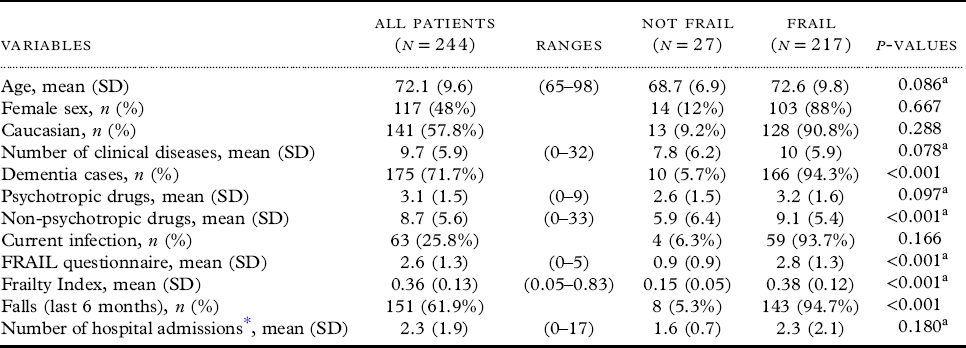
Demographics and clinical characteristics of the patients according to frailty status are shown in Table 1. The sample was balanced between sexes and the majority of patients had dementia. A high mean of the number of clinical (somatic) diseases and polypharmacy (75% of the sample presented five medications or more in use) was observed.
Clinical characteristics of the total sample and according to frailty status

Note: n = number; SD = standard deviation; *past year; p-values were calculated using chi-square test; except for aMann–Whitney test.
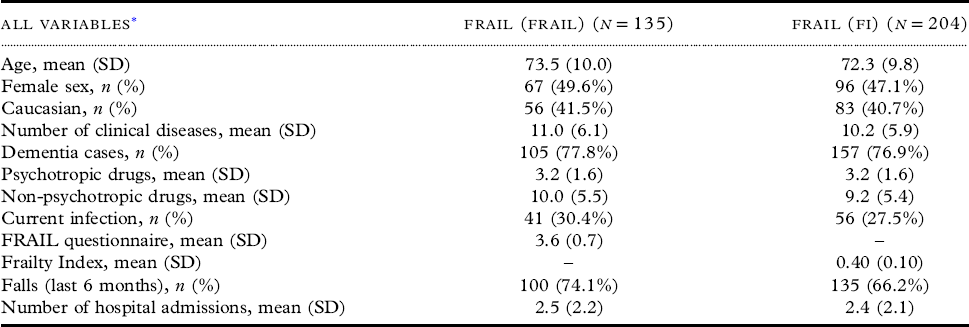
Prevalence of frailty was high, that is, 204 (83.6%) patients according to the FI and 135 (55.3%) patients according to the FRAIL questionnaire. And 122 (50%) patients were classified as frail according to both measures (FRAIL and FI), 82 (33.6%) only according to the FI, 13 (5.3%) only according to the FRAIL, and 27 (11.1%) were not frail. There is no statistically significant difference related to the main characteristics of the patients after frailty measurements (Table 2).
Frailty was significantly higher among dementia patients compared to non-dementia patients according to the FRAIL (χ 2 = 5.4, df = 1, p = 0.019) and the FI (χ 2 = 13.8, df = 1, p < 0.001). Frailty was also more frequent among patients with a primary psychotic disorder compared to non-psychotic patients according to the FI (χ 2 = 13.9, df = 1, p < 0.001) but not according to FRAIL (χ 2 = 3.2, df = 1, p = 0.071). Of the total sample, 61.9% has at least one fall in the previous 6 months, and the average number of hospital admissions was 2.3 in the previous year.
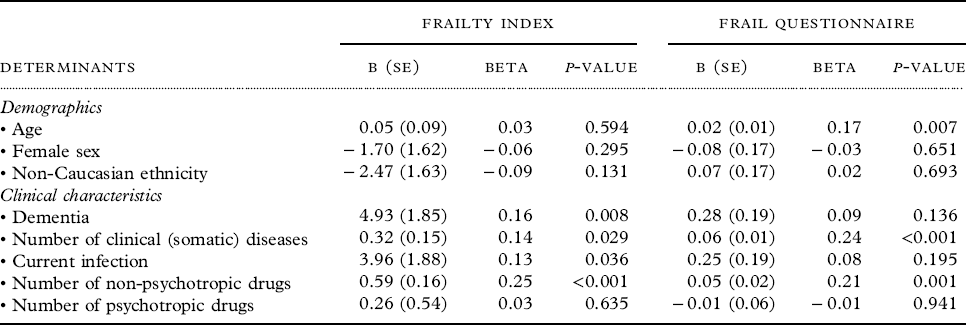
Multiple linear regression analyses of demographic and clinical variables on frailty are shown in Table 3. Age, the number of clinical (somatic) diseases, and the number of non-psychotropic medications were independently associated with frailty identified by the FRAIL. Dementia, current infection, the number of clinical (somatic) diseases, and the number of non-psychotropic medications were independently associated with frailty according to the FI.
Clinical characteristics (n = 244) according to frailty measurement

* No statistically significant difference between different frailty assessments.
Multiple linear regression analyses between independent variables and frailty measures

Note: R-squared 0.169 and 0.167 for Frailty Index and the FRAIL, respectively. Variance inflation factor between the number of clinical (somatic) diseases, the Frailty Index, and the FRAIL ranged from 1.0 to 1.22.
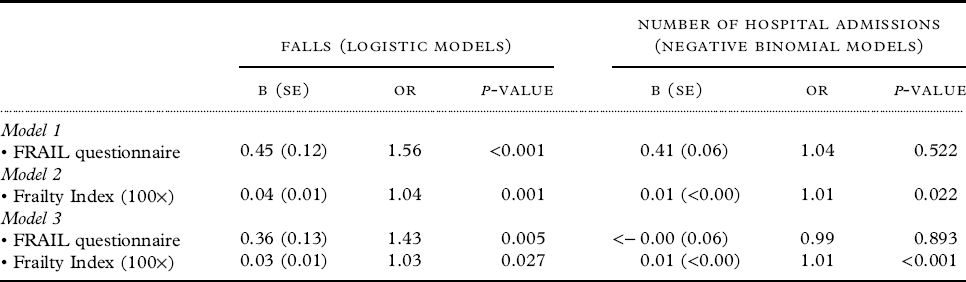
Multiple regression analyses between the different frailty assessments and either falls or the number of hospital admissions are presented in Table 4. Falls were significantly associated with both frailty instruments (see Table 4, Model 1 and 2). Including both frailty measures in one model showed that both measures were significantly associated with falls independent of each other. Regarding hospital admission, however, we found only a significant association with the FI and not with the FRAIL questionnaire.
Multiple regression analyses between the different frailty assessments and either falls or number of hospital admissions adjusted for covariates

Note: logistic regression R-squared 0.160, 0.149, and 0.177 for Model 1, 2, and 3, respectively. Variance inflation factor between the number of clinical (somatic) diseases, the Frailty Index, and the FRAIL ranged from 1.25 to 1.30. Covariates adjusted in the models: age, female sex, non-Caucasian ethnicity, dementia, number of clinical diseases, current infection, number of non-psychotropic drugs, and number of psychotropic drugs.
Discussion
Main findings
In the present study, the prevalence of frailty was high among geriatric psychiatric inpatients (55% and 84% according to the FRAIL and FI instruments, respectively). The FI classifies more patients as frail, which may easily lead to ceiling effects when used as a diagnostic instrument (frailty present or absent). Nonetheless, this is no problem as the FI is a multidimensional measure with a large range and huge variability among frail older persons. Our study shows that even in a frail population, the FI remains associated with a history of falls as well as the number of previous hospitalizations (as a real frailty measure). On the other hand, the FRAIL questionnaire is only associated with falls and not hospitalization. This might be explained by the fact that FRAIL largely focuses on sarcopenia as an underlying concept as it is mainly based on physical frailty phenotype, whereas the FI assesses frailty more comprehensively. Nonetheless, being that specific, the FRAIL has additive predictive value for falls when applying next to the FI.
The prevalence of frailty among old age psychiatric inpatients seems to be high. Three previous studies report a prevalence from 52.5% to 59.2% (Benraad et al., Reference Benraad2020a, Reference Benraad2020b; Stolz et al., Reference Stolz, Rásky and Jagsch2020). However, a retrospective case-control study of 142 psychogeriatric inpatients with matched controls showed a higher prevalence (95.5%) (Stolz et al., Reference Stolz, Rásky and Jagsch2020). All these studies used FI as a measure of frailty and in two of them, the FI independently predicted mortality (Stolz et al., Reference Stolz, Rásky and Jagsch2020; Benraad et al., Reference Benraad2020b). Higher prevalence of frailty is observed among geriatric psychiatry inpatients when compared to a pooled mean of 9.9% for the phenotype criteria and 13.6% to multidimensional (e.g. FI) frailty criteria in community-dwelling older adults from high-income countries (Collard et al., Reference Collard, Boter, Schoevers and Oude Voshaar2012). One important observation is the higher prevalence among inpatients with dementia and primary psychotic disorders. The former condition is associated with frailty in longitudinal studies (Borges et al., Reference Borges, Canevelli, Cesari and Aprahamian2019). However, there is no previous consistent data published regarding the association between frailty and psychotic disorders. One possible hypothesis to explain this association is maybe a higher frequency of appetite or weight alterations, lower physical activity, and a higher prevalence of undertreatment of medical diseases among patients with psychotic disorders.
Independent determinants of the FI among psychiatric inpatients are a diagnosis of dementia, number of somatic diseases, current infection, and number of non-psychiatric drugs. Dementia and the number of non-psychotropic medications showed stronger associations. These determinants are more or less reflections of multimorbidity, which may point to the FI merely being an indicator of multimorbidity (Rockwood and Mitnitski Reference Rockwood and Mitnitski2007; Mitnitski et al., Reference Mitnitski, Mogilner and Rockwood2001). This is in line with a smaller cohort of 120 psychogeriatric inpatients in which the FI was also associated with multimorbidity and functional impairment (Collard et al., Reference Collard, Arts, Schene, Naarding, Oude Voshaar and Comijs2017). Also interesting is that we found that among psychiatric inpatients, age is not an independent determinant of the FI anymore. Although this finding contrasts with validation studies of the FI (Rockwood and Howlett Reference Rockwood and Howlett2019), age was also not associated with frailty in a previous study among psychogeriatric inpatients (Benraad et al., Reference Benraad2020a). This is most likely explained by the fact that the other determinants are all highly age-related and fits with the hypothesis that the FI is a measure of the “biological age” of a person (Bersani et al., Reference Bersani2020). From a clinical perspective, this finding points to the need for a comprehensive evaluation of geriatric psychiatry inpatients, as multiple chronic diseases and medications probably better predict adverse health outcomes than chronological age (Fabbri et al., Reference Fabbri, Zoli, Gonzalez-Freire, Salive, Studenski and Ferrucci2015; Hopman et al., Reference Hopman2016).
Interestingly, the FRAIL questionnaire remains independently associated with chronological age and not with the presence of dementia. Curiously, the mean age of frail inpatients according to the FRAIL questionnaire was the same to the non-frail group, despite of expectations of a higher mean age among frail individuals. This suggests that frailty according to this instrument still increases with age among psychiatry inpatients and may be a more specific indicator of physical frailty, or more specifically, sarcopenia (Aprahamian et al., Reference Aprahamian2017; Dent et al., Reference Dent2019; Morley et al., Reference Morley, Malmstrom and Miller2012). It is important to highlight that the FRAIL does not have objectively measures and four out five questions resemble components from the phenotype criteria. Thus, the FRAIL and the physical phenotype model are not identical. Originally, the FRAIL was elaborated to be a screening instrument proposed from a mix of components based on both phenotype and accumulated deficits model (Morley et al., Reference Morley, Malmstrom and Miller2012). The FRAIL instrument was also associated with multimorbidity and the number of non-psychotropic medication analogs to the FI. Finally, both frailty measures were independently associated with polypharmacy. This finding is in line with both cross-sectional and longitudinal studies showing an association between polypharmacy and frailty (Aprahamian et al., Reference Aprahamian2017; Aprahamian et al., Reference Aprahamian2019). Nonetheless, polypharmacy is generally not recognized as a risk factor for frailty but merely as a potential treatment target (Dent et al., Reference Dent2019). Moreover, reduction of inappropriate drug use appears to be beneficial for the prevention of frailty (Aprahamian et al., Reference Aprahamian2017).
Frailty is associated with adverse health events, such as falls, disability, hospital, and long-term care admissions, and death (Dent et al., Reference Dent2019; Fried et al., Reference Fried2001; Kojima Reference Kojima2017; Cheng and Chang Reference Cheng and Chang2017; Kojima Reference Kojima2018, Reference Kojima2019; Kojima et al., Reference Kojima2018). Previous studies involving geriatric psychiatric inpatients showed the prognostic value of frailty for mortality and admission to long-term care institutions (Benraad et al., Reference Benraad2020a, Reference Benraad2020b; Stolz et al., Reference Stolz, Rásky and Jagsch2020). Although we assessed adverse health effects like falls and hospital admissions retrospectively, it still adds some credibility to current evidence for a potential association of frailty with falls and hospital admissions. Additionally, frailty was not associated with the overall clinical impression (a disease severity scale) among psychogeriatric inpatients (Benraad et al., Reference Benraad2020a). Collectively, these findings may reflect the potential relevance of frailty for risk stratification of geriatric psychiatric inpatients, and again it reinforces that integrated health care would be of utmost importance. Although the FRAIL questionnaire is recommended for frailty screening (Dent et al., Reference Dent2019), our results suggest that a more comprehensively FI has additive value (Cesari et al., Reference Cesari, Gambassi, Abellan van Kan and Vellas2014). This again argues for integrated health care for psychogeriatric and older psychiatric inpatients.
Strengths and limitations
Firstly, the present study has some strengths to be highlighted. In addition to the use of different instruments to assess frailty, we evaluated the largest sample of psychogeriatric inpatients on this topic thus far. Moreover, previous evidence came from Europe and this study adds information from another continent and correspondent health system. Finally, our results were adjusted for several confounding factors including polypharmacy, which was not considered before. Nonetheless, some limitations should also be acknowledged. First, the adverse health effects associated with frailty were assessed retrospectively and may in fact have contributed to the emergence of frailty instead of vice versa. Other important variables associated with frailty, such as socioeconomic characteristics, were not collected in our study. Furthermore, the cross-sectional design also does not allow a causality connection between the clinical determinants and frailty. Secondly, data collection was based on chart review. Although the EPIC system is a fully integrated medical dossier, including data from psychiatric as well as other medical specialties and we had a strict data extraction protocol, we still have to rely on clinical judgment.
Conclusions
Frailty is highly prevalent among geriatric psychiatry inpatients. The FRAIL questionnaire and the FI may capture different forms of frailty dimensions, being the former more associated with the phenotype model and the latter more associated with multimorbidity. Collectively, our findings point to the need for comprehensive geriatric care for inpatients with mental illness, although this should be formally tested in randomized controlled trials.
Conflicts of interest
None.
Description of authors’ roles
I. Aprahamian designed the study, was responsible for the statistical design of the study and for carrying out the statistical analysis, wrote the paper, and supervised the development of the paper. A. Landowski, F.O. Ahn, B.A. Neves, and J.T. Rocha collected the data and assisted with writing the paper. J. Strauss supervised the data collection and assisted with writing the paper. M.K. Borges was responsible for carrying out the statistical analysis and assisted with writing the paper. J.E. Morley assisted with writing the paper. R.C. Oude Voshaar designed the study, was responsible for the statistical design of the study and for carrying out the statistical analysis, wrote the paper, and supervised the development of the paper.
Source of funding
Grant 2019/09421-5 from the São Paulo Research Foundation (FAPESP) and grant 126368/2019-8 from the National Council for Scientific and Technological Development (Ministry of Science, Technology, Innovation and Communications, Brazil). Dr. Ivan Aprahamian receives an individual national public grant level two (304069/2017-5) from the National Council for Scientific and Technological Development (Ministry of Science, Technology, Innovation and Communications, Brazil).