Introduction
Ecological interactions between parasites and neotropical reptiles have been the subject of a number of recent studies (e.g. Anjos et al., Reference Anjos, Rocha, Vrcibradic and Vicente2005; Almeida et al., Reference Almeida, Vasconcelos, Freire and Lopes2007, Reference Almeida, Costa, Freire and Vasconcelos2008; Ávila & Silva, Reference Ávila and Silva2010). In general, the number of parasites infecting a single host (i.e. intensity of infection) is related to individual body size, with larger individuals having higher parasite loads, possibly because of increased chances of infection during longer lifespans or due to niche divergences between juveniles and adults (Rocha, Reference Rocha1995). Differences in prey selection may also be a reason to explain any sex-based differences in prevalence and intensity of infection in reptiles (Ribas et al., Reference Ribas, Rocha, Teixeira and Vicente1995).
Endoparasites obtain all their nutrients from their hosts, and nematodes may feed on the intestinal contents or on the host tissues (Quinnell et al., Reference Quinnell, Medley and Keymer1990), which may induce energetically costly immunological responses (Lochmiller & Deerenberg, Reference Lochmiller and Deerenberg2000) leading to deficits in energy budgets of their hosts. Thereby, parasitized individuals might have less energy to invest in reproduction (Polack, Reference Polack1998; Bollache et al., Reference Bollache, Gambade and Cézilly2001), physiology (Hernández-Bello et al., Reference Hernández-Bello, Escobedo, Guzmán, Ibarra-Coronado, López-Griego and Morales-Montor2010), behaviour (De Jong-Brink & Koene, Reference De Jong-Brink and Koene2005) and ultimately survival (Fuller & Blaunstein, Reference Fuller and Blaustein1996), affecting the overall fitness of hosts (Schüpbach & Baur, Reference Schüpbach and Baur2008; Thomas et al., Reference Thomas, Poulin and Brodeur2010). For reptiles, authors have found different responses of hosts to parasites. For example, Hidalgo-Vila et al. (Reference Hidalgo-Vila, Martínez-Silvestre, Ribas, Casanova, Pérez-Santigosa and Díaz-Paniagua2011) reported that the nematode Serpinema microcephalus caused pancreatitis in red-eared slider turtles, Trachemys scripta elegans, with tissue destruction and inflammation. Madsen et al. (Reference Madsen, Ujvari and Olsson2005) found that the intensity of infection of a hematozoan blood parasite is negatively correlated with growth and condition in water pythons, Liasis fuscus. On the other hand, in the lizard Lacerta vivipara, blood parasite load was positively related to the relative clutch mass and investment per young in female lizards (Sorci et al., Reference Sorci, Clobert and Michalakis1996).
Amphisbaenians are fossorial reptiles and their burrowing habit presents difficulties when collecting large series of individuals from their natural environment. Hence, information regarding infection patterns for this reptile group is scarce. Nevertheless, studies have demonstrated that amphisbaenians may have an important role as hosts in the life cycle of some parasite species. For example, the species Amphisbaena alba is the final host of the pentastomid Raillietiella gigliolii (Winch & Riley, Reference Winch and Riley1985), and may show high prevalences of this nematode species (from 55% (Almeida et al., Reference Almeida, Sales, Santana, Vieira, Ribeiro, Alves and Nóbrega2009) to 86% (Winch & Riley, Reference Winch and Riley1985)) and an intensity of infection from 1 to 13 parasites (Almeida et al., Reference Almeida, Sales, Santana, Vieira, Ribeiro, Alves and Nóbrega2009).
The aim of the present study was to analyse the gastrointestinal helminth infection patterns in a population of the shovel-snouted amphisbaenid Amphisbaena wuchereri by measuring the level of aggregation (i.e. aggregation of parasites within the host population; Poulin, Reference Poulin1993), the prevalence and mean intensity of infection of parasites. Since females are larger than males in A. wuchereri (Filogonio et al., Reference Filogonio, Galdino, Cabral, Righi, Lopes and Nascimento2009), we compared the relative parasite load between the sexes. Additionally, we tested the effect of helminth loads on the storage of fat in the amphisbaenians. Reptiles typically have coelomic fat bodies and their size may represent the stored energy remaining from that spent on maintenance metabolism and growth, indicating the condition of the organism (Hayes & Shonkwiler, Reference Hayes, Shonkwiler and Speakman2001).
Materials and methods
Collection and examination of reptiles
Amphisbaenians in this study were collected by animal rescue groups, in October and November 2001, during the flooding process leading to the construction of the Santa Clara hydroelectric power plant in the municipalities of Nanuque and Serra dos Aimorés, Minas Gerais state, south-eastern Brazil (17°50′S, 40°21′W). This site is situated within the Atlantic rainforest biome and possessed forest fragments that were damaged as a result of timber extraction. Captured animals were transported to the hydroelectric laboratory and maintained in a ventilated wooden collection box (40 × 20 × 20 cm) for 2–3 days and were not fed during this period. Wet cotton pads were placed in the box to maintain humidity. Individuals were subsequently euthanized, fixed in 10% formalin, kept in a storage solution of 70% alcohol, and deposited at Museu de Ciências Naturais, Pontifícia Universidade Católica de Minas Gerais (MCNR 279-425), Brazil.
Prior to dissection in the laboratory, we measured the snout to vent length (SVL), subtracting tail length (measured with a caliper to the nearest 0.05 mm from the extreme posterior point of the cloacal flap to the tip of- the tail) from total length (measured with a measuring tape to the nearest 1 mm). Individuals were sexed by verifying the presence or absence of the everted hemipenis. The gonads were examined in individuals in which the hemipenis was not present in order to positively assign a sex to each individual. During dissections, we first removed the fat bodies located within the body cavity and dried them with paper towels for c. 30 min prior to weighing with a precision balance to the nearest 0.1 mg. Since fat body mass (FBM) can be affected by reproductive stage in squamate reptiles (e.g. Van Sluys et al., Reference Van Sluys, Mendes, Assis and Kiefer2002; Galdino et al., Reference Galdino, Assis, Kiefer and Van Sluys2003) we inspected gonads in order to verify reproductive condition of A. wuchereri. The gonads showed no overt sign of reproductive activity (see Filogonio et al., Reference Filogonio, Galdino, Cabral, Righi, Lopes and Nascimento2009). Hence, we are confident that all individuals of A. wuchereri were non-reproductive and, consequently, that FBM was not influenced by differences in reproductive state between individuals.
The gastrointestinal tract (stomach and small and large intestines) were removed and checked under a stereomicroscope for the presence of helminths. The taxonomic determination of helminths was carried out by morphological characters following Vicente et al. (Reference Vicente, Rodrigues, Gomes and Pinto1993) and Bursey (Reference Bursey2002). Parasites were cleared with lactophenol and analysed under a light microscope with the Leica Application Suite (LAS V5) computerized system (Leica Microsystems, Wetzlar, Germany). For each helminth species, we calculated the prevalence [(infected amphisbaenians/examined amphisbaenians) × 100] (Bush et al., Reference Bush, Lafferty, Lotz and Shostak1997) and the mean intensity of infection (arithmetic mean number of worms from infected amphisbaenians) (Bush et al., Reference Bush, Lafferty, Lotz and Shostak1997). Voucher specimens of the helminths were deposited at the Coleção Helmintológica do Instituto de Biociências (CHIBB, no. 5098-5099), Universidade Estadual Paulista – UNESP, Brazil.
Data analysis
Preliminary analyses were performed to test the normality and homoscedasticity of data and to choose the appropriate statistical tests. Descriptive statistics are presented as mean ± standard error (according to Bush et al., Reference Bush, Lafferty, Lotz and Shostak1997). The Spearman's Rank Correlation and Pearson's Correlation (Zar, Reference Zar1999) were used to evaluate the association between host size (SVL) and infection intensities in males and females, respectively. Differences in intensity of infection between sexes were tested using Mann–Whitney U-test. The discrepancy index (D), used to measure the level of aggregation, was calculated according to the equation:
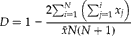 $$\begin{eqnarray} D = 1 - \frac {2{ \sum _{ i = 1}^{ N } }\,\left ({ \sum _{ j = 1}^{ i } }\, x _{ j }\right )}{ \bar {>x}N ( N + 1)} \end{eqnarray}$$
where x is the number of parasites in host j (hosts are ranked from the least to most infected) and N is the total number of hosts (Poulin, Reference Poulin1993). The index has a minimum value of zero (D= 0) if all hosts harbour the same number of parasites, and a maximum value (D= 1) if all parasites were found in a single host. This index was calculated with the software Quantitative Parasitology 3.0 (Rózsa et al., Reference Rózsa, Reiczigel and Majoros2000).
Mass is a function of body size (Le Cren, Reference Le Cren1951; Hayes & Shonkwiler, Reference Hayes, Shonkwiler and Speakman2001) and parasite intensity has been positively correlated with body size in a number of reptile species (e.g. Van Sluys et al., Reference Van Sluys, Rocha and Ribas1994, Reference Van Sluys, Rocha, Bergallo, Vrcibradic and Ribas1997; Vrcibradic et al., Reference Vrcibradic, Cunha-Barros, Vicente, Galdino, Hatano, Van Sluys and Rocha2000, Reference Vrcibradic, Rocha, Bursey and Vicente2002). Thus, comparisons between FBM and parasite intensity can be confounded by variations in body size. In order to minimize the effect of size on the relationship between parasite load and FBM only the 10 longest individuals of each sex were used to perform a linear regression of these variables. We used this methodology to meet the assumption of independency between size and mass pointed out by Green (Reference Green2001) for body condition analysis (see Results). Prior to analysis, FBM was cubic root transformed. The effect of parasites on FBM was tested for males and females separately.
Results
The study utilized 41 individuals of A. wuchereri. From these, 23 individuals were males (290 ± 15.0 mm SVL) and 18 females (352.1 ± 11.1 mm SVL). The only parasite found in the gastrointestinal tract of A. wuchereri was the nematode Paradollfusnema amphisbaenia (Nematoda: Cosmocercidae). All amphisbaenians were parasitized by at least one individual of P. amphisbaenia (overall prevalence = 100%). The mean intensity of infection was 116.2 ± 16.6 (range 1–467). The male hosts' mean intensity of infection was 110.7 ± 24.6 (range 1–467) and the females' mean intensity of infection was 130.0 ± 21.9 (range 11–317). However, this difference was not statistically significant (Mann–Witney; U= 174; P= 0.2). We also checked for differences in intensity of infection between the ten longest individuals of each sex and we found no intersexual difference (t= − 1.23, df = 18, P= 0.23).
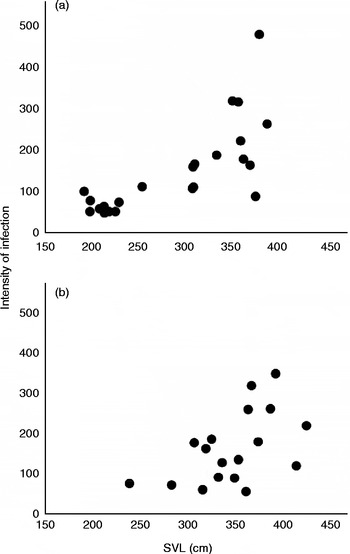
Regarding the infection sites, parasites were located in the large intestine of all host specimens (i.e. a prevalence of 100%). The mean intensity of infection in this site was 113.6 ± 16.8 (range 1–467). An infection range of 5–12 was found in the small intestine (prevalence of 7.3%), and one parasite was found in the stomach (prevalence of 2%). The body size of the amphisbaenian host had a positive influence on the intensity of infection (Spearman's rank correlation, r s= 0.70, P< 0.0001, n= 41), in both male hosts (Spearman's rank correlation, r s= 0.78, P< 0.0001, n= 23) and female hosts (Spearman's rank correlation, r s= 0.57, P< 0.01, n= 18) (fig. 1). The discrepancy index (D) for male hosts was D= 0.51 and for female hosts, D= 0.39. Overall discrepancy was D= 0.47.
Correlation between snout to vent length (SVL) and intensity of infection of Paradollfusnema amphisbaenia infecting Amphisbaena wuchereri at Minas Gerais state, Brazil. Spearman's rank correlation between SVL and intensity of infection to male hosts (a) r s= 0.78, P< 0.05, n= 23; and to female hosts (b) r s= 0.57, P< 0.01, n= 18.

In the ten longest individuals of each sex (body size range 310.90–388.85 mm, 359.10 ± 23.33, SVL of males; body size range 337.10–432.05 mm, 373.54 ± 28.8, SVL of females), SVL was not correlated with FBM (r 2= 0.08, P= 0.27, n= 20) or parasite intensity (r 2= 0.06, P= 0.15, n= 20). Hence, our analysis was not confounded by size effects and met the assumption of independency between size and mass for body condition analysis (Green, Reference Green2001). Males' FBM ranged from 0.56 to 4.53 g (1.90 ± 1.38 g) and females' FBM ranged from 1.20 to 4.50 g (2.75 ± 1.04 g) and, in both cases, FBM was not associated with parasite intensity (Spearman's rank correlation, r s= 0.24, P= 0.28, n= 10, for males; Pearson's correlation, r= 0.37, P= 0.14, n= 10, for females).
Discussion
Although other helminth species are known to infect amphisbaenians (Ávila & Silva, Reference Ávila and Silva2010), the nematode fauna found in the sampled population of A. wuchereri was composed solely of the species P. amphisbaenia. Paradollfusnema was created by Baker (Reference Baker1982) as a nomen novum replacing Dollfusnema Baker, 1981, preoccupied by Dollfusnema Caballero, 1974. There are two species in this genus, P. amphisbaenia, from the Brazilian amphisbaenian Amphisbaena microcephala ( = Leposternon phocaena Duméril and Bibron, 1839) (Vicente et al., Reference Vicente, Rodrigues, Gomes and Pinto1993), and the most recently described species Paradollfunsnema tellfordi Bursey, Reference Bursey2002 from the amphisbaenian Rhineura floridana from Florida, USA (Bursey, Reference Bursey2002). Hence, this finding constitutes a register of a new host for P. amphisbaenia and also extends its range of occurrence through south-eastern Brazil.
Amphisbaena wuchereri presented high prevalence (100%) and intensity of infection when compared to previous studies of parasitism of amphisbaenians. For example, Blanus strauchi presented a prevalence of 70% and the intensity of infection varied from one to two gastrointestinal helminths (Düşen et al., Reference Düşen, Uğurtaş and Aydoğdu2010); R. floridana had a prevalence of 50% and intensity of infection of one parasite per host infected (Telford & Bursey, Reference Telford and Bursey2003). The very high prevalence of P. amphisbaenia in A. wuchereri rules this out as an incidental case of parasitism and suggests that A. wuchereri constitutes a specific host for this helminth species.
As for other reptile species, intensity of infection was positively associated with the host's body size, evidencing ontogenetic differences in intensity of infection. Age differences in intensity of infection can be assigned to an increase in the chances of acquiring parasites during the lifetime of larger (i.e. older) lizards (Vrcibradic et al., Reference Vrcibradic, Rocha, Ribas and Vicente1999). Another hypothesis explaining ontogenetic differences in intensity of infection of parasites is that it might emerge as a consequence of segregation in diet between smaller (young) and larger (adults) individuals (Rocha, Reference Rocha1995). Unfortunately, due to the 3-day fasting period prior to killing for preservation, and the bad conservation of stomach contents, we were not able to evaluate dietary composition.
There were no differences in the intensity of parasite infection between males and females despite the females being longer than males (Filogonio et al., Reference Filogonio, Galdino, Cabral, Righi, Lopes and Nascimento2009). Sexual size dimorphism can lead to different microhabitat utilization (Schoener, Reference Schoener1968) or to segregation in diet between sexes (Gomes et al., Reference Gomes, Maciel, Costa and Andrade2009). Such ecological segregation is argued in the literature to be an important factor in determining patterns of intensity of infection and prevalence in reptiles (Ribas et al., Reference Ribas, Rocha, Teixeira and Vicente1995; Anjos et al., Reference Anjos, Rocha, Vrcibradic and Vicente2005). However, several studies have suggested that other factors might also be involved in determining infection patterns in reptiles. For example, for the lizard species Eurolophosaurus nanuzae (Fontes et al., Reference Fontes, Vicente, Kiefer and Van Sluys2003) and Mabuya frenata (Vrcibradic et al., Reference Vrcibradic, Rocha, Ribas and Vicente1999), intersexual differences in prevalence were encountered despite the apparent absence of ecological divergences between sexes regarding diet, microhabitat use and active body temperatures (Kiefer, Reference Kiefer1998; Vrcibradic & Rocha, Reference Vrcibradic and Rocha1998). Moreover, for the lizard Anolis lineatopus, intersexual differences in intensity of infection were suggested to be a consequence of divergent environment use between sexes, or to different genetic susceptibility of the host population, or a combination of both factors (Vogel & Bundy, Reference Vogel and Bundy1987). It seems that if there is any ecological divergence between sexes in this population of A. wuchereri as a consequence of sexual dimorphism, it is not expressed in the prevalence or intensity of infection. The scarcity of basic life-history data regarding amphisbaenians, especially A. wuchereri, precludes any further ecological inferences.
The habitat for the parasites is not spatially continuous and consists of cells or discrete ‘islands’ (i.e. the hosts represent patches of favourable habitat in an uninhabitable environment). The parasites are not evenly distributed in these islands, as individual hosts contain very different numbers of parasites. Thus, parasite populations are frequently more aggregated among their hosts than if they were randomly distributed (Poulin, Reference Poulin1993, Reference Poulin2007). Paradollfusnema amphisbaenia presented a rather homogeneous distribution in this host sample, with a tendency to be more aggregated in male hosts. According to Poulin (Reference Poulin1993), more prevalent parasites show lower D values. Our results support this presumption as in this A. wuchereri population the prevalence was high (100%) and the D value indicated an even distribution of parasites. Amphisbaena wuchereri is a highly specialized digger (Gans, Reference Gans1971) and the environment under the soil might be rather homogeneous, which would preclude significant differentiation in individual habitat use and, consequently, infection patterns.
Parasitism can be negatively related to host's life history (e.g. Bosch et al., Reference Bosch, Torres and Figurola2000). However, despite the high infection rates found for A. wuchereri, intensity of infection was not associated with its FBM. Nevertheless, we found inflammatory infiltrations in the large intestine of infected individuals of A. wuchereri (Rajão, unpublished data). Additionally, we must consider that FBM could be biased by the 3-day fasting period that individuals were submitted to (see Materials and methods), leading us to incur a Type II error. If this is the case, it is possible that P. amphisbaenia is harming individuals of A. wuchereri to some degree.
Acknowledgements
We thank Edwin W. Taylor and Cláudio J. Von Zuben for their kind suggestions on the preparation of this manuscript. R.F. received an MSc scholarship from Conselho Nacional de Desenvolvimento Científico e Tecnológico (CNPq; #131220/2010-1); L.A.A., a postdoctoral grant from Fundação de Amparo à Pesquisa do Estado de São Paulo (FAPESP; # 08/50417-7); C.A.B.G., a postdoctoral grant from CNPq (#151663/2010-6); and L.B.N., financial support from Fundação de Amparo à Pesquisa do Estado de Minas Gerais (FAPEMIG).