Introduction
There is an increasing criticism towards the use of psychotropic drugs (e.g. anti-psychotics and benzodiazepines) and physical restraints in nursing home care for people with dementia. Both psychotropic drugs and physical restraints are used to treat or control behavior of people with dementia which is often perceived as challenging by their environment, such as agitation, wandering, and aggression (Evans and FitzGerald, Reference Evans and FitzGerald2002; Hamers and Huizing, Reference Hamers and Huizing2005; Lovheim et al., Reference Lovheim, Sandman, Kallin, Karlsson and Gustafson2006; Snowdon et al., Reference Snowdon, Day and Baker2006). Additionally, physical restraints are often prescribed for fall prevention and safety reasons (Evans and FitzGerald, Reference Evans and FitzGerald2002; Hamers and Huizing, Reference Hamers and Huizing2005).
There is no clear proof, however, that psychotropic drugs are effective in treating the challenging behavior of people with dementia (van lersel et al., Reference van lersel, Zuidema, Koopmans, Verhey and Rikkert2005), whereas there is strong evidence that physical restraints are not effective for controlling challenging behavior, reducing falls, or fall-related injuries (Evans and FitzGerald, Reference Evans and FitzGerald2002; Pellfolk et al., Reference Pellfolk, Gustafson, Bucht and Karlsson2010). Psychotropic drugs only attempts to treat behavioral symptoms instead of analyzing the behavior, and prevent and treat the causes. Furthermore, both psychotropic drugs and physical restraints have well-known side effects and risks of severe events (Castle and Engberg, Reference Castle and Engberg2009; Stevenson et al., Reference Stevenson2010). With regard to psychotropic drugs, there are two types, benzodiazepines and antipsychotics, that have raised particular concerns regarding misuse and side effects (Eggermont et al., Reference Eggermont, de Vries and Scherder2009; Stevenson et al., Reference Stevenson2010).
For these reasons, there is a worldwide consensus that the use of psychotropic drugs and physical restraints should be reduced and non-pharmacological interventions should be employed first to cope with challenging behavior in dementia (World Health Organization, 2012; Zwijsen et al., Reference Zwijsen, de Lange and Pot2013). Consequently, the use of psychotropic drugs and physical restraints can only be justified when no alternatives are available and there is a presence or expectancy of danger (e.g. International Psychogeriatric Association, 2002). Findings from earlier studies, however, show that psychotropic drugs are still frequently used in 52% to 80% of nursing home residents with dementia (Smeets et al., Reference Smeets2014), and physical restraints in 6% to 31% of nursing home residents in general (Feng et al., Reference Feng2009). Great differences have been found in the use of psychotropic drugs and physical restraints among nursing home facilities, even when controlled for resident characteristics (Huizing et al., Reference Huizing, Hamers, de Jonge, Candel and Berger2007; Feng et al., Reference Feng2009; Pellfolk et al., Reference Pellfolk, Gustafson, Bucht and Karlsson2010).
Although physicians make the formal and final decision in the Netherlands to use or remove psychotropic drugs or physical restraints, the initiative to do so usually comes from healthcare staff (Werner and Mendelsson, Reference Werner and Mendelsson2001; Cornege-Blokland et al., Reference Cornege-Blokland, Kleijer, Hertogh and van Marum2012). Therefore, they might have an important influence on the use of psychotropic drugs and physical restraints. There is a large body of literature on the relationship between staff's work environment and quality of care and resident outcomes in healthcare showing that a healthy work environment for healthcare staff is related to higher quality of care and positive resident outcomes (e.g. Kramer et al., Reference Kramer, Maguire and Brewer2011; Aiken et al., Reference Aiken2012; Kirwan et al., Reference Kirwan, Matthews and Scott2013). Based on this literature, one could assume that facilities with an unhealthy work environment use more psychotropic drugs and physical restraints. High levels of usage can be seen as an indicator of poor quality of care given the fact that consensus exists that the usage of both should be reduced.
Examples of characteristics of a healthy work environment are adequate staffing according to the perception of employees, job autonomy, collegial, and collaborative relationships (i.e. social support), and supportive manager relationships (Kramer et al., Reference Kramer, Maguire and Brewer2011). These characteristics of a healthy work environment are similar to the job characteristics of common occupational stress models that are known to influence staff well-being, such as the Job Demand-Control (DC) Model (Karasek, Reference Karasek1979) and the expanded Job Demand-Control-Support (DCS) Model (Johnson and Hall, Reference Johnson and Hall1988). The expanded DCS Model includes the following, related job characteristics: job demands (i.e. time and work pressure), job control, coworker, and supervisor support (Johnson and Hall, Reference Johnson and Hall1988).
Only a few studies have studied the relationship between staff's job characteristics and the use of psychotropic drugs and physical restraints in particular, with mixed results (Pekkarinen et al., Reference Pekkarinen, Elovainio, Sinervo, Finne-Soveri and Noro2006; Huizing et al., Reference Huizing, Hamers, de Jonge, Candel and Berger2007; Pekkarinen et al., Reference Pekkarinen, Sinervo, Elovainio, Noro and Finne-Soveri2008). These studies have studied the key job characteristics of Karasek's (Reference Karasek1979) Job DC Model: job demands and job control. However, they did not study coworker and supervisor support. The studies used different terms for job demands (i.e. time pressure and workload) although they refer to the same job characteristic. One study found an association between higher job demands and the use of more restraints, especially when job control was low (Pekkarinen et al., Reference Pekkarinen, Elovainio, Sinervo, Finne-Soveri and Noro2006). In this study, no relationship with the use of psychotropic drugs (i.e. antipsychotics) was found. On the contrary, in a second study, it was found that a high level of perceived job control by healthcare staff was associated with increased physical restraint use (Huizing et al., Reference Huizing, Hamers, de Jonge, Candel and Berger2007), while no relationship was found between workload and the use of physical restraints. In a third study, higher levels of time pressure were found to be associated with increased anti-anxiety and hypnotic drug use (Pekkarinen et al., Reference Pekkarinen, Sinervo, Elovainio, Noro and Finne-Soveri2008). Finally, Karlsson and colleagues (Reference Karlsson, Bucht, Eriksson and Sandman2001) found that staff on restraint-free wards reported more job control compared to wards that did use restraints. Besides, the findings of qualitative research suggest that decision making in cases of physical restraints are influenced by their work environment. It was, for example, found that time pressure and shortages of staff can increase the use of physical restraints and a lack of support from managers can impede decision-making processes around the use of restraints (de Casterlé et al., Reference de Casterlé, Goethals and Gastmans2014).
The present study aims to explore whether the characteristics of an unhealthy work environment in nursing home care for people with dementia is associated with more prescription of psychotropic drugs and physical restraints expanding earlier research by: (1) studying this relation in a large nation-wide sample of long-term care facilities providing nursing home care, (2) studying the total prescription of psychotropic drugs and physical restraints and specific subtypes of both, (3) studying next to job demands and decision authority, the role of social support from colleagues and supervisors separately. The present study focuses on the two types of psychotropic drugs, benzodiazepines, and antipsychotics, that have raised particular concerns (Eggermont et al., Reference Eggermont, de Vries and Scherder2009; Stevenson et al., Reference Stevenson2010). In line with the literature on healthy working environments (e.g. Kramer et al., Reference Kramer, Maguire and Brewer2011), it was hypothesized that more prescription of psychotropic drugs and physical restraint is related to successively higher job demands, lower decision authority, and lower social support of healthcare staff (i.e. characteristics of an unhealthy work environment).
Methods
Study design and sample
Cross-sectional data were used from the Living Arrangements for people with Dementia study (LAD-study). The LAD-study is a national study of a wide range of long-term care facilities providing nursing home care for people with dementia in the Netherlands (Willemse et al., Reference Willemse, Smit, de Lange and Pot2011). In the Netherlands, nursing home care for people with a primary diagnosis of dementia is mostly organized on wards in long-term care facilities that exclusively provide care to people with dementia. Only these wards were included. These facilities are comparable to dementia special care units in the USA since both are especially meant to reside residents with dementia. A total of 136 facilities for people with dementia (e.g. nursing homes, homes for the aged with a special care unit for people with dementia, small group living homes) participated in the study. All facilities participating in this study were non-private facilities, receiving reimbursement from the Exceptional Medical Expenses Act dependent on the referral status of the resident. Everyone in the Netherlands with such referral status has the right to receive care in a long-term care facility according to this act.
In each participating facility, a manager of the facility was asked to retrieve registrations on the prescription of psychotropic drugs and physical restraints from the medical records of all its residents. The research assistant advised the manager to ask the elderly care physician to fill out the registration forms. A simple instruction, a list with explaining which drugs were considered antipsychotics and benzodiazepines, and contact details of the researchers in case of questions were attached to the registration form. The physician and healthcare workers were not aware of the documentation occurring before the day the research assistant was on site. After the form was returned, the research assistant checked the form for completeness. If information was missing, the research assistant contacted the manager of the facility.
In addition, 15 healthcare workers were randomly selected. In facilities, where less than 15 healthcare workers were employed, all were selected. Healthcare workers (i.e. nursing assistants (NA), certified nursing assistants (CNA), and registered nurses (RNs)) working on a permanent basis were eligible to participate. This means that staff with a flexible contract or stand-by workers working at different locations of the care organization were not participating.
A total of 1,952 questionnaires was distributed to staff, and 1,147 healthcare workers participated and met our criteria, resulting in a response of 62% (SD = 16%), which is not unusual in this type of research. The mean staff response in the participating long-term care ranged from 27% to 100%.
Finally, 12 residents per facility were randomly selected to participate in the study. Insight into, among other things, dependency in Activities of Daily Living (ADL) and behavioral symptoms was gained through questionnaires that were completed by their primary healthcare staff contact. If facilities did not have more than 12 residents, no randomized selection was conducted but every resident was included to participate. The response rate was 88% (SD = 16%), yielding information from 1,366 residents. The mean resident response in the participating facilities ranged from 33% until 100%.
Long-term care facilities with questionnaires returned for less than four staff members or residents were excluded, because the aggregated score would then not be sufficient to create a representative sample for a facility. In addition, facilities with missing data on working conditions, resident characteristics, prescription of psychotropic drug, or physical restraint use were excluded. The final data sample consisted of information from 1,138 residents and 993 healthcare workers in 111 long-term care facilities. Data regarding the use of psychotropic drugs and physical restraints was available of 4,796 residents in total.
Measures
Prescription of psychotropic drug and physical restraint
To measure prescription of psychotropic drugs and physical restraints, the number of residents was registered with prescribed benzodiazepines and anti-psychotic drugs, and physical restraints on the day before the visit of the research assistant. The research assistant provided registration forms. For the registration of restraints, we focused on restraints that are primarily used during the day: chairs with tables, chairs with a board, belts tied to a chair or bed, and deep chairs (i.e. layback geriatric chairs or Princess Chairs). This implies we did not include bed rails.
We have no information on whether or not the psychotropic drugs and physical restraints prescribed were used regularly or occasionally or not anymore. The latter is not likely for physical restraints because the Health Care Inspectorate in the Netherlands is critical towards the use of physical restraints in particular. Facilities have to report all physical restraints in use regularly. Consequently, facilities and physicians are keen on removing physical restraints from the records.
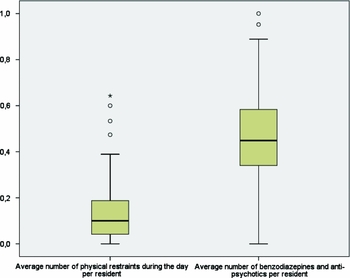
With the information from the registration forms, the average number of psychotropic drugs per type and in total was calculated. The number of psychotropic drugs prescribed per category was divided by the number of residents. In addition, the number of both types of psychotropic drugs prescribed were added and divided by the number of residents to calculate the average number of these types of drugs prescribed per resident. The same was done for the physical restraints that were registered (Table 1; Figure 1).
Boxplots of average number of physical restraints and psychotropic drug use in participating long-term care facilities.

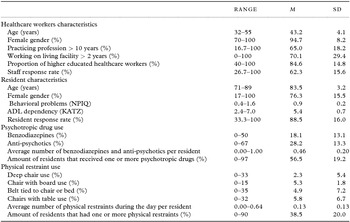
Mean resident and care staff characteristics and use of psychotropic drugs and physical restraints in long-term care facilities for people with dementia (n=111)

Job characteristics
Measures for job characteristics – job demands, decision authority (i.e. job control), coworker, and supervisor social support – were derived from the LQWQ (van der Doef and Maes, Reference van der Doef and Maes1999), a frequently used instrument when studying the DCS Model (Haüsser et al., Reference Haüsser, Mojzisch, Niesel and Schulz-Hardt2010). All job characteristics were measured on a 4-point scale ranging from (1) “strongly disagree” to (4) “strongly agree.”
Job demands were measured with the work and time pressure scale (Cronbach's α = 0.76; 5 items). The items addressed the degree to which the pressure of work and time urgency dominate the work environment, e.g. “I have enough time to provide good care to residents.”
The decision authority scale (α = 0.71; 4 items) measured the extent to which healthcare workers are able to make their own decisions, e.g. “I continuously have to do what others tell me to do.”
Social support was operationalized as social support from the supervisor and social support from coworkers. The social support from the supervisor scale (α = 0.92; 4 items) measured to which extent management is supportive, e.g. “I feel appreciated by my supervisor.” The social support from coworker scale (α = 0.85; 4 items) assessed the extent to which care staff is supportive of one another, e.g. “People I work with are helpful in getting the job done.”
Staff characteristics
Age, gender, educational level, employment in profession, length of service, and contract hours a week were included as control variables. The score for the facilities on employment in profession was expressed as the percentage of staff that worked longer than ten years in the profession. For length of service, the percentage of staff that worked longer than two years in the facility was calculated. Within the Netherlands, healthcare worker's education level ranges from 1 to 5. In the Dutch education system, level 2 is equivalent to NA, level 3 to CNA, and level 4 and 5 to RN in the USA. Most of the staff had education level 3, which means most staff had three years of vocational training. The percentage of staff with an educational level of 3 or higher was calculated. Finally, the mean age of staff and the percentage of female staff were calculated.
Resident characteristics
Assistance needed with ADL was measured using the Katz index of ADL (Katz et al., Reference Katz, Downs, Cash and Grotz1970). The index consists of six items with a 7-point scale (1 to 7), a higher score meaning more dependency in ADL.
Behavioral symptoms were measured with the abridged (paper-and-pencil) version of the Neuropsychiatric Inventory Questionnaire (NPI-Q) (Cummings et al., Reference Cummings, Mega, Gray, Rosenberg-Thompson, Carusi and Gornbein1994). Each of the 12 items of this scale represents a neuropsychiatric symptom. The total score ranges from 0 to 3 with a higher score indicating greater symptomatology. Finally, the resident's age and gender were assessed.
Statistical analyses
Data were analyzed using SPSS 22.0 software. All analyses were conducted at the level of the long-term care facility. Therefore, all variables measured at staff and resident level were first aggregated to create an average score per long-term care facility. Next, facilities mean values, standard deviations, and ranges were calculated for prescription of psychotropic drugs and physical restraints, staff's job characteristics, residents characteristics, and healthcare staff characteristics. Since the variables for both the subtypes and the total prescription of psychotropic drugs and physical restraints did not fulfill the conditions for linearity, neither after log transformation, a median split was used for these variables. Consequently, logistic regression analysis was used to study the relationship between the four job characteristics and prescription of psychotropic drugs and physical restraints.
All analyses were adjusted for staff and resident characteristics when needed. For each outcome measure, it was assessed which of the potential confounders (i.e. staff and resident characteristics) correlated significantly with both the outcome measure and one of the job characteristics. The potential confounders that were found to correlate significantly with both type of variables were added to the analyses.
Ethics
Our study investigates routine, daily practice in nursing home care for people with dementia.
Healthcare staff and residents in this study do not receive particular treatment and are not asked to behave in a particular way. Furthermore, the healthcare workers do not have to spend a considerable amount of time completing the questionnaire (15–20 minutes per questionnaire). Finally, data of people with dementia are only collected via observation and registration by the healthcare workers. Therefore, the Medical Research Involving Human Subjects Act (WMO) does not apply to this study and no formal ethical scrutiny was required (see also Willemse et al., Reference Willemse, Smit, de Lange and Pot2011).
Results
Sample
As shown in Table 1, healthcare staff working in the long-term care facilities was on average 43.2 years old and almost 95% of them were female. Most of them were working for more than ten years in the profession (65%) and for more than two years in the facility (70%). In addition, 84.6% had an educational level three or higher. The sample of residents was on average 83.5 years old and about three quarters of them were female. Their ADL dependency was rather high (M = 5.4; SD = 0.7) and, on average, not many behavioral symptoms (M = 0.9; SD = 0.2) were observed.
Table 1 also shows the prescription of psychotropic drugs and physical restraints. On average, 18% of the residents were prescribed benzodiazepines and 28% anti-psychotics. The sum of both drugs shows that one in every two residents had been prescribed one of the psychotropic drugs on average. Regarding physical restraints it was found that on average one in eight residents with dementia were physically restricted in some way. However, there was a large variation in the prescription of both psychotropic drugs and physical restraints (Figure 1). There were long-term care facilities where no benzodiazepines or anti-psychotics were prescribed, while there were also arrangements where half of the residents were prescribed benzodiazepines (50%) and about three quarters anti-psychotics (67%). Finally, there were facilities where, for example, no chairs with tables were prescribed, while there were also facilities where almost one third of the residents had a chair with a table.
Job characteristics and prescription of psychotropic drugs
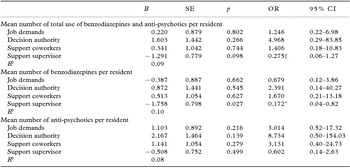
Logistic regression analyses showed how the four job characteristics were related to the prescription of the sum of benzodiazepines and anti-psychotics (Table 2). A trend (p = 0.098) was found that when staff perceived more supervisor support, less benzodiazepines, and anti-psychotics were prescribed.
Logistic regression analyses of job characteristics in relation to total psychotropic drugsa

*p < 0.05, †p < 0.10.
a Analyses are adjusted for resident sample's ADL dependency and behavioral problems.
Additionally, we studied how the four job characteristics were related to both the prescription of benzodiazepines and anti-psychotics separately. The analyses showed that a higher level of staff's perceived supervisor support was significantly related to less prescription of benzodiazepine (p = 0.027). No significant relationship was found with the prescription of anti-psychotics.
For job demands, decision authority, and coworker support, no significant relationships were found in relation to prescription of psychotropic drugs.
Job characteristics and prescription of physical restraints
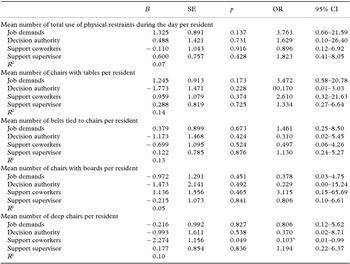
The logistic regression analyses for the sum of physical restraints prescribed showed no significant relationships with either one of the four job characteristics (Table 3)
Logistic regression analyses of job characteristics in relation to physical restraintsa

*p < 0.05.
a Analyses are adjusted for resident sample's ADL dependency and behavioral problems.
For the separate types of physical restraints, analyses showed that more perceived coworker support was related to a lower prescription of deep chairs (p = 0.049). No such significant relations were found for chairs with tables, chairs with boards, and belts tied to chairs, respectively.
No significant relationships were found for job demands, decision authority, and supervisor support pertaining to the prescription of the separate types of physical restraints.
Discussion
This study aimed at gaining more insight in whether characteristics of an unhealthy work environment in nursing home care for people with dementia are associated with more prescription of psychotropic drugs and physical restraints. This is an important issue given the large differences in psychotropic drug and physical restraint use between long-term care facilities that have been found in current and earlier studies.
Results showed that staff's job characteristics were only limitedly related to the prescription of psychotropic drugs and physical restraints. We found that less benzodiazepines were prescribed in facilities where staff perceived more supervisor support. And a trend was found: in facilities where staff perceived more supervisor support on average, the average number of prescribed psychotropic drugs per resident was lower. Furthermore, more coworker support was associated to less prescribed deep chairs. No significant associations were found between job demands and decision-authority, and the prescription of psychotropic drugs and physical restraints. The finding that job characteristics were only to a limited extent related to the prescription of psychotropic drugs and physical restraints is similar to findings from another Dutch study of Huizing and colleagues (Reference Huizing, Hamers, de Jonge, Candel and Berger2007). In both studies, resident characteristics were found to be more strongly associated to restraint use than job and ward characteristics.
Not finding a strong relationship between the prescription of psychotropic drugs and physical restraints, and job characteristics could be viewed as a positive finding. It indicates that in facilities with characteristics of an unhealthy work environment (e.g. high workload, low decision authority, and low support) one is not more likely to prescribe psychotropic drugs or physical restraints for residents with dementia than in facilities with a healthy work environment. However, there might be other explanations for not finding a strong relationship in our study. First, our sample, on average, perceives relatively less job demands and more job control as compared to the samples studied by Pekkarinen et al. (Reference Pekkarinen, Elovainio, Sinervo, Finne-Soveri and Noro2006, Reference Pekkarinen, Sinervo, Elovainio, Noro and Finne-Soveri2008). It is possible that staff's job characteristics only have a negative influence on the usage of psychotropic drugs and physical restraints when staff perceives high and harmful levels of job demands and low levels of decision authority. This might also explain the fact that Pekkarinen and colleagues did find a relationship with job demands (Reference Pekkarinen, Elovainio, Sinervo, Finne-Soveri and Noro2006).
Second, long-term care, and decision making regarding the use of physical restraints in particular, differs between countries. This could explain why both our and Huizing's study did not find strong relationships between job characteristics and psychotropic drug and physical restraint use. In the Netherlands, the elderly care physician is prescribing both psychotropic drugs and physical restraints, carrying the formal and final responsibility in a multidisciplinary setting. A multidisciplinary team exists of a physician, paramedics, nursing staff, and most of the time a psychologist. This in contrast to other countries where a physician's prescription is not required for the application of physical restraints (Goethals et al., Reference Goethals, Dierckx de Casterl+® and Gastmans2013) and care is not organized as multidisciplinary. The influence of staff's job characteristics might be stronger when care is organized less multidisciplinary and nursing staff has a bigger say in the prescription.
Another explanation for not finding a strong relationship between the prescription of psychotropic drugs and physical restraints, and job characteristics could be a lack of statistical power. Although we used data on the prescription of psychotropic drugs and physical restraints to 4,796 residents with dementia, and survey data on 996 healthcare workers and 1,138 residents were considered, the final number of cases in our analyses was 111 long-term care facilities. Reason for this is that we chose to conduct the analyses at the level of the facility. However, Perkkarinen et al’s studies (Reference Pekkarinen, Elovainio, Sinervo, Finne-Soveri and Noro2006, Reference Pekkarinen, Sinervo, Elovainio, Noro and Finne-Soveri2008) included even a smaller number of cases.
Significant relationships that were found in this study relate to social support. The finding that more supervisor support was related to less prescription of benzodiazepines in particular, suggests that leadership behavior could affect resident outcomes. This is in line with the conclusions of a review that showed that relationship-oriented management practices (i.e. giving constructive feedback, helping staff resolve conflict, generating trust) promotes better outcomes in nursing homes, such as better quality of life and improved resident behavior (Toles and Anderson RA, Reference Toles and Anderson2011).
The finding that more social support from co-workers was related to less prescription of deep chairs cannot easily be explained. Especially given the fact that we did not find this association for the total number of physical restraints. Since we have studied many relations, this could be a spurious finding by chance.
Strengths and limitations
There are some strengths and limitations of the current study that should be considered when interpreting its results. A first strength compared to previous studies is that, to our knowledge, the relationship between support and the prescription of both psychotropic drugs and physical restraints was not investigated before while it is considered to be an important aspect of a healthy work environment (Kramer et al., Reference Kramer, Maguire and Brewer2011) and an important job characteristic in the Job DCS Model (Johnson and Hall, Reference Johnson and Hall1988). Second, no other studies have investigated different subtypes of psychotropic drugs and physical restraints and their total prescription at the same time either. Finally, the type of analyses used in the current study with the outcome on facility level (i.e. the mean number of psychotropic drugs and physical restraints per resident) seems more in line with the aim of these kind of studies than analyzing the differences between restrained and unrestrained residents (i.e. outcome on resident level) as Huizing et al. (Reference Huizing, Hamers, de Jonge, Candel and Berger2007) did. The aim of these studies is to gain insight whether particular job characteristics in a ward or facility influence the degree in which residents are prescribed psychotropic drugs and/or physical restraints. An approach with an outcome on resident level would be more appropriate when studying why particular residents are and others are not restrained, for example. Pekkarinen studied an outcome on facility level as well (Reference Pekkarinen, Elovainio, Sinervo, Finne-Soveri and Noro2006, Reference Pekkarinen, Sinervo, Elovainio, Noro and Finne-Soveri2008).
In addition, this study also contains a number of limitations. A first limitation is that facilities with a response of fewer than four residents or healthcare workers were excluded since we did not find such a low response representative. However, the facilities with a low response could be the ones with high levels of job demands and their healthcare workers therefore did not feel they had the time or the will to fill out the questionnaire. This means that it is possible that several facilities with a relatively high level of job demands have been excluded from this study which remains a problem in survey studies. Second, the registrations of the prescription of psychotropic drugs and physical restraints in our study have been completed by physicians in the long-term care facilities and not by the research assistant based on the medical records of residents. Since the data was not collected by an independent researcher this could have resulted in underreporting of prescription and consequently might have biased the data. However, the numbers we found regarding the prescription of psychotropic are comparable to data in other studies (Zuidema et al., Reference Zuidema, Koopmans, Schols, Achterberg and Hertogh2015). Third and last, given the fact that we took a random sample of residents and staff in facilities that mostly exist of a number of wards, the selected healthcare workers were not necessarily taking care of the residents that were selected. However, we aimed to create a representative sample for the facilities and the data were analyzed at the facility level.
Future research
Further research is needed given the mixed results in this field of research, and the fact that the extensive differences in the prescription of psychotropic drugs and physical restraints between facilities can only to a limited extent be explained by staff's job characteristics.
To clarify the mixed results found in the cross-sectional studies regarding job characteristics and psychotropic drug and restraint use, further research using longitudinal designs is needed. However, it seems even more important to focus on other, additional factors, especially since significant differences exist in the organization of long-term care for people with dementia between countries and facilities. Factors that are of interest for further research are: e.g. the multidisciplinary decision-making process and the (formal) role of the physician in this process, staff's attitudes and knowledge, and philosophy of care and institutional policy. The limited empirical studies already available with regard to these factors are mostly qualitative or provide indirect evidence, and mostly did not relate these factors to the amount of psychotropic drugs or physical restraints used.
Limited attention has been paid to the first factor: the multidisciplinary decision-making process. Up to now, research in this field has primarily focused on nurse decision-making (Goethals et al., Reference Goethals, Dierckx de Casterl+® and Gastmans2012; Mohler and Meyer, Reference Mohler and Meyer2014). Yet, it is stated, both in research and practice, that the decision to use physical restraints or psychotropic drugs should be a multidisciplinary one (Zwijsen et al., Reference Zwijsen, de Lange and Pot2013; de Casterlé et al., Reference de Casterlé, Goethals and Gastmans2014). This is not the case in every country, as we mentioned earlier. The importance of attention for a multidisciplinary approach is underlined by studies finding that it results in less use of antipsychotics and antidepressants to manage challenging behavior (Zwijsen et al., Reference Zwijsen2014) and that cooperation between professionals can avoid the need for prescription of psychotropic drugs (Smeets et al., Reference Smeets2014). In future research focusing on multidisciplinary decision making, special attention should be paid to the (formal) role of the physician since they carry the final responsibility and have the final say in many countries regarding the prescription of psychotropic drugs and physical restraints. A second factor is staff attitudes and knowledge. Staff's mindset and knowledge have indeed been found to be of influence on the prescription of psychotropic drugs according to nurses and physicians (Smeets et al., Reference Smeets2014). For example, it was found in this qualitative study that nurses can have unfounded high expectations of the effectiveness of psychotropic drugs for neuropsychiatric symptoms which induces psychotropic drug description. In line with this finding, a recent review focusing on attitudes of nurses towards the use of physical restraints in geriatric care concluded that, even now that the use is restricted by law in many countries, nurses attitudes seem to be unchanged and they still have insufficient knowledge of its effectiveness, alternatives and reasons for not using them (Mohler and Meyer, Reference Mohler and Meyer2014). Insight is needed in how national policies can be properly translated to and implemented in daily practice to change staff attitudes and staff knowledge.
Third, it has been suggested that philosophy of care (Meyer et al., Reference Meyer, K+Âpke, Haastert and M++hlhauser2009) and institutional policy (Gulpers et al., Reference Gulpers, Bleijlevens, Ambergen, Capezuti, van Rossum and Hamers2011; de Casterlé et al., Reference de Casterlé, Goethals and Gastmans2014), determining staff's attitudes and beliefs, is most likely a powerful determinant of restraint us. It has, for example, been found that the perception of resident behavior as disturbing without a clear understanding of what constitutes it, frequently leads to restraints (Goethals et al., Reference Goethals, Dierckx de Casterl+® and Gastmans2012). The opposite is true when behavior is approached in a more person-centered way and the cause of the behavior is treated. Furthermore, it was found that the multicomponent intervention EXBELT, of which policy change was one of the components, effectively reduced the use of belt restraints (Gulpers et al., Reference Gulpers, Bleijlevens, Ambergen, Capezuti, van Rossum and Hamers2011). Further longitudinal research with a direct focus on the implementation of a more person-centered philosophy of care or an institutional policy regarding the use of psychotropic drugs and physical restraints, and the effects on the use of psychotropic drugs and physical restraints is needed.
Finally, it is important to gain insight into whether or not it is important to adjust the analyses for resident characteristics as all studies did. It is unclear if increased ADL dependency, for example, is not a consequence of the use of physical restraints instead of a cause of it. In our study, a trend was found that more job demands were related to more physical restraint use (particularly the use of chairs with tables), before adjusting the analyses for resident characteristics. Little research has been done to this regard while it has been suggested that behavioral symptoms or challenging behavior of people with dementia, and immobility could be a reaction to the physical restraint (Castle and Engberg, Reference Castle and Engberg2009; Karlsson et al., Reference Karlsson, Bucht, Eriksson and Sandman2001).
Conclusion
Overall, this study showed that the prescription of psychotropic drugs and physical restraints varies extensively across facilities. We found that in some long-term care facilities psychotropic drugs or physical restraints were not prescribed at all, while in others nearly every resident received either one or more types of psychotropic drugs or physical restraints. Moreover, this study corroborates the conclusion of Huizing et al. (Reference Huizing, Hamers, de Jonge, Candel and Berger2007) that the extensive differences in the use of psychotropic drugs and physical restraints between facilities can only to a limited extent be explained by staff's job characteristics. This stresses the need for further research and insight in what predicts the usage of these means, in particular in facilities with high usage.
Conflict of interest
None.
Description of authors´ roles
Bernadette Willemse collected, analyzed, and interpreted the data, drafted the paper and helped designing the study. Wouter Dasselaar helped collect the data and perform the data analysis. Marja Depla and Jan de Jonge helped in analyzing and interpreting the data, and to draft the paper, as did Dieneke Smit. Dieneke Smit also helped to design the study and to collect the data. Anne Margriet Pot is principal investigator of the LAD study, designed and supervised the study, helped to interpret the data and draft this manuscript. All authors read and approved the final paper for publication.
Acknowledgments
The LAD-study is supported by a grant from the Netherlands Ministry of Health, Welfare, and Sports.