The existence or absence of territorial disputes is central to whether relations between states are cooperative or conflictual. Military conflict is more likely when neighbors have a territorial dispute, while cooperative relations are undermined. Despite substantial efforts to understand the consequences of territorial claims, surprisingly little research focuses on where and why territorial disputes emerge in the first place.Footnote 1 No research that we are aware of sheds light on the timing of territorial claims. Consequently, the literature leaves us without a clear explanation for why Italy waited until 1919 to make a claim over the territory of Fiume, which had been an autonomous entity within Austria-Hungary since 1719. The port city of Fiume had been primarily populated by Italian speakers and Italian nationalists’ desire to integrate it was not certainly not new to the postwar years.
The absence of research on the timing of claims is surprising because the data reveal a stark pattern of temporal clustering, with well over 60 percent of all claims to territory in Europe after the Congress of Vienna made in the ten most claim-prone years.Footnote 2 From the standpoint of the revisionist states activating their latent territorial claims, this pattern is puzzling. The justification or basis underlying a state's territorial claim generally predate the claim by years if not decades. Why would a state wait years to formally make a territorial claim if the primary justification undergirding the claim is quite old? There are few compelling reasons to think that the benefit of activating such a claim would increase over time. Rather, the opposite is more plausible—a competing claim to sovereignty, whether based on history, ethnic kinship, or some other principle generally loses strength across time.Footnote 3 A claim made over a historical boundary precedent, for example, can become less attractive across time as a combination of generational change and state efforts to consolidate the current boundary diminishes the historical border's political and economic relevance.Footnote 4 Given that every state makes a distinct case justifying its territorial claims, why would so many states converge on making these distinct claims in the same year? We argue that territorial claims are clustered at specific periods of time when the existing management of the state system experiences instability and the great powers that dominate it are embroiled in crisis. Revisionist states have incentive to activate latent claims when the system is in turmoil because the great powers are occupied with systemic crises and less interested in policing “local” instances of destabilizing territorial revisionism that are considered more salient to their security interests in times of peace and stability.
States refrain from activating latent claims because doing so carries significant costs. For instance, it is firmly established that territorial issues are associated with an increased risk of militarized conflictFootnote 5 as well as depressed trade and lower investment.Footnote 6 While the costs associated with claims are clear, it is not obvious why the security and economic costs would decline enough over time to make a previously unattractive claim worthwhile and why these costs would lower simultaneously for a large number of states. We argue that the international system's stability is key to understanding both why many states wait to make latent claims active and why so many claims are activated in so few years.
First, we point out that the dominant great powers that benefit from the status quo—for example, Great Britain for much of the nineteenth century or the United States post-World War II—have a general aversion to destabilizing territorial claims.Footnote 7 The aversion became so strong in the post-World War II era that scholars began to associate the lack of military conquest of territory with a “territorial integrity norm.”Footnote 8 Second, we highlight that regional great powers that are dominant in a particular region but are not plausibly hegemonic (e.g., the Austrian Empire in Italy for much of the nineteenth century) also have an aversion to destabilizing territorial claims in their region that might upset the status quo. Finally, we highlight that great powers that are neither dominant across the system nor in a specific region sometimes have incentive to foment territorial revisionism during times of systemic crisis, since instability can increase the chances of structural changes that favor their future power status.
Central to our argument is the idea that great powers’ incentives generally push revisionist states to make territorial claims during times of systemic crisis. In times of stability the dominant great power in the system or a specific region works to deter revisionist territorial claims by imposing costs (or threatening to) on states that make them. The dominant great powers also work to deter other powers from encouraging revisionist territorial claims. However, when the dominant great power or its allies are embroiled in crisis these constraints are loosened or lifted because the great powers have incentive to concentrate on preserving their position atop the system and “local” territorial conflicts become of secondary importance. The constraints on great powers with revisionist aims are also loosened as they find it easier to support or encourage potentially disruptive claims without drawing serious sanction. In sum, the incentives of both dominant great powers and their competitors push revisionist states to make potentially disruptive “local” territorial claims during times of systemic turmoil.
Examining the specific years in which territorial claim making is clustered suggests the plausibility of our argument that systemic influences are of central importance—the most influential periods are, without exception, periods of well-known systemic instability. Influential years in the nineteenth century are 1816 (Establishment of Concert of Europe), 1848–1849 (Revolutions of 1848), 1853–1854 (the Crimean War), 1866 (Austro-Prussian War), and 1870 (Franco-Prussian War), while the influential periods in the twentieth century are the years before and after World Wars I and II as well as 1991–1993 (the end of the Cold War). This perspective also sheds light on why the Italians waited until 1919 to claim Fiume. While the history surrounding the claim is complex, as is always the case, it is hard to overstate the importance of the fact that the European system was experiencing a virtually unprecedented bout of instability. In 1919, the British and French were exhausted and indebted, Germany defeated, Tsarist Russia had experienced revolution and civil war, the Austro-Hungarian empire had crumbled, and the map of Europe was being redrawn in the aftermath.Footnote 9
Our arguments connect to recent advances showing that interested third parties shape states’ behavior in territorial disputes by imposing costs on disruptive or destabilizing claims, for example, claims that have poor standing in international law.Footnote 10 For instance, much emphasis in Zacher's influential article about the “territorial integrity norm” is on how powerful managers of the system help enforce the norm,Footnote 11 while Fazal argues that enforcement of this norm has virtually eliminated the incidence of “state death” in the post-World War II international system.Footnote 12 However, there is no work that explores the consequences of how powerful third parties constrain states in making territorial claims—the existing literature is mostly focused on claim management. We argue that the constraining power of the international system's great power managers is clarified by examining the timing of territorial claim emergence.
We develop measures of systemic instabilityFootnote 13 that are derived from five main sources of crisis: great power war; reordering constitutional settlements following great power wars; internal economic malaise and conflict within great powers; the dissolution of empires; and great power proxy conflicts. We demonstrate that these measures are generally important predictors of claim timing in Europe and globally. We also develop measures of instability among regional great powers that tap into the idea that these relatively local great powers have greatest influence over the claim-making behavior of smaller states in their neighborhood. Subsequently, we develop composite measures of systemic instability and regional instability using principle components analysis and demonstrate that these measures rely on all five sources of instability and are good predictors of claim timing. We tie our findings about systemic instability to the existing literature on the emergence of claims by showing that the estimated effect of competing historical boundary precedents in Europe on the emergence of claims spikes at times of systemic and regional instability. This demonstration leverages newly constructed dyadic data that measure the spatial distribution of all historical boundaries from 1650 to 1789 within fifty-kilometer buffers of post-1815 dyadic boundaries.
The Timing of Territorial Claims
The clustering of territorial claims around times of systemic instability is puzzling since most territorial disputes are inherently dyadic. Territorial claims involve a state leader publicly and unambiguously making a claim over a piece of another state's territory. These have been mostly viewed as a product of domestic considerations. For example, Huth focuses on variables that measure the domestic context or bilateral relations like the presence of cross-border ethnic kin or the military balance between the two states.Footnote 14 Goemans and Schultz argue that the onset of African claims is a function of the domestic political considerations of countries’ first postcolonial leaders.Footnote 15 These results clarify where disputes tend to arise. However, the fact that the majority of claims are made in a very small set of years suggests a need for more theoretical focus on claim timing and the role of systemic variables.
While the anticipated actions of powerful third parties such as great powers play an important role in theory over the management and resolution of territorial disputes, systemic factors play almost no role in work on the emergence of territorial claims.Footnote 16 The systemic factors that are the focus of most research on the management of territorial disputes mainly exploit variables viewed as promoting peace, like international law,Footnote 17 involvement by international organizations,Footnote 18 or the proportion of democracies in the international system.Footnote 19 Clearly, the spikes in territorial claims around times of systemic instability, like those made in 1912–1913, are not associated with peaceful outcomes.
There are two ways that the clustered timing of territorial claims could be explained. First, spikes in claims during specific years could be direct outgrowths of systemic crises themselves. In other words, the claims clustered in 1870 would be accounted for by French and Prussian territorial claims against each other as they moved toward and started fighting a war. However, even a cursory examination of the territorial claims made in years of systemic instability makes clear that the vast majority of claims are not made by the states directly embroiled in systemic crises. In fact the majority of claims do not even involve great powers—only around 13 percent of European territorial claims made since 1816 are made by a great power.Footnote 20 The second and more interesting possibility is that periods when the system is in turmoil lead to more territorial claims because the constraints on state behavior imposed by the structure of the international or regional system are relaxed. The idea that the great powers that dominate the system constrain most states’ behavior is consistent with what theorists like Kenneth Waltz have long claimed, but there is scant empirical evidence describing how systemic constraints affect leaders’ behavior in addressing contentious and salient foreign policy issues like territorial disputes.Footnote 21
Systemic Instability and Claim Timing
Territorial claims tend to be precise, small, and infrequent.Footnote 22 Considerable effort has worked to identify the potential benefits of making a claim, seeking to explain why the prospective integration of a territory is desirable.Footnote 23 For instance, latent claims bounded by well-established boundaries are favored because leaders are familiar with these borders’ functionalityFootnote 24 and these precedents often continue to coordinate patterns of economic and social behavior in ways that increase their attractiveness as claims.Footnote 25
For states with attractive latent claims there are benefits to formalizing them. Making a formal claim is almost always the initial step if leaders seek integration as part of the homeland in a manner that the international community might view as legitimate. If a state prospectively wants to integrate a piece of territory, making a claim over it is usually a necessary step, unless it is willing to shoulder the risks and costs associated with attempting to forcefully take it via fait accompli.Footnote 26 Moreover, there are almost always domestic political benefits to activating an attractive latent territorial claim.Footnote 27 Leaders stand to gain from publicly making claims to territory viewed as part of the “homeland,” a point numerous scholars make.Footnote 28
Given the various benefits of making a latent territorial claim active, there are reasons for states with such claims to activate them sooner rather than later. When latent claims sit unactivated they can become less attractive and credible. For example, the idea that claims are made along historical precedent due to the persistent effects of old boundaries implies that such claims become less attractive as time passes.Footnote 29 Goemans and Schultz show that African borders bisecting an ethnic group tied to the states’ leaders tend to be activated right after independence.Footnote 30 Every year a latent claim is not made the state that currently administers the territory works to further consolidate its control over the land.Footnote 31 These points suggest that the payoffs associated with a territorial claim tend to depreciate across time.Footnote 32
Revisionist states also pay costs for making territorial claims, many of which derive from a heightened risk of militarized conflict.Footnote 33 The heightened threat of militarized conflict bears nontrivial costs for disputants even if militarized conflict never breaks out and war itself is not exceedingly likely. For instance, the increased threat of armed conflict associated with active claims against a neighbor's territory generally results in greater military spending even in the absence of war.Footnote 34 There are a number of high-profile examples of latent territorial claims that are not made because of aversion to anticipated costs. For instance, prospectively high costs help explain why Syria has never formally made a claim over the Turkish province of Hatay, which was annexed by Turkey in the 1930s, despite it being common knowledge that the Syrians’ continue to see this territory as part of Syria. The heightened atmosphere of threat and security competition also leads to economic costs that are not the direct product of military spending. Neighbors with active territorial disputes trade lessFootnote 35 and also enjoy less foreign investment.Footnote 36 For example, the long-standing territorial dispute between Ecuador and Peru that was finally settled in 1998 was a drag on investment and bilateral trade relations. Energy sector analysts noted that trade in oil between Ecuador and Peru was well below potential in no small part because of their contentious dispute. An industry publication that highlighted the issue pointed out that “Ecuador has a lot of oil under the ground that can't get out, and Peru has a pipeline that is half full.”Footnote 37 In short, the direct costs of being in a territorial dispute are not trivial, which helps to explain both the rarity of territorial claims—they were made at the rate of less than two per year in post-1815 Europe—as well as how carefully drawn and specified such claims typically are.Footnote 38
System Status and Territorial Revisionism
Although episodes of systemic turmoil exhibit considerable heterogeneity in terms of what key events transpire and who is involved, they all have one essential feature of interest in common: they produce uncertainty over great powers’ ability and interest in taking costly action to maintain the stability of the current regional and/or international order. As we highlight, systemic crises also provide opportunity for revisionist great powers to encourage destabilizing territorial claims.
Great Powers and Territorial Claims
There are several ways that episodes of systemic turmoil affect great powers’ behavior—particularly the dominant great power and its allies. As theorists like Ikenberry note, dominant great powers that sit atop the prevailing international or regional order receive numerous benefits from this position.Footnote 39 Accordingly, a dominant great power's foreign policy is shaped by constant work maintaining both its position and the stability of the status quo. When a great power sits atop the existing order, few events occur that are not seen as relevant to its security interests. Great powers frequently intervene to tip the scales in a range of internal and “local” conflicts like coup attempts, insurgencies, as well as in interstate territorial claims. The US has long invested substantial resources in intervening to protect its perceived interests in the Western Hemisphere, and has done so globally since World War II. In the contentious territorial dispute between Ecuador and Peru, the US served as a key player, serving as a guarantor of the 1942 Rio Protocol and applying pressure on both sides to abide by the terms of the treaty up until the resolution of the dispute. In sum, dominant great powers often oppose revisionist territorial claims because they are seen as potentially destabilizing.
Of course, it is not only the most powerful or dominant great power that has a strong interest in whether smaller states make territorial claims. Regional powers that are geographically close or contiguous to the potential revisionist state often have the strongest interest in maintaining the regional status quo. For example, it was the Austrian empire that took the most active role in countering potential and actual territorial claims on the Italian peninsula during the nineteenth century. In a multipolar context like nineteenth-century Europe where there are competing great powers, it will often be the great power that is geographically proximate to a potential revisionist state that has the strongest interest in whether a claim is activated or not. For example, historical treatments of nineteenth-century British foreign policy detail how British leaders considered events in the Italian peninsula important to their interests.Footnote 40 The lack of British intervention was more a function of capabilities relative to other powers than a lack of interest, which suggests a need to highlight what great powers can do in response to claims.
Observing a claim and doing nothing to oppose it carries the risk of perturbing the existing regional order and erodes the great power's reputation as manager of that order. In general, punishments that impose greater costs should be more effective at deterring territorial claims, with military intervention being the most costly and less severe options like economic sanctions also carrying significant cost. Whether these potential interventions are credible or not depends both on the great powers’ interests and capabilities. The salience of a potential territorial dispute to a great power's security interests tends to be greater the closer the claim is to its borders. Moreover, a great power's ability to credibly threaten intervention is partially a function of geographic distance because the ability to project power tends to decline with distance.Footnote 41 A great power's ability to impose economic costs on a revisionist state is also often a function of distance since trade flows decrease with distance,Footnote 42 and existing evidence also suggests investment declines with distance.Footnote 43 While dominant great powers tend to view any security issues in their region as salient, it is often those that are more proximate to the revisionist state that have a high enough level of capability and interest to credibly intervene.
Not all great powers view potentially destabilizing events like territorial claims as a threat to their position. Those not in a position to dominate might see destabilizing events as an opportunity and thus might encourage revisionist claims. For example, during the Cold War the Soviet Union tended to support revolutionary regimes in the Western Hemisphere, like Castro's Cuba, whereas the US, the dominant power in the region, actively opposed these regimes and their claims. Revisionist great powers’ motivation to support destabilizing events like territorial claims derives from the possibility they might contribute to a reordering that is more favorable to themselves.Footnote 44 Great powers that are neither dominant nor aligned with the dominant coalition will often, when presented with the opportunity, encourage revisionist territorial claims that can increase the chance of a favorable revision of power.
We argue that systemic turmoil's effect on the behavior of both great powers satisfied with the status quo and revisionist great powers leads to similar effects on potential challengers’ claim-making behavior. Dominant-coalition great powers seek to maintain their position atop the system. While revisionist territorial claims can destabilize the prevailing order and are thus usually actively opposed, systemic crises are fundamental threats to this order and thus must be addressed. When dominant-coalition great powers are tied up with a larger crisis, they are less apt and able to intervene and block more “local” revisionist territorial claims. We identify two main mechanisms that explain great powers’ inability to police revisionist claims during times of crisis.
First, dealing with systemic crises ties up considerable resources, increasing the marginal cost of intervention to block local claims. For instance, the marginal cost to the British or French to intervening to block Italian claims in 1853 was higher given that they had already intervened in Crimea to address the emerging systemic crisis involving Russia and the Ottoman empire. The same basic dynamic holds for regional great powers embroiled in a larger crisis that threatens their position in the prevailing order. For example, Italy laid claim to Rome in 1870 when France, which was responsible for defending the Papal State's position in Rome, was struggling against the Prussian Army. The marginal cost of devoting resources to preserve the status quo in Rome was too high for the French, given that they were facing a serious threat to homeland territory.
Second, dominant-coalition great powers that attempt to manage systemic crises have no assurance that their efforts will prevent an upending of regional or international order. When these great powers oppose revisionist territorial claims, they do so primarily to protect their position atop the current system or their regional position. Thus, they are doing so not just to protect the status quo, but also to continue to benefit from being in the dominant power coalition in the future. When the system is rocked by crisis and the dominant power and its allies expend resources to weather it, they discount their future payoff from being atop the system by the probability they will weather the crisis. Thus, as an interested great power faces crises of greater severity, intervention to block or punish territorial claims becomes less worthwhile as it weighs its payoff for deterring the potentially destabilizing claim by the probability that it will actually still enjoy the prevailing international or regional order after the crisis subsides.Footnote 45 Intuitively, we can think of a crisis like the Belgian Revolution as an example of systemic turmoil that was relatively “easy” to deal with, that is, the dominant coalition would probably survive it intact. Comparatively, the conflict and instability in the run-up to World War I was a relatively severe bout of systemic instability.
Great powers outside of the dominant coalition do not generally possess the resources to make direct challenge to the existing order worthwhile. Nonetheless, those that are not aligned with the dominant powers do not necessarily share an interest in preserving it. If the dominant great powers are unable to block destabilizing events, this can degrade their reputations and deplete their treasuries. Thus, for the same reasons that dominant great powers dislike destabilizing claims, revisionist great powers that are shut out of the dominant coalition can benefit from them. Since great powers that are neither dominant nor beneficiaries of the prevailing order are typically at a structural disadvantage (otherwise they would be dominant themselves), they have heightened incentive to support disruptive territorial claims during times of systemic crisis. When the dominant power and its allies are addressing a systemic crisis they are less capable of intervening to block revisionist claims or taking action against a revisionist claim maker's great power patron.
For revisionist states both types of great powers’ incentives line up to make periods of systemic and regional crisis attractive times to make claims. Revisionists want to make attractive claims but also to avoid paying significant costs for doing so. Given that the justifications that undergird territorial claims tend to lose strength across time, waiting for long periods of time to make claims carries costs. Thus, there must be a rationale for many revisionist states to sometimes wait years or decades to make claims. The great-power dynamics we identify provide a theoretical basis for understanding why revisionist states wait and why so many claims cluster at specific points in time. During times of systemic turmoil, revisionist states can anticipate that their latent claims have temporarily lower associated costs because the dominant great power or its allies will find it less worthwhile to intervene. Some revisionist states can find diplomatic, financial, or other support from great powers that are outside of the dominant coalition and see the opportunity to foment further turmoil during periods of systemic crisis. The prospect of temporarily lower costs coupled with the possibility of some support from great powers that seek to benefit from turmoil temporarily increase claims’ attractiveness during times of instability.
What Generates Systemic Crises?
Now that we have clarified why episodes of systemic and regional crisis are associated with claim making, we outline the main five “types” of events that generate such crises and how they work within the context of our theory:
1. When one or more great powers experience considerable domestic instability, this can generate systemic crisis. Two main kinds of internal instability contribute to systemic turmoil. First, when great powers are occupied with internal rebellion and unrest, this staunches both their interest and ability to be attentive to smaller states’ disruptive territorial claims. Dealing with internal rebellions often entails the use of the military to suppress challenges, increasing the marginal cost of using the military to intervene abroad.Footnote 46 The Revolutions of 1848 are a prime example of this type of systemic crisis, where opposition to illiberal regimes spread across states including France and the Austrian Empire.
Second, when multiple great powers are dealing with significant economic crises, it both lowers their ability and interest in intervening to block smaller powers’ territorial claims. Serious economic crises, like bouts of extremely high inflation or subsequent currency devaluations, strain great powers’ ability to expend resources to block revisionist claims. Given that domestic unrest and government crises usually loom on the horizon during economic crises, a great power's interest in devoting attention to revisionist states’ claims is much less than when there is no economic crisis to deal with.
2. Wars involving multiple great powers often generate systemic turmoil. For example, during the Franco-Prussian war, both parties were constrained by the fact that they had to invest the bulk of their resources in the war effort. Consequently, the French were not well positioned to intervene when Russia made a claim over Southern Bessarabia that year, which is part of the Romanian province of Moldavia. Although Russia failed to gain the territory in 1870, they did obtain the claimed region in the Berlin Treaty of 1878. When great powers are embroiled in war, this makes them both less willing and able to intervene to try to block territorial claims. This is the opportune time for great powers with revisionist aims to encourage claims.
3. Major reorganizations of the international order, which usually stem from the settlement of major power wars, tend to leave serious bouts of systemic turmoil in their wake. For example, the settlement at the Congress of Vienna in 1815 and treaties such as Versailles and Trianon that settled World War I follow considerable instability and increased uncertainty over the leadership and direction of the international system. At the conclusion of major wars, revisionist states that were previously constrained by a great power that lost or was considerably weakened by the war have incentive to activate claims. First of all, great powers that have just fought a major war may have depleted treasuries and publics with an understandable distaste for intervention in other states’ disputes. Second, the negotiated settlements that follow in the wake of major wars often generate significant reordering of power and territorial redistribution. These liminal moments where regional and international order is being restructured give incentive to states with latent claims to put their desired revisions on the table.
In an environment where the exact shape and leadership of the international and/or regional order is uncertain, great powers have less incentive to invest in policing small states’ claims because it is much less clear how these claims might (or might not) threaten their position within a system that is in flux. For example, after World War I the newly revived Polish state made a large territorial claim against Russia, claiming an expansive area reaching into Belarus and Ukraine that would have recreated the large pre-partition (1772) Poland–Lithuania. The power vacuum created by the defeat of Germany and the dissolution of the Austrian and Tsarist empires, coupled with the fact that the map of Europe was being radically redrawn by the United States, the United Kingdom, and France (the latter two were exhausted and indebted), injected considerable uncertainty over the European order's exact character and the constraints (or lack thereof) on the newly reconstituted Polish state.
4. The breakup of empires into smaller units also leads to systemic instability because it often involves a great power or large state breaking into constituent parts. The breakup of empire is often a product of a postwar settlement and is thus sometimes closely related to our postwar settlement point, for example, the breakup of Austria-Hungary following World War I. However, empires do not always crumble as a result of war, with the breakup of the Soviet Union in 1991 at the end of the Cold War being a prime example. The logic behind why smaller states make territorial claims in the wake of crumbling empire is quite similar to why claims emerge during major postwar settlements. The former constituent units that emerge from the breakup of empire have incentive to immediately make their claim, since the newly weakened rump state would have otherwise been the regional power that would police potential claims. The breakup of the Soviet Union led to a territorial reordering in Eastern Europe and Central Asia as well as some uncertainty over the future role of Russia in the former Soviet republics. Consequently, a number of territorial claims emerged from the crumbling of the USSR, for example, the highly contentious dispute between Azerbaijan and Armenia over Nagorno-Karabakh.
5. Great power competition and conflict via proxy states can generate systemic turmoil. Proxy conflicts where great power patrons are allied with and support opposite parties in a conflict generate systemic instability as they tend to become more serious conflicts with higher stakes than they otherwise would be without great power involvement. The fact that the great powers are already involved in ongoing conflicts constrains their ability and interest in intervening to block territorial claims by other states. For example, without great power involvement the Korean War would have likely just involved the newly formed South and North Korean states. However, with great power involvement on both sides it escalated into a major conflict that directly involved the United States and China, and indirectly involved the Soviet Union. Following the outbreak of the Korean War, and particularly after both the US and China's involvement, there was a flurry of territorial claims made in the region, including a claim North Korea made against China over Changbai Mountain, China against Vietnam and the USSR, and a number of other claims by states such as Japan and Thailand. Another prominent example is the Second Balkan War in 1913, where Serbia was supported by Tsarist Russia and Bulgaria was aligned with Austria-Hungary. A spate of territorial claims were made in the Balkans following the Balkan crises, and of course, the outbreak of World War I is closely tied to the Balkan crises.
Data
We exploit several sources of data. First, we construct our measures of the timing (and location) of territorial claims with the Issues Correlates of War (ICOW) data that describe each territorial dispute in Europe and globally after 1815.Footnote 47 We measure the first emergence of each particular territorial claim from 1816, so we are not treating subsequent escalation or reiteration of an existing claim as an event because it does not represent the initial emergence of a claim. Given our theoretical focus on how crises embroiling great powers affect smaller states’ claim-making behavior, we focus exclusively on claims that do not involve great powers. We use a variety of data sources to create measures of systemic crisis and to measure the other theoretically important variables.
Empirically Accounting for Systemic Uncertainty
We employ a number of measures to assess the effects of systemic instability on claim-making behavior. We first outline a rather general measure that accounts for several of the distinct sources of systemic crisis.Footnote 48 To assess the idea that regional great powers often play a greater role in deterring revisionist territorial claims than the dominant (or hegemonic) great power, we also develop measures of regional instability that account for the geographic proximity of each potential revisionist state and the great powers affected by crises. Subsequently, we develop measures that tap into the five distinct sources of systemic crisis that we identify. Finally, we use principle components analysis (PCA) to develop composite measures of both systemic instability and regional instability.
The first measure we employ is the systemic instability variable developed by Gunitsky.Footnote 49 This variable measures annual changes in the distribution of military capabilities among great powers in the international system.Footnote 50 The systemic instability measure is calculated in each year, t, for the k great powers as follows:
 $${\rm Systemic\;Instabilit}{\rm y}_t = \displaystyle{{\mathop {\mathop \sum \nolimits_k^{\,j = 1}} \vert {{\rm Capabilitie}{\rm s}_{\,j\comma t}-{\rm Capabilitie}{\rm s}_{\,j\comma t-1}} \vert } \over k}.$$
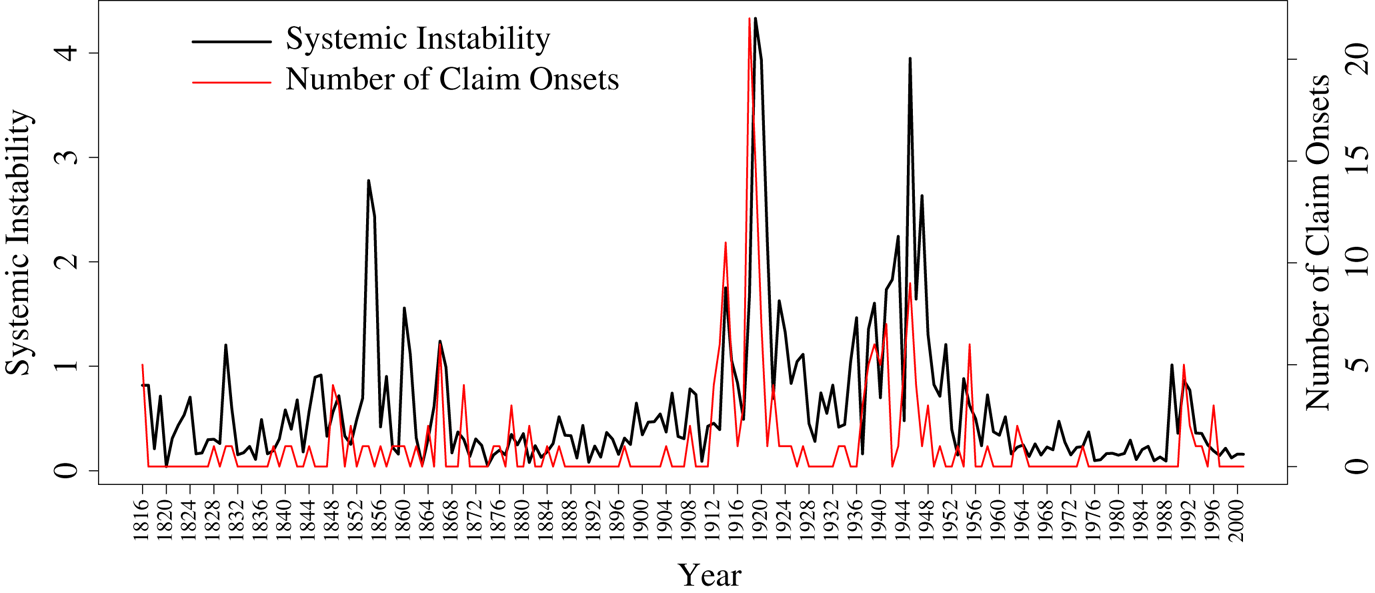
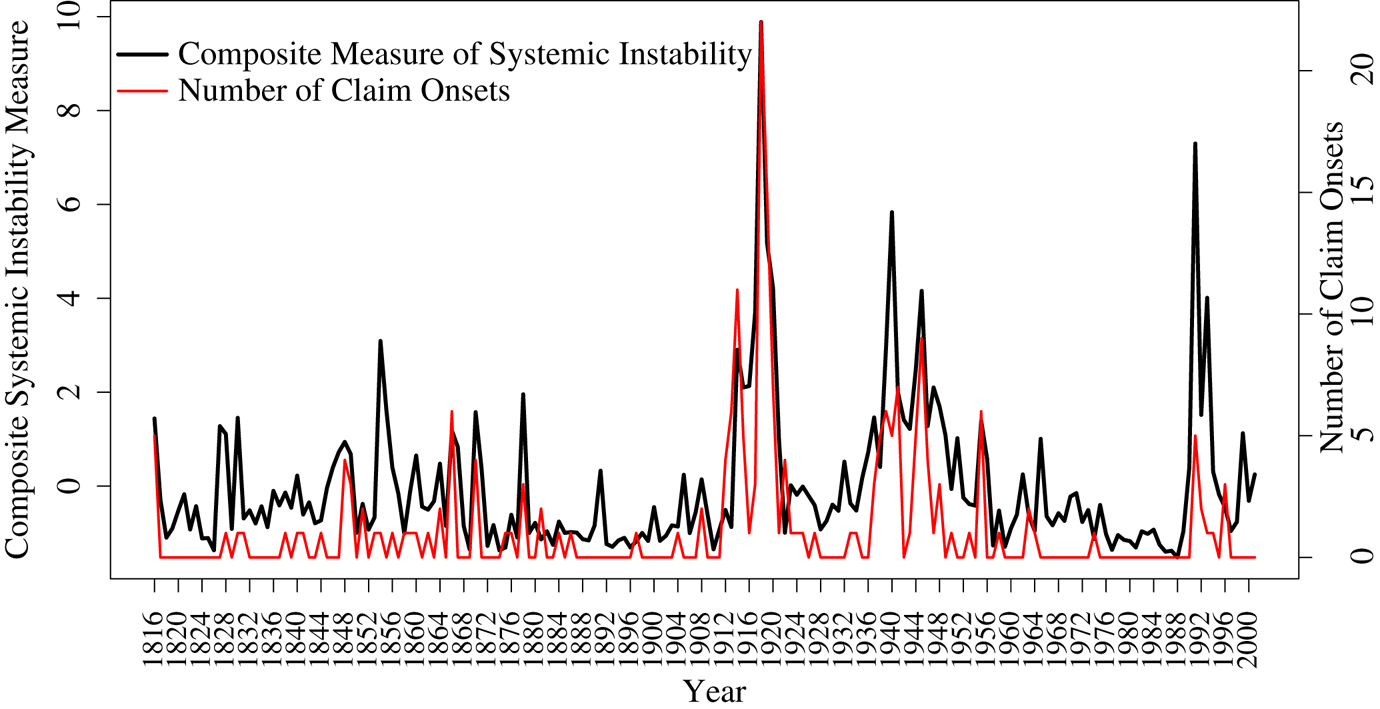
We identify great powers using the Correlates of War list of major powers and follow Gunitsky in measuring power using the widely employed composite index of national capabilities (CINC) scores, also from Correlates of War. Figure 1 shows yearly variation in the systemic instability measure along with the number of European claims.Footnote 51 The measure comports well with a qualitative assessment of systemic crises because the “spikes” in the plot occur most starkly around 1830 (Belgian Revolution), 1853 (Crimean War), two spikes in the 1860s (proximate to the Austro-Prussian and Franco-Prussian wars), major spikes around World Wars I and II, and finally a smaller spike around the end of the Cold War.Footnote 52 Thus, the systemic instability measure seems to have a good deal of face validity. It also is conceptually related to several of the sources of systemic instability we describe. It should pick up internal turmoil within great powers because economic malaise should be reflected in iron and steel production and in energy consumption. It should also be related to severe internal conflict within great powers as well as interstate wars involving great powers, since military spending tends to increase sharply in response to both kinds of security threats. Similarly, we expect it to do a good job measuring the periods following major great power wars when grand settlements are negotiated—these periods tend to involve demobilization and decreases in military spending as well as the breakup (or elimination) of great powers, for example, Austria-Hungary after World War I. That being said, we also highlight two limitations of this measure and subsequently outline our solutions to them.
Systemic instability and claims, 1816–2001

First, the measure is truly systemic—it does not at all reflect different great powers’ relative proximity to a potential revisionist state. Consequently, it does a poor job of drawing on the dynamics we discuss theoretically where regional great powers often have both greater interest and capability to credibly intervene to influence claim making among “local” revisionist states. We address this issue by developing a regional instability measure that accounts for the relative distance between a given revisionist state, i, and each great power, j. Thus, rather than summing up all yearly changes in great power capabilities and weighting them equally across all potential revisionist states, we produce a state-specific measure that puts more weight on changes in great power capabilities as they involve powers that are geographically closer to the revisionist state. Specifically, we calculate:
 $${\rm Regional\;Instabilit}{\rm y}_{i\comma t} = \displaystyle{{\mathop {\mathop \sum \nolimits_{j = 1}^{k}} {\rm Relative\;Distanc}{\rm e}_{i\comma j}\ast \lpar {\,\vert {{\rm Capabilitie}{\rm s}_{\,j\comma t}-{\rm Capabilitie}{\rm s}_{\,j\comma t-1}} \vert } \rpar } \over k}.$$
The relative distance measure varies between 0 and 1, equaling 1 for the closest great power and 0 for the most distant great power.Footnote 53 The systemic instability measure and the regional instability measures are correlated at around 0.62, which makes clear that distance weighting changes the values quite a bit in some cases.Footnote 54
The second potential problem with the systemic instability measure is that it likely misses significant episodes of domestic turbulence that all or most great powers weather, such as the Revolutions of 1848, which do not necessarily shock the distribution of capabilities to the extent that events like World War I did.Footnote 55 It is also the case that the exclusive focus on great powers can be limiting—it is likely that the crumbling of the Ottoman Empire generated systemic instability in Europe but the Ottoman Empire is not coded as a great power during this period, so these events are at best indirectly related to the measures. While it is likely to be correlated with the five main sources of instability we outline, it does not provide a very direct measure any of these underlying sources of systemic uncertainty. Accordingly, we now develop measures that derive more specifically from each of our posited sources of instability.
Great Power Internal Turmoil and Systemic Instability
We develop two complementary measures of internal instability within the great powers. First, we develop a system-wide measure of whether the great powers are experiencing severe economic crisis. Reinhart and Rogoff point out that inflationary crises have long been a significant element of economic crisis.Footnote 56 Inflationary crises, defined as years when inflation is at least 20 percent, are indicative of a country's larger financial problems because they are often associated with currency depreciation to deal with debt.Footnote 57 Inflationary crises are also relatively simple to observe empirically and are tied to specific years, which is essential given our interest in the timing of claims.Footnote 58 We measure the degree to which economic crisis grips the system's great powers with % great power inflationary crisis, which measures the proportion of all great powers embroiled in inflationary crisis in a given year.Footnote 59 We also create regional inflationary crises, which is the sum of all great power inflationary crises weighted by relative distance to the potential revisionist state.
Our second measure based on internal turmoil within great powers relies on measures of civil war. We use intra-state war data from the Correlates of War (COW) to measure civil wars that embroil great powers.Footnote 60 These intra-state war data have two key advantages in our context. Substantively the COW data measure severe instances of civil conflict that require at least 1,000 battle deaths in each year. This high threshold is appropriate because it is unlikely that lower-intensity civil conflicts, for example, using a twenty-five-battle-death-per-year threshold, cripple a great power's ability to intervene in other conflicts to the same degree that a high-intensity conflict does. More practically, the COW intra-state war data are also available for the entire period under study, which allows us to analyze it without losing a century of observations. We again measure the degree of intra-state war affecting great powers in the system in two ways: % great power civil war measures the percentage of all great powers embroiled in intra-state war in a given year, and regional great power civil wars is a relative distance-weighted sum of all great power civil wars specific to each potential revisionist state.
In the interest of space, we report estimates for % great power inflationary crisis and regional great power civil wars and relegate the other two measures to the appendix. Both systemic measures are correlated with the yearly number of claims as % great power inflationary crisis and the number of claims is about 0.35 while the correlation for % great power civil wars is around 0.25.
Great Power Wars, Postwar Settlements, and Systemic Instability
To measure systemic instability generated by great power wars, using data from the COW interstate war database, we generate two complementary variables that capture the degree to which the system is beset by great power war: % great powers in war measures the percentage of all great powers embroiled in an interstate war in each year and has 0.45 yearly correlation with the number of claims; and regional great power wars again employs our relative distance measure to weight the importance of each great power interstate war by the distance between each involved great power and the potential revisionist state.
To measure significant postwar settlements we create great power war termination, a binary variable that indicates whether a war involving at least two great powers has ended in the prior two years. This construction ensures that we capture both postwar settlements that conclude in the year following the termination of hostilities, for example, the Treaty of Paris that ended the Crimean War, as well as cases in which the final agreements take more time to complete, for example, the treaties that formally concluded World War I. The yearly correlation between great power war termination and the number of claims is about 0.09. Similarly, we create regional great power war termination, which is a state-specific relative-distance-weighted sum of all great power war terminations in the prior two years.
The Breakup of Empires and Systemic Instability
We use two complementary measures to identify systemic instability that derives from empires or large states dissolving into smaller states. First, number of new dyads counts the number of contiguous dyads in the international system in which at least one of the two states is “new.” This measure acknowledges the idea that the breakup of empires almost always involves the creation of new states, for example, the creation of many Balkan states like Serbia (1867) as a result of the Ottoman Empire crumbling. The yearly correlation between the number of European claims and number of new dyads is 0.64, which is quite high. A second complementary measure, number of secessions, counts the number of secessions that occurred in the region in a given year. Whether empires break up, like Austria-Hungary after World War I, or they more slowly crumble into constituent parts, like the slow decline of the Ottoman Empire, the process often involves the secession of units formerly within the empire. Our measure of the number of secessions picks up the dissolution of empires that do not result from great power war, such as the dissolution of the Soviet Union at the end of the Cold War. Number of secessions has yearly correlation of around 0.4 the number of European claims.
Proxy Conflicts and Systemic Instability
Measuring how smaller states’ relationships with great powers affect claim-making behavior is somewhat difficult. We introduce two main approaches that account for: (1) wars that involve two nongreat powers that have different great power allies and (2) the volume of yearly shifts in alliances between potential revisionist states and great powers.
Great power proxy wars measures the number of ongoing wars between nongreat powers with nonoverlapping great power allies in each year. We view wars between states with distinct sets of great power allies as a plausible measure of whether the war proxies for great power competition. We expect great power proxy wars to generate systemic instability because both states are likely to be emboldened by the prospect (or fact) of support from their powerful patron. The yearly correlation between great power proxy wars and territorial claims is around 0.30.
Our second measure, systemic change in great power alliances, records the system-wide yearly volatility in nongreat powers’ alliances with great powers. We first calculate the percentage of each (nongreat power) state's alliances with great powers that have changed status in the past year. For example, in 1854 Spain gets a value of 0.4 because it had no great power alliances in the prior year, but gained alliances with the United Kingdom and Austria in that year. We then sum this percentage for each state across all states in the system by year, and then divide by the number of states in the system in that year. Dividing by the number of states in the system in each year normalizes the measure such that we do not record higher levels of instability as the number of states proliferates.Footnote 61 We treat both individual states’ addition and loss of great power allies as contributing to this measure since they both identify periods of change in great powers’ alliance structures that can plausibly reflect proxy conflicts among great powers (e.g., Egypt changing its great power alliances during the Cold War involved adding the United States and losing the Soviet Union, both of which reflected regional realignments). Returning to the year 1854 in Europe, the system as a whole gets a value of 0.2, which indicates that the “average” state changed great power alliance status with one great power relative to 1853. This marks 1854 as an especially volatile year because 0.2 is in the ninetieth percentile of all years in Europe since 1815. The yearly correlation between systemic change in great power alliances and the number of European claims is about 0.34.
Measuring the Value of Latent Claims
Our primary concern here is to explain why so many territorial claims are made in a handful of years known to be rife with systemic crisis. Accordingly, we develop a number of time-varying measures of systemic and regional instability and focus most of our empirical analysis on them. However, as existing studies of claim emergence highlight, well-specified models of claim-making behavior need to account for the presence and value of latent claims within a dyad. We take two complementary approaches to accounting for the value of latent claims within a dyad. First, we note that most variables used to measure the territorial characteristics associated with the prospective value of territory do not vary much (if at all) across time within-dyad. For instance, the measures of historical boundary precedents in Europe that we earlier showed to be good predictors of where claims arise do not vary across time, while the ethnic data used to measure cross-border ethnic kin in Huth or Goemans and Schultz are also not measured at a level of detail such that they vary across time.Footnote 62 While we want to account for the fact that some dyads are much more dispute-prone than others, given that our focus is on the timing of claims, the variables that have received the most attention in the existing literature are fairly static and thus unlikely to be good predictors of claim timing. Accordingly, our first approach is to condition out all time-invariant dyadic factors with dyad fixed effects, allowing us to place our attention on the empirical task of central theoretical interest: assessing how sources of systemic instability are associated with claim making by revisionist states. Another advantage of conditioning out all fixed factors that contribute to territorial value with dyad fixed effects is that the lack of a need to reliably measure territorial value across historically and contemporarily distinct regions allows us to analyze claims at the global level.
Latent Claims and Historical Boundary Precedents in Europe
While the primary focus of this paper is not to measure the value of latent territorial claims, it is of theoretic interest to analyze whether the effect of known indicators of territorial value influence claim making conditional on our measures of systemic instability. Such analysis promises to clarify the kinds of claims activated during times of systemic crisis, as well as to make important connections to existing work on the emergence of claims. Latent claims have been notoriously difficult for scholars to measure.Footnote 63 Recent work demonstrates that historical boundary precedents are particularly important to understanding where and why territorial claims emerge, especially in Europe.Footnote 64 Most relevant here given our interest in Europe is our earlier work, which produced data describing all historical boundary precedents in Europe using spatial maps of all state boundaries from 1650 to 1790, measured in five-year panels.Footnote 65 As such, we use historical boundary precedents in Europe to analyze how estimates of the effect of territorial value on claim making are conditioned by our measures of systemic instability.
The units of observation within which we measure territorial value are post-1815 border dyads (e.g., the border defined by every pair of contiguous states in Europe). Since most territorial claims are proximate to current borders, we want to ensure that our results are not affected by the measurement of unit-level factors that are far from borders and might be spuriously associated with territorial claims. To do this we create dyadic data defined by the fifty-kilometer buffer zones around each post-1815 state's border and limit our measurement of factors associated with territorial value (e.g., historical boundary precedents), in these buffer areas.Footnote 66 Abramson and Carter introduce several ways of measuring historical boundary precedents and their characteristics. We implement the most straightforward measure here since all perform similarly. We create historical boundary precedents by counting the number of international borders that were in place in a buffer between 1650 and 1789 but are no longer international borders.Footnote 67
Measuring the Value of Latent Claims: Additional Factors
We are also concerned with potential bias that might result from features of economic and physical geography that could plausibly explain both past border changes and contemporary claim making. For example, if the military or economic value of territory persists across time, it could explain both why borders changed in the past and why leaders make claims in the present.Footnote 68 Accordingly, we develop additional measures that draw on the potential value of territory in each buffer unit.
We account for features of natural geography that could plausibly make territory more attractive by conferring military and economic value. For example, rivers make particularly attractive and defensible borders.Footnote 69 We account for the special value attached to territory with rivers by controlling for the length of rivers within a given territorial unit. Since mountain ranges have been viewed as natural frontiers and especially defensible, they are particularly valuable in border areas.Footnote 70 We account for how mountainous an area is with spatial data on terrain ruggedness collected by Shaver, Carter, and Shawa.Footnote 71
To control for bias that might result from persistent economic value over time, we include three covariates measuring economic development. First, following convention we include the size of the urban population in the year 1600 living within a given unit as a proxy for its overall level of development.Footnote 72 These data are taken from Bairoch, Batou, and Pierre who describe the population sizes of the about 2,200 towns which at some point had 5,000 or more inhabitants between 800 and 1800.Footnote 73 Second, we use data describing the location of iron forges in pre-industrial Europe and take the count of iron-production centers within a given unit.Footnote 74 Third, we account for agricultural economic potential by measuring the rain-fed suitability to generate agricultural output. This captures the ability of a given piece of territory to produce agricultural output without extensive irrigation and is derived from the FAO's (Food and Agriculture Organization) GAEZ combined land-suitability data set.Footnote 75
Since our unit of analysis—the border dyad—is not uniformly sized (some borders are longer than others) it is possible that longer borders have a greater potential for generating disputes. We account for this possibility in two ways. First, we simply control for the size of each buffer-dyad, conditioning out whatever potential confounding effect a greater border area has on claim making. Second, we also control for the latitude and longitude of a buffer unit to control for other spatial factors that might affect territorial value. Additionally, as a blunt indicator of whether there are latent claims yet to be made in a dyad, we include a variable that indicates whether the two states in question have reached a full legal settlement of their boundary or not, using data collected by Oswiak, Cuttner, and Buck.Footnote 76
Analysis
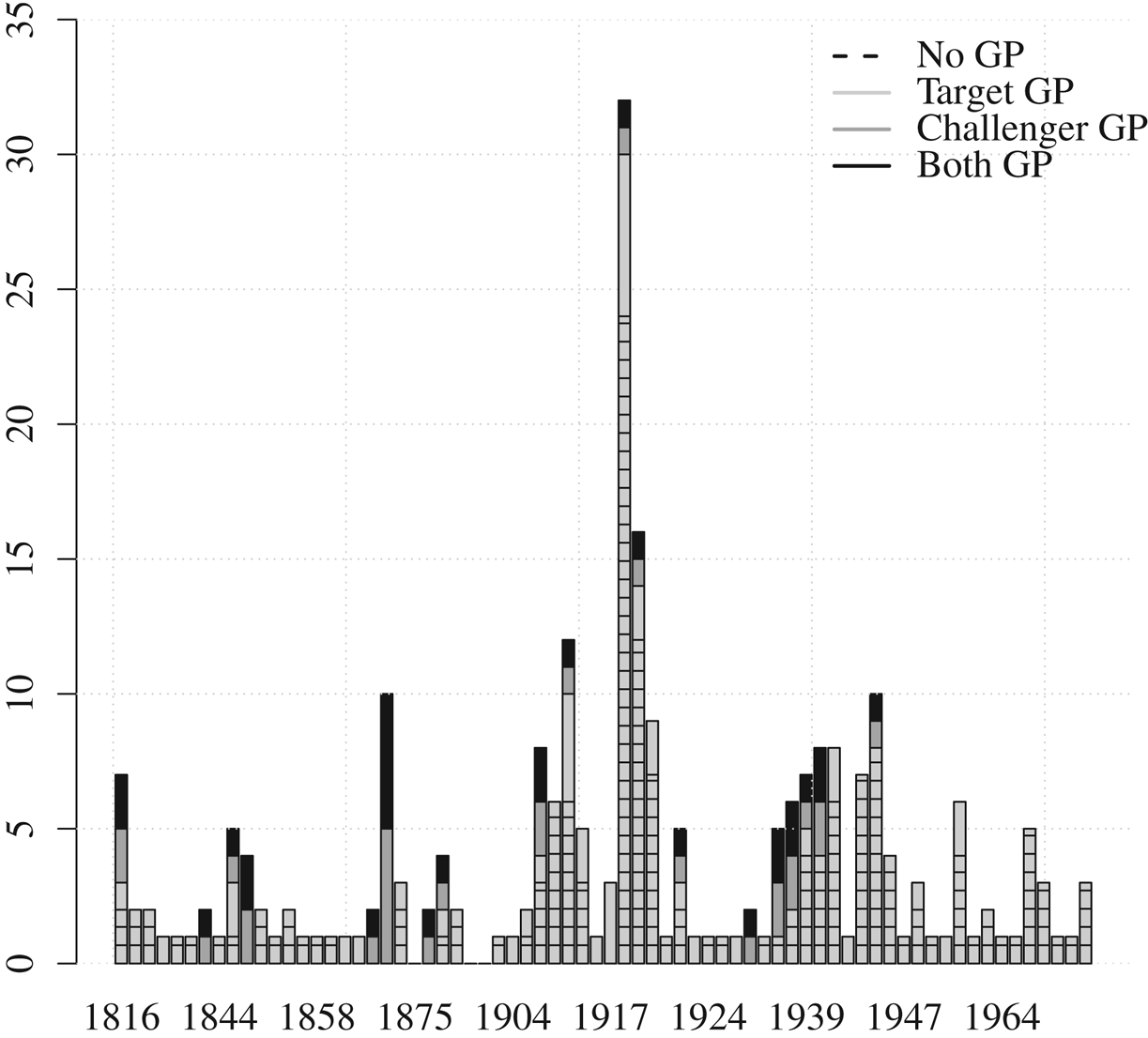
To understand the interplay between the systemic and unit-level factors that determine when and where territorial claims are made, consider the raw number of claims over time. These are plotted in Figure 2. Here, we break down claims into four groups: cases in which both challenger and target states are great powers, cases where neither are great powers, and cases where either just the target or challenger state are great powers, respectively. We see that, while overall claim-making patterns cluster temporally, it is not the consequence of great powers exclusively making claims in these periods. In fact, around two-thirds of all European claims made among these dyads exclusively involve nongreat powers, while over 82 percent of all claims made are activated by nongreat powers. Given our theoretical focus on how great power crises affect smaller states’ claim-making behavior, we exclude great power dyads from all specifications, which also helps us deal with the fact that our systemic instability variables measure events that embroil great powers and are probably related to great power claims, which could be problematic for our estimates if they were included.Footnote 77
Who and when? Claim timing and and great powers

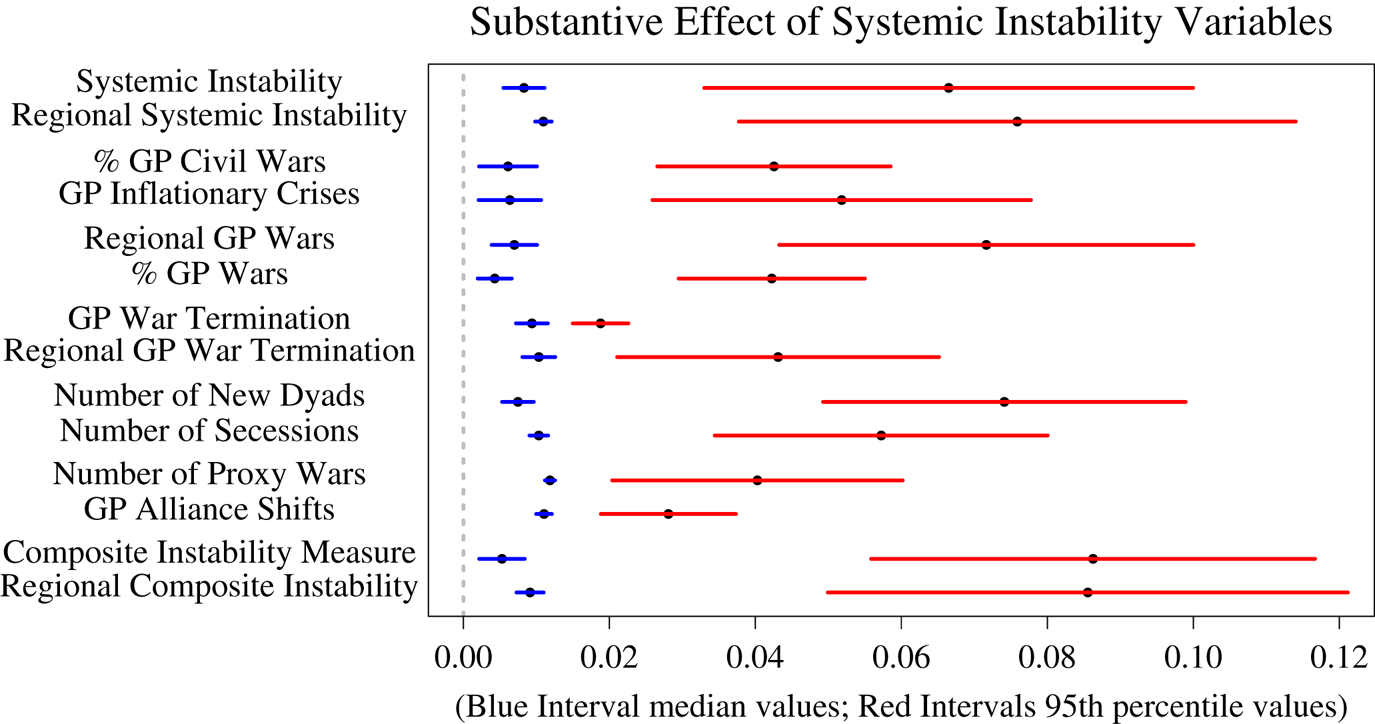
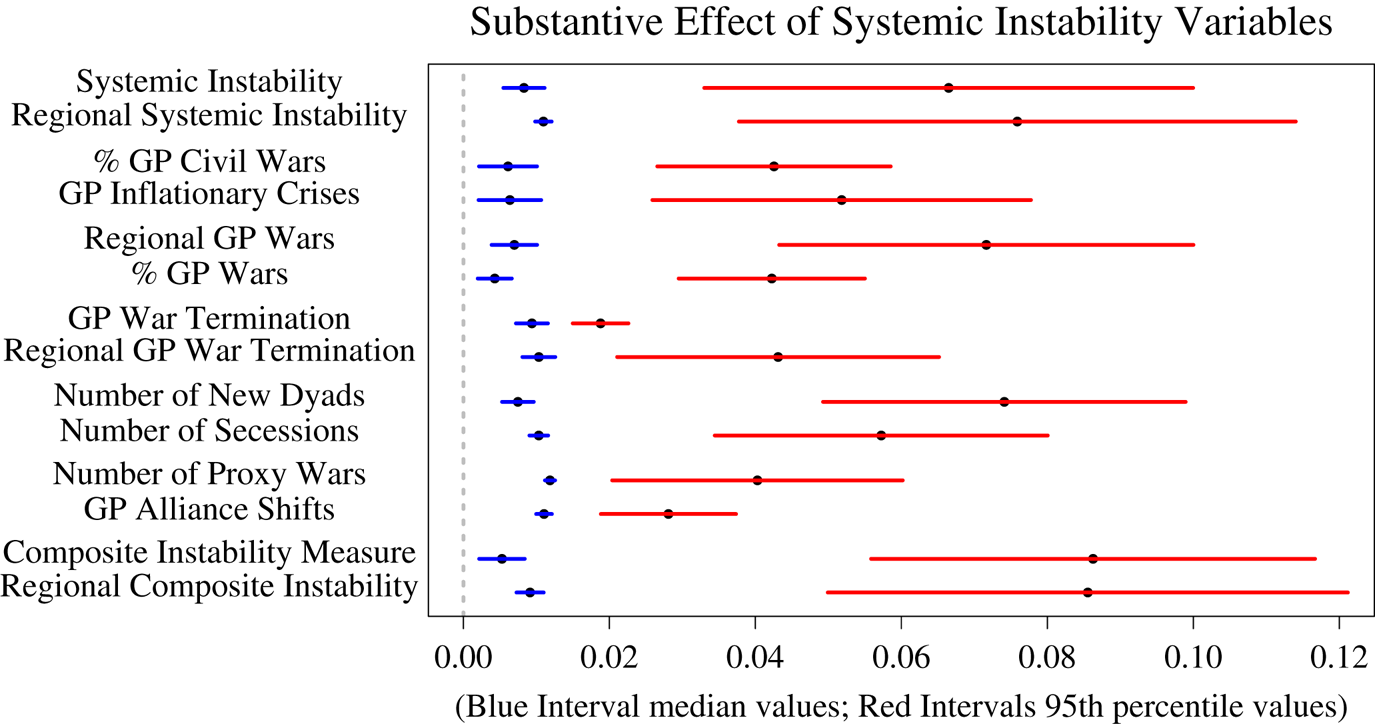
To facilitate comparison across measures of systemic and regional instability we provide a plot in Figure 3 that summarizes the estimated impact of each measure of systemic instability. Each of the estimated effects is based on estimates from the OLS model with dyad fixed effects using the European sample.Footnote 78 The point estimates with black confidence intervals around them are the predicted probabilities when we hold all variables at their median value, including the systemic or regional instability measure of interest. The point estimates with gray confidence intervals around them are predicted probabilities where the only difference is that we increase the value of the relevant systemic or regional instability measure to its ninety-fifth percentile value. We choose the ninety-fifth percentile because we are interested in years that, while not necessarily the maximum value, are plausibly years of systemic turbulence. We refer to Figure 3 throughout the results section.Footnote 79
Substantive effects of different measures of systemic instability
Systemic Instability, Regional Instability, and Claim Making
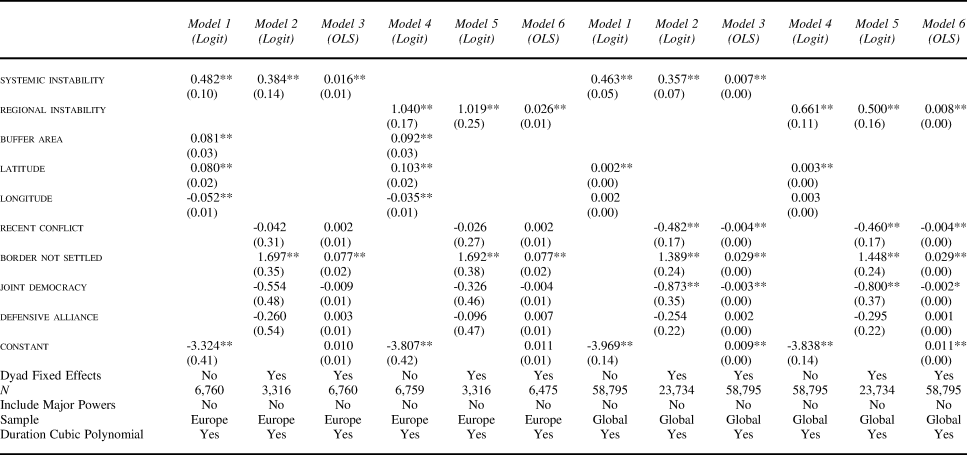
We now turn to measurement of periods of systemic instability using the variable introduced by Gunitsky.Footnote 80 Table 1 shows the results of regression models of claim onset that estimate the effect of systemic instability and regional instability. Models 1 to 3 analyze the effect of systemic instability on claim timing in post-1815 Europe, while models 4 to 6 analyze the effect of distance-weighted systemic instability in Europe. We analyze a baseline logit model for each measure (models 1 and 4), conditional logit models with dyad-fixed effects (models 2 and 5), and OLS models with dyad-fixed effects (models 3 and 6).Footnote 81 The key advantage of the OLS specifications is that we can include dyad-fixed effects without losing all of the dyads that never experience claim emergence over the sample period. Models 7 to 12 follow the same specification strategy as models 1 to 6, with the difference being that the sample is global. All models but the baseline logit models also include a measure of recent militarized conflict in a dyad using an indicator that takes a value of 1 if there is a dyadic MID in the prior five years,Footnote 82 include a measure of joint democracy where a Polity score of at least 7 indicates democracy, and include a measure of whether two neighbors have a defensive alliance.Footnote 83
Systemic instability and territorial claim onset

Note: Standard errors clustered by dyad in parentheses; * p < .10; ** p < .05.
Regardless of specification, we find that systemic instability exerts a large, positive, and statistically significant effect on the probability a country will make a claim in a specific year. Note that the estimate is not greatly affected by the inclusion of additional regressors and dyadic fixed effects. For example, the estimate in the pooled logit model, that is, model 1, is only slightly smaller than the estimate in model 2, where we also include additional regressors such as recent dyadic conflict, as well as dyad-fixed effects. The estimates for regional instability are similarly unaffected by the inclusion of additional regressors and fixed effects in models 4 and 5. The estimates for systemic instability demonstrate similar immunity to specification with OLS.
The first two rows of Figure 3 show the substantive importance of both systemic instability and regional instability. Specifically, the plot shows how moving from the median level to the ninety-fifth percentile of each variable affects the probability that an “average” dyad will see a claim. Both variables have large effects: moving from a typical year to one of systemic instability increases the probability of a claim by around seven times. The average effect of regional instability is even greater: the effect of moving from a typical year for a revisionist state to a year where proximate great powers have experienced unusually large fluctuations in capabilities increases the probability of a claim by almost eight times.
Throughout our analysis we provide support that our estimates are robust to selection on unobservables, that is, omitted variable bias. To accomplish this we use the test developed by Oster which, building on work by Altonji, Elder, and Taber provides an assessment of the degree to which our estimate for systemic instability or regional instability is biased by selection on unobservables.Footnote 84 The test allows us to formally evaluate whether the coefficients for our systemic instability measures are affected when we assume that selection on unobservables is proportional to selection on existing covariates in our OLS models with dyad-fixed effects (models 3 and 6). We find that both estimates are robust at the threshold that Oster suggests as good practice for observational studies.Footnote 85
Great Power Internal Instability and Claim Making
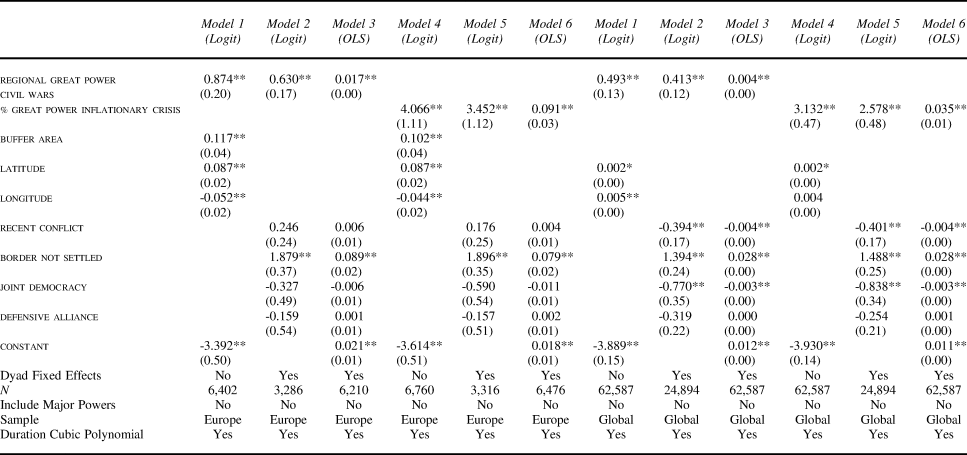
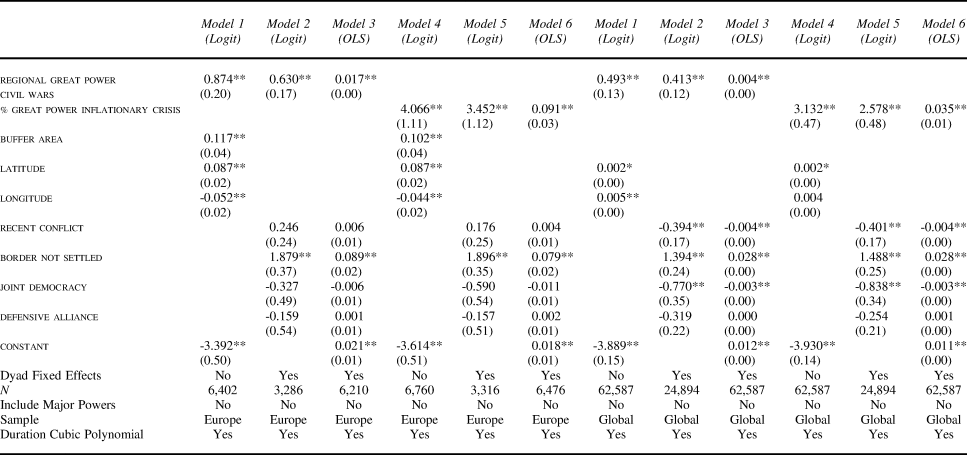
Table 2 displays the results of models that estimate the effects of two measures of internal turmoil within great powers on claim making. First, regional great power civil wars calculates the sum of all the civil wars great powers are embroiled in, where for each potential revisionist state the value of a great power's civil war is weighted by its relative geographic distance.Footnote 86 Second, % great power inflationary crisis measures the percentage of all great powers that experience inflationary crises within a given year.Footnote 87 Except for the different measures of systemic instability, we specify the models in Table 2 just as we did in Table 1. Again, the first six columns show results from post-1815 Europe, while the second set of six models show global results.
Great power internal crises and territorial claim onset
Note: Standard errors clustered by dyad in parentheses; * p < .10; ** p < .05.
The estimates in Table 2 suggest that systemic instability that stems from great powers’ internal turmoil also has significant effect on claim timing. Both distance-weighted great power civil wars and % great power inflationary crisis have a consistently large, positive, and significant effect on the emergence of a claim across all specifications, regardless of whether we focus on Europe or expand our analysis to all states in the international system.
The predicted probabilities in Figure 3 show that the substantive effects of systemic instability stemming from great powers’ internal turmoil are similar to the measures of systemic instability in Table 1. Specifically, the estimated effects of the distance-weighted measure of great power involvement in civil war show that the probability of a claim being made in a specific year increases over three times when when we compare an “average” directed dyad-year to one in which enough relatively proximate great powers are involved in civil conflict to be in the ninety-fifth percentile of this variable. For example, two observations in the data where this was the case are Greece and Belgium in 1848. The predicted value for % great power inflationary crisis shows an even greater substantive effect. If we compare a year where no great powers experience inflationary crisis to a year like 1848 or 1854 where half of the great powers experience serious economic turmoil, the probability increases by over five times from a median year without crisis.
Great Power Wars and Claim Making
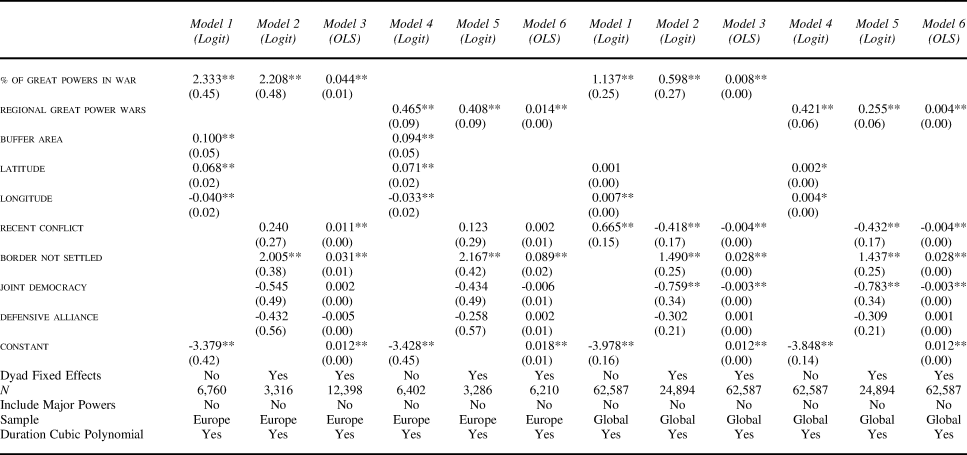
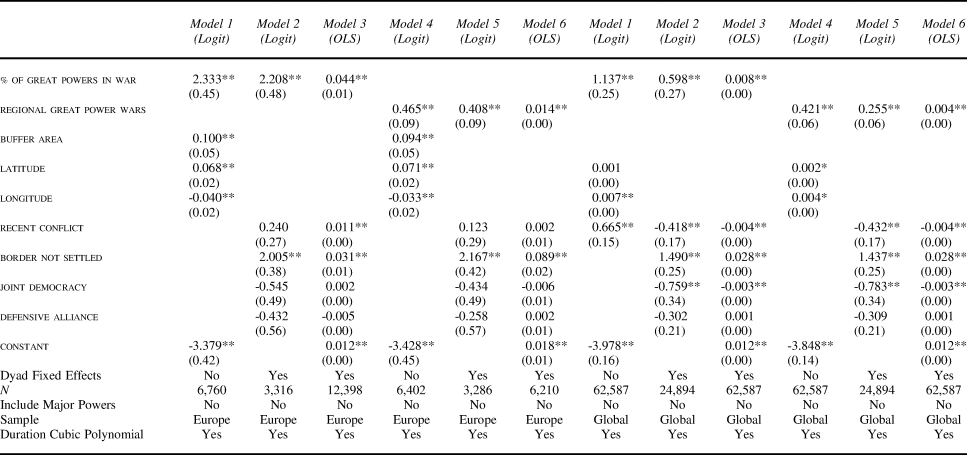
Table 3 shows the results of models that explore how systemic instability generated by great power wars affects claim timing. We analyze two alternative measures, % of great powers in war, which is a systemic measure of the percentage of great powers involved in interstate wars in a given year, and regional great power wars, which is the sum of great power wars each year weighted by relative distance for each potential revisionist state. Again, we employ the distance-weighted measure to tap into the idea that regional great powers exert more influence over the claim-making behavior of smaller states than distant great powers.
Great power wars and territorial claim onset
Note: Standard errors clustered by dyad in parentheses; * p < .10; ** p < .05.
The results in Table 3 show that measuring systemic stability whose source is great power war produces very similar results to our previous measures. Both the fully systemic variable % of great powers in war and the regionally weighted regional great power wars have a large, positive, and statistically significant effect on claim timing across all specifications. The substantive effects of these two measures shown in Figure 3 are also large, especially for regional great power wars, which has an effect of similar size to the measures of systemic instability from Table 1. The years where these measures are in their ninety-fifth percentile are those with well-known great power wars such as the World Wars, the years of the Crimean war, and the Austro-Prussian war.
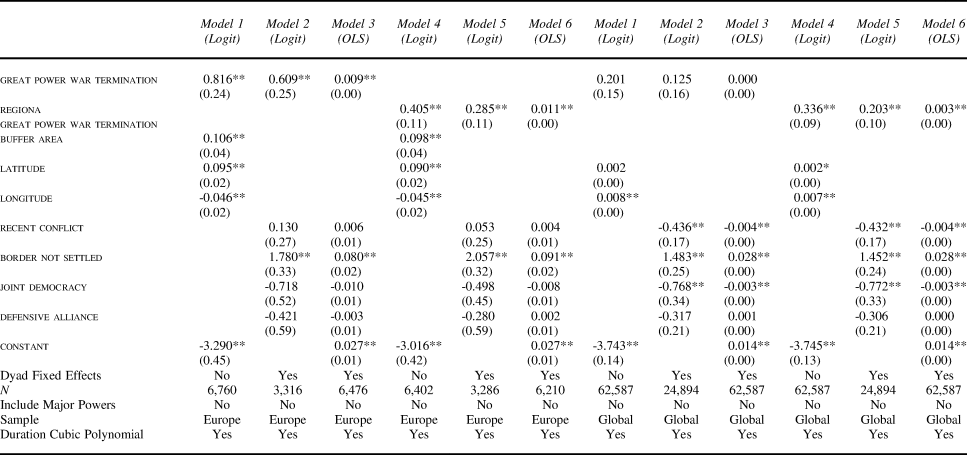
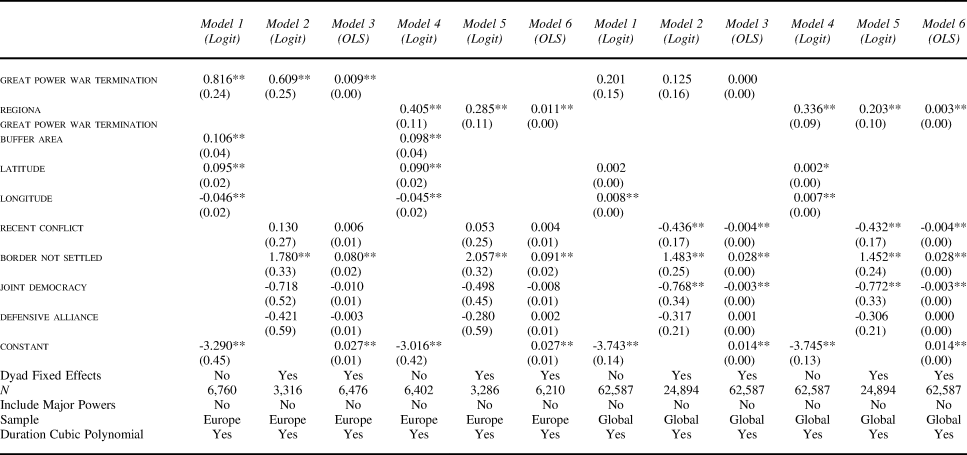
In Table 4 we examine the influence of systemic instability generated by major resettlements of international and regional order following great power wars. We again employ two related measures, one that is fully systemic in that it varies across years but not dyads, and a second that weights great power war-termination events for each potential revisionist state by the relative geographic proximity of the affected great powers. As noted before, both measures capture the two-year period following any interstate war that involves at least two great powers.Footnote 88
Great power war termination and territorial claim onset
Note: Standard errors clustered by dyad in parentheses; * p < .10; ** p < .05.
For the models that analyze European claims, we find that both measures are consistently positive and significant across specification. We find that the fully systemic measure great power war termination does not have significant effect in the global sample, while the regional great power war termination variable is statistically significant across specifications. This difference reflects the fact that for most of the post-1815 period, the great powers are clustered in Europe. Being proximate to great powers that have settled ongoing wars has a regional effect in the global sample, but the mere fact that (distant) great powers have settled their wars does not necessarily matter much for claim making outside of Europe.
The substantive effects presented in Figure 3 (which focuses on the European sample) suggest that the influence of these postwar periods is less than that of the other sources of instability. The effect of changing great power war termination from 0 to 1 roughly doubles the probability of a claim. While this is certainly not a trivial effect, it is significantly smaller in magnitude than that of most of our other measures of systemic instability. It is possible that this relatively modest estimated effect is a result of a countervailing effect of great-power war agreements: new international orders can also help to resolve some territorial disputes in addition to producing incentive for some latent claims to be activated.Footnote 89 The regionally weighted variable has a larger effect, increasing the probability that a claim will be made by roughly four times relative to a year where no great power wars ended.
Crumbling Empires and Claim Making
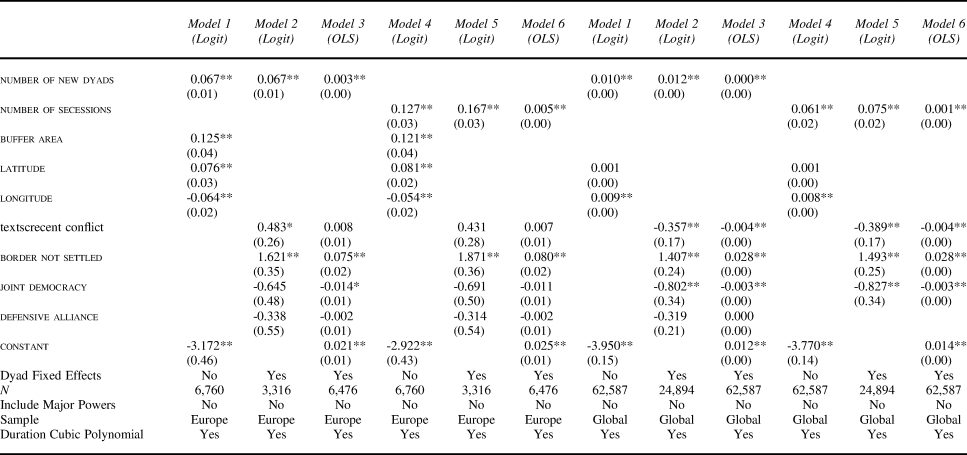
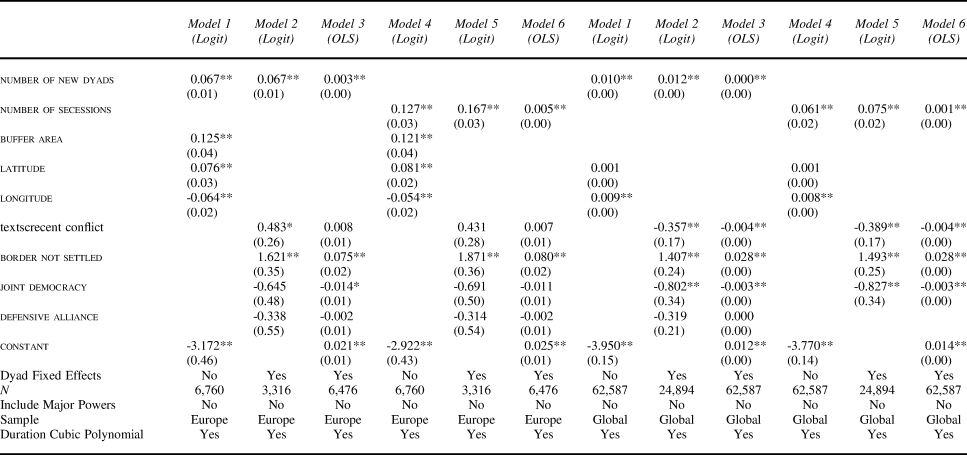
Table 5 contains results that describe the influence of empires’ dissolution. We analyze two complementary measures, number of new dyads, which measures the number of new neighboring dyads that have emerged in the system in each year, and number of secessions, which counts the number of new states that have emerged by seceding from a larger state. While there are a number of years in which there are one or two secessions in the data, number of secessions is a good indicator of empire dissolution because it takes large values only in years where large empires have broken up. In the global sample (columns 7–12), the number of new dyads also nicely captures the wave of decolonization that occurred in Africa and Asia during the late 1950s and early 1960s.
The breakup of empires and territorial claim onset
Note: Standard errors clustered by dyad in parentheses; * p < .10;** p < .05.
The results suggest that both of our measures of systemic instability that stem from empires crumbling have significant effects across all specifications. Both measures have consistent positive influence on the propensity for claims to be made in a particular year. The substantive effects of both measures are also large. Figure 3 shows that the effect of number of new dyads is quite large—moving from a “typical” year where there are no new dyads to a year where there are enough new dyads in the system to suggest it is associated with systemic turbulence increases the probability of a claim by over seven times. This effect is about as large as that exhibited by any of the other systemic variables. The years that correspond to the ninety-fifth percentile of the number of new dyads in a system are years such as 1991, 1993, and 1918—all periods when empires and formerly large states crumbled. The effects of the number of secessions is similar, although the point estimate for the increase in the probability of a claim is slightly smaller.
Great Power Proxies and Claim Making
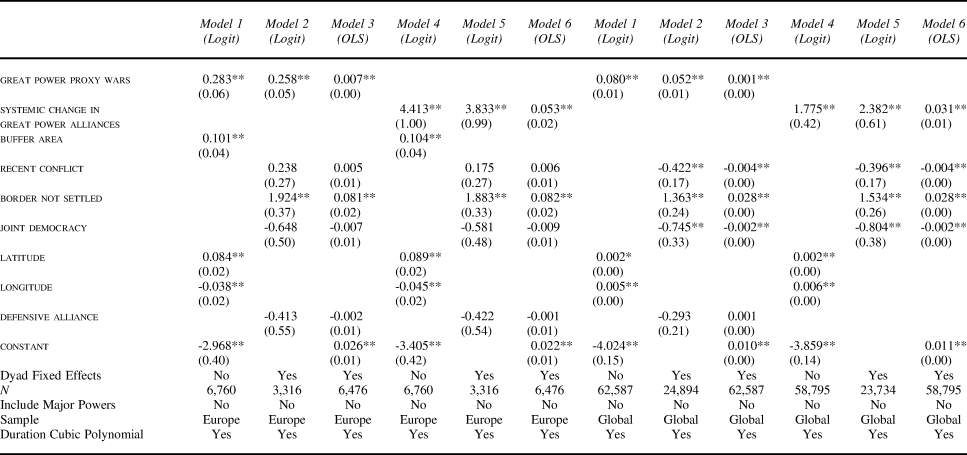
Our final measures rely on how proxy conflicts fueled by great power alliances can generate systemic instability. We analyze two variables: great power proxy wars and systemic change in great power alliances. The former counts the number of wars across the system in which the two combatants have different great power allies. This variable assesses the importance of wars between smaller states that can become systemic events by the nature of their importance to great power patrons. Systemic change in great power alliances measures how much small states’ alliances with great powers have changed across the system in the past year. Accordingly, this variable takes higher values in years when a great number of states in the European (columns 1–6) or international system (columns 7–12) have changed their alliance status with great powers.
The results suggest that both measures are systematically related to claim timing since both have positive and statistically significant effect across all specifications. Thus, both great power proxy wars and systemic change in great power alliances are associated with claim timing in Europe as well as globally after 1815. The estimated substantive effects in Figure 3 demonstrate that while the effects of proxy conflict are not trivial, they are substantially smaller than for most of our other measures of systemic instability. For instance, we find that moving from a median year for the rate at which smaller states shift alliances with great powers to a high value, that is, the ninety-fifth percentile, increases the probability of a claim by a little more than 2.5 times.Footnote 90
Combining Measures of Systemic Instability
The measures of each source of instability exhibit significant effects when we compare the median value to the ninety-fifth percentile, which obviously indicates a high level of systemic instability. The plots exhibit variation in how powerful a predictor of claim making each measure is. The measures that induce the greatest increase in the probability of a claim are systemic instability, regional systemic instability, regional great power wars, and number of new dyads. The predictive power of systemic instability that is based on yearly changes in CINC scores among great powers is perhaps unsurprising, considering that this measure accounts for multiple sources of instability. Those that seem to exert the least effect on claim making are the great power war termination and the measure of global shifts in smaller states’ alliances with great powers. The results summarized in the plot also suggest support for the idea that regional great powers exert a great deal of influence over claim-making behavior because the regional measure always leads to a greater average predicted probability of a claim for the measures that have both a systemic and regional variant. The measures of systemic instability that we develop and analyze are positively correlated with each other, which is unsurprising since they are designed to refer to the same underlying theoretical process.Footnote 91 While several of the measures draw from some of the same underlying years, the measures of different sources of systemic instability allow us to highlight different years of systemic crisis—some years are rife with internal instability within great powers, while others see interstate war or large realignments in alliances patterns. This suggests that placing them all in the same model specification is not a good idea,Footnote 92 but also suggests that combining the measures using principal components analysis (PCA) or item response theory (IRT) is a promising way to leverage each of their distinct strengths and reduce measurement error.Footnote 93 We use PCA to produce composite measures of systemic instability and regional instability (the final two estimates in Figure 3). A key advantage of PCA here is that it allows us to generate an overall measure of systemic instability that draws from all of our different measures.Footnote 94
Qualitative and quantitative assessment of this composite measure of systemic instability suggests that it is a good measure of systemic crisis across the five sources we identify theoretically. The plot in Figure 4 shows the variation in the composite systemic instability measure across time along with the number of European territorial claims. The relationship between these two measures is clear from visual inspection of the plot. In fact, at the yearly level the bivariate correlation between the composite systemic instability measure and the number of claims is over 0.7, which indicates a very strong relationship.Footnote 95 The correlation between the claim onset variable and the composite systemic instability measure in the full directed dyadic sample is around 0.2.
Composite measure of instability and territorial claims, 1816–2001
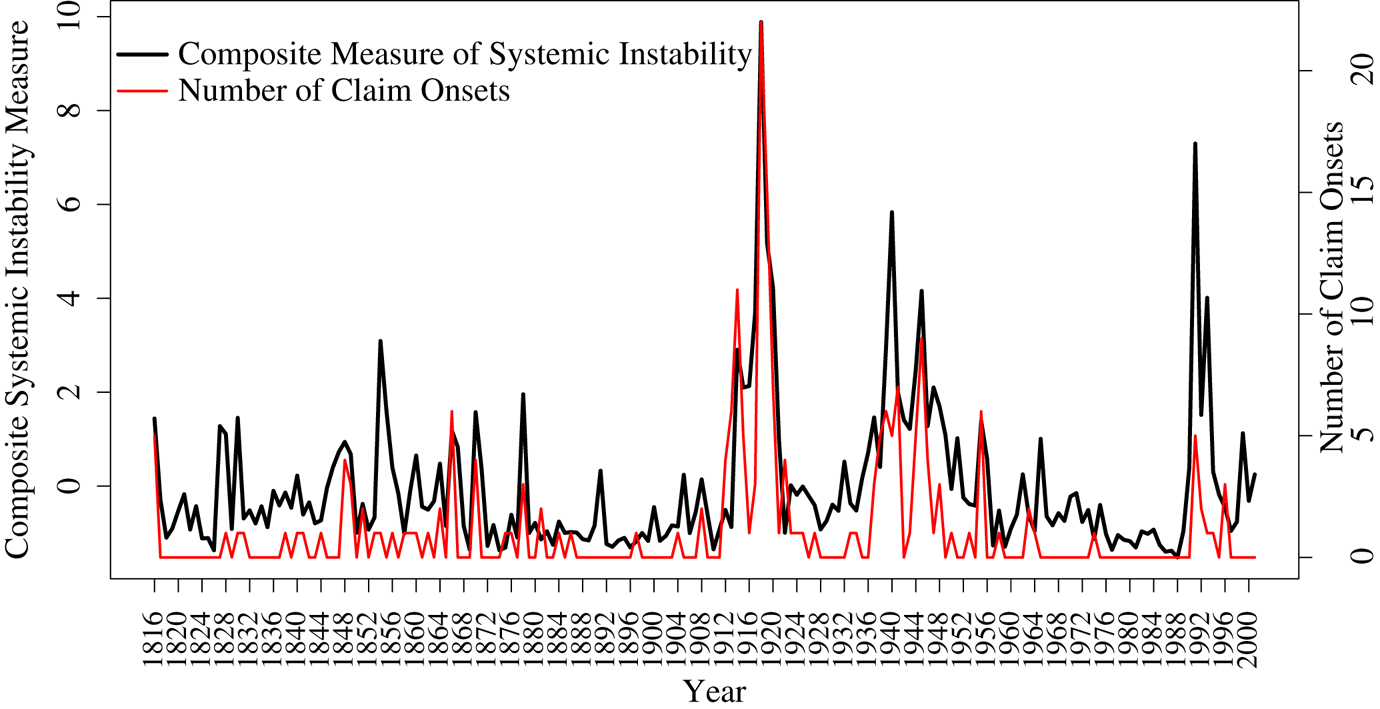
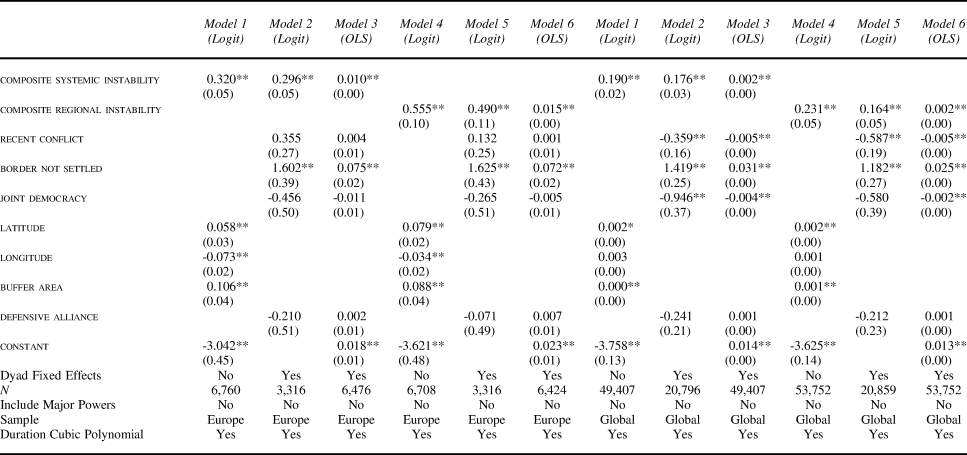
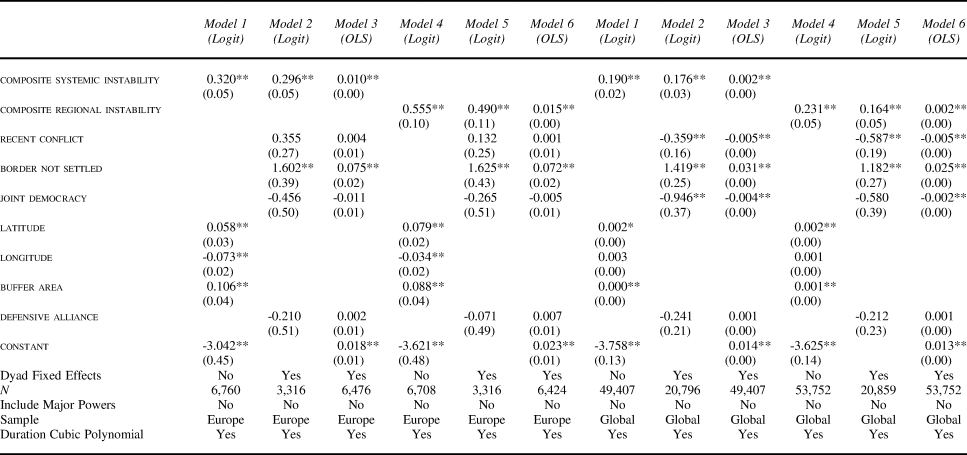
Table 7 contains the results of models that are specified exactly as the models in Tables 1 to 6, but include either composite systemic instability or composite regional instability. The composite measure has positive significant effect across all specifications. Examination of the substantive effects in Figure 3 shows that composite systemic instability and composite regional instability have two of the largest effects on the probability of a claim among the measures, increasing the probability for an “average” dyad by around nine times. This makes sense—the composite measures leverage information from all of the other measures. They also fair well in the sensitivity analysis for selection on unobservables (see the appendix). We expect these measures to be quite useful to scholars interested in doing future analysis of systemic or regional instability who are not interested in a particular source but in the general concept.
Great power proxy conflicts and territorial claim onset

Note: Standard errors clustered by dyad in parentheses; * p < .10;** p < .05.
Composite measure of systemic instability and territorial claim onset
Note: Standard errors clustered by dyad in parentheses; * p < .10; ** p < .05.
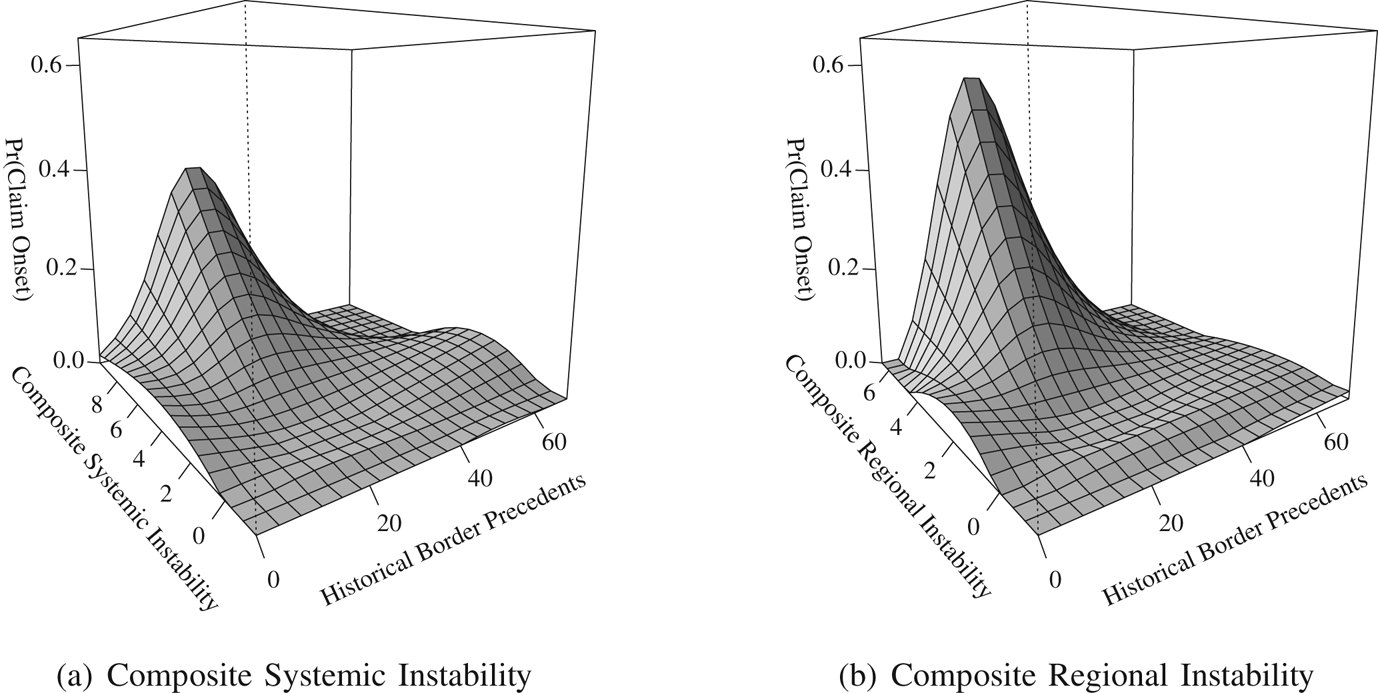
Systemic Instability and the Value of Potential Claims
The results thus far demonstrate that periods of systemic instability exert a real and persistent influence on states’ claim-making behavior. We now analyze whether and how the value of latent territorial claims interacts with systemic uncertainty to influence claim making. Specifically, we investigate whether the activation of latent claims in Europe in areas with attractive competing historical boundary precedents is conditioned by our composite measures of systemic and regional instability.Footnote 96 We follow Abramson and Carter and measure the spatial density of historical boundary precedents in each of our units.Footnote 97 We also include all of the measures of economic and military value outlined earlier: river density, terrain ruggedness, iron forges, urban population, buffer unit area, latitude, longitude, a nonparametric estimate of the time since the last claim, as well as an indicator of whether the border is legally settled or not.
Given that the historical boundary precedent measures necessarily precede the time frame of the sample, they also do not vary within dyad, a feature shared by our other geographic measures of value, for example, river density or iron deposits, which is also more often than not the case in common measures of territorial salience.Footnote 98 This suggests that their specification within a claim-timing model should also incorporate an interaction with time-varying factors to account for why attractive prospective claims are activated at specific points in time. Obviously, the inclusion of time-invariant regressors alone cannot explain why claims are especially likely in 1853 but not in 1835. Accordingly, we estimate flexible models that allow variables such as historical border variability to have differential influence on the onset of claims across time. Specifically, we estimate a linear regression model of claim onset that includes historical boundary precedents, our composite measures of instability and nonparametric smoothed interactions between composite instability, and historical boundary precedents using generalized additive models (GAMs).Footnote 99 These models allow the estimated effect of regressors to vary across different values of systemic instability without placing much restriction on the exact shape of the interaction.Footnote 100 This statistical approach is consistent with the advice of Hainmueller, Mummolo, and Xu, who systematically demonstrate how assuming linearity in an interaction effect is often problematic in applied research.Footnote 101
We rely on plots to show how the effect of variables such as historical border variability are conditioned by systemic instability because the smoothed interaction estimates from the generalized additive models are not easy to interpret. Figure 5 contains two three-dimensional plots that depict the interaction between composite systemic instability and historical boundary precedents (Figure 5a) and the interaction between composite regional instability and historical boundary precedents (Figure 5b) across their entire ranges. These graphs nicely depict the predicted effect the interactions have on claim making for every possible combination of values.
Composite instability measures, boundary precedents, and European claims

The plot in figure 5(a) shows that increasing historical boundary variability greatly increases the probability of a claim for values of composite systemic instability roughly greater than 4, until the variable takes values that imply a very large number of border changes within a buffer unit (around twenty precedents). The estimated relationship's shape is remarkably similar to the one reported in our earlier work, which had a completely different research design, and is consistent with the idea that in areas where borders changed very regularly post-Westphalia, meaning there are many competing precedents, the resulting precedents were not well-established enough to be attractive.Footnote 102 The portion of the data where the relationship between historical boundary variability and claim making is increasing constitutes over 80 percent of the sample. The estimated relationship in Figure 5(b) where we interact composite regional instability with historical precedents has a very similar shape. Again, increasing the number of competing historical precedents in a buffer unit increases the probability of a claim only when there is regional instability of at least 2 or so.
A novel finding that emerges from the plot is that the relationship between historical boundary variability and claim making is highly conditional on the level of systemic or regional instability. For relatively low levels of either systemic or regional instability, there is not much of a relationship between historical boundary precedents and claim onset. By contrast, as the level of systemic instability increases, the slope of the effect of historical boundary variability also rapidly increases. Comparison of the two identically constructed plots suggests that the composite regional instability measure is quite effective at measuring revisionist state-specific episodes of regional uncertainty that encourage claim making. While the maximum predicted probability of a claim is around 0.4 in Figure 5(a) where we use the composite systemic instability measure, the maximum predicted probability is nearly 0.6 in Figure 5(b) where we use our composite regional instability measure. If we estimate the relationship between composite regional instability and claim onset at the twenty-fifth and seventy-fifth percentile of historical boundary precedents, both values that have support in the data, the 95 percent confidence intervals do not overlap at all when composite systemic instability is greater than 5 or when composite regional instability is greater than 3. This suggests that the differences across our instability measures are statistically significant in addition to being substantively important.
Conclusion
Although the literature on the consequences of territorial disputes is voluminous, little work explores the origins of these disputes and no research we are aware of explains their timing. We demonstrate that territorial claims are overwhelmingly made at points of systemic crisis and instability. From the standpoint of nongreat powers making claims that are typically small and precise, this is surprising because the justification for territorial claims often predates the claim by years if not decades. This raises the question of why states wait, given that the justifications underlying prospective claims tend to weaken the longer they are not made. Given that all claims have distinct justifications, why would so many states converge on making their claims in the same year? We argue that states wait to make claims at points when the great powers that sit atop the international or regional system are embroiled in crisis. When the system is in turmoil great powers are less interested in policing bilateral territorial claims, which are correctly viewed as potentially disruptive in times of stability. We corroborate our arguments with a battery of statistical tests and a case study of the territorial claims that led to the formation of the Italian state, which we detail in the appendix.
This article uncovers a number of new findings of importance to the literatures on international conflict, great power politics, international order, and territorial disputes. We demonstrate that there is much to be gained from tighter theoretical and empirical links between the rich empirical literature on territorial disputes and the theoretical literature on international order and great power politics. That being said, there remain a number of important avenues left unexplored that we think are fruitful pursuits for future research. First, although we demonstrate that our measures of instability predict claims in Europe and beyond, the bulk of our focus is on Europe. For instance, we explore the interplay between dyad-level measures of latent claims, that is, historical boundary precedents, and systemic instability but do not undertake a similar analysis for other regions. Our historical case study also focuses on Europe, although we draw qualitative examples from most other regions throughout the paper. Thus, there is much work to be done on these issues that focuses on other regions such as East Asia, which will necessitate additional theoretical and empirical work on the spatial features that undergird attractive latent claims in these regions. Given our findings, we view this as a very promising and important area for future research to address.
Our paper also provides insight into the regional and global security consequences of instability within and among the great powers. Change and breakdown of international order are addressed in influential theoryFootnote 103 but there has not been much statistical investigation of its general effects on states’ propensities to initiate contentious disputes. Territorial disputes are central to understanding whether two states’ relations are likely to be cooperative or conflictual—a vast literature shows them to be among the most difficult and deadly issues of contention among states. Our finding that systemic and regional instability is strongly associated with large increases in the number of territorial disputes across Europe and the rest of the world is sobering. While it is true that there has been a secular decline in the rate of territorial claim onset since World War II, particularly in Europe, it is not clear that this corresponds to a weakening of the mechanisms we put forth. In fact, there are theoretical reasons to think that the structure of the international system during and especially after the Cold War has contributed to a reduction in territorial revisionism and the “territorial integrity norm” that proscribes forceful conquest.Footnote 104
During the Cold War, the US and the Soviet Union both had incentives to police claims within their respective “blocs,” and the prospect of provoking superpower intervention was often enough to tamp down on such claims across alliance blocs. As scholars such as Ikenberry argue, the US-led liberal order has built into it a general distaste for militarization and conflict, in part because conflict and war usually depress flows of trade and investment.Footnote 105 We conclude by noting that many scholars view the Trump administration's “America first” foreign policy as having injected considerable uncertainty into the US's long-standing alliance commitments and its support of the “rules based” liberal international order. If it is the case that the Trump administration's policies are generating considerable instability in the existing order, our findings suggest that this will likely encourage states with latent territorial claims to activate them. Recent aggressive moves by Russia in Ukraine and Syria as well as by China in its disputes in the South China Sea that are starkly inconsistent with the US's positions raise the real possibility that systemic and regional instability in Europe and East Asia in particular might perturb the existing order and provide incentive for states to activate latent territorial claims. The empirical record quite clearly indicates that an increase in territorial claims is likely to accompany an increase in militarized conflict.
Data Availability Statement
Replication files for this article may be found at <https://doi.org/10.7910/DVN/SYJZNG>.
Supplementary Material
Supplementary material for this article is available at <https://doi.org/10.1017/S0020818320000545>.
Acknowledgments
We thank Stephen Chadoin, Terry Chapman, Alex Debs, Paul Huth, Jason Lyall, Xinru Ma, Jonathan Markowitz, Pat McDonald, Ethan Bueno de Mesquita, Nuno Monteiro, Jim Morrow, Thania Sanchez, Anne Sartori, Jake Shapiro, Beth Simmons, Jaroslav Tir, John Vasquez, Scott Wolford, seminar participants at the University of Colorado, Boulder, seminar participants at Harvard University, seminar participants at the University of Texas–Austin, seminar participants at Yale University, seminar participants in the Borders and Boundaries speaker series at Perry World House at the University of Pennsylvania, participants at the 2018 Political Economy of Security conference at the University of Southern California, and participants of the 2015 and 2017 North American meetings of the Peace Science Society (International) for comments. All mistakes remain our own responsibility.