Introduction
In resource-poor settings, gender inequality remains a major driver of poor health outcomes for women and girls (World Health Organization, 2011; Derrick, Reference Derrick2014). Countries characterized by poor gender equity often experience higher rates of maternal morbidity and mortality (Filippi et al., Reference Filippi, Ronsmans, Campbell, Graham, Mills, Borghi and Osrin2006; Asling-Monemi et al., Reference Asling-Monemi, Naved and Persson2009), and higher rates of infant and child morbidity and mortality, particularly among girl children (Asling-Monemi et al., Reference Asling-Monemi, Naved and Persson2009; Brinda et al., Reference Brinda, Rajkumar and Enemark2015). The negative effects of gender inequity on female health are most pronounced in resource-poor settings in East and South Asia, the Middle East and multiple regions in Africa, where cultural norms supporting a preference for male children are strongest (Hesketh & Xing, Reference Hesketh and Xing2006a; Fuse, Reference Fuse2010). Such norms confer social and economic utility on male children and social and economic expense on female children. Families are faced with the choice between raising a son who is culturally integral to the family’s livelihood, lineage, inheritance and religion, or a daughter who is an additional financial responsibility on the family’s already constrained resources (e.g. dowry, low earning potential; Das Gupta et al., Reference Das Gupta, Zhenghua, Bohua, Zhenming, Chung and Hwa-Ok2003; Fikree & Pasha, Reference Fikree and Pasha2004; Milazzo, Reference Milazzo2014). Having male children in such environments is a greater-good obligation rather than mere preference (Brunson, Reference Brunson2010), driving a bias towards sons and creating the potential for negative health effects for girl children.
The effects of gender on female health are found in many cultural contexts. In the extreme form, gender bias favouring sons may result in female-fetal abortion and female infanticide (Fuse, Reference Fuse2010), and physical and/or medical neglect of female infants and children, examples of which can be seen from studies across low- and middle-income countries. In India, girls are breast-fed for a shorter period and are given less milk overall compared with boys (Fledderjohann et al., Reference Fledderjohann, Agrawal, Vellakkal, Basu, Campbell, Doyle and Stuckler2014), and are less likely to be immunized compared with boys (Corsi et al., Reference Corsi, Bassani, Kumar, Awasthi, Jotkar, Kaur and Jha2009). In Egypt, boys receive better treatment for diarrhoeal diseases compared with girls (Yount, Reference Yount2003), and in India, Bangladesh and Pakistan, girls receive less preventive care and less nutritious food compared with boys (Fikree & Pasha, Reference Fikree and Pasha2004). In Turkey, daughters are given less access to overall resources than sons (Altindag, Reference Altindag2016). Such practices contribute to malnutrition (Raj et al., Reference Raj, McDougal and Silverman2014), poorer growth patterns (Koolwal, Reference Koolwal2007), discrimination in school attendance and care practices (Hesketh & Xing, Reference Hesketh and Xing2006b) and increased mortality (Chamarbagwala, Reference Chamarbagwala2011; Dyson, Reference Dyson2012; Jayachandran, Reference Jayachandran2014). A recent trend towards a desire for ‘balanced families’, i.e. one in which there are similar numbers of boys and girls, is increasing in some resource-poor countries with low birth rates – such as those in Eastern Europe and the Caucuses (Garenne & Hohmann, Reference Garenne and Hohmann2014). This may have particular implications for same-sex twin pairs and has led to increases in sex-selective abortion in Armenia and Azerbaijan (Garenne & Hohmann, Reference Garenne and Hohmann2014).
Overall, females should have lower rates of first-year mortality (Naeye et al., Reference Naeye, Burt, Wright, Blanc and Tatter1971; Waldron, Reference Waldron1983; Asling-Monemi et al., Reference Asling-Monemi, Naved and Persson2009). X-chromosome-linked vulnerabilities more readily inherited by male children (Waldron, Reference Waldron1983) make them more susceptible to respiratory problems and low birth weight (Snow, Reference Snow2008). Higher levels of testosterone are also shown to depress infants’ immune systems (Ahmed & Talal, Reference Ahmed and Talal1990; Bouman et al., Reference Bouman, Jan Heineman and Faas2005). In settings where son preference is prevalent, cultural norms that reduce the desire for female children risk usurping the inherent biological advantage of female children.
Singleton births have provided researchers with the most practical means by which to study gender bias and associated health disparities during the prenatal, neonatal and postnatal periods, simply by being more common than multiple births. Smits and Monden found the average twinning rate across 76 resource-poor countries to be 1 in 76 (or 13 per 1000 births), and the average triplet rate to be 1 in 6700 (Smits & Monden, Reference Smits and Monden2011). There is little evidence for how, or if, the disadvantages associated with gender bias and son preference extend to multiple births – a population inherently at risk of a number of health challenges. Compared with singletons, twins in resource-poor settings are more likely to be born preterm and have a low birth weight, both of which present increased risk for adverse perinatal outcomes (Vogel et al., Reference Vogel, Torloni, Seuc, Betrán, Widmer, Souza and Merialdi2013), including mortality (Vogel et al., Reference Vogel, Torloni, Seuc, Betrán, Widmer, Souza and Merialdi2013; Miyahara et al., Reference Miyahara, Jasseh, Mackenzie, Bottomley, Hossain, Greenwood and Roca2016). A range of studies focused on twins in resource-poor settings have shown the negative health effects experienced by twins. Twins are more likely to be smaller in the post-neonatal period in Malawi (Kalanda et al., Reference Kalanda, Verhoeff and Brabin2006) and Ghana (Van der Mei et al., Reference Van der Mei, Heijstra and Boersma2003), and twins are more likely to be undernourished in Malawi (Kalanda et al., Reference Kalanda, Verhoeff and Brabin2006) and The Gambia (Jaffar et al., Reference Jaffar, Jepson, Leach and Greenwood1998). In Malawi, Tanzania and Zambia, twins under five years of age are at higher risk for mortality than singletons (Justesen & Kunst, Reference Justesen and Kunst2000).
Due to the distinct health challenges faced by female offspring and by twins in resource-poor settings, being both a female and a twin may result in adverse health outcomes that are much more severe than those seen in female singletons or male twins. Few studies have explored this issue directly, though Miyahara et al. (Reference Miyahara, Jasseh, Mackenzie, Bottomley, Hossain, Greenwood and Roca2016) found female twins in The Gambia to have a higher mortality risk than male twins (Miyahara et al., Reference Miyahara, Jasseh, Mackenzie, Bottomley, Hossain, Greenwood and Roca2016). Studies examining twins in resource-poor settings have not taken into account how the sex composition of twins is associated with morbidity and mortality outcomes. This study analysed how two key covariates – the sex composition of twins and societal gender inequity – are associated with eight mortality and morbidity outcomes in 38 resource-poor countries. This research fills gaps in the literature on the intersection between sex composition of twins and health in resource-poor settings. Understanding the effects of son preference on twins’ health outcomes will contribute towards the goal of reducing gender inequity, as detailed in Global Goal number five (World Health Organization, 2015).
Methods
Data
The analysis utilized data from the women’s questionnaire (female respondents aged 15–49) of the Demographic and Health Surveys (DHS). In order to constrain the sample to a definitive time period and reduce the possibility of cohort effects, only surveys collected in 2010 or later were included (n=44). Some surveys did not collect data specific to multiple births, resulting in a final count of 38 DHS datasets. A full description of the methodology, survey contents and data for the DHS are publically available at www.measuredhs.com.
The 38 DHS datasets were combined to create a global register of live twin births representing all six WHO regions (n=11,684 children, 5842 sets of twins). Each line of the data was an individual child, thus the unit of analysis was the child, not the twin set. A variable was then created to categorize the sex composition of the twins with values of 1 to 4, where 1=boy/boy, 2=boy/girl, 3=girl/boy and 4=girl/girl. Since each twin set consists of one index child and one sibling, this requires opposite-sex twins to be categorized into those with a male index child (boy/girl) and a female index child (girl/boy). Considering the hypothesis of this study centres on gender treatment, monozygotic and dizygotic twin pair were not differentiated. However, due to the inherent differences in the health outcomes of male and female children described above, it was determined that boy/girl and girl/boy dizygotic pairs should remain discrete categories. This categorization also allowed investigation of the associations between the index child’s gender, the gender of their twin and the morbidity, mortality and treatment-seeking outcomes.
To examine how the health of twins may be shaped by gender inequality, the Gender Inequality Index (GII) score for each country was added to the dataset. This measure aims to quantify gender inequality via three aspects of human development: 1) reproductive health, measured by a country’s maternal mortality ratio and adolescent birth rates; 2) female empowerment, measured by proportion of parliamentary seats held by females and proportion of adult males and females with at least a secondary education; and 3) labour market participation, measured by labour force participation rate of females and males aged 15 years or older (United National Development Programme, 2015). The GII is scored on a scale of 0 to 1, with a higher score indicating a higher degree of gender inequality.
Outcome variables were categorized as mortality, morbidity or treatment-seeking. Mortality outcomes included neonatal (birth to 28 days), post-neonatal (28 days to 1 year), infant (first year of life) and child (first 5 years of life) mortalities. Morbidity outcomes included mother-reported episodes of diarrhoea and fever/cough for either twin in the past 2 weeks. Treatment-seeking outcomes included whether or not the mother reported seeking medical treatment for these episodes of diarrhoea or fever/cough from a medical professional.
Analysis
The primary aim of this analysis was to ascertain the associations between the sex composition of twins, gender equity and the eight outcome variables. The models used in the analysis controlled for additional factors known from the literature to be associated with infant and child health in resource-poor settings. These included WHO region of residence, rural/urban residence, wealth quintile, parity, institutional vs non-institutional delivery, birth order, birth spacing, child age, maternal age, mother’s educational attainment, mother’s current employment status and whether or not the mother received the WHO prenatal care minimum standard of at least four antenatal care assessments by a skilled attendant in her last pregnancy (World Health Organization, 2006). The fact that each mother accounted for two children in the dataset represents a hierarchical structure to the data. Therefore, a multilevel model was necessary to account for the non-independence of data and avoid an overestimation of the regression coefficients (Steele et al., Reference Steele, Diamond and Amin1996; Diez-Roux, Reference Diez-Roux2000). Separate, identical, multilevel logistic regression models were fitted for each of the eight outcome variables, including the mother as the only random effect term. Due to small cell counts in some regions, the region variable was excluded from the child mortality model and both treatment-seeking models. Maternal age was also excluded from the treatment-seeking for diarrhoea model for this reason. Analysis was completed using Stata version 14 (Stata Corporation 2014).
Results
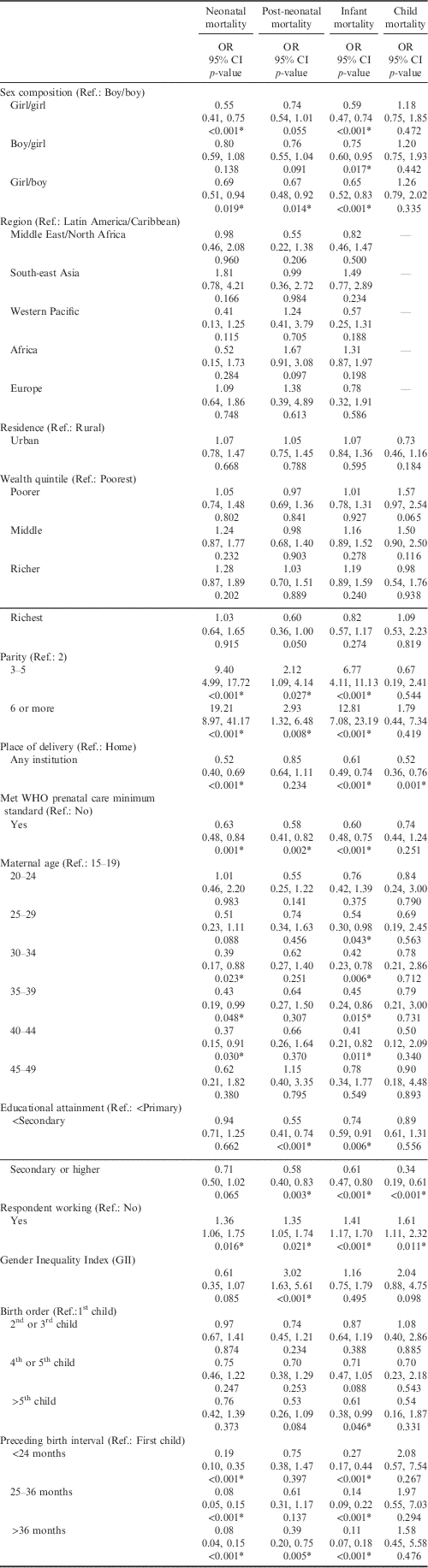
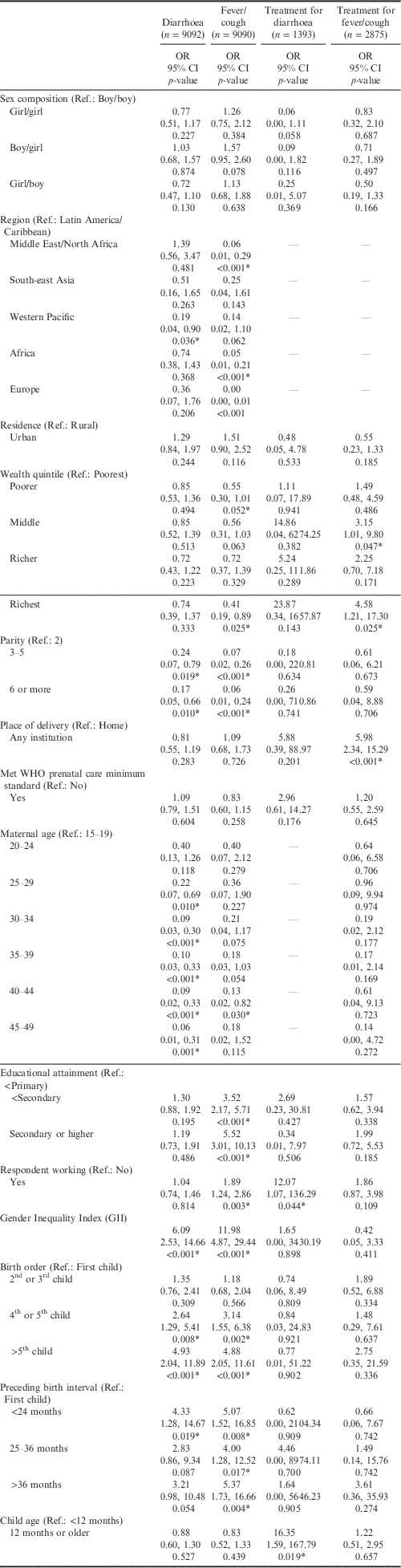
The results indicate that sex composition of twins is significantly associated with several mortality outcomes (Table 1). Girl/girl and girl/boy twin pairs were less likely to experience neonatal mortality (girl/girl: OR, 0.55; 95% CI, 0.41–0.75; p<0.001; girl/boy: OR, 0.69; 95% CI, 0.51–0.94; p=0.0195) and girl/boy pairings showed a reduced odds of post-neonatal mortality (girl/boy: OR, 0.67; 95% CI, 0.48–0.92; p≤0.001). Twin pairings containing at least one girl were less likely to die in their first year of life (girl/girl: OR, 0.59; 95% CI, 0.47–0.74; p<0.001; boy/girl: OR, 0.75; 95% CI, 0.60–0.95; p<0.017; girl/boy: OR, 0.65; 95% CI, 0.52–0.83; p<0.001) than boy/boy twins. Sex composition was not significantly associated with morbidity or treatment-seeking outcomes, though lower odds of treatment for diarrhoea approached significance in girl/girl twins compared with boy/boy twins (OR, 0.06; 95% CI, 0.00–1.11; p=0.058; see Table 2).
Mortality outcomes for twins in 38 low- and middle-income countries, n=11,684

*p<0.05.
Health and treatment-seeking outcomes for twins in 38 low- and middle-income countries
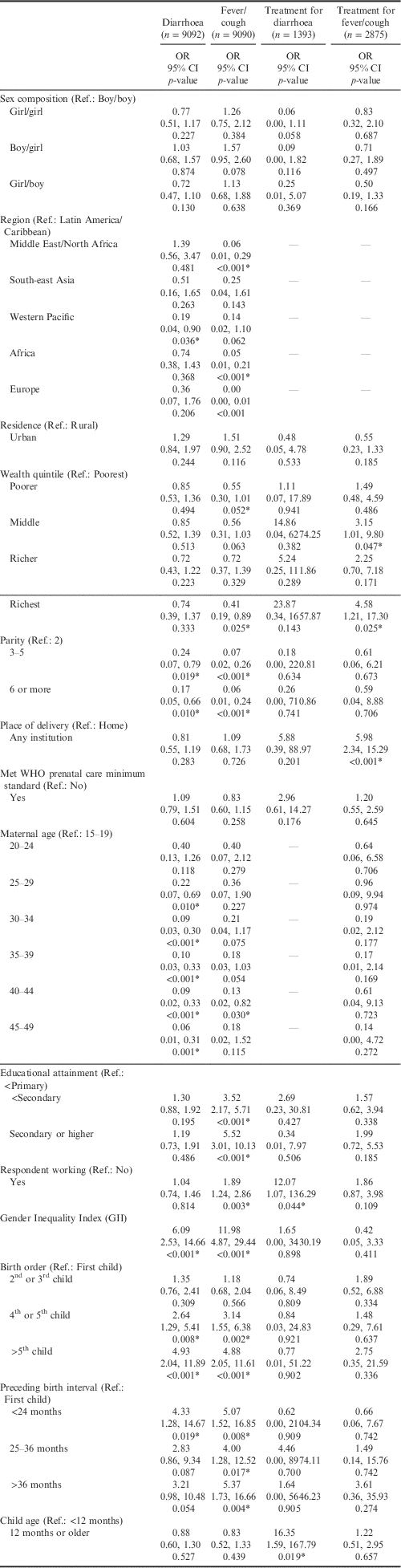
*p<0.05.
A higher GII score was associated with increased odds of post-neonatal mortality (OR, 3.02; 95% CI, 1.63–5.61; p≤0.001). Higher country-level gender inequality was also associated with six and twelve times the odds of reporting diarrhoea and fever/cough, respectively (diarrhoea: OR, 6.09; 95% CI, 2.53–14.66; p<0.001; fever/cough: OR: 11.98; 95% CI: 4.87–29.44; p<0.001). Country-level gender inequality was not associated with either treatment-seeking outcome.
Discussion
This analysis explored how sex composition of twins and country-level gender inequality were associated with morbidity and mortality outcomes in resource-poor settings. The hypothesis that female twins are at an enhanced risk of adverse health outcomes due to combined twin vulnerability and gender bias was not well supported. Results indicate that twin dyads containing at least one girl actually have lower odds of mortality in the first year of life than boy/boy twins, suggesting that biological factors contributing to the female advantage may be at play here in female twins, and that they may counteract the son preference exhibited in many of the resource-poor countries studied until after the first year of life. The significance of the gender inequality variable affirms the findings from previous studies of singleton births that higher levels of gender equality are associated with improved health outcomes for girl children (Carmignani et al., Reference Carmignani, Shankar, Tan and Tang2014). Increased gender equity may directly increase the health of female twins by increasing the value associated with female children, and may indirectly affect the health of all twins by increasing the autonomy of women to seek health care for their children. This aligns with extant work with singleton births that shows boys should be biologically disadvantaged in the first year of life, with female children more disadvantaged outside this period (Brothwood et al., Reference Brothwood, Wolke, Gamsu, Benson and Cooper1986; Kraemer, Reference Kraemer2000; Stevenson et al., Reference Stevenson, Verter, Fanaroff, Oh, Ehrenkranz, Shankaran and Papile2000; Asling-Monemi et al., Reference Asling-Monemi, Naved and Persson2009). This is partially supported by the non-significance of the child mortality variable, in which neither boy nor girl twins had increased odds of death before age five. Further work using older sets of twin children and twin adolescents may provide insight into how, when and to precisely what effect the biological advantage and social disadvantage intersect to result in poorer health outcomes for females.
There are some limitations to this analysis. The study sample is skewed towards sub-Saharan Africa, with 81% of the study sample coming from these countries. While region of residence was included as a covariate, a majority of respondents from one region may mask underlying differences when analysing the outcome variables and may neutralize effects of sex composition on health from countries in South Asia known to have greater prevalence of son preference. The GII is not a comprehensive measure of gender inequality, and fails to include variables (such as sex-selective abortion) that may be prudent to this study. However, it is the best available measure of gender inequality that can be quantified across all 38 countries in the dataset. The exclusion criteria for DHS surveys also precluded inclusion of the latest DHS survey from India, a country with well-documented son preference, which was released in 2005. The DHS samples are biased towards living women: that is, women who died in pregnancy, childbirth or the post-partum period are not included in the sample. With higher rates of maternal mortality likely for women experiencing multiple births, it is possible that the sample is biased towards twins of mothers who survived pregnancy and childbirth.
Conclusion
The large, nationally representative samples of the Demographic and Health Surveys afford the opportunity to create a large sample of twins, facilitating analysis of the associations between sex composition of twins, gender equality and health outcomes in resource-poor settings. The expected hypothesis, that girl/girl twins should experience the most severe health outcomes due to combined son preference and the inherent health effects of multiple births, was not true. In fact, girl twins, or the girl in a mixed-sex twin set, consistently proved to have greater survival prospects in the first year of life. While this analysis provides a first attempt at quantifying the relationship between sex composition and health outcomes for twins in resource-poor settings, further work is warranted to understand how these relationships may vary across specific socio-cultural settings with varying degrees of gender inequality and son preference. Understanding these relationships has the potential to inform current efforts to curb the influence of gender preference on the health of female children in resource-poor settings.