Congenitally corrected transposition of the great arteries is an uncommon malformation accounting for 0.5–1% of the CHDs. Reference Hoffman1
Defined as atrioventricular and ventriculo-arterial discordance, the clinical manifestations are variable and depend on the associated cardiac lesions and age at presentation. Outcomes and optimal management of these complex patients still remain a challenge. Surgical strategies include classic or physiologic repair and anatomic repair. Physiologic correction repairs the defects maintaining the right ventricle as the systemic ventricle, increasing the long-term risk of systolic dysfunction, especially if there is an association with tricuspid valve regurgitation. Anatomic correction restores the left ventricle in the systemic circulation and atrioventricular and ventricular-arterial concordance using a combination of different surgical procedures that are all technically demanding. Reference Hoffman1–Reference Presbitero, Somerville and Rabajoli3
The aim of this study was to evaluate the outcome of different surgical techniques performed in 89 patients with congenitally corrected transposition of the great arteries and to determine if surgical treatment turned out to be an independent risk factor for the development of post-surgical cardiovascular events, reinterventions, pacemaker implantation, and mortality.
Methods
An analytical, observational, longitudinal, retrospective cohort study was conducted. Medical records of patients with congenitally corrected transposition of the great arteries treated at the Pediatric Cardiology and Pediatric Cardiovascular Surgery Departments of Prof. Dr Juan P. Garrahan hospital were reviewed.
Eighty-nine patients underwent definitive surgical repair between January 1998 and January 2020.
The surgical procedures were divided into three groups: anatomic correction, physiologic correction, and univentricular palliation.
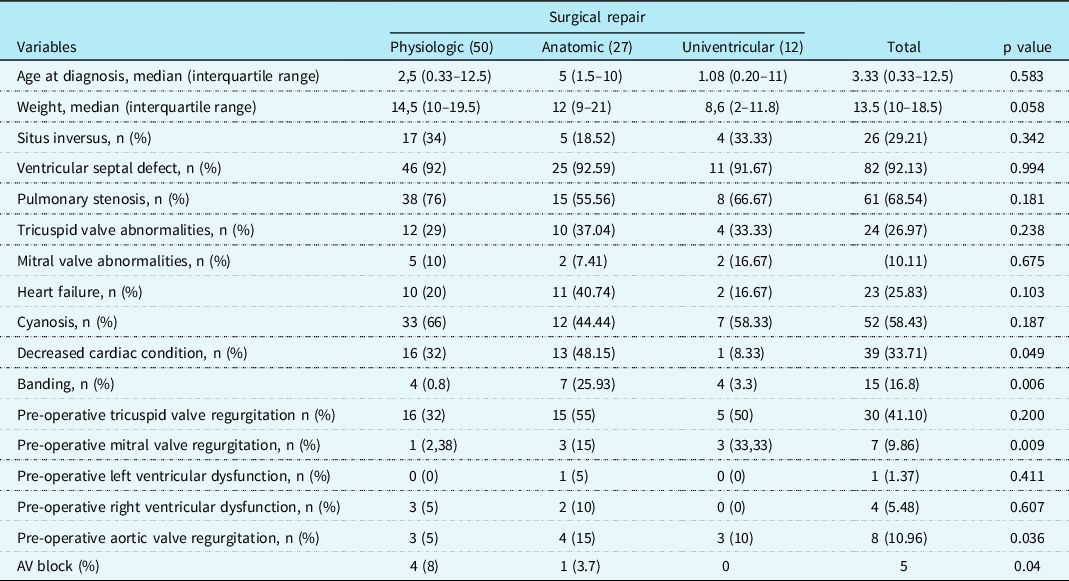
Table 1 shows demographic and clinical variables by patient group before surgery.
Demographic and clinical variables by patient group before surgery

The variables assessed were tricuspid regurgitation, mitral regurgitation, left ventricular systolic dysfunction, right ventricular systolic dysfunction, complete AV block, aortic regurgitation, reinterventions, and mortality.
Reintervention was defined as the need for catheter-based or surgical intervention after physiologic or anatomic repair or Fontan palliation.
Echocardiography was first performed at diagnosis and, depending on associated lesions, every 3–6 months during follow-up and post-operative period to assess systolic ventricular function and atrioventricular and semilunar valve function.
Left ventricular systolic function was considered normal with ejection fraction >51%, mild systolic dysfunction 41–50%, moderate systolic dysfunction 31–40%, and severe systolic dysfunction <30% Reference Lang, Badano and Mor-Avi4 .Right ventricular systolic function was assessed by tricuspid annular plane systolic excursion Reference Koestenberger, Ravekes and Everett5 and S wave velocity in tricuspid annular tissue Doppler imaging measurement. Reference Eidem, Cetta and O’Leary6 When data were not available, a subjective evaluation was done. Valvular regurgitation was classified as absent, mild, or moderate to severe. Reference Zoghbi, Enriquez-Sarano and Foster2
Mortality was defined as early (less than 30 days post-operative), mid-term (30 days to 1 year post-operatively), and late (more than 1 year post-operatively).
Physiologic correction (Group 1) was performed in 50 patients (56.18%) with a mean age of 58.17 months (SD 27.6). The main procedures were conventional Rastelli in 35 (70%), isolated ventricular septal defect closure in 10 (20%), systemic atrioventricular valve replacement in three (6%), and ventricular septal defect closure + systemic atrioventricular valve replacement in two patients (4%). Mean follow-up was 104 ± 95 months.
Anatomic correction (Group 2) was performed in 27 patients (30.34%). Mean age (SD 25.9) was 44.6 months. The main procedures were double switch + ventricular septal defect closure in 10 (37%), double switch in four (14.8%), switch + hemi-Mustard in two (7.4%), Senning + Rastelli in four (14.8%), Mustard + Rastelli in four (14.8%), hemi-Mustard + Nikaidoh in two (7.4%), and hemi-Mustard + Rastelli in one patient (3.7%). Mean follow-up was 56 ± 42 months.
Univentricular palliation (Group 3) was performed in 12 patients who underwent extracardiac total cavopulmonary connection (Glenn procedure + extracardiac conduit). Mean age was 40 months. Mean follow-up was 56 ± 42 months.
Statistical analysis
Statistical analysis was performed with the Stata 14.0 program. Variables were compared using Student’s t-test, Wilcoxon, ANOVA, Kruskal–Wallis, or chi-square tests, as appropriate. To analyse the effect of each variable as a risk factor for the different events, the Cox proportional hazard model was used, first in univariate regression analysis and then adjusting the variables in multivariate regression models, maintaining variables that showed a level of a significance <0.05 and confounding variables, with surgical treatment being the main risk factor evaluated. Relative risks were reported as hazard ratio. Post-operative categorical variables were summarised by incidence rates with events per 100 person-years. To be able to compare the incidence of the same events at the pre- and post-surgical level, they were also reported as cumulative incidence. Overall survival and event-free survival probabilities were analysed using the Kaplan–Meier method and the log-rank test. The 95% CI was reported, and the results were considered statistically significant with a p value <0.05.
Results
89 patients underwent surgical repair. The median follow-up time was 4.29 years (interquartile range: 0.33–10.83). The pre-surgical characteristics of the patients are detailed in Table 1. According to the surgical treatment received, the patients were divided into 3 groups.
Group 1. Physiologic correction
50 patients (56.18%) Procedures: Ventricular septal defect closure + morphologic left ventricle to pulmonary artery conduit 35 patients (70%), ventricular septal defect closure 10 patients (20%), systemic atrioventricular valve replacement 3 patients (6%),ventricular septal defect closure + systemic atrioventricular valve replacement 2 patients (4%).
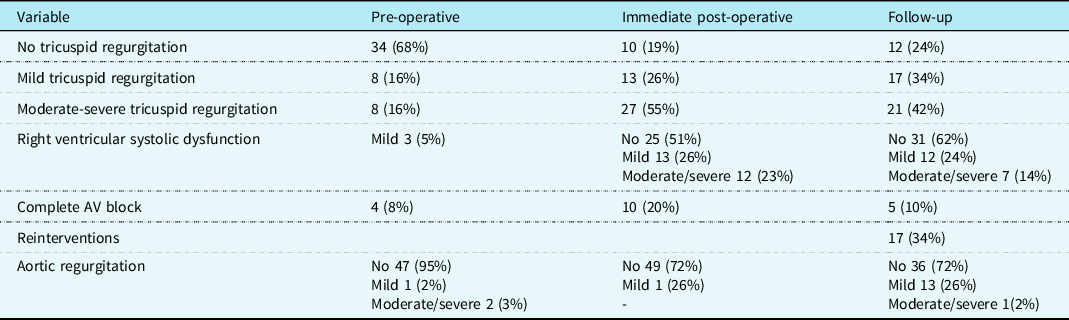
Eight patients (16%) had moderate to severe tricuspid regurgitation before surgery, and 21 (42%) developed it after the correction and during follow-up.
Seven patients (14%) developed moderate to severe right ventricular systolic dysfunction during follow-up (Table 2).
Physiologic correction (50 patients)
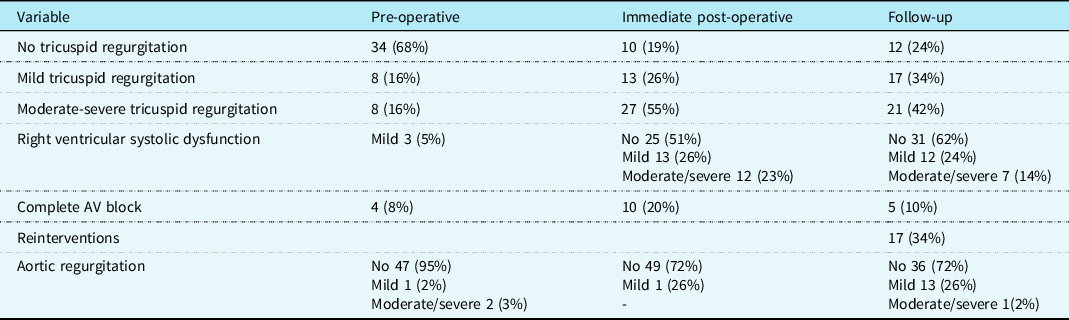
The incidence of complete AV block and pacemaker placement was 30 % (15 patients) after surgery (Table 2).
Majority of the patients had none or mild aortic regurgitation during the follow-up (Table 2).
Reinterventions were needed in 17 patients (34%). The procedures included the following: homograft replacement 3 patients, tricuspid valve repair/replacement 3 patients, residual ventricular septal defect closure 2 patients, pacemaker implantation 2 patients, homograft replacement + tricuspid valve repair + pacemaker implantation 2 patients, homograft replacement + pacemaker implantation 2 patients, tricuspid valve repair + residual ventricular septal defect closure 1 patient, tricuspid valve repair + residual ventricular septal defect closure + pacemaker implantation 1 patient, and residual ventricular septal defect closure + pacemaker implantation 1 patient.
The median time to reintervention in this group was 102 months (range 7–320 months).
Early mortality: 3 patients (2 patients had low cardiac output, 1 patient died of sepsis). Mid-term mortality: 2 patients (1 patient died because of unknown cause, 1 patient died in reoperation of ventricular septal defect closure). Late mortality: 1 patient (reoperation of homograft replacement).
Group 2. Anatomic correction
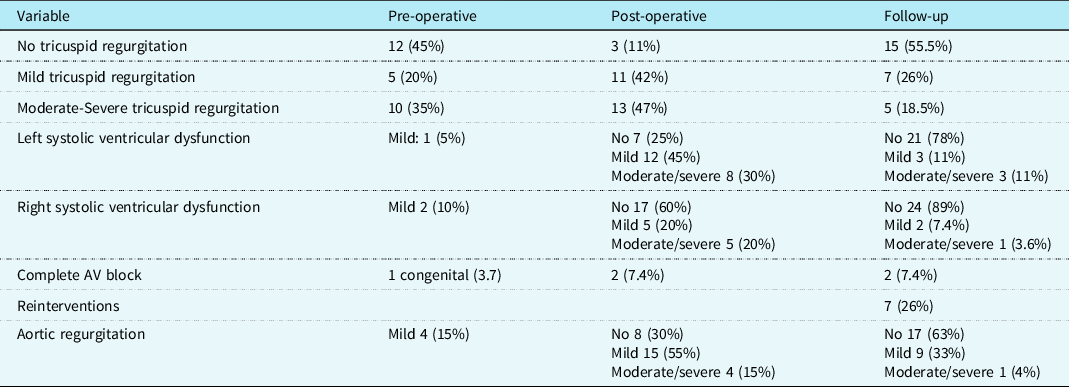
27 patients (30.34%) Procedures: double switch + ventricular septal defect closure 10 patients (37%), double switch 4 patients (14.8%), switch + hemi-Mustard 2 patients (7.4%), Senning + Rastelli 4 patients (14.8%), Mustard + Rastelli 4 patients (14.8%), hemi-Mustard + Nikaidoh 2 patients (7.4%), hemi-Mustard + Rastelli 1 patient (3.7%). Ten patients (35%) had moderate to severe tricuspid regurgitation before surgery, and 13 (47%) developed it immediately after the procedure, with an improvement in the follow-up (18.5%) (Table 3).
Anatomic correction (27 patients)
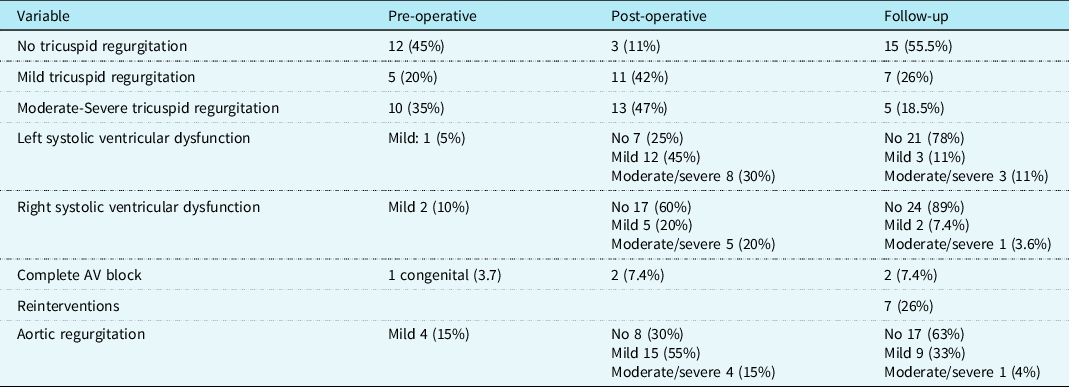
Regarding left ventricular systolic dysfunction, only one patient had mild dysfunction before surgery, and during the follow-up, 11% (3) of the patients developed it (Table 3).
On the other hand, 2 patients had mild right ventricular systolic dysfunction pre-operative and 1 patient developed moderate to severe right ventricular dysfunction after surgery (Table 3).
Complete Av block was observed in 4 patients (14.8%) after surgery (Table 3).
During follow-up, aortic regurgitation was moderate to severe in 4 patients (15%) (Table 3).
Seven patients (26%) needed reinterventions. The procedures were as follows: homograft replacement 2 patients, mitral valve replacement 1 patient, ventricular septal defect 1 patient, aortic valve repair + homograft replacement 1 patient. Median time to reoperation was 76 months (12 to 125 months)
Early mortality: 3 patients died in the immediate post-operative: low cardiac output (1 double switch + ventricular septal defect closure and 2 patients post-operative of hemi-Mustard + Rastelli). Mid-term mortality: 2 patients died because of electromechanical dissociation (double switch + ventricular septal defect closure and low cardiac output in reoperation (homograft replacement in Senning–Rastelli technique). We do not have late mortality yet in this group.
Group 3. Univentricular palliation
12 patients (Glenn procedure + extracardiac conduit). Mean age was 40 months. Mean follow-up was 56 ± 42 months.
Early mortality: 1 patient died because of low cardiac output (8.3%).
Comparison between groups
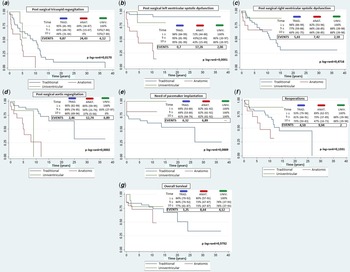
Figure 1 shows a comparison between the incidence and degree of pre- and post-surgical involvement of tricuspid and aortic regurgitation according to the surgical treatment group.
Statistically significant differences were found between groups when evaluating the free survival of post-operative tricuspid regurgitation (p log-rank = 0.0170), post-operative left systolic ventricular dysfunction (p log-rank < 0.0001), and post-operative aortic regurgitation (p log-rank = 0.002) but not on post-operative right systolic ventricular dysfunction (p log-rank = 0.4716) (Fig 1).
Kaplan-Meier curves and log-rank test. Free survival (by groups) of postsurgical tricuspid regurgitation ( a ), postsurgical left ventricular dysfunction ( b ), postsurgical right ventricular dysfunction ( c ), postsurgical aortic regurgitation ( d ), need for implantation of a pacemaker ( e ), reoperations ( f ), and overall survival ( g ). TRAD = physiologic repair, ANAT = anatomic repair, UNIV = univentricular palliation.

Different risk factors for cardiovascular events were evaluated. Independent risk factors for post-operative tricuspid regurgitation were surgical technique (anatomic versus physiologic, p = 0.006, anatomic versus univentricular, p = 0.043) and having a dysplastic tricuspid valve prior to surgery (p = 0.002). Among the patients who presented post-operative left ventricular systolic dysfunction, surgical technique (Anatomic versus Physiologic, p = 0.001) was an independent risk factor. Among those who presented aortic regurgitation, surgical technique (anatomic versus physiologic, p < 0.001) and pre-operative aortic regurgitation (p = 0.043) were independent risk factors too. In the multivariate analysis, the only risk factor for right ventricular systolic dysfunction was the presence of dysfunction prior to surgery (p = 0.011).
No differences were observed between the surgical treatment groups in pacemaker-free survival (p log-rank = 0.089) or reintervention-free survival (p log-rank = 0.1331), nor were independent risk factors identified for these events (Fig 1).
Overall survival at 5 and 10 years, respectively, was 80% (95% CI 69, 87) and 75% (95% CI 62, 84). There were no statistically significant differences in mortality between the groups (p log-rank = 0.5752). The hazard ratio for mortality by groups was in anatomic versus physiologic of 1.63 (95% CI 0.61, 4.29; p = 0.321), in univentricular versus physiologic of 1.08 (95% CI 0.23, 4.19; p = 0.916), and in anatomic versus univentricular of 1.50 (95% CI 0.30, 7.30; p = 0.612) (Fig 1).
In the multivariate analysis of the pre-operative variables, no independent risk factors were observed that increase the risk of mortality in the group of patients with congenitally corrected transposition of the great arteries.
When analysing risk of mortality, only post-operative left ventricular systolic dysfunction increased the risk, independent of surgical technique (hazard ratio 11.08; 95% CI 1.94, 63.28 and p = 0.007), and it was also observed that among those patients with moderate to severe left ventricular systolic dysfunction, the risk was even higher, also adjusted for surgical technique (hazard ratio 19.55; 95% CI 2.66, 143.55 and p = 0.003).
Pulmonary artery banding
Between the 3 groups of surgery, there are 23 procedures of banding in 22 patients.
The median age of banding was 6 months for anatomic repair, 3 months for physiological repair, and 2 months for univentricular group.
The mean duration of banding was 14 months (SD 25.8).
Sixty-eight per cent of 22 patients achieved some type of surgery: 7 patients underwent anatomical repair (one patient needed re-banding); in 4 patients, physiological repair was performed, and 4 patients received univentricular palliation.
Three patients were lost to follow-up, and 4 patients died (one patient died 2 months after banding, 2 died after double switch procedure, and 1 patient died during follow-up belonging to the group of traditional surgery).
Discussion
This study is a single-centre report about congenitally corrected transposition of the great arteries and the different surgical approaches in our institution.
In our series, the surgical procedure was not identified as a risk factor for reoperations, pacemaker implantation, or post-operative right systolic ventricular dysfunction. On the other hand, anatomic correction was identified as a risk factor for post-operative left ventricular systolic dysfunction and aortic regurgitation.
When analysing our series, left ventricular systolic dysfunction in anatomic correction was significant (mild 45%, moderate to severe 30%) in the immediate post-operative period, improving in the longer term. We assume that part of this improvement in follow-up is explained by the usual improvement in ventricular function after immediate post-operative time.
We observed progression of tricuspid regurgitation during follow-up, mainly associated with tricuspid morphology. This finding was an observable trend even in the univentricular group, although it did not reach statistical significance. Prieto et al reported that the presence of a morphologically abnormal tricuspid valve was the only predictor of significant tricuspid regurgitation and the only independent risk factor of mortality, both in operated and non-operated patients. Twenty-year survival rate for operated patients with and without tricuspid regurgitation was 34 and 90%, respectively. These data support the concept that right ventricular failure as a primary process is uncommon but is a frequent sequela secondary to prolonged tricuspid regurgitation. Reference Prieto, Hordof and Secic7
AV block is not a minor complication. The incidence (14 to 38%) is higher in physiologic repair, related to ventricular septal defect closure and/or enlargement, although several techniques have been described to avoid the complication. Reference Hraska, Duncan and Mayer8–Reference de Leval, Bastos and Stark11 In our cohort, the highest incidence was 30% in the physiologic repair, with similar pacemaker-free survival between groups.
When analysing mortality, we did not find the surgical approach as a risk factor, but post-operative left ventricular systolic dysfunction increased the mortality risk, independent of surgical technique, and it was also observed that among those patients with moderate to severe left ventricular systolic dysfunction, the risk was even higher, also adjusted for surgical technique. Initially, the “classic” or physiological repair was suggested, with good short-term and mid-term, but discouraging long-term results. Reference Hraska, Duncan and Mayer8,Reference Yeh, Connelly and Coles10,Reference Bogers, Head and de Jong12 Yeh et al reported 118 patients with an intraoperative mortality rate of 6% and a 20-year survival of 48%. Reference Yeh, Connelly and Coles10 Hraska et al showed a higher survival rate in those with ventricular septal defect + pulmonary stenosis compared to those who required early or late tricuspid valve replacement. Risk factors were end-diastolic pressure >17 mmHg and AV block, while in those with tricuspid regurgitation, the major risk factor was Ebstein anomaly. Survival rate was 61% at 15 years. Reference Hraska, Duncan and Mayer8
Anatomic repair, restoring the left ventricle to the systemic circulation improving long-term outcome, Reference Termignon, Leca and Vouhé9,Reference de Leval, Bastos and Stark11,Reference Kollars, Gelehrter and Bove13,Reference Said, Burkhart and Schaff14 has theoretical advantages and a mortality rate of less than 6%; however, the surgery is complex, technically demanding, and not free of complications. Reference Duncan and Mee15,Reference Ly, Belli and Leobon16 It implies the combination of different surgical techniques to re-establish atrioventricular and ventricular-arterial concordance. The left ventricle should have adequate pressure and ventricular mass and systolic function to maintain the systemic flow and pressure. Reference Duncan and Mee15,Reference Ly, Belli and Leobon16 Nevertheless, if the left ventricle is not adequate, retraining by using pulmonary artery banding is an alternative, Reference Duncan and Mee15,Reference Quinn, McGuirk and Metha17–Reference Winlaw, McGuirk and Balmer20 but anatomic repair is not always achievable. Reference Ly, Belli and Leobon16,Reference Winlaw, McGuirk and Balmer20 Our series has 22 patients with a mean duration of 14 months. Tricuspid valve regurgitation improved in 30.7% without a significant change in left ventricle systolic function; anatomic, physiologic, or univentricular repair could be performed in 68% of the patients.
Similar to anatomic repair, physiologic surgery has evolved and is therefore still an option in the treatment of congenitally corrected transposition of the great arteries. The most recent series from Texas and Toronto have shown that outcome after physiologic surgery is like that of anatomic repair, defining tricuspid regurgitation as a prognostic factor and emphasising that anatomic repair did not appear to be superior in terms of transplant-free survival or outcomes compared to single ventricle palliation. Reference Acar, Sidi and Bonnet21–Reference Hirose, Nishina and Kanemitsu23
Finally, univentricular surgery is an option when the anatomical characteristics do not allow biventricular repair, although long-term outcome is not as good.
In our centre, we consider that the best strategy in the management of congenitally corrected transposition of the great arteries is to identify risk factors, particularly evaluating the characteristics of the tricuspid valve. Although the mechanism of tricuspid regurgitation is often unknown, the more dysplastic and Ebstein-like, the higher the probability of significant regurgitation. Right ventricular systolic dysfunction should be avoided when preparing the patient for anatomic correction, although the intervention is not carried out if there is no regurgitation. Physiologic repair is performed in patients with pulmonary obstruction who have a competent tricuspid valve and an adequate ventricular septal defect size.
We believe that the interpretation of our results is difficult taking into account the heterogenous population and different follow-up of each procedure. As observed by Barrios et al, the early and mid-term survival did not show difference between each repair and was after 12 years post-operative follow-up that the physiologic technique showed a lower survival. Reference Barrios, Zia and Pettersson24
Limitations
This is a retrospective study with many variables to take into account (associated lesions, age at presentation, and type of surgery) and a heterogeneous population, making it difficult to interpret surgical outcomes and generalise the clinical decisions to all patients with congenitally corrected transposition of the great arteries.
The follow-up period of the groups is different due to the time period in which each type of surgery began to be performed. We believe that longer follow-up is necessary to draw robust conclusions.
Conclusions
Congenitally corrected transposition of the great arteries remains a challenge for the cardiologist and the cardiovascular surgeon. The broad spectrum of the disorder increasingly leads us to decide on treatment modality for each patient individually. In our experience, outcome after physiologic repair was satisfactory in spite of the progression of tricuspid regurgitation during follow-up and the high incidence of AV block requiring the placement of a permanent pacemaker. Anatomic repair did not show a trend toward improvement of tricuspid regurgitation; in this group, the risk of developing aortic regurgitation, although mild, at the mid- or long-term follow-up was higher and so was the risk of developing left ventricular systolic dysfunction. Late reinterventions were similar in both biventricular repairs. Regarding the late events, incidence was lowest in the Fontan group.
Acknowledgements
We would like to thank MD Alejandro Di Sibio for his great support during this study.
Financial support
This research received no specific grant from any funding agency, commercial, or not-for-profit sectors.
Conflicts of interest
None.
Ethical standards
Not applicable.