

1. Introduction
It is ironic how a book that starts with a disclaimer of originality ‘There is little that is fundamentally new in this book’ (Knight, Reference Knight1921: vii) profoundly shaped economists’ understanding of two fundamental categories: ‘risk’ and ‘uncertainty’. ‘In the former the distribution of the outcome in a group of instances is known (either through calculation a priori or from statistics of past experience), while in the case of uncertainty this is not true, the reason being in general that it is impossible to form a group of instances’ (Knight, Reference Knight1921: 233). This distinction sometimes also associated with authors like von Mises (Bylund and Manish, Reference Bylund, Manish, Fiorito, Scheall and Suprinyak2016) and Keynes (Ferrari-Filho and Conceição, Reference Ferrari-Filho and Conceição2005: 592) was ‘used and misused’ (Townsend et al., Reference Townsend, Hunt, McMullen and Sarasvathy2018: 660). Numerous debates about its precise meaning (Langlois and Cosgel, Reference Langlois and Cosgel1993; Ramoglou, Reference Ramoglou2021) or Knight's original intentions (Brooke, Reference Brooke2010; Gunning, Reference Gunning1993; LeRoy and Singell, Reference LeRoy and Singell1987) have taken place, reflecting this observation. The distinction is continually refined (Lampert et al., Reference Lampert, Kim and Polidoro2020; Packard and Clark, Reference Packard and Clark2020a), but also criticized because it does not correspond to business practice, since financial analysts (Leins, Reference Leins, Cassidy, Pisac and Loussouarn2013: 220) and risk managers (Hubbard, Reference Hubbard2020: 90–91) tend to use the terms risk and uncertainty with different meanings than Knight's. Notwithstanding being questioned and even contested, the distinction is widely known, and it is both sufficient and necessary to add the adjective ‘Knightian’ before using risk or uncertainty to make sure the audience understands risk as the probability of unknown events and uncertainty as unquantifiable randomness.
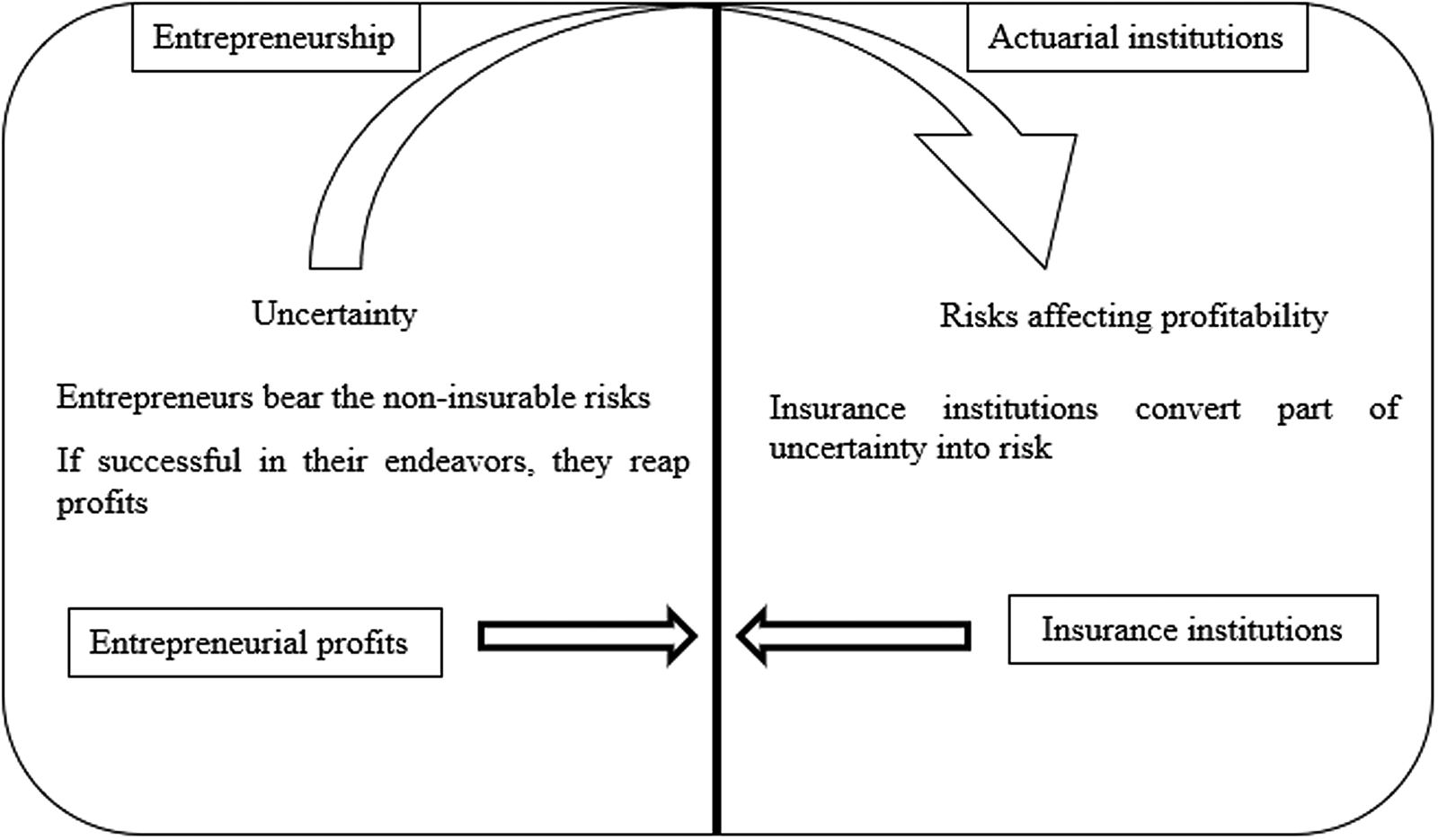
Among the numerous influences of the Knightian distinction on economic theory, arguably the most noteworthy spin-off concerns the contrast between entrepreneurial profits, associated with uncertainty, and insurance coverage, associated with risk (Baumol, Reference Baumol1968: 64; Kihlstrom and Laffont, Reference Kihlstrom and Laffont1979). Knight (Reference Knight1921: 285) insists that ‘true [entrepreneurial] profit depends on an absolute uncertainty’, and scholars define entrepreneurship in contrast with insurability (LeRoy and Singell, Reference LeRoy and Singell1987: 400). This influential approach portrays insurance and entrepreneurship as two inversely proportional and rigidly disconnected compartments, implying that insurance reduces the scope of entrepreneurship (see Figure 1). In Knight's own words: ‘by the act of insurance, the business man abdicates so much of his entrepreneurship’ (Knight, Reference Knight1921: 43). However, despite being highly influential in economics and management (North, Reference North1990: 126), this distinction offers a partial view of both entrepreneurship and actuarial institutions. On the one hand, it deprives entrepreneurial judgment of an essential feature with a critical impact on profits and losses: the decision to buy insurance coverage. On the other hand, it oversimplifies the understanding of insurance institutions by assigning them a limited and somewhat passive background role: to reduce the part of pure (bad) luck in entrepreneurship (Knight, Reference Knight1921: 245).
A rigid interpretation of the distinction between uncertainty and risk.

Without changing the Knightian definitions of risk and uncertainty, this paper aims to revise such a compartmentalized division of roles between insurance institutions and entrepreneurship and to replace it with an integrative model where risk calculations and insurance coverage are embedded within entrepreneurial judgment. It draws on risk management and actuarial studies literature to highlight hedging strategies through which entrepreneurs offset losses in investment by taking the opposite position and betting against themselves. Interestingly, an examination of hedging in greater detail shows that when entrepreneurs convert uncertainty into risk, they do not entirely and systematically delegate it to actuarial institutions. This discussion will contribute to the growing body of literature applying institutional theory to entrepreneurship (Bruton et al., Reference Bruton, Ahlstrom and Li2010) by conceptualizing the interplay between entrepreneurship and actuarial institutions. As the literature reviews of this research stream implicitly attest (Su et al., Reference Su, Zhai and Karlsson2017), the complexity of this relationship is mostly overlooked. The proposal of an integrative view of insurance and entrepreneurship also aspires to open a novel conversation within this body of literature. This will also enrich the judgment-based theory of entrepreneurship by adding hedging to the category of entrepreneurial judgment and fine-tune the conception of entrepreneurial profits and losses by showing that they can be related to risk as well as uncertainty.
The argument unfolds as follows. First, it adopts a counterfactual perspective to show that profits and insurance coverage cannot be entirely disconnected within entrepreneurial judgment. Second, it discusses the institutional settings that allow entrepreneurs to assume a share of the risk they convert from uncertainty. The third section discusses the implications of this integrative view for actuarial institutions, entrepreneurial profits, and judgment theories.
2. Betting on the future
If we set aside the negative connotations of betting often used to present entrepreneurs as irrational (Keynes, Reference Keynes1936: 136) and the markets as casinos (Sinn, Reference Sinn2010; Strange, Reference Strange1997) and the insoluble debate over the share of pure luck in anticipating the future (Demsetz, Reference Demsetz and Ronen1983), it is noteworthy that entrepreneurs can be seen as individuals who put their resources at stake, anticipating a given future state of affairs (Kray et al., Reference Kray, Thompson and Lind2005). Grounded on Knight's conception of uncertainty, the entrepreneur is presented as a speculator who ‘deals with the uncertain conditions of the future. His success or failure depends on the correctness of his anticipation of uncertain events’ (von Mises, Reference von Mises1998: 112). Considered alongside this encompassing common objective (anticipating the future), betting and entrepreneurship are, of course, fundamentally different institutions. In entrepreneurship, there is no ‘house’, and unlike gamblers entrepreneurs compete to capture market share, by selling goods and services to consumers.
Predicting the future
The Knightian conception of entrepreneurship implies that the future is open not only epistemologically (we do not know what will happen) but also ontologically (future choices are not yet made). For instance, any attempt to forecast is fatally limited by the non-existence of what is meant to be predicted. Consider, for example, the promise made by a growing number of companies to forecast demand, such as PredictHQ, which provides information about future variations in demand to companies offering delivery services and ride-sharing apps. To do so, it uses software that is fed with data about planned public events, holidays, sports, concerts, expected social and political unrest, and weather forecasts. Although PredictHQ might communicate the estimated turnout of a public event to Uber (and even attempt to extrapolate an aggregate number of potential users), it cannot tell exactly who will choose to use the app (if anyone), precisely because these choices simply do not exist yet (Eabrasu, Reference Eabrasu2021).
The open future is often contrasted with the closed past (in which choices can no longer be changed). As Lewis famously noted: ‘we tend to regard the future as a multitude of alternative possibilities, a “garden of forking paths” in Borges’ phrase, whereas we regard the past as a unique, settled, immutable actuality. These descriptions scarcely wear their meaning on their sleeves, yet do seem to capture some genuine and important difference between past and future’ (Lewis, Reference Lewis1979: 459). This epistemological and ontological asymmetry between a settled past and an open future is the object of longstanding conversations in philosophy and modal logic (Kodaj, Reference Kodaj2014: 419) and, more recently, in management studies (Arend, Reference Arend2020; Rapp and Olbrich, Reference Rapp and Olbrich2020a). Packard and Clark (Reference Packard and Clark2020a) distinguish and defend ‘aleatory’ predictability (which rests on an ‘open future’ ontology) against ‘epistemic’ predictability. The latter assumes that ‘there is always a probability distribution that can be applied to a decision, even if it is unknown and/or subjectively generated in the mind of the decisionmaker’ (Packard and Clark, Reference Packard and Clark2020b: 704).
Factual and counterfactual profits
In light of such numerous and passionate conversations, the ‘open future’ ontology indicates that, in an attempt to anticipate most accurately which possible world will become actual, entrepreneurs must imagine themselves through a counterfactual lens that shows what their enterprise could become if they opt for one or another available investment option. Counterfactuals permeate all reasoning involving uncertainty economic theorizing (Aligica and Evans, Reference Aligica and Evans2009; Hülsmann, Reference Hülsmann2003), institutions (Hédoin, Reference Hédoin2019), strategic managerial decisions (Rindova and Courtney, Reference Rindova and Courtney2020), and morality (Eabrasu, Reference Eabrasu2019) and entrepreneurship thinking is no exception.
This counterfactual perspective allows us to see that, even when entrepreneurs are not gamblers in the sense that they do not bet on the future against each other (Bazerman and Gillespie, Reference Bazerman and Gillespie1999; Kray et al., Reference Kray, Thompson and Lind2005), they are nevertheless systematically betting on the future against their own counterparts who are about to make a different choice. In other words, when entrepreneurs are choosing one investment option among others, they are implicitly betting against imagined future versions of themselves who are hypothesized to make a different choice. Setting aside the longstanding philosophical debate about the ontological status of the counterparts (Lewis, Reference Lewis2013), it is essential to note that in doing so, entrepreneurs in the actual world expect to perform better than their counterparts in the possible worlds. Even though they might be, as Baron (Reference Baron2000) describes them, individuals less inclined to experience regrets and have a hindsight bias, since entrepreneurs are resolutely future-oriented individuals (Haynie et al., Reference Haynie, Shepherd and McMullen2009), they necessarily weigh the possible outcomes of their actions against each other (Gaglio, Reference Gaglio2004). Thus, they have to think not only about actual profits, roughly defined as ‘yield minus costs’ (Knight, Reference Knight1921: 37; von Mises, Reference von Mises1998: 286), but also about counterfactual profits (‘profits they could make if…’).
Rather than having a merely straightforward timeline, entrepreneurs facing uncertainty imagine strategies and, ideally, would wish to take the path that, ceteris paribus, maximizes their profits or minimizes their losses. As Mullins and Forlani (Reference Mullins and Forlani2005) point out, entrepreneurs facing an uncertain future typically have two fears: making the wrong choice (sinking the boat) and letting a better opportunity slip away (missing the boat). Therefore, to assess the profits they expect in the actual world, entrepreneurs must compare them with the counterfactual profits – i.e. with the profits they imagine could be realized in an alternate world, if they make a different choice. Ex ante, the answer to the question ‘Would the profits be higher or lower if …?’ is part of the judgment involved in the economic calculation. Ex post, the answer to this question can be a source of satisfaction or discontent, regardless of the actual profits. Even when a business incurs losses in the actual world, entrepreneurs might nonetheless consider that it is counterfactually profitable if (ceteris paribus) it would otherwise have incurred higher losses.
The counterfactual economic calculation makes ‘revenues’ and ‘costs’ interdependent variables, and an accurate prediction of the future state of affairs in the actual world also entails foreseeing events that might affect (positively or negatively) business plans (Brück et al., Reference Brück, Llussá and Tavares2011). Counterfactual profits can be maximized by choosing the possible world where the profitability of the business plan is, all things being equal, most positively (or least negatively) affected by exogenous events (Salvato et al., Reference Salvato, Sargiacomo, Amore and Minichilli2020). Hence, the importance entrepreneurs must assign to risk becomes more visible, especially when looking at profits through counterfactual lens.
Connecting profits and risk
It is precisely when entrepreneurs weigh possible future courses of action against each other that they convert the uncertain amorphous future into a heterogeneous set of options denoting a subjective order of preference, each subjectively tagged with different probabilities of success (Lachmann, Reference Lachmann1976: 59). Insofar as the ideal future possible world might be deemed less likely than another (ranked lower on the preference scale) to become the actual world, the final entrepreneurial choice of where to invest available resources is necessarily influenced by a subjective estimation of the likeliness of a possible world to become actual (Eabrasu, Reference Eabrasu2011). From a Knightian subjective standpoint, Langlois insists: ‘it is not meaningful to talk about “knowing” a probability or a probability distribution. A probability assessment reflects one's state of information about an event; it is not something ontologically separate whose value can be determined objectively’ (Langlois, Reference Langlois1982: 8).
In fact, contingent contracts demonstrate precisely that, on specific occasions, subjective interpretations and expectations about the future formulated by the parties negotiating a contract are fundamentally divergent (Kray et al., Reference Kray, Thompson and Lind2005). To move beyond disagreements about which possible future will be actualized, the parties agree on a deal that will be completed only when a future event (the contingency) actually takes place. ‘With a contingent contract, differences of opinion about future events don't have to be bridged; they become the core of the agreement. Companies bet on the future rather than argue about it’ (Bazerman and Gillespie, Reference Bazerman and Gillespie1999: 4).
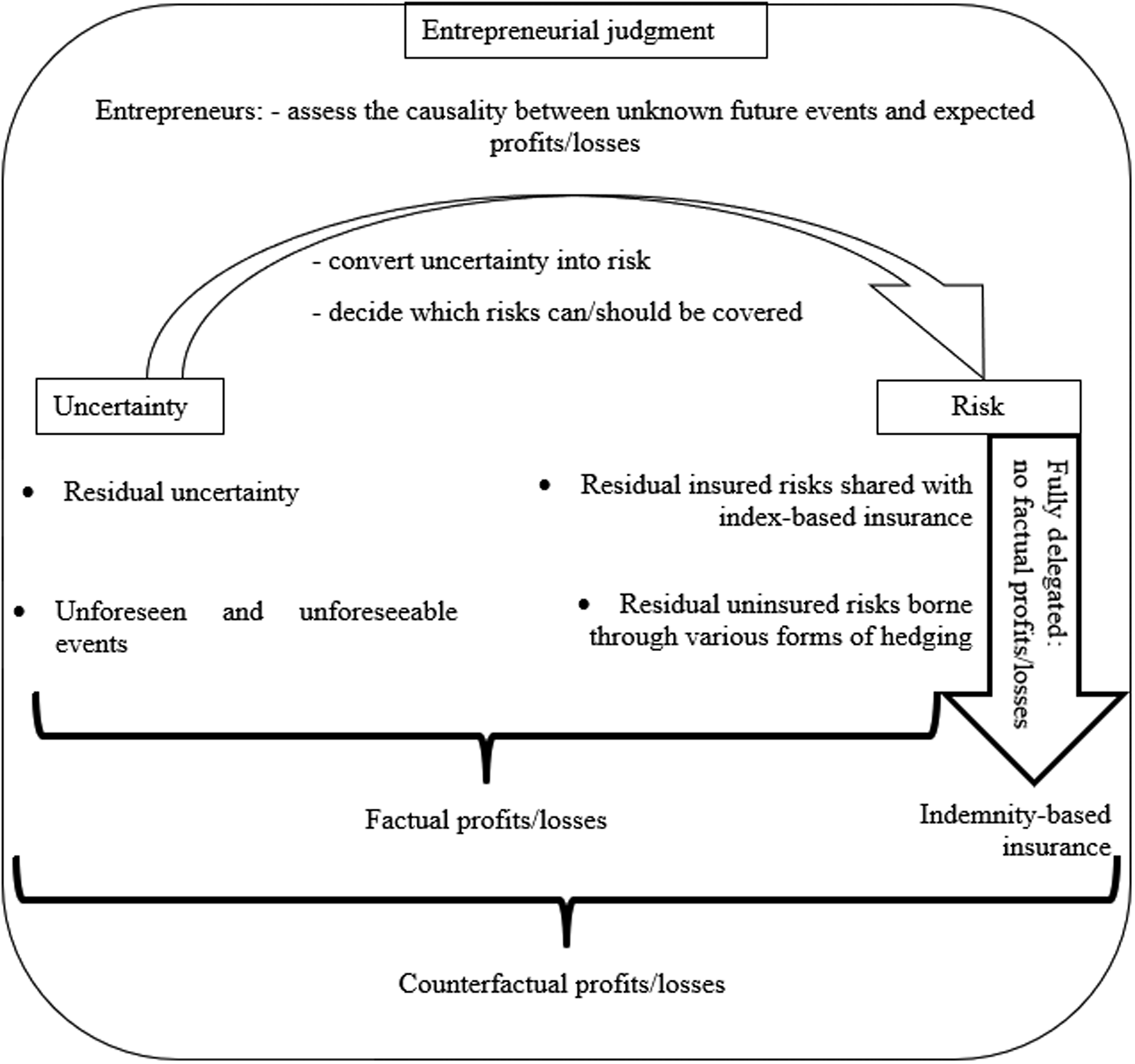
The judgment converting uncertainty into risk can be more or less ill-structured (Rapp and Olbrich, Reference Rapp and Olbrich2020a, Reference Rapp and Olbrich2020b; Simon and Newell, Reference Simon and Newell1958). Rather than a mere box to be checked, risk estimation is a continuum. On the one hand, it relies on gut instinct (Huang, Reference Huang2018); on the other, it is grounded on sophisticated data analysis, such as that habitually undertaken by insurance underwriters, or companies like YayPay or HighRadius using AI to forecast the risk of payment defaults. Entrepreneurs must decide whether or not to rely on others’ predictions of the future and the appended probability of the events expected to occur. Once the uncertainty is converted into risk, entrepreneurs must take a series of critical decisions regarding the share of risk to be assumed that will ultimately affect the profitability of their enterprise (see Figure 2). They must decide whether they prefer to transfer (if possible) the risk to an insurance company in exchange for paying a premium. Within a counterfactual perspective, instead of being perceived as a pure cost, insurance becomes a lever to reduce losses that would have otherwise been incurred, especially ‘if the external provider of risk management services is a more efficient provider than the self-insuring corporation’ (Goldberg, Reference Goldberg1990: 218).
An integrative view of entrepreneurship and insurance.

Conversely, entrepreneurs might deem that it would be more profitable to assume the specific risk, trusting that the unwanted events will not occur (or that, if they do occur, their costs will remain inferior to the insurance premium they would have paid). However, alongside this relatively passive attitude, entrepreneurs can display more proactive judgment in attempting to anticipate and offset the risk by deploying a variety of hedging strategies.
3. Betting against oneself
Insofar as future events are expected to jeopardize expected gains (and implicitly threaten a business project), it becomes crucial to consider strategies for offsetting any adverse movement astutely. Thinking this way adds a layer of counterfactual complexity to entrepreneurial judgment. Alongside betting on the future against their counterparts, entrepreneurs must also bet against themselves, since they must invest resources in a direction that is the opposite of their interests. Although buying classic indemnity-based insurance coverage is already a step in this direction (since one must imagine an adverse scenario possibly becoming actual), this is not strictly speaking betting against oneself. Policyholders of indemnity-based insurance can choose the extent to which they want to cover their assets. As long as the payouts cannot exceed the sustained loss, they only have the choice of buying more or less insurance (i.e. covering more or fewer possible losses). Of course, this does not exclude situations where the insured parties might subjectively value the payouts more than their own assets, and might have an interest in suffering losses. However, excluding insurance fraud cases, they typically do not have the option to over-evaluate their assets; nor can they receive payouts if they still have their assets.
These options are, however, enabled through index-based or parametric insurance.
Index-based insurance
Index-based (or parametric) insurance is an innovative actuarial scheme that, unlike indemnity-based insurance, does not rely on a damage assessment but indemnifies the policyholder according to the variation of an index (parameter) that is observable, reliable, and – ideally – correlated with sustained losses. Since parametric insurance offers substantially wider latitude for risk arbitrage than classic indemnity insurance, the insured parties can strategize their subscription to a parametric insurance policy and become hedgers. Like supporters of a sports team who consider betting against it, parametric-insured parties bet on the realization of an exogenous event that they estimate might negatively affect their own business interests. Their reasons for betting against themselves are various, ranging from wishing for financial compensation in the case of a loss to anticipating a future state of affairs that is the opposite of their personal interests.
However, the critical specificity of the hedging of parametric policyholders is that they might receive the payouts without having to bear losses. In comparison, for sports fans who bet against their own team, it is not possible either to win the bet while experiencing the pleasure of seeing the team win or to lose the bet while the team also loses. In a parametric insurance scheme, even though the index is supposed to be correlated with a sustained loss, the insurance company offers no such guarantee: its payouts are only triggered by the index, regardless of real losses. Parametric insurance lets policyholders self-assess the magnitude of losses that a given event might bring about. Hence, they must act as hedgers and calculate the basis risk, which might be negative (the sustained loss exceeds the payout) or positive (the payout exceeds the sustained loss). Insofar as the policyholders are confident that the basis risk is positive, they might even prefer the result if the parameters of the event covered under the policy language really occur.
That said, betting in parametric insurance is not a pure lottery either. The usual distinction that makes gambling and insurance two completely different spheres is that the former creates a risk while the latter covers it (Swadener, Reference Swadener1964). However, this distinction becomes fuzzier when risk-averse gamblers are willing to pay more to improve their chances of winning a game (McGuire et al., Reference McGuire, Pratt and Zeckhauser1991). In so doing, are they gambling, or are they insuring themselves against the risk of losing their stake? The answer is much less straightforward than the usual distinction between insurance and gambling would suggest. In such a situation, the bet does not create the risk but instead reduces it.
In situations where entrepreneurs engage in hazardous projects by operating in areas that may be affected by natural disasters, the boundary between insurance and gambling is not entirely clear either. Assuming that the future is uncertain, doing business in such conditions involves imagining possible scenarios and assessing the interest of offsetting the most optimistic expectations by paying a premium and ‘betting against oneself.’ In a nutshell, actuarial institutions can indeed enable policyholders to ‘both gamble and purchase fair insurance at the same time’ (Nyman et al., Reference Nyman, Welte and Dowd2008: 2495), despite the widespread assumption to the contrary in the insurance economics literature.
Insuring the uninsurable
Decoupling payouts and sustained losses offers broad potential for converting uncertainty into risk, thus covering hazards that would not be otherwise covered. Future losses that are initially interpreted as ‘uncertainty’ (given the impossibility of calculating probabilities) can be transformed into ‘risk’ (and hence insured) when entrepreneurs can correlate them, directly or indirectly, with exogenous events for which an insurance company could calculate probabilities and propose parametric coverage. However, considering the initial uncertainty, entrepreneurs inevitably engage in an ‘aleatory contract’, bearing similarities to gambling and insurance. In doing so, they make a new prediction about the future to offset the uncertainty associated with the one in their initial business plan. It is worth emphasizing that using parametric insurance as a hedging tool does not automatically reduce profits.
It is precisely because parametric insurance disconnects payouts and sustained losses that it can overcome the patent limitations of indemnity insurance. Especially in low-income areas of developing countries, the lack of accurate data and the atypical ownership (which greatly complicates the risk assessment of indemnity insurance) do not represent important obstacles for parametric insurance, since the risk assessment is shared with the policyholder (Barnett et al., Reference Barnett, Barrett and Skees2008). Furthermore, parametric insurance's marketability is also facilitated by its inherent simplicity: not only does it not require adjusters to assess the damage, it also typically does not have exclusions or deductibles. All these features make parametric products attractive beyond low-income areas in all sorts of contexts, such as business interruptions, where incurred loss measurement is expensive or cannot be accurate (Harrison and Ng, Reference Harrison and Ng2019). Since 2017, Swiss Re commercializes parametric insurance (Insur8) tailored to corporations that would incur revenue losses following a level 8+ typhoon warning issued by the Hong Kong Observatory. The originality of this product lies in the fact that the payout is triggered by a warning rather than the actual typhoon intensity and geolocalization (as in the case of an equivalent product sold by Assured Risk Cover).
Parametric insurance covers not only business activity interruption and reduction but also business profitability when exogenous events might influence customer buying decisions or directly affect their solvency. In a White Paper published by Meteo Protect, Bertrand et al. (Reference Bertrand, Hershey and Parnaudeau2016) suggest that retail businesses should consider betting on bad weather, considering the correlation with sales declines. Maipark markets an earthquake index insurance in Indonesia, AGBBI (Asuransi Gempa Bumi Berbasis Index), tailored to regional banks and microfinance institutions with a significant client base in earthquake-prone areas. The scheme is designed to help these businesses hedge against liquidity crises from large savings withdrawals and/or losses from non-performing loans due to earthquake exposure. In this case, the payout depends on the earthquake magnitude, but it can be multiplied by buying additional insurance policies, depending on the savings the financial institutions want to insure against. Another feature of this scheme is that the policyholders can choose, from a predetermined set of geographical locations, which to insure and to what extent. They can decide to insure all areas where their clients live or only a proportion of them. Given the decoupling of payouts and sustained losses, the business owner has the opportunity to arbitrate between the areas to be covered and the amount of coverage. In this particular case, it would be profitable to bet on a site where the earthquake has its epicenter (and benefit from a higher payout than somewhere else) but where the bank's financial exposure remains limited.
Other hedging strategies
Parametric insurance contributes to expanding risk coverage significantly beyond the habitual risks covered by classic indemnity-based insurance, and further innovations of actuarial institutions may expand coverage areas even further. However, beside insurance institutions, entrepreneurs rely on a variety of other institutions to allow them to convert uncertainty that might jeopardize their profitability into risk and to offset it. As Miller writes: ‘To the extent that external markets for transferring risk fail or are inefficient, firms may choose to control or hedge risk through operational and strategic hedging’ (Miller, Reference Miller2007: 62). Risk management literature shows at length that although hedging comes at a cost, it can also contribute to reducing the firm's costs and, implicitly (and all things being equal), to increasing its profits (Mackay and Moeller, Reference Mackay and Moeller2007).
Various strategies can be deployed to offset future hazards. These depend on the nature and type of risk that must be mitigated and, of course, on the available institutional settings. In finance, for instance, future and forward contracts – as well as more sophisticated derivatives or financial instruments such as married puts, covered calls, delta neutral, and back-to-back – are set up to mitigate the various risks ranging from commodity and volume demand to credit, currency, interest, and equity volatility. In strategy, scholars refer to operational hedging to mitigate the risks associated with production and storage capacity constraints and product demand. These strategies typically include ‘postponing logistics decisions, switching production and sourcing decisions contingent on demand uncertainties and creating production capacity flexibilities’ (Awudu et al., Reference Awudu, Asare, Asa, Osmani, Gonela and Afful-Dadzie2019: 223).
Of course, hedging strategies should not necessarily be linked with sophisticated financial instruments. They are commonly deployed in business activity and even in daily life, merely following reasonable decisions and forecasting possible risks. Hedging strategies can be embedded in a more or less complex and long-term risk-sharing network system (Bramoullé and Kranton, Reference Bramoullé and Kranton2007), or they can follow a commonsense decision to limit exposure to foreseen and foreseeable risks. When a business unit is excessively exposed to currency debasement, it does not require a particular financial instrument or knowledge – merely prudent judgment to set up another business unit to take advantage of the potential situation; when an entrepreneur anticipates an inflationary period, it might be wise to index wages and the prices to a stronger currency.
This heterogeneity of hedging strategies derives naturally from the variety of risks and institutional settings that entrepreneurs use to self-insure. The development of recent betting exchange platforms (such as Betfair.com or Betdaq.com, which invite bets on politics and business events that might affect expected profits) pushes hedging limits even further. In addition, new betting exchange platforms like Augur explicitly advertise their no-limit betting status (Peterson and Krug, Reference Peterson and Krug2015). Suppose an exogenous event expected to influence a business plan negatively is non-insurable (earthquake, pandemic, stock exchange movement, election, etc.). In that case, one can place a wager on it at any time and can expect someone else to have a different view about its probability and bet against it.
4. The integrative view of insurance and entrepreneurship
The discussion in the previous section suggests that the frontier between insurance and entrepreneurship is more porous than is habitually assumed, based on the Knightian distinction between risk and uncertainty. This invites us to integrate insurance within entrepreneurial judgment (see Figure 2). The revision of the frontier between entrepreneurship and insurance points out their imperfect correspondence with ‘uncertainty’ and ‘risk’, respectively. However, it does not entail changing the terms of the Knightian distinction between risk and uncertainty. Nor does it erase entirely the difference between entrepreneurship and insurance, which remain distinct economic categories with various functions. It merely shows that there is an interplay between these two spheres that goes beyond an inverse proportional relationship. This argument has important consequences for understanding actuarial institutions, entrepreneurial profit, and judgment-based entrepreneurial theory that need to be highlighted.
Shedding new light on actuarial institutions
The case made in this paper for an integrative view takes issue with the rigid distinction between entrepreneurship and insurance (Outreville, Reference Outreville2013), which leaves ‘pride of place’ to the former (de Vries et al., Reference de Vries, Verhoeven and Boeckhout2011: 497). The role thus assigned to the latter is merely to securitize the entrepreneurial playground (North and Thomas, Reference North and Thomas1973). This interpretation of actuarial institutions is typically projected through economic history to understand how it contributes to facilitating entrepreneurial endeavors. ‘We think of insurance and portfolio diversification in the modern world as methods for converting uncertainty into risks and thereby reducing, through the provision of a hedge against variability, the costs of transacting’ (North, Reference North1990: 126). This view also accounts for the anti-hero image of insurance entrepreneurs, which contrasts with the more positive image of other entrepreneurs (Reinmuth and Lewis, Reference Reinmuth and Lewis1970: 291).
The focus given in the previous section to hedging, and parametric insurance in particular, should contribute to revising this conception of insurance institutions as external to entrepreneurship. Also, following up on the Henrekson and Sanandaji (Reference Henrekson and Sanandaji2011) idea that institutions not only influence entrepreneurship but can also be shaped by it, we can see how hedging entrepreneurs contribute to expanding the area of insurability beyond that available from classic indemnity-based insurance. Consider, for instance, the French insurer Meteo Protect, Lloyd's cover holder, which offers a highly customizable parametric insurance that allows entrepreneurs to propose the hazards and the parameters before obtaining a quote for the premium. It invites entrepreneurs to think as insurance underwriters and write their own policy.
Furthermore, the heterogeneity of hedging strategies also shows that actuarial institutions are much more complex than is usually thought when considering only indemnity-based insurance schemes. Although index-based schemes also fall under the umbrella category of ‘risk transfer institutions’, the rules, procedures, and practices diverge in many regards from indemnity-based insurance. They offer substantially wider latitude for arbitrage to policyholders, as parametric insured parties are invited not only to choose which risk to offset but also to strategize their hedging by adjusting the basis risk. Hence, parametric insurance can also be located under the ‘institutional category’ of ‘aleatory contracts’, along with gambling.
Amending the Knightian theory of entrepreneurial profits
A consequence of the argument that actuarial institutions have a broader scope than simply classic indemnity-based insurance is that it also leads to a revision of the Knightian theory of entrepreneurial profits. The reason Knight insists that true entrepreneurial profits cannot be derived from insurance is that he considers indemnity-based schemes. Indeed, policyholders of this type of insurance can hope only to have their losses reimbursed, not to make profits. However, when we take into account parametric insurance, policyholders who anticipate the basis risks better than the insurance company can also earn profits because they can receive payouts without incurring losses. Furthermore, when entrepreneurs who decided to self-insure correctly anticipate the future by astutely deploying hedging strategies, they also earn profits; this cannot merely be reduced to what von Mises calls ‘technological expertise’ (von Mises, Reference von Mises1998: 290), which generates wages (Knight, Reference Knight1921: 310). Unlike parametric insurance, where policyholders might make profits from betting against themselves, the profit a hedger generates from one direction is proportional to the loss borne from the investment in the opposite direction. However, the overall profit (the yield of both investments minus the cost of both investments) is the result of an entrepreneurial judgment, resulting in a decision to hedge. Moreover, if we look through a counterfactual lens, any decision about delegating the risk or not (including the decision to delegate risk to indemnity-based insurance) can generate profits if the actual profit of the decision is superior to the profits that could have otherwise been obtained.
The interest in showing that the sphere of insurability can be extended through parametric insurance schemes also allows us to see that it does not necessarily reduce the sphere of entrepreneurship (McMullen and Shepherd, Reference McMullen and Shepherd2006: 138). Indeed, a closer look at the contrast between entrepreneurship and insurance drawn through the lens of the Knightian distinction between uncertainty and risk indicates that the two spheres are not exclusive of each other. The contrast with insurable risks cannot generate an accurate definition of entrepreneurship since uncertainty and insurability do not perfectly overlap; the latter sphere is wider than the former. An activity can be uninsured for various reasons, and some of these clearly have nothing in common with entrepreneurship. The absence of an offer to cover a given activity does not necessarily signal that its outcomes are uncertain; on the contrary, it could be that they are known with certainty. Furthermore, merely observing that an activity is not currently insured does not mean that it is not insurable. An offer to cover a risk might not meet demand for various reasons: it may be poorly marketed, too pricey, etc. Another explanation for this possible gap between ‘insured’ and ‘insurable’ might be that the insurance firm has overlooked business opportunities, thereby failing to offer coverage for activities that could have been insurable.
Moreover, even if an activity is duly insured, it does not necessarily mean that it is not uncertain. Again, like any other firm, insurance firms might also make wrong business decisions and sell, for instance, policies that cannot be paid if the coverage trigger were to occur. Furthermore, the risk assessment of insurance underwriters could be distorted through government regulations and subsidies, which might influence the price they assign to a given risk by making an activity look less uncertain than it really is. In a nutshell, ‘uninsurability’ is not an accurate proxy for ‘uncertainty’; nor does ‘insurability’ rule out ‘uncertainty’. Merely observing that an activity is not currently insured does not suffice to label it as entrepreneurial and expect that it will generate entrepreneurial profits; conversely, an insured activity, and its related profits, should not automatically be discarded as non-entrepreneurial.
Enhancing the judgment-based theory of entrepreneurship
Hedging adds a layer of complexity to entrepreneurial judgment, often defined as the ‘mental process of assigning relevance to those things we already know’ (High, Reference High and Kirzner1982: 167). It can, therefore, enrich the judgment-based theory of entrepreneurship (Foss and Klein, Reference Foss and Klein2012) – a spin-off of the Knightian concept of uncertainty (Klein, Reference Klein2010: 54) – by showing that entrepreneurs do not necessarily give up their entrepreneurship when subscribing to an insurance policy. The judgmental entrepreneur is presented as an alternative to the Schumpeterian innovator entrepreneur and Kirznerian alert entrepreneur (Klein and Bylund, Reference Klein and Bylund2014). ‘In this approach, entrepreneurship is conceptualized as judgmental decision-making which takes place in a market setting under uncertainty. Entrepreneurs combine heterogeneous assets, which differ in their attributes, and deploy these assets within a firm to the production of new offerings that may satisfy customer wants at a profit’ (Foss and Klein, Reference Foss and Klein2015: 587). Despite significant advances in pinning down the workings of entrepreneurial judgment processes (Godley and Casson, Reference Godley and Casson2015; Hallberg, Reference Hallberg2015; McMullen, Reference McMullen2015), substantial areas remained to be explored, and hedging is one of these.
To understand how entrepreneurs make profits out of unknown and unique situations and eventually embody the roles usually assigned to them in the literature – risk-takers and uncertainty-bearers (Knight, Reference Knight1942: 129), arbitrageurs and speculators (von Mises, Reference von Mises1998: 288) – they also need to be considered as hedgers. These entrepreneurial features likewise fit well with resource management (Foss et al., Reference Foss, Klein, Kor and Mahoney2008), imagining alternate worlds (Bylund, Reference Bylund2016: 82), pondering opportunities, and/or making prudent choices (Naughton and Cornwall, Reference Naughton and Cornwall2006). More specifically, adding hedging to entrepreneurial judgment invites us explicitly to consider business longevity and sustainability over time. This approach not only stimulates fruitful theoretical conversations but is also relevant for entrepreneurial practice. This is especially the case in contemporary reality, where market signals – that usually guide and drive entrepreneurial judgment – are increasingly scrambled (Holcombe, Reference Holcombe2017; Munger and Villarreal-Diaz, Reference Munger and Villarreal-Diaz2019).
Consider, for instance, the tense legal debates over insurance coverage for business disruptions and interruptions related to the COVID-19 pandemic (French, Reference French2020). From an actuarial perspective, it could be pointed out that today's foreclosures are associated with a lost opportunity to hedge against pandemics. It is worth noting that various parametric products abundantly purchased today were primarily ignored before the COVID-19 crisis, although they were already on the market (Goyder and Smythe, Reference Goyder and Smythe2020). For example, PathogenRX, one of the parametric products available before 2019, is underwritten by Munich Re and sold by Marsh to US businesses, covering risks stemming from an infectious disease event in a designated geographical coverage area. Coverage can be triggered by mortality count, civil authority lockdown, and/or a public health emergency declaration.
5. Concluding remarks and paths for further research
This paper emphasizes the interplay between entrepreneurship and insurance and proposes to replace the existing narrative, which pictures them as separate, with an integrative view where insurance is embedded within entrepreneurial judgment. Beside the implications for the three specific literature streams presented in the previous section, this argument is also meant to stimulate further research in each of them.
One direction relates to the peculiar status of the hedging institutions discussed in this paper. The permeability of the frontiers between insurance and entrepreneurship and their common features with betting invites us to rethink the status of institutions (such as index-based insurance) that share rules, procedures, and practices with other institutions. As well as fueling the philosophical discussion about the status and definitions of institutions (Searle, Reference Searle2005), this example can also inspire more in-depth research to pin down in detail the workings of these overlapping institutions.
A second direction concerns the limits of insurability. The paper argues that hedging can expand risk insurability beyond classic indemnity-based insurance to cover new areas. It also emphasizes the fact that astute hedging strategies can generate entrepreneurial profits. This discussion raises a further fundamental research question of whether any risks remain fatally uninsurable. This issue naturally points to specific entrepreneurial losses, which would raise an adverse selection problem (Langlois and Cosgel, Reference Langlois and Cosgel1993). Although self-insuring through hedging does not have to face this problem, the issue can still be raised in situations where the bet involves other outside parties, such as index-based insurance schemes or betting exchange systems. Thus, this argument can be expanded to fine-tune the limits of insurability of entrepreneurial losses, especially when they concern ‘absolute uncertainty’, such as the commercialization of radically new technologies (Packard et al., Reference Packard, Clark and Klein2017).
Finally, the third research direction is opened by the integration of hedging within entrepreneurial judgment. Among the various forms of insurance, this paper emphasizes the importance of hedging strategies for entrepreneurial judgment, and presents their diversity, mirroring the intuitional heterogeneity. Depending on the specificity of the risks to be covered, entrepreneurs can rely on a wide spectrum of hedging tools to offset them. Further research exploring this spectrum in greater depth might suggest ways of making sense of it while allowing us to understand and organize hedging strategies better. Also, empirical research might direct its attention toward testing entrepreneurial use and understanding of various hedging tools.