


Introduction: Unlocking a New Paradigm
The global proliferation of escape rooms – live-action, team-based games where players solve puzzles to ‘escape’ a themed room within a time limit – presents a compelling cultural phenomenon situated at the intersection of entertainment, social activity, and experiential design. Originating in Japan around 2007 and spreading rapidly worldwide, escape rooms have been described in the Guardian as a ‘global craze’, with thousands of venues now operating across North America, Europe, and Asia.Footnote 1 As Scott Nicholson summarizes, these are environments where players ‘discover clues, solve puzzles, and accomplish tasks in one or more rooms in order to accomplish a specific goal’, typically within a constrained timeframe.Footnote 2 Traditionally analyzed through the lens of game studies, educational psychology, or team dynamics, the escape room is often framed as a logical extension of digital adventure games or puzzle hunts into physical space. However, a more profound evolution is underway, particularly within specific commercial contexts, which challenges this primarily ludic classification.
This article argues that a distinct, high-end segment of the Chinese escape-room industry is undergoing what I call an ‘immersive turn’ – a shift beyond sequential puzzle-solving towards narrative atmosphere, emotional engagement, and multi-sensory scenography. Crucially, this evolution is not merely a commercial upgrade or a matter of aesthetic embellishment, but instead represents a legitimate, contemporary manifestation of postdramatic theatre practice. By applying the theoretical framework established by Hans-Thies Lehmann,Footnote 3 we can reconceptualize these advanced escape rooms not as games that borrow ‘theatrical’ elements, but as commercially driven sites where the core principles of postdramatic performance – the decentring of text, the privileging of spatial and sensory experience, and the reconfiguration of the spectator as an embodied, co-creative agent – are being enacted on a considerable scale.
UMEPLAY, one of the most prominent brands in this sector, operates over a dozen venues across major Chinese cities, each housing between two and nine themed experiences. A single 75-minute session typically accommodates four to six participants, with sessions running multiple times daily – suggesting an audience reach that, while distinct from mass entertainment, rivals that of medium-scale theatrical productions. This scale invites comparison not with avant-garde theatre’s typical audience numbers but with the reach of popular immersive experiences or regional musical theatre.
Theatre and games have long been considered separate domains, the former often relegated to the ‘art and creative industry’, the latter to ‘entertainment activities’. However, the deeper parallels in design and audience experience between escape rooms and theatrical performances, particularly immersive theatre, are, as noted above, unlikely to be accidental. The business market has intuitively sensed this connection, with escape-room operators increasingly adopting the term ‘immersive’ as a marketing strategy, while theatre companies like Punchdrunk have experimented with game-like structures. This cross-pollination suggests a fluid boundary. Scholarly work has begun to map this terrain, with Katriina Penttilä identifying interactive theatre as a key precursor to escape rooms, noting that several escape-room creators cite such experiences as Punchdrunk’s Sleep No More (2011) as direct inspirations.Footnote 4 This indicates a conscious lineage, a flow of influence from the experimental edges of performance art into the heart of a burgeoning experience economy.
To understand this shift, we must move beyond surface comparisons, and we will argue here that the Chinese ‘immersive turn’ is best understood not as a theatrical imitation, but as a distinct manifestation of postdramatic performance logic. By centring on UMEPLAY’s ‘Abeille’ – a paradigm of this evolution – we seek to demonstrate how escape rooms can function as sites where narrative, space, and spectatorship are reconfigured according to principles first theorized by Hans-Thies Lehmann. The following sections develop this argument through a dedicated theoretical framework, a granular case study, and a critical analysis of its cultural and commercial implications. In advanced escape rooms (as in the productions of Punchdrunk or Shunt), light, sound, texture, and smell are not decorative but constitutive, shaping narrative and emotion through immersive, embodied experience.
To position the escape room merely as a cousin to immersive theatre, however, is to understate the specificity and ambition of its recent evolution, particularly in China. The Chinese escape-room industry, burgeoning from around 2012–13, has since undergone a rapid and technologically sophisticated transformation. While the UK market features a mix of small-scale, independent operators and a few larger franchises, the Chinese industry has developed with a distinctive emphasis on high production values, technological integration, and narrative complexity. The design focus has evolved from purely mechanical puzzles towards more advanced and automated game environments, with scene settings achieving levels of detail and realism that draw on high cinematic production values. This has given rise to new formats, especially role-play-heavy narratives, which place a particular emphasis on players’ immersive experiences. The term ‘immersive’ has become a potent selling point, catering to desires for novelty, emotional resonance, and spectacular engagement. The popularity of escape rooms in China has also been amplified by mainstream media, particularly the long-running reality television series The Great Escape (2019—), adapted from a popular South Korean format. The show has introduced millions of viewers to the concept of escape rooms, fuelling public curiosity and driving attendance at physical venues. Brands like UMEPLAY have led this charge, employing real-world sets, collaborating with top-tier special-effects experts, and crafting narratives with a high cinematic quality. This commercial ecosystem has produced experiences like ‘Abeille’ that are qualitatively distinct from the early, lock-and-key model of escape rooms. Here, the act of solving a puzzle is no longer the ultimate goal but is subsumed into a larger dramaturgy of feeling, witnessing, and exploring.
It is within this context that the central thesis of this article takes shape, for it is our contention that the Chinese ‘immersive turn’ in escape rooms, exemplified by works like ‘Abeille’, can be productively analyzed as a form of postdramatic practice. This is not to claim they are ‘theatre’ in any traditional, institutional sense, but that they operate through a postdramatic paradigm: they construct meaning through spatial dramaturgy and sensory assault rather than textual exposition; they employ narrative as a fragmented, atmospheric field rather than a linear plot; and they position the participant as a ‘performing spectator’ whose physical actions and emotional responses complete the work. This perspective moves the debate beyond cataloguing similarities and into the realm of theoretical critique, allowing us to examine how postdramatic strategies are adapted, commodified, and popularized within a specific cultural and economic frame.
In order to ground its argument, this study employs a multimodal methodology centred on the detailed performance analysis of ‘Abeille’, enriched by participatory observation, drawing on first-hand experience of the game’s complex narrative, spatial choreography, and sensory design. Furthermore, insights from an interview with Reanne, a game master and designer, will provide valuable context regarding creative intentionality and the manipulation of participant experience. This case study is not presented in isolation; it is contextualized within the broader landscape of Chinese immersive entertainment, and strategically contrasted with western precedents in immersive theatre (e.g. Punchdrunk) to highlight its distinctive features. The following sections will first seek to solidify the theoretical framework of postdramatic theatre, then proceed to a sustained analysis of ‘Abeille’ through this lens – examining its treatment of narrative, its spatial and sensory dramaturgy, and its reconfiguration of participant agency. Finally, the discussion will address the implications of this ‘immersive turn’, exploring the tensions between curated experience and perceived freedom, and considering what this popular, commercial form reveals about the ongoing expansion and adaptation of postdramatic strategies in the twenty-first-century experience economy. It is therefore the ultimate aim of this article to reconceptualize advanced Chinese escape rooms as commercial sites where postdramatic performance logic is enacted, expanding the fields of both theatre studies and game studies.
Theoretical Framework: Situating the ‘Postdramatic’
To contend that the evolution of escape rooms represents a form of postdramatic practice first requires establishing a clear understanding of what constitutes the ‘postdramatic’ and how it manifests in related performance modes, notably immersive theatre. This theoretical framework does not seek to impose an external taxonomy but rather provide a critical lens through which the specific aesthetics and participant dynamics of advanced escape rooms can be decoded and understood as part of a broader performance tradition. The journey begins with Hans-Thies Lehmann’s seminal reconceptualization of theatre at the close of the twentieth century, travels through its practical enactment in immersive theatre, and arrives at the specific cultural moment of the ‘immersive turn’ within the Chinese experience economy. This progression outlines a theoretical continuum from the decomposition and reconfiguration of dramatic form to its reassembly within interactive, environmental, and commercially driven contexts.
Lehmann’s concept of ‘Postdramatic Theatre’, articulated as a means to explain the series of innovations since the 1970s, provides the foundational pivot. His work identifies a decisive shift away from the primacy of the dramatic text – the linear narrative, psychological character development, and closed symbolic universe that had dominated western theatre since Aristotle. In postdramatic theatre, as noted above, text is no longer considered the central element, with objects, music, sound, and bodies all now being equally important. This is no mere set of additional ingredients, rather a fundamental democratization of theatrical semiotics. The traditionally unified ‘point of view’ disintegrates, granting the audience the opportunity to choose their own narrative instead of passively accepting the artists’ arrangement. Lehmann’s theatre is one that promotes presence and perception over representation, and in which the performance text is replaced by a texture of scenes, sounds, images, and movements where meaning is often paratactic – accumulating side-by-side rather than unfolding causally. Of course, this emphasis on the sensory and the spatial has precedents: one might trace it through Artaud’s theatre of cruelty, Brecht’s Gestus and his interest in the spectator’s critical observation, or the environmental experiments of the 1960s. Lehmann’s contribution is to synthesize these strands into a coherent framework for understanding the post-1970 avant-garde, while acknowledging that the relationship between text and performance has always been more fluid than simple models suggest. Even in so-called ‘dramatic’ theatre, performance necessarily exceeds the written script; text is always already mediated through embodiment, scenography, and reception. The postdramatic, then, names a tendency to foreground this excess, to make the means of production visible, and to reposition the spectator as an active co-creator.
Space, in this paradigm, is never merely a neutral container or illustrative backdrop. Theatre has always understood the constitutive power of space – from the Greek amphitheatre’s integration with landscape, via the symbolic uses of space in medieval mystery plays, to the proscenium arch’s framing of illusion. The postdramatic does not invent spatial significance but intensifies it, making space an active, performative agent. As Lehmann famously observed, ‘When a factory floor, an electric power station, or a junkyard is being performed in, a new “aesthetic gaze” is cast on to them. The space presents itself.’Footnote 5 This resonates deeply with the phenomenological impact of designed environments, whether in immersive theatre or escape rooms. Furthermore, Lehmann introduces the figure of the ‘performing spectator’, whose very act of witnessing, navigating, and reacting becomes constitutive of the event. The dramaturgy is no longer locked in a script but unfolds in the real time of the encounter, creating what he terms an ‘aesthetics of responsibility’Footnote 6 – or, at times, of response-ability – where the audience’s physical and perceptual engagement is the crucial final component of the work’s composition. This shift from a drama of the word to a theatre of senses and situations provides the crucial theoretical backbone for analyzing any form that prioritizes experiential density over narrative explication.
The most prominent and directly relevant manifestation of postdramatic principles for this study is immersive theatre. While Lehmann’s theory provides the philosophical groundwork, scholars such as Adam Alston, Gareth White, and Josephine Machon have meticulously charted its practical application in this participatory mode. Immersive theatre, as defined by Alston, is ‘a participatory theatre style broadly premised on the production of experience’, a definition that immediately aligns with the experiential core of both postdramatic theory and escape-room design.Footnote 7 White expands on this, describing it as a prevalent trend for ‘performances with installations and expansive environments and mobile audiences’, where practitioners ‘take advantage of space and site and encourage spectators to explore physically’.Footnote 8 Here, the connections to Lehmann are explicit: the mobile audience fragments the single perspective, the environment is central, and exploration is a physical, perceptual act. Machon further deepens this, arguing that immersive theatre intentionally places audiences and participants in the world of performance in an experimental and dramatic way, aiming for a state where, through interaction, the audience will forget themselves and truly integrate into the environment, space, music, performers and other theatrical elements.Footnote 9 This pursuit of integration – or immersion – is key. However, as Alston wisely cautions, the term itself is ambiguous, and immersive experiences might be better distinguished by degrees of immersion rather than kind.Footnote 10 This gradation is vital, as it allows us to analyze different forms – from traditional proscenium arch, to full-blown environmental theatre, to escape rooms – on a spectrum of perceptual and physical engagement, rather than through rigid binaries.
Central to the mechanics of this engagement is what Machon theorizes as the ‘rules of engagement’, positing that immersion actively blurs the boundary between audience and performance through those rules, which enable the participants to embrace more opportunities in the theatre event. These rules function as ‘clear guidelines for the participants to feel safe in the environment so that they can embrace further possibilities.Footnote 11 This concept is a master key for understanding the structured freedom in both immersive theatre and escape rooms. It acknowledges that profound participation requires a framework, a set of boundaries that paradoxically enable deeper exploration. This insight finds a direct echo in game studies. ‘Games aren’t appealing because they are fun,’ as Ian Bogost argues, ‘but because they are limited. Because they erect boundaries. Because we must accept their structures in order to play them.’Footnote 12 The ‘rules of engagement’ in immersive performance are the aesthetic and social equivalent of a game’s rules. Katriina Penttilä makes this connection explicit, commenting that the rules Machon identifies are equally important in game design, describing the core process as ‘the players acting within a designed system and that said system responding to the actions’.Footnote 13 This theoretical confluence reveals that the structural heart of a game and an immersive theatre piece may be functionally similar: both are designed systems inviting performative engagement within a bounded framework.
The historical desire to engage the spectator as a participant is, of course, nothing new. It can be linked to ‘communal dances and tribal rituals’ and, in the modern era, to the provocations of the Futurists, who used direct interaction ‘to push the audience to take actions’.Footnote 14 Janet Murray’s emphasis on the ‘satisfying power to take meaningful action and see the results of our decisions and choices’ captures the enduring human appeal of this agency, whether digital or live.Footnote 15 Immersive theatre research, as conducted by Machon, Alston, White, and others, has thus focused on a reconstruction of an exploratory framework, arranging narratives around the centre of the audience. This research increasingly prioritizes the audience’s response to certain situations and how it contributes to the scenarios, and explores approaches based on engaging the audience through the senses. The ultimate aim is more engagement from the audience. The primary challenge for creators therefore becomes how best to focus deeply on, in order to optimize, the audience’s experience, crafting an environment that is both enjoyable and challenging. This description could, without alteration, serve as the design brief for a high-end escape room, underscoring the shared experiential goal that forms the practical bridge between the two forms.
This bridge between theatre and game has been under construction in artistic practice for some time. As Steve Dixon notes, there is a crossover in the ‘structure and set of rules’ between the two, with spectators/players needing to follow these forms.Footnote 16 To Dixon’s argument for the theatricality of digital games has been added Alan Filewod’s assertion that, while digital gaming may not be theatre, ‘it is a theatricalized activity, and it has a place in the wider sphere of activities that theatre embraces’: a spectrum that includes ‘participatory play, narrative simulation, enactment, and spectatorship’.Footnote 17 Performances by groups like Punchdrunk and Coney have explicitly employed game-like structures. Punchdrunk’s work, as analyzed by Keren Zaiontz, incorporates ‘game level design, gameplay modes (role players and power players), and the social dynamics of virtual world gaming cultures’ to empower its audience.Footnote 18 Similarly, Coney’s work creates a ‘playing audience’, a term Machon employs to denote active participants whose interactive activities drive the event. Gareth White, reflecting on a Coney piece, described an environment where ‘others will play alongside you, play with you, see you playing, watch how you play.’Footnote 19 This social, playful, and observant dynamic is precisely the atmosphere cultivated in team-based escape rooms. It is within this existing dialogue between game and theatre that the escape room emerges not as an interloper but as a natural, if commercially potent, contributor.
Against this theoretical and practical backdrop, we can now precisely define the ‘immersive turn’ within the specific context of the Chinese escape-room industry. This ‘turn’ signifies a deliberate and market-driven paradigm shift within the design philosophy of escape rooms. It moves the focus from the puzzle-as-object (finding a key, solving a riddle, combining symbols) to the puzzle-as-situation (navigating a fraught narrative, empathizing with a character, surviving a sensory ordeal). The goal transitions from the cerebral satisfaction of logical deduction (‘solving’) to the embodied, emotional satisfaction of atmospheric integration (‘experiencing’). This turn leverages the full postdramatic toolkit: it utilizes space as a narrative and affective force in the manner of conception of spaces that ‘present themselves’; employs a sensory scenography, aligning with Alston’s emphasis on ‘touching and being touched, tasting, smelling and moving’;Footnote 20 and structures participation through Machon’s ‘rules of engagement’,Footnote 21 which here double as game rules and theatrical conventions. The ‘text’ of the experience becomes the participant’s own journey through this constructed world – a journey composed of visceral reactions, social negotiations with teammates, and encounters with narrative fragments, rather than a pre-authored plot delivered in sequence.
This turn is inseparable from its cultural and commercial context. In China, the escape-room industry’s rapid growth and technological sophistication since around 2012–13 created a fertile ground for this evolution. The drive for market differentiation in a competitive landscape pushed designers beyond mechanical puzzles towards more advanced and automated game environments and scene settings that have also become more refined, aiming to restore authenticity. The emergence of role-playing formats further catalyzed this shift, placing a particular emphasis on players’ immersive experiences. The term ‘immersive’ itself became a powerful marketing tool, used to satisfy people’s diverse needs for novelty, excitement, and emotional resonance. This commercial imperative does not negate the aesthetic ambition; rather, it channels it. UMEPLAY stands as the most prominent exponent of this trend, renowned for its ‘horror tape series’ and such critically acclaimed titles as ‘Insane’, ‘Enola’, ‘Haven’, and ‘Sinner’. The brand has cultivated a dedicated following, with enthusiasts sometimes returning to experience the same theme performed by different casts – a testament to the emphasis on live acting quality. However, UMEPLAY is not alone in this premium segment. Other established brands – including X先生 (Mr. X), 屋有岛 (Wuyoudao), 异次元 (Yiciyuan), 暴风岛 (Storm Island), and 根号九 (Genhao Jiu) – operate extensive networks of venues across China, offering consistently high-quality productions. Within the enthusiast community, however, allegiance tends to attach less to brands than to specific acclaimed titles, many of which receive recognition through China’s Experiential Game Awards (EGA), an annual industry event that honours outstanding escape-room design across various categories. This ecosystem of competing brands and award-winning titles collectively constitutes a sophisticated, rapidly evolving sector of Chinese entertainment. This results in a popular postdramatic form – a mass-cultural adaptation of avant-garde performance principles. It confronts us with the reality that postdramatic strategies of fragmentation, environmental dramaturgy, and the performing spectator are not confined to the subsidized art theatre but are highly effective and desirable within the contemporary experience economy.
Therefore, situating the ‘postdramatic’ for this analysis means recognizing it as a living, adaptable set of aesthetic principles. It is the theoretical lens that allows us to see the advanced Chinese escape room not as a diluted or bastardized version of theatre, but as a legitimate, if distinct, site where the postdramatic confrontation with text, space, and the spectator is being re-staged for a new audience and within a new economic model. The following case study of ‘Abeille’ will put this framework to work, demonstrating how its design concretely embodies postdramatic practice, thereby validating the ‘immersive turn’ as a significant development in the ongoing story of participatory performance.
Case Study: ‘Abeille’ as Postdramatic Text
To move from theoretical proposition to concrete demonstration, we turn to a detailed performance analysis of ‘Abeille’, a flagship experience by the Chinese brand UMEPLAY. This case study does not merely present the game as an example of advanced design but interrogates it as a postdramatic text – a complex, multi-sensory composition where the principles outlined by Lehmann and his interpreters are not merely referenced but operationalized. The experience begins with a potent act of de-familiarization: a videotape inserted into a time machine, a door opening to a dilapidated ship’s cabin, and a sudden, violent storm that shakes the players into a new reality. This initial sensory shock is a deliberate rupture, severing participants from the mundane world and plunging them into an aesthetic realm governed by its own rules of perception and engagement.
The experience is set on Uechan Island, where the blind researcher Abeille searches for a cure to a plague that has devastated her community. Her brother Tristan, grief-stricken by the loss of his family, meanwhile descends into madness. Players arrive in the role of accidental castaways who, by touching a system of hexagonal honeycombed ‘bee houses’, move between two parallel timelines to assist Abeille and witness Tristan’s deterioration. Over the course of 75 minutes, the players co-create a tragic family drama: a story of sacrifice, loss, and unattainable love, without any of the traditional puzzle-solving that defines conventional escape rooms.
By examining its approach to narrative, its spatial and sensory dramaturgy, and its reconfiguration of the participant, we can begin to analyze how ‘Abeille’ embodies the ‘immersive turn’ we are tracing, while functioning as a legitimate site of postdramatic practice.
Deconstructing the Dramatic Text: Narrative as Atmosphere and Fragment
A cornerstone of postdramatic theatre is the destabilization of the linear, text-centric narrative. In ‘Abeille’, this manifests not as an absence of story, but as its radical reconfiguration from a plot to be followed into an atmosphere to be inhabited. The premise – stranded on Uechan Island, navigating a tragedy involving disease, loss, and a search for a cure – provides a narrative scaffold. However, this story is not delivered through exposition or character dialogue in a traditional dramatic sense. Instead, it is spatialized and sensualized. Players do not learn the story; they stumble upon its residual traces and experience its emotional consequences in their very bodies. The narrative exists as a series of fragments: the decaying ship’s cabin speaks of disaster, the shaky wooden bridge embodies precariousness, the hexagonal bee houses serve as temporal and emotional triggers rather than logical clues. Crucially, this fragmented narrative field operates on more than one level. While the diegetic narrative concerns disease and loss on Uechan Island, a secondary narrative unfolds in real time: the social drama of the player group itself – their communication breakdowns, moments of collective triumph, or shared fear. In ‘Abeille’, these two narrative layers are not in competition but co-constitutive: the urgency of the fictional crisis heightens team cohesion, while collaborative problem-solving deepens emotional investment in the characters’ fates. This is narrative in the postdramatic sense, where, as Lehmann argues, meaning accrues through the paratactic juxtaposition of theatrical elements rather than causal progression.
This method directly challenges the traditional escape-room paradigm where, as Aida Rocci observes, the story can just be ‘the background context’, while the ‘focus of the experience, what creates the tension that engages the participants, is the game’.Footnote 22 In ‘Abeille’, the story is the environment, and the game is the process of navigating its affective landscape, but the puzzles themselves undergo a transformation. While tasks exist – finding materials, helping Abeille in her lab, collecting honey – they are not abstract logical exercises. They are diegetic actions deeply embedded in the narrative situation: assisting a blind researcher, calming a grief-stricken brother, gathering a cure. The ‘puzzle’ is the emotional and ethical situation of the characters, such that its solving requires empathy and embodied engagement rather than detached deduction. This aligns with a broader shift noted in some immersive experiences, where, as one audience member commented of Punchdrunk’s work, where the act of exploration and puzzle-solving can seem to exceed the significance of the story itself. Here, exploration is the story, and puzzle-solving is the mechanism of deeper narrative immersion.
The use of written text within the room further illustrates this postdramatic approach. Diaries, patient files, and letters are present, as noted in descriptions of other story-based designs where diaries, patient files, and letters are offered up to the view of those interested in a story. In ‘Abeille’, however, these texts are not essential, ‘information-dumping’ documents: they are ambient artefacts, akin to the ‘found objects’ of an installation. So while they contribute to the verisimilitude and emotional tone of the experience – the ‘sense of the story’ – a participant could theoretically complete that experience without deciphering every word. The narrative comprehension is haptic and visual before it is literary: the madness of Tristan is witnessed in his frantic performance; the dedication of Abeille is felt in the tactile task of assisting her; the tragedy of the lovers is seen in the final, holographic montage of their separated figures. This demotion of written text, from narrative engine to lowlier component, at once echoes Lehmann’s diagnosis and fulfils Dixon’s observation as to the non-textual trend of postdramatic theatre. The primary ‘script’ is written in space, light, sound, and the choreography of bodies in motion.
Spatial Dramaturgy: The Environment as Performative Agent
If narrative operates through atmosphere and fragment, then space becomes its primary medium of expression. In ‘Abeille’, the environment fully embodies Lehmann’s concept of the self-presenting space that actively participates in the performance.Footnote 23 The design is highly organic, meticulously engineered to be a creative and active force. From the outset, space is not a static container but a dynamic antagonist and collaborator. The violently shaking ship’s cabin does not represent a storm – it is the storm, using physical motion to induce disorientation and vulnerability. The wobbly wooden bridge to Uechan Island is not a symbol of transition – its very instability performs the perilous journey, making the participant’s careful footing a part of the narrative action. These spaces are what White, discussing immersive theatre, calls ‘ready-made exploratory landscapes, redolent of other histories’,Footnote 24 and the co-play between the players and the environment is fundamental to the experience.
This spatial dramaturgy operates on principles of contrast, compression, and revelation, much like the ‘visual dramaturgy’ Lehmann associates with postdramatic work. The design moves participants from the claustrophobic, chaotic, storm-tossed ship to the ostensibly open yet fraught natural space of the island, and then into the intimate, lab-based interiors. Each transition is a dramatic beat. The act of crawling through a passage or hiding in a closed wardrobe, feeling the danger up close and personal, are not mere tasks but spatial scores that script the participant’s bodily relationship to the story. These moments of physical compression make the subsequent expansions (such as the final transition to the outdoor terrace garden) feel like emotional and physical release. This manipulation of scale and permeability is a classic theatrical device, here rendered literally tangible.
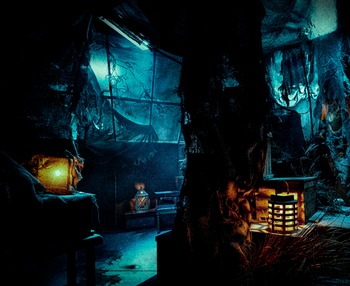
The most striking example of postdramatic spatial composition is the climactic scene in Abeille’s laboratory. As the laboratory (conceived as a vehicle) moves, players witness the performances of NPCs (‘Non-Player Characters’, here played by trained actors) in different directions and spaces, not unlike the montage technique used in films. This is a direct translation of postdramatic parallel action into a three-dimensional, navigable environment. The figures of Abeille and Pierre appear separated, their shadows and images superimposed through a slanted mirror, creating a holographic effect that portrays a sense of fateful separation between ‘untouchable’ lovers. This scene does not rely on dialogue to convey tragedy. It uses spatial dislocation, light, and mirroring, to create a poignant, simultaneous presentation of parallel destinies – a purely theatrical, post-literary expression of the theme. It also confirms Rocci’s observation that escape rooms ‘employ all of the tools developed for theatre’, including ‘a detailed and dynamic set and technical design that could be that of a small immersive production’, but pushes it into the realm of symbolic, affective composition (Figure 1).Footnote 25
The overgrown island hut in ‘Abeille’. Source: UMEPLAY. © UMEPLAY. Reproduced with permission.

The Synaesthetic Score: Composing with Light, Sound, and Sensation
The postdramatic rejection of textual dominance elevates the other elements of performance into a synaesthetic score. ‘Abeille’ demonstrates a masterful understanding of this, crafting immersion not through storytelling but through sense-making. Darkness is strategically employed not just for mystery but to amplify other senses; as I myself noted during my participation, ‘When I am under pressure in the dark, my senses get even more acute.’ Sound is a constant, imperceptible driver of emotion. The use of non-diegetic music (a filmic technique that deploys music extraneous to what the narrative includes) to emphasize suspense, excitement, or sadness directly manipulates the participant’s emotional state, operating as a form of direct, unmediated affective address that bypasses intellectual interpretation.
The design extends boldly into the olfactory and gustatory: realms that, while present in all theatre (the smell of dust and paint, the shared breath of an audience), are here deliberately foregrounded as compositional elements. The scent of blue iris flower pollen and the final ritual of tasting the black bee honey water are not incidental details but crucial dramaturgical elements. As Scott Palmer reflects in a different context, ‘Scenographic elements which acknowledge the sensory and stimulate embodied responses are able to evoke profound responses and create meaning through drawing subtly upon the themes of the piece.’Footnote 26 The honey water in ‘Abeille’ performs exactly this function. It is the literal fruit of the narrative’s central quest (the cure), transformed into a sensory epilogue. This act of tasting completes a symbolic loop, creating thematic and experiential closure by making the participant’s body the final site where the story’s meaning – sweetness born of sacrifice – is literally incorporated. This deep, multi-sensory engagement exemplifies what Alston and Nibbelink identify as characteristic of immersive theatre: acts of touching and being touched, tasting, smelling and moving that contribute directly to immersion.
The Participant as ‘Performing Spectator’: Agency, Role, and the Social Ensemble
The final and most crucial element in this postdramatic equation is the reconfiguration of the participant. In ‘Abeille’, the player becomes the embodiment of Lehmann’s ‘co-player’Footnote 27 and Machon’s ‘audience-participant-performer-player’,Footnote 28 a hybrid agent whose presence and actions complete the work. This is achieved through several interconnected strategies.
First, agency is framed as diegetic action rather than abstract puzzle-solving. The tasks – climbing a ladder to retrieve honey, being chased through a corridor, assisting Abeille – are what Dixon, via Murray, might call ‘enactments of life situations at varying levels of abstraction’.Footnote 29 They are physical scores that require the participant to perform within the fictional world. This performance is not a pantomime of a pre-written character but the authentic, improvisatory behaviour of one’s own body under a fictional pretext. It creates what Machon identifies as the higher level of engagement found in immersive theatre: the bodily interaction with the environment and other performers that the digital world ‘cannot offer because it cannot be reactive to the actual presences’.Footnote 30
Second, the game masterfully employs NPCs (‘Non-Player Characters’, performed by actors whose role blurs performance and facilitation) to interpellate participants into the narrative, blurring the boundary between actors and players. As described, when an NPC questioned a participant’s identity, a teammate spontaneously offered, ‘She came with us on the ship. She fell asleep on the ship, so she doesn’t know much about the situation.’ This moment serves as a microcosm of the process: through social interaction within the fictional frame, the player is seamlessly written into the story. The NPCs serve a dual function. They are characters within the drama, but they also act as living embodiments of Machon’s ‘rules of engagement’ as guides, prompters, and living interfaces that structure the participant’s journey while maintaining the fictional bubble.Footnote 31 Their performances (particularly in the one-on-one moments where a single player follows Tristan) mirror the intense, personal encounters found in such shows as Sleep No More, offering the audience a unique personal experience’ that ‘further enhances the sense of immersion and provides a deeper identity and emotional resonance.
Third, the experience is fundamentally structured as a social, collaborative performance. The ‘inherent multi-modal and team-based mechanics’, as Wiemker et al. note, ensure engagement.Footnote 32 However, beyond mere engagement, this teamwork becomes the social dramaturgy of the piece. The need to communicate discoveries, support each other during tense moments, and collectively interpret events, turns the participant group into an ensemble in real time. They are not just solving a game; they are co-creating a shared, dramatic experience through physical language, interaction, and tacit understanding. This social dimension amplifies the emotional impact and mirrors the communal, playful audiences observed in works by companies like Coney, where spectatorship is reconfigured as a collective, performative activity.
These strategies – diegetic action, NPC interpellation, and social ensemble – collectively transform the participant from solver to witness, from player to performer. Yet this transformation raises critical questions about the nature of freedom, authorship, and commodification in such experiences. We now turn to these broader implications.
Analysis: The Mechanics of the ‘Turn’ and Its Implications
Having established ‘Abeille’ as a postdramatic text, our analysis now pivots from descriptive explication to critical examination. It is not enough to map the correspondences between the escape room and postdramatic theatre; we must dissect the precise mechanics of the ‘immersive turn’ itself, and grapple with its broader implications for performance, spectatorship, and cultural production. This involves probing the fundamental shift in experiential logic, scrutinizing the nature of the agency it purports to offer, and confronting the complex (perhaps contentious) relationship between avant-garde artistic principles and the commercial engine that drives this evolution. The ‘turn’ is not merely aesthetic; it is a recalibration of how narrative, challenge, freedom, and value can be variously produced within a participatory framework.
This recalibration is not uniform across global contexts. While western immersive entertainment often prioritizes individual agency and open-ended exploration (e.g., Punchdrunk), the Chinese ‘immersive turn’ emphasizes collective emotional catharsis and tightly choreographed sensory journeys. This may reflect broader cultural values around communal experience and narrative closure, as well as the rapid scaling of high-tech leisure infrastructure in urban China. It is within this specific ecosystem that the postdramatic potential of the escape room finds its most elaborate popular expression.
The most profound mechanism of the ‘immersive turn’ is the redefinition of the core challenge, a move from puzzle-solving to Einfühlung (empathetic immersion). Traditional escape rooms, following Nicholson’s foundational definition, are ‘live-action team-based games where players discover clues, solve puzzles, and accomplish tasks … in order to accomplish a specific goal (usually escaping from the room)’.Footnote 33 The paradigm is cognitive and goal-oriented: the room is a problem to be solved, a lock to be picked on a grand scale. The pleasure derives, as Murray describes, from the ‘satisfying power to take meaningful action and see the results of our decisions and choices’,Footnote 34 but this action is primarily instrumental and intellectual. In contrast, the advanced model exemplified by ‘Abeille’ subordinates the logic of the puzzle to the logic of the situation. The goal is no longer a clean, binary ‘escape’, but a messy, emotional passage – to witness, to endure, to help, and ultimately, to grieve. The puzzles do not disappear, but they are metabolized into the dramatic tissue. Finding a cure for Abeille is not a riddle to be cracked for points; it is, rather, a narrative imperative that channels the participant’s actions into a posture of care and collaboration. In ‘Abeille’, exploration is the narrative mode, and puzzle-solving is the vehicle for deeper empathetic and sensory investment. The ‘puzzle’ becomes the affective and ethical quandary of the characters, and ‘solving’ it involves an emotional and physical resonance that transcends pure logic. This aligns with the postdramatic privileging of experience over explication, where, as Alston defines it, the work is ‘broadly premised on the production of experience’.Footnote 35
This reorientation necessarily implicates the second critical mechanism: the construction of curated freedom and the postdramatic contract. Both immersive theatre and escape rooms are celebrated for empowering their audiences, for offering a tantalizing sense of agency. In escape rooms, players can choose different clues or paths and explore their own ways of solving puzzles to some extent. Similarly, in immersive theatre, the audience is often given the freedom to choose their viewing perspective, explore different storylines, or even directly influence the development of the plot. This freedom, however, is a carefully engineered illusion, a foundational element of Machon’s ‘rules of engagement’ that enable immersion by providing a safe, structured playground for exploration.Footnote 36
Analysis of ‘Abeille’ reveals the contours of this contract. Participants can linger in spaces, interact with props in various sequences, and engage with NPCs in personal ways, creating a powerful sense of individual journey – yet the ultimate narrative trajectory and emotional climax are fixed. The honey water will be tasted; the tragedy of Abeille and Pierre will be revealed; but the player’s role is to arrive at this predetermined destination via a path that feels uniquely theirs. Rather than being a shortcoming, this is the essence of its dramaturgy. As noted in observations on both forms, these choices are still limited, and this freedom of interaction is often not entirely unrestricted. Zheyu Wei’s critique of immersive theatre is piercingly relevant: ‘These interactions and freedoms are all predicted and meticulously controlled.’Footnote 37 The ‘aesthetics of responsibility’ Lehmann associates with the postdramatic spectator is, in this commercial context, also an aesthetics of compliance with a pre-composed sensory and narrative score.Footnote 38 The participant’s agency lies not in altering the outcome but in the quality of their presence and attention within it – in how deeply they commit to the performance of their own role within the given framework. This creates a potent, if paradoxical, dynamic: the feeling of agency is the very medium through which the designer’s authored emotional experience is most effectively transmitted and embodied.
This leads to the most significant implication of the ‘immersive turn’: the rise of commercial postdramatism. This is where the analysis must engage directly with a potential point of scholarly scepticism. Can a for-profit entertainment product, designed for mass consumption and operational efficiency, legitimately be discussed in the same breath as the radical, often subversive, tradition of postdramatic theatre? The evidence from the Chinese industry compels us to answer in the affirmative, not by claiming identical artistic intentions, but by demonstrating the adaptive resilience and popular resonance of postdramatic strategies. The ‘immersive turn’ is fundamentally a market-driven phenomenon, born from the need to differentiate in a competitive landscape and to cater to a generation craving novelty, excitement, and emotional resonance. The term ‘immersive’ itself is wielded as a selling point. Companies like UMEPLAY explicitly pursue immersive game experiences with high cinematic quality through technological investment and spectacular scenography. This commercial imperative, however, has inadvertently created a pipeline for postdramatic aesthetics to reach a vast, non-specialist audience.
The implications are two-fold. First, it demonstrates the exportability and flexibility of principles like decentred narrative, environmental dramaturgy, and the performing spectator. These are not fragile, rarefied concepts, but robust design tools capable of generating profound engagement outside the subsidized art house. The Chinese escape-room industry, with its world-class standards in terms of technological innovation, scene restoration, and cross-industry cooperation, has become an unwitting laboratory for popularizing a post-literary, sensorially driven form of storytelling. It answers an earlier lament by DixonFootnote 39 about academic bias towards gaming topics as simplistic, cartoonish, inconsequential, and essentially plebeian by showcasing how a ‘theatricalized activity’ (in Filewod’s term)Footnote 40 can be both popular and experientially sophisticated.
Second, this commercial context inevitably shapes its postdramatic expression. The experience is streamlined, polished, and designed for repeatable, reliable impact. The rough edges, political provocations, or overt existential fragmentation of much historical postdramatic work are often smoothed into more universally accessible emotional arcs – melodrama, Gothic horror, heroic adventure. The focus shifts from a competitive focus on winning or losing to a creative focus on building a play world. This ‘play world’, however, is often a consumable aesthetic package, within which the core postdramatic transaction persists: the spectator is dethroned from their position of passive observation and relocated into the midst of a meaning-making system composed of space, sensation, and action. As Felix Barrett of Punchdrunk has suggested, the two forms need not become each other; it is enough to borrow each other’s techiques. In this context, however, that line is not just crossed but dissolved into a new hybrid practice. As Guardian writer Thomas McMullan observed, both forms are ‘snatching at its neighbours, testing its barriers’.Footnote 41 The commercial escape room has snatched the neighbour’s most valuable tools – its techniques of embodied, environmental storytelling – and built a wildly successful enterprise with them.
However, this process of adaptation also reveals something about the postdramatic paradigm itself. The ease with which postdramatic strategies can be absorbed into commercial entertainment might suggest that they are, at least in part, formal techniques separable from the critical or political ambitions that often accompanied their development. If postdramatic principles can be so readily commodified, this may indicate a certain formalism within the paradigm – a set of devices that can be deployed for diverse purposes, from avant-garde provocation to mainstream pleasure. This observation does not diminish the paradigm’s value but rather illuminates its versatility. Moreover, the very success of these commercial adaptations may generate counter-movements within art theatre, as artists seek to differentiate their work from commodified forms, producing new experiments that resist easy absorption. The ‘immersive turn’ in escape rooms thus not only reveals the reach of postdramatic ideas but may also help generate desires and resistances that push theatrical practice in new directions. The history of theatre is, after all, a history of continual transformation in response to changing social relations, technological possibilities, and cultural competition.
The ‘immersive turn’ in Chinese escape rooms is therefore more than an industry trend; it is a significant cultural development that reconfigures the relationship between avant-garde performance theory and mainstream leisure. It demonstrates that the appetite for embodied, atmospheric storytelling extends far beyond avant-garde circles into mainstream entertainment culture. The implications for theatre studies are substantial: it demands that we expand our field of vision to include these commercial sites as legitimate objects of performance analysis, recognizing them as part of the continuing evolution and democratization of postdramatic forms. The ‘turn’ challenges creators and scholars alike to consider how the profound mechanics of immersion, agency, and sensory narrative can thrive within, and be transformed by, the realities of the global experience economy.
Conclusion: The Stage after the Lock
This study has sought to show that the lock at the heart of the escape room is not merely mechanical but epistemological. By treating ‘Abeille’ as a postdramatic text, we have unlocked a new way of seeing commercial entertainment as a legitimate site of performance innovation. Far from diluting theatrical avant-gardism, the Chinese ‘immersive turn’ demonstrates its remarkable adaptability: its capacity to thrive in the marketplace while retaining its core challenge to passive spectatorship. At the same time, however, this flexibility also raises questions as to the long-term vitality of these forms. Will the immersive escape room’s carefully curated freedoms begin to feel clichéd or prescriptive as the format matures? Might participants eventually rebel against its managed agency, seeking out less structured, more genuinely open-ended forms of play? The history of entertainment suggests that novelty fades, and what feels liberating today may become formula tomorrow. The very success of commercial postdramatism may generate desires for different kinds of theatre and art – forms that resist commodification, and which embrace the unruly, the unpredictable, the politically charged.
The implications of this reconceptualization are substantial, contributing to knowledge across several interconnected fields. Firstly, this research provides a rigorous and urgently needed theoretical framework for analyzing hybrid experiential forms. It moves the discourse beyond the stagnant debate of whether escape rooms are ‘like’ theatre, offering instead the precise analytical tools of postdramatic theory to dissect their mechanics of immersion, agency, and meaning-making. Secondly, it significantly expands the geographical, cultural, and economic scope of postdramatic performance studies. By taking a commercially driven, popular entertainment product from China seriously as a performance text, this work challenges the implicit western-centric and avant-garde biases that can limit the field. It shows how postdramatic strategies have been organically adopted and adapted within a vibrant, technology-savvy experience economy, demonstrating their powerful resonance beyond the subsidized art theatre. Finally, it reframes the ‘immersive turn’ as a significant development in contemporary performance culture, one that vividly illustrates the ongoing, fluid convergence of theatrical and ludic forms. As McMullan observed, theatre and games are each ‘snatching at its neighbours, testing its barriers’;Footnote 42 this study has accordingly documented one of the most successful and aesthetically rich results of that cross-pollination.
Looking forward, the stage that emerges after this conceptual lock has been picked is one of exciting, if blurred potential. The boundaries of theatre are, as this research acknowledges, constantly evolving, with new practices emerging one after another in the eye of post-dramatic theatre. The Chinese immersive escape room, as an innovative representative of the gaming industry, has claimed an irrevocable place on that evolving stage. It not only offers audiences a novel, unique, and challenging artistic experience, but also serves as a compelling provocation for traditional theatre-makers. The logistical genius, technological integration, and operational scalability of these commercial models offer invaluable lessons for creating profound immersive experiences that are both sustainable and accessible. Future research might fruitfully explore the reciprocal flow of influence, investigating how the techniques honed in these escape rooms – their mastery of environmental pacing, sensory choreography, and structured participatory agency, for example – might feed back into and transform mainstream theatrical production.
Furthermore, the global dimensions of this ‘turn’ warrant investigation, comparing the specific trajectory of the Chinese industry with developments in other cultural contexts to build a richer, comparative understanding of how postdramatic aesthetics are being globalized and localized. In the end, our journey through ‘Abeille’ and its theoretical ramifications confirms a simple, powerful truth: whether standing in a room designated as a game or a performance, the human desire ‘to explore’, to feel, and to find meaning through embodied action remains constant. The Chinese immersive escape room, in its highest form, has built a masterful new architecture for housing those ancient desires, creating a popular and potent theatre for its time – even as that time, like all theatrical moments, will inevitably give way to new forms and new desires.