Introduction
Nutrient deficiencies are a major factor limiting productivity on smallholder farms in sub-Saharan Africa (SSA), as soils are widely infertile and farmers have limited access to amendments such as inorganic fertilizers and manureReference Okalebo, Othieno, Woomer, Karanja, Semoka, Bekunda, Mugendi, Muasya, Bationo and Mukhwana1. Legume diversification in rain-fed cereal production has been shown to have positive effects on soil organic matter (OM) and nitrogen through crop residue incorporation and biological nitrogen fixation (BNF), moisture conservation and soil microbial activitiesReference Kumar Rao, Thomson, Sastry, Giller and Day2–Reference Rao and Mathuva4. However, legume production is often limited in scopeReference Snapp, Kanyama Phiri, Kamanga, Gilbert and Wellard5, constraining contributions to agricultural nutrient cycling and sustainabilityReference Adu-Gyamfi, Myaka, Sakala, Odgaard, Vesterager and Hogh-Jensen6, Reference Ojiem, Vanlauwe, de Ridder and Giller7.
The potential benefits—and challenges—associated with integrating more legumes into maize-based cropping systems are complexReference Snapp, Blackie, Gilbert, Bezner-Kerr and Kanyama-Phiri8. The benefits of legumes on soil OM pools, soil fertility and cropping system production will vary based on edaphic factors, genetics and management practicesReference Giller, Cadisch, Ehaliotis, Adams, Sakala and Mafongoya9. A case study in northern Malawi is evaluated here. A small, landlocked country in southern Africa, Malawi is highly representative of rain-fed, smallholder maize production across the continent. The majority of farmers in Malawi have an average land holding size of <1 ha. The staple food crop is maize (Zea mays L.), which is cultivated on >70% of arable landReference Kumwenda, Waddington, Snapp, Jones, Blackie, Byerloe and Eicher10; secondary crops include tobacco (Nicotiana tabacum), cotton (Gossypium hirsutum), cassava (Manihot esculenta) and groundnut (Arachis hypogaea).
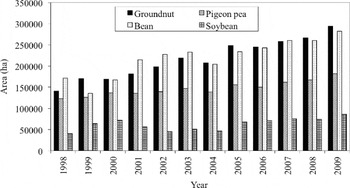
Constraints and opportunities related to legume crop production have been studied in some detail in northern MalawiReference Bezner Kerr, Snapp, Chirwa, Shumba and Msachi11. A unique opportunity is presented by the slow but steady rate of expansion in legume cultivation that has been underway over the past decade (Fig. 1). In Malawi, the most common legumes grown include bean (Phaseolus vulgaris), soybean (Glycine max), cowpea (Vigna unguiculata) and pigeon pea (Cajanus cajan), frequently grown as intercrops in southern Malawi, whereas sole stands of groundnut and bambara groundnut (Vigna subterranea) are typical of northern MalawiReference Bezner Kerr, Snapp, Chirwa, Shumba and Msachi11. Maize and legume crop area and yield data show increased production of maize12, groundnut and pigeon pea from 1998 to 2009, while area planted to soybean has fluctuated (Fig. 1).
Total area of groundnut, pigeonpea, common bean and soybean production in Malawi, 1998–2009. Source: FAO, FAOSTAT (http://faostat.fao.org).

Legume performance
Legume growth and rhizobial nodulation are highly dependent on adequate moisture and aeration. Temperature gradients can also influence legume production, but across tropical Africa the climate is generally sufficiently warm for most legume species and moisture is the more widespread constraint. Rainfall is a particularly important factor in annual legume biomass production and N inputs. In one study, biomass production in cowpea (V. unguiculata) was found to be 34% higher in high rainfall areas (900 mm annual precipitation) than in low rainfall sites (450 mm annual precipitation)Reference Kayinamura, Murwira, Chivenge and Waddington13. In a study in Kenya, low rainfall was associated with lower yields of intercropped grain legumes and maizeReference Rao and Mathuva4. Generally, insufficient rainfall limits legume growth; however, excess moisture and extreme rainfall events are becoming major problems for African crop production. This was highlighted in a recent decadal analysis of three long-term experiments located in Nigeria, Zambia and Malawi. Grain yield loss was more often associated with excess rainfall than insufficient rainfallReference Akinnifesi, Ajayi, Sileshi, Chirwa and Chianu14. Many leguminous crops require well aerated soils and have almost no tolerance of flooded conditions, as might be expected given the high energy demands associated with microbial symbionts and N fixation.
Soil factors, including both biological and geochemical properties, exert a major influence on legume performanceReference Giller15. Deficiencies of soil N and inorganic P are some of the most widespread constraints to legume development and yield potential, and nowhere is this more evident than in Africa. Phosphorus affects root growth and development, nodulation and the N fixation processReference Jemo, Abaidoo, Nolte, Tchienkoua, Sanginga and Horst3, Reference Hoa, Thao, Lieu, Herridge and Herridge16. This is not surprising, given the energetic demands of the BNF process and high requirements for ATP synthesis. To enhance BNF on smallholder farms, one of the most effective management practices is to amend legume fields with a phosphorus source, such as manure or inorganic fertilizerReference Mhango, Mughogho, Sakala and Saka17, Reference Snapp, Mafongoya and Waddington18.
Different growth habits and management practices are associated with legumes grown for soil fertility properties. These include viny plants, shrubs and trees grown as part of green manure and agroforestry systems. Sequential or relay intercrops are frequently used for these types of dedicated soil improvement systems. Agroforestry, or the integration of woody species with herbaceous plants such as food crops, green manures and pastures, can provide a variety of goods and services, including food, fodder, soil fertility improvement, soil erosion control and biopesticidesReference Kwesiga and Coe19–Reference Gilbert, Eilittä, Mureithi and Derpsch21. Examples of leguminous woody species include fish bean (Tephrosia volgelii), gliricidia (Gliricidia sepium), winterthorn (Faidherbia albida), sesbania (Sesbania sesban) and leuceana (Leuceana leucocephala). However, barriers to adoption of green manure and agroforestry systems include seed availability, pests in some tree species and unpredictable rainfall patterns, as well as concern for lack of sufficient short-term benefits, and the opportunity cost of allocating arable land to trees as opposed to food crops, and labor inputs.
Legume growth characteristics
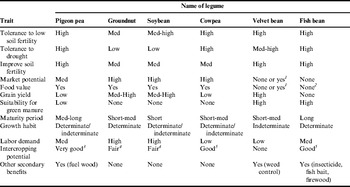
The growth habits and other characteristics of legumes vary by species and variety (Table 1). Some of the characteristics can be complementary, depending on the species and management practices; for example, differences in growth habits allow intercropping of maize with pigeon pea, fish bean or climbing bean. Similarly, upright groundnut varieties or soybean can be intercropped with pigeon pea. Intercropping, if carefully designed and managed, can help to increase resource-use efficiencyReference Hauggaard-Nielsen, Jornsgaard, Kinane and Jensen22. However, reported constraints to adoption include limited markets for grain and access to seeds as well as increased labor requirementsReference Snapp, Rohrbach, Simtowe and Freeman23. Total N fixed over time varies widely depending on legume species and variety, site, weather, soil and crop management practices, and cropping system. The net N and soil fertility benefits from legumes are influenced by residue N inputs and nitrogen harvest index (NHI). The net N benefit is minimal or nil from high grain harvest crops such as soybean where often over half of the aboveground N is removed in the grainReference Sanginga26. Conversely, species with a lower NHI that are grown primarily for inputs from N-enriched tissues, such as green manures, perennial agroforestry and indeterminate legumes, have been shown to have greater soil fertility benefits than annuals, determinate and grain legumesReference Ojiem, Vanlauwe, de Ridder and Giller7, Reference Giller15. Grain legumes with low harvest indices grown primarily for vegetative materials, such as long-duration soybean, are best characterized as multipurpose legumes.
Characteristics of selected legumes that can influence smallholder farmer preferences (sources: information on legume characteristics and use from Malawi Government, MOAIFS24; legume traits adapted from Snapp and SilimReference Snapp and Silim25).

Note: med=medium.
1 Velvet bean is usually grown as a green manure. However, people in the southern region of Malawi prepare delicious snacks from velvet beans and eat or sell them. Recipes are not well known in the central and northern regions, and if not well cooked and processed, velvet beans can be poisonous.
2 Not suitable for human consumption.
3 Intercropped with maize or groundnut or soybean.
4 Groundnut or soybean are usually grown in pure stands. However, either of the two legumes can be intercropped with pigeon pea.
5 Intercropped with maize.
On-farm measurements of BNF have been reported for many species. The values range from low in common bean (8–31 kg N ha−1)Reference Ojiem, Vanlauwe, de Ridder and Giller7 to a wide range for soybean (3–112 kg N ha−1)Reference Chikowo, Mapfumo, Nyamugafata and Giller27, Reference Sanginga, Dashiell and Okugan28 and groundnut (22–124 kg N ha−1)Reference Ncube, Twomlow, van Wijk, Dimes and Giller29–Reference Rebafka, Ndunguru and Marschner31. Higher N fixation values are generally associated with longer lived crops such as pigeon pea (37–164 kg N ha−1)Reference Adu-Gyamfi, Myaka, Sakala, Odgaard, Vesterager and Hogh-Jensen6, Reference Egbe, Idoga and Idoko32 and leguminous tree species (44–277 kg N ha−1)Reference Nezomba, Tauro, Mtambanenge and Mapfumo33–Reference Sanginga, Vanlauwe and Danso35. Values in SSA have been reported to be as high as 170 kg N ha−1 for grain legumesReference Sanginga, Dashiell and Okugan28, Reference Egbe, Idoga and Idoko32 and 300 kg N ha−1 for green manuresReference Ojiem, Vanlauwe, de Ridder and Giller7. It is known that on-farm performance of legumes is generally much reduced compared to the potential shown by research studies, but specific edaphic constraints to legume performance have rarely been documented, nor is it known which farmer criteria are key influences on adoption and area sown to legume crop species. The unique focus of our study was to document—at the field and farm family scale—the biophysical and socio-economic factors that influenced expansion of legume adoption and nitrogen fixation in a smallholder environment.
The study objectives were to: (1) determine if farmers who participated with the Soils, Food and Healthy Communities (SFHC) project had greater knowledge of legume crops and grow more of them than the farmers who had not participated; (2) document farmer adoption and criteria for assessment of legume crops; and (3) document soil properties associated with specific fields, management and cropping species history.
Materials and Methods
Case study background
Since 2000, SFHC, a project of the Ekwendeni Mission Hospital, has provided nutritional and agronomic education to promote legume diversification, and supported gains in soil fertility and family nutrition in Ekwendeni, Mzimba district, northern MalawiReference Bezner Kerr, Snapp, Chirwa, Shumba and Msachi11, Reference Bezner Kerr and Chirwa36. The hospital, which offers medical services to the entire watershed, established the program to address the poor nutrition among children from surrounding communities, especially those below the age of 5. In an earlier study, low crop yields were among the factors associated with malnutritionReference Bezner Kerr and Chirwa36. The SFHC project focused initially on promoting legume production and educating farmers on residue management and food preparation. Some of the legumes promoted for integration into traditional maize rotation and intercropping systems included improved varieties of groundnut, soybean, pigeon pea, velvet bean and fish bean. The project farmers received training on the agronomy of legume production, post-harvest utilization of various grains, and residue management with legumes to improve soil fertility and family nutritionReference Bezner Kerr, Snapp, Chirwa, Shumba and Msachi11.
The project farmers are organized into farmer research teams (FRTs) to facilitate farmer experimentation and sharing of experiences on legume technologies (production and utilization)Reference Bezner Kerr, Snapp, Chirwa, Shumba and Msachi11. The FRTs are selected by the villagers and they conduct field demonstrations in their communities. The demonstration plots act as learning centers for a wider community and the technologies are disseminated through field days and nutrition education days.
Study site
Malawi has a semi-arid to sub-humid tropical climate with two main seasons, a wet season (October–March) and a dry season (April–September). Almost all maize is grown without irrigation during the wet season. Most soils on smallholder farms are low in nutrient status and depleted in OMReference Snapp37. Soils on smallholder farms include a wide range of textures, but a dominant type is coarse-textured, well-drained Alfisols. The government subsidy programs have partially improved access to fertilizers by subsidizing access among smallholder families to one or two bags of fertilizerReference Denning, Kabambe, Sanchez, Malik, Flor, Harawa, Nkhoma, Zamba, Banda, Magombo, Keating, Wangila and Sachs38, but fertilizer use remains low to moderateReference Snapp, Kanyama Phiri, Kamanga, Gilbert and Wellard5.
The study site is the Ekwendeni watershed, located in northern Malawi. Ekwendeni lies at 11°20′S, 33°53′E, with an elevation of 1200 m and annual rainfall of 800–1200 mmReference Snapp and Silim25 from December to March. Annual precipitation in the Ekwendeni watershed averaged 817±212 mm for the period from 1996 to 2007, a moderately low 10-year average but generally sufficient for maize production if the rain is well distributed over the rainy season. The soils are classified as fine kaolinitic, thermic, typic kandiustalfs with low OM (<15 g kg−1)Reference Chilimba, Mughogho and Wendt39.
Surveys
Household and farm field surveys were conducted in June 2007 using two semi-structured interview instruments, the initial instrument documented farm household socio-economic characteristics, knowledge of and use of legumes, and farmer criteria for evaluating legume crop species. The second instrument was used to elicit management history and crop species associated with two specific fields per farm family, where each field was subsequently soil sampled. Farmers were asked to choose two fields, one that was primarily used for maize production, and the other that had been used for legume production.
The selection of farmers for the interviews was done through a multiple step process, starting with random selection of eight villages from among the 60 villages located within the SFHC project area. Within each village, 5–6 farmers were randomly selected for the interviews. Two-thirds of the survey respondents represented project farmers (actively involved with SFHC) and one-third were control farmers (did not work with SFHC, although all farmers had heard of the project). The surveys were conducted by the first author, who is a native speaker of the local language. Specifically, the data collected through the questionnaires administered to household heads included the farm family members, numbers of adults and children, food security status (self-defined) crops grown generally, how legume crops are utilized, traits associated with preferred legumes and constraints to legume production.
After each household interview was completed, a farm field interview process was conducted. As the basis for this interview—a field-specific questionnaire was administered which documented a 3-year history of crop species grown and management practices—two fields/farm were identified for the interview, in consultation with farmers. This included a predominantly maize field (continuous maize with not more than one other crop rotated or intercropped in the last 4 years) and a legume-diversified field (three or more legume crops grown as sole crops or intercrops with maize over the last 4 years). The objective was to compare soil fertility status on ‘maize’ and ‘legume-diversified’ fields, as indicated by biological and chemical properties (soil OM, nitrogen, phosphorus, magnesium, calcium and potassium).
A total of 88 fields were identified, as paired sets of fields from 44 farms. This allowed us to evaluate how soil properties and land use varied, in relation to the field-specific interview. Soil sampling was conducted in the fields, as follows. From each field, composite soil samples (10 random subsamples per field) were collected at 0–15 and 15–30 cm soil depth. The samples were mixed, air-dried, passed through a 2 mm sieve, and stored. A sub-sample of the soil was dried overnight at 40 °C, ground and analyzed for OM, pH, available phosphorus (P), exchangeable potassium (K), magnesium (Mg) and calcium (Ca)40. The OM was determined by loss on ignition at 360 °C and the data correlated with Walkley–Black. Soil pH was determined in a 1:1 soil to water slurry. Available P and exchangeable cations were extracted according to Mehlich IIIReference Mehlich41, and analyzed by inductively coupled plasma spectrometry. These P data were correlated to and reported as Bray PReference Bray and Kurtz42. The data for exchangeable cations were correlated to and reported as a 1 N ammonium acetate extractionReference McIntosh43. Particle size distribution and particulate OM were determined using gravimetric sedimentationReference Gee and Bauder44.
Statistical analysis
Frequencies and percentages were computed for categorical variables (marital status, education level and preferred legume characteristics) using SPSS statistical software45. A chi-squared analysis of equal proportions was performed to test for association between farmer involvement with SFHC and utilization of legumes or crop residue management, using SAS statistical software46. Multiple regressions were performed to evaluate the relationship between OM and soil properties. Normality of residuals was checked using normal probability plotsReference Chatterjee and Hadi47. The presence of outliers was examined using Cook's D values.
Multicollinearity was assessed using a correlation procedure and a variance inflation ratio. The best fitted model was selected based on stepwise regression procedures. Data analysis was conducted using PROC UNIVARIATE and PROC REG of SAS46. The effects were declared significant at a 5% level of significance.
Results and Discussion
Biophysical environment
The study site is representative of one of the most common land use systems in the sub-humid tropics, which has been termed the mixed maize farming system. Precipitation is highly variable but averages approximately 1000 mm annually in a unimodal pattern starting sometime around December and lasting for about 4 or 5 months. Unpredictable weather patterns contribute to variable production in the region and are expected to increase in variability in the coming decades with global climate changeReference Burke, Lobell and Guarino48. Recent studies have highlighted the vulnerability of cereal-based farming in southern AfricaReference Funk, Dettinger, Michaelsen, Verdin, Brown, Barlow and Hoell49.
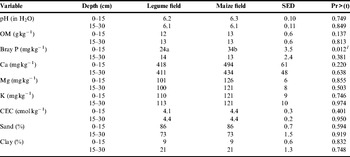
Soil resources are important determinants of the vulnerability and resilience of cropping systemsReference Smaling and Dixon50. The soil properties observed in this study were consistent with a well-drained soil of predominantly coarse to medium loam texture with an average sand content ranging from 72 to 86% and clay content from 9 to 22% (Table 2). The soil pH was slightly acidic to neutral, 6.1±0.6 in 15–30 cm to 6.2±0.6 in the 0–15 cm soil layer. Soil OM levels were generally low and varied considerably (12±4 g kg−1). At the 0–15 cm soil depth, cation exchange capacity (CEC) was the only factor positively related to OM variation across fields (R 2=0.316). A wide range of OM values (5–20 g kg−1) has been reported for Malawi smallholder farms from a previous country-wide surveyReference Snapp37, whereas higher values than reported here were observed at a Malawi research station (25–35 g kg−1)Reference Beedy, Snapp, Akinnifesi and Sileshi51. Our findings of 13 g kg−1 average OM at the surface soil depth were similar to an earlier soil survey conducted in northern Malawi which reported 15 g kg−1 OMReference Snapp37.
Means and standard errors of soil chemical properties and texture of legume and maize diversified fields, 0–15 and 15–30 cm soil depths, N=44.

Means in a row followed by same letters are not statistically significant at P<0.05; SED=standard error of the difference for the paired fields.
1 Inorganic P is based on Bray I extract.
Nutrient status overall was moderate to deficient, and there were a few detectable differences in soil chemical properties between fields with a different cropping system history (compare maize and legume-diversified fields, Table 2). The exception was inorganic P in the 0–15 cm soil layer, which was 50% higher (P=0.012) in maize fields (40±21 mg kg−1) than in legume fields (27±18 mg kg−1). Soil pH was moderately acid (6.2) and phosphorus was on an average 34 mg kg−1 for maize fields and 24 mg kg−1 for legume fields (Table 2). In Malawi, the critical level of inorganic Bray P for field crops is 20 mg kg−1Reference Chilimba, Mughogho and Wendt39, thus the fields surveyed were generally low to medium in available soil P. All other chemical properties documented in this experiment were within a range favorable for the growth of most tropical cropsReference Wendt52. Overall, the soil phosphorus data indicates that a beneficial practice at a majority of the field sites would be a modest dose of P fertilizer applied to enhance legume growth.Reference Ofori, Pate and Stern53, Reference Fujita, Ofosu-Bundu and Ogata54
The higher P status that was observed on maize fields relative to legume-diversified fields could be attributed to strategic allocation by farmers, where maize is sown on fertile soils. It might also relate to fertilizer amendments applied preferentially to maize production fields. This is supported by the soil fertility amendments reported, which were generally higher for maize fields than legume-diversified fields. Consistent with our findings, a study in Kenya found that farmers tended to focus soil fertility amendments on maize, which was produced on the highest soil fertility areas of the farmReference Tittonell, Leffelaar, Vanlauwe, van Wijk and Giller55.
Household characteristics
The results from the survey show that the average age of the household head was 43 (2.3) and the household size was 5 (0.4); the standard error is presented in parentheses. We were interested in labor availability, and asked about the number of adults (defined here as 13 and older) and children in the household. This information was used to calculate the dependency ratio (number of children per adult household member), which averaged 0.9. Our broad definition of adult included youths of 13 years, and we note that 15 is more generally considered the cut-off age for adult members of a family in the region. An earlier smallholder farm survey carried out in central and southern Malawi found a quite similar household size: however, the dependency ratio was lower than observed hereReference Snapp, Rohrbach, Simtowe and Freeman23. The percentage of households self-defined as food insecure was 41%, which is consistent with previously reported high levels of malnutrition in the areaReference Bezner Kerr, Snapp, Chirwa, Shumba and Msachi11.
Cropping system characteristics
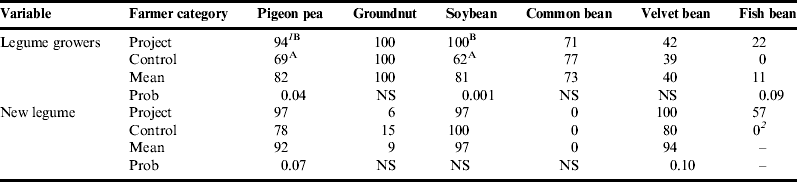
The legumes grown by farmers in this study area were, in order of decreasing frequency, as follows: groundnut, soybean, pigeon pea, common bean, cowpea, velvet bean and fish bean (Table 3). Other legumes were grown on a small scale, notably bambara groundnut and chickpea (Cicer arietinum L.). The cropping system arrangements documented included sole crop, intercrop and crop rotation. The intercropped legumes were generally grown in mixtures with maize or in legume–legume mixtures consisting of an SFHC-promoted ‘doubled up legume’ system of the long-duration, shrubby legume pigeon pea grown with an understorey of a short-duration grain legume, usually soybean or groundnut. In the second season of the legume–legume intercrop, pigeon pea was ratooned (after pods were harvested, the main stem was cut back to about 0.5 m high) and regrown as an intercrop with maizeReference Snapp, Blackie, Gilbert, Bezner-Kerr and Kanyama-Phiri8.
Number of farmers growing legume species in 2006/2007 season and proportion indicating that a legume species is new (not grown historically at this site).
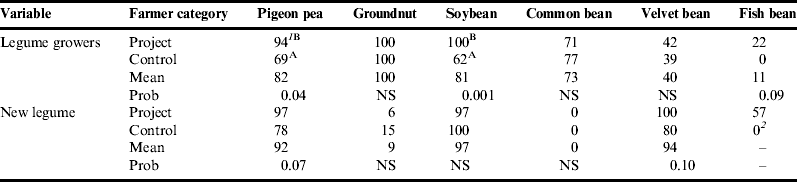
1 Figure reported as percent growers within the farmer category.
2 None of the control farmers grew fish bean.
NS not significant at P=0.05.
Means in a column followed by same letters are not different at P=0.01 per category.
In some farmers' fields the maize–legume intercropping system prioritized maize production, as shown by the high plant population density of maize, which was maintained at ∼36,000 plants per ha, a level recommended for sole stands. An intercropped legume crop such as pigeon pea or soybean was generally grown at a moderate density, following an additive design. In contrast, when groundnut was intercropped with pigeon pea, the density of groundnut was reduced as compared to a groundnut only stand. Interestingly, farmers demonstrated local innovation capacity through experimenting with different density patterns beyond the recommended combinations, including intercropping the ratooned pigeon pea with maize in the subsequent season at a range of densities depending on soil type and utilization-based criteria. The cropping system innovations are consistent with an earlier report from this regionReference Bezner Kerr, Snapp, Chirwa, Shumba and Msachi11.
Farmer evaluation of legumes
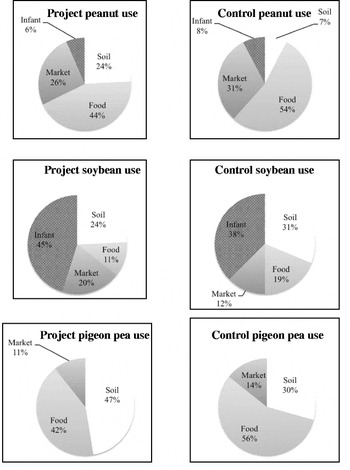
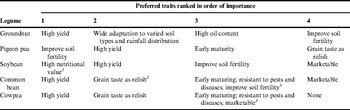
The major species characteristics influencing legume adoption included grain yield, adaptation to different environments, soil fertility benefits, maturity period, grain quality (size, taste), resistance to pests and diseases, and market potential (Table 4). Farmers preferred legumes with multiple desired characteristics. High yield was the number one criterion used by farmers in selecting grain legumes, with the exception of pigeon pea, where soil fertility benefits were frequently top priority. Grain quality ranked second after yield in common bean and cowpea (Table 4). Surprisingly, market potential was only mentioned as the third to fifth desired characteristic for a number of legumes, including cowpea, soybean, pigeon pea and groundnut. However, it was a major use of legumes grown, accounting for 12–31% of end use (Fig. 2). Previous studies reported that yield and grain characteristics (size, color and pod size) were the most important criteria for evaluating cowpeaReference Kitch, Boukar, Endondo and Murdock56 and common beanReference Sperling and Scheidegger57. Labor costs associated with cowpea managementReference Kitch, Boukar, Endondo and Murdock56 and other plant characteristics (uprightness, height from lowest pods)Reference Sperling and Scheidegger57 have also been reported as traits associated with preferred varieties.
Utilization of grain legume species by SFHC project farmers and control farmers. End use was reported by farmers surveyed, and included market sales, soil fertility improvement (abbreviated ‘soil’), food (home consumption) and infant feeding.

Summary of preferred characteristics associated with grain legumes.

1 Farmers indicated interest in child feeding with this crop, and thus high nutritional value for this purpose.
2 Relish is the local name used to describe the sauce that accompanies the staple maize dish, a key ingredient for food security.
3 More than one trait listed, ranked the same by farmers.
Farmers strongly preferred edible grain-producing legumes, such as groundnut and pigeon pea, over green manure legumes, such as velvet bean and fish bean. Novel grain legumes were adopted relatively rapidly, while adoption of green manure crops was slow to nil (Table 3). Survey data indicated that farmers were not generally familiar with soybean, pigeon pea, velvet bean and fish bean before the SFHC project was established, whereas now the adoption of soybean and pigeon pea is widespread. The adoption of fish bean and velvet bean was shown to be less common, and only the project farmers had adopted fish bean (Table 3). Overall, as hypothesized, interaction with the SFHC project staff and educational programs was associated with increased legume adoption.
Legume utilization
The legumes were primarily used for household consumption, infant nutrition, soil fertility and for sale at market (Fig. 2). Infant nutrition describes the specific role of legumes in enriching weaning food and as a nutritious supplement for the diet of young children. The results were consistent with the adoption of new legume crops based largely on home consumption demand, and to a moderate extent, market demand (Table 4). Farmers who interacted with the SFHC were more likely to appreciate the benefits of legumes for the dual purposes of soil fertility and food security. Project farmers were twice as likely to grow groundnut for soil fertility as farmers who were not involved with the SFHC (Fig. 2).
Our interviews documented that more than 60% of the households grow soybean grain (G. max), as a source of oil, protein and vitaminsReference Liu58, to prepare food for children. Soybean has been promoted heavily by the SFHC project through education on the nutritional value and methods for preparation of soybean porridge, extraction of soybean milk, and use of soybean flour to enrich the staple food (maize porridge) and vegetablesReference Bezner Kerr, Snapp, Chirwa, Shumba and Msachi11. Project farmers were more likely to grow soybean than control farmers (P=<0.001) (Table 3). Pigeon pea was grown for both soil fertility benefits and food, as well as occasionally for market (Fig. 2). Additional uses of pigeon pea were mentioned by some farmers, such as stems for firewood and traditional medicine (Table 4). Firewood from pigeon pea can be a significant contribution to rural communities where high population and deforestation has led to clearing of natural forestsReference Snapp, Rohrbach, Simtowe and Freeman23.
Velvet bean and fish bean were grown primarily for soil fertility, whereas about 20% of the project farmers grew velvet bean for sale. Velvet bean can be eaten if extensively processed, and the grain is a traditional crop in some districts of southern Malawi; however, it can take up to 8 h of cooking to remove the l-DOPA (3,4-dihydroxyphenylalanine), a toxic substance found in the grain that can be fatal if not well processedReference Fuji, Shibuya and Yasuda59, Reference Pulangethi, Vadivel and Siddhuraju60. Velvet bean can help control weeds through allelopathyReference Snapp, Rohrbach, Simtowe and Freeman23, Reference Fuji, Shibuya and Yasuda59 and hence can be used in integrated weed management. In addition to modest adoption of fish bean for soil fertility, many farmers were interested in the plant for its toxic leaves, which can be crushed to produce a bio-pesticide used to control weevils and grain borers during grain storageReference Koona and Dorn61.
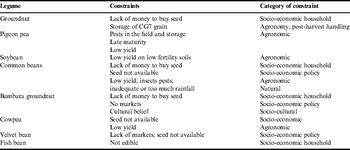
Legume production challenges
Farmer-identified constraints to legume production are shown in Table 5. Seed shortage was mentioned frequently, for almost all legume species, due to lack of money and/or limited seed availability. Seed shortages in legumes may be exacerbated due to the high level of food insecurity reported (41%), which is expected to put pressure on seed saved due to home consumption of legume grain. Post-harvest storage was an issue with specific varieties, as has been noted in previous studiesReference Freeman, Van Der Merwe, Subrahmanyam, Chiyembekeza and Kaguongo62; for example, varieties that are high in oil are susceptible to spoilage; however, this characteristic may enhance nutrition value.
Major constraints to production of legumes.

Farmers reported several challenges specific to growing pigeon pea, including the range of field pests as well as its susceptibility to post-harvest weevil damage. The main field pest is the pollen beetle, which feeds on the plant's floral parts, resulting in low fertilization, pod set and grain yieldReference Abate and Ampofo63. According to farmers, the ideal variety of pigeon pea should be early maturing, in order to avoid certain pests and provide soil fertility benefits.
Farmers reported that most legumes were tolerant of low-fertility soils, with the exception of soybean which did not generally perform well. Improved growth and grain yield for soybean was high priority (Table 5). The soybean varieties grown are not generally promiscuous types and require rhizobium inoculum—which is not available commercially in Malawi—and soils in this area may not have sufficient presence of the appropriate rhizobium species to support BNF in this newly introduced cropReference Zahran64. Similar concerns have been reported in southern Malawi for velvet bean and pigeon peaReference Kabambe, Mhango, Msiska, Msuku, Nyirenda and Masangano65. Applying fertilizer to low-nutrient soils may improve soybean yield; in another study in northern Malawi, application of 23:20:4 and 46:40:8 kg ha−1 of N:P:S fertilizer increased grain yield of soybean by 27 and 71%, respectively, over the controlReference Mhango, Mughogho, Sakala and Saka17.
Sustainable farming relies on biologically mediated nutrient acquisition, most notably BNF. However, in our study, farmers allocated twice as much field space for maize crops as they did for legumes (0.35 versus 0.15 ha), consistent with earlier findings in central and southern Malawi where the land allocated to maize was 3–9 times larger than groundnut fieldsReference Snapp, Rohrbach, Simtowe and Freeman23. If N inputs are to be substantial, then the proportion of land devoted to legumes must also be substantialReference Giller15. Another way to enhance BNF is to give priority to long-lived legumes, shrubs and vines that grow and fix N over most of the year rather than only 4–6 months as is typical of annualsReference Snapp, Mafongoya and Waddington18. The farmer preference for edible legumes such as soybean and groundnut presents a challenge, as there is a trade-off between maximizing grain yield and maximizing vegetation that contributes to soil fertilityReference Snapp, Blackie, Gilbert, Bezner-Kerr and Kanyama-Phiri8; however, legume–legume intercrops of different growth types may be an important way forward to address dual aims.
Conclusions
Legumes offer an important means of improving food security and the sustainability of maize-based cropping, but there are many challenges, including limited seed access, low soil phosphorus status and limited area devoted to growing legumes. Farmers are interested in expanding areas devoted to legume production, but there are barriers to wider adoption and scaling up. Most of the challenges are socio-economic, including seed access, labor and markets. Improved legume seed is expensive and hence not affordable for many smallholder farmers, and there is considerable need for the government, NGOs and communities to identify strategies to improve seed availability for smallholder farmers.
Legume adoption and residue incorporation are limited across SSAReference Snapp, Rohrbach, Simtowe and Freeman23, but nutrition education, introduction of new legume species, and on-farm experimentation through participatory research and extension conducted by the SFHC project have increased legume adoption and residue incorporation in these northern Malawi communities. Farmers expressed interest in experimenting with legumes and in education about agronomy, pest control and nutrition, suggesting many opportunities for wider legume adoption. In agronomic practices, farmers were particularly interested in planting time, patterns and density of sole and intercropped legume, and identification and control of pests and diseases. Interest in grain utilization was also a major area of interest, where recipes and nutrition education could support not only nutritional gains, but also expanded BNF through promoting legume adoption.
Acknowledgements
This study was a component of the Legume Best Bets project, funded by the McKnight Foundation Collaborative Crop Research Program. We are also grateful to the University of Malawi—Bunda College, C.S. Mott Fellowship for Sustainable Agriculture of Michigan State University (MSU) and MSU International Predissertation Travel Award for financial support. Lastly, we thank all the staff and farmers working with the SFHC project of Ekwendeni Mission Hospital for their support.