The History of the Incas is one of the most important chronicles in the field of Andean Studies. It contains valuable information for the study of the pre-Hispanic Andes, as well as for understanding the political and social role played by Inca elites in the new social scenario imposed by the Spanish conquest at the end of the sixteenth century. Pedro Sarmiento de Gamboa, its author, wrote the chronicle in Cusco in 1572, at the request of Viceroy Francisco de Toledo. Later, that same year, Toledo ordered the execution of Túpac Amaru, the last Inca ruler, and undertook a spurious trial against some important members of the Inca elite. The main objective of the History, written to serve the viceroy's agenda, was to prove the illegitimacy of the Inca empire, by depicting its rulers as tyrants.
The History was not published in Peru or Spain and the trail of its only manuscript was completely lost until the end of the nineteenth century, when it was found in the Göttingen State and University Library. Its discovery was a landmark event for early Andean scholars, opening an impassioned debate about the veracity of Inca Garcilaso de la Vega's Comentarios reales, as Sarmiento's account openly contradicted the kindness and civilization of his version of the Inca Empire.Footnote 1 In the following years, the content of the History provided ethnohistorical data for archaeological research, while historians and litterateurs focused on its differences with other Andean chronicles, such as the Miscelanea antártica by Miguel Cabello Valboa and the Crónica del Perú by Pedro Cieza de León.Footnote 2
In the last decades, studies have centered on the History's contradictions, as Sarmiento seems to admire some Inca rulers and at the same time condemn Inca cruelty and disloyalty.Footnote 3 Research has also explored the similarities and connections between the History and other documents written during Toledo's administration, especially the Informaciones sobre los incas and the Parecer de Yucay, and its political role in defending the legitimacy of the Spanish government in the New World.Footnote 4
But, what about the mystery of the History's manuscript? Where was it for 300 years? Why was it never published? When the manuscript was found, the Göttingen State and University Library's records showed that it had been acquired from the auction of Abraham Gronovius's library, in Leiden, at the end of the eighteenth century. How did it travel from Cusco to Leiden? Who was Abraham Gronovius? What happened to the manuscript after it arrived in Göttingen in the eighteenth century?
The aim of this paper is to explore the lives of Sarmiento's manuscript outside the field of Andean Studies, delving into its textual journey, providing new information on its multiple destinations, and placing its circulation in the context of the bibliophile networks of modern and contemporary Europe. In doing so, the paper also explores the material dimension of the manuscript and how its regime of value changed during the long period that it was out of public view. Over three centuries, the manuscript traveled approximately 8,640 miles, which is more or less a third of the Earth's circumference. During that time-distance, its political significance was forgotten and the manuscript became an antique, a commodity whose social and economic value prevailed over its initial purpose. In sum, the present research note aims to reconstruct the trajectories and contexts that inscribed new meanings into the social life of an Andean manuscript.
In trying to assembling the puzzle of the History's pilgrimage, I undertook a unique journey as well. It led me first to the Göttingen State and University Library and the Herzog August Library, in Germany and then to the Leiden University Library, in the Netherlands. The next year, I went to Spain, to the General Archive of the Indies in Seville, and the Valencia de Don Juan Institute, the Francisco de Zabálburu Library, and the Real Biblioteca del Palacio Real de Madrid. My journey ended a year later, with visits to the Bartolomé de Las Casas Center and the Cusco Regional Archive, in Cusco, Peru, just where the manuscript's afterlife began four centuries ago.
First Phase: Cusco
From 1537, after the triumph of the Pizarro brothers and Diego de Almagro in the siege of Cusco, Inca elites were split into two factions. Some rebel Incas left the city and hid in Vilcabamba, while others remained in Cusco trying to maintain some of their old prerogatives in the new colonial order. It was not easy. Viceroy Toledo was a strong opponent of even the minimal political recognition accorded to Inca elites in colonial Peru during the previous administrations, and worked constantly to neutralize their aspirations of nobility, forcing them to work and pay taxes.Footnote 5 He also undertook a spurious lawsuit against Carlos Inca, the wealthiest of them. The coup de grâce delivered to Inca elites in both Cusco and Vilcabamba came in September of 1572 when Toledo executed Túpac Amaru, the last ruler of the rebel Incas. The History of the Incas, another part of Toledo's plan, was written in this tense social atmosphere.Footnote 6
Captain Pedro Sarmiento de Gamboa, the author of the History, had a varied life. He was born in Galicia and arrived in the Indies around 1550. An unfortunate encounter with the Inquisition, which ended in public caning, overshadowed his early years in New Spain. Once in Peru, Sarmiento faced a formal inquisitorial trial, but his skills as a navigator prevailed and he became part of Alvaro de Mendaña's expedition to the Solomon Islands. When Viceroy Francisco de Toledo arrived soon after, Sarmiento became his personal cosmographer. This strategic alliance launched his career as a trustworthy man in the viceregal administration, even if a second inquisitorial trial landed him in jail in around 1576. Threatened by the presence of Francis Drake on the Pacific Coast, Toledo commanded Sarmiento to embark on an expedition to the Strait of Magellan, an important geopolitical region in early modern times. After the initial expedition, Sarmiento organized an armada to found a settlement in the strait in 1584, and King Philip II appointed him as its governor. The expedition was a disaster. Only 10 percent of the armada crew survived the journey through the Atlantic, and these survivors died soon after founding the settlement in Magellan. Sarmiento went to Spain looking for help, but he was imprisoned first by English corsairs and then by French Huguenots. Both events involved diplomatic negotiations with the Spanish crown, but the agreements arrived too late. Sarmiento never went back to the Strait of Magellan and died in 1592.Footnote 7
The History of the Incas is the magnum opus of Sarmiento's Andean period. He conceived it as a chronicle, a chronological account of the Andean past, from the population of the Indies until the author's present. It was part of a broader plan: a general history of Peru composed in three parts. The first part would be a natural history of the Indies, the second would focus on Inca history, and the third would be an account of the first Spaniards in Peru. Sarmiento started with the second part at the request of Viceroy Toledo, so the name on the first page of the manuscript is Segunda parte de la historia general llamada índica (Second Part of the General History called Indica).Footnote 8
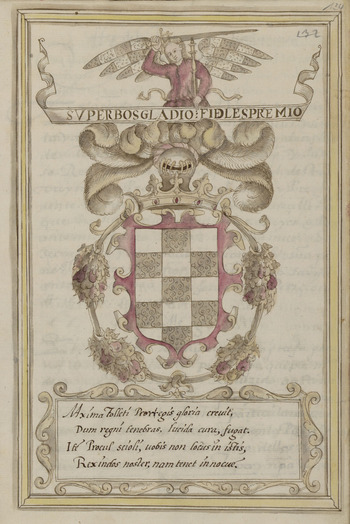
The History opens with a prologue dedicated to King Philip II that praises his virtue and generosity, illustrated with two hand-drawn coats of arms. The first is of Castile and León and the second is of Philip II.Footnote 9 A third coat of arms, also hand-drawn, corresponds to Toledo's family and precedes the second part of the chronicle, called Fe de probanza y verificación. (The probanza, in the colonial period, was a legal document that accredited the veracity of a fact or testimony.)Footnote 10 Through this legal document, the noble descendants of the Inca governors who ruled the Inca Empire before the Spanish arrived, called royal aillus, approved the version of the Inca past as construed by Sarmiento, wherein their ancestors were described as cruel tyrants. This apparent contradiction can be understood in light of the climate of coercion and distrust that prevailed in Cusco in 1572.
Toledo's animosity towards the colonial Incas is not-so-subtly stated in the motto displayed on his coat of arms in the manuscript: “For the arrogant, the sword, for the loyal, reward.” The motto also depicts Toledo as the light amid the shadows, as a warrior defending the generous intentions of Philip II, who embraces Indians: “The great glory of Viceroy Toledo has grown, while his brilliant care puts to flight the kingdom's shadows. Depart far away, pseudo-intellectuals; there is no place for such as you here! For our king rules Indians gently” (see Figure 1).Footnote 11
Coat of arms of viceroy Francisco de Toledo
Source: Pedro Sarmiento de Gamboa, History of the Incas, Georg-August-Universität Göttingen, 2° Cod. Ms. hist. 809 Cim, II, 134.

The year 1572 was a hard one, not only for Inca elites but also for Viceroy Toledo, who was dealing with many problems at once. An Inca-corsair alliance was an ever present threat, as Sarmiento warned Philip II in a letter.Footnote 12 At the same time, the Chiriguano and Mapuche wars permanently reduced the viceregal reserves. At the core of the viceroyalty's political jurisdiction, Toledo tried to strengthen his position amid the criticism of his opponents in the audiencias, the main courts of justice in the Spanish administration.Footnote 13 Oidores (judges) comprised the audiencias, and part of Toledo's task was overseeing their work. Due to the nature of the job and the controversies surrounding it, Toledo and Philip II had agreed in 1568 in Aranjuez, prior to the viceroy's arrival in Peru, to an alternative channel of communication, in order to avoid the usual channel, which was through the audiencias. If there was confidential information to be exchanged about the viceregal government, Toledo could trust his personal secretary or another reliable person with it.Footnote 14 More than once, this key person was Gerónimo de Pacheco, his nephew and servant of utmost trust.Footnote 15
Toledo sent the manuscript of the History to Madrid in one of these private dispatches, in March of 1572, although the confidential information entrusted to Pacheco on that occasion was not ostensibly related to Sarmiento's account but to the performance of some judges from the Lima audiencia. Among other judges, Toledo recommended that the king evaluate the performance of the licenciado Altamirano, who was accused of bribery in a murder case.Footnote 16 The dispatch also involved confidential information that Pacheco was to communicate personally to the Council of the Indies. Further, it included the so-called paños, a set of four canvases painted with the genealogy of the Incas, many letters written by the viceroy to the king, and reports or informaciones about the present and past administration of some provinces.
Toledo introduced Sarmiento's manuscript and the paños with a brief letter. In it, he told Philip II that the paños were made by indigenous painters who were not as skilled as those from Spain “por la flema y poca pesadumbre de su naturaleza” (because of the phlegm and little sorrow of their nature).” He offered to send some of the painters to Aranjuez, El Bosque, y El Pardo, stressing how little cost and effort would be required to maintain them.Footnote 17
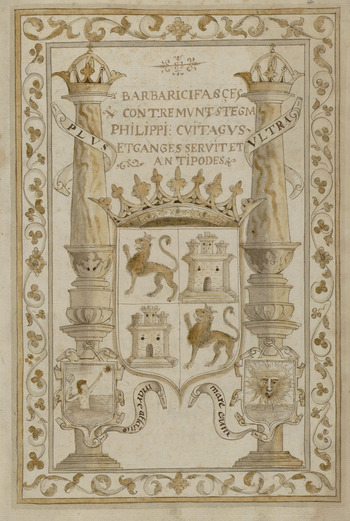
When the manuscript left Cusco, it looked like a file of documents in folio, measuring 20 cm by 29 cm. It consisted of 13 booklets and three loose leaves inserted at the beginning. It is uncertain if the file already contained the coats of arms. Evidence of its Andean origin is an error in the illustration of the coat of arms of Castile and León: the two quarters of the upper part of the escutcheon are inverted, that is, the arms of León occupy the place of Castile and vice versa (see Figure 2).
Coat of arms of Castile and León
Source: Pedro Sarmiento de Gamboa, History of the Incas, Georg-August-Universität Göttingen, 2° Cod. Ms. hist. 809 Cim, II, I.

Inverting quarters from a royal coat of arms was very unlikely among metropolitan painters and engravers, even if the typographic workshops were not obliged to follow the heraldic rules.Footnote 18 On the other hand, the reversal of the quarters in the coat of arms of Castile and León was a very common mistake among Andean painters from Cusco in the sixteenth and seventeenth century. It is present in the painting El encuentro de los españoles con Atawallpa en Cajamarca, a work by an anonymous sixteenth-century painter, now exhibited in the Santo Domingo church in Cusco. The error is also present on the coat of arms carved in stone on the front of the Seminario de San Antonio Abad, currently the Monasterio Hotel, and in the wooden carved coat of arms in the choir of the cathedral, both in Cusco. Moreover, of the nine times that Felipe Guaman Poma de Ayala portrayed the coat of arms of Castile and León in the Nueva corónica, he reversed the quarters eight times.Footnote 19 This viceregal error suggests a possible local elaboration of the manuscript's coats of arms.
Nevertheless, the origin of Sarmiento's coats of arms remains an open question. The motto in the coat of arms of Castile and León, also present in the coat of arms of Philip II, foresees the dynastic union of Portugal and Spain under the Habsburgs, an event that happened in 1580, eight years after the making of the History: “The barbarian's fasces (as emblems of power) tremble before the crown of Philip, whom the Tagus, the Ganges and the Antipodes serve.”Footnote 20 (see figure 3). Even if the conception of a wider Christian dominion that extended from the Ganges to Chile appeared in the Araucana by Alonso de Ercilla (1578), the mention of the Ganges leaves the door open to a later intervention in the manuscript, made after 1580.Footnote 21
Coat of arms of Philip II
Source: Pedro Sarmiento de Gamboa, History of the Incas, Georg-August-Universität Göttingen, 2° Cod. Ms. hist. 809 Cim, II, IIIv.

On to Madrid
The Council of the Indies acknowledged the receipt of Toledo's documents one year later, in February 1573, and commanded him to keep some of them “secret to the memorial,” maybe due to their confidential nature.Footnote 22 Once the council received the set of documents and the paños carried by Pacheco, its various pieces took different directions. We know, for example, that the paños became part of the collection of the Casa del Tesoro del Palacio Real.Footnote 23 In the dispatch letter, Toledo recommended printing Sarmiento's manuscript of the History to refute “other books of lies and false accounts” that had deceived not only Spain but also other nations.Footnote 24 His criticisms were addressed to authors such as Bartolomé de Las Casas and Diego Fernández de la Palencia, who were very likely the “pseudo-intellectuals” ordered to depart in the motto of his coat of arms. The History of Peru written by Fernández de la Palencia was on the viceroy's mind, as it had been published in Seville in 1571. For Toledo, its account of the Inca's genealogy assaulted “many of the rights that your majesty has in these kingdoms,” in its favoring of the tyranny of the Incas.
The viceroy's insistence on the illegitimacy of the Inca rulers appears to be more a personal concern than an affair of state. In fact, the printing of Fernández de la Palencia's history in Spain had been controversial, but for different reasons. The dispute had nothing to do with the Incas, but rather with the ambiguous behavior of some conquistadors in the Spanish civil wars. Fernández obtained the license to publish his book in Madrid at almost the same time that Hernando de Santillán, oidor of the audiencia of Lima, asked the council to ban it, because it contained “many things that are contrary to what happened.”Footnote 25 Sarmiento's manuscript arrived in Madrid at the wrong moment, amid a polemic that discouraged any printing project about the history of Peru.
The disagreement between Fernández de la Palencia and Santillán fell into the hands of Juan López de Velasco, the newly chosen official cosmographer of Philip II. López de Velasco considered his appointment as a temporary position rather than a profession, a brief stage in his career as a bureaucrat.Footnote 26 He resolved the disagreement by prohibiting future publications of Fernández's book and withdrawing existing copies from circulation.Footnote 27 Nevertheless, it was too late, as the book had already circulated widely in Peru. In fact, Guaman Poma mentions Diego Fernández de la Palencia's work in his Nueva corónica, which was completed around 1615.Footnote 28
But López de Velasco's actual duties had more to do with centralizing information about the Indies than with solving conquistadors’ conflicts. According to the Ordenanzas del Estado de las Indias promulgated in 1571, one of his tasks was to write a general history of the Indies, based on information previously sent by viceregal scribes. According to the ordinance, the council would decide which information would be suitable, or not, for the public domain.Footnote 29 A brief statement, just one line, added that the banned documentation would be stored in the “secret archive” that the cosmographer was required to oversee.Footnote 30
The destiny of Sarmiento's manuscript, would have been that secret archive, except for the fact that organizing such an archive was far beyond López de Velasco's intentions, as was the history of the Indies that he never wrote. More than a hundred years after the ordenanzas of Ovando, in 1709, the council ordered an examination of the secret archive. The commissioners José Llorente and Diego Fernández found only two cupboards and three drawers containing drafts and some random papers. As another commissioner said later, the secret archive existed in name only. The documents about Mexico and Peru remained scattered among the secretarías, or departments, of the Council.Footnote 31 The implementation of Ovando's ordinances was an ambitious enterprise, and many details, such as the secret archive, fell into an administrative ‘no man's land.’
It is possible that Sarmiento's History found a safe place in the labyrinths of the council archives, becoming one archived item among others, in a huge and scattered institutional collection. The Spanish monarchy under Philip II had to exchange official information with 12 audiencias, 35 provinces, and 41 archbishoprics.Footnote 32 Hundreds of documents piled up on the desks of the council members annually. Problems in communication between different institutions of the Spanish administration were an obstacle to the centralization of the information of such a huge empire. Toledo, for example, bitterly complained that after two years as the head of the viceroyalty, and having sent many reports, letters, and other confidential information to the council and the king, he never received an answer. Even though in 1568 he had acquired general instructions for governing Peru, in the famous Junta Magna, four years later, in 1572, he was ruling Peru blindly, “not having seen a word of Your Highness.”Footnote 33
The Council of the Indies was not the well-organized institution that Toledo's will demanded. Following Tamar Herzog, Kathryn Burns rightly points out that “early modern monarchies were far less centralized than they might appear . . . The state not only couldn't oversee all instances; it never tried to.”Footnote 34
Devoid of its former political value and far from the polemics surrounding the legitimacy of the Incas, the manuscript probably slept on a Madrilenian shelf for a long time, and eventually its trace vanished completely. It is not inventoried in any library catalog related to colonial manuscripts in the sixteenth or seventeenth century. It does not appear among the records of the selected library of Conde Duque de Olivares (1627), which did have a manuscript of the Historia verdadera de la conquista de la Nueva España by Bernal Díaz del Castillo.Footnote 35 Nor does it appear in the Epítome de la biblioteca oriental y occidental, náutica y geográfica by Antonio de León Pinelo (1629), the main compilation of manuscripts and printed books from the Indies, which records a manuscript of the Suma y narración de los incas by Juan de Betanzos.Footnote 36 Nor is it in the inventory of the books of Philip IV (1637).Footnote 37 And although the catalog of the books that Philip II sent to El Escorial's library got lost in the nineteenth century, the binding of the History does not have the grill-mark of San Lorenzo, a distinctive characteristic of its collection.Footnote 38
At some point in the late sixteenth or early seventeenth century, Sarmiento's manuscript acquired the appearance of a book. The History and the Probanza were bounded together in a sober plateresque style, in dark-brown-dyed goat leather, and goffered with plant motifs. The front and back covers of the binding were filled with ten sheets from incunabula manuscripts and printed records. A recent research project led by Göttingen State and University Library and Herzog August Library in Wolfenbüttel found the bibliographical reference of these records. The four manuscript sheets correspond to Dominicus de sancto Geminiano: Commentaria in distinctiones decreti and were probably copied in Italy in the fifteenth century. The six printed sheets belong to Bartolus de Saxoferrato: lectura super secunda parte Infortiati, published in Venice in 1478. Even if the material in both cases originated in Italy, the manuscript was likely bound in Spain.Footnote 39 Salamanca, Alcalá de Henares, Medina del Campo, and Valladolid were famous in the sixteenth century for their bookbinding workshops. In addition, El Escorial's library in Madrid had, until 1600, its own bookbinder, Pedro Del Bosque.Footnote 40
Emerging from Hiding in Leiden
After being lost for almost 200 years, the History reappeared in 1785, during the auction of the library of Abraham Gronovius in Leiden. In the eighteenth century, Leiden was the bustling center of the European book trade, with a well-regulated industry of booksellers, auction houses, and printing agents. Between 1711 and 1805, approximately 2,040 public book auctions took place in Leiden—an average of 20 or 21 per year, that is one or two auctions each month.Footnote 41
Leiden's vigorous book industry in the seventeenth century benefited from the rebellion of the Protestant Low Countries against Philip II of Spain; a number of refugee printers came to Leiden from Antwerp, the printing capital of the Low Countries, before the Dutch Revolt.Footnote 42 The vibrant book culture also benefited from the creation of Leiden University, the first university of the young Dutch Republic, and its library, which was the first institutional library in Europe to have a printed catalog of its records, the Nomenclator. In the seventeenth century, the French scholar Joseph Scaliger bequeathed his private collection of manuscripts and books on the Orient to the university, an important factor in the library's rise to prominence.Footnote 43
Abraham Gronovius, the owner of the History, was librarian of the Leiden University library from 1741 to 1775. He held a doctorate in law, but his scholarly interest lay in classical philology, especially in Latin, Greek, and Syriac manuscripts. The Gronovius family was a dynasty, with links to the university library going back to Johannes Fredericus, Abraham's grandfather, who was a professor of Greek and history and, later, the university's librarian. Jacobo Gronovius, Abraham's father and also a professor of Greek and history, had worked very closely with the library in the acquisition of the books and manuscripts of the famous Dutch scholar Isaac Vossius after his death. The three generations of the Gronovius family edited many Greco-Latin classics, a task that involved comparing different manuscripts of the same work and studying texts as a basis for “reconstructing antique sources as faithfully as possible.”Footnote 44
The bookseller Haak Et Socios was responsible for the auction of the Abraham Gronovius library. The company organized two auctions, one in 1776, a year after his death, and another in 1785.Footnote 45 Following on an ordinance of the municipal authorities, they printed the library's inventories, which circulated widely among the bibliophile networks in Northern Europe.Footnote 46 Between them, the two catalogs included around 5,780 items.Footnote 47 Due to the sheer number of books and manuscripts, the auctions lasted six and five days respectively. The 1776 auction included only printed books of the recently deceased Abraham, while the other, from 1785, offered manuscripts and printed records that Abraham had inherited from his father Jacobo and his grandfather Johannes Fredericus, alongside unpublished correspondence and philological notes by the Gronovius family.Footnote 48
Since Sarmiento's History belonged to the bibliographic heritage of the Gronovius family, it was auctioned in the first batch of the second auction as part of the catalog of codex manuscripts in folio.Footnote 49 It was the only manuscript in Spanish, and the only item related to America in the whole collection. Of the almost 6,000 items registered in the two catalogs, there were only six books written in Spanish, and one in French related to Spain, plus three books in Dutch about the Spanish language.Footnote 50 Sarmiento's History in Abraham Gronovius library was, without a doubt, in no way expected. It was an amazing find among thousands of other possibilities.
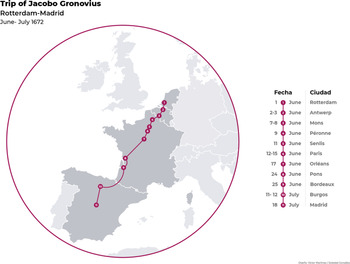
Even though the three generations of the Gronovius family had traveled extensively, it was Jacobo, Abraham's father, who had traveled the most, and was, furthermore, the only one who had visited Spain. Moreover, he was in the Spanish court in 1672. This year is known in the history of the Dutch Republic as rampjaar or “the year of disaster,” due to the political instability, frequent revolts, and wars with France and England, and with Munster and Cologne. The General States of the Dutch Republic sent Adrian Paets, a skilled ambassador, to negotiate with Spain. Jacobo Gronovius was one of Paets's best friends and also part of his diplomatic retinue. Gronovius recorded the experience briefly, in a little notebook that now belongs to the special collections of the Leiden University library.Footnote 51
As part of an official mission, Jacobo attended meetings with the highest authorities of the Spanish court, such as Gaspar de Bracamonte Guzmán and Pascual de Aragón-Córdoba, both among the regents who attended to Queen Maria of Austria while King Carlos II was a minor. They also met with the king and queen, the main purpose of their trip, in October of 1672 in Aranjuez.Footnote 52
However, Jacobo's interests did not lie in politics, but in the acquisition of new manuscripts. Although he did not document in his notebook the items he acquired during the trip, he did visit a select circle of bibliophiles and philologists along the road between Rotterdam and Madrid. He visited the library of the cathedral of Antwerp, where he met Daniel Papebroch, a leading Jesuit hagiographer. While in Mons, he met with Governor Gaspar de Haro and Fernández, famous for his vast collection of antiquities (see figure 4).
Trip of Jacobo Gronovius, Rotterdam-Madrid, June-July 1672, Visualization by Víctor Martínez
Source: Jacobus Gronovius, Dagverhaal eener Reis naar Spanje en Italien, 1672 en 1673. Leiden University Library, Special Collections, LTK 859-1.

In Paris, Jacobo's friend, Melchisédech Thévenot, took him to the huge library of the recently deceased Pierre Séguier, chancellor of France. Thévenot was a famous traveler, inventor, and physicist, and later became royal librarian under King Louis XIV of France. In Paris, Jacobo also met the philologist and numismatist Nicolas Toinard, who showed him a catalog of the El Escorial library, and Henri de Valois, editor of the Greek authors Polibio, Diodoro, and Eusebio. While in Burgos, he visited the library of the monastery of Santo Domingo de los Silos. Jacobo's bibliophile interests led him to extend his trip to Italy, where he spent a long period with his friend Antonio Magliabecchi, librarian of Leopoldo de Medici, to whom the Aztec codex owes its name.
It is hard to know exactly the value of the History of the Incas for the Gronovius family. Maybe the name on the cover caught Jacobo's attention, because of the similarity with the Historia indica of Flavio Arriano, a text that he later published in 1704, alongside the Expeditionis Alexandri. Or perhaps Jacobo was curious about the first part of the History, wherein Sarmiento expounds on the origin of the inhabitants of the Indies, following Ptolemy and Plato. The manuscript could have been a gift for Paets’ embassy in Madrid. Neither can we dismiss the possibility that the History arrived in the Gronovius family library by way of one of their many bibliophile connections, as they kept a continuous exchange of correspondence with prominent scholars from all over Europe. The truth is that neither Jacobo nor any other member of his family had a particular interest in Spanish manuscripts or books, and even less in American items. The Leiden University library also did not pay special attention to Spanish America as a field of study. The New World was not an alternative for philologists in quest of old Mediterranean writing sources.
Throughout its stay in Leiden, the History was bound in a red silk sleeve that hid the damage of the old leather cover, which had been exposed to humidity and bookworms, none of which affected the manuscript itself.Footnote 53 Far from receving the attention paid to the polemics about Spanish legitimacy in Peru or the institutional collection of the Council of the Indies’ archive, Sarmiento's manuscript went unnoticed among 6,000 records of Greco-Roman tradition until someone set his eyes on it. His name was Christian Gottlob Heyne, and he was the director of the Göttingen University library.
Göttingen: The Early Years
After the sale of Abraham Gronovius's library, the auctioned items were scattered across different institutions, mainly European university libraries. Leiden University acquired a major part of the collection, while other items ended up at the Debrecen Reformed Theological University and the Ludwig Maximilian University of Munich.Footnote 54 The Göttingen University library acquired Sarmiento's manuscript. Compared to Leiden University's library, the Göttingen University library was a young institution. King George II of Great Britain and Ireland, also duke of Brunswick-Lüneburg, founded it in 1734. The library experienced a vertiginous growth during its first 70 years of existence, thanks to the generous financial support of the Electorate of Hanover. By 1800, the library collection had reached around 133,200 volumes.Footnote 55
Christian Gottlob Heyne was the librarian behind the successful development of Göttingen University library, where he applied his previous experience in building private collections. He was also deeply knowledgeable of the history of the ancient world and deeply skilled in the study of old objects, shaping the horizon for the creation of archaeology as a university-based discipline, from within the philology faculty.Footnote 56 Books, like objects, were evidence from the past—antiques. Heyne's main objective was to convert the Göttingen library into a universal library, in which would be gathered manuscripts and books from all disciplines, eras, and nations. His acquisition policy did not include compilations or reissues, but only sources that contributed, through corrections, improvements, or extensions to “the progress of scientific culture.” To accomplish this, Heyne worked with a network of contacts in the book trade throughout Europe, exploiting the privileged diplomatic channels of the university to acquire items.Footnote 57 He personally carried out the entire process to purchase the History of Sarmiento, starting from its selection.
The copy of Abraham Gronovius's auction catalog in the Göttingen library has pencil marks next to 21 items, on the outer margins of the sheets.Footnote 58 These manuscripts likely correspond to Heyne's personal selections from the Gronovius catalog. Of these items, 11 were bought at the auction, including Sarmiento's manuscript. The History of the Incas was a cheap acquisition compared to other items, priced at just 1,20 guilders, approximately equivalent to current USD$14. The most expensive item bought by the library was a set of manuscripts from the fourteenth century, acquired for nearly six times that amount (see table 1).Footnote 59
Titles and prices of the books and manuscripts purchased from Abraham Gronovius' library by Göttingen University library

Source: Göttingen State and University Library, SUB Göttingen, Bibl.-Arch. A 20 c (1785).
Heyne's network in Leiden included the librarian Koenig, who bought the History of the Incas and the other ten manuscripts, and Laurent van Santen, a specialist in Greek and Latin poetry who was affiliated with Leiden University and who acted as the guarantor for the purchase. The professional relation between Koenig and Van Santen was complicated. In a letter to Heyne in December of 1786, more than a year after the auction, Van Santen complained about Koenig's dishonest behavior, as he had had to cover the costs of purchase for the Gronovius manuscripts and other deals.Footnote 60
The Gronovius auction placed the History of the Incas in the spotlight for a heterogeneous network of book traders, librarians, and international bankers. It acquired a price and became a commodity in a speculative and autonomous process that was totally divorced from its former political value. Moreover, the manuscript was transformed into a special class of commodity—a luxury good, an antique—that made its economic value subject to special attributes: restricted circulation, complexity of acquisition, and specialized knowledge for its appropriate consumption.Footnote 61 The History's price was the result of an equation that factored in both Heyne's desire for a universal library and the demands of a well-established market of book dealers. In this market, the value of the History of the Incas was almost equal to that of the Micrologus, a treatise on medieval music from the eleventh century, or a lexicon of Arab geography from the twelfth century.
During Heyne's administration, the Göttingen library acquired well above 2,000 volumes per year, which is the equivalent of five books or manuscripts per day.Footnote 62 Partly due to this compulsive acquisition policy, a large number of these items were not catalogued until the end of the nineteenth century. Therefore, it took another hundred years for someone to find Sarmiento's manuscript again.
Göttingen: Waking after 100 Years
Toward the end of the nineteenth century, the interest in Latin American antiquities gained traction among European scholars. Following on independence, national elites aimed to build a postcolonial history unattached to Spanish influence, a task nonetheless entrusted mainly to foreign explorers and adventurers.Footnote 63 Andean chronicles had a key role in the reconstruction of a Peruvian past. Latin Americanist scholars knew about the existence of the History of the Incas, but not its whereabouts. Toledo and Sarmiento mentioned it in letters and other documents that scholars were aware of.Footnote 64 However, expectations of finding the manuscript were not high—Marcos Jiménez de la Espada, the Spanish explorer who worked extensively in Peru, considered it “definitely lost.”Footnote 65 Sarmiento's manuscript was thus a missing, desired, and long-hoped-for treasure from the Andean past. Neither Jiménez de la Espada nor any other Americanist was familiar with the Abraham Gronovius auction catalog, which was targeted to a restricted audience of North European book dealers. Things changed, however, in October 1889, due to circumstances completely alien to the frustrated desires of Latin Americanist scholars.
At the end of the nineteenth century, Göttingen was part of the Kingdom of Prussia, under the rule of Otto von Bismarck. The Ministry of Spiritual, Educational, and Medical Affairs encouraged the study of the kingdom's past through the elaboration and publication of a catalogue of all the manuscripts in the Prussian libraries. This task was entrusted to Wilhelm Meyer, professor of Latin philology at Göttingen University. Meyer had acquired vast experience in manuscripts and libraries in his previous position as librarian and director of the manuscript department of the Munich State Library.
In October, 1889, the head of the ministry exempted Meyer from his academic obligations to allow him to complete the task of cataloguing as a full-time job. The ministry paid him a remuneration for the new assignment, as well as providing money for travel to Prussian libraries, even though the university still had to pay his salary as a professor and an allowance for rent. Meyer, starting his new job cataloguing the manuscripts of the Göttingen library, ran into Heyne's legacy and, correspondingly, into the History of the Incas. Footnote 66
Meyer was probably the first reader of the History in centuries, as the manuscript bears no evidence of any intensive leaf-through. After its discovery in 1893, Meyer published an article in German communicating his finding to the scientific world. The article reveals Meyer's deep and broad knowledge of Andean past through extensive readings of Inca Garcilaso de la Vega, Pedro Cieza de León, and Cristóbal de Molina, and books on the pre-Columbian history of America such as Narrative and Critical History of America, edited by Justin Winsor, librarian of Harvard University. Meyer also became familiar with Pedro Sarmiento de Gamboa's biography, mainly in regard to his voyage to the Solomon Islands.Footnote 67 Later in the same year (1893), Juan Facundo Riaño published an article in the Bulletin of the Royal Academy of History, announcing in Spanish Meyer's discovery of the manuscript.Footnote 68Around the time that Meyer published the article on Sarmiento's manuscripts, ministry authorities began to suspect that he would not finish the cataloguing assignment. After four and half years, he was still working on the Göttingen manuscripts. The authorities established new conditions for Meyer's work, but he did not accept the deal and quit the job, earning the animosity of some colleagues. He never finished cataloguing the manuscripts in Prussian libraries. The next year, 1894, he returned to the university, this time as professor of Medieval Latin poetry, and over time published works on Venantius Fortunatus, a Merovingian poet, and on the thirteenth-century Codex Buranus. Footnote 69
The Incas were a pitstop on Meyer's road, probably just one of the reasons for his delay in cataloguing Prussian manuscripts. Nevertheless, the pre-Columbian past was far from Meyer's main interests. In a letter to Gustav Roethe in May 1907, Meyer complained about the displacement of Humanism by an “extreme Americanism” in scholarly institutions, hoping that someday Latin Medieval poetry could take the place that it deserved in the “European soul.”Footnote 70
After its discovery, Sarmiento's manuscript was bound for the second time in its life, acquiring the modern appearance of Göttingen library manuscript collections.
Göttingen: The Story Continues
When Meyer returned to teach Latin at the university, the History of the Incas caught the attention of another prominent scholar, Richard Pietschmann, chief librarian of the Göttingen library since 1894 and professor of Egyptology and Oriental History at the university. Pietschmann's early research focused on Hermetic tradition and on the Phoenicians, but the History marked a milestone in his life.Footnote 71
Pietschmann's fascination was such that after encountering Sarmiento's manuscript, he forever abandoned orientalism and spent 13 years studying and editing the History. His archive at the Göttingen library evidences how he improved his Spanish and deepened his knowledge of Andean chronicles and the history of Peru, reading authors such as Ernst Middendorf, Johann Jakob von Tschudi, and Max Uhle. Pietschmann developed the critical apparatus for the edition of the manuscript, and classified the information by using keywords, modernizing old words, and creating indexes.Footnote 72 Finally, the History saw the light, for the first time, in 1906. Despite Meyer's resistance, the director of the Göttingen library had also converted to “Americanism”.
Pietschmann's Andean turn was to remain with him. Soon after finishing the editing of Sarmiento's manuscript, he began work on the Relación del camino e viaje que Diego Rodríguez hizo desde la ciudad del Cuzco a la tierra de guerra de Mango Inca, which he published in 1910. While still occupied with this work, he traveled in 1908 to Copenhagen and in his review of the catalogues of the Royal Library, he discovered the Nueva corónica y buen gobierno by Felipe Guaman Poma de Ayala. Guaman Poma marked another milestone in Pietschmann's career. He learned Quechua and Aymara directly from colonial dictionaries, translating paragraphs from the Relación de antigüedades de este reino del Pirú by Juan de Santa Cruz Pachacuti Yamqui.Footnote 73 He developed a special interest in the Inca calendar, integrating in his analysis a famous archaeological piece known at that time as “the Golden Breastplate.”Footnote 74 Pietschmann died in 1923, without finishing the editing of Guaman Poma's manuscript.
The publication of the History of the Incas launched Sarmiento's manuscript into the limelight. Pietschmann himself spread the news among his librarian colleagues, such as Gualberto López-Valdemoro de Quesada, director of the Royal Library of Spain.Footnote 75 Clements Markham produced the first translation in English for the Hakluyt Society just one year after Pietschmann's edition, in 1907. Hans Steffen, a German geographer who worked for the Chilean government, soon published a complete review of the History in the Anales de la Universidad de Chile. Footnote 76 The History of the Incas was finally available not only for a Spanish audience, but also for an English one, after 300 hundred years of a largely clandestine wandering life.
Pietschmann recognized in Sarmiento's manuscript a potential that his Latinist colleagues had previously ignored. Unlike his forerunners, his curiosity went beyond the scope of the Mediterranean world. As the Phoenicians or the Egyptians, the Incas represented for Pietschmann—and for American and European explorers of the early twentieth century— an open gate to the past, a civilization not completely revealed. The discovery of the History of the Incas was not an isolated event in the interest surrounding Andean history. Five years after its publication, Hiram Bingham III arrived at the ruins of Machu Picchu, his expedition supported by Yale University.
Pietschmann's edition of the History reopened the debate about the Inca tyranny and Toledan bias found in the chronicle, this time under the parameters of a positivist historiography. Most of the arguments centered on the veracity of Sarmiento's account and, accordingly, the authenticity of his oral sources. Thanks to its publication in Göttingen, the political value that Toledo and Sarmiento assigned to the History in the sixteenth century was finally a major one, not in the Spanish Royal Court, but in the emerging field of Andean studies.
Epilogue
In this research note, we delved into the long journey of Sarmiento's manuscript, from its departure from Cusco through its arrival and eventual resurrection in Göttingen, exploring how its value changed over time and place. In Cusco, Viceroy Toledo conceived the History as a political device, aimed at proving the illegitimacy of the Inca rulers in the Andes. Nevertheless, the key role of the History for the Peruvian viceroy was not the same for metropolitan authorities, who were concerned more with the polemics of the present than with the controversies of the past. Avoiding lawsuits by dishonored conquistadores was a priority for the Council of the Indies, and books like Sarmiento's were effective in transmitting uncertain news about some of their behavior in the civil wars of Spanish America.
In Madrid, Sarmiento's manuscript began a new life as a regular item in the Council of the Indies’ archive. Its unique value vanished among the thousands of documents stored in the secretary's offices or the secret archive (if it really existed beyond the 1571 Ordenanza). At an undetermined point in its trajectory, the History traveled from the administrative shelves of Madrid to a Dutch private library in Leiden, where it became an odd piece in the inventory, among Greek and Latin classics. The Gronovius family placed Sarmiento's manuscript in the hotspot of the European book trade, paving the way for it to acquire an economic value.
In Leiden, auction catalogs played the role of a showcase, displaying an offer of sale. In the catalogue of the Gronovius family library, elaborated by a commercial company, the History experienced the first phase of its commodification process, placed into the category of “manuscripts in folio.” It was a good, awaiting a buyer. The Göttingen library contributed to a second movement of the manuscript and its commodification by offering a price for it. The speculative procedure had nothing to do with the Inca governors, the Andean past, or Philip II, but rather with the interests of book dealers, international bankers, and institutional libraries. For the Göttingen library, Sarmiento's manuscript represented an antique to be fit into the past, a piece in the unfinished puzzle of human civilization.
With a few exceptions, the afterlife of most Andean manuscripts remains unexplored. One of these exceptions is the road taken by the Nueva coronica manuscript, which arrived at the Royal Library of Denmark, probably through Cornelius Lerche, Danish ambassador in Spain in the seventeenth century.Footnote 77 Another exception is the hazardous journey of the Wellington manuscript of the Historia General del Piru by Martín de Murúa, taken as booty from the Royal Library of Spain by José Bonaparte during the French occupation at the beginning of the nineteenth century.Footnote 78 But what about the only manuscript of De las costumbres y conversión de los Indios del Perú by Bartolomé Álvarez? Or the Mallorca manuscript of the Suma y narración de los Incas by Juan de Betanzos? What do we know about their multiple lives, besides the library catalogue statement?
Did these manuscripts, as the History of the Incas, have an afterlife beyond their Andean origins?