Introduction
Effects of bicameralism on government formation have attracted scholarly attention since Lijphart’s (Reference Lijphart1984) seminal contribution. Thereafter, a number of authors attempted to incorporate bicameralism into formal models of coalition government formation (Diermeier et al., Reference Diermeier, Eraslan and Merlo2007). Empirical research has highlighted that bicameral parliaments may indeed influence fundamental aspects of the process of government formation − such as the type of coalition that eventually forms, the number of attempts needed to reach an agreement, the decision to write a formal coalition agreement − as well as government duration (Druckman and Thies, Reference Druckman and Thies2002; Druckman et al., Reference Druckman, Martin and Thies2005; Eppner and Ganghof, Reference Eppner and Ganghof2015, Reference Eppner and Ganghof2017; De Winter and Dumont, Reference De Winter, Dumont, Strøm, Müller and Bergman2008).
Following Lijphart, most scholars have characterized bicameral legislatures in terms of two dimensions: congruence and symmetry. Congruence refers to the extent to which the two chambers have similar composition; symmetry occurs when the two chambers have equal or near equal constitutional prerogatives. Such dimensions have been widely used for comparative purposes in order to gauge the strength of bicameralism. The literature on the effects of bicameralism on government formation has mainly focused on the symmetry dimension, by looking at the constitutional powers of the two chambers. We contend that to fully explore the impact of bicameral legislatures on the process of government formation, we should also take into account their variation in terms of congruence. Congruence has been commonly interpreted in terms of the similarity of the two houses’ political composition. Based on the veto player approach, Tsebelis and Money (Reference Tsebelis and Money1997) and Tsebelis (Reference Tsebelis2002) argued that the two chambers can be considered as incongruent if and only if the partisan representation in the two houses is not the same and, only in this particular case, they may be considered as two potentially distinct veto players. In this article, we take the notion of partisan congruence as a starting point to analyze the impact of bicameralism on the process of government formation.
We restrict our attention to a particular feature of this process, that is, the length of negotiations between political parties to form a new government. Bargaining delays are deemed important as they may have substantial political and economic consequences. The literature, however, provides competing accounts of their potential effects. Warwick (Reference Warwick1994) suggested that protracted negotiations imply a high level of attention to the bargaining details and hence a better deal between political parties which, in turn, reduces the risk of government termination. By assuming that the payoffs associated with forming a government evolve during the negotiation process, Merlo (Reference Merlo1997) pointed out that parties may choose to delay it until a better compromise can be reached. The predominant view is that bargaining delays may perturb the ‘normal’ democratic cycle of representation and accountability, as until a new cabinet has been installed, political decisions need to be taken by the outgoing cabinet, whose legitimacy and authority are weak (Martin and Vanberg, Reference Martin and Vanberg2003; Conrad and Golder, Reference Golder2010). Moreover, coalition negotiations take place before an ‘audience’ of voters and other types of party supporters, who will evaluate and sanction parties’ behavior during the bargaining process (Martin and Vanberg, Reference Martin and Vanberg2020).
As protracted negotiations generate uncertainty over the identity of governing parties and the content of policy compromises among them, they may also create ambiguity over the future direction of governments. This feature may affect not only the behavior of political and economic actors inside and outside the country but also undermine the perceived legitimacy of the democratic process (Golder, Reference Golder2010; Martin and Vanberg, Reference Martin and Vanberg2003). In addition, lengthy negotiations indicate deep disagreement among potential coalition partners and hence may signal in advance the internal difficulties a coalition will encounter once formed (Grofman and van Roozendaal, Reference Grofman and van Roozendaal1994; De Winter and Dumont, Reference De Winter, Dumont, Strøm, Müller and Bergman2008). Finally, the uncertainty generated by long and inconclusive bargaining rounds may affect exchange rate markets (Bernhard and Leblang, Reference Bernhard and Leblang2002), stock market volatility (Leblang and Mukherjee, Reference Leblang and Mukherjee2005), and the types of investments in financial markets (Bernhard and Leblang, Reference Bernhard and Leblang2006).Footnote 1
While the empirical literature has examined potential consequences of bargaining delays, research on their determinants is scarce. In particular, despite having long recognized the role of institutional features on the bargaining environment, the effects of bicameralism on the negotiation’s duration have not been explored yet in the literature. This is somehow surprising as bicameralism – like all institutional arrangements devised to implement the separation of powers – is commonly understood as a mechanism that generates delay in policy-making and constraints for the executive. Historically, the constitutional choice of bicameralism has been justified on the basis of a need to improve the quality of legislation and generate more thoughtful political decisions. As far as policy-making is concerned, a second chamber is expected to induce stability in the law-making process. The downside of stability is gridlock – that is, inability to change the status quo policies inherited from previous governments – which is particularly likely to occur when the two branches of parliament diverge in their partisan composition.
In this article, we take a closer look at the varieties of bicameral institutions to examine effects of bicameralism on bargaining delays. We focus on bicameral incongruence as this feature remains under-researched in the literature on coalition bargaining. We maintain that, attempting to anticipate future outcomes, political parties involved in government formation make efforts to include additional partners in the government coalition in order to secure the cabinet’s control of the upper chamber, which can be viewed as an additional veto power. Seen in this perspective, bicameralism may protract the length of negotiations. However, as bicameral conflict on legislation cannot be completely avoided even when the cabinet is supported by the same legislative majority in both chambers (Tsebelis and Money, Reference Tsebelis and Money1997), we contend that the difficulties associated with double deliberation of legislation might lower the payoffs associated to reaching a full-fledged coalition deal at the time of government formation. These incentives should have the opposite effect of reducing the length of negotiations. In this article, we aim at specifying the conditions under which we should expect less or more protracted negotiations over government formation in bicameral systems.
The remainder of this article is organized as follows. In the next section, we review the literature on bicameralism and generate expectations about the relationship between partisan congruence and bargaining duration. In the third section, we test our argument using a dataset that includes information on the partisan composition of second chambers in Western and Eastern Europe. Overall, our data cover 275 formation processes that occurred in 12 bicameral countries over the postwar period. The fourth section presents and discusses our results. We find that incongruence between the two chambers shortens bargaining duration, but only when the powers of the upper house on policy-making are sufficiently strong. This result contrasts with the conventional wisdom that bicameralism introduces an additional element of complexity in the bargaining environment that has the effect of increasing delays. Concluding remarks follow in the final section.
Theory and hypotheses
Bicameral legislatures have been analyzed in terms of two properties: congruence and symmetry. To examine congruence, scholars mainly refer to variations in institutional features such as electoral rules, chambers’ size, requirements for being elected, length of mandate, and simultaneity of elections. It is well known that variations of this kind are intentionally designed with the purpose of implementing constitutional goals such as protection of minorities or fair representation of states in a federal system. In turn, the different composition of the two chambers resulting from the above-mentioned institutional features is meant to accomplish the ultimate purpose that a long tradition in political thought associates with bicameralism, that is to minimize majority tyranny. According to classical justifications of bicameralism, divergent preferences deriving from a different composition of the two chambers are a necessary condition for bicameralism’s effective control of unfettered majorities (Buchanan and Tullock, Reference Buchanan and Tullock1962; Riker, Reference Riker1992).
On the other hand, symmetry has been characterized in terms of the distribution of legislative and non-legislative powers between the two chambers. Legislative powers refer to legislative attribution to the upper chamber in comparison to the lower chamber (for example, extreme asymmetry occurs when the upper chamber can only delay the passing of legislation), origin of bills, mechanisms of dispute resolution, and instruments of legislative control of the executive such as investigation powers. Non-legislative powers are very different in the context of presidential vis-à-vis parliamentary systems. In presidential systems, such powers may refer to the fact that both chambers share the approval of executive appointments or participation in impeachment. In parliamentary systems, non-legislative powers mainly refer to the ‘dual responsibility’ in appointing and dismissing governments (Diermeier et al., Reference Diermeier, Eraslan and Merlo2007). Although the ‘dual responsibility’ is uncommon, two European countries – Italy and Romania – require the governing coalition to maintain the confidence of both chambers of parliament to stay in power. In the past, this was true also in Belgium (until 1995) and Sweden (until 1970).Footnote 2
The literature highlights how bicameralism can affect the process of government formation in several ways, as the upper chamber is likely to be taken into account by both formateur parties and other parties considering cabinet entry. This is especially true in those parliamentary systems where the government has to maintain the confidence of both chambers to stay in office. Hence, building a new government means gathering a coalition of parties that has to be consistent across the two chambers. In most parliamentary systems, however, only the lower house takes part in the confidence relationship with the executive. Even in those cases, bicameralism may shape the key parameters of the cabinet formation game because when negotiating the formation of a new cabinet, the presence of a second chamber can affect party leaders’ expectations about future law-making. This is what Druckman et al. (Reference Druckman, Martin and Thies2005) have called ‘influence without confidence.’ Research linking bicameralism with cabinet formation focused on the type of governments that are likely to form and on government duration. In particular, Lijphart (Reference Lijphart1984, Reference Lijphart, Bakvis and Chandler1987, Reference Lijphart1999) conjectured that cabinet builders tend to form oversized coalitions in order to control strong second chambers (see also Sjölin, Reference Sjölin1993). More recently, it has been found that those government coalitions holding a majority of seats in each chamber are more likely to form (Druckman et al., Reference Druckman, Martin and Thies2005; Eppner and Ganghof, Reference Eppner and Ganghof2017) and have a substantially longer life (Druckman and Thies, Reference Druckman and Thies2002) in comparison to those that do not control the upper chamber. As previously noted, however, this literature has primarily focused on the institutional prerogatives of the two chambers – that is, on the degree of symmetry in the powers of the two houses. Much less attention has been paid to the extent to which the preferences of the two chambers differ due to their different composition – something that can be defined as the degree of bicameral incongruence. Moreover, to the best of our knowledge, nobody has ever taken into account the partisan incongruence of the two chambers, that is, the divergence in the partisan representation in each branch of a bicameral parliament.
Our explanandum here is the variation in the length of negotiations to form a government. In so far as political outcomes are produced by the interaction of institutions and actors’ preferences, we expect bicameralism to have greater impact especially when the second chamber has relevant policy-making powers and, at the same time, divergent preferences (Heller, Reference Heller2007). In other words, bicameralism should affect the political process more deeply – including bargaining over government formation – when the two chambers’ preferences diverge and the constitutional rules assign relevant prerogatives to both of them. In contrast, if the political composition of the upper chamber mirrors the lower chamber’s one, the upper chamber can be seen as a redundant institution (Krehbiel, Reference Krehbiel1996; Binder, Reference Binder2003; Cutrone and McCarty, Reference Cutrone, Mc Carty, Weingast and Wittman2006) which does not add any further element to the bargaining environment. If the upper house has no sufficient leverage to keep the lower house from acting unilaterally, there is not so much need to consider it during cabinet formation.Footnote 3 In particular, provided that the second chamber is powerful enough in the law-making, we expect that the greater the incongruence between the two chambers, the greater will be the impact of bicameralism on the duration of the bargaining process when a new government has to be formed.
The extant literature on cabinet negotiations emphasizes the role of uncertainty and complexity in the bargaining environment to explain delays in the government formation process.Footnote 4 Despite none of the few existing studies dealing with bargaining cycles (Diermeier and van Roozendaal, Reference Diermeier and van Roozendaal1998; Martin and Vanberg, Reference Martin and Vanberg2003; Golder, Reference Golder2010) explicitly investigates the role of upper chambers, at first glance one might conjecture that bargaining over government formation should be facilitated when the composition of the two legislative branches is similar. This expectation rests upon the assumption that, when trying to form a new government, negotiators are interested in building a coalition that can extend its control over the second chamber. If the distribution of seats among parties in the second chamber diverges from that in the first one, the formateur would face a situation made more complex by the potential extension of negotiations to parties that gain leverage in the bargaining process because of their strength in the upper chamber. In short, uncertainty and the complexity of the bargaining environment should lead to longer delays, and partisan incongruence would add further complexity to the bargaining process. However, there are good reasons to hypothesize that bicameral incongruence might mitigate to some extent the effect that second chambers potentially have on the complexity of the bargaining environment. This is because an incongruent second chamber might indeed shorten the time spent in negotiations over a new government due to a smaller set of feasible coalitions and policy agreements.
To start with, the desirability for the negotiators to reach an agreement ensuring the control of an incongruent upper house should ‘double’ all majority considerations that enter the process of coalition formation (Müller et al., Reference Müller, Strøm, Strøm, Müller and Bergman2008, p. 24). In other words, by constraining the options of the negotiators, incongruence should reduce the overall number of viable coalitions in the government formation game (Strøm et al., Reference Strøm, Budge and Laver1994). Maintaining that government builders strive to control both branches of a bicameral parliament, we may assume that they will try to assemble a legislative majority not only in the lower house but also in the upper house. Yet, not all the coalition alternatives that can be formed in the lower chamber would allow the government to control a majority of seats in the upper chamber. Some of them are not acceptable simply because they would grant the government only a minority of votes in the upper chamber.Footnote 5 In this way, an incongruent (and relevant) second chamber can act as an institutional constraint on the game of government formation. Bicameralism should therefore make government formation easier through directing the bargaining process toward a more limited set of ‘focal’ solutions.Footnote 6
While incongruence might decrease the number of viable coalition options – thereby reducing the complexity of the bargaining environment – some of the feasible coalitions could be ideologically diverse and involve many parties. Coalitions’ ideological heterogeneity and fragmentation can of course make it difficult for negotiating parties to strike a compromise deemed acceptable to all the potential government members. However, it should be noted that these characteristics of potential governments depend primarily on the polarization and fragmentation of the entire party system (Golder, Reference Golder2010), which can be controlled for in empirical terms.Footnote 7
Moreover, even though some viable potential coalitions may be heterogeneous and include many parties, this possibility does not necessarily translate into bargaining delays because of another factor – that is, negotiating parties’ expectations about future policy-making. We contend that this is a second reason why bicameral incongruence may be associated with shorter bargaining delays. When negotiating over the formation of a new government, potential coalition partners try to anticipate what will occur during the law-making process once the government has formed. These expectations affect not only the outcomes of the bargaining process such as government membership, type of government, distribution of cabinet posts and agreed-upon coalition government program (Laver and Shepsle, Reference Laver and Shepsle1996; Schofield, Reference Schofield1993; Tsebelis, Reference Tsebelis2002) but also the duration of the negotiations. Looking at the impact of bicameralism on the legislative process, social choice scholars have theorized that bicameral legislatures produce more stable legislative outcomes than unicameral ones, making it harder for a legislative majority (or the government) to overcome the status quo policy. This is because, when legislation is deliberated in two distinct houses, reaching a majority agreement to change the status quo is more difficult and takes longer. Hence, the presence of a second chamber tends to mitigate problems associated with majority cycles, which are particularly likely to occur in a simple majority-rule institution – especially when collective decisions involve more than one policy dimension (Riker, Reference Riker1992; Levmore, Reference Levmore1992). Put in a slightly different way, the set of policy alternatives (i.e., bills) that can beat the status quo (the winset of the status quo) is likely to be smaller in a bicameral parliament than in a unicameral assembly (Tsebelis, Reference Tsebelis2002). These social choice arguments are grounded on the two chambers having a different composition and hence incongruent preferences. On the contrary, if the composition of the two chambers is the same, their preferences overlap; in this event, the risk of majority cycling is not reduced by bicameralism and the second chamber turns out to be ‘absorbed’ by the first one.
As a consequence, the greater the incongruence between the chambers, the greater will be the difficulties for any government (once formed) in the law-making process. This also implies that under great bicameral incongruence, all governments, once formed, will be relatively unstable. Ceteris paribus, incongruent bicameralism decreases government duration because governments with a smaller winset are weaker in the policy-making process and less able to respond to unexpected policy shocks (Tsebelis, Reference Tsebelis2002; Tsebelis and Ha, Reference Tsebelis and Ha2014). To sum-up, when bicameralism is incongruent, potential coalition partners anticipate that, whatever government forms, it will have lower chances to change the status quo and to survive for long.Footnote 8 Under these circumstances, there is no reason why bargaining over the formation of a new (relatively weak and probably unstable) government should take a long time; it is not worth spending a lot of time and resources trying to negotiate a government. Under incongruent bicameralism, the precious time that would be spent in ‘screening out’ potentially unstable governments would be wasted. This argument also resonates with theoretical accounts according to which the type of government formed, the time needed for its formation, and the expected cabinet duration are all endogenous variables and are simultaneously determined in equilibrium (e.g., Diermeier et al., Reference Diermeier, Eraslan and Merlo2007). Partial support for this conjecture derives from observing those situations in which coalition partners subscribe post-electoral coalition agreements. Empirical evidence shows that in bicameral systems, coalition agreements are shorter and consequently less detailed.Footnote 9
Finally, unlike lower chambers, many upper chambers are subject to partial renewal of their members. This can be due to staggered election terms, selection of members of the upper house by local governments, or a longer length of mandate (Fortunato et al., Reference Fortunato, König and Proksch2013). A future change in the composition of the upper chamber may deter coalition builders from spending a long time in negotiating a consistent coalition across chambers at the time when a new government has to be formed. At the time of government formation, an incongruent upper chamber may be the outcome of staggered elections and partial renewal that occurred in the past, and its composition may be prone to change again in the future because of the same mechanisms. In these circumstances, as those parties that are involved in the bargaining process cannot easily anticipate the future composition of the second chamber, they may have few incentives to engage in protracted negotiations.
To sum-up, even though bicameral incongruence may lengthen negotiations through increased complexity, there are a number of reasons to hypothesize the opposite effect. First, bicameral incongruence reduces the number of viable potential coalitions due to the ‘double majority’ constraint. Second, bicameral incongruence may generate the expectation of a gridlocked policy-making process and a potentially unstable government. This may shorten negotiations, as bargaining parties have no incentive to waste time in crafting full-fledged policy agreements (even when there are many coalition builders or they are ideologically diverse). Third, bicameral incongruence may reduce delays when there is a reasonable expectation that the composition of the upper chamber is likely to change at a later stage because of mechanisms such as staggered elections.
We expect these three arguments to hold when the second chamber is strong enough. Therefore, we formulate the following conditional hypothesis on the relationship between bicameral incongruence and the length of the bargaining process over government formation, using the potential influence of the upper chamber on the policy-making process as a moderator:
HYPOTHESIS 1: When the influence of the upper house on policy-making is sufficiently high, the greater is the partisan incongruence between the two chambers, the shorter will be the duration of negotiations over government formation.
In order to properly single out the impact of bicameral incongruence on bargaining delays, we test our hypothesis by including in the empirical analysis a number of indicators of uncertainty and complexity of the bargaining environment that the existing literature has employed to explain the variations observed in the duration of the bargaining process over government formation (see Golder, Reference Golder2010 for a review).
Data and coding
Although scholars have suggested that bicameralism could extend the length of government negotiations, in the previous section we highlighted a series of reasons for expecting the opposite effect. While the first interpretation is predominant, our competing argument has yet to be tested against data on government formation’s duration. Data to test our hypothesis come from the European Representative Democracy Data Archive (ERDDA) (Andersson et al., Reference Andersson, Bergman and Ersson2014) and cover 12 bicameral countries in Western and Eastern Europe. The countries included in our dataset are Austria (1945–2013), Belgium (1946–2010), Czech Republic (1996–2013), France (1962–2012), Germany (1949–2013), Ireland (1944–2011), Italy (1948–2011), Netherlands (1946–2012), Poland (1991–2011), Romania (1990–2012), Spain (1977–2011), and Sweden (1945–1970).Footnote 10 Altogether, these data provide information on 275 government formation processes including government formation’s duration, which is our key dependent variable.Footnote 11 Following the existing literature (Diermeier and van Roozendaal, Reference Diermeier and van Roozendaal1998; Martin and Vanberg, Reference Martin and Vanberg2003; De Winter and Dumont, Reference De Winter, Dumont, Strøm, Müller and Bergman2008; Golder, Reference Golder2010; Ecker and Meyer, Reference Ecker and Meyer2015), formation’s duration is defined as the number of days between the termination of the previous government and the start of the new one. The beginning of the bargaining period coincides either with the day of the formal resignation of the previous government or with the date of the general elections. The formation process ends either the day on which the new government is officially inaugurated by the head of state or the day of the investiture vote (Strøm et al., Reference Strøm, Müller and Bergman2008).
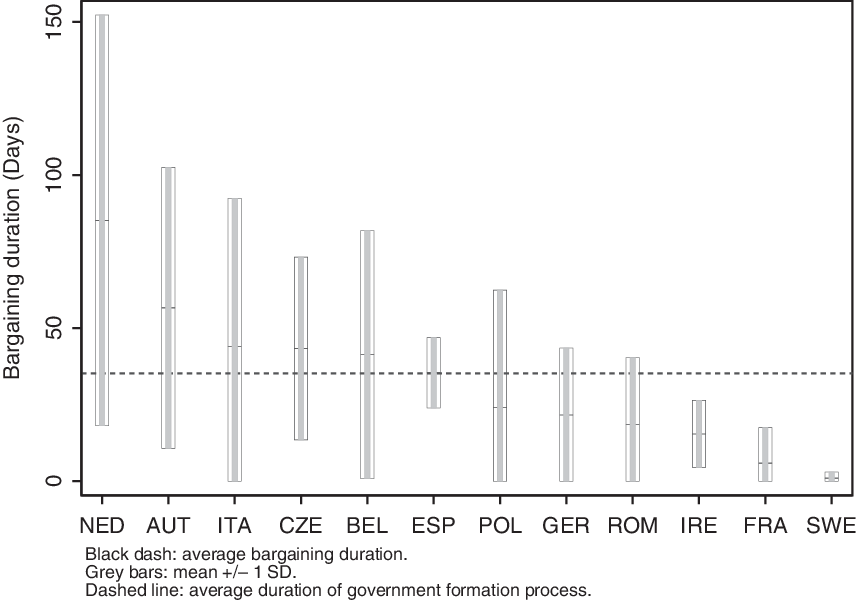
Figure 1 shows the distribution of formation duration across and within the countries included in our dataset. The black dashes represent the average duration of the bargaining process in each country. The gray bars span all over the values between one standard deviation below and one standard deviation above the mean. Finally, the horizontal dashed line indicates the average duration of the government formation process in the 12 bicameral systems selected for our analysis. In general, formation duration is longer in countries with two chambers (35 days) than in those with a unicameral parliament (20 days).Footnote 12 Therefore, these data support the idea that bicameral veto constraints make bargaining somehow more difficult.Footnote 13 However, the impact of bicameralism is not constant across and within the countries included in our analysis. On average, the process of government formation lasts almost 3 months in the Netherlands (86 days), but only a few days in Sweden (1 day) or France (6 days). There is also a considerable variation of formation duration within countries, with the length of the bargaining process spanning through a wide range of values.
The duration of the government formation process across and within 12 bicameral systems.

We argue that the variability observed in the duration of the government formation process in our set of countries is a function of different combinations of the characteristics of bicameral institutions mentioned above. To measure ‘symmetry,’ we rely on the ‘Bicameralism Index’ introduced by Heller and Branduse (Reference Heller, Branduse, Martin, Saalfeld and Strøm2014). The index is intended to capture the formal prerogatives of second chambers to affect the content of legislation and the policy outcomes simply based on their institutional characteristics. This measure considers whether the second chamber can veto all legislation, only a subset of bills, or simply delay passage (reporting for how many days in the latter case). The final score combines this information with an adjustment in case the veto power of the upper chamber can be overridden. We let the index vary from 0 to 100, with 100 indicating a second chamber with formal legislative powers substantially equal to those of the lower house and 0 representing upper houses with a purely ceremonial role. In our sample, the most influential second chambers (a score of 100) can be found in Italy, the Netherlands, Belgium (before 1995), and Sweden (before 1970).Footnote 14 The least influential is the Spanish Senado, with a score of 9.2.
The ‘Bicameralism Index’ captures the ability of second chambers to influence policy independently from partisan concerns. However, when the composition of the upper house mirrors that of the lower one, even the most influential second chamber becomes redundant. For this reason, we include in our model a variable measuring the level of ‘partisan incongruence’ between the two chambers. We measure partisan incongruence using the Duncan Index of Dissimilarity (Duncan and Duncan, Reference Duncan and Duncan1955). Incongruence is defined as follows:  $0.5*\mathop \sum \limits_{i = 1}^n \left| {UpperShar{e_i} - LowerShar{e_i}} \right|$, where UpperShare and LowerShare are the seat share of party i in the upper and lower chamber, respectively (for similar measures, see Heller, Reference Heller2001; Druckman and Thies, Reference Druckman and Thies2002). To compute the index, we completed the ERDDA data with information about the composition of the second chamber when missing.Footnote 15 Our measure ranges from 0 to 100, with 0 indicating that the seat share of each party is the same between the two chambers and 100 representing the hypothetical case when the party systems and seat distributions in the upper and lower houses completely differ.
The existing literature explains the variations observed in the duration of the bargaining process in terms of two main variables: uncertainty and complexity of the bargaining environment. In their seminal work, Diermeier and van Roozendaal (Reference Diermeier and van Roozendaal1998) acknowledged that under the assumption of complete information, rational bargaining is incompatible with delays. Game-theoretical models suggest that in equilibrium, the first proposal is made immediately and it is always accepted by the other negotiators. This prediction sharply contrasts with real-life records which show, as displayed in Figure 1, a wide variation in the length of the formation process within and across countries. However, game theoretical models still constitute a useful tool for the study of bargaining delays provided that the assumption of complete and symmetric information is relaxed. The formation time thus reflects the uncertainty about key parameters in the bargaining environment. In the absence of complete information, a formateur does not know what combination of government policies and ministerial portfolios would constitute a satisfactory offer to other negotiators. Therefore, uncertainty presupposes a higher number of interactions in the form of offers and counter-offers to reveal parties’ preferences, resulting in protracted negotiations. Following previous studies, we capture the impact of uncertainty employing a dummy variable which codes as one the formation processes starting immediately after a general election (‘Post-election Status’).Footnote 16
The strategic foundations of Diermeier and van Roozendaal’s model exclude other potential alternative explanations for bargaining delays. However, even assuming complete information about actors’ preferences, the government formation process becomes more problematic as the complexity of the bargaining environment increases. Martin and Vanberg (Reference Martin and Vanberg2003) identify two main sources of complexity: the ideological range of the government that emerges from negotiations and the number of parties involved in the bargaining process. According to the authors, the ideological diversity of the coalition that will form makes it harder for party leaders to evaluate which kind of proposals should be acceptable or not, while the number of parties that the coalition contains hinders a stable agreement that is good enough for all the coalition members. This brings Martin and Vanberg to conclude that bargaining delays are better explained by complexity rather than by uncertainty. Following Golder (Reference Golder2010), we add to our model two more variables measuring the level of complexity in the bargaining environment: the ‘effective number of parliamentary parties’ (Enpp) and ‘polarization.’Footnote 17 The former is computed using the standard formula proposed by Laakso and Taagepera (Reference Laakso and Taagepera1979). The latter is based on the equation presented in Bergman et al. (Reference Bergman, Gerber, Kastner, Nyblade, Strøm, Müller and Bergman2008, p. 112) and it is estimated starting from parties’ left-right placements provided by the MARPOR Project (Volkens et al., Reference Volkens, Lehmann, Matthieß, Merz, Regel and Werner2016).
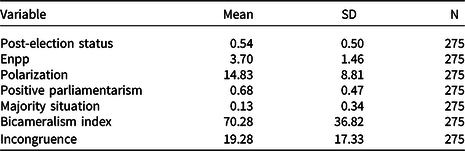
Following previous studies, we also include two control variables. The first one considers whether the formation process is characterized by ‘positive parliamentarism,’ that is, if the government that eventually forms must pass a vote of confidence (in one or both chambers) before taking office. The second one checks for government formation processes that involve a ‘majority situation.’ In these cases, the party controlling an absolute majority of seats can form a government without negotiating with other parties. Our argument is grounded on the assumption that bicameralism introduces an institutional constraint on the government formation process when upper houses can influence policy. As noted above, second chambers do not usually play a direct role in the negotiations for the new cabinet since in most countries, governments only need to retain the confidence of the lower house. For this reason, the existence of a majority party and all the measures associated to the complexity in the bargaining environment are investigated only in relation to the lower chamber.Footnote 18 Table 1 provides information on descriptive statistics for all the variables included in our analysis.
Descriptive statistics for the main independent variables

Analysis and findings
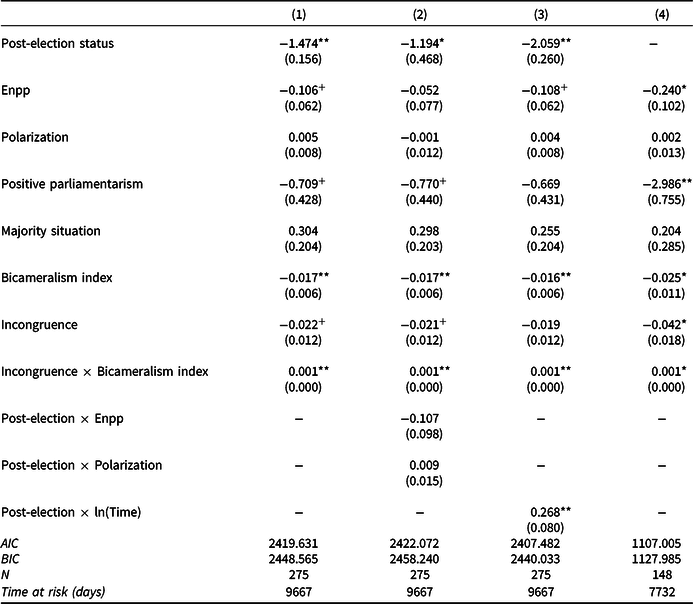
We test our hypothesis using a series of Cox’s partial likelihood survival models. The central concept in survival analysis is the hazard rate h(t) which is the probability that an event occurs at a particular point in time, conditional to the fact that it has not occurred yet. In our analysis, the event of interest is the successful achievement of an agreement between coalition partners to form a government.Footnote 19 The hazard rate has two components. The first is the set of covariates that are hypothesized to systematically affect the timing of an event. The second is the baseline hazard rate, which indicates the underlying probability of the event occurring over time when the vector of all covariates is zero (Box-Steffensmeier and Jones, Reference Box-Steffensmeier and Jones2004). In Table 2 we report the results of the four models we have estimated. In all of them the coefficients are expressed as proportional hazard estimates, with positive and negative values indicating, respectively, an increased or a decreased risk to reach a successful agreement over government formation. Consequently, a positive coefficient means that increases in the variable of interest reduce the duration of the bargaining, while a negative coefficient implies that higher values of the related variable delay government formation. Once exponentiated, the coefficients can be interpreted as hazard ratios. All the models are estimated employing shared frailties to control for unobserved characteristics at the country level (mainly institutional), which may systematically affect the bargaining duration.Footnote 20
Determinants of the duration of the government formation process in 12 bicameral systems

Standard errors in parentheses. The Breslow method is employed for handling ties.
+P < 0.1, *P < 0.05, **P < 0.01.
Model 1 explores the impact of symmetry and congruence in bicameral systems on government’s formation duration, keeping under control the effect of uncertainty and complexity in the bargaining environment. Model 2 aims at testing Golder’s (Reference Golder2010) argument that both uncertainty and complexity matter in the bargaining process, but in a conditional way: while uncertainty always produces delays, complexity should matter especially when uncertainty is sufficiently high.Footnote 21 We include, therefore, interactions between the variable capturing uncertainty and the covariates related to complexity. However, none of these interactions is statistically significant, proving that Golder’s hypothesis does not survive when data include only bicameral systems. In Model 3, we replicate Model 1, accommodating the violation of the proportional hazards assumption for the impact of the ‘Post-election Status.’Footnote 22 The standard solution consists in interacting this variable with the natural log of the time at risk. Finally, in Model 4, we replicate Model 1, excluding inter-electoral governments from the analysis. The bargaining process over the formation of an inter-electoral government may (informally) start well before the official end of the incumbent one. Consequently, researchers cannot be fully confident that their data about bargaining delays are reliable as, in the case of inter-electoral governments, they can systematically underestimate the actual length of negotiations. Moreover, it has been underlined that only a few inter-electoral replacements involve a real change of the political status quo represented by the incumbent cabinet. Most of the time, inter-electoral replacements can be classified as continuity replacements meaning that almost nothing has changed in comparison to the incumbent cabinet (Fernandes and Magalhães, Reference Fernandes and Magalhães2016). For all of these reasons, Model 4 includes only post-election cabinets to check the robustness of our results.
Our hypothesis states that partisan incongruence between the two chambers should shorten bargaining duration when the influence of the upper house on policy-making is sufficiently high. The statistically significant interaction between ‘Incongruence’ and ‘Bicameralism Index’ across all the four models corroborates the existence of a conditional relationship between these variables regardless of the set of observations employed in the analysis (the whole dataset or only post-election cabinets). For the sake of comparison with previous work dealing with bargaining delays, in what follows, we comment on the results from Model 3, which is based on the whole dataset.Footnote 23
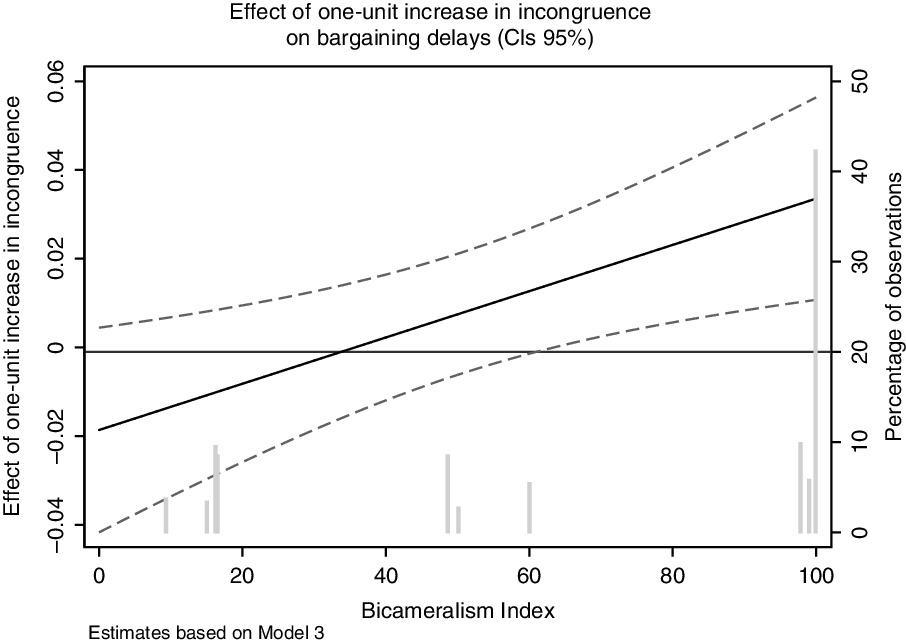
We rely on graphical representation to clarify the interpretation of this relationship (Brambor et al., Reference Brambor, Clark and Golder2006). The black solid line in Figure 2 represents the average marginal effect of one-unit increase in partisan incongruence on formation duration, plotted against each value of the ‘Bicameralism index.’ The dashed lines represent the 95 per cent confidence intervals. When the confidence intervals are both below or above the zero line, the effect is statistically significant. As predicted, incongruence starts to reduce the duration of the bargaining process (i.e., it has a positive marginal effect) when the ‘Bicameralism Index’ is higher than 63. Such a threshold, according to the histogram superimposed on Figure 2, means that our conjecture is valid for about 60 per cent of the government formation processes included in our analysis, which are essentially clustered in six countries: Belgium (before 1995), Germany, Italy, the Netherlands, Sweden (before 1970), and Romania. The latter country represents a good example of how bicameral incongruence may shorten bargaining delays in presence of a strong second chamber. The Romanian Senat has almost the same prerogatives of the lower house but at the same time a very different composition, with an average dissimilarity index of 52 during the 1991–2012 period. On average, the bargaining processes over the formation of the 16 cabinets included in our sample lasted 18 days.
Average marginal effect of partisan incongruence on government duration.

For the remaining 40 per cent of observations, which are grouped in countries having second chambers with weak formal powers, incongruence does not exert any significant impact on formation duration. Substantially, a one-unit increase in partisan incongruence increments the hazard rate to end negotiations over government formation by 3.4 per cent when the ‘Bicameralism Index’ is set to its maximum value (100). Considering that our measure of divergence between the two chambers ranges from 0 to 100, this result indicates that partisan incongruence plays a relevant role in shaping the government formation process. This holds true, however, only in those countries where the upper house has strong veto powers.
According to Model 3, the only other variable included in our model that affects formation duration is the ‘Post-election Status.’ As in previous analyses in the literature, we find that increasing uncertainty – that is, switching from an inter-election phase to a post-election one – significantly extends the length of time a government needs to form. However, the interaction with the time at risk shows that the effect of uncertainty slowly fades away as time elapses. After one day of negotiations, a government forming after an election faces a hazard rate of reaching a successful agreement 20% lower than in the inter-electoral period. After 35 days of negotiations – the average duration observed in our data – the hazard rate is reduced to 16%. These findings are consistent with the interpretation of uncertainty in the bargaining environment as a proxy for incomplete information about key parameters in the negotiations. As time passes, parties acquire information about each other, increasing, therefore, the possibilities of ending the bargaining process and forming the new government. In contrast, the variables related to complexity are not found to have any significant impact. Altogether, these results support the original argument of Diermeier and van Roozendaal (Reference Diermeier and van Roozendaal1998) who identify uncertainty, rather than the complexity of the environment, as the main driver of bargaining delays. On the other hand, our results highlight the impact of partisan incongruence – when coupled with relevant institutional veto powers of upper chambers – on the process of government formation.
Conclusion
In recent years, there has been a surge of attention for the implications of bicameralism on the process of coalition governments’ formation. This article focused on the impact of bicameral incongruence on the length of the government formation process, which represents a neglected area in the study of coalitions. We interpreted bicameral incongruence not only in terms of the differences in the composition of the two chambers depending on formal rules but also as a de facto incongruence in their partisan representation. This interpretation is grounded in the literature on bicameralism and more specifically in the veto player approach for the study of bicameral institutions. We argued that bicameral incongruence not only affects the duration of the bargaining process by acting as a constraint on the number of feasible options but also by influencing parties’ expectations about law-making in the near future. On the one hand, an incongruent second chamber reduces the overall number of viable coalitions in the government formation game, shortening the duration of the government formation process. On the other hand, incongruent chambers make the approval of government legislation harder. Anticipating this, potential coalition partners may find it irrational to spend time and resources in prolonged negotiations, which would lead to ‘useless’ agreements characterized by a high level of details especially when the degree of bicameral incongruence could increase – once a government has formed – because of partial renewal of the members of the upper chamber.
Using data from a broad sample of Western and Eastern European bicameral countries, this article has shown that partisan incongruence between the two chambers tends to reduce the length of the negotiation process, provided that the upper house has sufficiently formal veto powers to affect the policy-making process. This result is not in line with common wisdom – and sometimes purely anecdotal – representations of second chambers, which are often seen as institutional bodies designed to increase the complexity of the bargaining environment. Our findings, which are to some extent counterintuitive, suggest that the impact of bicameralism on government formation can be better understood when actors’ expectations about future bicameral law-making are taken into account.
Our work suggests avenues for future research. One of these is a deeper examination of the relationship between the length of government formation and the actual outcomes of this process. If bicameral incongruence shortens the process of government formation, which types of cabinet are formed after a relatively short bargaining? Do the new cabinets control a majority in both parliamentary branches? And how long do these cabinets last once in office? Although these questions have been tentatively addressed in this research, they require more accurate theoretical efforts and more systematic empirical tests. Secondly, further investigation is certainly needed regarding how partisan incongruence affects the type of coalition (minority, minimum winning, or oversized) formed in the two branches. Is partisan incongruence important as such? Or is incongruence relevant only when, for instance, it prevents a majority coalition in the lower house from controlling a majority of seats in the upper house? The present work only marginally touched these questions, which may constitute fruitful interrogatives for future research.
Acknowledgements
An earlier version of this article was presented at the 7th EPSA Conference (Milan, 22–24 June 2017) and at the ECPR SGoP Conference (Basel, 29 June–1 July 2017). The authors thank all participants for discussing the article. The authors also thank four anonymous referees for their helpful comments and suggestions.