





Introduction
Processing and representation of word meaning (and conceptual knowledge in general) have been addressed from numerous perspectives (e.g., see Kumar, Reference Kumar2021, for a detailed review of semantic memory). However, different approaches sometimes focus on different phenomena, thus leaving the important empirical effects nested within a single framework and preventing important insights they could provide regarding the debates within other approaches. Here, we focus on two frameworks—embodied cognition (Barsalou, Reference Barsalou2008) and lexical ambiguity models (specifically, PDP models of lexical ambiguity; Rodd, Reference Rodd, Gaskell and Rueschemeyer2018)—to address the nature of the representation of ambiguous words. On the one hand, we bring to focus the common practice of collecting lexical-semantic norms at the level of the word as a unit of meaning and apply the same procedure separately for individual meanings/senses of ambiguous words.
Word meaning representation within the embodied cognition framework
The growing body of recent empirical evidence suggests that features originating from sensory and motor experiences with the world around us are crucial for semantic representation of concepts, which is contrary to the traditional conception, which describes the conceptual knowledge coded in language as the amodal system nested between inputs from perception and outputs to the motor system (Chatterje, Reference Chatterjee2010; Fodor, Reference Fodor1975; Mahon & Caramazza, Reference Mahon and Caramazza2005; Pylyshyn, Reference Pylyshyn1984). Building on the dual coding theory, which postulated analogous and amodal representations in parallel (Paivio, Reference Paivio and Joelson Segal1971, Reference Paivio1986, Reference Paivio1991; but see also Kaup et al., Reference Kaup, Ulrich, Bausenhart, Bryce, Butz, Dignath, Dudschig, Franz, Friedrich, Gawrilow, Heller, Huff, Hütter, Janczyk, Leuthold, Mallot, Nürk, Ramscar, Said, Svaldi and Wong2024), contemporary theories operating under the name embodied cognition further elaborated the importance of previous sensorimotor (SM) experience for representation. Although heterogeneous in the type and importance of the postulated role of sensorimotor information, all of them agree that the semantic representation is at least partially composed of interconnected, modally specific sensorimotor representations that originate from the previous SM experience with the entity labeled by the word (for review, see Meteyard et al., Reference Meteyard, Cuadrado, Bahrami and Vigliocco2012).
According to some models of embodied cognition (Barsalou, Reference Barsalou1999, Reference Barsalou2008, Reference Barsalou2010), reading or hearing a word (e.g., apple) leads to a simulation of previous actual sensory and motor experience with an object denoted by that word (e.g., information about the appearance of an apple, its texture, the way the apple is held in the hand, etc.). Theories of strong embodiment, which take the most extreme view, even suggest that sensory and motor neurons activated during word comprehension are the same ones that were active during sensorimotor experience with an object. There is a growing body of electrophysiological and neuroimaging evidence showing that processing of the verbal material referring to sensorimotor concepts is coupled with higher activation in sensorimotor cortical areas. It was shown that processing of verbs referring to motor actions resulted in activation of the corresponding cortical areas responsible for planning, organizing, and executing motor actions specific to the effector that verbs denote (hand, foot, head, etc.; Pulvermüller et al., Reference Pulvermüller, Härle and Hummel2000, Reference Pulvermüller, Härle and Hummel2001). This finding was replicated many times on both verbs (Aziz-Zadeh et al., Reference Aziz-Zadeh, Wilson, Rizzolatti and Iacoboni2006; Hauk & Pulvermüller, Reference Hauk and Pulvermüller2004; Hauk et al., Reference Hauk, Johnsrude and Pulvermüller2004) and nouns referring to specific sensory features (e.g., Chao et al., Reference Chao, Haxby and Martin1999; Gonzáles et al., Reference González, Barros-Loscertales, Pulvermüller, Meseguer, Sanjuán, Belloch and Ávila2006; Kiefer et al., Reference Kiefer, Sim, Herrnberger, Grothe and Hoenig2008; del Prado Martin et al., Reference del Prado Martín, Hauk and Pulvermüller2006; Pulvermüller & Hauk, Reference Pulvermüller and Hauk2006; Simmons et al., Reference Simmons, Ramjee, Beauchamp, McRae, Martin and Barsalou2007). More evidence comes from studies showing that lesions affecting sensory processing or motor actions result in problems with processing of corresponding verbal material (Bak et al., Reference Bak, O’Donovan, Xuereb, Boniface and Hodges2001; Boulenger et al., Reference Boulenger, Mechtouff, Thobois, Broussolle, Jeannerod and Nazir2008; Buxbaum & Saffran, Reference Buxbaum and Saffran2002; Fernandino et al., Reference Fernandino, Conant, Binder, Blindauer, Hiner, Spangler and Desai2013a, Reference Fernandino, Conant, Binder, Blindauer, Hiner, Spangler and Desai2013b; Trumpp et al., Reference Trumpp, Kliese, Hoenig, Haarmeier and Kiefer2013).
To assess the typical sensorimotor experience associated with word stimuli, norming studies were conducted where participants rated the extent to which it was possible to experience something by seeing/hearing/touching, etc. (Chen et al., Reference Chen, Zhao, Long, Lu and Huang2019; Filipović Đurđević et al., Reference Filipović Đurđević, Popović Stijačić and Karapandžić2016; Lynott & Connell, Reference Lynott and Connell2009, Reference Lynott and Connell2013; Lynott et al., Reference Lynott, Connell, Brysbaert, Brand and Carney2019; Miklashevsky, Reference Miklashevsky2018; Popović Stijačić, Reference Popović Stijačić2021; Repetto et al., Reference Repetto, Rodella, Conca, Santi and Catricalà2023; Speed & Majid, Reference Speed and Majid2017; Vergallito et al., Reference Vergallito, Petilli and Marelli2020; Zhong et al., Reference Zhong, Wan, Ahrens and Huang2022). Validation of the norms was achieved from two directions. On the one hand, the validity of the norms was confirmed by showing that sensorimotor information indeed did reflect semantic information. Namely, recent studies (Speed & Majid, Reference Speed and Majid2017; Wingfield & Connell, Reference Wingfield and Connell2023) demonstrated that similarity between the profiles of sensorimotor ratings correlated positively with rated semantic similarity between the two words. E.g., Speed and Majid (Reference Speed and Majid2017) showed that concepts with the same dominant sensory modality (e.g., auditory modality for an alarm and a harmonica) as opposed to concepts with different dominant modalities (e.g., an alarm and a lavander) are rated more semantically similar. Along the same line, Wingfield and Connell (Reference Wingfield and Connell2023) showed that the most similar sensorimotor profiles can be found in the near synonyms (e.g., a guitar and a bass guitar). These results indicate that sensorimotor information was semantic in nature, as claimed by theories of embodiment. On the other hand, multiple experiments demonstrated that sensorimotor information associated with the word was predictive of cognitive processing. For example, the modality-specific perceptual strength, i.e., an average rating of individual sensory experience (visual strength, auditory strength, etc.), is shown to be predictive for reaction latencies in the lexical decision task (Connell & Lynnott, Reference Connell and Lynott2009; Filipović Đurđević et al., Reference Filipović Đurđević, Popović Stijačić and Karapandžić2016; Lynott & Connell, Reference Lynott and Connell2013; Popović Stijačić, Reference Popović Stijačić2021). The integrative measures (measures derived from modality-specific ratings) also corroborated the importance of the sensorimotor information, although yielding inconsistent results concerning the best candidate for the single quantification of the overall perceptual richness. Some studies revealed the advantage of maximal sensory strength (highest per-modality rating; Lynott & Connell, Reference Lynott and Connell2013), whereas others reported vector length (Euclidean distance, Minkowski distance; Filipović Đurđević et al., Reference Filipović Đurđević, Popović Stijačić and Karapandžić2016; Lynott et al., Reference Lynott, Connell, Brysbaert, Brand and Carney2019), sensory entropy (the imbalance among the sensory ratings; Filipović Đurđević et al., Reference Filipović Đurđević, Popović Stijačić and Karapandžić2016), summed perceptive strength (sum of per-modality ratings; Speed & Majid, Reference Speed and Majid2017), and modality exclusivity (standing out of the one sensory modality among the others; Lynott & Connell, Reference Lynott and Connell2009; Popović Stijačić, Reference Popović Stijačić2021) as the best candidates. The effects of perceptual richness were also shown to affect memory (Popović Stijačić & Filipović Đurđević, Reference Popović Stijačić and Filipović Đurđević2015, Reference Popović Stijačić and Filipović Đurđević2022) and even the performance of individuals with mild cognitive impairment and first-episode psychosis (Filipović Đurđević et al., Reference Filipović Đurđević, Sekulić Sović, Erdeljac, Mimica, Ostojić, Kalinić, Vukojević and Savić2024a; Filipović Đurđević et al., Reference Filipović Đurđević, Sekulić Sović, Erdeljac, Mimica, Ostojić, Kalinić, Vukojević and Savić2024b). However, although numerous norming studies have been conducted so far, they have focused on a word as a unit, thus neglecting the phenomenon of lexical ambiguity.
Representation and processing of lexical ambiguity
In language, it often happens that one word can be interpreted in more than one way (Brochhagen et al., Reference Brochhagen, Boleda, Gualdoni and Xu2023; Piantadosi et al., Reference Piantadosi, Tily and Gibson2012; Xu et al., Reference Xu, Duong, Malt, Jiang and Srinivasan2020). It is estimated that over 80% of words are ambiguous (Rodd et al., Reference Rodd, Gaskell and Marslen-Wilson2002). If a word has two or more completely unrelated meanings that, by accident, share the same word form (e.g., bark—loud noise or part of the tree), we call them homonyms (word forms that map onto multiple meanings). If a word has two or more related, semantically similar referents (e.g., head—a body part or a leading person), we refer to them as polysemes—word forms that map onto multiple senses. Multiple studies demonstrated that, in comparison to unambiguous words, polysemes elicited shorter reaction latencies, whereas homonyms elicited longer reaction latencies in shallow processing, and that an increase in the number of meanings/senses enhanced this effect (e.g., lexical decision task or naming; Armstrong & Plaut, Reference Armstrong and Plaut2008, Reference Armstrong and Plaut2011; Beretta et al., Reference Beretta, Fiorentino and Poeppel2005; Klepousniotou & Baum, Reference Klepousniotou and Baum2007; Rodd et al., Reference Rodd, Gaskell and Marslen-Wilson2002; in Serbian: Filipović Đurđević, Reference Filipović Đurđević2019; Filipović Đurđević & Kostić, Reference Filipović Đurđević and Kostić2008, Reference Filipović Đurđević, Đurđević and Kostić2009; Mišić & Filipović Đurđević, Reference Mišić and Filipović Đurđević2022a, Reference Mišić and Filipović Đurđević2022b; however, for no difference between polysemy and homonymy, see Haro et al., Reference Haro, Demestre, Boada and Ferré2017 and López-Cortés, Reference López-Cortés2024; for facilitatory effect of homonymy, see Haro & Ferré, Reference Haro and Ferré2018; for review, see Eddington & Tokowicz, Reference Eddington and Tokowicz2015; López-Cortés, Reference López-Cortés2024). The processing differences between polysemy and homonymy are so far best explained by the parallel distributed processing (PDP) models (Armstrong, Reference Armstrong2012; Armstrong & Plaut, Reference Armstrong and Plaut2016; Rodd, Reference Rodd, Gaskell and Rueschemeyer2018, Reference Rodd2020; Rodd et al., Reference Rodd, Gaskell and Marslen-Wilson2004; but see also Frisson, Reference Frisson2009, or Klein & Murphy, Reference Klein and Murphy2002, for different accounts). They postulate that the mental representation is distributed in the pattern of activation of basic units that represent different semantic features. Because different polysemous senses share features, they have overlapping basic unit activation patterns, which gives them a processing advantage. However, one should bare in mind that the described pattern is characteristic for less semantically engaging tasks where a word is presented without a disambiguating context (i.e., the lexical decision task), whereas models give different predictions for presentation in a context (e.g., see Armstrong & Plaut, Reference Armstrong and Plaut2016). When a polysemous word is presented without a context, the blend of all senses activates, which leads to a facilitatory effect and faster recognition of polysemous words, compared to homonyms and their non-overlapping representations that mutually inhibit each other. Additional support comes from studies that have taken into account the difference in the degree of polysemous sense relatedness: they showed that the more similar the word senses are, the bigger the postulated overlapping area between their activation patterns, which would lead to a bigger facilitatory effect in a lexical decision task (Armstrong & Plaut, Reference Armstrong and Plaut2008, Reference Armstrong and Plaut2011; Beretta et al., Reference Beretta, Fiorentino and Poeppel2005; Klepousniotou & Baum, Reference Klepousniotou and Baum2007; Rodd et al., Reference Rodd, Gaskell and Marslen-Wilson2002). This pattern is also recorded using the priming paradigm, with two polysemous senses of the same word being prime and target stimuli. The facilitatory effect of one sense’s processing on another sense’s processing was stronger when senses were more similar (Brown, Reference Brown2008; Klepousniotou et al., Reference Klepousniotou, Titone and Romero2008; but see Eddington & Tokowicz, Reference Eddington and Tokowicz2015, for a comprehensive review).
Knowledge gap and study goals
Although prevalent in language and relevant for cognitive processing, the phenomenon of lexical ambiguity has so far been neglected by the widespread approach of collecting sensorimotor ratings within the embodied cognition framework. By far, many studies collected extensive sensorimotor norms (Chen et al., Reference Chen, Zhao, Long, Lu and Huang2019; Filipović Đurđević et al., Reference Filipović Đurđević, Popović Stijačić and Karapandžić2016; Lynott & Connell, Reference Lynott and Connell2009, Reference Lynott and Connell2013; Lynott et al., Reference Lynott, Connell, Brysbaert, Brand and Carney2019; Miklashevsky, Reference Miklashevsky2018; Popović Stijačić, Reference Popović Stijačić2021; Repetto et al., Reference Repetto, Rodella, Conca, Santi and Catricalà2023; Speed & Majid, Reference Speed and Majid2017; Vergallito et al., Reference Vergallito, Petilli and Marelli2020; Zhong et al., Reference Zhong, Wan, Ahrens and Huang2022) and showed that norm-based measures are predictive for word processing (Filipović Đurđević et al., Reference Filipović Đurđević, Popović Stijačić and Karapandžić2016; Lynott & Connell, Reference Lynott and Connell2013; Popović Stijačić, Reference Popović Stijačić2021; Speed & Majid, Reference Speed and Majid2017; Živanović & Filipović Đurđević, Reference Živanović and Filipović Đurđević2011), which is in line with embodied cognition models (Barsalou, Reference Barsalou1999, Reference Barsalou2008, Reference Barsalou2010; Meteyard et al., Reference Meteyard, Cuadrado, Bahrami and Vigliocco2012). However, neither empirical studies nor models of embodied cognition have yet taken into account that the vast majority of all words are ambiguous. With that in mind, the justification of the previous norming practice can be questioned due to the uncertain nature of measures obtained in this way. Namely, we cannot be certain of the exact meaning that a participant holds in mind while rating; e.g., to what extent one can taste a bar when rating would be different in the case of an iron bar, a chocolate bar, and a local bar (as also suggested by Myachykov & Fischer, Reference Myachykov and Fischer2019; Myachykov et al., Reference Myachykov, Scheepers, Fischer and Kessler2014).
To the best of our knowledge, there have only been a few attempts to collect such data, and all pointed towards the importance of considering sensorimotor experience with individual senses/meanings of the ambiguous words. One of the first was the work done by Gilhooly and Logie (Reference Gilhooly and Logie1980) that collected concreteness ratings for words presented both in isolation and in a disambiguating context, pointing to the individual word senses. They observed that the most dominant meaning tends to be the most concrete and imageable (also found for homographs by Wollen et al., Reference Wollen, Cox, Coahran, Shea and Kirby1980). Additionally, the ratings of the more dominant meanings tended to correlate the best with the ratings for a word presented in isolation. In the Serbian language, Filipović Đurđević and Kostić (Reference Filipović Đurđević, Kostić, Halupka-Rešetar and Martínez-Ferreiro2017) collected concreteness ratings for 150 polysemous Serbian words (following the typical approach in the field; e.g., Altarriba et al., Reference Altarriba, Bauer and Benvenuto1999; Brysbaert et al., Reference Brysbaert, Stevens, De Deyne, Voorspoels and Storms2014a, Reference Brysbaert, Warriner and Kuperman2014b), but for the same words, they also collected concreteness ratings for the individual senses. Their results revealed a moderate positive correlation between the concreteness ratings of the word and the averaged concreteness ratings of individual senses (r ∼ .60). The correlation coefficient was driven by the correlation with the concreteness rating of the dominant sense (r ∼ .70), whereas the correlation with the average concreteness of the subordinate senses was lower (r ∼ .20, or null). Their findings suggested that the participants mostly relied on the dominant sense when rating the word concreteness of the polysemes. However, they also suggested that word concreteness could not be reduced to the concreteness of the dominant sense, i.e., that the semantic uncertainty caused by the lexical ambiguity affected the word rating. Other studies have also pointed out the importance of obtaining concreteness ratings for both words and word senses—some focusing on the metaphor (Reijnierse et al., Reference Reijnierse, Burgers, Bolognesi and Krennmayr2019), some on the stability of the ratings (Montefinese et al., Reference Montefinese, Gregori, Ravelli, Varvara and Radicioni2023), and some collecting ratings but not performing any formal comparative analysis on them (Scott et al., Reference Scott, Keitel, Becirspahic, Yao and Sereno2019). However, one paper failed to find the effect of disambiguation on concreteness ratings (Theijssen et al., Reference Theijssen, van Halteren, Boves and Oostdijk2011). More recently, in an unpublished manuscript, Trott and Bergen (Reference Trott and Bergen2022) collected sensorimotor ratings for 117 words from the Lancaster Sensorimotor Norms (Lynott et al., Reference Lynott, Connell, Brysbaert, Brand and Carney2019) and also observed only partial overlap. Additionally, van Dantzig et al. (Reference Van Dantzig, Cowell, Zeelenberg and Pecher2011) collected similar norms for adjectives denoting object properties and demonstrated their relevance in a memory task. These early attempts strongly suggested that lexical ambiguity should be taken into account when discussing the influence of sensorimotor experience on the form-to-meaning mapping.
PDP models of lexical ambiguity have so far focused on the question of the relationship of separate senses/meanings, as well as the dynamics of the disambiguation process (Armstrong, Reference Armstrong2012; Armstrong & Plaut, Reference Armstrong and Plaut2016; Rodd, Reference Rodd, Gaskell and Rueschemeyer2018, Reference Rodd2020; Rodd et al., Reference Rodd, Gaskell and Marslen-Wilson2004), whereas the epistemic aspect of hypothesized basic units has been neglected. Although there is a growing amount of research that stresses the importance of sensorimotor experiences for the representation of knowledge, and the models of lexical ambiguity do not exclude their relevance, never before have sensorimotor features been considered as candidates for basic units in coding the meaning of ambiguous words (i.e., representation of senses/meanings).
For that reason, the main goal of this study is to investigate the role of sensorimotor information in the representation of ambiguous words. We pursue this goal in two steps. First, we investigate if the linguistic difference between polysemy and homonymy is reflected in the sensorimotor profiles of their meanings/senses (Study 1) and if the sensorimotor information obtained for senses/meanings is related to semantics (Study 2).
Study 1: Collecting and evaluating sensorimotor ratings for meanings/senses
In Study 1, we collected ambiguity-sensitive sensorimotor norms, i.e., we collected ratings on sensorimotor scales for specific meanings and senses of ambiguous words, rather than for words presented in isolation (without disambiguating context). We did so for the range of sensorimotor scales reported in Lynnott and colleagues (Lynott et al., Reference Lynott, Connell, Brysbaert, Brand and Carney2019), with one modification. Namely, the dimension of motor experience using the head was separated into two distinct scales: using the head as a physical body part in interacting with objects and using the head as a mental structure in thinking about objects/ideas (this modification had also been suggested in the Lancaster Sensorimotor Norms paper to resolve the confound observed in their study).
To check if the nuance of collecting per-sense/per-meaning ratings is relevant, i.e., rooted in the linguistic distinction of homonymy and polysemy, in Study 1, we focused on sensorimotor profiles of separate meanings/senses. More precisely, we looked into the relation among sensorimotor profiles of different meanings/senses within a word. We derived our prediction by crossing the linguistic qualification of homonymy and polysemy (unrelatedness of homonymous meanings vs. relatedness of polysemous senses) and the psychological qualification of sensorimotor information as the component of meaning representation. Based on that, we expected the sensorimotor profiles to be more similar for the senses within a polysemous word than for the meanings within a homonymous word. Moreover, we also tested whether homonymy/polysemy status could be predicted based on the similarity of the sensorimotor profiles of meanings/senses within a word.
Method
Participants
The initial pool consisted of 91 participants who were first-year psychology students from the University of Belgrade and participated as part of the activities for course credits. They signed the informed consent form approved by the Institutional Review Board of the Department of Psychology at the Faculty of Philosophy, University of Belgrade (Protocol #2021-66).
Materials and design
Staring from the previous databases in Serbian (Filipović Đurđević, Reference Filipović Đurđević2019; Filipović Đurđević & Kostić, Reference Filipović Đurđević, Kostić, Halupka-Rešetar and Martínez-Ferreiro2017; Mišić et al., Reference Mišić, Anđelić, Ilić, Osmani, Manojlović, Filipović Đurđević, Halupka-Rešetar and Ilić2024; Popović Stijačić, Reference Popović Stijačić2021), we selected 98 ambiguous nouns of the Serbian language: 34 homonyms and 64 polysemes. The polysemous words were chosen in such a way that among their senses there were those created by metaphor and those created by metonymy to ensure the existence of variability in terms of similarity of meaning, i.e., covering the entire postulated continuum of ambiguity (Klepousniotou & Baum, Reference Klepousniotou and Baum2007). Although the selected words had a range of 2–19 meanings/senses, to control for the number of presentations in our study, for each word we selected 2–4 meanings/senses. While for the homonyms, we mostly included all of the listed meanings (since they are already scarce), for polysemous senses, we made sure to select the most familiar ones (based on native speaker intuition). That resulted in a total of 280 meanings/senses. The stimuli consisted of the references to individual meanings/senses of these words, either by placing a noun in a syntagm (e.g., table [for eating]) or by using a short description (e.g., key [button on a keyboard]). In the next step, for each word, we created pairs of referents (N = 282), making all possible combinations of the preselected meanings/senses for the word in question (e.g., key [on a keyboard] and key [for a door]). The pair was classified as homonymous if the two referents were listed as separate dictionary entries and as polysemous if they were listed within a single entry (Filipović Đurđević, Reference Filipović Đurđević2019; Filipović Đurđević & Kostić, Reference Filipović Đurđević and Kostić2008, Reference Filipović Đurđević, Kostić, Halupka-Rešetar and Martínez-Ferreiro2017, Reference Filipović Đurđević and Kostić2023; Rodd et al., Reference Rodd, Gaskell and Marslen-Wilson2002). Out of 282 referent pairs, 61 (21.631%) were classified as pairs of homonymous meanings and 221 (78.369%) were classified as pairs of polysemous senses. Classification can be seen in Supplementary Material 1 available in OSF.
Additionally, to ensure the calibration of participants to the whole range of sensorimotor scales, we selected verb + noun phrases (e.g., to taste an apple) from the Lancaster Sensorimotor Norms (Lynott et al., Reference Lynott, Connell, Brysbaert, Brand and Carney2019) in a way that for each of the 12 sensorimotor scales, we selected two stimuli on both of the positive and negative extremes and one with a moderate rating, resulting in a total of 36 phrases.
Procedure
Sensorimotor norms were collected by using the SoSci software (Leiner, Reference Leiner2019; the SoSci project is available in Supplementary Material 2 available in OSF).
Participants were instructed to use a five-point Likert scale to express to what extent some concept could be experienced on 12 sensory and motor scales, adapted from Lynott et al., Reference Lynott, Connell, Brysbaert, Brand and Carney2019). Six scales were related to sensory experience: to experience something 1. by seeing, 2. by hearing, 3. by touching, 4. by smelling, 5. by tasting, and 6. by interoception (senses inside the body). The other five scales were related to motor actions: by performing an action 1. by hand/arm, 2. by foot/leg, 3. by torso, 4. by head, and 5. by mouth/throat. The twelfth scale referred to performing actions by head in the metaphorical sense (i.e., thinking). The distinction was clarified in the instructions (e.g., using a head to handle a ball vs. using a head to handle ideas). Because using the head to handle ideas does not reflect a motor action (and we are testing the sensorimotor representations), analyses were conducted both including and omitting this scale.
Stimuli for calibration were presented before the main part, and all of the participants rated the same 36 phrases in randomized order prior to the main part. In the main part, participants rated 57 randomly chosen stimuli on all 12 scales. The stimuli order was randomized, but the order of scales was fixed to avoid additional attention load. The whole procedure lasted about 30 minutes.
Results & discussion
Descriptive statistics, t-tests, and correlation analysis were conducted in JASP 0.17.2.1 (JASP Team, 2023); canonical discriminant analysis was conducted in International Business Machines Corporation (IBM) SPSS Statistics 23 (IBM Corp., 2015), and all of the graphs were created in R, using packages ggplot2 (Wickham, Reference Wickham2016) and ggpubr (Kassambara, Reference Kassambara2023).
In the preprocessing phase, from the initial pool of 91 participants, we filtered out those with a too short instruction reading time and a too large percentage of “I don’t know the meaning” answers. The final pool consisted of 77 participants. Each of the initial 280 stimuli (meanings/senses) was rated 16 times on average, and from the initial pool, we excluded 5 stimuli that were unfamiliar to participants, i.e., that didn’t have enough participants’ ratings. The database containing sensorimotor norms for 275 meanings/senses is available in Supplementary Materials 3 available in Open Science Framework (OSF), and the exclusion criteria are available in Supplementary Materials 4 available in OSF.
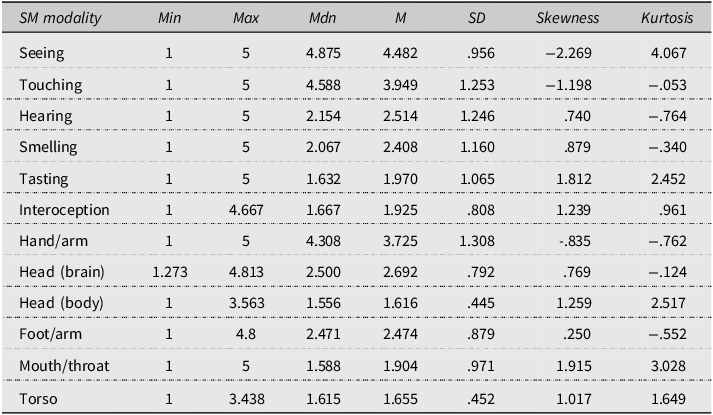
Descriptive statistics for 12 sensorimotor scales are presented in Table 1. A sensory modality that emerged as the most dominant for this stimulus sample was vision, followed by touch, whereas interoception and taste had the smallest average score. This is in line with previous studies (Filipović Đurđević et al., Reference Filipović Đurđević, Popović Stijačić and Karapandžić2016; Lynott et al., Reference Lynott, Connell, Brysbaert, Brand and Carney2019; Popović Stijačić, Reference Popović Stijačić2021), which suggested that our stimulus sample was representative. The most dominant effector scale was hand/arm, and the least dominant were mouth/throat, torso, and head (as part of the body). This pattern deviated from findings in the previous study (Lynott et al., Reference Lynott, Connell, Brysbaert, Brand and Carney2019), where the head scale was the most dominant, followed by the hand/arm. However, we believe that this accumulation of higher scores in the case of the head was a consequence of the confound between two interpretations of the original scale that were separated in our study. It was shown that the average estimates for the head as a moving part of the body and the head as a brain differed (U = 68540.5, p < .001), which pointed towards the justification of separating these two measures.
Descriptive statistics for sensorimotor norms

Table 1. Long description
A table presenting descriptive statistics for 12 sensorimotor scales. The table has 12 rows and 8 columns. The columns are labeled as SM modality, Min, Max, Mdn, M, SD, Skewness, and Kurtosis. The rows are labeled with different sensorimotor modalities: Seeing, Touching, Hearing, Smelling, Tasting, Interoception, Hand/arm, Head (brain), Head (body), Foot/arm, Mouth/throat, and Torso. Each row contains values for the respective modality across the different statistical measures. For example, the row for Seeing has values 1, 5, 4.875, 4.482, 0.956, -2.269, and 4.067 under the columns Min, Max, Mdn, M, SD, Skewness, and Kurtosis respectively.
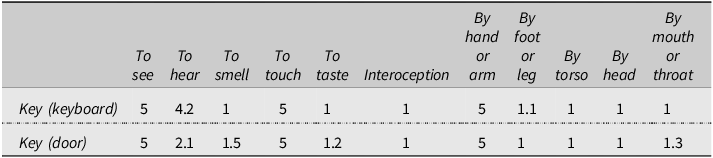
Using the collected sensorimotor ratings, we calculated pairwise sensorimotor similarity between meanings/senses within a word (N = 282) by using the Pearson correlation (see Table 2 for illustration). The average correlation of sensorimotor similarity calculated on 11 motor scales was .617, ranging from −.549 to .991, but the distribution of the SM similarity measure was skewed. With skewness being −1.114, the great majority of the referent pairs were estimated to be very similar in the sensorimotor way.
Schematic illustration of calculating sensorimotor similarity of meaning/sense referents pair, based on sensorimotor norms for the individual meaning/sense of an ambiguous word

Table 2. Long description
A table comparing sensorimotor similarity of meaning/sense referent pairs based on sensorimotor norms. The table has 2 rows and 9 columns. The columns are labeled as To see, To hear, To smell, To touch, To taste, Interoception, By hand or arm, By foot or leg, By torso, By head, By mouth or throat. The rows are labeled as Key (keyboard) and Key (door). Row 1: Key (keyboard): To see, 5; To hear, 4.2; To smell, 1; To touch, 5; To taste, 1; Interoception, 1; By hand or arm, 5; By foot or leg, 1.1; By torso, 1; By head, 1; By mouth or throat, 1. Row 2: Key (door): To see, 5; To hear, 2.1; To smell, 1.5; To touch, 5; To taste, 1.2; Interoception, 1; By hand or arm, 5; By foot or leg, 1; By torso, 1; By head, 1; By mouth or throat, 1.3.
Pearson’s correlation (key1, key2) would here be: r(9) = .935, t = 7.91, p < .001.
Because of the non-normal distribution of the similarity measure, we used the Mann-Whitney test to examine the difference between the homonymic and polysemous pairs regarding their sensorimotor similarity. As expected, the sensorimotor profiles of polysemous pairs were more similar on average (Mdn = 0.823) than the sensorimotor profiles of homonymic pairs (Mdn = 0.492), and the observed difference was significant (U = 3804, Z = −5.208, p < .001; see Figure 1; Supplementary Materials 5 & 6 available in OSF).
The distribution of ratings of sensorimotor similarity for homonyms and polysemous nouns.

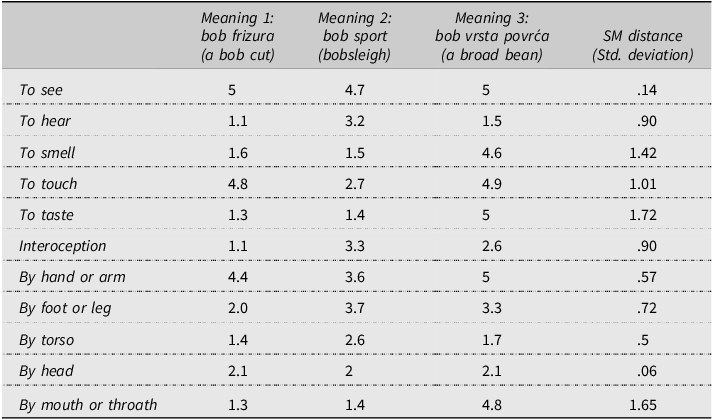
Having shown that senses/meanings that denote similar entities also have similar sensorimotor representations, we moved forward to test if the homonymy/polysemy status could be predicted by the similarity of their sensorimotor profiles and to additionally examine the relative contribution of each of the 11 sensorimotor scales to the differentiation between homonyms and polysemous nouns. For each word (regardless of the number of meanings/senses included), we calculated 11 separate distance measures—one for every sensorimotor scale. This measure of distance is calculated as a standard deviation of obtained ratings on a given scale for each of the senses/meanings. This way, for each noun, we had the numerical measure of the degree to which all of that word’s meanings/senses differ on each of the 11 scales separately, as illustrated in Table 3 (and provided in Supplementary Material 7 available in OSF).
Schematic illustration of calculating sensorimotor distance for the word bob that is a homonym in Serbian with three unrelated meanings (type of haircut, type of sport, and type of bean)

Table 3. Long description
A table comparing sensorimotor distances for the word bob with three meanings in Serbian: bob frizura (a bob cut), bob sport (bobsleigh), and bob vrsta povrca (a broad bean). The table has 11 rows and 4 columns. Columns are labeled Meaning 1: bob frizura (a bob cut), Meaning 2: bob sport (bobsleigh), Meaning 3: bob vrsta povrca (a broad bean), and SM distance (Std. deviation). Rows are labeled To see, To hear, To smell, To touch, To taste, Interoception, By hand or arm, By foot or leg, By torso, By head, and By mouth or throat. Each cell contains numerical values representing sensorimotor distances for each meaning and the standard deviation.
Those 11 sensorimotor distance measures were our predictors in descriptive canonical discriminant analysis, and the two criterion groups were homonyms (N = 33) and polysemes (N = 64). We observed a statistically significant canonical correlation coefficient of .522 (χ 2(11) = 28.530, p < .05), with 77.3% of words correctly classified as homonym/polysemous. The group centroid for homonyms was .844 and −.435 for polysemes, which suggested that homonyms had higher sensorimotor distances. Scales that contributed the most to the definition of the canonical discriminant function were hearing (r = .483, β = .518) and touching (r = .466, β = 1.128), while seeing was a redundant variable (r = .412, β = .026). Other variables were either bad predictors or redundant/suppressor variables, with much smaller values of coefficients of canonical discriminant structure and standardized canonical discriminant coefficients.
To conclude the findings from Study 1, we showed that the linguistic categories of homonymy and polysemy were reflected in the sensorimotor regularities. The related, polysemous senses are shown to have more similar sensorimotor profiles, as opposed to the unrelated, homonymic meanings, shown to have less similar sensorimotor profiles. We also showed that the group membership (polysemy/homonymy) can be predicted based on the similarity of the ratings of auditory and tactile experience with the entities denoted by their meanings/senses. The uninformativeness of the usually dominant seeing scale is possibly a consequence of a high correlation between the similarity of touching and seeing (r = .693, p < .001), with the touching being more discriminative. Given the novel and exploratory nature of this analysis, it is worth attention that the same two senses (touching and hearing) were found to differ the most between concrete and abstract concepts (Banks & Connell, Reference Banks and Connell2023), along with interoception.
Study 2: Collecting and evaluating semantic similarity ratings for meanings/senses
In Study 2, we collected subjective semantic similarity ratings for the pairs of meanings/senses within words. Because Study 1 demonstrated that categorical linguistic distinction between homonymy and polysemy was reflected in the sensorimotor profiles of their meanings/senses, in Study 2, we took the next step of validating this finding in the psychological context of subjectively perceived similarity, as operationalized by semantic similarity ratings. We first compared homonymy and polysemy for the average semantic similarity ratings to confirm for our set of words that the linguistic distinction is reflected in the psychological realm of subjective semantic similarity. Then, we looked into the relationship between the similarity of the profiles of sensorimotor ratings (as calculated in Study 1) and the rated semantic similarity of the meaning/sense pairs within a word (collected in this study). We predicted a positive correlation between them. This finding would include the distinction between homonymy and polysemy observed in Study 1 but would also capture a more fine-grained differentiation in the overlap of meanings/senses (continuum of ambiguity; Klepousniotou, Reference Klepousniotou2002; Klepousniotou et al., Reference Klepousniotou, Titone and Romero2008; Yurchenko et al., Reference Yurchenko, Lopukhina and Dragoy2020).
Method
Participants
As in Study 1, participants were first-year psychology students from the University of Belgrade, whose participation was acknowledged as course credits. The initial pool consisted of 90 participants who signed the informed consent form approved by the Institutional Review Board of the Department of Psychology (Protocol #2021-66). The participants were sampled from the same pool of first-year psychology students as the participants from Study 1. However, the overlap was only partial, as the stimuli were drawn from a bigger pool randomly for each participant. Additionally, the two research phases were 2 weeks apart, and they were presented as two unrelated studies to prevent the first phase from affecting the second one.
Stimuli
We presented the same stimuli that were described in Study 1: 282 meaning/sense pairs. Additionally, to ensure the calibration of participants to the whole range of the semantic similarity scale, we selected 23 word pairs (without disambiguating context; e.g., a mouse—a rat) from the previous study that also collected similarity ratings (the SimLex-999 database, Hill et al., Reference Hill, Reichart and Korhonen2015) in a way that covered the entire continuum of semantic similarity. In addition, another nine pairs of meanings/senses (e.g., work [activity, labor]—work [task]) were selected from the database of Serbian ambiguous nouns (Filipović Đurđević & Kostić, Reference Filipović Đurđević, Kostić, Halupka-Rešetar and Martínez-Ferreiro2017, coded for metonymy/metaphor in Manojlović & Filipović Đurđević, Reference Manojlović and Filipović Đurđević2025), so that they cover the entire semantic similarity continuum.
Procedure
Using the SoSci software (Leiner, Reference Leiner2019; SoSci project available in Supplementary Materials 8 available in OSF), participants used a five-point Likert scale to rate to what extent two concepts were semantically similar (e.g. pen [for writing] and pen [for sheep]). Each pair was shown in two orders, i.e. the position of the sense during presentation was counterbalanced. Each participant rated 90 randomly chosen meaning/sense pairs. The instructions that clarified the concept of semantic similarity were adapted from Hill and colleagues (Reference Hill, Reichart and Korhonen2015), focusing on the synonyms as the extreme example and pointing out the difference between semantic and associative similarity. The calibration stimulus pairs, both unambiguous and ambiguous ones, were presented before the main task, in randomised order for every participant. The entire procedure took about 20 minutes per participant.
Results & discussion
Descriptive statistics, t-tests, and correlation analysis were conducted in JASP 0.17.2.1 (JASP Team, 2023) and IBM SPSS Statistics 23 (IBM Corp., 2015), and all of the graphs were created in R, using packages ggplot2 (Wickham, Reference Wickham2016) and ggpubr (Kassambara, Reference Kassambara2023).
In the preprocessing phase, we excluded participants with an excessively high percentage of invalid answers and a short instruction reading time from the initial 90-participant pool, leaving 71 participants in the final pool. The exclusion criteria are available in Supplementary Material 1, available on OSF.
Each meaning/sense was rated 22 times on average. We observed the average semantic similarity rating of 2.078 (Sd = .897). The distribution of the semantic similarity ratings was positively skewed, with a skewness of .783 and the Shapiro-Wilk test indicating deviation from the normal distribution (W = .918, p < .001), i.e., the great majority of the referent pairs were rated as semantically dissimilar (Supplementary Materials 5 & 6 available in OSF).
To check if a sample of polysemous nouns and homonyms is representative, i.e., if two groups differ semantically as would be expected from the definition of polysemy and homonymy, we first conducted a Mann-Whitney test to examine the difference between them regarding semantic similarity. On average, the polysemous pairs were found to be more semantically similar (Mdn = 2.115) than homonymous pairs (Mdn = 1.238; U = 1161.500, Z = −9.895, p < .001; see Figure 2), which corroborated the representativeness of the sample of words in our study.
The distribution of ratings of semantic similarity for homonymous and polysemous nouns.

Next, we examined whether rated semantic similarity (a continuous variable) correlated with the measure of sensorimotor similarity, which was tested using Spearman’s correlation (due to the observed skewness of the distributions). As predicted, it was found to be positive and significant (rs (280) = .484, p < .001; see Figure 3 & Supplementary Material 5 available in OSF).
The relation between semantic and sensorimotor similarity.

The observed correlation between the two similarity measures is of a similar magnitude as the one registered in the previous study (Wingfield & Connell, Reference Wingfield and Connell2023), where it ranged from .29 to .45, depending on the database used. Although one could expect a stronger relationship with using the more precise concept definition (i.e., including the disambiguation), the results are similar. One of the reasons may lie in the observed asymmetrical distribution, i.e., accumulation of low values of semantic similarity, which was unexpected, given that the majority of the pairs were composed of polysemous senses, which are by definition similar to some extent. The explanation that seems possible is that the instructions for semantic similarity ratings could have biased participants into giving lower ratings, as the concept of semantic similarity was explained through the concept of synonyms as extremely semantically similar words, as in the previous study (Hill et al., Reference Hill, Reichart and Korhonen2015). Although participants first rated stimuli for calibration, it seems that the biasing effect of instructions remained. However, in both Studies 1 and 2, we showed that sensorimotor similarity was reflected in semantic similarity.
General discussion
In this research, we brought together the framework of embodied cognition (Barsalou, Reference Barsalou1999, Reference Barsalou2008, Reference Barsalou2010; Meteyard et al., Reference Meteyard, Cuadrado, Bahrami and Vigliocco2012) and the PDP models of lexical ambiguity (Armstrong, Reference Armstrong2012; Armstrong & Plaut, Reference Armstrong and Plaut2016; Rodd, Reference Rodd, Gaskell and Rueschemeyer2018, Reference Rodd2020; Rodd et al., Reference Rodd, Gaskell and Marslen-Wilson2004). We conducted two studies to shed light on the long-neglected status of sensorimotor information in the representation of ambiguous words. We collected sensorimotor norms for individual meanings/senses of ambiguous words and demonstrated that linguistic distinction between polysemy (as a form of lexical ambiguity where a single form is mapped onto a set of related senses) and homonymy (mapping of a single form onto a set of unrelated meanings) was reflected in the sensorimotor experience with the objects denoted by different senses/meanings of ambiguous words. Next, we showed that the captured sensorimotor information was related to the semantic dimension of representation. This finding contributed to the view that sensorimotor information can serve the role of the units of representation postulated by the PDP framework. We thus showed that the framework of embodied cognition can be a fruitful ground for testing the debates concerning the representation of ambiguous words, but we also demonstrated that lexical ambiguity should be taken into account when collecting sensorimotor norms.
The two studies corroborated that semantics was reflected in the sensorimotor information and extended this insight onto lexical ambiguity. Namely, related senses of polysemous words are shown to be not only semantically more similar but also more similar in the sensorimotor domain, i.e., to have more similar sensorimotor profiles compared to the unrelated meanings of homonyms. For example, both daily paper and wrapping paper can be experienced in visual, tactile, and olfactory domains (but not in auditory and gustatory), whereas dog bark, unlike tree bark, can be experienced in the auditory (but not visual, tactile, etc.) domain. This finding is congruent with the linguistic fact that in the case of polysemy, different senses often have the same etymological origin, i.e., they have a basis in the same extralinguistic referent, while on the other hand, homonyms form by coincidence. This finding is thus in accordance with the more traditional, etymology-based view of polysemy and homonymy. In addition to such a categorical distinction between polysemy and homonymy, this relationship was also captured using continuous variables by registering a positive correlation between the ratings of semantic similarity among senses/meanings and a similarity measure derived from their sensorimotor profiles. On the one hand, this finding captured a more fine-grained differentiation of senses/meanings, potentially capturing the gradual shift from homonymy to metaphor, then metonymy, etc. On the other hand, it demonstrated that the variation reflected in sensorimotor profiles was semantic in nature. Therefore, as predicted, sensorimotor features coded some aspects of ambiguous word meaning representation. This finding is in line with the observations from two similar studies that reported a positive correlation between sensorimotor and semantic similarity of words as unitary concepts (treated as unambiguous, without denoting a particular meaning/sense; Speed & Majid, Reference Speed and Majid2017; Wingfield & Connell, Reference Wingfield and Connell2023).
This research is rooted in two theoretical frameworks, embodied cognition models and lexical ambiguity models of the PDP approach, that seem to shed light on different but complementary aspects of mental representation of word meaning. Regarding the embodied cognition models, our findings both corroborate and broaden their assumptions. Namely, given that they postulate that sensorimotor information is the foundation of the meaning of a word (Barsalou, Reference Barsalou1999; Barsalou et al., Reference Barsalou, Simmons, Barbey and Wilson2003), it is conceivable that the sensorimotor profile would be attuned to subtle differences in meaning. In the context of our research, it would be expected that the sensorimotor profile obtained for a word (e.g., mouse) could not directly mirror all of the different senses/meanings of that word (e.g., mouse [for computer] and mouse [animal]). In this regard, it would be expected that the greater divergence in the meanings of two meanings/senses would be accompanied by greater divergence in sensorimotor profiles. As we identified the difference in the similarity of sensorimotor profiles across the semantic continuum, our findings suggest that sensorimotor experience at least partially constitutes the representation of concepts.
On the other hand, lexical ambiguity theories have so far focused mainly on the structure of the representation depending on the lexical ambiguity type—homonymy and polysemy (regular and irregular; Apresjan, Reference Apresjan1974). Along the same line and more specifically, within the PDP approach, assumptions were mainly given about the relationships among the representations of meanings/senses within a word and the dynamics of their activation during the disambiguation process (Armstrong, Reference Armstrong2012; Armstrong & Plaut, Reference Armstrong and Plaut2016; Rodd, Reference Rodd, Gaskell and Rueschemeyer2018, Reference Rodd2020; Rodd et al., Reference Rodd, Gaskell and Marslen-Wilson2004). However, lexical ambiguity theories have so far mostly neglected the discussion about the nature and origin of the hypothetically postulated basic units.Footnote 1 Especially, they have failed to explicitly take into consideration the experiential aspect of the meaning that represents the central idea of the embodied cognition models. Therefore, our findings inform PDP models that the basic units whose patterns of activation constitute mental representation could be sensorimotor in nature as well. We therefore contributed to the pursuit of the epistemological status of the basic units in PDP models. Once such a partial nature of basic representational units is established, the finding can be used for further testing of the predictions of the PDP models. For example, Armstrong and Plaut (Reference Armstrong and Plaut2016), as well as Rodd (Reference Rodd2020), propose that representations of unrelated (homonymous) meanings are separate and linked via inhibitory connections. Unlike homonymous meanings, related polysemous senses overlap in the shared core, which not only reduces the competition among senses but also projects facilitatory connections towards the remaining representations of the senses. Although our study was not designed to test the proposed dynamics, it introduces a novel tool for such tests. By combining our findings and the assumptions of the PDP models, we would predict that an increase in sensorimotor similarity (i.e., in shared sensorimotor experience among senses/meanings) would lead to facilitation in word recognition latencies over and above the established effect of number of meanings/senses.
Along with the described theoretical contributions and novelties, this research fills the empirical gap as well. As far as we are aware, there is only one study that has collected what we call ambiguity-sensitive sensorimotor norms, i.e., what they call contextualized sensorimotor judgments (Trott & Bergen, Reference Trott and Bergen2022). Our finding regarding the positive relationship between sensorimotor similarity and semantic similarity is in line with the negative relationship between sensorimotor distance and rated relatedness that Trott and Bergen (Reference Trott and Bergen2022) registered.
Although not directly related to the main goal of the study, an additional novelty of our study lies in the contribution to the procedure of collecting sensorimotor norms. Specifically, the dimension of motor experience using the head was divided into two different scales: using the head as a physical body part in interacting with objects and using the head as a mental structure in thinking about objects/ideas, as it had been suggested in the Lancaster Sensorimotor Norms paper (Lynnott et al., Lynott et al., Reference Lynott, Connell, Brysbaert, Brand and Carney2019).
This study, although among the first to collect sensorimotor ratings for separate senses and the first to directly test the role of SM information in ambiguity representation and processing, is not without limitations. Primarily, the distributions of both similarity measures deviate from the normal distribution, so using nonparametric tests was necessary. Since more than two-thirds of our stimuli were polysemous and since polysemous pairs were more sensorimotorly similar, it seems clear why we observed a negatively asymmetrical distribution of the sensorimotor similarity measure. However, this cannot explain the observed positively asymmetrical distribution of semantic similarity measures. We offered one possible methodological explanation to account for the finding, but further studies are needed to shed more light. Future studies could also look into more detailed differences between metaphor and metonymy polysemes, i.e., to test the difference in sensorimotor similarity in these two linguistic categories. Another direction worth exploring is inspecting the ability of our two similarity measures to predict behavioral patterns, e.g., reaction latency in a lexical decision task, in accordance with the tradition of the PDP approach to lexical ambiguity. Since it has already been demonstrated that semantic similarity of word meanings/senses facilitates processing in the lexical decision task (LDT) when treated categorically, by comparing the least semantically similar homonymy, the more similar metaphor, and the most similar metonymy (Armstrong & Plaut, Reference Armstrong and Plaut2008, Reference Armstrong and Plaut2011; Beretta et al., Reference Beretta, Fiorentino and Poeppel2005; Klepousniotou & Baum, Reference Klepousniotou and Baum2007; Rodd et al., Reference Rodd, Gaskell and Marslen-Wilson2002), it would be valuable to test this relationship continuously as well. Besides predicting the facilitatory effect of the subjective semantic similarity, we would also predict the sensorimotor similarity to have the same effect, given the postulated and expected ability of sensorimotor information to code meaning (Speed & Majid, Reference Speed and Majid2017; Wingfield & Connell, Reference Wingfield and Connell2023). Therefore (as discussed previously), we would predict that sensorimotor similarity would facilitate lexical decision along with the semantic similarity. However, one should bear in mind that LDT, although a widely used experimental paradigm, might be falling short of capturing these subtle effects since, according to some studies, it does not engage semantic processing deep enough (Balota & Lorch, Reference Balota and Lorch1986; Becker et al., Reference Becker, Moscovitch, Behrmann and Joordens1997; Joordens & Becker, Reference Joordens and Becker1997). Therefore, we would suggest looking more closely into specific word senses and sensorimotor experiences typically related to them by administering a task that demands deeper semantic processing of the specific senses/meanings (e.g., the meaning/sense priming paradigm).
To conclude, our research provided one attempt to reconcile PDP models of lexical ambiguity and embodied cognition models. The findings both confirm and broaden these two groups of models by indicating the
relatedness of semantic and sensorimotor aspects of mental representation, as well as showing the role of sensorimotor information in the processing of linguistic material.
Replication package
All experimental materials, trial-level data, and analysis code are available at this link: https://osf.io/rs7mx.
Acknowledgements
Studies 1 and 2 are partially based on the master thesis of the first author. Portions of this work were presented at the 23rd meeting of the European Society for Cognitive Psychology (ESCOP) in Porto, PT (Sept. 2023), and at the 29th scientific conference, Empirical Studies in Psychology (EIP), in Belgrade, SRB (March 2023).
Funding statement
This research was funded by the Ministry of Science, Technological Development, and Innovation of the Republic of Serbia (info:eu-repo/grantAgreement/MESTD/inst-2020/200163/RS//).
Competing interests
The authors have no known conflict of interest to disclose.



 Open access

