Introduction
Ammonium sulfate chlorides are quite rare (see for instance rruff.info/ima/), the only examples known to date seem to have been found as sublimates at Vulcano Island, Aeolian Islands, Sicily, Italy (Campostrini et al., Reference Campostrini, Demartin, Gramaccioli and Russo2011), i.e. adranosite (Demartin et al., Reference Demartin, Gramaccioli and Campostrini2010), adranosite-(Fe) (Mitolo et al., Reference Mitolo, Demartin, Garavelli, Campostrini, Pinto, Gramaccioli, Acquafredda and Kolitsch2013) and therasiaite (Demartin et al., Reference Demartin, Castellano and Campostrini2014). Acmonidesite (NH4,K,Pb2+,Na)9Fe42+ (SO4)5Cl8, is an additional new mineral of this kind recently found in the fumaroles at the same locality. This mineral was approved as a new species by the International Mineralogical Association Commission on New Minerals, Nomenclature and Classification (IMA2013-068, Demartin et al., Reference Demartin, Campostrini and Castellano2013). The name is from Acmonides (from the Greek Ακμωνιδης), cited by Ovidius as one of the Cyclops, who were helpers of Hephaistos, the mythological god of fire whose forge was alleged to be located at Vulcano.
This paper deals with the description of the new mineral, together with its crystal structure determination.
Occurrence, chemical data and physical properties
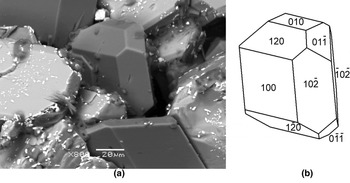
Acmonidesite is a volcanic sublimate found at La Fossa crater, Vulcano, Aeolian Islands, Sicily, Italy, in an active fumarole [fumarole FA, reported in Borodaev et al. (Reference Borodaev, Garavelli, Garbarini, Grillo, Mozgova, Organova, Trubkin and Vurro2000) and Pinto et al. (Reference Pinto, Balić Žunić, Garavelli, Garbarino, Makovický and Vurro2006)] that occurs on a pyroclastic breccia as brown prismatic crystals up to 0.10 mm long, in association with salammoniac NH4Cl, alunite KAl3(SO4)2(OH)6 and adranosite (NH4)4NaAl2(SO4)4Cl(OH)2, (Fig. 1). The most commonly observed forms are: {1 0 0}, {1 2 0}, {0 1 1}, {0 1 0} and {1 0 2}; such an indexing has been obtained by comparison of computer-generated drawings of the crystals. No twinning is apparent. The a:b:c ratio calculated from the unit-cell parameters is 0.5060:1:0.9177 (single-crystal data). The streak is light brown and the lustre is vitreous. Cleavage and fracture were not observed. No fluorescence was observed under both shortwave and longwave ultraviolet radiation. A measurement of the density, obtained by flotation in a diiodomethane-benzene solution, gives the value of 2.56(1) g cm–3. The density calculated using the empirical formula and single-crystal unit-cell data is 2.551 g cm–3.
Back-scattered electron image of crystals of acmonidesite with alunite and a crystal drawing with indexing of the faces.

Acmonidesite is biaxial (+) with α = 1.580(2), β = 1.590(2) and γ = 1.635(2) (white light), measured with a spindle stage. 2V(meas) = 53(3)° and 2V(calc) = 51.6°. Orientation is X = c, Y = b, Z = a. Taking into account the empirical chemical formula and the density based on it, the calculated mean refractive index is 1.602, using the Gladstone-Dale constants of Mandarino (Reference Mandarino1976, Reference Mandarino1981). The compatibility index 1–(Kp/Kc) = 0.033 is rated as excellent. Dispersion could not be observed because of the intense brown colour of the mineral.
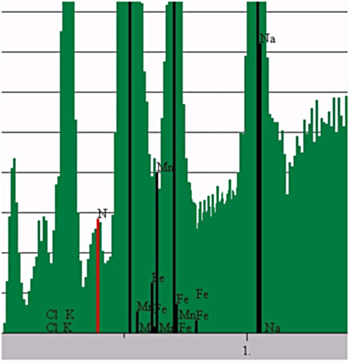
Quantitative chemical analyses (8) were carried out in energy-dispersive spectroscopy (EDS) mode using a JEOL JSM 5500 LV scanning electron microscope equipped with an IXRF EDS 2000 microprobe (20 kV excitation voltage, 10 pA beam current and 2 µm beam diameter). The analytical method was chosen because it was impossible to prepare a flat polished sample and the crystal is severely damaged by using the wavelength-dispersive spectroscopy technique, even with a low voltage and current and a large diameter beam. Element concentrations were measured using the Kα lines for S, K, Na, Fe, Mn and Cl, the Lα line for Br and the Mα line for Pb. The presence of ammonium was established from crystal-structure analysis, confirmed by the Fourier-transform infrared (FTIR) spectrum (Fig. 2) as well as by the EDS spectrum (Fig. 3). The IR spectrum was recorded on a Jasco IRT-3000 spectrometer and shows strong absorption bands related to the presence of ammonium at 3214 (broad), 2921, 2851 and 1395 cm–1, together with typical sulfate absorptions at 740, 1005, 1083, 1137 and 1218 cm–1. Minor absorptions at 1620 and 1730 cm–1 may be due to partial replacement of Cl– by OH–. The (NH4)2O content was deduced from structure solution, taking into account its partial replacement by K+ (see below). The mean analytical results are reported in Table 1. The empirical formula (based on 28 anions pfu) is (NH4)5.77K1.42Pb0.62Na1.24Fe3.96Mn0.08S5.04O20.16Cl7.97Br0.08. The simplified formula is (NH4,K,Pb2+,Na)9Fe42+(SO4)5Cl8. Holotype material is deposited in the Reference Collection of the Dipartimento di Chimica, Università degli Studi di Milano, specimen number 2013-02.
FTIR spectrum of acmonidesite.

A portion of the EDS spectrum, where the presence of the ammonium nitrogen is evident.

Analytical data for acmonidesite (average of 8 analyses).*

* The empirical formula (based on 28 anions pfu) is (NH4)5.77K1.42Pb0.62Na1.24Fe3.96Mn0.08S5.04 O20.16Cl7.97Br0.08. The simplified formula is (NH4,K,Pb2+,Na)9Fe42+(SO4)5Cl8.
S.D. – standard deviation; **from structure solution.
X-ray data
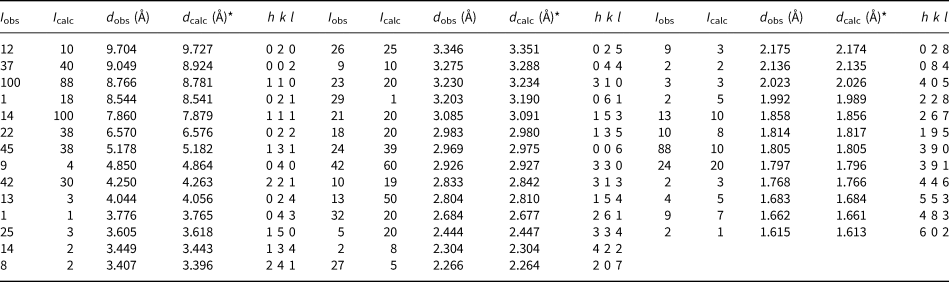
Powder X-ray diffraction data (Table 2) have been obtained using a Rigaku DMAX II diffractometer, with graphite monochromatised CuKα radiation. The indexing of the powder-diffraction pattern was made by comparison with the pattern calculated after the structure determination. The following unit-cell parameters a = 9.840(1), b = 19.455(2), c = 17.847(2) Å and V= 3416.6(5) Å3 were derived from least-squares refinement from the above data using the program UNITCELL (Holland and Redfern, Reference Holland and Redfern1997).
X-ray powder diffraction data for acmonidesite.

* Calculated from the unit cell a = 9.840(1), b = 19.455(2), c = 17.847(2) Å and V = 3416.6(5) Å3, obtained from least-squares refinement of the above data using the program UNITCELL (Holland and Redfern, 1997).
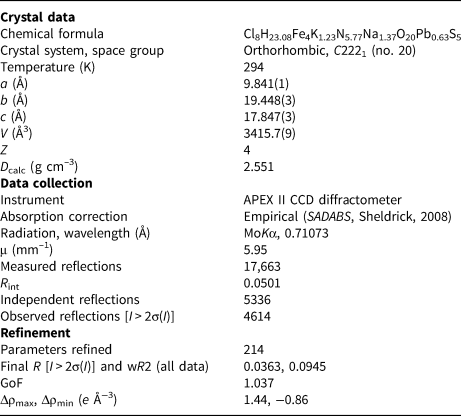
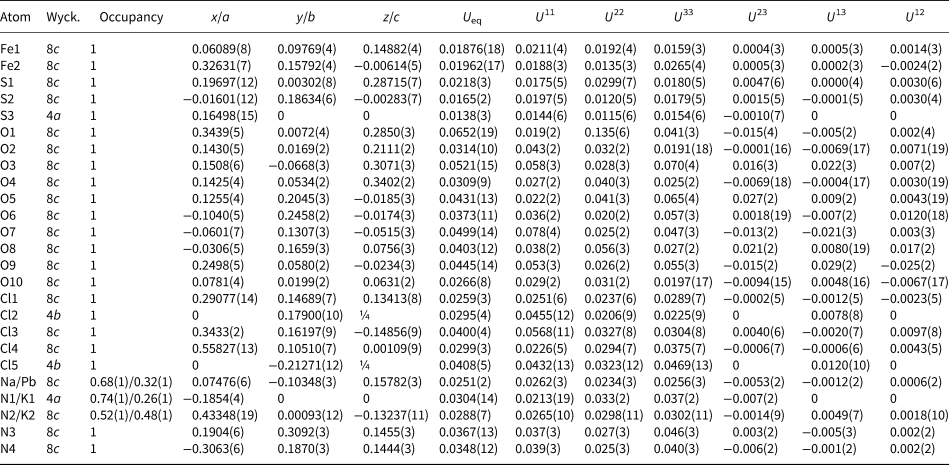
Single-crystal diffraction data were collected using a Bruker Apex II diffractometer with MoKα radiation (λ = 0.71073 Å). Some 17,663 intensities were measured up to 2θ = 63.03°, of which 5336 were unique (R int = 0.0501). A SADABS absorption correction was applied (Sheldrick, Reference Sheldrick2000) (μ = 5.95 mm–1). On the basis of systematic absences the space group C2221 (no. 20) was selected unambiguously, in agreement also with statistical tests on the distribution of the E values [|E 2–1| = 0.781] and confirmed by satisfactory structure solution and refinement. The structure was solved by direct methods and refined using the SHELXL-2017 program (Sheldrick, Reference Sheldrick2008) implemented in the WinGX suite (Farrugia, Reference Farrugia1999) to a final R = 0.0363 for 4614 observed reflections [I > 2σ(I)] (Table 3). A refinement of the occupancies of the N and Na sites revealed in two of them a significant substitution of the ammonium ions by K+ and of Na+ by Pb2+, as shown in Table 4, whereas no occupancy was refined for the Fe and Cl sites, due to only small amounts of Mn and Br replacing Fe and Cl, respectively. The formula resulting from the structure refinement is (NH4)5.77K1.22Pb0.64Na1.36Fe4(SO4)5Cl8 (corresponding to 17.63 positive charges for the cations and 18 negative charges for the anions). It seems satisfactory in view of the approximations introduced for the atomic scattering factors of mixed sites. The positions of all the hydrogen atoms of the ammonium ion could not be detected from a difference-Fourier map due to local disorder. The value of the Flack parameter, 0.228(8), confirms the correctness of the absolute structure, considering the fact that the crystal is partially twinned and a TWIN refinement was carried out (twin matrix [ $\bar{1}$ 0 0], [0
 $\bar{1}$ 0], [0 0
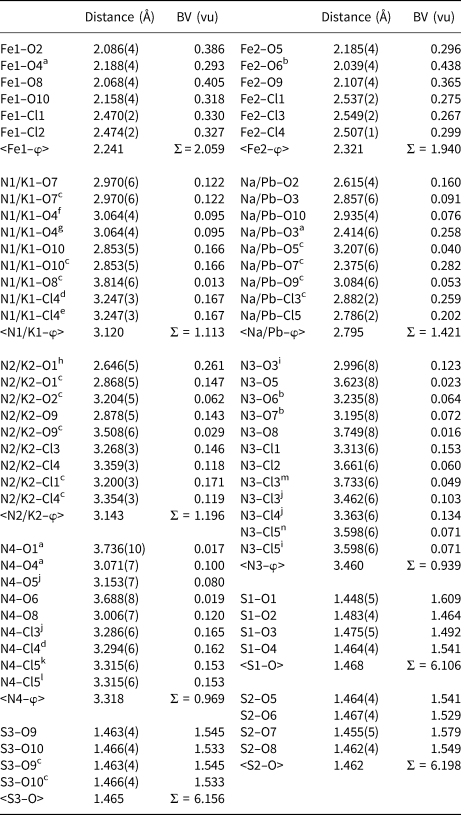
 $\bar{1}$] and components ratio 0.772(8)/0.228(8)). The coordinates and displacement parameters of the atoms are reported in Table 4; selected interatomic distances are listed in Table 5. The crystallographic files have been deposited with the Principal Editor of Mineralogical Magazine and are available as Supplementary material (see below).
Single-crystal diffraction data and refinement parameters for acmonidesite.

Notes: R = Σ||Fo|–|Fc||/ Σ|Fo|; wR2 = {Σ[w(Fo2 – Fc2)2]/Σ[w(Fo2)2]}1/2; w = 1/[σ2(Fo2) + (0.0563q)2] where q = [max(0, Fo2) + 2Fc2]/3; GoF = {Σ[w(Fo2 – Fc2)]/(n – p)}1/2 where n is the number of reflections and p is the number of refined parameters.
Final atom coordinates and equivalent isotropic displacement parameters (Å2).*

* The anisotropic displacement factor exponent takes the form: –2π2(U 11h 2(a*)2+… + 2U 12hka*b* + …); U eq according to Fischer and Tillmans (Reference Fischer and Tillmanns1988).
Wyck. – Wyckoff site.
Selected interatomic distances (Å) and bond valences* (BV, vu) in acmonidesite.

Symmetry codes: a = –x, y, 1/2–z; b = x + 1/2, 1/2–y, –z; c = x, –y, –z; d = x–1, y, z; e = x–1, –y, –z; f = –x, –y, z–1/2; g = –x, y, 1/2–z; h = 1–x, –y, z–1/2; i = 1/2–x, y + 1/2, 1/2–z; j = x–1/2, 1/2–y, –z; k = x–1/2, y + 1/2, z; l = –x–1/2, y + 1/2, 1/2–z, m = 1/2–x, 1/2–y, z + 1/2, n = x + 1/2, y + 1/2, z.
* Bond-valence parameters from Brown and Altermatt (Reference Brown and Altermatt1985) and Brown (Reference Brown2009).
Description of the structure and discussion
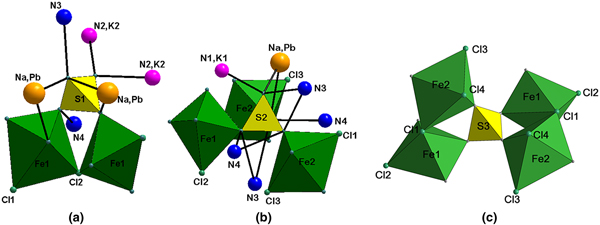
The structure of acmonidesite (Fig. 4) contains two independent, distorted octahedral iron sites, Fe1 and Fe2, with the iron atoms in the 2+ oxidation state, as confirmed by the range of interatomic distances and bond-valence calculations (2.06 and 1.94 valence units (vu), respectively). Fe1 is surrounded by two chlorine atoms and four oxygens of the sulfate ions, with the following average distances: Fe1–O 2.125 Å and Fe1–Cl 2.472 Å; and Fe2 is surrounded by three chlorine atoms and three oxygens of the sulfate ions, with the following average distances: Fe2–O 2.111 Å and Fe2–Cl 2.531 Å. The structural type of acmonidesite is unprecedented and displays finite clusters made by four Fe vertex-sharing distorted octahedra and sulfate tetrahedra (Fig. 5), interacting each other only through the sulfate anions. Iron octahedra linked via vertices to form infinite chains encased from both sides by SO4 tetrahedra are also present in parabutlerite (Plášil et al., Reference Plášil, Petřiček and Majzlan2017), however, in acmonidesite each couple of adjacent octahedra is bridged by two sulfate anions instead of by one. The three independent sulfate anions, one of which located on a two-fold axis (S3), are connected to the Fe polyhedra and to the other cations as shown in Fig. 6. The S1 sulfate shares two vertices of the tetrahedron with two symmetry-related Fe1 polyhedra of the same cluster. The S2 sulfate shares two vertices with Fe1 and Fe2 polyhedra of the same cluster and one with a Fe2 of an adjacent cluster. The S3 one shares two of the four vertices with Fe1 and Fe2 octahedra of the same cluster and the other two with the corresponding Fe1 and Fe2 polyhedra related by two-fold symmetry. Voids within the three-dimensional framework determined by the arrangement of these clusters are occupied by four independent ammonium ions (two of them partially replaced by K+), by one Na+ cation, partially substituted by Pb2+ and one Cl– anion (Cl5). The larger voids are those occupied by ammonium only (average radius of the cage 3.32–3.46 Å) or by ammonium plus potassium (average radius 3.12–3.14 Å). The smallest (average radius 2.79 Å) are occupied by Na+ and Pb2+, as expected by the ionic radii of these cations. Bond-valence calculations (Table 5) are in agreement with the structure model proposed. The value of 1.421 vu obtained for the Na/Pb site accounts for the presence of an amount of the divalent Pb2+ cation.
Perspective view of the structure of acmonidesite seen almost along [100]. Green octahedra: Fe2+; yellow tetrahedra: SO42−; blue spheres:  ${\rm NH}_{\rm 4}^{\rm +} $; orange spheres: Na+/Pb2+; magenta sphere:
 ${\rm NH}_{\rm 4}^{\rm +} $/K+; and green spheres: Cl5.

Perspective view of the discrete cluster of iron and sulfate polyhedra observed in acmonidesite.

The environment about the three independent sulfate anions.

The ammonium ions interact with the surrounding sulfate oxygens and chloride ions via hydrogen bonds. The three sulfate anions display S–O distances ranging from 1.448(5) to 1.483(4) Å with an overall average distance of 1.465 Å, not significantly different from the grand mean S–O distance reported by Hawthorne et al. (Reference Hawthorne, Krivovichev, Burns, Alpers, Jambor and Nordstrom2000).
In spite of the similar chemical composition with adranosite-(Fe) and therasiaite, no topological relationship of acmonidesite with them is evident. In adranosite-(Fe) iron is present only in the 3+ oxidation state, and its polyhedron does not contain chlorine which is instead coordinated to Na; the FeO4(OH)2 distorted octahedra and sulfate tetrahedra are linked to form helicoidal chains extending along [001]. Two different oxidation states for iron are instead present in therasiaite, where three chlorides and three oxygens of the sulfate anions are octahedrally coordinated to the metal centre thus forming [Fe2(SO4)3Cl56−]n infinite chains along [001].
The occurrence of acmonidesite in the fumaroles at La Fossa crater, together with other rare and unique minerals containing ammonium, is an additional example of the singularity of this locality and provides further information in the study of the overall geochemical context of this environment. The presence of these minerals as volcanic sublimates emphasises a high activity of free ammonia and volatile chlorides in the gas phase that prevent dissociation of such minerals, which would be otherwise unstable at the observed temperature.
Supplementary material
To view supplementary material for this article, please visit https://doi.org/10.1180/mgm.2018.115.
Acknowledgements
The authors are most indebted to Prof. Silvia Bruni for the FTIR measurements and to the referees Sergey Krivovichev, Peter Leverett and an anonymous referee for useful suggestions.