The ‘mediatization’ of politics is difficult to dispute,Footnote 1 and questions relating to the influence of mass media on politics have attained growing importance. Through their agenda-setting power, the mass media are often perceived as constituting a central force in modern democracies. This development is also often viewed from a ‘media malaise’ perspective.Footnote 2 Mass media are seen as a malign force in politics, and their increased importance is seen as a potential problem for democracy.
As Newton points out, however, claims regarding the power of the mass media in contemporary politics are much more frequent than research actually analysing the influence of mass media on politics.Footnote 3 This is especially true if one considers studies of mass media influence on ‘macro-political agendas’, i.e. elite agendas such as the agendas of political parties. Whereas the influence of mass media on the agenda of individual citizens, i.e. the public agenda, has at least been studied to some extent,Footnote 4 studies of mass media influence on macro-political agendas are far rarer, especially outside the United States.Footnote 5
Moreover, the findings of the studies actually conducted in relation to macro-politics are generally inconclusive. Mass media coverage of an issue occasionally appears to have a strong impact; at other times, mass media attention seems to have little, if any, impact. As Walgrave and van Aelst show, the findings depend on what exactly is being studied: which mass media are studied?Footnote 6 What issues are studied? In other words, the existing literature clearly suggests that the mass media impact on macro-political agendas is conditional.Footnote 7 It depends on a number of factors relating to the mass media input as well as the political context, such as whether election times or routine politics are studied.
This article focuses on the political context. Building upon the notion of issue ownership,Footnote 8 it argues that the capacity of the mass media to influence the respective agendas of political parties is conditional upon the interests of the political parties. Media attention to an issue attracts attention from political parties when the issue is one that political parties would have an interest in politicizing in the first place. Thus, while the existing literature generally ascribes issue variation in media effects to the character of the issues themselves,Footnote 9 this study argues that at least part of the variation is due to the fact that the interests of political parties vary across issues.
Empirically, the article is based on a time-series study of the effects of mass media attention (measured by radio news) on opposition party attention (measured by questions to the minister) in Denmark covering the entire policy agenda from 1984 to 2003. Opposition party attention in routine times has been chosen because the existing literature argues that this is the most likely situation in which to find mass media influence on party agendas; thus, to be able to study the conditionality of mass media influence, mass media influence on party agendas must exist in the first place. The analysis reveals a clear effect of mass media attention on opposition party attention, but – with the main exception of foreign policy issues – only on issues that the opposition parties ‘own’.
For the broader question of the role of the media in contemporary politics, the implications of the findings are important: increasing media influence on macro-politics is often seen as automatically implying the declining importance of party politics.Footnote 10 This study shows that even when mass media can be shown clearly to influence party politics, this is only when mass media attention ‘fits’ party politics in the first place. The strategic interest of political parties with regard to ‘issue competition’ is thus a crucial ‘gate-keeping mechanism’ in terms of mass media influence on macro-politics.Footnote 11 Party politics plays a crucial role in contemporary agenda-setting processes.
Mass media influence on ‘macro-politics’
The literature on mass media influence on macro-politics has evolved around the question of the reciprocal relationship between the macro-political agendas and the media agenda. On the one hand, there are good arguments behind what Kleinnijenhuis and Rietberg label a top-down model of agenda setting.Footnote 12 Top politicians easily fulfil the news criteria governing modern mass media,Footnote 13 and one should therefore expect them to be able to influence the mass media agenda.Footnote 14 The top-down model has also been supported in several studies.Footnote 15 On the other hand, there are also strong arguments behind a ‘mediacratic’ model of agenda setting, where the media agenda influences macro-political agendas. Politicians depend on media exposure and have an incentive to attempt to frame the public debate and are therefore likely to respond to the media agenda. Several studies also support such a mediacratic agenda-setting perspective.Footnote 16 Following the reciprocal logic, the two perspectives are not mutually exclusive. The question in the literature has therefore been the relative importance of, or ‘the balance of power’ between, the two agenda-setting dynamics.Footnote 17 As Walgrave and van Aelst argue, there is no clear answer to this balance-of-power question emerging in the literature; instead, they outline a preliminary ‘contingency theory’ of mass media agenda-setting power.Footnote 18 What is needed is a much better understanding of the conditions under which mass media may impact macro-politics: in this case, the agendas of political parties.
Some questions about the contingency of mass media influence have been addressed. For instance, differences in media outlets have received some attention,Footnote 19 and especially the question of cross-issue variation has been investigated in a number of studies.Footnote 20 Such studies are typically based on Zucker’s distinction between obtrusive and unobtrusive issues,Footnote 21 which Soroka has developed into a typology distinguishing between sensational, prominent and governmental issues.Footnote 22 Sensational issues are issues that cannot be observed directly by the public, i.e. they are unobtrusive, and are characterized by dramatic events. Examples are the environment and law and order, and these are issues where mass-media effects are most likely. Prominent issues are issues such as the economy, unemployment and welfare-state issues, which have tangible consequences for people, but where people can rely on their own experience, i.e. they are obtrusive, for which reason media effects are expected to be more modest. Finally, governmental issues are unobtrusive issues, and they are not dramatic, for which reason media effects on macro-politics are not expected. Examples include defence and foreign policy and administrative issues. The importance of this typology for understanding mass media impact has been demonstrated in the Canadian context by SorokaFootnote 23 and in the Belgian context by Walgrave et al.Footnote 24
What remains almost completely unaddressed in the literature, however, is the ‘political contingency’ of the influence of the mass media. As Walgrave and van Aelst point out, there is some evidence that the agenda-setting effects of the mass media mainly exist in routine times as opposed to, for example, election times, where the mass media seem to follow political parties.Footnote 25 They also suggest that mass media effects are stronger on symbolic opposition activities, such as questions and interpellations in parliament, compared to substantial government decisions on policy.Footnote 26 This has been confirmed by findings on Belgium,Footnote 27 and studies of budgetary decisions have also found limited media influence.Footnote 28 Beyond this, however, the political contingency of agenda setting has hardly been explored.
Walgrave and van Aelst stress the importance of focusing on the strategic nature of macro-politics compared to public opinion.Footnote 29 Where the understanding of mass-media impact on the public is understandable for cognitive reasons, the impact of the mass media on the behaviour of political parties must be understandable for strategic reasons. As they point out, the understanding of the influence of the mass media on macro-politics must be based on a behavioural perspective on political actors, in this case political parties.Footnote 30 Such a perspective has actually existed in political science for decades!
Political Conditionality Of Mass Media Effects
Studies of party competition have long pointed to the idea of issue competitionFootnote 31 or selective emphasis.Footnote 32 Political parties compete just as much by trying to draw attention to preferable issues as they do by assuming different positions on pre-defined issues. As Carmines has put it: ‘All successful politicians instinctively understand which issues benefit them and their party and which do not. The trick is to politicize the former and depoliticize the latter’.Footnote 33 In other words, party competition is very much about drawing attention to issues that are favourable to a party. For the question of mass media influence, the issue competition logic contains an important political contingency, namely that politicians will react to mass attention if it is about an issue that is preferable to them. Based on this logic, media attention can thus be expected to influence party agendas if it is about issues that politicians want to politicize; otherwise, political parties will neglect mass media attention.
For further study, the question naturally becomes which issues are preferable to political parties. The idea of issue ownership provides an answer by its emphasis on the manner in which parties own certain issues, in the sense that the electorate considers them to be the best to handle these issues.Footnote 34 For instance, social democratic parties have often owned welfare-state issues. At particular times, parties may of course find it in their own strategic interest to address issues that they do not own. If the government has failed in delivering a promised policy solution, for instance, opposition parties may want to draw attention to the issue, even if it is ‘owned’ by the governing parties. ‘Issue trespassing’ occurs,Footnote 35 and there is thus an unavoidable short-term contextual element involved in parties’ decision making about which issues to focus on. From a general perspective, however, the idea of issue ownership provides an important element in understanding the contingency of the impact of mass media influence on party agendas. Thus, the central hypothesis in the following is that if the mass media focus on an issue that is owned by a political party, we would expect the party to react and attempt to politicize it. If the mass media pay attention to an issue not owned by a political party, we expect the party to ignore it.
This argument implies considerable issue variation in the effects of the mass media on party agendas. As already mentioned, issue variation can also be predicted based on issue characteristics, and the theories may predict the impact of the media in relation to the same issues, for example, if issues central to issue competition are also sensational. However, the logic behind the expectations is different. The arguments about issue characteristics mainly draw on a ‘mass media logic’, i.e. how issues fit the media with regard to drama etc., whereas the arguments about political conditionality focus on whether media attention fits a ‘party competition logic’. For our understanding of the ‘balance of power’ question and, thus, the role of modern mass media in contemporary politics, determining which of these logics generates mass media influence on party agendas is central. Distinguishing the two logics will therefore be a central aim of the analysis below.
Data
One of the reasons why relatively few studies of mass media influence on macro-politics exist is the data challenge. Studying the causality between mass media attention and macro-political attention – in this case party attention – requires long time series for both types of attention. In this study, we are able to draw on two such datasets covering both media attention and party attention in Denmark over twenty years. Compared to other studies, these datasets allow us to analyse the entire agenda – not just selected issues – over a very long time period.
Media attention was measured twice daily using the issues addressed in Danish radio news (at noon and 6.30 p.m.) when long versions of the hourly radio news were broadcast.Footnote 36 The radio news is produced by the Danish Broadcasting Corporation (DR), which in this period could be said to enjoy a de facto monopoly on broadcasting radio news nationally. The database covers the period 1984–2003.
Media attention is often measured by coding newspapers and occasionally television news. For instance, Walgrave et al. find newspapers to be more influential than television.Footnote 37 The use of radio news in the present study is driven by studies of the Danish media system,Footnote 38 which indicates that many stories originate in the major national newspapers, but that radio news is the most important filter through which stories raised in the newspapers have to pass to make it into the television news in the evening. Radio news thus links newspapers and television, thereby constituting the best single source for measuring the agenda of the mass media in general. The database was developed using individual radio features as the unit of analysis. Each feature was thus coded in terms of issue, length, etc.Footnote 39 The analysis is based on 104,417 news features broadcast in the period.Footnote 40
Concerning the choice of party indicator, we choose to focus on opposition parties. In order to study the conditionality of mass media influence on party politics, the influence of the mass media must be present in the first place. According to the literature, opposition party attention in routine times is the most likely context in which to find mass media effects on party politics. Focusing on a situation where mass media influence on party politics is most likely implies that the design is most favourable towards the ‘mediacratic perspective’. Given that the political conditionality argument can be seen as an argument against this mediacratic perspective, the research design is thus most favourable towards the object of theoretical criticism.
‘Questions to the minister’ were therefore chosen. Danish members of parliament (MPs) can pose all of the questions they want in parliament, and the government is obliged to reply immediately.Footnote 41 Most questions are asked and answered in writing. Though questions to the minister are posed by the individual MP, studies of their issue content have found a clearly partisan pattern, as they follow an ‘issue competition logic’. The vast majority of questions are raised by MPs from opposition parties, so what the measure captures is basically the issue emphasis of opposition parties.Footnote 42 Our measures are based on the 47,324 questions asked in parliament from 1984 to 2003.
In terms of coding, both datasets were established as part of the ‘Danish policy agendas project’.Footnote 43 This project contains time series data on the content of different political agendas set up following the ideas behind the American policy agendas project.Footnote 44 All of the Danish datasets have been coded in keeping with a modified version of the American coding system. Different agendas have been coded with different levels of detail, thus varying from 236 categories in the parliamentary datasets to 60 in the media dataset. The different coding systems were designed for easy translation from one coding scheme to the other.
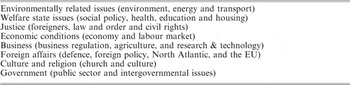
For the empirical analysis, we developed the eight ‘issue groups’ presented in Table 1. The aggregation was based on the typology of issue characteristics developed by SorokaFootnote 45 and is similar to the typology used by Walgrave et al.Footnote 46 The first two issue groups are thus dominated by sensational issues such as the environment, transport (accidents etc.), law and order and immigration-related issues. The issue groups ‘economic conditions’ and ‘welfare state issues’ are both dominated by prominent issues, like the state of the economy or health care issues, whereas the latter four groups are all ‘governmental’ issues. These issues involve little drama and few tangible consequences for the public in general.Footnote 47 As will be argued below, these issue groups also differ with regard to issue ownership in Danish politics and thus allow us to analyse both the role of issue characteristics and issue ownership.
Overview of ‘Issue Groups’

Analytical Design
In terms of design, we proceed in two steps. First, we document that the mass media actually have an impact on opposition party attention. In keeping with Walgrave et al., this is done using a time-series cross-sectional ordinary least squares (OLS) model, which allows us to study the aggregate effects for the eight issue groups.Footnote 48 As the next step, the conditionality of this media effect is studied by focusing on the different issue groups. The time period under investigation is split into two using the respective colours of the government and the opposition. This split illustrates how a change of government/opposition influences the issues to which media attention attracts opposition attention. For this second part on issue variation, we set up a vector autoregression (VAR) model for each of the eight issue groups. Both types of modelling draw on a ‘Granger approach’Footnote 49 to causality by using lagged variables to investigate causality.Footnote 50
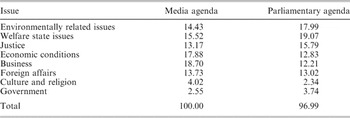
The time unit chosen is one week.Footnote 51 The measures of both the media content and the questions are thus constructed as the share of the total agenda that is devoted to each of the eight issues each week over the twenty years for which we have data. Table 2 presents the average agenda share on both agendas for the eight issue groups.
Mean Share of the Political and Media Agenda for Eight Issue Groups, 1984–2003 (Percentages)

Note: The sum for the parliamentary agenda is less than 100 because the percentage basis includes 28 weeks (3.01 per cent) with no parliamentary activity.
Questions are asked all year round – also during the parliamentary summer recess – though activity is particularly low over the Christmas period and at the opening of parliament in the first week of October. To account for this, a dummy variable for weeks 1, 40 and 52 is included in the analyses. Likewise, a dummy variable is included to adjust for the tendency (especially in the earlier part of the period under examination) for parliamentary activities to grind to a halt during an election campaign and the two weeks following a campaign prior to the convening of the new parliament.Footnote 52
The lag structure chosen for the aggregate model includes five lags for each variable. For models dealing with the relationship between the public and media agendas, the time frame of the effects remains a fairly open question, although somewhere between one and eight weeks appears to be the most commonly applied frame.Footnote 53 As we are intentionally analysing strategically acting politicians in the present context (cf. above) rather than the public, we should expect the time frame to be somewhat shorter, as awareness can be expected to be greater among the former group than among the latter. Five lags have thus been chosen with a view to permitting the full effects to manifest themselves without unnecessarily complicating the models.Footnote 54
Aggregate Media Effects
Aggregate media effects are studied based on a time-series cross-sectional OLS model with panel-corrected standard errors,Footnote 55 where each of the eight issue groups constitutes a panel. The model estimated is of the fixed-effects type.Footnote 56 The estimated models thus assume the following form:

where i indexes issues and t time, while Me and Q are the media content and question variables, respectively. D represents the issue-specific dummy variables that form part of the fixed-effects specification, Y the yearly rhythm of the parliament, and E the election periods. The results of the analysis appear in Table 3.
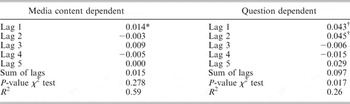
Results of Fixed-effects Panel Regressions of Media Contents and Parliamentary Questions on Each Other, 1984–2003

Notes: *Significant at 0.05, †significant at 0.10, based on panel-corrected standard errors; n = 7,448. Coefficients pertain to the effects of the other variable. The models also included five lags of the dependent variable as well as dummies for each issue and for election periods and low activity periods in parliament; none of these coefficients are shown. χ 2 tests are for the combined significance of all five lags of the independent variable.
Table 3 provides clear support for a ‘mediacratic model’ of agenda setting. Looking at the test for the combined influence of the lagged effects of the questions and media content variables in the equations with media contents and questions, respectively, as a dependent variable, it is clear that only the P-value of the χ 2 test with questions like the dependent variable is significant. Although the first lag of the questions variable is significant in the media contents equation, the combined effect of the media content variable in the questions equation (as reflected in the test of the combined significance of all five lags) is far stronger. In other words, our expectation that opposition attention in routine times is a good setting for studying the conditionality of mass influence is confirmed. Mass media attention has a clear impact on opposition party attention, whereas the opposite effect is much weaker. The next step is to explore the conditionality.
Issue Effects
Based on an issue-characteristic logic, one should expect the strongest media effects in relation to sensational issue groups, i.e. environmentally related and justice issues, weaker on issue groups dominated by prominent issues, i.e. welfare state issues and economic conditions, and no effects on governmental issue groups. To derive expectations from the issue competition logic, one needs information on issue competition and issue ownership in Denmark. Issue competition is generally concentrated around a few central issues where different parties have issue ownership. In Denmark, issue competition in the period studied has been concentrated on issues in the first four issue groups. The macro-economy, the welfare state, the environment, refugees and immigrants, as well as law and order have dominated the political agenda during the period.Footnote 57 In terms of issue ownership, the Danish election studies have traced consistent patterns of issue ownership as regards these central issues. Thus, the Danish electorate has relatively stable views of which parties own which issues.Footnote 58 The left-of-centre parties have generally maintained issue ownership with regard to welfare state issues and the environment. By contrast, the right-of-centre parties have generally maintained issue ownership regarding macro-economic issues, and law and order, as well as foreigners. Furthermore, the issue content of the questions to the minister follow an issue-ownership logic in the sense that parties in particular ask questions about the issue they own in the eyes of the electorate.Footnote 59
Though the issue-ownership data do not completely fit the issue groups developed from an issue-characteristic logic, they come close enough to derive hypotheses about the issue groups on which we should find that media attention causes partisan attention from opposition parties. We would thus expect opposition partisan interest to be concentrated around the issue groups that have dominated party competition, i.e. economic conditions, welfare, justice and environmentally related issues.
However, on which of these issues media attention will actually generate opposition attention will depend on whether the opposition is left-of-centre or right-of-centre. Danish politics is structured as a bloc competition between a left-of-centre bloc consisting of the Social Democrats and left-wing support parties and the right-of-centre bloc dominated by the Liberals and Conservatives. The period studied here can be split into two parts, namely the period 1984–93 with right-of-centre governments – and thus left-of-centre opposition – and the period 1993–2001, with left-of-centre governments and right-of-centre opposition.Footnote 60 We would expect mass media effects to be found in the first period within environmentally related and welfare state issues. When the opposition then shifts to the right-of-centre bloc, we would instead expect media effects to shift to justice and economic conditions.
Compared to the expectations based on issue characteristics, the two literatures concur that the many issues Soroka labels as ‘governmental issues’ in particular should not be characterized by media attention causing opposition attention. The major difference between the two perspectives relates to the expectations about the consequences of changes in the political context. As issue characteristics are stable over time, the issue characteristics of media effects on the attention of opposition parties are also expected to be so. By splitting the analysis in relation to the two periods, it thus becomes possible to distinguish the causes of issue variation in mass media effects. As pointed out above, this is central to a theoretical understanding of the issue variation in media effects on the attention of opposition parties.
As mentioned earlier, the method chosen for the second analytical step is vector autoregression (VAR) modelling. This choice follows such work as that of Bartels and Wood and Peake,Footnote 61 where VAR models are applied when a number of time series are thought to affect each other and where theory does not point to a clear causal structure between the variables. It is therefore impossible to specify the restrictions correctly so as to identify a set of structural equations. As VAR models do not require such assumptions, they are well suited to this type of analysis.
In our case, of course, the variables in question are the two series tracking the share that a given issue group makes up of the media and the parliamentary questions, respectively. Basically, VAR models consist of a number of simple OLS regressions, where each of the variables that are treated as endogenous appear as the dependent variable in one such regression, with lags of itself and the other endogenous (as well as possible exogenous) variables as the independent variables.Footnote 62 In contrast to ordinary least squares (OLS), however, the set of equations is estimated simultaneously, thereby removing the bias that would arise had the regressions been run independently. As in the panel model applied above, we allowed for up to five lags; however, the exact number for each model was adjusted according to likelihood ratio (LR) tests indicating the lowest number of lags making a significant contribution to the model.Footnote 63 The resulting lag lengths appear in Table 4 below. Likewise, the models also included the (non-lagged) dummy variables for the election period and low activity periods in parliament; both were treated as exogenous. As dictated by our theoretical interest, Table 4 presents the results from only that part of the analysis in which the parliamentary questions appear as the dependent variable. Due to the risk of collinearity among the coefficients of individual lags, we only report the sum of the lags and the Granger-style significance tests for the combined effect of all of the lags of the variable in question.
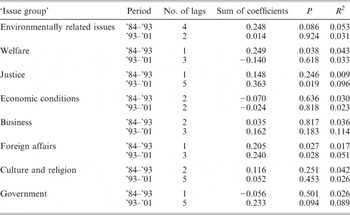
Results of VAR Models. Number of Lags, Sum of Coefficients for Effect of Media Content on Parliamentary Questions, Significance of All Lags Combined, and Variance Explained, 1984–93 and 1993–2001

Note: n ranges from 471 to 460 for each issue group in each period depending on the lag length. P-values are based on Granger-type Wald tests. The models also included lags of the dependent variable as well as dummies for election periods and low activity periods in parliament; none of these coefficients are shown. As part of the VAR framework, simultaneous models with the opposite causal relationship were also run; these models are not shown. The top two issue groups are ‘owned’ by the left-of-centre parties while the following two are ‘owned’ by the right-of-centre parties. The last four groups are not ‘owned’ by any party in particular.
As clearly illustrated in the table, our expectations based on the issue-ownership logic are largely supported. For the first period, with its left-of-centre opposition, media effects of a certain magnitude are present for welfare issues and environmental issues, although the latter is weaker in terms of its P-value. These effects disappear completely in the second period, where the left-of-centre government took office, implying a right-of-centre opposition. In that period, in contrast, justice issues display the expected effect, while economic conditions fail to live up to our expectations. A likely explanation is that the Danish economy boomed in this period, with strongly declining unemployment rates etc., which made it unattractive for the right-of-centre opposition to focus on economic conditions in issue competition. The logic of issue-ownership is that voters consider one party alternative better at handling certain problems, but exactly because Denmark witnessed an ‘economic miracle’ during the latter part of the 1990s, the right-wing issue-ownership of the economy had limited value.Footnote 64
However, surprisingly, the media seem to influence opposition attention to foreign affairs in both periods, just as an effect – though weaker in terms of P-value – pertaining to the running of the public administration (the government category) is found in the latter period.Footnote 65
In sum, the analysis provides clear support for the issue-ownership logic. With the exception of foreign affairs, mass media attention only generates opposition party attention when it is about issues owned by the opposition. When the opposition parties change, so do the issues in which mass media attention generates party attention. Issue effects are thus generally not stable over time, as the issue-characteristic logic would predict; instead, they shift over time in ways that are largely predictable from an issue-ownership logic.
What Have We Learned About The Effects Of The Mass Media On Macro-Politics?
Do the mass media influence macro-politics? In the light of the mediatization of politics, the answer to this simple question has become a central issue for democracy. As Newton points out, however, it is also a question to which the answer is often assumed to be affirmative without much actual research to support it.Footnote 66
The results from this study support this simple ‘Yes’ answer to some extent. In Denmark – and thus outside the American context, where the influence of the mass media on macro-politics has mainly been studied – there is evidence of a significant mass media effect on macro-politics. At the same time, however, this article clearly points towards the political contingency of the mass media influence on politics. With the exception of foreign affairs, opposition parties only react to media attention to an issue if it is an issue they own and thus want to politicize in issue competition with the government, even if it is attention around a sensational issue. In other words, the possibility for mass media attention to generate political attention is limited to issues that fit the strategic interest of political parties with regard to issue competition. At any given time, mass media attention is thus likely to generate significant party political attention only with regard to the few issues playing a central role in issue competition.
Whereas the existing studies of issue variation in macro-political response to mass media attention have attributed these effects to issue characteristics based on a mass media logic – whether they are dramatic, sensational etc. – this article argues that the political ‘fit’ is a central variable in determining whether media attention generates party attention. The analysis above focused on separating these two different reasons for issue variation. However, the two perspectives may not be mutually exclusive. The results above showed – again, with foreign affairs as the main exception – that the issues for which mass media effects on opposition issue emphasis were found were all sensational or prominent issues. In other words, certain issue characteristics may be a necessary condition for mass media attention effects on macro-politics, but the results above clearly showed that they are not sufficient; they must fit the strategic interests of political parties.
From the perspective of both issue characteristics and issue competition, the findings regarding foreign affairs were surprising. Such issues have rarely played a central role in Danish party competition, and are best classified as a governmental issue in a small country context like that of Denmark.Footnote 67 Nonetheless, media attention to foreign affairs issues throughout the entire period generated opposition attention. The most likely explanation is that political interest in foreign affairs in a small country such as Denmark is almost exclusively generated by focusing on events such as EU constitutional negotiations or the killing of a Danish peacekeeper. Such focusing events are reported to politicians through the media. This is in line with studies of media effects on macro-politics in the United States.Footnote 68
The argument about political conditionality clearly points to the limitation of mass media influence on macro-politics in the sense that it indicates the issue competition logic as the central mechanism for understanding the effects of media on party agendas. At the same time, if media attention fits an ‘issue competition logic’, it may have significant policy consequences. In the period studied, several examples of this can be found in Danish politics. In 1986, the media reported intensively on the so-called ‘dead zone’ problems, i.e. oxygen depletion causing fish deaths, in the waters surrounding Denmark, which is linked to a run-off from intensive farming.Footnote 69 As shown above, media attention to environmentally related affairs generally generated opposition attention to such issues, and the media focus on the dead zone problems triggered outcries from the opposition for government action. After a very short decision-making process, this resulted in a 2 billion DKK plan to combat the problem – one of the most spectacular policy decisions in Denmark.Footnote 70 A similar example from the 1990s is how media attention to crime generated opposition demands for action, to which the government quickly responded with changes in the criminal code in the direction of longer sentences, etc.Footnote 71 In other words, mass attention may have very significant policy consequences if it fits the issue competition game of politics.
The argument and findings of this article merely represent a first step in exploring the conditionality of the effects of the mass media on macro-politics focusing on the political conditionality. Empirically, this article has focused on opposition reactions to media attention. The focus on the opposition was based on the argument that opposition parties react with words, whereas government parties must react with policy measures, which renders opposition reaction more likely.Footnote 72 Government parties also have opportunities for more symbolic reactions, and studying them may offer a means for further investigation of the political conditionality of mass media influence on politics. Based on the existing literature, one could expect government parties to be less responsive to media attention, but when government parties do respond, the political conditionality logic of this article is expected to apply to the responses. Government parties thus face the same incentives as those in opposition to try to politicize favourable issues.
Studies of the attention to politics paid by the mass media must generally be combined with a theoretical understanding of the role of different actors and institutions in political competition. Whereas American researchers have started exploring the effect of the media on different political institutions,Footnote 73 such questions are almost completely unexplored in a parliamentary context. Furthermore, as shown by Hallin and Mancini,Footnote 74 media systems vary substantially across countries; how this affects the nature of the effects of mass media attention on macro-politics remains almost completely unknown, however.
For the broader debate regarding the role of mass media in politics, the clear finding of the political conditionality of mass media influence indicates that the power of the mass media in contemporary politics is more limited than is often assumed. Mass media attention to an issue is a powerful force in contemporary politics, but understanding the conditionality of media power is crucial. In this regard, the fact that this study points to a party political conditionality is central. It has been customary to view political parties and party politics as being of declining relevance for understanding contemporary West European politics.Footnote 75 This declining relevance is often related to the increasing power of the mass media,Footnote 76 which is commonly perceived as almost being a fact of contemporary politics.Footnote 77 This study, however, shows that party politics remains crucial for understanding the dynamics between the mass media and politics. In such agenda-setting processes, which are often considered to be of increasing political relevance, party politics plays a key role. So far, however, this role has not been explored to any great extent.