INTRODUCTION
Scholars ranging from Max Weber to Pierre Bourdieu have emphasized the prominent place of lawyers in the modern state (Weber Reference Weber1978; Bourdieu 1987; Reference Bourdieu2015, 52–55, 264–77; Dezalay and Madsen Reference Dezalay and Madsen2012). These accounts contrast with the Latin American experience, where the legal profession was displaced from key positions of public governance by the mid-twentieth century (Steiner Reference Steiner1971, 59; Babb Reference Babb2001, 186; Pérez-Perdomo Reference Pérez-Perdomo2006, 117). Writing about Brazil and Chile, Yves Dezalay and Bryant Garth (Reference Dezalay and Garth2002, 36) note that, during the twentieth century, “the prestige of the judiciary and law professors … declined as they came increasingly to seem anachronistic and out of touch with the expertise necessary to promote economic progress.”
The reasons for this development are not self-evident. The emergence of the administrative state between the 1930s and 1970s provided superb opportunities for the placement of legal professionals within the growing public bureaucracy. Law schools remained an important source of recruitment for political movements, producing partisan cadres who entered the increasingly demanding electoral competition (Lomnitz and Salazar Reference Lomnitz, Salazar, Dezalay and Bryant2002; Pérez-Perdomo Reference Pérez-Perdomo2006, 119). So why did law graduates lose professional authority in the political sphere during this period? While Dezalay and Garth and others have called our attention to this phenomenon, none have made it their primary object of inquiry. Using Chile as a case study, this article examines how and why lawyers lost authority in public governance in mid-twentieth-century Latin America. I show that the emergence of the administrative state resulted in the gradual separation of the state and the legal field, reducing elite lawyers’ sphere of professional jurisdiction and producing diverse political constraints on legal institutions.Footnote 1
Until the early twentieth century, elite law graduates guided the nation-building process in several countries of the region during a period dominated by aristocratic politics (Dezalay and Garth Reference Dezalay and Garth2002). Lawyers held jobs related to the exercise of public power in cabinets, legislatures, and agencies (the state field) and performed what we usually define as juridical tasks: adjudication, litigation, counseling, and law teaching (the legal field). In so doing, they participated simultaneously in two sets of institutional networks. Since the early 1930s, however, harsher electoral competition, more diverse political actors, and widespread demands for material welfare led to the reorganization of governmental labor, calling into question the well-established role of elite lawyers. Increasingly, people without legal training held political office. Meanwhile, law graduates’ professional paths began to diverge between those in the legal field and those in the state field. Additionally, contingent on different constraints associated with the political conditions of the period—such as the lack of robust private markets demanding legal services, lawyers’ dependence on partisan links, and the executive’s attacks against the judiciary—legal actors were unable to take bold stances or be politically consequential. As a result, lawyers lost authority in public affairs.
Chile offers a valuable case study to understand this phenomenon for at least three reasons. Lawyers in this country performed a critical role in statecraft during the nineteenth century, but, by the 1960s, they regularly complained about their displacement from public governance (Lowenstein Reference Lowenstein1970, 60–64). The country’s small size allows for a relatively exhaustive analysis of the actors involved. Furthermore, the absence of military dictatorships during most of the period eliminates possible distortions associated with authoritarian politics (Pérez-Perdomo Reference Pérez-Perdomo2006, 117, 119).
This article unfolds as follows. First, I set out my theoretical framework, drawing on Weber’s concept of political modernization and other relevant scholarship. Second, I present my research design, which employs Pierre Bourdieu’s perspective on the state and the legal field. Third, I explain how the small Chilean elite used legal training to professionalize statesmanship in the nineteenth century and how the rise of the administrative state created incentives to differentiate legal and political tasks in the early twentieth century. Fourth, I show how governmental labor split up between 1932 and 1970, employing evidence drawn from a longitudinal analysis of Chilean elite law graduates who held influential positions within the state and the legal fields. Fifth, I explore how legal institutions faced growing constraints from political actors during this period, like the Chilean Bar Association Board’s (CHBA) dependence on partisan networks and several political attacks against higher courts. Finally, I present findings confirming that the new regime triggered the gradual separation between the state and the legal sphere, which was a result not only of the emergence of professional competitors but also of the differentiation of law graduates who operated in the legal system and those who held political roles. The findings also show how political constraints on legal institutions weakened their authority, producing a bar with little influence over policymaking and courts that avoided controversial issues.
THE STRUCTURAL DIFFERENTIATION OF LEGAL INSTITUTIONS: A PERSPECTIVE FROM LATIN AMERICA
This study’s methodology integrates Weber’s idea of modernization as theoretical scaffolding and Bourdieu’s concept of fields to evaluate the positions of elite lawyers within state politics. I also draw on recent sociolegal scholarship on the legal profession and politics, including Dezalay and Garth’s (Reference Dezalay and Garth2002) study of the transformation of state expertise in Latin America and Terence Halliday’s (Reference Halliday1987) work about the authority of the organized bar. Weber and Bourdieu concur on the prominent role of lawyers as institution builders from about the thirteenth century onward, highlighting lawyers’ ubiquitous participation in self-governing cities, courts, and parliaments. Under different professional configurations, law graduates contributed in rationalizing power, creating the polity as a juridical fiction and formalizing an official political discourse (Martines Reference Martines1968; Weber Reference Weber1978, 775, 792; Bourdieu Reference Bourdieu1987). Analyzing some nineteenth-century Latin American countries, Dezalay and Garth assert that some lawyers advanced beyond the traditional models of clerks, judges, and attorneys in courts and became what they label “gentlemen politicians of law.” Upper-class lawyers employed generalist juridical expertise as practical wisdom for social and political leadership and became intermediaries for landed aristocracy, miners, and merchants (Dezalay and Garth Reference Dezalay and Garth2002, 18–22). Although comprising only a minor portion of law graduates, they exerted immense influence in governmental practice, academics, and business.
The gentlemen politicians of law’s jurisdiction do not fit the dichotomy between technical or moral authority employed by Halliday (Reference Halliday1987, 37–41). Although they centered their professional identities on the law, their work blurred the boundaries between social pedigree, legal expertise, and politics. Usually, their patrician social origins granted them access to political circles. More than other academic credentials available at the time, such as degrees in theology or the humanities, the law degree served to certify practical knowledge for public affairs and political economy. A law degree also provided technical knowledge for constitutional and legislative design, providing terms and concepts that were critical in the first steps toward nation building. As a result, these elite law graduates had distinct advantages over nonlawyers in the competition for state responsibilities (Pérez-Perdomo Reference Pérez-Perdomo2006, 89–98). Most of those gentlemen politicians of law were officeholders in the upper reaches of both the state and the legal field throughout their lives.
Why were elite lawyers displaced from critical positions of public governance in Latin America by the mid-twentieth century? Scholars have not directly considered this question. Some studies underline the rise of professional competitors, such as economists and social scientists, who comprised the core of a new technocracy that mastered better skills to deal with material progress (Babb Reference Babb2001; Dezalay and Garth Reference Dezalay and Garth2002; Silva Reference Silva2009). But, in focusing their attention on these new competitors, these authors fail to adequately describe other factors that explain the decline of legal professionals. Addressing this process of displacement, this article builds upon different insights on the later phases of modernization that Weber anticipated toward the end of his life. He warned presciently about the end of aristocratic, patrimonial regimes and their replacement by a new sort of polity that coincided with what we would conventionally call the administrative state. Following a kind of structural differentiation, two contradictory trends characterized the polity: (1) a growing public apparatus dominated by trained bureaucrats who performed their tasks to enhance the institutional capacity of the state’s administrative agencies and (2) increasing electoral competition led by professional politicians whose power derived not from inherited social status but, rather, from their ability to mobilize mass political parties (Weber Reference Weber, Gerth and Wright Mills1946, 77–128). Weber also asserted that the formal rationalization of law would evolve into a clear and consistent system of rules, embodied in gapless juridical codes and procedural routines that would serve as expertise for social ordering. In the evolution, Weber proposed, legal institutions would tend to conform to the specific bureaucratic model separated from lawmaking, insofar as it matched the ideal of legal rationalization and impersonal authority (Trubek Reference Trubek1972, 739; Weber Reference Weber1978, 775–76, 1404; Halliday Reference Halliday1987, 25–26). The transformations that Weber envisioned are key for understanding the political decline of these gentlemen politicians of law in Chile.Footnote 2
Other scholarly research, such as Dietrich Ruschmeyer’s (Reference Ruschmeyer1973) comparative study on German and American lawyers, describes how the authority of the legal profession varied according to distinct political contexts and the possibilities of collective action. Ruschmeyer identifies two basic models: a state-oriented legal profession and a market-oriented one. In Germany, the Prussian state controlled the legal institutions to curtail aristocratic influence, surveilling juridical training and professional associations, routinizing legal tasks, and filling the posts of the legal system on merit. Such a centralized political surveillance produced a state-oriented legal profession highly incorporated into the public apparatus. In the US context, conversely, the American Bar Association kept a high level of autonomy, thanks to the fragmentation of state power and the dynamism of internal markets, which allowed it to orient its work toward private practice. We also find in the United States some evidence of lawyers’ discomfort because of the influence wielded by business corporations and a significant level of conflict within the profession during the New Deal years (Hofstadter Reference Hofstadter1955, 152–58; Shamir Reference Shamir1995). Although individual lawyers are no longer considered the high priests of politics, the profession has preserved a significant degree of political influence (Glendon Reference Glendon1994; Kronman Reference Kronman1995). Halliday’s (Reference Halliday1987) study on the Chicago Bar Association, which was playing a considerable role in Chicago politics by the mid-twentieth century, is a remarkable example of a different process in the construction of rational professional authority.
During the structural differentiation of governmental practice in Chile in the mid-twentieth century, the legal profession fit neither the state-oriented nor the market-oriented models of the growth of legal influence in politics. The upper reaches of the bar needed partisan links to advance its position within the administrative state but lacked the independence provided by robust private markets or the security offered by the status of full civil servants. The judiciary, initially controlled by aristocratic lawyers, bureaucratized in response to political attacks coming from a strong executive branch. Legal institutions operated under constraints that hindered their scope of action, which, in addition to the process of dividing up governmental labor, contributed to their dwindling authority in public governance.
Other Latin American countries experienced similar developments with variations in timing and scope. For instance, in Brazil, elite lawyers lost influence in the late 1960s due to conflicts with new competitors in statecraft like economists and sociologists (Steiner Reference Steiner1971). In Mexico, groups of generalist lawyers linked to the Institutional Revolutionary Party, known as camarillas, also saw their influence gradually ebb (Sepúlveda Reference Sepúlveda1979; Dezalay and Garth Reference Dezalay and Garth1997, 127; Babb Reference Babb2001, 186). Footnote 3 These cases do not fit existing models of legal authority in statecraft, which scholars have derived from the experiences of lawyers in Germany and the United States. They show the need for a new model, one derived from the experience of legal professionals in Latin American politics.
METHODOLOGY
This article employs Bourdieu’s concept of field as a strategy to figure out how the upper echelons of law and the state diverged (Swartz Reference Swartz1997, 117). This enables me to study the different roles that lawyers held throughout their lives, which is fundamental for the theory put forth by this work. It also allows me to assume that law graduates compose a kind of hierarchical network where not all have the same influence and political status, which is critical because this study observes only individuals at the uppermost section of each field.
I conducted a longitudinal analysis of Chilean elite law graduates who held the most influential positions within the state and the legal field between 1830 and 1970. The aim of this inquiry was to observe the separation of political duties from the juridical tasks during the period of the administrative state (1932–70). For that purpose, I limited my inquiry to persons who received a law degree enabling them to practice law (Licenciado en derecho) and, additionally, to persons who fell into at least one of the following categories: (1) acted in Congress as a senator; (2) took part in the Cabinet of Ministers; (3) were on the Board of the CHBA (Chilean Bar Association or Colegio de Abogados); and/or (4) were justices in courts of appeals and the Supreme Court (excluding pro tempore judges, called abogados integrantes). I supplemented data from several published datasets on the Chilean political elite and the judiciary with records collected through archival research from the CHBA, the National Archive of Administration, and the Chilean Institute of Genealogical Research (Figueroa Reference Figueroa1928; Hilton Reference Hilton1947; Valencia Reference Valencia Avaria1986; de Ramón Reference De Ramón1999; Bravo Lira Reference Bravo Lira2011). I reviewed more than two thousand biographies and studied three selected samples of individuals who met the previously mentioned characteristics: 416 members of the Senate and the Cabinet of Ministers, 745 justices on higher courts, and 105 members of the Board of the CHBA.
I coded each biography to capture any important responsibilities they held within both fields to compare their career paths. As participation in the state field, I included involvement in the country’s presidency, the Chamber of Deputies, the Senate, the Cabinet of Ministers, municipalities, high bureaucratic offices, diplomacy, high courts, and any position held in state commissions. As participation in the legal field, I included work in the judiciary, law schools, corporate practice, litigation, boards of the CHBA, and legislative committees as well as their contributions to legal literature. Additionally, I coded for political party and social class. I have used the codes quantitatively to measure the degree of engagement within each field shown by the law graduates in the Senate or the Cabinet of Ministers (Figure 3). As I explain in Appendix 1, the coding was intended to ascertain the level of relevance wielded by every individual in each field, assigning a score according to the influence and duration of every office they held throughout their lives. Adding up these scores, I then elaborated a state field index and a legal field index for every individual in the sample. Thus, Figure 3 attempts to observe graphically how the state and legal fields diverge by comparing the career paths of these law graduates. To complement this line of inquiry, I studied a range of primary sources, such as speeches, archival testimonies from the CHBA, legislation, and periodicals. I also used secondary literature to illustrate the context and examples of the behavioral patterns shown by legal institutions.
FROM THE ARISTOCRATIC POLITY TO THE ADMINISTRATIVE STATE
“No other profession trains in this manner for the government of the people,” asserted the senator and noted public speaker Enrique MacIver during a ceremony marking the establishment of the Lawyers’ Institute of Santiago in 1915. He underscored how the knowledge and personal attributes that emerged from performing juridical tasks were “not only a necessary condition for the management of public affairs, but also a guarantee of wise decision-making in such a high office” (Instituto de Abogados de Santiago 1915, 9). The composition of the institute’s Board corroborates MacIver’s account. Among the eighteen members of the Board were two future presidents of the republic (Pedro Aguirre Cerda and Juan Esteban Montero); the chief justice of the Supreme Court (José Gabriel Palma); a mayor of the capital (Ismael Valdés Vergara); three senators in office (plus five future ones); four deputies (representatives) from the Lower Chamber of Congress; twelve professors of law (including the outstanding legal scholars Luis Claro Solar and Raimundo del Río); and seven future Cabinet ministers (Instituto de Abogados de Santiago 1915, 4; de Ramón Reference De Ramón1999). In the early twentieth century, lawyers held a quasi-monopoly on statecraft.
In Chile, as in other Latin American countries, lawyers occupied a preeminent position in state building after independence. Historical and sociolegal literature has identified several reasons for this role (Barman and Barman Reference Barman and Barman1976; Mirow Reference Mirow2004, 122–27; Pérez-Perdomo Reference Pérez-Perdomo2006, 94–98). First, juridical knowledge provided a valuable epistemological canon for the management of public affairs. The new republics needed a significant effort at even the most fundamental level of institutional design, and legal professionals were well positioned to navigate through the disarray of remaining colonial regulations. Second, law schools and legal practice cultivated social networks and political skills that allowed lawyers to evolve smoothly into active players within the ruling group. Finally, a law degree could bestow economic stability and social status. If law graduates were well connected within the landed elite or other affluent groups, such as miners and financial businessmen, they could earn a comfortable living. At the same time, like the military and the priesthood, legal careers held social prestige, a tradition that hailed back to the colonial era. Thus, legal studies attracted the attention of young men more than other areas like engineering or the natural sciences (Serrano Reference Serrano1994, 168–78).
Moreover, in the Chilean case, political conditions explain why lawyers played such a key role. The country’s geography and the structure of the local elite seems to have led to the early onset and relative success of state building in Chile. Like other fledgling republics in Latin America, it lacked religious dissent and a manorial past, which was conducive to building a centralist government. Chile also possessed one of the most homogeneous elites in the Spanish-speaking world, and the predominantly agricultural labor carried out on rural estates was organized around land tenancy agreements called inquilinaje, which allowed agrarian landowners to not have to rely on local military force to control economic production. Overall, the aristocracy’s main ideological disputes were not driven by regional rivalries fed by economic fragmentation or military caudillismo nor by intense mass mobilization. On the contrary, Chile quickly handled divisive political issues, such as secularization, within the small ruling group characterized by the supremacy of agrarian landlords located in the Central Valley, avoiding the graver conflicts that erupted in other young Latin American republics (Kurtz Reference Kurtz2013, 61–73, 86).
A stable political environment and relative collaboration within the local elite provided opportunities for lawyers, who evolved gradually from performing clerical functions during colonial times to being political power brokers during the development of the republic. They reformed the old authoritarian order progressively, establishing a liberal regime under the control of Congress. By the mid-nineteenth century, Chile was an aristocratic polity dominated by lawyers (Dezalay and Garth Reference Dezalay and Garth2002, 18–22).
Most law graduates who became part of the ruling class in this period were members of upper social groups who employed legal training to professionalize their statesmanship. The historian Sol Serrano explains that, of the 1,128 law graduates from the University of Chile between 1843 and 1879, 277 held public office, and most of this group came from the patrician echelon of society (Serrano Reference Serrano1994, 177). A socioeconomic analysis of the Senate between 1834 and 1924 confirms Serrano’s interpretation. Of the 292 individuals who served as senators for more than one year, 151 were lawyers or legal scholars (such as Andrés Bello). Of this group, 127 (84 percent) belonged to socially and/or economically affluent groups, coming from the landed aristocracy (52 percent, n = 79), minor gentry (28 percent, n = 42), or high commercial bourgeoisie (4 percent, n = 6). Only nineteen lawyers in the Senate (12 percent) were outsiders who, after marital arrangements, business success, and political socialization, were frequently accepted into the ruling classes. Footnote 4 The leaders of the most important political groups during the period, such as the Conservative, Liberal, and Radical parties, were lawyers from aristocratic families (Figueroa Reference Figueroa1928; Valencia Reference Valencia Avaria1986; de Ramón Reference De Ramón1999).
The preeminence of the aristocratic lawyers’ role can be appreciated through their overlapping roles in the state and legal fields. Several of the most influential political leaders of this period held positions in the highest reaches of law, such as higher courts and the leading law schools (the University of Chile and, later, the Catholic University, among others). For instance, all eleven Cabinet ministers during Federico Errázuriz Zañartu’s government (1871–76) were graduates of the University of Chile’s School of Law, and 70 percent of them previously held positions at courts and in legal academia. Zañartu himself was a law graduate with experience as a lecturer in the law school. The influential jurists Andrés Bello, Luis Claro Solar, and Jorge Huneeus were in the Senate as well. Likewise, prominent political leaders occupied key slots in the judiciary, such as President Manuel Montt and the liberal patriarch José Victorino Lastarria. Noted practitioners such as Manuel Antonio Tocornal, Antonio Varas, and Eleodoro Yáñez led Congress. Footnote 5
Besides the dominance of aristocratic politics, some institutional features help explain these overlapping functions. Congress was ordinarily in session only three-and-a-half months per year, which allowed the representatives and senators to carry out other activities that, unlike political offices, were paid positions. For instance, congressional functions were compatible with judicial posts until the 1880s, and law graduates frequently used their position in Congress to secure a law school professorship. As of the 1870s, elite lawyers who occupied political positions and held social and economic networks led a dynamic set of small law firms associated with the nitrate industry, copper mining, and banking (Serrano Reference Serrano1994, 173–74; de la Maza Reference De la Maza2002).
By the turn of the twentieth century, the coupling of the state and the legal field reached its zenith. Over the next two decades, however, poverty, lack of housing, and poor health conditions, among other matters, undermined the initial process of modernization. The resulting turmoil ended the aristocratic polity in the mid-1920s, and, in its place, an administrative state arose that was better equipped to grapple with the social issues that had unleashed the crisis (Ibáñez Santa Maria Reference Ibáñez Santa María2003; Henríquez Reference Henríquez2014). Distinctive elements of this new regime, called the Estado de Compromiso, allow us to understand the conditions under which the gradual structural differentiation of legal institutions occurred.
First, the Estado de Compromiso was built on political alliances determined by the predominance of the middle class and urban population, which were generating increasingly greater electoral competition and mobilization. In this new regime, centrist parties controlled the executive branch and Congress and continuously bargained with each other to satisfy their constituencies’ demands in areas such as price and salary fixing (Ibáñez Santa Maria Reference Ibáñez Santa María2003). The different coalitions led by the Radical party, which alternatively maneuvered between Communist support and the political right to reach the presidency three consecutive times (1938–52), make up the most paradigmatic cases. Beyond the electoral landscape, the administrative state was also able to integrate business associations and labor unions into the boards of economic agencies, developing a kind of cooperative capitalism in which the businesses and unions participated in policymaking (Collier and Collier Reference Collier and Collier2002, 16–17; Schneider Reference Schneider2004, 154–62). In so doing, members of labor, professional, and business associations were usually identified along partisan lines (Henríquez Reference Henríquez2014).
Second, the regime rested on a broad consensus about the policies of the welfare state and the protection of national industry. Since the early 1930s, several state-run agencies began to provide social services directly in areas like health, public instruction, and housing (Urzúa and García Reference Urzúa Valenzuela and García1971). Footnote 6 Later, a new phase of the consensus emerged around planning and economic protectionism. The state created the National Development Corporation in 1939, which became the cornerstone of the entrepreneurial state by articulating a complete strategy of industrialization that established several public companies in fields like electricity, sugar, and oil. The state levied protectionist tariffs on foreign products to privilege the national private manufacturers that were industrializing the country and to satisfy the urban constituencies’ demands for work and products (Ibáñez Santa Maria Reference Ibáñez Santa María2003, 190–200; Silva Reference Silva2009, 84–110).
Finally, the new regime also bolstered presidential authority to better implement its new set of policy preferences. To address the inability of the previous period of parliamentary politics to respond to social crises, the Constitution of 1925 granted the president substantial control over the lawmaking agenda. Simultaneously, the new Constitution gave the executive branch the power to appoint Cabinet members and nominate high justices from a pool of candidates proposed by the Supreme Court (Guerra Reference Guerra1929, 24–30).
The emergence of the Estado de Compromiso gradually widened the structural differentiation between legal and political tasks. Government labor diversified because of harsher electoral competition and more complex administrative management. At the same time, slow economic growth associated with economic protectionism, the close links between guilds and partisan politics, and the strengthening of executive authority constrained the bureaucratization of legal institutions.
The Displacement of Chile’s Lawyers: Analyzing the Data
By the mid-1960s and early 1970s, lawyers resented their displacement from the key positions of public governance. In 1972, the dean of the Catholic University’s School of Law, Guillermo Pumpin (Reference Pumpin1972, 10–11) wrote: “At the beginning of the [twentieth] century, lawyers were always placed in the top rank of social prestige, but now they are in the middle ground or even below. … The primacy of the engineer, the physician, the psychologist, the sociologist, the economist over the lawyer is overwhelming.” In the same vein, the prominent professor and lawyer Eduardo Novoa Monreal (Reference Novoa Monreal1968, 5–6) asserted: “The time in which the jurists were who most influenced the government is gone. Nowadays, the government is led by men of different origin…. They have been [the ones] who have carried out the social and political transformation, dragging behind the juridical structures.” These and other sources from the 1960s and 1970s highlight the displacement of lawyers from the process of governance (Orrego Vicuña Reference Orrego Vicuña1970; Silva Bascuñán Reference Silva Bascuñán1972, 53–68; Tomassinni Reference Tomassini1972, 19–68). The following part examines the profiles of those who led the state and juridical fields to explain how their professional paths began to separate.
A Look at the Political Forums
Biographical accounts of those in charge of public affairs provide information about the significant role of elite lawyers during the initial stages of the Estado de Compromiso. In fact, the career paths of the regime’s first presidents, Arturo Alessandri Palma and Pedro Aguirre Cerda, reflect the traditional course taken by the gentlemen politicians of law at the turn of the twentieth century (de Ramón Reference De Ramón1999, 1: 31–32, 51–53; Dezalay and Garth Reference Dezalay and Garth2002, 21–22). Law graduates also dominated the few debates within the subcommission that wrote the draft for the 1925 Constitution (Bernaschina and Pinto Reference Bernaschina and Pinto1945). Elite lawyers held a significant and steady share of positions in the Senate and the Cabinet of Ministers through the 1930s.
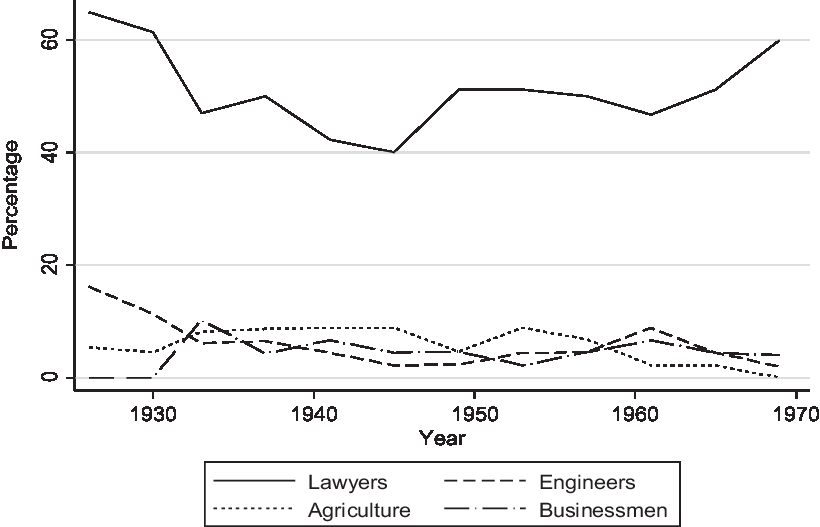
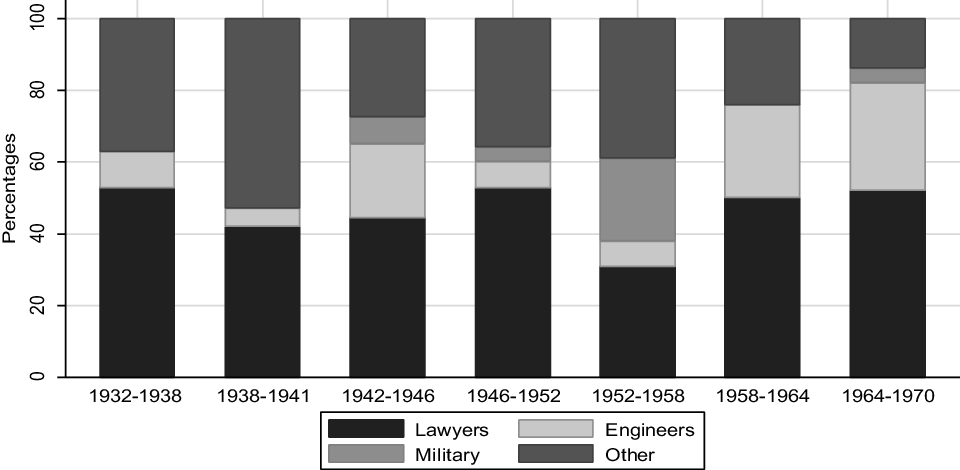
After this point, however, lawyers became less important in the Chilean government. Figure 1 illustrates a drop in their presence in the Senate around the mid-1940s, even when no other professional group had a similar percentage of seats in Congress. Similarly, Figure 2 shows that the presence of lawyers in the Cabinet of Ministers abruptly decreased by the early 1950s. In effect, during the second administration of Carlos Ibáñez, their participation dropped to 30 percent and then rose again to 50 percent in the next few years. At the same time, the analysis regarding the Cabinet of Ministers illustrates how engineers, who previously were almost absent from politics, gained authority beginning in the late 1950s.
The Senate, 1925–69: an occupational profile. Source: Valencia Reference Valencia Avaria1986; de Ramón Reference De Ramón1999.

The Cabinet of Ministers, 1932–70: an occupational profile by presidential periods. Source: Valencia Reference Valencia Avaria1986; de Ramón Reference De Ramón1999.

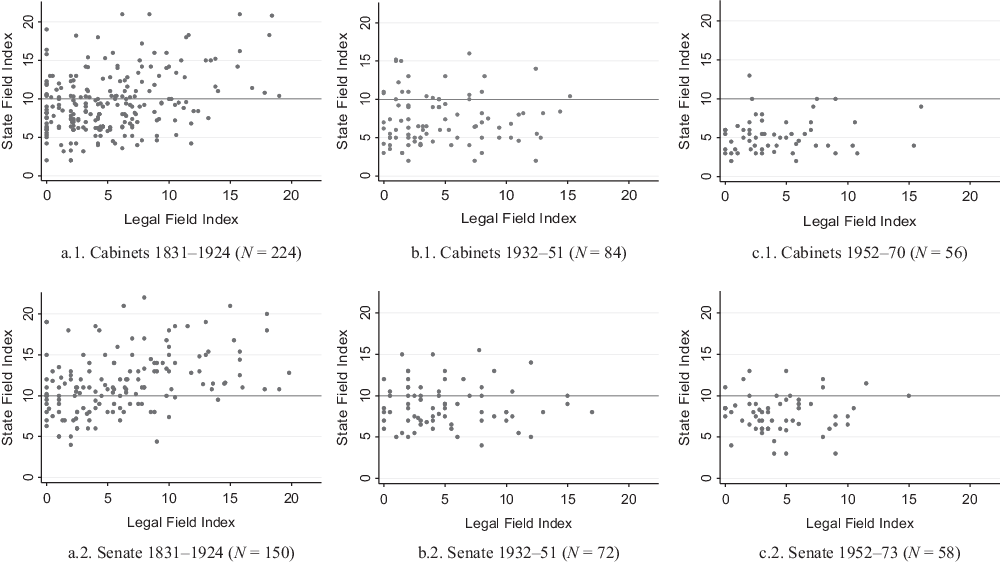
The decoupling of the state and the legal field: law graduates’ profiles at the Cabinets of Ministers and the Senate.

The evidence also reveals a clear differentiation between those law graduates who performed proper legal functions and who followed a political track. By analyzing the profiles of the entire cohort of law graduates who took part in the Senate and who were cabinet ministers, Figure 3 reveals how their professional paths slowly split. By crafting a particular quantitative indicator, each axis of the graphs cumulatively added up the life-long power positions of every single law graduate within the sample (considering both the duration and relevance of such responsibilities). For instance, the state field index at the axis y adds up all of the posts and opportunities in which every individual participated in governmental structures (for example, the Chamber of Deputies, the Senate, Cabinets, diplomacy, and bureaucracy). Likewise, the legal field index at the axis x reflects their roles in the juridical system (for example, judgeship, the legal academy, legal literature, the organization of the bar, and legal practice). Through such a study of politically relevant lawyers (N = 416), a bivariate graph illustrates the concentration and density of the relations between the state and legal fields during particular periods of democratic rule: the regime of aristocratic polity (1831–1924), the initial years of the Estado de Compromiso (1932–51), and the gradual political polarization during the Cold War years (1952–70). From a long-term perspective, the historical sequence illustrates the gradual change in the profile of lawyers in these traditional forums of national politics.
A detailed analysis of how these profiles evolved demonstrates the change in the relations between the state and legal fields. Before 1924, there was dense interaction, characterized by the persistent participation of patrician law graduates at the highest levels of politics (Figure 3, a.1 and a.2). Usually, they were simultaneously engaged in juridical tasks. As explained previously, several gentlemen politicians of law were officeholders at higher courts until the end of the nineteenth century, when Congress banned dual office holding for political and judicial posts. Footnote 7 Likewise, many were scholars in subjects like civil law, Roman law, and procedure. The most outstanding jurists and legal scholars of the time, who worked on legislative codification, constitutional reform, and the elaboration of the first commentaries to the codes, were present in these political settings. Footnote 8 Moreover, biographical accounts show that several of them were committed to extensive legal practice fostered by the nitrate-mining boom that began in 1870. Footnote 9 Finally, elite attorneys involved in politics also made a significant contribution to the efforts aimed at organizing the CHBA in Santiago and Valparaiso and at the nationwide level. Footnote 10 Even when we can also observe in this sample the presence of lawyers with a lower political profile around the 1900s, or law graduates in politics who did not perform a specific juridical activity, these cases do not alter the general pattern of a dual agency that was explained previously.
Between 1932 and 1951—the initial years of the Estado de Compromiso—we can observe a different stage (Figure 3, b.1 and b.2). In comparison to the previous period, these law graduates accumulated less state power (y axis), a phenomenon probably associated with greater electoral competition, professional diversification, and the growing pool of people possessing legal training. Beginning in the 1930s, law graduates were increasingly middle class. Other elements of their profiles changed significantly as well. Aside from a few cases of law graduates who went into politics after they had retired from the judiciary, practically no law graduates who entered politics had experience on the bench. A small number performed minor judicial tasks as clerks and as officials when they were young and at the very beginning of their careers or worked temporarily as pro tempore judges (abogado integrante) at high courts, collaborating on judicial panels. As I explain below, judges were formally excluded from partisan politics after the late 1920s, and judicial duties of any kind became rare among the profiles studied. Likewise, the law graduates included in the analysis were less involved in the legal academy and the production of legal literature, and what they did produce was mostly related to secondary legal disciplines such as mining law. Following the same tendency, lawyers involved in traditional forums of politics tended to be gradually replaced by full-time practitioners from the boards of the national bar. To sum up, these years reveal a whole new set of profiles.
Finally, the last period under analysis, between 1952 and 1970, represents a further step in the progressive disengagement between the state and legal fields (Figure 3, c.1 and c.2). Comparatively, profiles both in the Cabinets of Ministers and the Senate indicate that law graduates accumulated still less state power, and those individuals permanently committed to politics were usually party men who did not lead the legal field. There is no significant judicial experience, and their participation in legal scholarship seems unimportant. Although some lawyers such as Julio Philippi, Víctor García Gárcena, and Patricio Aylwin taught in traditional legal subjects, only Aylwin produced substantial contributions to legal literature (de Ramón 1: 119–20, 2: 140, 3: 144). Likewise, their engagement within academia was considered inconsequential, often in alternative areas such as political economy (for example, Alberto Baltra and Humberto Enríquez Frödden [1: 132, 2: 53–54]). Overall, their contributions were mostly essays and minor works. Similarly, the evidence shows that, aside from the exceptional case of Pedro Jesús Rodríguez who went from being president of the CHBA to secretary of justice in 1964, they were not involved in the organization of the bar. Footnote 11
Indeed, circumstances related to the organization of the executive branch help to explain this last phenomenon. The three governments of the period (1952–70) rejected the traditional model of pragmatic politics where elite lawyers had thrived. Colonel Carlos Ibáñez’s rule (1952–58) relied heavily on the military, and many lawyers in his administration came from minor bureaucratic cadres. Jorge Alessandri’s administration (1958–64) portrayed itself as a “managerial government,” initially incorporating lawyers from the private practice sector. A growing lack of support at the end of Alessandri’s government made room for politically skilled law graduates from the Radical party (Ibáñez Santa Maria Reference Ibáñez Santa María2003, 345, 364; Silva Reference Silva2009, 108). Eduardo Frei Montalva’s government (1964–70) proposed substantial structural transformations, such as agrarian reform, following the advice of renowned technocrats from the fields of economics and sociology. Although young law graduates were asked to join Frei Montalva’s Cabinet, they explicitly resented the loss of influence to a technocracy that guided decision-making in settings such as the Economic Committee, which was established to design and coordinate critical public policies (Silva Reference Silva2009, 122–27).
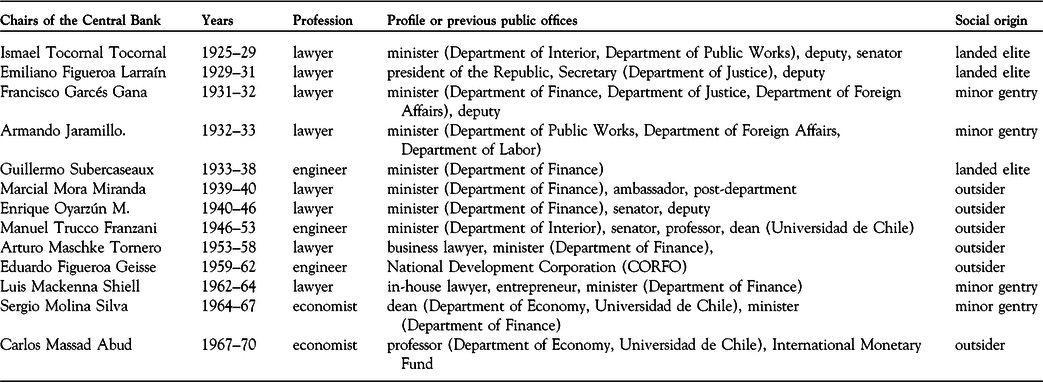
The waning influence of lawyers is also perceptible in the entrepreneurial state and in the administrative agencies that structured the new regime. For instance, a substantial number of lawyers who acted in Congress, the Cabinet of Ministers, and the Board of the CHBA were legal counsels (fiscales) from public and semi-public corporations, usually during the period in which they were politically active. They were instrumental as power brokers for diverse groups of interests, reframing legal structures to isolate these companies from centralized legal control in the 1930s and the early 1940s. Footnote 12 Such is the case of Pablo Ramírez (Nitrates Sales Corporation), Juan Antonio Ríos (Mining Credit Fund), and Osvaldo Hiriart (National Development Corporation), among many others. However, in-house lawyers with low political profiles and a focus on everyday legal affairs replaced them after the early 1950s. Footnote 13 We can observe a similar shift in several economic and regulatory bureaus. There, gentlemen politicians of law were gradually replaced by specialized in-house lawyers or members of other emerging professions, such as engineers and economists, who came from more diverse social backgrounds. Table 1, which looks at the chairs of the Central Bank, provides an illustrative example of such an evolution.
Chairs at the Central Bank

Notes: Individuals identified as professors perform such tasks in the department related to the area of their profession unless otherwise indicated. Outsiders imply middle-class, commercial bourgeoisie.
Sources: Hilton Reference Hilton1947; de Ramón Reference De Ramón1999; Carrasco Reference Carrasco2009.
Some elite law graduates were aware of their profession’s political decline and became involved in the organization of new academic fields related to public affairs. In 1954, the University of Chile’s School of Law created an Institute of Public Administration, which was headed by outstanding law professors such as Enrique Silva Cimma (Universidad de Chile 1954). The emergence of the field of economics may be the best example of lawyers moving into related fields. Established in 1934, the School of Industrial Economy at the University of Chile was initially led by Pedro Aguirre Cerda, a lawyer who was to be elected president of Chile, and Alberto Baltra, who became the first president of the United Nations Economic Commission for Latin America (de Ramón Reference De Ramón1999, 1: 132–34). Likewise, Julio Chaná, a business lawyer and law professor, transformed the School of Economy at the Catholic University. Between 1954 and 1964, Chaná reorganized the school and signed an academic agreement with the University of Chicago, giving a whole new generation of Chilean students training in neoclassical economic theory (Krebs, Muñoz, and Valdivieso Reference Krebs, Muñoz and Valdivieso1994, 1: 531–34).
The declining influence of elite lawyers, and, in some settings, juridical expertise itself, seemed unmistakable by the 1950s. Even when elite lawyers participated in the first steps of the Estado de Compromiso, the emerging sociopolitical environment would push for a rearrangement in the professional hierarchies of the ruling group. Lawyers ceased to be intellectuals who oriented governments or agents who were able to cover critical areas of the state management. The functional unity of the legal and political tasks had come to an end.
Two Explorations from the Juridical Field
The structural differentiation between the state and legal fields can also be tracked by looking at the main settings where members of the legal profession conducted their activities, particularly the bar and higher courts. This analysis contributes to comprehending the different constraints that affected legal institutions during their differentiation from politics, which constitutes a second cause to understand their dwindling authority.
The CHBA
The story of the organized bar is an example of the diminishing position of legal professionals within the public realm. This illustrates how the constraints that affected lawyers during this process of differentiation, such as their corporative dependence on political networks, contributed to their weak authority. When elite lawyers did not perceive threats to their monopoly on juridical services and access to decision-making, they were not prone to investing their resources in a collective organization. In fact, their attempts to found a national bar association between 1862 and 1868 failed. Footnote 14 Due to the lack of professional competition and a limited supply of legal practice, most elite lawyers considered their professional position to be secure. Moreover, consolidated governments did not see a political incentive to regulate the bar. The need to organize themselves only arose during a period of uncertainty at the end of the former aristocratic polity after law graduates created local private societies designed to coordinate their actions, like the Valparaiso Bar Association (Colegio de Abogados de Valparaíso 1901) and the Lawyers’ Institute of Santiago (Instituto de Abogados de Santiago 1915).
By the mid-1920s, as mounting political conflict moved toward the end of aristocratic politics, a group of leading law graduates began to pursue a more comprehensive strategy of bargaining with public power to regulate legal practice (Preusser Taylor Reference Preusser Taylor1927). Resorting to their networks in government circles, elite law graduates established the CHBA by a statute that set its bylaws in 1925. Different legislation that was issued in 1928 and 1935 converted this organization into a quasi-administrative bureau with a public law status. These regulations were critical in determining the lawyers’ sphere of jurisdiction and provided significant advantages for its members (Sierra and Fuenzalida Reference Sierra, Fuenzalida and Atria2014, 423–24).
The most elemental and evident function of the CHBA was to keep the monopoly and disciplinary control on juridical services. For example, the guild made it compulsory for law graduates to join the CHBA and lobbied so that the credentials of foreign attorneys would not be recognized (Estevez Gazmuri Reference Estévez Gazmuri1950, 50–55; Sierra and Fuenzalida Reference Sierra, Fuenzalida and Atria2014, 426–27). Footnote 15 The CHBA was committed to protecting lawyers’ social status—for instance, it successfully incorporated lawyers into the retirement plan for public employees in the early 1940s, obtaining advantageous conditions (Estevez Gazmuri Reference Estévez Gazmuri1950, 36–38). The CHBA also collaborated with the general functioning of the legal system, participating in issues such as the legal aid service, which was established in 1932, providing access to justice for the urban poor. The state paid for those services rendered and, additionally, granted the CHBA tax exemptions and some physical infrastructure. By the mid-1960s, the government was providing a substantial part of the CHBA’s budget (Sierra and Fuenzalida Reference Sierra, Fuenzalida and Atria2014, 429).
The CHBA’s institutional position was not merely the result of its key leaders’ politicking but also reflected a profound change in the occupational profiles of law graduates. Due to weak economic growth in this period and the absence of robust markets demanding legal services, private practice remained a relatively modest activity, except for the few who represented foreign capital. Private law firms were family organized or very small in size, and the practice of law often constituted a part-time activity that was supplemented by transitory positions as officers in civic service and other corporations opened during the Estado de Compromiso (Urzúa Reference Urzúa1972, 104–16; de la Maza Reference De la Maza2002, 14–15; Pérez-Perdomo Reference Pérez-Perdomo2006, 119). On most occasions, the state only required filling rank-and-file positions for legal work, which were usually associated with social and political networks (Lowenstein Reference Lowenstein1970, 39–40).
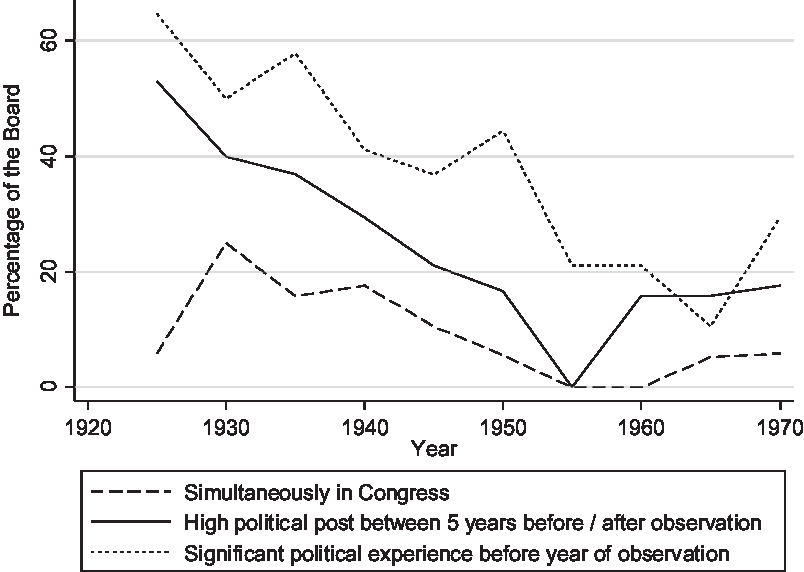
Although the establishment of the CHBA might seem a success story, insofar as it relied on its quasi-administrative status to perform its functions as a professional guild, there were also significant drawbacks, such as a low level of bureaucratization. This association depended on its partisan links to influence corporative bargaining and to obtain state financial support, hampering its ability to take bold stances. In total, 70 percent of the members on its Board identified with certain political parties, mostly the Conservative, Liberal, and, to a lesser degree, Radical parties. Footnote 16 Nevertheless, their position within the bar did not provide significant political capital for their leading fellow members. Empirical data illustrated in Figure 4 indicates that the members of the CHBA boards progressively disengaged from active political responsibilities, particularly by the mid-1950s and the early 1960s.
CHBA Boards: engagement in governmental responsibilities (N = 104). The estimates of high political posts and significant previous political experience are calculated considering positions in Congress, the Cabinet of Ministers (secretary or undersecretary), the head of a public agency, and ambassador. Source: CHBA 1926–70; de Ramón Reference De Ramón1999.

Due to its constraints, the association was unable to build robust professional authority between the 1930s and 1970. The organized bar did not speak out to defend civil and political rights in moments of political conflict, such as the banning of the Communist party in 1948 (CHBA 1925–70; Lira and Loveman Reference Lira and Loveman2014). However, its almost nonexistent role in policymaking is the best example to illustrate the diminished possibilities of its collective action and influence. For instance, in 1939, the CHBA and the University of Chile’s School of Law coordinated a group of leading law professors and practitioners to collaborate in the legislative process (Institute of Legislative Studies). Although its foundational documents included policy-oriented functions, the institute was not the cornerstone contribution of juridical expertise to policymaking that it intended to be (Facultad de Ciencias Jurídicas, Universidad de Chile 1973). It helped draft several statutes but limited its real input to minor technical matters like alimony rights and deferred payments. By contrast, when the institute and the CHBA attempted to deal with some critical aspects of the public agenda, the Parliament did not consider its drafts for debate. Thus, when they repeatedly proposed a bill establishing administrative courts to solve the lack of judicial control over public agencies in the late 1940s and the 1950s, the partisan elites in charge of the political process ignored them (Estevez Gazmuri Reference Estévez Gazmuri1950, 33–38). Likewise, when the CHBA organized several seminars to discuss monetary inflation during 1954 and 1957—one of the most critical issues of the time—their voices were not heard by lawmakers who foresaw the enormous political price of carrying out the association’s proposals (Varela Reference Varela1957). Indeed, the professional authority of lawyers and the bar displayed signs of decay.
The Higher Courts
Besides the bar, the transformation of the judiciary also shows how high-level state politics and legal functions followed separated paths. In that setting, the process of structural differentiation was characterized by a broad change in the judges’ career paths and, at the same time, by a forced process of bureaucratization that hindered their political power.
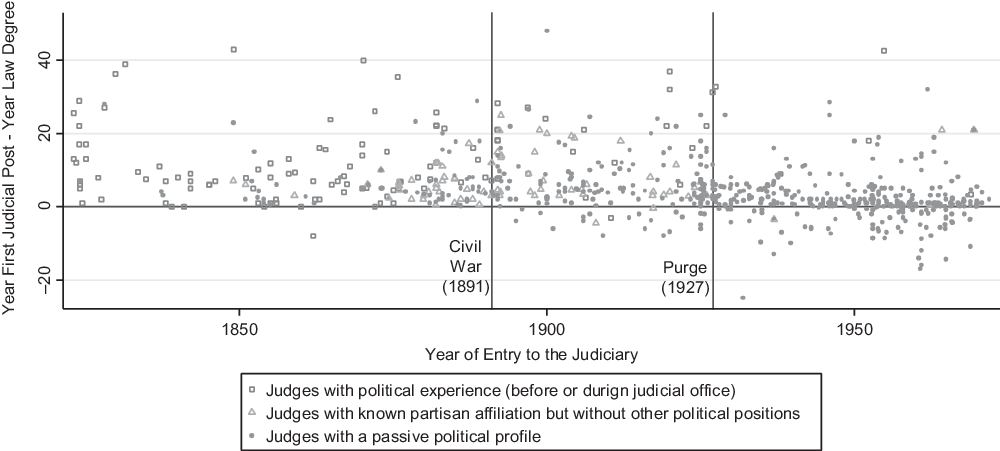
Figure 5 captures the profiles of all of the justices that entered the judiciary between 1823 and 1970, reaching positions on the Supreme Court and the Court of Appeals in their lifetime (N = 745). By assessing the difference between the year of entry to courts and the year they received their professional degree as a lawyer, axis y illustrates how many years of experience each of them had before joining the judiciary. Hence, y over 0 represents the time of previous professional activity and y under 0 means they entered as clerks before receiving their degree. Different symbol styles illustrate political profiles. Axis x represents the time line. This historical sequence results in a helpful portrait to explain the evolution of the judicial organization, with a focus on the beginning of the administrative state.
Political profiles at the judiciary (1823–1970). To determine their year of entry, the data reflects exclusively judicial responsibilities (e.g., judicial clerk, secretary, trial judge). Source: Bravo Lira Reference Bravo Lira2011.

Gentlemen politicians of law led the judiciary before the 1920s, but their engagement with politics was not exempt from pitfalls, particularly during the last decades of the aristocratic political cycle (1891–1925). To protect judicial independence, Congress banned holding both political and judicial posts in 1888. After a brief civil war in 1891, the victorious groups purged the judiciary, expelling about 80 percent of its members and replacing them with a new group of elite lawyers who would dominate the higher courts for the next three decades. The ban on dual office holding prevented them from performing other governmental duties, but, as Figure 5 shows, they continued participating in political parties. Armando de Ramón’s (Reference De Ramón1989) study shows that political affiliation with the Liberal and Conservative parties enabled some justices to move up the ranks during this period. This study also detected political favoritism and leniency toward judges’ misbehavior. As a result, the judiciary lost much of its prestige by the turn of the twentieth century (37–40, 51).
The framers of the Constitution of 1925 included provisions designed to insulate the courts from political pressures (Guerra Reference Guerra1929, 452–54). The new constitution granted the Supreme Court the prerogative to select a list of nominees from the judicial ranks, which used to be appointed to higher courts by the executive branch based on seniority within the judicial service. It also gave the Supreme Court the power to review legislative acts. Considering the moderate or conservative inclinations of those who drafted the new Constitution, Lisa Hilbink (Reference Hilbink2007, 58) identifies this institutional design as a strategy for ensuring hegemonic preservation in a context of high uncertainty at the end of the aristocratic regime.
Political conflict at the beginning of the new political cycle, particularly several authoritarian governments between 1925 and 1932, contributes to explaining the situation of the courts during structural differentiation. In the wake of a period of political instability, the administrations of Emiliano Figueroa and, later, Colonel Carlos Ibáñez tried to reduce judicial involvement in partisan politics (Faúndez Reference Faúndez2007, 129). In 1927, the secretary of justice warned, “the intervention by the political parties and parliamentary groups has carried an ill-fated breath, the look of bandits upon the judiciary” (de Ramón Reference De Ramón1989, 53). The executive branch provoked division among the members of the Supreme Court when it illegally removed antagonistic judges from the bench. In 1933, representatives moved (unsuccessfully) to impeach members of the Supreme Court, arguing they did not keep the integrity of the judiciary during the years of authoritarian rules (1925–32) (Frühling Reference Frühling1986). Furthermore, the executive pressured courts to facilitate harassing dissidents and to curtail freedom of expression in the late 1930s (Lira and Loveman Reference Lira and Loveman2014, 149–60, 297–304).
The Executive and Congress imposed significant institutional limitations on courts as well. They excluded justices from public ceremonies until the early 1950s (Bravo Lira Reference Bravo Lira2011, 63). They kept judicial salaries low and physical infrastructure inadequate (Galecio Reference Galecio1966). Such conditions motivated a strike by lower-court judges, who demanded an increase in the judicial budget in 1969 (Hilbink Reference Hilbink2007, 95–96). In response to political and institutional constraints, the judiciary became an increasingly closed bureaucratic organization, with higher courts exerting disciplinary control over judges on the lower courts and judges emphasizing their strict separation from politics (Hilbink Reference Hilbink2007). Congress passed new legislation on the judiciary in 1943, further strengthening the Supreme Court’s disciplinary control upon lower judicial ranks and prohibiting judges’ participation in partisan politics.
During the same period, less experienced and less politically engaged individuals began to sit on the bench (Figure 5). A significant number entered the judiciary even before receiving their law degree, thus undergoing a prolonged process of bureaucratic socialization before reaching higher courts. Biographical accounts indicate that the judges who joined the judiciary after 1927 overwhelmingly belonged to the middle class. Low salaries and the diminishing social prestige of the judges might explain the elite’s increasing disinterest in a judicial career. Moreover, it is likely that the judges’ social backgrounds, a small market for private legal practice, and their limited political networks—caused by having entered the judiciary early in their professional careers—increased the cost of the disciplinary sanctions that higher courts could impose on the judicial officers of lower ranks, thereby reinforcing bureaucratic structures.
Evidence indicates that between 1932 and 1970 the judiciary generally deferred to the policy preferences of the executive power. After the return to democracy in 1932, courts continued recognizing the validity of some decrees issued during the authoritarian governments between 1925 and 1932, avoiding the disruption of the new agencies established during that period (Bravo Lira Reference Bravo Lira2011, 62). At the same time, they barely checked public agencies and were largely deferential to them (except for a minimal protection of property rights). Despite a constitutional provision that mandated the creation of special administrative courts (which were never established), the judiciary asserted that it did not have the competence to check state agencies and strategically steered clear of many controversial issues. During the 1940s, the courts also consistently developed the doctrine of “act of authority,” by which they refused to assess the legality of administrative regulations and pronouncements, asserting that such acts only concerned political branches (Faúndez Reference Faúndez2007, 141–43). They resorted to a similar tactic to deny liability when an official made wrong decisions or misbehaved (Pierry Reference Pierry2002, 384–85). Meanwhile, the Supreme Court frequently declined to use its powers to review the constitutionality of legislation, and the scope of such decisions remained very modest. For example, between 1925 and 1946, the Supreme Court dismissed about 90 percent of the cases for judicial review of statutes and administrative acts brought before it, and its decisions had little impact at least until the mid-1970s (Faúndez Reference Faúndez2007, 132). It would be impossible to weigh all of the complexities in the relations between the courts and politics during these years. Nevertheless, at least we can establish an association between a judiciary that faced considerable political constraints and a pattern of extreme deference to the political branches during the same period.
CONCLUSION
This article has examined why elite law graduates in Chile lost authority in public governance during the transition from an aristocratic regime to the administrative state. The study confirms what scholars and lawyers have already described occurring elsewhere in Latin America: law graduates lost their monopoly on statecraft (Dezalay and Garth Reference Dezalay and Garth2002; Pérez–Perdomo Reference Pérez-Perdomo2006, 117). New professional competitors took over important public policy decisions. Engineers guided industrial planning in the 1940s and 1950s; social scientists intervened in Frei Montalva’s economic reforms in the late 1960s (Silva Reference Silva2009). Legal expertise was no longer the cornerstone discipline that provided practical wisdom in public affairs.
Yet the diminishing authority of legal professionals cannot be explained simply by pointing to the rising trajectory of competitor professions. As Weber theorized, political modernization provoked not only the rise of professional competitors but also a gradual division between the state and the legal field. Tracing the career paths of elite law graduates reveals that, in contrast to the era of aristocratic politics, it was no longer possible to be a judge, legal practitioner, congressional representative, and law professor in a single lifetime. The legal and political functions of elite lawyers began to separate. Some law graduates turned away from juridical tasks and invested in electoral competition and partisan life. The judiciary became closed to them and all those who participated actively in politics. Practitioners and law professors only sporadically gained access to ministerial cabinets or other agencies, while the numerous rank-and-file lawyers working in the governmental machinery occupied a lower stratum within the administrative state. The idea of a legal profession that led government and dominated the public arena lost standing by the mid-twentieth century.
The political and economic conditions under which the structural differentiation of law and governmental practice operated were decisive in defining the authority of the legal profession. In the case of Chile at least, significant political and institutional constraints influenced the performances of bureaucratized legal institutions. Many lawyers relied on their connections to political parties to keep open slots as part-time civil servants, which was critical for their careers in the new regime. The CHBA depended on their links to political networks as well, obtaining state support to perform its functions as a professional guild. Until 1970, it did not take bold political stances and lacked the professional autonomy to build a substantial degree of authority. Its failed attempts to influence policymaking illustrate its dwindling influence. Meanwhile, higher courts faced severe political attacks and were subjected to political constraints at the very beginning of the new political cycle. They adopted a policy of self-restraint that was likely a tactic to avoid being a government watchdog (Frühling Reference Frühling1986; Hilbink Reference Hilbink2007).
I am not claiming here that the administrative state offers a simple, cause-and-effect explanation for the diminishing political role of legal professionals. Indeed, many other factors could have influenced the shrinking scope of their authority. For instance, legal culture encompassed a strong ideology on the separation of powers that conceptually divided adjudication and lawmaking, reducing legal methods to a descriptive textual interpretation. Their roots can be traced back to at least the civil code of the mid-nineteenth century. My point is that, as a consequence of increasingly bureaucratic legal institutions, overarching ideas of positivistic jurisprudence that dominated the region deepened and took on a more radical reading (López Medina 2004, 66, 122–27; Reference Medina2012). All of these mutually enforcing elements explain why law graduates saw themselves as ill-equipped to fill leadership positions in the public sphere (Velasco Letelier Reference Velasco Letelier1965; Novoa Monreal Reference Novoa Monreal1972; Pumpin Reference Pumpin1972; Silva Bascuñán Reference Silva Bascuñán1972).
The conditions that affected the structural differentiation of legal institutions during the mid-twentieth century were not particular to Chile nor were the complaints about the devaluation of traditional legal expertise in decision-making and the political struggle. These were also present in other Latin American countries around the same period. Although some variations and commonalities of this process have been analyzed tangentially, its further study still offers an attractive research agenda (Dezalay and Garth Reference Dezalay and Garth2002). Casting a comparative glance, we could tentatively argue that the reframing of legal institutions in the region evinces a professional model that differs from the American or German patterns (Ruschmeyer Reference Ruschmeyer1973). This Latin American model could constitute an essential element in understanding the rule of law in the region by the mid-twentieth century as well as a starting point for approaching the different efforts to reframe legal expertise in public governance since the early 1970s (Gardner Reference Gardner1980; Dezalay and Garth Reference Dezalay and Garth2002, 163–67; López Medina Reference Medina2004, 447–61). A better understanding of the history of the legal profession in Latin American statecraft helps to explain the role of law graduates in this region’s politics today.
APPENDIX 1: OBSERVING THE STATE AND THE LEGAL FIELD IN FIGURE 3
According to the methodology section in this article, I have used the codes quantitatively to measure the degree of engagement within each field shown by the law graduates who participated in the Senate and the Cabinet of Ministers. The coding was built in order to grasp the level of influence wielded by every individual in each realm, assigning a score according to the relevance and duration of every office they held throughout their lives. Adding up these scores, I then elaborated a state field index and a legal field index for every individual in the sample. The scores were assigned according to the following criteria.
State Field (Axis Y)
(P) Presidential Authority: + 5 President of the Republic (once), + 9 (twice).
(D) Chamber of Deputies: + 2 (once), + 3 (more than once).
(S) Senate: + 3 (once), + 4 (more than once).
(m) Mayor or other relevant posts of local politics (e.g. Governor, Intendants): + 1.
(C) Cabinet of Ministers: + 2 (once), + 3 (more than once).
(b) Bureaucratic Official (non judicial): + 1 to +3, depending upon timing and relevance.
(O) Other Political Commissions: Drafter Constitutions 1823-1833, +2 once, +3 twice; Conservative Commission operating during Congress recess, + 1; Council of State: + 1)
(D) Diplomacy: + 1 or + 2, upon relevance.
(A) Adjudication, highest post held at the judiciary: + 4 Supreme Court, + 3 Appellate Court, + 2 low level lettered court. Abogados Integrantes are excluded, since they were not part of the judicial service.
Legal Field (Axis X)
(J) Judiciary (aggregation of posts): + 1 minor clerk, public defender; + 2 judicial secretary at low level court, court reporter (relator), integral lawyer; + 3 judge at trial court; + 4 Justice at Appellate Court; +5 Justice or Fiscal at the Supreme Court.
(U) University: + 1 to + 3 University Positions outside the Law School, upon relevance to law; +4 relevant private docent (Bello), + 5 President at the University; Professor at the law school, or Forensic Academy: + 2 no core legal subject; + 3 to + 4 main legal subject, + 5 Dean at the Law School.
(ll) Contributions to Legal Literature: + 1 to + 3 upon relevance;
(c) Corporate Practice: + 1 to + 3 upon relevance.
(B) Boards of the Bar Organization: + 2, + 3 (more than 5 years), + 4 (more than 10 years), + 5 (Chair, no matter how many years).
(p) Legal Practice as advocate before courts: + 1 to + 3 upon relevance.
(L) Legislative Committee: + 2 to + 5, Commissions for codification (upon relevance); + 1 Commission of Constitution, Legislation and Justice at the Senate:
To facilitate visualization and to enhance the accuracy of the graphs, each state field and legal field indexes could be modified between 0.2 to 0.6 according to duration in the offices and other nonarbitrary characteristics. Moreover, the graphs include a line at point 10 of the axis y.