Personal initiative is a construct of active effort (Hacker, Reference Hacker, Frese and Sabini1985) which is conceptualized as a series of behaviours that characterize people who are proactive, persistent and self-starting when facing the difficulties that arise in achieving goals (Frese & Fay, Reference Frese, Fay, Staw and Sutton2001). Proactivity means that a person is able to anticipate both problems and opportunities and then act upon them. This implies taking a long-term view and searching actively for feedback. A persistent individual is someone who perseveres in order to achieve self-initiated goals, carries on in the face of difficulties, and who shows a strong desire to progress. Finally, self-starting means that it is the person him or herself who decides what to do, without the need for any explicit guidance or instruction; thus, it is the individual who sets and takes responsibility for his or her own goals. An additional key aspect, which has been highlighted by Frese and Fay (Reference Frese, Fay, Staw and Sutton2001), is that behaviour which lacks a prosocial focus should not be regarded as personal initiative. People sometimes adopt initiatives that are beneficial to themselves but not to the group to which they belong or to their immediate surroundings. However, in order to be considered personal initiative a given behaviour must benefit not only the individual but also the group or immediate context, as only thus can it be conceived of as functional. An initiative that has an exclusively personal focus is considered dysfunctional and, therefore, does not form part of the construct of personal initiative that is used in the present study (Frese & Fay, Reference Frese, Fay, Staw and Sutton2001).
Following on from this last point, various studies have shown that personal initiative benefits both the individuals that display it and the organizations which promote it. Individuals with high levels of personal initiative obtain better academic results (Fay & Frese, Reference Fay and Frese2001), perform their tasks better (Frese, Reference Frese, Erez, Kleinbeck and Thierry2001), are more employable (Lantz & Anderson, Reference Lantz and Anderson2009), more innovative (Lisbona, Palací, & Gómez, Reference Lisbona, Palací and Agulló2008) and more entrepreneurial (Krauss, Frese, Friedrich, & Unger, Reference Krauss, Frese, Friedrich and Unger2005). Similarly, organizations that promote personal initiative respond to new challenges more successfully (Koop, De Reu, & Frese, Reference Koop, De Reu, Frese and Frese2000), are more efficient (Frese, Reference Frese2000) and more profitable (Baer & Frese, Reference Baer and Frese2003).
Although the concept of personal initiative arose in the organizational sphere (Frese, Fay, Hilburger, Leng, & Tag, Reference Frese, Fay, Hilburger, Leng and Tag1997) it can be applied to various contexts, including education (Frese & Fay, Reference Frese, Fay, Staw and Sutton2001; Lisbona & Frese, Reference Lisbona and Frese2012). According to Lisbona and Frese (Reference Lisbona and Frese2012) there are three main reasons why this concept can usefully be applied to academic settings. First, the active notion underlying personal initiative adequately reflects the active nature of human beings and enables the potential of students to be developed (Frese & Fay, Reference Frese, Fay, Staw and Sutton2001; González & Tourón, Reference González and Tourón1992; Lisbona & Frese, Reference Lisbona and Frese2012). In this regard, several authors consider personal initiative to be a personality dimension that resembles extroversion and which should be encouraged in the educational context (Xia, Ding, Hollon, & Wang, Reference Xia, Ding, Hollon and Wan2013; Xia et al., Reference Xia, Liu, Ding, Hollon, Shao and Zhang2012). Second, there is evidence to suggest that personal initiative contributes to academic success (Frese et al., Reference Frese, Fay, Hilburger, Leng and Tag1997). And third, if the current labour market needs active and responsible employees who are capable of taking initiative, then the best way of achieving this is to ensure that training along these lines begins in schools and colleges. Indeed, one would expect that promoting personal initiative among students would enable them to respond better to the needs of the market and, therefore, to find a job more easily. Not surprisingly, personal initiative constitutes one of the key competences of the European Framework for Lifelong Learning (European Commission, 2007).
In recent years, several studies have found that one or more of the dimensions of personal initiative are related to variables such as self-efficacy, enterprising attitude, responsibility and control aspirations, mood repair, and academic achievement. As these variables have been shown to be relevant in the educational field (Bisquerra & Pérez, Reference Bisquerra and Pérez2007; Lisbona & Frese, Reference Lisbona and Frese2012; Ponton & Carr, Reference Ponton and Carr2000; Roth & Lacoa, Reference Roth and Lacoa2009) we believe that they should be taken into account in the validation process that is described in this paper. With respect to self-efficacy, research has indicated that this variable is related to the probability of displaying personal initiative behaviours (Frese, Teng, & Wijnen, Reference Frese, Teng and Wijnen1999; Sanjuán, Pérez, & Bermúdez, Reference Sanjuán, Pérez and Bermúdez2000). As for enterprising attitude, various studies have found that entrepreneurs score higher than non-entrepreneurs on self-starting and persistence (Frese et al., Reference Frese, Fay, Hilburger, Leng and Tag1997), and also that personal initiative correlates with entrepreneurial success (Korunka, Frank, Lueger, & Mugler, Reference Korunka, Frank, Lueger and Mugler2003; Krauss et al., Reference Krauss, Frese, Friedrich and Unger2005). Responsibility and control aspirations have likewise been linked to personal initiative (Frese & Fay, Reference Frese, Fay, Staw and Sutton2001; Lisbona, Palací, & Agulló, Reference Lisbona, Palací and Agulló2008). One of the dimensions of emotional intelligence is what is known as mood repair, and various studies have shown a positive association between this variable and persistence (Kanfer & Heggestad, Reference Kanfer and Heggestad1997; Lisbona & Frese, Reference Lisbona and Frese2012). In terms of academic achievement, one of the few studies carried out on personal initiative in the educational field (Fay & Frese, Reference Fay and Frese2001) found that personal initiative was related to better academic achievement. Research on persistence provides complementary evidence in this regard (González & Tourón, Reference González and Tourón1992).
When reviewing the literature we found no studies that directly analyse the relationship between personal initiative and conscientiousness (as a personality factor) or personal initiative and emotional clarity (as an aspect of emotional intelligence). However, it is worth pointing out that a sense of conscientiousness towards tasks and goals is a constant in the antecedents and consequences of the theoretical model of personal initiative (Frese & Fay, Reference Frese, Fay, Staw and Sutton2001). As for emotional clarity, initiative constitutes one of the key emotional skills in various models of emotional intelligence (Bisquerra & Pérez, Reference Bisquerra and Pérez2007; Goleman, Boyatzis, & McKee, Reference Goleman, Boyatzis and McKee2002). In view of all this, we would expect, in the present study, to find that personal initiative is positively associated with conscientiousness and emotional clarity.
In sum, given the importance that personal initiative seems to have within the academic environment and the scarcity of measures for assessing students’ personal initiative, the aim of the present study was to develop a measure for assessing personal initiative within the educational field that includes four dimensions (proactivity, persistence, self-starting, and prosocial), and then to analyse its psychometric properties in a sample of vocational training students.
Scale Development and Pilot Study
Based on the four dimensions of personal initiative that appear in the model proposed by Frese and Fay (Reference Frese, Fay, Staw and Sutton2001), a total of 35 initial items were formulated. Specifically, 6 items were formulated for the proactivity dimension, 7 items for the persistence dimension, 16 items for the self-starting dimension and 6 items for the prosocial behaviour dimension. Of these 35 items, 20 were drafted in a positive sense, in other words, stronger agreement with the item would indicate a greater degree of personal initiative; the remainder were reverse formulated. These initial items were then evaluated by a group of expert judges in order to obtain evidence that they were relevant to the construct of personal initiative and adequately represented each of its dimensions. The group of experts comprised 10 teachers, 2 directors of training centres and 2 experts in innovation and entrepreneurship. Although the percentage of items that were correctly allocated to their corresponding dimension was not very high, the average values in appropriateness were high for all the items, and consequently none of them was modified or eliminated.
Following this consultation process a pilot study was conducted. In the first phase the questionnaire was answered by a sample comprising 42 engineering students (35 male and 7 female) aged between 21 and 36 (M = 24.1; SD = 2.8). In this phase a series of quantitative (homogeneity indexes and descriptive statistics) and qualitative (difficulty in understanding the wording of some items) analyses were carried out, resulting in the elimination of 10 items and the reformulation of a further 10. In the second phase, the scale was applied to 142 vocational training students (121 male and 21 female) aged between 15 and 30 (M = 21.30; SD = 3.67). The aim here was to conduct an initial analysis regarding the number of scale dimensions and the items of which they were composed. Taking the Minimum Average Partial (MAP; Velicer, Reference Velicer1976) as the criterion for extracting the factors, a principal component analysis, followed by oblique rotation, was carried out. This yielded three factors accounting for 34.46% of the variance. Taking a factor loading equal to or greater than .40 as a reference for item selection we identified 17 items with a clear loading on their corresponding dimension. Factor 1 (eigenvalue = 4.20) included eight items and accounted for 16.80% of the variance. The items of this factor reflected proactivity and prosocial behaviour components of personal initiative. Factor 2 (eigenvalue = 2.41) accounted for 9.65% of the variance and its four items corresponded to the persistence component of personal initiative. Finally, Factor 3 (eigenvalue = 2) consisted of five items and accounted for 8.01% of the variance. The items of this factor reflected the self-starting dimension of personal initiative. The instrument was given the following name: Scale for Measuring Personal Initiative in the Educational Field (EMIPAE, in its Spanish initials).
Method
Participants
The sample used in the empirical study comprised 244 participants (36 female and 208 male) aged between 15 and 30 (M = 20.76; SD = 3.38). They were all students recruited from among 10 vocational training centres in the Basque Country (northern Spain). The reason for focusing on vocational training students was their close association with the employment context, in which personal initiative is regarded as a very useful competence. Fifty-eight percent of the students were working or engaged in work experience. The sample selection was non-probabilistic. With regard to sample size, an observation/item ratio of 10:1 was considered necessary for the requirements of confirmatory factor analysis (Nunnally, Reference Nunnally1978). Thus, given that the EMIPAE contains 17 items it was decided that the minimum sample size should be 170 participants.
Instruments
The instruments used were as follows:
Scale for Measuring Personal Initiative in the Educational Field (EMIPAE)
The 17 items of the EMIPAE are designed to assess three dimensions of personal initiative: a) proactivity and prosocial behaviour (e.g. I usually participate actively in the classroom/workshop/laboratory, even if I do not receive anything in return); b) persistence (e.g. When I no longer understand the contents of a module/project/subject, I get frustrated and give up [reverse-scored item]); and c) self-starting (e.g. I am particularly good at putting into practice the ideas I had in the classroom/workshop/laboratory). The items are responded on a 5-point Likert scale ranging between 1 (Totally disagree) and 5 (Totally agree). The EMIPAE can be obtained upon request from the authors.
Spanish adaptation for adults of the Trait Meta-Mood Scale (Fernández-Berrocal, Extremera, & Ramos, 2004)
This is a self-report instrument comprising three sub-scales that assess the extent to which the respondent: a) pays attention to and places importance on his/her feelings (attention: e.g. I think about my mood constantly); b) identifies and clearly understands his/her feelings (clarity: e.g. I almost always know exactly how I am feeling); and c) uses positive thinking to overcome negative emotional states (regulation: e.g. Although I am sometimes sad, I have a mostly optimistic outlook). Overall, the scale comprises 24 items which are responded on a 5-point Likert scale ranging between 1 (Totally disagree) and 5 (Totally agree). This instrument showed adequate psychometric properties (Fernández-Berrocal et al., Reference Fernández-Berrocal, Extremera and Ramos2004), with alpha coefficients of .90, .90 and .84, respectively for the dimensions of attention, clarity and regulation, and test-retest correlation coefficients of .66 (attention), .70 (clarity) and .83 (regulation). In terms of its external validity, the correlations between scores on the TMMS-24 and measures of depression, life satisfaction and reflexive response all followed the expected direction. In the present study (N = 177), the dimensions of attention, clarity and regulation yielded Cronbach’s alpha coefficients of .83, .82 and .76, respectively.
Self-Assessment of Entrepreneurial Potential (Roth & Lacoa, 2009)
This is a one-dimensional scale designed to assess enterprising attitude based on statements relating to proactivity, a disposition towards excellence, the quest for efficiency, confidence in success, and resilience. It comprises 15 items (e.g. I am always ready to undertake new projects) that are responded on a 4-point Likert scale ranging between 1 (Totally disagree) and 4 (Totally agree). The measure displays adequate psychometric properties (Roth & Lacoa, Reference Roth and Lacoa2009). In the present study, minor modifications were made to three of the items so as to adapt them to the Spanish cultural context. Despite these changes, internal consistency in the present sample was .92 (N = 168), and the measure showed a single factor which explained 48.74% of the variance.
Spanish adaptation of General Self-Efficacy Scale (Baessler & Schwarzer, 1996)
This instrument assesses self-perceived ability to manage a wide range of stressful situations in an effective way. It comprises 10 items (e.g. I can solve most problems if I invest the necessary effort) that are responded on a 10-point Likert scale ranging between 1 (Totally disagree) and 10 (Totally agree). The instrument displays adequate internal consistency (α = .87), as well as predictive and external validity (Sanjuán et al., Reference Sanjuán, Pérez and Bermúdez2000). In the present study (N = 175) the Cronbach’s alpha coefficient was .91.
Self-Reported Initiative (Frese et al., 1997)
This is a self-report measure to assess personal initiative. It comprises seven items (e.g. I actively attack problems) that are responded on a 5-point Likert scale ranging between 1 (Totally disagree) and 5 (Totally agree). These items measure the self-starting and proactivity components of personal initiative and were translated into Spanish for the present study. In this sample (N = 132) the instrument achieved an internal consistency index of .71 and displayed a single factor which explained 37.02% of the variance.
Spanish adaptation of Responsibility and Control Aspirations Scale (Lisbona et al., 2008)
This scale assesses the extent to which a person makes his/her own decisions about daily tasks, establishes the amount of daily work to carry out, establishes the rules and procedures on how to perform the tasks, and feels responsible for the tasks performed. It comprises six items that are responded on a 5-point Likert scale ranging between 1 (Totally disagree) and 5 (Totally agree). Given that the scale was originally developed for application in the organizational environment, some terms specific to that environment were replaced by others that are more inherent to the educational field (e.g. in item 6, the term supervisor was replaced by teacher, rephrasing the item as “I prefer to have a teacher who tells me what I should do; that way he/she will be responsible if something goes wrong”. In the present study (N = 132) the scale displayed a single factor which explained 47.69% of the variance, and it achieved an internal consistency index of .78.
Spanish adaptation of the NEO Five-Factor Inventory (NEO-FFI; Costa & McCrae, 2008)
This is a version of the NEO PI-R Form S which provides a quick and general measure of the five personality factors: neuroticism, extraversion, openness to experience, agreeableness and conscientiousness. It comprises 60 items that are responded on a 5-point Likert scale (A = Totally disagree, E = Totally agree). The instrument displays adequate psychometric properties (Costa & McCrae, Reference Costa and McCrae2008). In the present study, only the conscientiousness dimension was used (e.g. I always consider the consequences before I take action). Cronbach’s alpha coefficient for this dimension was .76 in this sample (N = 98).
Procedure
The EMIPAE, together with the other measures necessary for its validation, was applied by a psychologist in the students’ usual classroom during the ordinary school day. The measures were administered in different sessions and in the following order: the EMIPAE, the Spanish adaptation for adults of the Trait Meta-Mood Scale, the Self-Reported Initiative scale, the Responsibility and Control Aspirations Scale, the Self-Assessment of Entrepreneurial Potential, the General Self-Efficacy Scale and the Spanish adaptation of the NEO Five-Factor Inventory. For part of the sample it was also possible to gather information regarding their academic achievement. The study was approved by the Ethics Committee for Research and Teaching of the University of the Basque Country (UPV/EHU). Informed consent was requested from the directors of the training centres, as well as from the parents and/or legal guardians of participants below the legal age of consent, and from participants themselves when they were above this age.
Data analysis
The dimensionality of the instrument was examined through a confirmatory factor analysis (CFA) in order to test whether the data corroborated the three-factor model found with the first sample in the principal component analysis. Subsequently, Cronbach’s alpha coefficients were computed to estimate the internal consistency of the factors. In addition, and in order to obtain evidence of the convergent validity of the EMIPAE, the association between its dimensions and the measure of self-perceived personal initiative (Self-Reported Initiative scale) was examined using Spearman’s rho correlation coefficients. Finally, various procedures were applied to obtain evidence of the external validity of the instrument. Specifically, Spearman’s rho was used to analyse the association between the dimensions of the EMIPAE and the following variables: enterprising attitude, general self-efficacy, responsibility and control aspirations, conscientiousness, and academic achievement. The process of obtaining external validity evidence was completed by examining whether there were any differences in emotional clarity and regulation between participants with high (above the 70th percentile for EMIPAE dimensions) and low (below the 30th percentile for EMIPAE dimensions) personal initiative. These comparisons were made using the Student’s t test and Cohen’s d index of effect size.
Results
Factor Validity and Internal Consistency
A Robust Weighted Least Squares Factor Analysis (as a CFA) was conducted over the polychoric correlation matrix using EQS v6.1 (Bentler, Reference Bentler2006). The adequacy of model fit was assessed by means of the following indices: Satorra-Bentler χ 2 , the BBNNFI (Bentler-Bonett non-normed fit index), the CFI (comparative fit index), the IFI (incremental fit index) and the RMSEA (root mean square error of approximation). The value of the chi-square statistic (χ 2 (116) = 219.12, p = .0001) indicated a statistically significant lack of model fit. However, the sensitivity of the chi-square statistic to the violation of the assumptions on which it is based means that the fit assessment should be based mainly on alternative indices. When measures of fit less sensitive to deviations from normality were used, the results showed a good fit, with values of the BBNNFI (.91), CFI (.92) and IFI (.93) close to 1.00, and a RMSEA (.06) between the cut-off points of .05 (good fit) and .08 (acceptable fit).
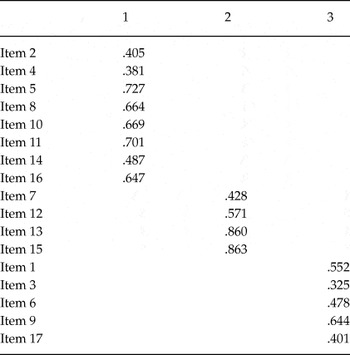
With the exception of items 3 and 4 the standardized loadings were equal to or greater than .40 for all the items, indicating that they are important to the definition of their corresponding construct (Table 1 shows the factor loadings).
Standardized factor loadings of EMIPAE items

The alpha coefficients were .72, .73 and .57 for the proactivity/prosocial behaviour, persistence and self-starting dimensions, respectively.
Convergent Validity
The correlation coefficients between EMIPAE factor scores and those on the measure of self-reported initiative were .32, .09 and .43 for proactivity/prosocial behaviour, persistence and self-starting, respectively. The higher correlations with the proactivity/prosocial behaviour and self-starting dimensions were an expected result as the items on the Self-Reported Initiative scale measure these two components of personal initiative.
External Validity
Table 2 shows the relationships between EMIPAE dimensions and self-efficacy, enterprising attitude, responsibility and control aspirations, conscientiousness, and academic achievement.
Correlations between EMIPAE dimensions and self-efficacy, enterprising attitude, responsibility and control aspirations, conscientiousness, and academic achievement

* p < .05.
** p < .01.
As expected, the three dimensions of personal initiative were positively correlated with self-efficacy, enterprising attitude, and conscientiousness, although the correlation indices were moderate. Persistence also showed a moderate correlation with responsibility and control aspirations. Finally, and in line with theoretically predicted relationships, there were positive correlations between the three dimensions of personal initiative and academic achievement. However, the size of the correlation index only reached a moderate level for the proactivity/prosocial behaviour dimension.
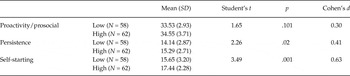
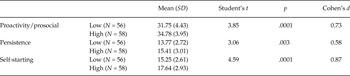
Additional external validation data were then obtained by examining the relationships between EMIPAE dimensions and two other variables: emotional clarity and mood repair (regulation). Here it was expected that, in comparison with students who display low personal initiative (i.e. below the 30th percentile based on the scores obtained on each of the EMIPAE dimensions), students with high personal initiative (i.e. above the 70th percentile on these dimensions) would report feeling clearer about their emotions, and would use positive thinking to a greater extent when seeking to repair negative moods. Results obtained in these comparisons are shown in Tables 3 and 4.
Means (standard deviation), Student’s t values and Cohen’s d values for the comparison of emotional clarity between students with high and low self-initiative

Means (standard deviation), Student’s t values and Cohen’s d values for the comparison of mood repair between students with high and low self-initiative

All the results followed the expected direction, although the effect size for the comparison of students with high and low proactivity/prosocial behaviour was small for emotional clarity.
Discussion
The aim of the present study was to develop a scale to measure personal initiative in the educational field (the EMIPAE) and to analyse its psychometric properties in a sample of vocational training students.
With respect to the dimensionality of the instrument, the results indicated the existence of three factors, two of which coincided with two of the components in the reference model, namely persistence and self-starting, and a third which included items referring to proactivity and prosocial behaviour. Grouping the items of the latter two components into a single factor is consistent with the scientific literature, since several studies in the organizational field consider prosocial behaviour to be a subtype of proactivity (Belschak & Den Hartog, Reference Belschak and Den Hartog2010). This subtype would involve the ability to foresee both problems and opportunities with the aim of benefitting not just oneself but also the group as a whole and the immediate context; this contrasts with a purely self-oriented form of proactivity that merely seeks personal gain.
The internal consistency indices of the EMIPAE dimensions revealed that the instrument displays acceptable reliability, although the coefficient for the self-starting component was rather low. This lower value may be related to the content of the items included in the self-starting dimension, which in fact is composed of two slightly different types of items: The content of items 1 and 9, whose loadings are .552 and .644, is only related to self-starting behaviour, whereas items 3, 6 and 17, with lower loadings (.325, .478 and .401, respectively), include behaviours that combine self-starting with developing alternative plans and anticipating problems.
The pattern of correlations observed between scores on the EMIPAE dimensions and those on the Self-Reported Initiative scale provided some evidence for the convergent validity of the instrument. The highest correlations were found between self-reported initiative and the proactivity/prosocial behaviour and self-starting dimensions. This is an expected result because, as noted earlier, the Self-Reported Initiative scale evaluates precisely these two dimensions of personal initiative. The fact that the EMIPAE also includes items that assess persistence gives the instrument added value, since recent studies have indicated that persistence is a key component of personal initiative (Lisbona & Frese, Reference Lisbona and Frese2012).
With regard to the external validity of the instrument, and in accordance with the predictions derived from previous studies, the three dimensions of the EMIPAE showed a positive correlation with self-efficacy, enterprising attitude and academic achievement. The positive relationship between self-efficacy and personal initiative could be due to the fact that the presence of the former will increase the likelihood of a difficult task being successfully carried out, strengthening the effort and persistence shown in doing so. By contrast, low self-efficacy may hamper the development of personal initiative because such individuals tend to avoid challenging situations and are often quick to give up in the face of obstacles (Speier & Frese, Reference Speier and Frese1997). As regards enterprising attitude, our results are consistent with those of various studies reporting that entrepreneurs score higher than non-entrepreneurs on self-starting and persistence (Frese et al., Reference Frese, Fay, Hilburger, Leng and Tag1997), and that personal initiative correlates with entrepreneurial success (Korunka et al., Reference Korunka, Frank, Lueger and Mugler2003; Krauss et al., Reference Krauss, Frese, Friedrich and Unger2005). It should also be noted that personal initiative is one of the seven dimensions of entrepreneurial spirit (Lisbona & Frese, Reference Lisbona and Frese2012; Miller, Reference Miller1983), a construct that refers to the psychological orientation of entrepreneurs and which is positively associated with entrepreneurial success (Korunka et al., Reference Korunka, Frank, Lueger and Mugler2003; Krauss et al., Reference Krauss, Frese, Friedrich and Unger2005; Lumpkin & Dess, Reference Lumpkin and Dess1996). With respect to academic achievement the results confirm the findings of Fay and Frese (Reference Fay and Frese2001) in that this variable was positively associated with two dimensions of personal initiative, namely proactivity/prosocial behaviour and persistence; the correlation was, however, low with respect to the third dimension, self-starting. Persistence was also positively correlated with responsibility and control aspirations, this being consistent with previous studies indicating that if a person perceives that he/she has responsibility and control of his/her actions, then he/she will persist (Frese & Fay, Reference Frese, Fay, Staw and Sutton2001). As for conscientiousness and emotional clarity, both these variables were linked to the EMIPAE dimensions. The association between personal initiative and emotional clarity was expected, since various models of emotional intelligence consider initiative to be one of the key emotional skills (Bisquerra & Pérez, Reference Bisquerra and Pérez2007; Goleman et al., Reference Goleman, Boyatzis and McKee2002). Finally, conscientiousness was positively correlated with all three dimensions of the EMIPAE, supporting the hypothesis proposed earlier in this study. Given the pattern of correlations observed between personal initiative and the other variables studied in this sample of vocational training students, it can be concluded that the EMIPAE shows evidence of external validity in the present sample.
This study does have a number of limitations. First, it would have been advisable to analyse the dimensionality of the instrument using some resampling methods such as bootstrapping or cross-validation, which are especially useful for testing the stability of factor loadings when the normality assumption is not met (Zientek & Thompson, Reference Zientek and Thompson2007). A further limitation is that the sample was composed exclusively of vocational training students, most of whom were male. A task for future research is therefore to broaden this sample and include subjects from different educational levels, as well as a larger number of female participants.
Despite the abovementioned limitations the results obtained allow us to conclude that the EMIPAE is a suitably valid measure for assessing the personal initiative of vocational training students. The information derived from the application of this instrument may be useful for designing and evaluating intervention programmes with the aim of developing personal initiative in the educational field.
The study was partially funded by a grant of Promotion of Gipuzkoa Program (OF83/2010) from the Gipuzkoa Provincial Council, by a grant from the Research Bureau of the University of the Basque Country (General Funding for Research Groups, GIU11/29) and by a grant from Economy and Competitiveness Ministry of the Spanish Government (PSI2012–32275).