Introduction
Greater awareness and improved imaging of congenital airway obstruction has led to increased antenatal diagnosis. ENT surgeons may be asked to participate in delivery to establish an airway. We present our experience of managing neonates with airway obstruction using an interventional airway birth plan to aid colleagues who may be asked to provide this service.
Congenital airway obstruction is rare; prior to improvements in imaging, it may have presented as an emergency late in pregnancy or during labour, requiring emergency intervention at birth. However, improved antenatal diagnosis of congenital airway obstruction alone does not improve outcomes, even when an ENT team is present to assist in securing the airway via intubation or tracheostomy if the neonate does not breathe spontaneously.Reference McDevitt, Kubba, Macara, Reynolds and Simpson1 Outcomes can be improved by performing an interventional delivery and adopting an immediate airway intervention strategy to ensure neonatal oxygenation and secure an airway. Airway interventions include intubation and tracheostomy.
There are two types of interventional delivery procedure: ex utero intrapartum treatment (‘EXIT’) and operation on placental support (‘OOPS’). Both procedures start with caesarean section to provide access to the neonate. In an operation on placental support, the whole baby is delivered but the umbilical cord is not cut and the placenta is not delivered. The baby is kept level with the uterus and the Syntocinon injection is delayed. This maintains feto-placental circulation until the umbilical cord goes into spasm, allowing an intubation time window of 5–20 minutes. In ex utero intrapartum treatment, the baby is partially delivered after caesarean section. Only the head is delivered, together with a shoulder if more access is required. Partial delivery allows feto-placental circulation to be maintained for 20–50 minutes, which permits a longer interventional procedure for securing an airway.
Materials and methods
A retrospective review was performed of cases in which ENT input was required at birth for airway obstruction. Four cases were managed prior to the implementation of an interventional airway delivery team and tailored interventional airway birth plan. Seven cases were managed between 2005 and 2012 after the team's inception and implementation of the airway birth plan. All neonates requiring airway intervention were included in this case series.
Results
Outcomes before service implementation
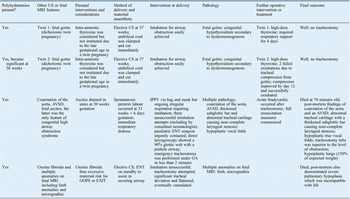
Our experience prior to development of a complex airways interventional delivery team demonstrated that antenatal diagnosis is insufficient to improve survival (Table I; n = 4).Reference McDevitt, Kubba, Macara, Reynolds and Simpson1 Antenatal discussion between different medical specialists resulted in having the ENT team on ‘standby’ to intervene if intubation failed, and highlighted the need for a detailed airway intervention plan. Two infants (twins) with congenital goitre were successfully intubated by the neonatology team. Two cases resulted in peri-natal death when tracheostomy failed. Ex utero intrapartum treatment was considered in one case but the maternal risk of haemorrhage was deemed too high because of uterine fibroids. Attempted tracheostomy in this neonate revealed a significantly deviated and flattened trachea, which was cannulated. Severe lung hypoplasia (incompatible with life) was found at post-mortem examination. In the second death, the ENT team was immediately called to the delivery suite after spontaneous preterm labour occurred. Tracheostomy was performed within two minutes but the neonate's condition failed to improve despite full resuscitative measures. Post-mortem examination revealed the tracheostomy tube to be proximal to the level of obstruction. Causes of airway obstruction were fetal goitre (n = 2), congenital high airway obstruction syndrome (n = 1) and partial laryngeal and tracheal agenesis (n = 1). In all cases, significant polyhydramnios was present antenatally.
With no multidisciplinary birth plan: airway obstruction cases and patient outcomes

US = ultrasound; MRI = magnetic resonance imaging; CS = caesarean section; AVSD = atrioventricular septal defect; IPPV = intermediate positive pressure ventilation; GA = general anaesthesia; OOPS = operation on placental support; EXIT =ex utero intrapartum treatment
Outcomes after service implementation
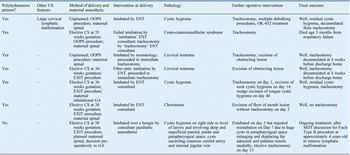
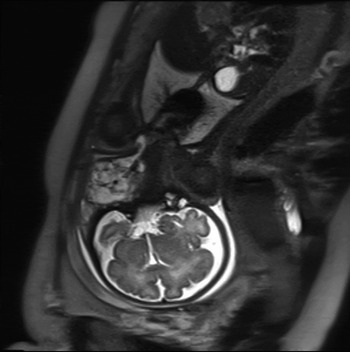
After the development of a complex airways interventional delivery team, interventional delivery birth plans were made for seven neonates delivered within our unit between 2005 and 2012 (Table II). Intubation was successful in six neonates and failed in one neonate; immediate tracheostomy was successful for the latter. One neonate required fibre-optic guided intubation and then underwent immediate tracheostomy. Three neonates underwent tracheostomy in the delivery suite and two underwent tracheostomy the day after delivery. A neonate with a lymphatic malformation (Figure 1) underwent a trial of extubation on day 5 but required reintubation because the cysts increased in size causing further airway obstruction. Elective tracheostomy was performed in week two after a further multidisciplinary team (MDT) discussion.
With a multidisciplinary birth plan: airway obstruction cases requiring airway intervention at birth and patient outcomes

US = ultrasound; OOPS = operation on placental support; CS = caesarean section; EXIT =ex utero intrapartum treatment; GA = general anaesthesia
Fetal magnetic resonance scan showing a lymphatic malformation.

Six neonates underwent tracheostomy. There was one death at three months due to respiratory failure. Five of the surviving six patients underwent tracheo stomies: three have since been decannulated (two before discharge). The causes of airway obstruction in this cohort were lymphatic malformation (n = 3), cervical teratoma (n = 2), costo-craniomandibular syndrome (n = 1) and choristoma (n = 1).
Discussion
Keeping an ENT surgeon on standby at delivery to perform tracheostomy is of limited value. Emergency tracheostomy in the neonate is difficult because the trachea is not aerated if the child has not inspired, making the trachea difficult to identify during surgery. This is a stressful, high-risk situation, particularly if the umbilical cord has been cut thus removing feto-placental oxygenation. Early antenatal diagnosis guides multidisciplinary discussion and formulation of a detailed delivery plan specific to the cause of airway obstruction. The mortality rate before implementation of an interventional delivery team was 50 per cent (n = 2). After implementation of an interventional airway delivery team and a patient-specific airway birth plan, all neonates (n = 7) survived the neonatal period (i.e. first four weeks of life). One died at three months as a result of respiratory failure. Thus, the mortality rate in this cohort was 14 per cent (n = 1). The death was associated with other fetal abnormalities; that is, airway obstruction was not an isolated feature. Airway obstruction associated with other fetal abnormalities is also linked to poorer long-term outcomes and a higher mortality rate (41.6 per cent) despite MDT management and use of an airway protocol.Reference Osborn, Baud, Macarthur, Propst, Forte and Blaser2 Two cases were referred pre-natally from other units where the parents had been given a poor prognosis; both of these neonates survived.
Success depends on a number of factors: involvement of all specialists to formulate a birth plan in a unit with a well-established supporting infrastructure in place. Our service is supported by an infrastructure that includes the Scottish National Service for Complex Airways Management in Children, a paediatric intensive care unit , paediatric cardiac surgery unit, and a tertiary fetal medicine and neonatal unit; it is one of only four units in the UK that provides extracorporeal membrane oxygenation.3 Our service has an MDT approach with co-ordination between the fetal medicine, neonatology, anaesthetics and otolaryngology specialities.
Fetal and maternal risks must be balanced when contemplating an interventional airway delivery. An elective caesarean section at 36–38 weeks gestation (based on the volume of polyhydramnios) is feasible in most cases. The ideal scenario is to have two healthy patients at the end of the procedure; however, the mother's well being is paramount and over-rides any decisions regarding the baby. An obstetric anaesthetist for the mother and a paediatric anaesthetist for the baby should be present at all interventional deliveries, together with a neonatology team to receive the baby, transfer it to a neonatal intensive care unit and institute further assessment and care.Reference Farrell4
Delivery recommendations
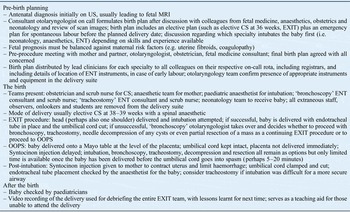
Our recommendations are summarised in Table III. In the initial cases, an operation on placental support was performed because it has a lower risk of maternal haemorrhage whilst allowing adequate time to perform airway intervention before the umbilical cord goes into spasm.Reference Skarsgard, Chitkara, Krane, Riley, Halamek and Dedo5 An operation on placental support is performed using spinal anaesthetic. The infant is delivered completely via a lower segment caesarean section and placed on a Mayo table at the level of the placenta. The umbilical cord is kept intact and synthetic oxytocin injection is delayed, allowing feto-placental circulation to be maintained for as long as possible (approximately 5–20 minutes).
Recommendations for delivery

US = ultrasound; CS = caesarean section; EXIT = ex utero intrapartum treatment; MRI = magnetic resonance imaging; OOPS = operation on placental support
Ex utero intrapartum treatment is an alternative, and was our procedure of choice in recent deliveries. It allows greater control of maternal and fetal haemodynamic stability because feto-placental circulation can be maintained for up to an hour and the neonate is only partially delivered, thus reducing the maternal haemorrhage risk. It can be accomplished using maternal spinal anaesthesia or inhalational general anaesthesia.Reference George, Melnick and Rose6, Reference Govindarajan and Atkinson7 General anaesthesia permits greater uterine relaxation and the potential for more prolonged intervention; however, there is a higher risk of uterine atony and maternal haemorrhage.Reference Abraham, Sau and Maxwell8 In ex utero intrapartum treatment, intubation and bronchoscopy can be very awkward because of partial delivery of the head, but it can be converted to an operation on placental support if greater access is required. However, this reduces intervention time because the placenta separates. In some cases, the risk of maternal haemorrhage maybe too great for either ex utero intrapartum treatment or an operation on placental support (e.g. uterine fibroids) when balanced with the prognosis of the neonate (e.g. other fetal abnormalities detected). In this situation, a caesarean section could be performed with the ENT team on standby to help secure an airway.
• Congenital airway obstruction is a rare but potentially fatal condition
• Antenatal imaging has improved the early detection of this condition and enables intervention at birth to secure an airway
• In the absence of other abnormalities, this has decreased mortality and improved outcomes
• Multidisciplinary planning ensures that the best outcome can be achieved for mother and baby
• Ex utero intrapartum treatment with maternal spinal anaesthesia reduces the maternal haemorrhage risk
ENT involvement and expertise
Two consultants should be present to secure the airway: one for intubation and one to perform tracheostomy. This allows the ‘intubator’ to fully concentrate on the process of intubation. The intubator may not be aware of wider issues such as maternal blood loss or the passage of time. The designated tracheostomy surgeon can make the decision to step in and take over in full knowledge of the situation in the delivery suite and without the emotional burden of having just ‘failed’ at intubation. It is decided at the antenatal MDT planning meeting who should have primary responsibility for intubating the patient. The decision is based on clinical experience and a presumed requirement for rigid bronchoscopy (i.e. a consultant paediatric anaesthetist or ENT surgeon could be the designated primary intubator). It is vital for both patients’ safety that the agreed plan is adhered to, that is if the primary intubator declares that formal airway intervention is required and the patient is not intubatable, then tracheostomy is immediately commenced. The presence of two consultants also allows for consensus decision-making during a stressful situation. It must be remembered at all times that the ultimate responsibility lies with the obstetric team: if they call a halt to the delivery (e.g. due to excess blood loss), then the baby should be delivered immediately without question.
Unplanned deliveries
The plan is disseminated to the on-call teams of each specialty in case the mother enters spontaneous labour. Not all cases of airway obstruction will be detected in the early period of the pregnancy: some are diagnosed late in pregnancy if polyhydramnios develops suddenly. The airway abnormality would then be detected upon ultrasound assessment. In this circumstance, an operation on placental support or ex utero intrapartum treatment is still an option if an MDT discussion and an interventional birth plan is developed early enough for an emergency lower segment caesarean section to be performed.