


1. Introduction
In modern generative grammar, the analysis of argument structure has relied heavily on the decomposition of the VP into (at least) an external-argument–selecting vP and a lower lexical VP. Some of the key evidence for such an approach has come from complex-predicate constructions (see e.g. Butt & Ramchand Reference Butt and Ramchand2005, Folli, Harley & Karimi Reference Folli, Harley and Karimi2005, among many others), for which it is argued that the separate projections are independently realized by separate syntactic constituents. However, the question of how complex-predicate constructions differ from simplex verbs in their composition and argument structure has seldom been addressed.
In this paper, we turn to a family of constructions in Italian which provide an ideal laboratory for the investigation of these issues, as we can compare and contrast simplex and complex-predicate constructions side-by-side in a well-understood grammatical system. We argue that a compositional, syntactico-centric approach to these constructions can provide considerable insight into subtle properties of their interpretation and grammatical behavior, previously unaddressed in lexicalist analyses. In addition, we are able to provide several tests which we argue are diagnostic of functional status for the light-verb element in these constructions, thereby shedding light on the perennially vexed question of distinguishing functional elements from lexical elements in complex-predicate constructions involving multiple verbal components.
The construction in question is based on a class of feminine event nominals, usually derived from the past participle of verbs by the suffixation of -a:
(1) Participle Nominalization
ha camminato → una camminat-a
‘has walked’ ‘a walking’
These nominals frequently enter into complex-predicate–like constructions in combination with a light verb, either fare ‘make’ or dare ‘give’:
- (2)
(a) Gianni ha fatto una risata.
Gianni has made a laughing
‘Gianni laughed.’
(b) Gianni ha dato una lavata alle camicie.
Gianni has given a washing to.the shirts
‘Gianni washed the shirts.’
In this paper we revisit the properties of these constructions and propose an analysis within a compositional view of the syntax/semantics relationship which makes no appeal to special operations of complex-predicate formation in the lexicon or elsewhere. Rather, as we will see, the properties of the light verb (heading vP) and the semantic and argumental properties of the event nominal itself compose to derive the complex characteristics observed in these constructions.
One key piece of evidence we will bring to bear on this issue concerns the status of a variant which uses prendere ‘take’ as the light verb, rather than dare or fare:
(3) Gianni ha preso una sgridata.
Gianni has taken a scolding
‘Gianni was scolded.’
We will show that prendere is in a paradigmatic relation with dare and fare, forming a minimal contrast based on the type of v element involved and its syntactic context. This type of relationship, we argue, is diagnostic of the functional status of these light verbs, given the treatment of blocking and competition adopted in the Distributed Morphology framework (Halle & Marantz Reference Halle and Marantz1993). The analysis of the V-ata complex-predicate constructions which we propose is illustrated in (4).
(4)
(a) fare +V-ata

(b) dare + V-ata
(c) prendere + V-ata
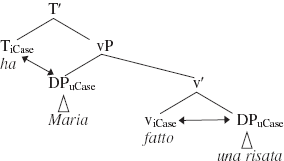
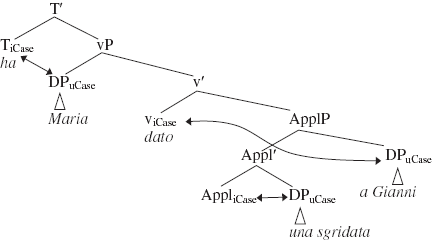
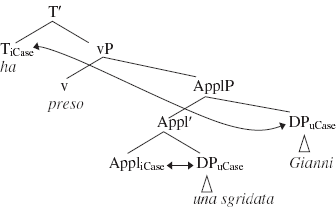
In these structures, the light verbs dare, fare and prendere occupy a v° position. The trees vary in two crucial dimensions. One concerns the particular flavor of v° employed; vCAUSE, which introduces an external argument, and vBECOME, which does not. The other concerns the presence or absence of an Applicative projection introducing the internal argument of the V-ata nominal. We will argue that the combinatorial possibilities made available by this structural approach result in a better understanding of a number of properties of these constructions.
The paper first provides some background on the nominals themselves, drawing on previous studies, in Section 2. Section 3 introduces the syntax of the complex-predicate construction, reviewing the only previous syntactic treatment in the literature and introducing the details of our own proposal, including the applicative analysis of the previously unanalyzed third variation on the construction with a distinct light verb. Section 4 discusses the empirical results which follow from the proposed analysis. Section 5 goes into more detail concerning the Case-checking relationships we propose, and Section 6 considers a number of additional issues and properties of the constructions, discussing how they might be accounted for within our analysis. Section 7 concludes.
2. Background
Previous analyses of -ata nominals have tended to focus either on the formation of the nominals themselves and their morphological and semantic properties (Mayo et al. Reference Mayo, Schepping, Schwarze and Zaffanella1995, Samek-Lodovici Reference Samek-Lodovici1997, Ippolito Reference Ippolito1999, Gaeta Reference Gaeta2002, Acquaviva Reference Acquaviva, Grossmann and Thornton2003), or else on the syntactic process by which they compose with the light verbs to form the complex construction (Samek-Lodovici Reference Samek-Lodovici1997, Reference Samek-Lodovici2003).
We begin our discussion by considering first the formation of the nominals themselves, focusing on the semantic contribution of the -ata morpheme(s).
2.1 The formation of V-ata nominals
All previous analyses concur that when a V-ata nominal is formed from a verb, the morphological structure is quite complex, consisting of the verb root with its theme vowel, the past participial morphology of the relevant conjugation class, and the feminine -a ending. Below are examples of such nominals from all three conjugation classes. Notice that the nominal form is based on the varying participial forms of each class.
(5) Infinitive Participle Nominal
(a) 1st conjugation: -are verbs
mangiare mangiato mangiata ‘eat’
litigare litigato litigata ‘quarrel’
(b) 2nd conjugation: -ere verbs
aggiungere aggiunto aggiunta ‘add’
difendere difeso difesa ‘defend’
(c) 3rd conjugation: -ire verbs
offrire offerto offerta ‘offer’
chiarire chiarito chiarita ‘clarify’
Since the majority of verbs which undergo this process are from the first conjugation, these are often termed V-ata nominals, but we emphasize that this term includes all such participial formations, no matter the conjugation class.
Interestingly, these nominals are also quite productively formed from nouns, mapping an individual-denoting nominal to an event-denoting one:
(6) notte ∼ nott-ata
‘night’ ‘night (experience of length of time)’
gomito ∼ gomitata
‘elbow’ ‘(an) elbowing’
asino ∼ asinata
‘donkey’ ‘(a) foolish act/remark’, lit.: ‘a donkeying’
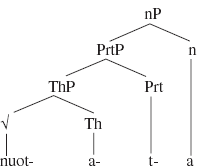
Such nominals are invariably formed with -ata. Samek-Lodovici (Reference Samek-Lodovici1997) and Ippolito (Reference Ippolito1999) show that this is due to the independent fact that nonce verbs in Italian, formed by default verb-forming morphology, all fall into the first conjugation, that is, -are, which is the default conjugation for the language (Dardano Reference Dardano1978; Scalise Reference Scalise1984, Reference Scalise1994). These noun-based -ata nominals, then, are formed in a two-step process, where the stem first receives the appropriate participial suffix and then the feminine -a nominalizer.Footnote 2 The presence of the participial layer accounts for their event-denoting semantics, which has been remarked on by all previous accounts; the internal structure is illustrated below, next to the structure for an inflected verb stem (ThP = Theme (Vowel) Phrase; √ = (Verb) Root):
- (7)
(a)
(b)
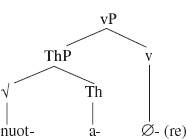
Some such nominals also refer to quantity, rather than to an event proper:
(8) cucchiaio ∼ cucchiaiata
‘spoon’ ‘spoonful’
camera ∼ camerata
‘room’ ‘big room’
Within the deverbal analysis, however, these can be conceived of as denoting the result of a containment event, consistent with the cross-linguistic observation that event-denoting nominals often give rise to result-denoting ones, when an appropriate result is implied (Grimshaw Reference Grimshaw1990).
As with much productive derivational morphology, the biggest puzzle with such nominals under this analysis is the existence of gaps: for many such nominals, the predicted fully verbal form does not surface. Hence we have giornata ‘a day (long)’ but not #giornare ‘to spend a day’, spaghettata ‘a spaghetti feast’ but not *spaghettare ‘to feast on spaghetti’, etc.
Modern proposals concerning the structure of the verb phrase, however, allow us to understand the existence of such gaps in a somewhat more principled fashion. Because the participle form (containing participializing Prt°) and the fully verbal form (containing v°) are both based on a common stem (ThP), it is possible for a participial form to be constructed independently of the existence of a full verbal form. The participle is not built from the verbalized form, i.e. it does not contain the vP projection. As illustrated in (7a) above, we assume that it is built by attaching the participializing projection to a ThP, not to a vP. Consequently, the existence of a participial form, which selects simply for a ThP complement, does not necessarily imply the existence of a fully verbal infinitival or inflected form, which must include a vP.Footnote 3 Other factors, including conceptual knowledge, speaker convention, and usefulness, will enter into a full account of the variation in acceptance and productivity of the corresponding fully verbal form. On the other hand, in the structural approach here, the existence of a verbal participial form does not necessarily predict the existence of the corresponding feminine event nominal in -a, and similar factors will govern variation in acceptance of the event nominals as well.Footnote 4
2.2 The packaging function of the event nominalizer
The -a nominalizer produces a complex event nominal in the sense of Grimshaw (Reference Grimshaw1990), as demonstrated by Mayo et al. (Reference Mayo, Schepping, Schwarze and Zaffanella1995) and Ippolito (Reference Ippolito1999), and assumed in all subsequent work. These nominals can occur as subjects of temporal predicates and co-occur with event-modifying adjectives:
- (9)
(a) Ogni lavata di camicie mi fa perdere ore e ore.
every washing of shirts to.me makes lose hours and hours.
‘Every washing of shirts costs me hours and hours.’
(b) Gianni comincia ogni seminario con un' interminabile elencata dei suoi successi.
Gianni begins every seminar with an interminable listing of his successes
‘Gianni begins every seminar with an interminable listing of his successes.’
Semantically, these nominalizations are said to ‘package’ the eventuality denoted by the verbal base. Gaeta (Reference Gaeta2002) and Acquaviva (Reference Acquaviva, Grossmann and Thornton2003) emphasize that a V-ata nominal derived from an unbounded activity predicate does not itself denote an unbounded event, but rather a very saliently bounded, single ‘portion’ of the event. Accordingly, they treat the -ata suffix (unanalyzed) as a semantic packager, in the sense of Jackendoff's (Reference Jackendoff, Levin and Pinker1991) ‘Universal Packager’, which accomplishes coercion from mass to count nominals. Ippolito (Reference Ippolito1999), who decomposes -ata, as we have seen above, rather attributes this telicity-inducing effect to the presence of the -t- past participle morphology.
Gaeta's (Reference Gaeta2002) and Acquaviva's (Reference Acquaviva, Grossmann and Thornton2003) treatments in fact entail that the packaging function of -ata can apply productively only to unbounded events – they claim that V-ata nominals are generally only formed from activity-denoting predicates, and that other V-ata nominals are ‘marginal’ or ‘exceptional’ cases. While we agree with the general picture of the packaging/telicizing function of the nominalizer, we will argue below that the proposed restriction to activity verbs is not borne out by the data; in fact, we will see that many change-of-state verbs participate fully in the V-ata paradigm.
3. Complex predicates with -ata: Previous analysis and our proposal
We now turn to the previous work on the syntax of V-ata constructions, Samek Lodovici (Reference Samek-Lodovici1997, Reference Samek-Lodovici1999, Reference Samek-Lodovici2003), and present our revised interpretation of the adicity facts first described therein. We also introduce a third, non-agentive, variant on the complex-predicate pattern, and show that its properties can be captured with the analytical machinery proposed for the fare and dare analyses.
3.1 Complex-predicate formation: Samek-Lodovici (Reference Samek-Lodovici1997, Reference Samek-Lodovici1999, Reference Samek-Lodovici2003)
Samek-Lodovici (Reference Samek-Lodovici1997, Reference Samek-Lodovici1999, Reference Samek-Lodovici2003) argues that V-ata nominals enter into a lexical process of complex-predicate formation when composed with the light verbs fare and dare, in the spirit of Grimshaw & Mester's (Reference Grimshaw and Mester1988) ‘argument transfer’ hypothesis. In Samek-Lodovici's treatment, these complex predicates are formed by a process of index suppression and transference: the thematic indices of the arguments of the nominalized verb are transferred to the light verb's indexless arguments. Selection of arguments by the nominalized main verb is thus accomplished through the light verb surrogate, which does not impose any selectional restrictions of its own.
The only contribution the light verb makes in Samek-Lodovici's treatment is to provide an appropriate number of argument slots for the thematic indices of the complex predicate. Therefore, the choice of light verb is determined solely by the transitivity of the nominalized verb. Deverbal nominals with two indices to transfer are composed with dare ‘give’, which has three argument slots; intransitive deverbal nominals, which have only one index, are composed with fare ‘make’, which has two argument slots. The process of thematic index-transfer can be graphically represented as in (11):
- (10)
(a) Gianni ha fatto una risata/*lavata alle camicie.
Gianni has made a laughing/cleaning to.the shirts
‘Gianni laughed/*cleaned the shirts.’
(b) Gianni ha dato una lavata alle camicie/*una risata.
Gianni has given a cleaning to.the shirts/a laughing
‘Gianni cleaned the shirts/*laughed.’
(11)
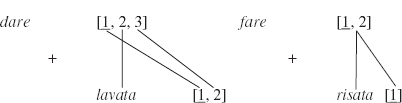
The intuition is that the surplus argument slot in the light verb is required to host the V-ata nominal itself, hence intransitives require a transitive light verb and transitives a ditransitive one.
Samek-Lodovici's proposal provides a clear basis for the strong effects of adicity on selection of the light verb in the complex predicate. However, we show below that this approach does not capture several salient generalizations, especially with respect to selectional differences between the complex predicates and their non-complex counterparts, as well as with respect to semantic effects introduced by the properties of fare and dare. More generally, we will argue that there is no need to posit a special lexical mechanism of complex-predicate formation, as the constructions' properties are better understood as a result of normal syntactic and semantic composition.
3.2 Our proposal: Building a complex predicate in the syntax
Within the syntax-based framework for argument introduction developed in current generative grammar (see e.g. Hale & Keyser Reference Hale and Keyser1993, Kratzer Reference Kratzer, Rooryck and Zaring1996, Marantz Reference Marantz1997, Pylkkänen Reference Pylkkänen2002, among others), operations like Samek-Lodovici's index-transference are unavailable. A compositional approach to the construction of the complex predicate is required.
In its essentials, the complex-predicate construction consists of a light verb composed with a V-ata nominal. This fits smoothly with current proposals concerning the decomposition of the verb phrase: the light verb corresponds to the v° head of the vP projection while the V-ata nominal realizes the lexical content in the predicate below (Hale & Keyser Reference Hale and Keyser1993, Chomsky Reference Chomsky1995, Kratzer Reference Kratzer, Rooryck and Zaring1996, Borer Reference Borer, Spencer and Zwicky1998, inter alia).
3.3 Fare vs. dare
We have seen in (2) and (3) above that V-ata nominals appear with fare, dare and prendere as light verbs. We begin our analysis with a proposal concerning the fare/dare pair. The structures we assume for the basic cases are illustrated again in (12):
- (12)
(a) fare + V-ata
(b) dare + V-ata
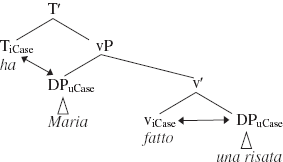
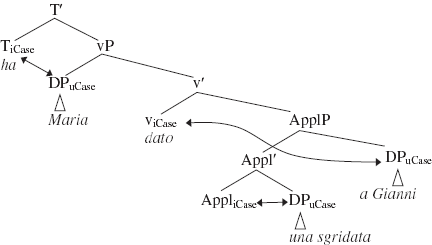
The complex predicates formed with both fare and dare are agentive, and both these light verbs select an external argument of their own. In combination with the -ata nominal, this gives the interpretation ‘X agentively does V-ata’. The difference between fare and dare lies in the presence of an Applicative projection between the v head and the nominal in the latter (Marantz Reference Marantz and Mchombo1993, McGinnis Reference McGinnis1998, Reference McGinnis and Pica2001, Pylkkanen Reference Pylkkänen2002, Cuervo Reference Cuervo2003, Harley Reference Harley, Hinzen, Werning and Machery2012). The Applicative head relates a second argument to the event nominal, expressing an affectedness relation between the applied argument and the event nominal.Footnote 5 In previous work (Folli & Harley Reference Folli, Harley, Doetjes and Gonzáez2006), we have shown that dative applied arguments in Italian c-command accusative Themes, which are introduced lower in the structure. The affectedness reading introduced by the Applicative head will become especially important when we consider the structure of the prendere cases below.
The underlying causative light verb, we claim, is identical in the two cases. The fare/dare alternation is purely morphological, simply reflecting the result of incorporating Appl° into v°: dare is the spell-out of v + Appl; fare is the spell-out of pure causative v°. This is why light verb fare is incompatible with a dative argument in these constructions; the dative argument is necessarily introduced by the Applicative head, and light fare is simply (morphologically) blocked from appearing in that context; dare wins the competition for spelling out the v° + Appl° head (for discussion of competition within the Distributed Morphology framework, see Halle & Marantz Reference Halle and Marantz1993, Embick & Marantz Reference Embick and Marantz2008).Footnote 6
(13) Vocabulary items competing to realize vCAUSE at Late insertion
[vCAUSE-Appl°] ↔ ‘dare’
[v CAUSE] ↔ ‘fare’
This analysis essentially expresses Samek-Lodovici's (Reference Samek-Lodovici1997, Reference Samek-Lodovici1999, Reference Samek-Lodovici2003) insight that the light verb involved is crucially dependent on the number of arguments in the construction, and vice versa, but implements it without positing an extra (pre-syntactic) lexical mechanism of theta-index–transfer.
In Section 4 below, we present several additional generalizations about the fare/dare + V-ata complex-predicate structure, and argue that in each case, the ‘little v’ approach can provide important insights into the source of these generalizations.
3.4 ‘Unaccusative dare’: prendere
We next turn to the third member of the complex-predicate class, involving prendere ‘take’, showing that its behavior cannot be accounted for via index-transference. The choice of light verb in this case instead reflects the presence of a distinct underlying semantic formative, vBECOME.
With certain V-ata nominals, the choice of light verb is more flexible. Besides dare, the nominal can occur with prendere ‘take’, as illustrated in (14) below. None of the previous analyses considers this variation on the general pattern. The change in light verb is clearly associated with a change in the semantics of the construction.
- (14)
(a) Gianni ha preso una sgridata.
Gianni has taken a scolding
‘Gianni was scolded.’
(b) Maria ha dato una sgridata a Gianni.
Maria has given a scolding to Gianni
‘Maria scolded Gianni.’
Consider in particular (14a) above, where the subject Gianni is not agentive. Instead, Gianni is the recipient of the scolding, the internal argument of sgridare, which with the simplex verb is a normal accusative object, Maria ha sgridato Gianni ‘Maria scolded Gianni’. The sentence in (14a) has a counterpart with dare, illustrated in (14b), in which Gianni is the dative argument, rather than the subject.Footnote 7
Notice that prendere in Italian has two readings, as shown in (15) below:
- (15)
(a) Gianni ha preso la sedia. (agentive reading only)
Gianni has taken the chair
‘Gianni took the chair.’
(b) Gianni ha preso la febbre. (non-agentive reading)
Gianni has taken the fever
‘Gianni got the fever.’
When prendere composes with an event-denoting nominal in Italian, it usually has the non-agentive, unaccusative reading, as in (15b). In other words, there is no equivalent to English phrases such as John took the exam or John took a leak in Italian which use prendere.
Similarly, when it occurs with the V-ata event nominal, the unaccusative reading is mandatory; there is no agentive prendere + V-ata combination.
The choice between dare and prendere here is determined by the intended causative or unaccusative semantics not by the number of arguments of the nominal sgridata.
In summary, prendere complex predicates are non-agentive and have a subject which is an affected argument or participant. Next, we argue that these constructions fall into place straightforwardly in the larger framework of the vP analysis.
Within this framework, the causative/inchoative alternation seen with verbs like melt (tr)/melt (intr) is taken to reflect an alternation in light verb type, vCAUSE alternating with vBECOME (Harley Reference Harley1995, Marantz Reference Marantz1997, Folli & Harley Reference Folli, Harley and Karimi2005). The latter does not select an external argument, and consequently an internal argument is promoted to subject position.
Pesetsky (Reference Pesetsky1995), Richards (Reference Richards2001), Harley (Reference Harley, Pica and Rooryck2002), inter alia, argue that ditransitive verbs can have transitive but ‘unaccusative’ counterparts, where an external Agent argument does not appear and instead the VP-internal Goal/Experiencer argument is promoted. For example, transitive get in English (in the ‘receive’ sense only) is argued to be the unaccusative counterpart of ditransitive give. Similarly, in many languages it is morphologically obvious that learn is an unaccusative transitive counterpart of a causative ditransitive meaning teach.
Evidence for the causative/unaccusative relationship between give and get in English comes from pairs like those exhibited in (16):
- (16)
(a) The Count gives everyone the creeps.
(b) You get the creeps (just looking at him) (Richards Reference Richards2001: 189)
The phrase the creeps receives the same idiomatic interpretation in the two sentences in (16), despite the surface difference in the two verbs involved. The proposal advanced by Richards is that the key difference between (16a) and (16b) involves the upper v° projection – causative in the first case, introducing an Agent argument in Spec-vP, and unaccusative vBECOME in the second, without a specifier. This results in the promotion of the Experiencer argument John to subject position. The local environment for the NP the creeps in the lower part of the VP remains identical (a HAVE relation), and so the idiomatic reading carries over.Footnote 8
We propose that dare ‘give’ and non-agentive prendere ‘receive’ stand in this same relation in Italian, and the difference between the minimal pairs in (17) below is simply in the type of v° head involved. Just as dare is the spell-out of vCAUSE + Appl°, non-agentive prendere is the spell-out of vBECOME + Appl°.
- (17)
(a) Gianni ha preso una sgridata.
Gianni has taken a scolding
‘Gianni was scolded.’
(b) Maria ha dato una sgridata a Gianni.
Maria has given a scolding to Gianni
‘Maria scolded Gianni.’
(18)
(a) prendere + V-ata
(b) dare + V-ata
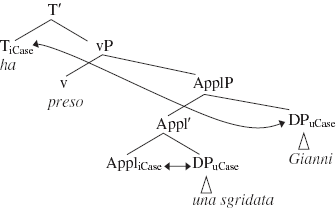
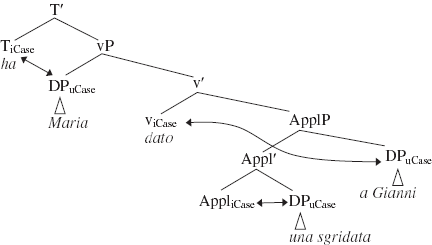
The Vocabulary-Insertion rule for prendere is given below, along with a repetition of the rule for dare, for ease of comparison:
(19) Vocabulary items competing to realize v + Appl at Late insertion
[v CAUSE-Appl°] ↔ ‘dare’
[v BECOME-Appl°] ↔ ‘prendere’
In the lexical index-transfer approach, the failure to transfer the external argument of the V sgridata to prendere would presumably predict ill-formedness for (17a), since it is precisely such a failure which accounts for why transitive verbs must compose with dare rather than fare in the theory.
4. Empirical results
We now turn to exploring some of the empirical predictions of the proposal presented above, beginning with an exploration of the proposed functional status of the light verb in V-ata complex predicates.
4.1 Light verbs and passivization (or lack of)
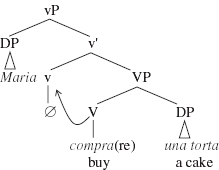
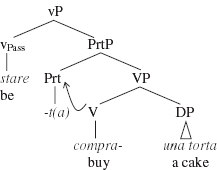
Folli & Harley (Reference Folli and Harley2007) argued that the vP framework entails that light verbs cannot have participial passive forms. Passive participle morphology has the effect of prohibiting the projection of an overt external argument. In their analysis, the passive morphology eliminates the external argument by attaching to the root below the v° level, preventing the projection of vCAUSE.Footnote 9 In an Italian passive, essere ‘be’ replaces the upper v°, and the passive participle complement to essere is built from the root below, along the lines proposed in Embick (Reference Embick2004) for English and Alexiadou & Anagnostopoulou (Reference Alexiadou and Anagnostopoulou2008) for Greek. The two structures are illustrated in (20):
(20)
(a) Active vP
Maria compró una torta.
‘Maria bought a cake.’
(b) Passive vP
Una torta è stata comprata.
‘A cake was bought.’
Consequently, passive participle morphology cannot occur on true light verbs, whose position of base-generation is always v°. Only lexical verbs, whose root is projected low in the split-vP, can have a passive participle form.Footnote 10Folli & Harley (Reference Folli and Harley2007) argue that this prediction is borne out by Italian causative constructions with fare. Causative constructions with light verb fare resist passivization, as shown in (21), in contrast to main verb fare (22), which permits it:Footnote 11
(21)
(a) Gianni ha fatto ridere Mario.
Gianni has made to.laugh Mario
‘Gianni made Mario laugh.’
(b) *Mario è stato fatto ridere da Gianni.
Mario is been made to.laugh by Gianni
‘Mario was made to laugh by Gianni.’
(22)
(a) Gianni ha fatto una torta.
Gianni has made a cake
‘Gianni made a cake.’
(b) Una torta è stata fatta da Gianni.
a cake is been made by Gianni
‘A cake was made by Gianni.’
This pattern extends to all the light verbs in the Vata constructions under consideration here. As predicted, they also fail to passivize:
(23)
(a) *?Una risata è stata fatta da Giulia.
a laughing is been made by Giulia
‘A laughing was made by Giulia.’
(b) *Una letta è stata data a Kant da Gaia.
a reading is been given to Kant by Gaia
‘A reading was given to Kant by Gaia.’
(c) *?Una sgridata è stata presa da Gianni.
a scolding is been taken by Gianni
‘A scolding was taken by Gianni.’
This pattern is consistent with a little v analysis for fare and dare (and prendere) in these structures, but not with a main V analysis. If fare and dare (and prendere) were true main Vs, they would be expected to have passive forms.
4.2 Diagnosing light verbs
Given this account of the failure of passivization in these constructions, we can use the passive to confirm or deny the identity of particular instances of potential light verbs, in combination with other tests.
We can use our passivization test to investigate the status of certain V+ata nominals in construction with other verbs, asking whether these V + V-ata combinations are true complex predicates or not. One typical example involves V-ata nominals of bodily contact, such as gomitata ‘elbowing’ and testata ‘head-butting’. These nominals can occur as the object of tirare ‘pull’, as in (24) below, as well as with dare and prendere.
(24) Zidane ha tirato una testata.
Zidane has pulled a head.butting
‘Zidane head-butted (someone)’
We might then wonder whether tirare+V-ata is a complex-predicate construction on a par with the other cases considered so far. Given what we have said above about passivization, we predict that if tirare is a light verb, (24) should not passivize. In fact, it can, as shown in (25), suggesting that tirare here is not a light verb at all:
(25) Una testata è stata tirata da Zidane.
a head.butting is being pulled by Zidane
‘(Someone) is being head-butted by Zidane.’
This conclusion is supported by interpretive differences between tirare+V-ata and prendere + V-ata. Just like main verb prendere, in Italian, tirare has several interpretations, including the agentive ‘throw’ and a kind of non-agentive ‘get’-type meaning. In (24), then, we see two distinct interpretations, one in which Zidane is the Agent of a head-butting event, and another where he has simply knocked his head against something involuntarily.
This contrasts sharply with the light verb prendere cases in (14) above, where only the non-agentive interpretation is available. This, we argue, is because prendere is a true light verb, a functional element in paradigmatic opposition with agentive dare and fare. Prendere, since it is not a heavy verb, does not contribute its own encyclopedic content here; its meaning derives from the content of the v° head which it competes to realize.
In contrast, we conclude that tirare is a heavy verb even with a V+ata complement. Both the passivization test and the different interpretations available for tirare in (24) support this conclusion. See Section 6.2 below for further discussion of V+ata nominals as independent arguments of main verbs.
4.3 Thematic change: Verbs of creation with dare
Another contrast between dare+V-ata complex predicates and the corresponding non-complex forms can be seen with transitive verbs of creation. It is well known that many verbs of creation typically have two interpretations. On one interpretation, the object is understood as coming into being as the result of the action; on a second interpretation, the pre-existing object is merely affected by the action. Crucially, in the former interpretation, there is no existence presupposition for the object, while in the latter, an existence presupposition is present (see e.g. Lee Reference Lee1973), as illustrated in (26):
(26) Michelangelo ha scolpito il pezzo di marmo/La Pietà.
Michelangelo has sculpted the piece of marble/The Pietà
‘Michelangelo sculpted the piece of marble/The Pietà.’
In the corresponding complex predicate, however, the creation reading is impossible; the only reading is the one in which the object is presupposed and is affected:Footnote 12
(27) Michelangelo ha dato una scolpita al pezzo di marmo/*alla Pietà.
Michelangelo has given a sculpting to.the piece of marble/to.the Pietà.
‘Michelangelo has sculpted the piece of marble/The Pietà.’
A similar effect is seen with another set of verbs with canonical Incremental Theme objects. With the simplex forms of such verbs, a completion implication is present (though cancellable) and this is reflected in the relatively degraded status of (28a′) compared to (28a). On the other hand, there is no implication of completion in the complex-predicate form, and therefore (28b) and (28b′) are equally good.Footnote 13
(28)
(a) Gianni ha pulito il tavolo.
Gianni has cleaned the table
‘Gianni cleaned the table.’
(a′) ??Gianni ha pulito il tavolo ma è ancora sporco.
Gianni has cleaned the table but it.is still dirty
‘Gianni cleaned the table but it is still dirty.’
(b) Gianni ha dato una pulita al tavolo.
Gianni has given a cleaning to.the table
‘Gianni cleaned the table.’
(b′) Gianni ha dato una pulita al talvolo ma è
Gianni has given a cleaning to.the table but it.is
ancora sporco.
still dirty
‘Gianni cleaned the table but it is still dirty.’
Effectively, the Incremental Theme interpretation is not available in V-ata complex-predicate constructions. In Samek-Lodovici's framework, it is not clear why the simplex and complex predicates should differ in this regard, since theta-transfer should not be sensitive to the particular thematic relationships at issue. In contrast, we argue that the presupposition of existence in (27), and the lack of an Incremental Theme reading in both (27) and in (28b′), follow from the light-verb approach.
Recall that the fundamental difference between the dare and fare light verbs has to do with the type of complement they take. Fare has a simple DP complement, denoting an event. The interpretation of the construction with fare is simply ‘X makes/does Y’, where Y is an event denoted by the V-ata nominal. In contrast, the complement to v° in the dare construction is predicative – a small clause introduced by the ApplP projection. The subject of this predication is the dative argument, and the predicate is the relation denoted by the Appl° head together with its complement, the event nominal. Essentially, in dare constructions the complement of v° is a small clause, and the whole is interpreted as [vP X cause [SC Y Appl -ata]]. This is the canonical structure associated with a change-of-state event (Hoekstra & Mulder Reference Hoekstra and Mulder1990, Harley Reference Harley2005, among many others).
Thus, the dative object in a dare+V-ata construction is an ‘inner subject’, in the terminology of Hale & Keyser (Reference Hale and Keyser1993) – the (affected) subject of a result state predication. This position is well-known to involve a presupposition of existence, since a non-existent item cannot undergo a change of state (Tenny Reference Tenny1987). Consequently, the creation reading – the Incremental Theme reading – is impossible for the complex construction in (27).Footnote 14
5. Case assignment and argument licensing
We turn now to the general question of argument licensing in these constructions, beginning with our assumptions about Case assignment.
We essentially adopt Samek-Lodovici's (Reference Samek-Lodovici1997, Reference Samek-Lodovici1999, Reference Samek-Lodovici2003) view of the case situation in the fare and dare complex predicates, namely that there are two structural Cases available in the former, and three in the latter, but we differ in terms of the projections which make these Cases available.
All finite clauses have one structural Case available in Spec-TP, where the highest Case-licensed argument appears. Clauses with and without Applicative heads, however, differ in the number of structural Cases available in the lower portion of the clause. We assume, standardly, that agentive vP has a structural Case available (Chomsky's Reference Chomsky1995 v*P), which licenses the accusative object in most transitive constructions. We further assume that the Applicative head carries a structural Case feature, which can license a DP argument as well. It is important for the analysis we are about to present that the Applicative head licenses a normal structural Case, not inherent or quirky dative case.
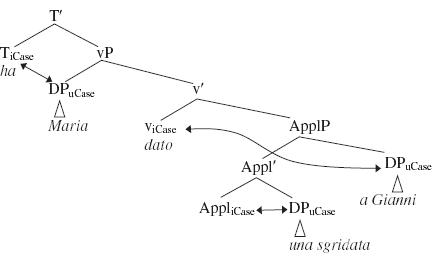
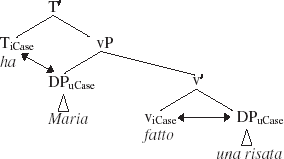
Following Marantz (Reference Marantz, Westphal, Ao and Chae1991), Bobaljik (Reference Bobaljik1995), Harley (Reference Harley1995), and Folli & Harley (Reference Folli and Harley2007), we assume a relativistic (‘dependent’) approach to the spell-out of checked structural Case features. Each DP, including the event nominal, enters the derivation with an uninterpretable Case feature, which checks, via Agree, the Case feature of the nearest c-commanding Case-licensing head. Consider the tree below, now attending particularly to the double-headed arrow notations indicating Case checking relationships:
(29)
(30)
(31)
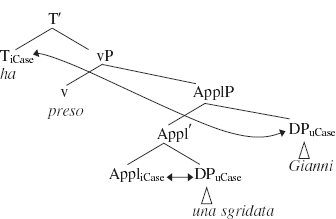
As shown in (29), (30) and (31) above, each argument checks its uninterpretable Case features against the nearest c-commanding Case assigner, in accordance with the Minimal Link Condition. However, spell-out of morphological cases is relativistic, with different winning case-markers chosen depending on how many other Case features are in the competition within a given clausal domain, and also depending on their configuration with respect to the other DPs in the clause bearing structural Case. A single Case feature in a clausal domain is spelled out with a nominative case marker; two are spelled out with nominative and accusative case markers, and three are nominative, dative and accusative, regardless of which head is responsible for checking the features of a given DP. For a more extended discussion, see Folli & Harley (Reference Folli and Harley2007), Bobaljik (Reference Bobaljik, Harbour, Adger and Béjar2008).
6. Extending the analysis
In this section, we consider a number of additional properties particular to the V-ata construction, to do with event structure, verb classes, argument composition, and the status and interpretation of the V-ata nominal itself.
6.1 Verb class flexibility of V-ata nominalization
Gaeta (Reference Gaeta2002) and Acquaviva (Reference Acquaviva, Grossmann and Thornton2003) both emphasize the notion that it is mostly unbounded activities which participate productively in V-ata nominalization. However, this does not seem justified. Consider the following list of nominalizations from various event classes:
(32) Unergatives
dormire ‘to sleep’→ dormita
nuotare ‘to swim’→ nuotata
galoppare ‘to gallop’→ galoppata
correre ‘to run’→ corsa
ridere ‘to laugh’→ risata
(33) Degree Achivements
salire ‘to climb/to rise’→ salita
crescere ‘to grow/to raise’→ crescita
aggiungere ‘to add’→ aggiunta
allungare ‘to lengthen’→ allungata
(34) Transitives
lavare (una camicia) ‘to wash (a shirt)’→ lavata (alla camicia)
mangiare (una mela) ‘to eat (an apple)’→ mangiata (alla mela)
studiare (la poesia) ‘to study (the poem)’→ studiata (alla poesia)
bere (il suo sciroppo) ‘to drink (his cough syrup)’→ bevuta (al suo sciroppo)
(35) Unaccusatives
entrare ‘to enter’→ entrata
uscire ‘to exit’ → uscita
venire ‘to come’→ venuta
cadere ‘to fall’ → caduta
scivolare ‘to slide’→ scivolata
Unergatives fit unproblematically into the activity class, consistently with Gaeta's and Acquaviva's treatments, but the remaining verb types do not. Degree achievements, while arguably unbounded, take essere ‘be’ as an auxiliary, so in some fundamental ways they pattern with change-of-state unaccusatives rather than activities. Similarly, the transitive verbs which work well with -ata tend to be object-drop verbs, consistent with the activity hypothesis, but they can also participate in the complex-predicate construction with delimiting object arguments present, on accomplishment-based interpretations.Footnote 15 Finally, many clearly unaccusative accomplishment/achievement verbs form felicitous V-ata nominals. In fact, Samek-Lodovici (Reference Samek-Lodovici1997) provides a list of several hundred V-ata nominals, divided into deverbal and denominal subgroups. Of the first forty cases in the (alphabetically organized) list of V-ata nominals he provides, most of them (more than 30) are transitive change-of-state verbs, members of either the bounded change-of-state class or the degree-achievement class. Gaeta (Reference Gaeta2002) and Acquaviva (Reference Acquaviva, Grossmann and Thornton2003: 7–8) suggest that these cases are marginal formations, but we see no reason to treat them as less productive than the activity predicates – emphatically the contrary, in fact. We argue below that our account explains the intuition of previous authors that intransitive activity verbs form the central cases of V-ata nominalization. The problem has to do with the conditions under which an event nominal can appear in isolation, outside the complex-predicate construction.
6.2 Independent status of V-ata nominal
Given our observations in Section 6.1 above, it seems incontrovertible that V-ata nominals are productively formed from many different classes of verbs, including transitive change-of-state verbs, contra the previous analyses mentioned.Footnote 16 However, there is a salient difference between V-ata nominals formed from intransitive verbs and those formed from transitive ones: the former seem to have an independent existence as nominals in the language, while the latter are very restricted, tending to occur only in construction with dare.
This distinction is robustly reflected in patterns of distribution of these nominals, including not only their occurrence outside the complex-predicate construction, but also the availability of modification with a strong quantifier. Intransitive V-ata nominals appear to be full-fledged nouns, while transitive ones are more constrained in their distribution.
In (36) we see that nominals formed on the intransitive verbs nuotare ‘swim’, ridere ‘laugh’ and camminare ‘walk’ can occur alone and with a strong quantifier.
(36)
(a) Che bella nuotata/risata/camminata!
what good swimming/laughing/walking
‘What good swimming/laughing/walking!’
(b) Ogni risata ti allunga la vita.
every laughing you.dat lengthens the life
‘Every laugh lengthens your life.’
(c) La mia nuotata quotidiana non si discute.
the my swimming daily not refl discusses
‘My daily swim is not to be discussed.’
(d) Il dottore mi ha prescritto molte camminate in montagna.
the doctor to.me has prescribed many walkings in.the mountain
‘The doctor has prescribed a lot of mountain walks for me.’
In contrast, (37) shows that nominals formed from transitive verbs such as aggiustare ‘fix’, attivare ‘activate’ and assicurare ‘secure’ are distinctly degraded in these contexts.
(37)
(a) *?Che bella aggiustata/assicurata/attivata (alla macchina/carta)!
what beautiful fixing/securing/activating to.the car/card
‘What a great fixing/securing/activating of the car/card!’
(b) *?La frequente aggiustata (alla mia macchina) mi permette di passare l'MOT.
the frequent fixing to.the my car me.dat permit to pass the.MOT‘Frequent adjustments to my car allows me to pass the MOT.’
(c) *?Molte attivate (alla carta) possono causare dei problemi.
many activations to.the card can cause of.the problems
‘Many card activations can cause problems.’
(d) *?La assicurata (alla macchina) mi è costata molti soldi.
the insurance to.the car to.me is cost much money
‘The car insurance cost me a lot of money.’
The above distributional restrictions are likely to be the source of the impression reported in previous work that activity verbs combine better with -ata than change-of-state verbs. However, the constraint is considerably more complex than a simple distinction in morphological productivity. Rather, both types of verb are equally well-formed with -ata, but differ in their freedom to occur outside the complex-predicate construction.
We will argue below that the difference depends on whether a given verb must co-occur with its internal argument, and on the ways in which such an obligatory internal argument can be Case-licensed in the syntactic structure. The account relies crucially on the notion that a DP cannot appear in the syntactic structure without receiving Case from an appropriate licenser, and on the notion that obligatorily transitive verbs are ill-formed without their internal arguments. If there is no source of Case-licensing for an obligatorily transitive verb's internal argument, ungrammaticality is the result. The lack of a Case-licenser explains why transitive event nominals cannot occur with their internal arguments on their own, and also why transitive event nominals cannot occur with fare.
The crucial distinction between the verbal complex-predicate context and the purely nominal independent context is that in the former there are additional resources available for Case-licensing nominals. In particular, applicatives are available in verbal contexts only.Footnote 17
In the examples in (37) above, the absence of the Applicative head accounts for the unavailability of the internal argument of the verb which is the source of the participle, and hence the ungrammaticality of these nominalizations.Footnote 18 Equivalent nominalizations formed from intransitive verbs, as in (36), are well-formed, because these verbs do not require the presence of an internal argument for interpretation. Since many intransitive verbs are unergative activity predicates, the effective result is an impression that the Aktionsart of the verbal base is important in determining whether -ata can be affixed to it or not.
This account makes two predictions concerning when a transitive verb will have an -ata form which can occur as an independent nominal. First, transitive verbs which allow object drop, such as spazzare ‘sweep’, pulire ‘clean’ or spolverare ‘dust’, will also form nominal V-ata items with an independent distribution, as in (38) (thanks to a JL referee for these examples):
(38) Una bella spazzata/pulita/spolverata! Ecco di cosa ha bisogno ilcortile/il tavolo/hanno bisogno i mobili.
a great sweeping/cleaning/dusting this of what has need the courtyard/the table/have needed the furniture
‘A great sweeping/cleaning/dusting! That's what the courtyard/table/furniture needs!’
These nominals are well-formed because they do not require a syntactic object, even if they semantically imply one, as indicated by the continuation in the example.
Second, if an alternative method for Case-licensing an internal argument is available within the DP, we predict that independent V-ata nominals of mandatorily transitive verbs will be well-formed, since their requirement for a syntactic object will be met. There are some such cases using the preposition di ‘of’, which we assume is analogous to the Last Resort assignment of of in English event nominals. Consider the following examples:
- (39)
(a) Che lavata di camicie!
what washing of shirts
‘What a washing of shirts!’
(b) *Che lavata alle camicie!
what washing to.the shirts
‘What a washing of the shirts!’
(c) Che bevuta di latte!
what drinking of milk
‘What milk-drinking!’
(d) *Che bevuta al latte!
what drinking of milk
‘What a drinking of the milk!’
Such di arguments are fine in stand-alone V-ata nominals, as they are Case-licensed entirely internally to the DP. The di has some special constraints, restricting the internal argument to an indefinite NP complement, which limits the general applicability of this strategy.Footnote 19
This, then, also provides the necessary ingredients to understand the absence of transitive V-ata nominals with fare. Our analysis predicts that, when we see fare with a V-ata nominal, no Applicative head is present, since v + Appl is spelled out as dare. This is why we do not expect fare to co-occur with a dative-marked internal argument, hence we do not expect it to co-occur with a transitive V-ata complement. However, when a different argument-introducing strategy is available internally to the DP, as in the di construction above, fare can in fact occur with a transitive -ata nominal (40), as the analysis predicts.
(40) Gianni ha fatto una lavata di camicie.
Gianni has made a washing of shirts
‘Gianni washed shirts.’
In short, the absence of internal arguments with fare + V-ata constructions follows from the unavailability of a Case-licenser for these arguments. This in turn follows from the approach advocated here, in which each argument is introduced by a head contributing to the overall syntactic and semantic properties of the whole.
6.3 Adicity mismatches
In the analysis proposed here, the dative arguments in V-ata complex-predicate constructions have a different source than dative arguments in run-of-the-mill ditransitives. In the former, they are introduced by an ApplP projection, while in the latter they are subcategorized for by a lexical verb, i.e. they are introduced in the specifier of the lower VP itself, in a local relationship with the lexical verb, rather than in the specifier of a higher functional projection such as Appl°. It is possibly unsurprising, then, that the requirement that dare occur with a dative argument is somewhat more relaxed in the complex-predicate cases than when dare is a lexical verb. There are cases of dare + V-ata nominals of transitives which can occur without the dative a-phrase in the right context:
(41) Gianni (ha preso il martello e) ha dato una martellata.
Gianni has taken the hammer and has given a hammering
‘Gianni took the hammer and gave a hammering.’
This seems to be possible when the nominalized verb is itself based on an instrumental noun, as with martellare ‘to hammer’, sforbiciare ‘to scissor’, or pedalare ‘to pedal’.
Lexical dare, in contrast, does not permit the omission of the dative DP without heavy contextual support:Footnote 20
(42) Maria ha dato una bicicletta *(a Gianni).
Maria has given a bicycle to Gianni
‘Maria gave Gianni a bicycle.’
Similarly, with certain denominal V-ata nominals, with the meaning ‘take/give a blow to N’, dare is well-formed without the dative argument.
(43) Gianni ha dato una testata prima di entrare in cabina.
Gianni has given a heading before of entering the cabin
‘Gianni knocked his head before entering the cabin.’
Even with dare+V-ata constructions which do not allow the omission of the a-phrase when all arguments are expressed as full DPs, there is a crucial difference from lexical verb dare. Both arguments must be present with lexical dare, even if only as pronominal clitics:Footnote 21
(44)
A: Gianni ha dato una bicicletta a Maria?
Gianni has given a bicycle to Maria
‘Did Gianni give Maria a bicycle?’
B:
(a) *Si, Gianni l'ha data.
yes Gianni it.has given
(b) Si, Gianni gliel'ha data.
yes Gianni to.her.it.has given
‘Yes, Gianni has given it to her.’
In contrast, in complex predicates with transitive V-ata nominals, the dative clitic may be omitted in the same context:
(45)
A: Gianni ha dato una letta a Kant?
Gianni has given a reading to Kant
‘Did Gianni read Kant?’
B: Si, Gianni l'ha data.
yes Gianni it.has given
‘Yes, he read Kant.’
In the account we propose, the complement of light verb dare is a small clause headed by ApplP; we contend that the single accusative clitic here refers to the proposition encoded by that small clause [[una letta Appl°] a Kant]ApplP.
While we do not have a specific account predicting the omissibility of the applicative datives, it is perhaps not surprising that they might differ in their omissibility from other datives, since they result from a different syntactic configuration. In particular, we note that the dative a with heavy verb dare is a true preposition. In contrast, we have assumed above and in earlier work that the dative a can be the realization of a structural Case. In such cases, the dative phrase is a simple DP, not a PP, and as such is integrated into the structural Case configuration of the clause. In Folli & Harley (Reference Folli and Harley2007), we argue that a structural dative a in Italian is supported by the accusative/dative alternation in Italian causatives of intransitive/transitive alternating verbs: Gianni ha fatto cantare Mario ‘Gianni made Mario sing’ vs. Gianni ha fatto cantare l'inno nazionale a Mario ‘Gianni made Mario sing the national anthem’. This, we suspect, is likely to be the source of the difference in omissibility of the dative argument with the complex-predicate construction.Footnote 22
6.4 Impression of size of -ata
Previous analyses have not suggested any approach to a subtle but salient semantic effect of V-ata nominalization, namely that the event denoted by the nominal in general carries an implication of a certain minimum size or intensity. For example, una mangiata ‘an eating’, usually refers to a feast, rather than a snack; similarly, una dormita ‘a sleeping’ cannot refer to a quick nap – it usually implies a long, sound sleep.Footnote 23
This contrast carries over to the V-ata nominals in construction with fare. It can be clearly felt when we compare a simplex verbal use of mangiare ‘eat’ with the construction involving a V-ata nominal in the examples below:
(46)
(a) Gianni ha mangiato.
Gianni has eaten
‘Gianni ate.’
(Can describe a small or regular-sized eating event.)
(b) Gianni ha fatto una mangiata.
Gianna has done an eating
‘Gianni ate.’
(Describes a substantial eating event.)
Interestingly, when a V-ata nominal composes with dare, the impression is in fact the opposite – dare with V-ata seems to suggest a brief, inconsequential version of the event. Compare the sentences with studiata ‘a studying’:
(47)
(a) Gianni ha fatto una studiata.
Gianni has done a studying
‘Gianni studied.’
(Presupposes a serious amount of studying.)
(b) Gianni ha dato una studiata a Kant.
Gianni has given a studying to Kant
‘Gianni studied Kant.’
(Presupposes a quick scan.)
In (47a), fare una studiata ‘do a studying’ seems to suggest a significant effort has been invested, as with (46b) above. In contrast, the sentence with dare una studiata a Kant ‘give a studying to Kant’ in (47b) implies a brief, insubstantial event.
We claim that the size effect in independent V-ata nominals derives primarily from the fact that the nominalizer is feminine, which correlates with cross-linguistic observations concerning the use of feminine gender with objects of a certain size (Gerdts Reference Gerdts2009 and references therein). However, the reverse effect which we see with dare derives from the event-structure properties of the light verb construction itself.
Let us consider the temporal properties of the dare + V-ata structure. In the dare construction, we propose that the semantics involves a simple transition to the result state – the relationship between the dative argument and the V-ata nominal is asserted to be caused. The period of time required for the establishment of the applicative relationship is then a function of the nature of that relationship, not a function of the event type involved – the size/temporal extent of the V-ata nominal is essentially irrelevant.Footnote 24
The nature of the applicative relationship is a matter of some debate in the literature, but there is a general consensus that it is a species of possession (or, perhaps, possession relationships are a species of applicative – see e.g. Pylkkänen Reference Pylkkänen2002). The crucial trait of such relationships for us is the instantaneous nature of their creation; one either is or is not a possessor of something – there is no transitional state on the way to possession. Possession-change relations such as get or double-object give behave like Achievements, in the Vendler classification, with respect to modification by temporal adverbials and other tests.Footnote 25
Applying this observation to our current analysis, we conclude that the dare + V-ata constructions are Achievement predicates because the small clause headed by the applicative is an instantiation of this possession relationship. The temporal contrast between Gianni ha studiato Kant ‘Gianni studied Kant’ and Gianni ha dato una studiata a Kant ‘Gianni has given a studying to Kant’, then, is a reflection of the different predicates involved in the small clauses. When studiare ‘study’ is a main verb, studiare itself is the predicate of the small clause, contributing all its temporal properties, specifically an extended duration, to the change of state. In contrast, when dare una studiata ‘give a studying’ is involved, the predicate is a punctual one introduced by the Appl° head, and the durational properties of una studiata are not relevant to the small clause's event structure.
7. Conclusion
In this paper, we have argued that a syntactic approach to argument structure can give considerable leverage on some puzzling features of Italian complex predicates in V-ata, which contrast with those of their simplex counterparts. In particular, it provides a natural explanation for the unavailability of the creation reading in complex predicates formed from Incremental Theme verbs. It also explains the variation in thematic roles seen with a change in light verb from agentive dare ‘give’ to non-agentive prendere ‘take’. These facts in particular constitute strong support for the hypothesis that there are varieties of light verb with different argument-introducing properties and event-structure interpretations. We have argued that the much-discussed intuition that V-ata nominals are primarily based on activity-denoting unergative verbs result from a simple difference in distribution of these nominals compared to their change-of-state, transitive counterparts. The actual formation of the nominals is equally productive for both types of verbs, but the argument-licensing needs of the transitive nominals prevents them from appearing in several contexts in which the activity-denoting verbs are possible. From a broader perspective, we feel that the account also demonstrates the viability and usefulness of the syntactico-centric approach to argument structure and morphological phenomena.


