1 Introduction
1.1 General background
Phonological analysis and theorising typically takes phonotactics as part of the data to be accounted for in terms of a phonological grammar. For example, Chomsky & Halle (Reference Chomsky and Halle1968: 382) aim to provide an account of voice assimilation in Russian as it is instantiated in morpheme alternations and also of the corresponding static phonotactic restriction: the absence of morpheme-internal sequences of obstruents that disagree in voicing (see Pater & Tessier Reference Pater, Tessier, Slabakova, Montrul and Prévost2006 for experimental support for a unified account of alternations and phonotactics). Ohala (Reference Ohala1986) challenges the assumption that phonotactics require a phonological account, raising the possibility that knowledge of the shape of a language's words could be reduced to ‘knowledge of the lexicon plus the possession of very general cognitive abilities’ (1986: 14). As an example of the requisite general cognitive abilities, he cites Greenberg & Jenkins' (Reference Greenberg and Jenkins1964) phoneme-substitution metric, which measures the closeness of a nonce word to the existing lexicon as proportional to the number of times that the replacement of each subset of the nonce word's segments yields an existing word.
Like many other models of word-likeness or probability, Greenberg & Jenkins' model of phonotactic knowledge is quite different from those constructed in phonological theory. The first difference is in the nature of the representations employed: Greenberg & Jenkins make use only of segments, while a phonological analysis of a language's phonotactics typically refers to segment-internal features as well as prosodic constituents such as syllables. While Greenberg & Jenkins and Ohala recognise the absence of features from the model as a potential flaw, purely segmental models of phonotactics continue to be common in psycholinguistics and natural language processing. The second difference is in the nature of the computation used to evaluate a representation. As Ohala (Reference Ohala1986: 14) points out, the Greenberg & Jenkins model assumes no ‘abstracted (‘derivative’) knowledge about language-specific or language-universal sound patterns', that is, it makes no use of phonological constraints or rules. The third and final difference is in the nature of the classification of a representation that the model returns: the Greenberg & Jenkins model yields a range of scores for representations that would typically be classified as only either ‘well-formed’ or ‘ill-formed’ in a phonological analysis (this two-way classification is commonly assumed in phonological theory – see e.g. Hayes Reference Hayes and Kager2004 and Prince & Tesar Reference Prince, Tesar and Kager2004, though cf. Chomsky & Halle Reference Chomsky and Halle1968: 417 and others cited immediately below). Ohala (Reference Ohala1986) mentions experimental data gathered by Ohala & Ohala (Reference Ohala1986) that shows that nonce word judgements are gradient in the way that the Greenberg & Jenkins model predicts.
Phonologists have only recently responded to Ohala's (Reference Ohala1986) challenge. The first type of response has involved the creation of models of phonotactics that provide gradient evaluation of well-formedness, but that exploit the representational vocabulary of phonological theory (e.g. Coleman & Pierrehumbert Reference Coleman, Pierrehumbert and Coleman1997, Bailey & Hahn Reference Bailey and Hahn2001, Frisch et al. Reference Frisch, Pierrehumbert and Broe2004, Coetzee & Pater Reference Coetzee and Pater2006, Reference Coetzee and Pater2008, Anttila Reference Anttila2008, Hayes & Wilson Reference Hayes and Wilson2008, Albright Reference Albright2009, Coetzee Reference Coetzee and Parker2009). The second type of response has been to provide experimental evidence that phonotactic knowledge is encoded in terms of the constructs of phonological theory, and cannot be attributed solely to measures of word-likeness or probability calculated over segmental strings (e.g. Berent et al. Reference Berent, Everett and Shimron2001, Frisch & Zawaydeh Reference Frisch and Zawaydeh2001, Albright Reference Albright2009, Coetzee Reference Coetzee and Parker2009).
The present paper contributes a novel type of evidence in support of a phonological account of phonotactics. We show using a nonce-word judgement task that Dutch speakers have knowledge of a phonotactic restriction against a sequence of a long vowel followed by a pair of consonants of which the second is non-coronal (e.g. *[meːlk]). The argument that this knowledge cannot be reduced to segmental sequence probability or to word-likeness is threefold. First, the experimental items were controlled for measures of both sequence probability and word-likeness. Second, as we discuss in the following section, the complexity of this restriction goes beyond the representational capacity of many models of sequence probability. And finally, our experiments indicate that the strength of this restriction is relative to syllable structure. When the trisegmental sequence at issue is contained within a syllable, as in *[meːlk], its effect on judgements is stronger than when it straddles a syllable boundary, as in *[meːl.kəl]. This asymmetry is not present in the Dutch lexicon, in which the sequence is rare in both contexts (as we show in detail in §2). It seems that in acquiring the phonotactics of Dutch, learners ‘over-phonologise’ them, imposing (or enhancing) a phonological structure.
The Dutch data presented below speak not only to the question of whether phonotactics deserve a phonological treatment, but also to the form of the phonotactic grammar. In the next section, we briefly introduce probabilistic models of phonotactics, focusing on how the Dutch phonotactic restriction investigated here may pose challenges for them. We return to further discussion of Hayes & Wilson's (Reference Hayes and Wilson2008) maximum entropy model of phonotactics in §4, where we present our account of our findings within that framework.
1.2 Probabilistic phonotactics and the Dutch phonotactic restriction
The complexity of the Dutch phonotactic restriction that we are investigating poses a challenge both to what can be taken as a baseline probabilistic model of phonotactics and to some versions of the more elaborate maximum entropy model proposed by Hayes & Wilson (Reference Hayes and Wilson2008).
A probabilistic model of phonotactics assigns to every word some probability over the space of possible words. The simplest probabilistic model of phonotactics is an n -gram model (see Jurafsky & Martin Reference Jurafsky and Martin2000 for an introduction). An n-gram model of phonotactics is based on the frequency of each segmental string of length n in the words of a language. These frequencies yield a probability p for each of the strings (the frequency of a string divided by the summed frequencies of all strings of length n). The probability of any string longer than n can then be calculated as the product of the probabilities of the substrings of length n. For example, a unigram model would calculate the probability of [paka] as p([p])×p([a])×p([k])×p([a]). A bigram model would calculate the probability of [#paka#] as p([#p])×p([pa])×p([ak])×p([ka])×p([a#]).
While appealingly simple, and broadly used in psycholinguistic research and natural language processing, n-gram models are limited in terms of the types of pattern they can capture. One limit derives from the sparseness of attested strings over the space of possible strings when n is larger than 2, making even trigrams typically unusable as models of phonotactics (see Pierrehumbert Reference Pierrehumbert, Bod, Hay and Jannedy2003: 214ff for related discussion). A second limit derives from the inability of n-gram models to cross-classify strings, to express the non-independent restrictions imposed by constraints on various aspects of phonological representation (Hayes & Wilson Reference Hayes and Wilson2008, Martin Reference Martin2011).
The Dutch restriction against long vowels followed by a consonant cluster ending in a non-coronal, e.g. *[meːlk], cannot be expressed in terms of bigrams, since sequences of a long vowel followed by a consonant (e.g. meel [meːl] ‘flour’) and of a long vowel followed by a consonant cluster ending in a non-coronal (e.g. melk [mɛlk] ‘milk’) are both well attested. §2 documents these claims on the basis of corpus statistics.
Pierrehumbert (Reference Pierrehumbert, Bod, Hay and Jannedy2003: 218) raises the issue of whether triphone constraints are internalised by native speakers: ‘possibly, people may have some implicit knowledge of these facts; but it would be difficult to demonstrate that any such knowledge goes beyond lexical neighborhood effects’. §3 presents experimental results that show that Dutch speakers have indeed internalised the *VːCC[–cor] restriction. As documented by their comparative well-formedness judgements, subjects show a stronger dispreference for long vowels followed by a cluster than for long vowels followed by just a singleton consonant. The experimental items were controlled for bigram and trigram frequency, as well as for measures of lexical similarity, including the lexical neighbourhood density measure mentioned by Pierrehumbert (which somewhat resembles the Greenberg & Jenkins model discussed above). These controls appear to rule out any model of phonotactics based purely on raw segment frequency as an account of these results.
To overcome the limits of simple probabilistic models of phonotactics like n-gram models, Hayes & Wilson (Reference Hayes and Wilson2008) propose a maximum entropy model, which calculates the probability of a word based on the weights of a set of phonological constraints (see Hayes & Wilson Reference Hayes and Wilson2008, as well as §4 below on the details of this calculation). There is no limit to the complexity of the constraints that can be employed in a maximum entropy model, nor is there a requirement that they be independent. This probabilistic model of phonotactics can in principle accommodate any constraint that has been proposed in phonological theory (that is, so long as the constraint assigns to each representation a numerical score, such as the number of violations).
Hayes & Wilson (Reference Hayes and Wilson2008) also propose a method for learning the constraints, and this method does impose limits on constraint complexity. Hayes & Wilson's constraints are restrictions against sequences of segment types (classified in terms of natural classes), with an upper limit of three elements in the sequence. To express dependencies between non-adjacent segments, as needed to capture vowel-harmony and stress-placement regularities, they make use of projections, similar to those used in autosegmental theory. However, Hayes & Wilson's learner does not acquire constraints that refer to syllable structure or any other prosodic structure.
Violations of *VːCC[–cor] can occur both tautosyllabically, and across a syllable boundary (e.g. *[meːlkəl]). At issue is whether violations in these contexts are judged to be equally serious by human subjects. Our corpus study supports Kager's (Reference Kager1989) observation that this sequence is also highly underrepresented heterosyllabically, and gives little evidence for the constraint's sensitivity to syllable structure. Nevertheless, our experimental results show that syllable structure affects well-formedness judgements; *VːCC[–cor] has a stronger effect when the string is contained in a single syllable.
We take these results to support the view that phonotactics do require a phonological account, since no explicit model of ‘knowledge of the lexicon plus … general cognitive abilities’ that we know of can account for them. They also support the view that phonotactic knowledge is not categorical, since the *VːCC[–cor] constraint does have exceptions, yet speakers still show evidence of having internalised the pattern, and they also distinguish between grades of ill-formedness. In §4, we provide an account of our results in terms of Hayes & Wilson's maximum entropy model of phonotactic grammar, using a constraint set that goes beyond the one that would be induced by their learner. In particular, the constraint set must distinguish between violations of *VːCC[–cor] that occur word-finally and those that occur word-internally. In terms of purely linear constraints, this would exceed the three-element maximum imposed by Hayes & Wilson. In our account, the distinction is achieved by allowing constraints to be indexed to syllabic context; we choose this over including even larger segmental constraints because we suspect that it will be more useful in generalising to other phenomena. We do not, however, provide an alternative model of constraint induction that would generate these constraints. The case of *VːCC[–cor] thus continues to stand as a challenge for models of the learning of phonotactics.
2 Corpus data
Dutch vowels fall into several classes, based on distributional criteria (de Groot Reference Groot1931, Moulton Reference Moulton1962, Cohen et al. Reference Cohen, Ebeling, Fokkema and van Holk1971, Nooteboom Reference Nooteboom1972, Booij Reference Booij1995, Gussenhoven Reference Gussenhoven, Hanson and Inkelas2009). We focus on monophthongs that can occur in stressed syllables (hence we ignore schwa, diphthongs and a class of long vowels that occurs in loanwords only). These vowels form two classes that have been traditionally referred to as Class A and Class B (Moulton Reference Moulton1962).
(1)


The division into these classes is based mainly on two distributional criteria (Moulton Reference Moulton1962, van der Hulst Reference Hulst1984, Trommelen Reference Trommelen1984, Kager Reference Kager1989, Booij Reference Booij1995, van Oostendorp Reference Oostendorp2000). First, Class A vowels never occur in word-final position or before another vowel (these vowels are ‘checked’), whereas Class B vowels freely occur in these positions (these vowels are ‘free’). Second, Class A vowels freely occur before consonant clusters whose second member is either labial or velar (i.e. a non-coronal), whereas Class B vowels do not, with few exceptions (e.g. twaalf [twaːlf] ‘twelve’). This distributional restriction on Class B vowels, which is the focus of our study, is illustrated in (2).
(2)
We will follow the phonological tradition of referring to Class A vowels as ‘short’ and Class B vowels as ‘long’. Most proposals about Dutch syllable structure have interpreted the phonotactic restriction illustrated in (2c) in terms of an abstract length property (van der Hulst Reference Hulst1984, Trommelen Reference Trommelen1984, Kager & Zonneveld Reference Kager and Zonneveld1986, Kager Reference Kager1989). In such proposals, the explanation of this phonotactic restriction is that the maximum rhyme template in word-final position for Dutch has three positions, two of which are occupied by a Class B vowel, leaving only space for a single consonant, plus an extraprosodic word appendix. Alternatively, the rhyme template can be filled by a Class A vowel (one position) plus two consonants. Since the appendix is restricted to containing coronal obstruents, this explains the relaxation of the pre-cluster restriction for final coronals (e.g. taart [taːrt] ‘cake’).
Phonetically it is more accurate to interpret Class A and B vowels as ‘lax’ and ‘tense’ respectively (Cohen et al. Reference Cohen, Ebeling, Fokkema and van Holk1971; cf. Rietveld & van Heuven's Reference Rietveld and van Heuven2009: 72, 90 use of ATR). When unstressed, Class B vowels are phonetically short (with approximately the same duration as Class A vowels; Nooteboom Reference Nooteboom1972, Rietveld et al. Reference Rietveld, Kerkhoff and Gussenhoven2004). Additional phonetic evidence against a length-based analysis is that the high Class B vowels [i u y] are phonetically short even when stressed (e.g. mie [mi] ‘Chinese noodles’, moe [mu] ‘tired’, cru [kry] ‘crude’ and riet [rit] ‘reed’, zoet [zut] ‘sweet’, fuut [fyt] ‘grebe’; Nooteboom Reference Nooteboom1972, Rietveld et al. Reference Rietveld, Kerkhoff and Gussenhoven2004), except that they are phonetically long before tautomorphemic and tautosyllabic singleton [r] (e.g. bier [biːr] ‘beer’, boer [buːr] ‘farmer’, buur [byːr] ‘neighbour’; Gussenhoven Reference Gussenhoven1993). Nevertheless, the high tense vowels [i u y] participate in both of the phonotactic restrictions for Class B vowels, with only a handful of exceptions to the pre-cluster restriction (e.g. hielp [hilp] ‘helped’, stierf [stirf] ‘deceased’, wierp [υirp] ‘threw’; Moulton Reference Moulton1962, Booij Reference Booij1995). Distributionally, it is relevant that these exceptions all contain short [i], even those where it occurs before tautomorphemic [r]. Identifying tenseness as the core contrastive property, van Oostendorp (Reference Oostendorp2000) proposes to specify Class B vowels as underlyingly tense and to derive the surface length of non-high tense vowels by open syllable lengthening.Footnote 1Gussenhoven (Reference Gussenhoven, Hanson and Inkelas2009) argues, on the basis of surface length pairs (e.g. short [i] in wierpen [υirpən] ‘threw+pl’ vs. long [i] in Kierkegaard [kiːrkəgaːrt]), that length should nevertheless be represented in the phonology (i.e. it cannot be due to phonetic implementation), although tenseness may suffice for lexical representations.
Clearly, the issue of whether length, tenseness or both are the phonologically active features is a complex one, and we do not aim to resolve it here. Our own phonological account in §4 is compatible with either view; all that is crucial is that there be some feature that separates the vowels into two classes. In our corpus study and our experiment, we identify the high tense vowels that are phonetically short as instances of Class B/‘long’ vowels. If Dutch speakers do not in fact classify these vowels as belonging to this class, this would only weaken the difference between the two types of stimuli, rather than introduce a confound.
The following are the statistics (type counts) from a dictionary of 8305 monomorphemic stems derived from the CELEX Dutch Phonological Lemmas database (Baayen et al. Reference Baayen, Piepenbrock and Gulikers1995). In all counts presented below, consonants in position C1 in VC1 and VC1C2 were limited to liquids [l r] and nasals [m n Ō], and consonants in position C2 of VC1C2 to obstruents [p b f v k g x ɣ t d s z] and nasals. This is a subset of the full set of clusters, with limits that are the same as we imposed on our experimental stimuli; this reflects an assumption that the subjects in our experiment may calculate the relevant probabilities over that part of the lexicon that has phonological properties similar to those of the test items (see further note 9). This choice does not affect our conclusions.Footnote 2 Long/tense vowels included [aː eː oː øː i u y] and short/lax vowels [ɑ ɛ i ɔ Y]. The CELEX database was searched for word-final strings without limitation to syllable number. For example, the search for the word-final sequence VCC[−cor] returned monosyllables such as bonk ‘lump’ as well as disyllables such as spelonk ‘cavern’.
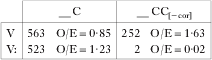
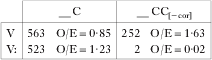
We start with word-final position, where consonant clusters are tautosyllabic, as in the above examples. The expected values (E) are calculated from the joint probability of the two levels of a factor in this set of strings. For example, the O/E value of 0·02 in the VːCC cell is based on an O value of 2 divided by an E value of 99. The latter comes from the overall probability of long vowels (0·39)×the overall probability of clusters (0·19)×the total number of strings (1340). O/E is the observed number (O) divided by E. When O/E is less than 1, the observed value is lower than expected. Since there are only two long vowels in the context of word-final clusters that end in non-coronals, O/E is quite low (O/E=0·02). A χ-square test measures the likelihood that the overall distribution arose from chance. The distribution in Table I is highly unlikely to have arisen from chance (χ2=191·87, df=1, p<0·001).
Word-final position in monomorphemic Dutch stems, where C2 is [–coronal].
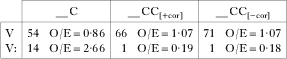
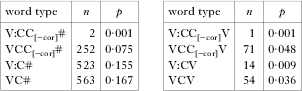
The underrepresentation of VːCC[–cor] sequences is thus not merely the product of the probability of long vowels in the __CC[–cor] context and the probability of postvocalic CC[–cor] sequences as compared with C. We can further note that while long vowels are somewhat underrepresented in all __CC contexts, the effect is far stronger with clusters that end in a non-coronal. That is, the *VːCC[–cor] restriction is not just a general restriction against long vowels before clusters. This can be seen in Table II, where the coronal-final clusters have an O/E score of 0·59.Footnote 3 The overall distribution is again highly unlikely to have arisen by chance (χ2=240·38, df=2, p<0·001).
Word-final position in monomorphemic Dutch stems.

We now turn to the distribution of clusters which occur in prevocalic position, and hence are heterosyllabic. This investigation is motivated by claims in the literature (Moulton Reference Moulton1962: 305, Kager Reference Kager1989: 202) that Class B vowels are restricted by a CC[–cor] cluster not only in word-final position but also before a vowel, where clusters are heterosyllabic (e.g. aarde [aːrdə] ‘earth’ vs. *[aːrbə]). Again, long vowels are highly underrepresented before non-coronal-final clusters. Compared with word-final position, the coronal/non-coronal difference is slightly smaller (that is, the degree of underrepresentation of long vowels before coronal-final clusters is higher in Table III than Table II). The overall distribution is again highly unlikely to have arisen by chance (χ2=1190, df=2, p<0·001).
Word-internal position in monomorphemic Dutch disyllabic stems.

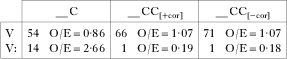
The disyllabic words in our experiment are limited to monomorphemic stems ending in a schwa–liquid cluster. Table IV presents the figures for monomorphemic stems ending in a schwa–liquid cluster in the Dutch lexicon, which form a subset of the cases in Table III. The pattern is largely the same, though long vowels are preferred in the __C context in Table III, while short vowels are more common in this same context in Table IV. The overall distribution is once more highly unlikely to have arisen by chance (χ2=23·48, df=2, p<0·001).
Word-internal position in Dutch stems ending in VC(C)ǝL.
In sum, long vowels are strongly underrepresented before both CC[–cor] clusters that are tautosyllabic with respect to the vowel (in word-final position) and those that are heterosyllabic (in prevocalic position). To test the statistical reliability of the *VːCC[–cor] restriction, and to investigate whether syllable structure affects its strength, we performed a logistic regression on the lexical data presented above. We included only the cases with singleton consonants and CC[–cor] clusters, since these correspond to our experimental stimuli. Words were coded for the binary dependent variable of vowel length (long=1, short=0), and the binary explanatory variables of following consonantal context (CC[–cor] cluster=1, singleton=0) and syllabification (tautosyllabic=1, heterosyllabic=0). We expect an effect of context based on the relatively low frequency of long vowels in the CC[–cor] cluster context shown in the tables above. If this effect is mediated by syllable structure, there should be an interaction between context and syllabification.
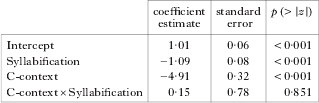
The first analysis includes the tautosyllabic data from Table II and the disyllabic data from Table III (that is, the broader set of disyllables). The model was fitted using the GLM function in R (R Development Core Team 2010), and the significance values of the factors and their interaction shown in Table V are those that it returns.
Result of logistic regression with full set of disyllables.
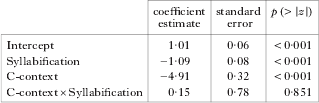
The effects of both consonantal context (C-context) and syllabification are statistically significant, while the relatively small effect of the interaction is not.
From the coefficient of the intercept, we can calculate the probability that the model gives a long vowel when the explanatory variables have a value of zero, that is, when a singleton consonant follows in a disyllable (1/(1+exp(−(1·01)))=0·73). This expected probability matches the frequency in the observed data (to several decimal places). The coefficients for each of the main effects allows us to calculate the probability given to a long vowel when a CC[–cor] cluster follows in a disyllable (1/(1+exp(−(1·01−4·91)))=0·02; observed frequency=0·06), and when a singleton follows in a tautosyllabic context (1/(1+exp(−(1·01−1·09)))=0·48; observed frequency=0·48). The large main effect for context is what we expected based on the rarity of long vowels in the CC[–cor] context. The effect for syllabification arises from the general overrepresentation of long vowels in disyllables relative to monosyllables.
With the coefficients from both of the main effects and the interaction term we derive the predicted probability of a long vowel before a CC[–cor] cluster in a tautosyllabic context (1/(1+exp(−(1·01−1·09−4·91+0·15)))=0·01; observed frequency=0·01). The coefficient for the interaction term indicates a small effect that goes in the opposite direction from what would be predicted if the presence of CC[–cor] cluster had a greater influence in a tautosyllabic context than in a heterosyllabic context on the probability of a long vowel. Since the effect is so small and so far from statistically significant at the 0·05 level, this almost certainly indicates the absence of the influence of syllable structure on the strength of the restriction, rather than influence in the unexpected direction.
In sum, the model gives long vowels significantly lower probability before *VːCC[–cor] clusters, and lower in tautosyllabic contexts than in heterosyllabic contexts, but these effects are independent: the strength of the *VːCC[–cor] restriction is not significantly greater in tautosyllabic contexts. We further confirmed this finding by fitting a model that does not include the interaction term: there was no significant difference in predictive power between the models as measured by a χ-square test (p=0·854). With the interaction, the AIC score was 3409·3; without it, it was 3407·3. On this measure, which includes a penalty for model complexity, lower is better, but a difference of 2 is not usually taken to be decisive in choosing between models (Burnham & Anderson Reference Burnham and Anderson2002: 446).
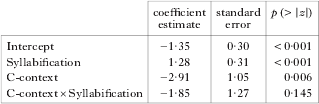
The second analysis includes the same tautosyllabic data, but the heterosyllabic data from Table VI, in which the rhyme shapes of the second syllables more closely match those of our experimental data. The analysis was otherwise conducted in identical fashion.
Result of logistic regression with subset of disyllables.
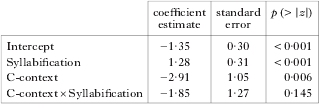
The picture is largely the same: the main effects are both statistically significant at the 0·01 level, while the interaction is not. The baseline expected probability for long vowels in heterosyllabic contexts with a following singleton is 0·21 (observed 0·21). With a following CC[–cor] cluster, the expected probability drops to 0·01 (observed 0·01). The expected probability of a long vowel with a following singleton in a tautosyllabic context is in this case higher than the baseline heterosyllabic case: 0·48 (observed 0·48). Finally, the expected probability of a long vowel with a following CC[–cor] cluster in a tautosyllabic context is 0·001. In this analysis, the coefficient for the interaction does have the expected sign: a CC[–cor] cluster does exert a greater negative influence on the probability of a long vowel in a tautosyllabic context. However, the lack of statistical significance of the interaction is again confirmed in model comparison: the χ-square test again fails to reach significance (p=0·198). Comparison of the AIC scores again does not rule out the model with the interaction, which has only a slightly worse score (1615·1) than the model without it (1614·7).
In sum, in the larger dataset, there is no evidence at all that syllable structure affects the strength of the *VːCC[–cor] restriction. In the smaller dataset, there is only very weak evidence of such an effect. It is difficult to know which of these datasets more closely matches the data that underlie the system that the subjects used to perform our experiment (though see note 9). We thus conclude that there is little or no evidence from the lexicon for the role of syllable structure.
3 Experimental data
To investigate (i) whether the *VːCC[–cor] restriction is internalised by native speakers, and (ii) whether the internalised constraint is syllable-sensitive, we conducted a non-word judgement experiment. We addressed the first question in terms of whether our Dutch participants show a greater dispreference for words containing long vowels when a CC[–cor] cluster follows than when a singleton does. We might also have tested whether the long vowel dispreference is greater when a CC[–cor] cluster follows than when a CC[+cor] one does, but there is a confound introduced by morphology. The Dutch suffixes [-s] (plural) and [-t] (2/3 singular) are both single coronals that attach to consonant-final stems, and so any nonce word containing final [s] or [t] might be interpreted as bimorphemic, which would exempt them from the restriction on non-phonological grounds. Omitting these consonants would overly limit the set of possible stimuli. We asked the second question in terms of whether this dispreference was affected by syllabification: whether the word being judged was a monosyllable, in which case the cluster is tautosyllabic and contained in a single syllable, or a disyllable, in which case the cluster is heterosyllabic and spans a syllable boundary. In statistical terms, we are asking whether there is a main effect of cluster presence on long vowel dispreference, and whether there is an interaction between cluster presence and syllabification.
The experiment involved a comparative well-formedness judgement task, in which participants were presented with pairs of nonce words and indicated which item in a pair sounded more like it could be a real Dutch word. Comparative well-formedness has been found to bring out finer-grained differences than judgements of single items on a scale (Ohala & Ohala Reference Ohala1986, Berent & Shimron Reference Berent and Shimron1997, Coetzee Reference Coetzee and Parker2009, Daland et al. Reference Daland, Hayes, White, Garellek, Davis and Norrmann2011).Footnote 4
3.1 Design
3.1.1 Participants
The participants were 34 native speakers Dutch, all students at the University of Utrecht. None reported any hearing difficulties. They were paid a small amount for participation.
3.1.2 Materials
A total of 240 stimuli was included, monosyllabic and disyllabic. Monosyllabic stimuli consisted of four sets of 30 nonce words of the structural types CVC, CVCC, CVːC and CVːCC, varying in vowel length (short vs. long) and the presence or absence of a cluster (cluster vs. singleton consonant). The clusters consisted of a sonorant [l r m] in first position, and a voiceless obstruent [p f k x] or a nasal [m] in second position. All clusters used ([lp lk lm rp rf rm mp mk]) are attested in monomorphemic words; one cluster was attested only intervocalically ([mk]). Singleton consonants ending CV(ː)C nonce words were [l r m], matching the postvocalic consonants of the CV(ː)CC items. Disyllabic stimuli consisted of four sets of 30 nonce words of the structural types CVCəC, CVCCəC, CVːCəC and CVːCCəC, all ending in schwa+liquid. These again had [l r m] in C1, but a slightly wider range of choice for C2, which also included the obstruents [b v x]. Nonce words of the types CVːl(C)əl and CVːr(C)ər were avoided, in order to rule out any possible influence from constraints disfavouring identical liquids. Stimuli came in short–long pairs: for each non-word containing a short vowel, there was another that was identical except in that it had a long vowel. Moreover, stimuli came in cluster–singleton pairs: for each non-word containing a consonant cluster, there was another that was identical except having a singleton, omitting the cluster's final consonant. Examples of non-word stimuli are provided in (3).
(3)
Nonce words ending in clusters contained zero or low-frequency V(ː)CC[–cor] portions. The rationale was that if speakers have internalised the restriction, then this should generalise to all VːCC[–cor] sequences, including ones unattested in Dutch (such as *[eːmk]). See the Appendix for a complete list of stimuli.
Throughout the stimulus set, we controlled for lexical factors and phonotactic probability in the sets of long–short pairs, e.g. CVC vs. CVːC, CVCC vs. CVːCC, etc. Two lexical factors were controlled for between the conditions. The first was Lexical Neighbourhood Density (LND), the sum of the logged token frequencies of a nonce word's neighbours, based on the CELEX database (Baayen et al. Reference Baayen, Piepenbrock and Gulikers1995). A neighbour was defined as any word that results from changing, inserting or deleting a single segment. The second was Cohort Density (CD), the sum of logged token frequencies of a nonce word's cohort members, where a nonce word's cohort was defined as all words sharing its first three segments.
In addition to these lexical factors, we controlled for transitional probabilities (TPs) of biphones. TP values were calculated from word types in the monomorphemic lexicon. The TP for a biphone xy is defined as p(y|x)=freq(xy)/freq(x), where freq(xy) is the frequency of a biphone xy, and freq(x) that of the phoneme x. Biphones included word-initial and word-final phonemes (e.g. [#b] for word-initial [b], or [p#] for word-final [p]). The transitional probabilities of stimuli as reported in the Appendix were defined as the averaged logged TP value of the biphones in each stimulus. For example, the transitional probability for [#baːm#], −1·030, was calculated as follows. The TP values of its four constituent biphones [#b], [baː], [aːm], [m#] (0·081, 0·089, 0·057, 0·187 respectively) were logged (−1·092, −1·049, −1·248, −0·729), then summed (−4·118), and this sum was divided by four, the total number of biphones. In case of biphones with zero frequencies, smoothing was applied, resetting their frequency to 1. 124 fillers were added to the 240 stimuli, all monosyllabic and disyllabic nonce words, none of which contained clusters used in the test words.
The materials were spoken by a female native speaker who was naive as to the purposes of the experiment, and were recorded digitally. Two versions of each stimulus were recorded. After listening to the recorded stimuli, we eliminated any that contained hesitation or noise, and selected the ones that sounded most natural. To form the test items, the stimuli were organised into 120 long–short pairs, such that each stimulus pair only minimally differed in vowel length, but was otherwise identical. Examples of test pairs are provided in (4).
(4)
The 120 test pairs were mixed with 120 filler pairs, which all consisted of one test item plus a filler item from the first experiment (e.g. [bɑmvər] – [xoːlər]). Each test pair and filler pair was presented in both orders, so that the total number of trials was 480. Stimulus order was randomised between participants.
3.1.3 Procedure
Participants were instructed to select the most word-like item for every pair of nonce words, using the following text (translated from the original Dutch): ‘You are going to listen to pairs of nonce words. Your task will be to determine how much these nonce words sound like real Dutch words. For each pair, you should select the one that sounds most Dutch-like: if it is the first one, press the left-hand button; if it is the second one, press the right-hand button’. Responses were recorded using a button box. Participants listened to stimuli through headphones at a comfortable level of loudness. The interstimulus interval (time elapsed between the members of the pairs) was 200 ms. The intertrial interval (time elapsed between the response and the next stimulus pair) was 500 ms. The response duration was 2500 ms. If no response had been made at that point, the next pair was presented.
3.2 Results
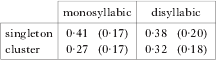
In Table VII, we present the proportion of long vowel responses for each of the conditions. Standard deviations, calculated over subjects, are given in parentheses. Examples of comparison pairs can be found in (4).
Proportion of long vowel choices in short–long pairs, with standard deviations.
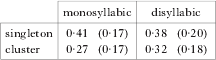
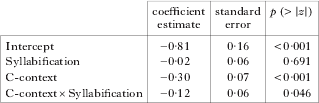
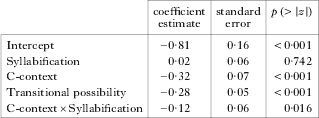
The frequency of long vowel responses was lower than chance in the singleton conditions. One possibility is that our distractors were not successful in stopping our subjects from developing a response bias, perhaps generalising the ill-formedness of long vowels in the cluster conditions to others. Nonetheless, even with this possible uniform response bias, differences between conditions remain. The pattern of responses suggests positive answers to both of our research questions. Words with long vowels were chosen less frequently when a cluster followed, across monosyllables and disyllables. In addition, the difference between singleton and cluster was greater in the monosyllables (0·14) than the disyllables (0·06), suggesting an interaction between consonantal context and syllabification. To test if the observed main effects for cluster and interaction between syllabification and cluster are statistically reliable, we used a mixed effects logistic regression model (see Baayen Reference Baayen2008 and Jaeger Reference Jaeger2008 on the advantages over ANOVAs for the type of data analysed here). As in the logistic regression analysis of the corpus data presented in §2, the dependent variable is vowel length (long=1, short=0), though here it corresponds to subjects' choice on a test pair, rather than the length of a vowel in a word in the corpus. The binary explanatory variables are again consonantal context (CC[–cor] cluster=1, singleton=0) and syllabification (tautosyllabic=1, heterosyllabic=0). The predictor values were centred before the analysis was run. Experimental items were given random intercepts, and subjects were given random slopes for consonantal context and syllabification (these random effects were selected through model comparison). The model was fitted in R using the lmer function of the lme4 package (Bates & Maechler Reference Bates and Maechler2010). We report here only on the fixed effects, whose coefficient estimates, with standard errors and p values, are shown in Table VIII.
Result of mixed effects logistic regression on experimental data.
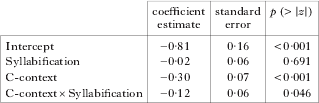
As expected from our descriptive statistics, C-context has a negative effect on the probability of selecting a long vowel. Without the random effects, the baseline probability of selecting a long vowel (in a disyllable with a following singleton) is 1/(1+exp(−(−0·81)))=0·31. This drops to 1/(1+exp(−(−0·81−0·30)))=0·25 when the vowel is followed by a consonant cluster. This effect is statistically reliable, as indicated by the very low p value for C-context. Syllabification on its own has only a very small negative effect, which is not statistically reliable, but the interaction of C-context and Syllabification is larger: the model gives a probability of 0·30 to a long vowel choice in the singleton context in a tautosyllabic case, and 0·22 in the cluster context in a heterosyllabic case. As shown in Table VIII, the interaction reaches significance at the 0·05 level. We further confirmed the reliability of this effect by comparing this model with one that has the interaction removed (from the fixed and random effects). The model with the interaction has an AIC score of 8954·2, which is better than the score of 8957·1 for the model without it, and the χ-square test returns a p value of 0·025.The finding of a statistically significant effect for the interaction supports the hypothesis that syllable structure affects the strength of the *VːCC[–cor] restriction.
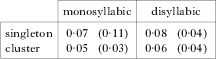
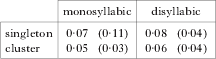
An alternative account of the effect of Syllabification might be that the long vowels are phonetically longer in monosyllables than disyllables, and that this increased phonetic duration is responsible for the greater dispreference for long vowels with a following CC[–cor] cluster.Footnote 5 To test this alternative account, we first took measurements of the duration of all of the vowels in our stimuli. These measurements are summarised in Table IX. Each cell contains the average difference between the long and short members of our test pairs, with standard deviations. These means indicate that the duration differences between the long and short vowels were in fact greater in the disyllables than in the monosyllables, counter to the premise of the alternative account.
Mean vowel-length differences in short–long pairs, with standard deviations.
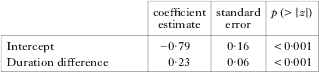
To further explore the role of duration in explaining our experimental results, we performed mixed effects logistic regressions using the duration differences in the test pairs as an explanatory variable. In the first analysis, in Table X, we included only duration difference as a fixed effect, and found that the best model included a random slope for subjects and a random intercept for items. Again, we discuss only the fixed effect.
Mixed effects logistic regression with phonetic duration.
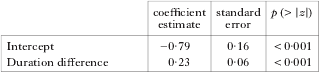
There is a significant effect for duration, but it goes in the opposite direction from that predicted by the alternative account of our results. Greater difference in duration between the long and short members of a pair leads to an increase in the probability of a long vowel choice. Even if one had an a priori reason to expect that greater duration differences should lead to more long vowel choices, this model does a poorer job of explaining the data than the one in Table VIII, with an AIC score of 9005. We also explored models that included both duration difference and consonantal context as fixed effects, and found that the best one (with duration difference as a random slope for subjects and a random intercept for items) had an AIC score of 8958, again worse than the 8954·2 for our preferred model. Because the effect goes in the opposite direction from that predicted, and because models using it do not perform as well as the one incorporating Syllabification, we reject phonetic duration differences as an alternative account of those aspects of the data that we attribute to syllable structure. However, there is reason to seek an explanation for why duration difference has the effect it does. When duration difference is added to our preferred model, it continues to have a positive effect on the probability of a long vowel choice, with a p value less than 0·001. This shows that its effect is not merely due to a correlation with the other explanatory variables (they continue to have the same direction of effect, with about the same size and p value).Footnote 6
Finally, we return to the question of whether the subject's judgements can be explained by segmental sequence probability and word-likeness. Our experimental items were controlled for measures of these constructs, but we here examine whether residual differences might play a role in explaining the data. We coded our experimental items for differences in the stimulus pairs for lexical neighbourhood density, cohort density and transitional probability (see §2 for definitions). We first performed a logistic mixed effects regression with vowel-length choice as the dependent variable and centred versions of these three measures and their interactions as fixed effects. Subject and items had random intercepts. In this analysis, we found that only the main effect of TP reached statistical significance at the 0·05 level (p<0·001), as did the interaction between TP and CD (p=0·036). The best model that we could find incorporating these measures (and no others) included only TP as a fixed effect, with TP as a random slope for subjects and a random intercept for items. This yielded an AIC score of 8989, much worse than that of our preferred model.
When we add TP to the model presented in Table VIII, the result is as shown in Table XI. The AIC score is 8933, the best that we found in our model exploration. Along with TP, C-context continues to have a highly reliable effect, and the effect of the interaction between C-context and Syllabification now approaches statistical significance at the 0·01 level.
Mixed effects logistic regression including transitional possibility.
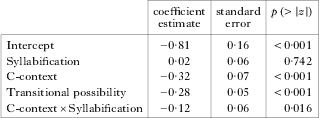
All of this indicates that TP did affect our subject's choices, but that this effect does not explain the same aspects of the data that consonantal context and its interaction with syllabification do.
4 A maximum entropy phonotactics account
Our experiment shows that Dutch speakers have knowledge of the *VːCC[–cor] restriction: their dispreference for long vowels is stronger before a cluster ending in a non-coronal than before a singleton consonant. The results also show that the force of *VːCC[–cor] is mediated by syllable structure: the dispreference for long vowels is stronger when the cluster is fully contained in the same syllable as the vowel. In this section, we provide an account of this aspect of Dutch phonology in terms of a maximum entropy model of phonotactics (Hayes & Wilson Reference Hayes and Wilson2008) that incorporates constraints referring to prosodic structure.
Maximum entropy phonotactics uses weighted constraints to define a probability distribution over the space of possible words. As an illustration, consider the probability distribution defined over a small space of monosyllabic words by an arbitrary weighting of two standard phonological constraints. The constraints penalise long vowels (*Vː), and consonants in coda position (*Coda), assigning a violation score of −1 for each offending structure. The scores assigned by the constraints to the types of word under consideration are shown in the rows of the tableau in (5). The first word type, VːCC, contains a long vowel, and thus scores −1 on *Vː, as well as two coda consonants, which result in a −2 score for *Coda. The weights of the constraints are shown beneath the constraint names in the first row: *Vː has a weight of 2, and *Coda has a weight of 1. The column labelled H shows the harmony of each word type: the sum of the violation scores, each multiplied by the constraint's weight (see Smolensky & Legendre Reference Smolensky, Legendre, Smolensky and Legendre2006 on the history of harmony in linguistics). VːCC-type words have H=(2×−1)+(1×−2)=−4. The next column, exp(H), shows the result of raising e (2·72) to the power of H. A word's probability is proportional to exp(H); this is shown in the final column.
(5)
This example illustrates several properties of the model. First, well-formedness, defined in terms of probability, is gradient, ranging from 0·59 for a word with neither a long vowel nor coda to 0·01 for the VːCC word type. Second, we can see how the constraint weights affect probability: because *Vː has a higher weight than *Coda, words with long vowels (Vː) have a lower probability (0·14) than words with codas (VC; 0·37). And finally, we can see the cumulative effect of constraint violation: VːCC words have the lowest probability not because they violate any one constraint that the others satisfy, but because they have a greater number of constraint violations than the others.
Our aim is to provide a maximum entropy phonotactic grammar that is compatible with our experimental findings that Dutch speakers have knowledge of the *VːCC[–cor] restriction, and that they are particularly sensitive to the restriction when the sequence is contained within a single syllable. We also aim to find the weights for the grammar by training a learner with the lexical data presented in §2. This second goal might at first seem to present an insurmountable challenge: if, as our regression analyses suggest, there is little or no evidence for syllable-sensitivity in the lexicon, how could a learner acquire a syllable-sensitive restriction on the basis of those data? The answer involves a particular kind of inductive bias: the learner posits a *VːCC[–cor] constraint that is relativised to prosodic context, and favours a grammar that gives a significant amount of weight to this constraint.
As the learning data, we used the lexical counts that were used in the second regression analysis in §2. These are the data that most closely match the experimental data: they exclude coronal-final clusters, and the disyllables are limited to ones ending in schwa–liquid clusters. The lexical data are shown in terms of counts and proportions/probabilities in Table XII.
Learning data.
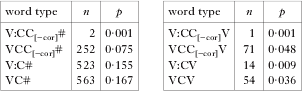
The constraints penalise particular types of segmental sequence, as in Hayes & Wilson (Reference Hayes and Wilson2008) and much other research in phonology. We do not employ Hayes & Wilson's constraint induction algorithm here, since it does not yield prosodically conditioned constraints. Instead, we employ the full set of constraints of a particular type that apply to our case, with the expectation that these may well be learned both by humans and by a learning algorithm on the basis of the observed forms of the language. Like Hayes & Wilson (Reference Hayes and Wilson2008), we have not tailored our constraint set to yield typological predictions: with different weights, they could yield implausible outcomes, such as a language that has lower probability of short than long vowels before tautosyllabic consonants. Our results could equally well be analysed using a typologically tailored constraint set, although see Hayes & Wilson (Reference Hayes and Wilson2008), as well as Daland et al. (Reference Daland, Hayes, White, Garellek, Davis and Norrmann2011) and Pater (to appear), for discussion of how phonological typology might be accounted for if constraints are learned.
As a first pass at a set of constraints, we can consider the ‘biphone’-type constraints in (6), which penalise each of the sequence types under consideration.
(6)
Because constraint interaction is cumulative in the maximum entropy model, one might think that this constraint set could account for the *VːCC[–cor] restriction as the cumulative effect of *VːC and CC[–cor]. However, the biphone constraints in a maximum entropy model will not suffice to account for the Dutch data, for a reason which is parallel to why the bigram model fails to account for them (see the discussion in §2). The problem is illustrated in (7).
(7)
By assigning *VːC a greater weight than *VC, and giving *CC[–cor] a positive weight, we succeed in making the harmony of VːCC[–cor] lower than that of the other word types, and thus making its probability the lowest. However, this also leads to VːC being at least as ill-formed relative to VC as VːCC[–cor] is to VCC[–cor]. If we take well-formedness to be a function of harmony (see Coetzee & Pater Reference Coetzee and Pater2008 on phonotactics), then the difference between these two pairs of word types will be equivalent (equal to the difference between the weights of *VːC and *VC). If we take well-formedness to be a function of exp(H) (Hayes & Wilson Reference Hayes and Wilson2008), or of p, then the difference between VːC and VC will in fact be greater, since exponentiation makes the contribution of the VːC vs. VC difference lower when the words also violate *CC[–cor]. Either way, the outcome is not the one we want.
We thus require a constraint that will pick out VːCC[–cor] as especially ill-formed. To produce this constraint as one instantiation of a constraint type, we expand our constraint set to include the triphone constraints in (8).
(8)
We also require a constraint to pick out VːCC[–cor]# as opposed to VːCC[–cor]V, so as to make the short vowel preference stronger when the *VːCC[–cor] violation is tautosyllabic. To produce the constraint type of which this is an instance, we include domain-specific versions of all of the constraints, which apply only when the sequence is contained in a single syllable. The domain-specific version of *VːCC[–cor] is shown in (9).
(9)
As mentioned in the introduction, an alternative would have been to expand the segmental size of the constraints, relativising VːCC[–cor] to the word-final and prevocalic environments. We relativise it to prosodic context because we expect that prosodically conditioned constraints will in general prove more useful to a theory of phonotactics than would extremely long segmental constraints.
To find constraint weights, we used the L-BFGS-B method (Byrd et al. Reference Byrd, Lu, Nocedal and Zhu1995), as implemented in R (R Development Core Team 2010).Footnote 7 The objective was to find a set of weights that minimises the difference between two probability distributions over the space of word types: the one supplied in the learning data, and the one defined by the maximum entropy grammar. We used Kullback-Leibler divergence as our measure of difference (Kullback & Leibler Reference Kullback and Leibler1951).Footnote 8 The objective function also includes a regularisation term or prior that penalises weights as they depart from zero. We set a zero minimum on constraint weights, and used an L2 or Gaussian prior, which with a zero minimum is equivalent to penalising the sum of squared weights. The strength of the regularisation term with respect to error minimisation is expressed in terms of variance in the distribution of weights, so its strength is inversely correlated with its magnitude. We used two values: 10, which imposes a strong penalty on large weights, and 1,000,000, which imposes a very weak penalty.
The constraint weights for the two grammars are shown in (10), with ‘weak’ and ‘strong’ indicating which regularisation term was used in learning (multiple runs get similar results). All other constraints were assigned zero weights.
(10)
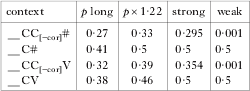
Our goal is for the learned grammar to reflect the pattern of data from our experiment. Table XIII repeats the probabilities of long vowel choices in each of the four experimental contexts in the column labelled ‘p long’. In none of the contexts does this probability reach 0·5, even though there is no general bias against long vowels in the lexicon. As we discussed in §3, this is plausibly the result of an experimentally induced response bias. We treat it as such here, and instead of trying to model it in the grammar, we provide scaled probabilities in the column labelled ‘p×1·22’, which multiply the probabilities by 0·5/0·41=1·22, resulting in the highest probability of long vowel choice being equal to 0·5. The grammatical probabilities of long vowel choices in each context were derived by dividing the probability that the grammar assigns the long vowel by the sum of the probabilities of it and the short vowel (i.e. by using the ‘Luce choice rule’; Luce Reference Luce1959). The probabilities thus derived using the strong grammar come close to matching the scaled experimental probabilities; the grammar learned with the weak regularisation term does not work as well.Footnote 9
Experimental data and probability of long vowel choices derived from grammars.
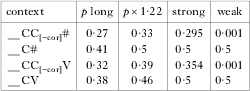
The strong grammar better matches the experimental probabilities for two reasons. First, the difference between the __CC[–cor] and __C contexts is not as sharp in the experimental data as it is in the lexicon. The weak grammar, which more closely matches the lexicon, has a relatively high weight of 4·67 for the *VːCC[–cor] constraint, which results in a very low probability of long vowel choice in the two __CC[–cor] contexts (0·001). Because the strong grammar was learned with a much bigger penalty on high weights, the *VːCC[–cor] constraint has a much lower weight of 0·60, which results in a higher probability for long vowel choices in the __CC[–cor] contexts. It is worth noting that regularisation is not crucial here: the result of experimental judgements being more diffuse than lexical probabilities could have been obtained in other ways (see e.g. Hayes et al. Reference Hayes, Zuraw, Siptár and Londe2009, who use a ‘Temperature’ parameter for this purpose). Second, and more importantly, the strong grammar differentiates between the two __CC[–cor] contexts because it assigns a non-zero weight to *VːCC[–cor]]σ, the version of the constraint relativised to the tautosyllabic context. This constraint was assigned weight because the L2 prior penalises the sum of squared weights, so that weight spread between *VːCC[–cor]]σ and *VːCC[–cor] is preferred to weight on *VːCC[–cor] alone.
5 Conclusions
The results of our experiments show that native speakers have internalised a phonological constraint that refers to a sequence of three segments. The fact that this constraint cannot be construed as a combination of two biphone constraints poses problems for both n-gram models of phonotactics, discussed in the introduction, as well as for phonological models that induce constraints only of biphone size (see Pierrehumbert Reference Pierrehumbert, Bod, Hay and Jannedy2003).Footnote 10 A second aspect of our experimental results is that the internalised representation of this phonotactic constraint is stronger in word-final than in word-internal contexts, which we take to indicate its sensitivity to syllable structure. While the Hayes & Wilson (Reference Hayes and Wilson2008) model of phonotactics is in principle compatible with syllable-based phonotactics, their learning model does not induce syllabically conditioned constraints. In our learning simulation, we showed that with such constraints, a maximum entropy learner trained on corpus data from Dutch ends up with a grammar that matches the distinctions found in the human judgement data. This supports the general point made by both Pierrehumbert (Reference Pierrehumbert, Bod, Hay and Jannedy2003) and Hayes & Wilson (Reference Hayes and Wilson2008) that probabilistic models, which are motivated by the gradience of phonotactic judgements, can and should operate over the sorts of representations developed in phonological theory.