Although the significance of morphological awareness in reading in Chinese is well-established (e.g., Cheng et al., Reference Cheng, Zhang, Wu, Liu and Li2016; Choi et al., Reference Choi, Tong, Law and Cain2018; Koh et al., Reference Koh, Chen, Gottardo and Pae2018; Luo et al., Reference Luo, Koh, Deacon and Chen2018; Pan et al., Reference Pan, Song, Su, McBride, Liu and Shu2016; Tong et al., Reference Tong, McBride, Shu, Ho and Ho2018; Wang et al., Reference Wang, Cheng and Chen2006), our understanding of the development of the skill is still emerging. Morphological awareness is commonly defined as the ability to understand and manipulate morphological units within words (Carlisle, Reference Carlisle2000). Consistent with this definition, it has been suggested that morphological awareness in Chinese, much like how it is operationalized in English, is a multidimensional construct consisting of two facets: (1) morpheme awareness and (2) structure awareness (Chen et al., Reference Chen, Hao, Geva, Zhu and Shu2009; Liu & McBride-Chang, Reference Liu and McBride-Chang2010; Liu et al., Reference Liu, McBride-Chang, Wong, Shu and Wong2013; McBride-Chang et al., Reference McBride-Chang, Shu, Zhou, Wat and Wagner2003). Morpheme awareness is concerned with the understanding of meanings of morphemes, whereas structure awareness refers to the understanding of morphological structure and rules governing word formation (Liu et al., Reference Liu, Chung, Zhang and Lu2013).
In recent years, researchers have suggested the need to examine how hypothesized dimensions of morphological awareness are associated with one another to gain a more comprehensive understanding of the skill and its development (e.g., Deacon et al., Reference Deacon, Tong and Francis2017). We argue that such investigations from a longitudinal perspective are also important. Theoretically, longitudinal investigations extend what we know about how dimensions of morphological awareness are related to one another by examining whether these relations are stable over time. Despite its significance, research in this area is lacking, especially in the case of Chinese. In studies among Chinese elementary school students, morpheme and structure awareness have varying associations with reading outcomes, providing indirect support for the conceptualization that these two facets are somewhat distinct (e.g., Li et al., Reference Li, Shu, McBride, Liu and Peng2012; Liu & McBride-Chang, Reference Liu and McBride-Chang2010; Liu et al., Reference Liu, Chung, Zhang and Lu2013). However, the body of literature also shows significant correlations between these two facets, indicating that the two facets are interrelated (e.g., Liu & McBride-Chang, Reference Liu and McBride-Chang2010; McBride-Chang et al., Reference McBride-Chang, Shu, Zhou, Wat and Wagner2003; Wang et al., Reference Wang, Cheng and Chen2006; Zhou et al., Reference Zhou, McBride-Chang, Fong, Wong and Cheung2012). The interrelation between these two facets is stronger in older children (e.g., Liu & McBride-Chang, Reference Liu and McBride-Chang2010), suggesting that relations between the two facets might change with age and reading level. However, this observation is largely based on cross-sectional data which limit inferences to be made about changes in developmental relations between the two facets. The question remains as to whether the differing correlations between the two facets observed across different age samples in studies with Chinese children reflect a true developmental change or simply cohort or random effects. A longitudinal approach is needed to address this question. Thus, the present study takes a developmental perspective in using a longitudinal design to examine the bivariate relations between Chinese morpheme and structure awareness in elementary school students across the early elementary grades.
Morpheme and structure awareness in Chinese
Chinese characters can be made up of one or more graphical elements (e.g., 青/qing1/ vs. 蚊/wen2/), and each character typically maps onto a single morpheme. Because of the semantic information contained in characters, morphological awareness has been shown to be an important correlate of reading in Chinese (e.g., McBride-Chang et al., Reference McBride-Chang, Shu, Zhou, Wat and Wagner2003; Pan et al., Reference Pan, Song, Su, McBride, Liu and Shu2016). As stated earlier, morphological awareness in Chinese is conceptualized as consisting of two facets: morpheme awareness and structure awareness (Chen et al., Reference Chen, Hao, Geva, Zhu and Shu2009; Liu et al., Reference Liu, Chung, Zhang and Lu2013).
Morpheme awareness is typically operationalized as homophone and/or homonym awareness because of the prevalence of homophones and homonyms in Chinese (e.g., Chow et al., Reference Chow, McBride-Chang, Cheung and Chow2008; Ku & Anderson, Reference Ku and Anderson2003; Li et al., Reference Li, Anderson, Nagy, Zhang, Li, Gaffney and Packard2002; Tan & Perfetti, Reference Tan and Perfetti1999; Wang et al., Reference Wang, Yang and Cheng2009). Homophones are morphemes that share the same pronunciation and tone but have different meanings; these morphemes are also represented by different characters in print (e.g., McBride-Chang et al., Reference McBride-Chang, Shu, Zhou, Wat and Wagner2003; Zhou & Marslen-Wilson, Reference Zhou and Marslen-Wilson1994). For instance, the syllable /bei4/ corresponds to a number of morphemes which are pronounced the same way but have different orthographic forms and meanings, including 被/bei4/ (to be), 背/bei4/ (back), 倍/bei4/ (double), and 辈/bei4/ (generation). Homonyms in Chinese, on the other hand, are morphemes that have the same pronunciation (including tone) and written form but different meanings. For example, the morpheme 带/dai4/ has the meaning of “bring/lead” when used in the word 带领/dai4ling3/ (lead) but means “tape” when used in the word 胶带/jiao1dai4/ (sticky tape). There are more than 7000 morphemes but about 1300 syllables in Chinese (Chao, Reference Chao1976; Li et al., Reference Li, Anderson, Nagy, Zhang, Li, Gaffney and Packard2002). As a result, each syllable typically corresponds to four or five homophones (Shu et al., Reference Shu, McBride-Chang, Wu and Liu2006). Given the prevalence of homophones and homonyms in Chinese, it is not surprising that homophone and homonym awareness predict Chinese word reading and reading comprehension outcomes in young children across a variety of studies (e.g., Liu & McBride-Chang, Reference Liu and McBride-Chang2010). In addition, this facet of morphological awareness is also a significant predictor of vocabulary in Chinese, as the ability to distinguish between homophones and homonyms in Chinese words is a precursor to the correct identification of meanings of words (Liu et al., Reference Liu, Chung, Zhang and Lu2013).
Structure awareness in Chinese, on the other hand, refers to the ability to understand and manipulate the structure of lexical compounds (Liu et al., Reference Liu, Chung, Zhang and Lu2013). Lexical compounding is the primary means by which words are formed in Chinese (Ceccagno & Basciano, Reference Ceccagno and Basciano2007), where more than 80% of words are formed by two or more morphemes [e.g., 小/xiao3/ (little) + 狗 /gou3/(dog) = 小狗/xiao3gou3/ (little dog – puppy)] (Institute of Language Teaching and Research, 1986).
Chinese morphemes are often combined in highly predictable ways to represent complex concepts (Shu et al., Reference Shu, Chen, Anderson, Wu and Xuan2003). Specifically, bi-morphemic compound words typically have subordinate (∼ 54%) or coordinative structures (∼ 21%) (Liu et al., Reference Liu, Yu, Zhu and Zhang2000; Yuan & Huang, Reference Yuan and Huang1998). Subordinate compounds are nouns that are right-headed. The second morpheme is the head morpheme that provides an indication of the semantic category of the compound word, whereas the first morpheme modifies the second morpheme. For instance, in the noun 课室 (/ke4shi4/ – classroom), the second morpheme 室 (/shi4/ – room) indicates that the word refers to a type of room and the first morpheme 课 (/ke4/class) indicates that it is a room where classes are held. On the other hand, subordinate compound verbs are typically left-headed (Packard, Reference Packard2000). In coordinative compounds, two morphemes of similar or contrary meanings occur together and both morphemes jointly contribute to the meaning of the word. To illustrate, 高矮 (/gao1ai3/) is a coordinative compound that means “height.” Its constituent morphemes have opposite meanings (高/gao1/ + 矮/ai3/ = tall + short).
Compound structures are highly regular and predictable in Chinese, so structure awareness is beneficial in deriving word meanings (Liu et al., Reference Liu, Li and Wong2017). This is because structure awareness facilitates the identification of the head morpheme in compound words (Chen et al., Reference Chen, Hao, Geva, Zhu and Shu2009). Research has shown that this facet of morphological awareness is associated with vocabulary and reading outcomes across a number of studies in Chinese (e.g., Chen et al., Reference Chen, Hao, Geva, Zhu and Shu2009; Tong et al., Reference Tong, McBride-Chang, Shu and Wong2009).
Developmental relations between morpheme and structure awareness
Understanding the developmental relations between morpheme and structure awareness over time has important theoretical and practical implications. The conceptualization of these two facets as related dimensions of the same construct has been largely theoretical. An empirical investigation of the relations between facets of morphological awareness would test the validity of this conceptualization and add to our understanding of how these two facets are related. From a practical standpoint, understanding how the two facets of morphological awareness influence the growth of one another provides insights into issues relating to morphological instruction in Chinese.
To date, no published study has directly considered how morpheme and structure awareness in Chinese are associated over time. Therefore, to examine the nature of developmental relations between the two facets, we derive and test four competing hypotheses. Specifically, the first hypothesis posits that the two facets are correlated but do not exert direct influences on each other, whereas the other three hypotheses outline unidirectional and bidirectional relations between the two facets, respectively. In the following section, we discuss the theoretical basis and rationale for each hypothesis as well as relevant empirical research in Chinese that provides support for each hypothesis.
Correlation between morpheme and structure awareness but no direct effects on development
The first hypothesis regarding the relations between the morpheme and structure awareness is that they are correlated but each facet does not affect growth in the other. Researchers put forth that although both morpheme and structure awareness in Chinese are facets of morphological awareness, their development is independent of each other because they pertain to processing of different aspects of morphology (e.g., Liu et al., Reference Liu, Chung, Zhang and Lu2013; McBride-Chang et al., Reference McBride-Chang, Cho, Liu, Wagner, Shu and Muse2005; Zhou et al., Reference Zhou, McBride-Chang, Fong, Wong and Cheung2012). Morpheme awareness is primarily concerned with meaning aspects, specifically, differentiating between morphemes that are phonologically identical but have different meanings. Structure awareness, however, centers on identifying the underlying morphological structure of compound words. Therefore, the growth of one facet is not dependent on the level of the other facet.
Despite independence in growth, the two facets are expected to be correlated because of their common association with a third variable of vocabulary knowledge and/or character reading. The close relation between vocabulary and morphological awareness is not surprising considering that both constructs are concerned with semantics and the strong empirical support for significant correlations between vocabulary and both facets of morphological awareness (e.g., Chen et al., Reference Chen, Hao, Geva, Zhu and Shu2009; McBride-Chang et al., Reference McBride-Chang, Cho, Liu, Wagner, Shu and Muse2005). Some studies have also reported stronger correlations between each facet of morphological awareness and vocabulary knowledge than that between the two facets (e.g., Chen et al., Reference Chen, Hao, Geva, Zhu and Shu2009; McBride-Chang et al., Reference McBride-Chang, Cho, Liu, Wagner, Shu and Muse2005; Shu et al., Reference Shu, McBride-Chang, Wu and Liu2006; Zhou et al., Reference Zhou, McBride-Chang, Fong, Wong and Cheung2012). Similarly, researchers see similar patterns in comparing both facets of morphological awareness and their associations with character reading in Chinese within the same study (e.g., Liu et al., Reference Liu, Chung, Zhang and Lu2013; McBride-Chang et al., Reference McBride-Chang, Shu, Zhou, Wat and Wagner2003). In these studies that examined children in kindergarten and early elementary grades, although moderate significant correlations were often found between the two facets of morphological awareness (i.e., .30 > r < .60), they were sometimes lower than the correlations either of them shared with character reading. For example, Liu et al. (Reference Liu, Chung, Zhang and Lu2013) showed that the correlation between structure and morpheme awareness of .46 was lower than that of .54 between compounding awareness and character reading.
Direct effects of one facet of morphological awareness on the development of the other
In contrast to the first hypothesis, the remaining three hypotheses describe possible direct effects of one facet of morphological awareness on one other. These hypotheses are informed by the hybrid model of morphological processing (Schreuder & Baayen, Reference Schreuder, Baayen and Feldman1995). This model was developed to characterize morphological processes and has been used more often as a framework for processing in alphabetic orthographies than non-alphabetic ones. It outlines three levels, or stages, of processing where knowledge of morphemes and morphological structure rules are used to derive word meanings. In the first level, the segmentation stage, an encountered word is divided into its constituent morphemes (e.g., stems, prefixes, suffixes) using ones’ morphemic awareness, and corresponding representations are mapped in the mental lexicon. During this mapping process, related semantic, phonological, and orthographic strings are also activated. The second level, or the licensing stage, outlines how structure awareness is activated to analyze whether the constituent morphemes in the word are combined in a way that is coherent with morphological rules (e.g., excitement rather than excitedness). Finally, in the third level, constituent morphemes of the word are combined to form a lexical representation of the word.
Inferring from this model, morphological processing can proceed in three directions. The first is the activation of the segmentation stage before the licensing stage; thus, processing of morphemes and their meanings precedes structure. Thus, it is hypothesized that morpheme awareness develops before and leads the development of awareness of morphological structure. The second direction in which processing can proceed is that the licensing stage occurs before the segmentation stage which suggests the development of structure awareness leads that of morpheme awareness. Finally, building on these two unidirectional routes of processing, a third way in which processing takes place is bidirectionally, as the morphological processing model suggests that activation of the segmentation and licensing processing can be simultaneous. Specifically, the identification of morphemes within a word activates information about its morphological structure, which in turn activates more information about the morphemes within the word. This would suggest a reciprocal bootstrapping relation between the two facets where morpheme awareness leads the development of structure awareness and vice versa.
To our knowledge, empirical evidence for these three directional hypotheses is not available because no study has examined these relations directly, particularly in non-alphabetic orthographies such as Chinese. Although there are similarities in morphological rules and structures between alphabetic orthographies such as English and non-alphabetic ones such as Chinese, the morphological structure of Chinese words is generally less complex as compared to English. This is as because English words can be formed by inflection, derivation, and compounding, but Chinese words are formed primarily by compounding. In addition, there is a one-to-one correspondence between characters and morphemes in Chinese (a characteristic absent in English); thus, boundaries between constituent morphemes in multimorphemic words are more obvious in Chinese as compared to English (Wu et al., Reference Wu, Tsang, Wong and Chen2017). Furthermore, when multimorphemic words are formed in Chinese, the form and pronunciation of constituent morphemes are typically preserved in the resulting multimorphemic words in Chinese. In contrast, it is more common to see changes in form and/or pronunciation of the constituent morphemes in English multimorphemic words (e.g., complicate + ion = complication where there is a vowel reduction of the stem) (Hu, Reference Hu2010). Morpheme changes within words increase the morphological opacity of words and make it more difficult to segment words into morphemes and to recognize morphological relatives in English as compared to Chinese (Hu, Reference Hu2010). Therefore, morphological processing in English appears to be more complex and the proposition that both unidirectional and bidirectional pathways are recruited in morphological processing (Schreuder & Baayen, Reference Schreuder, Baayen and Feldman1995) is logical. However, whether the same level of complexity of pathways in morphological processing is applicable in the context of Chinese is unknown.
Findings from two studies point to a unidirectional, rather than bidirectional relation between the two facets in Chinese. In the study conducted by Hao et al. (Reference Hao, Chen, Dronjic, Shu and Anderson2013), Chinese children demonstrated awareness of morphemes as early as kindergarten, but their awareness of morphological structure only emerged in grade two. Hao et al. (Reference Hao, Chen, Dronjic, Shu and Anderson2013) thus suggest that meaning drives the development of structure knowledge. Furthermore, in an intervention study conducted by Zhou et al. (Reference Zhou, McBride-Chang, Fong, Wong and Cheung2012), kindergarten children who were part of a homophone awareness training program improved significantly on lexical compounding skills subsequently. However, children who received lexical compounding training did not improve in their homophone awareness after the intervention. This suggests that the level of morpheme (homophone) awareness might have some influence on the development of structure awareness (lexical compounding). The reverse, however, appears to be less likely as lexical compounding training did not exert significant effects on homophone awareness.
Taken together, it appears that there are differences in how morphological processing proceeds in Chinese as compared to alphabetic orthographies since the bidirectional pathway of morphological processing is not observed in Chinese. These findings also support the argument that Chinese has a less complex morphological structure than alphabetic orthographies, and thus, there is less complexity in morphological processing pathways observed (i.e., unidirectional but not bidirectional relations have been shown between the two facets of morphological awareness in Chinese). However, both the studies conducted in Chinese did not examine the development of both facets of morphological awareness longitudinally; thus, it is not possible to draw definite conclusions on the nature and pattern of co-development between the two facets. Furthermore, Zhou et al. (Reference Zhou, McBride-Chang, Fong, Wong and Cheung2012) raised the possibility that potential significant relations between the two facets of morphological awareness might have been obscured in their study. This is as they found that children’s compounding skills did not significantly improve despite receiving training in lexical compounding. In the same vein, the homophone skills of those children who received homophone training did not improve significantly too. They cited measurement issues as one possible reason for these findings (e.g., tests used were either too easy or too difficult for the children). In light of these limitations, further investigations that test the longitudinal relations between morpheme and structure awareness directly are necessary. Such investigations to examine whether the different co-developmental relations outlined in the hybrid morphological processing are applicable to non-alphabetic orthographies such as Chinese also provide insights into language-specific and language-universal processes in morphological processing across languages.
The present study
In the present study, we derive four longitudinal hypotheses regarding the co-development of morpheme and structure awareness by extrapolating the hypothesized processing routes outlined in the hybrid morphological processing model (Schreuder & Baayen, Reference Schreuder, Baayen and Feldman1995). Specifically, we test four hypotheses: (1) morpheme and structure awareness are correlated but each facet does not have a direct effect on the growth of the other (uncoupled but correlated growth), (2) morpheme awareness has a direct effect on growth of structure awareness and not vice versa (a unidirectional effect), (3) structure awareness has a direct effect on growth in morpheme awareness and not vice versa (unidirectional effect in the opposite direction), and (4) morpheme awareness has direct effects on the development of structure awareness and vice versa (a bidirectional effect).
To this end, we conduct a longitudinal study to examine the four hypotheses using four waves of data collected from monolingual Chinese children between grades one and three. We focus our investigation on grades one to three because previous studies have consistently demonstrated that children’s level of morphological awareness in early grades is a strong predictor of later reading and writing outcomes (e.g., Pan et al., Reference Pan, Song, Su, McBride, Liu and Shu2016), suggesting the importance of examining morphological awareness development in the early elementary grades. Two widely used and accepted measures in the literature are used to assess the two facets of morphological awareness, respectively. The first is the homophone/homonym sensitivity task that measures morpheme awareness and has been used in a variety of studies (e.g., Hao et al., Reference Hao, Chen, Dronjic, Shu and Anderson2013; Li et al., Reference Li, Anderson, Nagy, Zhang, Li, Gaffney and Packard2002; McBride-Chang et al., Reference McBride-Chang, Shu, Zhou, Wat and Wagner2003; Tong et al., Reference Tong, McBride-Chang, Shu and Wong2009). The second measure is the morphological construction or analogy task that has been used to assess structure awareness across a variety of studies with Chinese children (e.g., Chen et al., Reference Chen, Hao, Geva, Zhu and Shu2009; McBride-Chang et al., Reference McBride-Chang, Shu, Zhou, Wat and Wagner2003).
We examine change-related bivariate longitudinal relations between the morpheme and structure awareness using a latent change score (LCS) approach (Ferrer & McArdle, Reference Ferrer and McArdle2010; McArdle, Reference McArdle2009) which offers both theoretical and methodological benefits. Currently, cross-lagged panel and growth curve analyses are two common methodological approaches researchers used to examine longitudinal bivariate relations among reading-related skills and constructs (Quinn et al., Reference Quinn, Wagner, Petscher and Lopez2015). Cross-lagged panel analysis allows for the investigation of reciprocal relations between variables over time (e.g., time 1 performance of one variable predicting time 2 performance of another variable). However, it does not examine the relations between rates of growth over time with this type of analysis. With growth curve analysis, one can examine the relations between intercept and slope parameters using a parallel process growth model, but this analysis does not allow for the investigation of developmental relations across specific time points independent of average growth. LCS combines the benefits of both cross-lagged panel models and parallel process growth models, where the resulting model can test dynamic (i.e., directional) relations between two variables while accounting for individual rates of change (Li et al., Reference Li, Fay, Frese, Harms and Gao2014). Inferences can thus be made about the potential causal relations between variables that are subject to changes over the developmental course (Quinn et al., Reference Quinn, Wagner, Petscher and Lopez2015). This is particularly relevant in the present study where the objective is to examine causal hypotheses derived from the morphological processing model regarding the directionality of relations between the two facets of morphological awareness.
Specifically, bivariate LCS models allow for the examination of three types of relations between two variables. First, growth trajectories of each variable are modeled where initial scores (intercepts) and rate of growth (slopes) are estimated. Furthermore, the model estimates whether and how the initial scores and rate of growth within each variable as well as between the two variables are correlated. Second, the model estimates how changes in scores over time for each variable are related to prior scores, and third, it provides estimates of whether and how scores in one variable directly affect change in scores in the other variable (Hoff et al., Reference Hoff, Quinn and Giguere2016).
Method
Participants
The initial sample consisted of 204 Chinese children (102 males) who were part of a larger longitudinal study that investigated the development of Chinese language and literacy skills in elementary school children in China. However, one participant was not present during testing sessions across all time point and was excluded from the study, reducing the final sample to 203 children. All participants were native speakers of Chinese and recruited from the same school in Beijing, China. Based on information from a demographic questionnaire that parents completed (89% response rate), approximately 50% of the children came from homes where one or both parents had a college or graduate degree. We followed the children beginning from fall of grade 1 (M age = 6.66 years, SD = 0.30 years) through fall of grade 3 (M age = 8.58 years, SD = 0.30 years). The children were administered a battery of language and literacy measures at four time points: fall of grade 1 (Time 1), spring of grade 1 (Time 2), fall of grade 2 (Time 3), and fall of grade 3 (Time 4). These measures included character reading and vocabulary knowledge measured in Time 1, as well as homonym awareness and lexical compounding tasks administered across the four time points. Approximately 2–8% of data were missing across the four time points due to student absences on days of testing.
Measures
Morpheme awareness
A 12-item homonym awareness task that was orally administered was used to assess morpheme awareness. For each item on the task, participants were presented with a bi-morphemic word [e.g., 花 朵 /hua1duo3/ (flower)] containing a target morpheme (e.g., 花 /hua1/ – flower) in an oral format. They were first asked to verbally construct a new word with the target morpheme. The morpheme in the new word had to bear the same meaning as that in the original word presented [e.g., 小 花 /xiao3hua1/ (small + flower)]. Following that, the children were asked to come up with another word that also contained the target morpheme, except that this time the target morpheme would have a different meaning from that in the original word [e.g., 花 钱 /hua1qian2/ (spend + money)]. We gave two practice items prior to the task to ensure the children understood the requirements of the task. Items were ordered according to difficulty. The total possible score for this task was 24 points (2 points for each item). The same task was administered across all time points (i.e., Times 1 to 4) in the study. This task has been used to assess Chinese homonym awareness among Chinese children across a range of elementary grades previously (Cheng et al., Reference Cheng, Zhang, Wu, Liu and Li2016; Shu et al., Reference Shu, McBride-Chang, Wu and Liu2006). The expressive format of this task was advantageous in that it negated the problem of ceiling effects often associated with receptive-type tasks (e.g., McBride-Chang et al., Reference McBride-Chang, Shu, Zhou, Wat and Wagner2003), especially in longitudinal investigations.
Structure awareness
We assessed structure awareness using a 20-item lexical compounding task adapted from McBride-Chang et al. (Reference McBride-Chang, Shu, Zhou, Wat and Wagner2003). In this orally administered task, participants heard a description of a novel object, animal, or concept for which they were asked to come up with a name or label for (e.g., 长得像青蛙的鸟叫什么? – what do you call a bird that looks like a frog?). The task was designed in such a way that naming the object, animal, or concept required children to combine morphemes in a correct sequence [e.g., 蛙鸟 (frog bird)]. All 20 items in the task were compound words because compounding is the most common word formation method in Chinese. Specifically, 12 were simple compounds (four noun-noun compounds, two noun-verb compounds, and two verb-noun compounds). The remaining eight were recursive compounds (four verb-noun-noun compounds, two noun-noun-noun compounds, and two noun-verb-noun compounds). Eight practice items were also provided prior to the task to help children familiarize themselves with the format of testing. This expressive format of testing has been used in previous studies with elementary school children to assess lexical compounding (Tong & McBride-Chang, Reference Tong and McBride-Chang2010; Tong et al., Reference Tong, Deacon, Kirby, Cain and Parrila2011) and was piloted with grade one Chinese children before it was used in this study. Words used in the task were sampled from commonly used words in the Chinese elementary curriculum.
A score of one, two, or three points was awarded based on the level of accuracy of the answer provided. The scoring criteria were adopted from that used in Liu and McBride-Chang (Reference Liu and McBride-Chang2010) and Cheng et al. (Reference Cheng, Zhang, Wu, Liu and Li2016). Specifically, zero points were awarded if any of the morphemes crucial to correctly naming the object was missing [e.g., 青鸟/qing1niao3/ – green bird where the crucial morpheme 蛙/wa1/ was missing]. One point was awarded if the answer had all the morphemes crucial to establishing the meaning of the word, but the word structure was largely incorrect. An example of such a response would be 青蛙小鸟/qing1wa1xiao3niao3/ (green frog little bird) where the correct morphemes 蛙 /wa1/ and 鸟/niao3/ were correctly identified but also contained unnecessary morphemes of 青/qing1/ and 小/xiao3/. Two points were awarded if all morphemes used to name the object/item/concept were correct, but structure was partially incorrect [e.g., 青蛙鸟/qing1wa1niao3/ – green frog bird where 青 /qing1/ was an unnecessary morpheme). Finally, three points were awarded if all the crucial morphemes were correctly identified in the correct order without omissions or redundancies. This partial credit scoring approach was taken here because it provided a more fine-grained analysis of children’s ability to construct new words using morphemic knowledge. The total possible score on this task was 60 points. Participants were administered the same task individually across all four time points of testing. Items were ordered in increasing difficulty and structural complexity and testing stopped if students obtained a score of zero on five consecutive items.
Confirmatory factor analyses that compared a one-factor model (where both structure and morpheme awareness tasks across all four time points loaded on the same dimension) and a two-factor model (where structure and morpheme awareness tasks loaded on two correlated but distinct dimensions) showed that the two-factor model was a better descriptive model of the dimensionality of the two facets [Δχ2 (1) = 40.46, p < .001]. Fit indices also indicated the two-factor model to be a good fit for the data (RMSEA = .02, CFI = .997, TLI = .996). This finding provides empirical evidence that the two tasks represented two different dimensions and that it was meaningful to differentiate between the two facets in subsequent analyses.
Chinese character reading
To assess Chinese character reading, children were presented with a character recognition task developed by Li et al. (Reference Li, Shu, McBride, Liu and Peng2012). The 150 characters in this task were taken from word lists and Chinese language textbooks used in China and were ordered according to difficulty and complexity. The children were asked to read aloud the characters, and a point was awarded for each word read correctly. Testing stopped if children made 15 consecutive errors. The total possible score for this task was 150 points. Scores obtained at Time 1 were used in subsequent analyses.
Vocabulary
Vocabulary knowledge was assessed using a 32-item word definition task developed by Song et al. (Reference Song, Su, Kang, Liu, Zhang, McBride-Chang and Shu2015). For each item on the task, children were read a target word and asked to provide an oral definition of the word. Children received a score of zero, one, or two for each definition based on the quality of the responses. Items were ordered in increasing difficulty and testing stopped if children received zero for five consecutive items. The total possible score for this task was 64 points. Scores obtained at Time 1 were used in this study.
Modeling developmental relations between morpheme and structure awareness
We used LCS modeling to examine our research question of the change-related dynamic relations between morpheme and structure awareness over time. Using this approach, for each of the two facets of morpheme (m) and structure awareness (s), the change trajectory of the true score for each facet (m t & s t ) at a specific time t for a particular individual n was derived from the (1) participant’s initial true score (m 0 and s 0 ), (2) the sum of all the changes in true scores over time up to time t, and (3) unexplained variance at time t (e m & e s ) (Grimm et al., Reference Grimm, An, McArdle, Zonderman and Resnick2012). The change trajectories for the two facets of morphological awareness could thus be expressed in the following two equations:
 $${m_{tn}} = {m_{0n}} + \left( {\sum\limits_{r = 1}^{r = t} {\Delta {m_{rn}}} } \right) + {\varepsilon _{mtn}}$$
 $${s_{tn}} = {s_{0n}} + \left( {\sum\limits_{r = 1}^{r = t} {\Delta {s_{rn}}} } \right) + {\varepsilon _{stn}}$$
Further, the latent change scores for both facets could be expressed in the two bivariate LCS model equations below. The true change scores for participant n at time t in each facet of morphological awareness (∆m & ∆s) were explained by three components. The first was a constant change parameter consisting of a fixed value of α and a slope (s m and s s ) that was represented by mean (µm and µs) and variance (σ2 mn and σ2 sn) components. The second was a proportional change parameter (βμ and βσ) associated with true scores of the same facet in the earlier time point. Finally, the third was a coupling parameter (γms and γsm) that was associated with true scores of the other facet in the earlier time point.
 $$\Delta {m_{tn}} = {\alpha _m} \cdot {s_{mn}} + {\beta _m} \cdot {m_{(t - 1)n}} + {\gamma _{ms}} \cdot {s_{(t - 1)n}} + {\zeta_{{\Delta}mtn}}$$
 $$\Delta {s_{tn}} = {\alpha _s}\cdot{s_{sn}} + {\beta _s} \cdot {s_{(t - 1)n}} + {\gamma _{sm}} \cdot {m_{(t - 1)n}} + {\zeta_{{\Delta}stn}}$$
Of the three parameters, we were particularly interested in the coupling parameters because the primary interest of this study was to examine whether and how change in one facet of morphological awareness was predicted by prior scores of the other facet, or in other words, whether one facet of morphological awareness led subsequent change in the other facet.
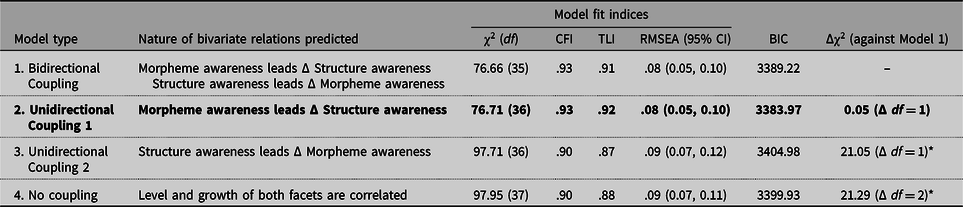
Based on the four hypotheses put forth about the reciprocal relations between morpheme and structure awareness, we tested four variant models derived from the bivariate equations (Table 2). Specifically, these models differed in the estimation of the coupling parameters (i.e., γms and γsm). The first model was a bidirectional model where both coupling parameters of γms and γsm were freely estimated. This was to test the hypothesis that earlier morpheme awareness scores led growth in structure awareness (γsm) and earlier scores of structure awareness in turn led growth in morpheme awareness (γms). The second model was a unidirectional model where the coupling parameter γsm was freely estimated but the other parameter γms was fixed at zero. This model was aligned with the hypothesis that earlier morpheme awareness scores led growth in structure awareness. The third model was also a unidirectional model where the coupling parameter γms was now freely estimated but the other parameter γsm was fixed at zero. This model tested the hypothesis that earlier structure awareness scores led growth in morpheme awareness. The final model was a no-coupling model where both coupling parameters were constrained to zero. This model corresponded to the hypothesis that level and change in structure and morpheme awareness were correlated but each facet did not lead growth in the other.
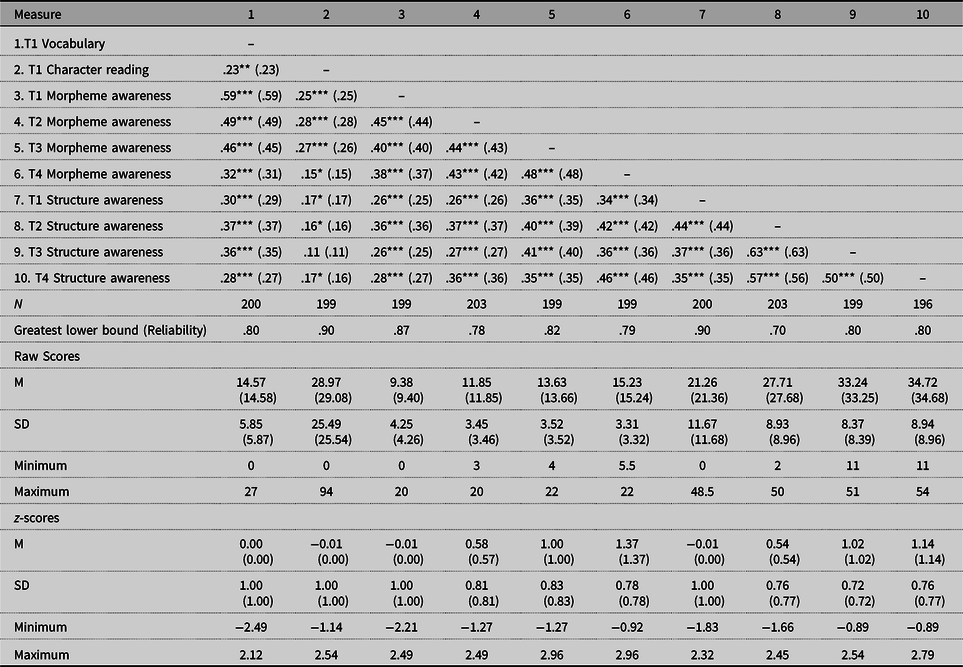
Descriptive statistics, reliabilities, and zero-order correlations among measures of morpheme and structure awareness across all time points and vocabulary at Time 1 (derived using full maximum likelihood estimation)

Note: * p <.05; ** p <.01; *** p <.001
Note: Numbers in parentheses are derived using listwise deletion
Model comparisons across all models tested

Note: Best-fitting model is in bold, * p < .05
In the building and estimation of the four models, there were three issues we addressed. First, we scaled Time 2, 3, and 4 scores based on that of Time 1 to derive at z-scores for use in the models, so that estimates of change over time yielded could be interpreted as the amount of variation from scores at Time 1 (Hoff et al., Reference Hoff, Quinn and Giguere2016). Second, as reviewed earlier, it has been argued that the association between morpheme and structure awareness is attributed to their associations with vocabulary and/or character reading (e.g., Chen et al., Reference Chen, Hao, Geva, Zhu and Shu2009; Liu et al., Reference Liu, Chung, Zhang and Lu2013). This means that the level of vocabulary knowledge and character reading ability could influence the level of the two facets of morphological awareness. Therefore, we included vocabulary knowledge and character reading measured at Time 1 as covariates for the initial level of morpheme and structure awareness in our models.
The final issue that we addressed was that the time points were not equidistant. Specifically, data were collected six months apart between Times 1, 2, and 3, whereas data were collected one year apart between Times 3 and 4. This uneven spacing between time points posed as a limitation because latent change modeling typically assumes invariance in change across time (Klopack & Wickrama, Reference Klopack and Wickrama2019). Therefore, we created one “phantom variable” (Horn & McArdle, Reference Horn, McArdle and Pooh1980; Rindskopf, Reference Rindskopf1984) for each facet of morphological awareness between Times 3 and 4 to ensure that the time points were evenly spaced. A phantom latent variable has no indicators and disturbances associated with it (i.e., paths are fixed at zero) and is not correlated with any variable in the model. Thus, adding phantom variables to the models does not alter the results in any way because these variables essentially are non-informative with the sole purpose of imposing constraints on the model to fulfill the invariance assumption of the LCS approach (Grimm & Ram, Reference Grimm and Ram2009; Klopack & Wickrama, Reference Klopack and Wickrama2019; Voelkle & Oud, Reference Voelkle and Oud2015).
Because the unidirectional coupling and no-coupling models (i.e., Models 2-4) were nested within the bidirectional model (Model 1), the difference in χ2 value between the bidirectional model and the three nested models was used to assess overall model fit. Non-nested models (i.e., Models 2 & 3) were compared using the Bayesian Information Criteria (BIC). A model with a lower BIC value was considered a better model. Additionally, the comparative fit index (CFI), Tucker-Lewis Index (TLI), and root mean standard error of measurement (RMSEA) were examined to evaluate model fit. CFI and TLI values of > .90 (Hu & Bentler, Reference Hu and Bentler1999) and RMSEA values of < .08 (Browne & Cudeck, Reference Browne, Cudeck, Bollen and Long1993) indicated adequate model fit.
Results
Data screening and descriptive statistics
Prior to conducting analyses to address our research question, we examined the data obtained from the 204 children for outliers, missing data, and violations of normality. Univariate outliers were identified using the median ± 2 interquartile range (IQR) cut-off criterion (Tabachnick & Fidell, Reference Tabachnick and Fidell2007). Four “high” outliers and seven “low” outliers were identified, and they were replaced with the upper bound (for high outliers) or lower bound values (for low outliers) calculated using the IQR criterion. The pattern of results yielded from using the original data and the data where replacements were made were unchanged. Therefore, results obtained using the latter data were reported in this study. No bivariate and multivariate outliers were identified using scatterplots and Mahalanobis distances.
We examined the nature of the missing data using two methods. We first compared the means, standard deviations, and correlations yielded from the data using listwise deletion and that obtained using the full maximum likelihood method. The values were similar with very small differences in values yielded between the two methods (Table 2). We then conducted the Little’s Missing Completely at Random (MCAR) test (Little & Schenker, Reference Little, Schenker, Arminger, Clogg and Sobel1995) which yielded a non-significant result [χ2 (65) = 78.27, p = .13]. Results from both methods indicated that the data met the missing at random (MAR) assumption. Thus, the maximum likelihood approach was used to handle missing data in subsequent analyses using Mplus 7.1 (Muthen & Muthen, Reference Muthén and Muthén1997-2012). This missing data handling technique was chosen because it yields the least biased parameter estimates as compared to other methods such as multiple imputation and listwise deletion used to handle missing data (Little & Rubin, Reference Little and Rubin1989; Soley-Bori, Reference Soley-Bori2013).
Table 1 shows descriptive statistics and reliabilities associated with all measures for the sample, as well as bivariate correlations among all measures across the different time points. Greatest lower bounds (glbs) (Sijtsma, Reference Sijtsma2009) rather than Cronbach’s Alphas were reported for task reliabilities. This is as increasingly, researchers point out that assumptions of equal variances and covariances among items that underlie the calculations of Cronbach’s Alphas are typically not met (Graham, Reference Graham2006), and thus Cronbach’s Alphas do not adequately reflect the reliabilities of tests (Sijtsma, Reference Sijtsma2009). The glb that has been recommended as a more viable alternative (e.g., Peters, Reference Peters2014) is thus reported here.
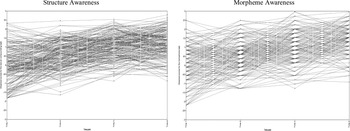
An examination of the mean scores showed that average scores on both the morpheme (homonym) and structure awareness (lexical compounding) tasks increased over time, although the rate of growth appeared to slow over time. Individual growth trajectories for both facets of morphological awareness also showed a similar trend (Figure 1). There was greater variance in scores over time on the structure awareness task as compared to the morpheme awareness task, as shown in the larger standard deviations associated with the scores. Variance in scores on the morpheme awareness task decreased over time, although there was a slight increase in variance between Times 2 and 3. Similarly, score variance on the structure awareness task decreased over time, except for a slight increase between Times 3 and 4 (Table 1). Moderate to strong correlations were observed in the structure awareness task across the four time points (.35 < r < .63). Significant moderate correlations were observed in the morpheme awareness task across the four time points (.38 < r < .48). Cross-variable correlations were also significant of weak or moderate strength (.26 < r < .46).
Observed Individual Growth Trajectories for Measures of Structure (Lexical Compounding) and Morpheme (Homonym Awareness) Awareness.

Model comparison results are shown in Table 2. When compared to the bidirectional model, constraining the coupling parameter leading from structure awareness to change in morpheme awareness (γms) to zero did not result in a significant reduction in fit (∆χ2 (1) = 0.05, p > .05). In contrast, fixing the other coupling parameter leading from morpheme awareness to change in structure awareness (γsm) to zero as well as fixing both coupling parameters resulted in significant reductions in model fit [∆χ2 (1) = 21.05; ∆χ2 (2) = 21.29; ps < .05]. Therefore, the unidirectional model for which earlier morpheme awareness scores led change in structure awareness was selected as the best-fitting model. As shown in Table 2, fit indices showed that this model (i.e., unidirectional model 1) had adequate fit, [χ2 (3) = 76.71, p < .05, CFI = .93, TLI = .92, BIC = 3383.97, RMSEA = .08, CI: .05, .10].
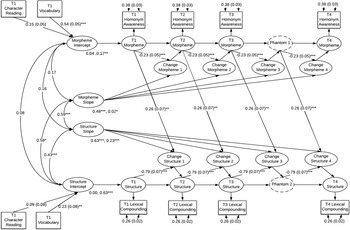
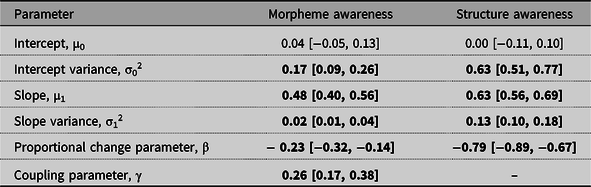
Figure 2 shows the best-fitting model depicting the unidirectional relation between morpheme and structure awareness in Chinese and selected results of the parameter estimates of interest in this study are presented in Table 3. As shown in Figure 2, the covariate of vocabulary, but not character reading, was a significant predictor of the initial levels of morpheme and structure awareness as well as of the growth of structure awareness. After accounting for the influence of Time 1 vocabulary and character reading on the initial levels of morpheme and structure awareness, the intercepts (i.e., initial scores) for both facets at Time 1 were not significantly different from zero (μ m0 = 0.04; μ s0 = 0.00; ps > .05), reflecting the z-score transformations using Time 1 as the reference time point. There were significant individual differences in scores at Time 1 as shown by significant intercept variances (σ2 m0 = .17; σ2 s0 = .63, ps < .001, respectively). Turning to the slope parameters, there was significant time point-to-time point growth in both morpheme awareness (μ m1 = .48, p < .001) and structure awareness (μ s1 = .63, p < .001) over time. There were also significant individual differences in the slope parameter for both types of morphological awareness (σ2 m1 = .0.02, p < .05; σ2 s1 = .13, p < .01).
Final Latent Change Score Model Depicting the Bivariate Relations Between Morpheme and Structure Awareness. Paths with No Coefficient Labels are Fixed at 1.* p < .05; ** p < .01; *** p < .001. T1 = Time 1, T2 = Time 2, T3 = Time 3, Time 4 = Time 4.

Selected results of parameter estimates in the final latent change score model of the bivariate relations between morpheme and structure awareness

Note: 95% bias-corrected bootstrap confidence intervals for each parameter are provided in parentheses, and estimates in bold are significant at p < .05
A positive correlation between the intercept and slope of structure awareness (r = .43, p < .001) indicated that children who had high initial levels of structure awareness also demonstrated greater growth. The slopes of both facets of morphological awareness were also significantly correlated (r = .59, p < .001), indicating that children with larger slope parameters in one facet tended to also have larger slope parameters in the other facet. Proportional change parameters for both morpheme awareness (βm = −.23, p < .001) and structure awareness (βs = −.79, p < .001) were significant, indicating that growth in both facets slowed down over time (i.e., these parameters affected the shape of growth such that the most growth occurred earlier in time). The coupling parameter between morpheme awareness and change in structure awareness was significant and positive (γsm = .26, p < .01), indicating that children who had higher levels of morpheme awareness showed greater growth in structure awareness over time. Specifically, controlling for the effects of the slope and proportional change parameter, children who scored 1 standard deviation above the mean on the morpheme awareness task grew .26 standard deviations faster in structure awareness over each 6-month interval between tests. There was no significant leading effect of structure awareness on change in morpheme awareness.
Taken altogether, each parameter listed above should be included in the bivariate change score equations to estimate the average change occurring between adjacent time points:
 $$\Delta {m_{tn}} = .48 - .23 \cdot m{_{(t - 1)n }}+ \zeta {_{\Delta mtn}}$$
 $$\Delta {s_{tn}} = .63 - .79 \cdot s{_{(t - 1)n }}+ .26 \cdot m{_{(t - 1)n}} + {\zeta _{\Delta stn}}$$
The equations show that the change score for morpheme awareness for participant n at time t was only informed by two sources of individual differences: (1) its slope parameter (s m ) and the proportional change parameter (βm). In contrast, the change score for structure awareness was informed by three sources of variance: it was driven by (1) the leading influence of morpheme awareness (γsm), (2) individual differences in both the slope parameter (s s ), and (3) the proportional change parameter (βs).
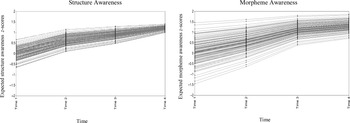
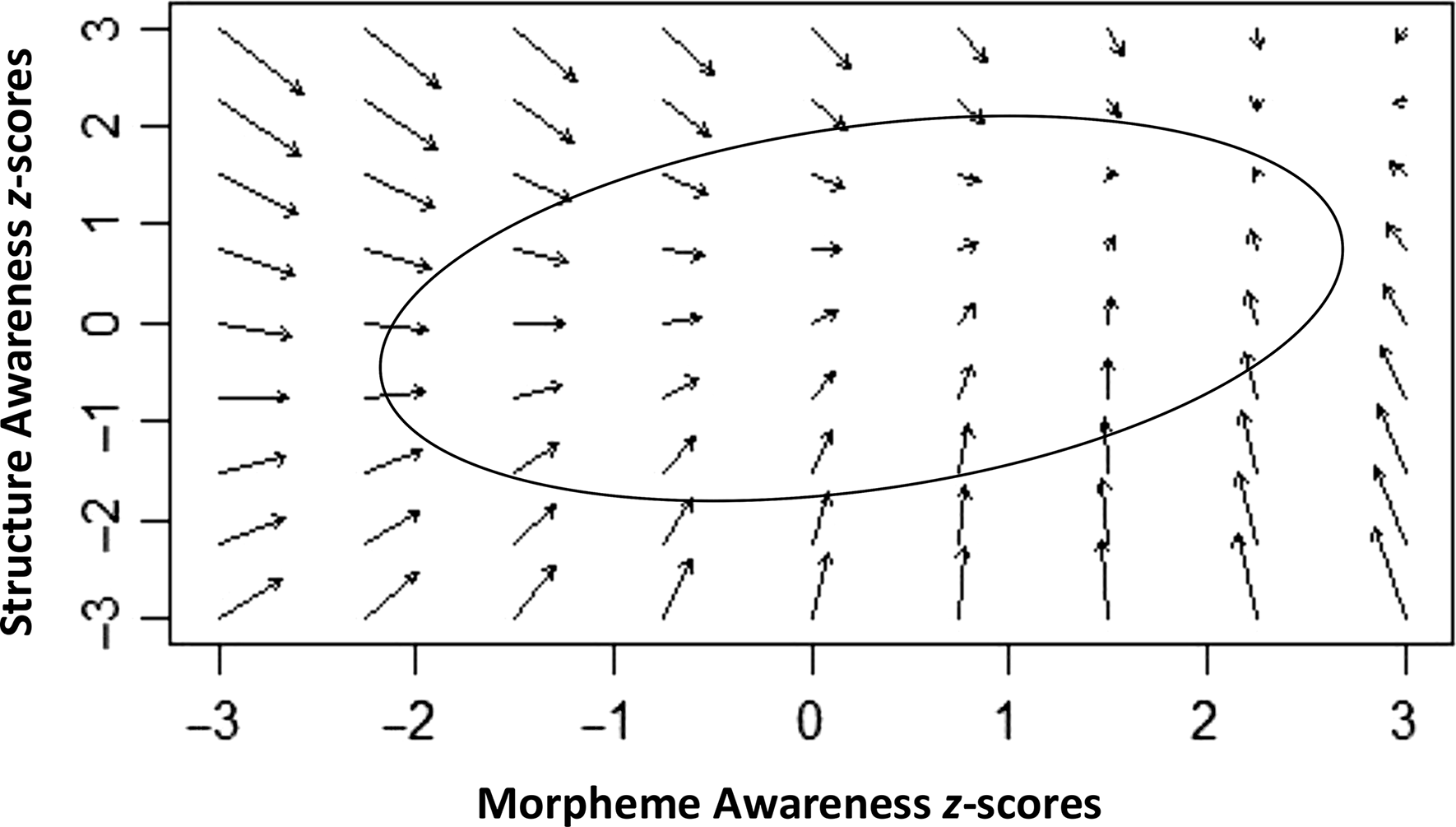
Using the parameter estimates derived in this best-fitting model, we plotted the expected individual growth trajectories of morpheme and structure awareness (Figure 3). The trajectories showed an increasing trend of scores for both facets of morphological awareness although there was much variation of initial levels of morpheme and structure awareness. Therefore, we examined the nature (i.e., direction and magnitude) of the dynamic relation between morpheme and structure awareness further using vector field plots (Boker & McArdle, Reference Boker and McArdle1995). As shown in Figure 4, the vector fields (i.e., arrows) in the plot indicated the estimated individual changes of both morpheme and structure awareness across the time points (i.e., 6-month intervals) in relation to the previous point of measurement (e.g., expected change in scores at Time t + 1 in relation to scores at Time t). Specifically, the direction of the arrow indicated whether change in each of the two facets of morphological awareness was positive, negative, or neutral, whereas the length and steepness of the arrows specified magnitude of growth.
Expected Individual Growth Trajectories for Measures of Structure (Lexical Compounding) and Morpheme (Homonym Awareness) Awareness.

Vector Plot of the Expected Directional Changes of Morpheme and Structure Awareness as a Function of Current Levels of the Two Facets of Morphological Awareness. Ellipsoid represents where 95% of the data are located.

An examination of the arrows within the 95% confidence interval ellipsoid (i.e., where 95% of the observed starting data points were located) in Figure 4 indicated that there was generally positive change (i.e., growth) in both morpheme and structure awareness. In considering the interaction between the two facets of morphological awareness, children with higher scores in both the morpheme and structure awareness tasks (z-scores > 0) grew minimally in both tasks as compared to those with lower scores on both tasks (i.e., z-scores < 0). This was as arrows in the lower left portion within the ellipsoid were much longer than arrows in the upper right portion in the ellipsoid. However, coupling effects leading from morpheme awareness to structure awareness appeared to be most evident among children with higher scores in morpheme awareness (z-scores > 0) but lower scores in structure awareness (z-scores < 0). Longer and almost vertical arrows associated with such a combination of scores indicated that children with higher scores in morpheme awareness and lower scores in structure awareness demonstrated greater growth in structure awareness as compared to children with other combinations of scores.
Discussion
The present study made use of latent change score modeling to provide a developmental perspective on the development of morpheme and structure awareness, and their co-development from grades one through three. Pertaining to development, the growth of both morpheme and structure awareness was characterized by decelerating growth, where the growth in performance on corresponding tasks grew at a decreasing rate over time. Furthermore, the rate of growth was more attenuated for structure awareness as compared to morpheme awareness, which is not surprising. This is as Chinese words typically have subordinate or coordinate structures (Yuan & Huang, Reference Yuan and Huang1998). The highly predictable morphological structure of words facilitates the development of structure awareness but contributes to the slowing of growth over time as children quickly become proficient in the predominant compound word structures and their characteristics in Chinese. In contrast, homonyms are prevalent in Chinese, so it will take more time for children to reach ceiling in their knowledge and understanding of homonyms in the language, delaying the slowing of growth of morpheme awareness.
Besides the development of each facet of morphological awareness, we were particularly interested to examine how they develop in relation to each other. In testing the four hypotheses put forth, our results favored the unidirectional hypothesis that morpheme awareness was a leading indicator of change in structure awareness across grades. Specifically, students who had higher levels of morpheme awareness demonstrated greater growth in structure awareness over time. In contrast, we did not find evidence that structure awareness predicted growth in morpheme awareness. This also meant that there was no evidence of bidirectional relations between the two facets of morphological awareness. The finding of a directional relation as opposed to only a mere correlation (i.e., uncoupled development) between the two facets of morphological awareness shows that having a common association to a third variable such as vocabulary or character reading cannot be the sole explanation for the relation between the two facets of morphological awareness. We discuss these findings from theoretical, measurement, and instructional perspectives.
Theoretically, our finding is aligned with the feed-forward route of the hybrid morphological processing model (Schreuder & Baayen, Reference Schreuder, Baayen and Feldman1995). We explain this finding in the context of four factors. The first pertains to the characteristics of Chinese morphology. For one, in Chinese words, identification of the structure (e.g., subordinate vs. coordinate compound words) and head morpheme (i.e., structure awareness) are often facilitated by knowledge of the meanings of the constituent morphemes (i.e., morpheme awareness). This is aligned with the explanation put forth in Hao et al. (Reference Hao, Chen, Dronjic, Shu and Anderson2013) that meaning drives the development of structure awareness. This point is especially relevant when we consider the process of extracting meanings of words containing morphemes that are homonyms. When one encounters such words, the ability to identify which is the head morpheme and what the structure of the word is might not be possible or helpful in deciphering the meaning of a word if one does not know which of the multiple meanings the head morpheme take to begin with. This explains why morpheme awareness leads the development of structure awareness.
Notably, although the morphological processing model is more often associated with alphabetic languages such as English, we find that the model is in part applicable in the context of morphological processing in Chinese where morpheme-level processing precedes structure-level processing. Because subordinate structures are common word structures in both Chinese and English (e.g., Chen et al., Reference Chen, Hao, Geva, Zhu and Shu2009), this overlap in morphological structures could possibly explain the between-language similarity in morphological processing.
However, we note that there are also differences between the languages. Specifically, the reverse route where structure-level processing precedes morpheme-level processing as put forth in the model was not supported by our data in Chinese. This difference is likely because while similarities exist between English and Chinese in rules governing word compounding, there are also major differences, as we have outlined earlier in the introduction. Inflection and derivation are the main mechanisms by which English multimorphemic words are formed (Chen et al., Reference Chen, Hao, Geva, Zhu and Shu2009; Liu & McBride-Chang Reference Liu and McBride-Chang2010; Wang et al., Reference Wang, Cheng and Chen2006). When prefixes and suffixes are added to base/root morphemes in English to form new words, the base/root morphemes are either preserved (e.g., un+happy = unhappy) or changed (e.g., go + ed= went). In the former case, the ability to identify the root/base morpheme would aid in identifying the structure of the word (e.g., prefix + base/root). In the latter case, however, analyzing the structure first (e.g., identifying the tense for the word went) would help in the identification of the base/root morpheme. The more complex word formation rules governing English may necessitate the use of more than one pathway in processing English words. In contrast, Chinese has a relatively simple morphological structure. Words are formed primarily by lexical compounding where the constituent morphemes are preserved (e.g., 太 tai4 + 阳 yang2= 太阳 – sun) (Ku & Anderson, Reference Ku and Anderson2003; Wu et al., Reference Wu, Anderson, Li, Wu, Li and Gaffney2009). Since the constituent morphemes are easily identifiable, using structure awareness to facilitate morpheme identification is less relevant than the reverse route.
A second factor that needs to be considered in explaining our finding is age. The present study focused on children in the early elementary grades (i.e., grades 1-3). It is possible that a different pattern of relations between the two facets of morphological awareness would be observed with older populations. Researchers point out that levels of morphological awareness become increasingly intertwined with age. One possible reason is that children encounter more multimorphemic words where one or more the constituent morphemes might be unfamiliar with age. The use of morpheme awareness alone might not be as effective because of incomplete morphemic knowledge. Children would likely invoke the use of both types of awareness simultaneously for additional support and verification in such instances. Therefore, it is possible that bidirectional, rather than unidirectional relations between the two, could be observed. Future research with different age groups would provide us with a more comprehensive understanding of how these two facets of morphological awareness co-develop.
Third, reading proficiency could also have an influence on the findings, an argument we put forth based on findings from two lines of research. The first is from empirical evidence showing that word reading abilities in Chinese facilitate the growth of morphological awareness among children in early elementary grades (Hulme et al., Reference Hulme, Zhou, Tong, Lervåg and Burgoyne2019). Chinese characters and words map onto morphemes which contain semantic information; thus, the amount of exposure to reading Chinese characters and reading proficiency could moderate how well children engage in morphological processing. In a separate line of research, there is evidence that advanced readers often use multiple related reading strategies in deciphering meaning in reading to ensure reading accuracy, especially when they encounter difficulties in reading (e.g., Kaufman et al., Reference Kaufman, Randlett and Price1985). Children in the present study could be considered beginner readers as they have just begun to receive formal instruction and are developing their proficiency in reading. Therefore, their limited reading proficiency and less developed morphological awareness might prohibit them from using multiple pathways in morphological processing as compared to more advanced readers. Conversely, proficient readers with more developed morphological awareness are able to make use of multiple pathways simultaneously instead of relying on only one pathway to facilitate morphological processing of words, particularly when they encounter more unfamiliar word forms and structures. Thus, a bidirectional relation between the two facets of morphological processing might be observed among more advanced readers. Indeed, research with adults who are likely more proficient readers has shown that awareness of morphemes and structural rules are activated simultaneously during morphological processing (e.g., Chialant & Caramazza, Reference Chialant, Caramazza and Feldman1995; Taft & Zhu, Reference Taft, Zhu and Feldman1995), which could facilitate co-development of the two facets.
A fourth factor to consider is instructional context. The finding that morpheme awareness predicted growth in structure awareness could reflect the instructional approach to reading instruction. Reading instruction in China has traditionally emphasized rote learning. Teachers typically ask children to memorize new characters (which map onto morphemes) rather than direct their attention to the morphological structures of words (Packard et al., Reference Packard, Xi, Li, Wu, Gaffney, Li and Anderson2006; Wu et al., Reference Wu, Li and Anderson1999). Given this emphasis on morpheme awareness in classroom instruction, it is logical that awareness of morpheme awareness precedes and facilitates growth of awareness of structures. A different pattern of relations between morpheme and structure awareness might emerge if more emphasis is placed on the morphological structure of words during instruction. Replication of the study using intervention and experimental designs across different instructional contexts in future would provide insight into how morphological instructional practices influence the co-development of morpheme and structure awareness in Chinese.
Implications of findings on measurement and classroom instruction
From a measurement perspective, the implications of our findings are two-fold. First, the finding of a direct association between the two facets of morphological awareness speaks to the dimensionality of morphological awareness, which is useful considering the dearth of construct dimensionality studies in Chinese. To date, the conceptualization of homophone/homonym awareness and lexical compounding as two related dimensions belonging to a common construct of morphological awareness in Chinese (e.g., Choi et al., Reference Choi, Tong, Law and Cain2018; Tong et al., Reference Tong, McBride-Chang, Shu and Wong2009) has been largely theoretical. Finding that one dimension leads the development of the other provides indirect support for the legitimacy of the view that both dimensions are related to a common construct. Furthermore, the relations to a common underlying construct that both facets share appear to be robust over the early elementary grades, as shown using a longitudinal design in the present study. Taken together, the findings provide a basis for validation in future dimensionality studies. Second, the measures we used in this study reflect those commonly used in the literature to assess morphological awareness. However, we found significant error variances associated with them, suggesting the need to consider using multiple measures for each facet of morphological awareness to adequately capture children’s level of morphological awareness.
The finding that morpheme awareness predicted growth in structure awareness also has important instructional implications. Previous research has shown that Chinese children who receive intervention in morpheme and/or structure awareness make significant improvements in word reading and vocabulary (Packard et al., Reference Packard, Xi, Li, Wu, Gaffney, Li and Anderson2006; Wu et al., Reference Wu, Anderson, Li, Wu, Li and Gaffney2009; Zhou et al., Reference Zhou, McBride-Chang, Fong, Wong and Cheung2012). Building on results of past intervention studies, our findings suggest that training in morpheme awareness may have the added benefit in that it facilitates the development of structure awareness over time. This turn could have a positive impact on reading and vocabulary in Chinese. The influence of morpheme awareness on growth in structure awareness over each 6-month period yielded a sizeable 0.26 coefficient. This suggests that the cumulative facilitation effect of morpheme awareness instruction on structure awareness growth could be substantial if instruction is carried out over longer periods, such as across grades. However, we acknowledge the difficulty in drawing definite conclusions because we did not examine mediating effects on literacy outcomes in our study. Therefore, future longitudinal intervention studies that examine these causal direct and indirect influences among facets of morphological awareness and literacy outcomes are needed.
Limitations and future directions
We acknowledge four main limitations in this study. The first is that we used a single task to measure each of the different constructs in this study. As mentioned earlier, we found significant error variances associated with the morphological tasks used, suggesting that there was still a significant amount of variance in performance on these tasks that were not accounted for by the latent variables. In addition, the correlations between the morphological tasks and character reading were quite weak. Considering the documented relations between morphological awareness and reading, multiple measures of reading at each time point should also be incorporated in future to better capture the possible confounding effects of reading in morphological investigations. Second, although we addressed the issue of uneven spacing between time points by introducing a non-informative phantom variable in our models between Times 3 and 4, it would be beneficial to replicate these findings using evenly spaced waves of data. Third, while we found that existing levels of morpheme awareness appeared to lead change in structure awareness over time, it is not possible to draw definitive causal conclusions due to the correlational nature of the data used in this study. Situating future investigations of bivariate relations between the two facets within intervention studies would clarify longitudinal causal relations. Finally, as about half of the participants in the present study had parents with a college degree and higher, the generalizability of the results to children with parents of different educational levels should be examined in future studies.
Despite these limitations, this study is to our knowledge, a first attempt at clarifying the longitudinal bivariate relation between Chinese morpheme and structure awareness, two important facets of morphological awareness. Our findings provide possible implications for instruction and points to the need to consider factors such as age, reading proficiency, and instructional context when considering longitudinal relations of facets of morphological awareness.
Author’s note
This work was undertaken when Poh Wee Koh was assistant professor in the Department of Teaching, Learning, and Culture at Texas A & M University.