Introduction
Reaction of metals, alloys, or oxides with water vapor at high temperatures
The reaction of water vapor with metal oxide surfaces is an extremely important area of research for a variety of engineering applications. Metal oxides can react with water vapor to produce gaseous metal hydroxides or oxyhydroxides according to the following equation:
 $${1 \over p}{{\rm{M}}_p}{{\rm{O}}_q}\left( {{\rm{s,l}}} \right) + m{{\rm{H}}_2}{\rm{O}}\left( {\rm{g}} \right) + n{{\rm{O}}_2}\left( {\rm{g}} \right) = {\rm{M}}{{\rm{O}}_{{q \over p} + m + 2n}}{{\rm{H}}_{2m}}\left( {\rm{g}} \right)\quad .$$
At higher partial pressures of H2O, the quantity of metal hydroxide or oxyhydroxide vapor can be a significant source of material transport. Reviews by Glemser and Wendlandt [Reference Glemser and Wendlandt1] and Hastie [Reference Hastie2] reported results for a variety of metallic and nonmetallic hydroxides. A previous review by Meschter et al. [Reference Meschter, Opila, Jacobson and Lipkin3] covered an extensive portion of the periodic table. This review will focus on selected hydroxides of particular importance in water vapor/oxide interface environments such as turbomachinery and fuel cells and on the determination of reliable thermodynamic data for these species. However, basic thermodynamic data are important in many applications beyond turbomachinery and fuel cells, such as nuclear systems, materials processing, and chemical plant environments.
Combustion environments
Combustion of hydrocarbon fuels under optimal operating conditions results in a combusted gas stream containing ∼3% oxygen and ∼10% water vapor as well as carbon-bearing species. Thermochemistry predicts ∼10% water vapor [Reference Jacobson4]; however, kinetic factors may reduce this amount to some extent [Reference Glassman5]. Modern gas turbines may operate at higher than 1 bar total pressure, and thus, several percent water vapor would constitute a significant partial pressure. Conditions are thus conducive to water vapor/oxide reactions, which will lead to degradation of the operating surface.
Thermal barrier coatings and environmental barrier coatings in combustion environments
Metal alloy turbine blades can be engineered to withstand higher temperatures if their surface is coated with a thermal barrier coating (TBC). Refractory materials used as TBCs on turbine blades are oxides. The TBC on the surface of the turbine blade is exposed to the highest temperatures in the turbine section of the engine. A thermal gradient exists across the coating and the underlying metal alloy comprising the turbine blade. State-of-the-art TBC materials are yttria-stabilized zirconia (YSZ) and most recently Gd2O3–ZrO2 systems.
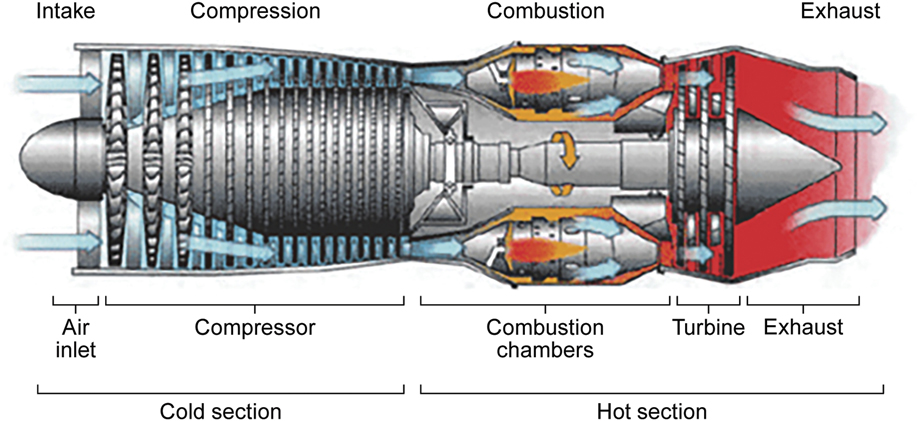
Environmental barrier coatings (EBCs) enable the use of light-weight high-temperature SiC or other refractory components in hot sections of high-pressure turbine engines. The combustion environments present in turbomachinery are very reactive regions in which one of the principal corrosive agents is high-temperature water vapor. In a gas turbine, the high temperature and the high pressure conditions present a very favorable environment for the formation of volatile hydroxide species. Figure 1 illustrates these portions of a gas turbine. At these pressures, species will form, which are not present in appreciable amounts in lower pressure regimes.
Schematic of a gas turbine engine. Temperatures in the turbine section can reach maximum temperatures of ∼1300 °C.

SiC composites have now entered service in hot section components in turbine engines, replacing some superalloy parts, due to their higher temperature capability, reduced weight, and reduced need for cooling air. SiC can form a passivating layer of SiO2:
 $${\rm{SiC}}\left( {\rm{s}} \right) + 1.5{{\rm{O}}_2} \left( {\rm{g}} \right) = {\rm{Si}}{{\rm{O}}_2}\left( {\rm{s}} \right) + {\rm{CO}}\left( {\rm{g}} \right)\quad .$$
This layer protects against further oxidation in dry oxygen but is subject to attack by water vapor:
 $${\rm{Si}}{{\rm{O}}_2}\left( {\rm{s}} \right) + 2{{\rm{H}}_2}{\rm{O}}\left( {\rm{g}} \right) = {\rm{Si}}{\left( {{\rm{OH}}} \right)_4}\left( {\rm{g}} \right)\quad .$$
Similar reactions occurring with other constituents make study of volatile metal hydroxides imperative for understanding and preventing corrosion.
In addition to Si(OH)4(g), other volatile hydroxides and oxyhydroxides typically have higher equilibrium pressures for a given element than the simple oxide vapor species. This makes them an important mode of corrosion in many combustion systems. Aluminum oxide may also be used as a constituent of EBCs or TBCs, as well as in refractories that are exposed to high-temperature water vapor. In experiments in flowing dry oxygen atmospheres at a temperature of 1500 °C, no significant mass loss of sapphire (Al2O3) coupons was observed. In contrast, significant mass losses were observed in H2O/O2 atmospheres under the same conditions of temperature and flow rates [Reference Opila and Myers6, Reference Opila, Myers, Opila, Hou, Maruyama, Pieraggi, Shifler and Wuchina7]. Transition metal oxides (e.g., Ta2O5) and rare earth oxides (e.g., Y2O3) may be constituents in TBCs and EBCs. These metal oxides can form volatile metal hydroxides, which will be at higher partial pressures than the corresponding oxide vapor species.
It is necessary to determine accurate thermodynamic data for the relevant hydroxides and oxyhydroxides. These data provide essential information needed to obtain reliable estimates of material loss rates under operating conditions.
Solid oxide fuel cells; steam boiler/turbine applications
Chromium steel is a prime candidate for interconnects in solid oxide fuel cells (SOFCs). High-chromium steels are desired for this application due to their ability to form electrically conductive chromium oxide, Cr2O3, required for cell operation in these high-temperature oxidizing environments. However, water vapor contents in the ambient air at normal relative humidity on the cathode side of the SOFC will cause significant volatilization of Cr as CrO2(OH)2(g), poisoning solid electrolytes [Reference Fergus8].
Oxidation of Cr in steels with concurrent volatilization of the thermally grown Cr2O3 from thin-walled heat exchangers/boilers/turbines leads to faster consumption of the underlying alloy and decreased component lifetimes [Reference Young and Pint9]. Increasing temperatures and water vapor pressures above existing operational conditions to increase efficiency will increase the rate of volatilization of Cr2O3 as gaseous metal hydroxides and decrease component lifetimes. The ability to accurately predict the formation rate of these volatile species is essential to life prediction of these components.
Characterization of volatile hydroxide species
Identification of species: free jet expansion mass spectrometry
There are several ways to establish the identity of volatile hydroxide and oxyhydroxide species. One very useful technique is free jet expansion mass spectrometry. This technique allows direct sampling of a vapor stream at 1 bar total pressure. The method permits the characterization of species that are not stable or have very low pressures under vacuum conditions, as in a Knudsen effusion mass spectrometer (KEMS).
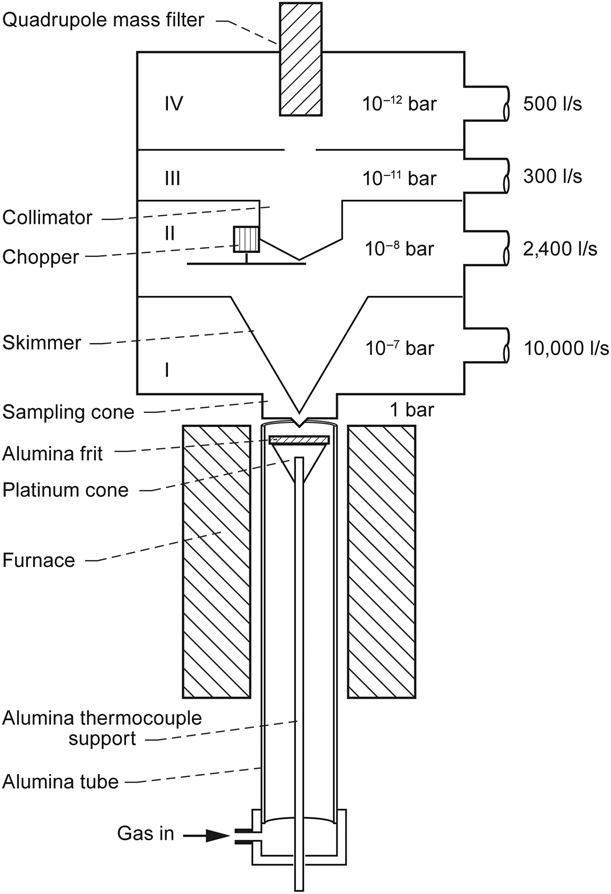
One example of such a system is shown in Fig. 2. Using an entrance orifice and a skimmer in a configuration developed by Kantrowitz and Grey [Reference Kantrowitz and Grey10], Milne and Greene [Reference Milne, Greene and Margrave11], and Stearns et al. [Reference Stearns, Kohl, Fryburg and Miller12], an intense supersonic molecular beam is formed and directed to a quadrupole mass spectrometer. An unobstructed path to the mass spectrometer allows direct identification of vapor species formed at 1 bar while preserving their chemical and dynamic integrity. The ability to sample at 1 bar total pressure makes this system ideal for sampling combustion environments or reactive gas mixtures. The water vapor pressure regimes present in gas turbine machinery can only be studied with a mass spectrometer using this free jet expansion approach.
Schematic of free jet expansion mass spectrometer system and furnace and sample configuration. The sample (alumina or other refractory material) was situated where the alumina frit is shown.

Recent research efforts at the NASA Glenn Research Center have centered on detection of volatile hydroxides from reaction of high-temperature water vapor with metal oxides or other materials used in combustion environments. Chemical systems that were studied include water vapor and SiO2 [Reference Opila, Fox and Jacobson13], BN [Reference Myers and Jacobson14], Al2O3 [Reference Myers and Jacobson14], Ta2O5 [Reference Myers, Kulis, Horvath, Jacobson and Fox15], and Cr2O3 [Reference Fryburg, Miller, Kohl and Stearns16].
Free jet expansion sampling mass spectrometry provides positive identification of volatile species, based on mass spectra and well-understood fragmentation patterns observed in hydroxide systems. However, it is difficult to obtain quantitative data in this system because of the complex expansion process for each species in conjunction with the ionization and detection processes in the mass spectrometer. Nonetheless, some investigators have quantified this process for other high-temperature reactions [Reference Hastie, Zmbov and Bonnell17].
Identification of species: dependence of flux of hydroxide species on partial pressure of water vapor and oxygen
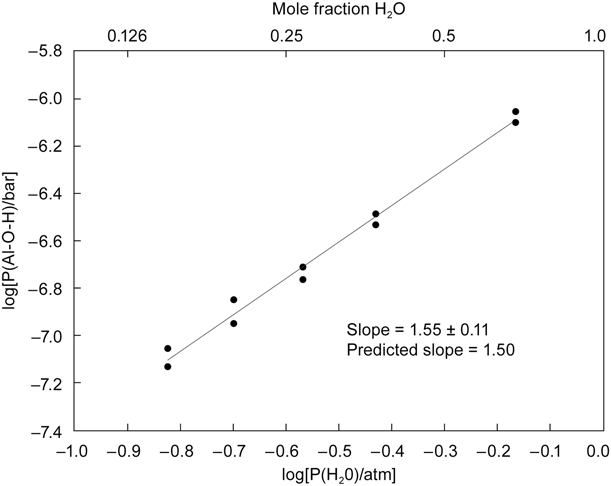
The identity of vaporizing hydroxides can also be inferred from pressure dependency in experiments where mass transport or mass loss is measured in flowing water/carrier gas atmospheres. In thermogravimetric experiments using coupons of oxide materials, altering the partial pressure of water will alter the total mass transport of volatile hydroxide [Reference Opila and Myers6, Reference Opila, Myers, Opila, Hou, Maruyama, Pieraggi, Shifler and Wuchina7]. A plot of log of mass transport versus log P(H2O) yields the stoichiometric coefficient for H2O in the chemical reaction producing the hydroxide [see Eq. (1)]. This is illustrated in Fig. 3 for Al(OH)3(g). If there is an oxygen dependency, varying the partial pressure of oxygen will reveal it as well.
P(H2O) dependence on amount of Al(OH)3(g) formed. Reprinted with permission from Ref. Reference Opila and Myers6. Copyright 2004 John Wiley & Sons.

Thus, thermogravimetric analysis measurements provide evidence for the identity of reactive species by inference from the observed pressure dependence, but do not provide direct identification of molecular species. Furthermore, it is inconclusive if multiple reactions are occurring with more than one product.
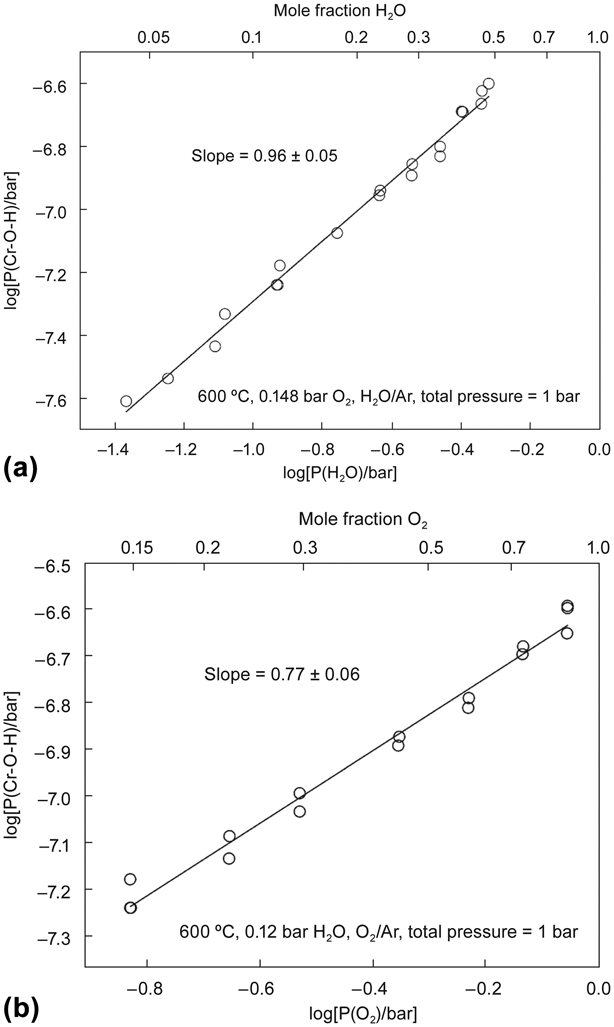
Pressure dependence from transpiration measurements can also provide the species identity from inference from pressure dependence, with the same limitations. In a transpiration study of the reaction of chromium(III) oxide with oxygen and water vapor [Reference Opila, Myers, Jacobson, Nielsen, Johnson, Olminsky and Allendorf18], Opila et al. varied the partial pressure of water and oxygen gas independently and found that the log P(Cr–O–H) versus log P(H2O) plot had a slope of 0.96 ± 0.05, while the plot of log P(Cr–O–H) versus log P(O2) had a slope of 0.77 ± 0.06 [see Figs. 4(a) and 4(b)]. The observed dependencies are consistent with the following reaction:
 $${1 / 2}{\rm{C}}{{\rm{r}}_2}{{\rm{O}}_3}\left( {\rm{s}} \right) + {{\rm{H}}_2}{\rm{O}}\left( {\rm{g}} \right) + {3 / 4}{{\rm{O}}_2}\left( {\rm{g}} \right) = {\rm{Cr}}{{\rm{O}}_2}{\left( {{\rm{OH}}} \right)_2}\left( {\rm{g}} \right)\quad .$$
(a) P(H2O) dependence on amount of CrO2(OH)2(g) formed, keeping P(O2) constant and (b) P(O2) dependence on amount of CrO2(OH)2(g) formed, keeping P(H2O) constant. Reprinted with permission from Ref. Reference Opila, Myers, Jacobson, Nielsen, Johnson, Olminsky and Allendorf18. Copyright 2007 American Chemical Society.

The data indicate that the volatile species is CrO2(OH)2. The Cr–O–H transpiration study is a nice illustration of determining species identity with pressure dependence from transpiration.
Determination of structures and spectroscopic constants of volatile hydroxides
A knowledge of structures and vibrational frequencies is important for accurate thermodynamics. Possible methods for determining structures are (i) molecular spectroscopy [Reference Bassler, Margrave and Margrave19], (ii) matrix isolation techniques coupled with spectroscopy [Reference Weltner20, Reference Wang and Andrews21, Reference Wang and Andrews22, Reference Shao, Zhang, Chen, Lu and Zhou23], or (iii) computational techniques [Reference Jensen24]. Structures and vibrational frequencies are also important for determining Gibbs energy functions (gefs) if a third law analysis is performed, as discussed in section Determination of thermodynamic data.
Determination of thermodynamic data
The transpiration method—Si–O–H; Cr–O–H; Al–O–H (indirectly); Ti–O–H
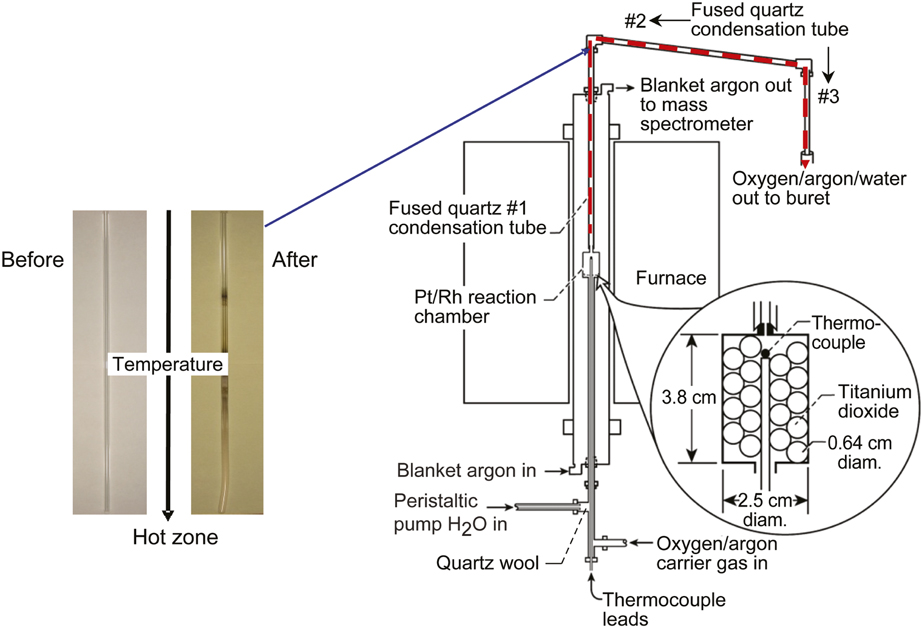
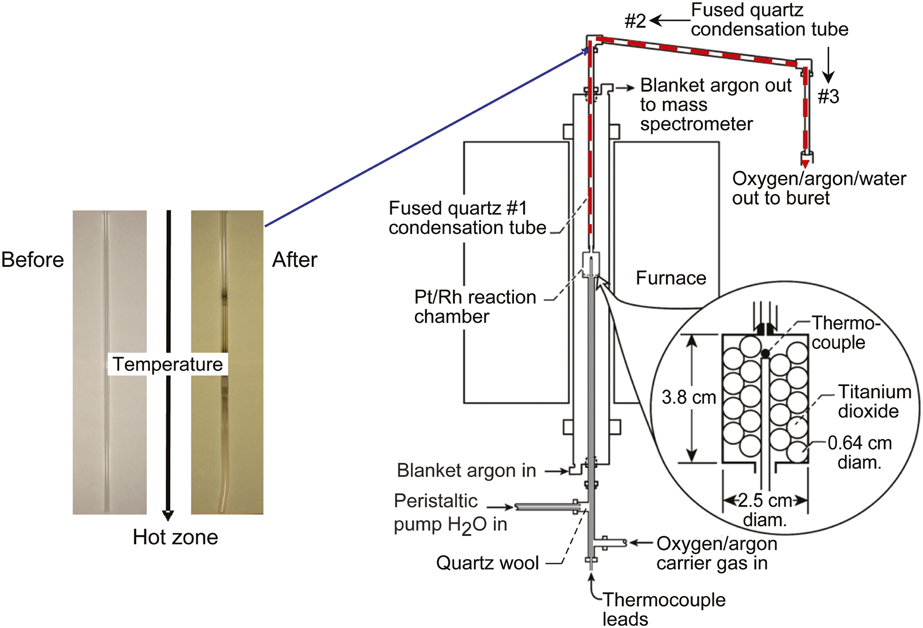
The transpiration method for the determination of equilibrium pressures and reliable thermodynamic data is particularly applicable to measurements involving volatile hydroxides [Reference Glemser and Wendlandt1, Reference Merton, Bell and Margrave25, Reference Belton and Richardson26, Reference Belton and McCarron27, Reference Belton and Jordan28, Reference Belton and Jordan29, Reference Kim and Belton30, Reference Hashimoto31, Reference Jacobson, Opila, Myers and Copland32]. In this method, a gas stream flows over a sample in a boat or sample cell. Vaporized material is transported in the gas stream to a cooler region in the furnace, where it condenses in a collection tube and can be dissolved for quantitative analysis. Incorporating water vapor into the gas stream permits reaction of the oxide sample with water to produce volatile hydroxide or oxyhydroxide species. A typical configuration suitable for hydroxide studies is shown in Fig. 5.
Transpiration furnace and transpiration cell (Pt/Rh) and (quartz) collection tubes. Insets show details of reaction chamber and condensate in the collection tubes. Reprinted with permission from Ref. Reference Nguyen, Bauschlicher, Myers, Jacobson and Opila43. Copyright 2017 American Chemical Society.
Varying the water and oxygen vapor pressures in the gas stream will yield variation in transported material, from which the identity of the volatile species can be inferred. The results can be ambiguous when more than one reaction product is formed. Sometimes variation in temperature can lead to one species predominating in the vapor. It is essential to operate in a flow rate regime that ensures saturation of the vapor phase. Varying the flow rate establishes the region of saturation and optimal operating conditions. The equilibrium pressure of the vaporizing species is given from the following relation:
 $${{{{\dot{n}}_2}} \over {{{\dot{n}}_1}}} = {{{P_2}} \over {{P_{\rm{f}}}}}\quad ,$$
where  ${\dot{n}_2}$ and
 ${\dot{n}_1}$ are the fluxes of the volatile hydroxide species and total carrier gases, respectively, P 2 is the equilibrium pressure of the hydroxide, and P f is the furnace pressure.
Measurement of equilibrium pressures over a range of temperatures leads to the determination of enthalpies and entropies for the reaction forming the hydroxide species, using standard methods from thermochemistry [Reference Drowart and Goldfinger33]. The data can be analyzed by means of the well-known second law method in which the ln K p (K p = equilibrium constant) for the reaction is plotted versus 1/T [Reference Drowart and Goldfinger33]. The resulting line follows the van’t Hoff relation:
 $$\ln {K_{\rm{p}}} = - {{{\Delta _{\rm{r}}}{H^\circ }} \over R}\left( {{1 \over T}} \right) + {{{\Delta _{\rm{r}}}S^\circ } \over R}\quad ,$$
 $${{d\left( {\ln {K_{\rm{P}}}} \right)} \over {d\left( {{1 \over T}} \right)}} = - {{{\Delta _{\rm{r}}}H_{{T_{{\rm{av}}}}}^\circ } \over R}\quad .$$
Enthalpies at 298.15 K are obtained using the following expression:
 $${\Delta _{\rm{r}}}H_T^\circ = {\Delta _{\rm{r}}}H_{298}^\circ + \int_{298}^T {\Delta {C_{\rm{P}}}{\rm{d}}T} \quad .$$
The third law method [Reference Drowart and Goldfinger33] makes use of the gefs to compute a value of the enthalpy of reaction from each reaction temperature.
 $${\rm{ge}}{{\rm{f}}_{298.15}} = {{\left( {G_T^\circ - H_{298.15}^\circ } \right)} / T}\quad .$$
This leads to the enthalpy of the reaction from Eq. (10):
 $${\Delta _{\rm{r}}}H_{298.15}^\circ = T\left\{ {\Delta \left\{ { - \left( {ge{f_{298.15}}} \right)} \right\} - R\ln \left( {{K_{\rm{P}}}} \right)} \right\}\quad ,$$
 $$\eqalign{{\rm{where:}}\;{\rm{ge}}{{\rm{f}}_{298.15}} = \left( {{{G - {H_0}} \over T}} \right) - \left( {{{{H_{298.15}} - {H_0}} \over T}} \right) \cr= \left( {{{G - {H_{298.15}}} \over T}} \right)\quad .$$
Thermodynamics of the Si–O–H system
The thermodynamics of the Si–O–H system is of great importance in a wide range of technological applications. Of particular interest is the role of high-temperature water vapor in the corrosion of ceramics that contain silicon as one component [Reference Opila, Smialek, Robinson, Fox and Jacobson34]. Krikorian [Reference Krikorian35] estimated thermodynamic data for several Si–O–H vapor species, including Si(OH)4 and SiO(OH)2. His results accurately reflect the general trends observed by experimental work which followed [Reference Hashimoto31, Reference Jacobson, Opila, Myers and Copland32]. Calculations using ab initio methods were performed by Darling and Schlegel [Reference Darling and Schlegel36], Allendorf et al. [Reference Allendorf, Melius, Ho and Zachariah37], and Plyasunov et al. [Reference Plyasunov, Zyubin and Zyubina51]. Experimental measurements utilizing the transpiration method were performed by Hashimoto [Reference Hashimoto31] and Jacobson et al. [Reference Jacobson, Opila, Myers and Copland32]. Hashimoto found evidence only for Si(OH)4 in his transpiration experiments. Jacobson et al. found evidence for Si(OH)4 and SiO(OH)2 at 1673 K. A detailed assessment of all available data for Si(OH)4 has been given by Plyasunov [Reference Plyasunov38]. Independent confirmation of the existence of the Si(OH)4 and SiO(OH)2 molecules was provided by Opila et al. [Reference Opila, Fox and Jacobson13] by means of free jet expansion sampling mass spectrometry. Transpiration studies can provide evidence of the vaporizing species by inference from pressure dependency of vapor transport on partial pressure of reactive carrier gases but cannot give direct observation of the vaporizing species.
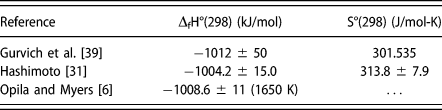
The existence of SiO(OH)2 in addition to Si(OH)4 was inferred by Jacobson et al. [Reference Jacobson, Opila, Myers and Copland32] from vapor species pressure dependence on P(H2O); the pressure of the Si(OH)4 species was subtracted out to find an equilibrium pressure of SiO(OH)2. A summary of the results obtained for silicon hydroxide and silicon oxyhydroxide is given in Table I.
Values obtained for Si(OH)4 and SiO(OH)2.

 ${{{C_{\rm{p}}}} \over R} = 27.4945 - 6.22157 \times {10^{ - 3}}T + 4.34739 \times {10^{ - 6}}{T^{ 2}} - 9.07719 \times {10^{ - 10}}{T^3} - 4.48699 \times {10^{ 3}}{T^{ - 1}} + 2.58937 \times {10^5}{T^{ - 2}}$ (T = 298.15–2100K) [Reference Plyasunov, Zyubin and Zyubina51].
Thermodynamics of the Al–O–H system
Thermodynamic data for the Al(OH)3 species from the reaction of water vapor with alumina were also determined by Hashimoto [Reference Hashimoto31]; however, their data were measured over a two condensed phase system containing calcium monoaluminate and calcium dialuminate, rather than directly from Al2O3 due to difficulty of dissolving pure alumina deposits. These data have been compared with the theoretical calculations and estimates from other investigations [Reference Opila and Myers6, Reference Opila, Myers, Opila, Hou, Maruyama, Pieraggi, Shifler and Wuchina7, Reference Gurvich, Veyts and Alcock39]. A summary is given in Table II.
Values obtained for Al(OH)3.

From Refs. Reference Gurvich, Veyts and Alcock39 and Reference Bale, Chartrand, Degterov, Eriksson, Hack, Mahfoud, Melançon, Pelton and Petersen57.
C p (J/mol-K) = 74.511990 + 9.545527 × 10⁻²T−4.112512 × 10⁻⁵T 2−1075464.0T −2 (298–700 K).
C p (J/mol-K) = 109.1773 + 2.979339 × 10⁻²T−5.317581 × 10⁻⁶T 2−4138997T −2 (700–2400 K).
C p (J/mol-K) = 153.8085 + 1.120288 × 10⁻³T−8.592387 × 10⁻⁸T 2−38406420T −2 (2400–6000 K).
Thermodynamics of the Cr–O–H system
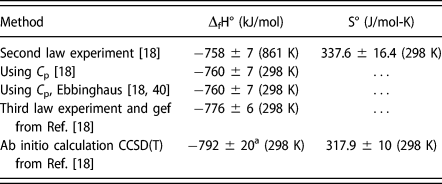
The reaction of chromium oxides with water vapor has been studied in a number of works. Ebbinghaus [Reference Ebbinghaus40] reviewed the topic and provided data on many species. Fryburg et al. [Reference Fryburg, Miller, Kohl and Stearns16] used free jet expansion mass spectrometry and cooled targets to determine that the principal hydroxide species was CrO2(OH)2. Kim and Belton [Reference Kim and Belton30] performed transpiration experiments and reported CrO2OH. More recently, the reaction of Cr2O3 with water vapor and oxygen was studied using the transpiration method by Gindorf et al. [Reference Stanislowski, Wessel, Hilpert, Markus and Singheiser41] and Opila et al. [Reference Opila, Myers, Jacobson, Nielsen, Johnson, Olminsky and Allendorf18]. Because of the transport of chromium-bearing species into cooler regions of the transpiration apparatus, quartz collection tubes were used and the entire gas train and all condensed water was collected and analyzed for Cr using ICP. Enthalpies of formation as determined in this study are given in Table III. Using this technique, Belton and coworkers studied hydroxides of W [Reference Belton and McCarron27] and Mo [Reference Belton and Jordan28].
Values obtained for CrO2(OH)2.

a Calculated from the isogyric reaction: CrO2(OH)2(g) → CrO3(g)+H2O(g).
C p (J/mol-K) = 163.4872 − 0.015289T + 3.57 × 10⁻⁶T 2 − 18249.2T −1 − 1.94 × 10⁻¹⁰T −2 (298–1000 K).
Thermodynamics of the Ti–O–H system
An extensive study utilizing both experimental (transpiration) and computational approaches was performed by Nguyen et al. [Reference Nguyen, Myers, Jacobson and Opila42, Reference Nguyen, Bauschlicher, Myers, Jacobson and Opila43]. Their experiments utilized the reaction of water vapor with TiO2 (rutile). The predominant reaction was determined to be:
 $${\rm{Ti}}{{\rm{O}}_2}\left( {{\rm{s,}}\;{\rm{rutile}}} \right) + {{\rm{H}}_2}{\rm{O}}\left( {\rm{g}} \right) \,⇌\, {\rm{TiO}}{\left( {{\rm{OH}}} \right)_2}\left( {\rm{g}} \right)\quad .$$
Some evidence was also found for the formation of Ti(OH)4, according to the following reaction:
 $${\rm{Ti}}{{\rm{O}}_2}\left( {{\rm{s,rutile}}} \right) + 2{{\rm{H}}_{\rm{2}}}{\rm{O}}\left( {\rm{g}} \right) \,⇌\, {\rm{Ti}}{\left( {{\rm{OH}}} \right)_4}\left( {\rm{g}} \right)\quad .$$
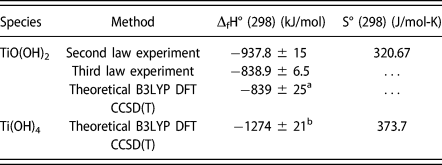
Accurate computational results for both species were determined [Reference Nguyen, Bauschlicher, Myers, Jacobson and Opila43]. The recommended values from their study are listed in Table IV.
Values obtained for TiO(OH)2 and Ti(OH)4 [Reference Nguyen, Bauschlicher, Myers, Jacobson and Opila43].

a Calculated from the reaction Ti(g) + O2(g)+H2O(g) → TiO(OH)2(g)
b Calculated from the reaction Ti(g) + O2(g)+2H2O(g) → Ti(OH)4(g)
For TiO(OH)2,  ${C_{\rm{P}}}\left( {298 - 1600\;K} \right) ({\rm{J}}/{\rm{mol\hbox-K}}) = 149.2 + \left( { - 0.02539} \right)T + \left( {8.28697 \times {{10}^{ - 6}}} \right){T^2} + {{ - 15614.05} \over T} + {{ - 5.2182 \times {{10}^{ - 11}}} \over {{T^2}}}\;{\rm{J/mol}}\;{\rm{K}}$.
For Ti(OH)4,  ${C_{\rm{P}}}\left( {298 - 1600\;K} \right) ({\rm{J}}/{\rm{mol\hbox-K}}) = 169.25 + \left( { - 7.1896 \times {{10}^{ - 3}}} \right)T + \left( {7.5164 \times {{10}^{ - 6}}} \right){T^2} + {{ - 10818.0308} \over T} + {{ - 4.8145 \times {{10}^{ - 11}}} \over {{T^2}}}\;{\rm{J/mol}}\;{\rm{K}}$.
Laminar flow methods—Al–O–H; Ta–O–H
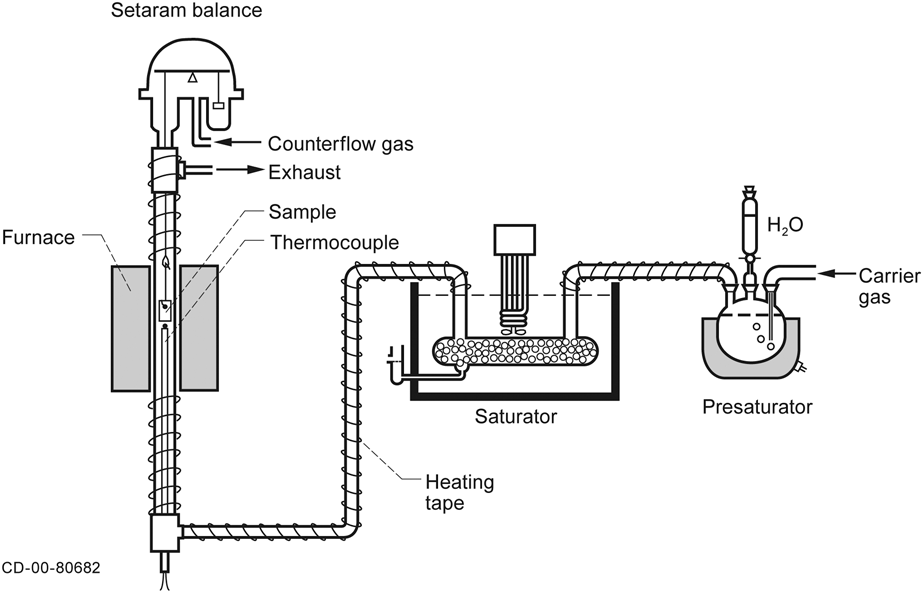
Reactions of water vapor with refractory oxides can also be studied using mass losses from oxide coupons under laminar flow conditions. In this technique, sample coupons are suspended from a recording balance in a tube furnace and the reactive gas mixture flows over them, as shown in Fig. 6. Due to the approximations necessary to derive diffusion-limited reaction rates, such an experiment cannot be used to obtain precise thermodynamic data. Nonetheless, it is a quick and relatively easy screening method for different systems.
Schematic of thermogravimetric apparatus used to study reactions of ceramic oxide coupons with moist atmospheres. Partial pressure of water vapor in gas stream is set by the temperature of the water bath in the saturator. A counterflow of gas is necessary to prevent condensation of volatile species or moisture on the electronic balance.

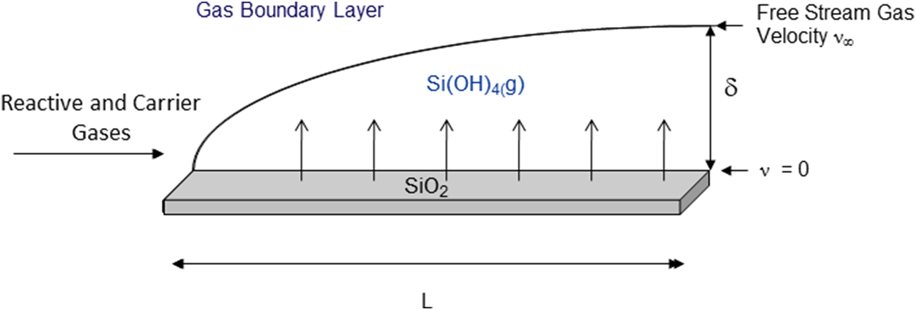
A schematic representation of the volatilization process is illustrated in Fig. 7, with SiO2 as substrate and Si(OH)4 as the volatile species. As in the transpiration method, the nature of the volatile species is inferred from partial pressure dependencies. Mass losses of the sample coupons are readily related to the partial pressures of the reactive gases, e.g., H2O and O2. The pressure dependence of the flux yields the stoichiometry of the chemical reaction. A diagram of the water vapor thermogravimetric apparatus (TGA) is shown in Fig. 6. Under laminar flow conditions, the reaction produces a flux of volatile reaction species as shown in Fig. 7. The equilibrium pressures are related to mass fluxes (unit mass per unit time, Δw/Δt) and reaction characteristics by the following equation [Reference Geiger and Poirer44]:
 $${{\Delta w} \over {\Delta t}} = 0.664{\left( {{{\rho 'vL} \over \eta }} \right)^{1/2}}{\left( {{\eta \over {\rho 'D}}} \right)^{1/3}}\left( {{{DPM} \over {LRT}}} \right)\quad .$$
Schematic of volatilization process from a surface experiencing laminar flow of a reactive gas. In the example, the reactive gas is water vapor and the surface is silica.

Where ρ′ is the gas density of the boundary layer, v is the gas velocity, η is the gas viscosity of the boundary layer, L is the characteristic length of the sample, D is the interdiffusion coefficient of the reactive gaseous species in the laminar boundary layer, P is the partial pressure of the volatile species, M is its molar mass, R is the ideal gas law constant, and T is the temperature. From this relation, equilibrium pressures may be calculated, or given measured pressures, expected mass losses may be calculated under known flow rates.
Formation of Al(OH)3(g)
A study of the reaction of alumina with water vapor utilizing this technique was performed by Opila and Myers [Reference Opila and Myers6]. In their experiments, sapphire coupons were exposed to flowing streams of water vapor/oxygen gas at temperatures between 1250 °C and 1500 °C, and water vapor partial pressures between 0.15 and 0.68 atm. Linear gas velocities of 4.4 cm/s were used in fused quartz tubes of diameter 2.2 cm, which gave laminar flow conditions. The results were used to calculate equilibrium pressures of Al(OH)3 from the following reaction:
 $${1 / 2}{\rm{A}}{{\rm{l}}_2}{{\rm{O}}_3}\left( {\rm{s}} \right) + {3 / 2}{{\rm{H}}_{\rm{2}}}{\rm{O}}\left( {\rm{g}} \right) \,⇌\, {\rm{Al}}{\left( {{\rm{OH}}} \right)_3}\left( {\rm{g}} \right)\quad .$$
In these experiments, good agreement with Hashimoto’s data for Al(OH)3 [Reference Hashimoto31] were obtained. An important aspect of this study in relation to that of Hashimoto is that the reaction of alumina with water was observed directly as opposed to measurements over a two condensed phase mixture of calcium aluminates. The dependency of partial pressure of water vapor on mass loss was found to be 1.55 ± 0.11, consistent with reaction [Eq. (15)] above. In addition, the results provided reliable recession rates for alumina in water vapor streams [Reference Opila, Myers, Opila, Hou, Maruyama, Pieraggi, Shifler and Wuchina7].
Formation of Ta–O–H species
A similar study of the reaction of tantalum(V) oxide in water vapor was performed by Myers et al. [Reference Myers, Kulis, Horvath, Jacobson and Fox15]. Evidence for significant mass losses from tantalum(V) oxide in 50% H2O streams was observed. Coupons of Ta2O5 were suspended in a TGA apparatus similar to the one used by Opila and Myers [Reference Opila and Myers6]. Mass flux dependence of vaporizing Ta–O–H species were determined at 1250 °C and at 1450 °C. At 1250 °C, the slope was determined to be 2.37 ± 0.35; at the higher temperature, the slope was 2.13 ± 0.15. At the lower temperature, the slope is consistent within experimental error with the reaction:
 $${1 / 2}{\rm{T}}{{\rm{a}}_{\rm{2}}}{{\rm{O}}_{\rm{5}}} + {5 / 2}{{\rm{H}}_{\rm{2}}}{\rm{O}} \,⇌\, {\rm{Ta}}{\left( {{\rm{OH}}} \right)_5}\quad .$$
At the higher temperature, the observed slope may be the result of competing vaporization reactions, possibly Eq. (16) and the reaction to produce TaO(OH)3:
 $${1 / 2}{\rm{T}}{{\rm{a}}_{\rm{2}}}{{\rm{O}}_{\rm{5}}} + {3 / 2}{{\rm{H}}_{\rm{2}}}{\rm{O}} \,⇌\, {\rm{TaO}}{\left( {{\rm{OH}}} \right)_3}\quad .$$
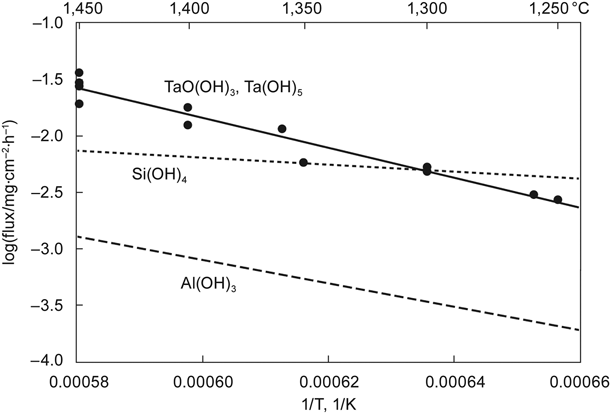
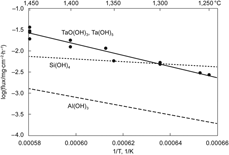
Free jet expansion mass spectrometry results found evidence for TaO(OH)2+, which would be the expected fragmentation product from TaO(OH)3. No clear evidence of Ta(OH)5 was found in mass spectrometric measurements. Measurements were performed in a 50% H2O–Ar atmosphere, and substantial mass losses were observed from 70% dense Ta2O5 coupons. Mass losses at temperatures of 1350 °C and higher were observed to be greater than those observed from SiO2 under the same conditions. A plot of predicted equilibrium fluxes of tantalum species versus 1/T is shown in Fig. 8, along with pressures of Si(OH)4 and Al(OH)3 for comparison.
Measured weight loss fluxes of oxides due to volatile hydroxide and oxyhydroxide formation. Ta2O5 is compared with calculated fluxes from hydroxides of SiO2 and Al2O3 in 50% H2O–Ar at 1 bar total pressure and 4.4 cm/s linear flow rate. Reprinted with permission from Ref. Reference Myers, Kulis, Horvath, Jacobson and Fox15. Copyright 2017 John Wiley and Sons.

The steam jet
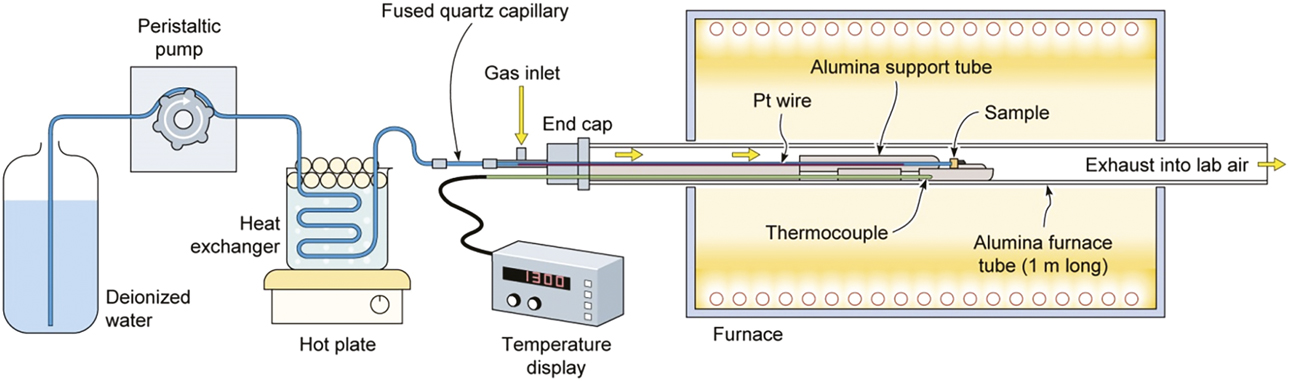
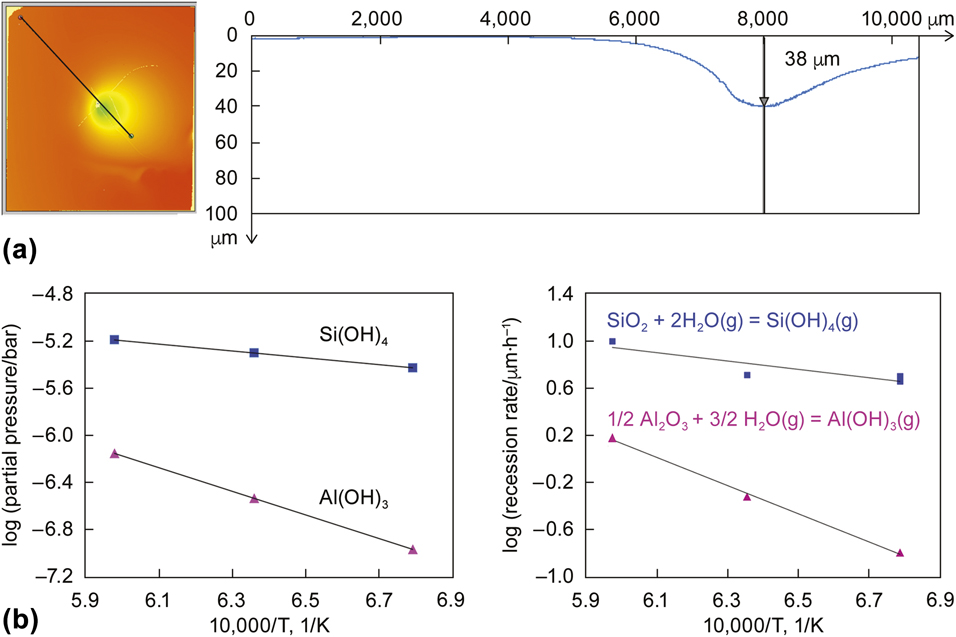
An additional technique for quantifying reactions of water vapor with refractory oxides utilizes a high-velocity jet of steam formed in a tube furnace [Reference dos Santos e Lucato, Sudre and Marshall45, Reference Golden and Opila46]. As shown in Fig. 9, liquid water is injected into a small-diameter capillary contained within a tube furnace. As the liquid enters the hot zone of the furnace and vaporizes, the resulting volume expansion forces the steam out of the capillary at high velocities. Sample coupons are placed in close proximity (1 mm) to the high-velocity jet of steam (150–250 m/s), allowing the reactive gas mixture to flow over the test specimen. Recession of the oxide is a direct result of the reaction and recession rates can be directly correlated with the equilibrium partial pressure of the relevant gaseous metal hydroxides. Figure 10(a) shows the measured recession profile of single crystal Al2O3. Figure 10(b) shows a side-by-side comparison of the measured recession of SiO2 and Al2O3 with the partial pressures of Si(OH)4(g) and Al(OH)3(g), showing the measured recession correlates with the partial pressure of the volatile species as expected from Eq. (14). Recent work has focused on extending this work to study volatility of Ta2O5 and TiO2. The steam jet recession of Ta2O5 was found to be consistent with the TGA results cited above when accounting for differences in temperature, water vapor partial pressure, and gas velocity (laminar flow), and assuming that the TaO(OH)3(g) species was the relevant species of interest [Reference Mueller, Golden and Opila47].
Steam jet furnace schematic. Reprinted with permission from Ref. Reference Golden and Opila46. Copyright 2016 Elsevier.

(a) Measured recession profile of single-crystal Al2O3 exposed to steam jet. The Al2O3 recession was measured after exposure at 1400 C, 1 bar P(H2O), 176 m/s steam velocity for 25 h. (b) Side-by-side comparison of the calculated pressures of Si(OH)4(g) and Al(OH)3(g) versus 1/T with the measured recession of SiO2 and Al2O3.

Theoretical computation of thermodynamic data for volatile hydroxides
Historical: estimates
Krikorian [Reference Krikorian35, Reference Krikorian48] estimated volatilities of a wide range of metal hydroxides, based on periodic trends and existing spectroscopic and thermodynamic data. Estimates of vibrational frequencies and molecular geometries were drawn from similar molecules. His work was very insightful and showed considerable intuition. Subsequent experiments have shown his estimates to be quite accurate in many cases, and they still fill in many gaps in the experimental literature. Today, they are a useful point of comparison for experimental and theoretical work in the field.
Accurate determination of molecular structure and vibrational frequencies
To obtain accurate third law analyses of thermodynamic data requires reliable determinations of the structure and vibrational frequencies of the hydroxide molecules in question. Historically, structures of gaseous molecules have been obtained from microwave spectroscopy or electron diffraction [Reference Greene and Margrave49], while vibrational frequencies have been determined from infrared and/or Raman spectroscopy [Reference Bassler, Margrave and Margrave19]. These methods require a significant equilibrium vapor pressure of the species of interest in the optical path of the spectrometer. Since many of the species of interest have relatively low equilibrium pressures, it is difficult or impossible to make such measurements using traditional spectroscopic techniques. This means that for many species of interest, only second law analyses can be performed on the experimental data unless an alternate method of determining structures and vibrational frequencies can be found.
Computation of gefs
Using modern ab initio methods, structures and gefs can be determined for molecules of interest. These methods are sometimes the only source of structure and vibrational frequencies of these molecules. This approach has been used to perform third law analyses on Si(OH)4 by Jacobson et al. [Reference Jacobson, Opila, Myers and Copland32], using the ab initio calculations of Allendorf et al. [Reference Allendorf, Melius, Ho and Zachariah37]. Hashimoto [Reference Hashimoto31] used data from Gurvich et al. [Reference Gurvich, Veyts and Alcock39] for his third law analysis of his Al(OH)3 data and from the JANAF Tables [Reference Chase50] for Ca(OH)2.
Computational determination of accurate thermodynamic properties
Thermodynamic data may be computed to a high degree of accuracy using composite methods [Reference Jensen24]. Recently, Plyasunov et al. [Reference Plyasunov, Zyubin and Zyubina51] have reported computed thermodynamic data for the Si(OH)4(g) species, which is consistent with experiments and prior computations. Theoretical and experimental results are best reported as part of the same study and together can provide a reliable dataset. Opila et al. reported both experimental and theoretical results for the Cr–O–H system [Reference Opila, Myers, Jacobson, Nielsen, Johnson, Olminsky and Allendorf18]; Nguyen et al. reported both experimental and theoretical results for the Ti–O–H system [Reference Nguyen, Bauschlicher, Myers, Jacobson and Opila43].
Computational chemistry can make two contributions to the determination of thermodynamic properties. The first is in the determination of the structure and vibrational spectra of the molecules of interest, which allows the determination of the temperature dependence of the thermodynamic properties. This allows the extrapolation of high-temperature experimental properties to lower temperatures. The second is by directly computing atomization or bond energies, which can be combined with known heats of formation, to determine the properties of the compound of interest.
The advent of analytic first and second derivatives for many types of computational methods, including density functional theory (DFT) approaches, makes it possible to optimize the geometry and determine the harmonic frequencies of even large molecules [Reference Martin52]. Experience has shown that the B3LYP hybrid functional yields very reliable structures and vibrational frequencies [Reference Scott and Radom53]. Scaling of the computed harmonic frequencies has been shown to account for basis set incompleteness and anharmonic effects. For many molecules, the rigid rotor-harmonic oscillator approximation can be used to compute the temperature dependence of the thermodynamic functions. However, for the metal hydroxides, the OH rotational barrier is rather low, meaning that this motion does not behave like a harmonic oscillator, but rather like a hindered rotor. This commonly occurs in organic molecules, for example, the rotation of –CH3 groups [Reference Pitzer, Gwinn and Pitzer54]. As a result, excellent approximations have been developed to treat such rotations, requiring only the calculation of the rotational potential [Reference Scott and Radom53]. The metal oxides have an additional problem in that the MOH bending potential is very anharmonic and even have a double-well potential in some cases [Reference Nguyen, Bauschlicher, Myers, Jacobson and Opila43]. This arises because the M–OH bonding is a mixture of covalent, which favors a bent geometry, and ionic bonding, which favors a linear geometry. We treat this problem by computing the MOH bending potential and evaluating many vibrational levels, which are then used to compute the thermodynamic properties as a function of temperature. Thus, while metal hydroxides require one to go beyond the rigid rotor-harmonic oscillator approximation, the corrections are straight forward and can be determined using potentials computed at the same level of theory as the geometry and harmonic frequencies.
To accurately compute the heats of formation requires a rigorous computational method. The coupled-cluster singles and doubles approach with a perturbational treatment of the triple excitations [i.e., CCSD(T)] has proven to be the method of choice. The CCSD(T) treatment can be performed in a series of one particle basis sets and the results extrapolated to the complete basis set limit. It should be noted that for larger systems, this method will become prohibitively expensive, and hybrid methods have been developed, where the CCSD(T) results obtained in a small basis set are corrected for basis set incompleteness using lower levels of theory. For small molecules containing only atoms from the first and second rows of the periodic table, computational chemistry has proven that it can rival all but the very best experiments. For the metal hydroxide systems, the calculations are more difficult and the accuracy is probably somewhat lower, but the computed values are an excellent check on the experimental values.
Future directions of research
Much remains to be determined in the area of volatile hydroxides of interest in high-temperature corrosion environments. More accurate data are needed for a number of chemical systems.
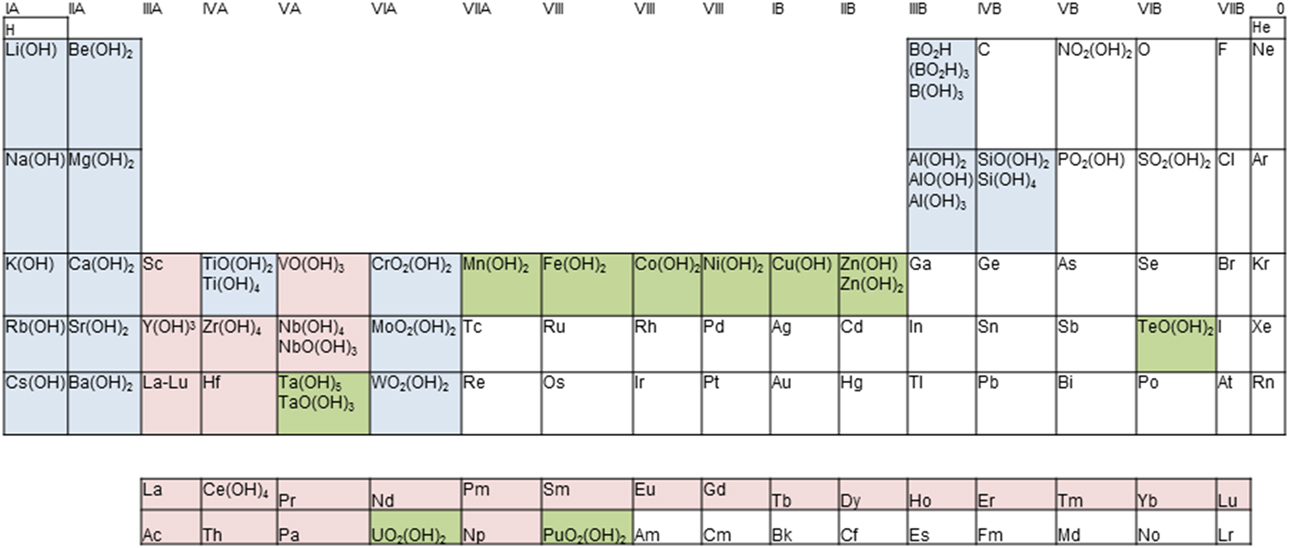
Figure 11 shows the periodic table with known hydroxide compounds. A recent review includes a summary of the data available [3]. The shaded elements indicate that thermodynamic data are known or needed. The blue shade indicates that the data are fairly well known. Note this includes the main Group I and II hydroxides, and these data are listed in the common data compendia [Reference Gurvich, Veyts and Alcock39, Reference Chase50]. Generally data are not available for the transition metal hydroxides and oxyhydroxides, with the exception of Ti, Cr, Mo, and W. The data for Fe, Ni, and Co appear to be good, but limited. Chromia is an important protective oxide and Mo and W are used in the lighting industry and as structural refractory materials in reducing environments. Data are also available for the hydroxides and oxyhydroxides of B, Al, and Si. We have indicated formulae for the molecules that are known. Beyond these distinct groups, data are limited.
Periodic table illustrating our current knowledge of volatile hydroxides and oxyhydroxides. Blue shade indicates the metal hydroxides/oxyhydroxides are well characterized, green shade indicates reasonably known, and pink shade indicates data are needed.

Refractory oxides are an important class of materials, which may also be used in environments where steam is encountered. Refractory bricks and refractory oxide coatings are important applications in steam-containing environments. As noted, data are available for some of the components of these materials—Al2O3, SiO2, MgO, and CaO. However, for the more exotic constituents, such as the rare earth oxides, few data are available.
As described earlier, Krikorian [Reference Krikorian48] estimated thermochemical data for several rare earth hydroxides and oxyhydroxides. His data give very low partial pressure for species such as Y(OH)3(g), which is consistent with the well-known stability of YSZ in combustion environments over long times. More recently, Courcot et al. [Reference Courcot, Rebillat, Teyssandier and Louchet-Pouillerie55, Reference Courcot, Rebillat, Teyssandier and Louchet-Pouillerie56] have conducted volatility measures of rare earth oxides in high-temperature water vapor. They report higher vapor pressures, which are not consistent with Kirkorian’s estimates or practical experience with rare earth oxides in environments with water vapor. Preliminary steam jet results are in agreement with those of Krikorian, indicating Y2O3 is extremely stable in high-temperature steam. Clearly, this inconsistency should be resolved.
The authors have promoted a combined computational/experimental approach to obtain the required thermodynamic data. As noted, availability and expertise in computational methods are growing rapidly, and it is now feasible to compute the desired data for many of these complex hydroxides and oxyhydroxides. Experiments provide quantities derived from actual conditions close to the actual applications. A judicious choice of theoretical approaches and appropriate experiments can generate a reliable dataset, which is needed for many of the transition metal and rare earth hydroxides and oxyhydroxides.
The experimental methods discussed here—both the traditional ones such as transpiration, thermogravimetric methods, and free jet expansion mass spectrometry and the more novel steam jet method—are continually improving. The major limitation with transpiration is the analytical method for accurate determination of the deposit amount. As discussed, free jet expansion mass spectrometry has the potential to be quantitative if the gas dynamics are better understood in addition to the ionization and detection process. Evidence suggests that the steam jet method attains equilibrium for many systems and this needs to be clarified for all systems.
Conclusions
Reaction of water vapor with metal or metal oxide surfaces is an area of research with significant impact on several modern technologies. Accurate thermodynamic data are necessary to determine the suitability of specific materials in contact with water vapor at elevated temperatures and to accurately predict lifetimes. Such data can be put into the databanks of thermochemical modeling codes, such as FactSage [Reference Bale, Chartrand, Degterov, Eriksson, Hack, Mahfoud, Melançon, Pelton and Petersen57]. A number of oxides have been studied, but additional data are definitely needed. Silicon, aluminum, and chromium compounds have been characterized, but a number of transition metal oxides warrant additional study. In particular, the yttrium and titanium systems are of importance.
The best approach is to combine experimental measurements with computational studies. Transition metals are more challenging with their large numbers of electrons, but modern computational techniques are making such studies more accurate and feasible all the time.
Free jet expansion mass spectrometry provides a way to identify volatile hydroxides and oxyhydroxides. Structures can be determined by spectroscopic techniques in conjunction with matrix isolation. Computational methods can provide a useful check on experimental results or provide reasonable structures when spectroscopic data are unavailable. Transpiration experiments can provide accurate thermodynamic data, especially when coupled with gefs obtained from spectroscopy or computation. Composite computational techniques provide invaluable checks on experimental results. Thermogravimetric analysis or steam jet experiments provide an important simulation of laminar or turbulent flow conditions typically found in actual applications. Examples of recent studies are discussed. Needed data for other systems are discussed as well as improvements to the theoretical and experimental techniques employed.