Introduction
Boea Comm. ex Lam. was first described in 1785 by Lamarck, based on material collected and named, but not published, by Commerson. Boea was the first Old World genus with a twisted capsule to be described, and as such, became the genus to which many new Southeast Asian species with a similar fruit type were ascribed. Most of these species are now assigned to a number of genera that have been distinguished from Boea (Puglisi et al., Reference Puglisi, Yao, Milne, Möller and Middleton2016).
The correct spelling of the genus name has been rather problematic. In the protologue (Lamarck, Reference Lamarck and Poiret1785), the genus is written ‘Bœa’, but this appears to have been interpreted as ‘Bæa’ in the index of the same work. Although Lamarck gives no etymology, an annotation in an unknown hand on the Geneva duplicate of the type collection suggests that the genus is named for a Mlle Beau, the niece of a clergyman friend of Commerson. She is presumed to be the Mlle Beau who became Commerson's wife. Clarke (Reference Clarke, Candolle and Candolle1883) suggests that the genus name derives from a M. le Beau, Commerson's wife's brother, and that Commerson spelled the genus name ‘Bea’. Whether the genus is named for the brother or sister, the suggestion is that ‘Beau’ is the inspiration for the genus name. The unclear typeface in the protologue and the possible derivation of the name led many later authors to spell the genus name ‘Baea’, including for other genera with names derived from this genus (e.g. Bentham & Hooker, Reference Bentham and Hooker1876). However unclear it is when the name is written in lower case letters in Lamarck (Reference Lamarck and Poiret1785), it is nevertheless unequivocally spelled with an ‘oe’ by Lamarck when written with capital letters, and the spelling ‘Boea’ must take priority, including in other genus names derived from it. This conclusion was also reached by Burtt (Reference Burtt1954).
There are few accounts of Boea in the literature. The first important change in the circumscription of the genus was the inclusion of the Chinese genus Dorcoceras Bunge and part of Didymocarpus Wall. (Brown, Reference Brown1840), a move that greatly expanded the morphological and geographical range of the genus. In Clarke's monograph of the Cyrtandreae (Clarke, Reference Clarke, Candolle and Candolle1883), many new species of Boea from throughout Southeast Asia were described. The genus was included in the twisted-fruited group of the tribe Didymocarpeae, together with the (then) Burmese genera Phylloboea Benth. and Ornithoboea Parish ex C.B.Clarke, and the African Streptocarpus Lindl. Schlechter (Reference Schlechter1923) resurrected Dorcoceras and restricted Boea to the Australasian species. His work was not followed by later authors, because he formed a rather heterogeneous Dorcoceras and did not treat the species of Boea in the Malay Peninsula. The last key publication on Boea was that of Burtt (Reference Burtt1984). In the account, the twisted-fruited Boea and the straight-fruited Paraboea were profoundly modified to match newly defined generic concepts based on the type of indumentum rather than on the twisting of the fruit. This change led to a major reduction in the number of Boea species, followed later by further reduction owing to the segregation of Kaisupeea B.L.Burtt (Burtt, Reference Burtt2001), Senyumia Kiew, A.Weber & B.L.Burtt (Kiew et al., Reference Kiew, Weber and Burtt1998) and Emarhendia Kiew, A.Weber & B.L.Burtt (Kiew et al., Reference Kiew, Weber and Burtt1998), genera created to accommodate the few remaining doubtful species of Boea and Paraboea. Eventually, Boea became a genus of 14 species with two centres of diversity: China and Papua New Guinea. As a result of molecular and morphological analyses, Puglisi et al. (Reference Puglisi, Yao, Milne, Möller and Middleton2016) recircumscribed Boea once again, restoring Schlechter's definition of Boea, placing the Asian species Boea hygrometrica (Bunge) R.Br., B. philippensis C.B.Clarke, B. wallichii R.Br. and B. geoffrayi Pellegr. in the resurrected Dorcoceras, and B. clarkeana Hemsl. in Damrongia Kerr ex Craib.
At present, Boea comprises 11 species, one of them newly described, distributed in Papua New Guinea, the Solomon Islands, Queensland (Australia) and Waigeo Island (Indonesia). It is characterised by the twisted fruit, free (or nearly free) sepals, a flat-faced pink to purple corolla and strongly divergent anthers.
The number of herbarium collections of Boea is not very high, nor are the specimens uniformly distributed across the taxa. Of the 183 collections examined, 156 (85%), represented just four species. Three or fewer collections were available for five of the species. Only the two taxa from Australia had recent collections. Most specimens from Waigeo Island, Papua New Guinea and the Solomon Islands were collected between the 1930s and the 1950s; some were collected even earlier, in the nineteenth century. These numbers suggest that more botanical work should be directed towards these biodiverse parts of the world. Further collections from the north and the west of New Guinea are particularly needed.
Materials and Methods
Specimens of Boea were studied from the following herbaria: A, BISH, BM, C, CANB, CAVA, E, G, GH, K, L, LAE, LINN, MEL, MO, NSW, P, SING, US, WRSL, YU (codes from Thiers, continuously updated). All the specimens cited have been seen, unless otherwise indicated. Barcodes of type specimens are given, when available. If the Global Positioning System coordinates were not reported on the specimen label, the collection locality was georeferenced using Google Earth (Google Inc., 2013) or various online resources and gazetteers. All the specimens were studied with a stereomicroscope and measured with a ruler. Smaller objects, such as seeds, were measured with a graticule or a loupe. Sizes should be considered accurate to 0.1 mm. Maps were generated in SimpleMappr (Shorthouse, Reference Shorthouse2010).
Distribution of Boea
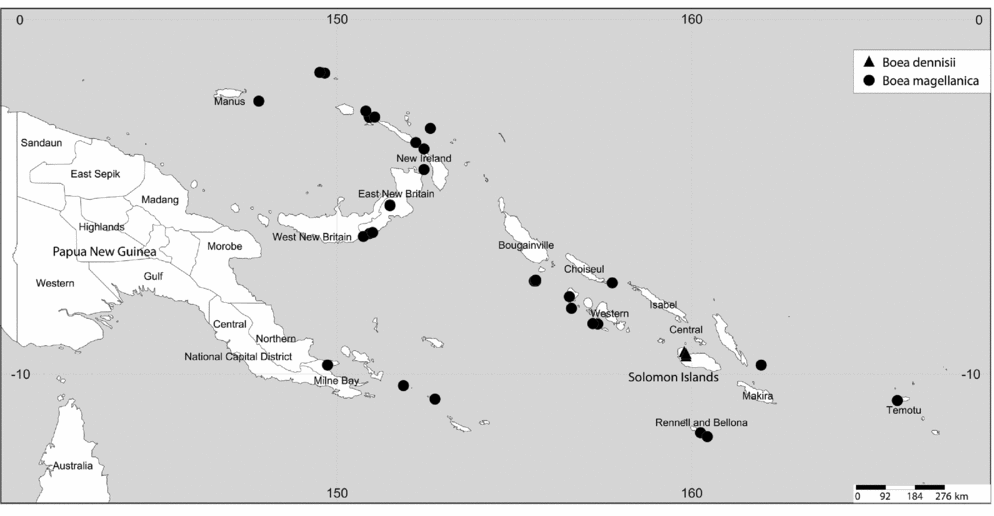
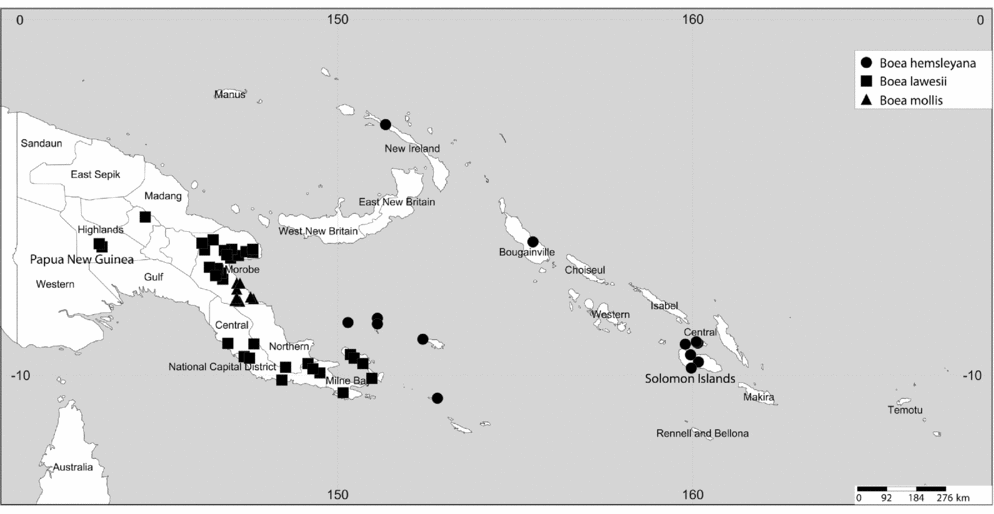
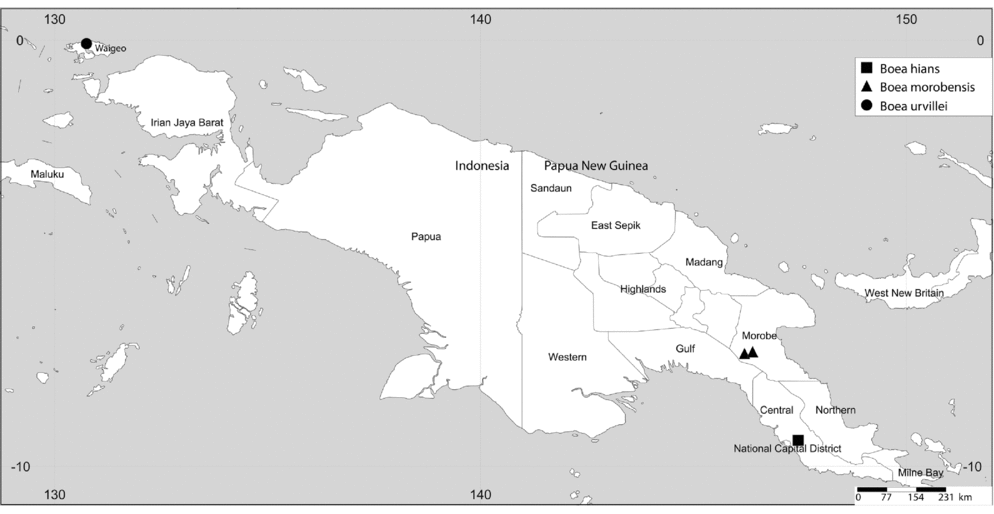
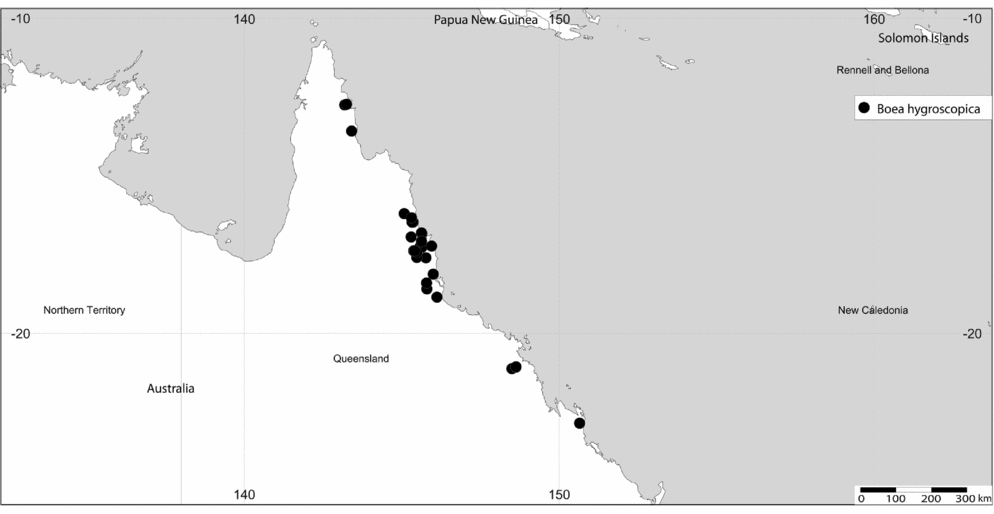
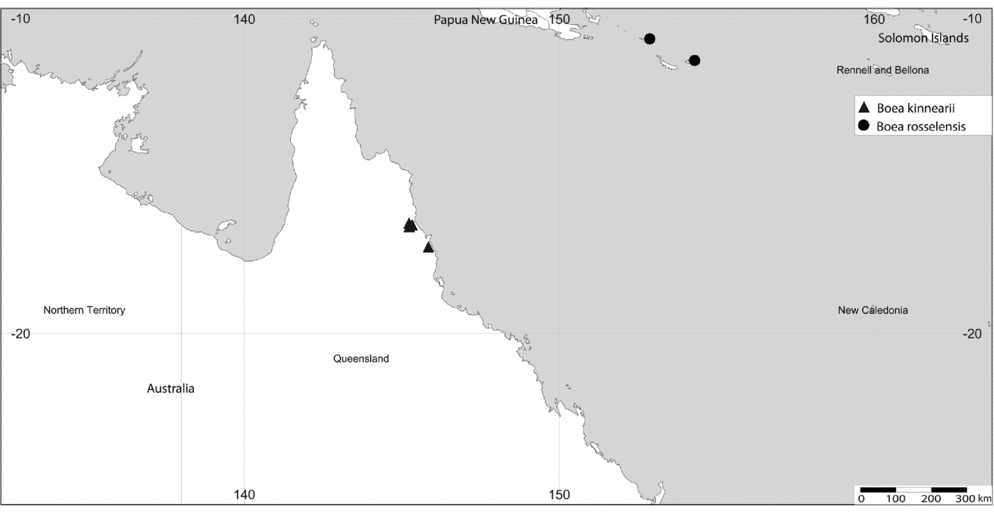
The centre of the distribution of Boea is eastern Papua New Guinea and the Solomon Islands. Additionally, Boea urvillei is found on Waigeo Island (Indonesia), off the north-west coast of New Guinea, suggesting that Boea could be more broadly distributed across New Guinea than currently known. Boea hygroscopica and B. kinnearii are endemic to Queensland (Australia).
The didymocarpoid Gesneriaceae colonised Southeast Asia from west to east (Weber, Reference Weber, Kubitzki and Kadereit2004; Cronk et al., Reference Cronk, Kiehn, Wagner and Smith2005; Möller et al., Reference Möller, Pfosser, Jang, Mayer, Clark, Hollingsworth, Barfuss, Wang, Kiehn and Weber2009, Reference Möller, Forrest, Wei and Weber2011), but only three genera have reached as far east as the Solomon Islands or Australia: Aeschynanthus Jack, Cyrtandra J.R.Forst. & G.Forst. and Boea. Puglisi et al. (Reference Puglisi, Yao, Milne, Möller and Middleton2016) showed that the closest relatives of Boea are the Peninsular Malaysian genera Senyumia and Spelaeanthus Kiew, A.Weber & B.L.Burtt, and more distantly, part of Loxocarpus R.Br. This suggests dispersal from the Sunda Shelf eastwards, across Wallacea, and is documented also in Begonia L. (Thomas et al., Reference Thomas, Hughes, Phutthai, Ardi, Rajbhandary, Rubite, Twyford and Richardson2012), Aglaia Lour. (Muellner et al., Reference Muellner, Pannell, Coleman and Chase2008) and several other plant families (Turner et al., Reference Turner, Hovenkamp and van Welzen2001; Richardson et al., Reference Richardson, Costion, Muellner, Gower, Johnson, Richardson and Rosen2012). Such an event is likely to have occurred after the late Miocene (c.10 Ma), when the eastern Malesian island arcs emerged and formed a path for island-hopping dispersal (Hall, Reference Hall, Metcalfe, Smith, Morwood and Davidson2001). The emergence of the north-eastern part of New Guinea is also believed to have started 10–9 Ma (Hall, Reference Hall2009). Migration to Australia from New Guinea was made possible by the short distance and low sea depth across the Torres Strait, which also became a continuous land bridge during the Glacial Maxima. Phylogeographic studies with secondary fossil calibration are under way (J. A. Luna-Castro, personal communication).
Morphology
This revision uses a morphological species concept. The main characters found to delineate discrete species are the habit, the shape of the corolla, and the type of indumentum and its arrangement on the calyx.
Plants of Boea are mostly caulescent with well-defined internodes between leaf pairs, or alternatively, tightly clustered leaves along the apical part of the stem (hereafter referred to as ‘shortly caulescent’). Most species are very clearly and consistently either caulescent or shortly caulescent, but in some specimens of Boea hygroscopica and B. magellanica, both usually shortly caulescent, distinct internodes have been observed. This ambiguity does not prevent the identification of Boea hygroscopica, being just one of two species occurring in, and endemic to, Australia, and the only one with a strongly twisted fruit and a mixed glandular–eglandular indumentum on the lower surface of the leaf. The caulescent form of Boea magellanica is, however, more difficult to identify, because it can be confused with B. lawesii or B. mollis. Boea kinnearii and B. urvillei are rosulate, which effectively means that they exhibit a more pronounced form of short caulescence, having fewer leaves and shorter stems.
Leaves are opposite or whorled in caulescent and rosulate plants. Shortly caulescent plants have an indistinct phyllotaxis owing to the tight clustering of the leaves.
Inflorescences are always axillary cymes. The rosulate species appear to be less floriferous than the shortly caulescent and caulescent species, which have several orders of branching in the inflorescence.
The calyx is of five lobes, free or almost free to the base. They are persistent even after the dehiscence of the fruit. They vary in length between 2 and 15 mm, including a tube that is never longer than 1 mm. The calyx is actinomorphic or slightly bilabiate with three upper and two lower lobes, and there can be very minor length differences between the lobes. The way the indumentum is arranged on the outer side of the calyx is taxonomically significant. Most species, for example Boea mollis, have lobes uniformly covered by the indumentum, whereas others, for example B. lawesii, may have hairs only along the axis and/or the margin of the lobe or be completely glabrous.
Boea has a bilabiate corolla typical of the Gesneriaceae, consisting of two upper and three lower lobes, with some variation between species. The tube broadens widely from the base, so that the overall appearance is that of a shortly campanulate to almost flat-faced corolla with pink to purple lips and some irregular yellow coloration at the throat. The corolla observed in the core group of species from Papua New Guinea and the Solomon Islands is strongly bilabiate. The upper lip has two large orbicular or elliptic lobes; the lower is narrow and elongated, with three small, elliptic lobes. The Australian species (Boea hygroscopica and B. kinnearii) and B. urvillei have a lower lip of a similar size to the upper, with the three lobes more or less equal and at least half the length of the lip.
The androecium is antisepalous and arises from the corolla. It consists of two ventral fertile stamens, on either side of the ventral corolla lobe, and three dorsal staminodes. The fertile stamens have short, often bent filaments and a pair of divergent anthers. The staminodes are more or less reduced and sometimes invisible.
The gynoecium includes a unilocular, bicarpellate ovary with axile placentation and many small ovules, a style, and a dorsoventrally bifid or capitate stigma. The main key character associated with the pistil is the indumentum of the ovary, which may often also be seen on the fruit.
The fruit is a cylindrical capsule with two valves dehiscing loculicidally and secondarily splitting septicidally again into two. The valves are strongly twisted in the majority of species, weakly twisted in Boea morobensis and B. urvillei, and straight to very weakly twisted in B. kinnearii. The calyx is persistent in the fruit, as is the tomentum, if present.
The indumentum is taxonomically significant in many genera of Gesneriaceae, and three main types are present in Boea: eglandular hairs, gland-tipped hairs and sessile glands. Eglandular hairs are always multicellular and unbranched, and vary in thickness and colour. A good example of such variation can be observed on the leaf of Boea urvillei, where long and thick yellow hairs are intermixed with much shorter and thinner white trichomes. Eglandular hairs are present in all species. Sometimes, multicellular hairs can end in a terminal gland. Gland-tipped hairs are not as polymorphic as the eglandular ones but do vary in length and number of cells.
Systematic Treatment
Boea Comm. ex Lam., Encycl. 1: 401 (1785); Jussieu, Gen. Pl. 121 (1789). Willdenow, Sp. Pl., ed. 4 1(1): 109 (1797); Persoon, Syn. Pl. 1: 15 (1805); Dietrich, Sp. Pl., ed. 6 1: 579 (1831); Bennett, Pl. Jav. Rar. 120 (1840); Bentham, Fl. Austral. 4: 535 (1868); Hooker, Curtis's Bot. Mag. 105: tab. 6468 (1879); Clarke in A.DC. & C.DC., Monogr. Phan. 5(1): 145 (Reference Clarke, Candolle and Candolle1883); Fritsch in Engler & Prantl, Nat. Pflanzenfam. 4(3b): 150 (1895); Bailey, Queensl. Fl. 4: 1131 (1901); Schlechter, Bot. Jahrb. Syst. 58: 259 (1923); Burtt, Notes Roy. Bot. Gard. Edinburgh 21: 194 (1954); Burtt, Notes Roy. Bot. Gard. Edinburgh 41: 413 (1984). – Boea sect. Subacaules Fritsch in Engler & Prantl, Nat. Pflanzenfam. 4(3b): 150 (1895). – Type species: Boea magellanica Lam.
Rhizomatous herbs, caulescent or rosulate; stem woody, if present, with glandular or eglandular indumentum. Leaves opposite or in whorls of 3 or 4, petiolate; petioles with glandular or eglandular indumentum; lamina surfaces with glandular or eglandular indumentum, margin entire to dentate. Inflorescence an axillary cyme, longer or shorter than the leaves, usually more or less compound, few- to many-flowered; peduncles always with an indumentum; bracts linear or lanceolate, hirsute on the abaxial surface, glabrous, with glands or with multicellular hairs on the adaxial surface. Calyx free or almost free to base, lobes sometimes slightly unequal in length, lanceolate or linear, outside glabrous or with an indumentum that covers them entirely or partially, glabrous inside. Corolla bilabiate, pink or violet to blue, often unevenly coloured and with a yellow throat; tube short; upper lip 2-lobed, lower lip 3-lobed. Stamens 2; filaments more or less bent, glabrous or with sessile glands; anthers dorsifixed, coherent, strongly divergent, dehiscing longitudinally; staminodes 3, sometimes extremely reduced or absent. Ovary bilocular, glabrous or with glandular or eglandular indumentum; placentation axile, ovules many; style more or less bent downwards; stigma capitate or dorsoventrally bifid, sometimes unequally so. Capsule 2-valved, more or less twisted, dehiscing longitudinally along the valves. Seeds elliptic, sometimes slightly twisted.
Eleven species from Indonesia, Papua New Guinea, Solomon Islands and Australia.
A comprehensive list of all the names published in Boea is reported in the Appendix.
Key to the species of Boea
-
1a. Habit caulescent, with distinct internodes_________________2
-
1b. Habit rosulate or short-caulescent with indistinct internodes_________________9
-
2a. Inflorescence axes with a glandular indumentum or a mix of glandular and eglandular hairs_________________3
-
2b. Inflorescence axes with an exclusively eglandular indumentum_________________6
-
3a. Leaf margin coarsely serrate [Louisiade Archipelago (Milne Bay)]_________________10. B. rosselensis
-
3b. Leaf margin entire, crenate, denticulate or finely serrulate [mainland Papua New Guinea, Australia]_________________4
-
4a. Adaxial leaf surface with hairs of two sorts, hispid gland-tipped and eglandular hairs_________________3. B. hians
-
4b. Adaxial leaf surface with hairs of only one sort, lacking gland-tipped hairs (sessile glands might be present)_________________5
-
5a. Abaxial leaf surface with a mixture of gland-tipped and eglandular white hairs_________________4. B. hygroscopica (rare caulescent form)
-
5b. Abaxial leaf surface without gland-tipped hairs, indumentum silvery brown_________________9. B. morobensis
-
6a. Ovary and fruit covered in multicellular hairs_________________2. B. hemsleyana
-
6b. Ovary and fruit glabrous or with scattered sessile glands_________________7
-
7a. Calyx externally glabrous or with an indumentum restricted to the midline and the margin of the lobes_________________6. B. lawesii
-
7b. Calyx externally entirely covered in eglandular hairs_________________8
-
8a. Leaves with 6–8 pairs of secondary veins; corolla upper lip 6–8 mm long; calyx 8–14 mm long_________________8. B. mollis
-
8b. Leaves with 3–6 pairs of secondary veins; corolla upper lip 8–10 mm long; calyx 3–10 mm long_________________7. B. magellanica [rare caulescent form]
-
9a. Lower lip of corolla with lobes ≥ half length of lip; leaf margin not entire [Australia and Waigeo Island]_________________10
-
9b. Lower lip of corolla with lobes < half length of lip; leaf margin entire or lightly serrulate [Solomon Islands and Papua New Guinea]_________________12
-
10a. Adaxial leaf surface with a strongly dimorphic indumentum of white and yellow hairs [Waigeo Island]_________________11. B. urvillei
-
10b. Adaxial leaf surface with colourless/white uniform multicellular hairs [Australia]_________________11
-
11a. Abaxial leaf surface with multicellular eglandular hairs only; fruit 0.8‒1 cm long, straight or slightly twisted_________________5. B. kinnearii
-
11b. Abaxial leaf surface with mixture of gland-tipped and eglandular hairs; fruit 1.5‒3.5 cm long, twisted_________________4. B. hygroscopica
-
12a. Ovary and fruit glabrous or with sessile glands_________________7. B. magellanica
-
12b. Ovary and fruit with multicellular hairs_________________1. B. dennisii
1. Boea dennisii B.L.Burtt, Notes Roy. Bot. Gard. Edinburgh 41: 415 (1984). – Type: Solomon Islands, Guadalcanal, 6½ miles up Umusami River, 450 ft, 4 vii 1965, fl. & fr. Dennis 2017 (holo K [K001193666]; iso E [E00259853]). Fig. 1.
Distribution of Boea dennisii B.L.Burtt and Boea magellanica Lam.

Rhizomatous, shortly caulescent herb; subaerial stem inconspicuous or to c.2 cm long, 4–5 mm diameter, woody, with an indumentum of uniseriate multicellular hairs around nodes, these perhaps rather part of the petiole bases. Leaves opposite, tightly congested at the apical part of the stem, petiolate; petioles 1–9 cm long, 1–1.5 mm diameter, densely pilose; lamina 5–14 × 1.5–4 cm, 2.5–4.5 times as long as wide, lanceolate, elliptic or oblanceolate, base acute to attenuate, apex acute, margin entire to laxly serrulate; adaxial leaf surface dull green, hirsute, indumentum denser towards the base, abaxial surface brown to beige-grey, hirsute; 3–6 pairs of secondary veins, inconspicuous on adaxial surface, visible and smooth on abaxial, with a much denser indumentum than on the lamina tissue, tertiary venation inconspicuous. Inflorescence hirsute up to and including the calyx, approximately as long as the leaves or shorter, usually only once or twice compound, 3- to 8-flowered, rarely single-flowered; peduncles 4–12.5 cm long; bracts 5–10 × 3–5 mm, narrowly lanceolate, hirsute on abaxial surface, glabrous on adaxial; pedicels 5–25 mm long. Calyx with c.1 mm long tube, lobes 4–11 × 1–1.5 mm, sometimes slightly unequal in length, narrowly lanceolate, apex obtuse, hirsute on outer surface, glabrous inside. Corolla strongly bilabiate, violet to blue, with upper lip reportedly paler than lower and centre of tube yellow, completely glabrous; tube 2–3 mm long; upper lip c.12 mm long, upper lobes elliptic, c.6 × 9 mm, lower lip c.12 × 9 mm, the three lobes c.2 × 3 mm, elliptic, equal, partly imbricate. Stamens with filaments bright yellow, c.4 mm long, bent, arising 1–2 mm above corolla base, glabrous; anthers c.1.5 × 3 mm, dehiscing longitudinally; staminodes 3, lateral pair c.1–1.3 mm long, central one extremely reduced. Gynoecium 12–13 mm long; ovary c.4 mm long, with multicellular hairs; style bent downwards, becoming glabrous distally; stigma bifid and densely hirsute. Capsule greyish brown, 0.7–1.8 cm long, 1.2–2 mm diameter, densely tomentose, 2-valved, twisted, dehiscing longitudinally along valves. Seeds elliptic, c.0.5 × 0.2 mm, slightly twisted.
Distribution. Solomon Islands (north-west Guadalcanal).
Habitat. Lithophyte on claystone, growing in shade.
Additional specimens examined. Solomon Islands: Guadalcanal: Poha river, 400 ft, 22 vi 1967, fr., G.F.C. Dennis BSIP 7930 (K, L, SING); cliff side above Poha River, c.500 ft, 23 vii 1967, fl., raised at RBGE from seed received from G.F.C. Dennis, C5937-67-1557 (E).
Similar to Boea magellanica, but distinct by the tomentose ovary and fruit, and the delicate petioles and peduncles.
2. Boea hemsleyana B.L.Burtt, Notes Roy. Bot. Gard. Edinburgh 22: 306 (1958); Burtt, Notes Roy. Bot. Gard. Edinburgh 41: 415 (1984). – Boea lanata Hemsl., Kew Bull. 1908: 180 (1908), nom. illeg., non Ridley (1896); Schlechter in Bot. Jahrb. Syst. 58: 260 (1923). – Type: Solomon Islands, Florida, Felsen, fl., fr., Woodford s.n. (holo K [K000249879]). Fig. 2.
Distribution of Boea hemsleyana B.L.Burtt, Boea lawesii H.O.Forbes and Boea mollis Schltr.

Woody, caulescent herb; subaerial stem 10.5–20 cm long, 2–7 mm diameter, woody, densely covered in an indumentum of thin, tawny, uniseriate multicellular hairs; internodes distinct, 3–50 mm long. Leaves opposite, petiolate; petioles 0.5–12 cm long, 1–2 mm diameter, densely pilose; lamina 2.5–16 × 1.7–9 cm, 1–2 times as long as wide, lanceolate, elliptic to broadly elliptic, base acute to shortly attenuate, apex acute to broadly acute, sometimes unequal, margin entire to slightly serrulate; adaxial leaf surface light to dark green, tomentose, indumentum of multicellular hairs, more or less dense, abaxial surface pale green, more or less densely tomentose; 4–7 pairs of secondary veins, rarely visible and smooth on adaxial surface, visible and slightly raised on abaxial, with a denser indumentum than on lamina tissue, tertiary venation inconspicuous. Inflorescence entirely covered in eglandular hairs up to and including calyx, longer than leaves, usually complex, many-flowered; peduncles 6–26 cm long; bracts 7–20 × 1.5–6 mm, lanceolate, hirsute on abaxial surface, glabrous on adaxial except for apical part, which is hirsute; pedicels 5–15 mm long. Calyx free to base, slightly bilabiate, lobes 4–10 × 1–3 mm, sometimes slightly unequal, lanceolate, apex acute, fully or partly covered in multicellular hairs on outer surface, glabrous or with sparse sessile glands inside. Corolla strongly bilabiate, violet, possibly with yellow throat, glabrous inside, slightly puberulous outside; tube 2–3 mm long; upper lip 8–9 mm long, lobes elliptic, 6–7 × 5–6 mm, lower lip c.12 × 10 mm, the three lobes c.4 × 4 mm, equal, slightly imbricate. Stamens with filaments bright yellow, 2–4 mm long, bent, arising 2–4 mm above corolla base, densely covered in glands; anthers c.1 × 4 mm, dehiscing longitudinally; staminodes absent. Gynoecium 9–10 mm long; ovary c.4 mm long, densely covered in gland-tipped and multicellular eglandular hairs; style slightly bent downwards, glabrous or with indumentum as on ovary; stigma bifid and densely hirsute. Capsule brown, 1–3 cm long, c.2 mm diameter, densely tomentose, 2-valved, strongly twisted, dehiscing longitudinally along valves. Seeds elliptic, c.0.5 × 0.2 mm.
Distribution. Papua New Guinea and Solomon Islands.
Habitat. Lithophyte in lowland and hill forest. Recorded from ultrabasic rock and limestone.
Additional specimens examined. Unknown origin: Cultivated at Cornell University, Ithaca, received from Paul Arnold, source unknown, 26 ix 1962, G-583 (E); Cultivated in Copenhagen, received from the American Begonia Soc., S. 1978-0875 (C); Cultivated at the Smithsonian as accession 91-001, from RES 11988, received from R.E. Stewart in 1991, fl., L.E. Skog & L. Brothers 7615 (US).
Solomon Islands: Cultivated at RBGE, collected by G.F.C. Dennis on 5 vi 1960, fl., C3851-60-2719 (E); 22 xii 1903, fr. C.M. Woodford (NSW). Guadalcanal: Nuhu, 1500 ft, 4 xi 1965, fl., E.J.H. Corner 203 (A, CANB, E, K, L, SING); NW Guadalcanal, Rove Valley, Honiara, 80 ft, 6 iv 1967, fl., fr., G.F.C. Dennis BSIP 7876 (K, L); Cultivated at RBGE, originally collected by Dennis in Rove Valley, Honiara, in 1967 (possibly matching BSIP 7876?), fl., C6028-67-1456 (E); SW Guadalcanal, Duidui area, 40 ft, 4 x 1968, fl., fr., R. Mauriasi & collectors BSIP 11751 (K, L, SING); West Coast Guadalcanal, Behind Duidui Village, 80 ft, 15 vi 1968, fl., B. Sirute'e & collectors BSIP 10149B (K, L, SING); SW Guadalcanal, Wanderer Bay area, 10 ft, 24 x 1968, fl., fr., R. Mauriasi & collectors BSIP 12295 (L, SING). Nggela Islands: Tulagi Island, 50 m, 26 i 1933, fl., fr., L.J. Brass 3520 (G, GH, L); Big Nggela, North of Haleta Village, 10 ft, 13 vi 1969, fl., fr., I. Gafui & collectors BSIP 14765 (L, SING); Nggela, Sole River, 200 ft, 11 iii 1970, fl., fr., R. Mauriasi & collectors BSIP 18176 (L, SING). Savo: West Savo, Tonginakulu R. Spasiata area, 300 ft, 14 iv 1969, fr., I. Gafui & collectors BSIP 12979 (L, SING).
Papua New Guinea: Milne Bay: Trobriands/Kiriwina, Siya Islet, 2–3 m, 7 xi 1972, fl., fr., D.G. Frodin UPNG 4134 (L); Trobriand Islands, viii 1974, fl., fr., R.J. Johns 1512 (CBG-CANB); Madawa Island, 10 m, 6 ix 1979, fl., fr., A. Kairo 180 (CBG-CANB, E, L, LAE); Losuia subdistrict, Kawa Island, 30 ft, 14 iii 1969, fl., fr., E.B. Mann & D.M. Osborn NGF 43056 (A, K, L, LAE); Misima Island, Mt Sisa, N slopes, 350 m, 23 vii 1956, L.J. Brass 27470 (L); Misima Island, Oia Tau, 15 m, 21 i 2009, fl., fr., R.J. Johns & R. Maru 12631 (SING); Fergusson Island, South of Mapamoiua, iii 2009, fr., R.J. Johns, O.G. Gideon & Bugoia 12887 (SING). New Ireland: Logagon Subdistrict, North Schleinitz Range, Logagon Village, 600 m, 23 x 1974, fl., fr., J.R. Croft LAE 65588 (CANB, E, L, LAE, NSW, US). Bougainville: Pavairi, 2700 ft, 20 i 1967, fl., fr., C. Ridsdale & P. Lavarack NGF 31029 (E, L, LAE); Pavairi, 1800 ft, 28 i 1967, fl., fr., C. Ridsdale & P. Lavarack NGF 31128 (E, L).
3. Boea hians Burkill, Bull. Misc. Inform. Kew 1901: 142 (1901); Schlechter, Bot. Jahrb. Syst. 58: 263 (1923); Burtt, Notes Roy. Bot. Gard. Edinburgh 41: 417 (1984). – Type: Papua New Guinea, between the South coast and the Owen Stanley Range, 1897, fl., Burke 356 (lecto K [K000249884], designated by Burtt (Reference Burtt1984: 417)). Fig. 3.
Distribution of Boea hians Burkill, Boea morobensis C.Puglisi and Boea urvillei C.B.Clarke.

Woody, caulescent herb; stem covered in indumentum of tawny gland-tipped and multicellular eglandular hairs, internodes 1–3 cm. Leaves opposite, petiolate; petioles 1–3 cm long, 1.8–2.3 mm diameter, with same indumentum as stem; mature lamina 9–13.7 × 4.5–6 cm, 1.9–2.3 times as long as wide, lanceolate-elliptic, base shortly attenuate or obtuse, apex acuminate, margin finely serrulate; adaxial surface with coarse, hispid gland-tipped and eglandular hairs and minute sessile glands, abaxial surface covered in thinner multicellular hairs, which are more abundant along veins and are associated with sparse gland-tipped hairs; 9–11 pairs of secondary veins, smooth on both surfaces, tertiary venation inconspicuous. Inflorescence subterminal, with scattered, gland-tipped and eglandular hairs, longer than leaves, 5- to 13-flowered; peduncles 15–19 cm long; bracts 5–7 mm long, narrowly lanceolate, apex acute, adaxial surface with sessile glands, abaxial densely tomentose with gland-tipped and eglandular hairs; pedicels 3–25 mm long, densely covered in gland-tipped hairs. Calyx almost free to base, lobes lanceolate, 4–5 mm long, apex acute, with occasional eglandular and gland-tipped hairs on outer surface, densely glandular on inner. Corolla strongly bilabiate, glabrous on outer surface, with sparse eglandular hairs on inner; tube c.2 mm long; upper lobes c.9 mm long, lower lobes c.13 mm long. Androecium, gynoecium and fruit not seen.
Distribution. Papua New Guinea (Central Province).
Habitat. Unknown.
Known only from the type collection.
4. Boea hygroscopica F.Muell., Fragm. 4: 146 (1864); Bentham, Fl. Austral. 4: 535 (1869); Clarke in A.DC. & C.DC., Monogr. Phan. 5(1): 146 (Reference Clarke, Candolle and Candolle1883); Bailey, Queensl. Fl. 4: 1131, Ill. pl. 44 (1901); Bailey, Compr. Cat. Queensland Pl. 364, 367 (Fig. 343 bis) (1913); Domin in Bibl. Bot. 22 (Heft 89): 1154 (1929); Burtt, Notes Roy. Bot. Gard. Edinburgh 41: 418 (1984). – Boea hygroscopica var. typica Domin, Bibliotheca Botanica 89(4): 1154 (1928). – Type: Australia, Queensland, Rockingham Bay, fl., fr., Dallachy s.n. (lecto K [K000249881], designated by Burtt (Reference Burtt1984: 418); isolecto C, GH [00054804 + second specimen without barcode], MEL [MEL1538652, MEL1538651, MEL1538563, MEL1538615]; possible isolecto P [P03884605]). Fig. 4.
Distribution of Boea hygroscopica F.Muell.

Boea hygroscopica var. bellendenkerensis Domin, Bibliotheca Botanica 89(4): 1154 (1928). – Type: Australia, Queensland, Mt Bellenden Ker, xii 1909, Domin 8374 (holo PR).
Rhizomatous, perennial, short caulescent or rarely caulescent herb; subaerial stem sometimes virtually absent, if present then up to 10 cm long, 2–4 mm diameter, woody, densely covered in woolly, long, thin, tawny, uniseriate multicellular hairs; internodes, if present, 1–15 mm long. Leaves opposite, petiolate; petioles 0.2–10 cm long, 1–2 mm diameter, densely hirsute with a white indumentum slightly coarser and shorter than that of stem; lamina 2.5–18 × 1.3–12 cm, 1.5–2.5 times as long as wide, elliptic, base acute, obtuse or truncate, apex acute to obtuse, margin crenate to denticulate; adaxial leaf surface bright to dark green, hirsute with an indumentum of white multicellular hairs, abaxial surface pale green, more densely hirsute with mixed gland-tipped and eglandular white hairs; 6–8 pairs of secondary veins, smooth on both surfaces, tertiary venation visible on both surfaces or hidden by indumentum. Inflorescence with scattered indumentum of multicellular eglandular hairs sometimes combined with gland-tipped hairs, longer than leaves, 4- to 20-flowered; peduncles 5–20 cm long; bracts 1–4 × 0.3–1 mm, linear, hirsute on abaxial surface with a mixed glandular and eglandular indumentum, glabrous on adaxial; pedicels 10–20 mm long, glabrous or with scattered sessile glands and eglandular hairs. Calyx free to base, lobes 2–5 × 0.5–1 mm, lanceolate, apex acute to obtuse, reflexed, with scattered multicellular hairs on outer surface and sessile glands inside. Corolla bilabiate, violet, throat yellow, purple marking at base of the central lobe of the lower lip, glabrous apart from glandular throat; tube 1–2 mm long; upper lip 8–9 mm long, lobes rounded, 4–6 × 4–6 mm, lower lip c.8–10 × 11–13 mm, the three lobes 4–6 × 4–6 mm, usually equal or sometimes lower lobe slightly smaller than lateral, slightly imbricate. Stamens with filaments bright yellow with orange-red markings, 4–5 mm long, swollen in the middle, arising 1–2 mm above the corolla base, glandular across the swollen segment; anthers c.1 × 3–4 mm, dehiscing longitudinally; lateral staminodes reduced, central staminodes absent. Gynoecium 6–8 mm long; ovary 2–4 mm long, with scattered glands; style glabrous; stigma bifid, slightly linguiform and densely hirsute on developed lip. Capsule brown, 1.5–3.5 cm long, c.1 mm diameter, glabrous or with some residual glands, 2-valved, strongly twisted, dehiscing longitudinally along valves. Seeds elliptic, c.0.5 × 0.1–0.2 mm.
Distribution. Australia (Queensland).
Habitat. Lithophyte on granite.
Additional specimens examined. Australia: Queensland: Cultivated in Sydney Botanic Garden as acc. 942356, 23 i 1997, fl., Q.C.B. Cronk & D.M. Percy T110 (E); Cultivated at Cornell University, Ithaca, plant from Nat. J. De Leon, vi 1959, fl., H.E. Moore 767bis (US); Cultivated at RBGE, received from the Bailey Hortorium in 1959, native of Queensland, v 1962, fl., BH59-2260/C3769 (E); Cultivated at RBGE, received from the Botanic Garden Canberra in 1962, fl., CA62-1621/C4076 (E); duplicate specimen ex Queensland Herbarium without particulars as for habitat or collector, fl., NSW168849 (NSW). Cook: Cultivated at National Botanic Gardens, Canberra, as plant 7907015, originally from Tinaroo Falls Dam, collection M.A. Clemens 1706, 11 xii 1979, fl., B. Barnsley 1212 (CBG-CANB); Mossman River Gorge, 5 ii 1932, fl., fr., L.J. Brass 2073 (BISH, K); Cape York Peninsula, Tozer Range, Tozer Gap, 60 m, 2 vii 1948, fr., L.J. Brass 19408 (A, CANB, L); McIlwraith Range, Leo Creek Falls and Leo Creek 0.5 m upstream from Falls, 25 vii 1978, fr., G. Butler 350 (CBG-CANB); Barron Falls, 1000 ft, fl., fr., L.S. Gibbs 6314 (BM, NSW); Mount Laverack Range, The Crater [Lakes National Park], v 1962, fl., fr., C.H. Gittins 507 (CANB); Mossman Gorge, c.1 km upstream from car park, along Rex Creek, 6 viii 1986, fl., K. Hill, P. Hind & D. Healey 1993 (NSW); Mount Windsor Tableland, 27 v 1989, fr., D.L. Jones & M.A. Clements 4408 (CBG-CANB); NW of Mareeba, Boyle Creek, 600 m, 15 vi 1962, fl., fr., H.S. McKee 9136 (CANB, P); Trinity Bay, Barron Falls, 1886, fl., W. Sayer s.n. (BM); Cultivated at Australian National Botanic Gardens, Canberra, as plant 761309, originally from West Claudie River, crossing on Iron Range Road, collection J.W. Wrigley 350, i 1977, fl., I.R. Telford s.n. (CBG-CANB); along road around Tinaroo lake, c.15 km E of Atherton, 5 iv 1990, fl., fr., H. van der Werff 11497 (MO); Kuranda, 28 ii 1922, fr., C.T. White 1555 (NSW); Robson Creek Road, NE of Atherton, 31 v 1972, fr., J. Wrigley & I. Telford NQ 353 (CANB); Stewart Creek Gorge, N of Mossman, 11 vi 1972, fr., J. Wrigley & I. Telford NQ 1025 (CANB); Mossman Gorge, W of Mossman, 13 vi 1972, fr., J. Wrigley & I. Telford NQ 1133 (CANB); Upper Barron River, near the Crater, 18 miles S of Atherton, 2 vi 1972, J. Wrigley & I. Telford NQ 508 (CANB). Gladstone: NE arm of Stoney Creek, upstream of Upper Stoney forest camp, 21 i 1984, fl., fr., P. Hind 3601 (NSW). North Kennedy: Cultivated at National Botanic Gardens, Canberra, as accession 7906769, originally from Wallaman Falls Road, collection M.A. Clemens 1640, 11 xii 1979, fl., B. Barnsley 1211 (CBG-CANB); Palmerston National Park, steep descent towards Tchupala Falls, 11 vii 1994, fr., E.A. Brown, R.G. Coveny & B. Tan 94/443 (NSW); Herberton, 1918, fl., fr., Rev. N. Michael 336 (GH, NSW); Mt Echo, fl., fr., F. von Mueller 14340 (BM); Mt Echo, fl., fr., F. von Mueller s.n. (P [P03884606], YU [YU066723]); Rockingham Bay, fl., F. von Mueller s.n. (BM, [BM0010311562]); Russell River, fl., F. von Mueller s.n. (BM, [BM0010311563]); Russell River, S. Johnson 1892 (P [P03884603]); Ravenshoe, 3000 ft, 12 i 1929, fl., T.A. Stephenson 615 (BM); Cloudy Creek Falls, Paluma Range, S of Ingham, c.500 m, 24 v 1970, fr., I.R. Telford 1990 (CANB); Millstream Falls, W of Ravenshoe, 2 vi 1972, fr., J. Wrigley & I. Telford NQ 584 (CANB); Wild River Gorge, 5 miles from Herberton, 5 vi 1972, fr., J. Wrigley & I. Telford NQ 727 (CANB); South Kennedy: Eungella Mts, fl., fr., H.H. Haines 142 Q (K); Finch Hatton Gorge, 24 iv 1984, fr., P. Hind 3616 (NSW); Finch Hatton Gorge, foot of Eungella Range, W of Mackay, 300 m, 19 v 1970, fl., fr., I.R. Telford 1787 (CANB); Finch Hatton Gorge, Eungella Range, Dooloomai Falls, c.300 m, 28 i 1983, fl., fr., I.R. Telford & G. Butler 9194 (CBG-CANB); Clarke Range, Eungella Range, Finch Hatton Gorge, Wheel of Fire Falls, 350 m, 22 iv 1991, fl., fr., I.R. Telford & J.D. Rudd 11150 (BISH, CBG-CANB, E).
5. Boea kinnearii (F.Muell.) B.L.Burtt, Notes Roy. Bot. Gard. Edinburgh, 41: 418 (1984); Mueller, Bot. Centralbl. 30: 278 (1887); Bailey, Queensl. Fl. 4: 1131 (1901); Bailey, Compr. Cat. Queensland Pl. 364 (1913); Morley & Dutkiewicz, J. Adelaide Bot. Gard. 1(2): 151, t.153 (1977). – Didymocarpus kinnearii F.Muell., Vict. Natural. 3: 159 (1887); Mueller, Bot. Centralbl. 30: 278 (1887). – Roettlera kinnearii (F.Muell.) F.Muell., Syst. Census Austral. Pl. 2: 166 (1889); Fritsch, Nat. Pflanzenfam. [Engler & Prantl] 4(3b): 147 (1894). – Type: Australia, Queensland, Summit of Mt Bellenden Ker, 5000 ft, 1887, fl., fr., Davidson & Sayer s.n. (lecto MEL [MEL69611], designated here; isolecto K [K000249880]). Fig. 5.
Distribution of Boea kinnearii (F.Muell.) B.L.Burtt and Boea rosselensis B.L.Burtt.

Rhizomatous, perennial, acaulescent to short caulescent herb. Leaves opposite, petiolate; petioles 0.5–8 cm long, 0.5–1(–2) mm diameter, densely covered in clear or white multicellular eglandular hairs; lamina 2–10 × 1–4.5 cm, 1.5–2.5 times as long as wide, lanceolate or elliptic, base broadly acute to truncate or somewhat cordate, apex acute, margin irregularly serrate or dentate, with a fringe of multicellular hairs; adaxial leaf surface bright or dark green, hirsute with an indumentum of colourless multicellular hairs, abaxial surface paler, bearing same type of indumentum; 6 or 7 pairs of secondary veins, smooth and hardly detectable on adaxial surface, smooth and visible on abaxial, tertiary venation inconspicuous. Inflorescence hirsute, usually longer than leaves, 2- to many-flowered; peduncles 5–11 cm long, reportedly pale green flushed purple at base; bracts (1–)2–4 × 0.4–1 mm, linear, hirsute on abaxial surface, glandular on adaxial; pedicels 4–10 mm long, glabrous or with scattered multicellular hairs, pale green to white. Calyx free to base, lobes 2–3 × 0.7–1 mm, lanceolate or linear, apex acute or obtuse, glabrous or hirsute on outer surface and glabrous or glandular inside. Corolla weakly bilabiate, white to pale lilac, glabrous; tube 1–2 mm long; upper lip 5–6 mm long, lobes rounded to ovate, 3–4 × 3–4 mm, lower lip c.5 mm long, with divided, equal lobes, 3–4 × 3–4 mm. Stamens with white filaments, 1–2 mm long, slightly curved, arising c.0.5 mm above corolla base, glabrous; anthers 0.6–1 × 1.2 mm, dehiscing longitudinally; 3 staminodes, c.1 mm long. Gynoecium 3–4 mm long; ovary 1–2 mm long, glabrous, violet; style c.4 mm long, glabrous; stigma capitate. Capsule light brown, 0.8–1 cm long, c.1.5–2 mm diameter, glabrous, 2-valved, straight or slightly twisted, dehiscing longitudinally along valves. Seeds elliptic, 0.5–0.6 × 0.1–0.2 mm.
Distribution. Australia (Queensland, Cook District).
Habitat. Lithophyte on granite boulders.
Additional specimens examined. Australia: Queensland: Cook: SFR 143, Kanawarra, North Mary Logging Area, 1162 m, 17 ii 2002, fl., fr., B. Gray 7986 (CANB); cultivated at Australian National Botanic Gardens, Canberra, originally collected by P. Heinze as plant 8112042, from Mt Lewis, 1200 m, 7 xii 1981, fl., I.R. Telford 8686 (CBG-CANB); Mt Lewis, 6 viii 1996, fr., I.R. Telford & S. Donaldson 12217 (CBG-CANB); Main Coast Range, 28 km along Mt Lewis road from Mossman–Mount Molloy Road, 1100 m, 30 iv 1991, fr., I.R. Telford & R.J. Rudd 11317 (BISH, CBG-CANB, E).
Like the other Australian species, Boea hygroscopica, the flower of B. kinnearii does not have the elongated lower lip typical of those from Papua New Guinea and the Solomon Islands. Boea kinnearii is characterised by the short capsule, which can be straight or slightly twisted. It is very similar in habit to Boea hygroscopica, which also occurs in the same type of habitat.
6. Boea lawesii H.O.Forbes, J. Bot. 25: 348 (1887); Schlechter in Bot. Jahrb. Syst. 58: 262 (1923); Burtt, Notes Roy. Bot. Gard. Edinburgh 41: 416 (1984). – Type: Papua New Guinea, Sogeri region, Astrolabe, 3500 ft, 1885–1886, Forbes 850 (lecto BM [BM000997779], first step designated by Burtt (Reference Burtt1984: 416), second step designated here; isolecto BM [BM000997780], E [E00823998], FI [FI013100], K [K000249882], LAE [254563], L [L0834170, L0003326], P [P03884624]). Figs 2, 6.
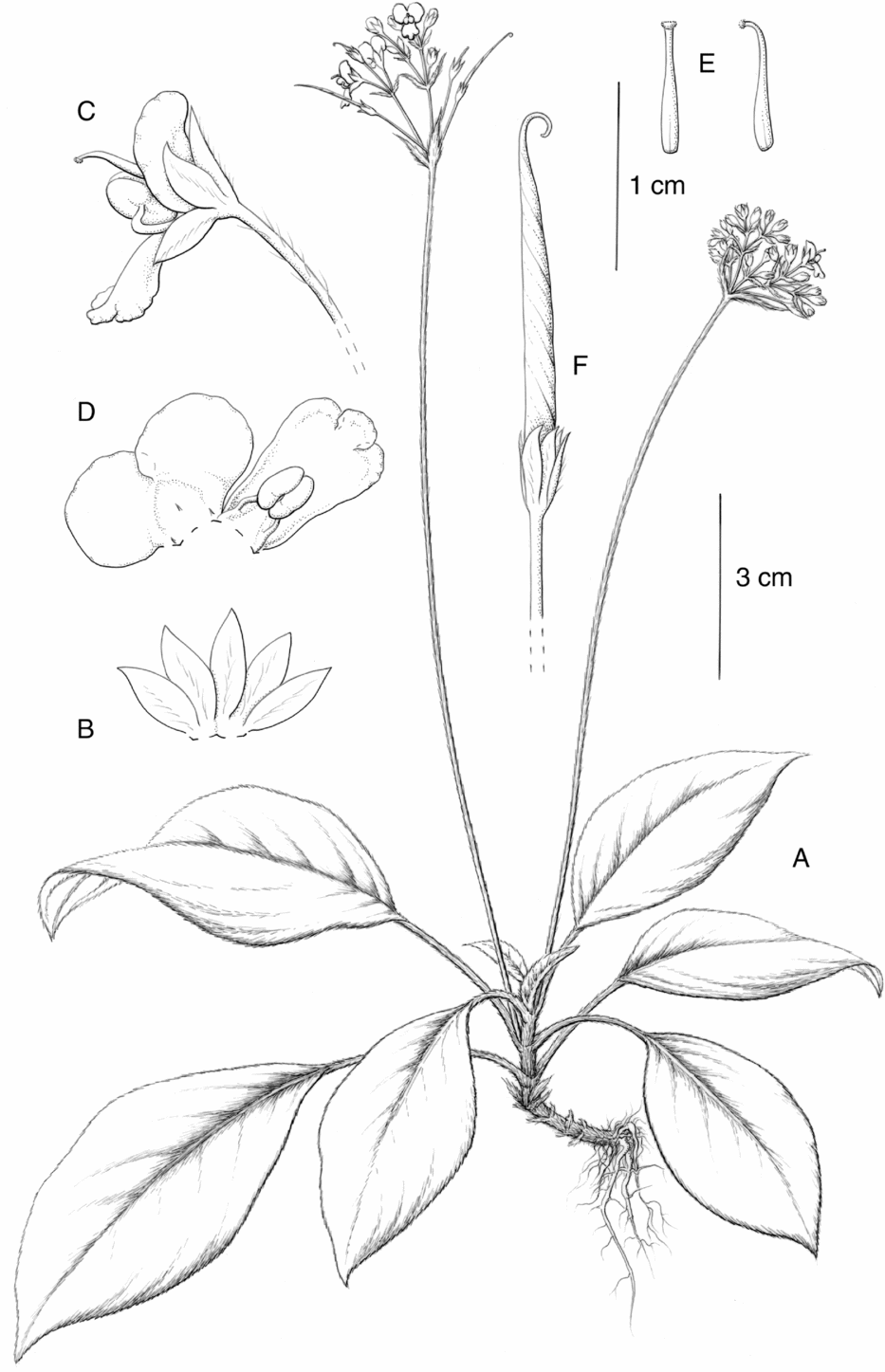
Boea lawesii H.O.Forbes. A, Habit; B, calyx opened out; C, flower from side; D, corolla dissection, E, ovary from two angles; F, fruit. Scale bars: A, 3 cm; B–F, 1 cm. Drawn from Van Royen 16054 (E) by Claire Banks.

Didymocarpus lawesii F.Muell., S. Sci. Rec. 2: 229 (1882). – Type: Papua New Guinea, Owen Stanley Range, c.1882, Rev. W.G. Lawes s.n. (lecto K, designated by Burtt (Reference Burtt1984: 416).
Boea lanuginosa K.Schum. & Lauterb., Fl. Schutzgeb. Südsee 540 (1900). – Type: Papua New Guinea, Nurufluss, felswanden, 160 m, 5 vi 1896, Lauterbach 2255 (lecto WRSL n.v., designated by Burtt (Reference Burtt1984: 416), isolecto LAE [205444]).
Rhizomatous, caulescent herb to c.60 cm tall; stem 2–17 cm long, woody, c.4 mm diameter, hirsute with an indumentum of tawny, multicellular eglandular hairs, internodes 0.5–7 cm long. Leaves opposite or in whorls of 3 or 4, petiolate; petioles 0.5–11 cm, 1–1.7 mm diameter, densely tomentose; lamina 3.5–19.5 × 1.5–10.5 cm, 1.5–3.5 times as long as wide, elliptic or lanceolate, base often unequal, acute or acuminate, rarely shortly attenuate, apex acute or acuminate, margin entire to irregular or serrulate, rarely more markedly serrate; adaxial surface medium to dull green with dense pale-coloured indumentum, abaxial surface beige, with long, abundant, sometimes lanate indumentum; 4–10 pairs of secondary veins, scarcely visible and smooth or just raised on adaxial surface, visible and associated with denser indumentum on lower surface, tertiary venation often inconspicuous. Inflorescence eglandular hirsute, as long as leaves or longer, broad, 9- to many-flowered; peduncles 1.5–33 cm long, 0.8–1.5 mm diameter; bracts 9–15 × 1–2.5 mm, narrowly lanceolate, hirsute on abaxial surface, glabrous or with hairs restricted to the tip on adaxial; pedicels 2–25 mm long. Calyx free to base, lobes 3–7 × 0.5–2.5 mm, broadly lanceolate, partially imbricate at maturity, apex narrowly acute, externally glabrous or with multicellular hairs restricted to midrib and/or margin, internally glandular. Corolla strongly bilabiate, violet, purple or blue, glabrous; tube 1–2 mm long; upper lip 8–11 mm long, lobes elliptic, 3–5 × 3–4 mm, lower lip narrow, 9–11 × 4–5 mm, lobes 1–2 × 3–4 mm, equal and elliptic. Stamens with yellow filaments attached c.1 mm above corolla base, 4–5 mm long, densely covered in glands, slightly bent; anthers pale yellow, 1–1.5 × 3–3.5 mm, divergent, dehiscing longitudinally; staminodes 3, the laterals c.1 mm long, the central extremely reduced or absent. Gynoecium 7–8 mm long; ovary 3–4 mm long, glabrous; style c.4 mm long, bent downwards, glabrous; stigma capitate. Capsule green, becoming brown when ripe, 0.9–4 cm long, c.1 mm diameter, twisted, 2-valved, dehiscing longitudinally along valves, glabrous. Seeds c.0.4 × 0.2 mm.
Distribution. Papua New Guinea.
Habitat. Exposed rock faces.
Additional specimens examined. Papua New Guinea: 1900, fl., fr., W.H. Goss s.n. (BM); 1900, fl., fr., W.H. Goss 162 (LAE, NSW); 500 m, 1896, fr., Lauterbach 2746 (WRSL); 1896, fr., Lauterbach 255 (WRSL). Western Highlands: Jimmi Valley, Tagan River Valley, 3800 ft, vi 1955, fl., fr., J.S. Womersley & A. Millar NGF 8517 (A, CANB, L, LAE, SING); Wabag Area, 4300 ft, 23 vi 1960, fr., R.G. Robbins 2709a (CANB). Central: Rouna Falls, 500 m, 4 v 1940, fl., fr., A.H. Batten Pooll 25 (LAE, NSW); Rouna Falls, 500 m, 4 v 1940, fl., fr., A.H. Batten Pooll 26 (LAE, NSW); Laloki River, Rona, 450 m, iv 1933, fl., fr., L.J. Brass 3560 (CAVA, US); Rouna, c.1600 ft, 13 iv 1935, fl., fr., C.E. Carr 11884 (BM, CANB, E, L, SING); Boridi, c.4200 ft, 19 ix 1935, fr., C.E. Carr 13202 (BM, L, SING); Boridi, c.4000 ft, 19 xi 1933, fl., fr., C.E. Carr 13408 (A, BM, CANB, E, L, SING × 2); Boridi, c.3300 ft, 12 xi 1935, fl., fr., C.E. Carr 14900 (BM, CANB, E, K, L, SING × 2); c.0.5 km W of Rouna Falls, by roadside above Laloki River, c.600 m, 21 iii 1988, fr., W.M.M. Eddie 88-001 (E); c.0.5 km W of Rouna Falls, by roadside above Laloki River, 19 iii 1988, fr., W.M.M. Eddie s.n. (E 2 sheets, L); Rouna Falls, c.2000 ft, 29 i 1963, fl., fr., P. van Royen 16065 (A, CANB, K, L, LAE); Rouna Falls, c.40 km from Port Moresby, on Sogeri Road, 30 iii 1970, fl., fr., H.F. Winters & J.J. Higgins 773 (CANB); Rouna Road, 20 miles from Port Moresby, 1000 ft, 27 i 1955, fl., fr., J.S. Womersley & N.W. Simmonds 7116 (A, CANB, K, L, LAE, SING); Sogeri Subdistrict, Vesarogo Creek, near Rouna, 1500 ft, 13 iii 1971, fr., J.S. Womersley & B.C. Stone NGF 43699 (L); Sogeri, Rouna Falls, xii 1952, fl., J.S. Womersley NGF 4733 (A, BM, CANB, L, LAE, NSW, SING); Laloke River, N of Port Moresby, 17 x 1962, fl., fr., P.J.B. Woods 112 (E 2 sheets); Owen Stanley Range, Musa mountains, near Doma Village, fr., P.J.B. Woods 204 (E 4 sheets, E cult.); Detana village, inland from Cape Rodney, 24 xi 1962, fl., fr. P.J.B. Woods 387 (E, E cult., LAE, NSW); Laloki River below Rouna Falls, c.1000 ft, 7 ix 1962, fr., T.G. Hartley 10669 (A, CANB); Coastal scarpe of Astrolabe Range, Port Moresby subdistrict, 3075 ft, 27 viii 1970, fl., P.F. Stevens LAE 50380 (E); Pt Moresby subdistrict, Rouna-Sogeri road below Rouna Gap, c.1200 ft, 29 vii 1962, fr. R. Pullen 3422 (CANB). Milne Bay: Maneau Range, N slopes of Mt Dayman, 400 m, 19 vii 1953, fr., L.J. Brass 23540 (A); Normanby Island, Lebudowa River, 40 m, 19 iv 1956, fl., fr., L.J. Brass 25500 (L); Normanby Island, Lebudowa River, 60 m, 12 v 1956, fl., fr., L.J. Brass 25858 (A, L); Goodenough Island, E slopes, 800 m, 26 x 1953, fl, fr., L.J. Brass 24993 (CANB, L, US); Esa'ala Subdistrict, NE Fergusson Island E slopes of Mt Kilkerran, 1000 m, 8 xii 1976, fr., J.R Croft et al. LAE 71077 (K, L); Bismara, 1500 ft, 10 v 1954, fl., fr., N.E.G. Cruttwell 411 (E, K); Bismara, 1500 ft, 10 v 1954, fl., fr., N.E.G. Cruttwell 411A (E); Esa'ala Subdistrict, Morima Range, near Ailuluai, 720 m, 2 xi 1976, fl., E.E. Henty NGF 49926 (L, LAE); Raba Raba Subdistrict, junction Ugat and Mayu rivers, near Mayu I., 600 m, 14 vii 1972, fl., fr., H. Streimann & P. Katik NGF 28882 (E, L); Sagarai Valley, inland from Mullins Harbour, 100 ft, 9 vi 1964, fl., fr., J.S. Womersley NGF 19278 (A, CANB, L, LAE, SING); Efogi environs, Owen Stanley Range, 10 ix 1970, fr., R. Schodde 5692 (CANB); Raba Raba subdistrict, Gwariu River, Biniguni, 200 m, 5 vii 1972, fr., H. Streimann NGF 28737 (A, CANB, L, LAE). Morobe: Wau Subdistrict, c.5 miles N of Bulolo, 14 xii 1969, fl., fr., G. Argent A 1000 (E); Bulolo, river gorge between Bulolo and Wau, 2700 ft, 5 iv 1959, fl., fr., L.J. Brass 29154 (A, CANB, K, L, US); Umi River, Markham Valley, 480 m, 20 xi 1959, fl., fr., L.J. Brass 32619 (CANB, E, US); near Wau, near junction of Edie Creek and Bulolo Roads, 31 viii 1970, fl., fr., B.G. Briggs 3846 (LAE, NSW); Wau Subdistrict, Bulolo, Inakanda Creek, 2500 ft, 30 i 1968, fl., fr., A. Kairo & J. Emos NGF 35788 (A, CANB, E, K, L, SING); Yunzaing, 4493 ft, 16 vi 1936, fr., J. Clemens & M.S. Clemens 3342 (A); above Bulung River, 3000–3500 ft, 5 i 1937, fl., J. Clemens & M.S. Clemens 4914 (A); Wantot, 3500–6000 ft, 3 i 1940, fl., fr., M.S. Clemens 10916 (US); Lae Subdistrict, Tewep-Kiakum Village, c.4500 ft, 16 ii 1960, fl., fr., A. Gillison 3 (K); Snake River, c.6 miles S of Mumeng, 2000 ft, 18 i 1962, fl., fr., T.G. Hartley 9766 (A, CANB, L); Huon Peninsula, Kua River, 3.5 miles S of Pindiu, 1200 ft, 11 iv 1964, fl., fr., R.D. Hoogland 8926 (CANB 2 sheets, E, L, US); Watut River, 1700 m, 1 xi 1977, fl., fr., A. Kairo 17 (A, CANB, CBG-CANB, L, LAE); Lae Subdistrict, Buso River, 60 m, 22 v 1974, fr., P. Katik & G. Larivita LAE 62047 (L 2 sheets); Wau Subprovince, Wau, 360 m, 13 i 1981, fl. fr., K. Kerenga & T.K. LAE 77242 (CANB, L); Mumeng (Wau Road), Snake River valley, 650 m, 16 iv 1987, fl., fr., J. Lambinon 87/380 (L); Dengalu Village, above Bulolo, below water race, 3500 ft, 15 i 1964, fl., fr., A.N. Millar NGF 23021 (CANB, E, L); near Bubia, 70–100 m, xii 2001, fr., W. Takeuchi & D. Ama 15600 (A); ridge above Bubia on track toward Taraka, c.100 m, 15 iv 2002, fl., fr., W. Takeuchi & D. Ama 16154 (A); near Bubia, 150 m, 18 v 2002, fl., fr., W. Takeuchi & D. Ama 16274 (A); Busu River drainage, around Popof, 915 m, 1 iii 1989, fl., fr., W. Takeuchi 4475 (BISH 2 sheets, E); Atzera Range, 200–400 m, 23 xi 1993, fr., W. Takeuchi 9273 (A); Umi river, c.1500 ft, 6 xii 1962, fl., fr., P. van Royen 16054 (A, CANB, E 3 sheets, K, L, LAE, NSW); Wau Gorge at Kulolo Bridge, 12 ii 1969, fl., fr., F.C. Vasek 690212–6 (CAVA); Wau Gorge near Bulolo, 22 i 1970, fr., H.F. Winters & J.J. Higgins 102 (CANB); Bulolo River Gorge, below Wau, 2800 ft, 5 iv 1959, fl., fr., J.S. Womersley NGF 11043 (CANB, L, LAE); Bulolo Gorge, c.2800 ft, vi 1960, fl., fr., J.S. Womersley & R.F. Thorne NGF 12800 (A, US); Wau-Bulolo Road, adjacent to Kulolo bridge, c.3500 ft, 3 xi, 1962, fl., fr., P.J.B. Woods 1 (A, E 2 sheets, E (cult.), LAE, NSW, US); Huon Peninsula, Rawlinson Mts, S side of Aregenang Village, 21 vi 1968, fl., fr., P.J.B. Woods & Y. Lelean 2000 (A, E, L, LAE, NSW, US). Southern Highlands: Lake Kutubu, Kui'yogabi, 800 m, 12 xi 1975, fl., B.J. Conn LAE 66434 (LAE, NSW); Nipa District, Lake Kutubu, gara, 800 m, 15 xi 1982, fl., fr., T.M. Reeve 5588 (CBG-CANB, E, K, L, LAE). Madang: S of the Ramu River, near Bembi (or Bembei) village, 19 viii 1955, fr., R.D. Hoogland 5129 (CANB, A, L).
Boea lawesii is similar in appearance to B. mollis but differs in the calyx: the lobes are longer (8–14 mm) and fully covered in hairs in B. mollis, whereas they are shorter (3–7 mm, but usually 4–5 mm), glabrous or tomentose only along the midline/margins in B. lawesii.
Forbes described Boea lawesii independently from Mueller's earlier description of Didymocarpus lawesii, although it is to be assumed that Forbes's mention of a Lawes collection is likely to be the same collection that Mueller used to describe his species. Burtt (Reference Burtt1984) lectotypified Boea lawesii with Forbes 850, which Forbes himself does not specifically mention, but does note that he has seen the plants in the field and would presumably have made a specimen. Clarke cites the Forbes collection in his separate note within the protologue (Forbes, Reference Forbes1887).
7. Boea magellanica Lam., Encycl. Méth. 1: 401 (1785); Lamarck, Tabl. Encycl. 1: 52–53, pl. 15 (1791); Willdenow Sp. Pl., ed. 4, 1(1): 109 (1797); Vahl, Enum. Pl. 1: 172 (1804); Persoon, Syn. Pl. 1: 15 (1805); Roemer & Schultes, Syst. Veg., ed. 15 bis 1: 179 (1817); Sprengel, Syst. Veg. (ed. 16) 1: 43 (1825); Dietrich, Sp. Pl., ed. 6 1: 579 (1831); G.Don, Gen. Hist. 4: 608 (1838); D.Dietrich, Syn. Pl. 1: 64 (1839); Bennett, Pl. Jav. Rar. 120 (1840). A.DC., Prodr. 9: 271 (1845); Trimen, J. Bot. 14: 92 (1876). Trimen, J. Linn. Soc., Bot. 15: 163 (1876); Clarke in A.DC. & C.DC., Monogr. Phan. 5(1): 145 (Reference Clarke, Candolle and Candolle1883); Engler, Bot. Jahrb. Syst. 7: 473 (1886); Fritsch in Engler & Prantl, Nat. Pflanzenfam. 4(3b): 150 (1895); Hallier, Gartenflora 45: 379 (1896); Hallier, Bull. Herb. Boissier 6: 284, tab. 7, fig. 2 (1898); Schlechter, Bot. Jahrb. Syst. 58: 260 (1923); Burtt, Notes Roy. Bot. Gard. Edinburgh 41: 416 (1984). – Boea praliniana J.St.-Hil., Expos. Fam. Nat. 1: 279 (1804), nom. superfl. – Boea commersonii R.Br., Cyrtandreae: 120 (1839), nom. superfl. – Type: [Papua New Guinea or Solomon Islands], Port Praslin, vii 1766 [The date reported on the specimens is not correct and the likely year is 1768 (Trimen, Reference Trimen1876)], Commerson s.n. (lecto P [P00061214], designated here; isolecto BM [BM001031560], C [C10013551], LINN, P [P03884601, P00700922], G [G00300724, 2 sheets]). Fig. 1 .
Boea warburgii Schltr., Bot. Jahrb. Syst. 58: 260 (1823). – Type: Papua New Guinea, Duke of York Islands, Mioko, x 1901, fl. fr., Schlechter 13683 (lecto BM [BM000957068], designated here; isolecto BM (not barcoded), WRSL).
Boea cardwelli F.Muell. ex C.B.Clarke in A.DC. & C.DC., Monogr. Phan. 5(1): 145 (Reference Clarke, Candolle and Candolle1883), nom. inval.
Rhizomatous, shortly caulescent, rarely distinctly caulescent, perennial herb; stem woody, 1–30 cm long, 2–8 mm diameter, hirsute with an indumentum of multicellular hairs. Leaves tightly congested at apex of stem, opposite or whorled, petiolate; petioles 1–15 cm long, 0.7–2 mm diameter, densely tomentose; lamina 2–15 × 1–6 cm, 1.7–3 times as long as wide, elliptic or obovate, base acute to attenuate, apex acute, margin entire to slightly serrulate; adaxial surface medium to dark green, with dense silvery indumentum, abaxial surface pale green-greyish, hirsute; 3–6 pairs of secondary veins, more or less visible and smooth or depressed on adaxial surface, visible and associated with a slightly denser indumentum on abaxial surface, tertiary venation occasionally visible. Inflorescence eglandular hirsute up to and including calyx, longer or shorter than leaves, few- to many-flowered; peduncles 2–23 cm long; bracts 3–13 × 0.5–1.3 mm, narrowly lanceolate, hirsute with eglandular indumentum on abaxial surface, glabrous or with glandular indumentum on adaxial; pedicels 0.3–2 cm long. Calyx almost free to base, lobes 3–10 mm long, 1–2 mm wide at base, lanceolate, apex acute, hirsute on outer side, glabrous or with glandular indumentum on inner. Corolla strongly bilabiate, violet, purple or blue, lips usually of different shades, throat yellow, glabrous; tube 1–3 mm long; upper lip 8–10 mm long, lobes 5–6 × 4–5 mm, lower lip 8–12 × 9–10 mm, lobes 1–3 × 3–4 mm, equal, round-elliptic. Stamens with filaments arising 1–2 mm above corolla base, 4–5 mm long, densely covered in minute glands, slightly bent, yellow, brighter on knee; anthers 1–2 × 4–5 mm, dehiscing longitudinally; staminodes 3, the lateral pair c.1 mm long, the central extremely reduced. Gynoecium 7–10 mm long, ovary 3–5 mm long, glabrous or with scattered sessile glands; style 4–5 mm long, more or less bent downwards, glabrous; stigma bilabiate, with one lip longer than the other, densely papillose. Capsule green, becoming greyish brown at maturity, 0.7–2 cm long, 1–2 mm diameter, twisted, 2-valved, dehiscing longitudinally along valves, glabrous. Seeds 0.3–0.5 × 0.15–0.2 mm.
Distribution. Papua New Guinea: Bismarck Archipelago. Solomon Islands.
Habitat. On limestone in coastal areas.
Additional specimens examined. Unknown country: fl., Dahl 1811 (C).
Papua New Guinea: Bismarck Archipelago: 1889, fl., fr., O. Warburg 21230 (BM, syntype of Boea warburgii). East New Britain: fr., Pourret s.n. (P); Subdistrict Pomio, Ott Island, 25 miles W–NW of Fulleborn Harbour, 140 m, 19 v 1973, fl., fr., R.S. Isles and J.R. Croft NGF 32208 (A, CANB, E, L, LAE); Duke of York Islands, Mioko, 21 ix 1899, fl., fr., Nyman 963 (UPS, syntype of Boea warburgii); Gasmata Subdistrict, Awul, sea level, 21 iii 1965, fl., fr., Sayers NGF 24111 (A, CANB, NSW, US, L, LAE, SING); Duke of York Island, 1875, fl., fr., C. Walter s.n. (BM); Gasmata Subdistrict, Cape Roebuck, West of Fullerborn Harb., sea level, 9 v 1973, fl., fr., J. Womersley NGF 41207 (E, NSW, CANB, A, L, LAE). Manus: Rambutyo Island, Peniselu Admin. Centre, 120 m, fl., fr., K. Kerenga & others LAE 77418 (E, K, A, CANB, L). Milne Bay: Cape Vogel Peninsula, Menapi, 50 m, 23 iii 1953, fl., fr., L.J. Brass 21630 (US, CANB, A, L); Misima Subdistrict, Misima Island, Narian, 0–10 m, 4 viii 1956, fl., fr., L.J. Brass 27601 (A, US, S, L); Misima Subdistrict, Misima Island, Gamugamuyuwa Tunnel, 12 m, 17 i 2009, fl., fr., R.J. Johns & R. Maru 12580 (SING); Misima Subdistrict, Hastings Island (Korailaki), 30 m, 24 x 1971, fl., fr., H. Streimann & Y. Lelean LAE 52665 (MO, CANB, E, K, L, LAE). New Ireland: Kavieng Subdistrict, Karu, sea level, 12 i 1969, fl., fr., M. Coode & P. Katik NGF 40108 (E); Kaut Harbour, sea level, 16 ii 1967, fl., fr., M. Coode & P. Katik NGF 29846 (A, CANB, E, E cult., NSW, L, LAE, SING); Wanup, near Lossuk, just inland from sea, 26 i 1967, fl., fr., M. Coode, T. Cropley and P. Katik NGF 29624 (K, CANB, E, L, LAE, SING); Namatanai, Lihir Island, Londolovit harbour, near Potzlaga, sea level, 12 xi 1984, fr., Gideon LAE 57228 (L); Mussau, small coral island 2 km off the shore, 20 i 1962, fl., fr., M. Køie & Sandermann Olsen 1191 (C, E two sheets); Mussau, small coral island off the shore, 29 i 1962, fl., fr., M. Køie & Sandermann Olsen 1359 (C); Kavieng Subdistrict, Kaut Sawmill, near the shore, 5 i 1981, fl., fr., J.M. Simaga 45 (CANB, LAE, NSW, A, L); Namatanai, Rases village, on the roadside near the beach, 7 i 1981, fl., fr., J.M. Simaga 130 (A, CANB, L).
Solomon Islands: Makira-Ulawa: Ulawa Island, near the coast, 7 x 1932, fl., fr., L.J. Brass 2981 (GH, GH, L); Ulawa, Limoli, sea level, 28 iv 1955, fr., E.S. Brown W/227 (BM). Western: NW New Georgia, Gurava, 4 ft, 4 ix 1964, fl., fr., Cowmeadow's collectors BSIP 4709 (L, SING); Mono Island, Southeast Mono, Palusua, 100 ft, 1 v 1969, fl., fr., R. Mauriasi & collectors 14169 (L, SING); South West Treasury Island [Mono Island], Kughala River Area, 25 ft, 24 iv 1969, fr., R. Mauriasi & collectors BSIP 14042 (L, SING); East Treasury Island [Mono Island], 75 ft, 5 v 1969, fl., fr., R. Mauriasi & collectors BSIP 14236 (L, SING); South East Ranongga [Island], Dae Area, beachside, 11 vi 1969, fr., R. Mauriasi & collectors BSIP 14423 (L); South East Ranongga [Island], Nona Area, 100 ft, 19 vi 1969, fl., fr., R. Mauriasi & collectors BSIP 14493 (K, L, SING); New Georgia Group, Rendova Island, West coast, near Zaimane River, 15 ix 1963, fl., fr., T.C. Whitmore BSIP 1936 (L, SING); vi 1908, fr., W.S. Campbell s.n. (NSW barcode 873823); New Georgia Group, Baga Island, 4 ii 1964, fl., fr., Whitmore's collectors BSIP 2934 (L, K, SING); Roviana Island, near New Georgia, 5 ix 1929, fr., J.H.L. Waterhouse 363 (K). Rennell and Bellona: Rennell Island, Lavanggu Area, 350 ft, 21 v 1969, fr., I. Gafui & collectors 14758 (K, L, SING); Rennell Island, Hutuna, by seashore, 28 iii 1965, fl., fr., T. Wollf 3144 (C, E). Temotu: Santa Cruz Island, SW end of Napir Bay, 10 ft, 1 vi 1956, fl., fr., Hadley 124 (BM). Malaita: Java [Ontong Java], fl., fr., Leschenault 1822 (P); Java [Ontong Java], fl., fr., D. Webb 1834 (P). Choiseul: Wagina Island, sea level, 20 iii 1964, fl., fr., Whitmore's collectors BSIP 5546 (K, L, SING).
L.J. Brass 27601a (L), Narian, Misima Island, is a variant form of Boea magellanica. Identical in habit, but described as “viscid” because of the presence of a dense indumentum of gland-tipped hairs. It could be a hybrid, perhaps with Boea rosselensis, which is also known from Misima Island, or a new variety, but material is insufficient for a diagnosis.
The first specimen of Boea magellanica was collected by Philibert Commerson in 1768, during his long trip on board La Boudeuse, under the command of Louis-Antoine de Bougainville. Commerson's material was eventually studied and published by Lamarck in 1785.
Lamarck did not know the origin of Commerson's new plant and assumed it was collected in Fuegia (Chile), as indeed was much of the material gathered during the expedition (Hooker, Reference Hooker1879). Accordingly, he gave the plant the epithet ‘magellanica’, as a reference to the Straits of Magellan. When, in 1838, Robert Brown worked on a revision of the Cyrtandreae (the name that was then applied to the Gesneriaceae of the Old World), he came across the original collection data of Commerson. Boea magellanica was reportedly collected in Port Praslin. Brown associated this locality with the island of Praslin, in the Seychelles. Because the epithet magellanica was no longer appropriate, he changed it to commersonii. Some later authors accepted this new name, now considered superfluous, seeing it better suited. Unsurprisingly, Boea commersonii has never been found again on Praslin, Seychelles (Trimen, Reference Trimen1876).
In 1875, Ferdinand von Mueller sent some specimens of Boea to Henry Trimen for identification. These collections were made by Mr C. Walter on Duke of York, a small island between New Britain and New Ireland, in the Bismarck Archipelago, north-east Papua New Guinea. Trimen soon spotted the similarity between Walter's and Commerson's collections, and surprised by the rather disjunct distribution of Boea magellanica, or commersonii, investigated further. He discovered that a remote bay on the south-west corner of the very same island, Duke of York, had been named Praslin by Bougainville's crew during their visit in 1768 (Trimen, Reference Trimen1876).
There is yet another locality called Praslin, on Santa Isabella, Solomon Islands. Both Duke of York and Santa Isabella are within the distribution area of Boea magellanica and they were both visited by La Boudeuse. Therefore, the exact origin of Commerson's material remains uncertain.
8. Boea mollis Schltr., Bot. Jahrb. Syst. 58: 261 (1923); Burtt in Notes Roy. Bot. Gard. Edinburgh 41(3): 417 (1984). – Type: Papua New Guinea, Waria, Ossi, c.400 m, 8 iii 1908, R. Schlechter 17385 (lecto P [P00061224], designated here; isolecto CAVA [UC226403]). Fig. 2 .
Rhizomatous, caulescent herb to c.70 cm tall; stem 10–40 cm long, woody, c.5 mm diameter, densely hirsute with indumentum of tawny multicellular eglandular hairs, internodes 0.5–4.2 cm long. Leaves opposite, petiolate; petioles 1–7 cm, 2–3 mm diameter, densely tomentose with occasional gland-tipped hairs mixed with eglandular hairs as on stem; lamina 3.6–18 × 0.7–9 cm, 1.7–3.2 times as long as wide, lanceolate, elliptic or rarely oblanceolate, base shortly attenuate or obtuse, sometimes unequal, apex acute or acuminate, margin entire, often irregular; adaxial surface pale green, with a dense, silky pale indumentum and sessile glands, abaxial surface beige, with indumentum of multicellular eglandular and gland-tipped hairs, more abundant along veins; 6–8 pairs of secondary veins, visible and smooth on adaxial surface, visible and slightly raised on abaxial surface; tertiary venation visible on the abaxial surface. Inflorescence densely hirsute, as long as the leaves or longer, many-flowered; peduncles 13–26 cm long, 1–2 mm diameter; bracts 10–12 × 1–1.5 mm, narrowly lanceolate, hirsute on abaxial surface, with sessile glands on adaxial; pedicels 1–2.2 mm long. Calyx with lobes forming a 0.7–0.8 mm long tube, lobes narrowly lanceolate, 8–14 × c.1.3 mm, apex narrowly acute, externally eglandular hirsute, internally glandular. Corolla strongly bilabiate, purple or blue, glabrous; tube 1–1.5 mm long; upper lip 6–8 mm long, lobes elliptic, 1–2 × 2–3 mm, lower lip 7–11 × 5–6 mm, lobes 1–1.5 × 1.5–2 mm, equal and elliptic, imbricate. Stamens with filaments arising c.2 mm above corolla base, 3–4 mm long, densely covered in glands; anthers 1–1.5 × 3–3.5 mm, dehiscing longitudinally; staminodes 3, 0.8–1 mm long. Gynoecium 7–9 mm long; ovary 2–4 mm long, glabrous; style 4–5 mm long, bent downwards, glabrous; stigma capitate. Capsule brown, 1.3–2 cm long, c.1 mm diameter, twisted, 2-valved, dehiscing longitudinally along valves, glabrous. Seeds 0.6–0.8 × 0.1–0.2 mm.
Distribution. Papua New Guinea (Morobe Province).
Habitat. Lithophyte on granite.
Additional specimens examined. Papua New Guinea: Morobe: Waria Valley, Waria River, Zare Village, 80 m, 25 vi 1999, fl., fr., R. Banka LAE 83022 (K); near Garaina, Warabum, 2000 ft, xii 1965, fl., fr., J. Buderus NGF 24014 (A, CANB, E, L, LAE); Lae Subdistrict, Buso Village, 20 ft, 10 v 1970, fr., I. Favasalu NGF 47781 (CANB, E, L, LAE); Garaina Subdistrict, Saru River, 2400 ft, 11 xii 1968, fl., fr., A. Gillison, Seruvatu & Kairo NGF 25750 (E, L, LAE); Subprovince Morobe, Mayama Village, 100 m, 17 vi 1981, fl., fr., P. Katik LAE 74941 (CANB, LAE); Wau Subdistrict, Garaina, Waria River Gorge, 2000 ft, 12 v 1971, fl., fr., B.C. Stone 10186 LAE 53486 (E, L); Lae Subdistrict, Ana Village, 24 km SW of Morobe on Mo R., 30 m, 29 i 1972, fl., fr., H. Streimann NGF 24316 (E, L); Lae Subdistrict, Lasanga Island, sea level, 6 xi 1969, fl., fr., H. Streimann NGF 44302 (A, CANB, E, L, LAE, NSW, SING); Kipu, Koneipa Village, 2800 ft, 7 i 1966, fl., fr., H. Streimann & A. Kairo NGF 26132 (CANB 2 sheets, E, L, LAE); Lae Subdistrict, Garaina, Waria River Gorge, 800 m, 23 ii 1973, fl., fr., J.S. Womersley LAE 55399 (A, CANB, L 2 sheets, LAE, NSW); cultivated at RBGE, raised from seeds received from J.S. Womersley, Lae, New Guinea. Originally collected from Waria Gorge, Garaina, Morobe District, c.1200 ft, vii 1966, fl., fr., C5935-x66-1833 (E cult.).
9. Boea morobensis C.Puglisi, sp. nov.
Herb characterised by the gland-tipped hairs on the pedicels, the fine hairs on the adaxial leaf surface, and the glandular indumentum on the ovary. Similar to Boea hians, but the hairs on the leaf surface are much finer and all eglandular (in B. hians the hairs are coarse, and both eglandular and gland-tipped hairs are present), the leaf apex is less acuminate than in B. hians, and the petioles are longer and more delicate than in B. hians. Also similar to Boea lawesii, from which it differs in having an indumentum on the ovary and gland-tipped hairs on the inflorescence, particularly on the pedicels. – Type: Papua New Guinea, Morobe District, Aseki Patrol Area, near Wengia, 3600 ft, 28 iv 1966, fl., fr., L.A. Craven & R. Schodde 1495 (holo L [L0834196]; iso A, CANB 3 sheets, K, LAE, US). Figs 3,7.
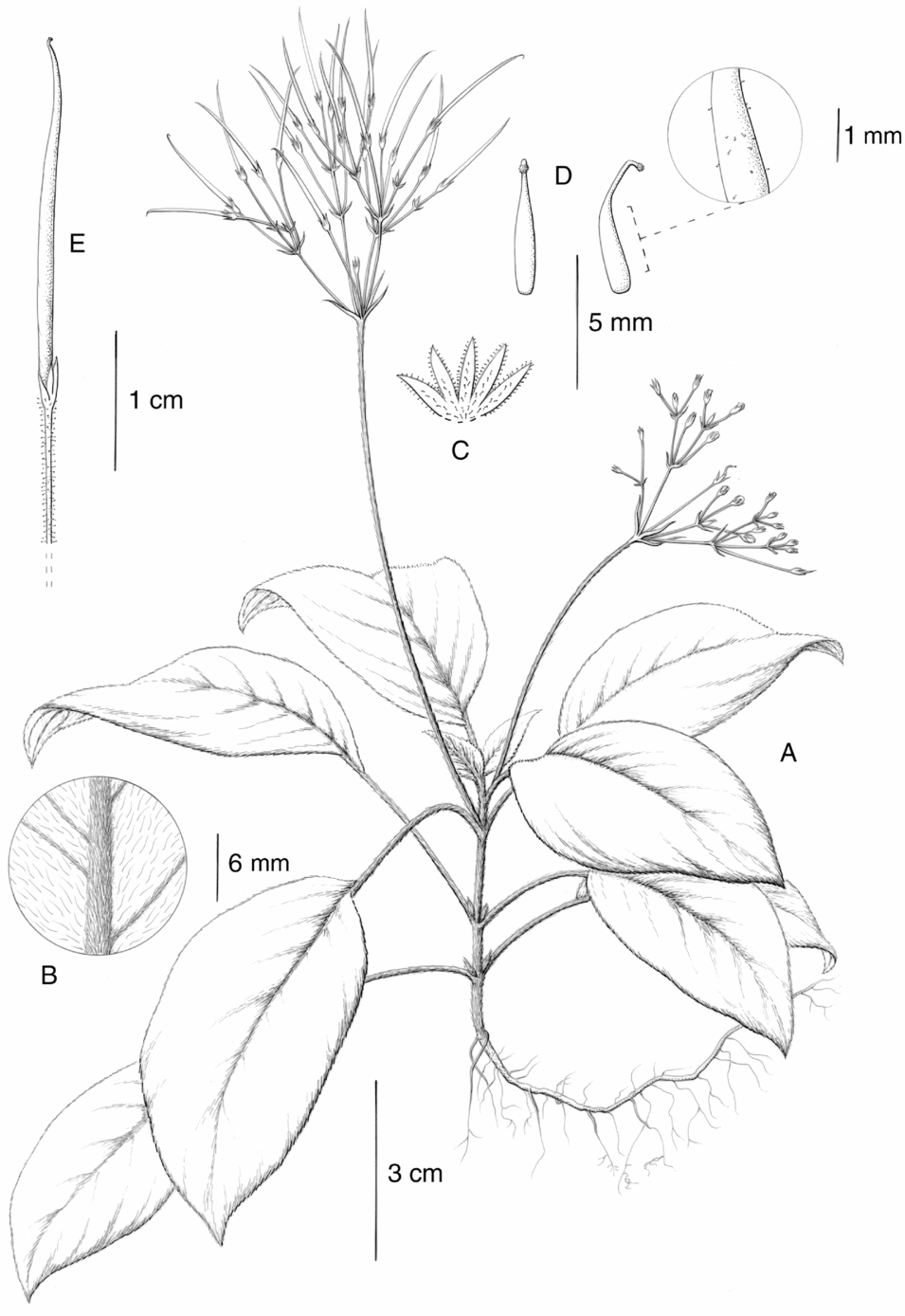
Boea morobensis C.Puglisi. A, Habit; B, details of indumentum on leaf; C, calyx opened out; D, ovary from two angles and detail of glands on ovary; E, fruit. Scale bars: A, 3 cm; B, 6 mm; C and D, 5 mm (inset, 1 mm); E, 1 cm. Drawn from Streimann & Stevens LAE 53846 (E) by Claire Banks.

Woody, caulescent herb; stem to 32 cm long, 2.5–5 mm diameter, fully covered in a layer of tawny multicellular eglandular hairs; internodes distinct, 1–5 cm long. Leaves opposite, petiolate; petioles 2–9 cm long, 1–1.5 mm diameter, with same indumentum as stem; lamina 6–14.5 × 3.4–6.5 cm, 1.5–3 times as long as wide, elliptic, base acute to somewhat rounded and unequal, apex acute to acuminate, margin entire to finely serrulate, serrulation masked by indumentum; adaxial surface silvery green, covered in thin, clear, multicellular eglandular hairs and scattered minute sessile glands, abaxial surface silvery brown with sparse multicellular hairs, much denser along veins; 6–11 pairs of secondary veins, raised and occasionally visible on adaxial surface, raised on abaxial, tertiary venation inconspicuous above, often visible on abaxial surface. Inflorescence compound, broad, longer than leaves, hirsute with an indumentum of multicellular hairs on peduncles progressively becoming glandular on pedicels, many-flowered; peduncles 10–24 cm long; bracts 9–18 × 0.5–1 mm, narrow, densely covered in multicellular eglandular hairs on abaxial surface, mixed glandular and eglandular hairs on adaxial; pedicels 5–30 mm long. Calyx with lobes fused at base, slightly bilabiate, lobes lanceolate, 2–5 mm long, 0.5–1 mm wide at base, apex acute or obtuse, with sparse gland-tipped hairs on outer side, particularly noticeable along edges and midline but not limited to these areas, less abundant glandular indumentum on inner. From flower buds, corolla deeply 2-lipped, reportedly purple; upper lobes broad and round, lower lip with lateral lobes broad and rounded, central lobe narrower and elliptic. Stamens appearing straight and glabrous; lateral staminodes 0.2–0.5 mm long, central staminode reduced or absent. Ovary with sparse glandular indumentum and perhaps a pruinose layer. Capsule glossy purple, slightly twisted, 1.5–3 cm long, c.1.5 mm diameter, glabrous or with short glandular hairs, 2-valved, secondarily splitting, 4-locular. Seeds elliptic, c.0.5 × 0.3 mm.
Distribution. Papua New Guinea (Morobe).
Habitat. Lithophyte on shady and damp sites in lower montane forest.
Additional specimen examined. Papua New Guinea: Morobe: Menyamya Subdistrict, Koki Village, 1370 m, 5 i 1972, fl., fr., H. Streimann & P. Stevens LAE 53846 (E, L, LAE).
H. Streimann & P. Stevens LAE 53846 was previously identified as Boea hians. The floral characters of Boea morobensis remain poorly known, because no mature open flowers have been observed.
10. Boea rosselensis B.L.Burtt, Notes Roy. Bot. Gard. Edinburgh 41(3): 417 (1984). – Type: Papua New Guinea, Rossel Island, Mt Rossel, south slopes, 700 m, 15 x 1956, fl. & fr., Brass 28417 (holo L [L0003327]). Fig. 5 .
Caulescent woody herb, 30–100 cm tall; stem 15–40 cm long, 3–5 mm diameter, densely covered in multicellular eglandular and gland-tipped hairs, internodes 1–8 cm long. Leaves opposite, petiolate; petioles 1–8 cm long, c.1 mm diameter, bases joining across the node, as tomentose as stem; lamina 7–17 × 3.3–7.5 cm, approximately 1.5–2.5 times as long as wide, lanceolate, base shortly attenuate to obtuse or rounded, apex acute to acuminate, margin coarsely serrate; adaxial surface pale green, with coarse multicellular eglandular and gland-tipped hairs, abaxial surface paler, hirsute with dimorphic hairs and sparse sessile glands; 6–8 pairs of secondary veins, smooth on both surfaces, tertiary venation inconspicuous. Inflorescence densely hirsute with dimorphic indumentum, shorter or just longer than leaves, 8- to 14-flowered; peduncles 8–17 cm long; bracts narrowly lanceolate, 4–9 × 0.5–1 mm, with indumentum of multicellular eglandular hairs throughout and gland-tipped hairs only towards base on abaxial surface, with glands on adaxial surface; pedicels 14–30 mm long, densely covered in gland-tipped hairs. Calyx almost free to base, lobes lanceolate, 4–6 × c.1 mm, apex obtuse and reflexed, with scattered dimorphic hairs or glabrous on outer surface, inner surface with minute sessile glands. Corolla reportedly violet to purple, glabrous; tube c.2 mm long; upper lip c.10 mm long, lobes rounded, c.5 × 5 mm, lower lip 8–11 mm long, lobes elliptic, c.4 × 3 mm. Stamens with filaments arising c.0.5 mm above the corolla base, 4–5 mm long, glabrous, slightly bent distally; anthers coherent, 2 × 4 mm, strongly divergent, dehiscing longitudinally; staminodes 3, the lateral 0.5–0.6 mm long, the central extremely reduced. Ovary c.6 mm long, glabrous; style c.4 mm long; stigma sublinguiform. Capsule purple, becoming brown at maturity, 1–2.6 cm long, 2-valved, twisted, glabrous or with sparse, small, stalked glands (not seen on the ovary), dehiscing along valves. Seeds narrowly elliptic, c.0.7 × 0.2 mm, slightly twisted.
Distribution. Papua New Guinea (Louisiade Archipelago: Rossel Island and Misima Island).
Habitat. Epiphytic (?) in hill forest.
Additional specimen examined. Papua New Guinea: Milne Bay: Misima Subprovince, Misima Island, Mt Oiatau, 10°40′S, 152°35′E, 740 m, 26 iii 1979, fr., Katik et al. LAE 70989 (CANB).
This species is distinct by the leaf serration and the coarse, dimorphic indumentum on the leaf. Whereas the type specimen has gland-tipped hairs as described above, the other specimen, Katik et al. LAE 70989, does not have them consistently.
11. Boea urvillei C.B.Clarke in A.DC. & C.DC., Monogr. Phan. 5(1): 147 (1883); Schlechter, Bot. Jahrb. Syst. 58: 263 (1923); Burtt, Notes Roy. Bot. Gard. Edinburgh 41(3): 418 (1984). – Type: Indonesia, Waigiou [Waigeo] Island, D'Urville 9188 (holo P [P00061223]). Fig. 3 .
Rosulate herb. Leaves opposite, petiolate; petioles 0.2–5 cm long, 1–2 mm diameter, densely covered in a polymorphic indumentum of whitish glandular and eglandular hairs of different lengths; lamina 3–9 × 2–5.5 cm, 1–2 times as long as wide, broadly elliptic, base acute to attenuate, sometimes unequal, apex acute to obtuse, margin irregularly crenulate to serrulate; adaxial surface reportedly yellow-green with bluish green veins, densely covered in eglandular multicellular hairs of two sorts (white, thin and c.1 mm long, and yellow, thick and 5–10 mm long), abaxial surface yellowish green, densely hirsute, with the longer yellow hairs predominant along veins and margin, and sessile glands, eglandular and gland-tipped hairs throughout surface; 5 or 6 pairs of secondary veins, slightly depressed on adaxial surface, raised on abaxial, tertiary venation inconspicuous. Inflorescence with mixed multicellular glandular and eglandular hairs on pedicels and peduncles, usually shorter than leaves, 1- to 3(–7)-flowered; peduncles 2.5–6.5 cm long; bracts narrowly lanceolate or oblanceolate, 2–3 × 0.3–1.3 mm, with mixed glandular and eglandular indumentum on both surfaces; pedicels 7–20 mm long. Calyx free to base, lobes 2–4 mm × c.0.6 mm, narrowly lanceolate, apex obtuse, with mixed indumentum on outer side and glandular indumentum on inner. Corolla weakly bilabiate, purple-blue, glabrous; tube 2 mm long; upper lip with 2 lobes c.6 × 5 mm, elliptic, lower lip not measured but with lobes at least half length of lip, 3 lobes equal, round, c.5 × 5 mm, imbricate. Stamens with filaments 4–5 mm long, glabrous at base and sparsely glandular distally, anthers coherent, c.4 × 2 mm, dehiscing longitudinally, thecae parallel; staminodes 3, the lateral c.3 mm long, the central c.1.2 mm long, all three with underdeveloped antheroids that appear purple in the exsiccatae. Ovary c.4 mm long, with indumentum at base; style c.5 mm long, glabrous; stigma capitate and densely short-papillose. Capsule light green, 2-valved, 2–2.5 cm long, slightly twisted, glabrous, dehiscing longitudinally along valves. Seeds c.0.5 × 0.2 mm, elliptic.
Distribution. Indonesia, West Papua (Waigeo Island).
Habitat. Lightly shaded limestone.
Additional specimen examined. Indonesia: Waigeo: Mt Buffelhoorn, c.10 km NE of Waifoi on E bank of Majalibit Bay, c.800 m, 17 i 1955. fl., fr., P. van Royen 5185 (CANB, E, L).
Acknowledgements
We wish to thank the curators and staff of the herbaria A, BISH, BM, C, CANB, CAVA, E, G, GH, K, L, LINN, MEL, MO, NSW, P, SING, US, WRSL and YU for providing access to the specimens. Research support was provided by BBSRC. We thank Claire Banks for the illustrations.
Appendix
List of the names published in Boea
Accepted names in bold.
Boea acutifolia Ridl., J. Linn. Soc., Bot. 32: 519 (1896) = Paraboea acutifolia (Ridl.) B.L.Burtt, Notes Roy. Bot. Gard. Edinburgh 41: 423 (1984).
Boea alata (Cav.) Pers., Syn. Pl. 1: 15 (1805) nom. inval. = Calceolaria petioalaris Cav., Icon. 5: 30–31, t. 451 (1799).
Boea amplexicaulis Parish ex C.B.Clarke, Commelyn. Cyrtandr. Bengal: t. 84 (1874) = Paraboea amplexicaulis (Parish ex C.B.Clarke) C.Puglisi, Taxon 60: 1699 (2011).
Boea arachnoidea Diels, Notes Roy. Bot. Gard. Edinburgh 5: 225 (1912) = Ornithoboea arachnoidea (Diels) Craib, Notes Roy. Bot. Gard. Edinburgh 11: 251 (1920).
Boea birmanica Craib, Bull. Misc. Inform. Kew 1913: 114 (1913) = Paraboea birmanica (Craib) C.Puglisi, Taxon 60: 1699 (2011).
Boea borneensis Scheff. ex H.O.Forbes, J. Linn. Soc., Bot. 19: 298 (1882), nom. inval. = Paraboea schefferi (H.O.Forbes) B.L.Burtt, Kew Bull. 1948: 56 (1948).
Boea brachycarpa Ridl., Bull. Misc. Inform. Kew 1929: 259 (1929) = Paraboea brachycarpa (Ridl.) B.L.Burtt, Notes Roy. Bot. Gard. Edinburgh 41: 424 (1984).
Boea brettiana W.W.Sm., Notes Roy. Bot. Gard. Edinburgh 8: 319 (1915) = Paraboea havilandii (Ridl.) B.L.Burtt, Notes Roy. Bot. Gard. Edinburgh 41: 429 (1984).
Boea caerulescens Ridl., J. Straits Branch Roy. Asiat. Soc. 44: 73 (1905) = Paraboea caerulescens (Ridl.) B.L.Burtt, Notes Roy. Bot. Gard. Edinburgh 41: 425 (1984).
Boea cardwelli F.Muell. ex C.B.Clarke in A.DC. & C.DC., Monogr. Phan. 5(1): 145 (1883) nom. inval. = Boea magellanica Lam.
Boea cavaleriei H.Lév. & Vaniot, Compt. Rend. Assoc. Franc. Avancem. Sci. 1905: 429 (1906) = Rhabdothamnopsis sinensis Hemsl., J. Linn. Soc., Bot. 35: 517 (1903).
Boea chaffanjonii H.Lév., Repert. Spec. Nov. Regni Veg. 9: 330 (1911) = Paraboea sinensis (Oliv.) B.L.Burtt, Notes Roy. Bot. Gard. Edinburgh 38: 471 (1980).
Boea clarkeana Hemsl., J. Linn. Soc., Bot. 26: 232 (1890) = Damrongia clarkeana (Hemsl.) C.Puglisi, Taxon 65: 285 (2016).
Boea cochinchinensis C.B.Clarke in A.DC. & C.DC., Monogr. Phan. 5(1): 143 (1883) = Paraboea cochinchinensis (C.B.Clarke) B.L.Burtt, Notes Roy. Bot. Gard. Edinburgh 41: 427 (1984).
Boea commersonii R.Br., Cyrtandreae 120 (1839), nom. superfl. = Boea magellanica Lam.
Boea crassifolia Hemsl., J. Linn. Soc., Bot. 26: 233 (1890) = Paraboea crassifolia (Hemsl.) B.L.Burtt, Notes Roy. Bot. Gard. Edinburgh 41: 427 (1984).
Boea darrisii H.Lév., Repert. Spec. Nov. Regni Veg. 11: 494 (1913) nom. illeg. = Ornithoboea feddei (H.Lév.) B.L.Burtt, Notes Roy. Bot. Gard. Edinburgh 22: 296 (1958).
Boea dennisii B.L.Burtt, Notes Roy. Bot. Gard. Edinburgh 41: 415 (1984).
Boea densihispidula S.B.Zhou & X.H.Guo, Acta Phytotax. Sin. 29: 477 (1991) = Damrongia clarkeana (Hemsl.) C.Puglisi, Taxon 65: 285 (2016).
Boea dictyoneura Hance, J. Bot. 21: 169 (1883) = Paraboea dictyoneura (Hance) B.L.Burtt, Notes Roy. Bot. Gard. Edinburgh 41: 427 (1984).
Boea divaricata Ridl., J. Straits Branch Roy. Asiat. Soc. 44: 75 (1905) = Paraboea divaricata (Ridl.) B.L.Burtt, Notes Roy. Bot. Gard. Edinburgh 41: 428 (1984).
Boea elegans Ridl., J. Linn. Soc., Bot. 32: 522 (1896) = Paraboea elegans (Ridl.) B.L.Burtt, Notes Roy. Bot. Gard. Edinburgh 41: 428 (1984).
Boea elephantopoides Chun, Fl. Hainan. 3: 588 (1974) = Dorcoceras philippense (C.B.Clarke) Schltr., Bot. Jahrb. Syst. 58: 259 (1923).
Boea esquirolii H.Lév. & Vaniot, Bull. Soc. Bot. France 53: 551 (1906) = Rhabdothamnopsis sinensis Hemsl., J. Linn. Soc., Bot. 35: 517 (1903).
Boea evrardii Pellegr., Fl. Indo-Chine 4: 550 (1930) = Middletonia evrardii (Pellegr.) C.Puglisi, Taxon 65: 286 (2016).
Boea feddei H.Lév., Repert. Spec. Nov. Regni Veg. 9: 449 (1911) = Ornithoboea feddei (H.Lév.) B.L.Burtt, Notes Roy. Bot. Gard. Edinburgh 22: 296 (1958).
Boea ferruginea Ridl., J. Linn. Soc., Bot. 32: 521 (1896) = Paraboea ferruginea (Ridl.) Ridl., J. Straits Branch Roy. Asiat. Soc. 44: 68 (1905).
Boea flocculosa C.B.Clarke, Commelyn. Cyrtandr. Bengal. 116, t. 83 (1874) = Middletonia multiflora (R.Br.) C.Puglisi, Taxon 65: 287 (2016).
Boea geoffrayi Pellegr., Bull. Soc. Bot. France 73: 425 (1926) = Dorcoceras geoffrayi (Pellegr.) C.Puglisi, Taxon 65: 286 (2016).
Boea glabra Ridl., J. Linn. Soc., Bot. 32: 521 (1896) = Paraboea glabra (Ridl.) B.L.Burtt, Notes Roy. Bot. Gard. Edinburgh 22: 311 (1958).
Boea glabriflora Barnett, Nat. Hist. Bull. Siam Soc. 20: 19 (1961) = Paraboea glabriflora (Barnett) B.L.Burtt, Notes Roy. Bot. Gard. Edinburgh 41: 429 (1984).
Boea glabrisepala (B.L.Burtt) Barnett, Kew Bull. 15: 255 (1961) = Paraboea glabrisepala B.L.Burtt, Kew Bull. 1941: 21 (1941).
Boea glutinosa Hand.-Mazz., Sinensia 7: 620 (1936) = Paraboea glutinosa (Hand.-Mazz.) K.Y.Pan, Novon 7: 431 (1997).
Boea hainanensis Chun, Fl. Hainan. 3: 588 (1974) = Paraboea hainanensis (Chun) B.L.Burtt, Notes Roy. Bot. Gard. Edinburgh 41: 429 (1984).
Boea hancei C.B.Clarke in A.DC. & C.DC., Monogr. Phan. 5(1): 144 (1883) = Paraboea dictyoneura (Hance) B.L.Burtt, Notes Roy. Bot. Gard. Edinburgh 41: 427 (1984).
Boea harroviana Craib, Bull. Misc. Inform. Kew 1926: 172 (1926) = Paraboea harroviana (Craib) Z.R.Xu, Edinburgh J Bot. 65: 240 (2008).
Boea havilandii Ridl., J. Straits Branch Roy. Asiat. Soc. 44: 73 (1905) = Paraboea havilandii (Ridl.) B.L.Burtt, Notes Roy. Bot. Gard. Edinburgh 41: 429 1984).
Boea hemsleyana B.L.Burtt, Notes Roy. Bot. Gard. Edinburgh 22: 306 (1958).
Boea herbacea C.B.Clarke in A.DC. & C.DC., Monogr. Phan. 5(1): 142 (1883) = Kaisupeea herbacea (C.B.Clarke) B.L.Burtt, Nord. J. Bot. 21: 117 (2001).
Boea hians Burkill, Bull. Misc. Inform. Kew 1901: 142 (1901).
Boea hygrometrica (Bunge) R.Br., Cyrtandreae 120 (1839) = Dorcoceras hygrometricum Bunge, Enum. Pl. Chin. Bor.: 54 (1833).
Boea hygroscopica F.Muell., Fragm. 4: 146 (1864).
Boea hygroscopica var. bellendenkerensis Domin, Biblioth. Bot. 89(4): 1154 (1928) = Boea hygroscopica F.Muell.
Boea hygroscopica var. typica Domin, Biblioth. Bot. 89(4): 1154 (1928) = Boea hygroscopica F.Muell.
Boea kerrii Craib, Bull. Misc. Inform. Kew 1916: 267 (1916) = Paraboea swinhoei (Hance) B.L.Burtt, Notes Roy. Bot. Gard. Edinburgh 41: 439 (1984).
Boea kinnearii (F.Muell.) B.L.Burtt, Notes Roy. Bot. Gard. Edinburgh, 41: 418 (1984).
Boea lanata Hemsl., Bull. Misc. Inform. Kew 1908: 180 (1908), nom. illeg. = Boea hemsleyana B.L.Burtt.
Boea lanata Ridl., J. Linn. Soc., Bot. 32: 520 (1896) = Paraboea lanata (Ridl.) B.L.Burtt, Notes Roy. Bot. Gard. Edinburgh 41: 431 (1984).
Boea lancifolia Ridl., Fl. Malay Penins. 2: 536 (1923) = Paraboea lancifolia (Ridl.) B.L.Burtt, Notes Roy. Bot. Gard. Edinburgh 41: 431 (1984).
Boea lanuginosa K.Schum. & Lauterb., Fl. Schutzgeb. Südsee (Lauterbach): 540 (1901) = Boea lawesii H.O.Forbes.
Boea lawesii H.O.Forbes, J. Bot. 25: 348 (1887).
Boea leporina H.J.Lam, Blumea 5: 580 (1965) = Paraboea leporina (H.J.Lam) B.L.Burtt, Notes Roy. Bot. Gard. Edinburgh 41: 431 (1984).
Boea macrophylla Drake, Bull. Soc. Philom. Paris, sér. 8, 2: 130 (1890) = Paraboea sinensis (Oliv.) B.L.Burtt, Notes Roy. Bot. Gard. Edinburgh 38: 471 (1980).
Boea magellanica Lam., Encycl. Méth. 1: 401 (1785).
Boea mairei H.Lév., Repert. Spec. Nov. Regni Veg. 12: 286 (1913) = Damrongia clarkeana (Hemsl.) C.Puglisi, Taxon 65: 285 (2016).
Boea martinii H.Lév., Fl. Kouy-Tchéou: 180, 181 (1914. = Paraboea martinii (H.Lév.) B.L.Burtt, Notes Roy. Bot. Gard. Edinburgh 38: 470 (1980).
Boea microcarpa Drake, Bull. Soc. Philom. Paris sér. 8, 2: 130 (1890) = Middletonia multiflora (R.Br.) C.Puglisi, Taxon 65: 287 (2016).
Boea minahassae Teijsm. & Binn., Natuurk. Tijdschr. Ned.-Indië 25: 415 (1863) = Paraboea minahassae (Teijsm. & Binn.) B.L.Burtt, Kew Bull. 1948: 56 (1948).
Boea minor Barnett, Nat. Hist. Bull. Siam Soc. 20: 19 (1961) = Paraboea minor (Barnett) B.L.Burtt, Notes Roy. Bot. Gard. Edinburgh 41: 433 (1984).
Boea minutiflora Ridl., J. Fed. Malay States Mus. 10: 148 (1920) = Senyumia minutiflora (Ridl.) Kiew, A. Weber & B.L. Burtt, Beitr. Biol. Pflanzen 7(2-3): 400 (1998).
Boea mollis Schltr., Bot. Jahrb. Syst. 58: 261 (1923).
Boea morobensis C.Puglisi, published above.
Boea multiflora R.Br., Cyrtandreae 120 (1839) = Middletonia multiflora (R.Br.) C.Puglisi, Taxon 65: 287 (2016).
Boea multiflora var. burmannica C.B.Clarke in A.DC. & C.DC., Monogr. Phan. 5(1): 144 (1883) = Middletonia multiflora (R.Br.) C.Puglisi, Taxon 65: 287 (2016).
Boea multiflora var. villosa Pellegr., Bull. Soc. Bot. France 73: 424 (1926) = Middletonia evrardii (Pellegr.) C.Puglisi, Taxon 65: 287 (2016).
Boea paniculata Hand.-Mazz., Anz. Akad. Wiss. Wien, Math.-Naturwiss. Kl. 62: 66 (1925 nom. illeg. = Paraboea birmanica (Craib) C.Puglisi, Taxon 61: 1699 (2011).
Boea paniculata Ridl., J. Linn. Soc., Bot. 32: 519 (1896) = Paraboea paniculata (Ridl.) B.L.Burtt, Notes Roy. Bot. Gard. Edinburgh 41: 434 (1984).
Boea parviflora Ridl., J. Straits Branch Roy. Asiat. Soc. 44: 76 (1905) = Paraboea parviflora (Ridl.) B.L.Burtt, Notes Roy. Bot. Gard. Edinburgh 41: 435 (1984).
Boea patens Ridl., J. Linn. Soc., Bot. 32: 520 (1896) = Paraboea patens (Ridl.) B.L.Burtt, Notes Roy. Bot. Gard. Edinburgh 41: 435 (1984).
Boea philippensis C.B.Clarke in A.DC. & C.DC., Monogr. Phan. 5(1): 146 (1883) = Dorcoceras philippense (C.B.Clarke) Schltr., Bot. Jahrb. Syst. 58: 259 (1923).
Boea plantaginea (Cav.) Pers., Syn. Pl. 1: 15 (1805) = Calceolaria biflora Lam., Encycl. Méth. 1(2): 556 (1785).
Boea poilanei Pellegr., Bull. Soc. Bot. France 73: 424 (1926) = Dorcoceras philippense (C.B.Clarke) Schltr., Bot. Jahrb. Syst. 58: 259 (1923).
Boea praliniana J.St.-Hil., Expos. Fam. Nat. 1: 279 (1804) = Boea magellanica Lam.
Boea primuloides Miq., Ann. Mus. Bot. Lugduno-Batavi 3: 190 (1867) = Oreocharis primuloides (Miq.) Benth. & Hook.f. ex C.B.Clarke in A.DC. & C.DC., Monogr. Phan. 5(1): 63 (1883).
Boea prolixa C.B.Clarke in A.DC. & C.DC., Monogr. Phan. 5(1): 143 (1883) = Paraboea prolixa (C.B.Clarke) B.L.Burtt, Notes Roy. Bot. Gard. Edinburgh 41: 435 (1984).
Boea pseudoglandulosa Elmer, Leafl. Philipp. Bot. 9: 3120 (1925), nom. nud., et Leafl. Philipp. Bot. 10: 3807 (1939) nom. inval. = Dorcoceras philippense (C.B.Clarke) Schltr., Bot. Jahrb. Syst. 58: 259 (1923).
Boea punctata (Cav.) Pers., Syn. Pl. 1: 15 (1805) = Jovellana punctata Ruiz & Pav., Fl. Peruv. 1: 13, t. 18 (1798).
Boea reticulata Barnett, Nat. Hist. Bull. Siam Soc. 20: 20 (1961) = Middletonia reticulata (R.Br.) C.Puglisi, Thai Forest Bulletin, in press.
Boea rosselensis B.L.Burtt, Notes Roy. Bot. Gard. Edinburgh 41(3): 417 (1984).
Boea rubicunda H.Lév., Bull. Acad. Int. Geogr. Bot. 25: 24 (1915) = Rhabdothamnopsis sinensis Hemsl., J. Linn. Soc., Bot. 35: 517 (1903).
Boea rufescens Franch., Bull. Mens. Soc. Linn. Paris 1(57): 449 (1885) = Paraboea rufescens (Franch.) B.L.Burtt, Notes Roy. Bot. Gard. Edinburgh 38: 471 (1980).
Boea rufescens var. seguinii (H.Lév. & Vaniot) H.Lév., Fl. Kouy-Tchéou 181 (1914) = Paraboea rufescens (Franch.) B.L.Burtt, Notes Roy. Bot. Gard. Edinburgh 38: 471 (1980).
Boea speciosa Rech., Oesterr. Bot. Z. 49: 145 (1899) = Paraboea speciosa (Rech.) B.L.Burtt, Notes Roy. Bot. Gard. Edinburgh 41: 438 (1984).
Boea speluncarum B.L.Burtt, Notes Roy. Bot. Gard. Edinburgh 31: 36 (1971) = Paraboea speluncarum (B.L.Burtt) B.L.Burtt, Notes Roy. Bot. Gard. Edinburgh 41: 438 (1984).
Boea suffruticosa Ridl., J. Linn. Soc., Bot. 32: 518 (1896) = Paraboea suffruticosa (Ridl.) B.L.Burtt, Notes Roy. Bot. Gard. Edinburgh 41: 439 (1984).
Boea swinhoei Hance, Ann. Sci. Nat. ser. 5, 5: 231 (1966) = Paraboea swinhoei (Hance) B.L.Burtt, Notes Roy. Bot. Gard. Edinburgh 41: 439 (1984).
Boea swinhoei var. diffusior C.B.Clarke in A.DC. & C.DC., Monogr. Phan. 5(1): 142 (1883) = Paraboea swinhoei (Hance) B.L.Burtt, Notes Roy. Bot. Gard. Edinburgh 41: 439 (1984).
Boea thirionii H.Lév., Repert. Spec. Nov. Regni Veg. 11: 301 (1912) = Middletonia multiflora (R.Br.) C.Puglisi, Taxon 65: 287 (2016).
Boea thorelii Pellegr., Bull. Soc. Bot. France 73: 424 (1926) = Paraboea thorelii (Pellegr.) B.L.Burtt, Notes Roy. Bot. Gard. Edinburgh 41: 439 (1984).
Boea treubii H.O.Forbes, J. Linn. Soc., Bot. 19: 297 (1882) = Paraboea treubii (H.O.Forbes) B.L.Burtt, Bot. J. Linn. Soc. 85: 25 (1982).
Boea triandra (Cav.) Pers., Syn. Pl. 1: 15 (1805) = Stemotria triandra (Cav.) Govaerts, World Checkl. Seed Pl. 3: 21 (1999).
Boea umbellata Drake, Bull. Soc. Philom. Paris, ser. 8, 2: 129 (1890) = Paraboea umbellata (Drake) B.L.Burtt, Notes Roy. Bot. Gard. Edinburgh 41: 440 (1984).
Boea urvillei C.B.Clarke in A.DC. & C.DC., Monogr. Phan. 5(1): 147 (1883).
Boea verticillata Ridl., J. Linn. Soc., Bot. 32: 519 (1896) = Paraboea verticillata (Ridl.) B.L.Burtt, Bot. J. Linn. Soc. 85: 25 (1982).
Boea violacea (Cav.) Pers., Syn. Pl. 1: 15 (1805) = Jovellana violacea (Cav.) G.Don., Gen. Hist. 4: 608 (1838).
Boea wallichii R.Br., Cyrtandreae 120 (1839) = Dorcoceras wallichii (R.Br.) C.Puglisi.
Boea warburgii Schltr., Bot. Jahrb. Syst. 58: 260 (1923) = Boea magellanica Lam.