


Introduction
Artificial intelligence (AI) has demonstrated rapid progress in diagnostic prediction, ambient documentation, clinical decision support, and research applications [Reference Singla, Afridi and Vayolipoyil1–Reference Ștefan, Niculescu and Bolocan4]. Publications and pilot implementations have proliferated across academic medical centers (AMCs), yet durable integration into routine clinical workflows remains uncommon, with only a few examples approaching broader use, such as ambient documentation tools and inpatient deterioration detection systems [Reference Watson, Hutyra and Clancy5–Reference Poon, Lemak, Rojas, Guptill and Classen8]. Although technical performance, regulatory oversight, and ethical considerations are frequently cited as barriers, many AI systems that demonstrate analytic validity fail to transition beyond pilot phases [Reference Kelly, Karthikesalingam, Suleyman, Corrado and King9–Reference Parikh, Obermeyer and Navathe11]. This persistent pilot-to-practice gap suggests that translational challenges extend beyond pre-deployment model performance.
Clinical AI translation occurs within complex care environments and requires coordination among clinicians, health system leaders, academic medicine, industry partners, and supporting data and infrastructure ecosystems [Reference Leiner, Bennink, Mol, Kuijf and Veldhuis12–Reference Zhang, Budhdeo and William14]. These stakeholders operate under distinct economic incentives, governance structures, risk exposures, and operational constraints. Industry partners prioritize scalability and return on investment, while hospitals function within constrained reimbursement environments and assume responsibility for clinical integration, safety oversight, and long-term sustainability [Reference Hogg and Al-Zubaidy15–Reference Stroud, Anzabi and Wise19]. Misalignment across these dimensions can impede implementation even when AI tools are technically sound [Reference Wells, Nguyen and McWilliams20].
Clinical AI translation differs from many health system innovations because it unfolds across distinct legal, economic, and operational entities. Established implementation science frameworks, including CFIR (Consolidated Framework for Implementation Research) [Reference Damschroder, Aron, Keith, Kirsh, Alexander and Lowery21,Reference Schmitt, Hawkins and Florsheim22] and RE-AIM (Reach, Effectiveness, Adoption, Implementation, Maintenance) [Reference King, Shoup and Raebel23,Reference Glasgow, Vogt and Boles24], emphasize intra-organizational determinants such as workflow integration and leadership engagement. While essential, these frameworks primarily emphasize implementation within healthcare organizations and do not make multidomain inter-organizational structural alignment their central organizing construct. As a result, successful translation may depend not only on institutional readiness but on cross-sector compatibility in economic incentives, governance responsibilities, legal accountability, and technical infrastructure.
In this context, clinical AI translation represents a form of T2–T3 translational science in which interventions are developed, deployed, and sustained across organizational boundaries rather than within a single institution [Reference Bernstam, Shireman and Meric-Bernstam25]. Durable integration depends not only on local implementation capacity but on alignment across sectors. We conceptualize this as multidomain alignment, an inter-organizational construct that conditions the success of clinical AI integration.
To examine these dynamics, the Principles for AI Translation in Healthcare (PATH) Working Group within the Clinical and Translational Science Awards (CTSA) Consortium convened a multi-sector panel including industry leaders, infrastructure partners, and academic health system leadership. The discussion identified recurring tensions across five domains: economic sustainability, risk and liability, data governance, infrastructure readiness, and post-deployment monitoring, reflecting systemic misalignment between industry and AMCs.
In this Special Communication, we present a thematic synthesis of this dialogue and propose an Industry–Academic Alignment Conceptual Model for clinical AI translation (Figure 1), defined as the cross-organizational development, deployment, governance, and sustainment of AI systems. The model conceptualizes alignment across five interdependent domains as a condition for translation and is intended as a theory-generating framework to guide future empirical work. Misalignment across these domains may represent an under-recognized barrier to sustainable AI integration within academic health systems.
Industry–Academic alignment conceptual model for clinical AI translation. clinical AI translation occurs at the interface between industry systems and academic health centers. Structural alignment across five domains – economic, risk and liability, data governance and intellectual property, infrastructure and workflow, and lifecycle monitoring and sustainability – may be necessary to bridge the pilot-to-practice gap. Health equity functions as a cross-cutting consideration across all five domains, while institutional resource context (including variation across rural, community, and safety-net settings) influences how alignment is achieved across different healthcare environments.

Figure 1. Long description
A conceptual model illustrating the alignment between industry systems and academic health centers for clinical AI translation. The model is divided into several sections. At the top, the industry system includes business model and investor incentives, data aggregation strategy, product deployment assumptions, and monitoring architecture. Below this, the alignment interface for clinical AI translation is highlighted, with health equity as a cross-cutting consideration. The institutional resource context, which includes variations across rural, community, and safety-net settings, is depicted as influencing how alignment is achieved. Five domains of alignment are shown: economic alignment, risk and liability alignment, data governance and intellectual property alignment, infrastructure and workflow alignment, and lifecycle monitoring and sustainability alignment. These domains are necessary to bridge the pilot-to-practice gap. At the bottom, the academic health center system includes reimbursement constraints, clinical and regulatory liability, data stewardship and privacy obligations, and IT infrastructure and patient safety oversight.
Methods
Panel context and deliberative structure
The PATH Working Group within the CTSA Consortium convened a national panel on February 11, 2026, titled “From Pilots to Practice: Industry–Academic Partnerships for Scalable AI Implementation.” The session was designed to inform PATH’s translational guidance and white paper on AI implementation across academic health systems.
The panel included three cross-sector leaders representing AI venture development, cloud infrastructure, and federated data networks that partner with academic medical centers. Approximately 70 participants from multiple CTSA hubs attended, including translational investigators, informatics leaders, and health system administrators.
The discussion followed a semi-structured moderator guide developed by PATH co-chairs, focusing on cross-sector friction, sustainability beyond pilot deployment, infrastructure and workflow barriers, partnership design, and actionable recommendations. The session was recorded and transcribed for analysis.
Thematic synthesis and model development
We conducted an exploratory thematic synthesis of the complete verbatim panel transcript to identify recurrent structural tensions shaping AI translation between industry partners and academic health centers. The objective was to develop a theory-generating conceptual framework describing areas in which structural alignment across sectors may influence the transition of clinical AI from pilot implementation to sustained clinical use.
AZ reviewed the complete transcript and organized panelist comments by topic. Preliminary thematic categories were developed iteratively from recurrent discussions of structural tensions between industry and academic health centers rather than from a predefined coding framework. AZ and MA then reviewed and refined these categories through discussion, consolidating related concepts and clarifying distinctions among the emerging domains. Differences in the interpretation or grouping of candidate categories were resolved through discussion between AZ and MA. The preliminary framework was subsequently reviewed by the other panel participants, and agreement was reached on five interrelated domains: economic sustainability, risk and liability, data governance, infrastructure and integration, and lifecycle monitoring.
The five-domain framework was subsequently presented to the broader PATH Working Group on March 11, 2026, for further discussion and refinement. Working Group members considered the applicability of the framework across different AI use cases and institutional contexts. These discussions identified health equity as a cross-cutting consideration that should inform the application of all five domains. Institutional resource context – including variation across rural, community, and safety-net settings – was recognized as a contextual factor shaping the financial, technical, workforce, governance, and monitoring capacity available to achieve alignment. These considerations were not treated as additional alignment domains. Following the meeting, the draft manuscript and conceptual framework were circulated to the broader PATH Working Group for approximately one month for additional review and comment. Feedback received during this period was incorporated into subsequent revisions of the framework and manuscript.
Results
Thematic synthesis of translational frictions
Overview
The exploratory thematic synthesis of the multi-sector PATH panel identified recurring structural tensions that may impede the translation of AI tools from pilot environments to sustained clinical integration within academic health centers. These tensions reflected cross-sector misalignments in incentives, risk allocation, governance expectations, infrastructure readiness, and lifecycle accountability. Five interrelated domains of translational friction emerged.
Domain 1: Economic alignment
A central tension exists between AI innovation and financial sustainability. Industry stakeholders prioritize scalability and growth, whereas academic health centers operate within constrained margins and reimbursement models that do not consistently reward efficiency gains. AI deployment introduces subscription costs, infrastructure investment, and workflow redesign, often with uncertain or indirect financial return. Variable compute costs and pilot-stage subsidies further obscure long-term sustainability. In fee-for-service environments, efficiency gains may paradoxically reduce revenue, whereas value-based care models may better align incentives for AI-enabled optimization. In addition, compute costs are often decoupled from licensing fees and vary with usage, introducing uncertainty into long-term financial planning. Without explicit alignment between business models and health system economics, technically validated AI tools may fail to progress beyond pilot deployment.
Domain 2: Risk and liability alignment
Liability and accountability emerged as central concerns. Vendors retain control over model development and updates, while health systems and clinicians bear responsibility for clinical outcomes. This asymmetry creates divergent risk tolerance, with institutions requiring higher levels of assurance before deployment. Academic health centers assume malpractice exposure, regulatory accountability, and reputational risk, yet lack direct control over model design, updates, and performance characteristics, reinforcing conservative adoption thresholds. Unlike regulated domains such as medical devices, where accountability frameworks are more clearly defined, clinical AI lacks consistent mechanisms to define responsibility among stakeholders. Unclear contractual delineation of responsibility for adverse events, model drift, and unintended consequences further slows adoption.
Domain 3: Data governance and intellectual property alignment
Data access and ownership remain persistent sources of friction. Industry relies on large, diverse datasets for model development, while academic health centers prioritize patient privacy and institutional stewardship. These differences create tension around data sharing, model training rights, and intellectual property. Federated approaches may enable cross-site validation while preserving local data control, but investor expectations for data exclusivity can limit adoption. As a result, translation is constrained not only by data availability but by misalignment in governance expectations and perceived value of data.
Domain 4: Infrastructure and workflow alignment
Operational infrastructure emerged as a critical determinant of translational success. Many academic health centers lack mature cloud environments, scalable data pipelines, and integration capacity required for modern AI systems, while vendors often assume these capabilities. This mismatch necessitates local re-engineering and can delay deployment. In practice, these gaps include limited access to GPU-enabled compute, batch-oriented data pipelines that restrict timely data availability, and constraints within electronic health record systems that limit integration of AI outputs into clinical workflows.
Beyond technical capacity, successful deployment requires workflow redesign, clinician engagement, and organizational adaptation. Tools that increase cognitive burden or fail to align with clinical decision-making processes are unlikely to achieve sustained use. These barriers reflect mismatches between vendor deployment assumptions and institutional capacity rather than limitations in model performance.
Domain 5: Lifecycle monitoring and sustainability alignment
The absence of scalable post-deployment monitoring emerged as a barrier to sustained integration. AI models are subject to performance drift due to evolving clinical environments and feedback effects introduced by deployment. In addition, deployment may alter clinician behavior and decision patterns, creating feedback loops that further influence model performance over time and introduce endogenous sources of drift. Responsibility for monitoring is often fragmented, with vendors controlling model updates and institutions responsible for safe use over time. Monitoring also introduces ongoing operational and economic burdens that are not typically addressed in initial deployment agreements. Without coordinated approaches to monitoring, institutions may lack the capacity to ensure safety and maintain trust over time.
Summary of thematic findings
Across domains, translational failure reflects misalignment between industry incentives and academic health center responsibilities. These domains interact in reinforcing ways, such that misalignment in one area can amplify friction in others. For example, a tool may demonstrate strong analytic performance yet fail to scale if long-term costs exceed sustainable margins or if institutions lack access to performance telemetry required for ongoing monitoring. Barriers to translation arise not solely from model limitations but from incomplete structural alignment across sectors.
An industry–academic alignment conceptual model for Clinical AI translation
Clinical AI translation depends on alignment across five domains: economic, risk and liability, data governance, infrastructure, and lifecycle monitoring. Each domain represents a distinct dimension of cross-sector compatibility, including incentives, governance obligations, operational capacity, and accountability. Misalignment across these dimensions generates friction that impedes sustained integration despite technical validity. Together, these domains define the structural conditions under which AI systems transition from pilot implementation to routine clinical use. This framing conceptualizes clinical AI translation as a T2–T3 translational process occurring across organizational boundaries, where alignment across sectors may represent an important condition for sustained integration rather than a secondary implementation consideration.
The five domains identify the principal areas in which structural compatibility is required between industry and academic health centers. Their application is necessarily use-case and context dependent. Health equity functions as a cross-cutting consideration that should inform how each domain is evaluated and operationalized. Institutional resource context – including variation across rural, community, and safety-net settings – shapes the capacity and mechanisms through which alignment may be achieved across different healthcare environments. For example, economic arrangements may limit access for lower-resource institutions, infrastructure requirements may be infeasible in some settings, and lifecycle monitoring capacity may vary substantially across organizations. Fairness remains an important evaluative consideration within relevant domains, particularly data governance, risk and liability, and lifecycle monitoring, but is not treated as a separate alignment domain or cross-cutting construct.
Economic alignment
Sustained adoption requires alignment between vendor business models and the financial realities of academic health centers. AI tools must demonstrate not only analytic validity but a viable economic pathway within constrained reimbursement environments. Transparent cost models, shared financial risk arrangements, and alignment with value-based care incentives may be necessary to prevent AI from becoming an additional operational burden.
Risk and liability alignment
Clear delineation of accountability across vendors, clinicians, and institutions is essential. Although health systems retain primary clinical and regulatory responsibility, they often lack control over model design and performance. Alignment requires explicit frameworks for shared responsibility, including contractual delineation of liability, transparent performance reporting, and governance structures for monitoring and responding to model behavior over time.
Data governance and intellectual property alignment
Data-sharing and model development must balance institutional stewardship with collaborative innovation. This domain requires clarity regarding data use, model ownership, reciprocal benefit, and privacy protection. Variation in institutional capacity and reliance on externally developed models further introduces challenges related to generalizability and transparency. Federated evaluation approaches may enable cross-site validation while preserving local data control but require supporting economic and contractual frameworks.
Infrastructure and workflow alignment
Achieving alignment in this domain requires matching vendor deployment assumptions with institutional technical readiness, including cloud infrastructure, data architecture, and integration capacity. Successful implementation also depends on workflow redesign, clinician engagement, and ensuring that AI outputs are interpretable and actionable within routine care.
Lifecycle monitoring and sustainability alignment
Alignment requires clear responsibility for post-deployment monitoring across stakeholders. Scalable approaches, including shared or federated frameworks, are needed to support continuous performance evaluation and drift detection. Sustainable integration further depends on access to model data and coordinated processes for responding to model updates, degradation, and unintended consequences over time.
Interdependence of alignment domains
These domains are interdependent. Economic alignment influences infrastructure investment and monitoring capacity; infrastructure enables lifecycle monitoring; and data governance shapes both infrastructure design and risk allocation. Clarity in liability frameworks also affects data sharing and institutional willingness to deploy AI. Addressing a single domain in isolation is insufficient. Sustainable AI translation requires coordinated cross-domain alignment.
Implications for the CTSA network and translational infrastructure
The Industry–Academic Alignment Conceptual Model suggests that the pilot-to-practice gap in clinical AI reflects insufficient cross-sector alignment across economic, governance, infrastructure, and lifecycle domains. Addressing this gap requires capabilities that extend beyond model evaluation or regulatory clarification to support coordination among stakeholders operating under different incentives and constraints.
The CTSA network is well-positioned to contribute to this effort. As a national consortium embedded within academic health centers and engaged in industry partnerships, CTSAs operate at the intersection of translational research, implementation science, and health system operations. This positioning enables CTSAs to support activities that facilitate cross-sector alignment.
CTSAs can support multidomain translational readiness assessments that extend beyond analytic performance to include economic fit, liability clarity, data governance alignment, infrastructure compatibility, and feasibility of lifecycle monitoring. Given variation in institutional capacity, such assessments may help identify cross-domain misalignment prior to large-scale deployment and guide the use of shared or network-level resources.
CTSAs may also facilitate alignment in risk and liability by convening stakeholders, including health systems, vendors, regulators, and legal experts, to develop shared approaches to accountability, performance reporting, and post-deployment governance. In parallel, CTSAs may serve as neutral facilitators in data governance and intellectual property agreements, helping balance institutional stewardship with collaborative innovation, particularly in settings where institutions differ in their capacity to develop and evaluate AI models.
In the domain of infrastructure and workflow, CTSAs can support cross-institutional learning in cloud architecture, data pipelines, system integration, and workflow redesign required for AI deployment. Such efforts may reduce duplication and strengthen institutional readiness across heterogeneous health systems.
CTSAs can further contribute to lifecycle monitoring and sustainability by supporting coordinated approaches to post-deployment evaluation. These may include institution-level monitoring, federated models that enable cross-site performance evaluation without sharing patient-level data, and shared frameworks for performance reporting and drift detection. Such approaches may enhance safety oversight while preserving institutional autonomy and data governance requirements.
The model also identifies a research agenda for translational science. Empirical studies are needed to evaluate associations between multidomain alignment and sustained AI integration and to clarify the relative influence of each domain across institutional and regulatory contexts. Operationalizing this framework will require development and validation of measurable indicators for each domain (Table 1), including financial risk-sharing arrangements, contractual delineation of liability, defined data use agreements, assessments of infrastructure readiness, and monitoring protocols for performance evaluation over time.
Illustrative operational indicators for multidomain alignment

Table 1. Long description
A table with five columns and five rows comparing alignment domains, core misalignment risks, illustrative indicators of alignment, and potential translational mechanisms. The columns are labeled Alignment domain, Core misalignment risk, Illustrative indicators of alignment, and Potential translational mechanisms. Row 1: Economic alignment, Vendor revenue model incompatible with AMC reimbursement environment, Shared financial risk agreements; value-based reimbursement pathways; transparent long-term cost projections, Risk-sharing contracts; reimbursement-linked pricing models. Row 2: Risk & liability alignment, Ambiguous responsibility for adverse outcomes or model drift, Contractual delineation of liability; defined escalation protocols; shared monitoring responsibilities, Structured co-governance agreements; malpractice clarification guidance. Row 3: Data governance and intellectual property alignment, Conflicting expectations regarding data ownership and model training rights, Explicit data use agreements; reciprocity clauses; federated evaluation infrastructure, Federated validation networks; standardized data-sharing templates. Row 4: Infrastructure and workflow alignment, Vendor deployment assumptions exceed institutional technical maturity, Cloud readiness assessments, integration capability mapping, and clinician workflow validation, Pre-deployment readiness audits; phased integration strategies. Row 5: Lifecycle monitoring and sustainability alignment, Diffuse or absent responsibility for post-deployment performance oversight, Formalized drift detection protocols; vendor telemetry access; monitoring dashboards, Federated monitoring consortia; continuous evaluation frameworks.
In this framework, clinical AI translation is characterized as a systems-level implementation challenge. Operationalizing multidomain alignment as a construct in translational science can support the transition from pilot implementations to sustained clinical integration.
Discussion
This study proposes a five-domain conceptual model that frames clinical AI translation as an inter-organizational alignment problem between industry and academic health centers. Prior work has examined economic, legal, ethical, governance, and operational barriers individually but has generally treated them as separate implementation challenges rather than as interdependent conditions spanning organizational boundaries [Reference Nair, Svedberg, Larsson and Nygren10,Reference Wolff, Pauling, Keck and Baumbach26,Reference Gerke, Minssen, Cohen, Bohr and Memarzadeh27]. This perspective identifies multidomain alignment as a potentially important condition for sustained clinical integration. Health equity functions as a cross-cutting consideration in applying the model, while institutional resource context – including variation across rural, community, and safety-net settings – shapes the capacity and mechanisms through which alignment may be achieved.
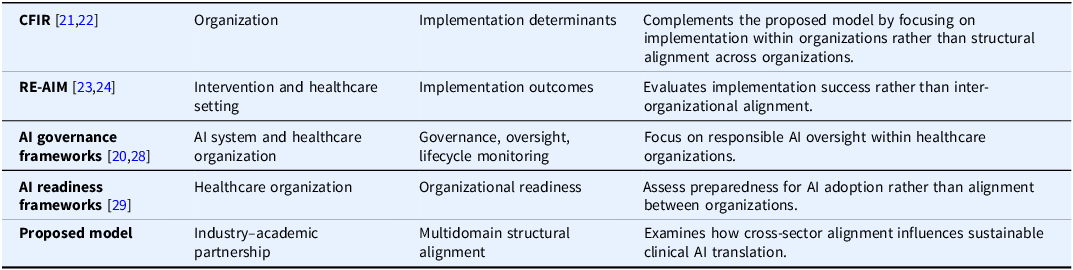
Existing implementation, governance, and readiness frameworks provide important but complementary perspectives on clinical AI translation. CFIR identifies multilevel determinants that influence implementation, while RE-AIM emphasizes the reach, effectiveness, adoption, implementation, and maintenance of interventions [Reference Damschroder, Aron, Keith, Kirsh, Alexander and Lowery21–Reference Glasgow, Vogt and Boles24]. Healthcare AI governance frameworks focus more directly on risk assessment, organizational oversight, lifecycle evaluation, and post-deployment monitoring, whereas AI readiness frameworks assess whether a healthcare organization has the leadership, workforce, infrastructure, financing, and operational capacity needed to adopt AI [Reference Wells, Nguyen and McWilliams20,Reference Wang, Freeman and Magrabi28,Reference Alami, Lehoux and Denis29]. Table 2 compares these representative approaches with the proposed model.
Comparison of representative frameworks relevant to clinical AI translation

Table 2. Long description
A table comparing different frameworks relevant to clinical AI translation. The table has five rows and four columns. The columns are labeled CFIR, RE-AIM, AI governance frameworks, AI readiness frameworks, and Proposed model. The rows are labeled Organization, Implementation determinants, and Description. Row 1: CFIR, Organization, Implementation determinants, Complements the proposed model by focusing on implementation within organizations rather than structural alignment across organizations. Row 2: RE-AIM, Intervention and healthcare setting, Implementation outcomes, Evaluates implementation success rather than inter-organizational alignment. Row 3: AI governance frameworks, AI system and healthcare organization, Governance, oversight, lifecycle monitoring, Focus on responsible AI oversight within healthcare organizations. Row 4: AI readiness frameworks, Healthcare organization, Organizational readiness, Assess preparedness for AI adoption rather than alignment between organizations. Row 5: Proposed model, Industry-academic partnership, Multidomain structural alignment, Examines how cross-sector alignment influences sustainable clinical AI translation.
AI = artificial intelligence; CFIR = Consolidated Framework for Implementation Research; RE-AIM = Reach, Effectiveness, Adoption, Implementation, and Maintenance.
Although these frameworks may incorporate external stakeholders, contextual influences, or organizational interfaces, multidomain structural alignment among independent organizations is generally not their primary unit of analysis. The proposed model complements rather than replaces them by focusing on how industry partners and academic health centers align economic incentives, liability and accountability, data governance, technical infrastructure, and lifecycle responsibilities. In this context, alignment functions as a systems-level translational condition that operates alongside implementation planning, organizational readiness, and model-level governance.
By conceptualizing AI translation as an interface problem between systems, the model shifts attention from isolated product optimization toward coordination across domains. Incompatibilities between development assumptions and health system operating environments may be as influential as evidence generation or clinician acceptance in determining sustained integration. Although the model is intended to apply broadly across clinical AI applications, the relative importance of each alignment domain will vary by use case. Ambient documentation tools may place greater emphasis on workflow integration, infrastructure, and economic sustainability, whereas predictive models and clinical decision support systems may require closer alignment around data governance, liability, clinical oversight, and lifecycle monitoring. Research-oriented AI applications may place greater emphasis on data governance, intellectual property, and infrastructure.
Clinical AI translation occurs across institutional and economic boundaries involving industry, academic health centers, technology and infrastructure providers, and the broader reimbursement and regulatory environments. The proposed model intentionally focuses on the structural interface between industry and academic health centers, reflecting the specific focus of the PATH panel that informed this analysis. This work represents one component of the broader PATH effort to examine clinical AI translation from the perspectives of different stakeholder groups. Patients, clinicians, operational leaders, payers, and regulators remain essential to successful translation, but their perspectives are not the primary unit of analysis in this paper. Future PATH work may examine how these perspectives intersect with, refine, or extend the five alignment domains. The proposed model therefore treats alignment as a reciprocal inter-organizational condition, rather than solely as a measure of whether an individual healthcare organization is ready to implement a technology. This distinction may help explain why technically valid tools can remain stalled at the pilot stage despite favorable local leadership, workflow fit, or implementation planning.
Several limitations should be acknowledged. The model was derived through an exploratory thematic synthesis of a single multi-sector panel discussion and refined through iterative review by panel participants and the broader PATH Working Group. This process was designed to support conceptual model development and did not employ a structured consensus methodology or a systematic qualitative investigation across multiple institutions. The composition of the panel likely shaped the perspectives represented and may have influenced the domains identified. Although the panel included representatives from industry, cloud infrastructure, federated data networks, and academic leadership, additional perspectives – particularly from frontline clinicians, patients, operational leaders, regulators, and payers – may further refine or expand the framework. The comparison with existing implementation, governance, and readiness frameworks was intended to clarify the model’s conceptual scope and unit of analysis and should not be interpreted as an exhaustive or systematic review of the framework literature. This work should therefore be interpreted as part of an ongoing series of discussions within the CTSA PATH Working Group aimed at informing broader guidance for clinical AI translation, rather than as a definitive taxonomy.
Future research should evaluate whether measurable indicators within these domains are associated with successful AI integration across academic health centers. Comparative studies across reimbursement environments, institutional IT maturity, and governance structures may clarify which dimensions exert the greatest influence in specific contexts. Research should also examine whether alignment within one domain can compensate for weaknesses in another or whether specific combinations of misalignment predict failure to progress beyond pilot implementation. Operationalizing alignment into assessable metrics could support prospective translational readiness assessment and reduce the likelihood of stagnation at the pilot stage.
In conclusion, clinical AI translation depends on cross-sector alignment across economic, governance, infrastructural, and oversight domains. Framing the pilot-to-practice gap as a systems-level alignment challenge highlights the need for coordinated capabilities in contracting and incentive alignment, governance and liability structures, scalable data and cloud infrastructure, and performance monitoring. By focusing on the relationships among organizations responsible for developing, deploying, governing, and sustaining clinical AI, the proposed model extends existing implementation, governance, and readiness perspectives to the inter-organizational level. For the CTSA network, advancing these capabilities may support the transition from pilot implementations to sustained clinical integration.
Acknowledgements
The authors thank Timothy Ferris, MD; Christine Silvers, MD, PhD; and Matvey Palchuk, MD, MS, for their participation in the multi-sector panel discussion that informed this analysis. We also thank the members of the CTSA PATH Working Group for their contributions to the structured deliberation and Thomas Radman, PhD, for his thoughtful review of the manuscript. OpenAI ChatGPT v.5.6 was used in July 2026 to assist with manuscript organization, language refinement, and preparation of responses to peer-review comments. All AI-assisted text was critically reviewed, revised, and verified by the authors, who take full responsibility for the final content.
Author contributions
Adrian Zai: Conceptualization, Methodology, Project administration, Visualization, Writing – original draft; Manisha Desai: Writing – review & editing; Timothy G. Ferris: Writing – review & editing; Christine Tsien Silvers: Writing – review & editing; Matvey Palchuk: Writing – review & editing; Timothy Huerta: Writing – review & editing; Mohammad Adibuzzaman: Conceptualization, Methodology, Project administration, Writing – review & editing.
Funding statement
This work received no specific external funding.
Competing interests
The authors declare no competing interests.



 Open access

