Significant outcomes
Chronic central delivery of clozapine does not lead to gross neurological or behavioural deficits in mice.
In male mice, chronic icv delivery of clozapine did not significantly affect locomotor activity or PPI.
Chronic clozapine treatment increases open field activity and PPI in female mice within 1 week after onset of treatment.
Limitations
We only tested for two behavioural domains – PPI and locomotor activity. A wider range of rodent behaviours could be used to model various aspects of schizophrenia.
Experiments were only performed in wild-type mice. Thus, results should be validated in mouse models of schizophrenia.
Introduction
Schizophrenia is a complex psychiatric disorder characterised by impairments in perception, affect and cognition (Andreasen, Reference Andreasen2000). The majority of currently approved pharmacological agents for the treatment of schizophrenia mainly target the dopaminergic and serotonergic systems (Mauri et al., Reference Mauri, Paletta, Maffini, Colasanti, Dragogna, Di Pace and Altamura2014). Although these drugs are quite effective in treating positive symptoms (i.e. psychotic symptoms), negative symptoms (such as lethargy, apathy and social withdrawal) and cognitive deficits remain largely unaffected (Horacek et al., Reference Horacek, Bubenikova-Valesova, Kopecek, Palenicek, Dockery, Mohr and Höschl2006; Carpenter & Koenig, Reference Carpenter and Koenig2008). Three independent studies, CATIE, CUtLASS and EUFEST (Lewis et al., Reference Lewis, Barnes, Davies, Murray, Dunn, Hayhurst, Markwick, Lloyd and Jones2005; Lieberman et al., Reference Lieberman, Stroup, McEvoy, Swartz, Rosenheck, Perkins, Keefe, Davis, Davis, Lebowitz, Severe and Hsiao2005; Kahn et al., Reference Kahn, Fleischhacker, Boter, Davidson, Vergouwe, Keet, Gheorghe, Rybakowski, Galderisi, Libiger, Hummer, Dollfus, López-Ibor, Hranov, Gaebel, Peuskens, Lindefors, Riecher-Rössler and Grobbee2008), indicate a limited benefit of currently available antipsychotics: overall, the first and second generation antipsychotics offer comparable efficacy, except for clozapine, which is associated not only with higher efficacy in treatment-resistant patients (Lewis et al., Reference Lewis, Barnes, Davies, Murray, Dunn, Hayhurst, Markwick, Lloyd and Jones2005; McEvoy et al., Reference McEvoy, Lieberman, Stroup, Davis, Meltzer, Rosenheck, Swartz, Perkins, Keefe, Davis, Severe and Hsiao2006) but also with more serious side effects including agranulocytosis and myocarditis (Kane et al., Reference Kane, Honigfeld, Singer and Meltzer1988). However, all drugs were associated with high rates of discontinuation due to side effects or dissatisfaction with their benefits. One possible reason is that current antipsychotics have similar mechanisms of action, for example, D2/5-HT2A receptor antagonism with minor effects at other receptors. Drug development for schizophrenia has not progressed appreciably by focusing solely on psychosis (Carpenter & Koenig, Reference Carpenter and Koenig2008). However, there is an urgent need for drugs that ameliorate cognitive impairments and negative symptoms, increase treatment adherence and provide improved options for treatment-resistant patients with less side effects (Fellner, Reference Fellner2017). Thus, targeting other systems and/or protein interactions closely involved in the pathophysiology of schizophrenia, particularly the glutamatergic system, may provide a more direct approach for the treatment of this disorder (Insel & Scolnick, Reference Insel and Scolnick2006). The glutamatergic synapse is a target-rich environment containing a large number of pre-, postsynaptic and regulatory proteins that could function as targets for drug development (Moghaddam & Javitt, Reference Moghaddam and Javitt2012), for example, metabotropic glutamate receptors (Yasuhara & Chaki, Reference Yasuhara and Chaki2010), the N-methyl-D-aspartate (NMDA) receptor (Hashimoto, Reference Hashimoto2014), as well as nNOS, NOS1AP and PSD-95 (Freudenberg et al., Reference Freudenberg, Alttoa and Reif2015). However, large-scale screening of new molecular entities for the treatment of central nervous system diseases is impeded by the blood–brain barrier (BBB), which can be circumvented by central delivery.
As a matter of course, validation of new therapeutic agents for schizophrenia requires comparison to established antipsychotic treatment, preferably to clozapine due to its unique clinical efficacy. Clozapine is superior to all other antipsychotics in its effects on positive and negative symptoms as well as suicidality (Brambilla et al., Reference Brambilla, Barale, Caverzasi, Tognoni and Barbui2002; McEvoy et al., Reference McEvoy, Lieberman, Stroup, Davis, Meltzer, Rosenheck, Swartz, Perkins, Keefe, Davis, Severe and Hsiao2006; Raja, Reference Raja2011; Krause et al., Reference Krause, Huhn, Schneider-Thoma, Bighelli, Gutsmiedl and Leucht2019). Notably, there is both in vitro and in vivo evidence suggesting a possible glutamatergic mechanism of action of clozapine (Tanahashi et al., Reference Tanahashi, Yamamura, Nakagawa, Motomura and Okada2012).
Clozapine has shown efficacy in rodent models of schizophrenia (Duncan et al., Reference Duncan, Moy, Lieberman and Koller2006; Abrams et al., Reference Abrams, Zheng, Choo, Yang, Wei, Anchordoquy, Zawia and Stevens2008). At the behavioural level, systemic clozapine treatment improves sensory gating in humans and mice (Simosky et al., Reference Simosky, Stevens, Adler and Freedman2003; Vollenweider et al., Reference Vollenweider, Barro, Csomor and Feldon2006). Sensory gating deficits have been identified as a fundamental cognitive impairment in patients with schizophrenia (Powell & Miyakawa, Reference Powell and Miyakawa2006). Modelling positive symptoms of schizophrenia in mice includes investigations of psychomotor agitation, particularly locomotor activity. In this context, clozapine has been shown to alter open field activity in rodents (Abrams et al., Reference Abrams, Zheng, Choo, Yang, Wei, Anchordoquy, Zawia and Stevens2008; Gray et al., Reference Gray, van den Buuse, Scarr, Dean and Hannan2009; Gururajan et al., Reference Gururajan, Taylor and Malone2012).
Abrams et al. (Reference Abrams, Zheng, Choo, Yang, Wei, Anchordoquy, Zawia and Stevens2008) have already investigated the effects of chronic intracerebroventricular (icv) delivery of clozapine in rats. However, to date, there is no established dosage for chronic icv delivery in mice. Here, we conducted the first dose-finding study for chronic icv clozapine administration in mice to pave the way for further preclinical studies comparing the effects of novel potential therapeutics for schizophrenia to centrally administered clozapine. We used changes in sensory gating and open field activity as our primary markers for adequate icv dosing of clozapine.
Methods
Mice
Adult male and female C57BL/6JRj mice (11 weeks old; Janvier Labs, France) were used for this study. All mice were held under standard laboratory conditions (21 ± 1°C temperature, 55 ± 5% humidity, 12 h light/dark cycle with lights on at 07:00 h) and housed in groups of four with access to food and water ad libitum. The experiments were performed in accordance with the German animal welfare laws (TierSchG and TSchV) and were approved by local authorities (Regierungspräsidium Darmstadt, approval ID FK/1101).
Drugs
Clozapine was dissolved as described in Abrams et al. (Reference Abrams, Zheng, Choo, Yang, Wei, Anchordoquy, Zawia and Stevens2008). In brief, 2-hydroxypropyl-beta-cyclodextrin (HPBCD) was used to solubilise clozapine first under acidic conditions (pH ∼2.0 with HCl) and titrated back towards neutral pH with NaOH. All formulations were in a HPBCD : clozapine molar ratio of 4 : 1 and filter sterilised prior to icv administration.
The clozapine doses used for this study were based on the known effective dose in rats (100 µg/day) (Abrams et al., Reference Abrams, Zheng, Choo, Yang, Wei, Anchordoquy, Zawia and Stevens2008). The average mouse brain volume is about one quarter of that of a rat brain (Bishop & Wahlsten, Reference Bishop and Wahlsten1999). Thus, a dose of approximately 25 µg/day would be effective assuming direct translatability from rats to mice. However, since differences in metabolism, receptor density, etc. can affect the actual effective dose, clozapine was tested in three different doses ranging around this value (i.e. 12.5, 25 and 50 µg/day). The concentrations used to achieve the desired doses at a delivery rate of 0.15 µl/h were 3.5, 7 and 14 mg/ml in 240 mg/ml HPBCD. The vehicle used here was 240 mg/ml HPBCD in 1× phosphate-buffered saline (PBS).
Mice (6–7 mice/group/sex) were randomly assigned to the four treatment groups [i.e. 12.5, 25, 50 µg clozapine/day or vehicle (i.e. HPBCD)]. Clozapine (or vehicle) was delivered centrally using osmotic minipumps (Alzet Model 2006, Cupertino, CA, USA).
Stereotaxic surgeries
Stereotaxic surgeries were performed under isoflurane anaesthesia (1–2%). For local analgesia, ropivacaine (2 mg/ml; 100–200 µl) was injected subcutaneously and metamizole (2 mg/ml) was given to the drinking water preoperatively for 2 days and postoperatively for 3 days. The uptake of metamizole was ensured by monitoring water intake daily. Mice were placed in a stereotaxic apparatus (Stoelting Co). The osmotic minipumps were prepared and implanted as described by Sanchez-Mendoza et al. (Reference Sanchez-Mendoza, Carballo, Longart, Hermann and Doeppner2016). The cannulae (Alzet Brain Infusion Kit 3, 30 G) were implanted into the right or left lateral ventricles (LVs) (counterbalanced across mice) with stereotaxic coordinates relative to bregma (Paxinos & Franklin, Reference Paxinos and Franklin2001): AP −0.5 mm, ML ± 1.4 mm and DV 3 mm from the skull surface. The cannulae were fixed to the skull with cyanoacrylate adhesive (Loctite 454). The osmotic pump was placed in a subcutaneous pocket at the back of the mouse and connected to the cannula via a vinyl catheter (0.71 mm outer diameter). After surgery, the incision was sutured, and stability was supported with N-butyl cyanoacrylate wound adhesive (Surgibond). The mice were allowed to recover from surgery for 7 days.
Behavioural testing
One week before and weekly until week three after surgery, a battery of three different behavioural tests was performed. Tests were carried out between 10:00 a.m. and 06:00 p.m.
The SHIRPA screen (adapted from IMPReSS; Doc. Number: ESLIM_008_001 from 26 June 2008) comprises a battery of 20 individual tests, organised in five functional categories: motor behaviour, reflex and sensory, neuropsychiatric, autonomous function and muscle tone of each mouse. This screen has been modified and specifically evaluates body weight, body position, tremor, palpebral closure, lacrimation, urination and defecation that were observed in a viewing jar (14 cm diameter; 18 cm height) for 5 min; transfer arousal, locomotor activity, gait, pelvic elevation, tail elevation, startle response and touch escape that were observed in an open field for 10 min; positional passivity, limb grasping, trunk curl, pinna reflex, corneal reflex, contact righting reflex. Throughout this screening, any occurrence of abnormal behaviour, fear, aggression or vocalisation was recorded.
Open field test. Locomotor activity was evaluated as part of the SHIRPA screen during a 10-min trial in an open field arena (Stoelting Co, 40 cm × 40 cm) with transparent acrylic walls (H: 35 cm). The ANY-maze™ video-tracking system (Stoelting Co) equipped with a digital camera (The Imaging Source Europe GmbH, Bremen, Germany) was used to record the total distance travelled, number of photobeam array activations and time spent in the centre of the arena (20 cm × 20 cm) for the total time of 10 min.
Prepulse inhibition (PPI) of the acoustic startle response (ASR) was measured with the SR-Lab™ startle response system (San Diego Instruments, Inc., USA). This startle setup consists of a light- and sound-isolated box with an acrylic cylinder mounted on a piezoelectric element to detect mouse movement. Mice were placed into the cylinder and after 5 min acclimation to background noise of 65 dB (continued throughout the test session), six acoustic startle pulses (120 dB broadband noise for 40 ms) were presented with an inter-trial interval (ITI) of 10 s. Thereafter, a total of 70 trials were presented in a randomised sequence and with variable ITI of (20–30 s): 10× no stimulus (only background noise was presented), 10× startle pulse only, 10 × each prepulse (4, 8, 12, 16 dB above background = 69, 73, 77, 81 dB) for 20 ms followed by a 40 ms startle pulse after an interpulse interval of 100 ms (onset to onset), 10 × prepulse only (16 dB above background) for 20 ms. The session was terminated with six startle pulses only with an ITI of 10 s. Each session lasted around 35 min. The magnitudes of ASR to pulse only trials were averaged for each mouse and defined as startle amplitude. PPI percentage was calculated as described by Geyer & Swerdlow (Reference Geyer and Swerdlow2001) using the following formula:
 $$88\% \% {\rm{PPI}} = 100 \times {{{\rm{startle}}\;{\rm{amplitud}}{{\rm{e}}_{{\rm{startle}}\;{\rm{trials}}}} - {\rm{startle}}\;{\rm{amplitud}}{{\rm{e}}_{{\rm{prepulse}} + {\kern 1pt} {\rm{startle}}\;{\rm{trials}}}}} \over {{\rm{startle}}\;{\rm{amplitud}}{{\rm{e}}_{{\rm{startle}}\;{\rm{trials}}}}}}$$
Perfusion of mice
Six weeks after implantation, mice were deeply anaesthetised with 5–6% isoflurane and transcardially perfused with ~6 ml 1× PBS solution followed by ~30 ml 4% formaldehyde (FA) in 1× PBS with a perfusion speed of 3 ml/min. Brains were then removed, postfixed in 4% FA in 1× PBS for 2 h and cryoprotected in 30% sucrose in 1× PBS for 48 h and then frozen in −20°C. Additionally, liver and kidneys were extracted, frozen in −20°C and later examined for organic changes by assessing their weight.
Brains were sectioned at 50 µm using a cryostat (Leica CM3050 S cryostat, Leica Biosystems) and stained with Haematoxylin-Eosin (Morphisto GmbH, Frankfurt) according to the manufacturer’s instruction. Brain slices were mounted in Histofluid (Paul Marienfeld) and imaged at 2.5×/0.085 magnification on a Zeiss Axio Observer.Z1. equipped with a Zeiss Axiocam 305 colour to confirm cannula placement.
Statistical analysis
JASP (v0.10) was used to perform statistical analyses. Since sex-specific differences were observed (e.g. open field activity, startle reaction, PPI; see Supplementary Material), males and females were analysed separately. Behavioural assessments, including the SHIRPA scores, body weights, locomotor activity, and startle and PPI data were examined statistically for significance using the Mann–Whitney U test for comparing female and male mice, and the Friedman test or Kruskal–Wallis test, followed by Conover’s or Dunn’s post hoc test (when appropriate) with Bonferroni correction against respective controls for within or between subject comparison. Data are reported as mean ± SE. Statistical significance was defined at p < 0.05.
Results
In vivo behavioural studies in mice
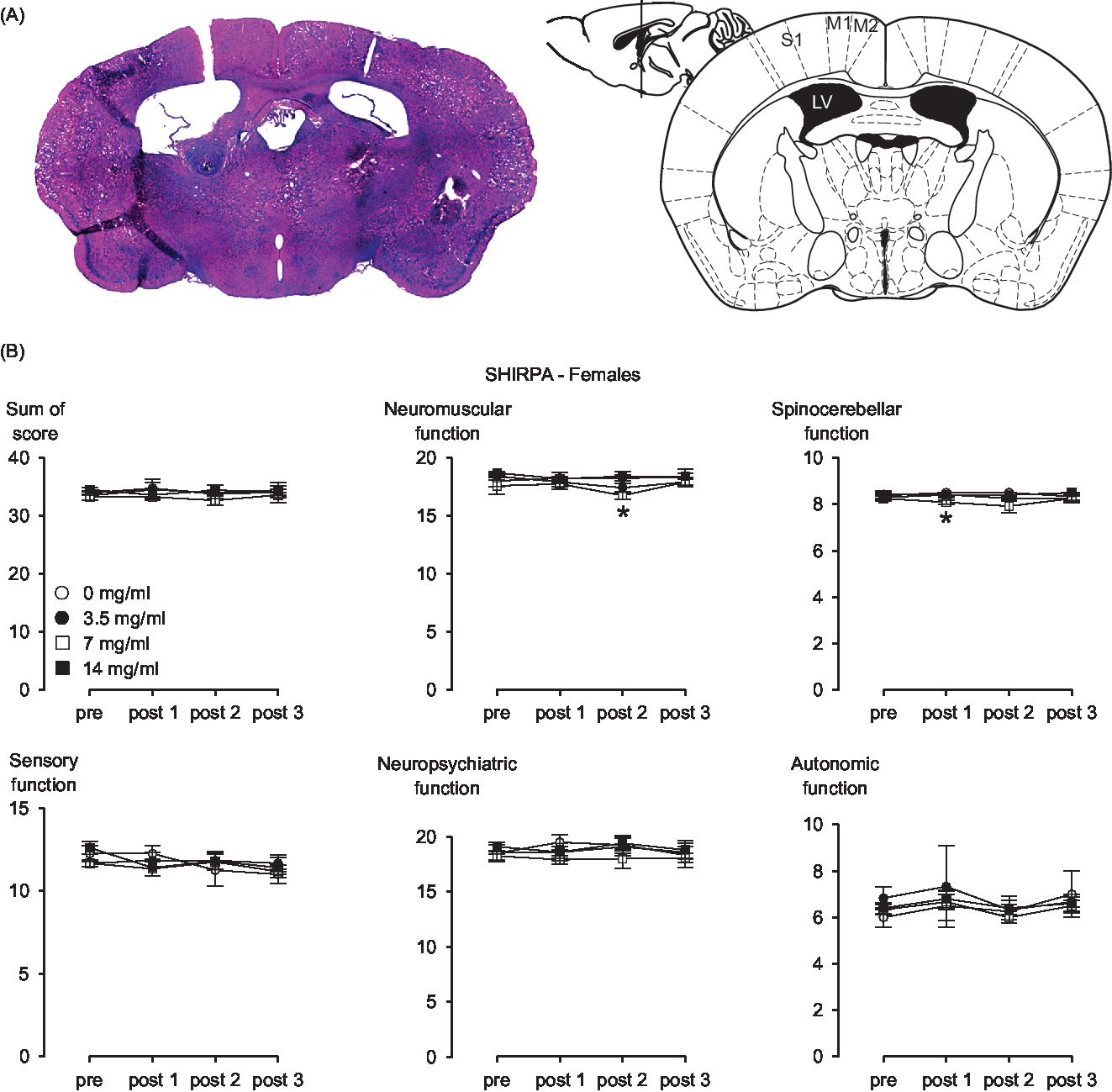
Mice were implanted with an icv catheter attached to an osmotic pump to deliver either clozapine in different concentrations (3.5, 7 or 14 mg/ml) or vehicle (i.e. HPBCD). Of the 52 mice used for this study, three died during surgery (mortality 5.8%). Mice with detached cannulae from the skull were excluded from further behavioural studies (n = 1 excluded from post 1 measurement; further n = 4 from post 2; further n = 6 from post 3). Mice with incorrect implantation were excluded from analysis (4 of 49 mice ≈ 8.2%). The implantation was considered a success when the cannula reached the necessary depth to enter the ventricular system (Fig. 1(A)). Tissue damage from injection was restricted to brain tissue directly above the LVs, including parts of the primary motor cortex, primary somatosensory cortex and the corpus callosum.
(A) Exemplary image of correct implantation of the cannula to the lateral ventricle (LV). Coordinates relative to bregma: AP −0.5 mm, ML ± 1.4 mm. Slices of 50 µm thickness were H&E stained to validate proper targeting. Right-hand panel: comparison to respective coronal and sagittal slices (AP −0.58) from Paxinos and Franklin’s the Mouse Brain in Stereotaxic Coordinates (2001) (Paxinos & Franklin, Reference Paxinos and Franklin2001). (B) Comparison of total SHIRPA scores (mean ± SE) of female mice (n = 21) before and after chronic icv administration of clozapine. The SHIRPA tests were divided into five categories (Rogers et al., Reference Rogers, Fisher, Brown, Peters, Hunter and Martin1997). Total scores were shown as the sum of the scores for all and each of the categories and are not scaled to vehicle-treatment levels. Analysis of variance (ANOVA) was performed with clozapine concentration as the grouping variable and post hoc comparisons were carried out using the Tukey’s Honestly Significant Difference (HSD) test. Asterisks indicate significant intergroup differences for clozapine concentration compared to control (i.e. 0 mg/ml): (*) p ≤ 0.05. Abbreviations: M1 = primary motor cortex, M2 = secondary motor cortex, S1 = primary somatosensory cortex.

All mice increased their body weight throughout the experimental period (female: χ2(3) = 39.15, p < 0.001; male: χ2(3) = 21.02, p < 0.001) whereby males were significantly heavier than female mice (pre: U = 0, p < 0.001; post 1: U = 2, p < 0.001; post 2: U = 15.5, p < 0.001; pre: U = 0, p < 0.001) with a significantly lower liver-to-body ratio (U = 72, p = 0.02) and a significantly higher kidney-to-body weight ratio (U = 19 p = 0.041). However, clozapine treatment had no effect on total body weight (female: H(3) ≤ 5.49, p ≥ 0.139; male: H(3) ≤ 3.231, p ≥ 0.357), liver-to-body-weight ratio (female: H(3) = 0.778; p = 0.855, male: H(3) = 0.164, p = 0.983) or kidney-to-body-weight ratio (female: H(3) = 0.778; p = 0.855; male: H(3) = 0.155, p = 0.985) throughout all measurement time points in both sexes.
SHIRPA
SHIRPA score was used to investigate whether icv delivery of clozapine causes behavioural and physiological impairments in mice (Fig. 1(B), Supplementary Table 1). The SHIRPA score revealed differences in the functional categories ‘neuromuscular function’ and ‘spinocerebellar function’ between groups, in female mice (Fig. 1(B)). One week of clozapine treatment showed an effect on spinocerebellar function in females (H(3) = 9.429, p = 0.024), whereby mice receiving 7 mg/ml clozapine displayed an altered body position and reared significantly less compared to vehicle-treated mice (p = 0.012). Two weeks after surgery, female mice displayed differences in their neuromuscular function depending on the clozapine concentration they received (H(3) = 8.762 p = 0.033). Female mice receiving 7 mg/ml clozapine displayed a modest, but significantly reduced spontaneous activity compared to mice receiving vehicle (p = 0.03). The other parameters measured were not different among the treatment conditions (p > 0.05). Male mice did not display differences in any behavioural measurement depending on the clozapine concentration (p > 0.05, data not shown).
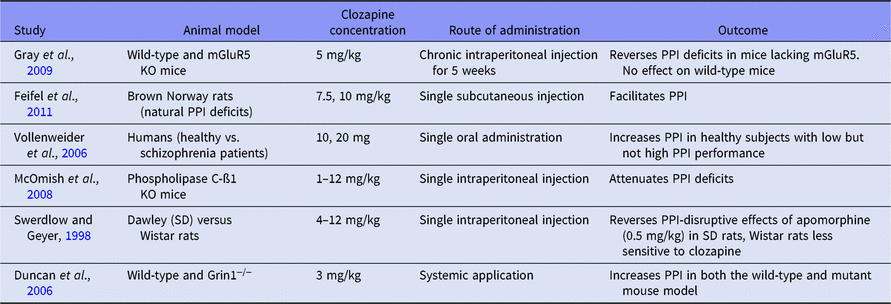
Comparison to other studies mentioned in the literature investigating effects of clozapine administration on PPI

Open field
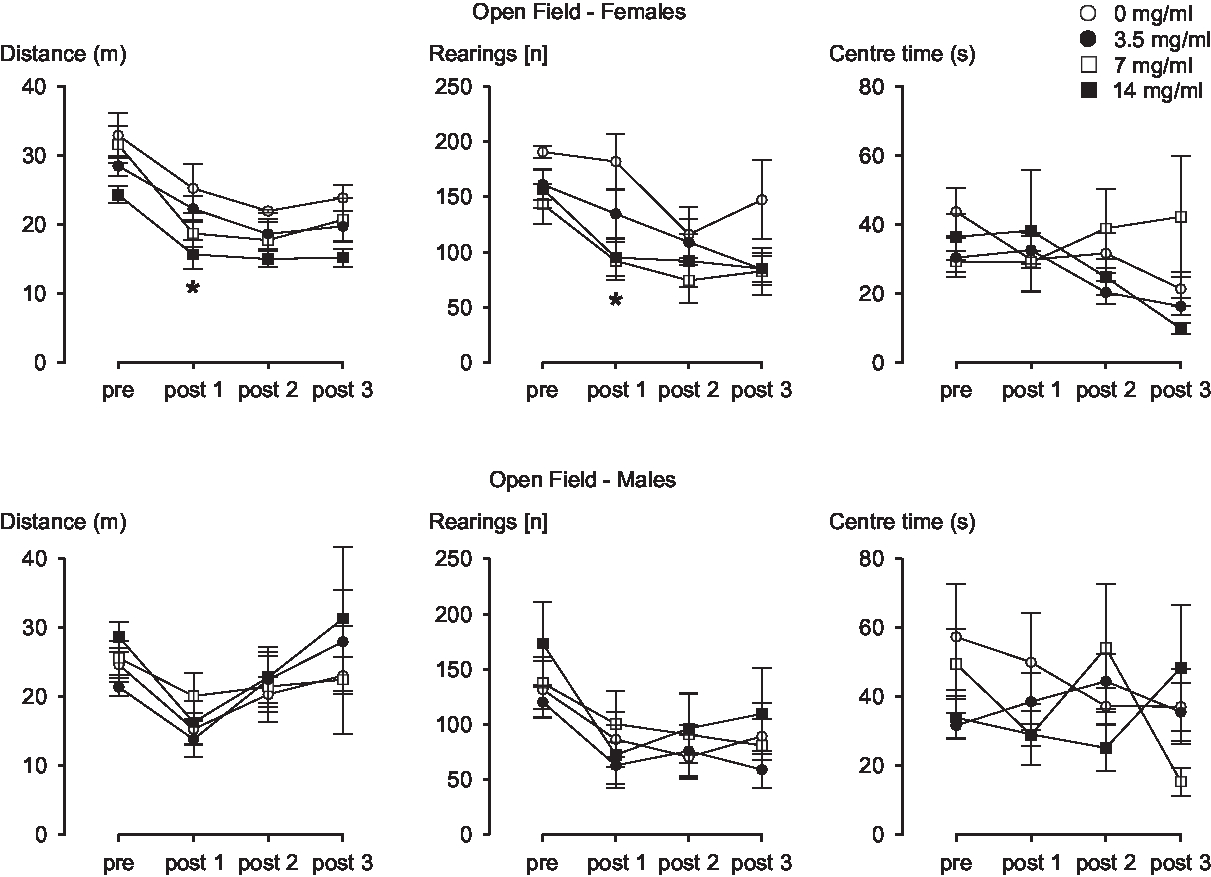
Mice with chronic icv administration of clozapine (3.5, 7 or 14 mg/ml) were tested in the open field (Fig. 2, Supplementary Table 2) to assess effects of clozapine treatment on locomotor and behavioural activity levels, which can be correlated with locomotive function (Tatem et al., Reference Tatem, Quinn, Phadke, Yu, Gordish-Dressman and Nagaraju2014).
Behavioural measurements (mean ± SE) recorded in the open field arena of female (n = 21) and male (n = 24) mice before and after chronic icv administration of clozapine for 3 weeks. Analysis of variance (ANOVA) was performed with clozapine concentration as the grouping variable and post hoc comparisons were carried out using the Tukey’s HSD test. Asterisks indicate significant intergroup differences for clozapine concentration compared to control (i.e. 0 mg/ml): (*) p ≤ 0.05.

Already 1 week after clozapine administration, some differences in the open field activity of female mice were observable between treatment groups (Fig. 2). While horizontal activity, specifically the total distance travelled was marginally affected (H(3) ≤ 7.01, p ≥ 0.072), vertical activity (number of photobeam array activation; i.e. number of rearings) was borderline significant (post 1: H(3) = 7.718, p = 0.052; all other time points: H(3) ≤ 4.167, p ≥ 0.244). Female mice treated with 7 or 14 mg/ml clozapine showed a significant decrease in vertical activity by up 50% at post 1 compared to vehicle-treated mice (p = 0.018 and 0.042, respectively). Mice treated with 14 mg/ml showed a significant ~20% reduction in locomotor activity (p = 0.033) at post 1. The time spent in the centre of the arena was significantly affected at post 3 (H(3) = 10.48, p = 0.015). However, there were no significant differences compared to control mice (p > 0.7). Centre time remained unaffected by clozapine treatment for all other time points (H(3) ≤ 3.659, p ≥ 0.301). In male mice, no differences could be observed between the treatment groups (H(3) ≤ 4.33, p ≥ 0.228).
Prepulse inhibition
Deficient PPI of ASR is a common endophenotype in schizophrenia and has been associated with impaired sensorimotor gating. PPI is considered to be a useful psychophysiological process for pharmacological screening (Swerdlow & Geyer, Reference Swerdlow and Geyer1998; Koch, Reference Koch1999).
The startle response was statistically comparable between all treatment groups (pre: H(3) ≤ 4.913; p ≥ 0.178). To assess startle habituation, pulse-alone trials at the beginning and end of the session were compared, revealing significant within-session habituation (pre: W = 887, p < 0.001; post 1: W = 954, p < 0.001; post 2: W = 882, p < 0.001; post 3: W = 111, p < 0.001). Within-session habituation was not significantly affected by clozapine treatment (p > 0.05).
Female mice showed a trend of reduced startle response to a 120-dB stimulus (pre: U = 179, p = 0.099) and a significantly reduced PPI (p < 0.01) compared to male mice (Supplementary Table 3). This difference in ASR could be accounted for by body weight in males and females which has a stronger impact on the responses by the piezoelectric element. Of note, there was a significant positive correlation found between PPI and ASR in females (r τ = 0.371, p = 0.019, n = 21) but a marginally significant negative correlation in males (r τ = −0.239, p = 0.107, n = 24). As expected, the amount of PPI increased with increasing prepulse intensity (χ2(3) = 84.44, p < 0.001). This difference reached statistical significance in each of the experiments (p < 0.01).
Again, due to sex differences in the startle response and PPI level males and females were analysed independently. Repeated measures analysis with the inner subject factor time (pre, post 1, post 2, post 3) revealed an effect of time for all prepulse intensities in female mice (χ2(3) ≥ 22.45; p < 0.001) but only for some prepulse intensities in male mice (4 dB: χ2(3) = 5.211, p = 0.157; 8 dB: χ2(3) = 11.533, p = 0.009; 12 dB: χ2(3) = 19.74, p < 0.001; 16 dB: χ2(3) = 2.558, p = 0.465). Similarly, the startle response to a 120-dB startle pulse also increased in female mice after surgery (χ2(3) = 16.14, p = 0.001) but not in males (χ2(3) = 5.968, p = 0.113).
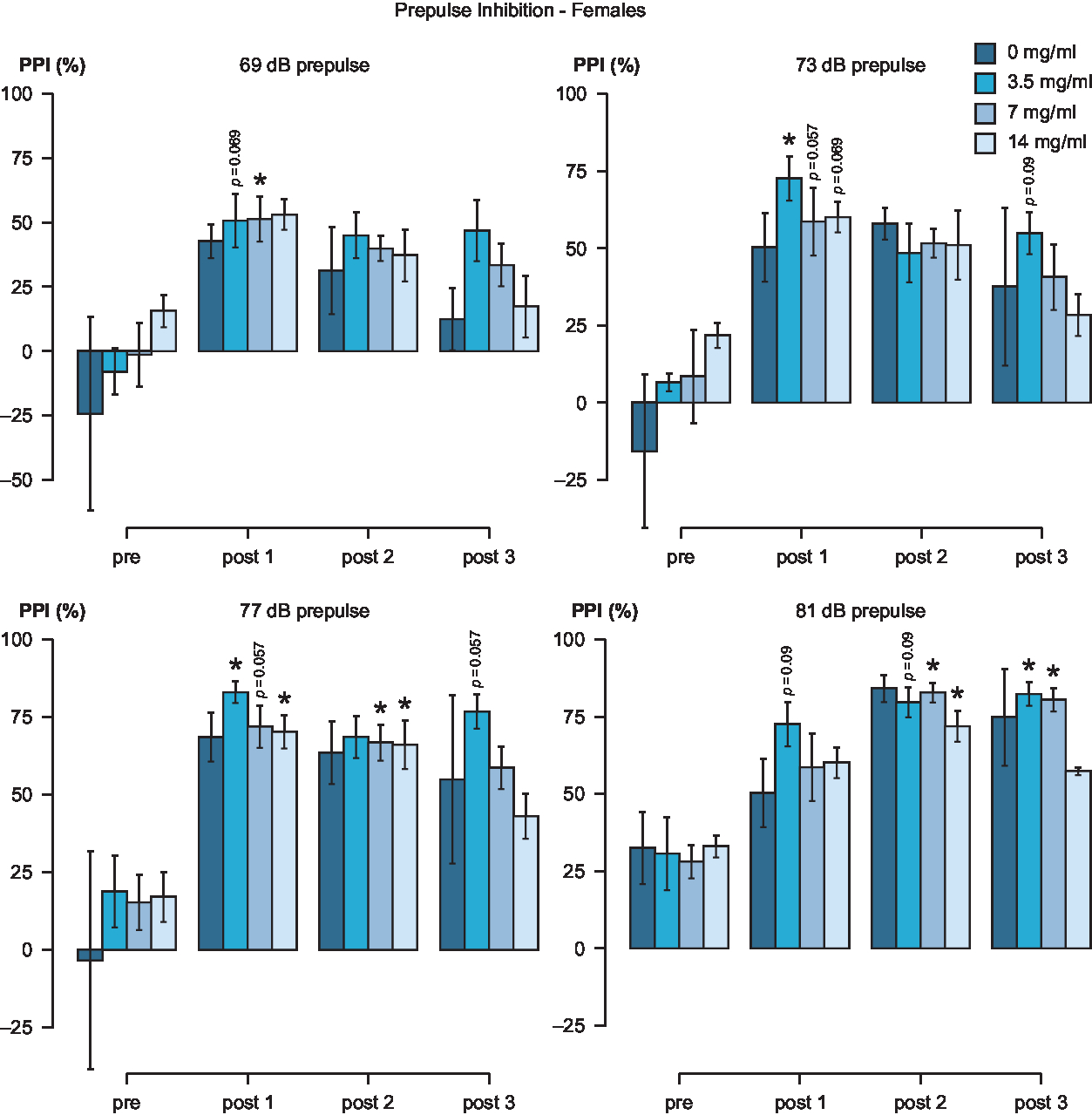
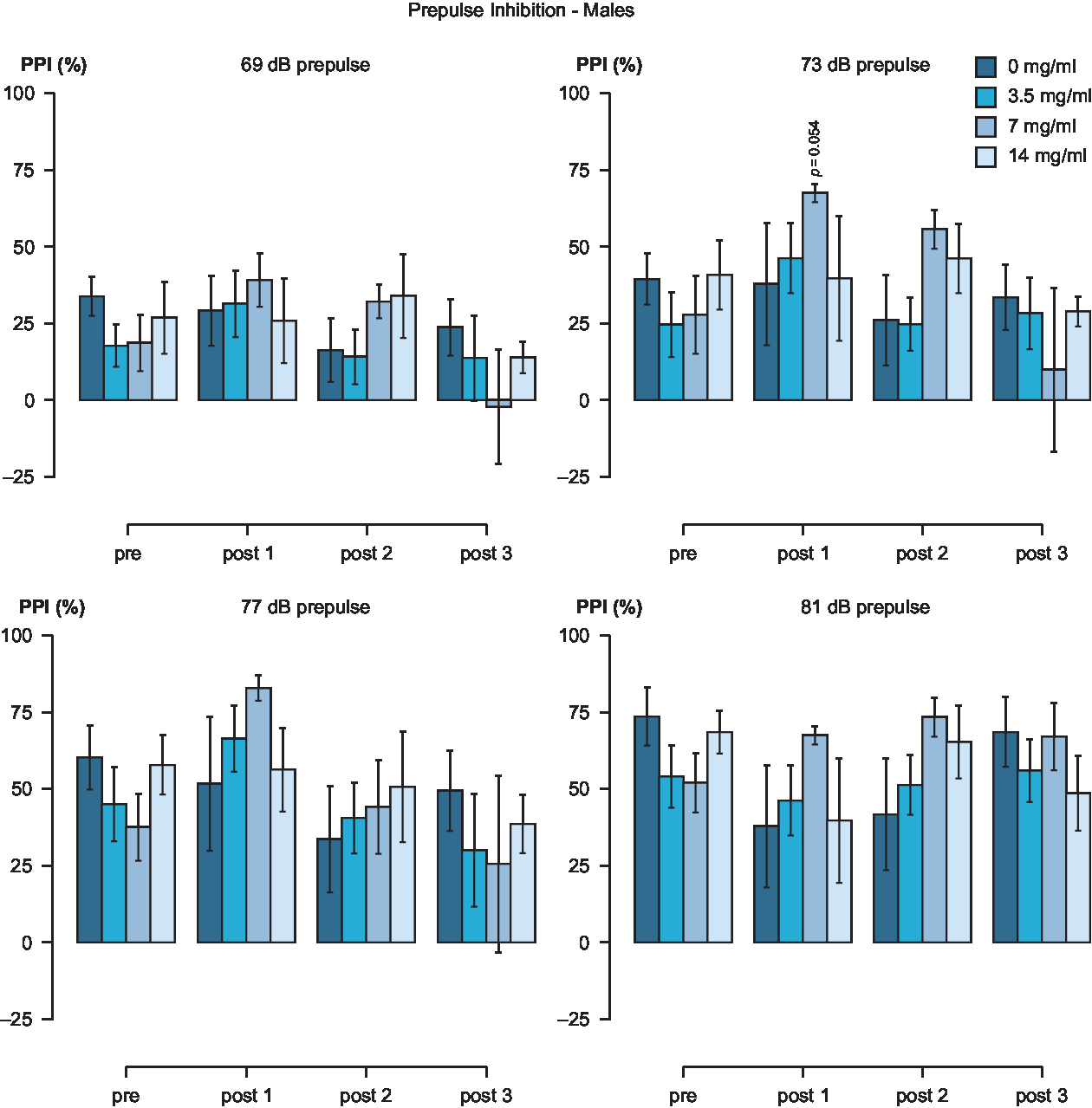
Due to PPI differences between groups already prevalent before treatment onset, treatment groups were analysed independently to evaluate whether PPI is significantly altered by clozapine administration. PPI levels at the lowest prepulse intensity (i.e. 4 dB above background) were sufficient for detecting PPI-enhancing effects of clozapine (7 mg/ml: χ2(3) = 12.05; p = 0.007) being evident 1 week after treatment onset (p = 0.018) but not in the second (p = 0.069) and third week (p = 0.132) in female mice (Fig. 3). PPI with prepulse intensity at 8 dB above background yielded clozapine effects at all dosages (3.5 mg/ml: χ2(3)=12.6, p = 0.006; 7 mg/ml: χ2(3) = 8.4, p = 0.038; 14 mg/ml: χ2(3) = 9.24, p = 0.026) though only the 3.5 mg/ml dose showed a significant effect at post 1 after correction for multiple testing. However, using the highest prepulse intensities (12 dB and 16 dB above background) PPI was significantly affected by all clozapine concentrations in female mice compared to vehicle-treated (12 dB – 3.5 mg/ml: χ2(3) = 11.6, p = 0.009; 7 mg/ml: χ2(3) = 11.6, p = 0.009; 14 mg/ml: χ2(3) = 13.56, p = 0.004; 16 dB – 3.5 mg/ml: χ2(3)=11.4, p = 0.01; 7 mg/ml: χ2(3) = 13.2, p = 0.004; 14 mg/ml: χ2(3) = 12.12, p = 0.007). In male mice, only the 7 mg/ml dose had an effect on PPI with prepulse intensities at 8 dB above background (χ2(3) = 11.1, p = 0.011) with post hoc testing showing a strong trend for increased PPI at post 1 (p = 0.054), but otherwise no significant clozapine effects on PPI could be observed in male mice, independent of the presented prepulse intensity (χ2(3) < 7.5, p > 0.05; Fig. 4).
Prepulse inhibition (PPI) in female mice. Means ± SEM of the means of the percentage of PPI following different prepulse intensities (4, 8, 12 and 16 dB above background of 65 dB) in female C57BL/6J mice (n = 21) at different time points prior and after surgery treated with different concentrations of clozapine (3.5, 7 and 14 mg/ml) and vehicle only. Asterisks indicate significant differences between pre- to post-measurements: (*)p ≤ 0.05. Significant trends (i.e. p values <0.1) for post compared to pre-measurements are indicated.

Prepulse inhibition (PPI) in male mice. Means ± SEM of the means of the percentage of PPI following different prepulse intensities (4, 8, 12 and 16 dB above background of 65 dB) in male C57BL/6J mice (n = 24) at different time points prior and after surgery treated with different concentrations of clozapine (3.5, 7 and 14 mg/ml) and vehicle only. No significant clozapine effects on time could be observed. Significant trends (i.e. p values <0.1) for post compared to pre-measurements are indicated.

Discussion
Identification of new targets at the glutamatergic post-synapse may be a promising therapeutic strategy for the treatment of schizophrenia (Moghaddam, Reference Moghaddam2004). However, the movement of large molecules between the blood, CSF and interstitial fluid of the brain is restricted by the limited permeability of the BBB (Pardridge, Reference Pardridge2005). In some cases, newly developed compounds may already cross the BBB or they may be chemically modified to improve their penetration into the brain (He et al., Reference He, Liu, Liang, Liu, Li, Liu, Ding and Tuo2018). In other cases, where penetration is poor or unknown, methodologies for direct administration into the brain allow evaluation of the potential therapeutic value of novel molecules. Positive results would provide the motivation to invest in the required medicinal chemistry for designing derivatives with improved pharmacokinetic and pharmacodynamic properties and compatible with peripheral routes of administration. Infusion into the ventricle will result in distribution throughout the whole ventricular system and the external CSF spaces like the basal cisterns and over the convexity (Slavc et al., Reference Slavc, Cohen-Pfeffer, Gururangan, Krauser, Lim, Maldaun, Schwering, Shaywitz and Westphal2018). In order to compare new compounds with an already known control substance, we administered clozapine chronically into the lateral cerebral ventricle of C57BL/6J male and female mice to determine the optimal dose.
The literature presents conflicting data regarding the effects of clozapine on open field activity. Abrams et al. (Reference Abrams, Zheng, Choo, Yang, Wei, Anchordoquy, Zawia and Stevens2008) have shown that rats with chronic icv administration of clozapine (17 mg/ml) displayed significant increase in the distance travelled in the outer square of the open field maze. In contrast, Gururajan et al. (Reference Gururajan, Taylor and Malone2012) have observed that a single intraperitoneal administration of clozapine (3 mg/kg) inhibits MK-801-induced hyperactivity in Sprague–Dawley rats. In a previous study, the same group noted that a moderate dose of clozapine (3 mg/kg) decreased locomotor activity, whereas a higher dose (10 mg/kg) had no effect on locomotor activity (Gururajan et al., Reference Gururajan, Taylor and Malone2011). Gray et al. (Reference Gray, van den Buuse, Scarr, Dean and Hannan2009) found that chronic intraperitoneal administration of clozapine (5 mg/kg) for 8 weeks did not alter the distance travelled by WT C57/Bl6 background mice but ameliorated the hyperactivity in mGluR5 knockout mice.
In the present study, central administration of clozapine did not affect locomotor activity in the open field or gross behaviour in the modified SHIRPA test, at least in male mice. Female mice receiving 7 mg/ml clozapine differed in their body position (rearing less) and displayed a reduced spontaneous activity compared to mice receiving vehicle. These findings are in line with a study showing that clozapine blocked the increase in rearing time and rearings elicited by methylphenidate administration in a dose-dependent fashion (Saldívar-González et al., Reference Saldívar-González, Campos-Rodriguez and Cano-Cruz2009).
Studies regarding the anxiolytic effect of clozapine have also been mixed. In the present study, clozapine had no significant effects on the time spent in the centre of the arena which can be associated with anxiety levels (Bailey & Crawley, Reference Bailey, Crawley and Buccafusco2009; Freudenberg et al., Reference Freudenberg, O’Leary, Aguiar and Slattery2018). Other findings point towards an increased anxiety-related behaviour and decreased exploratory activity in rats (Mc Fie et al., Reference Mc Fie, Sterley, Howells and Russell2012). However, several other studies have suggested an anxiolytic property of clozapine in the open field test (Bruhwyler et al., Reference Bruhwyler, Chleide, Liégeois, Delarge and Mercier1990), as well as in conditioned fear paradigms (Mead et al., Reference Mead, Li and Kapur2008).
Methodological differences might account for the discrepant reports related to the ability of clozapine to alter open field activity. Most previous studies have investigated the effects of an acute administration of clozapine on PPI or behaviour via a subcutaneous or intraperitoneal route using a concentration range of 1–12 µg/g, mostly 30 min prior to testing. Our study investigated chronic central administration with a daily dose of 12.5, 25 and 50 µg for 3 weeks. In case of a single injection, plasma concentration rises to a peak but then declines rapidly until the test compound is eliminated, which happens more rapidly in rats and mice than in humans (Löscher, Reference Löscher2007). Hence, the effects of a compound following a single injection are limited to few hours, whereas continuous drug administration using implantable infusion pumps ensures that test compounds are present in plasma and tissues for a defined duration to allow their biological effects to develop fully, with better reproducibility (Urquhart et al., Reference Urquhart, Fara and Willis1984). Consequently, effects of chronic central clozapine on behaviour can be considered as more reliable.
Sensorimotor gating, as tested by the PPI of the ASR, has a high translational value across species (Braff et al., Reference Braff, Geyer and Swerdlow2001) and is often used for pharmacological screening of antipsychotics or novel compounds involving new targets. Several different studies have already shown that antipsychotics can reverse PPI deficits (Table 1). Gray et al. (Reference Gray, van den Buuse, Scarr, Dean and Hannan2009) showed that chronic intraperitoneal clozapine treatment (5 mg/kg) for 5 weeks significantly increases PPI in mGluR5 KO mice compared to saline-treated KO mice. However, they could not observe an overall effect of clozapine in wild-type mice. Feifel et al. (Reference Feifel, Shilling and Melendez2011) showed that a single systemic clozapine injection (7.5 mg/kg) facilitated PPI in Brown Norway rats which exhibit natural PPI deficits under certain parametric conditions. In humans, a single clozapine administration increased PPI levels in healthy subjects with low but not high PPI performance in a manner comparable to that seen in clozapine-treated schizophrenia patients (Vollenweider et al., Reference Vollenweider, Barro, Csomor and Feldon2006). In the present study, mice treated with 12.5, 25 and 50 µg clozapine per day showed an increase in PPI 1 week after onset of treatment compared to the control, whereby the highest concentration showed no effects at the lower prepulse intensities. Thus, a dosage range between 3.5 and 7 mg/ml can be used in future studies requiring chronic icv delivery of clozapine.
Usually, pharmacological studies of PPI are based primarily on the ability of a drug (e.g. dopamine D2 receptor antagonist) to reverse a drug-induced deficit in PPI produced by psychotomimetic drugs such as amphetamine (indirect sympathomimetic) and phencyclidine (NMDA receptor antagonist) (Powell et al., Reference Powell, Zhou and Geyer2009). However, in the current study, we administered clozapine only to wild-type mice which were not pre-treated to induce schizophrenia-like conditions. Still, our results seem to be in line with studies showing that intraperitoneal administration of clozapine (1–12 mg/kg) attenuates PPI deficits, for instance, in phospholipase C-β1 KO mice (McOmish et al., Reference McOmish, Burrows, Howard, Scarr, Kim, Shin, Dean, van den Buuse and Hannan2008) or even completely reverses PPI-disruptive effects of apomorphine (D1 receptor agonist; Swerdlow & Geyer, Reference Swerdlow and Geyer1998; Swerdlow et al., Reference Swerdlow, Varty and Geyer1998). Duncan et al. (Reference Duncan, Moy, Lieberman and Koller2006) showed that systemic application of clozapine (3 mg/kg) increased PPI in both the wild-type and a mutant mouse model of chronic NMDA receptor hypofunction (i.e. Grin1 −/− mice) and concluded that the assessment of behaviour of this mutant mouse model in the PPI paradigm offers no advantage over the wild-type controls for identifying new clozapine-like drugs. Hence, finding the effective dose for chronic central clozapine administration in wild-type mice can be considered as a valid method.
The administered clozapine dose was the same in female and male mice. However, females seemed to be more sensitive to clozapine treatment displaying behavioural alterations. Anderson et al. (Reference Anderson, Livingston, Couchman, Smith, Connolly, Miller, Flanagan and Heald2015) showed that women tend to attain 17% higher plasma clozapine concentrations than men, although the prescribed clozapine concentration was not different. They concluded that the higher body mass index and blood glucose in women might relate to higher tissue exposure of clozapine due to sex differences in drug metabolism. This might explain the sex differences observed in our study.
Strikingly, we found that female mice showed a trend for lower startle response and significantly lower PPI than male mice which is in contrast to PPI measurement in humans where the difference is limited to PPI and not ASR. Gogos et al. (Reference Gogos, van den Buuse and Rossell2009) have shown that male patients with bipolar disorder (BD) have a reduced PPI compared to female BD participants and therefore concluded that studies should consider men and women with BD as two distinct groups, at least in PPI studies. However, in rodents it is important to consider that the differences in male–female body weights differently impact the piezoelectric accelerometer, whereas in the human paradigm weight is largely irrelevant as startle amplitude is measured by electromyographic recordings of the orbicularis oculi. The first demonstration of a sex difference in rodent sensorimotor gating was provided by Lehmann et al. (Reference Lehmann, Pryce and Feldon1999) showing that the ASR and PPI of the ASR are both greater in male than in female Wistar rats, being in line with these findings. Furthermore, testing PPI in females (human and rodents) requires to bear in mind that the PPI is affected by the oestrous cycle: PPI is typically reduced during the period of ovarian cycle when oestrogen levels are highest (Páleníček et al., Reference Páleníček, Hliňák, Bubeníková-Valešová, Novák and Horáček2010; Gogos et al., Reference Gogos, Kwek and van den Buuse2012). Mice were tested weekly for 3 weeks and because their oestrous cycle lasts approximately 4–5 days (Nelson et al., Reference Nelson, Felicio, Randall, Sims and Finch1982), it is plausive we covered all four phases. However, since the variance between males and females was relatively comparable, changes in the oestrous cycle appeared to have no major effect on the PPI in our study.
One factor potentially limiting a clear interpretation of our results was the administration of only two behavioural tests – PPI and open field. We chose these paradigms as it was shown in several studies that they are affected by clozapine treatment (Bruhwyler et al., Reference Bruhwyler, Chleide, Liégeois, Delarge and Mercier1990; Swerdlow et al., Reference Swerdlow, Varty and Geyer1998; Duncan et al., Reference Duncan, Moy, Lieberman and Koller2006; Abrams et al., Reference Abrams, Zheng, Choo, Yang, Wei, Anchordoquy, Zawia and Stevens2008; McOmish et al., Reference McOmish, Burrows, Howard, Scarr, Kim, Shin, Dean, van den Buuse and Hannan2008; Gray et al., Reference Gray, van den Buuse, Scarr, Dean and Hannan2009; Saldívar-González et al., Reference Saldívar-González, Campos-Rodriguez and Cano-Cruz2009; Feifel et al., Reference Feifel, Shilling and Melendez2011; Gururajan et al., Reference Gururajan, Taylor and Malone2011; Gururajan et al., Reference Gururajan, Taylor and Malone2012; Mc Fie et al., Reference Mc Fie, Sterley, Howells and Russell2012) as well as due to their high test–retest reliability (Schwarzkopf et al., Reference Schwarzkopf, McCoy, Smith and Boutros1993; Walsh & Cummins, Reference Walsh and Cummins1976), an important requirement, due to the repeated test sessions applied in this study. A wide range of rodent behaviours are currently used to model various aspects of schizophrenia which evaluate traits such as sensory-motor function, social interactions, anxiety-like and depressive-like behaviour, substance dependence and various forms of cognitive function (Powell & Miyakawa, Reference Powell and Miyakawa2006). Thus, in future studies, efficacy of chronic icv delivery of clozapine will need to be assessed in these models. Furthermore, in the present study we only used wild-type mice, which do not reflect a disease-like state. Thus, future studies using animal models of schizophrenia [e.g. using maternal immune activation (Brown & Meyer, Reference Brown and Meyer2018)] will provide a better predictive validity of current or future therapies.
Patients with schizophrenia often suffer from non-psychotic symptoms; especially depressive syndromes are found commonly, be it parallel to psychotic episodes or in the form of post-psychotic depression (Buckley et al., Reference Buckley, Miller, Lehrer and Castle2009). These patients require anti-depressant treatments (Taylor et al., Reference Taylor, Ellison, Ementon Shaw, Wickham and Murray1998; Englisch et al., Reference Englisch, Inta, Eer and Zink2010), and it has been shown that concomitant medication with anti-depressants reduces the risk for hospitalisation and emergency room visits (Stroup et al., Reference Stroup, Gerhard, Crystal, Huang, Tan, Wall, Mathai and Olfson2019). Therefore, another factor that could increase the translational value of our approach in future studies would be the co-application of anti-depressants with clozapine or other drugs with antipsychotic potential.
Interestingly, there is preliminary evidence that the clozapine metabolite N-desmethylclozapine (NDMC or norclozapine) – while showing no antipsychotic efficacy – contributes to the precognitive effects of clozapine after long-term treatment, specifically improving working memory (Rajji et al., Reference Rajji, Mulsant, Davies, Kalache, Tsoutsoulas, Pollock and Remington2015). Therefore, our model might also be used to further elucidate the complex actions of clozapine and its metabolite.
In summary, none of the clozapine concentrations tested caused neurological deficits or evident behavioural alterations in mice. Only the 7 mg/ml dose of clozapine significantly affected both behaviour in the open field and SHIRPA test, as well as PPI, while 3.5 and 14 mg/ml of clozapine increased PPI but showed no effects on SHIRPA score and minor effects on locomotor activity (only 14 mg/ml). Thus, the 7 mg/ml dosage can be used in future studies requiring chronic icv delivery of clozapine in mice.
Supplementary material
To view supplementary material for this article, please visit https://doi.org/10.1017/neu.2019.31
Author contributions
FF, MJC and AR conceived and designed the study. FF planned the experiments and supervised the work. AR and RAB advised on clinical aspects. DES and FF carried out the stereotaxic surgeries. DES performed the behavioural experiments, the staining of brains and validation of correct implantation. DES, FF and RAB analysed and interpreted the data. DES and FF wrote the manuscript with input from all authors. All authors approved the final version of the manuscript.
Financial support
This study has been supported in part by the DFG (FR3420/2–1 and 2–2 to FF), the DAAD with funds from the Federal Ministry of Education and Research (IDs 57348387 and 57458932 to FF), the Academy of Finland (309736 and 324581 to MJC) and the Avicenna-Studienwerk with funds from the Federal Ministry of Education and Research (to DES). The funding agencies had no further role in study design: in the collection, analysis and interpretation of data, in the writing of the report and in the decision to submit the paper for publication.
Statement of interest
None.
Ethical standards
The authors assert that all procedures contributing to this work comply with the ethical standards of the relevant national and institutional guides on the care and use of laboratory animals.