Surveying the Linguistic Terrain
This paper proposes some possibilities for thinking with a landscape as a place-responsive pedagogical concept, inspired by posthuman theory (e.g., Ulmer, Reference Ulmer2017). The idea of thinking with a landscape is enacted in the Australian Alps (AA), concentrating on the contentious environmental dilemma involving introduced horses and their management in this bio-geographical and cultural location. The topic of horses is of pedagogical relevance for place-responsive outdoor environmental educators as both a location-specific problem and an example of a troubling issue. I adopt a posthuman sensibility as a way to engage (immanently) with the landscapeFootnote 1 and the particularly contentious inhabitant — the horse. I aim to do this in a multiplicity of ways. To begin, thinking with is an acknowledgement that thinking is not a solitary act (Lloro-Bidart, Reference Lloro-Bidart2018; Ulmer, Reference Ulmer2017; van Dooren, Reference van Dooren2018); that is to say, thought is relational, involves others and can be prompted by nonhuman entities. So I am trying not to think strictly about horses or the AA, but with them, in a more relational sense.
My first hurdle appears when deciding what exactly to call these horses. Horses inhabit many places around the world, but the ones in the mountains of Australia — places such as Kosciusko National Park (KNP) — are different.Footnote 2 Names and descriptions vary: brumbies, wild horses, feral horses, Equus caballus, exotic, pest species, cultural icon, invasive, heritage, nonnative and introduced (to name some). As Halsey (Reference Halsey2006) explains, ‘…naming matters. Names levy effects. They either preclude or leave open particular kinds of potentials, capacities and juxtapositions of bodies’ (p. 2). I acknowledge that names are an anthropocentric label applied to a being other than human. Drawing upon Halsey (Reference Halsey2004, Reference Halsey2006), naming (categorising) ‘nature’ — such as naming a horse — is wrapped up in how one envisions it. Such modalities then flow on to have innumerable influences and effects. I’m led to consider, what is in these names and what do they do? Arthur (Reference Arthur, Bonyhady and Griffiths2002) offers some help in understanding language and what it implies about landscapes. She is a lexical cartographer — she maps landscapes through the language used to describe them — exploring the way different lexicons (vocabularies) and cultural influences shape perceptions (and conceptions) of places, their features and environmental politics. I hasten to add, places, landscapes or the inhabitants of them also play a part in shaping conceptions and perceptions. They are not static — both the landscape and the language perform, shaping ways of thinking and seeing. For my posthuman project, I do not intend to perform a lexical cartography. But the language still matters. Language can (in part) influence a ‘particular construction of a landscape’, presenting ‘domain[s] of understanding’ (Arthur, Reference Arthur, Bonyhady and Griffiths2002, p. 191) and can shed some light on the topic of horses in the AA.
In one sense, brumbies are seen as national heritage and part of Australia’s pioneering history during colonisation. A report on the cultural heritage value on brumbies states the name is:
A colloquial Australian term for a horse that has been raised in the wild. The term ‘brumby’ was in usage in NSW by 1881, one theory being that it derived from a Queensland Aboriginal word, booramby, meaning ‘wild’ (Australian National Dictionary online; Baker, 1966, p. 66). Another theory was that it derived from the name of an early settler in NSW, Sergeant James Brumby, who on moving to Tasmania in c.1804, released his horses into the wild (Campbell, 1966). (Context, 2015, p. 14)
Wherever the name emerged, for some people it invokes images of mountain cattlemen — the hard men that tamed the wild bush — pursuing horses, as described in Banjo Paterson’s (Reference Paterson1890) iconic ballad The Man from Snowy River. Seddon (Reference Seddon1994) describes the Snowy River area: ‘it is romantic country, and the scene of epic deeds, so romance is in the air’ (p. 160). It is hard not to get caught up in these cultural stories of the landscape.
A counter waypoint in the linguistic terrain is feral horse, implying that the animals — the largest animals in the mountainous areas of Australia — are nonnative invasive pests that destroy fragile and unique ecosystems and crucial waterways. In Autumn 2019, the Australian Alps National Parks Co-operative Management Program (AANP) conducted an aerial survey of horse numbers in the AA, showing a 23% increase in horse numbers per annum, with a total number estimated to be 25,318 (AANP, 2019). This shows a marked increase from 9190 in their 2014 aerial survey. The increase in horse numbers has conservationists calling for better management, including culling. In terms of naming, Williams (Reference Williams2019) argues that we (humans) should ‘be blunt about terminology — these animals are feral horses’ (p. 5). He continues by stating:
It is important to note the definition of the term ‘feral’ here — the word denotes a wild population derived from an original domesticated stock. In this sense, it is neither provocative nor insulting; rather, it is a calm statement of fact. Nevertheless, we should never refer to them by the romantic alternatives — ‘wild horses’ or ‘brumbies’… The term ‘feral horse’ says directly that the animals are not Australian and have not co-evolved within the ecosystems of the Australian Alps network of national parks. (p. 5)
Yet the term is provocative for some, raising the ire and adding to a polemic debate. I consider the different perspectives of the debate important, for, as Barad (Reference Barad2007) states, ‘difference cannot be taken for granted, it matters — indeed, it is what matters’ (p. 136).
Feral horses versus brumbies: this is the basic premise of the conflict, set out in simplistic, anthropocentric and dualistic fashion.Footnote 3 However, one key strategy of my project is to complicate the dualisms and challenge inequalities to open up the discourse. Differences do not need to be laid out in a dichotomous fashion, they can be pluralistic. In efforts to break this dichotomous and anthropocentric naming, I refer to the horses, plainly, as horses. I am still referring to the particular horses situated within and part of the areas (commonly and collectively known) as the AA. I use the strike through (sous rature) in a similar vein to Halsey (Reference Halsey2006).Footnote 4 For this paper, the strike through signifies the contested terrain of naming the horses and that the beings are a multiplicity, with naming always already a human-imposed construct. Furthermore, with the help of Halsey (Reference Halsey2006), this ‘in turn, is to commence a line of flight (however treacherous) toward a different kind of ethic(s)’ (p. 86).
The names for these horses are just my starting point for this volatile topic. The debate ranges well beyond linguistics and the naming of the animal, also involving issues of horses’ material agencies within the AA, other species, people, colonial heritage and, broadly, ethics. I argue that such explorations are pedagogical for outdoor environmental education (OEE) and can be helped by posthuman sensibilities.Footnote 5 The questions that help guide this project are: what might we learn when we pay attention to the dynamic landscape of the AA? And more specifically, what can we learn of the landscape when we focus on encounters with horses? Experiences with the landscape and encounters with horses can present educational opportunities, where such knowledge-making opportunities involve nonhuman elements (Barad, Reference Barad2007). This move is ontological, where nonhuman animals and the material landscape can act as co-teacher (Morse, Jickling, & Quay, Reference Morse, Jickling and Quay2018). In other words, humans can learn through encounters and explorations with the more-than-human world.
Notably, thinking with, in my case, is not thinking for (a value-laden term) or like (how can we think like a nonhuman animal?). My aim for this paper is to explore the agentic assemblage (Jackson & Mazzei, Reference Jackson, Mazzei, Taylor and Hughes2016) of the AA (a landscape, an ecology, an environment, a multispecies community or specific bio-geographical and cultural location) and horses as notably contentious actors with/in/of it.
Posthuman Sensibilities — Methodological Considerations
Broadly speaking, posthuman knowledge moves away from the conventional humanities, towards alternative and ethically minded modes of thought (Braidotti, Reference Braidotti2019). Under the banner of posthuman knowledge are a range of approaches to thinking that have genealogical lines leading from a range of philosophies. A key question is what can posthuman thinking do? I ask ‘what it can do’, as it is not a specific set of protocols, but a divergent array of ideas for investigating specific situated contexts (Ulmer, Reference Ulmer2017). For Braidotti (Reference Braidotti2019), posthuman knowledge production involves the convergence of post-humanism and post-anthropcentrism. Post-humanism, for Braidotti (Reference Braidotti2019), is influenced by poststructural, postcolonial and feminist theories. These theories encourage a rethinking of dominant discourses, attempt to chart accurate histories and include the influence of materiality and corporeality of different bodies (including nonhuman) in knowledge production. Furthermore, posthuman knowledge also includes attention to relational agencies of matter (Barad, Reference Barad2007). As I continue my explorations in this project, I will emphasise the postcolonial possibilities in my Australian educational context.
Post-anthropocentrism — Braidotti’s (Reference Braidotti2019) other element of posthuman convergences — challenges human exceptionalism (humans as superior beings) and prompts me to question centring the human in research and knowledge production practices. However, I agree with Affifi’s (Reference Affifi2020) arguments that anthropocentrism (and nonanthropocentrism) comes in varying degrees, in what he calls a fluid binary: ‘What is considered nonanthropocentric in one way is always anthropocentric in another, and vice versa’ (p. 3). In short, the fluidity of (non)anthropocentrism can fall into what Gough (Reference Gough2016) describes as an irreducible anthropocentrism, despite the extension of both thought and bio-physical limitations. We (humans/researchers) choose what to deanthropocentrise, which is where Affifi (Reference Affifi2020) notes the grounding is still partially humanistic. In other words, the researcher cannot completely remove their shadow from the sketch they draw. Nonetheless, in my case for this project, I strive to challenge some forms of anthropocentrism while inevitably slipping into other forms (due to my inherent humanness). One step is to acknowledge that humans are wrapped up among and a part of a more-than-human world. Being of the world means that I am not above it, but an agentic entity with it. This leads me to a form of postanthropocentric knowledge production (through an onto-epistemological position), which sees humans as not the only participants in the construction of knowledge. Or, as Ulmer (Reference Ulmer2017) describes, ‘humans are characters in a cast of many’ (p. 833). This can be described as a flat(ter) ontology, but (as you will see later) a completely flat ontology does not sit comfortably for me in this project.
Ulmer (Reference Ulmer2017) highlights the potential of posthuman methodologies for education, explaining that they can offer openings to think differently about the challenges of our times. I experiment with a posthuman sensibility (Braidotti, Reference Braidotti2013, Reference Braidotti2019), as it offers a way of exploring the AA and horses, without sticking to one particular traditional discipline (such as science, social science or humanities). I aim to play with some different modes of thinking as a pedagogical approach. Although, I am conscious that provocations to think differently have limitations. As Barad (Reference Barad2007) highlights, in posthuman research a researcher’s subjectivity is inescapable.
Thinking with a Landscape — A Pedagogical Concept
As a place-responsive outdoor environmental educator, concerned with the planet’s current ecological predicament, I aim to attend to problematic environmental dilemmas in the bio-geographical and cultural locations I work. Stewart (Reference Stewart2006, Reference Stewart2020) prompts me in this task, urging outdoor environmental educators to attend to the entangled natural and cultural histories in which they teach. What I want to explore is how we might think with a landscape as a pedagogical concept for learning aspects of natural cultural history. As Colebrook (Reference Colebrook2017) explains, concepts are valuable for education as they ‘create orientations for thinking’ (p. 654). For me, thinking with a landscape is a pedagogical concept that orients my thinking towards (and with) the AA. The purpose of this section is to further unpack what I mean by thinking with a landscape and how we may enact the concept in practice.
From a process-relational perspective, Mcphie (Reference Mcphie2019) contends that thinking is not necessarily located in the head but is extended throughout the material features of our environment. Simply put, we are participating with the environment materially and cognitively and by doing so we construct knowledge situated in those places. Mcphie (Reference Mcphie2019) discusses this notion via the extended body hypothesis — that the mind is not separate from the body nor the body separate from the environment (and in Mcphie’s instance, what part this has to play in mental health). Such thinking stems partly from Clark and Chalmers’s (Reference Clark and Chalmers1998) extended mind theory, where people ‘lean heavily on environmental supports’ (p. 8) for thinking and that ‘cognitive processes ain’t (all) in the head!’ (p. 10). What such ideas can do is break mind/body dualisms and human/environment dualisms. In my OEE setting, in places such as the AA, students’ minds (and connected bodies) extend throughout the environment and think with features of the landscape. But this is not a one-sided affair, as the features of the landscape always relationally act upon students in trans-corporeal ways (Alaimo, Reference Alaimo, Braidotti and Hlavajova2018). What students may learn from such a process is varied, depending on a whole range of contextual factors, and can be influenced by the way educators facilitate attention. With this process in mind (sic), I will return to Stewart’s (Reference Stewart2006) pedagogical provocation to attend to Australia’s natural cultural history as if it mattered.
Stewart’s (Reference Stewart2006) research asks outdoor environmental educators to observe what is materially visible within the landscape. Similarly, van Dooren, Kirksey, and Munster (Reference van Dooren2016) recommend cultivating the arts of attentiveness, where attentiveness requires curiosity and care. Importantly, to observe only one aspect of an environment narrows what knowledge may be constructed; to cultivate attentiveness by observing multiple layers (perspectives/lives) while participating within an environment promotes an understanding of the relations: ‘Developing a pedagogy of Australian natural history requires paying attention not only to one’s surroundings but also to the implications of observing one aspect of an environment and not another’ (Stewart, Reference Stewart2006, p. 92). For example, if I only look at horses and not the broader landscape or features within that landscape, I will only have a limited view. As Stewart (Reference Stewart2006, Reference Stewart2011, Reference Stewart2020) further advocates, we need more environmental education research and pedagogy that grapples with Australia’s (difficult) natural histories (which have been marked by increasing rates of native species extinction, loss of habitat and fragmentation). For Stewart (Reference Stewart2006, Reference Stewart2011), this is a decolonising task. So rather than just observing horses, for example, or horses living within the landscape, educators and researchers can also grapple with the histories that have led to horses being within this landscape (such as the colonial societies settler history that led to them being in the Alps). But how might I specifically enact such a practice in my context and for this research?
Horses are part of the natural cultural history of the AA — what I consider to be a more-than-human story (Jukes & Reeves, Reference Jukes and Reeves2019). To engage with natural cultural history, Stewart (Reference Stewart2008) suggests, educators may read the landscape as a text. Texts can be read and interpreted in any number of ways. Of course, landscapes are not static texts, which leads me to think of how stories/texts emerge and which ones are attended to. To read and understand, a text requires literacy. To read a landscape as text (or matter as text — Iovino & Oppermann, Reference Iovino, Oppermann, Iovino and Oppermann2014), I argue that educators (and in turn, their students) require environmental or ecological literacy (Orr, Reference Orr1992). Literacy includes an ability to critically read between the lines, so to speak — or in an ecological context, an ability to read relationships. So students’ and educators’ thinking extend into the physical environment and grapple with reading the complex text that is the landscape. As an educator, I am wary of how the landscape as a text may be read, what conceptualisations may be constructed and what certain conceptualisations might do.
I consider thinking with a landscape to be a situated practice. In my teaching in the AA, I attend to material encounters that emerge within fieldwork experiences to start up or enter discourse with my students and the place. It is through emergent encounters with features, species or other material aspects of the location we are within that starts this conversation. I find these encounters and conversations link well with some of Barad’s (Reference Barad2007, Reference Barad, Alaimo and Hekman2008) posthuman theory. For example, matter and meaning are entangled and co-constitutive and are a generative way to consider pedagogical practices of thinking with the landscape. What I mean by this is that material events open discursive conversations about the interactions (or intraactions in Barad’s terms) between bodies and how they matter. Or in other (contextualised) words, an encounter with a horse in a creek can be a starting point for various discussions about such an event and what it does (in ecological, cultural and aesthetic senses). Hence, thinking with the landscape of the AA may offer a way of learning — learning by discursive thinking that extends into more-than-human ways of life.Footnote 6 Landscapes offer rich signs of their past, if one knows how to read them. And critical reading enables broader understandings. It is such pedagogical consideration I aim to put to work.
Pedagogical Concept as Method — Thinking with the AA
At the beginning of the paper, I laid out my objectives: in summary, they were to engage with posthuman thinking as a way to explore OEE pedagogy within the AA, centring on the horse dilemma. Thus far I have framed the issue briefly and discussed some posthuman methodology as well as the pedagogical concept of thinking with a landscape. To explore these ideas further, I will utilise the concept of thinking with a landscape as a method for investigating its pedagogical potential in the AA (Lenz Taguchi & St. Pierre, Reference Costin, Gray, Totterdell and Wimbush2017). Lenz Taguchi and St. Pierre (Reference Lenz Taguchi and St. Pierre2017) explain that using the concept as a method is an approach that acknowledges acts of thought as practices that reorient ways of thinking. My employment here is to experiment with acts of thought which stem from empirical events in the AA. The events move beyond empirical descriptions of what students have said or proving learning outcomes, but instead explores the various ways of thinking that are possible.
Empirical Events — Sketches of the AA
If you speak the word data you have to sit on a corner and wear the black D Hat, also known as the Data Dunce-Hat. (Denzin, Reference Denzin2013, p. 355)
Denzin (Reference Denzin2013) questions what counts as evidence and what counts as data, beyond conventional positivist approaches. As an alternative, Denzin asks the researcher to imagine a different world, without ‘data’ and ‘evidence’, where there are new performative ways of producing knowledge. Weaver and Snaza (Reference Weaver and Snaza2017) also add that ‘in order to experiment with new approaches, we have to stop believing in “methods”, we have to stop performing them properly [original emphasis]’ (p. 1056). And so, not wanting to face the wrath of Norman K. Denzin (and to attempt something new or different), I refer to empirical events, rather than the ‘D’ word. These empirical events are depicted below via what I call sketches, which provide entryways to OEE encounters with horses in the AA. These are empirical encounters that I have experienced with undergraduate OEE students across several years and are not from one single fieldwork exercise. I say ‘sketches’ because they are not total representations or complete accounts, but short images and descriptions written later by myself that ‘sketch’ the situation, presenting conditions of possibility.
Following each sketch are discussions of discursive prospects for understanding aspects of the encounters in different ways. Ulmer (Reference Ulmer2017) writes that ‘thinking with is more-than-representational’ (p. 841). Rather than representations of empirical findings, these discussions create pathways that may help in the production of place-responsive knowledge. Moreover, these discussions are not static facts but open-ended and potential considerations for educators; they are ‘an experimentation in contact with the real’ (Deleuze & Guattari, Reference Deleuze, Guattari and Massumi1987, p. 12). I offer these discussions as a pedagogical map rather than a tracing that represents student learning. The four sketches that follow are titled: (1) Horses of the Alps, (2) Multispecies communities, (3) Colonial heritage and (4) Necropolitics and ethical paradoxes.
Sketch One: Horses of the Alps
To think with another is to attend to them in a way that takes seriously their own modes of life and understanding. This engagement … requires carefully paying attention … (even if not always in support of them) … (van Dooren, Reference van Dooren2018, p. 439)
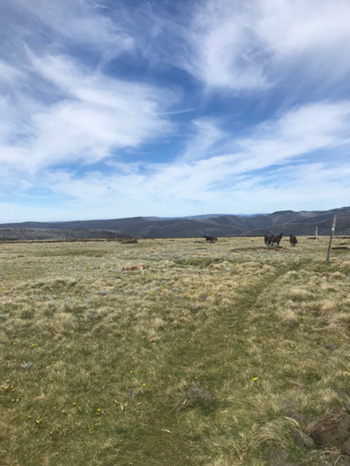
My mind and body were wandering, past Mt Jim, on the trail towards Mount Hotham (Figure 1). As I glanced up and surveyed the trail ahead, I realised I was being watched. A mob of horses had been basking in the sun and we had interrupted their lunch. They started snorting and getting a little antsy. I realised it was because a foal was asleep in the grass between us and the mob and we were continuing to walk towards it. The mare snorted more warnings, wanting to protect its young. The other horses placed their bodies between us and the other foals…
Encountering horses on the Bogong High Plains. Photo by the author.

I cannot think like a horse, but through encounters, such as the one I sketched above, I can consider a horse on its terms. They are intelligent and perceptive. They can perceive a threat, feel things and care for their kin (signs of animal sentienceFootnote 7). They live in communities and have social responsibilities. I have often referred to them as feral and destructive, but that is a human label. Horses do not consider themselves as pests or ferals, and like other creatures of the world, are trying to eke out an existence the only way they know how: ‘ferals do not recognise themselves by that name’ (Probyn-Rapsey, Reference Probyn-Rapsey2016, p. 19). As Peterson (Reference Peterson2019) highlights, ‘animals are not objects but sentient, active agents who have interests of their own and that do not always act in accordance with human preferences and values’ (p. 130). To have an encounter such as the one sketched above is different from thinking at the population level, considering the destructive potential of large numbers of horses across the AA.
An encounter with a family of horses opens some conversations. For example, the horses met above did not seem ‘feral’ but behaved in a relatable way. The label feral changes the perception of the animal. Probyn-Rapsey (Reference Probyn-Rapsey2016) discusses that the category of feral, when applied to animals, opens them up to greater cruelty, placing them inside an ‘ethical vacuum’ and opening them to ‘being exterminable’ or ‘killable’ (p. 18–19). Ferals do not fit inside an ‘imagined norm’ (Probyn-Rapsey, Reference Probyn-Rapsey2016, p. 21). And, as such, horses could be described as a problem animal, as they do not fit everyone’s idea of ‘nature’.
Peterson (Reference Peterson2019) discusses ‘problem animals’, explaining that ‘conservationists value nature selectively. Many share an ecocentric perspective that values individual creatures based on their contribution to the greater ecological good. Good animals are wild, native, and in the right numbers in their proper landscapes’ (p. 129). From this value judgment, horses fit outside of idealised nature. This opens an ethical conundrum, highlighting the degrees of (non)anthropocentrism and the difficulty with shaking anthropocentrism: ‘even ecocentric approaches to valuing nature can reinforce human interests and preferences’ (Peterson, Reference Peterson2019, p. 130). Conservation ethics still has an underlying assumption that humans know what is best when it comes to environmental management (Peterson, Reference Peterson2019). But feral acts of survival are a sign of resilience and defiance to domestication (Fawcett, Reference Fawcett, McKenzie, Hart, Bai and Jickling2009).
It could be argued that humans are just as much a threat to the Alps as horses — whether it is building the proposed pumped hydro-electrical project of Snowy 2.0, alpine ski resorts, human-induced climate change, bushwalkers bringing weeds or also trampling vegetation. It can also be argued that horses are not the greatest ecological threat, with deer and pigs also causing much ecological damage (from a conservation perspective). Such arguments move the spotlight off horses. Conversely, to focus too much on horses would be horse-centric and against a relational consideration of the environmental context. From a posthuman perspective, agency is distributed and no thing acts alone (Barad, Reference Barad2007; Bennet, Reference Bennett2010). So, I will expand my gaze to consider horse material relationships with others.
Sketch Two: Multispecies Communities
To be able to listen to non-human sentient beings’ voices and habitats, humans have to re-enter those worlds. Not as master storytellers or superior species, but as students. (Weaver & Snaza Reference Weaver and Snaza2017, p. 1060)
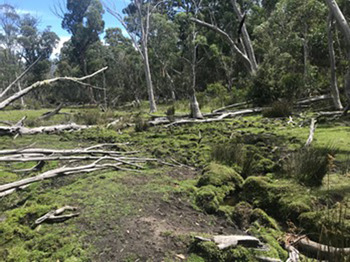
Our group was searching for the headwaters of the Murray River. We had left a 4wd track and were walking via a compass bearing through the bush. Horse tracks made it easier for us to travel, with well-worn paths heading the direction our compasses pointed. There was a clear gully ahead. The gully had a small trickling stream in the middle, surrounded by pugging – signs of horses (Figure 2). We followed the stream (what we thought to be the upper reaches of the Murray River) to where it bubbled out of the ground – the start of a 2,508 km journey to the sea. Just above the spring was a large wallow. More signs of horses making themselves comfortable. After 9 days to get to this point we shared feelings of wonder at the spring and shock at the disturbance caused by horses.
Near the headwaters of the Murray River. Image by the author, 11th of February 2019.

Horses have the capacity to act and affect in ways described in the last sketch — the ability to produce emotive responses and have humans empathise with their lives. But the horses have other capacities as well. It is not the horse itself (what it is) that is the focus of this section, but what a horse does (materially) as part of the landscape of the AA. What a horse does is always in relation to other things in the alpine landscape. For me as an educator, encountering signs of horses in waterways opens opportunities for reading the material landscape. Educators may take these opportunities to guide students’ attention to the material details and help students interpret what such material relations produce. Why is it important to consider the material relations? As Slattery (Reference Slattery2019) states, ‘the uninformed visitor or citizen who knows little of ecology, history or land management, overblown, selective cultural claims interpreting the historic value of the mountains speak louder than the science’ (p. 7). And so the material relations I observe are to do with alpine ecologies. I am not going to state that science has the ultimate God-like view of ‘seeing everything from nowhere’ (Haraway, Reference Haraway1988, p. 581), but it would also be an error to ignore specific scientific viewpoints in this discussion. Therefore, here I aim to engage productively with some scientific studies rather than critique science.
Simply, horses do not live in isolation, separate from the alpine landscape. To move a gaze from horses (singular), to horses and… (horses always in relation to their surrounds) opens up the environmental context and the perspective of conservation discourse. Some historical background may help understand aspects of a scientific approach to land conservation in the Alps. Historically, grazing was banned from alpine areas in KNP as the hard hoofs of cattle and horses used by cattlemen caused damage to valuable water catchments. As Slattery (Reference Slattery2019) aptly points out, ‘it is ironic that this generation has again allowed a major exotic animal grazing issue to build up to such an extent, apparently in ignorance of their own recent history’ (p. 8). Horses’ physical bodies impose consequences on the landscape and its native inhabitants through the disturbances they create. Disturbance, as Tsing (Reference Tsing2015) explains, ‘is a change in environmental conditions that causes a pronounced change in an ecosystem’ (p. 160). Sometimes disturbance is positive, prompting new life (e.g., certain types of fire in mountain ash forests), but disturbance can also be destructive and limit diversity and multispecies flourishing. Tsing reminds me that disturbance (as an analytical tool) requires awareness of the observer’s perspective.
From a horse perspective, they make themselves at home through pugging and wallowing; however, in such a process they also trample vegetation and defecate. Cherubin, Venn, Driscoll, Doherty and Ritchie (Reference Cherubin, Venn, Driscoll, Doherty and Ritchie2019) see such acts as disturbance, explaining the consequence is damage to alpine vegetation and waterways, which also impacts other species that call these places home. In particular, Robertson, Wright, Brown, Yuen and Tongway (Reference Robertson, Wright, Brown, Yuen and Tongway2019) state that one of the most significant impacts of horses is the damage they cause to sphagnum bogs and fens (an endangered ecological community). Sphagnum bogs and fens are crucial to alpine waterways as they act as large sponges or soaks — these are a source of many of eastern Australia’s largest river systems.
These ‘sponges’ occur in treeless basins of alpine and subalpine environments, absorbing and holding large amounts of water. They regulate the water flow and retain silt, peaty soils and decaying organic materials (Slattery, Reference Slattery2015). The water is slowly released year-round, flowing across much of eastern Australia. Although alpine areas make up a minority of catchment size, they provide the majority of water volume to streamflow, with some fen peats being 15,000 years old (Costin, Gray, Totterdell, & Wimbush, Reference Costin, Gray, Totterdell and Wimbush2017). The traits of these areas make them susceptible to damage from horses and other hard-hooved animals, which have adapted over long periods of time without such animals. Cherubin et al. (Reference Cherubin, Venn, Driscoll, Doherty and Ritchie2019) found that most of the impacts and activity in sphagnum bogs (in their research area) were attributed to horses, not other introduced herbivores. Impacts include trampling, channelling, spreading weed species through faeces and altering/driving vegetation change. These environments are water catchments used as a resource by humans and also habitat for animals other than horses.
The alpine water skink is the one whose habitat is affected. They are a robust little lizard (less than 10 cm) that digs burrows into or under sphagnum moss (Meredith, Hudson, Robertson, & Clemann, Reference Meredith, Hudson, Robertson and Clemann2003). The broad-toothed rat, a tubby critter with a gentle demeanour similar to a guinea pig (OEH, 2017), is another affected species. These two species warrant our attention when thinking with the AA as they are caught up in this relational web. Recent research by Cherubin et al. (Reference Cherubin, Venn, Driscoll, Doherty and Ritchie2019) explains that the impact of horses on sphagnum bogs and fens can negatively influence the presence and abundance of such native inhabitants. Schulz, Schroder and Green (Reference Schulz, Schroder and Green2019) also conducted a study examining the impact of horses on the broad-toothed rat and their various habitats. Schulz et al. (Reference Schulz, Schroder and Green2019) compared the abundance of the broad-toothed rat to the level of horse impact, finding the ‘level of feral horse impact had an overwhelming negative impact on broad-toothed rat occurrence’ (p. 33). Schulz et al. (Reference Schulz, Schroder and Green2019) further stated that ‘the decline in occupancy with increasing horse impacts suggests that feral horse impacts drive local population extinctions’ (p. 34). Furthermore, the loss of vegetation density due to horse grazing and trampling can also impact on the development of the subnivean space beneath the winter snowpack, resulting in loss of habitat and changes in snowpack.
The northern corroboree frog, known for its striking yellow and black colouring, is another one whose habitat is disturbed by horses. Already ravaged by the introduced amphibian chytrid fungus, the northern corroboree frog is on the verge of extinction and faces multiple stressors, with numbers declining over the last few decades due to drought, habitat loss, climate change and the fungus (Foster & Steele, Reference Foster and Scheele2019). Foster and Steele (Reference Foster and Scheele2019) compared habitat protected and unprotected by horse exclusion plots. Their results provide evidence of horses impacting both the quality and quantity of breeding habitat for the critically endangered species. The increase in horses also poses risks to the frogs due to direct trampling. Foster and Steele state that horse impacts on the alpine environment may compound other threats to the ecosystem.
Horses live as part of multispecies communities — webs of life. They are part of actual worlds lived by a range of other species that are often overlooked. The introductions I have made above are brief and limited, with there being other species that may be impacted directly and indirectly by horses. Some of these include the threatened alpine tree frog, alpine bog skink, alpine she-oak skink and alpine spiny crayfish (Robertson et al., Reference Robertson, Wright, Brown, Yuen and Tongway2019). The southern corroboree frog is another critically endangered frog species that resides only in the KNP (Hunter, Osborne, Smith, & MacDougall, Reference Hunter, Osborne, Smith and McDougall2009). The unfortunate fact is that many of the species and habitats I have mentioned are endemic to Australian alpine environments, environments that have adapted over millions of years without hard-hoofed ungulates. With alpine areas covering just 0.3% of Australia’s landmass (Slattery, Reference Slattery2015), these species have nowhere else to go. The threat of extinction is real. It matters who is bound up with whom and in what ways (van Dooren, Reference van Dooren2014). Extinction is not a singular moment, but an elongated drawn-out process of suffering and loss (van Dooren, Reference van Dooren2014). Multiple species are experiencing this loss and it is worth environmental educators paying attention to the lifeways that are disappearing and caring about what happens. Conversations that touch on such topics are central to my OEE practice walking and skiing through the AA with university students. This practice is an experiential and embodied method for encountering these multispecies communities and carefully considering the more-than-human world.
Sketch Three: Colonial Heritage
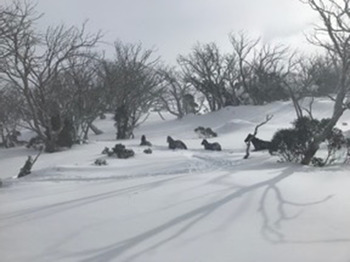
‘Look! Brumbies!’ said one of our group. ‘Aren’t they beautiful?’ Even though we were near dead horse gap, these horses were very much alive (Figure 3). ‘They are pretty tough to survive out here through such a storm!’ said another. They were a spectacular sight, large dark beasts contrasting against the stark white backdrop. They were wild animals in a wild landscape. The aesthetic image of horses in the Alps is powerful and part of the cultural attachment. Also, these animals are just battling to survive in a foreign land like European settlers.
Horses encountered in the snow near Dead Horse Gap on an OEE ski tour. Image by the author.

This section is opened by a picturesque scene and is my entryway into the topic of cultural heritage in the AA. In the OEE context such as the one I sketch above, I have students with a range of cultural perspectives join me in the AA. I have had past students whose family are former mountain cattlemen, horse lovers and also passionate conservationists. Their world views and others are complex to navigate in an educational setting. The cultural perspectives inevitably combine during conversations in the AA and thinking with the landscape is inevitably entangled with cultural discourses, hence, the foray into this discussion.
Heritage, as a concept, refers to the meaning ascribed to ‘material relics’ (Menzies, Reference Menzies, Guest and Mattfeld2019, p. 201). ‘Brumbies’ as a living material relic offer a symbol of national heritage and cultural value, which Menzies (Reference Menzies, Guest and Mattfeld2019) describes as an ‘avatar of belonging’ for white Australians (p. 201). The framing of brumbies as cultural heritage offers an insight into the narratives and discourses surrounding Australian heritage. Taking a critical standpoint, I suggest this may be a neocolonial (Ponzanesi, Reference Ponzanesi, Braidotti and Hlavajova2018) attitude of reinscribing hegemonic values by glorifying colonial remains — a form of environmental imperialism. Horses were introduced during colonial settlement — just a few hundred years ago — and now offer a form of colonial heritage, a reminder of the varied damage many European introductions have had on the Australian landscape. From a postcolonial standpoint, I am concerned that promoting horses has a darker side. By championing brumbies, are we not subjugating the Indigenous flora and fauna species, natural heritage and Indigenous cultural heritage? Is the value for the brumby as heritage an unacknowledged ‘species-ism’ (Braidotti, Reference Braidotti2013, p. 71)? The cultural aspect of the debate stirs up trouble and prompts me to question whose cultural heritage are we talking about?
For something to be recognised as heritage in Australia, it needs to be assessed against set criteria and of outstanding value to the nation. What I wish to emphasise is that ‘value’ is based on perception and that from a conservation perspective Australians might need a reevaluation (if Australia’s natural history is to matter [Stewart, Reference Stewart2006]). The iconography of ‘brumbies’ can mask the damage they cause to the landscape (Straight Talk, 2015). For Menzies (Reference Menzies, Guest and Mattfeld2019), the affective power of the horse in the Australian imaginary also instils settler Australians with a feeling of belonging — the co-constitutive power of the horse–human relationship. This power is crucial, as ‘belonging’ for settler Australians has been hard-fought, with the Australian environment offering fierce competition to European desires. As Flannery (Reference Flannery2003) states:
The Man from Snowy River is an archetypal Australian hero — one of the brave Aussies who tamed the rugged land. He sits side by side with the archetypal stockman in our constellation of national icons. We even have an entire museum at Longreach, Queensland devoted to the adulation of such men. Yet our worship of the self-reliant stockman neatly sidesteps the fact that the men of the cattle frontier were the shock troops in our Aboriginal wars. As Henry Reynolds has so amply demonstrated, during our frontier wars — the only wars ever fought on Australian soil — thousands of men, women and children were killed in battle or murdered in cold blood. There is a deep current in our colonial Australian society that resists these simple facts and clings to the great founding lie. (pp. 6–7)
The popularity and heroism of masculine men and their horses seem to be a dominant trope in the Australian psyche (Welberry, Reference Welberry2005). Stories such as The Man from Snowy River (Paterson, Reference Paterson1890) are examples of the hard-fought accomplishment of pioneering in the face of the wild bush. Yet, as Stewart (Reference Stewart2004) explains, ‘Eurocentric model[’s] of understanding and relating to the land has been an ecological failure in Australia’ (p. 48). What other stories can we explore? What other avatars of belonging (Menzies, Reference Menzies, Guest and Mattfeld2019) may we develop? Can we not develop attachment and care for something such as the broad-toothed rat? Or is the unfortunate naming of ‘rat’ too much to overcome?
An Indigenous story of relating — The Learning Walk — told by Aunty Rachel Mullett (Reference Mullett2014) of the Monero people — tells a different tale of belonging with the landscape around what is now known as Kosciuszko. In Aunty Rachel Mullett’s story, she describes the cultural performance of travelling through the landscape, living with and learning from the land and understanding its seasons and rhythms. I do not intend to romanticise Indigenous culture; however, this example read in juxtaposition with The Man from Snowy River offers two different and contrasting ways of being and belonging with the Australian landscape. Bruce Pascoe’s (Reference Pascoe2018) Dark Emu: Aboriginal Australia and the birth of agriculture offers another example of Indigenous relationships with the land contrasting to settler Australians, confronting the lie of colonisation that is often told — the lie of terra nullius and Indigenous apathy to the colonisers invasion. Maybe settler Australians need to develop other ways of relating to the Australian landscape.
Welberry (Reference Welberry2005) and Flannery (Reference Flannery2003) both argue that settler Australians hang their identities on cultural imaginaries. Welberry states the ‘“best” intruder (silver horse/Jim CraigFootnote 8) could “earn the right” to live in a privileged virgin space through demonstrating the ability to “read” and survive the landscape’ (p. 23). However, colonisers and early settlers forcibly took the land, hardly ‘earning the right’. In contrast, Pascoe’s (Reference Pascoe2018) research shows Indigenous people did not just survive, Indigenous culture thrived for 40–80 thousand years before European colonisation (invasion). Thriving for such a period also provides evidence of a sustainable lifestyle, something that seems elusive for our current society. Stewart (Reference Stewart2004), drawing upon ecofeminist Val Plumwood, explains non-Indigenous Australians could learn from Indigenous Australians about ‘how to relate to and understand the land without appropriating their knowledge’ (p. 48). Richard Swain, an Aboriginal man born and bred in the Snowy mountains,Footnote 9 argues that all Australians could cultivate heritage value for native species and landscapes instead of misplacing heritage value in a destructive pest (personal communication, 13 February and 22 November 2019). Richard suggests that caring for the Country and the Australian landscape (not including introduced species) does not have to be a uniquely Indigenous thing. Australians embracing native species and caring for their ways of life may be a decolonising project (Cattelino, Reference Cattelino, Heise, Christensen and Niemann2017).
Sketch Four: Necropolitics and Ethical Paradoxes
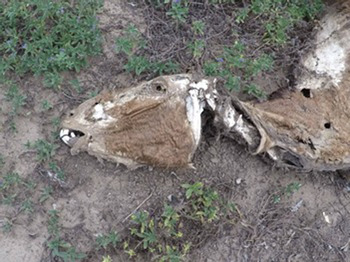
The smell of decay hits suddenly. The beating sun bakes a carcass ahead of us. The body is unmistakably another horse (Figure 4). We have seen about eight in the past few days, as we have walked along the Snowy River, upstream of Moyangul. The heat is relentless and the landscape bone dry — it’s no wonder the horses are doing it tough here. We are on day 15 of our walk and have traversed the alpine, sub-alpine and montane regions of the KNP. We are now in the dry rain shadow area of the Snowy River. The signs of horses are everywhere — despite being very remote, this is no pristine wilderness.
Horse next to the Snowy River, near Paupong Creek. Photo by Kane Harris.

Encountering dead horses provides an entryway into discussions on necropolitics (the politics of living and dying), a discussion that also broaches environmental ethics in this case. Necropolitics, according to Quinan (Reference Quinan, Braidotti and Hlavajova2018), ‘asks who gets to live and who must die (or who must live and who is let die), in the contemporary political economy’ (p. 271). For the horses of the AA, there are contrasting perspectives across the borders of Victoria and New South Wales (NSW). In the KNP in NSW, horses are somewhat protected as cultural heritage via the Kosciuszko wild horse heritage act introduced in 2018. The legislation mandates sustainable horse numbers in the park. Whereas in Victoria, after a federal court battle ending in May 2020, Parks Victoria was allowed to manage horse numbers, removing all horses from certain areas. I will not delve into the details of each state as it is beyond the scope of this paper and continually dynamic; however, the most controversial aspect of this dilemma is culling.
The scientific discourse, largely speaking, supports culling as a management practice (e.g., Driscoll et al., Reference Driscoll, Worboys, Allan, Banks, Beeton, Cherubin and Williams2019). Beeton and Johnson’s (Reference Beeton and Johnson2019) research conducted modelling for a range of management strategies, concluding that culling is the most efficient and cost-effective method of management. Fertility control is not seen as viable by some as it takes a long time for populations to decline (Hobbs & Hinds, Reference Hobbs and Hinds2018). On the other hand, brumby advocates (including animal rights activists) are staunchly opposed to culling (this can be evidenced in many ways, especially in the media and petitions at the time of writing, e.g., Schubert, Reference Schubert2020). The main concerns tend to be the horse’s heritage value, the welfare of horses and the inhumanity of culling.Footnote 10 The welfare of horses is also a concern for scientists (in a different form) in fire-ravaged, drought-stricken and overpopulated areas of the AA. Stuck in the middle of the volatile human debate is the horses and the other species of the AA. Among many things, this is a dilemma of competing ethical paradigms.
The investigation of Driscoll et al. (Reference Driscoll, Worboys, Allan, Banks, Beeton, Cherubin and Williams2019) explores and evaluates the ethical and social aspects of horse culling from a conservation standpoint, stating they think ‘barriers to culling appear to be unfounded’ (p. 64). The values of Driscoll et al. (Reference Driscoll, Worboys, Allan, Banks, Beeton, Cherubin and Williams2019) are with the health of the ecosystem (not including horses), supported by scientific evidence. It is worth quoting Driscoll et al. (Reference Driscoll, Worboys, Allan, Banks, Beeton, Cherubin and Williams2019) to understand this argument:
Unlike native animals, feral horses have been placed in the alpine parks by people and allowed to multiply to their thousands by ineffective management. We therefore argue that feral horse suffering cannot be dismissed as just a natural process in the wild; people are directly responsible, and ethically culpable for feral horses being in situations where they face extreme suffering and death. (p. 67)
The extreme suffering and death Driscoll et al. (Reference Driscoll, Worboys, Allan, Banks, Beeton, Cherubin and Williams2019) refer to is due to the conditions horses face through trapping and rehoming, where many horses do not get rehomed and end up going to abattoirs.Footnote 11 Furthermore, as the image in Figure 4 points out, some of the drier drought-stricken areas of the AA (as not all ecologies of the Alps are the same) provide conditions of suffering for horses due to the lack of viable feed, creating harsh conditions of living and dying. For Driscoll et al. (Reference Driscoll, Worboys, Allan, Banks, Beeton, Cherubin and Williams2019), they call these conditions, without culling, ‘a landscape of suffering’ (p. 68).
The horse issue presents a paradox from multiple angles. Firstly, leaving space open for horses may result in the suffering of those horses and the other species (including endangered ones) that live in the shared places of the AA; opening space for the survival of other native and endangered species in the AA may require the removal and death of horses. Driscoll et al. (Reference Driscoll, Worboys, Allan, Banks, Beeton, Cherubin and Williams2019) offer a ‘complete ethical equation’:
the balance between the mostly instantaneous death of aerial culling against:
(i) the prolonged suffering of horses in the alpine parks, especially at times of stress; (ii) the suffering of native animals affected by the horses and; (iii) the ethics of damage to water catchments and threatened ecosystems, and increasing the risk that species will become extinct (Fraser & MacRae, 2011; Fraser, 2012). (p. 67)
The argument — scientifically, culturally and ethically — is complex; from a multiplicity of angles living and dying will occur.
There is also an assumption from the scientific viewpoint that humans have the position to observe, decide and act on behalf of other species. This presents another paradox for posthuman modes of thought which aim to challenge human exceptionalism and want to rethink ways of being human (including relationships with the more-than-human world). Van Dooren (Reference van Dooren2019) raises relevant points surrounding management (in general), stating that management implies human control, and possibly even mastery over the environment (a worry for ecofeminists). Van Dooren has concerns over human stewardship, entitlement or right to the earth, conveying a more bio-egalitarian viewpoint. He states the earth is ‘not ours to sort out’, however ‘as earthly inhabitants like any others, we must still alter places and have impacts and ideas about how things might be’ (p. 124). To do nothing and expect everything to work out positively for all may be enforcing a nature–culture divide, where humans should separate themselves from ‘nature’. On the other hand, if humans are of the world, we might have a responsibility to attend to the messes we humans have played a part in creating. This point segues well into further discussions of responsibility.
Who gets to live and who is to die, and how? Death is inevitable, but Haraway’s (Reference Haraway2016) idiom of ‘living and dying well’ serves this discussion. Are horses currently living and dying well? Could it be defined as ‘well’, healthily or humanely? Or does it involve pain, suffering or stress? There is no universal answer to these questions. I am further prompted by Haraway (Reference Haraway2016) in asking does the horse’s presence in alpine areas encourage ‘multispecies flourishing’ (p. 3) or ‘multispecies wellbeing’ (p. 51)? For me, to think with the landscape is to consider if, on the whole, it is flourishing as an environment. Are the lesser known species, the rare, endangered and fragile ones, left with space to survive? Van Dooren (Reference van Dooren2019) reminds me that ‘not all possibilities (ideals, perspectives, projects, even bodies) are compatible, capable of mutual flourishing in the same placetimes’ (p. 56) — living for some comes at the expense of others.
As with Braidotti (Reference Braidotti2013), I am also aware ‘that we live in the era of the Anthropocene, that is to say an age when the earth’s ecological balance is directly regulated by humanity’ (p. 79). The circumstances of living and dying are valuable and important to think through, especially for OEE students. Are horses in the Alps expendableFootnote 12 or replaceable? Is culling (killing) them (ethically) acceptable? Are species such as the broad-toothed rat or the corroboree frog just needier endangered beings? Are native species expendable? Are native species just a human construction based on a limited temporal scale, contained by human-made borders? Van Dooren (Reference van Dooren2014) warns of the problematic nature of ‘trumping’ endangered species over others, justifying mass death in the name of conservation (p. 160). Elsewhere, van Dooren (Reference van Dooren2011) queries whether invasive species, those deemed to be out of place, are illegitimate life. Van Dooren is not an advocate for feral or invasive species, but he does ask difficult and illuminating questions. All the choices — management or lack of management in various forms — are not value-free and there is not a situation where everyone (human and nonhuman) is innocent, equal or wins. Ultimately I am reminded by van Dooren and Rose (Reference van Dooren and Rose2016) that good, and even ethical, responses are ‘always context specific and relational’ (p. 90). The same goes for confronting education within this context that broaches such topics.
What responsibility do educators have? I find Affifi’s (Reference Affifi2020) words particularly helpful here: ‘Rather than setting out to defend one pole of a crude dichotomy, the challenge lies in identifying concrete situations, given thoughts, experiences, models, practices, and pedagogical experiences’ (p. 3). In such situations, we may attempt to ‘foreground and background the human, [contemplate] how these ways interact with one another, and what effects this has on people and the planet’ (p. 3). Affifi explains that what is left is a ‘series of overlapping micro-dichotomies that shift and interact, forever banished from the a priori comfort of a totalising position by which to prescribe thought or pedagogy’ (p. 3). Moreover, part of my educational philosophy values questions as much, if not more, than any answer, as questions provoke thought. Thus, I find it particularly generative to dive into such complexity, educating with the various perspectives and intricacies to do with the landscape and its issues while encouraging students to think through and formulate their own (educated) understandings and subjectivities. Drawing upon Fien (Reference Fien1995), environmental education, no matter what form it takes, is never value-free. As such, I admit my teachings are not value-free, unbiased or completely objective — I have a viewpoint, developed over years of living, working and researching the AA. This entangles my pedagogical approaches and researcher subjectivity, with this paper being a partial example of my ruminations on this topic.
Thinking Beyond Horses: Fostering Sustainable Relations
This paper has enacted thinking with a landscape — a concept utilised to consider the AA and the horse problem. The sketches from the AA have been our entryway into the landscape and a problematic multispecies situation. My discussions have explored the horse issue as one complex layer of the AA’s natural history. Following Stewart (Reference Stewart2006), I think Australia’s natural history matters and I have aimed to attend to the landscape with care via a postcolonial sensibility. This natural history is layered with ethical and political complexity but is a rich topic to consider. In truth, I know I have not accounted for everything relating to horses (let alone the AA and the endemic species there) and this will continue to be an ongoing line of discussion.
My investigation has been situated and partial, a finite point of view from somewhere (Haraway, Reference Haraway1988; Ulmer, Reference Ulmer2017). On a personal level, I also acknowledge that my viewpoint may not be fully ‘posthuman’. I tend to agree more with the scientific consensus and postcolonial angle on this topic, with my concern more with the species labelled native than those considered introduced. This may be counter posthuman and not completely bio-egalitarian, but it is a contradiction I am willing to accommodate. Affifi (Reference Affifi2020) helps me sit with this thinking. He offers an extreme thought experiment: ‘Can you imagine some wily nonanthropocentrist defending the existence of nuclear waste or the Great Pacific Garbage Patch on the grounds that such material is ‘of’ the world as much as anything else?’ (p. 2). Horses are a less extreme example but still on this spectrum. Because horses are of the earth do they need protection in the AA? In the situated example I have portrayed, I do backpedal away from a prohorse perspective in favour of management for the welfare of the broader landscape and its natural history.
Nonetheless, my objective of employing a posthuman methodological sensibility has enabled me to consider alternate ways of conducting educational research. Furthermore, a posthuman sensibility has prompted me to think with animals and landscapes, allowing entryways to critically examine situated OEE contexts and navigate the complexity of precarious times. We have inherited these complex conditions and we have choices to make for our shared (multispecies) futures. There is a lot at stake and I believe that it is important to invite students into this thinking. As Haraway (Reference Haraway2016) advocates, through ‘passion and action, detachment and attachment’, we may develop abilities to respond (p. 34). One approach, which educators may work towards, is to reimagine and develop different ways of thinking and relating with Australian (and global) landscapes, including its native, threatened, endangered and feral species.
Acknowledgements
I would like to thank Alistair Stewart, Marcus Morse, Deirdre Slattery and Carmel Diezmann for the valuable advice offered on previous versions of this paper. Your feedback has greatly helped its development. I also benefited greatly from conversations with Richard Swain, Kathleen Pleasants, Don Butcher and Ya Reeves (among many others) in writing this paper. Lastly, I thank the anonymous reviewers for their detailed feedback which greatly improved this paper.
Financial Support
This research was supported by an Australian Government Research Training Program Scholarship.
Conflicts of Interest
None.
Scott Jukes is a lecturer and PhD student at La Trobe University, teaching in alpine and river environments. He is interested in how students engage with environmental problems and creating positive educational experiences. Scott’s research focuses on outdoor environmental education pedagogies, posthuman methodologies and new materialist thinking.