In ‘“You Are Here’: H.I.J.O.S. and the DNA of Performance,” a chapter in The Archive and the Repertoire, Diana Taylor locates the intergenerational transfer of traumatic memory relating to Argentina's Dirty War geographically with a map—identifying, for example, where tens of thousands opposed to the country's military dictatorship (one-third of them women) were made to disappearFootnote 1—but she also locates this transfer genealogically and even genetically, in terms of the bodies of surviving relatives who remain as visible evidence (quite literally, through family photographs) of the material existence of their missing parents and children. Like Taylor, I attend to both the physical geography and the embodied genealogy of cultural memory in this article, which is concerned with making connections between the hemispheric traffic in missing and murdered Indigenous women of the Americas. I want to begin by acknowledging some of the sites of individual trauma and various sights of collective protest and witnessing related to this topic.
Highway 16 stretches across the north of the province of British Columbia for more than 1,200 kilometers, beginning at Yellowhead Pass along the border with Alberta and continuing west to Prince Rupert. Across the Hecate Strait, on Haida Gwaii, the highway stretches for another 100 kilometers or so, proceeding south from Masset to Skidgate. However, it is the long, lonely 800-kilometer stretch of road that extends from Prince George to Prince Rupert that has earned Highway 16 the name by which it is more commonly known: the Highway of Tears. Since 1969, at least eighteen and likely more than forty women and young girls, mostly Aboriginal, have been murdered or have disappeared along this particular section of the highway.Footnote 2 In March 2006, a Highway of Tears Symposium held in Prince George involving provincial and federal law enforcement agencies and members of First Nations communities produced a list of thirty-three recommendations that have so far not been acted upon.Footnote 3 In part to protest this delay, a delegation of First Nations and women's activists descended on Parliament Hill in Ottawa the following September under the auspices of Walk4Justice, a nonprofit organization founded by Gladys Radek and Bernie Williams. Walk4Justice has called for a public inquiry into not just British Columbia's Highway of Tears but also the larger crisis of missing and murdered Aboriginal women across Canada; the Native Women's Association of Canada now estimates the total of such women to be close to six hundred.Footnote 4 Like the Women's Memorial March held every Valentine's Day to honor the lives lost in Vancouver's Downtown Eastside (which I discuss below) and like the vigils of the Madres de Plaza de Mayo and H.I.J.O.S. (Hijos por la Identidad y la Justicia contra el Olvido y el Silencio) in Argentina that Taylor discusses, the march on Ottawa was notable for how relatives brandished photos of lost loved ones, which both “work to reappear those who have been erased from history itself” and “make visible the lasting trauma suffered by [their] families . . . and the country as a whole.”Footnote 5
As commemorations of collective national trauma, these marches also adhere to what Paul Connerton has referred to as a performative rhetoric of ritual reenactment that has distinct calendrical, verbal, and gestural qualities and that, in giving embodied form to the past through a temporary suspension of clock time through the liminal state of ritual time, are re-presentational rather than representational.Footnote 6 In other words, the marches help shape communal memory as a “present past”Footnote 7 that can hold different memorial “scenes” from different historical time periods in contiguous, palimpsestic, or “repertory” relation. This is similar to what Marianne Hirsch has identified as the phenomenon of “postmemory,” in which subsequent generations experience the memories (again, most often traumatic) of their forebears as their own.Footnote 8 In this context, Indigenous women's cultural inheritance in British Columbia is dominated by systemic violence and death. In this article I am concerned with the imaginative uses to which that inheritance has been put by a generation of Aboriginal women artists who are deeply invested in reframing a memorial past as the starting place for present-day political action.
Part of that reframing, I argue, has to do with the politics of performance and with how modern Canadian theatre history, at least in its post-1967 English-language form, is shaped by the same commemorative repertoire as the marches I have just described. I contend that in writing for and about the theatre in Canada one cannot help but confront the ambiguous and paradoxical memorial project that is George Ryga's The Ecstasy of Rita Joe, a play that in supposedly inaugurating “indigenous” theatre making in English Canada placed the body of a dead Indigenous woman at its center. Rereading Ryga's text in repertory relation to a recent anniversary production of the play directed by Algonquin and Irish Canadian theatre artist Yvette Nolan, I argue that Nolan's directorial choices not only succeed in altering how we remember the title character's life and death but also belong on a larger performance continuum of Indigenous women artists from the Americas who write back to the representational archive of historical conquest and racism—one that sees (if and when it chooses to see) their mothers and sisters and daughters only as expendable victims. To this end, I follow my analysis of Ryga and Nolan with a discussion of works by Métis Canadian playwright Marie Clements and Anishinabe Canadian performance and visual artist Rebecca Belmore that specifically address the bodily materiality of the murdered and missing women of British Columbia. I then place those works in hemispheric relation to installations and videos by mestiza artist Teresa Margolles dedicated to the murdered and missing women of Latin America generally and of Juárez, Mexico, in particular. As all of these artists’ “re-membering” of the terms by which these women's apparently insignificant lives were lived is positioned deliberately against the spectacular (and sole) interest of local media in the eventfulness of their deaths, I also report directly from various journalistic accounts of this ongoing memorial scenario, if only to interrogate and make visible the alternative—and at times oppositional—narratives of (trans)national belonging buried within them.
In trying to pay attention to the bodies behind the headlines and in closely analyzing the representation of Indigenous women in written playscripts and newspaper documents alongside the politics and performance of their social realities on and off the stage, I take my lead from Taylor. In excavating from the past the repertoire of embodied acts that always exists in dynamic and metonymic relation to the archive of printed texts, Taylor posits using the terms “scene” and “scenario” as a way of moving beyond the impasse of script and performance, text and speech that has long bedeviled performance studies theorists and poststructuralist literary scholars.Footnote 9 Writing with particular reference to the scenarios of “discovery” and “conquest” that continue to haunt the plot of the Americas and to overdetermine various social dramas enacted therein, Taylor notes that whereas we can think of “scene” as referring to a physical location or environment (a street corner, a proscenium stage), “scenario” encompasses the setup and the action that frame and activate our interpretation of that scene. In other words, the scenario, as an embodied “act of transfer,” relocates us as spectators, placing us “within [the scene's] frame, implicating us in its ethics and politics” and forcing us to deal with the embodiment of the social actors in its plot.Footnote 10 As “meaning-making paradigms,” scenarios can be written down, according to Taylor, and their transmission certainly draws from communication systems integral to both the archive and the repertoire (writing, telling, [re-]enacting). This is why I include an analysis of single-authored theatrical playtexts alongside more participatory scenes of street theatre and collective political protest as part of the overall evental site of Indigenous cultural memory. At the same time, as a formulaic structure, the scenario predates the script and in its relocation and replaying from scene to scene (Smithers, Vancouver, Juárez) allows for revision, reversal, parody, and all manner of antimimetic ghostings. We shall see these things operating very clearly in the work of Nolan, Clements, Belmore, and Margolles.Footnote 11
Taylor, the Mexican-born daughter of Canadian expatriates, now directs the Hemispheric Institute of Performance and Politics at New York University. Her analysis of how contemporary performances of indigeneity allow us to connect histories of conquest and colonization to current practices of migration, globalization, and human rights activism throughout the Americas is an important intervention in Latin American area studies as they were hemispherically (and hegemonically) constituted by the United States during the cold war. And yet her professed desire in The Archive and the Repertoire to remap the “histories of the north and south as profoundly intertwined” does not extend to Canada.Footnote 12 This is a puzzling oversight, given that the “scenario of discovery” that she claims still haunts the AmericasFootnote 13 would seem less spectral than material north of the 49th parallel, where First Nations land claims are routinely contested in the courts, a Truth and Reconciliation Committee into abuse in residential schools is currently touring the country, and the prime minister's interest in “Arctic sovereignty” flies in the face of the social infrastructure the region really needs.
One of my goals in this article is to supplement Taylor's repertoire of embodied knowledges and performed behaviors in the Americas by focusing on the performance of Indigenous cultural memory in Canada and, more specifically, performances of Indigenous women's cultural memory in the nation's westernmost province of British Columbia. Many of the scenes that constitute this scenario are performative in an expressly legal and juridical sense. They extend from the punitive 1885 amendment of the Indian Act that banned the potlatch ceremony among the Heiltsuk, Haida, Nuxalk, Tlingit, Makah, Tsimshian, Nuu-chah-nulth, Kwakwaka'wakw, and Coast Salish First Nations of the Pacific Northwest (legislation that was then copied by the United States) to the corrective Delgamuukw Supreme Court decision of 1997 that recognized Aboriginal titles and the legitimacy of oral history in establishing the primacy of Aboriginal customary land tenure before and after settler colonial sovereignty.Footnote 14 Then, too, there are the present-day quasi-legal stages upon which expiation for past miscarriages of justice against Aboriginal communities is being enacted. These include the aforementioned Truth and Reconciliation Commission of CanadaFootnote 15 and the Missing Women Commission of Inquiry that recently concluded in Vancouver. This last scene is of most immediate consequence to this article.
In the early 1980s, vulnerable and at-risk women living on and off the street, many of them Aboriginal sex trade workers, began disappearing from the impoverished inner-city neighborhood of Vancouver's Downtown Eastside (DTES) at a rate of approximately two per year. However, despite substantial evidence and ongoing pressure from local community activists and relatives, Vancouver police initially refused to acknowledge a connection between the missing women from the DTES or to entertain the possibility that a serial murderer might be preying on them. It was only in 2001 that Vancouver's metropolitan police department (VPD), in conjunction with Canada's federal law enforcement agency, the Royal Canadian Mounted Police (RCMP), set up a special Missing Women Task Force, eventually compiling the names of more than sixty-five women who had disappeared. One year later, in February 2002, Robert Pickton was finally arrested in connection with the case after the most comprehensive forensic search in Canadian policing history turned up DNA evidence linked to the remains of several of the missing women on his farm in Port Coquitlam. He was initially charged with twenty-six counts of murder, but the judge presiding over the case eventually split the indictment into two parts, fearing that a single murder trial involving so many counts would overburden the jury. Pickton thus went on trial in January 2007 for the first-degree murder of just six women: Sereena Abotsway, Marnie Frey, Andrea Joesbury, Georgina Papin, Mona Wilson, and Brenda Wolfe. After a yearlong trial that heard from 128 witnesses, the jury returned a guilty verdict on all six counts on 9 December 2007. However, in doing so they reduced the charges to second-degree murder, leaving many to question how apparent serial killings could not be planned and premeditated. Following Pickton's sentencing to life in prison, Crown prosecutors announced that they would not proceed with a second trial on his twenty outstanding murder charges, a decision that angered friends and family of the victims. A final terrible irony hovering over the entire case is that at one point in 1997, Pickton had been in police custody on charges of stabbing a local prostitute; but those charges had been stayed and Pickton released, free to prey upon the women of the DTES for another four years.Footnote 16
In September 2010, the governing Liberal Party of British Columbia, after ten years of calls to do so, finally established an official commission of inquiry into the missing women of Vancouver's DTES and the handling of the case against Pickton. Wally Oppal, a former British Columbia Supreme Court judge and the province's attorney general until 2009, was appointed to head the commission. From the beginning, however, the proceedings were dogged by controversy, not least because the provincial government refused to provide legal funding for Aboriginal and other community groups wishing to make presentations to the commission beyond the representations of the two lawyers appointed to represent the families of the twenty-six identified victims of Pickton. In contrast, more than two dozen lawyers were appointed, at taxpayers’ expense, to represent police officers involved in the case. When all First Nations groups withdrew their support from the commission in protest, Métis lawyer Robyn Gervais was appointed to represent Aboriginal interests in August 2011. But Gervais resigned after only six months, arguing that too many police witnesses and too few Aboriginal witnesses had been called to testify at the commission. Throughout the debacle, Oppal, who had chaired a previous provincial inquiry into policing, exhibited a remarkably paternalistic attitude toward the concerns of Aboriginal and women's groups and about his own extracommission behavior, which included making a cameo appearance in a film about a serial killer.
The commission concluded its inquiry on 6 June 2012, and Oppal delivered his four-volume, 1,448-page report, Forsaken: The Report of the Missing Women Commission of Inquiry, the following December. Among other things, Oppal concluded that “systemic bias against the women who went missing from the DTES contributed to the critical police failures in the missing women investigations” and that this was “a manifestation of the broader patterns of systemic discrimination within Canadian society . . . reinforced by the political and public indifference to the plight of marginalized female victims.”Footnote 17 At the same time, Oppal, who had no mandate to investigate the discriminatory conduct or culpability of individuals, stated that he found “no evidence of widespread institutional bias in the VPD or the RCMP.”Footnote 18 Instead, he recommended that the two agencies commit to the creation of a single regional police force for greater Vancouver. He also called for the establishment of a healing fund and financial compensation for the children of victims.Footnote 19 And, in response to the commission's community consultations in northern British Columbia, Oppal urged the provincial government to implement fully and immediately the 2006 Highway of Tears Symposium Action Plan.Footnote 20 A year later, none of these recommendations has been acted on, and only three of the report's sixty-five other recommendations have been implemented.Footnote 21
Rita and Yvette
I have described who and what have been made to disappear in this latest scene in the ongoing scenario of the “vanishing Indian” in Canada in order to make clear that the performance of Indigenous memory in British Columbia must necessarily be set against a continuous historical backdrop of Aboriginal cultural genocide and, more particularly, femicide.Footnote 22 This same scenario is also at the heart of key scenes in Canadian theatre and performance history. One example is The Ecstasy of Rita Joe (1967), a work that several theatre historians, writing in the full flush of canon-building in the 1980s, claimed as foundational to modern English-Canadian drama.Footnote 23 The play, which was written by non-Aboriginal playwright George Ryga as a special commission for the new Vancouver Playhouse Theatre Company during Canada's centennial year and later remounted as the inaugural theatre production at the new National Arts Centre (NAC) in Ottawa in 1969, recounts the life and tragic death of its title character, a young Secwepemc (Shuswap) woman who has made her way from the reserve to the city in search of work but who quickly finds herself on the wrong side of the law. Throughout the play, Rita Joe is called upon to defend herself before a callous and increasingly impatient white magistrate on successive charges of vagrancy, theft, and prostitution. But it soon becomes clear that she is as much on trial for her insistent imposition of her family and cultural memories upon a social and political system that already wishes to forget her. This condemns her—via specious post hoc ergo propter hoc logic that the dreamlike temporality of the play explicitly questions—to the rape and murder that must necessarily be her fate. Within the next four years, the play was broadcast on CBC television, translated into French by leading Québécois playwright Gratien Gélinas, adapted by the Royal Winnipeg Ballet, and mounted to acclaim in Washington, D.C. Widely anthologized and often taught in postsecondary surveys of Canadian drama, the play has also received several high-profile remounts, including, most recently, a 2009 production directed by Yvette Nolan that traveled from British Columbia to the NAC in Ottawa. With this production, as I hope to show, Nolan succeeds in wresting the play from the representational archive to which it had been consigned, in which Rita (first played by a white actress) was a mute anthropological artifact of historical racism. Instead, Nolan places the text in repertory relation to the social continuum of sexual violence, systemic racism, and economic exploitation that is the material reality of Aboriginal women across Canada and to a performance continuum in which fellow Indigenous artists have likewise wrested from the archive of local media the terms by which these women's lives are remembered.
Given the relatively belated interest of those media in the women who began to go missing from Vancouver's DTES in the 1980s and 1990s, it is worth noting that Ryga's play had its genesis in a 1966 newspaper story that Vancouver Playhouse artistic director Malcolm Black read about the discovery of a murdered Aboriginal woman in a dumpster on Cordova Street. Moved by the account, Black commissioned Ryga to write a play exploring some of the scenarios that might have led to this tragic outcome.Footnote 24 The resulting script, what Ryga subsequently called “an odyssey through hell of an Indian woman,”Footnote 25 remains an important, if problematic, milestone in English-Canadian theatre history. Not only did its popular and critical success eventually convince other regional companies across the country to bet on and begin nurturing the voices of homegrown playwriting talents, but the play also dared to confront audiences with—and implicate them in—the systemic disenfranchisement of First Nations peoples via the dominant political and cultural institutions (religion, education, the law) settler culture had imposed on them. To this end, in his opening stage directions to the published text, Ryga stresses that at the start of the play both the front and back curtains should be up, along with the house and stage safety lights. Only after the cast has assembled onstage do the lights dim; this is followed by the lowering of a mountain cyclorama into place upstage, then a scrim featuring a cityscape in front of it. “This creates,” according to Ryga, “a sense of compression of stage into the auditorium.”Footnote 26 As the Magistrate enters and a Clerk announces that the court is now in session, the full meaning of this elaborate opening becomes clear: Rita is on trial and so are we, and we are to be each other's juries.
Another important hallmark of the play is that its socially realist content is counterpointed—and in some critics’ minds, structurally compromised—by its expressionistic style. For example, the cyclorama and scrim are meant to be supplemented by a sweeping circular ramp that encloses the center and downstage playing areas, most prominently the Magistrate's bench, and rises to a higher elevation upstage. This, together with the lack of scene breaks, the songs that “appear almost accidental” (9) in their accompaniment of the action, and the rich panoply of lighting effects—single spots to isolate Rita, different washes of color to announce a new memory crowding in, flashes of lightning that silhouette her murderers—allows Ryga to collapse the past within a continuous theatrical present that is contiguous with the social context of the audience. To this end, Rita's story unfolds as a series of flashbacks, a montage of scenes recalling her life on the reserve with her father, David, and her sister, Eileen; her initial excitement about making it to the city, where she meets up with and eventually moves in with her childhood friend Jaimie Paul; and the increasingly grave consequences of her persistent confoundment by the “rules here that was made before I was born” (54). As the Magistrate pronounces at the top of the play, the “quality of the law” when administered against Aboriginal peoples is not commensurate with “the real quality of the freedom” (10) it is reciprocally supposed to safeguard for them. Rita is before the Magistrate on a charge of solicitation, but the police officer testifying against her has actually entrapped her, giving her five dollars as she was trying to leave the city to go home and then arresting her.
Likewise, Jaimie, whose story parallels and fatally intersects with Rita's, learns that (white) mercy is never given unconditionally, just as it is not always gratefully received. Having come to the city, like Rita, to make his way in the world, Jaimie becomes frustrated by his inability to find a job and resentful that he must rely on the charity of Mr. Homer, a white man who runs a drop-in center for urban Aboriginals. Homer takes great pains early in the play to distinguish the real work he does from that of the liberal “do-gooders” (24), who are only seeking personal reward or the next photo opportunity. However, Jaimie eventually realizes that the food and clothing Mr. Homer bestows constitute a form of paternalism that is of a piece with the church's and the government's infantilization of Native peoples: “We're his kids an’ he means to keep it that way!” (70). Tired of wanting and not having, of standing in line but not being seen, Jaimie eventually says no to what Mr. Homer claims is given freely and without obligation: he helps incite a riot at the center and personally baits the white man until his underlying racism emerges in a vicious verbal attack on Rita (78).
Soon after this, Jaimie also leads Rita in saying a final no to their old life on the reservation, which he sees as part of the system “that makes us soft an’ easy to push this way . . . that way!” (82; ellipsis in original). These words are spoken to Rita's father, David Joe, who has come to the city to collect his daughter and take her home. Partly as the result of the highly poeticized speeches he is given—many of them quasi-fables involving extended animal imagery—and partly owing to the actor who played him in the original production—Dan George, the hereditary chief of the Tsleil-Waututh (formerly Burrard) First Nation, who later became famous for his Oscar-nominated role as Old Lodge Skins in the film Little Big Man—the character of David Joe has arguably become a synecdoche in Canadian theatre history not just for a lost Aboriginal culture but also for the play itself. Indeed, it is the image of Dan George as David Joe that continues to be reprinted on the cover of the Talonbooks edition of the play. But such a critical sleight of hand is not just a misreading of the play—which is careful, in scenes with Rita and her white teacher, Miss Donohue, and between Rita and the local priest to contextualize the competing and oppressive ideologies at work on the reserve. It is also a misreading of the documentary record of Chief Dan George's political involvement in the play and the ways in which, following from Rebecca Schneider's supple “re-do” of the relationship between the archive and the repertoire posited by Taylor, that photographic and textual record is both a performative remainder of the original production of Ecstasy and remains part of the repertoire of its subsequent performances.Footnote 27 In particular, a note by George included in the program for the 1967 Playhouse production and the preface he wrote for the published playtext make it clear that, as far as he is concerned, the play is not just an indictment of more than a hundred years of institutionalized racism and imposed poverty (the program note was adapted from a speech called “A Lament for Confederation”);Footnote 28 it is also a frank statement that the situation will not change until key questions of Aboriginal sovereignty and economic redress are tackled.
Those questions remain central to First Nations politics, especially in British Columbia, where a succession of modern treaties with different bands and ongoing disputes over resources have revealed just how high the stakes are for all levels of government regarding Aboriginal title. Nevertheless, for Colin Thomas, who reviewed a fortieth-anniversary production of Ecstasy at the Firehall Arts Centre in Vancouver in November 2007, Ryga's play “doesn't speak strongly to the present. . . . The play's Native characters lack understanding and agency—the script makes no mention of the residential-school system that did such damage to First Nations cultures, for instance—so they are lost in victimization, unable to take responsibility for their own lives.”Footnote 29 By contrast, Nolan, whose revival of the play two years later was timed to coincide with the fortieth anniversary of its first NAC staging, claims that the extent to which Ecstasy is a period piece has only to do with its 1960s-era expressionistic form, not its content:
Yes, I think Canadians would like to believe that we have evolved beyond the reality of Rita Joe. How adorable. Indeed, the missing and murdered women, the economically dead reserves that the people need to flee to try and make a living, the systemic obstacles to education and meaningful work, the diaspora. . . . How have we evolved since 1967? This is how: the only thing we changed in the text of Rita Joe was the cost of a room in Vancouver. Everything else stayed the same, and the audiences who saw it often forgot what time it was in.Footnote 30
Nolan's involvement in the coproduction that debuted in April 2009 at the Western Canada Theatre in Kamloops before traveling to the NAC in Ottawa later that spring began when Peter Hinton contacted her to discuss the play and its importance in Canadian theatre history. Since his appointment as artistic director of English theatre at the NAC in 2005, Hinton had taken steps to boost Aboriginal representation and programming at Canada's “national theatre,” although not without some missteps in terms of presumed artistic motives and resulting critical reception. He had directed a production of Métis playwright Marie Clements's Copper Thunderbird, about the life of Aboriginal visual artist Norval Morrisseau, during the 2006–7 season and partnered, in 2008, with Toronto's Native Earth Performing Arts (NEPA), of which Nolan was then managing artistic director, on an adaptation of Shakespeare's Julius Caesar called Death of a Chief. The latter production, which Nolan directed, was ecstatically received and played to virtually sold-out audiences in the NAC's smaller studio space. Finally, an all-Aboriginal King Lear—first conceived by actor August Schellenberg when he originated the role of Jaimie Paul in Ecstasy in Vancouver in 1967—was directed by Hinton in May 2012, during his final season. This Lear has been critiqued by many Aboriginal theatre artists in Canada, including Nolan, not least for its failure to include anyone from their community as part of its creative team and for its insensitivity, in its design and staging, to the plurality of First Nations cultural representation and history.Footnote 31
Perhaps anticipating an even greater potential backlash to a remount of Ecstasy (already a problematic and patronizing take on the “doomed fate” of Canada's first peoples conceived by a non-Aboriginal playwright during the country's centennial year), Hinton, in soliciting Nolan's participation in the 2009 Ecstasy coproduction, said he could not conceive a revival of the work unless it was undertaken by an Aboriginal director. Nolan told Hinton that the work's importance in inaugurating “a truly contemporary Canadian theatre” had less to do with its role in helping establish an “indigenous” Canadian playwriting tradition than with the fact that it brings together onstage Indigenous and settler colonial characters and asks “how we were getting along here, 100 years after Confederation.”Footnote 32 Forty-two years later, the question still felt pertinent. Moreover, the play—or at least its plot—had significant personal resonance for Nolan because, as a student at the Royal Winnipeg Ballet, she and her mother had been among the first audiences to see Norbert Vesak's dance adaptation of the piece in 1971, a work that in the string of fortieth-anniversary productions of the different versions of Ecstasy was revived to acclaim by the company in 2011. As Nolan has commented, “After the Swan Lakes and Nutcrackers, it was astonishing to see something that reflected my experience, my mother's experience, never mind that Rita Joe and Jaimie Paul were played by Ana Maria de Gorriz and Salvatore Aiello[;] to me they were First Nations dancers.”Footnote 33 Nolan's own produced work as a playwright also doubtless provided her with some pertinent insights into the subject matter of Ecstasy, particularly as it relates to how we memorialize murdered and missing women in North America. Her first play, Blade (1990), dissects the processes of benign misinformation, willful misconstrual, and outright disavowal by which the media turn a white, middle-class university student who was murdered by a serial killer into a prostitute. Annie Mae's Movement (1998) remains Nolan's best-known and most frequently produced play to date (including a significantly revised version directed by Nolan at NEPA in 2006). In it Nolan dramatizes the story of Anna Mae Pictou-Aquash, a Mi'kmaq woman from Nova Scotia who was active in the American Indian Movement (AIM) and whose murdered body was found outside the Pine Ridge Indian Reservation in South Dakota in 1976. The crime, which was not officially solved until 2010, continues to be the source of much speculation about its connection to the conviction of high-profile AIM leader Leonard Peltier in the 1975 shooting deaths of two FBI agents during the siege at Wounded Knee: in finally convicting John Graham of Pictou-Aquash's murder, prosecutors alleged that he and two other AIM insiders had believed she was a government spy.Footnote 34 Internal AIM politics and the role of women in the organization notwithstanding, Nolan is concerned with the larger institutional structures arrayed against Anna. As Rita must do time and again in Ecstasy, Anna is called upon to petition her case before various abstract representatives of patriarchy: FBI Guy, the Law, even a disembodied Voice. At the end of Ryga's play, the Magistrate acknowledges that he has “already forgotten” Rita with these words: “The jungle of the executive has as many savage teeth ready to go for the throat as the rundown hotel on the waterfront” (85). Anna's views reiterate this perspective. At the beginning of Nolan's play, she says, “There are all kinds of ways of getting rid of people,” particularly Indigenous peoples in the Americas:
In Central America they disappeared people. Just came and took them away in the middle of the night, whoosh gone, and then deny everything. Very effective. Well, here they disappear people too. They disappear them by keeping them underfed, keeping them poor, prone to sickness and disease. They disappear them into jails. In jails they disappear their dignity, their pride. They disappear our kids, scoop ’em up, adopt ’em out, the[y] never see their families again.Footnote 35
But if Nolan did not feel the need to make any significant changes to Ryga's script when she agreed to help Hinton make Rita Joe reappear on the NAC stage in 2009, that does not mean that the production remained static in its enactment of an Indigenous cultural politics or its transmission of Indigenous cultural memory. Nolan made three important performance-related substitutions/adaptations that together reveal the extent to which Rita has refused to recede passively as victim into either historical or theatrical memory but rather remains an active surrogate, in Joseph Roach's formulation of that term,Footnote 36 for the Canadian Aboriginal community's embodied retention of the living memories of its murdered and missing women. First, Nolan sought to reclaim Rita through the music that accompanies the play.Footnote 37 In the opening stage directions to the printed text of Ecstasy, the Singer is described as sitting on the edge of the Magistrate's desk, “turned away from the focus of the play” and with “all the reactions of a white liberal folklorist with a limited concern and understanding of an ethnic dilemma which she touches in the course of her research and work in compiling and writing folk songs” (9). And indeed, the songs, which were composed by Ann Mortifee, who sang them onstage during the original productions in Vancouver and Ottawa, serve less as integrated commentary on the action than as Brechtian interruptions. At the same time we are told that the Singer functions “as an alter ego to RITA” (9). It was this note, together with the final song in the play—about a “singing bird” finding “its wings / And . . . soaring!” (90)—that Nolan seized upon in conceiving of her Singer as “Rita's spirit self.” As played by Michelle St. John, the Singer in Nolan's production was thus visually disassociated from the Magistrate and physically reoriented toward Rita (Lisa Ravensbergen) as animating force for the play's lead character (Fig. 1). Working with Jennifer Kreisberg, St. John also translated some of Mortifee's lyrics into Secwepemc; reset the dance number between Rita and Jaimie at the beginning of act 2 as a traditional 49er, a drum song in the round done at powwows and other social gatherings; and composed a completely new song, “Real Seeds,” for the women of the company to sing (again in Secwepemc) whenever Rita remembers home. Finally, Nolan began the performance with the entire company singing Buffy Sainte-Marie's “Little Wheel Spin and Spin,” a song about how we learn to hate that was originally recorded in 1966 and rerecorded by the artist in 2009. The cast enters as a traditional chorus, their voices joined in unison, before scattering and leaving Rita alone with the Clerk, who is about to call the court into session. In other words, Nolan clearly uses music to link Rita to her community.
In a scene from the 2009 Western Canada Theatre/National Arts Centre production of The Ecstasy of Rita Joe, directed by Yvette Nolan, the title character (Lisa Ravensbergen, far left) is watched over by the Singer (Michelle St. John, far right), conceived by Nolan as Rita's “spirit self.” Photo: Barbara Zimonick; courtesy Barbara Zimonick and Western Canada Theatre.

Dance functions in a similar way. Whether as a result of her own movement training or perhaps reflecting the lingering influence of the ballet version that was Nolan's first introduction to the story of Rita Joe, Nolan worked closely with choreographer Michelle Olson in her own production of Ecstasy to imagine kinesthetically our culturally embodied attachments to space and our affective awareness of how other bodies move through and occupy that space. For example, shortly after Rita and Jaimie (Kevin Loring) dance the 49er and just before they repair to Jaimie's hotel room for the first time, Olson choreographed a movement sequence for Jeremy Proulx, one of the young actors in the company, in which he dances across the stage in a modified grass dance, a traditional means of tamping down the earth and “preparing the space” at powwows. In the scene that follows, Jaimie's own awkward dance of seduction and tentative plans for a future with Rita are circumscribed by the limitations of his room—its smallness, its shabbiness, its lack of amenities, its cost. However, the fluid grace of the dance by Proulx that remains a part of the audience's cognitive, sensorimotor response to this scene suggests something of the larger complex of feelings muscularly embedded in Jaimie's repertoire of angry poses and habitual actions: feelings of community and kinship, compassion and obligation, responsibility and indebtedness, vulnerability and loss. Olson also choreographed Rita's rape and death as a dance. But here Nolan did not wish to use movement as a way of creating empathy in the audience; rather, her goal was to abstract the violence, to show us something other than the Aboriginal woman's body being violated—which meant, in this case, focusing “also [on] the men who are beating her.”Footnote 38
Finally, song and movement come together in what was undoubtedly Nolan's boldest directorial choice, her decision not to punctuate the deaths of Jaimie and Rita with a pantomime of their funerals, as is called for in the published playtext of Ecstasy. Make no mistake, Rita still dies at the hands of her white rapists. But Nolan is not interested in having the body of an Aboriginal woman “play dead” onstage or off-. Thus, following her brutal murder, Rita's spirit “wakes in the place between.” When the entire company joins once again in song, she is “able to pass over[,] to rejoin her people.”Footnote 39 The community—which, significantly, includes the Priest, Mr. Homer, even the Magistrate—sings Rita back into their embrace, letting her, and us, know that in the ritual space of performance, she, and others like her, will not be forgotten.
Rebecca and Marie
The desire not to “do another play that ended with a dead Native woman on the floor”Footnote 40 that induced Nolan, in reviving Ryga's script for a post-Pickton audience, to revive the character of Rita after her rape and murder resonates with the unique structure and design of Marie Clements's The Unnatural and Accidental Women. First staged at Vancouver's Firehall Arts Centre in November 2000 in a production codirected by Clements and Firehall artistic director Donna Spencer, the play is a haunting and highly theatrical dramatization of the lives of several of the women—again, most of them Aboriginal—preyed upon by Gilbert Paul Jordan, a barber from Vancouver's DTES in a series of crimes that started in the mid-1960s and peaked in the 1980s. Jordan was eventually implicated in the alcohol poisoning deaths of at least ten women. Clements's title is taken from the coroner's reports on several of these women, which listed their deaths as “unnatural and accidental.” By contrast, in the play a succession of scenes from the first act imagines the deliberateness with which Jordan plotted and carried out these deaths in his barbershop, promising the women money if they continue their binge drinking—“Down the hatch, baby. / Twenty bucks if you drink it right down”Footnote 41—and cutting off their braids as trophies of his killings, a violent act that elicited shocked gasps from the Firehall audience. At the same time, we witness several of his victims deliberating with themselves (or with their silent interlocutors, including the furniture) about where they are now and what—and who—they left behind, scenes that help explain how we might reasonably expect these women, in what the switchboard operator Rose (Christine Willes) calls the void “in between people connecting,” to trade their single-occupancy hotel rooms for Jordan's barber's chair (19). However, Clements does not leave things with the slides (designed by Michelle Nahanee) that, projected onto the back wall of the Firehall theatre in the first act, reduce each of these women to a black-and-white, newspaper-ready collection of cold facts: name, age, date of death, blood-alcohol count, coroner's verdict. In act 2, the ghosts of the Barber's (Peter Hall) victims—specifically the quartet of Mavis, Verna, Valerie, and Violet (wonderfully embodied in the Firehall production by Gloria May Eshkibok, Sophie Merasty, Columpa Bobb, and Tasha Faye Evans, respectively)—are shown reclaiming and spontaneously reveling in (to the tune of Aretha Franklin's “Natural Woman”) what they were so mercilessly stripped of in act 1: their proudly undomesticated, thoroughly unruly, and reracinated Indigenous women's bodies. As part of this reembodiment, the women are also able to dial back in to the “eternal connection between women's voices and worlds” (19) that Jordan temporarily sundered. Their deaths are no barrier to communication with Rebecca (Michelle St. John), a troubled “mixed blood” (5) writer whose search for her missing mother provides the thread running through the narrative and whose memories, like Rita's in Ryga's drama, consistently materialize onstage in spatial and sensorial proximity to both past and present action.
Indeed, the mise-en-scènes of Clements's and Ryga's plays have much in common. The Firehall production of Unnatural and Accidental, like both the 1967 and 2009 productions of Ecstasy, made use of a multilayered, multifocused set that, in act 1, placed the guiding spirits of the English switchboard operator Rose and the Native mother figure Aunt Shadie (Muriel Miguel), who are described in the script as being “in their own world. Happy hunting ground and/or heaven,” on a raised platform upstage. The hotel rooms of the Barber's victims are behind scrims just below them, and Rebecca and her notebooks are at a table downstage center (7). Clements writes in the published playtext that “REBECCA's journey through Act 1 should be a growing up through memory. Being in a memory, but present in time” (7). This materialization of Hirsch's concept of “postmemory” onstage during the Firehall production was aided by Robert Gardiner's award-winning lighting design, which not only grew steadily warmer as the action progressed but also seemed purer and more brilliant in its illumination of the uppermost portion of the set (also designed by Gardiner), the all-seeing space occupied by Aunt Shadie and Rose. The combined effect contributes to what Reid Gilbert has described as the “sheerness” (that is, at once light, immaterial, and complete) of its theatricality, a quality he suggests is conveyed physically and sensually in the “bodies, sound, and apparatus of the stage” and in the “immateriality” of Clements’ writing.Footnote 42 These qualities come together in the following catalog of immersive effects that Clements provides to suggest what she is after with the design for Unnatural and Accidental: “Levels, rooms, views, perspectives, shadow, light, voices, memories, desires” (7). It is likewise no accident that Rebecca's preferred medium for accessing her repressed memories of her mother is the written word.
Audience immersion in the Firehall production of Unnatural and Accidental was enhanced even further through the use of the slide projections mentioned above and, again as in Ecstasy, through a complex and variegated sound score. That score includes original music composed by the Native women's a cappella group Ulali, arranged by Simon Kendall, and a montage of audio effects designed by Noah Drew that at the top of the play moves from trees whispering in the wind to loggers felling them with axes to chainsaws carving them into plywood and finally to the buzz of conversation in the hotel bars this wood has helped build. In this way, Clements acoustically telescopes the history of the DTES—in its evolution from old-growth forest to logging camp to depressed commercial zone—while also linking the settler colonial project of clearing Native space to a neoliberal project of economic and political enclosure that has permanently cut off Aboriginal peoples from their traditional means of sustenance: the land. In other words, the murder of Aboriginal women in British Columbia cannot simply be explained as the work of one depraved predator—a Gilbert Jordan or a Robert Pickton. It is part of a much longer cycle of environmental and cultural genocide:
Rebecca: Everything here has been falling—a hundred years of trees have fallen from the sky's grace. They laid on their backs trying to catch their breath as the loggers connected them to anything that could move, and moved them, creating a long muddy path where the ends of trees scraped the ground, whispering their last connection to the earth. This whispering left a skid. A skid mark. A row. Skid Row. (10)
In a play that critics have variously described as a riff on the modern-day police procedural and the early modern revenge tragedy,Footnote 43 the audience is required to do the forensic work of making these kinds of systemic and ideological connections. Thus, in the climactic scene of the play, having learned from the demon Barber that Aunt Shadie was her mother and having further deduced that he likely killed her, Rebecca proposes to shave him as a pretext for slitting his throat. Just as she is about to begin, she is magically joined by Shadie and the other dead women, now dressed as trappers. In a speech that recalls Jaimie Paul's boast about his former survival skills on a trapline just before he starts the riot at Mr. Homer's center in Ecstasy (ERJ, 75–6), Aunt Shadie describes what a “real good trapper” she was when she was young, how before she became “such a city girl” she could “walk that trapline . . . like a map, my body knowing every turn, every tree, every curve the land uses to confuse us. . . . I felt like I was part of the magic that wasn't confused” (UAW, 124–5; first ellipsis in original). Then, just as the murderers encircle Rita at the end of Ryga's play, Shadie and the chorus of dead women encircle the Barber in his chair, helping guide the razor blade in Rebecca's hand across his throat. In the Firehall production this scene was staged perhaps too quickly and realistically to be symbolically effective, resulting in a perfunctorily conventional denouement that transfers the focus during the concluding feast scene (“First Supper. Not to be confused with The Last Supper”) from the dead women to Rebecca and her cop-boyfriend Ron (126). However, in the 2004 production of Unnatural and Accidental that Nolan directed for NEPA in Toronto, this death scene was abstracted through choreographed movement composed by Tamara Podemski (Fig. 2). This choice was not made to mitigate the violence wrought upon the Barber as victim; rather, it becomes a way to see the women, moving in unison with ritual purpose as other than mere victims. Knife blade collectively in hand, the women reverse the familiar scenario of helplessness we see repeated throughout the play; it is now the Barber's turn to squirm. And as Aunt Shadie matter-of-factly summarizes, if she caught an animal in one of her traps and “it squirmed, I would put it out of its misery as fast as I could” (125). That the magic of the theatre could reverse not simply an ending that felt inevitable when Ryga's play premiered in 1967 but also an ongoing social injustice that local law enforcement agencies appeared unwilling to address was likely not lost on Clements as she watched Nolan's version of Unnatural and Accidental in Toronto. The day after the play first opened at the Firehall in Vancouver, a newspaper article reported that the real Jordan, out of jail and on probation for an earlier conviction for manslaughter, had again been charged with sexual assault, negligence causing bodily harm, and administering a noxious substance—alcohol.Footnote 44
Dressed as trappers, Aunt Shadie (Muriel Miguel) and the chorus of dead Indigenous women prepare to encircle Rebecca (Lisa Ravensbergen) and the Barber (Gene Pyrz) in the climax to the 2004 Native Earth Performing Arts production of Marie Clements's The Unnatural and Accidental Women, directed by Yvette Nolan. Photo: Nir Bareket; courtesy Marie Clements and Native Earth Performing Arts Inc.
Rebecca and Teresa
In June 2002, just outside the doors of the Firehall Arts Centre, celebrated Anishinabe artist Rebecca Belmore (who was Canada's representative at the 2005 Venice Biennale) insisted on not just speaking but shouting the names of the dead and missing women of the DTES that continued to turn up in the newspaper. She did so as part of the site-specific performance Vigil, which was mounted in connection with the launch of Vancouver's Talking Stick Festival. Planting herself on the corner of Gore and Cordova Streets, Belmore, clad in faded blue jeans and a white undershirt, begins the performance with a ritual cleansing of the material space of remembrance, donning pink rubber gloves and getting down on her hands and knees with a bucket of soapy water to scrub away trace signs of the collected detritus of three squares of sullied urban sidewalk and adjacent street—graffiti, garbage, saliva, urine, used chewing gum, used condoms, used needles, used women. Belmore's labor embodies several layers of transcultural meaning. At a very basic level, she is making publicly visible the often invisible and underpaid domestic work carried out by hundreds of thousands of women of color across the Americas in hotel rooms and restaurants and offices and private homes every day, labor that sustains our urban economies in essential ways. At the same time, the cleansing of this particular outdoor space, the site of many of Pickton's abductions, calls attention to the parallel and equally exploitative sexual economy into which many of these women are forced in order to make ends meet. Part of the DTES's notorious stroll, this sidewalk is always already marked as distasteful in the minds of many audience onlookers. However, the scrupulous care with which Belmore carries out her cleaning of its surface—her actions patient, methodical, attentive—makes it clear that in her mind, what is most in need of purification is not the bodies of the women who worked here but the violent and largely unreported crimes perpetrated against them.
Belmore herself reembodies the social and sexual stratification of this no-go zone of the city via the imprinting in felt-tip pen on her arms of the first names of several of these women. Following her cleansing of the street space, the artist begins lighting a series of votive candles in their memory, eventually ceding this large job to an audience member, a telling indication of the scale of the trauma she is commemorating. However, this trauma is communicated most viscerally to the audience when Belmore starts to yell out the names on her arms, drawing roses, replete with thorns, through her lips and teeth after each ecstatic invocation. As Charlotte Townsend-Gault has written of this moment, “In the performance, crimes against the body, the native body, the woman's body, are embodied in, enacted by, or inscribed on her own body, as if in an act of atonement.”Footnote 45 However, I would argue that far from letting anyone off the hook through a beneficent gesture of grace, the violence of Belmore's actions with the roses in this portion of the performance is actually designed to call attention to how the pain associated with the events being memorialized continues and will almost surely never cease without larger structural change in society. Through her repeated destruction of one of the most potent symbols of beauty and romantic love, Belmore not only incarnates the willful consumption of Indigenous women's bodies within a system of institutionalized racism and sexism, she also implicates the viewer through our failure to intervene against this destruction. Each time the artist looks at her arm and raises another clutch of cut roses to her mouth, we are aware of the bodily hurt that will surely ensue. And yet each time we do nothing. We do not act; we don't even turn away. We simply continue to watch impassively.
Vigil concludes with Belmore donning a bright red dress that she then nails methodically to a nearby telephone pole. In the subsequent struggle to free herself, the fabric of the dress is torn from her body bit by bit, her dispossession and dishabille in the moment of the performance's own disappearance standing in for the tattered remains, and what remains in tatters, of the lives of so many women so many of us in the audience had long ago forgotten. Once she is fully free from the dress, standing again in her jeans and undershirt, Belmore makes her way to a nearby pickup truck we had not previously noticed. As James Brown's “It's a Man's Man's Man's World” starts to blare from the truck radio, Belmore slowly, it seems reluctantly, climbs into the passenger street. Then the truck suddenly speeds away and we are left to ruminate uncomfortably on a final shocking irony. As the lyrics of the Brown song remind us, the taken-for-granted certainty of the triple masculine possessive in its title depends on a double negation, a necessary absenting, of feminine presence: “but it wouldn't mean nothin’, nothin’ / without a woman or a girl.”
When the video of the performance was included as part of Belmore's 2003 solo exhibition The Named and the Unnamed at the Morris and Helen Belkin Art Gallery at the University of British Columbia, its installation included a unique sculptural feature that doubled as a cognitive prompt and a visual impediment to the viewer. The screen on which the video was projected was dotted with several dozen small light bulbs (Fig. 3). Scott Watson summarizes the effect: “The light bulbs might be metaphorical extensions of the candles [Belmore] lights in Vigil. They create an unusual optical effect, dividing a viewer's perception so that we can see simultaneously the depth of field in the space of the projections and also upon its surface. . . . The lights are figuratively in our way, disrupting our vision the way the memory of these women ought to trouble our conscience.”Footnote 46 The labor required to see what is on the screen is literally registered upon the body, as with dazed retinas and heads bobbing side to side and up and down we struggle to take in the full dimensions of Belmore's performance.
In The Named and the Unnamed (2002), a video installation by Rebecca Belmore of her earlier site-specific performance piece Vigil, a grid of incandescent light bulbs interrupts the viewer's visual perception of the work and, in turn, the aesthetic consumption of its content. Photo: Howard Ursuliak; courtesy Rebecca Belmore, Howard Ursuliak, and the Morris and Helen Belkin Art Gallery, Vancouver.
But as the reflexive memory of such movements in any number of social, cultural, and institutional situations and spaces (not least the gallery) should remind us, it is possible to look and still not see. At one point in Clements's play, Aunt Shadie confesses to Rose that she left her child, Rebecca, in part because “I was afraid she would begin to see me the way he saw me, the way white people look up and down without seeing you—like you are not worthy of seeing. Extinct, like a ghost. . . . Being invisible can kill you” (UAW, 82). And, indeed, at the heart of the ongoing tragedy that is the story of the murdered and missing Aboriginal women of British Columbia is a truth that is as hard to register socially and politically as it is forensically: how can you register that someone has disappeared if you never noticed her in the first place? Even when these women became faces with names on a poster, most of us—meaning a presumptively white, male, and middle-class public—looked but refused to see. In her notes to the staging of act 1 of The Unnatural and Accidental Women, Clements states that “scenes involving the women should have a black-and-white picture feel that is animated by the bleeding-in of colour as the scene and their imaginations unfold. Colours of personality and spirit, life and isolation, paint their reality and activate their own particular landscape within their own particular hotel room and world” (7). In other words, in their memorializing of these women's barely registered deaths, in which their official archival remains exist only as a name in a coroner's report or, at best, a grainy photo in a newspaper, Clements and Belmore and Nolan are giving material embodiment to the diversity and vibrancy and complexity of their lived experiences within the repertory space of live performance.
In their reactivation and reanimation of spaces or landscapes, these artists also allow us to complete, in Taylor's terminology, the necessary “act of transfer” that sees these scenes of individual privation as part of a larger scenario of collective public memory. Once we are “placed” within the ethical frame of such a scenario, it is incumbent upon us to take note of—to see—its distressingly familiar structures and patterns. And within the plot of the Americas, our depth of field must be truly expansive. Only in this way will we be able to connect a dirty sidewalk in Vancouver's Skid Row to the skid marks left by tires along a highway in northern British Columbia, Eileen's plaint about her murdered sister Rita at the end of Ryga's play—“When Rita Joe first come to the city—she told me . . . the cement made her feet hurt” (ERJ, 90)—to Denise's visions of her missing sister Michelle in Métis playwright Keith Barker's The Hours That Remain. First written in response to his own ignorance about British Columbia's Highway of Tears,Footnote 47 Barker's script received several staged readings across Canada before its world premiere at Saskatoon's Saskatchewan Native Theatre Company in a coproduction with Toronto's New Harlem Productions in October 2012. During that time the story, while remaining dramatically focused, like those of Ryga and Clements, on familial loss, had also become, in its ritual repetition to new audiences across the country, a performative memorialization for all missing Aboriginal women in Canada. That this memorialization has always been and continues to remain a constitutive part of modern Canadian theatre and performance history was brought home to me during the course of writing this article when, fresh from directing a reading of Barker's play at the Gwaandak Theatre Society in Whitehorse, Nolan e-mailed me with the link to a story in the Winnipeg Free Press about the arrest of the latest serial murderer of three Aboriginal women in Canada, a man who, like Robert Pickton and Gilbert Jordan, police believe might be responsible for many more.Footnote 48 As Nolan put it: “Look at these women . . . what do you see? As if Ryga's script has nothing to say to the present moment.”Footnote 49
In the repertoire of Indigenous cultural memory in the Americas, past and present are contiguous not just temporally but also spatially. The murdered and missing women of British Columbia must be seen not only alongside a similar epidemic across Canada but also alongside the ghostly reminders of las feminicidios in the northern Mexican town of Ciudad Juárez, one of which came into my in-box just two days before the e-mail message from Nolan. I refer to a story in the 23 June 2012 online edition of the New York Times drawing readers’ attention to the border city in Chihuahua that became infamous in the 1990s for a wave of violent attacks against local young women that, according to international human rights agencies, left hundreds dead over the course of the decade.Footnote 50 However, local residents put the numbers much higher; some estimates suggest that several thousand women have been killed.Footnote 51 Most of the cases remain unsolved. As with the murdered and missing Aboriginal women of British Columbia, the story of las muertas de Juárez has spawned Web sites, public art projects, documentary and narrative films (including Bordertown, starring Jennifer Lopez), and works of literature (for example, Roberto Bolaño's 2666 contains an extensive discussion of the murders).Footnote 52 Nevertheless, outside interest in the story eventually moved on, despite the fact that, as the Times article notes, the violence continued and even increased; more women were killed in the first half of 2012 (roughly sixty at the time the article was published) “than in any year of the earlier so-called femicide era.”Footnote 53
Mestiza Mexican artist Teresa Margolles has attempted to capture something of the scale of the violence in Juárez in the specific context of its spectacular reproduction in the media in her installation PM 2010, created for the Seventh Berlin Biennale in 2012. In this large-scale wall-mounted piece, Margolles displays, in sequential order, all 313 covers published by Juárez's main daily newspaper in 2010 (Fig. 4). Each one features an image of a victim of drug and/or sexual violence. Framed by the familiar layout and recognizable typography of the tabloid format (with its bold red type and supersized font), the images are simultaneously flattened—pointing to the ways such violence in Juárez has become routine and normalized through its endless repetition—and made to seem almost pornographic. Telling, in this regard, is the fact that another standard feature on many of the covers is the image of a scantily clad young woman next to the crime scene photos, her body made available for what Margolles, like Belmore, suggests is the real focus of our twin appetites for sex and death.
A yearbook of drug-related deaths in Mexico's Ciudad Juárez, Teresa Margolles's PM 2010 (2012) collects, frames, and carefully displays covers from the city's main daily tabloid published in 2010, preserving this print and visual archive of record-breaking violence as a kind of death porn. Installation view, Seventh Berlin Biennale for Contemporary Art, Berlin, Germany, 2012. Photo: Marta Gornicka; courtesy Teresa Margolles and Galerie Peter Kilchmann, Zürich.
The forensic component of PM 2010 is a recurring feature in Margolles's work. A founding member of the radical art collective SEMEFO (Servicio Médico Forense), she has been creating art from the material (and memorial) traces of death in Mexico and Latin America for more than twenty years. Margolles, who has a diploma in forensic medicine in addition to her art school credentials, has displayed hospital linens containing the blood and bodily fluids of murder victims (Dermis/Derm, 1996); filled a fish tank with 240 liters of the water used to wash the corpses in the Mexico City mortuary, where she worked for a time (Fluidos/Fluids, 1996); photographed the sutured autopsy incisions on the bodies of victims of violence (Línea Fronteriza/Border Line, 2005); and, perhaps most famously, used coolers, humidifiers, and bubble-making machines to fill different gallery spaces with liquid traces of the dead (Vaporización/Vaporization, 2001; En el Aire/In the Air, 2002; and Aire/Air, 2003). R. Scott Bray has written of Margolles's practice that she uses “the fundamental matter of death decomposed” to comment on the “social violence and anonymity” attending the poor and marginalized within the “state and economic structure[s]” of Mexico and elsewhere in Latin America.Footnote 54 For her contribution to the 2009 Venice Biennale, Margolles created a durational performance piece that recalls the opening of Belmore's Vigil. In What Else Could We Talk About?, a man mopped the floor of an empty palazzo once a day for the length of the Biennale, using a long handle to push a pile of soiled damp rags from room to room. The rags had been soaked in the blood and grime of Mexican crime scenes and then freeze-dried for their journey to Italy, where they were plunged into buckets of water in preparation for their conscription as a cleaning agent. Together with similar blood-stained fabrics hanging in adjacent rooms and from the flagpole outside the palazzo, Margolles succeeded in turning her country's national art pavilion into both a searing memorial and a powerful indictment of the accumulated and commonplace residue of death that, as her coating of nearly every available material surface in the Venetian palazzo suggests, blankets everything and everyone in Mexico.
It is in her works dealing with the specific context of Juárez that Margolles reveals her deepest engagements with the performance of Indigenous women's cultural memory in the Americas and, by extension, the aesthetic and political sensibilities she shares with Belmore. For a 2005 exhibition in Zurich simply called Ciudad Juárez, Margolles displayed on the floor of the gallery a series of handmade adobe bricks she had produced from sand collected from places in and around Juárez where the corpses of sexually abused women had been found. Evoking headstones that mark burial sites, the stone sentinels, like the votive candles Belmore lit in Vigil, stand as memorials to the murdered women. But without names to identify the dead, epitaphs to distinguish and personalize their lives, or indeed actual graves to complete the work of mourning, the bricks, in their sameness, their combined weight, and their mute opacity also speak to the biopolitical expendability of these women in transnational institutional structures of government, law, and economy. Margolles accompanies the stones with a video called Lote Bravo, Lomas de Poleo, Anapra y Cristo Negro. It shows looped footage of a car ride through the dusty desert roads and byways that so many of the women of Juárez travel, traversing the poor neighborhoods of the title on their way to and from work. As Bray has noted, following the ratification of the North American Free Trade Agreement in 1994, Juárez, in large part because of its proximity to the U.S. border, saw an explosion in maquiladoras, factories set up by American corporations for the cheap assembly of prefabricated industrial parts that would then be shipped back to the United States for sale.Footnote 55 Although these factories provided “legitimate” employment outside the drug trade for hundreds of Juárez's citizens, the long hours, shift work, and distance of the factories from the center of town also left many female maquilas vulnerable to assault. In the same way that Belmore embedded within her washing of the sidewalk at the start of Vigil a subtle critique of North American domestic labor's traffic in the bodies of Indigenous women, here Margolles is suggesting that the continental drift of industrial capital licenses a similar model of consumption, disposal, and denial.
Coincidentally, in the summer of 2013, Belmore and Margolles were both part of a group show at the National Gallery of Canada called Sakahàn (an Algonquin word meaning “to light a fire”) that was billed as the largest-ever exhibition of international Indigenous art. Belmore's contribution, Fringe, is a large photographic light box displaying a seminude reclining woman. Across the length of her back runs a scar from the stitches of which ceremonial beading weeps instead of blood (Fig. 5). Margolles's contribution, Tela bordada, is a white blanket that had been wrapped around the body of a murdered Mayan woman from Guatemala (Fig. 6). Onto its surface, mixing with the bloodstains of the murdered woman, Margolles and other Indigenous activist women from the Atitlán region of Guatemala (who are featured in an accompanying video) have sewn a tapestry of brightly colored commemorative images from Mayan visual culture (including flowers and birds and candles). At once intensely beautiful and suggestive of the restorative and healing power that so often attends the collective memory work built into Indigenous women's textile traditions, these pieces by Belmore and Margolles nevertheless are records of past bodily violence. And this is another way that the commemorative art practices of Belmore and Margolles are performative: in the Austinian sense, their ritual performances are not purely symbolic, they are also functional, even deliberately instrumentalist.Footnote 56 Commemorating, to adapt Jack Santino, systemic death in the context of the very social conditions that caused that death, these public (and publicized) memorializations invite participation and compel interpretation—in this case, of what is not being done.Footnote 57 Like the Madres de Plaza de Mayo, who gathered every Thursday in the central square of Buenos Aires during the height of Argentina's Dirty War,Footnote 58 or the Nuestras Hijas de Regreso a Casa, A.C. (Civil Association for the Return Home of Our Daughters), a group of mothers, families, and friends who continue to lobby the Mexican government to pay more attention to the crisis of femicide in Juárez, Belmore and Margolles in their performances of bereavement create a form of memory theatre that politically admonishes the inaction of various state apparatuses. Moreover, because of the fluidity and unpredictability of spectatorship (live and virtual), their performative commemoratives open up a social conversation about the role of memory in constituting new—and potentially newly activist—performance publics.
Rebecca Belmore's Fringe (2008, photographic light box) uses the art-historical tradition of the reclining female nude to reference an equally long history of real and representational violence against Indigenous women. Photo: Henri Robideau; courtesy Rebecca Belmore.
To create Tela bordada (2012, embroidered fabric), Teresa Margolles worked with activist Indigenous women from Guatemala skilled in embroidery, who stitched traditional Mayan symbols in vibrant colors onto a fluid-stained cloth previously wrapped around the body of a murdered woman from Guatemala City. Photo: Thomas Strub; courtesy Teresa Margolles and Galerie Peter Kilchmann, Zürich.
In making these kinds of comparison of sisterly artists at the end of this essay, I do not mean to homogenize Indigenous women's cultural memories in the Americas or to suggest that performances of these memories are only about victimization. I merely wish to point out, along with Taylor, some of the ways that performance studies can “help us address, rather than deny, structures of intercultural indecipherability.”Footnote 59 At the same time, I want to contend that what often remains undeciphered in hemispheric and performance studies of Indigenous cultural memory in the Americas—at least as those studies have been institutionalized in the United States—is Canada. Let me end, then, with one final scene of memorialization for the murdered and missing women of British Columbia. This time, for once, the eyes of most of the world were watching.
Coda
In 2005, the Vancouver Organizing Committee for the 2010 Olympic and Paralympic Winter Games (VANOC) entered into a historic agreement with the Four Host First Nations (FHFN)—the Lil'wat, Musqueam, Squamish, and Tsleil-Waututh nations—on whose traditional lands the events and related activities of the games would be taking place. As a result of this agreement, for the first time in history Aboriginal peoples were included as full partners with other corporate and government stakeholders in the operational organization of an Olympics and were further guaranteed various economic, infrastructural, educational, and cultural legacies as a result of their participation.Footnote 60 For FHFN CEO Tewanee Joseph, who warmed immediately to the corporate structures modeled by VANOC and the International Olympic Committee (IOC), the agreement provided an opportunity to reverse more than a century of negative cultural stereotypes regarding First Nations peoples, in effect to wipe the historical slate clean. Commenting on the crowds that visited the FHFN Aboriginal Pavilion during the games in a post-Olympics media release archived on the FHFN Web site, Joseph noted that “‘in the corporate world, this would be called a re-branding strategy . . . and our re-brand is all about the renewed sense of pride, accomplishment and success [felt by Aboriginal peoples in British Columbia].’”Footnote 61 Yet in rewriting the script of the (digital) archive to suggest that, as a result of the Olympics, “[f]or the first time in memory, many Aboriginal people feel a part of Canada,”Footnote 62 Joseph and others in the FHFN secretariat conveniently elided several uncanny eruptions of the ghostly scenario that predates this script, one that suggests a very different memorial relationship between Aboriginal women and Canada.
Consider, in this regard, the scene in Vancouver on 14 February 2010, two days after the opening ceremonies of the 2010 Winter Games. The ceremonies consigned First Nations participation to a perfunctory background—and frankly embarrassing—performance of cigar-store Indianness, a traditional welcome in the FHFN's tribal languages and ceremonial dancing in souvenir-style regalia as the athletes paraded in to BC Place stadium. Indeed, the opening ceremonies, with their near-total whiteness—notwithstanding the presence of then–Governor General Michaëlle Jean (who is Haitian Canadian) and opera star Measha Brueggergosman (who is African Canadian)—were a spectacular example of what Clint Burnham has called Vancouver's particular brand of “Late Empire,”Footnote 63 an ersatz Anglophilic or faux-European disavowal of the city's Aboriginal past and its Asian future. The absence of a Chinese Canadian cultural presence in the opening ceremonies, which were produced on the eve of Chinese New Year, only added insult to injury for a community whose traditional parade route through Vancouver's historic Chinatown was diverted on 14 February and whose accompanying festivities were curtailed because of security concerns and the need to herd people into Rogers Arena for an afternoon hockey game.
This date, 14 February, is also the date of the annual Women's Memorial March in Vancouver to commemorate the lives of the murdered and missing women of the DTES. The march traditionally begins at Carnegie Community Centre at Main and Hastings in the early afternoon and wends its way through the DTES, stopping at various spots along the route where women were last seen, or their bodies were found, in order to perform a smudging ceremony—the ritual cleansing and casting out of bad sprits and negative energies through the burning of sage, sweet grass, cedar, and tobacco—before ending up at Oppenheimer Park for a healing circle and candlelight vigil. This Olympics year the route of the march also was threatened with interruption because of security concerns, heightened in the wake of protests in the same area two days earlier that forced the last-minute rerouting of the torch relay and culminated in minor rioting and property damage. But organizers of the Women's Memorial March refused to capitulate to VANOC and the IOC—nor, for that matter, to the balaclava-clad youths calling themselves the Black Bloc, whose glib parroting of slogans such as “No Olympics on Stolen Native Land” as they hurled rocks through department store display windows was as politically commemorative and materially redistributive as the empty anarchist symbols on their carefully torn T-shirts and jackets.
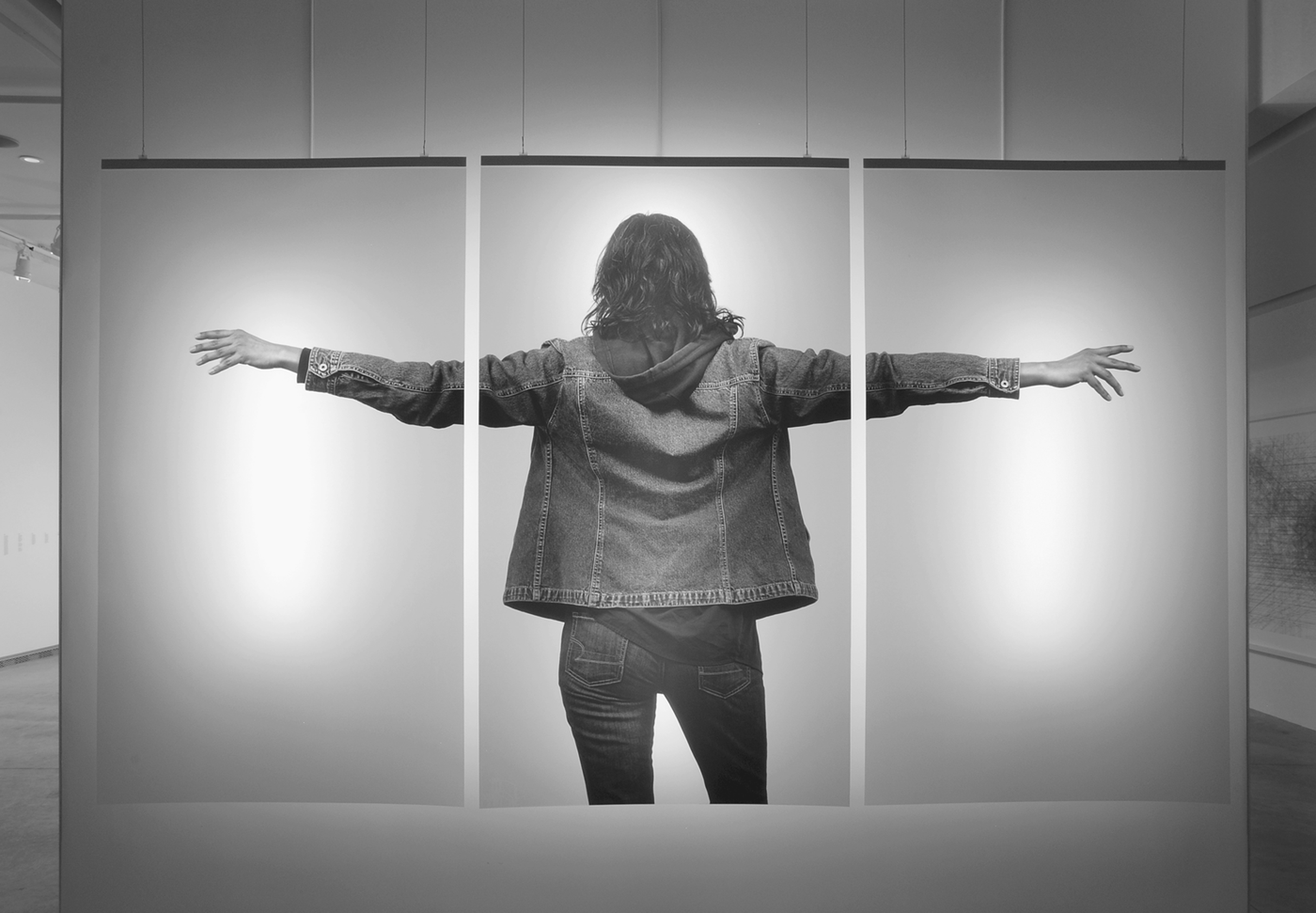
The march went ahead as planned, just as it has every year since 1991, becoming, in its ritual repetition over time, perhaps the most potent symbol of “Aboriginal women's active resistance to [the] acts of erasure”Footnote 64 they must daily confront in the DTES. One of the things those of us marching this particular February saw as we headed west along Hastings Street to Victory Square was an image by Belmore (Fig. 7). It hung in the window of the Audain Gallery, one of the just-completed exhibition and performance spaces at SFU Woodward's, the new downtown contemporary arts complex of my university. Part of the gallery's inaugural show First Nations/Second Nature and timed to coincide with the cultural programming that accompanied the 2010 Olympics, Belmore's work, called sister, is a life-size photographic triptych in color showing, like Fringe, a young woman from behind, except in this case the woman is fully clothed, clad in blue jeans, a jean jacket, and a hoodie. One hip is cocked defiantly—or is it defensively?—to the right. Both arms are stretched out to the sides, as if the woman is about to be frisked or, worse still, crucified. Given her garb and the captured pose, we might think the woman is one of the youthful anarchist protesters I mentioned, except that the color of her hair and the skin of her hands identify her as Aboriginal—and except that the social and institutional context for the photograph's display, a gallery in the DTES, in some respects overdetermines our reception of what that identification must mean. Crucially, we cannot see the subject's face in Belmore's photograph, a fact that perfectly encapsulates the paradox of public (in)visibility most Aboriginal women confront, not just in Vancouver's DTES but throughout the Americas: exposed to too much scrutiny in certain contexts and not enough in others.Footnote 65
In the life-size photographic triptych sister (2010, C-print on white plastic), Rebecca Belmore challenges our assumptions about who—and what—we see; installation view, First Nations/Second Nature, Audain Gallery, Vancouver, 2010. Photo: Kevin Schmidt; courtesy Rebecca Belmore and Audain Gallery, Simon Fraser University.
The restaging of the Women's Memorial March every February in Vancouver, like the theatre, performance, and visual art of Nolan, Clements, Belmore, and Margolles, is an attempt to remedy this imbalance, relocating not just when and where Aboriginal women will be seen and heard but how and on whose terms they will be remembered. Worth noting, in this regard, is that the closing event at the Aboriginal Pavilion during the 2010 Olympics was a short multimedia performance created and directed by Clements called The Road Forward. Originally conceived to honor the men and women of the Native Brotherhood of British Columbia (NBCC), Canada's oldest Aboriginal activist organization, and “to raise our hands to the Native women missing and murdered on the Highway of Tears and [in] Vancouver's Downtown Eastside,”Footnote 66 the work was eventually expanded into an evening-length blues-rock musical extravaganza that premiered on 1 February 2013 as part of the annual PuSh International Performing Arts Festival. Providing the vocal soul of the piece were three fierce divas—Cheri Maracle, Michelle St. John, and cocomposer Jennifer Kreisberg—who, in their set list, embodied the repertory link between a past and present archive of Indigenous countermemorialization in British Columbia, Canada, and beyond. Images from the NBBC's defunct newspaper, The Native Voice, were projected onto a screen upstage throughout the performance, while a live Twitter feed from the upstart Idle No More movement scrolled across a drum face downstage. The Native Voice, founded in 1946 and long edited by Maise Hurley, created one of the first spaces in print for the discussion of Aboriginal rights as human rights. It also provided a necessary counterdiscourse to the representation of Native peoples in the mainstream press and made a point of connecting grassroots activism in British Columbia to “the realities of Aboriginal people across the Americas.”Footnote 67 Idle No More, a hashtag that emerged from a teach-in held by Jessica Gordon, Sylvia McAdam, Sheelah McLean, and Nina Wilson in November 2012, has given the world a glimpse of what such a movement looks like in the age of social media: the flash mob as round dance and, always at the center, the voices of Indigenous women.