INTRODUCTION
Fasciolariids, the tulip snails or spindle snails, represented in the molluscan family Fasciolariidae, constitute an important component of the molluscan fauna in shallow coastal waters (Petuch, Reference Petuch1987), especially on sandy substrates. These carnivorous snails are widely distributed in tropical and temperate waters of oceans at sub-tidal depths (Harasewych, Reference Harasewych, Beesley, Ross and Wells1998; Snyder, Reference Snyder2003). The family comprises more than 100 genera grouped under three main subfamilies: Fasciolariinae, Fusininae and Peristerninae (Bouchet, Reference Bouchet2014). Kuroda & Habe (Reference Kuroda and Habe1952) described the genus Granulifusus and it currently accommodates 27 valid species worldwide (Bouchet, Reference Bouchet2014). The exact range of geographical distribution of all the species is not known and the genus Granulifusus is thus far not reported from the Indian coast. This paper records the occurrence of Granulifusus poppei Delsaerdt, Reference Delsaerdt1995 from the Indian coast and provides the sequence data of the mitochondrial gene cytochrome c oxidase 1 (CO1) of the species.
MATERIALS AND METHODS
Three specimens (shell length 35–41 mm; shell width 13–16 mm; aperture length 11–12 mm; aperture width 4–6 mm) were collected by bottom trawlers at an average depth of 100 m off the Kerala coast (9o31′N and 75o33′E), India. Morphometric measurements were recorded to the nearest millimetre using a digital Vernier calliper. Two specimens are deposited in the museum collections of the Department of Aquatic Biology and Fisheries, University of Kerala, India (Voucher Numbers DABF-UOK/GAS 2-3). The third specimen was preserved in 95% ethanol for molecular analysis. The material was identified following the criteria of Delsaerdt (Reference Delsaerdt1995) and Robin (Reference Robin2008).
Total DNA was extracted from the muscle tissue of G. poppei using DNeasy Blood and Tissue Kit (QIAGEN). The mitochondrial gene CO1 was amplified using the universal primers (Folmer et al., Reference Folmer, Black, Hoch, Lutz and Vrijenhoek1994) in a 25 µl reaction volume with Taq PCR master mix (QIAGEN) and template DNA using the thermal cycler (Eppendorf). The PCR products were purified with ExoSAP-IT (USB) and sequenced in forward and reverse directions using the corresponding PCR primers and Big Dye Terminator V.3.1 Cycle Sequencing Kit (Applied Biosystems, Inc.) in an ABI 3730 capillary sequencer. Intra-specific distance between the species of the Granulifusus genus was estimated using the Kimura 2-parameter distance model of MEGA (Version 6.0) Package (Tamura et al., Reference Tamura, Stecher, Peterson, Filipski and Kumar2013).
RESULTS
SYSTEMATICS
Family: FASCIOLARIIDAE Gray, 1853
Subfamily: FUSININAE Wrigley, 1927
Genus: Granulifusus Kuroda & Habe, Reference Kuroda and Habe1952
Granulifusus poppei Delsaerdt, Reference Delsaerdt1995
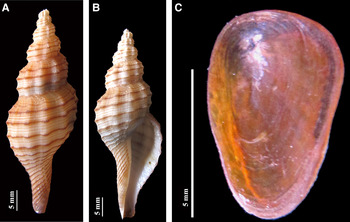
(Figure 1A, C)
Granulifusus poppei: (A) dorsal view; (B) ventral view; (C) operculum.

DIAGNOSIS
Colour whitish to light brown. Shell elongate and fusiform, thin, slightly transparent; post-nuclear whorls six. Body whorl rounded and elongate, sculptured with spiral cords that are slightly thickened at the point of crossing axial folds. 3–4 major light brown spiral cords interspersed with 3–4 minor threads; minor threads with whitish ground colour on the body whorls, getting coloured as the major cords on 6th and 7th post-nuclear whorls. Aperture oval, rather narrow, interior of aperture white and strongly lirate; columella with light brown spiral threads on the outside. Siphonal canal short and rather wide, ornamented with coloured spiral threads.
Operculum (Figure 1C) small, thick and ovate, about 6 mm in length. Amber coloured with an eccentric nucleus and ventral margins slightly ridged.
PHYLOGENY
Blast search showed that the obtained sequence has got 98% similarity with undescribed CO1 sequences of Granulifusus sp. available in GenBank (EU870579.1, EU870584.1 and EU870583.1), pointing to the possibility that these GenBank submissions may also represent G. poppei. The referred sequences in GenBank were submitted by Puillandre et al. (Reference Puillandre, Strong, Bouchet, Boisselier, Couloux and Samadi2009) from the egg capsules of Granulifusus sp. collected off the Philippines. However, collection of shells and availability of voucher specimens of G. poppei from the Philippines coast would alone help in establishing the argument. The phylogenetic position of our sequence was determined using maximum likelihood tree and found that our species is well clustered with other Granulifusus sp. with high bootstrap value (Figure 2). The taxonomy of our specimen was determined using conventional morphological analysis and therefore its barcode sequence has been submitted to GenBank under Accession Number KJ653226.
Maximum likelihood tree of partially sequenced mt DNA CO1 gene of Granulifusus poppei (KJ653226) with other reference sequences of Granulifusus sp. in GenBank. The numbers on the tree branches indicate bootstrap values.

REMARKS
Delsaerdt (Reference Delsaerdt1995) first described the species Granulifusus poppei off Mogadishu, Somalia. The species was also recorded from Mozambique (Galli, Reference Galli2014). The current record of G. poppei from the south-west coast of India shows the extended distribution of this species from the East African coast to the south-west coast of India in the western Indian Ocean. Sequence analysis of the mitochondrial CO1 gene confirmed clustering of our specimen with the genus Granulifusus and the sequence data generated by us will further help identification of G. poppei using DNA barcoding.
ACKNOWLEDGEMENTS
The authors thank the Department of Biotechnology, Government of India for the financial support of the project. Mrs Preetha Karnaver thanks the University Grants Commission for the financial assistance provided as part of the Faculty Development Programme. Thanks are also due to Mr A. Delsaerdt, Royal Belgian Society for Conchology, Belgium for confirming the identification of the species.