Leading explanations of the political institutional determinants of trade policy usually focus on the role of proportional representation (PR) versus plurality elections.1
See, for instance, Rogowski 1987; Mansfield and Busch 1995; Persson and Tabellini 2000; and Grossman and Helpman 2004.
Instead of focusing on any one particular institution, a preferable approach would be to focus on a conceptual dimension that can characterize a wide variety of institutional differences.2
Recent literature on comparative institutions has begun to emphasize these conceptual dimensions rather than specific institutions. The most prominent example of this is the veto player dimension as described in Tsebelis 2002. Other examples include Lijphart 1999, which discusses the consensus versus majoritarian dimension, and Mukherjee et al. 2006, which focuses on the role of the political time horizon's effects on government spending rather than the PR/plurality and presidential/parliamentary distinctions.
The rest of the article is organized as follows: first, I briefly review the existing literature on the effects of institutions on trade policy, highlighting how the causal mechanisms in much of this literature remain underspecified and how this leads to anomalous findings. Second, I introduce the theoretical framework of this article, defining what access points are and why they matter. Third, I derive hypotheses from this theory about how institutions, through the number of access points they provide, affect tariff rates. Fourth, I introduce the data and methods used to test these hypotheses. Fifth, I present the results of these tests. Finally, I conclude with an assessment of the theory and tasks for future research.
Institutions and Trade Policy
Early literature on trade policy typically ignored the effect of political institution, relying on the undifferentiated assumption that protectionist interests will lobby more often than free trade interests. This assumption lies at the heart of the endogenous tariff theory literature,3
See, for instance, Mayer 1984; Magee, Brock, and Young 1989; and Grossman and Helpman 1994 and 2002.
This is not to suggest that only protectionists lobby, but that protectionists are more likely to lobby. In the theory section below, I provide detail on why and how protectionists enjoy this collective action advantage
This is because the endogenous tariff literature largely ignores institutions that shape the strategic environment in which interest groups operate. Previous studies of the effect of institutions furnish a strong foundation on which to build but have left numerous anomalies and lacunae that still need to be explained. One of the earliest and still most influential institutional arguments derives from Rogowski's claim that PR makes free trade more likely; Mansfield and Busch, Persson and Tabellini, and Grossman and Helpman later made similar arguments.5
See Rogowski 1987; Mansfield and Busch 1995; Persson and Tabellini 2000; and Grossman and Helpman 2004.
Rogowski argues that PR improves the chances of free trade by insulating policymakers from protectionist interests due to the small number of large electoral districts and high degrees of party discipline associated with PR.6
Rogowski 1987. Rogowski also argues that trade-dependent countries choose PR because they know not to choose institutions that might make trade more difficult, a point that raises concerns about endogeneity: trade policy (and the actors pushing for particular policies) may have a causal influence on institutions as well as being influenced by institutions. Katzenstein 1985 makes similar arguments about how small countries, being trade dependent, choose PR systems to ensure openness to trade. However, Boix 1999 has found that trade openness has no influence on a country's choice of electoral laws, although he does not focus on the exact institutions examined here. Since most of the institutions that this article examines are either part of the electoral law or part of the constitution, and these institutions are rarely changed, endogeneity should not be a major concern. Moreover, within the sample examined here, trade dependence is not strongly correlated with either institutions or with trade policy: within the semi–cross-section described below, trade dependence is only significantly correlated with number of electoral districts and bicameralism among the institutional variables and is insignificantly correlated with tariff rates. Thus, even if small, trade-dependent states are more likely to choose insulating institutions, there is no evidence in the sample examined here that this will lead to endogeneity with trade policy outcomes. Future work, though, should further investigate how trade policy may influence institutional design.
Other scholars have focused on the effect of other institutions. For instance, Neilson examines the influence of presidentialism on trade policy.7
Neilson 2003.
This is not intended to be a comprehensive review of the literature on institutions and trade policy. Other important contributions to this literature include Alt and Gilligan 1994; Verdier 1994; McGillivray 1997 and 2004; and Hiscox 1999. See Milner 1999 for a more comprehensive review of the political science literatures on trade policy.
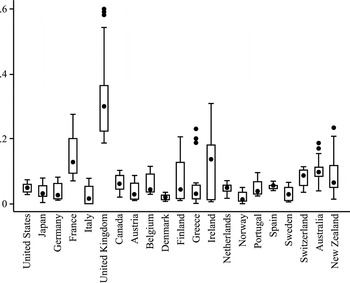
Both of these explanations generate numerous anomalies when attempting to explain the pattern of protectionism in postwar developed democracies. Figure 1 shows box plots of the average tariff, defined as the amount of customs revenue divided by the value of imports, in the advanced industrial countries, here defined as the twenty-one major member-states of the OECD, between 1948 and 1994.9
The dot in the center of the box represents the mean tariff rate over the forty-five-year period. The box represents the 25 to 75 percent interval of the data and the whiskers the rest of the range of the data. The dots above the whiskers are outliers.
Some of the values for the United Kingdom are misleading as the data source used, Mitchell 1998, combine customs revenue and excise taxes in the United Kingdom into one revenue category after 1968, thus inflating their tariff rates. However, the average over the pre-1968 period is roughly similar to the average over the post-1968 period and the United Kingdom has the highest rates in the pre-1968 period. The models estimated below control for this coding problem by including a dummy variable for the miscoded years. Eliminating the miscoded years from the sample altogether creates broadly similar results to those reported below across all of the reported models. Some of the coefficients lose significance in some of the models, most frequently the coefficients for party discipline and partisanship and sometimes the short-term effect of the number of parties, but the basic conclusion remains that the number of access points matters while PR does not. These results are available from the author on request.
Lijphart 1994.

Boxplots of average annual tariff rate in OECD countries
The presidentialism versus parliamentarism distinction yields similar results. The only countries in this sample that have presidents are the United States, France, and Finland. France has among the highest tariffs; the United States has relatively low tariffs; and Finland's average tariff is about the same as the U.S. average, but Finland occasionally had extremely high tariffs. The parliamentary countries have among both the highest and the lowest tariffs. Obviously, the distinction between presidentialism and parliamentarism alone cannot explain this pattern.
In addition to these empirical anomalies, the above research only studies particular institutions in isolation, although the PR literature does attempt to link PR to many other institutions. What would be preferable, and what I offer in this article, is a more general theory that can incorporate multiple institutional differences within one dimension. Veto player analysis12
Tsebelis 2002.
Henisz and Mansfield 2006 demonstrate one way in which veto player theory can be used to explain variation in trade policy. Declining macroeconomic performance can be expected to lead to increased demands for protection regardless of the current level of protection. However, the more veto players there are, the less likely this increased protection will be provided. Thus, veto players mediate the effect of economic conditions but are not expected to have any direct effect on the level of protection.
I offer here a different theoretical characterization of institutions that can provide this leverage: the number of access points the institutions provide to interest groups. Briefly, access points are policymakers with power in a particular policy sphere who are susceptible to interest group lobbying. The more access points there are in a system, the cheaper lobbying will be because access points will compete for the benefits provided by lobbyists, thus driving down the price of each access point. Because of their collective action advantage, protectionists are better able to take advantage of this; as a result, more access points lead to more protectionism. The theoretical section of this article will detail this process and the hypothesis section will demonstrate how different institutions can be categorized based on the number of access points they provide. The access point theory encompasses the theories about PR and presidentialism by demonstrating that the effects attributed to these institutions are the result of these institutions' effects on the number of access points. The theory also provides clearer causal mechanisms for the process by which these institutions affect trade policy. In particular, the theory demonstrates that it is not anything intrinsic to PR that makes free trade more likely: only to the extent that PR encourages party discipline and a small number of electoral districts (while not leading to large coalition governments) does PR reduce protectionism. Once these other institutions are controlled for, PR's effect on trade policy is insignificant. Thus, PR's effect is, at best, indirect, and is possibly spurious. The hypothesis section below will provide more detail on the link between access points and PR, and the empirical section will demonstrate the relative effects of these institutional features. The conclusion returns to the links between access points and veto players, which can best be viewed as complementary theories specifying the direction and possibility of change respectively.
Access Points and Trade Policy
This section introduces the access point theory and applies it to trade policy. First, I will define what access points are. Second, I describe how the costs of lobbying decline with increasing access points in a stylized policymaking process. Third, I use collective action theory to explain why protectionists benefit from this decline in lobbying costs.
The central theoretical proposition of this article is that, within democracies, increasing the number of access points increases the level of protectionism.14
The theory, as stated here, only applies to democracies. The relationship between policymakers and interest groups is likely to be different in nondemocracies, and I do not attempt here to theorize about how the number of access points affects this different type of policymaking process.
The role of Congress in setting trade policy is the subject of much debate, focusing on the role of the Reciprocal Trade Agreements Act of 1934 and fast-track authority. See Hiscox 1999; and Lohmann and O'Halloran 1994 for differing sides of this debate. Ehrlich 2005 applies access point theory to this debate and finds that delegation in the United States is associated with lower tariff rates which is consistent with the view that delegation reduced, even if not entirely eliminated, the relevance of Congress in trade policy.
In parliamentary settings, every Member of Parliament (MP) is technically relevant as they all have a vote. However, most backbenchers are not considered access points because they fail on the other two dimensions. Given strict party discipline, as exists in most parliamentary settings, party members will not be independent of their party leaders. Independence is the capacity of policymakers to exercise their relevance based on their own preferences. On most important votes in most parliamentary settings, backbenchers must follow strict marching orders from the party leader. Even if they are technically able to cast votes against party orders, party members will not do so for fear of losing their seat in parliament. Thus, only party leaders are truly relevant to policy outcomes and, in a fully unified, disciplined party, only one independent access point will exist per party. In addition, because the government can count on the support of their members, if the government has a majority of seats in parliament, nongovernmental parties have no power and even their leaders have no relevance to current policy.
Backbenchers can be considered access points, though, if they represent distinct constituencies, usually because they represent different districts. Equally sized legislatures could have each legislator elected from their own district or could elect all legislators from one district or could have multiple, multimember districts. In the single, national district case, all of the legislators represent the same constituency and are, thus, not access points if they are not independent. In the single-member district case, legislators represents their own constituency and may be considered an access point even if they are not independent. Party leaders in such a system may need to tailor policies to multiple districts to win a majority. In a sense, this phenomenon restores independence to some MPs: they will still vote as their party commands them, but the party must consider their electoral needs when crafting policy.16
McGillivray 1997 and 2004 discuss how party leaders in Canada, a single-member district system where MPs are not independent, target tariffs in competitive districts to ensure the election of their party members in those districts.
The access point theory argues that more access points lead to more protectionism because they lead to more net protectionist lobbying, defined as the amount of protectionist lobbying minus the amount of free-trade lobbying. Policymakers face time and resource constraints so they cannot devote full effort to an infinite number of policies, even if they potentially support many of these policies.17
Hall 1996 provides significant evidence for this time constraint on policymakers in the United States.
Interest groups are free to lobby whichever policymaker they want, but they should be expected to lobby the cheapest they can find. This policymaker might be the representative from the district the interest group resides in, as a member of Congress representing a district with many shoe manufacturers might be expected to be receptive to an interest group from that industry. This need not be the case, though, and an interest group faced with a hostile local policymaker is free to attempt to find a more receptive policymaker from a different district.
Increasing the number of access points should increase the probability of finding receptive access points, thus reducing the costs of lobbying. I demonstrate this effect using a model based on Weingast, Shepsle, and Johnsen's analysis of distributive politics.19
Weingast, Shepsle, and Johnsen 1981.
This proportion probably differs from country to country depending on the structure and health of the economy in that country. This variation in proportion of protectionists likely also influences variation in final trade policy irrespective of the institutions in the country. The economic controls variables in the empirical models estimated below control for this variation in underlying demand for protection versus free trade.
Individuals will only contribute to lobbying if the expected benefits of lobbying, B, exceed the expected costs, C, or if:

The expected benefits of lobbying are the value of moving policy in the desired direction multiplied by the marginal increase in the probability of moving policy given lobbying. The total costs of lobbying can be viewed as monetary bribes/campaign contributions, legislative subsidies, or search costs for policy information. These cost-benefit calculations internalize the collective action problem as the benefits only accrue if the individual's contribution to lobbying has a measurable effect on the probability of success of this lobbying. If, as when collective action problems are serious, this benefit does not move much relative to the cost, then individuals are unlikely to contribute. The insight provided by access point theory is that C declines as the number of access points, or N, increases, which I represent by setting the cost of lobbying the average policymaker to be κ/N where N is the number of access points and κ is a scaling factor that enables one to differentiate between the costs for different individuals. I assume for now that κ is fixed, but below I will argue that it is lower for the average protectionist than the average free-trader.
I demonstrate the effect of access points using a stylized policymaking process: assume that all access points vote in a single legislative chamber with equal weight on each vote. In order to achieve their trade policy goals, an interest group needs the support of at least a majority of these access points, or one-half plus one of the access points. Thus, interest groups will seek out the cheapest half-plus-one, which should be the most receptive access points. When there are more access points, the average cost of each access point should be lower because of competitive pressures between access points that will affect the bargaining power of each access point relative to the interest groups. With three access points, for instance, the most receptive access points can charge a premium, up to either the cost of the most expensive access point or the point at which lobbying is no longer beneficial, and still receive payment from the interest group since the interest group has so few alternatives. Increasing the number of access points increases the number of alternatives, which allows the interest group to shop around for the best deal, driving down the price. Furthermore, if there are few access points, they might be able to collude and set oligopolistic rents. Thus, increasing the number of access points should drive down the premium access points can charge for their time or vote so that it will approach the market rate.
For this reason, the average cost of lobbying each access point will decline with the number of access points, approximated here by κ/N. However, interest groups must buy the support of half-plus-one of these access points, so that the total cost to them is the average cost multiplied by the number of access points that need to be bought. Thus, individuals will only contribute to lobbying if:

By rearranging the terms in this equation, it can be seen that total costs decline with N:

The first parenthetical term is constant but the second term declines with N; thus the total costs decline with N. Loosely speaking, while the declining average costs are canceled out by the need to buy more policymakers to secure one-half of the access points, the relative cost of buying the “plus one” in the “one-half plus one” declines as the number of access points increases. Therefore, increasing the number of access points lowers the total cost of lobbying, which should increase the amount of lobbying.
Thus far, all I have demonstrated is that the more access points there are, the more lobbying there will be. What effect does this have on trade policy? If, as I assume above, all groups have the same costs for lobbying, that is, if κ is fixed, then it should not have any effect on final policy. However, if one side has a lower κ, on average, than the other side, then the side with cheaper average lobbying costs should gain an advantage when the number of access points rises. One should expect κ to be lower for protectionists than free-traders as a result of collective action theory; thus, increasing the number of access points should increase the level of protection. Following Olson, trade theorists have held that protectionists can better overcome the collective action problem since the benefits of protection are concentrated and the costs are dispersed while the benefits of free trade are largely dispersed and the costs are fairly concentrated.21
Olson 1972.
This advantage, however, should not be taken to mean that free-traders or liberalizers never lobby. Significant recent research has detailed under what circumstances free-trade interests can lobby. However, this literature, while showing that free-traders can overcome the collective action problem, has not shown (and typically has not attempted to show) that they are able to do so with the same ease as protectionists. Milner, for instance, argues that multinational corporations lobby to lower tariffs on products they transfer from one facility to another.22
Milner 1988.
Gilligan 1997.
However, on average, protectionists should still enjoy a collective action advantage: the link between lower domestic tariffs and lower foreign tariffs is often indirect (thus weakening the incentive for exporters to lobby)24
Individual exporters may have little incentive to lobby against protection ex ante because the chance that retaliatory tariffs will target their industry is small. Goldstein and Martin 2000 argue that the WTO should make it easier for exporters to mobilize to maintain existing trade agreements as the WTO allows countries to punish violators by drawing up specific retaliatory tariffs so that exporters will know whether or not they will suffer when the home country closes its market. However, this will only be after the initial violation occurs so that protectionism will increase for a year or two until the exporters (who now know that they are the retaliatory targets) mobilize to force the home country to back down.
At least in the United States, the empirical evidence bears out this assumption that protectionists enjoy a collective action advantage and, thus, lobby more. Hiscox documents appearances before congressional committees by interest groups to lobby on major trade bills.25
Hiscox 2002, 143.
Drope and Hansen 2004.
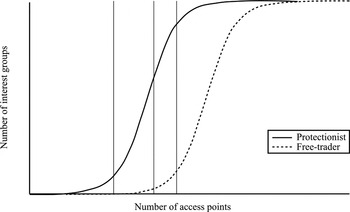
Protectionists lobby more because the ratio of costs to benefits of lobbying is lower for them due to their collective action advantage; this can be represented by setting the average κ for protectionists to be lower than it is for free-traders in the inequalities above. Although the costs and benefits of lobbying will differ for each organization depending on their ability to overcome the collective action problem or how important international trade is to them, the average free-trader will find less benefit, relative to cost, to lobbying than the average protectionist. Thus, as the number of access points increases, and lobbying becomes less costly, more protectionists than free-traders will find it newly beneficial to lobby, thereby increasing the amount of net protectionist lobbying, as illustrated in Figure 2.

Number of interest groups lobbying
The vertical axis in Figure 2 represents the number of interest groups lobbying while the horizontal axis is the number of access points. The left-most curve represents the protectionists, whose costs of lobbying are, on average, lower; the right-most curve represents free-traders. The vertical difference between the two curves is the amount of net protectionist lobbying. As the number of access points increase, the number of interest groups lobbying increases for both free-traders and for protectionists: the increase for protectionists over the relevant portion of the distribution is greater, though, so that their lobbying advantage increases as the number of access points increase.
At a low number of access points, as depicted by the line on the left, almost no free-traders lobby, but so do relatively few protectionists. Increasing the number of access points to the middle line increases the number of free-traders lobbying but increases the number of protectionists lobbying even more, thus increasing the amount of net protectionist lobbying and the level of protection. Eventually, increasing the number of access points does start to benefit free-traders, occurring here at the line on the right, as most protectionists are already lobbying and only free-traders are left to be drawn into the system. However, I assume that this point is never reached in practice, as the system with probably the most access points—the United States in the early twentieth century—still had few free-traders lobbying, suggesting it was still to the left of the third line in this figure. Thus, the more access points there are, the more net protectionist lobbying there will be, and the higher the level of protection.
Institutional Hypotheses
The basic hypothesis derived from the theoretical framework is that increasing the number of access points to policymaking will lead to more protectionism. In addition, increasing the receptivity of policymakers to interest groups, increasing the benefits of protectionism, or decreasing the costs of lobbying will also lead to more protectionism. How do these abstract concepts relate to real world political features? This section will detail a number of specific substantive hypotheses by examining how commonly discussed institutional features of different countries fit into the access point theory introduced in the previous section.27
First, I examine those institutional features typically associated with PR, namely number of electoral districts, number of parties, and level of party discipline, showing how each of these institutional features influences one of the dimensions that determine the number of access points—either the relevance, distinctiveness, or independence of policymakers—and then show why PR itself has no effect on the number of access points once these other features are controlled for. Next, I examine two important institutions not typically correlated with the PR/majoritarian distinction: presidentialism and bicameralism. Finally, I discuss the influence of partisanship to show how political factors can affect the level of receptivity of access points.One common dimension on which country's institutions diverge is the number of electoral districts within the country. Each additional electoral district is another potentially distinct access point as each electoral district is another different constituency that policymakers represent. Thus, increasing the number of electoral districts, controlling for any other institutional differences, increases the number of access points. Therefore, the first of seven hypotheses is the following:
H1: More electoral districts are associated with more protectionism.
Next, countries often differ on the number of parties in government, with some countries always having single-party governments and others having coalition governments of various size. In parliamentary systems, only parties in government have any relevance to the policymaking process. Opposition parties have no role in setting current policy and, therefore, would not be counted as access points. Also, if parties are highly disciplined, it should be possible to treat each party as one access point. Controlling for the number of electoral districts, lobbying backbenchers should yield little or no benefit. Thus, increasing the number of parties in government also increases the number of relevant policymakers, creating more lobbying opportunities. In presidential systems, minority parties often still retain significant policymaking powers. However, if there is divided government so that different parties control different branches of government, this should increase the relevance of the party that does not control the presidency. Thus, divided government should increase the number of access points by increasing the number of relevant policymakers.
H2: More parties in government are associated with more protectionism.
A third institutional feature differentiating countries is the level of party discipline within the legislature. In high party discipline countries, individual legislators will have less independence than in low party discipline countries, thus reducing the number of access points in these countries. In cases of perfect party discipline, only the party leader is independent. In cases of no party discipline, every legislator is independent. Where there is some party discipline, legislators will receive instructions from their party but may disregard these instructions. The more likely legislators are to vote against their party leaders, the more independent they are, and, thus, the more attractive they will be as targets for interest groups.
H3: Low levels of party discipline are associated with more protectionism.
The previous three institutional features—number of parties, number of electoral districts, and party discipline—are also crucial features distinguishing PR from plurality elections. PR countries tend to have few electoral districts, high party discipline, and coalition governments, while plurality countries tend to have the opposite. However, none of these characteristics are intrinsic or exclusive to PR systems, as demonstrated in the literature review. One can create a majoritarian system that has these features and one can create a PR system without them. Once these factors are controlled for, PR should have no effect on trade policy, as the only element still remaining that separates the two systems is the greater proportionality of PR elections. As proportionality has no effect on the number of access points, the access point theory predicts that PR should have no effect on the level of protectionism.28
Reestimating the main model shown below but including measures of proportionality confirms this: proportionality is insignificant, PR remains insignificant, and no other coefficient changes much in terms of substantive size or statistical significance.
H4: After controlling for the number of electoral districts, the number of parties in government, and the level of party discipline, proportional representation is not associated with any change in protectionism.
Two other frequent institutional differences between countries are not typically associated with the PR/majoritarian dichotomy. The first is bicameralism, where a country has two legislative chambers, one usually representing the people as a whole and one usually representing federal districts.29
Another frequently discussed institutional feature is federalism, which should increase the number of access points by creating sub-national actors who are relevant. I do not directly test for the effects of federalism here mostly because of the high degree of colinearity between federalism and bicameralism. In the sample used in this article, all bicameral countries are federal countries and vice versa. In one sense, I use bicameralism here as a measure of federalism, but I focus on bicameralism rather than federalism itself because sub-national actors rarely have a role in setting trade policy unless they also sit in a federal chamber of the legislature. Substituting other measures of federalism, such as number of federal districts or a dummy variable for existence of a federal system, does not change the results.
See Tsebelis and Money 1997, for more information on bicameralism. I consider any system to be effectively bicameral if Tsebelis and Money state that neither house is decisive on policy outcomes and that they are not congruent in electoral method.
H5: Bicameralism is associated with more protectionism.
The final institutional difference relates to presidential versus parliamentary systems. Creating a president as a separate executive may create an additional access point, in addition to all of the access points in the legislature. However, if the legislature delegates trade power to the president, as is the case in the sample used here, presidentialism will reduce the number of access points by reducing the relevance of the legislature, and will reduce the receptivity of the access points by giving power to a policymaker that is less receptive to protectionist demands. As described above, Neilson argues that the national constituency of a president makes him or her more concerned with the national interest and, thus, less receptive to protectionism.31
Neilson 2003.
See, for instance, Lohmann and O'Halloran 1994; and Bailey, Goldstein, and Weingast 1997. See Hiscox 1999, for a critique of this assumption. As discussed in fn. 15 above, delegation of trade policy to the president, at least in the United States, is probably not complete, that is, Congress still retains some of its trade policy power. However, members of Congress became much less important targets for lobbyists as their power became limited when they began delegating tariff-making power to the president starting in 1934.
In those cases where power is not delegated, then presidentialism may be associated with higher tariffs, although the lower receptivity of the president may counteract the increased number of access points.
H6: Presidentialism is associated with less protectionism.
The last hypothesis regards changes in receptivity rather than changes in the number of access points. There are numerous factors that can affect receptivity and it is possible that many of the economic factors that economists have argued affect tariffs do so through changing how receptive policymakers are to interest groups. For instance, Magee, Brock, and Young have argued that policymakers may compensate industries with protection when they are suffering economically: thus, in times of high unemployment, policymakers may be more receptive to protectionist demands.34
Magee, Brock, and Young 1989.
Since World War II, most of the advanced industrial countries, which represent the entire sample in this article, have been capital rich and labor poor. Therefore, according to the Stolper-Samuelson theorem, labor should support protectionism while capital should oppose it. The access point theory as presented above makes no explicit assumption about the nature of factor mobility, but the narrative describing it makes more sense in a specific factor world where each industry lobbies for their preferred tariff rates on products they produce or consume. The Stolper-Samuelson theorem, however, assumes mobile factors where entire classes have the same trade policy preferences regardless of industry. This apparent inconsistency can be resolved for two reasons. First, as Hiscox has shown, factors are neither completely mobile nor completely specific35
Hiscox 2002.
Another way to look at this is that including an ideology variable controls for the possibility that factors are at least partially mobile. Thus, access points matter even if factors are not entirely specific.
H7: Left-wing governments are associated with more protectionism.
Data and Methods
I test these hypotheses with a data set of twenty-one OECD countries from between 1948 and 1994. I use a panel design because the theory makes predictions about both cross-country and over-time variation: a country with more access points, all else equal, should have more protection than a country with few access points, and a change in the number of access points within a country should lead to a change in tariff rates.37
Some of the institutions examined here do not change much (or at all) within countries in the sample. I address this issue in Model 8 in the results that estimate a cross-sectional design.
The above discussion calls attention, though, to a critical assumption made in the following analysis: namely, that EU countries are treated as separate units of analysis despite the existence of the CET. Under the CET, tariffs are the same across all EU countries on each product. Thus, steel tariffs will be the same in all EU countries as will textile tariffs, but these tariffs differ from each other. Because different countries have different bundles of imports, they have different average tariff rates, as defined below. I argue that the EU should not be treated as one country despite its “common” tariff because these differences in average tariffs are both large and driven, in part, by differences in domestic institutions in a manner suggested here. In other words, countries with many access points are more likely to push for high tariffs on products they import than countries with fewer access points, thus leading to higher average tariffs in high access point countries. For instance, France, a country with many access points, tends to push for protection within the CET for its producers while Germany, a country with few access points, does not. Thus, though the final tariff schedule is mediated by international negotiations within the EU, final trade policy still reflects, at least partially, domestic preferences, which are still influenced by domestic institutional structure. Thus, I treat each EU country as a separate unit of analysis, determining its own trade policy, though a more complete analysis would certainly need to take into account the interaction between EU-level negotiations and domestic preferences.38
See Ehrlich 2005, for such an analysis, which provides evidence that the above assumption is justified by demonstrating that the structure of the CET, that is, which products have high tariffs and which have low tariffs, is partially determined by whether the countries importing and exporting those goods have many or few access points.
I provide detail here on the coding of the dependent variable and most of the political variables used to test the hypotheses while the economic variables and the remaining political variables are defined in Table A1. The dependent variable in the study, tariff, is taken from Mitchell and is computed as the revenue received from customs divided by the value of imports, and is frequently referred to as the trade-weighted average tariff.39
Mitchell 1998.
Trefler 1993.
The third, and possibly most severe issue, concerns the fact that tariffs are only one possible way to provide protection to trade. Nontariff barriers (NTBs) such as quotas, voluntary export restraints, and onerous regulatory regimes can restrict trade just as severely as high tariffs and have been increasing in use over the life of the sample used here. This should only be troubling, though, if NTBs and tariffs are substitutes for each other; that is, countries with low (high) tariff rates have many (few) NTBs. One should expect, though, that they are complements rather than substitutes: countries with high tariffs will also have many NTBs, while countries with low tariffs will have few NTBs, as industries seeking protection are likely to seek as many different of protection as possible. Though there has been a widely noted shift away from tariffs and toward NTBs during the sample years, all countries have been shifting away so that the difference between each country's tariff rates should still be a meaningful proxy of the difference in their overall trade policies. Further the empirical evidence in economics demonstrates that tariffs and NTBs are positively correlated41
See, for instance, Ray 1981; Ray and Marvel 1984; Trefler 1993; and Lee and Swagel 1997. These articles also find that not only are tariffs and NTBs positively associated within countries but also within industries; that is, industries that receive heavy tariff protection also tend to receive multiple nontariff barriers. Thus, using tariffs as a proxy may not even distort the structure of protection within countries, though that is not a concern in this article. Mansfield and Busch 1995 is the only study that finds a negative correlation between tariffs and NTBs. However, their evidence is drawn from a single year and, given the consistent findings in economics from studies that draw from many years, is probably anomalous. Kono 2006 also finds that tariffs and NTBs are, to some extent, substitutes: he finds that democracies have lower tariffs but higher NTBs than nondemocracies since NTBs are less transparent and easier to hide from the electorate. The countries in this article's sample, though, are all democratic, so this issue should not bias the particular results presented here.
Two alternatives are the average statutory tariff and a direct measure of NTBs—the most common of which is the NTB coverage ratio, which is the percentage of product lines on which there is at least one NTB. Average statutory tariffs measures the actual tariff collected on a product as reported in a country's tariff schedule, weighting all product lines equally. This measure does not change as import levels and composition changes, and appropriately measures prohibitory tariff barriers as high tariffs, solving Trefler's concerns. However, the average statutory tariff measure introduces its own problems: namely, not all product lines are equally important. Even in a world of completely free trade, the United States would import more steel or automobiles or electronic products than it would human hair or edible offal, both of which are product lines. Treating the tariff rate on human hair as equally important as the tariff rate on automobiles will yield the wrong result. Ideally, what one wants is to weight each product line by how much would be traded in the absence of any protection, but this measure is impossible. Using trade-weighted tariffs probably gets one closer to the truth, especially if controls are including for changing price levels. The NTB coverage ratio is flawed in a similar way: NTBs on any product line are treated as equally important. Furthermore, regardless of how restrictive NTBs are, they are treated the same. For instance, if one product has a quota of 10 units and another has a quota of 10,000 units, these two quotas are treated as equal in the NTB coverage ratio, even if the amount of trade in both products without quotas would be 10,001 units.
In addition to these conceptual concerns, data are extremely limited for these alternative measures. The United Nations Conference on Trade and Development (UNCTAD) collects data on statutory tariff rates and incidence of NTBs. However, UNCTAD only started doing so in the early to late 1980s, and it has done so at irregular intervals of every three to five years. Thus, the sample size is much smaller and there are gaps in all of the time series. Even filling in the gaps with imputed data, such as assuming fixed rates between years or linear changes from year to year, yields sample sizes too small from which to draw credible inferences. Depending on the independent variables included and whether the gaps are filled in, the sample size for these two variables range from 40 to 160 while the largest sample in the results presented below is greater than 700. This problem is compounded by the fact that some countries drop from the sample entirely and the analysis ends up focusing on less than ten years of data rather than the forty years of data in the main sample. If the countries and years that remain in the sample are different from the countries and years that are dropped, selection bias will result. For these reasons, the rest of the analysis in this article focuses only on trade-weighted average tariff rates even though it is clear from the discussion above that this is only an imperfect proxy for overall level of protection.42
In other words, there is measurement error in the dependent variable. However, this sort of measurement error does not yield biased results; rather, it makes for a conservative test because it will be harder to find significant results through the noise. See Greene 2000, 376.
Turning to the independent variables, Hypothesis 2 is specifically about the number of parties in government. Furthermore, the theory itself does not differentiate between access points based upon their power, so there is no reason to distinguish large from small parties. Thus, rather than the more familiar effective number of parties in the legislature, number of parties is measured here as the raw number of parties in government. This is the number of parties in the cabinet in a parliamentary system. In the United States, divided government is coded as 2, while unified government is coded as 1.
Hypothesis 3 concerns party discipline, which is notoriously difficult to measure.43
See Bowler, Farrell, and Katz 1999 for details on the difficulty in even coming up with a conceptual definition of party discipline and attempts to measure it within countries.
The most extensive cross-national database on party cohesion is from Carey 2004. However, even his database only includes four of the countries in this article's sample.
I use here a proxy called pool that measures the nature of vote choice within a country. pool measures the extent to which votes pool across districts or “the extent to which a candidate can ride his party's reputation to electoral success.”45
Seddon Wallack et al. 2003, 6. In addition to providing this measure, they also provide measures of other variables that may be related to the level of party discipline, such as whether elections are candidate- or party-centered and who controls the nomination of candidates. Vote pooling is the only measure that is significant. Including the other measures does not change the results, while substituting the other measures for vote pooling does not change the results of any other variable but yields insignificant results for party discipline.
By linking the electoral fate of party members in different districts, pooling may also lower the receptivity of access points to particularistic interests with support in only one district. This internalizing of the extra-district costs of particularistic policy should also manifest itself as higher levels of party cohesion as policymakers have less incentive to vote against their party members to acquire specific benefits for their constituents. This may be why pooling has a negative influence on tariff rates when the other institutional measures of party discipline do not.
Westminster systems such as Great Britain have low pooling but high party discipline as a result of the party's control over candidate nominations and the vote of confidence.
Hypothesis 5 concerns whether a country is presidential or parliamentary. Thus, presidential is an indicator variable for presidentialism, which in this sample is the United States, the French Fifth Republic, and Finland. The coding of both Finland and France as presidential may be seen as problematic, especially the former where the president has limited independent power. As shown below, though, the results are not sensitive to changes in variable coding. The coding of bicameralism is discussed above in the hypothesis section.
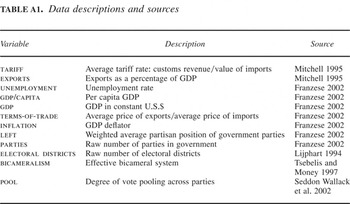
A number of the standard economic controls are also included in the model. I will briefly describe the reason for their inclusion here while the coding and these variables are discussed in Table A1.48
See Magee, Brock, and Young 1989, for an example of an economic study of cross-national differences in trade policy.
Substituting the logged level of exports does not change the results.
Katzenstein 1985.
I analyze these data primarily by using pooled error correction mechanisms (ECMs), which model how the dependent variable, in this case tariffs, responds to temporary or permanent changes in the independent variables. An ECM views the dependent variable as being in an equilibrium relationship with the independent variables: when these variables change it produces an “error” in the dependent variable; that is, they fall out of equilibrium, which is corrected over time as either a new equilibrium is reached (if the change in the independent variables was permanent) or as the shock fades away (if the change was temporary.) A pooled ECM analyzes this model by combining the data from all of the countries in the sample into a single data set and then differencing the dependent variable on the left-hand side and including both levels and differences of the independent variables as well as the lagged difference and lagged level of the dependent variable on the right-hand side. This difference and lag structure sets up the equilibrium relationship of the variables.51
See Beck 1991, for an introduction to ECMs and Franzese 2002 for an application of pooled ECMs to political economy issues. An ECM models the equilibrium relationship between the variables by assuming that short-term changes in the independent variables will lead to corresponding short-term changes in the dependent variable (the error correction as measured by the differenced variables) while permanent changes in the independent variables will change the equilibrium level of the dependent variable (as measured by the level variables).
ECMs have traditionally been used when cointegration is present, which exists when two or more variables have unit roots that determine each other. The search for unit roots in tariff data has often preoccupied previous researchers, such as Lohmann and O'Halloran 1994. However, given that tariffs are bounded, unit roots are not technically possible. Instead, tariffs are probably near-integrated. See De Boef and Granato 1999; and De Boef 2000. However, as Beck 1991 argues, and De Boef and Keele 2004 proves, ECMs can be used even when unit roots or cointegration are not present.
The larger institutional changes, such as presidentialism, the number of electoral districts, pooling, and bicameralism, are only entered in levels, which means I can only examine long-term dynamics for these variables. This is because these institutions rarely change within countries and, when they do, the political landscape is likely to be undergoing such radical change that policymakers are not focusing on changing trade policy in the immediate aftermath. Inclusion of differenced variables, though, do not change the results presented below.

The first two variables, the lagged level and lagged difference of the dependent variable, are the error correction component of an ECM and show how current tariff rates respond to changes to the previous year's tariff rates. The next set of variables (β3 through β14) are economic control variables, which are followed by the political variables of interest (β15 through β23). The last three variables are controls for the international environment, discussed below, and the control for the miscoded tariff rates in the United Kingdom.54
This is discussed above in fn. 10.
One might be concerned with multicolinearity in this model because of the presence of both levels and differences for many of the variables and the possibility that some of the institutional variables are strongly related with each other. Robustness tests show, however, that, though there is some multicolinearity, it does not rise to problematic levels. For the variables in the main model, I calculated the Variance Inflation Factors (VIFs), which measures how much colinearity exists in the data by regressing each independent variable on all the other independent variables to determine how strongly related these variables are to each other. In general, as described in Kennedy 1998, VIFs greater than 10 are usually presumed to suggest harmful multicolinearity. Although some of the VIFs in the model are quite high—greater than 8 for electoral districts and pr—none of them are above 10, only three others—gatt, pool, and lagged gdp/capita—are above 5, and the average VIF is 2.9.
Because the ECMs are analyzed on time-series, cross-section data, I also employ panel-corrected standard errors (PCSE)56
Beck and Katz 1995.
Results
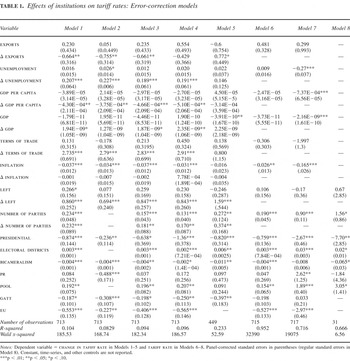
The main model discussed above is Model 1 in Table 1, which reports the coefficients and standard errors of the variables. The short-term effects are the coefficients on the change variables while the long-term effects can be calculated by dividing the coefficients on the level variables by the lagged-level of the dependent variable, which provides the new equilibrium tariff rate associated with permanent changes in the independent variables. All of the economic control variables are in the direction expected from previous studies.57
See, for instance, Magee, Brock, and Young 1989.
Hiscox 1999.
Effects of institutions on tariff rates: Error-correction models

The model also includes two control variables to account for the international environment in which domestic trade policy is situated: EU membership and GATT signings. Being a member of the European Union is associated with tariff rates lower than 6 percent, on average and in the long term, than non-EU members. The GATT variable counts the number of major GATT accords in effect during that year: each additional major round led to roughly 2 percent lower tariff rates in the long run, which provides a useful baseline against which to compare the size of the political effects.59
The major GATT accords during the sample years were the Dillon, Kennedy, and Tokyo Rounds.
On the whole, the political variables are in the direction predicted by the access point theory with nearly all of them statistically and substantively significant. The number of electoral districts has a positive effect on the size of the tariff, as expected by Hypothesis 1: each additional electoral district is associated with a .033 percent increase in tariff rates in the long term. Thus, a country with one-standard deviation more electoral districts than the average, or about 180 districts, will have nearly 6 percent higher tariff rates. As predicted by Hypothesis 2, the number of parties in government is associated with higher tariffs in both the short and long run. A change from one party in government to two leads to a modest short-term increase in tariffs by .23 percent. In the long run, though, a permanent one-party increase induces a 2.6 percent increase in tariffs, more than each additional GATT round. A one-standard deviation increase in the number of parties in government, about 1.2, is associated with about a 3 percent increase in tariff rates. Party discipline, as measured by vote pooling, also has the expected result: systems with no vote pooling (2 on the scale) have 4 percent higher tariff rates in the long run than systems with complete pooling (0 on the scale).
Controlling for these three variables, PR has no effect on tariff rates: the coefficient is, in fact, positive, although not significant. In other words, it is not PR that leads to free trade policy, as previous scholars have suggested, but those institutions, such as party discipline and a small number of electoral districts, which tend to go along with PR. Coalition government, another feature that is correlated with PR, actually leads to higher tariff rates, although, as seen below, this effect is swamped by the influence of electoral districts and vote pooling. Model 2 demonstrates why previous scholars have found significant negative effects for PR. In this model, where district, number of parties, and pool are not included, PR is significantly associated with 7.3 percent lower tariffs in the long run. Previous research, particularly Rogowski and Mansfield and Busch,60
which only included a variable for PR and not these other institutions, therefore, were giving credit to PR when, in fact, the other institutions were directly responsible for the effect. This is not to say that PR necessarily has no influence on trade policy: it simply does not have a direct or inherent influence on trade policy. To the extent that PR encourages party discipline and a small number of electoral districts, PR will lead to lower tariff rates, but, as discussed above, PR does not necessarily lead to these other institutions nor is PR necessary for these other institutions to exist. At best, PR's effect is indirect and is a result of the influence of PR on the number of access points in a system.Two of the other hypotheses are also supported by the results in Model 1. Presidentialism is associated with 9.6 percent lower tariff rates in the long-term and left-wing governments, which are expected to be more receptive to protectionist interest groups, are associated with higher tariff rates in both the long and short run. The short-term effect in a change to left-wing governments is .86 percent, which is of only modest substantive significance. The long-term effect of a permanent change, though, is over 2.9 percent, larger than the effect of each major GATT signing.
Only one hypothesis is not supported by Model 1: bicameralism is significantly associated with lower tariffs, which is the opposite of what was expected by the access point theory. Perhaps this is because the upper chamber usually represents larger districts than the lower chamber and so may be less receptive to interest groups than the lower chamber, because the upper body must represent many different interests and is less likely to be captured by any one. Thus, a federal chamber acts to temper the protectionist leanings of the popular chamber. By adding a large number of less receptive access points, the average receptivity declines, which may more than offset the increased number of access points. This is an admittedly ad hoc and, thus far, untested explanation, though it appears initially plausible. In addition, the presidential literature referenced above relies on a similar assumption about how larger constituencies will cause policymakers to be less receptive to protectionists.
Models 3 through 8 in Table 1 report the results of robustness checks on Model 1. The first two models show that the findings discussed above are not dependent on the particular coding of presidentialism. Model 3 codes both the United States and France as presidential systems, while only the United States is presidential in Model 4. The results are quite similar in all three models: the effect of exports in the short-term loses significance and the effect of left-wing parties becomes marginally insignificant in the long term in the models, but the rest of the variables have the same sign and level of significance. The size of the effects for number of parties and bicameralism shrink somewhat in these alternative models but remains highly significant statistically and substantively.61
Finland and France have among the largest coalition governments in the sample, so the results on number of parties may be somewhat sensitive to the coding of these countries.
Model 5 reports the results from excluding EU countries from the sample, which drops the number of observations to 449, a 35 percent reduction in the sample size. For the most part, though, the results do not change in meaningful ways from Model 1. Two of the institutional variables change in statistical significance, with pooled votes and the long-term effect of left-wing parties losing all significance. Pooling probably loses significance because there is less variance in this variable when the EU is excluded as most of the low-pooling countries are members of the EU for at least part of the sample. The size of the effect for the other political variables of interest actually grows in this model: the impact of increasing the number of electoral districts doubles, and the impact of increasing the number of parties in government increases by greater than 15 percent in the long term and by greater than 60 percent in the short term. PR remains highly insignificant in this model. In sum, the general results presented, showing that access points are related to higher tariffs, are robust to dropping the EU countries, so even if one finds the assumption that these countries still have control over their tariff rates to be questionable, the access point theory is still supported by the appropriate results.
Model 6 presents the results from a more standard lagged-dependent-variable-with-PCSEs approach to demonstrate that the results are not an artifact of the ECM method. In this model, the dependent (and all the independent variables) are measured in levels rather than changes, and the lagged level of the average tariff rate, the dependent variable, is included as an independent variable. The model is then estimated with PCSEs. The political results discussed above are largely unchanged in this new model: number of parties and electoral districts significantly lead to higher tariffs while pooling, presidentialism, and bicameralism all significantly lead to lower tariffs. PR, as above, is insignificant. The only change in political variables is found in partisanship, where the effect of left-wing parties is marginally insignificant. The effect of economic factors, on the other hand, changes dramatically in Model 6. Only inflation is found to be significant, suggesting that economic factors play almost no role in determining tariff rates. Thus, this model is probably seriously misspecified and should reinforce confidence in using the ECM framework instead. However, the results of interest to the access point theory do not depend upon this modeling choice.
Model 7 repeats Model 6 but drops the lagged dependent variable because of concerns that lagged dependent variables, when not theoretically warranted, can cause the effects of other independent variables to become insignificant or even flip signs because the lags “dominate” the regression.62
Achen 2000.
Ibid., 7.
Another potential concern with the above models derives from the lack of within-country variation in some of the political variables. While number of parties and partisanship often vary from election to election, and sometimes more often if there is cabinet instability between elections, the other variables, measuring the electoral law or the constitutional structure of the country, vary less frequently and, sometimes, not at all within countries. Thus, these variables may be picking up fixed-effects between countries, in addition to the effects of the institutions.64
In addition, one may be concerned that the panel design artificially increases the power of the hypothesis tests by recording multiple observations of the same data, thus making significant results more likely.
The changes in electoral districts occur in both directions, with the number of districts decreasing over time in Germany, Greece, Austria, Norway, and Sweden; increasing over time in Italy and Australia; and both increasing and decreasing in France.
To address these concerns, I replicate the analysis using a semi–cross-section of political systems. Instead of reducing all countries to one observation, I count each major institutional change as a different system, in a manner similar to Lijphart.66
Lijphart 1994.
Australia, Germany, Greece, Italy, Norway, and Sweden also have two observations each.
This procedure increases the sample size from twenty-one to thirty-one, still not enough to perform many sophisticated statistical analyses. Thus, Model 8 replicates the results above with standard ordinary least squares (OLS) and includes only the political variables, dropping the economic controls. These results are largely consistent with those found in Model 1 above: Number of parties and number of electoral districts are significantly related to more protectionism while presidentialism, pooling, and bicameralism are significantly related to less protection. PR remains insignificant in this model. The only major difference between the methods is that partisanship is now insignificant, which suggests that the effect of partisanship is largely operating within-country rather than across-country.68
Including the economic control variables does not change the sign of any of the coefficients except for partisanship, which becomes positive, as expected, but remains insignificant. With the controls, though, only number of districts and pooling remain significant. Given the sample size, including six more independent variables radically shrinks the degrees of freedom, so this loss of significance is not surprising.
In summary, the evidence strongly supports the access point theory, suggesting that domestic institutions not only have a large influence on trade policy, but that the mechanism through which this influence is felt is the amount of access provided to interest groups.
Conclusions
In this article, I introduced a new theory about the effects of institutions on policymaking and applied it to trade policy. The theory argues that increasing the number of access points increases the amount of lobbying because it makes lobbying less costly. Because protectionists have lower lobbying costs than free-traders, they are also better able to take advantage of increased access. As a result, increasing the number of access points also increases the level of protection. From this abstract theory, I generated a number of hypotheses about how specific institutional features, such as the number of parties and electoral districts, affect trade policy, emphasizing that proportional representation itself has no effect on protectionism.
I then tested the theory on previously unexamined data on tariff rates in postwar developed democracies. The results are largely supportive of the theory: I found that tariff rates were higher when more parties were in government, when there were more electoral districts, and when there were low levels of party discipline. Controlling for these factors, proportional representation did not have an independent effect on tariff rates. Furthermore, and in line with the theory, I found that presidentialism and right-wing governments were both associated with lower tariff rates.
The access point theory also better accounts for many of the anomalies identified above with regards to the PR versus plurality dichotomy. Ireland, despite having PR, has high tariffs in part because it has a large number of electoral districts and only an intermediate level of pooling. Switzerland, despite having PR, has high tariffs in part because it has a relatively high level of electoral districts and large cabinet coalitions. Japan, despite not having PR, has low tariffs in part because it has few coalition governments and high pooling. In other words, each of these countries has the level of protection one would expect from their number of access points. On the whole, I would therefore argue that the analysis presented here provides strong evidence that more access points lead to more protectionism.
While this article applied the theory to trade policy, the theory should have much broader applicability, providing one with a new way to understand the effects of institutions on policy outcomes. The number of access points should be able to explain policy outcomes whenever one side has an inherent lobbying advantage over the other. For instance, the more access points there are, the more pork-barrel politics there should be, as the benefits of pork, by definition, are concentrated on one group—the recipients—while the costs are dispersed across all taxpayers who are forced to pay for the pork, thus giving proponents of pork a distinct lobbying advantage over opponents. Consumer, environmental, health, and other regulations should also be less common in high access point systems, as the benefits of these regulations are dispersed over all consumers or citizens, while the costs are concentrated on the industries being regulated. It is left to future research to actually extend the access point theory to these and other policy realms, but both the extension and the tests should be relatively straightforward given the results presented here (though data collection may be problematic.)
Another extension of the access point theory would involve combining it with veto player theory. The access point theory has clear linkages to and overlaps with Tsebelis's veto player theory in that they both attempt to categorize different institutions on one dimension.69
Tsebelis 2002.
The specific application of the access point theory to trade policy conducted here not only provides support for the theory but also increases understanding of international trade. Previous literature on cross-national differences in trade policy has largely focused on economic differences or on the effects of one particular institutional difference, usually in a small set of countries. This article provides a systematic political explanation for differences in trade policy which helps in understanding why different countries have reacted differently to the pressures of globalization. For instance, France has both relatively high tariff rates and experienced a fairly high increase in tariff rates in the 1970s and 1980s, possibly because its large number of access points made it more susceptible to the demands of new protectionism than other countries, such as Germany, which had both lower overall tariffs and no resurgence. While there are plenty of possible extensions for the access point theory even within trade policy, such as examining the effects on less-developed countries or before World War II or examining in more detail the effect of institutional changes within individual countries, the initial results presented here strongly suggest that these extensions will continue to yield valuable insights into the trade policymaking process.
Data descriptions and sources