INTRODUCTION
The fish of the sub-family Epinephelinae belonging to the family Serranidae, popularly known as groupers or rock cods, constitute an important component of the demersal fishery resource of India and form about 2% of total marine landings in India (Banerjee et al., Reference Banerjee, Chavan, Sundaram, Kamble, Menon and Venugopal2006). The spinycheek grouper, Epinephelus diacanthus (Valenciennes, 1828) (family: Serranidae) is a demersal marine fish species found on the continental shelf of the northern Indian Ocean from the Gulf of Aden to Sri Lanka and India. It is one of the most common groupers on the west coast of the Arabian Sea (8–33% of all groupers landed), but is less common on the east coast bordering the Bay of Bengal, where it contributes less than 5% of grouper landings. Groupers have assumed commercial importance in view of their good quality meat and greater consumer demand in local and export markets both in fresh as well as frozen forms, and are valued as among the highest quality seafood in many parts of the world (Chen & Tsai, Reference Chen and Tsai1994).
Much research on the fatty acid composition of fish from different Epinephelus species has been reported, e.g. orange-spotted grouper (Epinephelus coioides) in the Persian Gulf, Epinephelus coioides in Kuwait, dusky grouper (Epinephelus marginatus), red grouper (Epinephelus morio) and greasy grouper (Epinephelus tauvina) in the Arabian Gulf (Gall et al., Reference Gall, Otwell, Koburgier and Appledorf1983; Kotb et al., Reference Kotb, Hadeed and Al-Baker1991; Hossain et al., Reference Hossain, Almatar, Al-abdul-elah and Yaseen2012; Jalili et al., Reference Jalili, Pour and Zoriastein2013). However, information concerning the nutritional value of the spiny cheek grouper, E. diacanthus is still scarce, though it is a dominant demersal fishery resource off the Indian coast. The study of seasonal lipid dynamics of food fish like E. diacanthus is of importance in determining their value as a source of essential nutrients for humans. Therefore this study has been designed to examine the spatial (south-west and south-east coasts of India bordering the Arabian Sea and Bay of Bengal, respectively), seasonal (pre-monsoon, monsoon and post-monsoon) and inter-annual (2008–2011) variations of lipids, fatty acids and cholesterol composition in the edible muscles of E. diacanthus. The biochemical composition of fish is strongly affected by the composition of their food (Henderson & Tocher, Reference Henderson and Tocher1987; Orban et al., Reference Orban, Nevigato, Masci, Di Lena, Casini and Caproni2007). It is well known that photosynthetic pigments are the index of primary production of an area and play a significant role in the ecological characteristics and nutritional properties of the species living in the ecosystem. The concentration of chlorophyll-a is often used as a proxy of phytoplankton biomass and water quality indicator (Wasmund & Uhlig, Reference Wasmund and Uhlig2003). Since chlorophyll-a is one of the major indices of the standing crop of phytoplankton, the estimation of this will give a general idea of the variation in the magnitude of nutritional quality of groupers. The relative abundance of chlorophyll-a concentration derived from Seaviewing Wide Field-of-view Sensor (SeaWiFS) data and the variations in the sea surface temperature (SST) obtained from MODIS-AQUA data for the studied period were also taken into account to understand their effect on these lipid signatures throughout the study period. The health indices such as atherogenic index, thrombogenicity index, and hypocholesterolaemic/hypercholesterolaemic ratio of the edible muscles of E. diacanthus were taken into account to understand its nutritional qualities as healthy food for human consumption.
MATERIALS AND METHODS
The study area and samples
Fresh groupers were collected (1 kg each) at the fishing harbours of Mangalore, Calicut, Cochin (south-werst coast, Arabian Sea–Indian ocean) and Chennai, Mandapam, Tuticorin (south-east coast, Bay of Bengal–Indian Ocean) during 2008–2011. Two pools of fish per collection site, each composed of 5–10 specimens of comparable body size were collected within each sample and transported to the laboratory in an ice box (−18°C) for analyses. The samples were collected on the 15th day of each month (January–December) from each location. The analysed results of the three centres from each coast were found to be similar and considered as triplicates. The mean values of the triplicate were used as the data of the particular coast. In order to obtain information on the seasonal variations, the monthly data were grouped as pre-monsoon (February–May), monsoon (June–September) and post-monsoon (October–January). The edible part of the fish was removed, cut into pieces and homogenized. A sample of 30 g of muscle was homogenized, and lipids were extracted according to the method of Folch et al. (Reference Folch, Lees and Stanley1957) using a chloroform/methanol mixture (2:1, v/v) containing 0.01% butylated hydroxytoluene (BHT) to prevent oxidation. The lipid content was determined gravimetrically and expressed as % (w/w edible muscle).
Fatty acid profile and nutritional indices
The aliquots of the lipids extracted were used to prepare the fatty acid methyl esters (FAME) and analysed using gas chromatography according to the procedure described by Chakraborty et al. (Reference Chakraborty, Chakraborty, Radhakrishnan and Vijayan2010). GLC data were recorded on a Perkin-Elmer (USA) AutoSystem XL gas chromatograph (HP 5890 Series II) connected with a SP 2560 (crossbond 5% diphenyl-95% dimethyl polysiloxane) capillary column (100 m × 0.25 mm i.d., 0.50 µm film thickness, Supelco, Bellfonte, PA) using a flame ionization detector (FID) equipped with a split/splitless injector, which was used in the split (1:15) mode. FAMEs were identified by comparison of retention times with known standards (Supelco™ 37 Component FAME Mix, Catalog No. 47885-U) and the results were expressed as percent of total fatty acids (% TFA).
The different ratios of fatty acid indicating nutritional values of groupers viz., n-3/n-6, docosahexaenoic acid (DHA)/eicosapentaenoic acid (EPA), polyunsaturated fatty acid (PUFA)/saturated fatty acid (SFA) and linoleic acid (LA)/α-linolenic acid (ALA) were calculated (HMSO, 2001). The mean value of each fatty acid was used to calculate the sum of the saturated (SFA), monounsaturated (MUFA) and PUFA. The indices of atherogenicity (AI) and thrombogenicity (TI) (Ulbricht & Southgate, Reference Ulbricht and Southgate1991) have been calculated as:
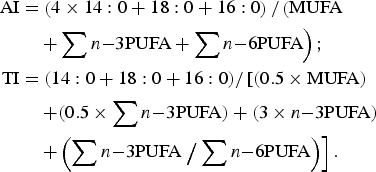 $$\eqalign{\hbox{AI}&=\left(4\times14\colon 0+18\colon 0+16\colon 0\right)/\left(\hbox{MUFA} \right. \cr &\left. \quad +\sum n{\rm -} 3 \hbox{PUFA}+\sum {\it n}{\rm -} 6 \hbox{PUFA}\right)\semicolon \; \cr \hbox{TI} & =\lpar 14\colon 0+18\colon 0+16\colon 0\rpar /\left[\lpar 0.5\times \hbox{MUFA}\rpar \right. \cr & \left. \quad +\lpar 0.5\times \sum n {\rm -} 3 \hbox{PUFA}\rpar +\lpar 3\times {\it n}{\rm -} 3 \hbox{PUFA}\rpar \right. \cr & \left. \quad + \left(\sum n{\rm -} 3 \hbox{PUFA}\; \big{/} \sum {\it n}{\rm -} 6 \hbox{PUFA}\right)\right].}$$
The hypocholesterolaemic/hypercholesterolaemic (HH) ratio were determined as:
 $$\eqalign{\hbox{HH} & = (18\colon 1 n {\rm -} 9+18\colon 2 {\it n} {\rm -}6+20\colon 4 {\it n} {\rm -} 6+18\colon \cr & \quad 3 {\it n} {\rm -} 3+20\colon 5 {\it n}{\rm -} 3+22\colon 5 {\it n} {\rm -} 3+22\colon 6 {\it n}{\rm -} 3)/\cr & \quad \lpar 14\colon 0+16\colon 0\rpar\ \lpar \hbox{Santos-Silva} \, et\; al.\comma \; 2002\rpar .}$$
Total cholesterol content
The total cholesterol content in the edible portion of oil sardines was determined spectrophotometrically (Varian Cary, USA) as described elsewhere (Wanasundara & Shahidi, Reference Wanasundara and Shahidi1999) with suitable modification using o-phthalaldehyde (50 mg dl−1 in glacial acetic acid). The total cholesterol content of the sample was calculated from the standard curve of cholesterol, and expressed as mg/100 g edible muscle.
Chlorophyll-a concentration and sea surface temperature
Chlorophyll-a concentrations derived from the global 9 km monthly mean SeaWiFS data for the period from January 2008 to December 2011 (Chakraborty et al., Reference Chakraborty, Joseph, Selsa and Vijayan2013) were taken into account to indicate the distribution of the photosynthetic pigment chlorophyll-a, and expressed as mg m−3. Similarly, sea surface temperature (SST) derived from global 9 km monthly mean Moderate Resolution Imaging Spectroradiometer (MODIS)—AQUA data for the period from January 2008 to December 2011 (Chakraborty et al., Reference Chakraborty, Joseph, Selsa and Vijayan2013) were also considered to study the effect of temperature on fatty acid composition.
Statistical analyses
Statistical evaluation was carried out with the Statistical Package for Social Sciences 13.0 (SPSS Inc., USA, v.13.0). Comparison of groups for different variables such as lipid content and fatty acid parameters, across different years (2008–2011), seasons (pre-monsoon, monsoon and post-monsoon) and coasts (south-west and south-east) were performed using the analysis of variance (ANOVA) with Scheffé's post-hoc analysis. The significant differences were represented as P < 0.05. The values were given as mean of triplicates ±standard deviation. The means of all triplicate parameters were examined for significance by ANOVA and the level of significance was reported at P ≤ 0.05.
RESULTS
Seasonal and inter-annual variability of lipid content in Epinephelus diacanthus
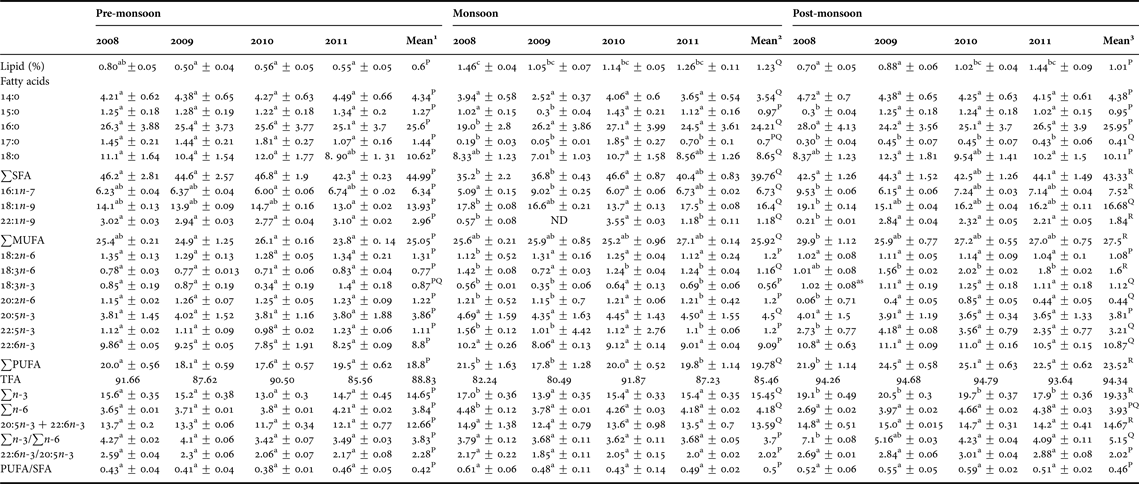
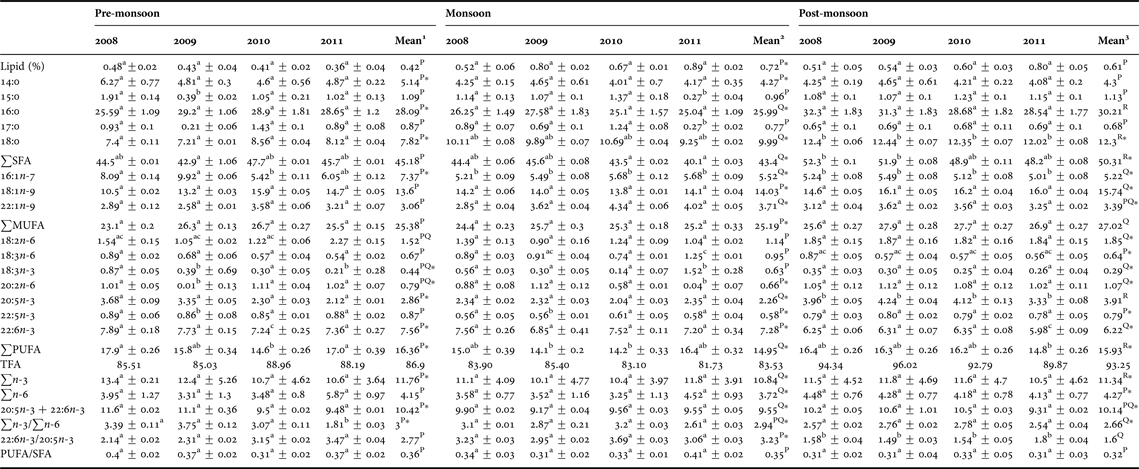
The seasonal and inter-annual variability of lipid content in the edible muscles of Epinephelus diacanthus are shown in Tables 1 and 2. The four-year seasonal mean lipid content observed significantly higher values during monsoon along south-west coast (four year mean 1.2%, P < 0.05) followed by post-monsoon (1.0%) and pre-monsoon (0.6%). A monsoon maxima was observed along the south-east coast (four year mean 0.7%) followed by post-monsoon (0.6%) and pre-monsoon season (0.4%). The groupers collected during monsoon showed significantly higher lipid content (1.2%) compared to the south-east coast counterparts (0.7%) during the same season (P < 0.05).
Lipid (%) and fatty acid composition (% total fatty acids) of Epinephelus diacanthus collected from the south-west coast of India during 2008–2011 in three different seasons (pre-monsoon, monsoon and post-monsoon).

Data are expressed as mean ± standard deviation of three replicates. ∑SFA, total saturated fatty acids; ∑MUFA, total monounsaturated fatty acids; ∑PUFA, total polyunsaturated fatty acids.
1,2,3Represents the mean values during pre-monsoon, monsoon and post-monsoon seasons, respectively. Means with different superscripts (a, b, c, d) in the same row indicates statistical difference (P < 0.05). Different superscripts (P, Q, R) in the mean values represent statistical difference (P < 0.05). ND, not detected. The fatty acids below 1% TFA (SFA—12:0, 20:0, 22:0, 24:0; MUFA—14:1n-7, 15:1n-7, 18:1n-7, 20:1n-9, 24:1n-9; PUFA—16:2n-4, 16:3n-4, 18:4n-3, 20:3n-6, 20:4n-6) are not included in this table.
Lipid (%) and fatty acid composition (% total fatty acids) of Epinephelus diacanthus collected from the south-east coast of India during 2008–2011 in three different seasons (pre-monsoon, monsoon and post-monsoon).
The notation in the table is as indicated in Table 1. The fatty acids below 1% TFA (SFA—12:0, 20:0, 22:0, 24:0; MUFA—14:1n-7, 15:1n-7, 18:1n-7, 20:1n-9, 24:1n-9; PUFA—16:2n-4, 16:3n-4, 18:4n-3, 20:3n-6) are not included in this Table. *In the mean value columns indicates the significant difference (P < 0.05) compared to the value of south-west coast at same season.
Seasonal and inter-annual variability of fatty acid composition in Epinephelus diacanthus
The groupers collected from the south-east coast showed significantly higher total SFA content during monsoon (four year mean 43.4%) and post-monsoon (four year mean 50.3%) seasons compared to the south-west coast samples during the same seasons (39.8 and 43.3%, respectively) (Tables 1 and 2) (P < 0.05). The most abundant SFA recorded along both the coasts during the study period was palmitic acid (16:0) accounting for almost 25–32.3% at the south-east coast and 19–28% along the south-west coast. The total MUFA content of groupers ranged between 23.8–29.9% along the south-west coast and 23.1–27.9% along the south-east coast. Significantly lower total MUFA content was observed for the groupers collected from the south-east coast during monsoon (four year mean 25.2%) compared to the south-west coast samples in the same season (four year mean 27.5%) (P < 0.05). The groupers collected from the south-west coast showed significantly higher total PUFA content during post-monsoon (four year mean 23.5%) compared to the south-east coast samples in the same season (four year mean 15.9%) (P < 0.05). On the south-west coast, the samples collected during post-monsoon (four year mean 23.5%) showed significantly higher total PUFA content compared to monsoon (four year mean 19.8%) and pre-monsoon (four year mean 18.8%) (P < 0.05). Similarly, the samples from the south-east coast showed significantly higher total PUFA content during pre-monsoon (four year mean 16.4%) compared to monsoon and post-monsoon samples (four year mean 14.9 and 15.9%, respectively) (P < 0.05).
The ∑n-3 PUFAs were found to be significantly higher in the samples collected from the south-west coast (13–20.5%) during all three seasons than those from the south-east coast (10.1–13.4%) (P < 0.05). Among the PUFAs, DHA (8.1–11.1% in south-west and 6–7.9% in south-east) and EPA (3.6–4.7% in south-west and 2.1–4.2% in south-east) contributed significantly major shares to the n-3 PUFAs irrespective of the seasons and years studied (P < 0.05). The four-year mean EPA recorded significantly higher values during monsoon (four year mean 4.5%) compared to other seasons (<4.0%) along the south-west coast. However, EPA content recorded significantly higher readings during post-monsoon season along the south-east coast (four year mean 3.9%) than in pre-monsoon (four year mean 2.9%) and monsoon (four year mean 2.3%) at the south-east coast. DHA in the south-west coast samples recorded significantly higher values during all the studied seasons (four year means ≥8.8%) compared to the south-east coast samples (four year means <7.6%) (P < 0.05). Along the south-west coast, significantly higher DHA content was observed during post-monsoon (10.9%) compared to monsoon (9.1%) and pre-monsoon (8.8%). However, both pre-monsoon and monsoon seasons along the south-east coast showed significantly higher DHA content (7.6 and 7.3%, respectively) compared to post-monsoon season (6.2%) (P < 0.05). The EPA + DHA content showed significantly higher values during post-monsoon (four year mean 14.7%) among groupers collected from the south-west coast (P < 0.05). Interestingly, EPA + DHA content showed significantly higher values along the south-west coast during all the studied seasons (P < 0.05).
Seasonal and inter-annual variability of nutritional indices in Epinephelus diacanthus
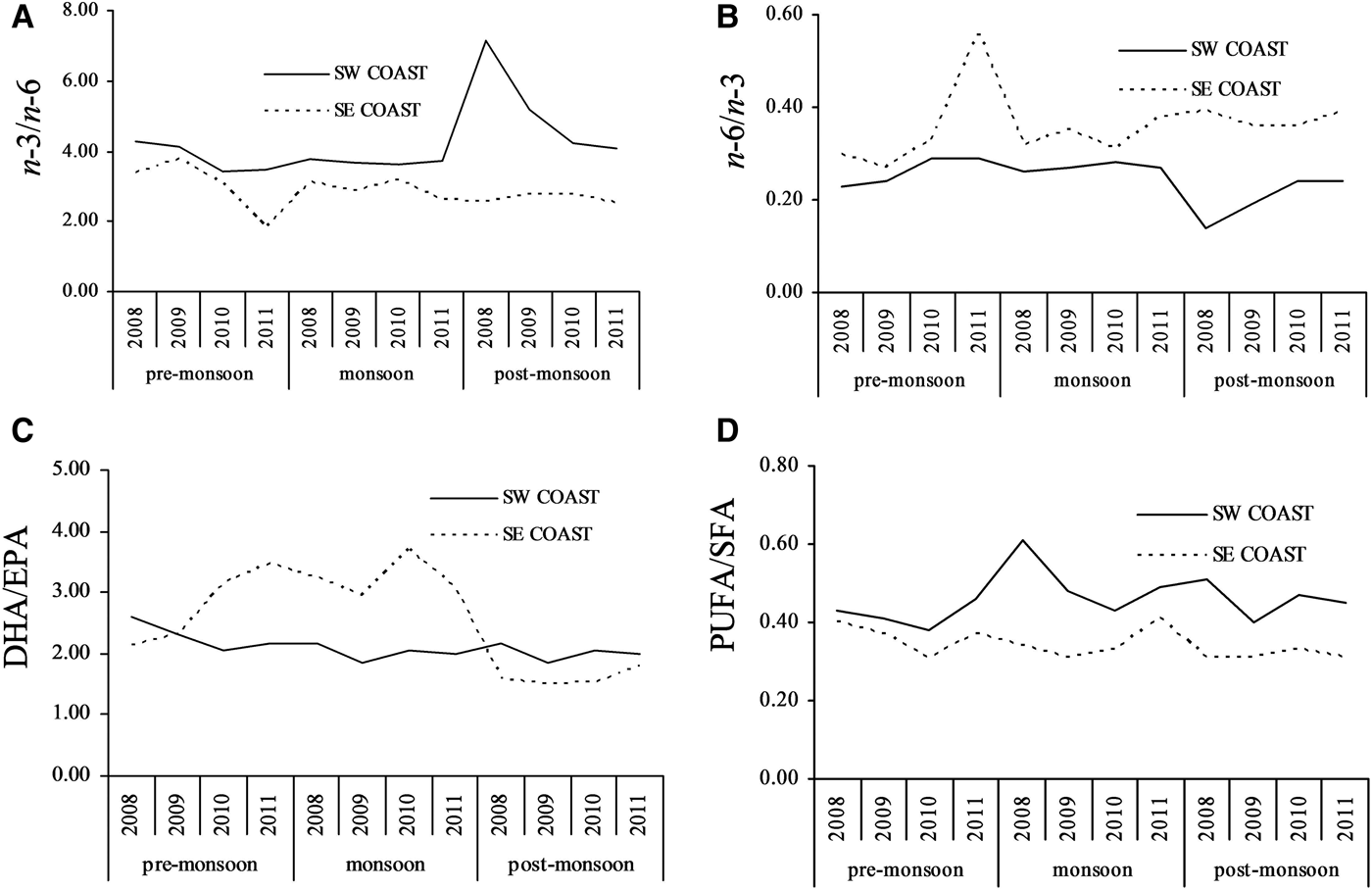
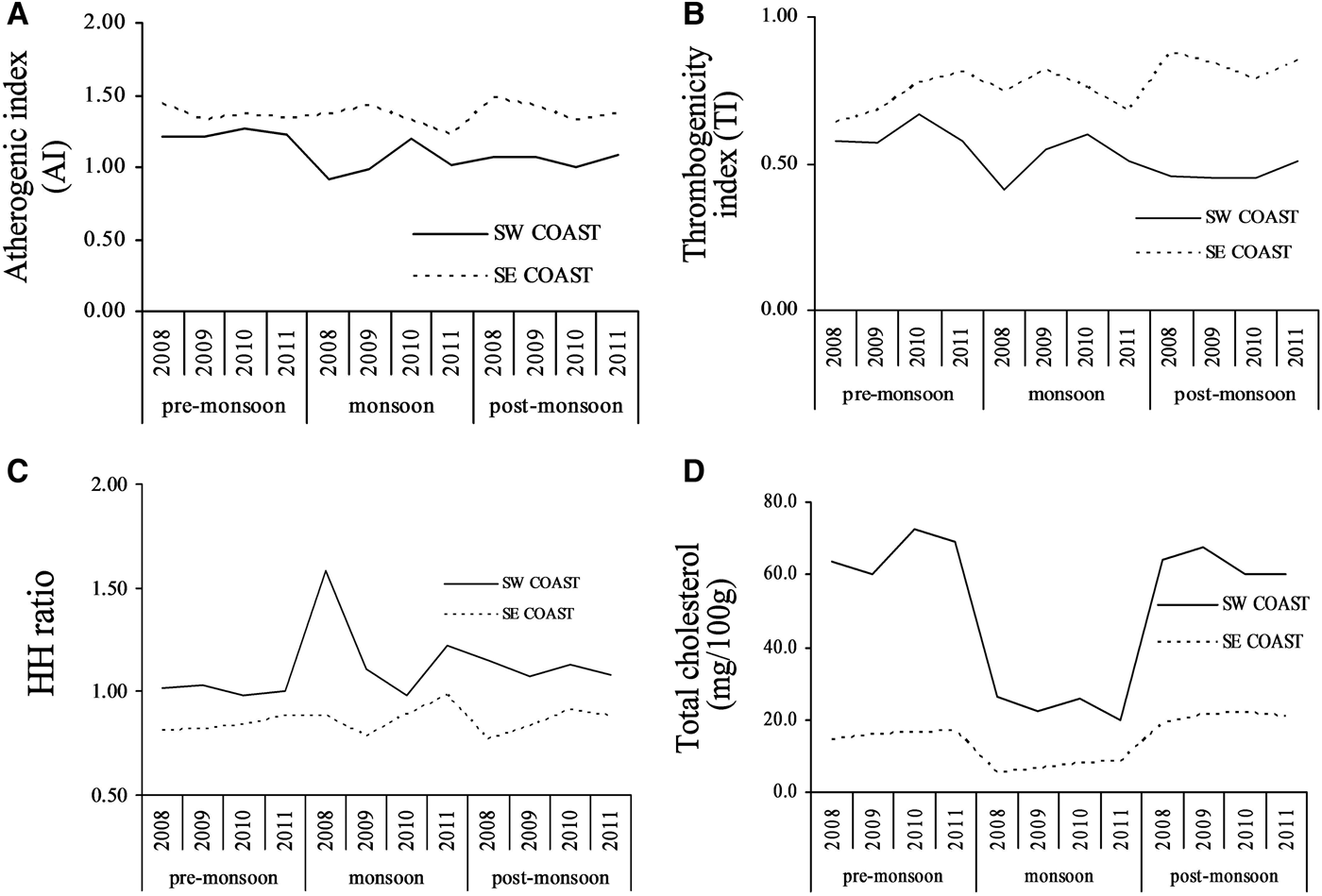
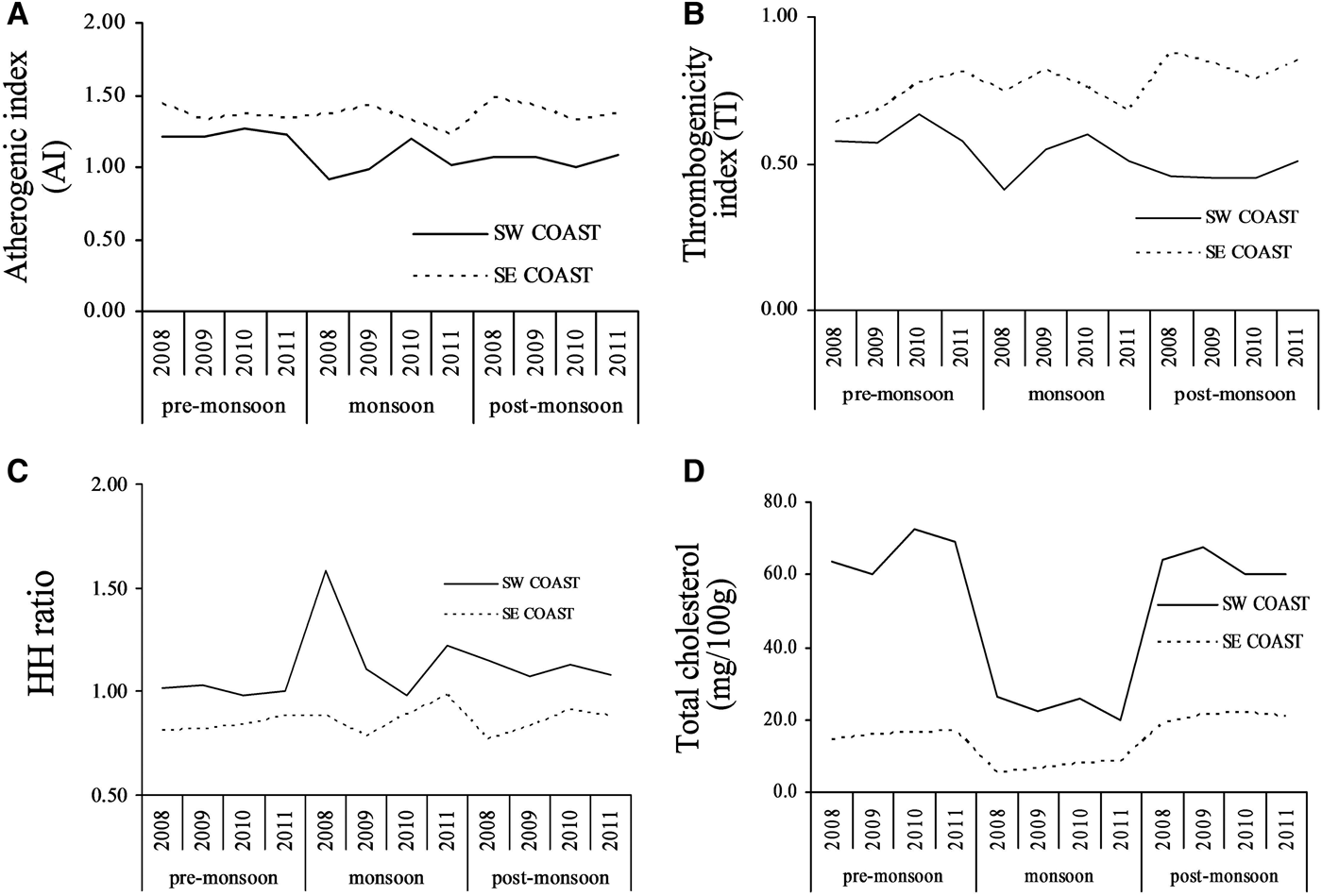
The post-monsoon maximum in the content of n-3/n-6 ratio was recorded in E. diacanthus on the south-west coast (5.2%), whereas the n-6/n-3 ratio was found to at its best during the pre-monsoon season on the south-east coast (3%) (Figure 1A, B). DHA/EPA ratio (Tables 1 and 2) in this species did not show any significant difference between seasons (P > 0.05) (Figure 1C). The PUFA/SFA ratio showed a monsoon maxima along the south-west coast (four year mean 0.54) and pre-monsoon maxima along the south-east coast (four year mean 0.36) (Figure 1D). The AI and TI indices were higher in the edible muscles of E. diacanthus collected from the south-east coast (1.2–1.6 and 0.42–0.57, respectively) than those from the south-west coast (0.7–1.1 and 0.3–0.4, respectively) (Figure 2A, B). The HH ratio was found to be higher in the edible muscles of E. diacanthus collected from the south-west coast (1.3–2.1) than those from the south-east coast of India (0.8–1.2) (Figure 2C).
Seasonal variability of: (A) n-3/n-6; (B) n-6/n-3; (C) DHA/EPA; (D) PUFA/SFA ratios of Epinephelus diacanthus collected from south-west and south-east coasts of India during 2008–2011 in three different seasons (pre-monsoon, monsoon and post-monsoon).
Seasonal (pre-monsoon, monsoon and post-monsoon) and inter-annual (2008–2011) variation in: (A) atherogenicity index (AI); (B) thrombogenicity index (TI); (C) hypocholesterolaemic/ hypercholesterolaemic (HH) ratio; (D) total cholesterol content (mg/100 g) of Epinephelus diacanthus collected from south-west and south-east coasts of India.
Seasonal and inter-annual variability of total cholesterol content in Epinephelus diacanthus
The total cholesterol content in the edible muscles of groupers ranged between 19.7–72.3 mg/100 g on the south-west coast and 5.7–22.0 mg/100 g on the south-east coast of India during the studied period (Figure 2D). The samples collected during pre-monsoon and post-monsoon (>60 mg/100 g) showed significantly higher cholesterol content on the south-west coast than during the monsoon season (~24 mg/100 g) (P < 0.05). Similarly, the total cholesterol content showed pre-monsoon and post-monsoon maxima (>14 mg/100 g) and monsoon minima (~8.0 mg/100 g) along the south-east coast.
Seasonal and inter-annual variability in chlorophyll-a concentration and sea surface temperature (SST) along the south-west and south-east coasts of India
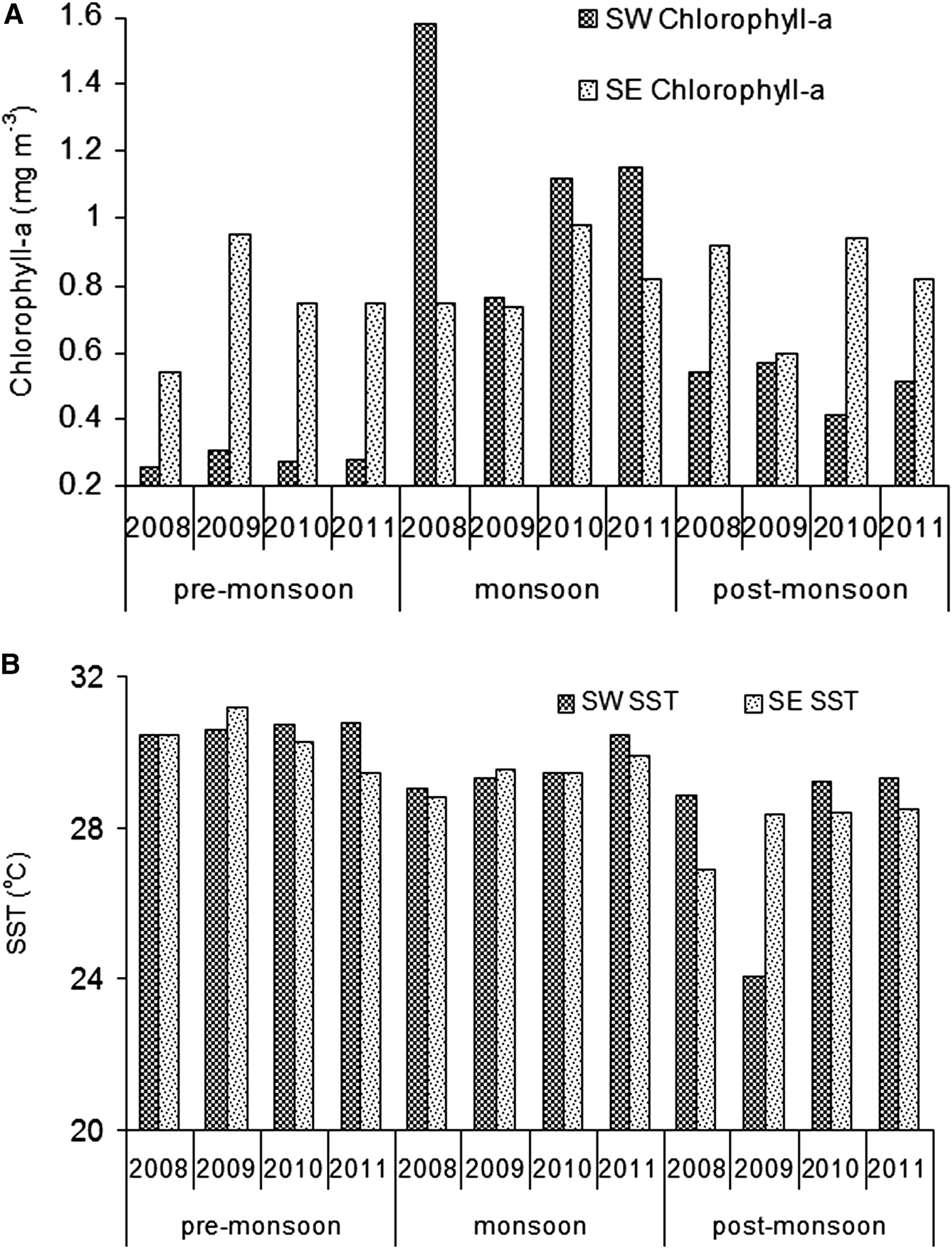
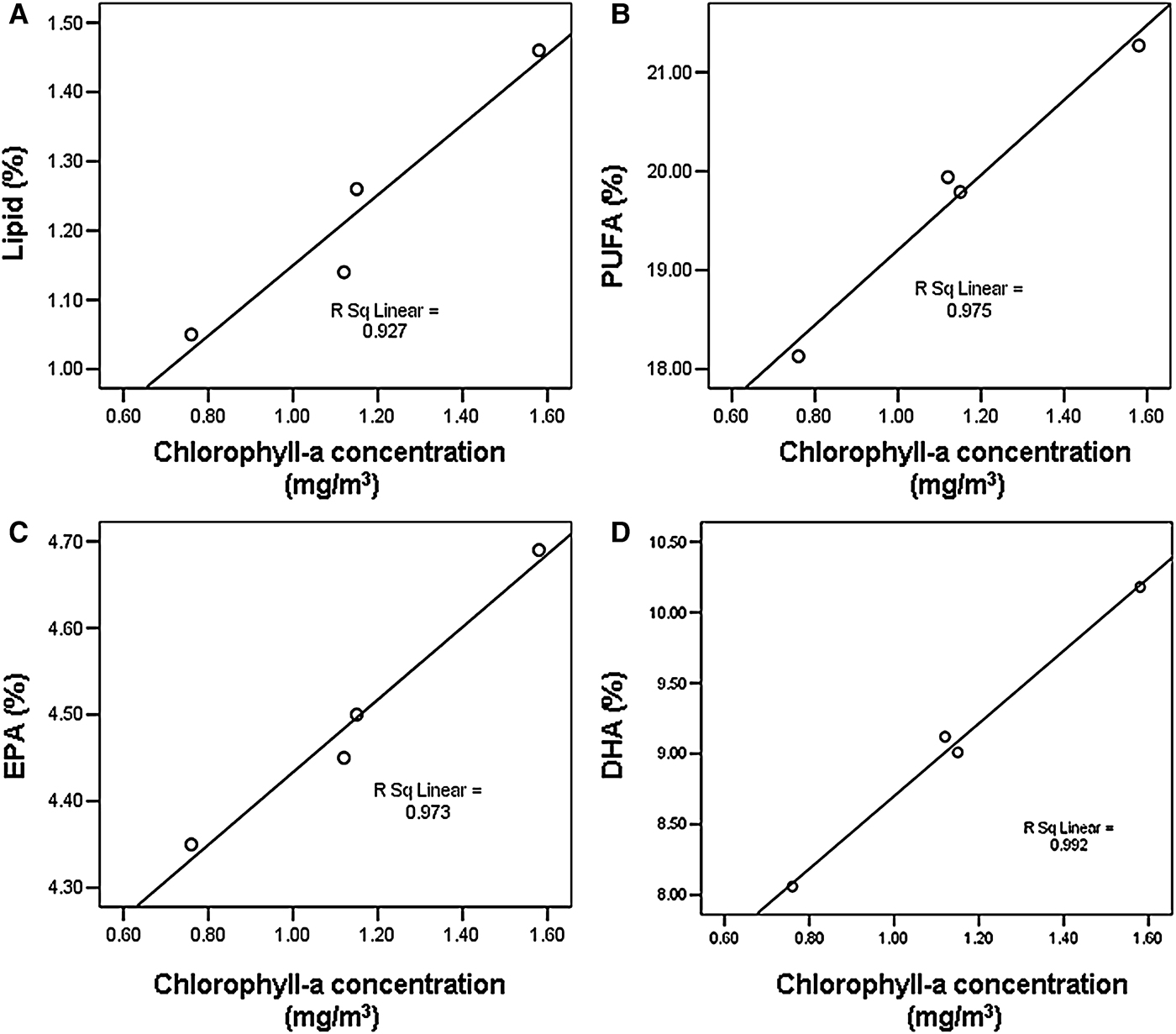
The variance in the spatial distribution of chlorophyll-a and sea surface temperature during 2008–2011, with respect to three seasons (pre-monsoon, monsoon and post-monsoon seasons) have been computed (Chakraborty et al., Reference Chakraborty, Joseph, Selsa and Vijayan2013) and are shown in Figure 3A, B, respectively. The chlorophyll-a, which showed relatively low values pre-monsoon (four-year mean of 0.3 mg m−3), reached monsoon maxima (1.2 mg m−3), and subsequently decreased throughout the post-monsoon season (0.5 mg m−3). The higher lipid content observed during monsoon on the south-west coast as compared with other seasons, showed positive correlation with the enhanced chlorophyll-a concentration (r 2 = 0.927; Figure 4A) during this season. In addition, a positive correlation was observed between chlorophyll-a concentration and total PUFA, EPA and DHA during monsoon on the south-west coast (r 2 = 0.975, 0.973 and 0.992; Figure 4B–D, respectively). On the south-east coast, chlorophyll-a recorded its maximum at 0.8 mg m−3 during the monsoon and post-monsoon seasons, and minimum during pre-monsoon period (0.7 mg m−3). Chakraborty et al. (Reference Chakraborty, Joseph, Selsa and Vijayan2013) also reported that high SSTs were observed during the pre-monsoon season throughout the study period (>30°C) along the south-west and south-east coasts, which decreased in the monsoon (~29°C) and post-monsoon seasons (<29°C) (Figure 3B).
(A) Seasonal (pre-monsoon, monsoon and post-monsoon) and inter-annual (2008–2011) variation in area-averaged time series of SeaWiFS chlorophyll-a concentration (mg m−3) for the period of four years from January 2008 to December 2011 during pre-monsoon, monsoon and post–monsoon seasons; (B) seasonal (pre-monsoon, monsoon and post-monsoon) and inter-annual (2008–2011) variation in monthly sea surface temperature (SST, expressed as °C) derived from global 9 km monthly mean MODIS–AQUA data for the four years (2008–2011) during pre-monsoon, monsoon and post–monsoon seasons.
The correlation between: (A) chlorophyll-a (mg m−3) and lipid content (%); (B) chlorophyll-a (mg m−3) and total polyunsaturated fatty acid (∑PUFA, %); (C) chlorophyll-a (mg m−3) and eicosapentaenoic acid (EPA, %); (D) chlorophyll-a (mg m−3) and docosahexaenoic acid (DHA, %), during monsoon season along south-west coast of India bounding the Arabian Sea.
DISCUSSION
The lipid content in the edible muscles of E. diacanthus was found to be significantly low compared to the lipid content of Epinephelus aeneus from the Mauritanian coast (2.1%, w/w), (P < 0.05) (Louly et al., Reference Louly, Gaydou and El Kebir2011). However, other Serranidae species, Cephalopholis taeniops and Serranus scriba (Louly et al., Reference Louly, Gaydou and El Kebir2011) showed similar lipid content to the present observations. The higher lipid content observed during monsoon on the south-west coast as compared with other seasons correlated well with the enhanced chlorophyll-a concentration (r 2 = 0.927; Figure 4A) during this season. In the warm pre-monsoon season, when water is poor in nutrients and mineral salts, the fish uses the energy reserves in the form of lipids and proteins (Keriko et al., Reference Keriko, Chege, Magu, Mwachiro, Murigi, Githua and Kareru2010) thereby resulting in the reduction of lipid content during the pre-monsoon season.
The total SFA content of E. diacanthus in the present study is similar to the SFA content of E. coioides (Hossain et al., Reference Hossain, Almatar, Al-abdul-elah and Yaseen2012) and E. aeneus (Louly et al., Reference Louly, Gaydou and El Kebir2011). The fatty acid 16:0 which is considered to be a source of potential metabolic energy in fish was observed to be the predominant SFA in the present study. The predominant MUFA was found to be 18:1n-9, which is in agreement with the earlier study of Louly et al. (Reference Louly, Gaydou and El Kebir2011) who observed that the predominant MUFA in the white grouper, E. aeneus was 18:1n-9.
A good correlation was observed between total PUFA and chlorophyll-a concentration during monsoon on the south-west coast (r 2 = 0.975; Figure 4B). The maximum total PUFA content was observed during post-monsoon on the south-west coast of India, when the temperature falls from >30 to <28°C. These results are in accordance with the earlier studies showing that PUFA content in fish varies inversely with water temperature (Shirai et al., Reference Shirai, Terayama and Takeda2002). On the other hand, when the chlorophyll-a concentration was lower pre-monsoon, a decrease in grouper PUFA content was observed along the south-west coast. It is of note that the LC-PUFAs, mainly n-3 fatty acids, are not synthesized de novo by the fish. In the present study, total n-3 PUFA content in the grouper muscles was found to be significantly higher than that of n-6 PUFA over the studied periods (P < 0.05). Hossain et al. (Reference Hossain, Almatar, Al-abdul-elah and Yaseen2012) reported 11.3% total n-3 PUFA in E. coioides, which is low compared with E. diacanthus collected from the south-west coast of India (13.0–20.5%) in the present study. Epinephelus spp. collected from both coasts irrespective of the seasons and years studied, had more than two times the amount of DHA compared to EPA. Similar findings were observed in other Epinephelus spp. like E. coioides (Hossain et al., Reference Hossain, Almatar, Al-abdul-elah and Yaseen2012), E. aeneus (Louly et al., Reference Louly, Gaydou and El Kebir2011) and E. sexfasciatus (Wan Rosli et al., Reference Wan Rosli, Rohana, Gan, Fadzlina, Rosliza, Helmy, Nazri, Ismail, Bahri, Mohamad and Imran2012). The relatively high level of DHA and the high DHA/EPA ratio appeared to be an inherent quality of these species, possibly due to a characteristically greater affinity to retain DHA. Therefore, the groupers collected from both Indian coasts, especially the south-west coast, proved to be an excellent source of DHA which is vital for the growth and functional development of the brain in infants and for maintaining normal brain function in adults (Sidhu, Reference Sidhu2003). A good correlation was observed between EPA and chlorophyll-a concentration during monsoon on the south-west coast (r 2 = 0.973; Figure 4C). EPA appeared to be accumulated from the phytoplanktons, largely unchanged, in the lipids of marine fish due to their reduced capacity for chain elongation and desaturation. The high quantity of EPA + DHA noted in the groupers from the south-west coast, especially during post-monsoon (14.7%) is of great interest because of the role of these fatty acids in the prevention of cardiovascular diseases (Laaksonen et al., Reference Laaksonen, Nyyssonen, Niskanen, Rissanen and Salonen2005). Linoleic acid (18:2n-6, LA) was the major n-6 PUFA found in groupers from both the coasts. Studies have found that higher PUFA and LA intake is associated with significant reductions in the risk of coronary heart diseases (CHD) or cardiovascular-related mortality (Laaksonen et al., Reference Laaksonen, Nyyssonen, Niskanen, Rissanen and Salonen2005).
An increase in the human dietary n-3/n-6 fatty acid ratio is essential to help prevent CHD by reducing plasma lipids and to reduce cancer risk. Though insignificant, the difference in the n-3/n-6 ratio between different seasons in the present study may be explained by the variability of the lipid content of the fish muscles, which depends on the species, period of the year, age, size, reproduction period, as well as the fatty acid composition of the diet (Shirai et al., Reference Shirai, Terayama and Takeda2002). The groupers collected from both coasts showed higher n-3/n-6 ratio (>2.5) than recommended (1:5 or 0.2) (Sargent, Reference Sargent1997), which is highly beneficial and desirable for the daily human diet from a nutritional point of view. The recommended minimum of PUFA/SFA ratio for a healthy diet is 0.45 (HMSO, 2001). The grouper samples collected from the south-east coast were not able to attain the minimum threshold PUFA/SFA ratio throughout the studied periods.
The AI and TI of the groupers collected from the south-west coast were found to be lower than those from the south-east coast of India. The higher n-3 fatty acid content and consequently the higher n-3/n-6 fatty acid ratio in E. diacanthus from the south-west coast apparently contributed to lower AI and TI indices in the edible muscles of groupers harvested from the SW coast. It has been reported that due to the anti-atherogenic and anti-thrombogenic properties, the n-3 PUFAs play a major role in protecting human beings from atherosclerosis and platelet aggregation (Barrento et al., Reference Barrento, Marques, Teixeira, Mendes, Bandarra, Vaz-Pires and Nunes2010). The ideal hypocholesterolaemic/hypercholesterolaemic ratio noted in the groupers, especially for the samples collected from the south-west coast, also contributed towards its desirable qualities from a consumer health perspective.
The total cholesterol content in the edible muscles of E. diacanthus from the south-east coast was found to be lower (5.7–22.0 mg/100 g) as compared to an earlier study carried out by Mathew et al. (Reference Mathew, Ammu, Nair and Devadasan1999) who observed that the banded grouper, Epinephelus latifasciatus and Clupeidae fish such as Opisthoptertus tardoor, Dussumieria acuta, etc, have cholesterol content in the range of 41.4–68.6 mg%. However, Osman et al. (Reference Osman, Suriah and Law2001) observed that the cholesterol content of the fish in Malaysian waters belonging to Clupeidae (Rasterelliger kanagurta, Parastromateus niger, etc) as 37.1–47.1 mg%, which is comparable with the south-west coast groupers in the present study. Epinephelus diacanthus collected from the south-east coast during all the seasons and during the monsoon season along the south-west coast, showed significantly lower cholesterol content (≤25.0 mg%) than beef (84 mg%), pork (79 mg%), chicken (85 mg%), cheese (105 mg%) and eggs (424 mg%) (P < 0.05) (USDA, 1998).
CONCLUSION
The present study demonstrated that the edible muscles of E. diacanthus collected from the south-west coast edging the Arabian Sea, especially during the post-monsoon season, are nutritionally superior with reference to PUFA, ∑n-3 PUFA, EPA + DHA, n-3/n-6, DHA/EPA content than those collected from the south-east coast. The total cholesterol, atherogenic and thrombogenicity indices, and hypocholesterolaemic/hypercholesterolaemic ratio of groupers conform to the optimal nutritional qualities as preferred healthy food for human consumption. The results described how the changes in the chlorophyll-a concentration and SST influence the lipid and fatty acid composition of E. diacanthus under different spacio-temporal conditions. This information is particularly valuable to estimate the probable nutritional status of this species of commercial importance without conducting real-time experiments. The long term study of lipidic parameters established E. diacanthus as an ideal healthy food for human consumption and as a desirable food item from the consumer health perspective.
ACKNOWLEDGEMENTS
The authors are thankful to the Indian Council of Agricultural Research, New Delhi for providing necessary facilities and encouragements to carry out the work under ICAR Outreach Activity-3 on ‘Nutrient profiling of fish as a food for health and dietary component’. The authors thank the Director, Central Marine Fisheries Research Institute for his guidance and support. Thanks are due to the Head, Marine Biotechnology Division, Central Marine Fisheries Research Institute for facilitating the research activity.