Introduction
Comparable to other Western countries, aging of the German population is associated with higher prevalence of chronic diseases such as dementia. In Germany, 1.4 million older adults suffer from dementia at the moment and prevalence of dementia is expected to rise up to 2.2 million people by the year 2030 (Deutsche Alzheimer Gesellschaft, 2012). However, dementia detection rates in primary care setting are too low suggesting a possible benefit of improving detection rates by implementing routine dementia screenings (Hensler et al., Reference Hensler, Engeser and Kaduszkiewicz2006). In Germany, screenings for dementia in primary care are currently not conducted regularly and primary care physicians often hesitate to initiate further diagnostic steps. Only a minority of those general practitioners holds dementia-specific qualifications (Melchinger and Machleidt, Reference Melchinger and Machleidt2005).
At the same time, although sensitivity and specificity of dementia screening instruments such as the Mini-Mental State Examination (MMSE) have been shown sufficient in some studies (Mulligan et al., Reference Mulligan, Mackinnon, Jorm, Giannakopoulos and Michel1996; Jorm, Reference Jorm1997) the utility of screenings in unselected populations is still considered to be questionable (Tangalos et al., Reference Tangalos1996). Furthermore, the success of any future effort in implementing dementia screening would depend on older adult acceptance and acceptance of undergoing such a screening procedure. In effort to measure the patients’ attitude toward dementia screening, more precisely towards Alzheimer's disease screening, Boustani et al. (Reference Boustani2008) have developed and validated the questionnaire Perceptions Regarding Investigational Screening for Memory in Primary Care (PRISM-PC), which covers questions regarding experience with Alzheimer's disease, acceptance of regular screening for Alzheimer's disease, memory problems, colon cancer, and depression as well as attitudes towards Alzheimer's disease screening (Boustani et al., Reference Boustani2008). Whereas attitudes towards and acceptance of dementia or Alzheimer's disease screening have been assessed in several studies within the USA and the UK (Boustani et al., Reference Boustani, Watson, Fultz, Perkins and Druckenbrod2003; Boustani et al., Reference Boustani2006; Boustani et al., Reference Boustani2008; Galvin et al., Reference Galvin, Fu, Nguyen, Glasheen and Scharff2008; Justiss et al., Reference Justiss2009; Boustani et al., Reference Boustani2011; Holsinger et al., Reference Holsinger, Boustani, Abbot and Williams2011; Fowler et al., Reference Fowler2012), no comparable studies have been conducted in Germany so far. In terms of regular screening for memory problems or dementia, acceptance rates of 49% or 81% were found (Boustani et al., Reference Boustani, Watson, Fultz, Perkins and Druckenbrod2003; Holsinger et al., Reference Holsinger, Boustani, Abbot and Williams2011). Because of cultural differences or different healthcare systems, however, acceptance rates within the German population might disagree.
The objectives of the current study were therefore to a) validate a German translation of the PRISM-PC questionnaire and to b) determine the attitudes of older adults in Germany towards Alzheimer's disease screening, especially assessing whether they would accept Alzheimer's disease screenings on a regular basis.
Methods
Study population
The study population consisted of a convenience sample of the Berlin Aging Study II (BASE-II), more precisely of participants who participated in the study between May 2011 and January 2013. Participants were originally recruited at the Max-Planck-Institute for Human Development (MPIB). Due to exclusion criteria, the sample of BASE-II did not suffer from severe medical, neurological, psychiatric or terminal diseases (see Bertram et al., Reference Bertram2013, for more information on the cohort profile). BASE-II was approved by the ethics committee of the Charité -Universitätsmedizin Berlin (number of the ethical approval: EA2/029/09), and by the ethics committee of the MPIB. All of the participants provided written informed consent to be enrolled in the study.
Study procedure and instruments
The PRISM-PC questionnaire (Boustani et al., Reference Boustani2008, see Appendix) was translated by two psychologist researchers who were experienced in the English language. Afterwards, the translated questionnaire was re-translated into English by an English native speaker whereupon divergences between the original version and the re-translated version were discussed and resolved with consensus. The translated version (see supplemental material, attached to the electronic version of this paper at: www.journals.cambridge.org/jid_IPG) was kept as similar to the original as possible. The translated version contained 46 items. Section A covered questions about prior experience with Alzheimer's disease while the acceptance of Alzheimer's disease screening was assessed in Section B. Section C contained two questions on acceptance of colon cancer and depression screening respectively; Section D was about attitudes towards Alzheimer's disease screening. In Section E, participants were asked to report other concerns regarding Alzheimer's disease screening; additionally, they got to state whether they felt comfortable answering the questions. Each item of Sections B, C, and D was rated on a five-point Likert scale reaching from “strongly agree” to “strongly disagree”. Items of Sections A and E had a dichotomous or an open response format.
The translated PRISM-PC questionnaire was completed by the participants either before or after an extensive neuropsychological assessment. This was done in order to control for possible interactions between the neuropsychological tests and the acceptance evaluation. Administration of the questionnaire took about 10 minutes. The participants were not given any information regarding the potential benefits or harms of Alzheimer's disease screening prior to completing the questionnaire in order to assess underlying attitudes.
In addition to the PRISM-PC questionnaire, participants of BASE-II underwent an extensive medical examination including the medical history, laboratory values, the physical status, and functional tests as well as other diagnostic tests such as audiometry or motion monitoring and a (neuro-) psychological assessment including the MMSE (Folstein et al., Reference Folstein, Folstein and McHugh1975), Clock Completion Test (Shulman et al., Reference Shulman, Shedletsky and Silver1986), DemTect (Kalbe et al., Reference Kalbe2004), the neuropsychological battery from the Consortium to Establish a Registry for Alzheimer's Disease (CERAD-Plus) (Morris et al., Reference Morris1989), and the Center for Epidemiological Studies Depression Scale (CES-D; Radloff, Reference Radloff1977; see Bertram et al., Reference Bertram2013 for more information on surveys and tests).
Statistical analysis
For statistical analyses, items were recoded such that higher values indicated stronger agreement. Items 37–41 were excluded from analyses with regard to their content: due to the German healthcare system, health insurance as well as long-term care insurance is obligatory and elderly adults do not need to worry that they will lose their insurance because of a certain disease. Regarding concerns that employers would find out the diagnosis (Item 39), most of the participants of BASE-II were already retired and hence we considered this item to be irrelevant.
Descriptive statistics were computed with SPSS (version 21); for exploratory as well as confirmatory factor analysis Mplus (version 7) was used. The software R (version 2.15.2) was applied for scree plots, parallel analyses, and the minimum-average-partial tests within exploratory factor analysis.
factor analyses
Exploratory factor analyses were computed for scales covering acceptance of Alzheimer's disease (Section B) and attitudes towards Alzheimer's disease (Section D). According to Boustani et al. (Reference Boustani2008) the principal axis method of factor extraction was employed for Section B. Regarding Section D, factor analysis was carried out with a MLR-estimator and an oblimin-rotation. Based on the results of the exploratory factor analyses, a hierarchical model for Section D was set up.
Results
Description of study population
Overall, data of 506 participants of BASE-II were included in the current analyses. Participants were between 60 and 82 years old (M = 68.39, SD = 3.48); 332 (65.6%) of them were male and 174 (34.4%) were female. Duration of education was between 1 and 26 years (M = 15.16, SD = 2.88). Their MMSE scores ranged between 20 and 30 points (M = 28.43, SD = 1.44); according to the MMSE, 46 (9.1%) participants would have been classified as being at risk for dementia (≤27 points) contrasting 460 (90.9%) participants who would have not. The participants’ CES-D scores ranged between 0 and 47 points (M = 7.09, SD = 6.45).
Validation of the PRISM-PC
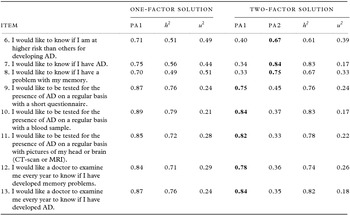
Section B: Acceptance of Alzheimer's disease screening (items 6–13).
For Section B the scree plot indicated that two factors were present. However, there was a rapid decrease in eigenvalues from the first to the second factor. The factor-loadings of both, the one-factor and the two-factor solution are presented in Table 1. As loadings on the first dimension within the one-factor solution were quite high, we decided for the one-factor solution.
Factor loadings for the one- and two-factor solution (Section B: acceptance of Alzheimer's disease screenings)

Note: PA = Principal Axis; h 2 = communality; u 2 = uniqueness of a certain item; AD = Alzheimer's disease. Bold loadings indicate the highest factor loadings for each item respectively.
Section D: Attitudes towards Alzheimer's disease screenings (items 16–44)
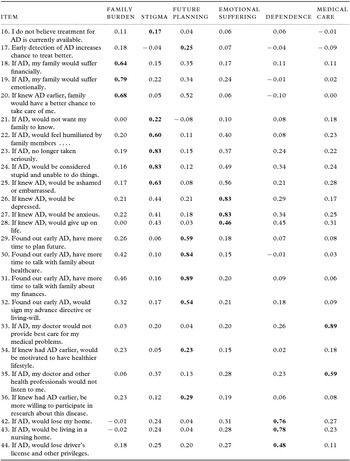
For Section D, the scree plot revealed four factors; parallel analysis suggested seven factors whereas the minimum-average-partial test by Velicer indicated the presence of only three factors. Then again, model fit indices reached acceptable values with the six-factor solution (RMSEA = 0.045 [0.037, 0.052]; CFI = 0.949; TLI = 0.903; SMR = 0.029). The six-factor solution was also plausible with regards to content. The six factors identified were denoted as “Family Burden,” “Stigma,” “Emotional Suffering,” “Future Planning,” “Medical Care,” and “Dependence”; factor loadings for each item are shown in Table 2. Correlations between “Emotional Suffering” and “Stigma” as well as “Future Planning” and “Family Burden” were highest (r = 0.51 and r = 0.49, respectively). Because of these correlations and because the scree plot, the parallel analysis, and the MAP-test disagreed in the number of proposed factors, presence of a second-order factor was hypothesized.
Factor loadings for the six-factor solution (Section D: attitudes towards Alzheimer's disease)

Note: Bold loadings indicate the highest factor loadings for each item respectively; AD = Alzheimer's disease.
Confirmatory factor analysis:
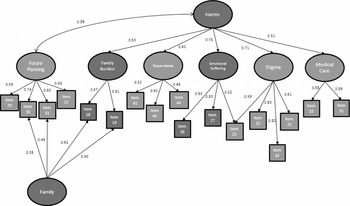
Based on the results of the exploratory factor analysis, a model was specified in which only the highest loading items for each factor were included. More precisely, Items 16, 17, 21, 34, and 36 were excluded because of overall low loadings (<0.30). Items 20 and 28 were excluded because they loaded highly on two factors each. The domains “Family Burden,” “Stigma,” “Emotional Suffering,” “Medical Care,” and “Dependence” were subsumed under the second-order factor “Harms.” Furthermore, a method factor was hypothesized on which all items that dealt with family issues loaded. The method factor “Family” was defined not to be correlated with the other factors. The model is displayed in Figure 1. According to the model modification indices in Mplus, the loading of Item 25 was specified as cross-loading on “Stigma” and “Emotional Suffering,” which was also plausible with regard to content. Apart from that, no further changes within the model were made. Model fit was good (RMSEA = 0.043 [0.034, 0.051]; CFI = 0.955; TLI = 0.943; SMR = 0.051).
CFA model for Section D (Attitudes towards Alzheimer's disease) of the modified PRISM-PC. Significant effects are shown as standardized coefficients (betas), which were significant at p < 0.05.

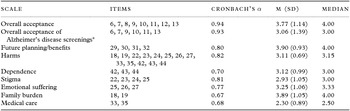
Internal consistency for the different scales that resulted from the analyses as well as some descriptive information on their scores is displayed in Table 3.
Internal consistency (Cronbach's α) and descriptive information for the various scales of the German PRISM-PC questionnaire

aExcluding highly correlated items (Items 8 and 12).
Note: M = mean of the respective score; SD = standard deviation of the respective score.
Acceptance of Alzheimer's disease screening
In order to create a scale that especially measured acceptance of Alzheimer's disease screening, we also built a scale that excluded Items 8 and 12. Items 8 and 7 as well as Items 12 and 13 were highly correlated (r Spearman = 0.76 and r Spearman = 0.87 respectively), which also justified the exclusion of the mentioned items. Internal consistency for the scale that included the remaining items (6, 7, 9, 10, 11, 13) was good (Cronbach's α = 0.93). Calculating the sum of the above mentioned items and dividing it by the number of the respective answered items resulted in an acceptance score with a positively skewed distribution indicating more frequent values in terms of strong agreement (median = 3.0). Additionally, this acceptance score was dichotomized such that values between 1.0 and 3.0 were transformed into 0 indicating “no acceptance” in contrast to values between 3.1 and 5.0, which represented “acceptance.” According to the dummy variable “Acceptance” 359 (71.2%) elderly adults would accept routine Alzheimer's disease screening whereas 145 (28.8%) participants would not.
Further descriptive information on responses to the items of the PRISM-PC
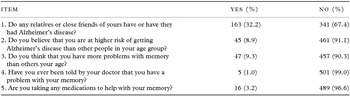
Descriptive statistics regarding prior experience with Alzheimer's disease (Section A: Items 1–5) are displayed in Table 4. In terms of the acceptance of screening for other conditions (Section C: Items 14 and 15), the mean acceptance score for colon cancer screening was 3.53 (SD = 1.45) and for depression screening was 2.91 (SD = 1.48). Regarding the last item (Section E: Item 46) 332 participants (65.6%) felt comfortable answering the questions, whereas 154 participants (30.4%) indicated that they did not feel comfortable.
Descriptive information on prior experience with Alzheimer's disease (Section A)

Note: Absolute frequencies with percentage frequencies in parentheses are shown.
Discussion
The purpose of this study was to validate a German version of the PRISM-PC questionnaire and to investigate whether elderly German adults would be interested in routine Alzheimer's disease screening.
Exploratory factor analysis of Section B revealed evidence for one or two factors, which is in line with previous research on the PRISM-PC (Boustani et al., Reference Boustani2008). The scale that explicitly measured acceptance of Alzheimer's disease screening showed good internal consistency (Cronbach's α = 0.93), which is again in line with other studies (Boustani et al., Reference Boustani2008; Holsinger et al., Reference Holsinger, Boustani, Abbot and Williams2011).
Concerning Section D of the PRISM-PC, we found the strongest evidence for a six-factor solution with the domains “Family Burden,” “Stigma,” “Emotional Suffering,” “Future Planning,” “Medical Care,” and “Dependence.” This is only partly in line with the four factors “Benefits,” “Stigma,” “Suffering,” and “Independence” proposed by Boustani et al. (Reference Boustani2008). However, in a recent study on a modified version of the PRISM-PC also “Medical Care” and “Family Impact” emerged as potential domains (Holsinger et al., Reference Holsinger, Boustani, Abbot and Williams2011) indicating that the results of factor analyses often depend on sample characteristics. On the other hand, we excluded five items in advance because they were not plausible with regard to the German healthcare system. This also might have altered results.
Results of the confirmatory factor analysis suggested a second-order factor “Harms” that covered negative aspects associated with Alzheimer's disease screenings. Conversely, the factor “Future Planning” covered possible benefits related to early detection of Alzheimer's disease. These results agree with the original intention of Section D, which was to create a scale that measured benefits and harms of Alzheimer's disease screening (Boustani et al., Reference Boustani2008). However, our method factor “Family” illustrates that it is important to take into account whether the respondent has a family or rather has a good relationship towards her or his family as this might affect how benefits and harms of Alzheimer's disease screening are perceived.
Regarding the artificial split of our acceptance score, 71.2% of our sample expressed acceptance towards routine Alzheimer's disease screening. This is somewhat lower than in other studies, which had been conducted in the USA: For example, Fowler et al. (Reference Fowler2012) reported that 89.7% of the participating primary care patients agreed to dementia screening after having completed the PRISM-PC. Moreover, in a study of Holsinger et al. (Reference Holsinger, Boustani, Abbot and Williams2011) 81% of primary care patients stated that they wanted to know if they developed dementia. However, as it has been shown before (Justiss et al., Reference Justiss2009), patients’ attitudes of dementia screening might differ across different countries. Because of culture-specific characteristics and different healthcare systems, different attitudes towards Alzheimer's disease and Alzheimer's disease screening might emerge. Also, results based on a dummy-coding and forced-choice scales might not be comparable because of acquiescence for example (e.g. Ray, Reference Ray1990). In terms of validity, it has to be considered that attitudes predict behavior only to some extent (see Wicker, Reference Wicker1969, for an overview) so that acceptance of Alzheimer's disease screening does not necessarily imply correspondent health behavior. Nevertheless, a value of 71.2% does indicate that the majority of our sample was interested in routine Alzheimer's disease screening.
Our study has several limitations. First, our sample was not randomly selected from the Berlin population, which resulted in a higher education level and overall better health in our participants (Bertram et al., Reference Bertram2013). Also, the voluntary participation of our participants indicated underlying high interest in health and health-check-ups, which might reflect higher-than-average acceptance of screenings. Furthermore, due to the particular time span in which our study was conducted we included twice as many men than women in our analyses. Therefore, generalizability of our results is limited. Second, the translated PRISM-PC was either administered before or after the neuropsychological assessment that might have influenced results. However, in terms of acceptance, overall acceptance of dementia screenings did not differ between those who completed the questionnaire before (n = 411) and after the neuropsychological assessment (n = 96) (φ = 0.02, p = 0.707). Third, excluding five items in advance might also have accounted for a different factor structure. Therefore, the comparison of our results to those of other studies that used the original version of the PRISM-PC must be treated with caution. Forth, artificially dichotomizing the acceptance score might not have reflected true underlying differences. Future studies should include a dichotomous item that assesses acceptance in order to test this assumption. Fifth, attitudes might have been different if participants were given a full account of the potential harms and benefits of screening in advance. Especially, the major harm of over-diagnosis or misdiagnosis was not included in the questionnaire that should be acknowledged as a weakness of the PRISM-PC. Finally, the term “Alzheimer's disease” (German: Alzheimer Demenz) served as an alternative for dementia as Boustani et al. (Reference Boustani2008) stated that this term would be more readily understood. Hence, our results might have been different if we had asked for the acceptance of dementia screening. Generalizations of our results towards acceptance of dementia screenings must be made with caution.
Despite these limitations, the results of this study suggest that acceptance of Alzheimer's disease screening can reliably be assessed by Section B of the PRISM-PC. Assessing acceptance of screening by a number of questions, i.e. screening by a questionnaire or by a picture of the brain, probably makes the concept of screening more manifest regarding elderly people. In general, high acceptance rates represent a starting point for implementation of routine dementia screenings that hopefully will lead to a faster treatment of dementia as well as a better prevention of comorbid diseases. However, it has to be noticed that nearly 30% of our participants stated that they would not accept routine Alzheimer's disease screening. In terms of ethics, a patient's right of not knowing their diagnosis as well as not wanting to be tested always needs to be taken into consideration. Regardless of possible effectiveness of screenings and overall acceptance within the population, performance of dementia screenings must be decided on an individual basis.
Future research should analyze how different attitudes towards dementia and dementia screening influence acceptance. This could facilitate the development of interventions that aim at increasing acceptance rates. Furthermore, it will be important to focus on cross-cultural differences in attitudes towards dementia and acceptance of dementia screening as this might also lead to a better understanding of how dementia and dementia screening are perceived in the population and how this perception influences the proportion of diagnoses and treatment.
Conflict of interest
None
Description of authors’ roles
S. R. Braun carried out the study, analyzed the data, and wrote the paper; K. Reiner formulated the research question, designed the study, carried out the study, and assisted in revising the paper; C. Tegeler formulated the research question, designed the study, carried out the study, and assisted in revising the paper; N. Bucholtz translated the questionnaire, formulated the research question, designed the study, carried out the study, and assisted in revising the paper; M. A. Boustani developed the questionnaire and assisted in revising the paper; and E. Steinhagen-Thiessen designed the study and assisted in revising the paper.
Acknowledgments
This paper uses data from the Berlin Aging Study II (BASE-II) that has been supported by the German Federal Ministry of Education and Research (Bundesministerium für Bildung und Forschung, BMBF) under grant number #16SV5536K, for which the authors are thankful. The responsibility for the contents of this publication lies with its authors.
Appendix – perceptions regarding investigational screening for memory in primary care (Boustani et al., Reference Boustani2008)
Please choose one answer to each of the following questions.
(A) Prior experience with Alzheimer's disease
1. Do any relatives or close friends of yours have or have they had Alzheimer's disease?
□ Yes □ No
2. Do you believe that you are at higher risk of getting Alzheimer's disease than other people in your age group?
□ Yes □ No
3. Do you think that you have more problems with memory than others your age?
□ Yes □ No
4. Have you ever been told by your doctor that you have a problem with your memory?
□ Yes □ No
5. Are you taking any medications to help with your memory?
□ Yes □ No
Please let me know if you agree or disagree with the following statements.
(B) Acceptance of screening for Alzheimer's disease
6. I would like to know if I am at higher risk than others for developing Alzheimer's disease.
□ Strongly agree □ Agree □ I do not know □ Disagree □ Strongly disagree
7. I would like to know if I have Alzheimer's disease.
□ Strongly agree □ Agree □ I do not know □ Disagree □ Strongly disagree
8. I would like to know if I have a problem with memory.
□ Strongly agree □ Agree □ I do not know □ Disagree □ Strongly disagree
9. I would like to be tested for the presence of Alzheimer's disease on a regular basis with a short questionnaire.
□ Strongly agree □ Agree □ I do not know □ Disagree □ Strongly disagree
10. I would like to be tested for the presence of Alzheimer's disease on a regular basis with a blood sample.
□ Strongly agree □ Agree □ I do not know □ Disagree □ Strongly disagree
11. I would like to be tested for the presence of Alzheimer's disease on a regular basis with pictures of my head or brain (CT-scan or MRI).
□ Strongly agree □ Agree □ I do not know □ Disagree □ Strongly disagree
12. I would like a doctor to examine me every year to know if I have developed memory problems.
□ Strongly agree □ Agree □ I do not know □ Disagree □ Strongly disagree
13. I would like a doctor to examine me every year to know if I have developed Alzheimer's disease.
□ Strongly agree □ Agree □ I do not know □ Disagree □ Strongly disagree
(C) Acceptance of screening for other conditions
14. I would like a doctor to examine me every year to know if I have developed colon cancer.
□ Strongly agree □ Agree □ I do not know □ Disagree □ Strongly disagree
15. I would like a doctor to examine me every year to know if I have developed depression.
□ Strongly agree □ Agree □ I do not know □ Disagree □ Strongly disagree
(D) Attitudes about Alzheimer's disease
16. I do not believe that treatment for Alzheimer's disease is currently available.
□ Strongly agree □ Agree □ I do not know □ Disagree □ Strongly disagree
17. I believe that early detection of Alzheimer's disease increases the chance to treat the disease better.
□ Strongly agree □ Agree □ I do not know □ Disagree □ Strongly disagree
18. If I had Alzheimer's disease, my family would suffer financially.
□ Strongly agree □ Agree □ I do not know □ Disagree □ Strongly disagree
19. If I had Alzheimer's disease, my family would suffer emotionally.
□ Strongly agree □ Agree □ I do not know □ Disagree □ Strongly disagree
20. If I knew that I had Alzheimer's disease earlier, my family would have a better chance to take care of me.
□ Strongly agree □ Agree □ I do not know □ Disagree □ Strongly disagree
21. If I had Alzheimer's disease, I would not want my family to know.
□ Strongly agree □ Agree □ I do not know □ Disagree □ Strongly disagree
22. If I had Alzheimer's disease, I would feel humiliated by my family members and/or others who would treat me poorly or laugh at me.
□ Strongly agree □ Agree □ I do not know □ Disagree □ Strongly disagree
23. If I had Alzheimer's disease, I would no longer be taken seriously.
□ Strongly agree □ Agree □ I do not know □ Disagree □ Strongly disagree
24. If I had Alzheimer's disease, I would be considered stupid and unable to do things.
□ Strongly agree □ Agree □ I do not know □ Disagree □ Strongly disagree
25. If I knew that I had Alzheimer's disease, I would be ashamed or embarrassed.
□ Strongly agree □ Agree □ I do not know □ Disagree □ Strongly disagree
26. If I knew that I had Alzheimer's disease, I would be depressed.
□ Strongly agree □ Agree □ I do not know □ Disagree □ Strongly disagree
27. If I knew that I had Alzheimer's disease, I would be anxious.
□ Strongly agree □ Agree □ I do not know □ Disagree □ Strongly disagree
28. If I knew that I had Alzheimer's disease, I would give up on life.
□ Strongly agree □ Agree □ I do not know □ Disagree □ Strongly disagree
29. If I found out early that I had Alzheimer's disease, I would have more time to plan my future.
□ Strongly agree □ Agree □ I do not know □ Disagree □ Strongly disagree
30. If I found out early that I had Alzheimer's disease, I would have more time to talk with my family about my healthcare.
□ Strongly agree □ Agree □ I do not know □ Disagree □ Strongly disagree
31. If I found out early that I had Alzheimer's disease, I would have more time to talk with my family about my finances.
□ Strongly agree □ Agree □ I do not know □ Disagree □ Strongly disagree
32. If I found out early that I had Alzheimer's disease, I would sign my advance directive or my living-will.
□ Strongly agree □ Agree □ I do not know □ Disagree □ Strongly disagree
33. If I had Alzheimer's disease, my doctor would not provide the best care for my other medical problems.
□ Strongly agree □ Agree □ I do not know □ Disagree □ Strongly disagree
34. If I knew that I had Alzheimer's disease earlier, I would be motivated to have a healthier lifestyle.
□ Strongly agree □ Agree □ I do not know □ Disagree □ Strongly disagree
35. If I had Alzheimer's disease, my doctor and other health professionals would not listen to me.
□ Strongly agree □ Agree □ I do not know □ Disagree □ Strongly disagree
36. If I knew that I had Alzheimer's disease earlier, I would be more willing to participate in research about this disease.
□ Strongly agree □ Agree □ I do not know □ Disagree □ Strongly disagree
37. If I had Alzheimer's disease, I would not be able to get health insurance.
□ Strongly agree □ Agree □ I do not know □ Disagree □ Strongly disagree
38. If I had Alzheimer's disease, I would be concerned that my health insurance company would find out.
□ Strongly agree □ Agree □ I do not know □ Disagree □ Strongly disagree
39. If I had Alzheimer's disease, I would be concerned that my employer would find out.
□ Strongly agree □ Agree □ I do not know □ Disagree □ Strongly disagree
40. If I had Alzheimer's disease, I would not be able to get life insurance.
□ Strongly agree □ Agree □ I do not know □ Disagree □ Strongly disagree
41. If I had Alzheimer's disease, I would not be able to get long-term care insurance.
□ Strongly agree □ Agree □ I do not know □ Disagree □ Strongly disagree
42. If I had Alzheimer's disease, I would lose my home.
□ Strongly agree □ Agree □ I do not know □ Disagree □ Strongly disagree
43. If I had Alzheimer's disease, I would be living in a nursing home.
□ Strongly agree □ Agree □ I do not know □ Disagree □ Strongly disagree
44. If I had Alzheimer's disease, I would lose my driver's license and other privileges.
□ Strongly agree □ Agree □ I do not know □ Disagree □ Strongly disagree
(E) Other comments
45. What other concerns do you have about having Alzheimer's disease? (Please specify)
46. Did you feel comfortable answering these questions?
□ Yes □ No