1. Introduction
During the past decades, it has become apparent that many agnostoid genera and species have a nearly cosmopolitan distribution and provide the most precise tools available for intercontinental correlations in the upper half of the Cambrian (e.g. Robison et al. Reference Robison, Rosova, Rowell and Fletcher1977; Robison, Reference Robison1984; Peng & Robison, Reference Peng and Robison2000; Geyer & Shergold, Reference Geyer and Shergold2000; Ahlberg, Reference Ahlberg2003). The subdivision of this interval into stages will consequently be largely based on the first appearance datum (FAD) of intercontinentally distributed agnostoids (e.g. Babcock et al. Reference Babcock, Peng, Geyer and Shergold2005; Babcock & Peng, Reference Babcock and Peng2007).
The middle Cambrian (provisional Series 3) faunas of Baltica are relatively diverse and generally dominated by agnostoids and polymerid trilobites including, for instance, paradoxidids, solenopleurids, conocoryphids and anomocarids. At the base of the Furongian, the middle Cambrian faunas are replaced by taxonomically restricted ones, generally dominated by largely endemic species of the family Olenidae (Eriksson & Terfelt, Reference Eriksson and Terfelt2007; Ahlberg et al. Reference Ahlberg, Axheimer, Babcock, Eriksson, Schmitz and Terfelt2009). Non-olenid polymerids are generally rare, confined to a few intervals, and represented by genera characteristic of Furongian successions elsewhere in the world (Terfelt & Ahlgren, Reference Terfelt and Ahlgren2007; Terfelt, Ahlberg & Eriksson, Reference Terfelt, Ahlberg and Eriksson2010). Global correlation of the Furongian olenid biofacies of Scandinavia is difficult and relies largely on tie points provided by a few agnostoids (Ahlberg & Ahlgren, Reference Ahlberg and Ahlgren1996; Ahlberg, Reference Ahlberg2003).
Here we report the occurrence in Scandinavia of Pseudagnostus rugosus Ergaliev, Reference Ergaliev1980, recorded from the middle–upper Furongian Ctenopyge tumida Zone. Its potential for intercontinental correlation is evaluated herein.
2. Intercontinental correlation
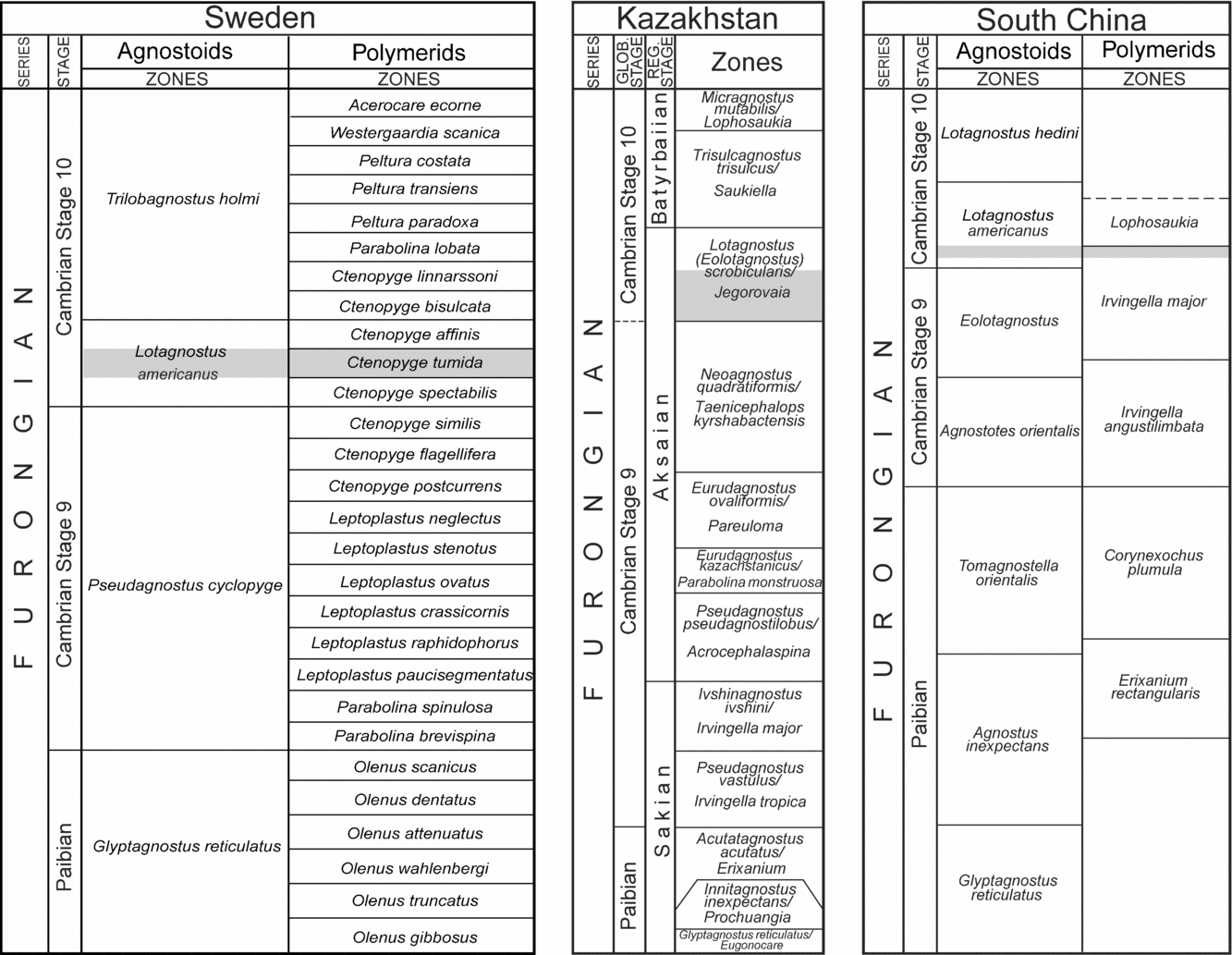
The non-olenid, ‘exotic’ polymerid trilobites in the Baltic trilobite realm have a fairly wide geographical distribution and they have potential for broad intercontinental correlations (Ahlberg, Reference Ahlberg2003; Terfelt & Ahlgren, Reference Terfelt and Ahlgren2007). Agnostoids provide, however, a firm basis for correlation with successions outside Baltica. Out of the 14 agnostoid taxa recorded from the Furongian in Scandinavia (including the species described herein), seven are excellent biostratigraphical indices or have potential for intercontinental correlation (Ahlberg, Reference Ahlberg2003; this study). Agnostus (Homagnostus) obesus (Belt, Reference Belt1867) is a common species ranging from the Olenus gibbosus Zone through the Parabolina brevispina Zone (sensu Terfelt et al. Reference Terfelt, Ahlberg and Eriksson2008) in Scandinavia (e.g. Westergård, Reference Westergård1944, Reference Westergård1947; Terfelt et al. Reference Terfelt, Ahlberg and Eriksson2008). This species has also been recorded from England (Rushton, Reference Rushton1983), Newfoundland (Martin & Dean, Reference Martin and Dean1988), Siberia (e.g. Lazarenko et al. Reference Lazarenko, Gogin, Pegel, Sukhov, Abaimova, Egorova, Fedorov, Raevskaya, Ushatinskaya, Rozanov and Varlamov2008), Kazakhstan (Ergaliev & Ergaliev, Reference Ergaliev and Ergaliev2008), Korea (Choi, Lee & Sheen, Reference Choi, Lee and Sheen2004; Choi & Kim, Reference Choi and Kim2006) and North America (Pratt, Reference Pratt1992; Stitt & Perfetta, Reference Stitt and Perfetta2000). The value of this species for correlation is, however, limited due to its long range and lack of clear diagnostic features. A single pygidium of Pseudagnostus leptoplastorum Westergård, Reference Westergård1944 has been recorded from the Leptoplastus raphidophorus Zone at Andrarum, southern Sweden (Westergård, Reference Westergård1944). This species was recently recorded from the Acutatagnostus acutatus–Erixanium Zone in the Kyrshabakty section, Malyi Karatau, Kazakhstan (Ergaliev & Ergaliev, Reference Ergaliev and Ergaliev2008), thus suggesting a broad correlation between the lower Leptoplastus-yielding strata in Scandinavia and the A. acutatus–Erixanium Zone in Kazakhstan (Fig. 2).
Glyptagnostus reticulatus (Angelin, Reference Angelin1851), Aspidagnostus lunulosus (Kryskov in Borovikov & Kryskov, Reference Borovikov and Kryskov1963) and Pseudagnostus cyclopyge (Tullberg, Reference Tullberg1880) are three distinctive and geographically widespread agnostoid species known from the lower Furongian in Scandinavia (Ahlberg, Reference Ahlberg2003). The cosmopolitan G. reticulatus appears near the FAD of Olenus gibbosus and ranges up into the Olenus wahlenbergi Zone, suggesting that the base of the O. gibbosus Zone correlates with the base of the Paibian Stage and the Furongian Series (Eriksson & Terfelt, Reference Eriksson and Terfelt2007). This correlation is further strengthened by the presence of A. lunulosus in the O. gibbosus Zone. Pseudagnostus cyclopyge (Tullberg, Reference Tullberg1880) is fairly common in the Parabolina brevispina Zone (basal provisional Stage 9) in southern Sweden. This species has also been recorded from the upper Steptoean Regional Stage in northwest Canada (Pratt, Reference Pratt1992) and in the middle Sakian Regional Stage in southern Kazakhstan (Ergaliev & Ergaliev, Reference Ergaliev and Ergaliev2008). Thus, P. cyclopyge has a wide palaeogeographical distribution, allowing a broad correlation into Laurentia and the Karatau-Naryn microplate (Kazakhstan).
In Scandinavia, agnostoids are absent in the middle Furongian (between the Leptoplastus crassicornis and Ctenopyge similis zones; upper part of provisional Stage 9), but occur sporadically in younger strata (e.g. Ahlberg & Ahlgren, Reference Ahlberg and Ahlgren1996; Terfelt et al. Reference Terfelt, Ahlberg and Eriksson2005). Lotagnostus americanus (Billings, Reference Billings1860) is an easily recognizable and widely distributed agnostoid, and the base of provisional Cambrian Stage 10 is expected to be drawn at the FAD of this species (Peng & Babcock, Reference Peng and Babcock2005; Babcock et al. Reference Babcock, Peng, Geyer and Shergold2005; Babcock & Peng, Reference Babcock and Peng2007). In Scandinavia, L. americanus (previously referred to as L. trisectus) appears in the Ctenopyge spectabilis Zone and ranges up into the Ctenopyge linnarssoni Zone.
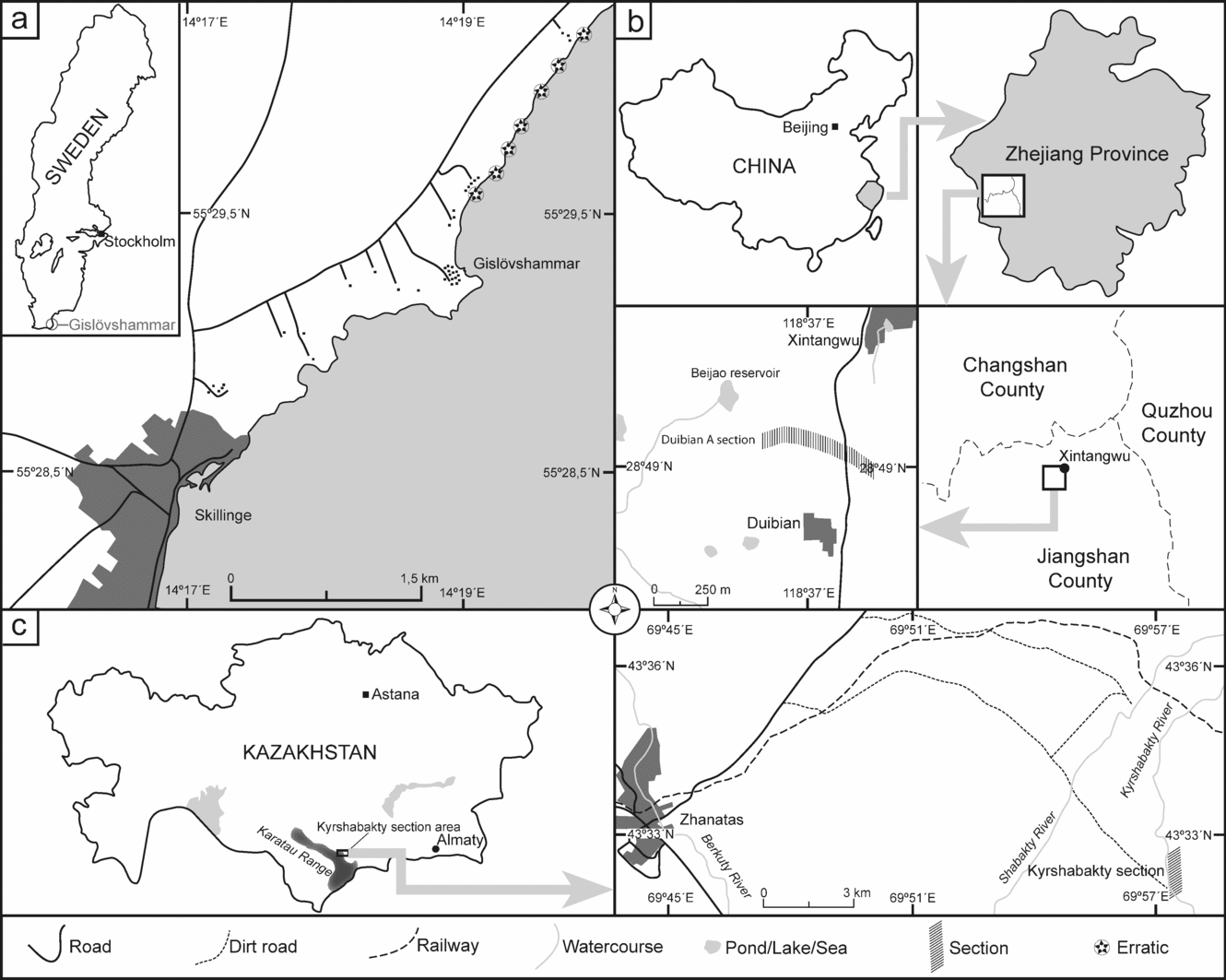
Another important species is Pseudagnostus rugosus Ergaliev, Reference Ergaliev1980, which has recently been recovered from the Ctenopyge tumida Zone at Gislövshammar in Scania, Sweden (Fig. 1a). This species was known previously from Malyi Karatau, Kazakhstan (Fig. 1c), and western Zhejiang (Fig. 1b) and northwestern Hunan, South China, and provides a newly recognized link between upper Furongian successions in Baltica, Kazakhstan and South China. In Kazakhstan, P. rugosus ranges from the base of, and approximately half way through, the Eolotagnostus scrobicularis–Jegorovaia Zone (Fig. 2) and is associated with a trilobite assemblage characterized by olenids (Westergaardites Troedsson, Reference Troedsson1937, Plicatolina Shaw, Reference Shaw1951, Parabolinites Henningsmoen, Reference Henningsmoen1957, Chekiangaspis Lu in Chien, Reference Chien (Qian)1961) and several species of Rhaptagnostus Whitehouse, Reference Whitehouse1936 (Ergaliev & Ergaliev, Reference Ergaliev and Ergaliev2008, table 5; Ergaliev et al. Reference Ergaliev, Zhemchuzhnikov, Popov, Bassett, Nikitina, Dubinina, Ergaliev and Fazylov2009, figs 5, 8). In western Zhejiang, China, P. rugosus ranges through the upper lower part of the Lotagnostus americanus Zone (Fig. 2) and is associated with the zonal index species (Lu & Lin, Reference Lu and Lin1983, Reference Lu and Lin1984). Peng (Reference Peng1992) figured a single pygidium from considerably older strata (Lotagnostus (Eolotagnostus) decorus/Kaolishaniella Zone) in the Cili-Taoyuan area, northwestern Hunan, South China. This is an anomalous occurrence not observed elsewhere, and the stratigraphical position needs to be confirmed. Hitherto, L. americanus has been the best tool available for intercontinental correlation of middle–upper Furongian strata. This species is fairly long-ranging, spanning five trilobite zones in Scandinavia. Pseudagnostus rugosus is, however, known from the Ctenopyge tumida Zone only and has a considerably shorter range. In China and Kazakhstan it appears to have a shorter range than the zonal indices. The record of P. rugosus in Scandinavia allows for a more precise correlation between the C. tumida Zone of Baltica, the lower Eolotagnostus scrobicularis–Jegorovaia Zone of Kazakhstan and the lower Lotagnostus americanus Zone of South China.
Maps showing key localities from which Pseudagnostus rugosus has been recovered. (b) and (c) modified from Peng et al. (Reference Peng, Babcock, Zuo, Lin, Zhu, Yang, Qi, Bagnoli and Wang2009) and Ergaliev & Ergaliev (Reference Ergaliev and Ergaliev2008) respectively.

Biostratigraphical subdivision of the Furongian of Scandinavia (modified from Terfelt et al. Reference Terfelt, Ahlberg and Eriksson2008), Kazakhstan (modified from Ergaliev & Ergaliev, Reference Ergaliev and Ergaliev2008 and Ergaliev et al. Reference Ergaliev, Zhemchuzhnikov, Ergaliev, Popov, Pour, Bassett, Rábano, Gozalo and García-Bellido2008) and Zhejiang, South China (modified from Peng et al. Reference Peng, Babcock, Zuo, Lin, Zhu, Yang, Qi, Bagnoli and Wang2009). Shaded intervals show stratigraphical occurrences of Pseudagnostus rugosus and levels of correlation.

3. Systematic palaeontology
Morphological terminology follows Robison (Reference Robison1982), Shergold, Laurie & Sun (Reference Shergold, Laurie and Sun1990) and Whittington & Kelly in Kaesler (Reference Kaesler1997). All described and illustrated specimens (LO) are housed at the Department of Geology, Lund University, Sweden.
Order AGNOSTIDA Salter, Reference Salter1864
Family agnostidae M'Coy, Reference M'Coy1849
Subfamily pseudagnostinae Whitehouse, Reference Whitehouse1936
Genus Pseudagnostus Jaekel, Reference Jaekel1909
Type species. Agnostus cyclopyge Tullberg, Reference Tullberg1880 (p. 26, pl. 2, fig. 15a, c) from the Furongian Parabolina brevispina Zone at Andrarum, Scania, southern Sweden; by original designation.
Remarks. Shergold (Reference Shergold1977) reviewed the concept and classification of Pseudagnostus and recognized three subgenera: Pseudagnostus, Pseudagnostina Palmer, Reference Palmer1962 and Sulcatagnostus Kobayashi, Reference Kobayashi1937. Peng & Robison (Reference Peng and Robison2000) discussed the morphological plasticity within the genus, and provisionally suppressed Pseudagnostina and Sulcatagnostus as junior subjective synonyms of Pseudagnostus. This view is followed herein (cf. Choi, Lee & Sheen, Reference Choi, Lee and Sheen2004).
Pseudagnostus rugosus Ergaliev, Reference Ergaliev1980
Figures 3a–f, 4a–f, Table 1
1980 Pseudagnostus (Sulcatagnostus) rugosus sp. nov.; Ergaliev, p. 112, pl. 17, figs 3, 4.
1983 Pseudagnostus rugosus; Ju in Qiu et al., p. 39, pl. 13, fig. 11.
1984 Pseudagnostus (Sulcatagnostus) rugosus Ergaliev; Lu & Lin, pp. 57–8, pl. 3, figs 4–6.
1989 Pseudagnostus (Sulcatagnostus) rugosus Ergaliev; Lu & Lin, pp. 119–20, pl. 14, figs. 12, 13.
1992 Pseudagnostus (Pseudagnostus) rugosus (Ergaliev, Reference Ergaliev1980); Peng, p. 26, fig. 12G.
2003 Lotagnostus cf. trisectus (Salter, Reference Salter1864); Ahlberg, fig. 3H.
2005 Pseudagnostus rugosus Ergaliev; Peng et al., fig. 6:7, 8.
2008 Sulcatagnostus rugosus (Ergaliev, 1989); Ergaliev & Ergaliev, p. 181, pl. 49, figs 9–12 (non pl. 48, fig. 4).
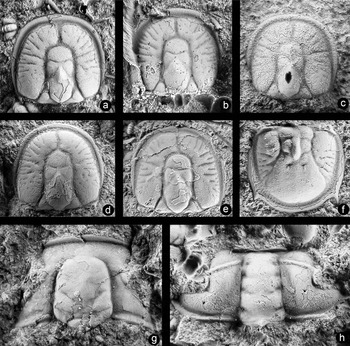
Pseudagnostus rugosus and selected polymerid trilobites from the Ctenopyge tumida Zone, Gislövshammar, Scania, southern Sweden. (a–f) Pseudagnostus rugosus. (a) Cephalon, ×11.5, LO10556. (b) Cephalon, ×13.0, LO10555. (c) Cephalon, ×13.5, LO10554. (d) Cephalon, ×10.0, LO10558. (e) Cephalon, ×10.5, LO10557. (f) Pygidium, ×14.0, LO10561. (g) Parabolinites laticaudus, cranidium, ×5.5, LO10566. (h) Ctenopyge tumida, cranidium, ×12.0, LO10567.

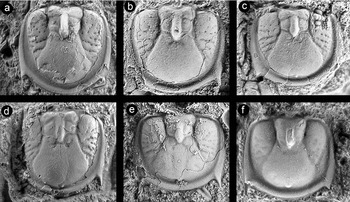
Pseudagnostus rugosus from the Ctenopyge tumida Zone, Gislövshammar, Scania, southern Sweden. (a) Pygidium, ×10.0, LO10564. (b) Pygidium, ×13.0, LO10562. (c) Pygidium, ×11.0, LO10563. (d) Pygidium, ×9.5, LO10565. (e) Pygidium, ×13.5, LO10560. (f) Small pygidium, ×16.5, LO10559.

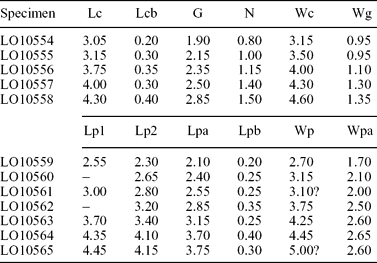
Dimensions (in mm) of cephala and pygidia of Pseudagnostus rugosus

Measurements were made with a micrometer eyepiece fitted inside a binocular microscope. All dimensions were measured as straight-line distances with an accuracy of about 0.05 mm. Lc – maximum length (sag.) of cephalon; Lcb – length (sag.) of cephalic border (including border furrow); G – length (sag.) of glabella; N – distance (sag.) from rear of glabella to highest point of median node; Wc – maximum width (tr.) of cephalon; Wg – maximum width (tr.) of glabella (excluding basal lobes); Lp1 – maximum length (sag.) of pygidium (including articulating half ring); Lp2 – length (sag.) of pygidium (excluding articulating half ring); Lpa – length (sag.) of pygidial axis (excluding articulating half ring); Lpb – length (sag.) of the posterior pygidial border (including border furrow); Wp – maximum width (tr.) of pygidium; Wpa – maximum width (tr.) of pygidial axis. Estimated measurements are denoted with a question mark.
Holotype. A nearly complete cephalon illustrated by Ergaliev (Reference Ergaliev1980, pl. 17, fig. 3) and Ergaliev & Ergaliev (Reference Ergaliev and Ergaliev2008, pl. 49, fig. 9).
Material. Thirty-seven cephala and 40 pygidia preserved in dark grey limestone concretions (orsten). All specimens are from locally derived boulders collected by Peter Cederström along the shore 0.6–2.0 km NNE of the hamlet of Gislövshammar in Scania (Skåne), southern Sweden. Most specimens are preserved in three dimensions.
Description. Cephalon moderately convex, subovoid to subrectangular in outline, slightly wider than long, and widest along transverse line slightly posterior to F3. Glabella, occupying 62–68% of total cephalic length, nearly parallel-sided, slightly constricted at mid-length, and broadly rounded anteriorly. Median node prominent, elongated, situated at midpoint of glabella, and extending into acute apex of F2. Rear of glabella obtusely angulated in dorsal view. F3 distinct and sinuous. F2 prominent and with shape of an inverted V. F1 absent. Basal lobes subtriangular, divided and connected medially. Preglabellar median furrow deeply impressed, broad and complete. Acrolobe slightly constricted. Genae distinctly scrobiculate, lacking cross furrows. Anterior and lateral border convex, defined by distinct border furrow, widest antero-laterally, becoming narrower postero-laterally. Sagittally, border and border furrow combined occupy 7–10% of total cephalic length.
Pygidium subovoid to subrectangular in outline, 1.1–1.3 times wider than long (excluding articulating half-ring), and widest at mid-length. Pygidial axis constricted at F2, reaching posterior border furrow. F1 and F2 well defined. M2 longer (exsag.) than M1. Median tubercle elongated, extending backwards above the anterior portion of posteroaxis. Posteroaxis strongly expanded, defined by straight to slightly concave axial furrows, and nearly twice as long as anteroaxis. Posteroaxis undivided or faintly trilobed (divided into an intranotular and a pair of extranotular parts) with small median node at posterior end. Anterior part of posteroaxis with a pair of rounded scars. Pleural fields with distinct pits, arranged in rows. Posterior and lateral border convex, defined by distinct border furrow, widest postero-laterally, becoming narrower antero-laterally. Prominent posterolateral spines situated along transverse line passing slightly anterior to rear end of posteroaxis.
Remarks. The material from Sweden agrees in all essential features with Pseudagnostus rugosus described by Ergaliev (Reference Ergaliev1980) and Ergaliev & Ergaliev (Reference Ergaliev and Ergaliev2008) from Malyi Karatau, southern Kazakhstan.
Pseudagnostus rugosus closely resembles P. intermedius Varlamov, Pak & Rosova, Reference Varlamov, Pak and Rosova2005 from the Agnostotes clavatus–Irvingella perfecta, Norilagnostus quadratus–Irvingella cipita and Irvingella norilica zones in the Chopko River section, Norilsk District, northwestern Siberian Platform. Pseudagnostus intermedius differs, however, from P. rugosus in having a 30% wider anteroaxis, smaller pygidial spines, a more constricted glabella, a wider cephalic border furrow, and a less pronounced anteroglabella. In addition, P. intermedius is more effaced.
A cephalon from Västergötland, south-central Sweden, figured by Ahlberg (Reference Ahlberg2003, fig. 3H) as Lotagnostus cf. trisectus, is here assigned to P. rugosus. As in the material from Scania, this cephalon has distinct scrobicules on the genae, a prominent F2 with the shape of an inverted V, and a transglabellar and sinuous F3.
In the material at hand, the smallest pygidia (Fig. 4e, f) have a more broadly rounded posterior margin and a proportionately narrower anteroaxis than larger pygidia.
Occurrence. Lower Lotagnostus (Eolotagnostus) scrobicularis–Jegorovaia Zone, uppermost Aksaian Regional Stage, Kyrshabakty section, Malyi Karatau, Kazakhstan (Ergaliev & Ergaliev, Reference Ergaliev and Ergaliev2008; Figs 1c, 2).
Upper lower Lotagnostus americanus agnostoid Zone or uppermost Irvingella major polymerid Zone, Siyanshan Formation in the Jiangshan-Changshan-Zhuji area, western Zhejiang Province, South China (Lu & Lin, Reference Lu and Lin1983, Reference Lu and Lin1984, Reference Lu and Lin1989; Peng et al. Reference Peng, Zuo, Babcock, Lin, Zhou, Yang, Li, Peng, Babcock and Zhu2005; Figs 1b, 2).
Lotagnostus (Eolotagnostus) decorus/Kaolishaniella Zone, Bitiao Formation, Shenjiawan section, Cili-Taoyuan area, northwestern Hunan, South China (Peng, Reference Peng1992).
Middle Lotagnostus americanus agnostoid Zone or Ctenopyge tumida polymerid Zone NNE of Gislövshammar, southeastern Scania, Sweden (Figs 1a, 2). Associated with C. tumida Westergård, Reference Westergård1922 (Fig. 3h), Parabolinites laticaudus (Westergård, Reference Westergård1922) (Fig. 3g) and Sphaerophthalmus alatus (Boeck, Reference Boeck and Keilhau1838). In Sweden, P. rugosus is also known from coeval strata at Hällekis in Västergötland (a cephalon referred to as Lotagnostus cf. trisectus by Ahlberg, Reference Ahlberg2003, fig. 3H).
Acknowledgements
Shanchi Peng and Adrian W. A. Rushton kindly commented upon the material. We are also indebted to Peter Cederström for his continuing contribution of scientifically important fossils from the Cambrian of Scandinavia. FT thanks the Swedish Research Council (VR) for funding the research. PA is indebted to the Royal Physiographic Society in Lund for financial support.