Implications
This study has demonstrated strong effects of both nitrogen (N) intake and other aspects of herbage composition on the partitioning of absorbed N between milk N and urine N. Some of these effects are linked to differences in rumen passage rates and microbial protein synthesis, which are important considerations for plant breeders developing forages with enhanced N utilisation. With current forages, a mix of red clover and maize silages will result in a reduction in urinary N relative to milk protein output in comparison with an iso-nitrogenous diet based on ryegrass silage.
Introduction
Forage legumes are important components of sustainable ruminant production systems because of their ability to fix atmospheric nitrogen (N), reducing the need for costly inorganic fertilizers. Herbage production from forage legumes without N fertilizer can exceed that from grasses with moderate levels of N fertilizer (Halling et al., Reference Halling, Hopkins, Nissinen, Paul, Tuori and Soelter2001). High levels of intake and milk production have been obtained with legume silages (e.g. Castle et al., Reference Castle, Reid and Watson1983; Thomas et al., Reference Thomas, Aston and Daley1985). Our studies confirmed the higher production and demonstrated a further benefit in increased levels of the n-3 fatty acid α-linolenic acid in milk, particularly when cows eat red clover silage (Dewhurst et al., Reference Dewhurst, Fisher, Tweed and Wilkins2003).
However, under typical UK management for silage, red clover and white clover silages had 35% and 70% higher N concentrations than grass silage, respectively. This leads to extremely high levels of N intake, low N-use efficiency (NUE) and consequent high output of urinary N (Dewhurst et al., Reference Dewhurst, Fisher, Tweed and Wilkins2003). Earlier studies of NUE with legume silages are difficult to interpret because their higher CP concentrations are invariably linked to high N intakes. The objective of this work was to investigate this potential advantage for legume silages by evaluating NUE when legume silages are combined with low-protein forage, maize silage, to produce mixtures with similar N concentrations to grass silage.
Material and methods
This study used eight multiparous Holstein–Friesian cows that were on average 74 (s.d. = 7.9) days in milk at the start of the first period. Cows weighed 626 (s.d. = 62.9), 621 (s.d. = 59.2) and 617 kg (s.d. = 48.7) at the start of the three collection periods, respectively. Four dietary treatments were evaluated in two 4 × 4 Latin squares, omitting the fourth period. Animal measurements were made in the final week of each 4-week period.
Diets
Pure stands of perennial ryegrass, red clover and maize were grown at Trawsgoed Research Farm (52°25′N, 4°5′W) during 2003. Diets were based on: first-cut perennial ryegrass silage (Lolium perenne cv AberDart; cut on 30 May, precision chopped and clamped on 31 May; early-to-mid flowering stage), first-cut red clover silage (Trifolium repens cv Milvus; cut on 29 May and harvested as baled silage on 31 May; late bud stage) and whole-crop maize silage (Zea mays cv Calypso), which was precision chopped and clamped. The red clover silage was prepared using Powerstart additive (Genus Breeding Ltd., Nantwich, UK) applied according to the manufacturer’s instructions, while additives were not used for the other silages.
Dietary treatments were designed to allow the comparison of N utilisation from grass silage with mixtures of red clover silage and maize silage. They were designed to separate out effects due to the higher intake characteristics of legume silages from effects due to their higher protein concentrations. Treatments were as follows: (i) ad libitum grass silage (GS), (ii) ad libitum red clover silage mixed with maize silage (40/60 on a dry matter (DM) basis; RM40, red clover/maize silage mixture (40/60)) – designed to be iso-nitrogenous with GS; (iii) the same forage mixture (RM40), but restricting intake to the level of GS (RM40r, RM40 restricted intake); and (iv) ad libitum red clover silage mixed with maize silage (25/75 on a DM basis; RM25, red clover/maize silage mixture (25/75)). Ad libitum intakes involved cows being offered sufficient feed to ensure 10% refusals. Calculation of forage allowances for treatment RM40r used adjustments for individual cows (based on ad libitum intake of GS recorded during a pre-experimental period) and periods (based on average intakes in the first week of each period). Fresh forage was given, and refusals recorded, each morning.
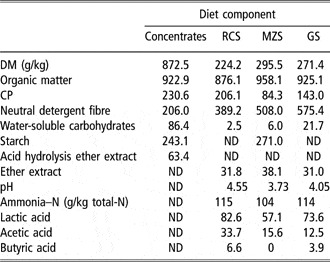
All cows received a flat-rate allocation (4 kg/day) of a single pelleted dairy concentrate (composition (g/kg): wheat (240), beans (200), rapeseed meal (175), maize distiller’s grains (150), soyabean meal (50), palm kernel expeller (44), molasses (100), vegetable oil (21) and mineral/vitamin premix (20)). The chemical composition of the concentrate is presented in Table 1.
Chemical composition (g/kg DM, unless stated otherwise) of the diet components used in this experiment (n = 3 for each feed)

RCS = red clover silage; MZS = maize silage; GS = grass silage; ND = not determined; DM = dry matter; N = nitrogen.
Animal measurements
This work was carried out under the authority of licences issued by the UK Home Office. Feed intakes were recorded throughout the collection week, with daily amounts offered and refused, as well as DM concentrations combined into a single intake value for statistical analysis. Daily feed samples were composited over the collection week. Milk yields were recorded at each milking by using mechanical milk meters (Tru-test Ltd., Auckland, New Zealand) and milk samples were taken from four consecutive milkings for analysis of fat, protein and lactose concentrations using an infra-red milk analyser (NMR Central Laboratory, Somerset, UK).
Separate total collections of faeces and urine were made over six consecutive days using the externally applied urine separators described by Aston et al. (Reference Aston, Fisher, McAllan, Dhanoa and Dewhurst1998). Urine was acidified using 2 M H2SO4 to adjust urine pH to 2 to 3 (approximately 2.8 l/cow per day, in two portions). Sub-samples from daily collections of urine and faeces were composited and frozen prior to analysis for total N concentration. A further sub-sample of urine was diluted (1 volume urine plus 4 volumes of water) prior to freezing and this was used for analysis of purine derivatives (PD) and creatinine. Faeces were not acidified and were freeze-dried prior to analysis, so faecal N output results were corrected for 12.5% loss of N (Juko et al., Reference Juko, Bredon and Marshall1961; Spanghero and Kowalski, Reference Spanghero and Kowalski1997). Retained N was calculated by subtracting N in milk, urine and faeces from N intake.
Dysprosium (Dy)-labeled GS was used as a standard feed for studies of rumen passage rate. Labeled GS was prepared by soaking dried (60°C) silage in a solution of Dy-acetate (25 g in 10 l) overnight, rinsing in tap water and drying at 60°C. The concentration of Dy in the labeled feed was 8.77 g/kg DM. On the day prior to the commencement of faecal collections, cows were fed 60 g of the labeled silage, mixed in with an initial (2 kg) batch of their fresh allocation of forage. This was consumed within 1 h and cows were then given their full allocation of forage. Small sub-samples of faeces were collected twice daily from the faecal collection vessels, dried (60°C), ground and analysed for Dy concentration.
Analytical methods
Analytical methods used for feed have been described previously (Dewhurst et al., Reference Dewhurst, Moorby, Dhanoa, Evans and Fisher2000a). Urine (undiluted) was analysed for N concentration using a Leco FP428 Nitrogen Analyser (Leco Instruments (UK) Ltd., Stockport, UK). The diluted urine samples were further diluted (to a final concentration of 1 in 50) and analysed for PD (allantoin plus uric acid) and creatinine using the HPLC method of Dewhurst et al. (Reference Dewhurst, Mitton, Offer and Thomas1996). Samples for Dy analysis were ashed and the soluble mineral taken up in nitric acid. Dy concentration was analysed using inductively coupled plasma atomic emission spectroscopy (Liberty Series II Axial Spectrometer; Varian Ltd., Oxford, UK).
Statistical methods
Rumen passage rates were calculated from the excretion curves for faecal Dy over approximately 5 days after dosing, using the two separate values from each day. The log-linear declining portion of the excretion curve for Dy was selected by eye and rumen passage rates were estimated by regression analysis using natural logs of concentrations of Dy concentrations against sampling time (Grovum and Williams, Reference Grovum and Williams1973).
Measurements were not achieved for one animal (on diet GS) during the final period because of a severe case of mastitis; this was treated as a missing value in the statistical analysis. Statistical analysis was conducted for feed intake, milk production and composition, N partitioning, urine components and rumen passage rates in the final week of each experimental period. A single (mean) value was used for each cow in each period. Statistical analysis was conducted by using GenStat Release 10.1 (Payne et al., Reference Payne, Murray, Harding, Baird and Soutar2006). Analysis of variance used a treatment structure of ‘Diet’ and blocking structure of ‘Period’ + ‘Cow’. Further comparison of means was conducted with a Student-Newman-Keuls multiple range test.
Results
Feed composition
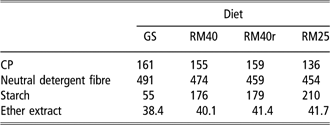
The chemical composition of the red clover silage, GS and maize silage is presented in Table 1, while Table 2 give calculated values for the concentrations of CP, ether extract, starch and NDF in the overall diets. The most marked difference between diets was in starch concentration, which ranged from 55 to 210 g/kg DM, while concentrations of CP, NDF and ether extract were similar, apart from the low CP concentration for the RM25 diet (136 g/kg DM).
Calculated chemical composition (g/kg DM) of the overall diets used in this experiment (n = 3 for each diet)
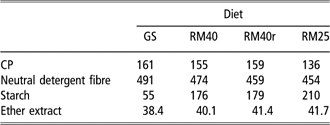
GS = grass silage; RM40 = red clover/maize silage mixture (40/60); RM40r = red clover/maize silage mixture (40/60) restricted intake; RM25 = red clover/maize silage mixture (25/75); DM = dry matter.
Feed intake and milk production
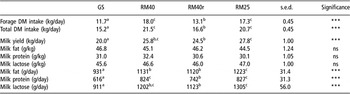
Red clover silage mixtures led to significantly higher feed intake and milk production than the GS-based diet, though there were no significant effects on milk composition (Table 3). Although feed intakes of RM40r cows were restricted by 4.9 kg DM/day in comparison with unrestricted cows (RM40), they were still significantly (1.4 kg DM/day) higher than for GS.
Effects of different silages and mixtures on voluntary intake, milk production and composition

GS = grass silage; RM40 = red clover/maize silage mixture (40/60); RM40r = red clover/maize silage mixture (40/60) restricted intake; RM25 = red clover/maize silage mixture (25/75); DM = dry matter; ns = not significant.
***P < 0.001.
Means with different superscripts are significantly different at the 5% confidence level (Student-Newman-Keuls test).
N partitioning
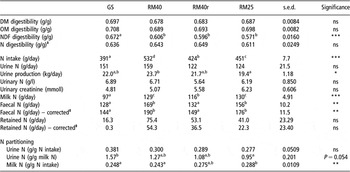
There was no significant effect of dietary treatment on the digestibility of DM, organic matter (OM) or N, though the digestibility of NDF was significantly lower for diets based on mixtures of red clover and maize silages (Table 4). Table 4 also presents results of the N partitioning study. Highly significant differences in N intake reflect the differences in feed intake and dietary CP concentrations mentioned previously. There were highly significant effects of dietary treatment on milk N output and milk N as a proportion of N intake. There were no significant effects on urinary N output or urinary N as a proportion of N intake and only small differences in urinary volume between treatments. There were increases in faecal N output with diets RM25 and RM40 in comparison with diet GS, but no evidence for repartitioning of N away from urine N to faecal N with the red clover/maize diets when comparisons are made at the same N intake (i.e. comparing diets GS and RM40r). There was a numerical increase in retained N for all diets based on red clover silage and maize silage, but this was not significantly higher than for the GS diet.
Effects of different silages and mixtures on diet digestibility and nitrogen partitioning

GS = grass silage; RM40 = red clover/maize silage mixture (40/60); RM40r = red clover/maize silage mixture (40/60) restricted intake; RM25 = red clover/maize silage mixture (25/75); DM = dry matter; OM = organic matter; ns = not significant; N = nitrogen.
‡Faecal nitrogen increased by 12.5% to allow for volatile losses during collection and freeze-drying.
*P < 0.05; **P < 0.01; ***P < 0.001.
Means with different superscripts are significantly different at the 5% confidence level (Student-Newman-Keuls test).
Regression analysis showed that urine output increased by 49 g (s.e. = 15.3; P < 0.01) for each additional gram of urinary N output. Despite the lack of significant diet effects on urinary N output (g/day) and concentration (g/l), there was a significant relationship between the two, which was not affected by diet:

Rumen measurements
The mean R 2 for regressions relating natural log Dy concentrations in faeces and time was 0.97 (s.d. = 0.021). While all values were above 0.90, three values were below 0.95 and these were all for diet RC40r – suggesting that this relatively simple approach to estimating rumen outflow rates is less well suited to diets where feed intake is restricted. Excluding these three values from the analysis gave a higher estimate of the passage rate for RM40r (5.64%/h) – very close to the value for RM40. The rumen outflow rate of Dy-labeled silage was numerically higher for diets containing red clover silage than for GS, significantly so for RM25. Restriction of feed intake reduced rumen passage rate, although not significantly (Table 5).
Effects of different silages and mixtures on rumen passage rate of Dy-labelled silage and urine excretion of allantoin and uric acid

GS = grass silage; RM40 = red clover/maize silage mixture (40/60); RM40r = red clover/maize silage mixture (40/60) restricted intake; RM25 = red clover/maize silage mixture (25/75); DM = dry matter; OM = organic matter; ns = not significant.
‡Allantoin and uric acid.
***P < 0.001.
Means with different superscripts are significantly different at the 5% confidence level (Student-Newman-Keuls test).
Urinary excretion of PD, both allantoin and uric acid, was significantly higher for the unrestricted red clover silage-based diets in comparison with GS. Urinary PD excretion expressed on a DM (or digestible OM) intake basis was not significantly different between treatments, but again values for diets based on red clover silage were numerically higher (Table 5).
Discussion
Silage composition
Although the grass and red clover silages were prepared from single cuts, their chemical composition was close to averages for these types of silages made in the UK (Dewhurst et al., Reference Dewhurst, Fisher, Tweed and Wilkins2003). The comparatively high pH (4.55) of the red clover silage is normal for clover silage and reflects the relatively high-buffering capacity and low water-soluble carbohydrate concentration of the original crop (Dewhurst et al., Reference Dewhurst, Fisher, Tweed and Wilkins2003). While the DM content of the red clover silage was quite low, other indicators of fermentation quality (ammonia–N and fermentation acids) were similar to the GS.
Diet digestibility
The digestibility of NDF was significantly lower for the diets based on mixtures of red clover and maize silages. Although not significantly different, NDF digestibility was lower (0.571) for RM25 than RM40 (0.606), suggesting that the maize silage NDF was much less digestible than NDF from either the GS or red clover silage. It is well recognised that NDF from maize silage is less digestible then NDF in GS (Browne et al., Reference Browne, Juniper, Bryant and Beever2005), while Margan et al. (Reference Margan, Moran and Spence1994) showed a lower NDF digestibility for maize silage than for red clover hay.
Feed intake and milk production
The voluntary intake of mixtures of red clover and maize silages was much higher than for the GS. The additional intake was more than in our earlier work with pure red clover silage, even when only 4 kg/day concentrates were fed (Dewhurst et al., Reference Dewhurst, Fisher, Tweed and Wilkins2003). Failure to equalise feed intakes for GS and RM40r reflects the difficult of achieving this objective in a changeover-design experiment with short experimental periods. Nonetheless, the restriction was substantial (4.9 kg DM/day) and this helps differentiate effects of forage species and N intake on the relationship between N intake and urinary N output (Figure 1 and see below).
Relationship between nitrogen (N) intake (g/day) and urinary N output (g/day) in this experiment and relationships established by previous reviews of the literature (Kebreab et al., Reference Kebreab, France, Beever and Castillo2001; Huhtanen et al., Reference Huhtanen, Nousiainen, Rinne, Kytölä and Khalili2008). Values are adjusted treatment means from this study; error bars are s.e. Dietary treatments: GS, grass silage; RM40, red clover/maize silage mixture (40/60); RM40r, red clover/maize silage mixture (40/60) restricted intake; RM25, red clover/maize silage mixture (25/75).

The higher feed intake of the red clover/maize silage mixtures were reflected in increased yields of milk and major milk components. The restriction of intake (RM40r) had no significant effect on milk component yields. The large increases in yield of milk and milk components for RM40r in comparison with GS were proportionately greater than the increase in DM intake (Table 3). There were no significant effects of dietary treatments on concentrations of fat, protein or lactose in milk. Earlier studies have shown small and inconsistent effects on these milk components (Thomas et al., Reference Thomas, Aston and Daley1985; Hoffman et al., Reference Hoffman, Combs and and Casler1998; Dewhurst et al., Reference Dewhurst, Fisher, Tweed and Wilkins2003; Al-Mabruk et al., Reference Al-Mabruk, Beck and Dewhurst2004).
N partitioning
The significant increase in N intake for all treatments based on red clover/maize silage was associated with a significant increase in milk protein output, but no significant effect on urinary N output. Part of the reason for the lack of significant effects on urinary N relates to the large s.e. associated with these measurements. This must relate to experimental error and the difficulty of making these measurements. Even after correction, retained N was probably an overestimation; there are known unaccounted losses such as dermal and scurf losses, as well as other possible uncharacterised losses (Spanghero and Kowalski, Reference Spanghero and Kowalski1997). Consequently, it seems likely that cows offered diet GS were losing body N over the 3rd to 5th month of lactation.
Closer inspection of urinary N results reveals a lack of consistent relationship between N intake and urinary N, with the lowest urinary N output for RM40r and RM25, despite their having higher N intakes than GS. Earlier reviews have described the general relationship between N intake and urinary N excretion (Kebreab et al., Reference Kebreab, France, Beever and Castillo2001; Huhtanen et al., Reference Huhtanen, Nousiainen, Rinne, Kytölä and Khalili2008). Plotting treatment means from this study against these relationships (Figure 1) reveals a good agreement for GS-based diets. This is reassuring as the study of Kebreab et al. (Reference Kebreab, France, Beever and Castillo2001) used GS diets, while the meta-analysis by Huhtanen et al. (Reference Huhtanen, Nousiainen, Rinne, Kytölä and Khalili2008) was largely based on GS diets. However, urinary N excretion was 40 to 80 g/day (or 25% to 30%) less than predicted from these relationships for each of the diets based on red clover/maize silage mixtures.
Results from the treatment with restricted intake (RM40r) allowed us to separate N intake from forage source, adding confidence to the conclusion that this effect relates to some other aspect of the composition of these mixtures. The lack of association between N intake and milk protein output suggests that milk protein yields were driven by some other aspect of diet. Variation in the starch content of diets was much greater than variation in CP, NDF or ether extract (Table 2) and it is most likely that these effects are related to effects of starch on rumen microbial protein synthesis and other aspects of rumen and/or mammary metabolism. Urinary PD excretion was higher for all of the diets based on mixtures of red clover and maize silage, in comparison with GS (Table 5).
While urine output increased with urine N output (P < 0.01), there remained a significant positive relationship between urine N concentration and urine N output. Taking the mean ± 1 s.d. for urine N output from lactating dairy cows in the review by Spanghero and Kowalski (Reference Spanghero and Kowalski1997) (100 to 210 g urine N/day), this relationship predicts a modest variation in urine N concentration (0.51 to 0.87 g/l).
Rumen function
The higher rates of passage of Dy-labeled silage from the rumen of cows fed diets based on mixtures of red clover and maize silages is consistent with our earlier measurements based on rumen emptying (Dewhurst et al., Reference Dewhurst, Fisher, Tweed and Wilkins2003). As all measurements were made with a standard marker, this shows that a significant part of the variation relates to differences in rumen conditions affecting the propensity of feed particles to leave the rumen, rather than effects due to differences in the particle types. Studies with individually labeled feeds would be needed to further investigate these effects.
Urinary PD, allantoin and uric acid, were used as an index of rumen microbial synthesis (Chen et al., Reference Chen, Hovell, Ørskov and and Brown1990). Tas and Susenbeth (Reference Tas and Susenbeth2007) have confirmed the strong linear relationship between duodenal flows of (microbial) purine bases and urinary excretion of PD. The higher excretion of PD associated with the unrestricted red clover/maize silage mixtures reflects the substantially greater amount of substrate for rumen microbial synthesis with these diets. These results are consistent with effects of both feed intake and other factor(s) associated with red clover/maize silage on microbial protein synthesis. This latter effect could be related to dietary starch (Dewhurst et al., Reference Dewhurst, Davies and Merry2000b) and/or dilution of microbial maintenance costs related to reduced microbial residence time in the rumen (Pirt, Reference Pirt1965; AFRC, 1992) linked with the higher rumen passage rates of red clover/maize silage. However, such effects would need further investigation, as the numerically higher values for urinary PD per kilogram digestible OM were not significantly different from values for GS.
Conclusions
N partitioning results show strong effects of both N intake and forage source on the partitioning of dietary N between milk and urine. When dietary protein is diluted by the inclusion of maize silage, red clover silage leads to increased milk N and reduced urinary N in comparison with GS. Some of this effect may be related to increased rumen passage rates and microbial protein synthesis, although other effects (e.g. on liver and mammary metabolism) are also likely.
Acknowledgements
The financial support of the Department for Environment, Food and Rural Affairs is gratefully acknowledged. The authors acknowledge the skilled technical assistance for feed and urine analysis provided by the Analytical Chemistry and Ruminant Nutrition laboratories at Plas Gogerddan.