INTRODUCTION
It is well known in the field of SLA that second language (L2) learners tend to experience difficulties in the accurate and consistent production of inflectional morphology. Proposals as to why this is the case have generally fallen into one of two camps. According to one view, the reason for these difficulties is that L2 learners do not have the same mental representation or type of knowledge of morphosyntax as native speakers do (e.g., Clahsen, Reference Clahsen1990; Hawkins & Chan, Reference Hawkins and Chan1997; McCarthy, Reference McCarthy2008; Meisel, Reference Meisel1997; Schachter, Reference Schachter1990; Tsimpli & Dimitrakopolou, 2007). This knowledge deficit is often attributed to a critical or sensitive period for language acquisition, which, once passed, makes it difficult or even impossible to acquire an L2 in a nativelike manner (e.g., DeKeyser, Reference DeKeyser2000; Jiang, Reference Jiang2004; Johnson & Newport, Reference Johnson and Newport1989). According to the other view, L2 learners can acquire a nativelike representation or knowledge of L2 morphosyntax. The reason for their difficulties is simply a matter of processing; they are unable to consistently access their knowledge of the L2 in order to use it accurately, whether due to time pressure, demands on working memory, delays in lexical access, or even interference of the L1 (e.g., Ellis & Sagarra, Reference Ellis and Sagarra2010; Haznedar & Schwartz, Reference Haznedar, Schwartz, Hughes, Hughes and Greenhill1997; Hopp, Reference Hopp2010, Reference Hopp2013; Lardiere, Reference Lardiere1998; McDonald, Reference McDonald2006; Prévost & White, Reference Prévost and White2000; White, Valenzuela, Kozlowska-Macgregor, & Leung, Reference White, Valenzuela, Kozlowska-Macgregor and Leung2004).
In general, this debate has centered on research that examines L2 performance at the phrasal or full sentence level, often comparing accuracy rates of L2 learners’ comprehension and production of inflectional morphology to native-speaker accuracy rates. However, more recent research has begun to examine these issues by investigating L2 performance at the lexical level, focusing on how learners and native speakers process words that are morphologically complex due to inflectional processes. The rationale for this is that a possible cause for difficulties in the accurate and consistent production of inflectional morphology could be that morphologically complex words are not represented in the mind in the same way by L2 learners as they are by native speakers. If this is the case, then it is not surprising that such a difference becomes evident as learners access their lexical store, either for language comprehension or production. In fact, a number of studies that have been published in the last few years seem to support this hypothesis (e.g., Bowden, Gelfand, Sanz, & Ullman, Reference Bowden, Gelfand, Sanz and Ullman2010; Clahsen, Balkhair, Schutter, & Cunnings, Reference Clahsen, Balkhair, Schutter and Cunnings2013; Jacob, Fleischhauer, & Clahsen, Reference Jacob, Fleischhauer and Clahsen2013; Kirkici & Clahsen, Reference Kirkici and Clahsen2013; Neubauer & Clahsen, Reference Neubauer and Clahsen2009; Silva & Clahsen, Reference Silva and Clahsen2008). Specifically, according to these studies, learners seem to be less sensitive to morphological structure at the lexical level than native speakers, such that while native speakers decompose regularly inflected words into their component morphemes during lexical processing, L2 learners do not. Instead, they simply process these words as one whole, unstructured word form. For example, if a native speaker of English encounters the morphologically complex word prayed, he or she automatically and unconsciously segments the word into its stem (pray) and affix (-ed) as a part of the word-recognition process. An L2 learner of English, by contrast, seems to process prayed as a nondecomposable form according to the results of the previously listed studies.
Based on these findings, Clahsen, Felser, Neubauer, Sato, and Silva (Reference Clahsen, Felser, Neubauer, Sato and Silva2010) propose that L2 learners tend to store these words as wholes, rather than in their component stems and affixes, and hypothesize that this may be due to a heavier reliance on declarative rather than procedural memory in L2 acquisition, in the spirit of Ullman’s (Reference Ullman and Sanz2005) declarative/procedural model as applied to L2. However, this hypothesis of “shallow” morphological structure has primarily been supported by data from L2 learners of English and German, in studies that examine only verbal forms (e.g., English past tense, German participles), and that use masked-priming methodologies. Research that has examined L2 morphological processing in other languages or that has employed other types of experimental tasks seems to indicate that learners are in fact sensitive to morphological structure at the lexical level (e.g., Basnight-Brown, Chen, Hua, Kostić, & Feldman, Reference Basnight-Brown, Chen, Hua, Kostić and Feldman2007; Coughlin & Tremblay, Reference Coughlin and Tremblay2015; Feldman, Kostić, Basnight-Brown, Filipović Durdević, & Pastizzo, 2010; Gor & Cook, Reference Gor and Cook2010; Gor & Jackson, Reference Gor and Jackson2013; Lehtonen & Laine, Reference Lehtonen and Laine2003; Lehtonen, Niska, Wande, Niemi, & Laine, Reference Lehtonen, Niska, Wande, Niemi and Laine2006; Portin, Lehtonen, & Laine, Reference Portin, Lehtonen and Laine2007). Based on these studies, L2 learners do not differ from native speakers in the way they store and process morphologically complex words, and therefore, this aspect of lexical access does not seem to be a source of the problems that learners experience in their comprehension and production of inflectional morphology.
Given these conflicting results, the goal of the present study is to further examine the issue of L2 morphological processing with a focus on exploring what factors may affect whether L2 learners decompose morphologically complex words or not. It does so by extending existing research to the case of L2 Spanish, and by examining not only morphologically complex verbal forms, but also adjectival forms. It is critical to investigate L2 morphological processing across a variety of languages, as there is evidence that the extent to which morphological decomposition plays a role in lexical representation and access may differ crosslinguistically based on the language’s morphological richness (e.g., Lehtonen et al., Reference Lehtonen, Niska, Wande, Niemi and Laine2006). It is also crucial to expand beyond the examination of one type of inflection in order to determine how the complexity of different types of inflected forms may affect morphological decomposition. As noted in the preceding text, existing studies typically focus on decomposition of verbal forms, which tend to be more complex than other types of inflected forms; depending on the language in question, verbs can include inflectional morphemes that indicate tense, aspect, mood, person, number, and gender, while nouns and adjectives may just include morphemes that mark number, gender, and case. An examination of the processing of different types of inflection may show that L2 learners are more or less likely to decompose forms as a function of their morphological complexity.
Another factor that may play a role in whether learners decompose morphologically complex words is L2 proficiency. Proficiency level has been shown to be an important factor in determining the accuracy and consistency with which learners are able to produce inflectional morphology in the L2 (e.g., Foote, Reference Foote2010, Reference Foote2015; McCarthy, Reference McCarthy2008; White et al., Reference White, Valenzuela, Kozlowska-Macgregor and Leung2004), implying that learners at lower proficiency levels may not be as sensitive to morphological structure as those at higher proficiency levels. However, many of the studies in which learners do not show evidence of morphological decomposition have had highly proficient L2 participants (e.g., Clahsen et al., Reference Clahsen, Balkhair, Schutter and Cunnings2013; Jacob et al., Reference Jacob, Fleischhauer and Clahsen2013; Kirkici & Clahsen, Reference Kirkici and Clahsen2013; Neubauer & Clahsen, Reference Neubauer and Clahsen2009; Silva & Clahsen, Reference Silva and Clahsen2008). Moreover, some studies on L2 morphological processing propose a role for L2 proficiency, but claim that it has a different effect than that described previously (e.g., Gor & Jackson, Reference Gor and Jackson2013; Lehtonen & Laine, Reference Lehtonen and Laine2003; Lehtonen et al., Reference Lehtonen, Niska, Wande, Niemi and Laine2006; Portin et al., Reference Portin, Lehtonen and Laine2007). According to these studies, learners of relatively lower proficiency levels are the ones who rely primarily on morphological decomposition in their processing of complex L2 words. As they gain more experience with high-frequency words in particular, learners begin to process them as whole word forms rather than expending the extra processing effort required to break them down into component morphemes. This reflects what native speakers seem to do with high-frequency words, according to some studies. Thus, it is unclear exactly what role proficiency may play in L2 morphological decomposition: Higher proficiency may make it more likely that learners decompose morphologically complex words, or it may mean that learners are more likely to access and process more frequent L2 words as whole forms.
With these issues in mind, the specific research questions of the present study are (a) do L2 learners of Spanish store and process regularly inflected, morphologically complex words in the same way as native speakers of Spanish?; (b) does this depend on level of L2 proficiency?; and (c) does type of inflection (verbal or adjectival) play a role in the storage and processing of these words? In order to answer these questions, 20 native speakers of Spanish, 20 advanced L2 learners, and 20 intermediate learners of Spanish completed two lexical-decision tasks in which they responded to verb or adjective targets that were preceded by masked primes that were identical to the targets, morphologically related, orthographically related, semantically related, or unrelated. In contrast to previous masked-priming lexical-decision studies with L2 learners, results show no difference in priming patterns between native speakers and learners, regardless of proficiency level or type of inflection.
The Representation and Processing of Morphologically Complex Words in an L1
Research on how native speakers represent and process words that are morphologically complex due to inflectional processes has primarily centered on the single- versus dual-mechanism debate, along with the debate on whether complex words are stored and accessed as wholes, or in their component parts. According to single-mechanism models of the representation and processing of morphologically complex words, all words that are morphologically complex due to inflectional processes are generally processed in the same way, using just one mechanism, although models differ on what this mechanism is. According to some single-mechanism proposals, though words typically thought of as regularly inflected seem to have a clear boundary between a stem that bears the principal semantic information of the word and affixes that carry grammatical information, this boundary is not psychologically real; all words, seemingly morphologically complex or not, are stored as nondecomposable units (whether symbolic and discrete or distributed as activation patterns) in an associative network based on orthographic, phonological, and semantic relatedness (e.g., McClelland & Patterson, Reference McClelland and Patterson2002; Rumelhart & McClelland, Reference Rumelhart, McClelland, McClelland and Rumelhart1986; Seidenberg & McClelland, Reference Seidenberg and McClelland1989). Other single-mechanism models propose the opposite: that words that are morphologically complex due to inflection are stored in the mental lexicon in their component parts (stems and affixes), and are obligatorily assembled and disassembled as needed based on a rulelike mechanism (e.g., Stockall & Marantz, Reference Stockall and Marantz2006; Taft, Reference Taft1979, Reference Taft2004).
In contrast to these proposals, proponents of dual-mechanism models claim that two distinct mechanisms are used to process morphologically complex words. As with single-mechanism proponents, dual-mechanism models differ on how these two mechanisms are characterized. According to one view, while irregular word forms are stored and accessed as nondecomposable units, regularly inflected words are stored in their component parts and assembled or disassembled as needed (e.g., Pinker, Reference Pinker1999; Pinker & Ullman, Reference Pinker and Ullman2002). Another dual-mechanism view claims that while irregulars are stored as whole forms, the direct, whole-form route and the decomposition route operate in parallel for regular forms, with the most time-efficient route being the one that prevails for a particular form (e.g., Baayen, Dijkstra, & Schreuder, Reference Baayen, Dijkstra and Schreuder1997). Which route is the most efficient for a given form may be influenced by the properties of the specific stem and affixes, such as frequency, productivity, semantic and phonological transparency, and form ambiguity, along with how a particular language forms words (Baayen et al., Reference Baayen, Dijkstra and Schreuder1997, p. 112).
In summary, the debate on the storage and processing of morphologically complex words centers on whether morphological structure is psychologically real, such that it affects how words are represented and accessed during language comprehension and production, and also on whether morphologically complex words are processed by means of one single mechanism, or more than one. There is a large body of research that has been conducted over the past few decades to determine how these words are stored and processed, in a variety of languages and employing a number of different experimental methodologies (see Amenta & Crepaldi, Reference Amenta and Crepaldi2012, and Marslen-Wilson, Reference Marslen-Wilson and Gaskell2007, for a review, and Baayen & Schreuder, Reference Baayen and Schreuder2003, and Sandra & Taft, Reference Sandra and Taft1994, for edited volumes on the role of morphology in the lexicon). However, there is still no conclusive answer to this question. Some studies seem to support a central role for degree of form and meaning similarity in the processing of morphologically complex words rather than explicitly represented morphological relationships (e.g., Feldman, Reference Feldman2000; Rueckl, Mikolinski, Raveh, Miner, & Mars, Reference Rueckl, Mikolinski, Raveh, Miner and Mars1997; Rumelhart & McClelland, Reference Rumelhart, McClelland, McClelland and Rumelhart1986), while others appear to indicate that, at least in the case of regularly inflected words, stems and affixes are assembled and disassembled during language processing, possibly depending on the specific characteristics of the stems and affixes in question (e.g., Baayen et al., Reference Baayen, Dijkstra and Schreuder1997; Marslen-Wilson & Tyler, Reference Marslen-Wilson and Tyler1997; Sonnenstuhl, Eisenbeiss, & Clahsen, Reference Sonnenstuhl, Eisenbeiss and Clahsen1999; Stockall & Marantz, Reference Stockall and Marantz2006; Ullman et al., Reference Ullman, Pancheva, Love, Yee, Swinney and Hickok2005). Similarly, some studies support the proposal that there is just one mechanism responsible for the processing of these words (e.g., McClelland & Patterson, Reference McClelland and Patterson2002; Rumelhart & McClelland, Reference Rumelhart, McClelland, McClelland and Rumelhart1986; Stockall & Marantz, Reference Stockall and Marantz2006), while others support a dual-mechanism account (e.g., Baayen et al., Reference Baayen, Dijkstra and Schreuder1997; Pinker, Reference Pinker1999; Pinker & Ullman, Reference Pinker and Ullman2002).
The predominant behavioral methodology that has been used to investigate how morphologically complex words are processed during word recognition is priming. In priming tasks, the presentation of a prime stimulus is followed by the presentation of a target stimulus, under the assumption that if the prime and target are related in some way, then access to the target’s lexical representation will be facilitated or inhibited by the prime’s presentation. The idea behind this assumption is that primes and targets that are related are likely to either be directly connected in the network of connected nodes that make up the mental lexicon, or simply located near each other in the network. In the investigation of the processing of morphologically complex words through priming methodologies, primes that share a morpheme (usually the stem) with the target are employed. The finding that primes facilitate access to targets on the basis of their morphological relationship is taken to mean that the shared morphemic unit regulates lexical access (Frost, Deutsch, Gilboa, Tannenbaum, & Marslen-Wilson, Reference Frost, Deutsch, Gilboa, Tannenbaum and Marslen-Wilson2000).
There are three principal types of priming tasks that are typically used in research on the decomposition of morphologically complex words: unmasked or traditional priming, crossmodal priming, and masked priming. All three types of priming involve the presentation of a prime, and the subsequent presentation of a target that the study participant is asked to respond to in some way, usually by deciding whether it is a real word in a particular language (lexical decision), or by naming it aloud. In unmasked priming, a prime and target are both presented either visually or auditorily with the target either immediately following the prime, or following the prime after a delay of some number of experimental trials; both prime and target are consciously perceived by the research participant. This type of priming seems to be sensitive to orthographic, phonological, morphological, and semantic similarity, depending on the time gap between the presentation of the prime and target. The longer the delay, the less likely orthographic, phonological, or semantic priming will occur, while morphological and identity priming persist across a number of trials (e.g., Bentin & Feldman, Reference Bentin and Feldman1990; Napps, Reference Napps1989). In crossmodal priming, the prime is usually presented auditorily, with the target presented visually immediately afterward. The participant is conscious of the presentation of the prime, and the response to the target is typically influenced by phonological, semantic, and morphological relationships between the two, as when prime and target are presented in the same modality. In masked priming, both prime and target are visually presented, with the prime only visible for a very short period of time (usually between 40 and 60 milliseconds), thus preventing it from being consciously perceived by the participant. This type of task is generally thought to be only sensitive to orthographic and morphological relationships between prime and target; meaning does not seem to come into play with such a short time between prime presentation and target presentation, although there is some recent evidence that semantics can influence even these very early stages of word recognition (Feldman, Milin, Cho, Moscoso del Prado Martín, & O’Connor, Reference Feldman, Milin, Cho, Moscoso del Prado Martín and O’Connor2015; see Forster, Mohan, & Hector, Reference Forster, Mohan, Hector, Kinoshita and Lupker2003, for a discussion of the mechanisms behind masked priming).
Empirical research employing priming tasks has provided some support for the role of morphological structure in lexical access. For example, a number of studies have consistently found a facilitatory effect of shared morphology between prime and target, such that the presentation of a prime that only differs from the target on its inflectional suffix has the same effect as the presentation of a prime that is identical to the target. Stanners, Neiser, Hernon, and Hall (Reference Stanners, Neiser, Hernon and Hall1979) found this to be true in an early study on morphologically related words in English. Regular past-tense forms (e.g., poured), third-person singular present-tense forms (e.g., pours), and gerund forms (e.g., pouring) were presented as primes to simple targets (e.g., pour) in a visual lexical-decision task in which primes occurred an average of 10 items before targets (delayed unmasked priming). The effect of the morphologically related primes did not differ in size from the effect of primes that were identical to the targets. Stanners et al. (Reference Stanners, Neiser, Hernon and Hall1979) concluded that regularly inflected forms are not represented in the lexicon separately from simple forms, but are accessed on the basis of the verb stem. In a similar experiment, but in the auditory modality, Kempley and Morton (Reference Kempley and Morton1982) found the same pattern of results, even though the delay between the presentation of the prime and target was between 10 and 40 minutes. Marslen-Wilson, Hare, and Older (Reference Marslen-Wilson, Hare and Older1993) compared crossmodal priming with regular and irregular past-tense forms in English, and also found equivalent priming in identity and regularly inflected primes to present-tense targets. In a series of crossmodal priming experiments on German participles and noun plurals, Sonnenstuhl et al. (Reference Sonnenstuhl, Eisenbeiss and Clahsen1999) found no difference in priming effects between morphologically related primes and identical primes.
One possible objection to the interpretation of these results as evidence for the effects of morphological structure alone on lexical representation and access is that morphologically related words are generally also orthographically, phonologically, and semantically related. This makes it difficult to distinguish between form and meaning effects versus pure morphological effects, although delayed priming paradigms do seem to show that while form and meaning effects disappear after a certain delay between the presentation of prime and target, morphological effects do not (Bentin & Feldman, Reference Bentin and Feldman1990; Napps, Reference Napps1989). Additional support for the role of morphological structure in the lexicon comes from masked-priming studies in which orthographic or semantic similarity alone does not produce priming, such as those that examine priming in Semitic languages (e.g., Boudelaa & Marslen-Wilson, Reference Boudelaa and Marslen-Wilson2005; Frost, Forster, & Deutsch, Reference Frost, Forster and Deutsch1997; Frost, Kugler, Deutsch, & Forster, Reference Frost, Kugler, Deutsch and Forster2005). In these languages, all words are composed of at least two abstract bound morphemes, which combine nonconcatenatively to form a meaningful word. For example, the root k-t-b (∼write) combines with the word pattern ma–a-a (∼location) to form the word ma kt a b a (library). Due to the nonconcatenative nature of Semitic morphology, morphologically related words can bear significantly less resemblance in form and/or meaning than in languages that connect affixes to an intact root. For example, in Arabic, suʔaal (question) and masʔu:liyya (responsibility) share the root s-ʔ-l, but differ substantially in both their form and meaning. Nevertheless, research has shown that even when there is little resemblance in form or meaning between two morphologically related words, priming still occurs in Arabic and Hebrew based on the shared root; when two words are similar in form or meaning, but do not share a morphological relationship, there is no priming (e.g., Frost et al., Reference Frost, Forster and Deutsch1997; Frost et al., Reference Frost, Kugler, Deutsch and Forster2005). This pattern of results may be limited to Semitic languages, however, as there are masked-priming studies that do show effects of orthographic form in languages with concatenative morphology, depending on such factors as stimulus onset asynchrony (SOA), target neighborhood size, and type of orthographic similarity (e.g., Frisson, Bélanger, & Rayner, Reference Frisson, Bélanger and Rayner2014; Robert & Mathey, Reference Robert and Mathey2012).
Most relevant to the present study, the few existing studies with native speakers of Spanish also suggest that Spanish words that are morphologically complex due to inflectional processes are decomposed into their component morphemes during word recognition, and that effects of morphological structure cannot be accounted for on the basis of form or meaning relationships alone. Sánchez-Casas, Igoa, and García-Albea (Reference Sánchez-Casas, Igoa and García-Albea2003) used masked- and unmasked-priming tasks to examine priming patterns in words related by regular inflection, specifically gender (e.g., niño “boy” – niña “girl”). They found that while this type of word pairing led to facilitatory priming, orthographically related controls (e.g., piña “pineapple” – niña “girl”) did not, in either masked or unmasked priming. They also found that semantically related words that were not also morphologically related (e.g., arma “weapon” – puñal “dagger”) did not show priming effects either. In another study that varied the time between the presentation of the prime and the target, Domínguez, Segui, and Cuetos (Reference Domínguez, Segui and Cuetos2002) found that different relationships between primes and targets (form, meaning, or morphological) showed different priming patterns. They investigated words that were related by regular inflection (grammatical gender, e.g., loco “crazy,” masculine – loca “crazy,” feminine), words that were orthographically related (e.g., rato “moment” – rata “rat”), and words that were semantically related (e.g., luto “mourning” – pena “sadness”). Results showed facilitatory priming for morphologically related words at all SOAs tested (32, 64, and 250 ms). Orthographic priming occurred only at SOAs of 32 and 64 ms, while semantic priming occurred only at an SOA of 250 ms (when the prime was unmasked). This finding is important because it suggests that there is something different about morphological relationships, such that they cannot be broken down into just form or meaning similarities. Sánchez-Casas et al. concluded based on their findings that “morphological information is coded in the lexicon at a central level, distinct from pure form and semantic levels” (2003, pp. 654–655). However, whether or not morphological priming effects are attributable to morphological relationships, or are simply a result of shared form and meaning, the existing literature on L2 learners indicates that they do not always show the same priming patterns as native speakers when processing morphologically complex words, implying possible differences in lexical representation and processing between the two populations. We turn next to a review of relevant recent findings.
The Representation and Processing of Morphologically Complex Words in an L2
With the finding of evidence of morphological decomposition in native speakers of various languages, researchers interested in the nature of L2 morphological processing have conducted a number of studies to investigate similarities and differences in how native speakers and L2 learners store and process words that are morphologically complex due to inflectional processes. Several researchers have investigated whether L2 learners distinguish between regularly inflected and irregular forms as native speakers have been found to do, with varying results (e.g., Babcock, Stowe, Maloof, Brovetto, & Ullman, Reference Babcock, Stowe, Maloof, Brovetto and Ullman2012; Basnight-Brown et al., Reference Basnight-Brown, Chen, Hua, Kostić and Feldman2007; Beck, Reference Beck1997; Bowden et al., Reference Bowden, Gelfand, Sanz and Ullman2010; Feldman et al., Reference Feldman, Kostić, Basnight-Brown, Filipović Durdević and Pastizzo2010; Gor & Cook, Reference Gor and Cook2010; Gor & Jackson, Reference Gor and Jackson2013; Jacob et al., Reference Jacob, Fleischhauer and Clahsen2013; Lehtonen & Laine, Reference Lehtonen and Laine2003; Lehtonen et al., Reference Lehtonen, Niska, Wande, Niemi and Laine2006; Murphy, Reference Murphy2004; Neubauer & Clahsen, Reference Neubauer and Clahsen2009; Pliatsikas & Marinis, Reference Pliatsikas and Marinis2013; Portin et al., Reference Portin, Lehtonen and Laine2007). In some cases, L2 learners pattern with native speakers, while in others, they do not.
In studies that examine the decomposition of regular forms using priming tasks, findings of differences between native speakers and L2 learners seem to depend in part on the type of priming employed. In masked-priming lexical-decision tasks, existing studies indicate that while native speakers consistently show full priming for regularly inflected forms, so that effects of identity primes do not differ from effects of morphologically related primes, L2 learners do not. Silva and Clahsen (Reference Silva and Clahsen2008) examined the masked priming of target verbs (e.g., boil) that were preceded by primes that were identical (e.g., boil), unrelated (e.g., jump), or morphologically related (regular, past-tense forms of the verbs: e.g., boiled) in native speakers of English and L2 learners with Chinese, Japanese, or German as an L1. As has been found in the L1 literature, native speakers showed equivalent priming in the identity and the morphologically related conditions. However, L2 learners, no matter their L1, only showed identity priming; their responses to targets preceded by morphologically related primes did not differ from responses to targets preceded by unrelated primes. Neubauer and Clahsen (Reference Neubauer and Clahsen2009) found a similar pattern of results in their masked-priming experiment, in which native speakers and L2 learners of German made lexical decisions to first-person, singular, present-tense verbs preceded by primes that were identical to the targets, morphologically related (past participles of the target verb), or unrelated. Native speakers again showed no difference in the magnitude of priming between targets preceded by identity primes and targets preceded by regular participle primes, while L2 learners showed no priming with regularly inflected participle primes. Kirkici and Clahsen (Reference Kirkici and Clahsen2013) investigated priming in L1 and L2 Turkish, in a departure from the focus on L2 English and German. In this study, participants made lexical decisions to bare verbal stem targets that were preceded by morphologically related forms in the present aorist tense. Results again indicated priming in native speakers, but not in L2 learners, despite the relative richness of inflectional morphology in Turkish, an agglutinating language. However, identity primes were not included in this study, so it was not possible to measure the relative magnitude of morphological priming that was present in the native speaker group.
Given these findings of differences between native speakers and even advanced L2 learners, Clahsen et al. (Reference Clahsen, Felser, Neubauer, Sato and Silva2010) argue that learners differ from native speakers in terms of the extent to which they form a detailed representation of the morphological structure of words during lexical processing. Specifically, while native speakers decompose regularly inflected words into their component morphemes, learners generally do not. Instead, they process morphologically complex words as whole, unstructured word forms. Clahsen et al. hypothesize that this may be due to a heavier reliance on declarative rather than procedural memory in L2 acquisition, as outlined by Ullman’s declarative/procedural model as applied to L2 learners (Ullman, Reference Ullman and Sanz2005). According to this model, native speakers of a language use two distinct memory systems for language processing and production. The declarative memory system serves memorized, form-based lexical knowledge, while the grammar or rules of the language are served by the procedural memory system. In L2 acquisition that occurs postpuberty, learners begin with both types of knowledge being dependent upon the declarative system, so that the combinatorial rules present in native speaker grammars either do not exist in the learner’s system, or they do exist, but function in a qualitatively different way or to a lesser extent. Within this framework, as L2 proficiency increases, learners may be able to begin to rely more on the procedural system, so that they eventually make use of both memorized forms and combinatorial rules like native speakers do, but individual differences in procedural learning abilities as well as exposure to the L2 may affect the extent to which this is possible in a specific learner (Ullman, Reference Ullman and Sanz2005, pp. 152–153).
Yet Clahsen et al.’s hypothesis does not account for a number of studies in which L2 learners appear to decompose morphologically complex words like native speakers do. In contrast to the lack of L2 priming in masked-priming lexical-decision tasks, some researchers have found evidence of morphological decomposition in L2 learners with crossmodal priming, in which both prime and target are consciously perceived by the participant. Basnight-Brown et al. (Reference Basnight-Brown, Chen, Hua, Kostić and Feldman2007) investigated the processing of English past-tense verb forms in native speakers of English, L1 Serbian learners, and L1 Chinese learners of L2 English, and found that all three groups showed priming for targets preceded by regularly inflected past-tense forms. In Feldman et al. (Reference Feldman, Kostić, Basnight-Brown, Filipović Durdević and Pastizzo2010), native speakers of English and L2 learners of varying proficiency with Serbian as their L1 all showed priming with regular forms in a crossmodal priming task that again examined English past-tense verb forms. Interestingly, the higher-proficiency L2 learners in this study also showed priming with regular forms in a masked-priming task, in contrast to the findings of the studies described in the preceding text (although the studies are not fully comparable because Feldman et al. did not include an identity condition that would have allowed for a comparison of the magnitude of morphological to identity priming). Another recent study that also found morphological priming in L2 learners, but that did include an identity condition is Coughlin and Tremblay (Reference Coughlin and Tremblay2015). In their study, L2 learners of French with English as their L1 completed a masked-priming task in which they were asked to name verb targets aloud rather than making a lexical decision to them. Results showed full priming for both native speakers and L2 learners, with the magnitude of the morphological priming effect in the L2 learners increasing with higher proficiency levels. These findings suggest that L2 learners do decompose words that are morphologically complex due to inflectional processes, although this may be modulated by proficiency.
In summary, the results of some studies suggest that L2 learners do not consistently decompose words that are morphologically complex due to inflectional processes, while native speakers do. However, there are other studies that find that learners treat these types of words in a nativelike fashion. More research is clearly needed in order to understand the circumstances under which learners may or may not decompose morphologically complex words.
The methodology employed seems to be one factor that may play a role in whether learners show nativelike results or not; while most masked-priming studies find that learners do not show evidence of morphological priming, most crossmodal priming studies find that they do. Clahsen et al. (Reference Clahsen, Felser, Neubauer, Sato and Silva2010) acknowledge this and suggest that the two methodologies are tapping two different types of lexical representations. Masked priming is thought to tap access representations, which are representations that are specific to a certain modality (visual or auditory), and which contain form-level information. Crossmodal priming, however, may tap central lexical entries, which are not modality specific. These representations contain the more abstract syntactic and semantic information of the lexical item (Marslen-Wilson, Reference Marslen-Wilson and Gaskell2007, as cited in Clahsen et al., Reference Clahsen, Felser, Neubauer, Sato and Silva2010). It may be the case, then, that L2 learners differ from native speakers only in their access representations, but not in their central lexical entries (Clahsen et al., Reference Clahsen, Felser, Neubauer, Sato and Silva2010, p. 39).
Another factor that may determine whether learners decompose morphologically complex words is proficiency. As pointed out in the introduction, proficiency level seems to play a role in how accurately learners produce inflectional morphology in the L2. However, in many of the studies in which learners did not show morphological decomposition, L2 participants were highly proficient. By contrast, in some of the studies that do provide evidence for morphological decomposition in L2 learners, proficiency level did seem to be related to whether decomposition occurred, with higher proficiency participants being more likely to show morphological decomposition than lower proficiency participants (e.g., Coughlin & Tremblay, Reference Coughlin and Tremblay2015; Feldman et al., Reference Feldman, Kostić, Basnight-Brown, Filipović Durdević and Pastizzo2010). In addition to these studies, however, there are others that also propose a role for proficiency in morphological decomposition, but claim that rather than higher proficiency leading to an increased likelihood of morphological decomposition, it actually leads to an increased reliance on whole-form retrieval as a function of frequency and possibly other factors, such as productivity and transparency (e.g., Gor & Jackson, Reference Gor and Jackson2013; Lehtonen & Laine, Reference Lehtonen and Laine2003; Lehtonen et al., Reference Lehtonen, Niska, Wande, Niemi and Laine2006; Portin et al., Reference Portin, Lehtonen and Laine2007). Specifically, the claim is that, as learners gain proficiency and therefore gain more experience with words in the L2, they can begin to process high-frequency L2 words as whole forms instead of always having to decompose them into their component morphemes. This hypothesis goes along with dual-route models that propose that the most time-efficient route is the one that prevails for a particular form, and that the route that is most efficient may be influenced by properties such as frequency (e.g., Baayen et al., Reference Baayen, Dijkstra and Schreuder1997). An example of a study on learners that takes this perspective is Lehtonen and Laine (Reference Lehtonen and Laine2003). In their study, monolingual Finnish speakers and early Swedish-Finnish bilinguals made lexical decisions to monomorphemic and multimorphemic Finnish words at three different frequency ranges. Results showed evidence of morphological decomposition in the monolinguals only with the low- and medium-frequency morphologically complex forms. They processed the high-frequency complex forms as whole-word forms. In contrast, the bilinguals showed evidence of decomposition for all of the complex forms due to their overall reduced experience with the language in comparison to the monolinguals. In a similar study on Swedish, however, Lehtonen et al. (Reference Lehtonen, Niska, Wande, Niemi and Laine2006) found that Finnish-Swedish bilinguals did not differ from Swedish monolinguals; all participants decomposed only low-frequency complex forms. The finding of a difference between learners of Finnish (a morphologically rich language) and Swedish (a morphologically limited language) leads to another factor that seems to affect morphological decomposition in both natives and learners, which is the morphological structure of the target language.
The bulk of the studies on morphological decomposition in L2 have focused heavily on L2 English and L2 German. One goal of this study is to therefore to expand this research to L2 Spanish, a relatively morphologically rich language. It is critical to investigate L2 morphological decomposition across a variety of languages, particularly because, as noted previously, there is some evidence that the extent to which morphological decomposition plays a role in lexical representation, and access may differ crosslinguistically. For example, Lehtonen and Laine (Reference Lehtonen and Laine2003) and Lehtonen et al. (Reference Lehtonen, Niska, Wande, Niemi and Laine2006) found differences in the effect of word frequency on the processing of inflected words in Finnish and in Swedish. Although some dual-route model proponents assume that regularly inflected forms are composed and decomposed during language production and comprehension, they acknowledge that regularly inflected forms that are of high frequency are likely to be stored as whole word forms for the sake of processing efficiency. In tasks in which the processing of morphologically complex words is compared to the processing of monomorphemic words, there tends to be a speed advantage when decomposition does not have to take place; in other words, speakers are faster to process whole word forms, presumably because they do not have to take the time to apply a rule. Research with native speakers of English suggests that whole word form representations exist for morphologically complex words that have a frequency exceeding six occurrences per million words (Alegre & Gordon, Reference Alegre and Gordon1999). Lehtonen and Laine (Reference Lehtonen and Laine2003) find that in native speakers of Finnish, a morphologically rich language, these whole-form representations only exist for morphologically complex words with a frequency of approximately 100 per million. In Swedish, a much less inflected language, the pattern of processing resembles that of English. Native speakers seem to store whole-form representations for both medium- and high-frequency range words, rather than just high-frequency words. This implies that morphological richness affects the extent of decomposition of morphologically complex words, with languages with more inflected forms utilizing decomposition more than languages with fewer inflected forms. Spanish, the language examined in the present study, is a Romance language with relatively rich inflectional morphology, particularly in comparison to English (the L1 of this study’s learner participants); based on the studies outlined in the preceding text, this may mean that speakers of Spanish are more likely to decompose morphologically complex words than speakers of other languages.
In addition to the goal of examining morphological decomposition in a relatively morphologically rich language, another goal of this study is to investigate whether morphological decomposition may differ based on type of inflection. The majority of the existing L2 studies have solely investigated verbal forms (e.g., simple past tense or past participles). It is often the case that verbal inflection is more complex than other types of inflection because verbal forms provide information on so many aspects of the event denoted by the verb (e.g., tense, aspect, mood, person, number, gender, etc.). It could be that this complexity and the number of possible forms a verb can take may delay the L2 development of the rules necessary for morphological decomposition to take place. To examine whether this is the case, the present study includes both verbal and adjectival inflection.
In Spanish, verbs are marked morphologically for person and number as well as tense, aspect, and mood. There are three verb classes, into which verbs are categorized based on the thematic vowels present in their infinitives and many of their conjugated forms: Class I: –a (e.g., hablar “to talk”), Class II: –e (e.g., comer “to eat”), and Class III: –i (vivir “to live”). The three classes vary in terms of number of members, productivity, and regularity, with Class I containing the most verbs, and being the most regular as well as the only truly productive class to which new verbs can be added (e.g., faxear “to fax”). One of the most common irregularities in Spanish verbs is a change in the vowels and sometimes the consonants of the verb’s stem; inflectional suffixes that indicate person, number, tense, aspect, and mood are typically regular within each class. The verb forms relevant for the present study are third-person, singular, present-tense forms that vary on mood (indicative or subjunctive). The verbal suffixes that express indicative mood are taught from the beginning of Spanish instruction, while the suffixes that denote the subjunctive are generally taught late in the first semester or early in the second semester of courses at the university level. In the present tense, the third-person, singular subjunctive verb form is the same as the indicative, but with the thematic vowel switched; instead of –a for Class I, –e is present, and instead of –e for Classes II and III, –a is present. No irregular or stem-changing verbs were included as targets in this study.
Adjectival inflection is much simpler than verbal inflection in Spanish, in that it only marks the number and gender of the noun that the adjective modifies. Number is expressed on both nouns and adjectives with the suffix –s if the noun or adjective ends in a vowel, or –es if the noun or adjective ends in a consonant (e.g., rojo – singular; rojos – plural “red”; azul – singular; azules – plural “blue”). All nouns are categorized as either masculine or feminine, with gender of animate nouns being largely semantic in nature so that the noun’s grammatical gender reflects the biological gender of the noun’s referent. The gender categorization of inanimate nouns is arbitrary with respect to meaning, although it does tend to follow specific patterns based on the noun’s morphophonological characteristics. Nouns ending in –o tend to be masculine (e.g., libro “book”), while nouns ending in –a tend to be feminine (e.g., bolsa, “bag”). Many adjectives have distinct masculine and feminine forms that follow the same pattern, so that the masculine form ends in –o and the feminine form ends in –a (e.g., rico – masculine; rica – feminine “rich”). Others do not vary in form based on gender. Instead, they end in –e, a consonant, or an invariant –a in both forms (e.g., verde “green”; azul “blue”; maya “Mayan”). The adjective targets in the present study only included those that vary in form according to the canonical pattern described in the preceding text.
In summary, factors that may affect whether L2 learners show evidence of morphological decomposition include not only experimental task, but also proficiency level, the relative morphological richness of the L2, and the complexity of the type of inflection examined. Therefore, the specific research questions for this study (outlined previously and repeated here for convenience) are (a) do L2 learners of Spanish store and process regularly inflected, morphologically complex words in the same way as native speakers of Spanish?; (b) does this depend on level of L2 proficiency?; and (c) does type of inflection (verbal or adjectival) play a role in the storage and processing of these words? In order to answer these questions, native speakers and learners of Spanish completed two masked-priming lexical-decision tasks.
METHOD: TASK 1 (VERBS) AND TASK 2 (ADJECTIVES)
Participants
Task 1
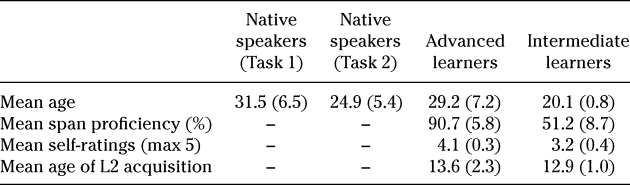
Twenty native speakers of Spanish, 20 advanced L2 learners, and 20 intermediate L2 learners of Spanish participated in Task 1. The native speakers were from Spain or a variety of Spanish-speaking countries in Latin America. All had received schooling in Spanish at least through the equivalent of high school, and were currently residing in the United States as faculty or students at one of two large midwestern universities. L2 learners were also faculty or students at the same two universities. They all had English as their native language, and had begun learning Spanish in a classroom setting at age 10 or later. The learners were split into two groups based on proficiency in Spanish, which was measured by a written proficiency test. The written proficiency test consisted of the vocabulary section of an MLA test (30 multiple-choice items) and the cloze section of one of the tests to obtain the advanced Diplomas de Español como Lengua Extranjera (20 multiple-choice items). Learners who scored above 75% on the test were categorized as advanced, and those who scored between 35% and 75% were categorized as intermediate. Self-ratings of proficiency in Spanish were also collected from learner groups, and were based on a scale from 1 (can barely speak/understand/read/write Spanish) to 5 (can speak/understand/read/write Spanish like a native speaker). A two-tailed independent t-test conducted on mean ratings indicated that the two groups differed in their perceived proficiency level [t(38) = 7.70, p < .001]. An additional t-test indicated that the two groups did not differ on age of acquisition of Spanish [t(38) = 1.29, p = .206].
Task 2
Twenty native speakers of Spanish, 20 advanced L2 learners, and 20 intermediate L2 learners of Spanish participated in Task 2. The learners were the same as those who participated in Task 1. However, the native speakers who participated in Task 2 were different from those who participated in the first task. Footnote 1 Task 2 native speakers were recruited from a public university in Mexico, where they were students. All had received schooling in Spanish through the university level. Many had some experience studying English and/or French in school, but few had traveled or lived abroad. Table 1 summarizes participant characteristics for both tasks.
Participant characteristics (standard deviations in parentheses)

Materials
Masked-Priming Lexical-Decision Tasks
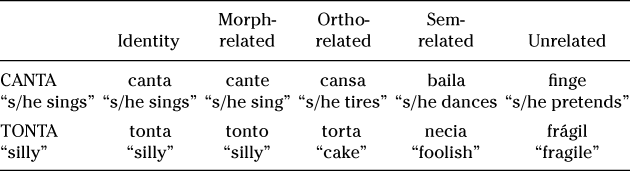
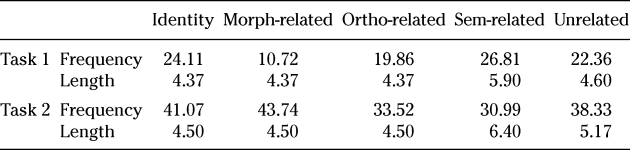
Lexical-decision tasks with masked priming served as the main experimental tasks. Each one included a total of 200 target items, half words and half nonwords. Of the word targets, 30 were critical items and 70 were fillers. All of the critical items and 20 of the fillers in Task 1 were verb forms; the other 50 fillers were nouns. In Task 2, all of the critical items and 20 of the fillers were adjective forms, and the other 50 fillers were nouns. Half of the nonword targets were verblike (Task 1) or adjective-like (Task 2) and half were nounlike to match the word targets, and half were formed by changing the onset of the first syllable of an existing word, while the other half were formed by changing the onset of the second syllable. Critical targets were paired with primes in five different conditions: (a) identity (the same as the target), (b) morphologically related (differing from the target only in mood – Task 1; differing from the target only in gender – Task 2), (c) orthographically related (differing from the target in one letter), (d) semantically related to the target, and (e) unrelated in morphology, orthography, or meaning to the target. Target verbs were always indicative forms, while morphologically related verb primes were subjunctive forms of the same verb. Target adjectives varied in gender, with half masculine and half feminine; morphologically related primes were of the opposite gender from the target. Targets and morphologically related primes differed from each other by only one letter. Orthographically related primes also differed from targets by only one letter, but did not share a root with the targets. All critical target verbs were regular, non-stem-changing verbs. All critical adjectives were of the canonical type, so that the masculine forms ended in –o and the feminine forms ended in –a. Although previous studies with L2 learners have generally not included orthographically or semantically related primes, they were included in this study as a method of confirming that any priming effects found between morphologically related primes and targets are specifically due to a morphological relationship, not simply shared form or meaning. Primes were matched across conditions on word form frequency, and as much as possible, on length in letters as well. Spanish word frequencies were retrieved from the LEXESP frequency count (Léxico informatizado del español, Sebastián Gallés, Cuetos, Carreiras, and Martí, Reference Sebastián Gallés, Cuetos, Carreiras and Martí2000). A one-way ANOVA on prime frequencies confirmed that there were no significant differences in frequency across the five prime conditions [Task 1: F(4, 145) = 0.90, p = .469; Task 2: F(4, 145) = 0.37, p = .833]; however, a similar analysis of length in letters indicated differences across conditions in both experiments [Task 1: F(4, 145) = 19.22, p < .001; Task 2: F(4, 145) = 10.71, p < .001]. Post hoc tests revealed that the semantically related and unrelated primes in Task 1 were longer than the identity, morphologically related, and orthographically related primes (all p’s < .01). The length of semantically related and unrelated primes did not differ from each other. In Task 2, semantically related primes were significantly longer than all other types (all p’s < .001). Noncritical targets and nonwords were paired with one word prime each. No primes or targets were repeated in any part of the tasks, or across tasks. Table 2 provides an example set of target and associated primes from each experiment, and Table 3 lists length and frequency means for each prime condition in each task.
Example set of primes associated with their targets (in caps)

Mean frequency (per million words) and length in letters by prime condition in each task

Five counterbalanced experimental lists were created for each task, with all targets, fillers, and nonwords appearing only once in each list. Targets were preceded by one of the five possible primes in each list, so that across the five lists for one task, each prime accompanied its target once; this means that each participant saw six items in each of the five prime type conditions in each task. Equal numbers of participants in each group saw each experimental list in each task.
Semantic Ratings Task
In addition to the experimental tasks, all of the learner participants along with the native speaker participants from Task 1 completed an online semantic ratings task in order to verify that the primes chosen as related in meaning to the targets were considered to be semantically related. Two counterbalanced lists were created that included all target words from both experimental tasks. In each list, targets appeared only once, paired with either the semantically related prime, or with the unrelated prime, so that half of the word pairs in each list were considered to be related, and half unrelated. Pairs were presented in random order. Participants were asked to rate each word pair in terms of how related in meaning the pair was on a five-point Likert scale, with possible responses ranging from “very unrelated” to “very related.”
Procedure
Participants were tested individually in a quiet room. Before completing the masked-priming, lexical-decision tasks, they filled out a questionnaire about their experience with languages. L2 learners also completed the written Spanish proficiency test, and self-ratings of their proficiency in Spanish as described previously. The order in which the experimental tasks were completed was varied, so that half of the participants completed Task 1 first, and half completed Task 2 first. The procedure for each masked-priming lexical-decision task was as follows: first, a mask consisting of hash marks appeared in the center of the computer screen for 500 ms. Immediately following the mask, the prime appeared in lowercase letters in 22-point Arial font for 50 ms. Next, the target appeared on the screen in capital letters (in the same font) until a timeout of 5,000 ms, or until the participant made a lexical decision to it by pressing a “yes” or a “no” key on the keyboard, whichever came first. In each task, experimental items were preceded by 10 practice items, and were presented in a different random order for each participant. The software package used to present the stimuli and record response accuracy and response time (RT) was DMDX (Forster & Forster, Reference Forster and Forster2003). After the lexical-decision tasks, learner participants and native participants from Task 1 completed the semantic ratings task using a survey website. The entire experimental session took approximately 25 to 45 minutes, depending on the tasks completed.
Scoring
For the masked-priming tasks, response accuracy and RT from the onset of the target were recorded. All responses to experimental items were included in accuracy analyses, while only correct responses to experimental items were included in RT analyses. The removal of incorrect responses for the RT analyses affected 6% of the native speaker data, 4% of the advanced L2 learner data, and 15.8% of the intermediate L2 learner data in Task 1, and 3.7% of the native speaker data, 4.7% of the advanced L2 learner data, and 18.2% of the intermediate L2 learner data in Task 2. After incorrect responses were removed, responses that were faster than 200 ms and those that were slower than 1,500 ms were removed. This affected an additional 1% of the native speaker data, 3.8% of the advanced L2 learner data, and 1.8% of the intermediate L2 learner data in Task 1, and an additional 2.7% of the native speaker data, 1.8% of the advanced L2 learner data, and .5% of the intermediate L2 learner data in Task 2. Responses to the semantic ratings task were coded as -2 (very unrelated), -1 (somewhat unrelated), 0 (I don’t know), 1 (somewhat related), or 2 (very related). The semantic ratings responses from one advanced learner participant were lost due to a network error; all other participants’ responses were included in the analyses.
RESULTS
Semantic Ratings Task
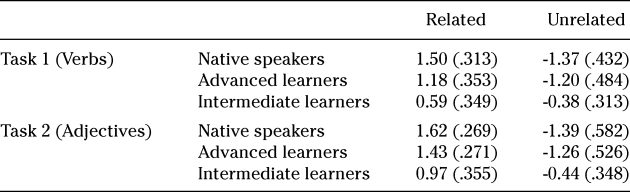
Mean semantic ratings by group and by task are listed in Table 4. All groups rated semantically related target-prime pairings positively (related), and unrelated target-prime pairings negatively (unrelated). This was confirmed for Task 1 (verbs) using a mixed ANOVA with relatedness as a within-participants variable with two levels (related and unrelated) and group as a between-participants variable with three levels (native speakers, advanced learners, and intermediate learners). The analysis yielded a main effect of relatedness [F(1, 56) = 1483.05, p < .001] and an interaction between relatedness and group [F(2, 56) = 113.72, p < .001]. The interaction between relatedness and group was due to a disparity in the magnitude of the difference between mean ratings of related and unrelated pairs across groups. Native speakers’ and advanced learners’ rating differences were similar (2.87 and 2.38 points between related and unrelated pairs, respectively), while intermediate learners’ rating differences were lesser in magnitude (only .97 points between related and unrelated pairs). This likely reflects the lower proficiency of the intermediate learners, who more often answered with 0 (“I don’t know”) than the other groups. A mixed ANOVA on adjective ratings (Task 2) also yielded a main effect of relatedness [F(1, 56) = 1475.58, p < .001] and an interaction between relatedness and group [F(2, 56) = 63.13, p < .001], again due to a disparity in the magnitude of the difference between mean ratings of related and unrelated pairs across groups. As with the verbs, native speakers and advanced learners showed relatively similar magnitudes of difference (3.01 and 2.69 points, respectively), while intermediate learners showed a smaller magnitude (1.42 points between related and unrelated pairs).
Mean semantic ratings by task and group (standard deviations in parentheses)

Masked-Priming Lexical-Decision Tasks
The results from the lexical-decision tasks were combined for statistical analyses in order to include target type (verb and adjective) as a within-subjects factor, along with prime type (identity, morphologically related, orthographically related, semantically related, and unrelated). Participant group (native speakers, advanced learners, and intermediate learners) was included as a between-subjects factor. Accuracy and RT analyses are presented separately. In both cases, analyses were conducted using mixed-effect models with the maximal random-effect structure supported by the design (Barr, Levy, Scheepers, & Tily, Reference Barr, Levy, Scheepers and Tily2013), including random intercepts for items and participants, and by-participant random slopes for prime type. Footnote 2 A mixed-effect logistic regression model was used for accuracy data, and a mixed-effect linear model was used to analyze RTs. All analyses were carried out in R (R Development Core Team, 2015). Mixed-effect models were run using the lme4 library (Bates, Maechler, Bolker, & Walker, Reference Bates, Maechler, Bolker and Walker2015); the native speaker group was used as the baseline for comparison in the case of the group factor, and the identity prime condition was used as the baseline for the prime type factor. Footnote 3 In order to obtain p values for significance testing purposes, the mixed function from the afex library was used (Singmann, Bolker, & Westfall, Reference Singmann, Bolker and Westfall2015). This function provides F and p values for the model. All significant effects reported by the mixed function were further explored with pairwise comparisons carried out using the pairs function from the lsmeans library (Lenth, Reference Lenth2015).
Accuracy
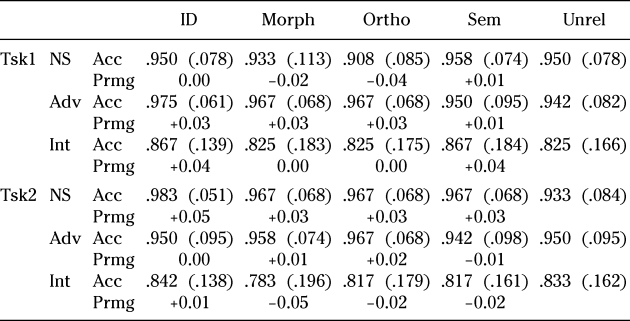
Accuracy proportions and priming magnitudes by task, group, and prime type are presented in Table 5. Priming magnitude was calculated by subtracting the accuracy proportion in the unrelated condition from the accuracy proportion in the condition in question.
Mean accuracy proportion and priming magnitude by task, group, and prime type (standard deviations in parentheses)

Note. Facilitatory priming is marked with a “+” and inhibitory priming is marked with a “-”. Accuracy is abbreviated as “Acc” and priming is abbreviated as “Prmg”.
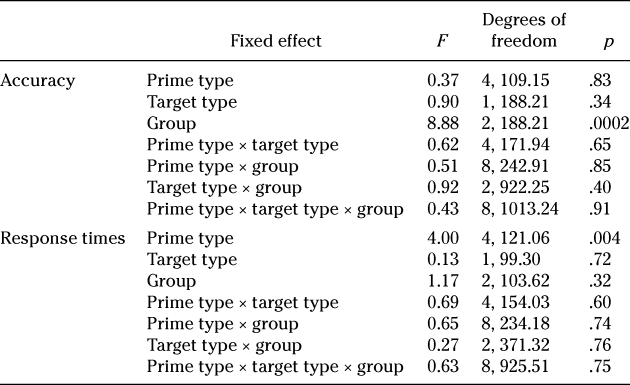
A summary of the F and p values obtained for the mixed logit model for accuracy is provided in Table 6. This analysis revealed a significant main effect of group only, with no interactions. Follow-up pairwise comparisons with a Tukey adjustment for multiple comparisons indicated that native speakers and advanced learners did not differ from each other on accuracy (p = .967), but that the intermediate learners were significantly less accurate in their responses than both of the other groups (both p’s < .001).
Summary of the mixed-effects models for accuracy and response times

Response Times
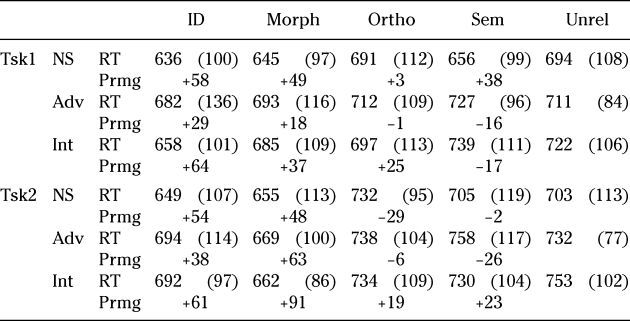
Mean RTs in milliseconds (ms) and priming magnitudes by task, group, and prime type are listed in Table 7. Priming magnitude was calculated by subtracting the RT in the condition in question from the RT in the unrelated condition.
Mean response times and priming magnitude by task, group, and prime type (standard deviations in parentheses)

Note. Facilitatory priming is marked with a “+” and inhibitory priming is marked with a “-”. Response time is abbreviated as “RT” and priming is abbreviated as “Prmg”.
The F and p values obtained for the mixed linear model for RTs is summarized in Table 6. This analysis yielded a significant effect of prime type only, with no interactions. Footnote 4 Pairwise comparisons with a Tukey adjustment for multiple comparisons indicated that targets preceded by identity and morphologically related primes were responded to significantly faster than targets preceded by all other prime types (all p’s < .05), and that they did not differ from each other (p = 1.000). Targets preceded by orthographically related and semantically related primes did not differ in RT from targets preceded by unrelated primes (p = .999 and 1.000, respectively).
In order to verify that the lack of semantic priming in the L2 learners in particular was not simply due to a lack of vocabulary knowledge (especially in the case of the intermediate learners), correlations between the size of the semantic priming effect (calculated as the difference between the RT mean when targets were preceded by unrelated primes and when they were preceded by semantically related primes) and the size of the rated semantic similarity effect were carried out in each L2 group. Pearson r values indicated no significant correlations between these two effects in either group, in either task (verbs – advanced learners r = 0.137, p = .576, intermediate learners r = 0.244, p = .300; adjectives – advanced learners r = 0.159, p = .515, intermediate learners r = -0.220, p = .352).
DISCUSSION
The primary goal of this study was to explore what factors may affect whether L2 learners decompose morphologically complex words or not, extending previous research to the case of L2 Spanish. Specifically, the goals were to determine whether L2 learners of Spanish store and process regularly inflected, morphologically complex words in the same way as native speakers, and whether this might depend on L2 proficiency level or type of inflection. Based on the results of the two masked-priming lexical-decision experiments, it seems that learners do decompose these types of words like native speakers do, and that this does not depend either on proficiency level or type of inflection. With both verb and adjective targets, a full priming pattern with morphologically related primes and targets was found, with no interaction between prime type and participant group. Moreover, the lack of priming with semantically and orthographically related prime-target pairs suggests that this effect was morphological in nature, and not simply due to shared form or meaning between primes and targets. In terms of proficiency, although the intermediate learner group was less accurate in the lexical-decision tasks than the other two groups, they did not differ from the other groups in their priming pattern when they made correct lexical decisions.
These results therefore provide additional evidence against the notion that learners are less sensitive to morphological structure at the lexical level than native speakers are, or that they store morphologically complex words as whole units rather than in their component stems and affixes, whether access representations or central lexical entries are considered. On the contrary, L2 learners seem to decompose morphologically complex words, even at intermediate levels of proficiency. From a dual-route model perspective in which regular inflection is processed by the procedural memory system, this finding supports the aspect of Ullman’s declarative/procedural model that asserts that learners may come to rely more on the procedural system as they gain proficiency in the L2 in order to make use of combinatorial rules like native speakers do. However, because there was no group in this study that did not employ rulelike processing of morphologically complex words, there is no evidence available in these data that L2 learners are ever restricted to declarative knowledge only. It would be necessary to include a lower-level group in order to determine whether this stage of dependence on the declarative system occurs, although it might be difficult to find a sufficient number of lexical items known by participants at very low levels of proficiency for the type of task utilized here. There is one recent study on the production of Spanish verb forms that found evidence that even beginning learners utilize a compositional strategy in producing verb conjugations, rather than relying on whole-form lexical knowledge (Presson, Sagarra, MacWhinney, & Kowalski, Reference Presson, Sagarra, MacWhinney and Kowalski2013). However, this finding was based on accuracy data rather than RT data, and so may reflect much more conscious processes than those used in priming tasks.
In terms of the opposing hypothesis about the role of proficiency in the storage and processing of morphologically complex words, specifically, that higher proficiency leads to increased reliance on storage for high-frequency morphologically complex words, the present study cannot clearly speak to this issue. Frequency was not manipulated as a factor, and therefore there is no basis for comparing results for high-frequency versus low-frequency targets. It is important to note, however, that the average frequency per million of verb targets in this study was 24.11, and the average frequency per million of adjective targets was 41.07. As noted in the introductory sections of this study, native speakers of English seem to store and access whole-word representations for words with frequencies exceeding approximately six per million (Alegre & Gordon, Reference Alegre and Gordon1999), while native speakers of Finnish only store and access whole-word representations for words with frequencies exceeding 100 per million (Lehtonen & Laine, Reference Lehtonen and Laine2003). Given these statistics and the fact that Spanish falls in between English and Finnish in terms of its morphological richness, it is likely that the words employed as targets in the present study were not frequent enough to allow for the use of whole-word representations, either in native speakers or in learners. Additional research that directly manipulates target frequency is therefore needed to speak to whether proficiency interacts with frequency in determining whether L2 learners store or decompose morphologically complex words like native speakers.
The other factor investigated in this study as a possible determinant of whether learners show morphological decomposition was type of inflection. As noted in the preceding text, the studies that have found differences between natives and nonnatives in masked-priming lexical decision have investigated verbal forms only. The present study therefore included adjectival forms as well, in order to determine whether a simpler morphological structure (fewer inflectional morphemes) might be more conducive to L2 decomposition, with the thought that the number of possible forms a word can take may make it more difficult for L2 learners to develop the rules necessary for morphological decomposition to take place. However, this does not seem to be the case, at least with respect to the differences in complexity between verbs and adjectives in Spanish: The learners in this study showed decomposition with both types of targets, making it clear that type of inflection was not the determining factor in whether learners decomposed morphologically complex forms. It could be the case, however, that comparative morphological complexity could make a difference in learner decomposition within a language if the language has forms that vary more widely on complexity than those found in Spanish.
The remaining principal difference between this study and those that have found native–nonnative differences is related to the present study’s manipulation of type of inflection, in that it also involves morphological structure. Specifically, this study differs from the others on the target language examined. While other studies have generally investigated morphological decomposition in L2 English or German, the present study did so in L2 Spanish. Spanish differs from both English and German in that there are few irregularities in the verbal paradigm. That is, all Spanish verbs inflect for person, number, tense, aspect and mood (although whether these morphemes are explicitly present in a particular tense/aspect/person/number combination varies). In other words, the same general inflectional “rules” are applied to all verbs, with irregularities being found in the verb’s stem instead of in its inflectional suffixes. This characteristic may be key in explaining why L2 learners of Spanish (and similar languages, like French: Coughlin & Tremblay, Reference Coughlin and Tremblay2015) appear to rely on morphological (de)composition in their lexical processing, while L2 learners of other languages may not. If every single verb in the language requires that the same type of rule be applied in order for comprehension or production of its forms to take place, then it seems that it could be more likely that rule-based processing would develop, and that this development would occur relatively sooner in the L2 acquisition process than in languages that do not have such transparently rule-based systems. The findings described previously in the section on morphological decomposition in native speakers, that the extent of morphological decomposition in the native processing of a language may depend on its morphological richness, lend support to this idea (e.g., Lehtonen & Laine, Reference Lehtonen and Laine2003; Lehtonen et al., Reference Lehtonen, Niska, Wande, Niemi and Laine2006). However, it seems that it may not be only the morphological richness of a language that plays a role in learner decomposition; it may also matter how transparent or productive the inflectional rules of the language are, with relatively richer languages leading to increased L2 decomposition in particular when the rules that need to be applied in order to process complex words are more transparent and productive. Results of a study by Gor and Jackson (Reference Gor and Jackson2013) suggest that this is true. They found that L2 learners of Russian showed decomposition of high-frequency verbs at all proficiency levels tested (advanced, advanced high, and superior); however, with low-frequency verbs, priming effects were weaker in the less-proficient learners as a function of the complexity and unpredictability of verb stem allomorphy. This provides evidence that rule transparency and productivity can affect whether learners show morphological decomposition or not.
One problem for this account of learner decomposition, however, is the finding of Kirkici and Clahsen (Reference Kirkici and Clahsen2013) that L2 learners of Turkish did not show morphological priming. Turkish is an agglutinating language, which should mean that word formation processes are transparent, and that morphological decomposition is likely to be prominent in native speaker processing. Results from Kirkici and Clahsen’s Experiment 1, in which inflection was examined, showed a significant difference between RTs to targets when preceded by unrelated primes and RTs to targets when preceded by morphologically related primes, but only for native speakers of Turkish. The L2 learners, although of relatively high proficiency, showed no such difference. One argument for why there may not be L2 decomposition in a language like Turkish, while there is in Spanish, French, and Russian, is that there are simply too many forms for L2 learners to get a handle on until they reach very high levels of proficiency. According to Hankamer (Reference Hankamer and Marslen-Wilson1989, as cited in Kirkici & Clahsen), there are approximately 1.8 million possible word forms for Turkish verbs. With this many possible forms, it may be more difficult for learners to proceduralize all of the rules necessary for decomposition to consistently take place, given their lower overall exposure to the language, even if those rules are transparent. As noted in the preceding text, although the relative morphological complexity of a particular type of inflection within Spanish did not affect the participants of the current study, the complexity that is present in Turkish words may be enough to slow down the development of rule-based processing in L2 learners, so that a greater amount of experience with the language is required before decomposition can consistently take place. However, as described in the introductory sections of this study, findings with Swedish-Finnish bilinguals suggest that less exposure to a language with many possible inflected forms actually leads to increased decomposition rather than whole word storage and processing. Lehtonen and Laine (Reference Lehtonen and Laine2003) found that bilinguals relied on morphological decomposition at all frequency ranges in a lexical-decision task in Finnish, whereas monolinguals had formed whole-word representations for high-frequency lexical items. An important difference in their participants and the participants of other studies on L2, though, is that theirs had all learned both Swedish and Finnish early in life, and were relatively balanced in the two languages. The participants in Kirkici and Clahsen were late L2 learners, who were first exposed to Turkish in a classroom setting after the age of 10. It is unclear how age of acquisition may affect morphological processing. The only studies I am aware of that have examined age of acquisition in morphological decomposition are Gor and Cook (Reference Gor and Cook2010) and Mason (Reference Mason2014). In both, early learners (heritage speakers whose dominant language was English rather than the target language) showed patterns of morphological processing that differed from native speakers. These results suggest that early age of acquisition may not lead to more morphological sensitivity. Clearly, more research is called for to determine the roles of age of acquisition and the characteristics of the target language in morphological representation and processing.
CONCLUSION
The current study examined the storage and processing of morphologically complex words in L2 Spanish. Based on the results of two masked-priming lexical-decision experiments, it seems that learners of L2 Spanish do decompose morphologically complex words like native speakers. They are sensitive to morphological structure in Spanish, and do not differ from natives in terms of their processing patterns. Learner proficiency did not play a role in whether morphological decomposition took place in the present study, as both intermediate and advanced participants showed the same pattern of decomposition. In addition, type of inflection (or relative morphological complexity) did not make a difference in whether learners decomposed target words; results for both verbs and adjectives in Spanish were similar. Further research is needed to clarify exactly what factors may play a role in whether morphological decomposition takes place in L2 processing. Factors that should be manipulated in order to do so include the type of experimental task, learners’ age of acquisition, and, in particular, the morphological structure of the target language, which seems to be a likely candidate for determining whether morphological decomposition takes place in both native speakers and L2 learners.