Introduction
With an incidence of nearly 1%, CHD is the leading cause of congenital anomalies at birth. Medical advances in the management of CHD have shifted the focus from childhood mortality to life-long morbidity. Reference Marelli, Mackie, Ionescu-Ittu, Rahme and Pilote1 Currently, long-term survival rates exceed 90% in most CHD; Reference Spector, Menk and Knight2 therefore, clinical research in paediatric cardiology tends to replace mortality outcomes with functional and patient-reported outcomes. Reference Amedro, Gavotto and Guillaumont3
In children with CHD, cardiopulmonary fitness correlates with health-related quality of life and decreases faster over time than in healthy controls, especially in complex CHD. Reference Amedro, Gavotto and Guillaumont3–Reference Gavotto, Ladeveze and Avesani5 Impaired cardiopulmonary fitness is commonly marked by a decrease in maximum oxygen uptake (VO2max), and ventilatory anaerobic threshold, as observed in cohort studies on serial cardiopulmonary exercise tests. Reference Amedro, Gavotto and Guillaumont3,Reference Gavotto, Ladeveze and Avesani5 In adult heart failure, Reference Kempny, Dimopoulos and Uebing6,Reference Myers, Arena and Dewey7 impaired cardiopulmonary fitness is used as a surrogate marker of morbidity and mortality. Moreover, in the general adult population, a VO2max decrease above 3.5 mL/kg/min (e.g., 1-MET) is a predictor of all-cause mortality and cardiovascular events. Reference Kodama, Saito and Tanaka8 Similarly, cardiopulmonary fitness parameters have come to play an important role in the functional assessment and prognosis of CHD, from paediatric age onwards. Reference Amedro, Gavotto and Guillaumont3,Reference Amedro, Picot and Moniotte4 Consequently, cardiopulmonary fitness is increasingly used as a marker of functional status in current clinical trials in the paediatric CHD population. Reference Amedro, Gavotto and Abassi9,Reference Amedro, Gavotto and Legendre10 The recent production of reference values for paediatric cardiopulmonary exercise test, with Z-scores applicable to extreme weights in children with CHD, is a further step in developing this line of research. Reference Gavotto, Mura and Rhodes11,Reference Amedro, Matecki and Pereira Dos Santos12
Despite these advances in paediatric cardiology, the stratification of CHD severity using a simple and reproducible classification has not been established, as could be the NYHA functional class in adult heart failure. Reference White and Myers13 Various classifications have been used in CHD, focusing on anatomical lesions, physiological status, or complexity of care, but their prognostic value has not been established. Reference Stout, Daniels and Aboulhosn14–Reference Warnes, Liberthson and Danielson16 Yet, the diagnosis of CHD is largely made prenatally or in the first days of life, and it would be useful to identify the CHD classification that best reflects disease severity in children in terms of functional status.
Therefore, we aimed to compare the accuracy of the main existing CHD classifications, in the prediction of functional status in children with CHD, as determined by cardiopulmonary fitness.
Methods
Study design and population
This retrospective cohort study was carried out from November 2010 to September 2020 in two paediatric cardiology institutions (centre 1: M3C Regional Paediatric and Congenital Cardiology Centre, Montpellier University Hospital, France; centre 2: Paediatric Cardiology and Rehabilitation Centre, Saint-Pierre Institute, Palavas-Les-Flots, France). Children with a CHD who performed two exercise tests during the study period, with at least one year between the two examinations, were identified from our previously reported paediatric cardiopulmonary exercise test cohort. Reference Amedro, Gavotto and Guillaumont3 For patients who had undergone more than 2 exercise tests during the study period, only the first (baseline cardiopulmonary exercise test) and last (final cardiopulmonary exercise test) exams were considered.
Selection of CHD classifications
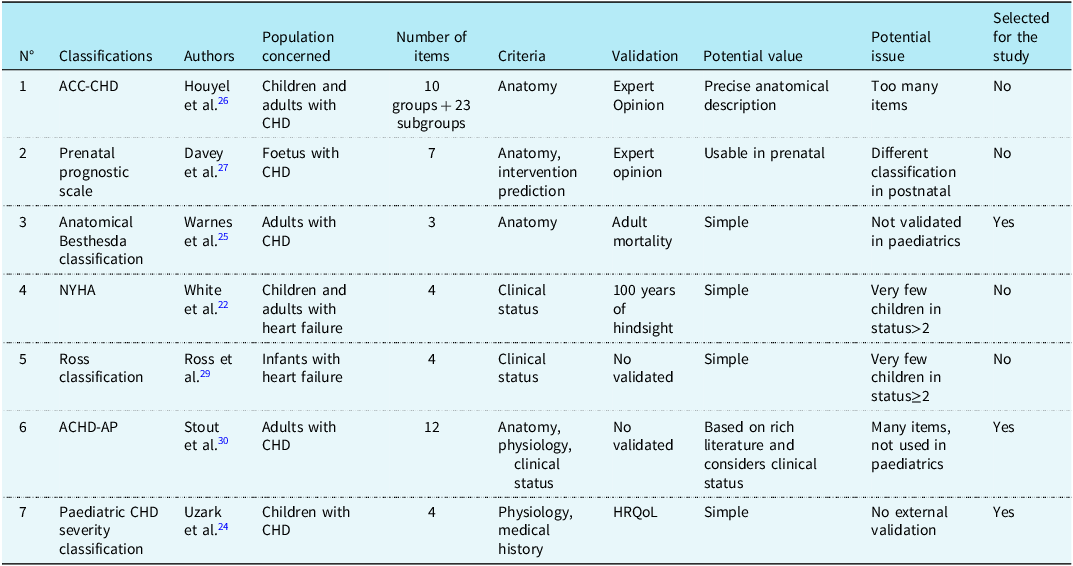
A panel of three experts (PA, SG, and AG) reviewed the literature on the classifications used in paediatric and congenital cardiology, whether in clinical research or routine follow-up. Seven CHD classifications were identified (Table 1):
Classifications used in the CHD population

ACC-CHD = anatomic and clinical classification of CHD; ACHD-AP = adults with congenital heart defect—Anatomic and Physiological; HRQoL = health-related quality of life.
-
1. The ACC-CHD classification categorises the various cardiac malformations into 10 main groups and 23 subgroups, according to a multi-dimensional approach including anatomy, echocardiography, and clinical management criteria. Reference Houyel, Khoshnood and Anderson17
-
2. The prenatal prognostic scale from Davey et al. grades foetal cardiovascular diseases in 7 levels, from level 1 (cardiovascular finding with minimal, if any, negative impact on well-being), to level 7 (cardiovascular abnormality and complex form of CHD with very poor prognosis). The level of severity is related to the cardiovascular status diagnosed by foetal echocardiography, involving parameters such as postnatal intervention, the number of interventions planned, the likelihood of biventricular repair versus single-ventricle palliation, and the overall prognosis. Reference Davey, Donofrio and Moon-Grady18
-
3. The anatomical Bethesda classification was initially built based on mortality in the adult CHD population and categorised into three groups: simple CHD, CHD of moderate severity, and CHD of great complexity. Reference Warnes, Liberthson and Danielson16
-
4. The NYHA functional class (from NYHA class I to NYHA class IV) is not specific to CHD but has a prognostic value in adult heart failure, including in adults with CHD. Reference White and Myers13,Reference Bredy, Ministeri and Kempny19 The NYHA functional class correlates with cardiopulmonary fitness in adults with CHD. Reference Bredy, Ministeri and Kempny19
-
5. The Ross classification is used to grade the severity of congestive heart failure in infants and is categorised into four severity groups (from Ross class I to Ross class IV). Reference Ross, Bollinger and Pinsky20
-
6. The adult CHD anatomical and physiological classification from Stout et al. primarily intended to capture the complexity of CHD anatomy and physiology, using three levels of anatomical complexity and four stages of physiological severity. This classification takes account of the fact that patients with the same underlying anatomy may undergo very different repairs and suffer different physiological consequences from their repaired CHD. Reference Stout, Daniels and Aboulhosn14
-
7. The four-stage paediatric CHD disease severity classification from Uzark et al. was used in HRQoL studies and categorised as follows: (1) mild CHD requiring no therapy or effectively treated nonoperatively (catheter therapy), (2) moderate CHD requiring no therapy or surgically corrected (curative), (3) surgically treated CHD (≥ 1 procedure) with significant residua or need for additional surgery, or (4) complex or severe CHD, uncorrectable or palliated (including single ventricle). Reference Uzark, Jones, Slusher, Limbers, Burwinkle and Varni15
Four classifications were considered inappropriate for the study: (1) the ACC-CHD classification relies on an extensive anatomical description including a high number of items (23 subgroups), for which previous studies have failed to show any significant association with cardiopulmonary fitness Reference Amedro, Gavotto and Guillaumont3 ; (2) the prenatal prognostic scale from Davey et al. includes a relatively high number of items (7 groups) to grade foetal cardiovascular diseases and can only be used prenatally but not postnatally; (3) the NYHA functional class correlates with cardiopulmonary fitness in adults with CHD, but not in the paediatric population of exercise-testing age (6–18 years), where the prevalence of heart failure is low and most patients are in NYHA I or II Reference Swenski, Fox, Udaipuria, Korth, Daniels and Jackson21 ; and (4) the Ross classification is only suitable for infant heart failure and not for children old enough to undergo an exercise test.
Finally, three CHD classifications were evaluated in this study: (5) the anatomical Bethesda classification Reference Warnes, Liberthson and Danielson16 ; (6) the adult CHD anatomical and physiological (ACHD-AP) classification from Stout et al. Reference Stout, Daniels and Aboulhosn14 , and (7) the four-stage paediatric CHD disease severity classification from Uzark et al. Reference Uzark, Jones, Slusher, Limbers, Burwinkle and Varni15 (and named in this study as the “Bethesda”, “Stout”, and “Uzark” classifications, respectively).
Cardiopulmonary exercise test procedures
As in our similar paediatric exercise physiology studies, cardiopulmonary exercise test procedures in both centres were harmonised before the study started. Reference Amedro, Gavotto and Guillaumont3,Reference Amedro, Picot and Moniotte4 Both cardiopulmonary exercise test laboratories used the same technical devices: paediatric face masks (Hans Rudolph, Shawnee, Kansas, USA), a calibrated gas analyser (Oxycon Pro, Jaeger, Erich Jaeger, Hoechberg, Germany), breath-to-breath measurement software (Windows V.98, Jaeger), 12-lead ECG equipment (CardioSoft, GE Healthcare, Little Chalfont, UK), a pulse oximeter (Nellcor, Medtronic, Fridley, Minnesota, USA), and a manual sphygmomanometer with adapted paediatric cuffs. In 2015, the centre 1 changed their cardiopulmonary exercise test equipment: calibrated gas analyser (Quark CPET, Cosmed Srl., Pavonna di Albano, Italy), breath-to-breath measurement software (Windows 10, Omnia, Cosmed), 12-lead ECG equipment (Norav Medical, Mainz-Kastel, Germany), and pulse oximeter (Nonin Medical Inc., Plymouth, MN 55441 USA).
Both centres used the same cardiopulmonary exercise test paediatric cycle ergometer protocol adapted to children to obtain a homogeneous incremental overall duration between 8 and 12 minutes: a 1-minute rest; a 3-minute warm-up (10 or 20 W) in increments of 10, 15, or 20 W each minute (based on the theoretical VO2max or the previous cardiopulmonary exercise test); a pedalling rate of 60 to 80 revolutions per minute; a 3-minute active recovery (20 W); and a 2-minute rest.
When the VO2max did not reach a plateau, the peak VO2 was collected, as usual in paediatrics. Reference Rowland and Cunningham22 The ventilatory anaerobic threshold was calculated using the V-slope method. Reference Beaver, Wasserman and Whipp23 VO2max and ventilatory anaerobic threshold were normalised in Z-scores using reference values in the contemporary paediatric population. Reference Gavotto, Mura and Rhodes11,Reference Amedro, Matecki and Pereira Dos Santos12
Impaired cardiopulmonary fitness was defined by VO2max or ventilatory anaerobic threshold values < −1.64 Z-score. Reference Souilla, Guillaumont and Auer24
Statistics
The study population was described with means and standard deviations for quantitative variables and with numbers and percentages for qualitative ones. The Student’s t-test was used when the distribution was Gaussian and the Mann–Whitney otherwise. For qualitative variables, the Χ2 or Fisher’s exact tests were used.
For each CHD classification used in this study, the patient’s characteristics at baseline cardiopulmonary exercise test assessment were taken into account. A double-blind classification of patients was performed for 20% of the cohort, by two paediatric cardiologists (one senior and one junior). Despite the difference in expertise, we compared the estimation of the risks established by “senior” vs. “junior” judges and their inter-observer reproducibility. The agreement between the classifications assessed by the two judges was determined by the weighted Kappa coefficient with its 95% confidence interval.
VO2max and VAT Z-score values at the baseline and final cardiopulmonary exercise test assessments were compared for each classification subgroup. Patients over 18 at the final cardiopulmonary exercise test assessment were removed from the study, as Z-score models are only validated in the paediatric population. The change in VO2max and VAT between the 2 cardiopulmonary exercise test assessments was expressed as the annual change in Z-score and the annual relative change in mL/Kg/min.
The discriminating power of each subgroup of each classification in terms of functional status was assessed at baseline cardiopulmonary exercise test, according to VO2max and VAT Z-score values and the existence of impaired cardiopulmonary fitness (VO2max or VAT Z-score < −1.64).
The predictive value of each classification in terms of functional status was evaluated on the final cardiopulmonary exercise test using the receiver operating characteristics curve, according to the existence of impaired cardiopulmonary fitness (e.g., VO2max or VAT Z-score < −1.64). Receiver operating characteristic curves were drawn by plotting the sensitivity against (1–the specificity). The area under the receiver operating characteristics curve with its 95% confidence interval was calculated to evaluate the most discriminant classification.
The statistical significance was set at 0.05, and analyses were performed using the software SAS Enterprise Guide, version 7.13 (SAS Institute, Cary, NC, USA).
Results
Population
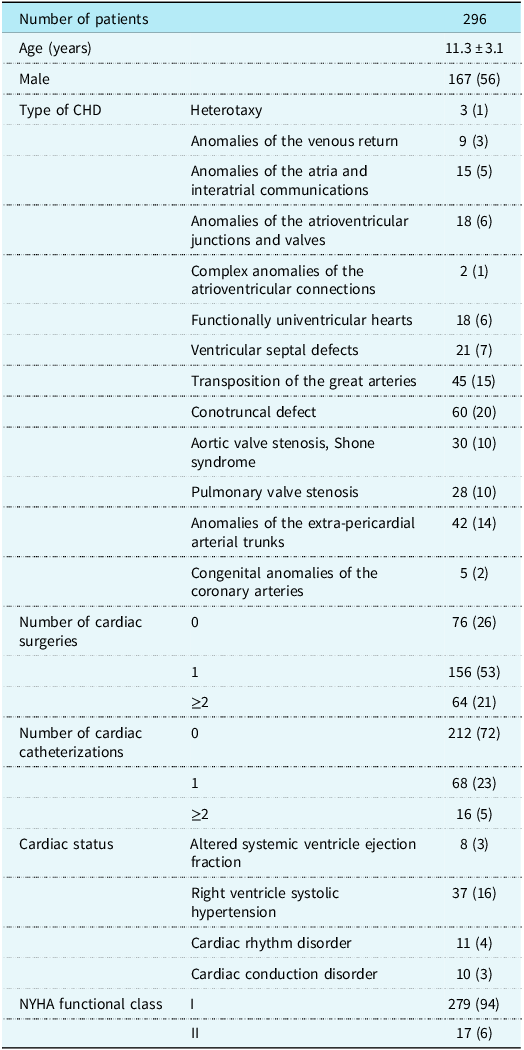
From the cardiopulmonary exercise test database (N = 496 subjects with CHD), a total of 296 subjects had undergone 2 exercise tests during the study period. At the final cardiopulmonary exercise test, 41 patients had reached adulthood (> 18 years) and were excluded. Therefore, 296 patients at baseline cardiopulmonary exercise test (mean age 11.3 ± 3.1 years, 129 female) and 255 patients at final cardiopulmonary exercise test (mean age 14.8 ± 2.3 years, 113 female) were analysed in this study. The population baseline characteristics are summarised in Table 2. All types of CHD were represented, in particular conotruncal malformations (n = 60; 20%), transposition of the great arteries (n = 45; 15%) and coarctation of the aorta (n = 42; 14%). Nearly three-fourths of the children (n = 220, 74%) had undergone at least one cardiac surgical intervention and 84 (28%) patients had undergone at least one cardiac catheterisation intervention. Very few patients (n = 8) had systemic ventricular dysfunction, and none had end-organ dysfunction.
Baseline population characteristics

NYHA = New York Heart Association Values are numbers with (%) or means ± standard deviation.
Functional status determined by cardiopulmonary fitness
The mean time from baseline to final cardiopulmonary exercise test assessments was 4.1 ± 1.6 years. A significant decrease in cardiopulmonary fitness was observed between the two assessments, with an annual change of −0.14 ± 0.34 Z-score for VO2max (P < 0.01) and −0.12 ± 0.36 Z-score for VAT (P < 0.01). The proportion of patients with impaired cardiopulmonary fitness significantly increased between baseline and final cardiopulmonary exercise test assessments, for both VO2max (22% vs. 42%, P < 0.01) and VAT (18% vs. 35%, P < 0.01). These data are summarised in Supplementary Table 1.
Discriminating power of each classification in terms of functional status
The four-stage paediatric CHD disease severity classification by Uzark best discriminated the functional status, in terms of cardiopulmonary fitness. Indeed, VO2max and VAT Z-score values significantly decreased according to the severity group (group 1 and 2 > group 3 > group 4). Moreover, impaired cardiopulmonary fitness (VO2max or VAT < −1.64) significantly increased according to the severity group (group 1, 2 and 3 < group 4) (Supplementary Table 2).
Using the Stout classification, only two groups (IIC and IIIC) were different according to VO2max Z-score and impaired VO2max, and only one group (IIIC) was different according to VAT Z-score and impaired VAT (Supplementary Table 3). No group difference was found using the Bethesda classification, according to VO2max and VAT (Supplementary Table 4). Supplementary Table 5 summarised the VO2max decrease and the odds ratio of VO2max impairment between the sub-groups.
The change in VO2max and VAT Z-scores between baseline and final cardiopulmonary exercise test assessments according to the subgroup classifications and the differences between subgroup classifications at baseline and final cardiopulmonary exercise test assessments were illustrated in Figure 1.
VO2max Z-score at baseline and final CPET assessments according to the classifications. Legends: green boxplots represent the baseline and red boxplots represent the final CPET assessment. The bottom and top of the box represent the first and third quartiles. Inside the box, the band represents the second quartile (median), and the black points represent the mean. Whiskers represent the minimum and maximum values. The black stars represent a significant difference between baseline and final assessments. The green and red stars indicate a significant difference between the two subgroups at baseline and final assessment, respectively. Abbreviations: CPET = cardiopulmonary exercise test; VO2max = maximum oxygen uptake.

No differences in terms of VO2max or VAT change were observed according to the subgroup classifications (Supplementary Tables 3, 4, and 5).
The inter-judge classification agreement was good, with a Kappa coefficient of 0.88 (0.78–0.98) for the Uzark classification and 0.83 (0.70–0.96) for the Bethesda classification. A moderate inter-judge classification agreement was observed for the Stout classification, with an intraclass coefficient of correlation of 0.49 (0.33–0.64).
Predictive value of CHD classifications in terms of functional status
In terms of prediction of cardiopulmonary fitness impairment at the final cardiopulmonary exercise test assessment for each classification, the AUC values for impaired VO2max (<−1.64 Z-score) were, in descending order, 0.62 (0.55-0.69) for the Uzark classification, 0.59 (0.51–0.66) for the Stout classification, and 0.55 (0.48–0.62) for the Bethesda classification (Figure 2A). The AUC values for impaired VAT (<−1.64 Z-score) were, in descending order, 0.62 (0.55–0.69) for the Uzark classification, 0.56 (0.48–0.63) for the Stout classification, and 0.51 (0.44–0.59) for the Bethesda classification (Figure 2B).
ROC curves of CHD classifications for predicting functional status in children with CHD. Legend: ROC curves of CHD classifications for predicting impaired cardiopulmonary fitness at final CPET assessment: VO2max (A) or VAT (B) < −1.64 Z-score. Abbreviations: AUC = area under the ROC curve; CPET = cardiopulmonary exercise test; ROC = receiver operating characteristics; VAT = ventilatory anaerobic threshold; VO2max = maximum oxygen uptake; 95%CI, 95% confidence interval.

Discussion
From a multicentric longitudinal cohort of nearly 300 children with CHD, this study explored for the first time the discriminating power and predictive value of the existing CHD classifications, in terms of functional status determined by cardiopulmonary fitness. The functional approach appears to be essential in chronic diseases, as mentioned in 1980 by the WHO, who stated that functional capacity explorations best reflect the impact of a chronic disease on the quality of life. Reference Wood25
The four-stage paediatric CHD disease severity classification by Uzark showed the best discriminating power in terms of functional status. Indeed, using Uzark classification, cardiopulmonary fitness was well correlated with disease severity and the ability to predict a decline in cardiopulmonary fitness over time was better than with other classifications. Moreover, the Uzark classification was the most reliable in terms of reproducibility. This classification was originally generated to assess HRQoL in children with CHD, about disease severity, providing a rapid and user-friendly approach for clinical practice. Reference Uzark, Jones, Slusher, Limbers, Burwinkle and Varni15 Patient-reported outcomes have been increasingly used in cardiovascular research, Reference Amedro, Gavotto and Legendre10,Reference Anker, Agewall and Borggrefe26 and HRQoL correlates with cardiopulmonary fitness in children with CHD. Reference Amedro, Picot and Moniotte4 In addition, this classification has the advantage of being determined at an early stage in the management of heart disease, right from the first cardiac intervention, without being conditioned by the subsequent appearance of symptoms secondary to the heart condition.
The other classifications evaluated in this study were less reliable in terms of functional status prediction and reproducibility in paediatric CHD. The four-stage physiological severity classification from Stout et al is based on symptoms which more frequently occur in adulthood. Reference Stout, Daniels and Aboulhosn14 Heart failure and organ dysfunction are less common in paediatric CHD, which makes it more difficult to stratify severity according to Stout’s classification in paediatrics. Moreover, the Stout classification includes 12 subgroups (3 anatomical and 4 physiological severity stages), which may explain the low reproducibility observed in this study. Reference Stout, Daniels and Aboulhosn14 In contrast, Bethesda’s simple three-stage classification is based solely on anatomical parameters of CHD, Reference Warnes, Liberthson and Danielson16 yet no difference in exercise capacity was found between the three severity groups. Currently, most children with CHD, even complex anatomical forms, undergo surgical repair. Apart from univentricular heart, cardiopulmonary fitness is normal or subnormal in the contemporary paediatric CHD population; Reference Amedro, Gavotto and Guillaumont3,Reference Müller, Böhm, Semsch, Oberhoffer, Hess and Hager27 therefore, the use of an anatomical classification in this population is not relevant. On the opposite, the extensive ACC-CHD anatomical classification includes 23 subgroups, making it difficult to use for prognostic stratification. The prognostic value of heart failure classifications (e.g., NYHA and Ross functional classes) could not be evaluated in this study, as most children were in low NYHA functional classes and the infant Ross classification is not suitable for children of exercise-testing age. Reference Bredy, Ministeri and Kempny19,Reference Ross, Bollinger and Pinsky20 The NYHA classification is strongly correlated with cardiopulmonary fitness in adult heart failure, Reference White and Myers13 including in adult patients with CHD. Reference Bredy, Ministeri and Kempny19 However, the predictive value of NYHA classification in paediatric CHD in terms of functional status remains challenging to demonstrate, considering the low prevalence of paediatric heart failure in this population. Indeed, in cohort studies, 85% of children were classified in NYHA class I and 13% in NYHA class II (94 and 6%, respectively, in our study). Reference Swenski, Fox, Udaipuria, Korth, Daniels and Jackson21 Interestingly, the seven-scale classification from Davey et al. has been built to predict postnatal prognosis prenatally, Reference Davey, Donofrio and Moon-Grady18 however, this instrument is not adapted to assess functional status in children after cardiac catheter-based or surgical repair.
Overall, the use of a simple and reliable classification predicting the functional status of children with CHD may help identify patients with a higher risk of cardiopulmonary impairment. Ultimately, children with CHD and substantial cardiovascular risk could be eligible for early preventive interventions, such as cardiac rehabilitation programmes. Reference Amedro, Gavotto and Huguet28
Study limitations
The use of cardiopulmonary fitness as the primary outcome to define functional status in this study was justified by its association with HRQoL in paediatric CHD and its prognostic value in the general population. Reference Amedro, Picot and Moniotte4,Reference Abassi, Huguet and Picot29 Nevertheless, a composite outcome measure including mortality and neurodevelopmental prognosis could have been relevant in this population. Reference Wikner, Sandström and Rinnström30,Reference Derridj, Guedj and Calderon31 The relatively short period of 4 years between baseline and final cardiopulmonary assessments may explain the lack of prediction of functional status decline over time for some classifications. Significant cardiac or non-cardiac events during these 4 years may have significantly altered the patient’s functional status, irrespective of the baseline classification assessment. The high number of 12 subgroups in Stout’s classification may have contributed to a lack of statistical power.
Conclusion
The four-stage paediatric CHD disease severity classification by Uzark is reliable in terms of functional status prediction and reproducibility in children with CHD. This simple classification may contribute to identifying children most at risk of cardiopulmonary fitness impairment and initiating early preventive cardiovascular interventions. The classifications used in adult patients with CHD are not adapted to the paediatric population. Further studies evaluating a composite outcome measure including mortality, functional status, and neurodevelopmental prognosis are needed in this population.
Supplementary material
The supplementary material for this article can be found at https://doi.org/10.1017/S1047951125001799.
Availability of data and materials
The datasets used and/or analysed during the current study are available from the corresponding author on reasonable request.
Author contributions
Pr. Amedro and Dr Gavotto directed, conceptualised, and designed the study, enrolled patients, drafted the initial manuscript, reviewed, and revised the manuscript.
Pr. Matecki, Dr Guillaumont, Dr Liard, and Mr. Ouhab enrolled patients, reviewed, and revised the manuscript.
Dr Picot and Mrs. Huguet supervised the data management, performed the statistical analyses, reviewed, and revised the manuscript.
All authors approved the final manuscript as submitted and agree to be accountable for all aspects of the work.
Financial support
None.
Competing interests
The authors declare that they have no competing interests.
Ethical standard
The study was conducted in compliance with the Good Clinical Practices and Declaration of Helsinki principles. The South Mediterranean IV Ethics Committee, Montpellier, France approved the study (2009-A00423-54) for the baseline population, and the Institutional Review Board, Montpellier University Hospital, France provided additional approval for the longitudinal cohort study design (reference number IRB-MTP_2023_09_202301473). Informed consent was obtained from all parents or legal guardians.
Consent for publication
Not applicable.
Declarations of interest
The authors have no competing interests to declare.